



Abstract
Due to ‘stay-at-home’ measures, individuals increasingly relied on smartphones for social connection and for obtaining information about the COVID-19 pandemic. In a two-wave panel survey (NTime2 = 416), we investigated associations between different types of smartphone use (i.e., communicative and non-communicative), friendship satisfaction, and anxiety during the first lockdown in Austria. Our findings revealed that communicative smartphone use increased friendship satisfaction over time, validating how smartphones can be a positive influence in difficult times. Friendship satisfaction decreased anxiety after one month, signaling the importance of strong friendship networks during the crisis. Contrary to our expectations, non-communicative smartphone use had no effects on friendship satisfaction or anxiety over time. Reciprocal effects showed that anxiety increased both types of smartphone use over time. These findings are discussed in the context of mobile media effects related to the COVID-19 pandemic.
Introduction
In January 2020, the World Health Organization (WHO, 2020) announced the global outbreak of COVID-19 and declared it a health crisis. As the virus started to spread worldwide, nations reacted with strict measures. In Austria, a Western European country that was largely affected by COVID-19, the federal government announced a nationwide lockdown on 16 March 2020 (ORF, 2020). A stay-at-home order was issued that included the closure of educational institutions, nonessential stores, sports facilities, restaurants and bars, and a partial closure of its national borders. Many working citizens were obliged to shift to home office working and were only allowed physical contact with people from the same household or family. A slow release of lockdown measures started in May 2020 when restaurants could reopen. However, social gatherings were limited to a minimum until mid-May. Although these prevention measures have been shown effective for containing the spread of the virus (Atalan, 2020), they have shown harmful consequences for people’s mental health due to, for instance, a loss of coping routines (e.g., spending time outside; Lades et al., 2020) and perceived social deprivation (Orben et al., 2020). These detrimental side-effects were amplified as COVID-19 created great feelings of uncertainty that are reflected in increased levels of anxiety (Salari et al., 2020).
During the pandemic, individuals increasingly relied on smartphones both to follow information about the pandemic (Garfin et al., 2020) and to keep in touch with their social network (Huckins et al., 2020; Nguyen et al., 2020). Prior to the crisis, researchers had been raising concerns over harmful influences of smartphones on mental health, highlighting increased anxiety and problematic habits (Elhai et al., 2017a). These concerns were accentuated during lockdown (Chao et al., 2020; Liu, 2020). Others, however, emphasized potential health benefits (Schneider et al., 2019) due to smartphones’ vital role as a coping tool to reduce stress (Carolus et al., 2019), particularly during social isolation (Garfin, 2020). This dualistic impact is in line with the position that outcomes of smartphone use depend on several factors, such as predispositions and context (Dogruel & Schnauber-Stockmann, 2020), or type and intensity of use (Elhai et al., 2017b).
In this study, we accept the notion that smartphone use per se does not result in harmful or in beneficial outcomes. Instead, we argue that outcomes largely depend on how people engage with it. Drawing from research that distinguishes between several types of smartphone engagement, such as social usage (Van Deursen et al., 2015) and non-social usage (Elhai et al., 2017b), we differentiate between communicative and non-communicative usage types (Chan, 2015). We situate this differentiation in the context of the pandemic, focusing on communication or information seeking about COVID-19. More specifically, communicative smartphone use refers to informational exchanges about COVID-19 with individuals’ social networks, while non-communicative usage refers to information consumption about the virus (Liu, 2020). The main goal of this research is to determine how these different forms of smartphone use affect anxiety and friendship satisfaction during a period of limited face-to-face interactions. During regular times, digital and in-person communication occurred interchangeably (Nguyen et al., 2021). However, this exceptional period of social isolation advanced online communication as the main means of communication, instead of merely being an alternative. Theoretically, the study may allow us to gain insights that might be relevant in other contexts where in-person communication is limited or not possible on a global and regional scale (health crisis, natural disasters) or even for personal crises, for example, personal tragedies or living abroad (Kaniasty, 2020; Nguyen et al., 2021).
Using a two-wave panel survey conducted during the first lockdown in Austria, we shed light on the interplay between different types of smartphone use, friendship satisfaction, and anxiety. Findings from previous research on the impact of digital media in the pandemic context are limited due to a predominance of correlational design (e.g., Liu, 2020; Nguyen et al., 2021). To account for directionality, we relied on a panel design that allows for investigation into reciprocal relationships as well as antecedents of communicative and non-communicative smartphone use, both of which have been neglected in past studies (Chan & Li, 2020).
Coping processes during the COVID-19 lockdown
Although pandemics have occasionally been reoccurring events throughout history, the COVID-19 pandemic has put many people in an unfamiliar situation. The lack of reliable knowledge about economic, health, and social consequences and, relatedly, the unpredictability of one’s own personal situation may generate uncertainty. Accordingly, current scholarship puts substantial emphasis on how individuals can deal with such uncertainty (e.g., Koffman et al., 2020).
Following research on uncertainty management (Brashers, 2001), individuals cope with uncertainty by seeking or avoiding information and by mobilizing social support. Since face-to-face communication was largely ruled out during lockdown, these coping strategies are realized primarily online (Garfin, 2020). Far from being inherently inferior, online communication provides fertile ground to compensate for a lack of (literal) social closeness during regular times when face-to-face communication is possible (Fox & McEwan, 2017; Gonzales, 2014; Litt et al., 2020; Thulin, 2018), even more so under physical distancing conditions (Canale et al., 2020). During reduced in-person communication, individuals may seek out to connect with their social circles online and communicate about the ongoing situation for the purposes of emotional self-disclosure and information seeking.
In addition to interpersonal interactions, another way of coping might manifest in searching for and consuming information about the crisis via news providers without social interactions. According to limited capacity models (e.g., Lang, 2000), individuals’ information processing is bounded by their available cognitive resources. When effectively communicated (Koffman et al., 2020) and individually moderated (Wiederhold, 2020), a solid informational basis can foster individuals’ coping processes (Oosterhoff & Palmer, 2020). However, because of the fast-growing amount of news about COVID-19 (Huckins et al., 2020; Quandt et al., 2020), searching for and engaging with rapidly changing and potentially unreliable information may likely cause information overload (e.g., Gao et al., 2018), which in turn can further reinforce anxiety (Liu, 2020; Oosterhoff & Palmer, 2020).
The present study is conceptualized upon these theoretical considerations. During the COVID-19 crisis, individuals may experience increased levels of anxiety, which they are constrained to cope with primarily via mobilization of online social support and online information-seeking. Keeping up and interpersonally engaging with increasing amount of available information about COVID-19 may demand individuals’ cognitive resources beyond its limits.
Reciprocal associations between smartphone uses and friendship satisfaction
Communicative activities have been shown to increase relationship quality and positive affect during regular times (Chan, 2015, 2018). Due to the affordances of smartphones (e.g., perpetual connectivity and communication possibilities; Mascheroni & Vincent, 2016), communicative use can further enhance social interactions and add an additional layer to relationship maintenance (Tong & Walther, 2011), reinforcing friendships and providing mediated social support (Chan & Li, 2020).
During lockdown, smartphone use increased considerably (e.g., in the US (Nguyen et al., 2020); in Spain (Sañudo et al., 2020). Smartphones were one of the most important tools for staying connected as well as for receiving and sharing news (e.g., in Belgium (Ohme et al., 2020) and acknowledged as necessary for maintaining friendship satisfaction (e.g., among adolescents in Canada (Ellis et al., 2020). According to the social presence theory, audiovisual communication (i.e., voice or video calls) in particular might be important for connectedness especially during crisis periods (Nguyen et al., 2021). Similarly, the internet enhanced self-disclosure hypothesis (Luo & Hancock, 2020; Valkenburg & Peter, 2009) argues that online disclosures have the potential to increase relational quality even more than face-to-face communication. Communicative use likely involves exchanges of experiences about the lockdown, self-disclosure of emotional situations, and mutual appreciation signaling individuals that they are not alone during times of physical isolation. Based on these empirical and theoretical works, we proposed the following hypothesis:
Other purposes for the engagement of smartphones are non-communicative. Due to the uncertainties of the pandemic, news consumption via smartphones and digital media increased as available information grew rapidly (Liu, 2020; Van Aelst et al., 2021). Prior to the pandemic, it was shown that mobile information-seeking could result in negative outcomes, such as decreased positive affect (Chan, 2015) and increased depression and anxiety (Elhai et al., 2017b). Although studies have established these negative outcomes of non-communicative smartphone use on well-being, the association with friendship satisfaction is not clear. Prior research has suggested the possibility of time displacement (Kraut et al., 1998) or social displacement via technology engagement (Verduyn et al., 2021). It is less clear whether such displacement can also occur during physical distancing. Previous findings in this area are inconsistent. Some researchers argued that displacement might not occur (Valkenburg & Peter, 2007), which was also shown for non-communicative social media use (Hall et al., 2018). However, the unique conditions of the lockdown period must be considered. When in-person communication is limited, traditional displacement effects might be less relevant as there is less value to be displaced. Conversely, it could be argued that displacement may still have an impact on one’s friendship satisfaction if non-communicative activities are pursued more heavily. In other words, individuals who spend much time on their smartphones for non-communicative purposes might experience less friendship satisfaction during lockdown. In this specific context with limited face-to-face communication, we were interested in whether people’s searches of rapidly growing information was associated with friendship satisfaction. Due to inconclusive prior findings, we proposed a research question:
Based on differential susceptibility to a media effects model (Valkenburg & Peter, 2013), media outcomes can affect subsequent usage, a process that is described as ‘reciprocal over-time’ (p. 224). Previous research has indeed shown that online communication increased in-person communication and online communication as well as life satisfaction over time (Dienlin et al., 2017). A further study indicated that closeness to friends is reciprocally associated with communicative Facebook relationship maintenance behaviors (Rousseau et al., 2019). Before the pandemic, loneliness had been demonstrated to increase non-communicative use (Frison & Eggermont, 2020; Stevic & Matthes, 2021). Previous research also revealed that higher friendship satisfaction can decrease excessive smartphone use (Bae, 2015). Based on these findings, it can be assumed that individuals who experience lower friendship satisfaction and who lose opportunities to meet in person during lockdown might engage even more with non-communicative activities because they have more time available for them. Nevertheless, since insights into such reciprocal relationships are scarce (or rather non-existent for lockdown periods) formulating a second research question was deemed more appropriate. Therefore, we asked:
Reciprocal associations between smartphone uses and anxiety
Viewed from a media effects perspective, findings on communicative and non-communicative activities are mixed. Communicative social media activities have been found to have a small but positive impact on people’s well-being primarily via social support during the COVID-19 crisis (Canale et al., 2020; Qi et al., 2020). For communicative activities that consist of informational exchanges, however, studies found a negative influence on people’s anxiety through social amplification of misinformation (Nguyen & Nguyen, 2020) or co-deliberation (Ellis et al., 2020). Engaging in discussion about COVID-19 with friends and family has been found to amplify individuals’ risk perceptions (Dryhurst et al., 2020) and anxiety levels (Drouin et al., 2020). Particularly since people tend to prioritize such informational exchanges with their closer social network over engaging in broader (i.e., more news-focused) social media platforms (Ohme et al., 2020), communicative smartphone use may turn out to be more harmful than beneficial for people’s anxiety.
Although a recent content analysis demonstrated that established news media (in Germany) provided social media users with multi-perspective coverage of COVID-19 during the first months of the pandemic (Quandt et al., 2020), and although researchers emphasized the value of moderated news consumption during lockdown (e.g., Wiederhold, 2020), research has documented that non-communicative activities have a negative impact on mental health (e.g., Drouin et al., 2020). Studies in the pre-pandemic context showed that mobile information seeking was negatively related to positive affect (Chan, 2015). Conversely, Hofer et al. (2019) proposed a positive relationship between online information seeking behavior and life satisfaction among older adults. When focusing on pandemic-related news consumption, we still expected negative relationship due to the established results suggesting that COVID-19 news is linked to anxiety (Stainback et al., 2020). Other studies that were conducted during the lockdown period demonstrated that information consumption over social media increased worry (Liu, 2020). Potential explanations for this harmful impact may be information overload (Farooq et al., 2020) or, more generally, a high prevalence of negative reporting (Quandt et al., 2020). Following this empirical evidence, we assumed that both types of smartphone use increase anxiety:
Previous research has demonstrated that people turn to information and communication technology during disaster situations to gain and share information (Kaniasty, 2020). Similar patterns have been documented after the COVID-19 outbreak with a sharp rise in digital and social media use among adults (Colley et al., 2020; Nguyen et al., 2021). Cross-sectional studies during the pandemic revealed that individuals’ anxiety is positively linked to their media consumption (Chao et al., 2020), and with their engagement in both communicative and non-communicative activities (Drouin et al., 2020). Similarly, Bendau et al. (2020) found that individuals who tend to use social media as their primary source of COVID-19-related information exhibit higher anxiety than people who did not report using social media but relied on official governmental websites. In a recent study during the lockdown period in Belgium that was based on mood management theory, Cauberghe et al. (2021) found that feelings of anxiety increased different types of social media use for coping purposes among adolescents. By zooming in to people’ smartphone behaviors following public announcements, Ohme et al. (2020) further demonstrated a temporal link between anxiety-inducing events (e.g., the implementation of lockdown restrictions) and increased communicative and non-communicative smartphone activities. During the first lockdown, underlying uncertainties were not resolved and restriction measures prevented alternative coping activities. It is therefore plausible to assume that coping behaviors have gravitated toward online communication beyond these event-related patterns:
Reciprocal associations between friendship satisfaction and anxiety
Anxiety can be described as an unpleasant emotional state that is triggered by the perception of being insufficiently prepared for future events (Barlow, 2000). Recent surveys indicate that uncertainties surrounding the COVID-19 crisis have increased the prevalence of anxiety within the general public (Salari et al., 2020). Feelings of security and belongingness are basic human needs (Baumeister & Leary, 1995). Strong friendships have indeed long been known as a crucial factor in maintaining health, acting as a buffer against stress (Cohen, 2004), as anxiety–uncertainty management theory (Gudykunst, 2005) argues that individuals, at the interpersonal level of communication, seek social support and fulfill their need to belong through friendships. During the COVID-19 crisis, Ohme et al. (2020) demonstrated that individuals quickly engage in discussion with their personal networks after anxiety-inducing public events, reflecting the subjective relevance of friends in gaining social support (Canale et al., 2020). On the downside, loneliness emerged as a major risk factor for harmful levels of anxiety during lockdown (Palgi et al., 2020). Based on these findings, we assumed that satisfying friendships affect people’s anxiety in a beneficial manner:
Contrariwise, anxiety may also have an influence on friendship maintenance during lockdown. A study that compared Swiss students’ social networks before and after the outbreak indicated that an individuals’ circle of friends remained stable during lockdown, while incidental interactions with other students decreased considerably (Elmer et al., 2020). Beyond highlighting individuals’ appreciation of friendship during a stressful period, this finding may also imply greater social expectation among friends that may challenge their friendship status (Scott et al., 2020). This could be particularly relevant for more anxious individuals, who are not only more in need of social support from their friends but also more likely to perceive received social support as insufficient (Dohrenwend, 2000). Thus, friendships may more likely be impaired due to negative responses to friendly behavior among individuals with higher social anxiety, which results in lower friendship quality (e.g., Fernandez & Rodebaugh, 2011). As previous studies largely supported these assumptions for other natural disaster situations (e.g., Platt et al., 2016), we assume a similar effect:
Method
Sample and procedure
We conducted a two-wave panel survey during the first lockdown in Austria. The study was part of a larger research project that was approved by the Institutional Review Board of the Department of Communication at the University of Vienna (ID 20200321_009). The first wave took place during March and the beginning of April 2020 (= T1), followed by a second wave approximately one month later in May 2020 (= T2) immediately before lockdown measures were released. To achieve a sufficient sample size in our study despite limited resources (Lakens, 2021), 1 our quota-based sample was collected via two recruitment modes: (1) through the professional online polling institute Dynata and (2) in cooperation with students from University of Vienna. Both recruitment modes relied on quota-based census data provided by the online polling institute stratified by age, gender, and educational levels in Austria. In total, 64% of our sample were recruited by students, and the remaining 36% were recruited by the polling institute Dynata. Both recruiting processes started at the same time with the same survey. Confirming consent, using a smartphone, and age of at least 16 years were defined as eligibility criteria. Data are available at https://osf.io/b9yra/?view_only=5f75bd76548b4bc283fb930bca44596e
A total of N = 731 participants (Mage = 40.49, SD = 13.33; 53.9% women; 20.5% no education and lower-secondary education, 46.5% secondary education, 33.0% complete university education) completed the study at T1 and N = 416 participants (Mage = 41.97, SD = 13.59; 54.3% women; 21.6% no education and lower-secondary education, 45.0% vocational school education and secondary education, 33.4% complete university education) at T2. The attrition rate was 43.1%. There was no significant difference between participants who dropped out after T1 (n = 315) and participants who completed the survey at T2 (N = 416) regarding gender (χ2(2) = 1.37, p = .504), education (χ2(5) = 5.33, p = .377), communicative smartphone use (t(729) = 1.72, p = .086), non-communicative use (t(729) = 1.30, p = .194), friendship satisfaction (t(729) = 0.05, p = .961), and anxiety (t(729) = 0.27, p = .789). Participants who dropped out at T2 indicated a lower age (M = 38.53, SD = 12.80) than respondents who participated in both survey waves (M = 41.98, SD = 13.55; t(729) = 3.49, p = .001).
Measures
Communicative smartphone use
We adapted three items from Chan (2015) to the context of the COVID-19 crisis and asked the participants (on a 7-point Likert scale; 1 = never; 7 = very often) how often did they use their smartphone last week to: (1) talk to family members and/or friends and/or acquaintances about the novel coronavirus; (2) chat with others online via messenger services (e.g., WhatsApp, Telegram, etc.) about the novel coronavirus; (3) use social media (e.g., Facebook, Twitter, etc.) and keep up to date with messages and postings from family and/or friends and/or acquaintances about the novel coronavirus? (T1: Cronbach’s α = .65; M = 4.37, SD = 1.66; T2: α = .75; M = 3.44, SD = 1.78).
Non-communicative smartphone use
We used three items (7-point Likert scale; 1 = never; 7 = very often) from Chan (2015) adapted to the context of the COVID-19 crisis. We asked participants how often did they use their smartphone during last week to: (1) spend time on the Internet websites that offer information about the novel coronavirus; (2) spend time on news sites that provide information about the novel coronavirus; (3) watch TV, video clips, or documentaries about the novel coronavirus and/or similar topics? (T1: α = .74; M = 3.89, SD = 1.70; T2: α = .80; M = 3.08, SD = 1.63).
We analyzed the two-factor structure of both types of smartphone use with Confirmatory Factor Analysis (CFA) that revealed excellent fit: χ2(8) = 19.61, p < .05, CFI = .99, TLI = .98, RMSEA = .05 [.02; .07].
Friendship satisfaction
Respondents indicated their agreement on three items on a 5-point Likert scale (1 = strongly disagree; 5 = strongly agree) based on the dyadic adjustment scale DAS-4 (Sabourin et al., 2005, adapted from Chan, 2018): ‘Relationships with my friends are going well’; ‘I can confide in my friends’; ‘I am satisfied with the relationships with my friends.’ (T1: α = .91; M = 4.17, SD = 0.92; T2: α = .90; M = 4.11, SD = 0.91). The CFA analysis revealed excellent fit: χ2 (8) = 45.13, p < .001, CFI = .99, TLI = .97, RMSEA = .08 [.06; .10].
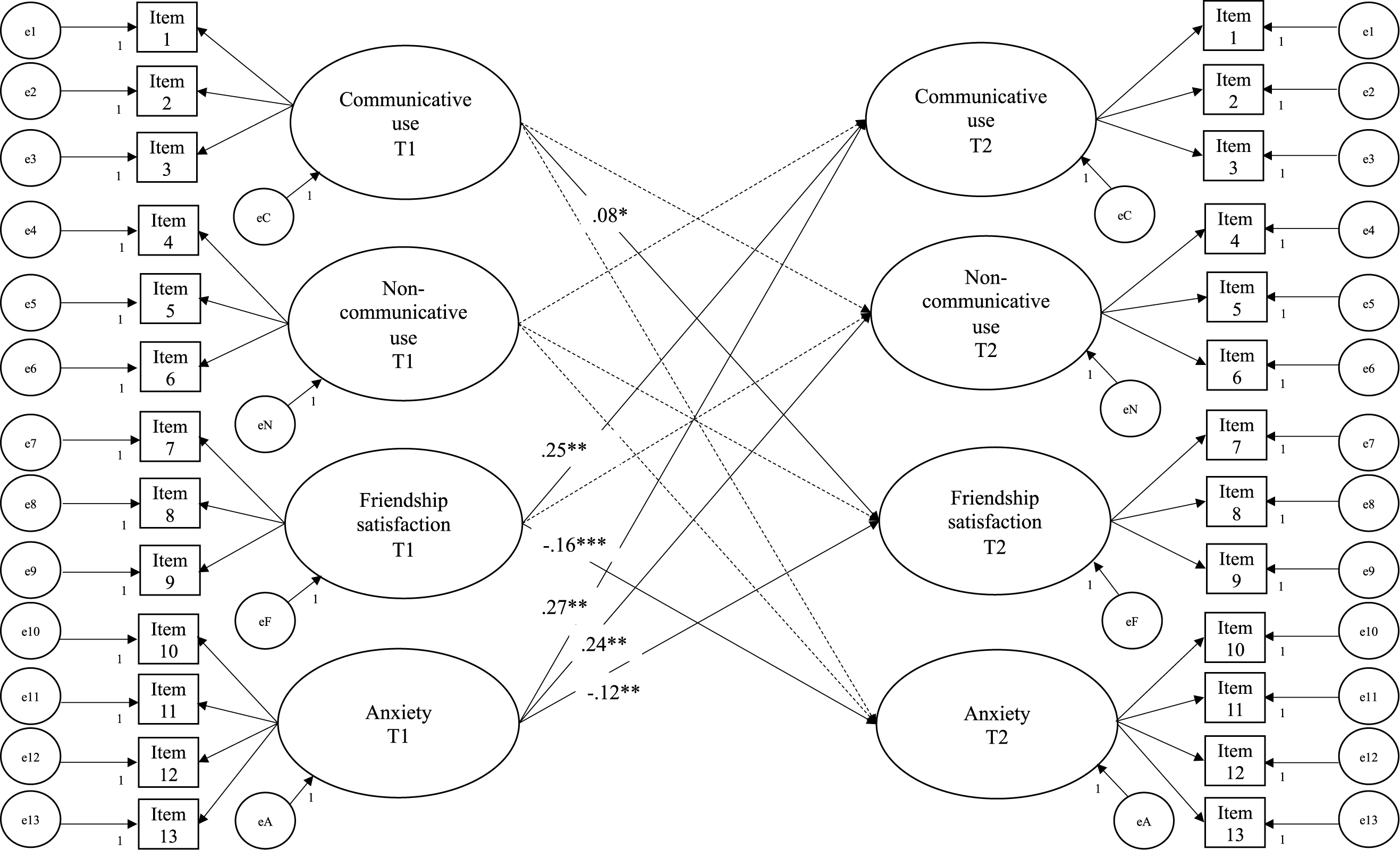
The structural equation modeling constrained model examining the relationships between communicative and non-communicative smartphone use, friendship satisfaction, and anxiety, controlling for all auto-regressive effects, age, gender, education and sampling mode. Note. Values reflect unstandardized coefficients. Ovals reflect latent variables. T1 = Time 1; T2 = Time 2. *p < .05, **p < .01, ***p < .001.
Anxiety
We assessed anxiety with four items based on the Hamilton rating scale for anxiety (HAM-A) by Hamilton (1959). Respondents indicated their agreement on a 5-point Likert scale (1 = strongly agree; 5 = strongly disagree) on the following statements: ‘I am very worried at the moment’; ‘I expect the worst’; ‘It is very difficult for me to relax at the moment’; ‘I feel strong inner restlessness.’ (T1: α = .84; M = 2.54, SD = 1.01; T2: α = .87; M = 2.21, SD = 0.98). CFA model fit for anxiety suggested adequate fit: χ2 (19) = 242.77, p < .001, CFI = .91, TLI = .87, RMSEA = .13 [.11; .14]. We decided to keep all four items given their one-dimensional structure based on the Exploratory Factor Analysis and their high internal consistency at both times.
Control variables
As control variables, we used each participant’s age, gender, and education. Additionally, we controlled for our sampling mode with one dummy variable (0 = recruited by polling institute, 1 = recruited by students).
Data analysis
Using SPSS Amos (Arbuckle, 2014), we conducted Structural Equation Modeling with Full Maximum Likelihood estimation. We used latent variables, controlling for age, gender, education, and sampling mode as well as all auto-regressive effects (e.g., communicative use at T1 as a predictor for communicative use at T2) and longitudinal metric measurement invariance of all outcome variables (Vandenberg & Lance, 2000), by constraining all factor loadings of the latent variables at T1 and T2. Both the unconstrained (CFI = .96; TLI = .94; NFI = .92; χ2 (347) = 679.470, p < .001; RMSEA = .04, 90%-CI [0.03; 0.04]) and the constrained (CFI = .96; TLI = .94; NFI = .92; χ2 (356) = 685.284, p < .001; RMSEA = .04, 90%-CI [0.03; 0.04]) model showed good fit, with no significant difference between them (χ2(9) = 5.81, p = .758). Therefore, the constructs show metric invariance over time, which is a sufficient condition to interpret relationships between constructs.
Results
Table 1, Table 2, and Figure 1 show all findings. In H1, we expected communicative use to positively predict friendship satisfaction. The results showed a significant positive association between communicative smartphone use at T1 and friendship satisfaction at T2 (b = .08, SE = .03, p =.016). Thus, we confirmed H1.
In RQ1, we asked whether there is an association between non-communicative use and friendship satisfaction. The results revealed no significant association between non-communicative smartphone use at T1 and friendship satisfaction at T2 (b = -.03, SE =. 03, p = .216).
RQ2 asked whether friendship satisfaction predicts communicative use (RQ2a) and non-communicative smartphone use (RQ2b). The results revealed that friendship satisfaction at T1 increases communicative smartphone use at T2 (b = .25, SE = .10, p = .010). There was no significant association between friendship satisfaction at T1 and non-communicative smartphone use at T2 (b = .01, SE = .10, p = .941).
We further expected communicative use (H2a) and non-communicative use (H2b) to increase anxiety. The results revealed that communicative use at T1 did not have a significant association with anxiety at T2 (b = .03, SE = .04, p = .370). Similarly, non-communicative use at T1 had no significant association with anxiety at T2 (b = .00, SE = .03, p = .988). Thus, H2a and H2b were not supported.
We also assumed that anxiety would increase both communicative (H3a) and non-communicative smartphone use (H3b). The results showed a significant positive association between anxiety at T1 and communicative use at T2 (b = .27, SE = .09, p = .004) as well as with non-communicative use at T2 (b = .24, SE = .09, p = .010). We confirmed H3a and H3b. Anxiety increased both types of smartphone use over time.
In H4, we assumed friendship satisfaction would decrease anxiety. The findings showed that friendship satisfaction at T1 negatively predicted anxiety at T2 (b = -.16, SE = .05, p < .001). Therefore, we confirmed H4.
Furthermore, we expected anxiety to decrease friendship satisfaction (H5). The results showed that anxiety at T1 negatively predicted friendship satisfaction at T2 (b = -.12, SE = .04, p = .006). Thus, we could confirm H4.
Regarding control variables, we found a significant negative association between age at T1 and anxiety at T2 (b = -.01, SE = .00, p = .015), showing that older participants experienced less anxiety over time. We also found a significant positive association between age at T1 and non-communicative smartphone use at T2 (b = .01, SE = .01, p = .023), meaning that older participants used their smartphones slightly more for non-communicative purposes than did younger ones. Results further revealed that women experienced higher levels of friendship satisfaction than men over time (b = .17, SE = .07, p = .019). Last, highly educated participants showed lower friendship satisfaction over time (b = -.24, SE = .10, p = .020).
Discussion
The present study was set out to clarify reciprocal associations between smartphone use, friendship satisfaction, and anxiety during the first lockdown in Austria. We argued that the occurrence of beneficial or harmful outcomes is contingent on the type of smartphone use. To that end, we tested the outcomes of communicative and non-communicative smartphone use related to COVID-19 information on friendship satisfaction and anxiety, and vice versa.
Our findings showed a positive impact of communicative smartphone use on friendship satisfaction, which is in line with research conducted prior to the pandemic (Chan & Li, 2020). While well-established empirical results regarding social connection, online self-disclosure, and relationship maintenance in the context of online communication (Valkenburg & Peter, 2009) and smartphone use (Chan, 2015) during regular times demonstrated positive effects of communicative use, our results extend them to the specific crisis-related context in which face-to-face communication had to be replaced almost completely with online communication (Nguyen et al., 2021). Being able to talk and exchange information about COVID-19 with one’s social networks enhanced feelings of friendship satisfaction and strengthened the relationships after one month. During periods of imposed physical distancing, smartphones appeared to have helped individuals maintain their interpersonal relationships and cope with the pandemic through active online communication. After all, the main utility of smartphones is mobile communication that ensures perpetual social connectedness (Mascheroni & Vincent, 2016) and relying on smartphones appears to ensure sufficient levels of belongingness while ‘stay-at-home’ measures were enforced. In other words, social relationships did not suffer but were enhanced via online communication, confirming the usefulness of mobile technology as a coping tool.
Despite empirical pre-pandemic evidence showing that non-communicative smartphone use can impair well-being and social support (Chan, 2015), we did not find such a relationship with friendship satisfaction during lockdown. Although overall engagement with smartphones increased (Sañudo et al., 2020), spending time on information about COVID-19 had no significant association with friendship satisfaction. In contrast to established displacement hypotheses (Kraut et al., 1998; Verduyn et al., 2021), this finding might be viewed favorably because friendship satisfaction was not disrupted by online information seeking (in line with Hall et al., 2018).
Interestingly, our findings also suggested a reciprocal association between friendship satisfaction and communicative smartphone use but not non-communicative use over time. Friendship satisfaction increased communicative use, showing that dependency on smartphones to maintain friendships can work out well. Due to the specific conditions of the imposed physical isolation, reduction in offline activities might have left individuals with more time to invest in communication activities about COVID-19. Therefore, individuals experienced friendship satisfaction despite spending time on information-seeking and news consumption activities that could have displaced time spent in active communication (Kraut et al., 1998).
In line with the established assumption that anxious states beget the use of coping strategies, we found that anxiety at the beginning of the first lockdown positively predicted both communicative and non-communicative smartphone use one month later. These results are consistent with findings on individuals’ communicative behavior in disaster situations (Kaniasty, 2020) and further qualify prior research during the COVID-19 crisis that had shown increases in (social) media and smartphone use (Colley et al., 2020). Since most ‘offline’ coping strategies are barred by imposed restriction measures, people appear to turn to computer-mediated alternatives to reduce their anxiety. Our result point to the possibility of smartphones serving as individuals’ coping tools during the crisis or other periods of imposed separation or isolation as had been shown in the case of adolescents’ social media use (Cauberghe et al., 2021). Importantly, these findings could be relevant for similarly challenging (global or local) events or even for personal life crises.
However, no reciprocal effect was established as neither communicative nor non-communicative smartphone use affected people’s anxiety over time. Accordingly, our data provide no indication of amplifying co-deliberation between friends (as shown in Canada (Ellis et al., 2020) or of enhanced uncertainty due to feelings of helplessness (Farooq et al., 2020), or exposure to unreliable or negative reporting (Quandt et al., 2020). In other words, our findings do not suggest the existence of a reinforcing feedback loop. Anxiety may lead to coping through enhanced smartphone use, but enhanced smartphone use may not result in increased anxiety levels over time. While these results can be read favorably—that smartphone activities do not directly add to already existing anxieties—they also reveal poor efficiency as direct coping measures.
However, these non-effects do not necessarily mean that smartphone activities have neither a harmful nor a beneficial influence on anxiety. It might be possible that present positive and negative outcomes have balanced each other out, and that a more fine-grained analysis of smartphone activities (e.g., ones that go beyond asking whether people engage smartphones in a communicative or non-communicative way but focus on the content of these activities) might detect on what these relationships depend (e.g., online experiences or digital skills (Hofer et al., 2019).
In general, our findings could be informative for other digital devices, especially those with mobile features. Uninterrupted mobile communication can be regarded as an extension of in-person communication due to absence of constraints in space and time (Carolus et al., 2019). Looking from a broader perspective, static digital devices or general social media use offer the same possibilities of messaging, calling, video chatting, and information seeking (Cauberghe et al., 2021). Thus, our findings offer insights into different types of use and possible antecedents and outcomes related to COVID-19. Since digital devices offer numerous possibilities to interact, search for information and pass time, similar results due to the main features could be expected.
Aside from smartphone use, our results further revealed a pivotal interplay of anxiety and friendship satisfaction during the COVID-19 crisis. Individuals who had more satisfying friendships at the beginning of the lockdown experienced lower anxiety one month later, indicating both the stress-buffering function of supportive relationships (Cohen, 2004) and the necessity of introducing efficient measures that may prevent the advent of loneliness during lockdown (Palgi et al., 2020). Although the two-wave panel design of our study cannot provide definitive evidence, this result also creates a plausible indirect path for a beneficial impact of communicative smartphone use via increased friendship satisfaction on well-being (as suggested by the internet-enhanced self-disclosure hypothesis (Valkenburg & Peter, 2009). Considering the limited size of direct effects of media consumption on well-being (e.g., Orben & Przybylski, 2019), it may be extremely valuable to implement multiple waves for future research that enable researchers to test for intermediary constructs.
Moreover, our data suggested that anxiety might have a negative influence on individuals’ friendship satisfaction over time (in line with Dohrenwend, 2000). Controlling for engagement in communicative activities about COVID-19, anxious individuals were more likely to become disappointed with their existing friendships during the one-month time interval of our study. By implication, this disappointment makes them more vulnerable to end up alienated as they might decide to break off relationships, starting a downward spiral of missing social support (e.g., Qi et al., 2020). Our two-wave panel design is limited in providing valid evidence on such indirect effects. Our finding can merely issue a warning notice about this harmful interplay that should be investigated thoroughly by future inquiries. Nonetheless, it may already be solid ground to call for stronger awareness of social needs during challenging times.
Limitations and future research
Several limitations should be noted. The present study relied on two panel waves with a one-month interval. Although we could estimate changes over time, our design does not allow us to test long-term mediated process. Future research should focus on longitudinal three or more wave panel designs to account for possible reciprocal mediation mechanisms between smartphone use, friendship satisfaction, and anxiety (as well as other constructs). Following the internet-enhanced self-disclosure hypothesis (Valkenburg & Peter, 2009) and a two-process framework of online self-disclosure and well-being (Luo & Hancock, 2020), communicating online is relevant for well-being via enhanced relationship quality and should be tested accordingly.
Concerning communicative smartphone use with family, friends, and acquaintances, we did not assess other related outcome variables, such as relationship satisfaction with family members or general social connectedness (Nguyen et al., 2021). Additionally, we did not consider the content of non-communicative, information consumption activities, which might have resulted in different outcomes regarding anxiety and reassuring health-related information (Te Poel et al., 2016). Future research should aim for a more fine-grained analysis of communicative and non-communicative activities to avoid being blinded by spurious non-effects and to find beneficial and harmful ways of how people use their smartphones during uncertain situations. Furthermore, looking at different generations, prior research has suggested that age moderates relationships between smartphone use and well-being (Stevic et al., 2021). Based on the socioemotional selectivity theory that proposes increased focus on emotional experiences in older adulthood (Carstensen et al., 1999), a possible role of age in the context of smartphone use, friendship satisfaction and anxiety should not be disregarded. 2
Our findings are grounded in the particular time frame of the first lockdown and cannot be directly translated to later stages of the pandemic. Our results can be interpreted in the context of limited social contacts during the lockdown in Austria and might be extended to the context of other European countries whose citizens were experiencing similar lockdown measures.
Finally, our sample was recruited via a polling company and university students, thus resulting in two significant paths (see Table 2) that could be explained by differences in two samples. 3 We used self-reports that are prone to recollection biases and social desirability; however, over the past years scholarship has ascertained mixed evidence about their reliability and a recent study showed that findings from self-reported data tend to underestimate smartphone effects in comparison to logged smartphone data (Jones-Jang et al., 2020).
Zero-order correlations
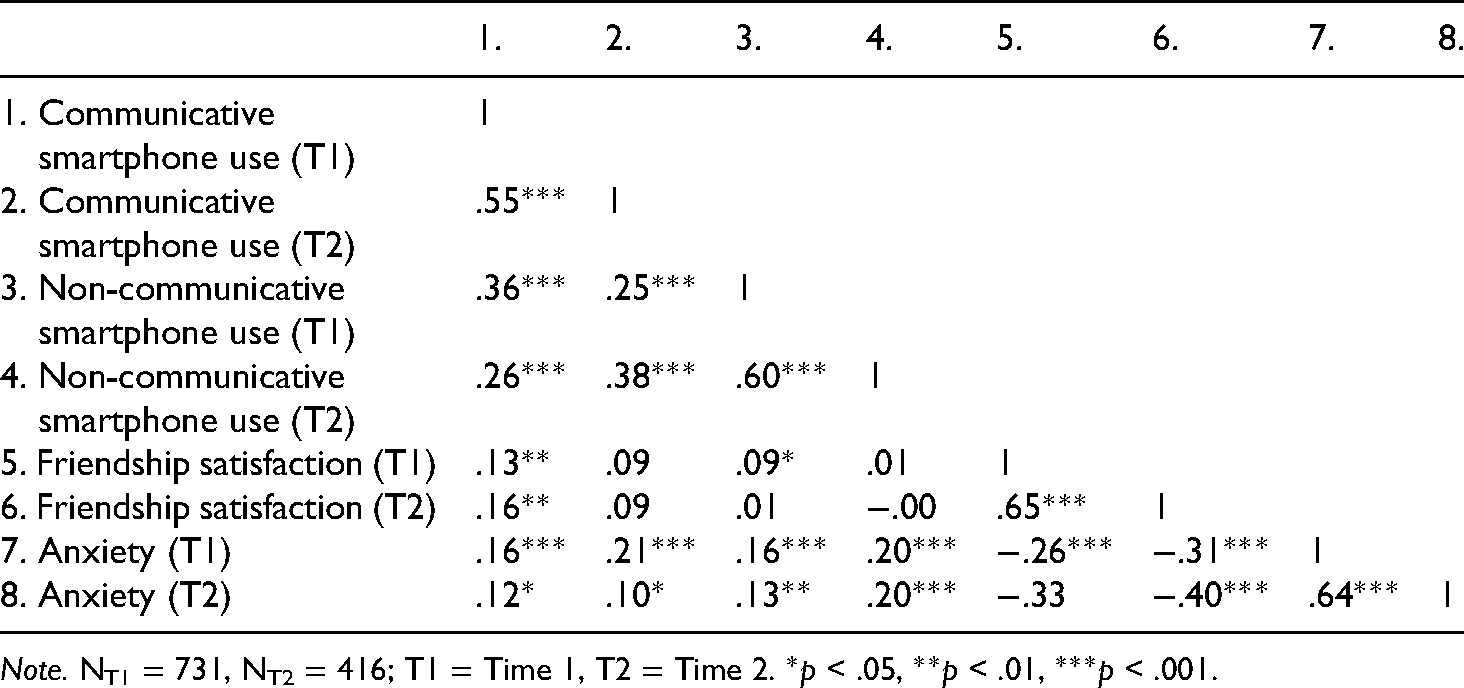
Note. NT1 = 731, NT2 = 416; T1 = Time 1, T2 = Time 2. *p < .05, **p < .01, ***p < .001.
Results of hypothesized structural equation model based on the Full Maximum Likelihood estimation controlling for baseline assessment of the outcomes to assess residual changes.
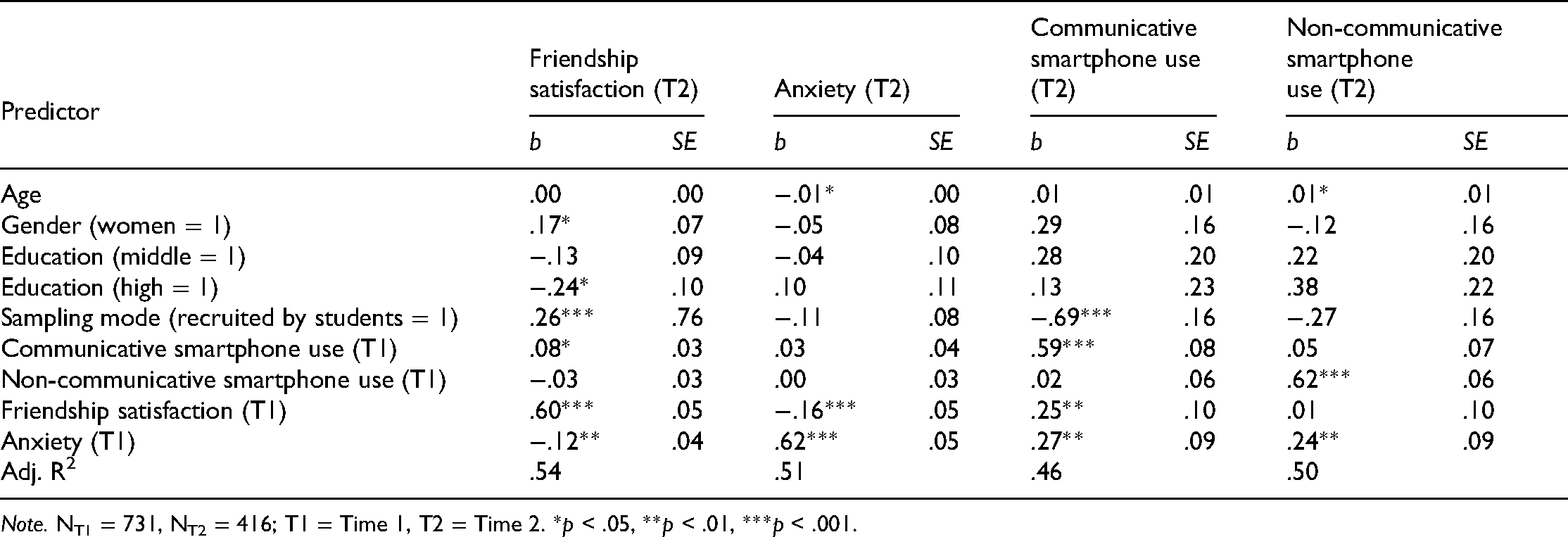
Note. NT1 = 731, NT2 = 416; T1 = Time 1, T2 = Time 2. *p < .05, **p < .01, ***p < .001.
Conclusion
In sum, this panel study provides a first understanding of the interplay between different types of smartphone use and their outcomes on friendship satisfaction and anxiety during the first lockdown in Austria. Although we cannot confirm mediation mechanism, our results pointed to a beneficial impact of communicative smartphone use, whereas non-communicative use did not result in harmful outcomes. Fulfilling its basic function, smartphones were shown to be relevant tools for friendship satisfaction in times of social isolation, which helped to relieve individuals of excess anxiety and offered reassurance through mediated contact.
Footnotes
Acknowledgements
We would like to thank master students of the University of Vienna for their assistance with the recruitment of participants.
Funding
The author(s) received no financial support for the research, authorship and/or publication of this article.

Notes
Author biographies
Anja Stevic (PhD, University of Vienna) is a postdoctoral researcher in the Department of Communication at the University of Vienna. Her research interests include mobile communication as well as smartphone and social media effects on well-being.
Kevin Koban (PhD, Chemnitz University of Technology) is a postdoctoral researcher in the Department of Communication at the University of Vienna. His current research focuses on the science of well-being and individuals' interaction with digital systems.
Alice Binder (PhD, University of Vienna) is a postdoctoral researcher in the Department of Communication at the University of Vienna. Her research interests include persuasive communication, health communication, and food placement effects on children.
Jörg Matthes (PhD, University of Zurich) is professor of communication science in the Department of Communication at the University of Vienna, where he chairs the division of advertising research and media psychology. His research focuses on advertising effects, the process of public opinion formation, news framing, and empirical methods.