



Abstract
Does the news media exacerbate or reduce misinformation problems? Although some news media deliberately try to counter misinformation, it has been suggested that they might also inadvertently, and sometimes purposefully, amplify it. We conducted a two-wave panel survey in Brazil, India, and the UK (N = 4732) to investigate the effect of news and digital platform use on awareness of and belief in COVID-19 misinformation over time (January to February 2022). We find little support for the idea that the news exacerbates misinformation problems. News use broadened people's awareness of false claims but did not increase belief in false claims—in some cases, news use actually weakened false belief acquisition, depending on access mode (online or offline) and outlet type. In line with previous research, we also find that news use strengthens political knowledge gain over time, again depending on outlets used. The effect of digital platforms was inconsistent across countries, and in most cases not significant—though some, like Twitter, were associated with positive outcomes while others were associated with negative outcomes. Overall, our findings challenge the notion that news media, by reporting on false and misleading claims, ultimately leave the public more misinformed, and support the idea that news helps people become more informed and, in some cases, more resilient to misinformation.
Introduction
News, at its best, helps people become more informed and potentially more resilient to misinformation, propaganda, and other attempts to lead them astray (Acerbi et al. 2022; Humprecht et al. 2020). This observation is not just central to how many journalists and editors like to think about their work. It is also an effect of news media use known from decades of research documenting how news—despite its imperfections—helps people become more knowledgeable about politics and public affairs (Aalberg and Curran 2012).
This is especially important in a context where the informational benefits of relying on digital media, including platforms such as social media, search engines, and the like, are much less clear (Amsalem and Zoizner 2022; Lorenz-Spreen et al. 2021), where much of the public is concerned about whether the information they come across online is true or false (Newman et al. 2021), and where misinformation sometimes has wide reach on platforms such as Facebook, Twitter, YouTube, and WhatsApp. In times of crisis, such as the COVID-19 pandemic, news media can help people be more informed, take steps to protect themselves and others (e.g., wear a face mask, take a vaccine), and be less misinformed and avoid dangerous behaviors (e.g., rely on pseudo-cures). Since online news consumption increased during the pandemic, and that people largely turned to reliable news outlets (Altay et al. 2022), news media played a central role. But does news in fact help people be more resilient to misinformation or does it contribute to the misinformation problem?
Some researchers and fact-checking groups fear that news coverage can sometimes, even if inadvertently, amplify misinformation—for example through attempts to debunk, by reporting on it, or by featuring sources or guests who spread misinformation. Many widely-used news media are sometimes hijacked by actors who use them as a way to spread false, misleading, or other forms of problematic information (Phillips 2018). And some individual news media, such as Fox News, loom large in the asymmetric media structures other scholars have argued drive “networked propaganda” in the United States (Benkler et al. 2018).
This has led some scholars to suggest that “mainstream media are responsible for much of the public attention fake news stories receive” (Tsfati et al. 2020). Others go further and hypothesize that “the origins of public misinformedness [are] more likely to lie in the content of ordinary news or the avoidance of news altogether as they are in overt fake news” (Allen et al. 2020) and misinformation more narrowly conceived.
In this article, we investigate the effect of media use on awareness of and belief in false claims about COVID-19. More specifically, we explore whether more frequent news use and more frequent digital platform use increases or decreases the likelihood that people will (a) become aware of false COVID-19 claims as they emerge over time, and (b) whether they are more or less likely to believe those false claims. To anchor our findings in long-standing research on this issue, we also include analysis of how news helps people gain political knowledge. Using a panel survey to avoid the shortcomings of cross-sectional data, and deploying a comparative study across Brazil, India, and the UK to go beyond existing research which has mostly focused on the unusual case of the US, we examine the impact of media use—including general news use, online and offline news access, the use of different types of news outlet, and the use of different digital platforms, as well as a range sociodemographic control variables.
While results are not identical across countries (underlining the importance of comparative research to guard against unwarranted generalizations), nor consistent for all types of news use (further underlining the need to consider asymmetric media structures), overall, we find that news can help. In two of the three countries news use broadens people's awareness of false claims without simultaneously increasing the likelihood that they will be believed, and in one country news use clearly weakens false belief acquisition (while also in many cases, as previous work has found, increasing political knowledge). With some important exceptions, most forms of platform use have no significant effect on either awareness of or belief in false claims about COVID-19—even when the potential mediating effects of political interest and trust in news are considered.
News Media and Digital Platform use and Their Impact on Political Knowledge and Misinformedness
In the absence of empirical research on the effects of news use and social media use in Brazil and India, we formulated research questions instead of hypotheses. Results from the global north cannot be generalized to the global south given the clear differences in media systems, news use, and platform use (Neyazi et al. 2021; Zhang and Neyazi 2020). For instance, two-third of Brazilians and Indians rely on social media to access news, while only one-third of Britons do so (Newman et al. 2022). Almost half of Brazilians and Indians rely on YouTube and WhatsApp to access news, while only one in ten Britons do so. Half of Indians still access news via print whereas less than one in five Britons and Brazilians do so. The UK has well-funded, widely used, and broadly trusted public service media. These three countries also have different misinformation ecosystems. For instance, researchers have found that President Jair Bolsonaro has repeatedly spread falsehoods about COVID-19 during the pandemic (Nalon 2022), as have some prominent political and religious leaders in India (Daria and Islam 2021). And India is characterized by high levels of belief in conspiracy theories, while the UK by particularly low ones (with Brazil in between the two; Kirk 2022).
Decades of research have documented that traditional news use is associated with higher political knowledge (Albæk et al. 2014; Shehata et al. 2015; Wei and Lo 2008) and with being more informed about public affairs (Aalberg and Curran 2012). To benchmark our later analysis of the effect of media use on COVID-19 misinformation, we first measured the effect of news use on the acquisition of political knowledge—on the basis that being able to find similar effects using our approach would lend credence to our results on COVID-19 misinformation
1
.
RQ1: What is the effect of news use on the acquisition of political knowledge?
Different kinds of media have different effects, with exposure to hard-news-oriented sources (e.g., upmarket newspapers or public service broadcasting) producing significant information gain while exposure to soft-news-oriented outlets (e.g., popular newspapers) does not (Fraile and Iyengar 2014). And the effect of specific news outlets can differ from news more generally. For instance, some studies have found that watching Fox News is correlated with belief in specific political conspiracy theories and failure to follow recommendations of health experts during the pandemic (Jamieson and Albarracin 2020; Simonov et al. 2020). That's why we systematically investigated not only the effect of general news use, but also of (i) online vs offline news use, (ii) different kinds of media, and (iii) individual news outlets.
News media continue to be important parts of many people's media repertoires, but people increasingly also (and in some cases instead) rely on digital platforms including social media, messaging applications, and search engines. Strong opinions abound in public debate, but empirical research has not yet produced a clear consensus on what relying on various digital platforms means for people's political knowledge. A recent systematic literature review concludes that while the picture is not yet clear, digital media use tends to be associated with more political knowledge in cross-sectional surveys, panel surveys, and field experiments (Lorenz-Spreen et al. 2021), while a meta-analysis of 76 studies found small-to-nonexistent knowledge gains across social media platforms (Amsalem and Zoizner 2022).
RQ2: What is the effect of platform use on the acquisition of political knowledge?
The fact that researchers have found news use generally increases political knowledge and helps people become more informed about public affairs is part of the reason why news media could also help increase resilience to misinformation (Acerbi et al. 2022, Humprecht et al. 2020). The role of news, however, is not clear, as some researchers have suggested that mainstream news media may expose people to a large amount of misinformation, and could even be responsible for most of the misinformation people are exposed to (Haber et al. 2021; Tsfati et al. 2020). Beyond cases where an outlet might deliberately publish disinformation, this could happen when news media report on false or misleading claims by prominent politicians or other public figures or allow them to make such claims in debate programs or during live coverage of, for example, election rallies or press conferences (Phillips 2018). It could also take the form of reporting on misinformation that ends up amplifying the central claim, or debunking and fact-checking that risks drawing additional attention to the material and narratives they are engaging with (Wardle and Derakhshan 2018).
RQ3: What is the effect of news use on awareness of false claims about COVID-19?
Exposure is one aspect, but what about impact? People do not necessarily believe false claims just because they are exposed to them (Altay et al. 2021). For instance, false claims encountered in the context of a fact-check could make people aware of these claims, while reducing belief in them (Walter et al. 2020). Some have suggested that the news media may not only expose people to false claims but also increase belief in these false claims (Haber et al. 2021). For this reason, we not only measured awareness of false claims about COVID-19, but also the acquisition of false beliefs in those claims.
Compared to research on political knowledge, research on the role of media in how people acquire false beliefs is relatively nascent. A series of cross-sectional studies during the coronavirus pandemic found that news use is associated with lower belief in COVID-19 misinformation (Bridgman et al. 2020; Dhawan et al. 2021; Nielsen et al. 2021; Romer and Jamieson 2021; Stecula et al. 2020). Yet, the effect of media use is not homogeneous. For instance, in the US conservative media use is a predictor of belief in some COVID-19 conspiracy theories (Jamieson and Albarracin 2020), echoing pre-pandemic findings showing that partisan media use is associated with holding political misconceptions (Weeks et al. 2022). Overall, these findings support the idea that, with some exceptions, news use help citizens be less misinformed.
RQ4: What is the effect of news use on the acquisition of false beliefs about COVID-19?
Next, we examine the role of digital platforms. Numerous findings suggest that social media use is associated with exposure to misinformation, at least to the extent that people report being exposed to substantial amount of misinformation on social media (Nielsen et al. 2021; Jurkowitz and Mitchell 2020). More direct evidence has shown that Facebook was a gateway to untrustworthy websites in the 2016 US presidential election (Guess et al. 2020)—through its role greatly diminished in 2018 (Guess et al. 2018). At the beginning of the COVID-19 pandemic in 2020, while people largely turned to reliable news outlets online, Facebook engagement increased for both reliable and unreliable news outlets (Altay et al. 2022). And in some countries like France and the US, unreliable news outlets accounted for up to a quarter of all engagement with news outlets’ Facebook pages (Altay et al. 2022). Thus, in some countries, people were indeed exposed to a lot of misinformation about COVID-19 on Facebook. The role of other platforms is less well understood.
RQ5: What is the effect of platform use on awareness of false claims about COVID-19?
Do digital platforms also increase belief in misinformation? Numerous correlational studies found that social media use is sometimes associated with conspiratorial and misinformed beliefs both before (e.g., Stecula et al. 2020; although see: Valenzuela, Halpern, et al. 2022; Valenzuela, Muñiz, et al. 2022; Halpern et al. 2019) and during the pandemic (Allington et al. 2021; Bridgman et al. 2020; Jamieson and Albarracin 2020; Nielsen et al. 2021; although see: Dhawan et al. 2021). These results vary across platforms. For instance, Stecula and Pickup (2021) found that Facebook and YouTube use was associated with belief in conspiracy theories, contrary to Twitter use. And a large multi-platform panel study in Europe and Israel found that Twitter use was associated with reduced belief in conspiracy theories while Facebook, YouTube, and WhatsApp use were associated with increased belief in conspiracy theories (Theocharis et al. 2021).
RQ6: What is the effect of platform use on the acquisition of false beliefs about COVID-19?
Given variation in how they operate, who uses them, and what they are used for, different platforms will not necessarily have the same effects, nor the same effects on different people (Theocharis et al. 2021). A consistent predictor mediating the effect of platform use is political interest. For instance, one study found that Facebook use led to the acquisition of less current affairs knowledge, especially among those least interested in news (Boukes 2019). On the other hand, the least politically interested benefit the most from incidental exposure to online news and political information on social media (Weeks et al. 2022).
Another important factor mediating the effect of platform use is trust in news. People who trust the news less are less likely to accept media messages (Ladd 2010), which reduces the positive effect of news use on political knowledge (Skipworth 2011). Similarly, people who trust the news less are more likely to acquire false beliefs (Valenzuela, Halpern, et al. 2022; Valenzuela, Muñiz, et al. 2022). More broadly, low trust in news and institutions is strongly associated with holding misconceptions and false beliefs (Roozenbeek et al. 2020; Zimmermann and Kohring 2020). Consequently, we posed four additional research questions concerning the mediating effect of political interest and trust in news on political knowledge (RQ7-8), and belief in false claims about COVID-19 (RQ9-10).
Pre-Registered Research Questions
We pre-registered a total of 16 research questions (though we changed the order of presentation to aid understanding, see SI section 1). Most of them are outlined in the introduction, but we also preregistered parallel research questions exploring the effect of media use (RQ11-12) and platform use (RQ13-16) on awareness of, and belief in true claims about COVID-19.
Method
To answer our research questions, we conducted a two-wave panel survey in Brazil, India, and the UK. Based on a pre-registered power analysis, we commissioned YouGov to recruit a representative sample of 2004 participants in Brazil (between the 4th and the 12th of January 2022), 2070 participants in India (between the 4th and 14th of January 2022), and 2052 participants in the UK (between the 4th and the 15th of January 2022). In the second wave, 1250 participants in Brazil (between the 4th and the 21st of February 2022; 612 women, Medianage group = 45–54, Medianeducation = A-Levels or baccalaureate), 1718 participants in India (between the 4th and the 21st of February 2022; 788 women, Medianage = 37, Medianeducation = 1 or 2 years after A-Levels or baccalaureate), and 1764 participants in the UK (between the 4th and the 15th of February 2022; 953 women, Medianage = 50, Medianeducation = 1 or 2 years after an A-Level or baccalaureate) took the survey again. The 1-month interval between the two waves was enough for new false claims to emerge, while keeping dropout rates low (except in Brazil). At the beginning of 2022, COVID-19 was still at the center of media attention because a new variant (Omicron) caused, as of January 2023, the largest COVID-19 infection wave in the UK and Brazil, and the second largest one in India.
Samples were assembled using nationally representative quotas for age, gender, education, and region in all three countries, with additional quotas for social grade, political attention, 2019 General Election vote and 2016 EU referendum vote in the UK. However, because internet penetration is relatively low in Brazil and India, samples are more representative of the online population, which in turn is more educated and affluent than the national population. This is particularly true in India with regards to education (and region), where quota targets differed from the sample achieved (see SI section 7). Furthermore, in India the survey was fielded in English only, meaning that the survey is, at best, representative of the online, English-speaking population only. More generally, because people opt-in to online survey panels rather than being selected at random, the samples are likely to be biased towards particular groups and attitudes, which in turn could be associated with the variables of interest.
Another more specific limitation stems from the fact surveys rely on self-reported measures of media use, despite the known discrepancy between actual news use and reported news use (Parry et al. 2021). However, because access to web tracking data from participants in Brazil and India is limited, and because we are primarily interested in the effect of media use on knowledge and beliefs, survey data is the only realistic option.
Design and Procedure
In the first wave of the survey, data were collected on education, interest in politics, political orientation, and trust in news. Respondents also answered four multiple choice political knowledge questions presented in a random order. Finally, participants reported whether they had previously heard or read eight claims about COVID-19 (half true, half false) and rated how accurate they believed each claim to be. The claims were presented in a randomized order.
In the second wave, the survey was similar except that we did not measure stable traits such as education, past vote, political orientation, and political interest (see Figure 1). We also measured platform use, general news consumption, the use of specific news brands both offline and online—which previous research has also found to be highly stable (Andersen et al. 2021). Importantly, in wave two we also added two new political knowledge questions, two new false claims, and two new true claims, that appeared in the news or on social media between waves one and two. This allows us to study the effect of media use on awareness gain and false belief acquisition specifically. These items were very unlikely to be known in wave one, either because they referred to events that had not yet taken place, or because they had not received any public attention. We verified with temporal Google searches that the items we selected have not been covered before the end of the first wave.
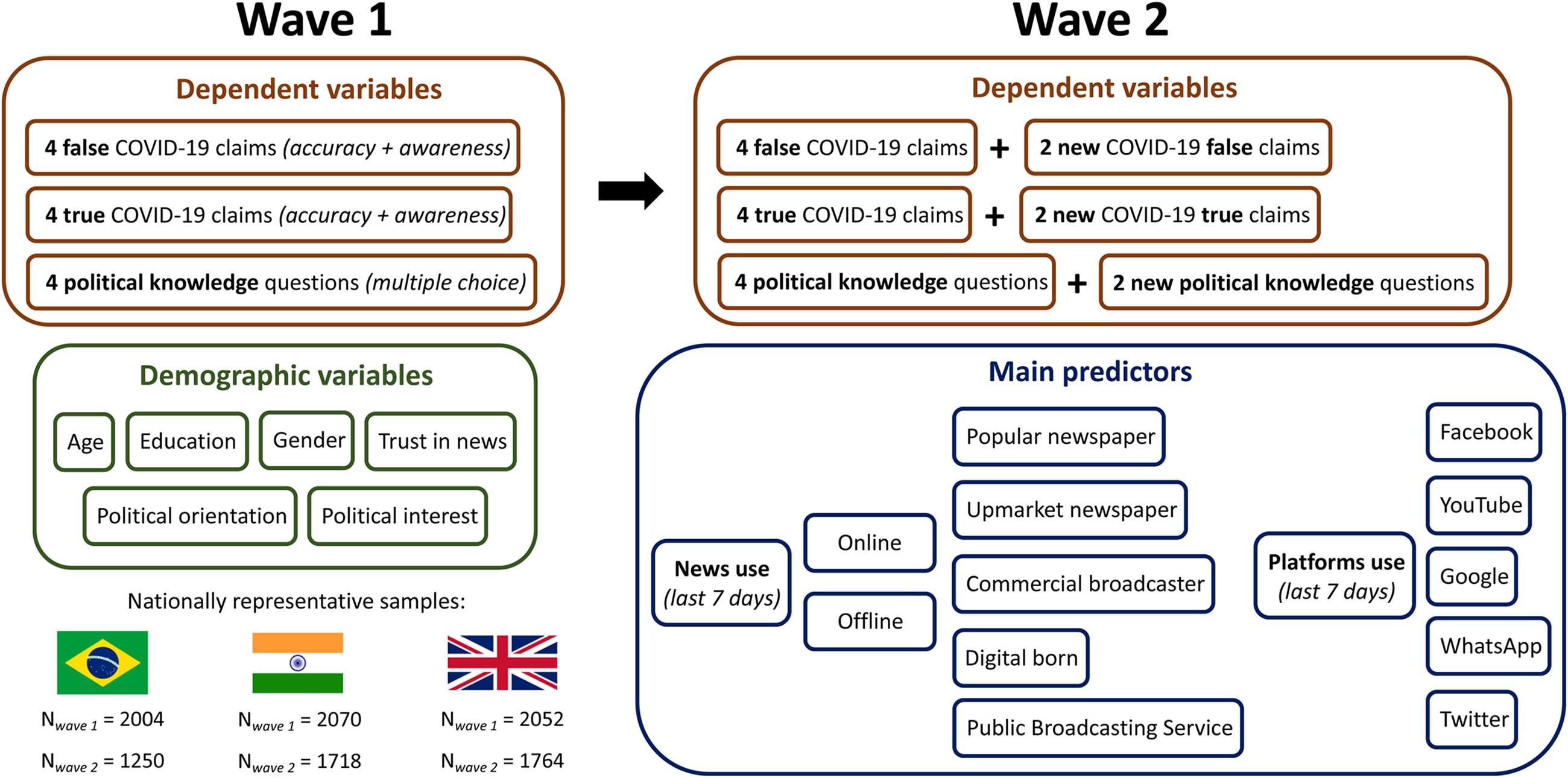
Overview of our design and the variables used in the statistical models.
With this design, we are able to leverage temporality such that changes in our dependent variables between wave one and wave two are much more likely to be the outcome of the independent variables rather than the reverse (Boukes 2019). This design reflects our interest in the evolution of our dependent variables (e.g., the accumulation of political knowledge over time), not in the evolution of our independent variables (e.g., changes in news use between wave one and wave two). In other words, we will treat our independent variables as static and our dependent variables as dynamic (for a similar design see Boukes 2019). This better reflects how people acquire new knowledge and beliefs from the news media in the real world, particularly compared to measuring changes in the same items over time. However, using such a design sometimes means that questions added in wave two are not of entirely the same character as those in wave one. For example, the political knowledge questions added in the second wave are closer to ‘surveillance knowledge’ of current affairs (Barabas et al. 2014) than what has been called ‘textbook knowledge’ about how politics and governments function (Jennings 1996). This is necessary given the short time window that we had to find novel political knowledge questions, but such questions are often used in surveys measuring political knowledge acquisition across numerous waves (e.g., Boukes 2019).
Measures
We measured political knowledge with four questions in wave one (α Brazil = .83, α India = .74, α UK = .67), and an additional two questions in wave two (α Brazil = .77, α India = .79, α UK = .72). Table 1 details all the political knowledge questions (and COVID-19 claims) used in this study. Each political knowledge question had five possible answers, including “Don’t know.” The correct answer was coded (1) while incorrect answers, and “Don’t know” answers, were coded (0). In SI section 4, we provide more details about the selection of the political knowledge questions.
List of true claims about COVID-19 (TRUE), false claims about COVID-19 (FALSE), and political knowledge questions (POL), per country and wave. Participants were exposed to the ‘Wave 1 & 2’ items both in wave 1 and in wave 2, while they were exposed to the ‘Wave 2’ items only in wave 2. For the true and false claims about COVID-19, we report the mean score of accuracy between the two waves. For the political knowledge questions, we report the percentage of participants who provided the correct answer at least in one wave.
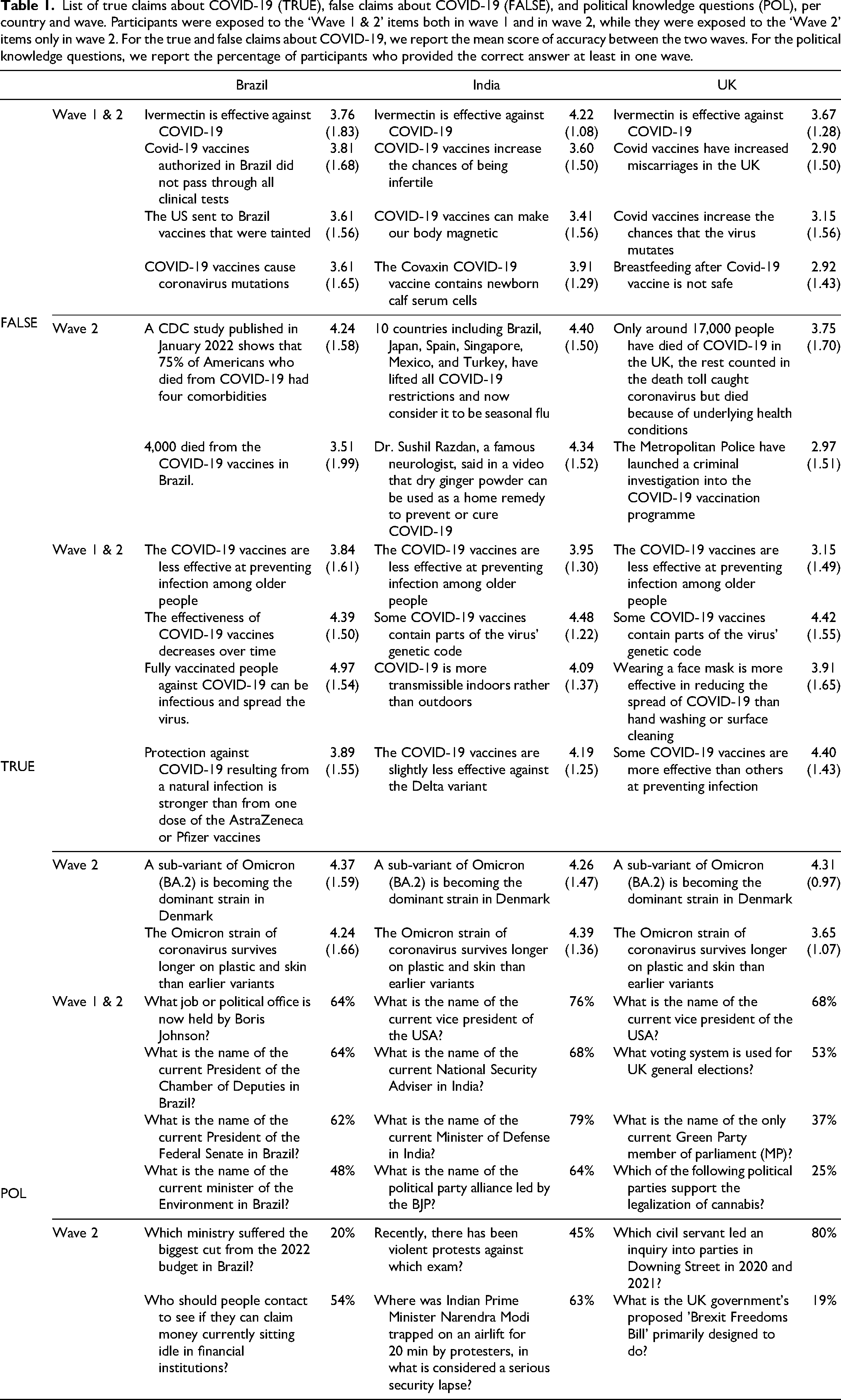
To measure awareness of and belief in false claims about COVID-19, we presented respondents with a series of four claims rated as false by independent fact-checkers in each country. We first measured awareness with the question: “Before taking this survey, had you read or heard this claim?” (1) “Yes, I had”, (0) “No, I hadn’t”, (0) “Don’t know / can’t recall”. Then, on the same page, we measured belief in the claim with the question: “How accurate or inaccurate is this claim?” (1) “Very inaccurate,” (2) “Inaccurate,” (3) “Slightly Inaccurate,” (4) “Don’t know,” (5) “Slightly accurate,” (6) “Accurate,” (7) “Very accurate.” In the second wave, we changed the awareness question to make sure that participants do not report being aware of a claim because they encountered it during the first wave: “Before taking this survey, or a similar one, had you read or heard this claim?”.
Awareness of, and belief in, true claims about COVID-19 were measured in the same way. The eight claims (four false, four true) were presented in a random order to introduce variation and to minimize the chances of respondents spotting a pattern. Although we treated the true and false claims similarly, they are not equivalent. To avoid floor effects in the measure of belief, we used some of the most prominent and most plausible COVID-19 false claims. However, to avoid ceiling effects we did not ask about the most prominent and most plausible true claims, given that the public's knowledge of basic COVID-19 facts (e.g., what an antibody test is, what the R 0 number refers to, etc.) is high (Nielsen et al. 2020, 2021). Instead, we selected relatively niche COVID-19 facts. This method of claim selection means that average belief in false claims and average belief in true claims can be quite similar, but this does not mean that people are as misinformed about COVID-19 as they are informed (for further details see SI section 4).
All independent variables mentioned in the paragraphs below come from questions adapted from the 2021 Digital News Report (Newman et al. 2021). News use was measured with two questions, one for offline news use and one for online news use. For offline news use, we asked: “On how many of the last 7 days, if any, have you used each of the following brands to access news offline in the last week (via TV, radio, print, and other traditional media)?”, and for online news use: “On how many of the last 7 days, if any, have you used each of the following brands to access news online in the last week (via websites, apps, social media, and other forms of Internet access)?”. For each, participants were presented with a list of the 15 most widely used online/offline news brands in their country (based on results from the 2021 Digital News Report), and responses were recorded on a scale ranging from (0) to (7) days, with a (NA) “Don’t know” option also available. In Table 2, we report the list of brands.
List of the brands included in the survey by country, and how they were classified in each category.
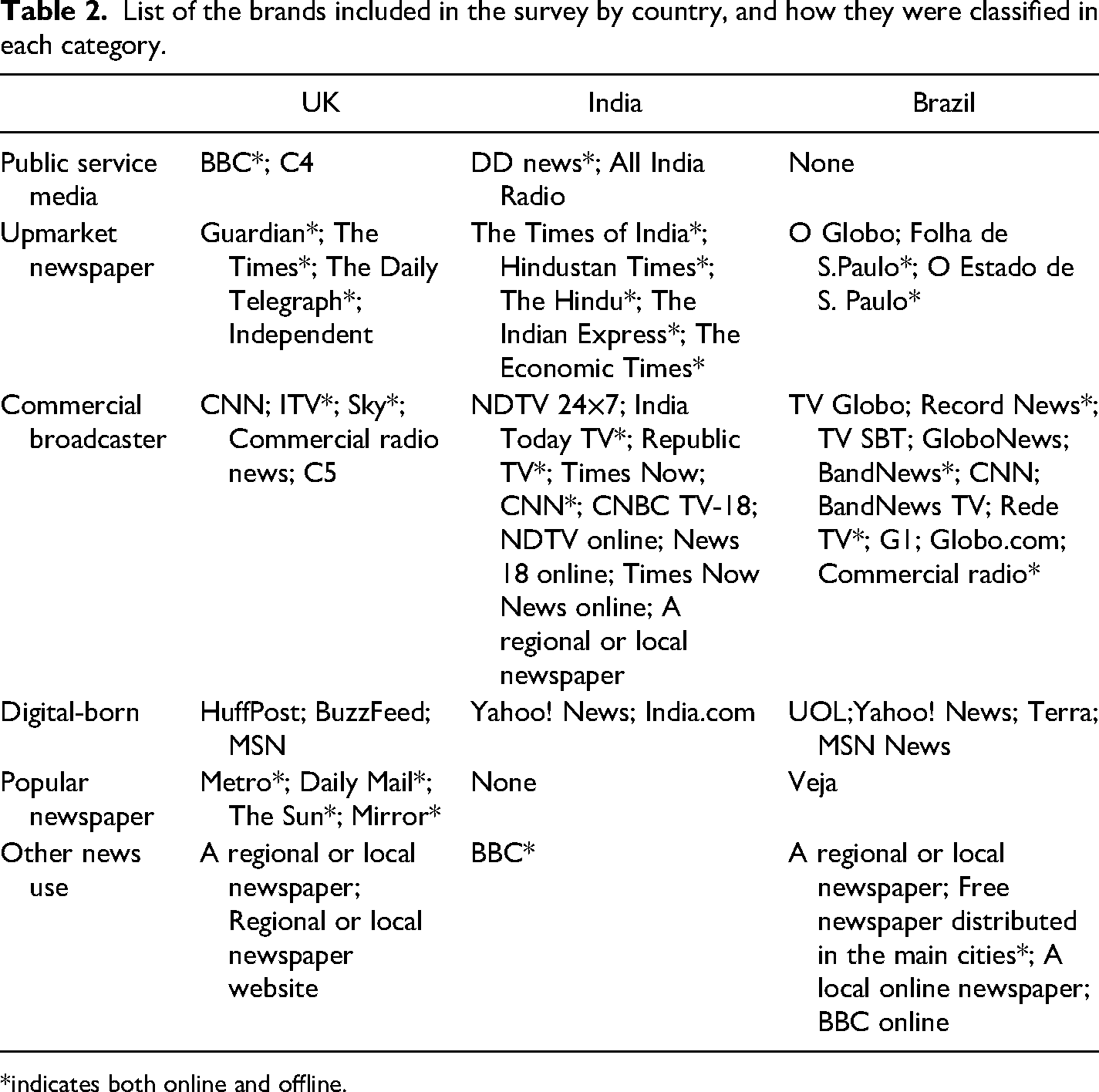
*indicates both online and offline.
Platform use was measured with the question: “Thinking about the last week…On how many days, if any, have you used each of the following for ANY purpose?”. The same response options as described above were offered. In each country, we selected platforms with at least 5% reach (13 in the UK and Brazil, and 16 in India) based on the results from the 2021 Digital News Report. We report how we measured the other independent variables in SI section 3.
Results
We answer our research questions using regression analysis. To account for the changes in the dependent variables between the two waves and the fact that the dependent variables will cumulate, we use multilevel growth curve models. We control for natural increases in the dependent variables by introducing a term for “wave” (the slope of which is allowed to vary) and interacting it with our stable independent variables to see whether news use, for example, is associated with a larger or smaller increase in the dependent variables (Andersen and Hopmann 2018; Boukes 2019; Hox et al. 2017; Shehata et al. 2015). This survey design, and statistical models, allow us to make stronger causal claims compared to a cross-sectional design.
For the analysis, we recorded our measures of news use in three different ways. First, as a general measure of news use, we took the sum of all news brands on the 0–7 scale. Second, for online vs offline news use, we took the sum of all online news brands and the sum of all offline news brands. And third, for categories reflecting type of outlet (regardless of whether accessed online or offline): popular newspaper, upmarket newspaper, public service media, commercial broadcaster, digital-born, and other (see the pre-registration for details about the coding of these categories). All measures of media use were natural log transformed to achieve a normal distribution of the residuals.
As planned, we tested our three measures of news use in distinct statistical models. For instance, the general measure of news use was not included in the same model as online and offline news use. In all the models, we control for the demographic variables represented in Figure 1. In the pre-registration we specify in more detail the statistical models and the R packages that we use.
Before the main analyses, we briefly report the correlations between demographic variables and belief in false claims across the two waves (in SI section 2 we report the effect of all demographic variables on all dependent variables). In the UK, being a woman, younger, more educated, and identifying as left wing (compared to the center of the political spectrum) or center (compared to having no political affiliation) was associated with less belief in false claims. In India, being more educated was associated with less belief in false claims. In Brazil, being younger, more educated, and identifying as center (compared to right wing) was associated with less belief in false claims. In all countries, political interest was associated with more political knowledge and more awareness of false claims. In the UK, political interest was associated with lower belief in false claims, but not in Brazil and India.
To save space and to ease understanding, we do not show the full regression tables in the main text (see the ‘Full regression tables’ file on the OSF project). Rather, we present summary Tables 3 to 5, where the coefficients reported below represent the interaction with “wave.” For instance, the effect of “News use” on political knowledge is not the effect of “News use” on the average political knowledge score across the two waves, but the effect of “News use” on the change in political knowledge between wave 1 and wave 2 relative to the average increase (e.g., from three correct responses in wave 1 to five correct responses in wave 2). In other words, the coefficients represent the between-person effect of our independent variables (e.g., news use) on within-person changes in our dependent variables (e.g., political knowledge).
Main results in UK. Estimates in bold are below the 5% alpha threshold.
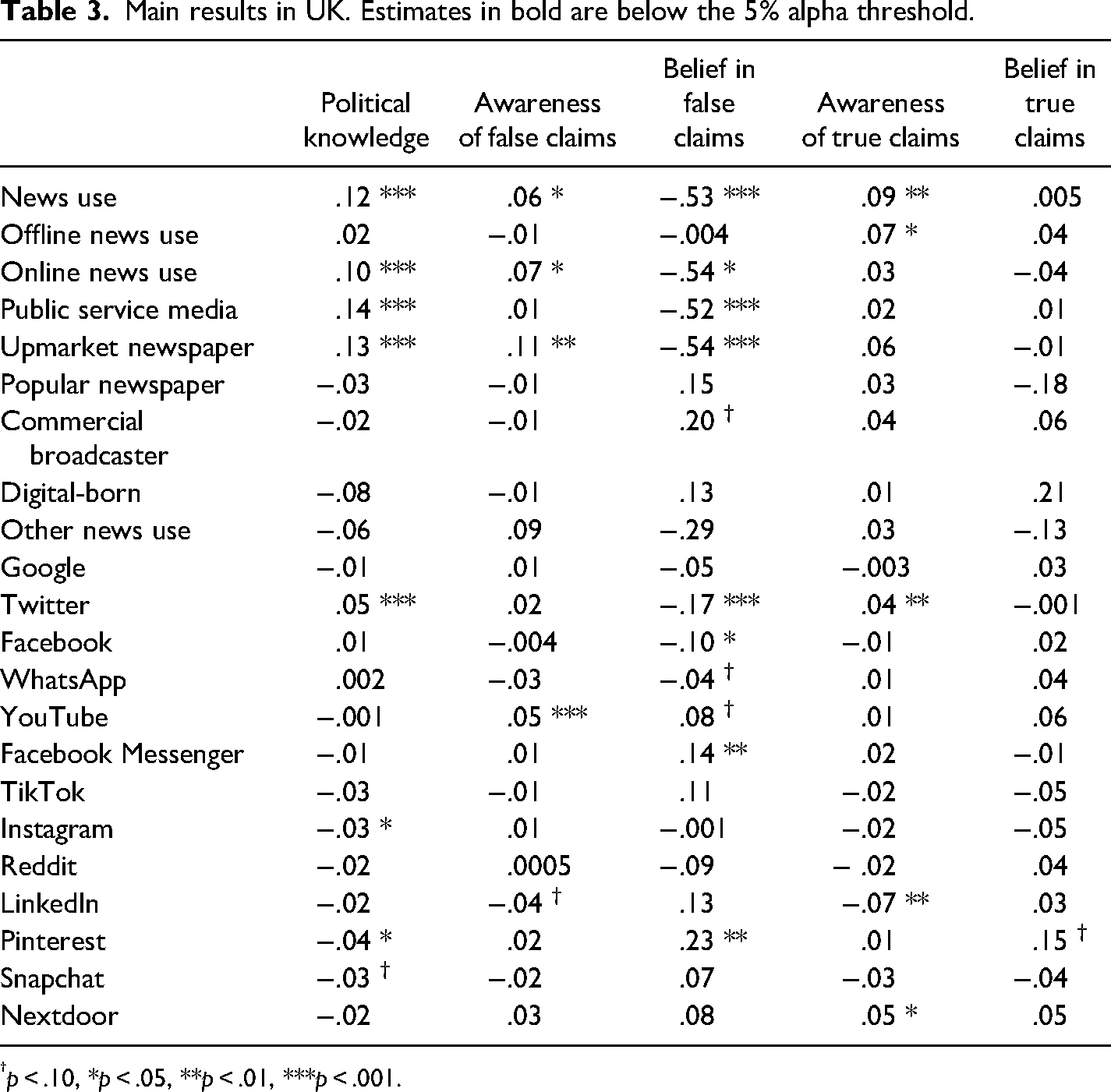
p < .10, *p < .05, **p < .01, ***p < .001.
Main results in Brazil. Estimates in bold are below the 5% alpha threshold.
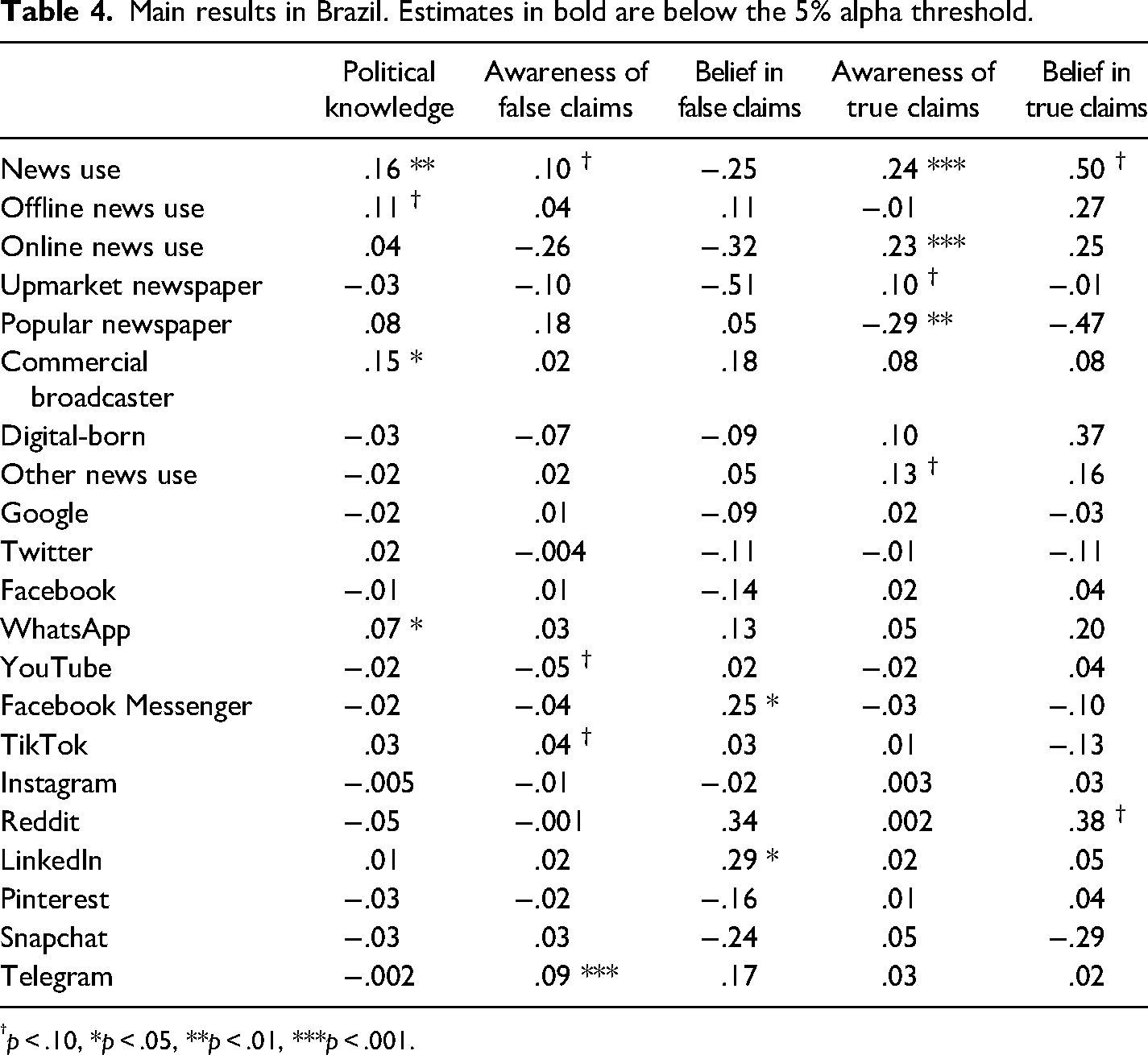
p < .10, *p < .05, **p < .01, ***p < .001.
Main results in India. Estimates in bold are below the 5% alpha threshold.
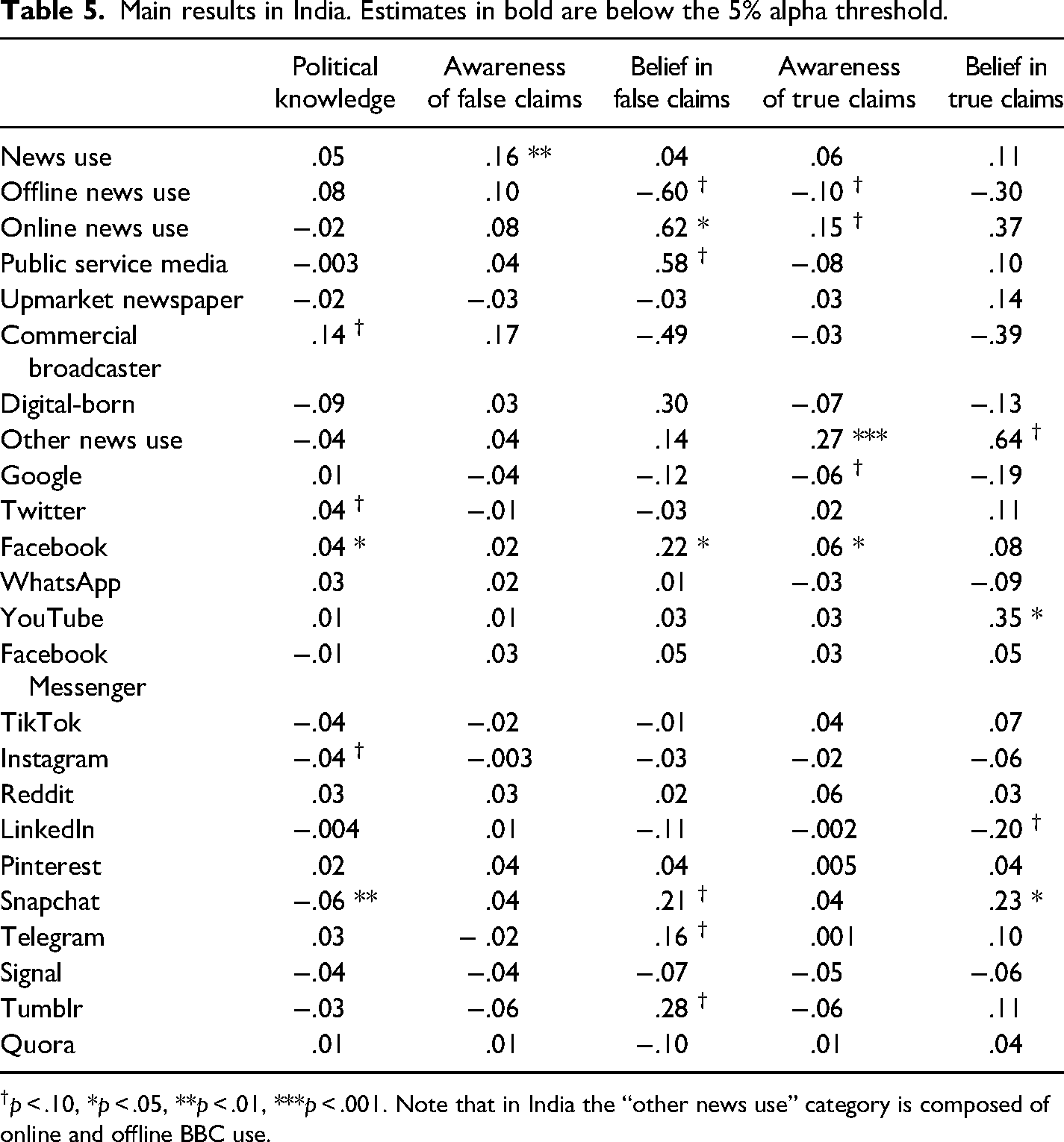
† p < .10, *p < .05, **p < .01, ***p < .001. Note that in India the “other news use” category is composed of online and offline BBC use.
We begin the analysis with the results where the dependent variable is political knowledge, as the effect of media use—especially news use—on political knowledge is better understood. This allows us to partly validate both the measures used and the overall approach. Our political knowledge variable is the sum of the correct answers in waves one and two.
In the UK, more frequent general news use led to stronger political knowledge gain over time (b = .12 [.07, .16]). Subsequent models suggest that the effect of general news use was primarily driven by online news use (b = .10 [.06, .15])—whereas the effect of offline news use was not significant. More frequent public service media news use (online and offline combined) and upmarket newspaper use also led to stronger political knowledge gain (b = .14 [.09, .19] and b = .13 [.07, .18]). In Brazil, more frequent general news use also strengthened political knowledge gain (b = .16 [.06, .27]), and although we did not find any significant differences between online and offline access, subsequent analysis showed a significant effect of more frequent commercial broadcaster news use (b = .15 [.01, .28]). In India, more frequent general news use had no significant effect on how much political knowledge people gained. Thus, our answer to RQ1, is that more frequent news use increases the likelihood of political knowledge gain in the UK and Brazil (see Figure 2), but with differential effects of access mode and outlet type in the UK.
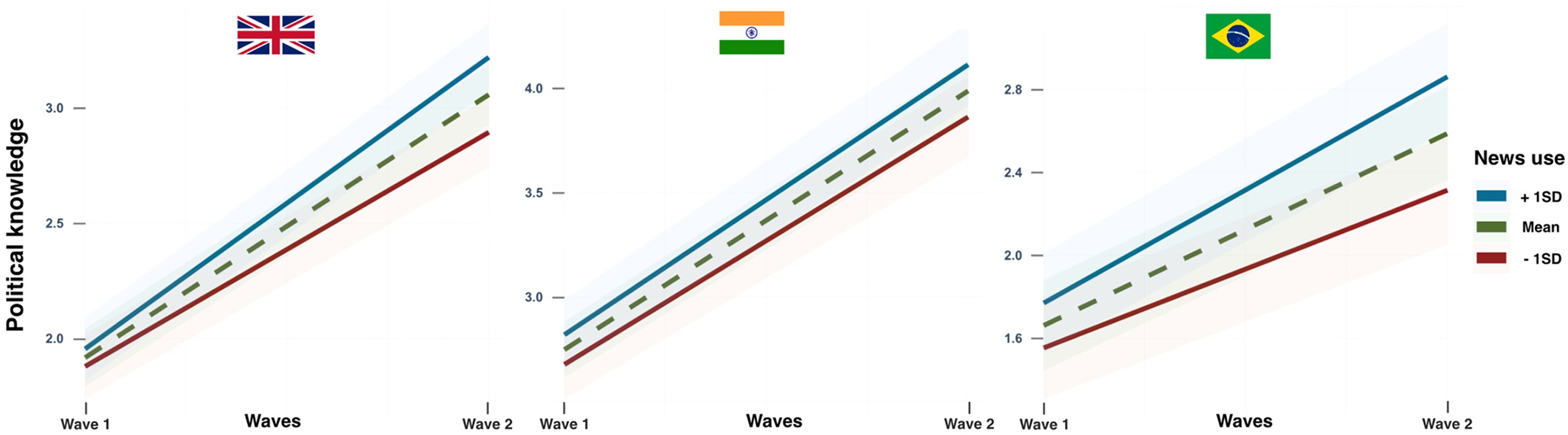
Political knowledge gains between wave 1 and wave 2 as a function of news use. The green dotted lines represent political knowledge gains for participants with average news use, while the solid blue line for one standard deviation above the average news use, and the solid red line for one standard deviation below the average news use. The colored shaded areas represent the 95% confidence intervals.
Focusing now on the effect of platform use on political knowledge gain, in answer to RQ2, for the most part more frequent platform use did not have a consistent effect on political knowledge gain. Looking in more detail, we see that in the UK, more frequent Twitter use strengthened political knowledge gain (b = .05 [.03, .07]), whereas more frequent Instagram (b = −.03 [−.05, −.01]), and Pinterest use (b = −.04 [−.08, −.01]) weakened political knowledge gain. In Brazil, more frequent WhatsApp use strengthened political knowledge gain (b = .07 [.01, .13]), and in India, more frequent Facebook use had a similar effect (b = .04 [.001, .09]). However, more frequent Snapchat use weakened political knowledge gain (b = −.06 [−.11, −.02]).
We now turn to the main focus of the study, which is the effect of media use on broadening awareness of and acquiring belief in false claims about COVID-19 (RQ3-4). Both dependent variables were computed as the sum of the responses to all false claims on the seven-point scale.
In the UK, more frequent general news use broadened awareness of false claims (b = .06 [.003, .11]), but crucially, it also weakened false belief acquisition (b = −.53 [−.74, −.32]). In other words, people who use news more frequently are more likely to be aware of the existence false COVID-19 claims as they emerge over time, but are simultaneously less likely to believe them. In the UK, the effects of news use on false belief awareness and acquisition were driven by online news use (b = .07 [.02, .13]; b = −.54 [−.74, −.33])—offline news use had no significant effects. More frequent upmarket newspaper use (b = .11 [.04, .17]) broadened awareness of false claims, while more frequent public service media news use (b = −.52 [−.76, −.29]) and upmarket newspaper use (b = −.54 [−.78, −.30]) weakened false belief acquisition. The negative effect of news use on false belief acquisition, and its positive effects on political knowledge acquisition, are mainly driven by the online use of the BBC and the Guardian. But the use of most individual news outlets across countries does not have significant effects on any of our dependent variable (see SI section 8). In India, more frequent general news use broadened awareness of false claims (b = .16 [.05, .28]), but had no significant effect on false belief acquisition. More frequent online news use increased the likelihood of false belief acquisition (b = .62 [.05, 1.18]) while we find an opposite, but non-significant, trend for offline news use (b = −.60 [−1.28, .08]). In Brazil, more frequent news use had no significant effect on awareness of or belief in false claims.
In answer to RQ4, we find only very limited support for the idea that the most-widely used news brands are increasing belief in false claims about COVID-19. Overall, news use broadened people's awareness of false claims (RQ3, see Figure 3), but did not increase the likelihood that people believe them (RQ4, see Figure 4). This suggests that the news media is largely able to report on COVID-19 misinformation, often increasing awareness of it, without inadvertently raising belief in it.
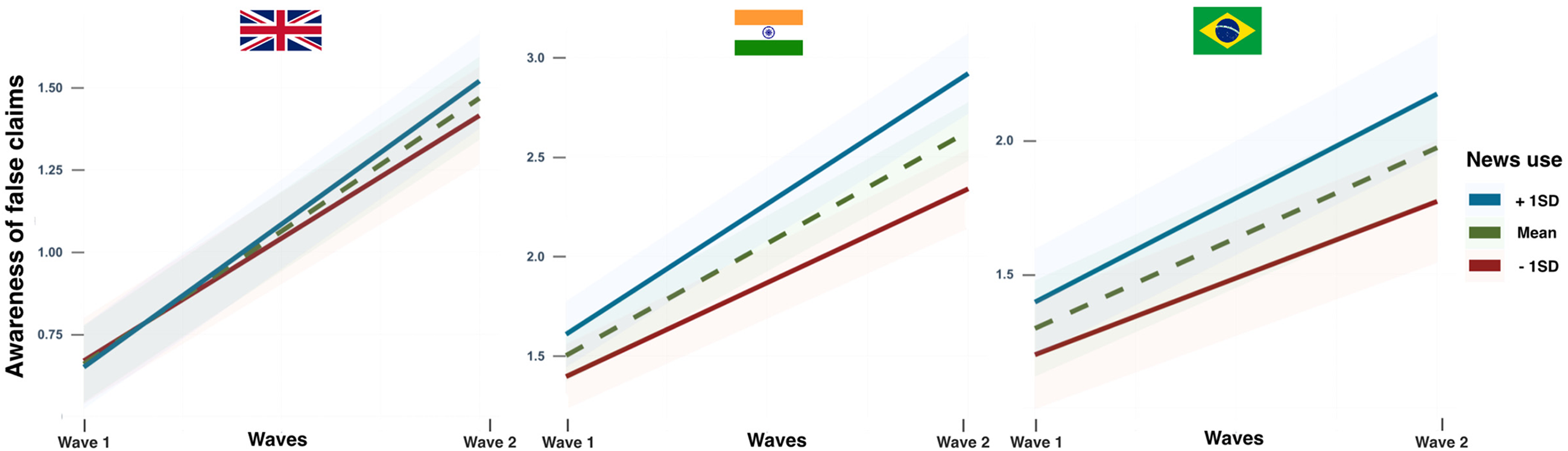
Evolution of false claims awareness between wave 1 and wave 2 as a function of news use. The green dotted lines represent the evolution of awareness of false claims for participants with average news use, while the solid blue line for one standard deviation above the average news use, and the solid red line for one standard deviation below the average news use. The colored shaded areas represent the 95% confidence intervals.
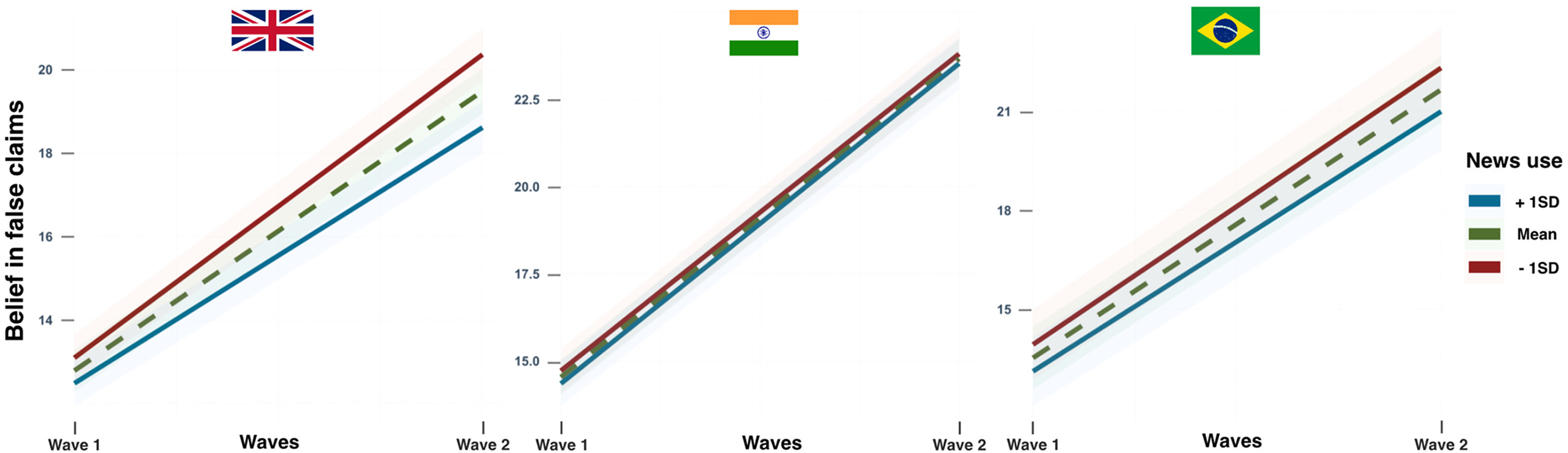
False belief acquisition between wave 1 and wave 2 as a function of news use. The green dotted lines represent false belief acquisition for participants with average news use, while the solid blue line for one standard deviation above the average news use, and the solid red line for one standard deviation below the average news use. The colored shaded areas represent the 95% confidence intervals.
We turn now to RQ5 and RQ6, and the effect of platform use on awareness of, and belief in, false claims about COVID-19. As can be seen in Tables 3 to 5, more frequent use of most digital platforms had no significant effect. Here, we report the few effects that reach statistical significance. In the UK, more frequent YouTube use broadened awareness of misinformation (b = .05 [.03, .08]). And more frequent Twitter and Facebook use weakened false belief acquisition (b = −.17 [−.26, −.08]; b = −.10 [−.18, −.01]) while more frequent FB Messenger and Pinterest use strengthened it (b = .14 [.04, .24]; b = .23 [.07, .39]). In India, more frequent Facebook use strengthened false belief acquisition (b = .22 [.01, .43]). In Brazil, more frequent Telegram use broadened awareness of false claims (b = .09 [.04, .13]), while more frequent FB Messenger and LinkedIn use strengthened false belief acquisition (b = .25 [.004, .49]; b = .29 [.02, .57]).
Although we mainly found null effects from the most widely used platforms, we also preregistered research questions on the mediating effect of political interest (RQ7,8,15) and trust in news (RQ9,10,16) on the effect of platform use. To answer these, we look at the three-way interactions between wave, platform use, and political interest/trust in news. Here, we report the strongest effects and offer an exhaustive overview, together with visual representations, in SI section 10. In the UK, more frequent Reddit use strengthened political knowledge gain among those who trust the news the least, while weakening it among those who trust the news the most (b = −.05 [−.08, −.02]). In India, more frequent Google use strengthened political knowledge gain among the least politically interested (b = −.07 [−.11, −.02]). In Brazil, more frequent Google use increased the likelihood of false belief acquisition among the least politically interested, while reducing it for the most politically interested (b = −.27 [−.52, −.03]).
Regarding the effect of news use and platform use on awareness of and belief in true claims about COVID-19 (RQ11–14), we found that more frequent news use broadens awareness of true claims in two countries, but we found no significant effect on belief acquisition. And most platforms had no significant effect on either awareness of or belief in true claims (see Tables 3 to 5).
Conclusion
Our findings challenge the notion that news media in general, by drawing people's attention to false and misleading content (Tsfati et al. 2020), leave the public misinformed (Haber et al. 2021), and support the idea that news helps people become more informed about politics (Aalberg and Curran 2012), and in some cases, more resilient to misinformation (Humprecht et al. 2020). With some variation across countries and across categories of media outlets, news use increases political knowledge gain, and while it often broadens people's awareness of false and misleading claims, it does not increase the likelihood—and in several cases decreases the likelihood—of believing misinformation. In line with previous research, both comparative studies and work focused on individual outlets such as Fox News (Jamieson and Albarracin 2020; Simonov et al. 2020), we find that not all kinds of news media deliver these effects, and a few may sometimes have detrimental effects—such as online news in India.
Increasing awareness of false claims without systematically reducing beliefs in false claims could be seen as a negative outcome. But it also means that with a few exceptions, news is unlikely to be causing acceptance of false claims about COVID-19. And it is worth noting that despite our efforts to select popular false claims about COVID-19, few of them were believed by participants (i.e., only 33% of participants in Brazil, 31% in India, and 10% in the UK, rated the false claims about COVID-19 as “slightly accurate” or more).
The role of news may be particularly important at the beginning of a crisis, when the need for information is high. For instance, in March 2020 when the WHO announced that we were facing a pandemic, online news consumption increased across countries (Altay et al. 2022), creating opportunities for informing the public, but also for misinforming it. At the beginning of 2022, when we conducted the present survey, a new COVID-19 variant—against which existing vaccines were less effective—led to a surge in COVID-19 infections. The effect of news use may be smaller outside of this rather unusual context, when uncertainty is lower and the role of news is less central.
In line with previous work (Lorenz-Spreen et al. 2021, Amsalem and Zoizner 2022), the informational benefits of relying on various digital platforms—both when it comes to increasing political knowledge gain, and weakening belief in misinformation—are much less clear. With a few exceptions, we find no significant effects either way. When we examine three-way interactions between wave, platform use, and political interest/trust in news, neither political interest nor trust in news had a consistent influence on the effect of platform use. We found no consistent effect of political orientation across countries. In the UK left-wingers were less likely than centrists to believe false claims about COVID-19, whereas in Brazil right-wingers were more likely than centrists to do so.
Our study has several limitations, including the reliance on online panels and the limitations of the sample—to some extent in Brazil, but especially in India—as well as in the specific focus on false and misleading claims about COVID-19, which may not generalize to misinformation about other issues. But we believe a three-country comparative panel design still helps shed light on key issues that have so far seen limited research. Despite a boom in insightful studies on the spread of misinformation across digital platforms and sometimes some news media, we still have much less work on whether, when, and under what conditions using these different sources of information impacts people's awareness of and, most importantly, belief in misinformation.
Some of our results—the absence of the negative effects of relying on news media and null effects for most platforms—are consistent across the three very different countries included in our comparative design. This suggests these may be generalizable across different contexts, though ideally researchers would want to test this in a wider range of countries. Others vary significantly—how many categories of news media increase political knowledge gain, and whether news media use reduces the likelihood of believing false claims—underlining the importance of continued comparative work to guard against unwarranted generalizations from case studies of individual countries, and of developing a better understanding of the link between variations in media systems (how media are organized, funded, etc.) and media effects (on political knowledge, belief in misinformation, etc.).
The findings have significant implications for how we think about the role of different kinds of media when it comes to misinformation. They document the key role that news media often, but not always and not everywhere, play in keeping people informed and resilient to misinformation. They support other empirical studies in the emerging literature on platforms that, while often problematic in other and more specific respects, challenge more sweeping assertions made about how they might lead to people being misinformed. They also underline the importance of cross-nationally comparative, and medium, even brand- or platform-specific research as the results are generally not uniform—for instance in India more frequent online news use increased the likelihood of false belief acquisition. The findings are a powerful reminder that any study of how informed or misinformed people are needs to consider the role played by news media, that context is key, and comparative work essential to advance our understanding.
Substantially, our findings raise questions for both platform companies and news media. Digital platforms may not feel it is their job to ensure the public is well informed, or at least not misinformed. But hundreds of millions of people across the world rely on them to access and find news and information and whatever the companies themselves think their role is, it is important to understand the effects they have on users. If digital platforms would like to ensure that relying on their products and services leave people less likely to be misinformed, our work is yet another reminder that they clearly still have much work to do.
For news media, some of the findings are encouraging. Editors and journalists may well feel helping people become more informed is the primary public purpose they serve and, given necessarily finite resources, focus on that. If, however, they want to take on a broader role—to not only seek truth and report it, but also to seek bullshit and debunk it—our research suggests that most current approaches do not have the unintended consequence of increasing belief in misinformation. Instead, relying on news media often helps people become more knowledgeable about politics, and, despite the concerns of some fact-checkers and researchers, even if it does make people more aware of false and misleading claims, news generally does not leave people more misinformed. In short: news can help.
Supplemental Material
sj-pdf-1-hij-10.1177_19401612221148981 - Supplemental material for News Can Help! The Impact of News Media and Digital Platforms on Awareness of and Belief in Misinformation
Supplemental material, sj-pdf-1-hij-10.1177_19401612221148981 for News Can Help! The Impact of News Media and Digital Platforms on Awareness of and Belief in Misinformation by Sacha Altay, Rasmus Kleis Nielsen and Richard Fletcher in The International Journal of Press/Politics
Footnotes
Declaration of Conflicting Interests
The author(s) declared no potential conflicts of interest with respect to the research, authorship, and/or publication of this article.
Funding
The author(s) disclosed receipt of the following financial support for the research, authorship, and/or publication of this article: This research was completed as part of the Oxford Martin Program on Misinformation, Science, and Media funded by the Oxford Martin School and with further support from the BBC World Service as part of the Trusted News Initiative.

Supplemental Material
Supplemental material for this article is available online.
Notes
Author Biographies
References
Supplementary Material
Please find the following supplemental material available below.
For Open Access articles published under a Creative Commons License, all supplemental material carries the same license as the article it is associated with.
For non-Open Access articles published, all supplemental material carries a non-exclusive license, and permission requests for re-use of supplemental material or any part of supplemental material shall be sent directly to the copyright owner as specified in the copyright notice associated with the article.
