



Abstract
Background
Diastolic wall strain (DWS) is based on linear elastic theory, which shows that impaired diastolic wall thinning reflects resistance to deformation in diastole and thus, increased diastolic myocardial stiffness. We aim to explore the role of DWS in patients with heart failure with preserved ejection fraction (HFpEF) in terms of correlation with indices of HFpEF.
Methods
Study enrolled 53 patients with exertional dyspnoea and normal left ventricular ejection fraction. Forty patients fulfilled the criteria for HFpEF according to ESC 2023 criteria.
Results
Two groups were analysed – Group 1 with criteria of HFpEF fulfilled and Group 2 with those who did not. Echocardiographic indices including relative wall thickness (RWT), left ventricular mass index (LVMI), E/e’, left atrial volume index (LAVI) and DWS were numerically different on comparison with group 2, with LVMI, LAVI and E/e’ statistically significant. Also mean Global Longitudinal Strain (GLS) was found to be −13.05%. Group 1 was divided into HFpEF with DWS ≤ median and HFpEF with DWS > median. Echocardiographic indices showed statistically higher LVMI and atrial filling fraction. This finding showed that patients with reduced DWS were more likely to have diastolic dysfunction. Also, it was found that DWS had a statistically significant correlation with LVMI, LAVI and RWT. Lower DWS had abnormal GLS. Limitations include small sample size.
Conclusion
Although difference in DWS between HFpEF and controls did not reach statistical significance, stratification by median value showed significant correlation of DWS with myocardial relaxation parameters. Also, with significant correlation with increased atrial filling fraction higher N-terminal pro-B type natriuretic peptide and correlation with impaired GLS, our study supports DWS as a potential research tool in evaluation of HFpEF.
This is a visual representation of the abstract.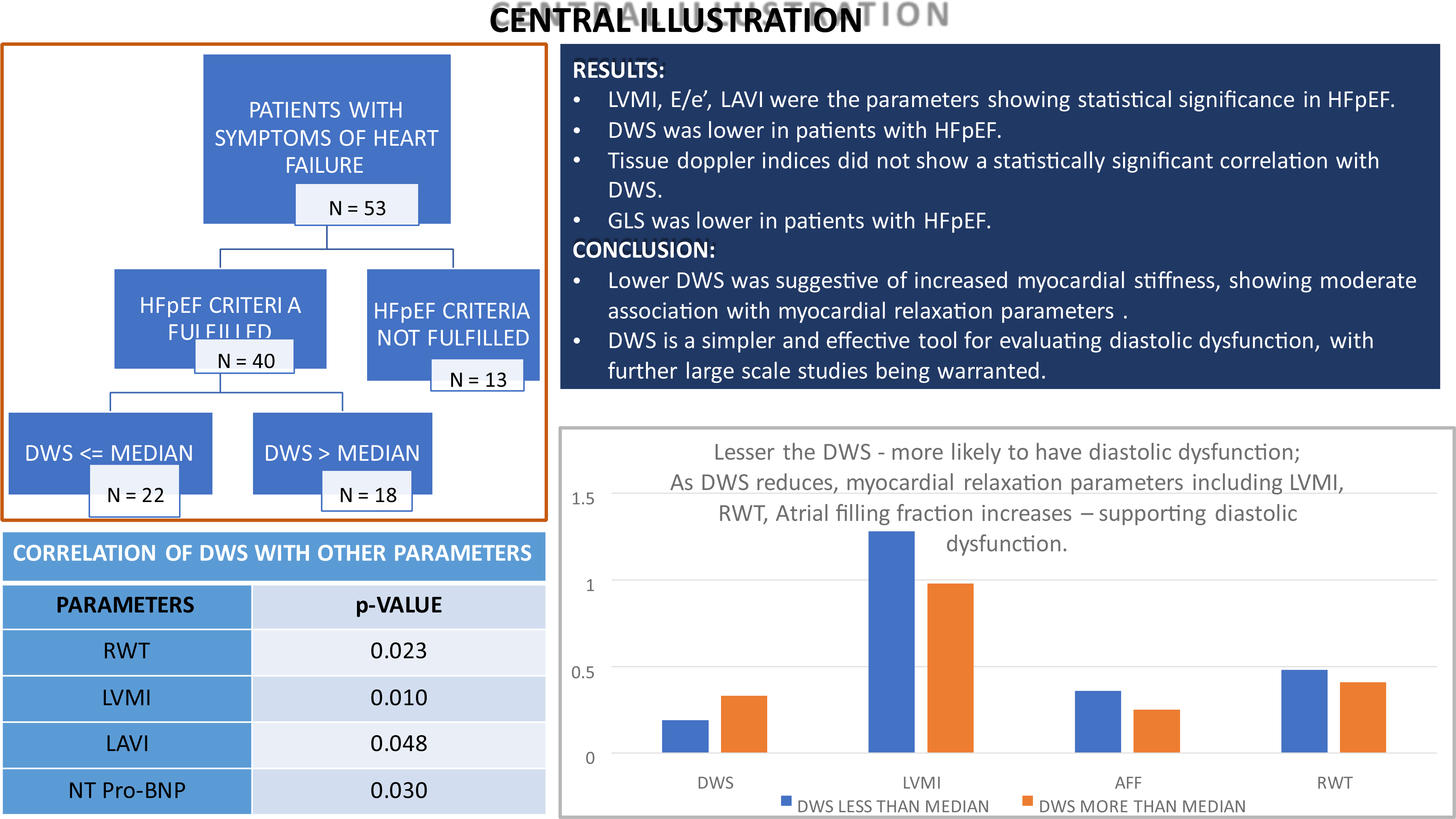
Get full access to this article
View all access options for this article.