



Abstract
In this article, the motives for voluntary work and work values in higher education contexts are examined in a cross-border region in Central Eastern Europe. Our goal is to find out what kind of relationship exists between different types of volunteering and work values among young people. In the theoretical section, we deal with the definition of volunteering in the education system, the types of and motives for students’ volunteering, and finally, the relationship between the work values and voluntary work of students. In the empirical section, we created cluster groups based on students’ motives for volunteering, and we examined differences among countries. Then we revealed the factor structure of the work values of students and analyzed the relationship between cluster groups and factors with variance analysis. Five cluster groups were identified: “careerists with postmodern features,” “unmotivated,” “highly motivated,” “volunteers in an anti-volunteering climate,” and a “helping new type volunteers” group. There were only slight differences among countries, as most respondents are characterized by mixed motivations. An interesting result is that the most frequent group is “the volunteers in an anti-volunteering climate” in all the countries examined, especially in Ukraine, so the culture of volunteering is not popular enough in this region of Central Eastern Europe. Regarding the relationship between work values and volunteering, we have found that these two fields (work values and volunteering) are closely related.
Introduction
In Central and Eastern Europe, the fall of communism and the transition to democracy had an impact on volunteering. Juknevicius and Savicka (2003) showed that the forced or often “compulsory” volunteering 1 which was prevalent during communism declined, while genuinely “voluntary” volunteering in new organizations gained popularity. This increase, however, was not constant. In the years after the fall of communism, the rise of civic society brought about an increase in volunteering; however, these swift changes were soon followed by a decrease in the pace of these phenomena and even a decline in volunteering.
Before the fall of communism, many people volunteered as a form of opposition (religious movements, “underground” political movements, and green movements), but at the same time, membership of state-controlled trade unions and professional labor organizations was widespread. After the end of communism, professional labor organizations and trade union movements lost much of their significance. The level of church-based volunteering rose for some years but then declined after a while. However, since the turn of the millennium voluntary activity among the whole population is on the increase, for example, in Hungary it increased by 14% from 2007 to 2012 (Society at a Glance, 2014). Nowadays, most Central Eastern European countries belong to the middle level (20–30%) of volunteering countries in the European Union (EU; Eurobarométer 752, 2011).
Our goal is to describe the types of volunteering among higher education students based on their motivations and to find a relationship between these groups of motivations and the work values of students. Besides this, we intend to show the differences between four Central Eastern European countries in the cross-border region under examination. To examine higher education students’ volunteering in 2015 is important because 2016 was the year in which the first generation in Hungary finished their school community service program (IKSZ) in secondary schools, so the positive effect of the program on volunteering among higher education students can also be measured later on based on our data.
Volunteering is a relatively new activity among higher education students in Central Eastern Europe and has been examined only very rarely, so far. Furthermore, in the academic literature, there are only a few papers which deal with higher education students’ volunteering. In Hungary, studies have been published examining the volunteering activities of the whole Hungarian population (e.g. Bartal, 2010; Czike and Kuti, 2006; Perpék, 2012) and of the young generation (Szabó and Marián, 2010), but they do not focus on volunteering among higher education students. The study by Handy et al. (2010) deals with this specific area, but their cross-cultural examination does not examine the tendencies in Central Eastern Europe.
Another important reason why volunteering among higher education students should be examined is that volunteering could be a measure of higher education efficiency. Volunteering – just like higher education itself – helps students’ academic development, other life skill development factors, and last but not least, civic consciousness and responsibility (Astin and Sax, 1998; Eyler et al., 1997; Hesser, 1995). Besides this, alongside traditional volunteering (i.e. based on altruistic values), it is interesting to examine in this special region the new type of volunteering among students (i.e. voluntary activities done to develop curriculum vitae (CVs)), which is becoming more and more popular (Handy et al., 2010). Furthermore, an examination of the relationship between the work values of students and the motivations for voluntary work is an outstanding need in the academic literature.
In the theoretical part of our article, we deal with the definition of volunteering, volunteering in the education system, the types and motives of students’ volunteering, and finally, the relationship between the work values and voluntary work of students. In the empirical part, cluster groups have been identified based on students’ motives for volunteering, and we examine differences among countries. Then we show our results relating to the factor structure of the work values of students and analyze the relationship between motivation cluster groups and factors with variance analysis. Finally, we examine work values by countries in the largest motivation cluster group.
The definition of volunteering in the education system
When defining volunteering, four main criteria are differentiated: it is not obligatory, it is done for the benefit of others (for other individuals, for institutions, or for society as a whole), it is not a paid activity, and it is usually done in an organizational framework (Bartal, 2010; Dekker and Halman, 2003; Handy et al., 2010; Wilson, 2000).
Since 2011, in order to obtain a school-leaving certificate from a Hungarian secondary school, a requirement has been participation in the School Community Service program (Iskolai Közösségi Szolgálat), which is a sort of obligatory “voluntary work” (see Bodó, 2015; Markos, 2015). The five goals of the program are to increase volunteering among secondary school students in the future, to gain work experience and to help students in career choices, to increase the sociability of students, to enlarge the social capital and social relationships of students, and finally, to be an active citizen in the future.
“Community service” in Western European higher education, similarly to Hungarian secondary education, is sometimes mandatory (it is not certain, however, to what extent it can be regarded as volunteering). Another term in use is “service learning,” which is slightly different, because community service of this kind also includes learning about a concrete topic. The latter is often built into the curriculum as an element of certain courses and as a kind of professional practice. Service learning differs from professional practices, which are prevalent in Hungary, among other countries, in that it is not necessarily connected to the given field of study. Its focus is rather on volunteering, that is, on the contribution to the common good. Its fields include education, healthcare, neighborhood activities, environmental protection, and general protection. There is also an extracurricular variant of service learning.
Service learning is also a new teaching method and is, thus, investigated from an educational–methodological perspective as well (Freese, 1998). It can be part of the educational mission at a faculty, integrated into the curriculum, either within the discipline or in an interdisciplinary context (Zlotkowski, 1996). Hesser (1995) has found that social professions and the humanities may profit from this teaching method, which is described by Mabry (1998) as “civic pedagogy.” To understand the topics of the course better and more efficiently, students should discuss their experiences of community service, which is included in the curriculum, and they should spend at least 20 hours on the activity (Gray et al., 1999). Service learning is aimed at developing civic engagement, increasing social responsibility, and supporting students’ studies and development, so that they can better find their way in a democracy (Burth, 2016). The opponents of this teaching method believe that it is not beneficial to include volunteer service in the curriculum, as students would be better off spending more time in the library or laboratories (Gray et al., 1999).
Volunteer activity among higher education students can be interpreted as a sort of intermediate variable, which is influenced by higher education itself and which has a positive impact on certain efficiency indicators and competencies. In Central and Eastern Europe, volunteering is not part of the higher education curriculum; therefore, the volunteer activity of higher education students is a kind of private initiative. However, in Romania, volunteering can be a part of professional practice. In Hungary, there has been no impact of assessments on higher education volunteering, although the impact of secondary school community service has been investigated (e.g. Bodó, 2015). In the international literature, the effects of service learning and volunteering are measured in both secondary (e.g. Lin et al., 2015) and higher education (e.g. Astin and Sax, 1998; Eyler et al., 1997; Hesser, 1995). Volunteering improves the same competencies as participation in higher education, namely academic, social, intercultural, and civic competencies, so there are many positive effects of volunteering in higher education.
Types and motives of volunteering among the young generation
When we investigate the motives for volunteering, we wish to obtain an answer to the question of why an individual does a particular volunteer activity. In the past, motivational models were quite simple, only including two or three factors (altruistic, egoistic, and social motivation), but now, multifactorial models are more commonly used. An interdisciplinary approach is increasingly favored, in which sociological, psychological, social psychological, economic, and other factors are investigated. Given that an individual’s motives are not independent of one another, and there are strong connections between some of them, it might be worthwhile to talk about motivational bases. Old-type volunteering is more coherent, whereas the motivational system of the new type of volunteering is less so (Czike and Kuti, 2006). According to Dekker and Halman (2003), both altruistic and egoistic motivations can lead to volunteer activity, although nowadays, rational motives tend to dominate more and more.
The traditional (old-type) motivations of volunteering are based on altruistic values (e.g. being useful for society and doing something for others) and on the importance of social interactions and community. The modern motivations include career development, personal growth, work experience, professional improvement, gaining information, developing and practicing skills, getting a job more easily, increasing human capital, making friends, meeting people with similar interests, and taking part in a useful leisure activity (learning and practicing sports and cultural activities). Among the young generation, the mixed motivation type is also frequent: for example, helping others is also important for students with modern motivations (Czike and Kuti, 2006; Handy et al., 2010; Perpék, 2012; Stefanescu and Osvat, 2011).
Handy et al. (2010) referred to one of the new types of volunteering among higher education students as career-related résumé-building volunteering (e.g. they do voluntary work because they can add this experience to their CVs). One of the characteristic features of this type of volunteering is the conversion of various forms of capital. By means of voluntary activities, the young generation converts the cultural and social capital they obtain into material capital later on in the form of higher wages and better jobs. In those countries (e.g. Canada and the United States) where volunteering represents a strong positive signal for employers, when young people are seeking jobs, they are more inclined to volunteer.
Another type of new volunteering among the young generation is cultural or leisure-oriented volunteering. Inglehart (2003) showed that volunteering has not decreased over recent years, but the traditional type of volunteering is less frequent. Young volunteers perform activities in a more flexible organizational framework, mainly in charitable and sports associations. However, regarding leisure-time volunteering, it is still important that the volunteer should work for the benefit of others (function and task tackling).
In Hungary, the motivations for volunteering among the young generation include belonging to a community, facing a challenge, professional development, spending leisure time in a useful way, and making new friends, so the motivations are more or less modern, but these results are valid among the whole 16- to 29-year-old population and not just higher education students (Szabó and Marián, 2010).
The new type of volunteering is usually goal-oriented, entailing more freedom and autonomy. It is a brief activity, and it takes place in a flexible organizational framework. “Revolving door volunteering” is also popular among the young generation. Young people want to test themselves, so they do several short-term voluntary activities and want to find which activity they are most effective at (Hustinx, 2001).
Handy et al. (2010) differentiate between three motive groups for higher education students’ volunteering. The first is the career-building motive; the second is altruistic, value-driven; and the third is a social motive (volunteer work due to the influence of others). We must note here that career-building motives are not necessarily egoistic. They are rather a message to the employer that the individual is career conscious and more suitable for the position than others who have not done volunteer work. Handy et al. (2010) have also shown that in the United States and Canada, the younger generation is more pragmatic, and career building is more important to them. Whether someone has done volunteer work or not is a meaningful message for employers. Furthermore, it has been found that among career-oriented volunteers, altruistic values are also important, that is, young people’s motives for volunteering are rather mixed.
The relationship between work values and volunteering
If we wish to deal with the phenomenon of work values, we have to start our analysis with the notion of values and the relationship between human actions and values. There are many definitions of values, but they are not equivalent (e.g. Hills, 2002; Kluckhohn and Strodtbeck, 1961). However, there are several common elements in these approaches: for example, the embeddedness in society or the features of their operation (values can show the right methods of actions and the right goals for members of societies – Rokeach, 1973). But it is not clear how values can precisely shape the actions of individuals because we are not dealing with a simple cause and effect relationship (Feather, 2003; Schwartz, 2004; Schwartz and Bilsky, 1987).
The phenomena of values can be analyzed from a culture and civilization perspective as well. This approach is necessary because, in this article, multiethnic regions were investigated, for example, Transcarpathia in Ukraine or Transylvania in Romania. The limits of ethnic groups are, at the same time, the limits of different civilizations according to Huntington (1996). In his civilization theory, Huntington (1996) draws the dividing line between Western and Orthodox cultures on the basis of religion, within the territory of Romania.
Comparative examinations among cultures affect several aspects that can be clearly grasped from the perspective of value preferences. Hofstede basically distinguishes six dimensions along which national cultures can be compared. 2 Some of Hofsetede’s dimensions can be linked to the phenomenon of volunteering (e.g. individualism or collectivism). It is essential to point out here that the strands of individualism lead to Western culture (Huntington, 1996; Macfarlane, 1978), while its influence in Orthodox culture seems to be more moderate (Buss, 2010). The index of the individualism is the highest in Hungary, while Romania, Serbia, and Ukraine have a modest level according to the Value Survey Modul. 3 However, we have to be aware of the fact that more collectivist thinking does not automatically affect the frequency of volunteering activities.
The different value models can be used as adequate bases in this theoretical approach. The fields of Schwartz’s two-dimensional model can correspond to the fields of work values (e.g. the fields of achievement or tradition), and consequently, to the fields of volunteering. The different types of volunteering and the main motives for volunteering can be rooted in certain segments of the value fields: the traditional type of volunteering refers to the traditional and collectivist pole, and the new type of volunteering is linked to the left side of Schwartz’s model. As we have mentioned, there is no clear-cut relationship between human actions and values, so we assume that this link does not always operate in the field of volunteering either.
The best known groups of work values are composed of intrinsic and extrinsic work values (Ester et al., 2006; Schwartz, 1999). The aims of extrinsic values are high salary, stable employment, favorable circumstances at the workplace, or the balance between work and free time. Intrinsic values refer to the evolving of human skills. There are several sociocultural variables which can form the system of work values: gender, social status, and age all shape this system as well (Abu-Saad and Isralowitz, 1997; Ryckman and Houston, 2003), and differences among countries have been shown through international quantitative analyses (Bocsi, 2015; Ester et al., 2006; Hofstede, 1997). If we analyze the system of work values, it is also very important to map other contexts (e.g. unemployment, potential wages, etc.).
Schwartz (1999) has identified two other dimensions of work values outside the extrinsic and intrinsic categories: social and power-centered work values. He connects work values with the field of normal value preferences and identifies compatible and conflicting value contexts. Social work values are in a compatible relationship with egalitarianism and harmony (harmony refers to Eastern Europe and egalitarianism to Western Europe in his model).
The academic literature regards the system of work values as the base of motivations which generate different volunteering actions (Chapman, 2007), although we know that the link between actions and values is not clear-cut. However, we suppose that the special pattern of work values results, for example, in the traditional type of volunteering. Work values also define the meaning of work for individuals.
Meglino et al. (1989) have named seven categories of work values (e.g. achievement, working hard, helping others, etc.), and according to Chapman (2007) these categories can be adapted to volunteering. Moreover, this is not a linear relationship moving from work values to actions because different volunteering actions (experiences, enjoyment, etc.) can form value preferences too. We suppose that volunteering actions can form not only value preferences but also the whole personality, and these experiences can also shape the meaning of work for individuals. The IKSZ (school community service) system, which was introduced to Hungary in 2011, will presumably influence the young generation’s conception of work.
According to our hypothesis based on the academic literature, there will be three types of volunteer groups with regard to motivations: the traditional volunteers, the new-type volunteers, and the mixed motivation type volunteers. Based on Fényes and Pusztai (2012), we also assume that the frequency of these types will differ among countries. In Hungary, where Hungarian students belong to the majority population, the new type of volunteering will be more prevalent, while in the other three countries, where Hungarian students belong to the minority group and economic conditions are worse than in Hungary, the traditional type of volunteering will be more popular. According to our further hypothesis, the patterns of work values and the patterns of volunteering clusters will mostly fit together, and we assume that the cluster center patterns in the field of work values will also differ among countries.
Method
Our research is based on the serial quantitative research conducted by the Hungarian Center for Higher Education Research and Development. Data were gathered in the border regions of four Central Eastern European countries, namely Hungary, Romania, Serbia, and Ukraine. We examined those Central European higher education institutions which have a high proportion of non-traditional (low status, rural, and minority) students.
The full-time students involved in the research were state-funded and full fee-paying students. We asked the students at the beginning and the end of the course in order to cover all levels of the course. We selected a proportional sample from the institutions, so the Hungarian sub-sample is bigger than the other cross-border Hungarian sub-samples. The planned sample size was 2000 persons. Eventually, 1792 students were questioned. 4
To examine the research questions, quantitative data were used. We conducted the data analysis with the SPSS program: cluster analysis, crosstabs, variance analysis, and factor analysis. To examine the motivations for volunteering, we used a 20-item Likert scale variable which is based on Clary et al.’s (1998) Volunteer Functions Inventory (VFI) scale. Because of the length of the questionnaire, we had to reduce the number of items to 20. Work values were mapped with the help of 19 items with a four-grade scale. The following steps will be conducted in this analysis:
We identify volunteering type clusters based on motivations;
We compare the clusters by country;
We then identify factors of work values;
We analyze the patterns of work values for different volunteering clusters;
Finally, we analyze the divergences among different countries.
We formed five cluster groups because we expected that there would be a very motivated and an unmotivated volunteer group as well. The cluster groups are the following: the “careerists with postmodern features,” the “unmotivated,” the “highly-motivated,” the “volunteers in an anti-volunteering climate,” and the “helping new type volunteers.” The cluster centers can be seen in Table 1.
The volunteer cluster groups (cluster centers, the items varied from 1 to 4; N = 461).
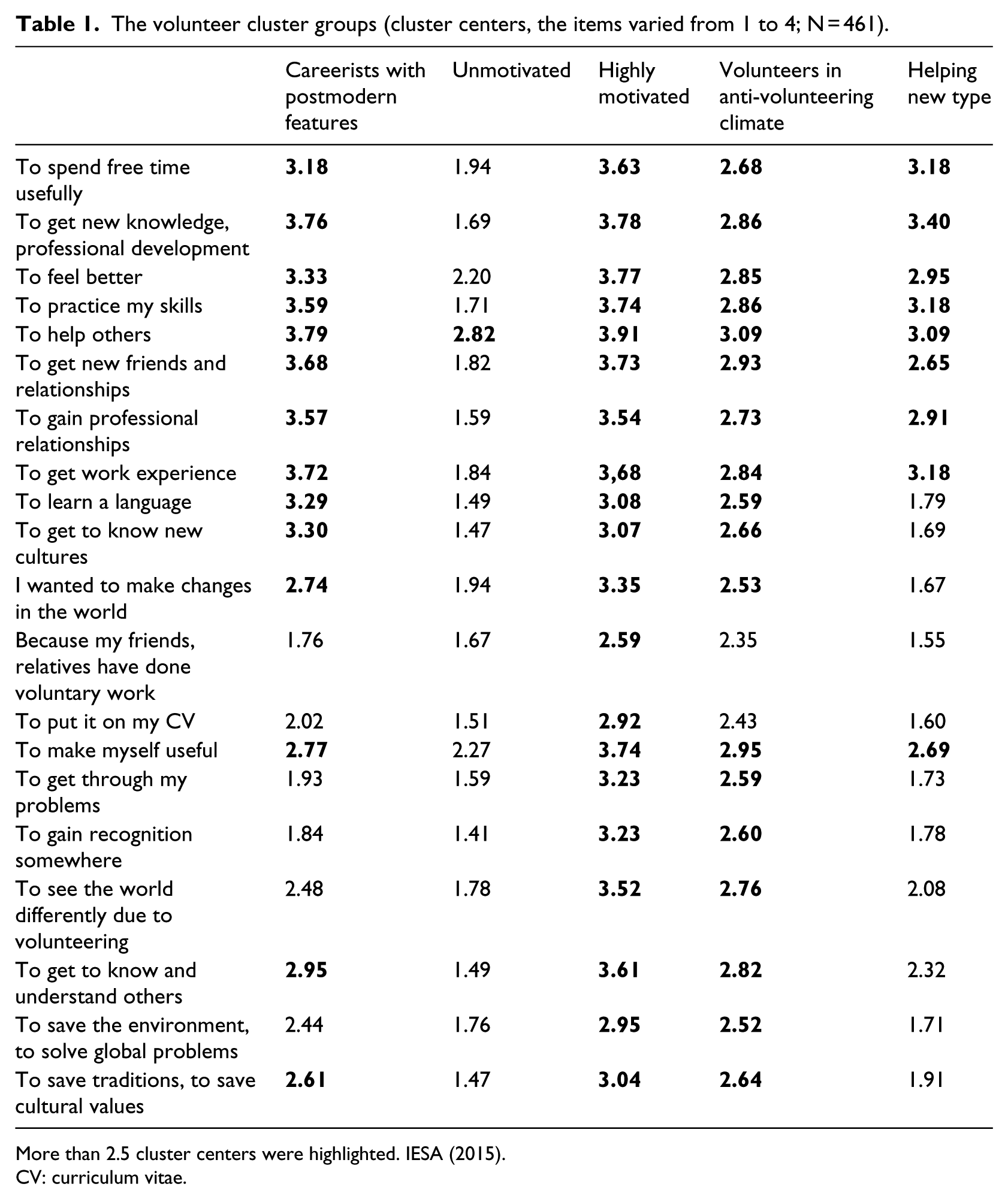
More than 2.5 cluster centers were highlighted. IESA (2015).
CV: curriculum vitae.
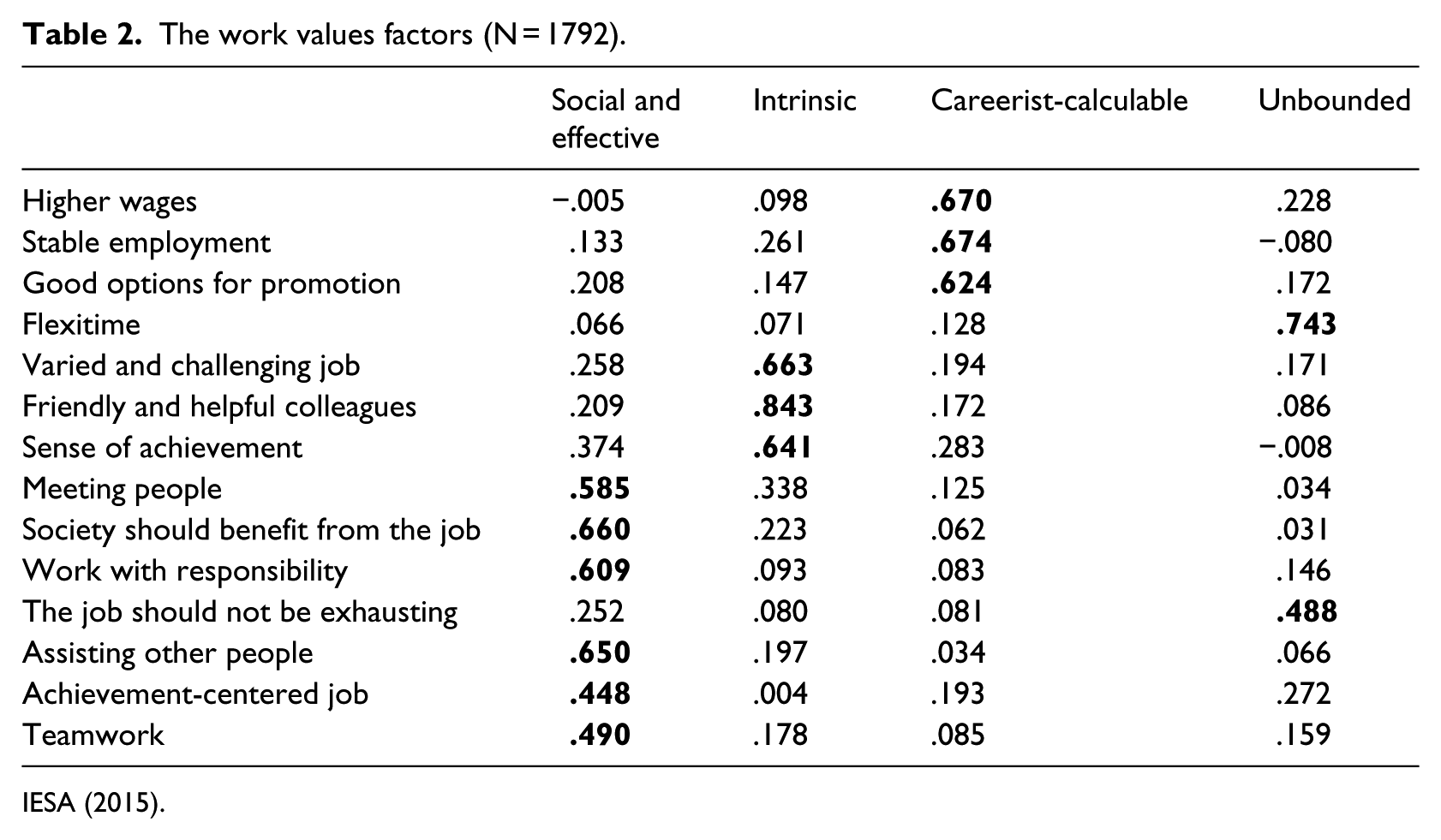
We tried to map the relationship between the system of work values and volunteering. With the help of the maximum likelihood method, four factors were identified on the basis of work values (varimax rotation, 5 KMO: .854, total variance explained: 49.5%). The patterns are shown in Table 2. Social items are mixed with the items of achievement and responsibility in the first factor (social and effective factor); this mixed type might appear strange at first sight because these items come from the different side of the Schwartz model. The second, intrinsic factor is grounded on internal motivation, success and interesting work. The careerist-calculable factor has an extrinsic feature and includes the efforts made to develop a career. Flexible working time and convenience are dominant in the last, unbounded factor.
The work values factors (N = 1792).
Results
According to Table 1, for the careerists with postmodern features type of volunteers, it is important to get new knowledge, to practice their skills, to gain professional relationships, to get work experience, and to develop professionally. When volunteering, they want to feel better, to help others, to get new friends and relationships, to make themselves useful, and to get to know and understand others. Some postmodern features such as learning languages, getting to know new cultures, making a change in the world, and saving traditions and cultural values through volunteering are important for the members of this group.
The “unmotivated” group includes those volunteers for whom no voluntary motivation item is significantly important, except that they want to help others during the activity. However, the value of this cluster center is also quite low. On the other hand, each individual volunteer motivation is important for the “highly motivated” group.
For the “volunteers in an anti-volunteering climate” group, all motivations were fairly important, except that they were not motivated by the fact that their family and friends are volunteers, and it was not important for them to put voluntary activities onto their CV, so employers do not take volunteering experience into consideration at the job interview.
Important criteria for the “helping new type volunteers” include some new type volunteer motivations, such as spending free time usefully, getting new knowledge, getting work experience, practicing their skills, getting new friends and relationships, getting work experience, and developing professionally. However, helping attitudes also appear in this group.
We examine the five volunteer groups by country. Most university students belong to the “volunteers in an anti-volunteering climate” group (see Table 3). They neither work as volunteers because their friends and family work as volunteers, nor put these voluntary activities onto their CV. Volunteering is important in itself. Their aim is not to display their volunteering activity to the outside world.
The occurrence of voluntary groups broken down by country (N = 461).
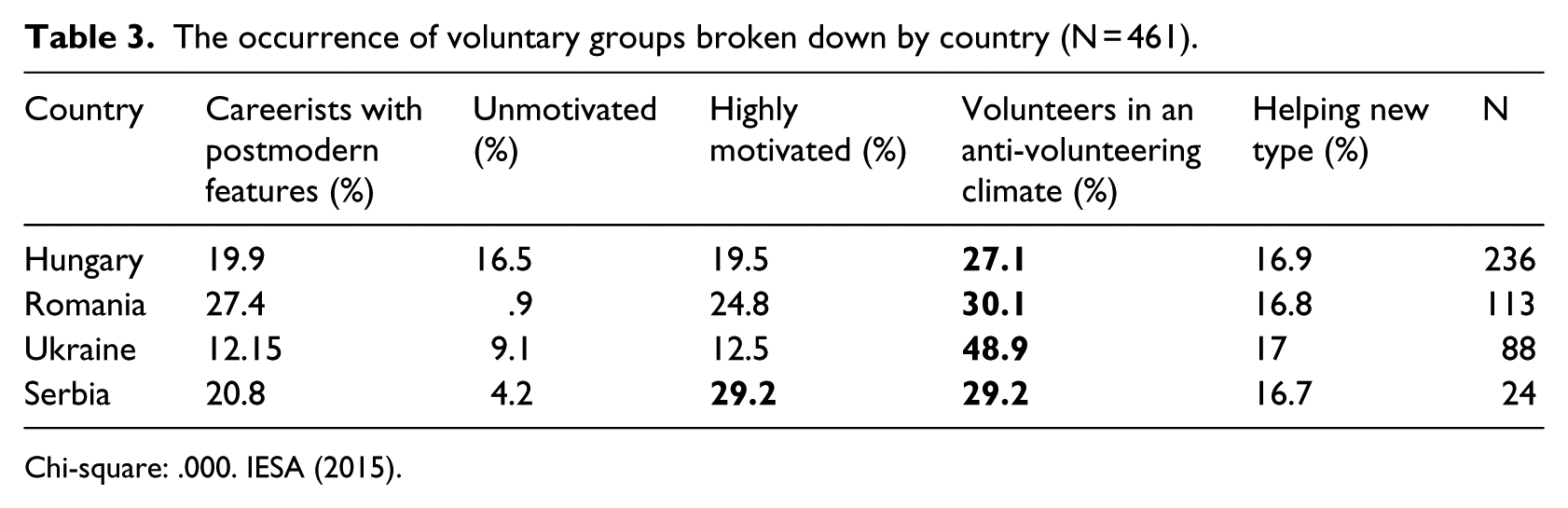
Chi-square: .000. IESA (2015).
In the “careerists with postmodern features group,” the outstanding country is Romania (27.4%), the “unmotivated” group is the highest (16.5%) among Hungarians, the “highly motivated” group is overrepresented in the Serbian sub-sample (29.2%), and the “helping new type” of volunteering is over-represented in Ukraine (17%).
Our second aim related to work values was to map the patterns of volunteering clusters. Variance analysis was used during this step, and four significant relationships were identified (analysis of variance (ANOVA), p < 0.05, sig.: .000, .000, .049, and .032). This result indicates that the ideal work preferences differ among the volunteering groups. This connection is shown in Table 4.
The patterns of work values of the volunteering clusters (N = 461).
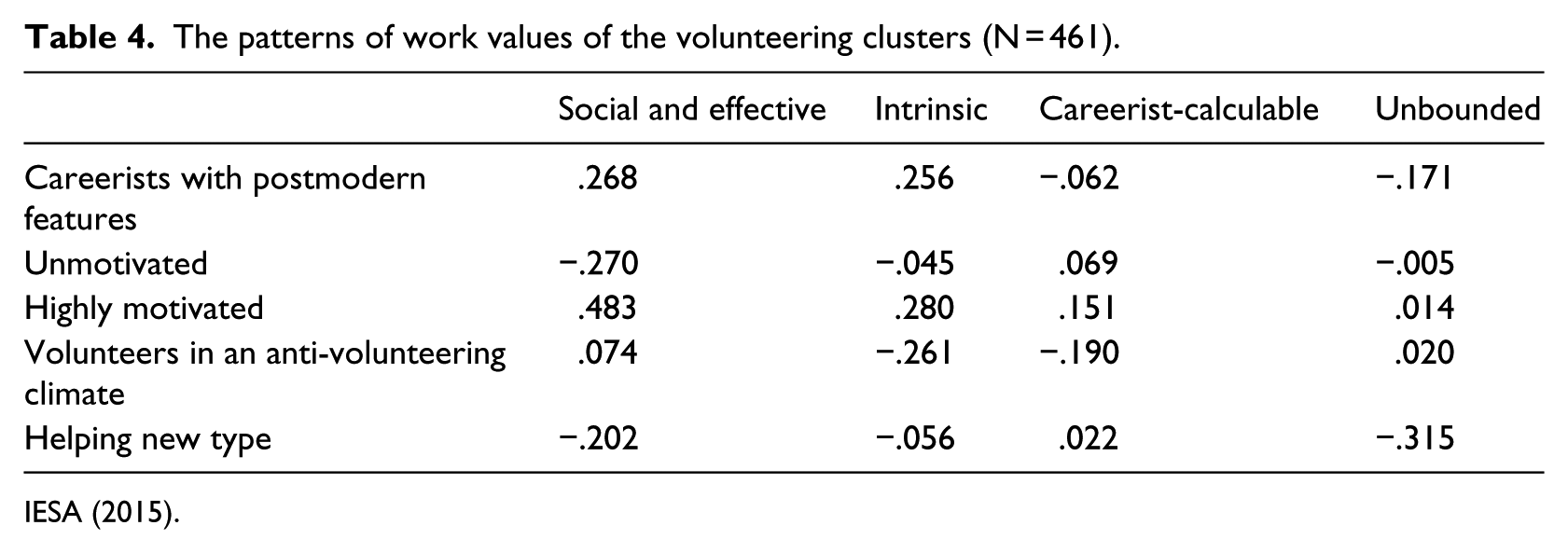
With the help of these empirical findings, the features of the clusters may be easier to explain. The social and effective elements of work values are typical in the “highly motivated” and the “careerists with postmodern features” groups, and the intrinsic features are dominant in these two groups as well. “Volunteers in an anti-volunteering climate” and “unmotivated” students have somewhat neutral or negative work attitudes, while the “highly-motivated” group has vigorous commitment toward all of the factors, with no unbounded items. Social attitudes are strong in the case of postmodern and highly motivated students. The practical motives of volunteering are typical in the “highly motivated” group, and these attitudes seem not to be significant in the case of volunteers in an anti-volunteering climate group.
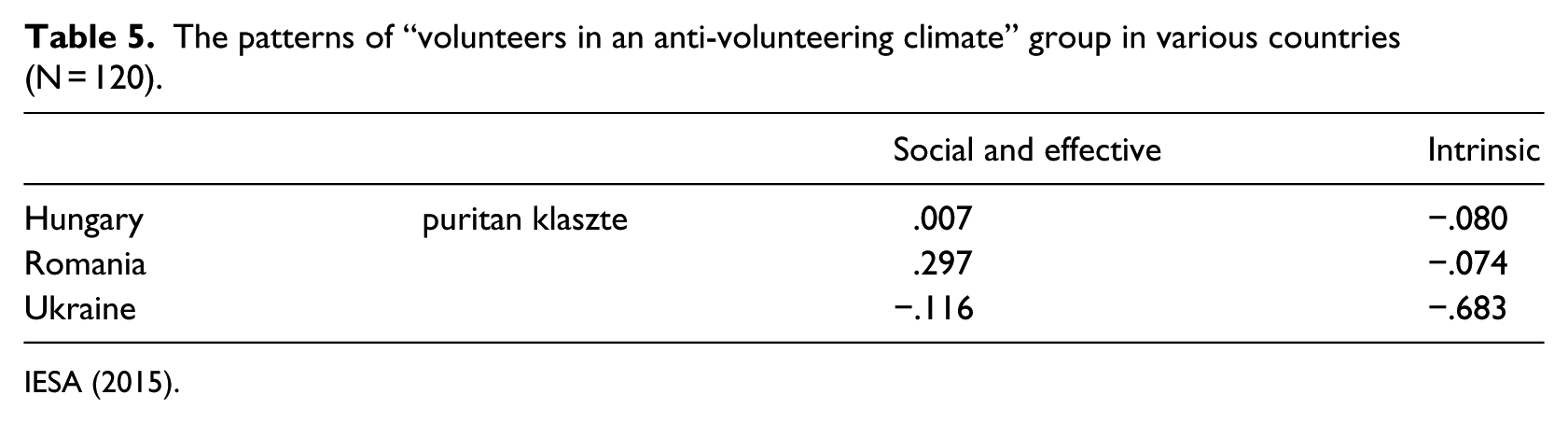
As a result, we supposed that the clusters will show different work attitudes in certain countries. Because the observed counts were low in most of the groups, we have only analyzed the patterns of the volunteers in an anti-volunteering climate in the Hungarian, Romanian, and Ukrainian sub-samples (the number of this cluster in Hungary is 53, in Romania is 27, and in Ukraine is 40). Variance analysis was used, and the empirical findings with two significant relationships are shown in Table 5 (ANOVA-test, p < .05, sig.: .001 and .01).
The patterns of “volunteers in an anti-volunteering climate” group in various countries (N = 120).
Discussion
In her previous research, Fényes (2015) examined the motivations of student’s volunteering with the help of factor analysis. According to her results, there are three volunteering motivation factors: the new type of volunteering with a helping attitude factor, the personal psychological improvement volunteering factor and the postmodern volunteering factor. In this study, we aimed to use another method. Instead of factor analysis, we used cluster analysis to examine our sample. According to our hypothesis, there will be three types of volunteer groups with regard to motivations: the traditional volunteers, the new type volunteers and the mixed motivation type volunteers. We can see in Table 1 that instead of three groups we have five cluster groups, which are the following: the “careerists with postmodern features group,” the “weak altruistic unmotivated group,” the “highly-motivated group,” the “volunteers in an anti-volunteering climate,” and the “helping new type volunteers” group.
As can be seen Table 3, most of the university students belong to the “volunteers in an anti-volunteering climate” group. In this group, Ukraine stands out, perhaps because the culture of volunteering is not yet so widespread. Most employers do not prefer jobseekers who have previously worked as volunteers.
In the “careerists with postmodern features” the outstanding country is Romania. In our sample in the Romanian higher education institutions, there are also a high proportion of Hungarian students. Hungarians are in a minority in Romania, and therefore, they have a greater need to preserve their identity than those who live in the majority society. Such identity-preserving activities include maintaining traditions and caring for culture. Consequently, they pay special attention to folkdance, folk music, and folk art. Identity-preserving activities can operate within an organizational framework which requires the involvement of volunteers.
According to Fényes and Pusztai (2012), Romanian university students have the highest proportion of churchgoers compared to other countries in the Partium region. On one hand, this strong religiosity can explain the greater rate of motivation to help, while on the other hand religiosity (which might also be considered a way of preserving traditions) reinforces other traditions.
Membership of the “unmotivated” group is highest among the Hungarians. According to the data, for the majority of higher education students, volunteering means the traditional, old type of volunteering which aims to help others. However, all motivation cluster centers are quite low in this group, so Hungarian students are much more unmotivated than others. In 2011, the government introduced the school community service (IKSZ) in Hungarian secondary schools, which can increase the number of both new-type and old-type volunteers in the future.
For the “highly motivated” group each motivation plays an important role. This group is overrepresented in the Serbian sub-sample, but their number is small in our database. This country requires the collaboration of volunteers in specific situations, for example, during wars, landslides, fires, floods, and so on. These occasions promote bottom-up initiatives and supporting activities. In Serbia, there was high rate of unemployment (21.4%) in 2015 (European Economic Forecast, 2016). So the new type of voluntary work can be helpful for young people because it helps them to enter the labor market by, for example, improving skills and competencies which are useful in the labor market, giving professional knowledge, and helping to build relationships.
The “helping new type” volunteering is overrepresented in Ukraine (17%), but the other countries (Hungary 16.9%, Romania 16.8%, and Serbia 16.7%) are not far behind. This type of volunteering helps young people to enter the labor market, so besides a helpful attitude, egoistic motivations will appear.
Our hypothesis – that Hungary is mainly characterized by the new type of volunteering and the cross-border volunteers are traditionally characterized by the old type of volunteering – is not supported. Most respondents are characterized by the new type of volunteering, but the helping attitude also appears.
As we have mentioned, the academic literature tends to regard work values as the base for motivations related to volunteering. One of our earlier publications analyzed the link between volunteering and value preferences (Bocsi and Fényes, 2012) but did not deal with the field of work values.
We have four factor groups, which are the following: the social and effective, the intrinsic, the careerist-calculable, and the unbounded (see Table 2). Our second aim regarding work values was to map the patterns of volunteering clusters (see Table 4). In one of our earlier publications, we analyzed the patterns of work values in a cross-border area. Romanian, Hungarian, and minority Hungarian students in Romania were studied in this work. The empirical findings showed that it is not only ethnic identity but also geographical location that has a strong effect (Bocsi, 2015).
The empirical findings seem to be unambiguous. The patterns of work values differ in different countries: for example, social attitudes are typical in the Romanian sub-sample, while this is not the case in the Ukrainian sub-sample. As we have demonstrated, the intrinsic factor has a negative meaning in the case of the “volunteers in an anti-volunteering climate” group (Table 4), but the means of this factor deviate from each other in the different countries. This result has made our hypothesis probable: the work values of the volunteering groups differ according to countries. The lesson of our analysis is that these categories are not universal because the motives for volunteering actions and the value background of different types are not alike. However, this link is not embedded in the minority and majority relationship either – for example, we have seen that social and effective work values are not typical in the Hungarian minority in Ukraine.
Conclusion
As we have already noted, an examination of the relationships between students’ work values and motivations for voluntary work together has not yet been carried out in the academic literature. Based on the literature concerning the motives for volunteering, we assumed that there would be three volunteer groups among students: traditional volunteers, new type volunteers, and mixed motivation type volunteers, and that, furthermore, there will be a very motivated and an unmotivated volunteer group as well. The following cluster groups have been identified: the “careerists with postmodern features” group, the “unmotivated” group, the “highly motivated” group, the “volunteers in an anti-volunteering climate,” and the “helping new type” volunteer group. Based on our previous research (Fényes and Pusztai, 2012), we also suppose that the frequency of these types will differ by country; however, there were only slight differences and most respondents are characterized by the mixed motivation type. An interesting result is that the most popular group of students the “volunteers in an anti-volunteering climate” is present in all examined countries, especially in Ukraine. This means that the culture of volunteering is not popular enough in Central Eastern Europe, friends and relatives have not been volunteers, and employers do not take voluntary experiences into account at job interviews. So, it is extremely important to increase volunteering in this region, especially among the young generation. It is also important because volunteering develops several competencies (which can be seen in the theoretical section). Faculties should inform students about voluntary work possibilities, and employers should consider voluntary work when students look for jobs. Volunteering can be involved in the higher education curriculum, as well as in secondary schools in Hungary. Promoting volunteering in higher education is important as well because of the school community service (IKSZ) programs introduced in secondary schools, so that not just secondary school students but also higher education students should be motivated to do volunteering.
To sum up the relationship between work values and volunteering, we can state that preconceptions and motives related to the labor market are different in different clusters, and that these two fields (work values and volunteering) remain closely linked. A passive attitude in one field is related to the other neutral attitudes (e.g. the unmotivated group), and strong commitment is also closely linked as well (e.g. the highly motivated group). If we attempt to analyze volunteering actions in different countries, the external contexts need to be taken into consideration because the effect of the economic and cultural context must also be significant (the features of the labor market, the potential career paths, the rate of unemployment, volunteering obligations (e.g. in Hungary), the expectations of the local or institutional communities, etc.).
All in all, as we have seen, there are no universal models and categories. The motives for volunteering and the values of students differ by country and ethnic group. Our other interesting finding is that there is an unmotivated volunteer group, which means that not all young volunteers do so enthusiastically and with strong motivation. Consequently, other – not examined – motivational factors should be included in our research later on. The terms ‘modern’ and ‘traditional’ volunteering should also be shaded and further developed, as other types of volunteering have appeared among the student community. The fact that the volunteers in an anti-volunteering climate group is the largest in all the examined countries means that there are also similarities in this region, so if we want to increase volunteering we have to deal with this attitude in more detail.
In our further research into the Hungarian higher education system, we will explore the rate of volunteering after 2016, the year when the first generation completed their studies at secondary schools with community service experience. We will examine the frequency of volunteering, the types of volunteering among students, and the changes in work values and motivations for voluntary work.
Footnotes
Declaration of Conflicting Interests
The author(s) declared no potential conflicts of interest with respect to the research, authorship, and/or publication of this article.
Funding
The author(s) received no financial support for the research, authorship, and/or publication of this article.