




Abstract
It is well evidenced in the literature that the act of volunteering provides university students with the opportunity to improve their employability skills, enhance their CVs and contribute to the common good of a community. Many other merits of volunteering are available to students, the host organisation and the community. Despite these merits, it is not clear what relationship, if any, exists between students who volunteer and their wellbeing. Drawing on a mixed methods approach, including 316 students from a modern university in England, this research employed a three-dimensional conceptualisation of wellbeing that touches on subjective, material and relational elements to examine associations between volunteering and the wellbeing of students whilst at University. Findings demonstrate that prior volunteering can be a predictor of future volunteering, and the duration of volunteering was positively correlated with student perceptions that their wellbeing was improved through volunteering. This positive impact can be evident through an array of effects such as personal growth, acquisition of a sense of meaningfulness, connectedness, positivity, improved mental health and increased confidence. The outcomes of this study have implications for policy and practice, particularly when considering mechanisms universities are putting in place to support the wellbeing of students.
Introduction
This paper explores the subject of student volunteering within wider definitions and in the specific context of Higher Education (HE), along with looking at wellbeing, its definitions and how wellbeing translates into a HE context. We then draw in the research undertaken at a university, acting as a case study, to demonstrate the possible linkages between these two key concepts – volunteering and wellbeing.
Understanding volunteering
Though there is broad agreement over which components make an act a voluntary one, how we conceptualise and understand volunteering and its role in society, remains debatable amongst scholars (Haski-Leventhal et al., 2008; Hustinx et al., 2010; McAllum, 2014). The traditional view of volunteering has centred around defining it simply as unremunerated tasks carried out deliberately and without compulsion to benefit someone, entity or community other than oneself. To elucidate further on this, the National Council for Voluntary Organisations (NVCO) asserts that ‘volunteering is when someone spends unpaid time doing something to benefit others. Helping your close friends or relatives isn’t volunteering. But doing something to benefit the environment (and through that, other people) is. Volunteering can be formal and organised by organisations, or informal within communities. It should always be a free choice made by the person giving up their time’ (National Council for Voluntary Organisations (NCVO), 2021: 1).
The central theme of a lack of monetary reward appears to have historically underpinned volunteerism literature (Freeman, 1997; Tremper et al., 1994; Wilson, 2000). When viewed through this lens, volunteering is easily categorised as ‘private, morally motivated’ and ‘at some distance to the world of politics’ (Evers and von Essen, 2019). Similarly, several other scholars have construed volunteering as a non-political, or perhaps an apolitical phenomenon (Eliasoph, 1998; Musick and Wilson, 2008; Wuthnow, 1991). Indeed, it has not been uncommon to see volunteering pigeonholed as a ‘leisure’ or ‘serious leisure’ activity (Overgaard, 2019; Stebbins, 1996). However, a potential shortcoming of focusing on a lack of remuneration, provides a reductive model and discourages closer scholarly inspections of the concept of volunteering. Moreover, to focus on a lack of reward (in this case money) risks painting the concept of volunteering as an irrational one, that has the potential to declare volunteering inexplicable as a concept.
Recent literature invites the reader to widen the scope of ‘reward’ when exploring volunteering endeavours, and to abandon a formerly dominant view of volunteers as ‘irrational’ actors who defy an old, rigid view of humans as money-orientated and self-centred (Handy et al., 2010; Hustinx et al., 2010; Lee and Brudney, 2012). Rather, we, like others, argue that volunteering should be viewed as a rational act in which participants weigh up the costs to them (e.g. time, expenses, practical considerations etc.) against the potential non-monetary benefits (improved social standing and reputation, the chance to work with specific groups of people and the opportunity to gain or utilise skills as examples). This more contemporary conceptualisation of volunteering is now widely-accepted and utilised (Brudney et al., 2019; Cnaan et al., 1996; Handy et al., 2000; Haski-Leventhal et al., 2019). That said, this does not mean that self-centred drivers have replaced altruistic or compassionate ones, but rather that they supplement them, as the two are not mutually exclusive (Holdsworth and Brewis, 2014; Hustinx et al., 2010; Overgaard et al., 2018; Wuthnow, 1991). Consequently, a broader basis on which to build a conception of volunteering has been established. Just because volunteers may not be driven by monetary factors does not mean they have no other motivating factors which fall outside the parameters of humanitarianism, which many other studies have cited as the only feasible and dominant attractor (Andreoni, 1990; Bénabou and Tirole, 2006; Carpenter and Myers, 2007). Instead, such concepts and definitions invite us to conceive of volunteerism as a process which may, for example, be seen as an ongoing exchange of mutual benefit between parties; the recruiter benefits from the cheap labour, while the volunteer increases their ‘human capital’ (Holdsworth and Brewis, 2014; Hustinx et al., 2010; Overgaard et al., 2018; Wuthnow, 1991).
Contested rationale for student volunteerism and the premise of social justice
As elucidated above, there are different contradictory premises or rationales that underpin volunteerism amongst students in higher education (Holdsworth and Quinn, 2010; Nordstrom et al., 2022; Rehberg, 2005). Critical to this is the question of social class or economic disposition of the volunteer. There is evidence to suggest that affluent youths or students in higher education are more likely to volunteer, compared to their less affluent counterparts (Southby et al., 2019). The reasoning behind this school of thought can be owed to the fact that the act of volunteering demands time and resources and there are costs to be incurred. Irrespective of the cost to the volunteer, it can also be posited that in order to narrow the inequality gap in the society, volunteering by students from a higher social class and in contexts of poverty might lead to compassion and a change of attitude towards the less privileged, hence foster social justice – however, the evidence to support this is mixed. It has been shown that some volunteering practices by students from privileged backgrounds are driven by self-interest that reproduces their economic competitiveness, such as the individualised benefits of employability (Holdsworth and Quinn, 2010). Some authors have also noted how some youths who volunteer tend to buttress their sense of social distance from the poor and less privileged by stereotyping them with blame the victim mentality (Hollis and Shirley, 2004; Southby et al., 2019). Although volunteerism can be intended to benefit a community and its people, it can also be used to debase or objectify the intended beneficiaries, thereby reinforcing the oppressed-oppressor dichotomy or relationship (Freire, 1970; King, 2004).
In sharp contrast to earlier definitions, which viewed volunteering as a private, non-political matter, a transformative orientation of the concept views volunteerism as something which begins with the individual before spilling outwards and with the potential of effecting change in the observable world around us in tandem with governance, institutions and culture (Clukey, 2010; Lawrence, 2006; Narushima, 2005). Effective volunteerism, underpinned by social justice, then, arguably, (see, e.g. the work of Andrews and Lockett, 2013; Guild et al., 2014; Narushima, 2005) has the capacity to transform the individual through interaction, learning and practice. Given this capacity and significance, higher education institutions actively promote the act of volunteering among their students. In one of the (relatively) rare forays into statistical explanation available in the literature, it is noted that 66% of higher education volunteers cited professional reasons as a driver, but this still lagged somewhat behind the ‘desire to improve things and help people’, which was cited by 78% (Williamson et al., 2018: 384). That notwithstanding, it is unclear how student volunteering relates to their wellbeing, if at all.
Volunteering in higher education
As the number of students enrolling and successfully completing higher education continues to rise (Higher Education Statistics Agency (HESA), 2020), paradoxically the number of graduate-level jobs in some sectors continues to fall. Recent reforms in the higher education sector, driven by neoliberal economics, have also shifted funding of the sector largely away from central government to higher student fees, resulting in student choice becoming a calibrator of the university market (Collini, 2012; Holdsworth and Brewis, 2014; Rice, 2011). The consequences of these changes are that those enrolling in higher education risk incurring greater costs than preceding generations, for less gain. Attempting to adapt to the rise of these ‘knowledge-based economies, where qualifications are no longer sufficient to confer an advantage in the labour market’ (Holdsworth and Quinn, 2010: 120), higher education volunteerism has been deliberately shifted from the extra-curricular to the co-curricular, with an increased focus on its contributions to a student’s employability (Blandy, 2019; Holdsworth and Brewis, 2014; Overgaard, 2019). This aspect of employability thus seems inextricably linked with the transformative concept of volunteerism as the drivers of student volunteerism are transformed by the labour market.
Whether one feels it is a positive or negative initiative by HEIs to foster students’ employability via the promotion of volunteering, there is evidence to show they have been successful in increasing the numbers of students who volunteer while engaged in higher education, with a study depicting that 63% of students engaged in formal volunteering since starting university (Brewis et al., 2010). Indeed, there is wide consensus that volunteering numbers are now much higher, with studies indicating that as many as one-third of UK higher education students now volunteer in some form (Ellison and Kerr, 2014; Wilkins and Burke, 2015; Williamson et al., 2018). Interestingly, however, survey data has shown that more of this volunteering has taken place outside of HEI auspices (so has not been coordinated by the HEI) than inside (Holdsworth and Quinn, 2010). With a figure of 48% of student volunteerism taking place outside of the HEI parameters (Gage and Thapa, 2012) while not quite indicating a majority, nonetheless demonstrates that non-HEI influenced volunteerism still makes up a considerable portion of overall volunteering by students.
Despite the political and cultural shift in the marketing of volunteering within higher education, employability has not yet overtaken the ‘natural’ drivers of compassion and positive contribution in the minds of students (Allan, 2019; Handy et al., 2010). Indeed, while students admit that employability and CV-building often informs their decision to volunteer to some extent (Barton et al., 2019; Blandy, 2019; Holdsworth and Brewis, 2014; Overgaard, 2019), it appears that a desire to help a certain demographic, to increase one’s self-esteem, and to see positive results of volunteerism coming to fruition are still the dominant drivers of student participation (Cunha et al., 2019; Holdsworth and Brewis, 2014). We acknowledge that the positive results of volunteering may be conceptualised in many ways, including wellbeing.
Conceptualising wellbeing
Much like volunteering, conceptualisations of wellbeing have evolved to become more specific. Early conceptualisation of wellbeing framed this as the absence of illness (De Simeone, 2014; Dodge et al., 2012; Herzlich, 1973). Revised definitions began to focus on an inclusive description of wellbeing resulting in a holistic conceptualisation (White, 2008) that considers not only the physical but also the psychological state of the individual (De Simeone, 2014; Fisher, 2014; Spreitzer et al., 2005; Warr, 1990).
In the extant literature, scholars have broadly noted two separate components of wellbeing which serve as a starting base for further critique: the hedonistic component, which is concerned with the individual’s levels of happiness and satisfaction (Dodd et al., 2021); and the eudaemonic component, which focuses on an individual’s sense of purpose or self-actualisation (Deci and Ryan, 2000). In addition to these different emphases, researchers also distinguish between objective and subjective forms of wellbeing.
Maccagnan et al. (2019: 219) commented that, ‘interestingly, objective and subjective wellbeing indicators do not always go hand-in-hand’, and it is widely agreed that contentment in one aspect will not always translate to the other (Dolan and White, 2007; Frey and Stutzer, 2005; Layard, 2005). Nevertheless, there is a pattern of correlation which, while not absolute, strongly suggests that subjective and objective wellbeing are interrelated, with the presence of one generally strengthening the other (Andrade and Peluso, 2005; Humphreys et al., 2013; Steptoe et al., 2015; White, 2008). A helpful definition might be that of Dodge et al. (2012: 230): ‘In essence, stable wellbeing is when individuals have the psychological, social and physical resources they need to meet a particular psychological, social and / or physical challenge. When individuals have more challenges than resources, the see-saw dips, along with their wellbeing, and vice-versa’.
The seesaw analogy is helpful in underlining the theme of balance within a conceptualisation of wellbeing. In this more nuanced definition, it is not necessarily the absence of hardship or worries which equate to wellbeing (though some individuals may hope for this). To this end, the study at the centre of this paper aims to determine the relationship, if any, between student volunteering and their wellbeing at University.
Methodology
A case study of a modern (post-92) university in England was the subject of the investigation which ran from February to June 2019. The university was chosen primarily because of its accessibility by the research team. Typically, a case study enables, one key theme, bounded system or practice to be studied in-depth (Merriam, 1998; Yazan, 2015; Yin, 2009). Although there is no unanimity of opinion, it is widely accepted that case studies tend to fall under the qualitative rather than quantitative research paradigm and as such they are more concerned with explaining ‘how’ and ‘why’, rather than ‘what’, as they provide a context often lost within quantitative research designs (Gibbert et al., 2008; Tsang, 2014). In the context of the research that underpins this paper, a mixed-method approach to research was adopted that combined both quantitative and qualitative methods. Here, rather than cleaving to an easily-accessible, but lacking in context, set of statistical data or alternatively an esoteric analysis of the systems within a particular subset of a topic, the mixed approach methodology, ‘goes beyond any individual method and considers the interaction—or synthesis—of data’ (Uprichard and Dawney, 2019: 20). Therefore, this research aligns with those who endorse the mixed method claim that it presents more holistic and complete findings than studies which are undertaken under a single methodology (Flick, 2017; Walker and Baxter, 2019).
Given that a case study would typically employ different methods for data collection, this project was administered via a ‘JISC Online Survey’, formerly Bristol Online Surveys (BOS) and focus group. Four undergraduate students were recruited via the university systems to co-create some elements of the project such as the content and design of the questionnaire. They also helped in administering the survey to their peers, randomly via a handheld iPad. It was hoped that the involvement of students to communicate and disseminate the survey to their peers might help mitigate power differences and elicit more in-depth responses.
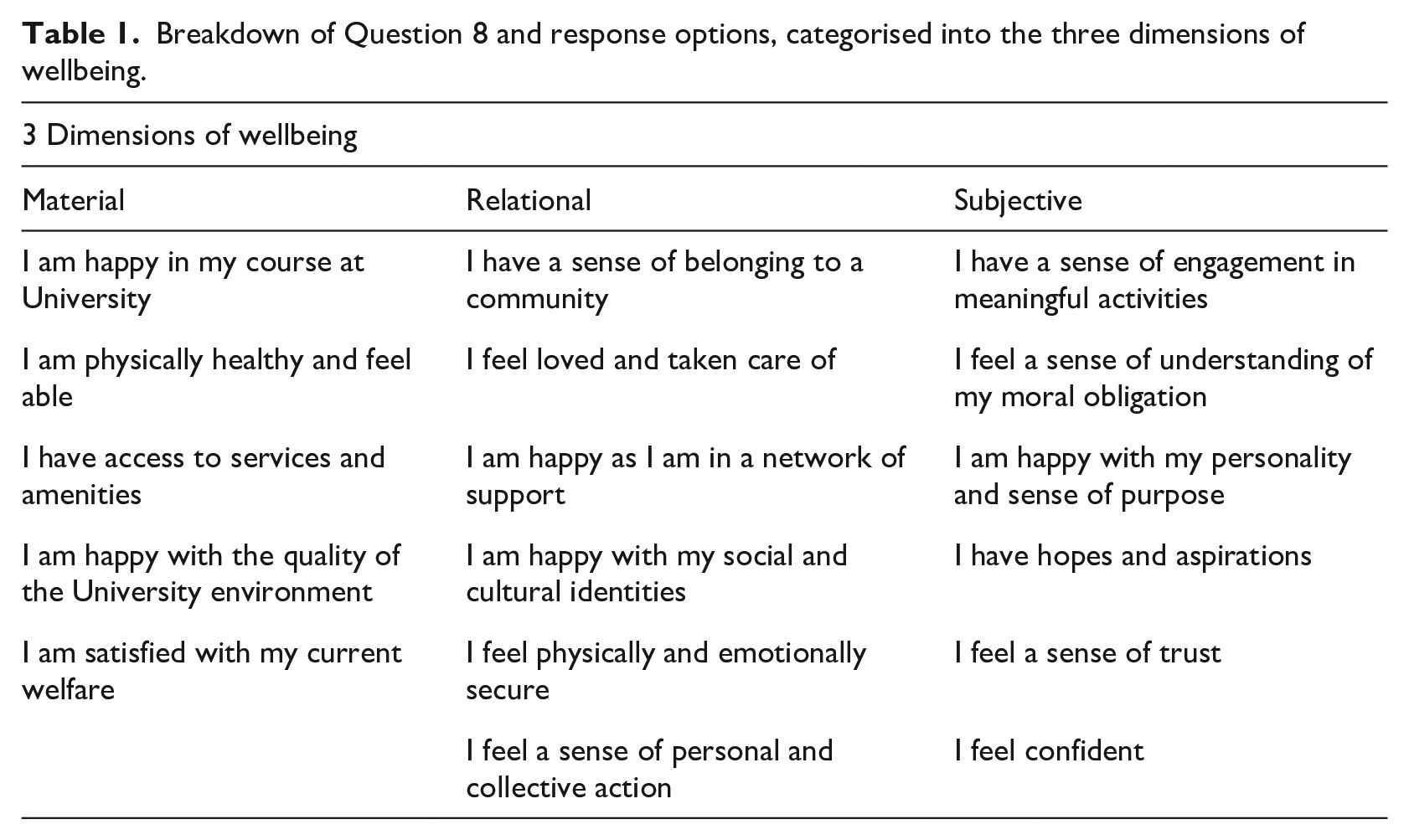
The quantitative element of the study was informed by White (2010) who captured three dimensions of wellbeing, notably the material, the relational and the subjective. A 5-point likert scale (1–5) was employed and these captured different response options as captured by Table 1. While these dimensions have relevance in the wider world, the survey focused on the experiences of students at university. This yielded an overall material score, relational score and subjective score. In line with White (2010), the material score concerns practical welfare and standards of living; the relational score concerns personal and social relations and the subjective score concerns values, perceptions and experience as illustrated below:
Breakdown of Question 8 and response options, categorised into the three dimensions of wellbeing.
The survey provided an opportunity for respondents to opt into a follow-up focus group. Out of the 316 students who completed the survey, nine opted and took part in two focus groups, each lasting for about an hour. Following the survey analysis, the focus groups explored emerging themes in greater depth.
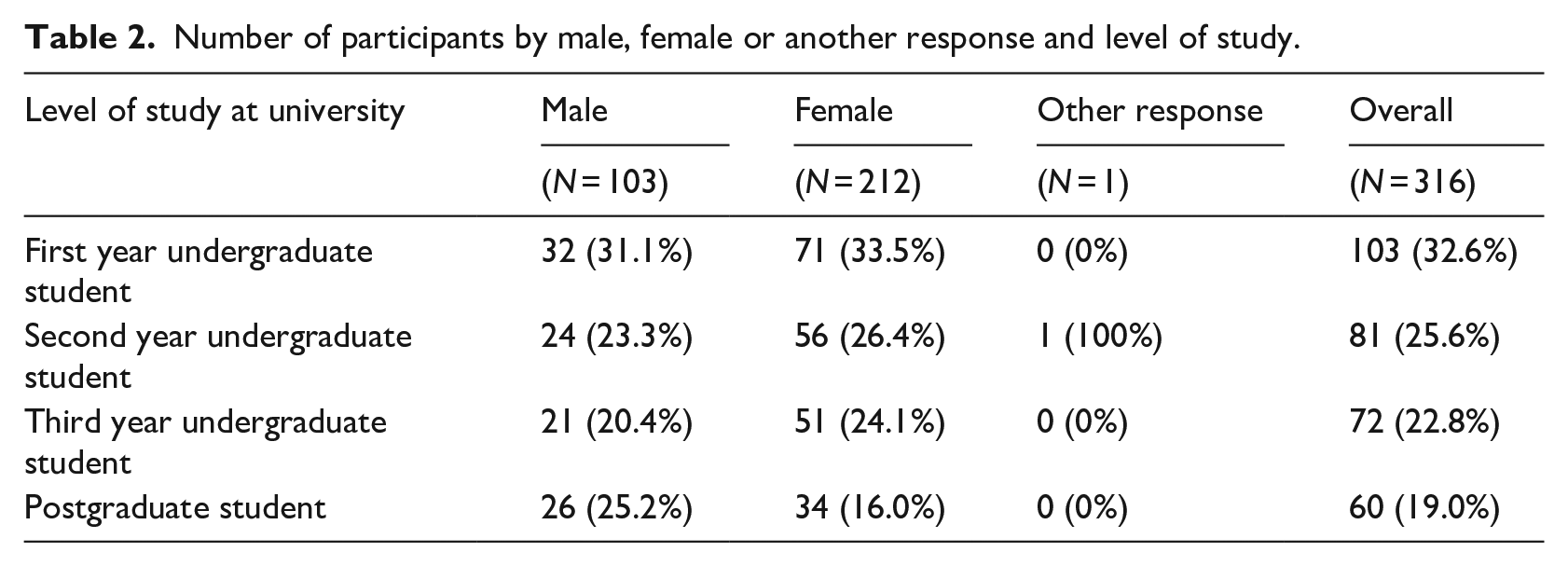
Ethical approval for the study was secured from the school’s ethics committee. The purpose behind the research was explained to all participants, by the student researchers, to secure informed consent. Confidentiality and anonymity guarantees were also given. The 316 participants were drawn from different gender backgrounds and levels of study as depicted by Table 2.
Number of participants by male, female or another response and level of study.
Other variables included in the study are: (1) age range, (2) degree programme, (3) reason for not volunteering, (4) motivation for volunteering, (5) context of volunteering, (6) duration of volunteering and (7) frequency of volunteering.
Analysis of data
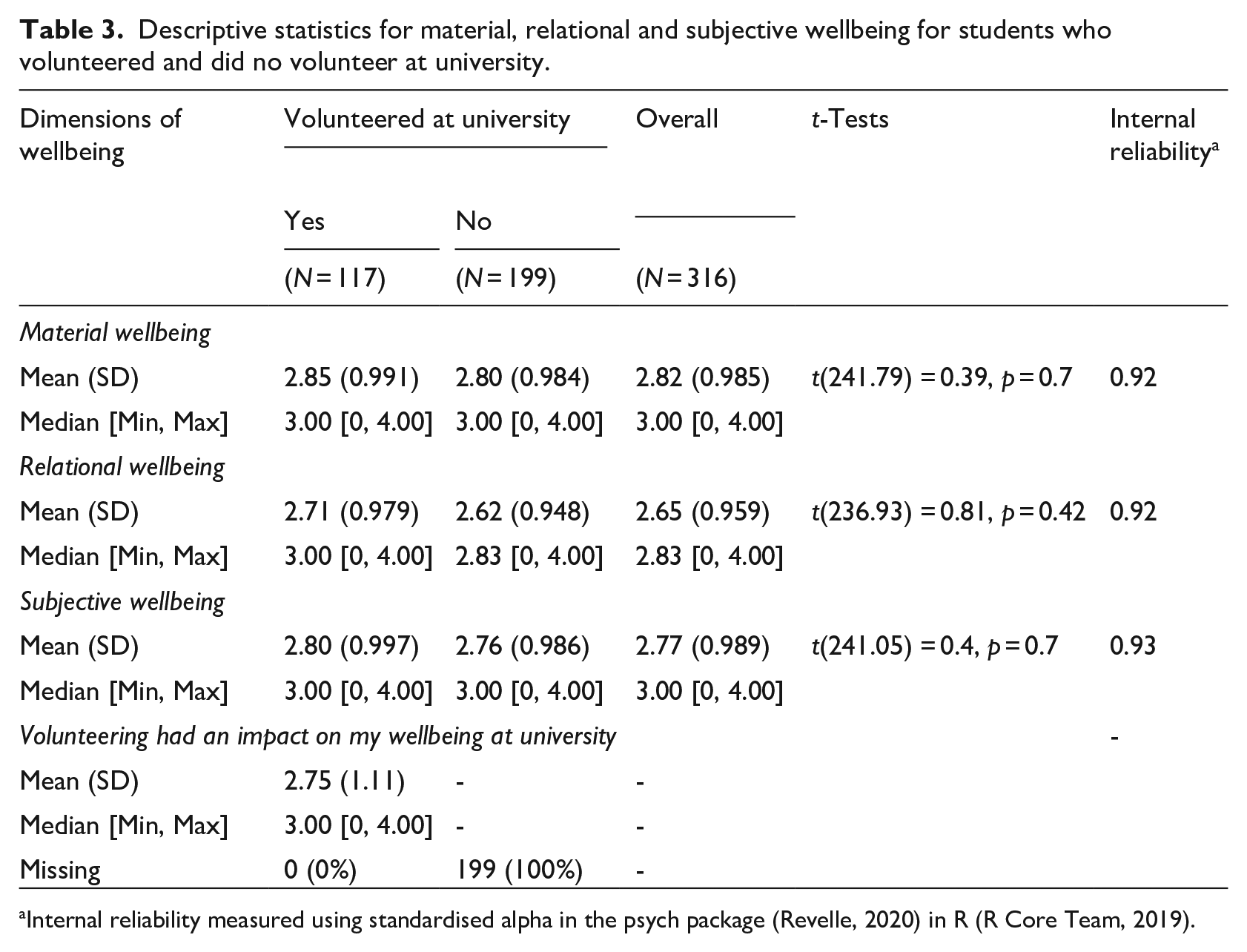
The study produced quantitative and qualitative datasets. It is worth noting that the datasets did not generate information on racialisation, ability, nationality and social class. For material wellbeing, relational wellbeing and subjective wellbeing, the mean of the items in each wellbeing scale was calculated for each participant (Table 3). Participants who reported that they had volunteered also addressed if volunteering had an impact on their wellbeing at university. This, single item, impact measure was included in the regression analyses that focused on the group who volunteered.
Descriptive statistics for material, relational and subjective wellbeing for students who volunteered and did no volunteer at university.
Internal reliability measured using standardised alpha in the psych package (Revelle, 2020) in R (R Core Team, 2019).
Table 3 reports the descriptive statistics for the three wellbeing measures and the internal reliability was high for these measures. Participants’ wellbeing, with a maximum score of four, tended to be above a mid-point score of two. Comparing those who volunteered to those who did not, there was no significant difference in the means for material, relational or subjective wellbeing.
In addition to the transcripts of the focus group discussions, the survey also captured a significant amount of qualitative data via open-ended questions. The qualitative datasets were analysed thematically (Castleberry and Nolen, 2018). This required reading participants’ responses firstly to understand the contexts and create relevant codes or sub-themes. The sub or emergent themes then fed into the superordinate theme. Excerpts and pseudonyms of participants are used to provide more light on the main themes.
Findings and discussion
Following data analysis, a number of key findings stood out: (1) students who had volunteered prior to coming to university were more likely to volunteer while enrolled at university, (2) the more students volunteered, the more they perceived this had a positive impact on their wellbeing, (3) perception of the effect of volunteering on the wellbeing of university students can be evident under personal growth, meaningfulness, mental health, confidence, connectedness and positive affirmation.
Predicting volunteering from prior volunteering
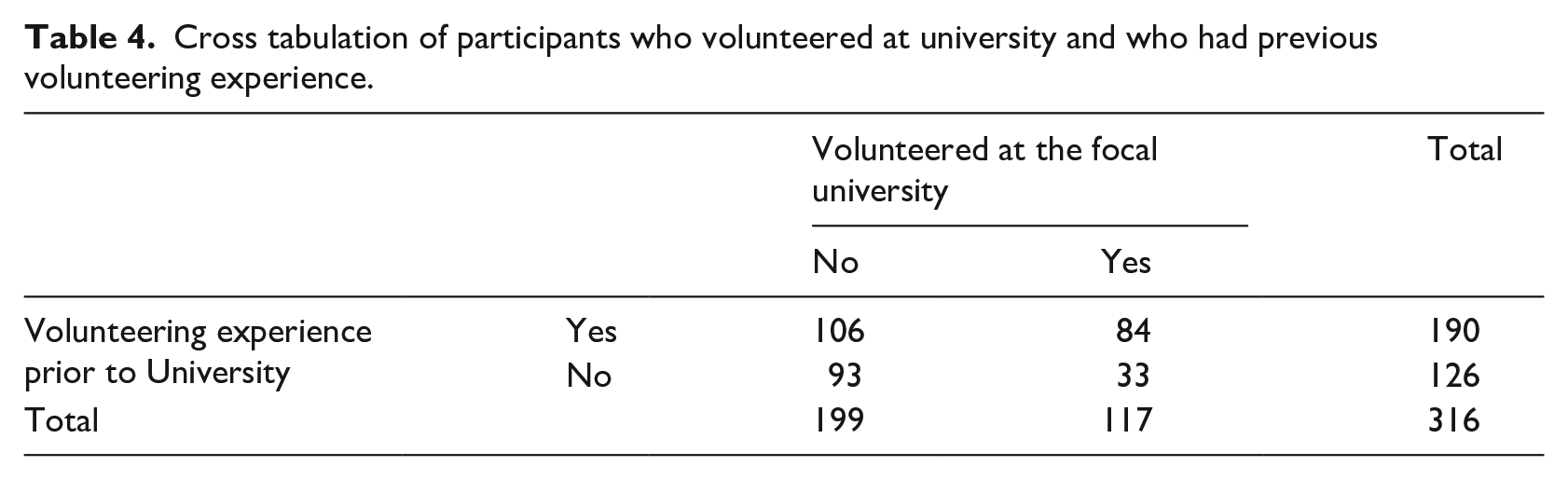
There was a significant association between volunteering at the investigated university and prior volunteering (χ² = 10.551, df = 1, p < 0.001). Students who had prior experience of volunteering were 2.5 times more likely to volunteer at the university (Table 4).
Cross tabulation of participants who volunteered at university and who had previous volunteering experience.
Our review of literature on volunteerism uncovered some drivers or catalysts of volunteering amongst university students. Some of these included adherence to certain political ideologies (Brown and Taylor, 2019), faith dispositions (Schwadel, 2005; van Tienen et al., 2011), social ties (Stritch and Christensen, 2016) and a sense of civic responsibility (Yuen, 2013). However, prior volunteering as a springboard to more volunteering is a novel finding which is of significant interest and could help universities to set priorities when promoting volunteering amongst students. Given that students who had prior experience of volunteering were more likely to continue to volunteer while at university, these sets of students may be encouraged to (1) leverage their prior volunteering experience and context or be assisted to navigate into new forms of volunteering in order to continue to reap the associated benefits, (2) partner with other students with or without prior volunteering experience to share lessons learnt, expectations and aspirations.
The duration of volunteering was significantly associated with perceived impact on wellbeing
Out of the 316 students who took part in the survey, 117 had a volunteering experience while enrolled at University (see Table 5 for summary of the number of hours they volunteered and the duration of their volunteering). The 117 students who had volunteered since enrolling at university were invited to rank their perceived impact of volunteering on their overall wellbeing with 5 being strongly agree and 1 strongly disagree. Seventy-one (61%) students either agreed or strongly agreed that volunteering had a positive impact on their wellbeing.
Number of participants (percentages in parentheses) for each response category for the following questions: hours of volunteering, duration of volunteering and responses to impact on wellbeing (N = 117).
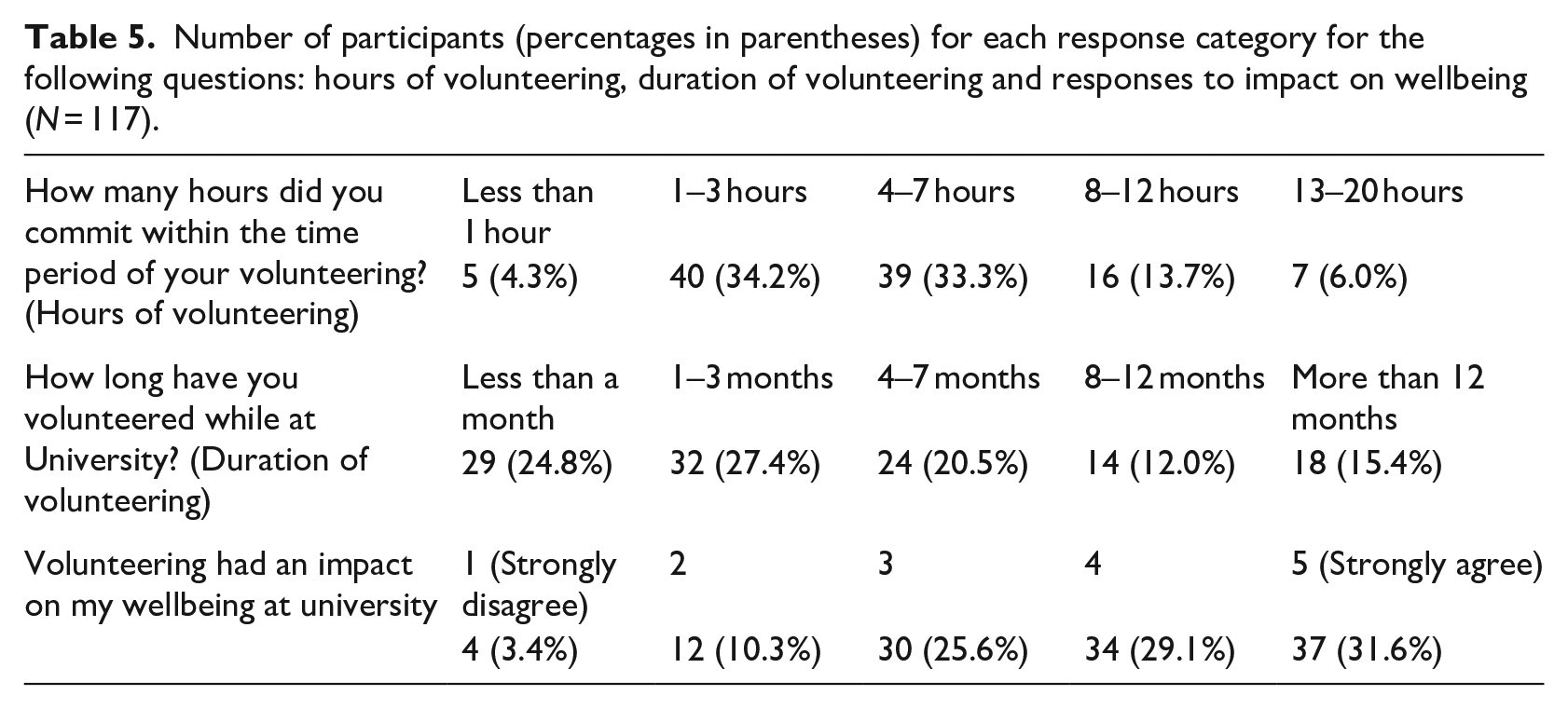
It is possible that subjective experiences of wellbeing are associated with the duration of volunteering experience. Four regression analyses were carried out with each measure of wellbeing (Material, Relational, Subjective, Impact) as outcome measures. The independent variables in each model were: gender, level of study, hours committed to volunteering, the duration of volunteering. For Material, Relational and Subjective the outcome measure was a scale and therefore a linear regression was used. For impact, the measure has four responses and therefore an ordinal logistic regression was conducted.
For the regression analyses, each of the independent variables was coded as follows: for Gender, males were coded as ‘0’ and females ‘1’, this led to the loss of one participant from the dataset; level of study was coded ‘0’, ‘1’, ‘2’ and ‘3’ in line with first to postgraduate levels of study; duration of volunteering ‘how long have you volunteered while at university’, which had five response categories (‘less than a month’, ‘1–3 months’, ‘4–7 months’, ‘8–12 months’, ‘More than 12 months’), were coded 0, 1, 2, 3 and 4, respectively.
However, neither material wellbeing (R² = 0.05), F(4, 111) = 1.36, p = 0.25), relational wellbeing (R² = 0.03), F(4, 111) = 0.81, p = 0.52, nor subjective wellbeing (R² = 0.04), F(4, 111) = 1.12, p = 0.35, were significantly associated with the independent variables.
‘Volunteering had an impact on my wellbeing at university’
The model for perceived impact on wellbeing was significant, (χ² = 24.83, df = 13, p = 0.024; pseudo R² = 0.19; Cox and Snell). Only one predictor variable was associated with the wellbeing impact response, which was duration of volunteering, see Table 6. Against the reference point (12 or more months volunteering), participants who responded they had volunteered for less than a month had a significant negative association with reporting that ‘volunteering had an impact on my wellbeing’ (b = −2.15, SE = 0.624, Wald = 11.93, p = 0.001). Notably, 12 of the 29 participants (41.38%) who had volunteered for less than a month reported a wellbeing impact score of 2 (the modal score for this group). This is compared to 13 of the 32 participants (40.63%) who had volunteered for either 8–12 months or more than 12 months who responded with a score of five (‘strongly agree’), the modal score when both groups were combined. This association (n = 47) was significant (χ² = 10, df = 4, p = 0.04).
Parameter Estimates for the ordinal logistic regression between independent variables and the outcome ‘Volunteering had an impact on my wellbeing at university’.
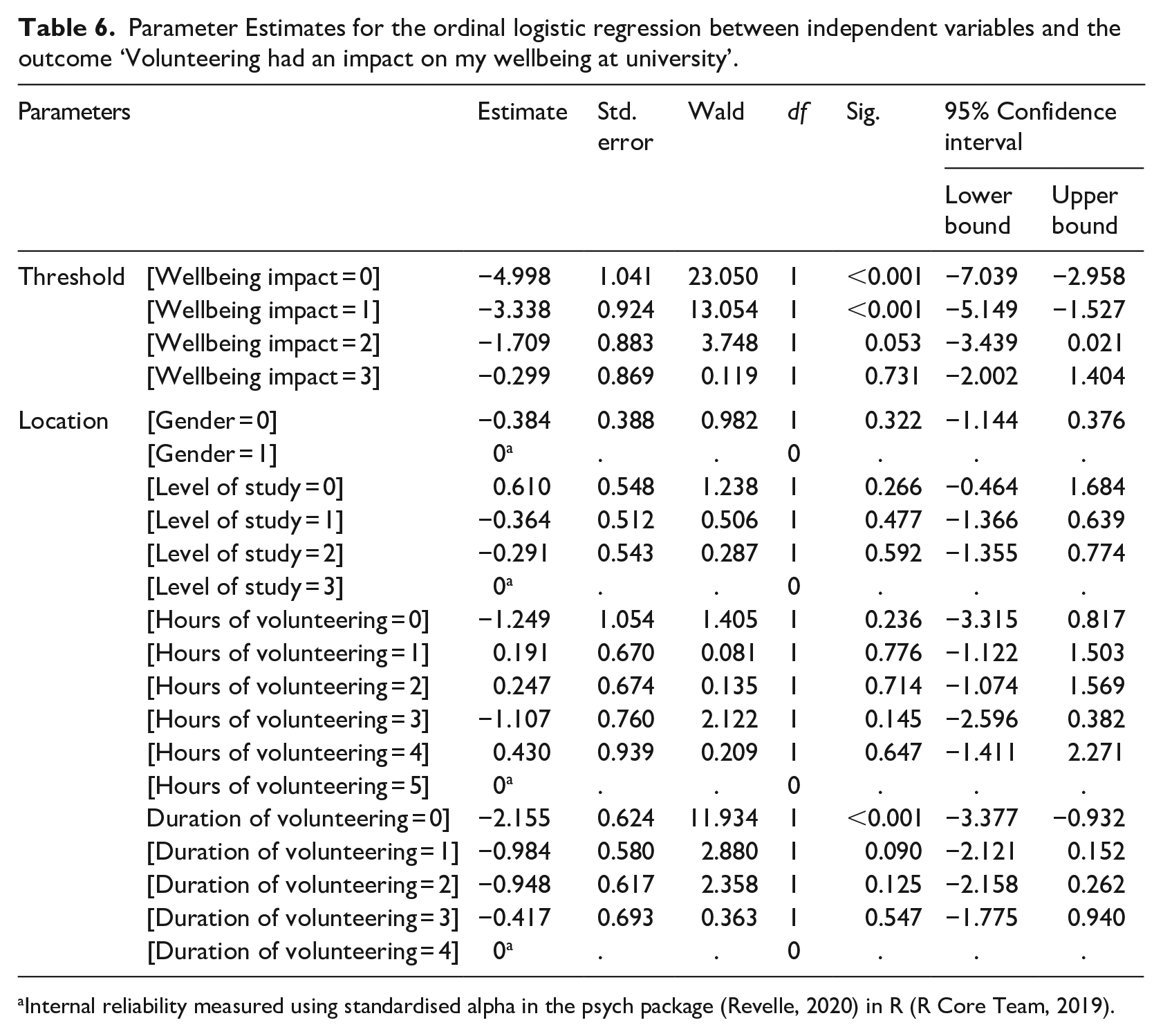
Internal reliability measured using standardised alpha in the psych package (Revelle, 2020) in R (R Core Team, 2019).
As revealed by the data, the duration of volunteering was associated with the wellbeing impact response. Although the duration of students volunteering can significantly impact their wellbeing, it needs to be treated with care. Mbah and Fonchingong (2019) asserted that duration is a factor when considering different forms of co-curricular or extra-curricular activities for students. Considering that a lack of time has been captured in literature as one of the challenges to volunteering (Sundeen et al., 2007; Wilson, 2012), encouraging students to spend even more time in volunteering activities should be reasonably contextualised. Furthermore, there is also the likely challenge of incurring costs when considering an extended duration of volunteering as volunteering activities are often not paid. While any attempt to extend the duration of volunteering by students may have wider implications, there is clear evidence that it could have notable outcomes on wellbeing. Below, we discuss some of these outcomes captured in the qualitative element of the study.
Insights from the qualitative data on wellbeing outcomes from student volunteering
Following the finding that suggests the duration of volunteering was associated with students’ perceived wellbeing, there was need to further examine this theme, via the thematic analysis of the qualitative datasets from the survey and focus group discussions. The following effects of volunteering on wellbeing were uncovered:
Personal growth: Promoting positive qualities and life skill
Insights into the qualitative data suggest that the act of volunteering enhances invaluable and essential life-skills of the volunteer, such as being an independent thinker, exercising of self-worth, open-mindedness and teamwork, contributing to personal growth. Not only was volunteering seen to aid the acquisition of life skills, but it was also observed to promote the qualities needed to complete one’s study at university such as proactiveness, communication of ideas and meeting deadlines. The following quotes from participants support this finding: My experience of volunteering internationally modified my approach to life, my studies. It has improved my self-worth and ability to complete tasks. (A survey participant, Max) It has enhanced my ability to share my ideas with others. (A survey participant, Peter) . . .It helped me to challenge my own learning capabilities and try to push out of my comfort zone, especially at things that I felt failed at. . . It makes me feel more proactive and goal driven. (A survey participant, Jo)
In addition to insights from the above survey participants, some focus group participants also discussed the subject of volunteering helping their personal growth as it promoted positive qualities and life skills. One participant noted: I think one huge thing that I’ve gotten from volunteering is flexibility. Like, I’ve learned how to be flexible in my thinking, in my actions. (A focus group participant, Mina)
Similarly and in response to Mina, a separate participant noted: . . . the willingness to throw yourself in. Also the willingness to ask for help. I think I’ve always felt like I’m dependent on myself and I have to do it, and if I fail to do it, I’ve done something wrong. (A focus group participant, Grace)
Volunteering has been cited as a useful means of building character and learning to cope with challenging situations (Resnick et al., 2013; Williamson et al., 2018). Arguably, these are also qualities students need to complete their university studies. A survey participant (Jo) asserted ‘because I enjoy what I do whilst volunteering, it makes me push myself in my studies to ensure I get to the job I want in the future’. There is considerable literature to suggest that student volunteers are more adept at building problem-solving skills through volunteering than adult/older volunteers (Buikstra et al., 2010; Yuriev, 2019). Stuart et al. (2011), for example, noted that mature students are more likely to undertake their volunteering (or extra-curricular activities) outside of the university environment, and that the correlation between volunteering and improved academic performance is lower for mature students than for younger ones. A cursory glance at the job market appears to support this contention, as mature students are marginally less likely to be working a graduate-level job within 18 months of completing their studies than younger students (Blasko et al., 2002; HESA, 2020), suggesting a disadvantage in comparison to their younger counterparts. Again, in the interests of future research, additional critical focus on this claim may help us gain a greater understanding of whether mature students face additional barriers to volunteering, how these can be overcome and how the popular methods and processes of volunteering within higher education might be developed to avoid placing them at an unintentional disadvantage, compared to their younger counterparts.
Meaningfulness: Finding the value of purpose
Research data also suggested that participants considered volunteering to provide an avenue to get involved in something meaningful, discovering a sense of purpose or being part of something bigger than one’s self. This was also seen as being altruistic in nature and evident via helping others and giving back to the community. The following insights from the survey participants support this claim: I feel able to help others and make an impression on people’s lives when they need it. It makes me feel good and like I’m doing my part in the world. (A survey participant, Matt) I feel more cemented and grounded with a real sense of purpose. (A survey participant, Gen) It gave me a connection to my course and a strong sense of purpose in this city. (A survey participant, Ryan) Makes you feel like you’re a part of something that is important and makes a difference. (A survey participant, Ron) It is something useful/meaningful in my free time. (A survey participant, Paolo)
As captured earlier, self-centred drivers of volunteering have not replaced altruistic or compassionate ones in many contexts (Holdsworth and Brewis, 2014; Hustinx et al., 2010; Overgaard et al., 2018; Wuthnow, 1991). As evident from our research data, many participants associated the effect of volunteering on the subjective element of wellbeing, further illustrated by having a sense of engagement in meaningful activities or ones that added value to one’s life or the lives of others. However, what constitutes meaningful activities and the values they add varied from person to person.
Improved mental health
Analysis of transcripts from the focus group discussion also pointed to the claim that volunteering has the potential to lead to an improvement of mental health. To cast more light on this, the following respondent who participated in a focus group defined volunteering as a stress reliever: I think sometimes it’s just a stress reliever just to do something that gets your mind off something. (A focus group participant, Grace)
While volunteering on subjects not related to what one is studying at university can refresh the mind or relieve stress, a different participant during the discussion reflected on her experience of volunteering amongst a group of persons who cared about her welfare and how that contributed to her mental health. She maintains: I don’t really have many friends around the university environment. So, being able to go to an organisation where people actually recognise me and get excited that I’ve come back and ask me how I’m doing and want to interact with me is really nice. Because it adds another layer to not just the university friendships and communities, but also, like the community outside of that. And for me, that’s really significant for my mental health. It keeps me bobbing above water. (A focus group participant, Ruby)
This finding aligns with other insights from Mak et al. (2022), which highlight that volunteering can lead to better mental wellbeing, and this generally can be evidenced via less loneliness and a greater sense of happiness. As people volunteer in communities, it provides an opportunity to connect and ‘ having relationships and interaction with others can help with self-worth and sense of belonging, can offer access to emotional and practical support and can protect against poor mental well-being’ Tierney et al. (2022: 328). Other closely related catalysts of mental health that emanate from volunteering include life satisfaction, personal achievement, social interaction and spending refreshing time outdoors (Haake et al., 2022). However, not every form or context of volunteering can strengthen a person’s mental health – the quality of the volunteering does matter, as well as who is taking part and for what purpose. This is particularly important as it has been depicted that some persons who participate in volunteering activities in countries or contexts with lower unemployment benefits may end up having lower mental health than non-volunteers (Wang et al., 2022).
Building confidence
Although the subject of self-confidence is related to the subjective elements of wellbeing mentioned above, it also merits separate consideration. Overwhelmingly, participants who had volunteered during their time at the university noted that volunteering engendered self confidence in them. The following insights from the focus group discussion underline this assertion: For me, um, maybe one main thing is confidence. Building confidence. Talking to strangers and, sort of, like, having that confidence to, you know, put myself out there and learn new things and have this motivation and confidence. (A focus group participant, Rosie) Confidence, yeah. It’s great, isn’t it, when you get the feedback. . . you know you’re doing it right. (A focus group participant, Beanie) Definitely confidence, like, talking to different types of people. (A focus group participant, Lily) . . . it enabled me to be more trusting of my capabilities, to trust I can do this, and I have skills to use. It means that I’m happy, kind of, like someone mentioned, to throw myself into a scenario and trust that even if I don’t know what I’m doing, I’ll do it anyway. And get the job done . . . and that’s really cool. (A focus group participant, Mina)
In a context where confidence may be lacking, volunteering can make the difference amongst HE students. It has been argued that ‘volunteering, which has been shown to have a positive effect on psychological wellbeing, may act as a way of increasing confidence and therefore fostering resilience especially in emerging adults as they develop their identities’ (Williamson et al., 2018: 394). In particular, the ability to help influence change and make a discernible difference, and the feeling of ‘empowerment’ (Pinderhughes, 1995) this instils, is a vital driver in such volunteerism (Rochester et al., 2016).
At a student volunteering level, the desire to partake in activities which result in a tangible change to the material circumstances of disadvantaged groups is a popular factor (Cunha et al., 2019; Holdsworth and Brewis, 2014). In terms of how this impacts a student’s wellbeing, Komives et al. (2009) suggest that this imbues not just confidence but also leadership qualities in student volunteers, which can be transferred across both their professional and personal lives. If a student can match the leadership necessary for such volunteering with their own circumstances, they build the capacity to negotiate tasks or take on different responsibilities.
Connectedness and sense of family
Apart from the material and subjective elements evident in participant’s construct of the effect of volunteering on their wellbeing, the relational element was also considered. This was defined in terms of having a sense of connectedness, community and not feeling home sick. The following narratives from participants underscore this finding: I think of that as, like, my second house. And the way they make you feel there, it’s like that family vibe. And you go there and it’s a family vibe, and you think, I’m not just here studying at the university, just minding my own business, thinking about the piece of paper. I’m getting involved in community events, and everyone’s there and everyone’s having a great time. And this isn’t just a place. This is the community. And you actually feel like a local and a resident, and like you’ve got a place and a meaning. (A focus group participant, Ruby)
The subject of community was particularly highlighted by some participants. They assert that a sense of community helped them to mitigate the feeling of homesickness which can be experienced by being away from loved ones. A student, Grace, explains in the course of the discussion: But once I started the volunteering, it made me a lot happier and it sort of distracted me from all the other things, from feeling homesick, from, like, oh, I want to go home. So, I think it balanced managing that, and having that, it gave me a balance. (A focus group participant, Grace)
A sense of community and belonging has been closely linked with the achievement of not only the relational aspect of wellbeing but also the subjective, on a personal and collective scale (Coulombe and Krzesni, 2019; Curtis et al., 2020). An absence of community can lead to, ‘alienation, loneliness and psychological distress’ for an individual (Terry et al., 2019: 165). In the context of HEIs, student volunteerism has increasingly been championed as a way of affirming pre-existing community values as well as creating new ones (Loewen and Friesen, 2009; Yuen, 2013). It seems reasonable that a sense of community may well be particularly important in the early months of higher education, when students are typically experiencing feelings of self-doubt, homesickness and loneliness (Boddy, 2020; Zafar et al., 2018). A volunteering community can therefore provide, ‘a stabilizing, cohesive influence. . .and provide the condition for free and open dialogue, critical debate, negotiation and agreement – the hallmark of higher education’ (Garrison and Kanuka, 2004: 97). In line with this, Murphy (2016: 5) states that ‘a desire to belong and an opportunity to bridge into local communities’ is a paramount driver of student volunteerism, which is corroborated at length elsewhere (Braime and Ruohonen, 2011; Powell et al., 2018). Indeed, Garvey et al. (2015) identifies a desire to give something back to one’s community as one of two primary drivers of student volunteering. Not only does this act as a push factor towards volunteering, it also solidifies the relational aspect of one’s wellbeing.
Positivity and affirmation: ‘The little shining light’
Many participants in this study considered volunteering as not just something that added value to their lives and the lives of others but defined who they are and the underlining transition from ‘darkness’ to ‘light’ they have experienced. It portrayed a sense of identity they wanted to affirm or be affiliated with, not just momentarily but an enduring one. The following insight from a focus group participant provide clarity: I guess my life has been quite dark in some ways and I’m just used to seeing dark, everything’s dark, just sad. And yeah, it kind of followed through, I guess, a bit with uni as well. Like, past experiences, I’m not very good at making friends. And then that kind of follows you at uni. And when you can actually go somewhere, and people are grateful and think you’re nice and they’re grateful for what you’re doing, and you can clean a load of stuff and people will be like, oh, you’ve really helped. And it’s just nice, because you think, it doesn’t matter if people my age don’t care about me or don’t want me about, because I can go and clean some floors for these people and they’re really grateful. And when you feel appreciated for something like that, it gives you a reason to smile. And then you’ve got another reason to go back to volunteering the next week, because you know it’s going to pick you up again, you know . . . It’s the little shining light. (A focus group participant, Ruby)
To cast more insight on the subject of a ‘shining light’, and the prospect of volunteering aiding academic performance, a different participant asserts: Everyone tells you you’re going to make so many friends at uni, you’re going to have the best time, and you’re like, I don’t have friends, I’m not having a good time. So, I think that now, finding that volunteering, I was now managing with the academic side. (A focus group participant, Grace)
The issue of identity and the different effects it can have on an individual’s wellbeing are particularly relevant to the discussion of higher education volunteering, as there is a consensus that identity formation takes place largely throughout an individual’s late teens and twenties (Arnett, 2000; Luyckx et al., 2006), and also because increased explorations during this period of life (such as student volunteering), ‘always involve identity relevant pursuits’ (Karaś et al., 2015: 731). This is also a reminder that wellbeing as a concept can be culturally specific and potentially defined very differently along geographical lines (Mitchell, 1990). This carries significant importance for international students, who may feel a greater need to cultivate and defend their identity once in a new, unfamiliar environment and who believe that a failure to do so will have a direct negative impact on their wellbeing (Hofstede, 2001; Ward et al., 2001). Furthermore, it can be evident that student volunteering is indeed, ‘an experience that can promote successful developmental transition by having a positive impact on personal identity’ (MacNeela and Gannon, 2014: 407–408). Increasingly, students see pro-social activity such as volunteering as an opportunity to formulate or affirm their worldview, agency and, in the case of international students, set their own culture and norms in contrast to the existing ones around them.
Conclusion
The act of volunteering and its significance in society is foregrounded in the literature. Whilst there is a plethora of studies on the subject of student volunteering, there is paucity of research that has examined its impact on student wellbeing. The research that underpins this paper therefore addressed this gap by examining the relationship between students’ volunteering and wellbeing. In doing so, we adopted White’s (2010) conceptualisation of wellbeing under three dimensions, namely: material, relational and subjective dimensions. A survey instrument was completed by 316 students at a modern university in England. This captured inputs on a range of questions, including their assessment of the overall impact of volunteering on their wellbeing. Follow-up focus group discussions took place with nine students to further discuss the emerging themes from the survey. Findings suggest the following: (1) Prior volunteering experience can predict the likelihood of a student volunteering in the course of enrolment at university; (2) The duration of volunteering is significantly associated with participants’ subjective view of the impact of volunteering; (3) the positive impact of the duration of volunteering on the wellbeing of students can be evidenced via a number of outcomes and these include the promotion of personal growth, a sense of meaningfulness, improved mental health, confidence building, connectedness and positive affirmation.
Although this study has some limitations, such as its reliance on a single case study which limits generalisation, the findings have implications for policy and practice in the higher education sector faced with the need to promote student retention, success and employability – volunteerism and wellbeing are critical factors here. While it may be construed that many universities are already doing something with regards to outreach and engagement activities, more could be done to leverage on their volunteering schemes to foster the wellbeing of students as captured in this paper. Although the ideas presented can be applied in relevant university departments or units, they can also have implications for sector-wide policies and industries on their approach to student volunteerism and wellbeing. Future studies would benefit from disaggregated datasets that highlight the positionalities of racialisation, ability, nationality or class in students’ volunteerism and their respective relationship with wellbeing. Furthermore, while the quantitative element of the study identified the duration of volunteering as the sole predictor variable associated with the wellbeing impact response, further research is needed to explore how student volunteers conceptualise wellbeing. Students’ understanding and measurement of wellbeing may differ from those proposed by White (2010), which could explain why the quantitative findings do not entirely reflect the strong feelings expressed in the qualitative section.
Footnotes
Acknowledgements
The authors wish to acknowledge Anne O’Grady, Andy Coppins, Jon Hoskin-Campion, and the student assistants for their invaluable contributions to various aspects of the project.

Funding
The author(s) disclosed receipt of the following financial support for the research, authorship, and/or publication of this article: The authors received financial support from Research England, via the host University’s QR grant, for the research, while open-access publication was supported by the University of Manchester.
Declaration of conflicting interests
The author(s) declared no potential conflicts of interest with respect to the research, authorship, and/or publication of this article.