




Abstract
The European dimension is of salient importance for understanding and shaping politics especially, but not only, in Europe. The European Union by now has become a compulsory content of civics classes in secondary schools throughout Germany. For teachers, however, teaching this topic is connected with manifold difficulties, for example, due to the complexity and dynamics of European integration, the (perceived) distance of European Union politics, and popular prejudices. European Union content and didactics are not always included in teacher training; moreover, civics is often taught by teachers who have not been trained in this subject. Thus, special continuing education for civics teachers with regard to teaching the European Union is needed. In the context of the Jean Monnet project Politiklehrerfortbildung zur nachhaltigen Vermittlung Europäischer Bürgerschaftskompetenzen [Civics teachers’ continuing education for sustainable teaching of European citizen competencies] (http://peb.uni-goettingen.de), 180 teachers participated in nine continuing education courses throughout Germany. The training courses were developed at Göttingen University and designed to update both teachers’ knowledge on European integration (focus: Treaty of Lisbon; the ‘Euro Crisis’) and their capacity to convey European Union knowledge and competencies to pupils. Practical experiences in various methodological approaches were integrated into the training course as well as a visit of a member of the European Parliament. The courses were accompanied by an empirical study with pre-, post- and follow-up-tests (standardized questionnaires, both paper and pencil and online; pre/post sample N = 179). This contribution introduces several key results of the accompanying study regarding the European Union-related characteristics of participating teachers (e.g. the relation between European Union knowledge and attitudes towards the European Union, controlling for background variables such as gender and school type), the current practice – including goals, approaches, methods and problems – of teaching the subject of the European Union from a teachers’ perspective and the effects of the teachers’ continuing education series Politiklehrerfortbildung zur nachhaltigen Vermittlung Europäischer Bürgerschaftskompetenzen.
Keywords
Motivation and background
In the European multi-level system, the citizens’ European Union (EU)-related political competencies are becoming ever more important. Estimates vary, but at least one-third of legislative decisions made in Germany at the federal level in recent years can be traced back to a ‘European impulse’ (e.g. Töller, 2008: 17). In addition to an expansion of its competencies to new policy fields, the deepening dynamics of the EU (see Rittberger and Schimmelfennig, 2005) also include a change in the modes of political decision-making that increasingly make majority decisions in the Council of Ministers possible, award continually more co-determination rights to the directly elected European Parliament and foresee the population’s participation in the European legislative process not via referendums but via the European Citizens’ Initiative. Politics in the EU member states can therefore not be adequately understood without the inclusion of the European level; at the same time, EU policies are not influenced solely by co-determination and political actions at the national level (Hix and Hoyland, 2011; Oberle, 2012a).
It can be assumed that a rational understanding of the complex structures of the EU cannot be achieved without effort, but instead requires targeted educational measures. In the European and national education recommendations, mobility measures (such as school partnerships, school exchanges, language trips) have traditionally been considered very important. It can also be confidently assumed that visiting other member states and knowledge of European cultures and languages increase the willingness and ability to adopt different perspectives and help create a common identity. However, it is questionable whether this mobility develops the participants’ political understanding of the EU and EU-related political decision-making and action-taking abilities (besides the language skills that are assuredly useful for this). Instead, it can be presumed that these goals require an intentional, decidedly political education. The results of an empirical study on the effects of discussing the EU in school civics classes while controlling for European mobility (holidays and exchanges/educational trips) support this assumption (see Oberle and Forstmann, 2015a). As a nationwide compulsory subject, civics education in Germany has the potential to reach every single adolescent – this is a great opportunity and responsibility. In fact, the education plans of all 16 German states now proscribe the EU as a topic in civics classes at the secondary level for general education schools (Geyr et al., 2007) and thus accommodate the growing importance of the EU for the (prospective) citizens.
The key task of a school’s civic education is to promote the students’ political competencies and thereby lay the foundation upon which their political understanding and ability to make political judgements and participate as adults can be built. Competencies include ‘knowledge and abilities’ (Klieme, 2004: 13). Competencies can be understood as cognitive, affective, evaluative, motivational and volitional characteristics that are in principle able to be obtained and that enable the individual to overcome problems arising in the future (Weinert, 2001a: 27–28; see also Weinert, 2001b). For political competency, Detjen et al. (2012) have produced a model that includes the following four dimensions: subject knowledge, political judgement, ability to act politically, and motivation and attitudes. When applied to the EU, this means that students should have a conceptual understanding of the EU and should be able to make political judgements and take action related to the EU. Relevant characteristics would also include interest in the EU or a positive EU-related internal efficacy (trust in one’s own political abilities; Vetter, 1997). Finally, basic trust in the EU, its institutions and external efficacy are conveyed, although it must be emphasized that this target dimension naturally depends on the ‘trustworthiness’ of the system and its organs; at the same time, basic trust in the political institutions is essential for the stability of representative democracies (Fuchs et al., 2002).
Due to the prohibition against overwhelming the students and the imperative of treating controversial subjects as controversial (for German civic education, these basic principles are part of the famous ‘Beutelsbach Consensus’; see Oberle, 2013a; Wehling, 1977), promotion of certain attitudes in civics education is fundamentally problematic. However, certain fundamental values are intrinsic to these principles of civic education (Schiele, 2000). The conveyance of ‘democratic virtues’ and values in accordance with liberal democracy remains a balancing act. The often ‘emphatic ideological–ethical character’ (Massing, 2004: 146) of education about Europe is rightly criticized. Students must also be exposed to criticism of the European unification process as well as alternative development scenarios, institutional designs and policies. For civics education in Germany, the openness to Europe set down in the Basic Law (Art. 23 Basic Law) justifies an in-principle positive evaluation of the European integration efforts and the EU in the classroom. It makes sense to differentiate here between general and performance-based attitudes in line with Easton (1965), that is, between a ‘hard’ and a ‘soft’ Euro-scepticism (Knelangen, 2015: 17; Weßels, 2009: 64). While a ‘fundamental’ rejection of the EU is not part of the aim of (German) school education today, a ‘constructive’ EU scepticism certainly corresponds to the goals of EU civic education.
The relevance of (prospective) citizens’ political knowledge can be normatively determined from democracy-theoretical (particularly in relation to participation-centred, but also elitist, democracy theories) and civics-pedagogical perspectives (Oberle, 2012a: 16–20, 27–38, 2012b). Empirical findings on the consequences of (a lack of) political knowledge emphasize the importance of the population’s basic civic knowledge. Political knowledge promotes the willingness to participate politically, for example, and is a precondition for political participation that fits the person’s own interests and is rationally justified (Delli Carpini and Keeter, 1996; for EU: Westle, 2015: 53–55). Often, it is explicitly or implicitly assumed that more knowledge about the EU leads to more positive attitudes about the EU. Surveys do seem to show that a subjective lack of understanding about the EU encourages scepticism about the European unification process and, for example, motivated people to abstain from or vote against national referenda on the European Constitutional Treaty or the Lisbon Treaty (see European Commission, 2009a; Hoecker, 2013). The relationship between knowledge of and attitudes towards the EU has not yet been the subject of sufficient empirical research, however.
Teachers play a key role in students’ acquisition of competencies – ‘teachers matter’ (Lipowsky, 2006: 64; also see Blömeke et al., 2008). In teaching about the EU, civics teachers seem to be confronted with unique challenges. Problems identified were, in particular, the EU’s high degree of complexity, the strong dynamics of its development (which brings with it a short ‘half-life’ for EU knowledge) and the (subjectively felt) distance of the EU from the citizens or everyday life (Detjen, 2004: 126–127). In order to successfully support the students’ learning process, in addition to other aspects of professional competency (such as pedagogical knowledge; beneficial beliefs about the nature of teaching and learning; motivations, including interest and perceived self-efficacy; and self-regulative abilities), civics teachers also need well-founded content and pedagogical content knowledge (Baumert and Kunter, 2006; Oberle, 2012c; Oberle et al., 2012; Shulman, 1986). Content knowledge is a necessary, though not sufficient, condition for high-quality lessons and the students’ learning progress. Regarding professional teaching competency, Baumert and Kunter (2006) state, ‘Mediated by the characteristics of lesson design, content knowledge and pedagogical content knowledge are of substantial import for the students’ subject-area performance […] Content knowledge is the foundation upon which pedagogical flexibility can come into existence’ (p. 496). In this, it seems that it is important for the students’ learning success that their teachers have a considerable knowledge edge compared to the students (e.g. Monk, 1994). Mere ‘textbook knowledge’ generally does not suffice; indeed, orientation to textbooks as a primary source seems to be particularly problematic for the dynamic topic of European integration.
To what extent the EU and teaching of the EU is part of civic teachers’ education today remains an open question. It is evident that teachers from different subjects (who can often be found teaching civics at German schools) must become familiar with the material on their own. But even if the EU and how to teach about the EU were discussed in the teachers’ education, there is a fast and frequent need to update their knowledge. In their daily work, it is a serious challenge for teachers to keep up with the constant development of European integration and the corresponding changes to the EU, and to update and expand their repertoire of teaching approaches.
The outlined demands and problems present the need for civics teachers’ continuing education – the challenge, the Jean Monnet project ‘Civics teachers’ continuing education for sustainable teaching of European citizen competencies (Politiklehrerfortbildung zur nachhaltigen Vermittlung Europäischer Bürgerschaftskompetenzen (PEB))’ wanted to address. At nine locations across Germany, in the spring of 2013, a continuing education session for teachers on EU civic education was carried out and accompanied by an empirical study. The teachers’ continuing education and accompanying study were developed at the University of Göttingen, Department for Political Science/Didactics of Civic Education. The continuing education series with a total of 180 participants and the accompanying study were funded by the EU in the framework of the programme for lifelong learning as a Jean Monnet project.
This contribution introduces several key results of the accompanying empirical study (see also Oberle and Forstmann, 2015b) regarding the EU-related characteristics of participating teachers, the current practice of EU teaching from a teachers’ perspective and the effects of the teachers’ continuing education series PEB.
Conceptualization and implementation of the continuing education series
The continuing education session ‘From Lisbon to the monetary crisis – successfully teaching about the European Union!’ was aimed at teachers of civics courses at the secondary level of all types of schools. It was conceptualized for one to two days and around 20 participants in order to make an individual and intensive handling of the topic possible. The goal was to bring participants up to date on EU education with necessary brevity – they were to be able to refresh, update and expand their content knowledge and pedagogical content knowledge, and receive assistance for independent further education. The continuing education course mixed concentrated content input from the speakers (University of Göttingen and European Parliament; see later) with tips on teaching approaches and methods, whereby some teaching methods were tested or ‘acted out’ during the course.
The content focuses of the course were as follows: (1) the main features of the political system that are relatively constant in the EU (e.g. the hybrid character as a supranational and intergovernmental organization; and corresponding to this, the double claim to equality – the equality of states and of citizens – which finds expression in strange institutional compromises, e.g. the ‘degressive proportionality’ of the vote weighting in European elections; double majorities in the Council of Ministers; the open finality of the integration process with competing models; the multi-level system); (2) the EU’s democratic deficit and efficiency problem, including the potential trade-off between solutions to these two central problems; (3) changes from the Treaty of Lisbon; and (4) causes and approaches for solutions to the ‘euro crisis’, that is, to the conglomerate of debt, real estate, financial, economic and monetary crisis.
The tested and presented methodological approaches included a variation of concept cards, a dialogue discussion about EU perceptions, a text-based mini-future workshop, an open discussion recorded in keywords on posters with provocative statements, scenario tours (a kind of gallery walk) with positioning on the future of the EU and the monetary crisis, silent discussions and simulation games. The slides from the talks with PowerPoint were made available to the participants. One element of all continuing education courses was also a visit by a member of the European Parliament with a lecture and discussion; here, parliamentary representatives of alternating fractions and an equal number of men and women were chosen. In three cases, the representative had another EU employee (European Parliament or Commission) fill in.
A large table with materials as well as informational and lesson materials handed out to the participants with tips on sources for information, some of them on CDs, gave insights into the spectrum of currently available materials. An extensive, commentated, current and location-specific link list for questions on the EU and how to teach it was passed out to participants to support their independent further education competency and, after the conclusion of the course, the list was sent electronically with hyperlinks.
The continuing education series took place as planned in nine locations (Berlin, Bonn, Dresden, Düsseldorf, Göttingen, Hamburg, Karlsruhe, Munich, Stuttgart). In some cases, there were long waiting lists with up to 60 registrations. The events were intensively advertised: the continuing education courses were accredited (if foreseen by the varying regulations of the German Länder) and listed in the respective regional continuing education catalogue. Around 1000 schools, teachers and disseminators of information were e-mailed directly, and over 1000 printed flyers were sent via post. The project homepage (http://peb.uni-goettingen.de) offered additional information and made contact and registration easier.
Objectives, design and implementation of the study
The continuing education courses for teachers were accompanied by a partly standardized survey. The main objectives were to highlight the current practice of teaching the EU in civics lessons as well as the difficulties in doing so – including the teachers’ education – to learn more about the structure of teachers’ EU-related characteristics, and finally, to examine the quality and effects of the continuing education series. The written questionnaire was done anonymously but with a personal, assignable code directly before starting and immediately after the course as well as around six to eight weeks later (pre- and post-survey paper/pencil, follow-up survey online using Unipark software). The questionnaires included mostly closed but also semi-open and open items. The calculation of the measurement models, regressions and path models was done in SPSS, ConQuest and MPlus.
The majority of the study’s total 179 participants were active teachers in civics or the respective group of subjects, primarily from advanced secondary schools (Gymnasien; 70%) but also intermediate and lower secondary schools (Haupt- und Realschulen; 12%), and comprehensive and vocational schools (Gesamt- und Berufsschulen; around 8% each). Of those surveyed, 43.1% were females, 56.9% males and the average age was 42. A total of 168 people responded to both the pre-test and post-test for the most part completely and assignably, and these make up the sample for the longitudinal analyses. The follow-up survey had an adequate response rate with 122 participants.
The EU-related content knowledge was evaluated in the pre-test and post-test with an identical battery of 24 multiple-choice questions typically with three incorrect answers and one correct answer. The questions were in the areas of general EU knowledge, institutional structures and legislative processes, citizen participation, the Lisbon Treaty, and the Economic and Monetary Union. Individual questions were adapted from secondary-level questions for students (Oberle, 2012a; Oberle and Forstmann, 2015a), and newly developed, more difficult and topic-specific questions (e.g. on supranational or intergovernmental ‘logic’ of individual EU institutions or on the Economic and Monetary Union) were added. The item analysis was done in ConQuest and the measurement model shows evidence of Rasch scaling and a high reliability (pre-test/post-test: (WLE) weighted likelihood estimator = .85/.73, (EAP) expected a posteriori estimate = .90/.81, variance = 2.101/1.429). The discrimination of the individual items was between .26 and .66, whereby the discriminatory power in the pre-test tended to be higher than in the post-test. All knowledge items in the survey were able to be included in the measurement model.
Besides content knowledge, the EU-related characteristics analysed for the teachers were attitudes and motivations as further elements of an EU-related professional teaching competency (see Oberle et al., 2013). Attitudes and motivations were mostly recorded with four-point Likert-type scaled item batteries and latently modelled in MPlus. In regard to EU attitudes, four aspects were captured: attitudes about the EU in general (four items according to the Eurobarometer; see e.g. European Commission, 2009b), about the EU’s performance (democratic legitimacy and efficiency, six items, in part from Shell Youth Study 2010; see Shell Deutschland Holding GmbH, 2010), about deepening (five items) and about the EU’s expansion (three items, both according to (ICCS) International Civic and Citizenship Education Study, conducted by the International Association for the Evaluation of Educational Achievement, IEA; see Schulz et al., 2010). The fit values confirm the four-dimensional model’s good data fit and acceptable reliability (comparative fit index (CFI) = .95, root mean square error of approximation (RMSEA) = .06, χ2 = 222.75 (129)***, Cronbach’s α for the sub-dimensions between .87 and .70). The participants’ interest in the EU was measured with a manifest four-point Likert-type scaled single item. In addition, the teachers’ general political interest was measured with a five-item battery (according to Köller et al., 2000) that showed a good data fit (CFI = .99, RMSEA = .05, χ2 = 7.42(5) n.s., Cronbach’s α = .69). The other characteristics measured but not taken into account in the partial study discussed here were interest in teaching about the EU (in contrast to the general EU interest), lesson-oriented self-efficacy beliefs and test-related subjective EU knowledge.
The measurement of EU attitudes and interest was only done in the pre-test as it was assumed that this was a relatively stable construct, and a typically one-day seminar would not likely effect any far-reaching changes in this target group. When looking at the results of a current Göttingen pilot study on short EU simulation games which showed that participation in a three-hour simulation game did promote changes in EU-related attitudes among students (mean comparisons, Cohen’s d; also see Oberle and Forstmann, 2014), results of a measurement of the change in the teachers’ attitudes would in fact have been interesting, however. Future studies could examine these.
In order to evaluate the quality of the continuing education course, the participants were first asked to evaluate the course and estimate its effect. Second, in the pre-test and post-test questionnaires, objective knowledge about the EU was measured in order to analyse whether the course induced an increase in content knowledge. In addition, participants were asked to what extent they could imagine using the teaching methods introduced in the course in their own lessons. Those who had already taught an EU lesson between the continuing education course and the follow-up survey were also asked about their realization of the methods. Evaluation questions were formulated with four-point Likert-type scales. The study thus focused primarily on two of four levels of teachers’ continuing education ‘efficacy’ (Lipowsky, 2010: 40): the reactions or evaluations of the participating teachers and the increase in participants’ knowledge. In this study, the teachers’ subsequent actions in their lessons were only examined in small part and the changes in the students’ development were not analysed at all.
Results of the study
Participant motivation
In the nine PEB courses, mostly teachers who generally tend to participate in continuing education took part. Of those surveyed, 88% had previously taken part in at least one continuing education course, and a little over three-quarters of these had already participated in more than five continuing education courses. The courses attended mostly had content knowledge (82%) and pedagogical content knowledge (66%) focuses (regardless of school subject) followed by courses with a pedagogical focus (40%). Nearly one-third had already taken part in EU-related continuing education courses, particularly with content knowledge (80%) but also with pedagogical content knowledge (48%) concentrations.
Those surveyed primarily stated the broadening of their own content knowledge (89%) and pedagogical content knowledge (70%) as motivations for their participation in the continuing education course (multiple responses were possible), followed by the materials received (48%) and the expansion of their knowledge of methods (46%). The visit from a guest speaker from the European Parliament, the exchange with colleagues (each around 35%) and the university organization of the course (21%) also motivated participants to take part. The course’s lack of participation fees, the awarding of a certificate of participation, the EU’s support and the recognition by the school management followed these – in some cases distantly.
The most successful media for advertising (multiple responses possible) were mailing lists (45%). Of the participants, 16.5% named flyers as their source of information. Colleagues (29%) and school management (22%) had also informed some of the participants about the course, which can be traced back partially to the mailing lists and partially to the flyers sent via post. Only 2.9% of participants learned of the event from a central continuing education catalogue.
Education and lesson praxis
The question whether the teachers had been exposed to the EU as a topic in the two phases of their education revealed the expected deficits (Figure 1). Around 80% of the participants had absolutely no exposure to the EU or only received marginal information about the EU during their studies and study seminar. For young teachers or individual states, the picture was not more clearly positive; however, starting with an age of about 40–50, the subject of the EU or its predecessor organizations was particularly rare during the teachers’ education.
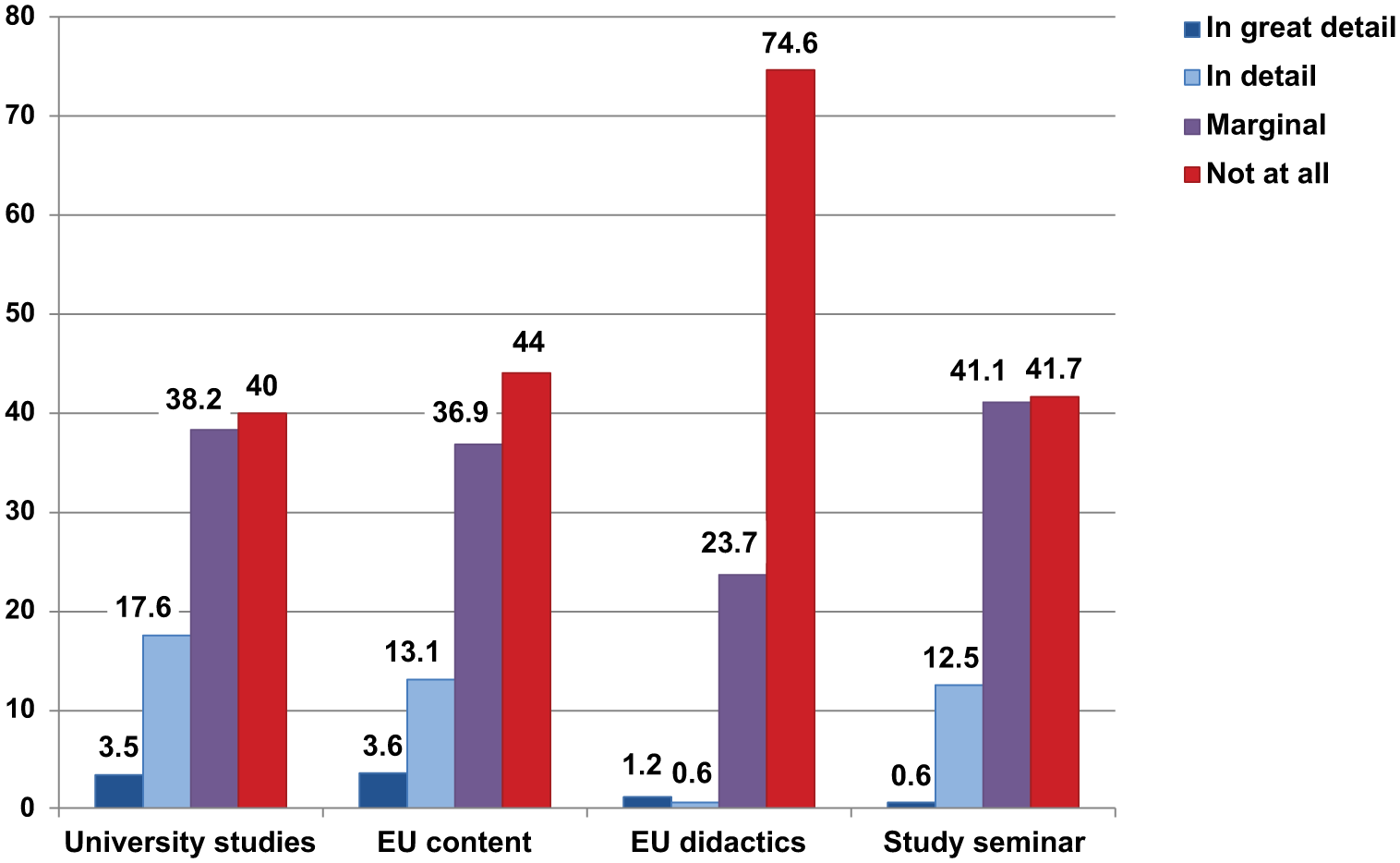
The EU as a subject of teachers’ education (in percentages).
In terms of the goals of teaching about the EU in lessons, nearly all teachers surveyed view the promotion of the ability to make independent judgements, the expansion of content knowledge and the motivation to participate politically as quite important or very important (see Figure 2). A majority of the teachers would also like to promote European identity and approval of the EU in their lessons, but some also find these points unimportant or are critical of them. The goals of the teachers are thus compatible with current models of competency-oriented civics lessons (Detjen et al., 2012; see earlier).
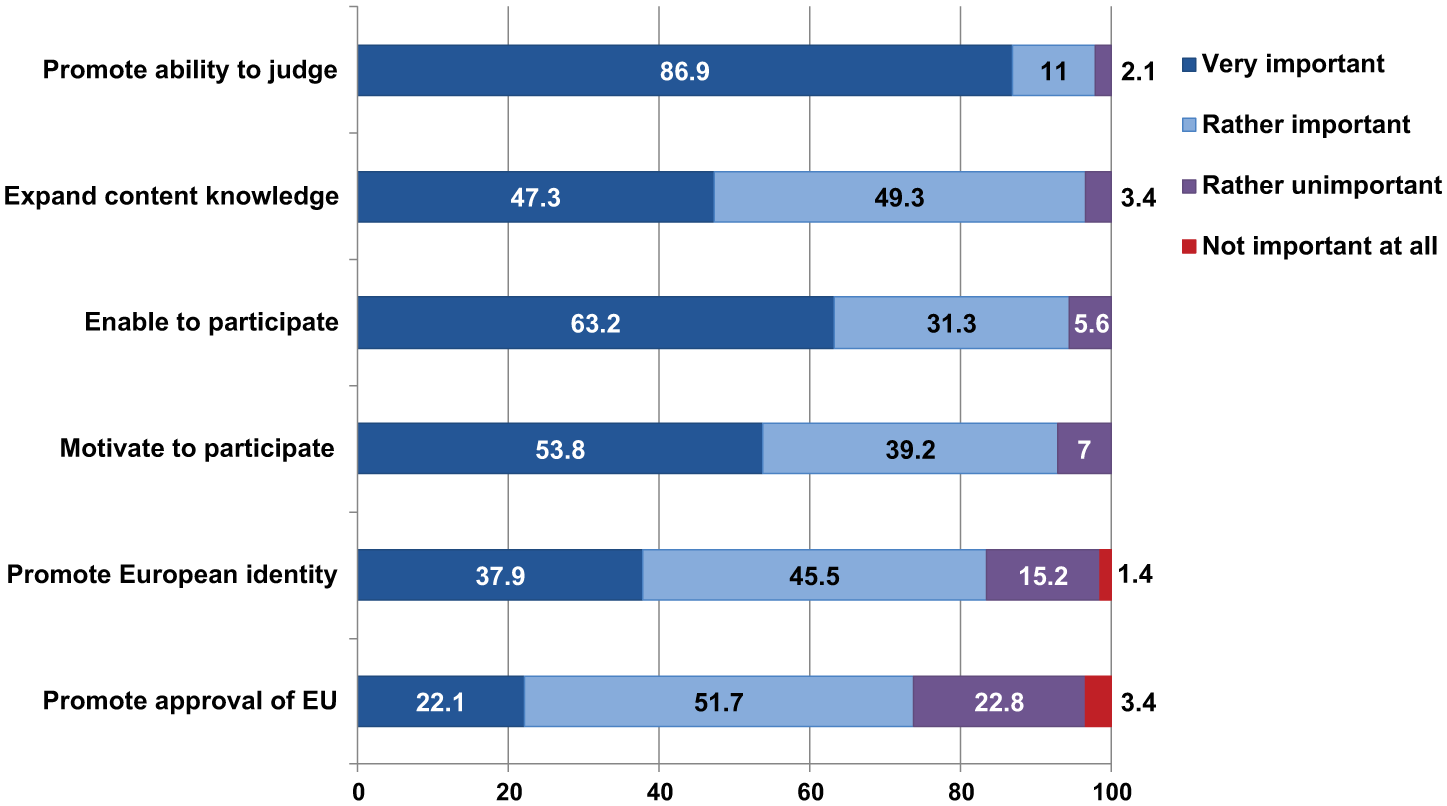
Goals of teaching the EU in class (in percentages).
The teachers’ answers to the question about the difficulty of teaching the subject of the EU (see Figure 3) confirm the assumptions already stated in the civics didactics: the complexity of the EU is viewed as by far the most difficult aspect of teaching in all types of schools included in the study. Following this are the disinterest on the part of the students, the dynamics of the EU, the lack of up-to-date materials, prejudices of the students and a lack of teaching methods. A lack of materials is, in contrast, not a main problem. It is interesting that problem perceptions vary according to the type of school and that, despite the small sample size in some groups, certain tendencies could be seen: the students’ disinterest was viewed from a teacher’s perspective as a problem primarily at vocational schools and less so at advanced secondary schools, whereas prejudices on the part of the students were named as a problem in this study at vocational, lower and intermediate secondary schools, less of a problem at advanced secondary schools and it was not named at all as a problem for comprehensive schools.
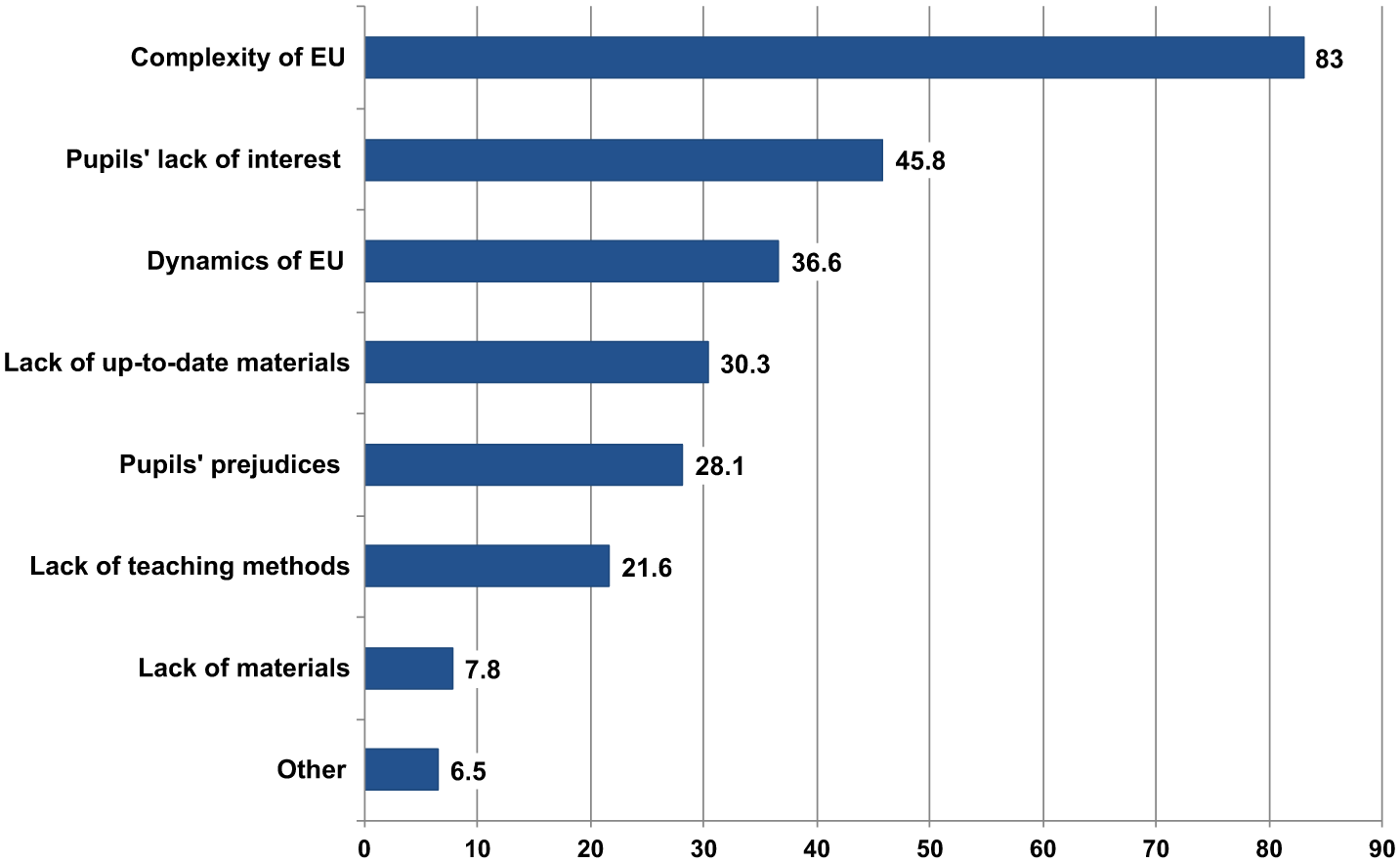
Difficulties in teaching the EU from a teacher’s perspective (in percentages).
The results are remarkable because the question of the EU’s complexity is discussed controversially. One could imagine that federal or municipal politics are not less complicated and that the EU is no more difficult to understand than other areas of politics (Goll, 2015: 188). But this survey clearly shows that civics teachers perceive the EU’s complexity as the most difficult problem by far in teaching it. This must be taken seriously – there is a need for education and continuing education for teachers that betters their own understanding of the EU, as well as a need for specific approaches to reduce complexity in teaching.
The practice of teaching about the EU in civics class can be described in the following way for our sample. The majority (68%) teach the EU only as a self-contained topic. According to their own statements, around one-quarter of teachers discuss it both as a general lesson principle (crosscutting theme, Weißeno, 2004) and in a separate block. Methodologically, in addition to group work (91%) and lectures by the teacher (68%), ‘action-oriented’ methods such as pro and con debates (64%), simulation games (24%) and project work (22%) are used (see Figure 4). Internet research and student presentations are used by around half of those surveyed. In terms of media and materials, around two-thirds of the teachers use textbooks to teach the EU. In contrast to some expressed assumptions, textbooks are therefore still a key element of civics lessons even on the topic of the EU. However, material from the Federal Agency for Civic Education (Bundeszentrale für politische Bildung; 86%) and newspaper articles (79%) are used more often, probably because both have the possibility of being more up-to-date. Around one-third use video material and only 10% use internet blogs and forums.
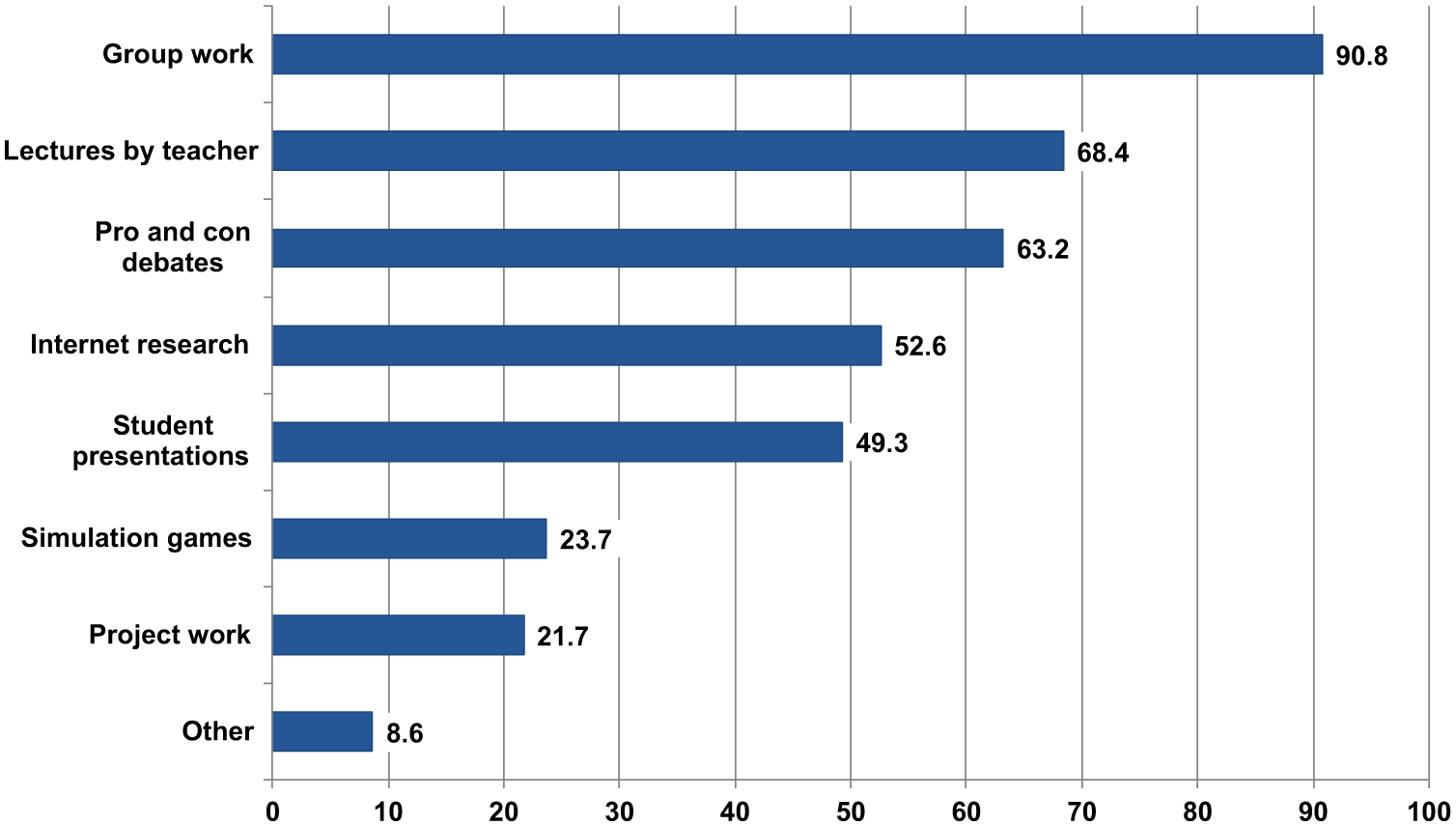
Methods used for teaching the topic of the EU in class (in percentages).
The EU chapters of the textbooks used received varying evaluations. On average, the teachers who use the textbooks are neither particularly satisfied nor dissatisfied with the EU chapters, although the evaluations vary quite a lot (M = 2.57, standard deviation (SD) = 0.79; Likert-type scale with 1 = very satisfied, 4 = very dissatisfied). Most books received positive evaluations for their descriptions of the basics of the EU, and in some books the graphics and figures were also rated positively. Nearly all textbooks were rated negatively for not being up-to-date, and many teachers also said the textbooks had a lack of target-group orientation for teaching the EU. In part, the teachers also criticized a lack of examples and too great a focus on institutions. Errors in content were rarely mentioned as a problem, though.
Teachers’ EU-related characteristics
The descriptive results of the participating teachers’ EU-related characteristics reveal the following. The variance in their previous EU knowledge was quite strong, which was expected, taking into account the different education and school type backgrounds (M = 13.95, SD = 5.90). Due to their self-selection, it is not unexpected that the participants are very interested in the EU (M = 1.37, SD = 0.54; these and the following information are based on a uniform poling of the four-point Likert-type scale with 1 = strongly agree/very positive, 4 = strongly disagree/very negative) and generally politically interested (M = 1.65, SD = 0.40). While the general attitudes about the EU are very positive (M = 1.30, SD = 0.41), the EU’s performance (focus: democratic legitimacy and efficiency) was evaluated more critically (M = 2.65, SD = 0.40). A future expansion of the EU is viewed rather positively by the participating teachers (M = 2.07, SD = 0.63), but they tend to reject deepening towards a European federal state (M = 2.81, SD = 0.51).
How are teachers’ EU-related attitudes linked, and what influence do the background variables gender, age and school type (advanced secondary school vs others) have? The structural equation in Figure 5 offers interesting information, especially in comparison to the results of another current study on civics teachers (Professional Competencies of Civics Teachers (PKP) Study; Weschenfelder, 2014; Weschenfelder et al., 2014) and a Göttingen student study (pupils` political knowledge and attitudes regarding the European Union II (WEUS-II); Oberle and Forstmann, 2015a). As expected, teachers at advanced secondary schools have a more extensive EU-related content knowledge than teachers at other types of schools (analogue to the PKP Study). Male teachers have greater content knowledge than their female colleagues (analogue to the PKP Study). Older teachers are more interested in the EU and view further deepening more positively than their younger colleagues. Otherwise, the background variables included revealed no direct influences on attitudes towards the EU, but positive effects were revealed based on the teachers’ existing knowledge of the EU: those who know more about the EU are more positive about expansion and tend to have slightly more positive general and performance-related attitudes towards the EU. As in the Göttingen EU student study WEUS-II, EU-related attitudes are systematically linked with basic knowledge about the EU. In contrast to the student study, more extensive EU knowledge did not have a negative but instead a slightly positive effect on the evaluation of the EU’s performance here (the operationalization of this was slightly different in comparison to the student study, however: here, the performance battery included two items on the EU’s efficiency in addition to democratic input legitimacy). That there was no link between EU knowledge and EU interest in contrast to general political interest could be due to the sample’s broad interest in the EU based on their self-selection, but it could also be due to the limited method of collecting data on EU interest using only a single item.
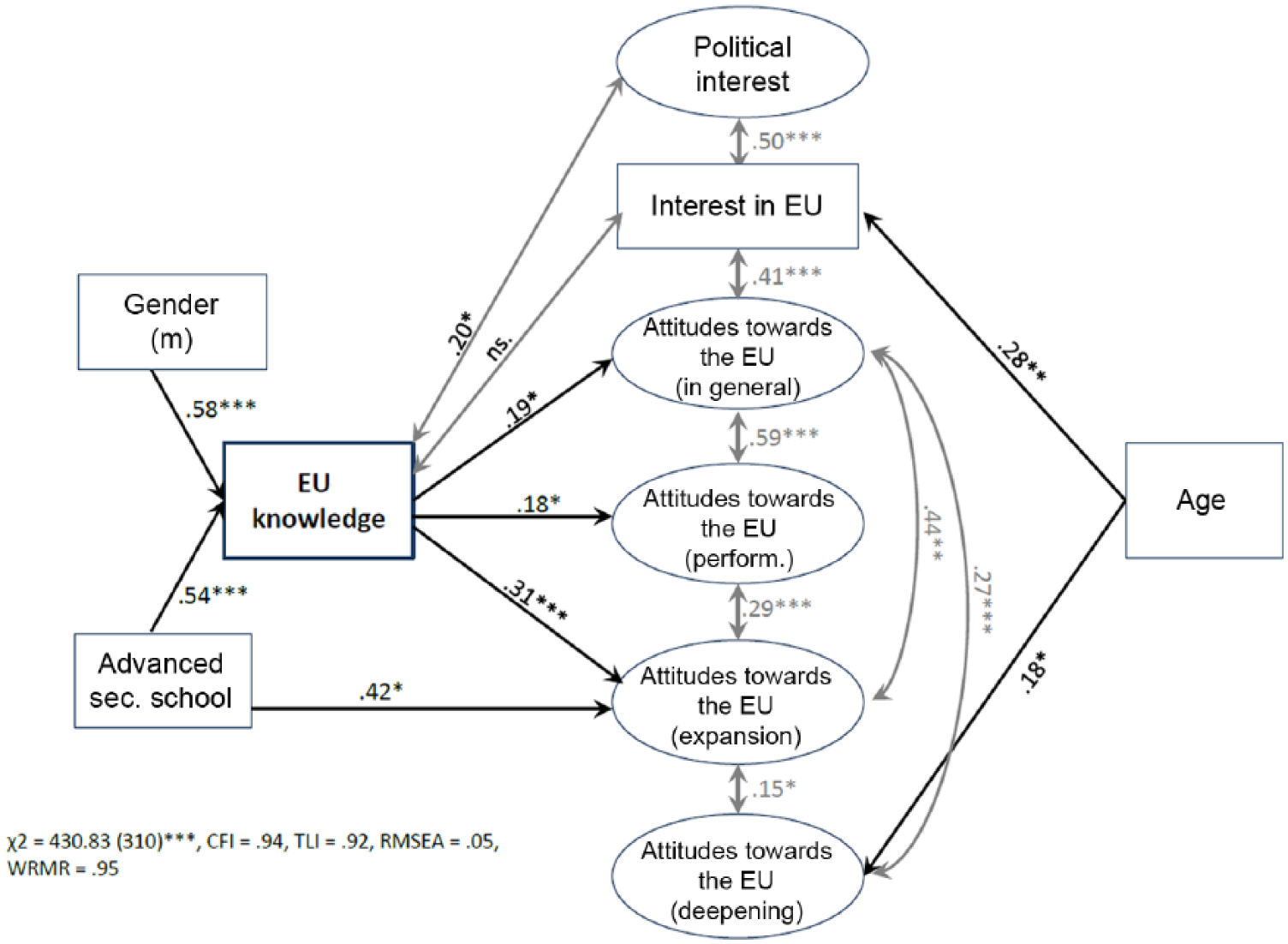
Latent structural equation – teachers’ EU-related attitudes depending on their EU knowledge and background variables.
Evaluation and effects of the continuing education series
The collection of data on EU-related content knowledge in the pre-test and post-test shows a clear increase in knowledge from the continuing education course: comparisons of means (Cohen’s d) show a highly significant, strong effect (Figure 6). This applies both to male and female participants.
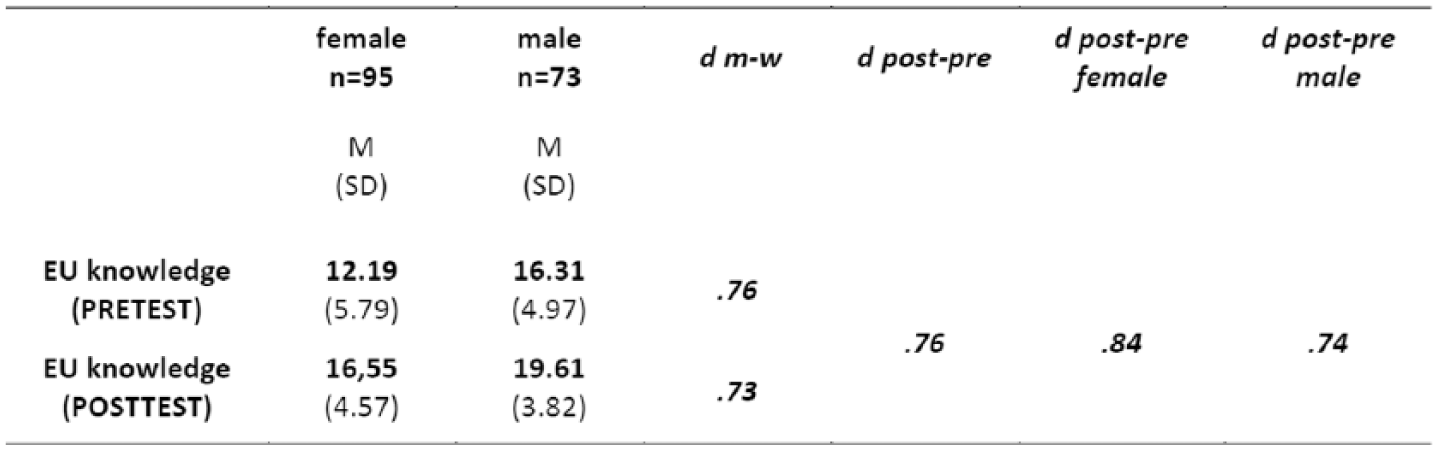
EU-related knowledge (summation indices): comparisons of means pre-test and post-test, gender-specific.
Group comparisons and multiple regressions of the increase in knowledge show that participants with a low level of previous knowledge achieved disproportionately greater increases in knowledge. On the whole, they were not lost by the course, and at the same time participants with extensive previous knowledge about the EU were able to refresh and expand their knowledge. Regressions also showed that advanced secondary school teachers had a slightly greater increase in knowledge than their colleagues from other school types, even when controlling for their previous EU-related knowledge. They were therefore apparently able to transfer the contents of the course more effectively to their available knowledge base.
The majority of participants could imagine using the presented methods in their own lessons (depending on the method between 68% (silent discussion), 80% (e.g. mini-future workshop, simulation game) and 90% (e.g. concept cards, future scenarios with positioning)). A total of 43 teachers had already taught an EU studies unit between the course and the follow-up survey. Around half of these used teaching methods learned in the continuing education course in these units, whereby the vast majority (mostly 100%, otherwise 86–96%) were satisfied with the use of the methods.
The vast majority of the participants stated that they found the course very or quite useful in regard to specific aspects of their EU lessons, that is, regarding their independent further education, lesson preparation, the successful conveying of knowledge about the EU to students, a more varied lesson design and the promotion of the students’ interest in the EU (see Figure 7). In total, the EU continuing education course was evaluated by 63% of the participants as very good and by 33% of the participants as good; 4% (seven participants) evaluated it as average. The level of the course was found to be appropriate by 86.5%, 11% found it too high and 2.5% found it too low (the deviations are not related to school type). Carrying out a subject-specific continuing education course for teachers from different school types was therefore shown to be quite feasible.
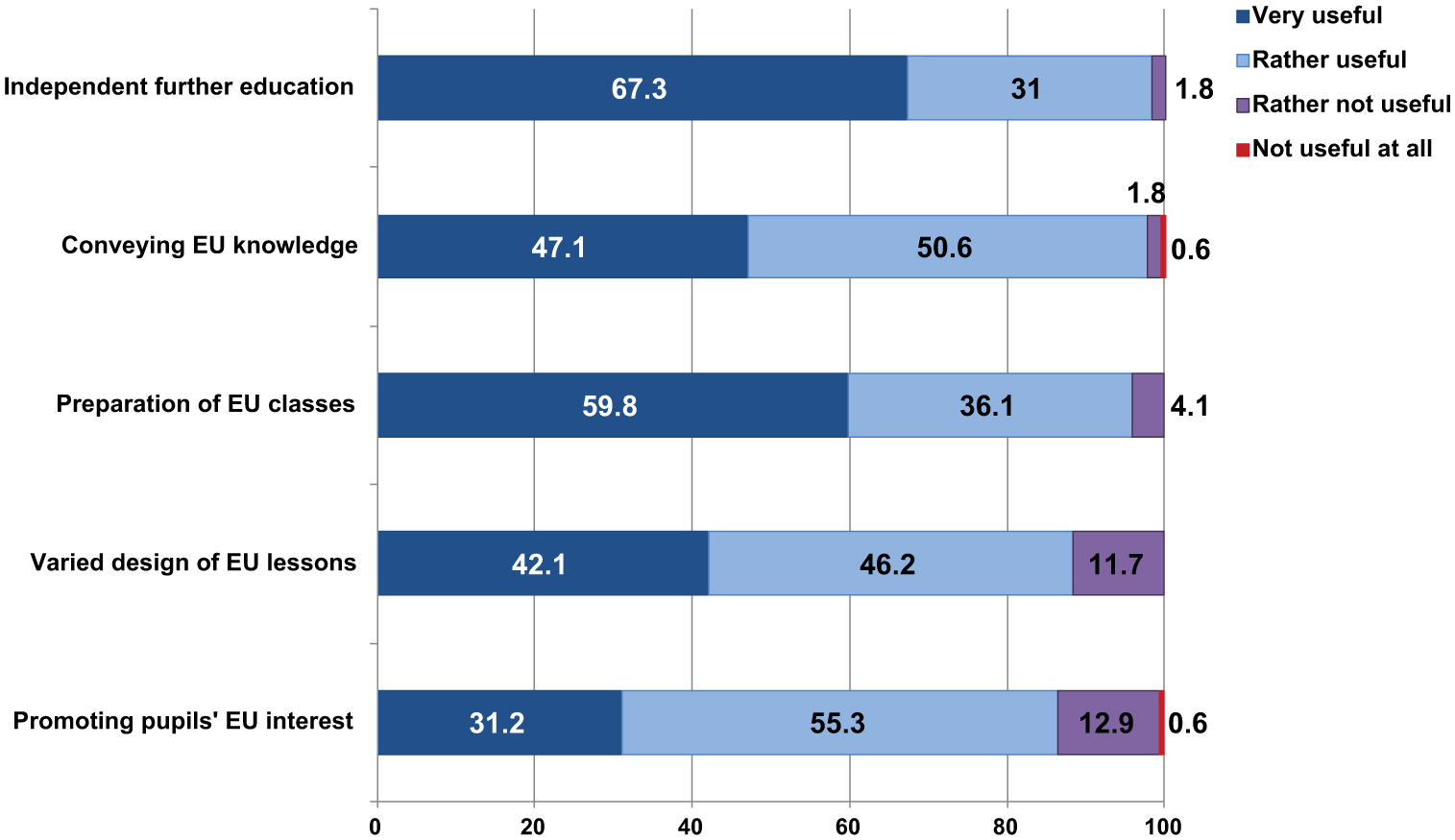
Evaluation of the effects of the PEB continuing education course by the participants (in percentages).
Outlook
The motivation for the PEB project was the assumption that teaching EU-related competencies is a relevant element of civic lessons at schools today and yet, at the same time, presents a particular challenge to teachers, who have a need for specialized continuing education courses. The ideas upon which the PEB continuing education series were based were generally confirmed. The results of the accompanying empirical study as well as the registration numbers show that there is a need for specific continuing education courses for teachers on the subject of the EU and how to teach it, and that there is a willingness on the part of the teachers to take advantage of such offers. When advertising such events, one should not rely on notification in central – for example, online – continuing education catalogues, however, but in particular the potentially interested groups should be made aware of the offer via mailing lists.
The conceptualization of the continuing education course was also proven successful with its mix of content knowledge and pedagogical content knowledge elements, including an active discussion and testing of teaching methods and the provision of current information and lesson materials. The integration of speakers from the university and political practice was evaluated positively. From the participants’ perspective, a carefully researched, current and understandable list of links with comments is also a very prudent component for strengthening their ability to independently further their knowledge and thus increase the sustainability of the course.
Despite varying levels of previous knowledge and specific expectations, the vast majority of the participants benefited from the course according to their own statements. The results of the EU knowledge test confirm the effectiveness of the course for the content knowledge dimension. Here, it was shown that teachers from all types of schools were able to significantly expand their knowledge of the EU. Teachers with lower levels of previous knowledge were not ‘lost’, while teachers who already had relatively extensive knowledge of the EU before the course were able to further expand that knowledge.
The study reveals gender differences in political EU knowledge at the expense of female teachers even when controlling for age and school type. When looking at the general gender gap in the political (EU) knowledge of the population (see e.g. Hoecker, 2013: 40–41) and students (Oberle, 2012b; Oberle and Forstmann, 2015a), this is not surprising. When taking into consideration our sample’s expert status, however, it was not as expected but does conform to the findings of the Karlsruhe–Göttingen PKP Study on the professional competency of civics teachers (Weschenfelder, 2014; Weschenfelder et al., 2014). The causes for the gender gaps in the teachers’ content knowledge should be researched in order to provide a basis for developing appropriate measures especially for women civics teachers (Oberle, 2013b). In this context, it is interesting to note that in this study the women civics teachers stated proportionately less often than their male colleagues that they taught civics as their ‘primary subject’. The women thus stated more frequently that they taught civics as their ‘secondary’ or even ‘tertiary subject’.
The participating teachers’ knowledge of the EU tended to be positively linked to their EU-related attitudes. The basic assumption underlying several current EU measures is that an expansion of an EU-related knowledge base will lead to a greater acceptance of the European integration project, and this was supported by the study’s results. However, it must be emphasized that the link between knowledge and attitudes (both for teachers and students; see Oberle and Forstmann, 2015a) is only moderate, and additional longitudinal studies are necessary in order to understand this more fully. For example, a reversed causality or mutually strengthening interdependency of knowledge and attitudes is conceivable.
Regardless of the question on the promotion of attitudes, however, the expansion of knowledge about the EU is an important objective for a civic education that values its citizens’ ability to make reflected judgements and participate (see also Rappenglück, 2005: 460). As Detjen (2013) stated, ‘Without well-founded knowledge, political participation is missing the element of rationality’ (p. 309). In turn, for knowledge and competency promotion in students, the teachers’ solid content knowledge, conveyed by their pedagogical content knowledge and abilities, is what is relevant, as has been show by empirical studies in other domains (Baumert and Kunter, 2006: 492–496).
The results of the study presented here confirm the assumption that the discussion of the EU in the education of civics teachers in Germany has clear deficits that extend even into the new millennium. This applies to content knowledge and pedagogical content knowledge during studies and in the study seminars, and reveals not only an urgent need for appropriate continuing education opportunities for teachers but also the call for the EU and EU civic education to be integrated comprehensively into the education of civics teachers in the future – in particular because the (voluntary) participants in continuing education courses will mostly be limited to teachers who are particularly motivated and interested in the EU.
Footnotes
Funding
This research was funded by the European Union in the framework of the programme for lifelong learning as a Jean Monnet project.