



Abstract
Twenty ye ars after the Lisbon strategy, education policy in the European Union (EU) is at a critical juncture, with a new set of strategic goals endorsed for the 2021–2030 decade. This article examines the complex interplay of ideas, institutions and actors, in articulating education policy priorities in the new European Education Area (EEA). Drawing on documentary reviews and interviews with policy actors in the European Commission and the Council of the European Union, we trace the rise and fall of policy ideas in the new framework. The negotiations over the definition of EEA reveal new tensions between and within European institutions over specific policy ideas, with “lifelong learning” and “gender” as the most controversial ones. Continuing, longstanding tensions between the education and employment fields remain, and present a difficulty for the construction of a comprehensive and cohesive education policy program.
Introduction
The making of education policy at the level of the European Union (EU) has always been a feat of compromise, contestation, and consensus, between the EU and member states, and within the EU institutions. Ever since the Lisbon Strategy and the creation of a “European space of education” (Hingel, 2001), education policy has been shaped and re-shaped by constant interactions of multiple institutions and policy actors. The struggle over the definition of education policy goals and directions has taken many forms and has been expressed as continuous process-outcome dynamics, crystallized in the construction of the Education and Training (ET) frameworks 2010, and 2020. Now, at the end of the latest framework (ET2020), education policy and the European education space are being re-examined and fine-tuned once again through the construction of the new generation framework, the European Education Area (EEA).
The process of defining education policy and its parameters is by no means a simple or straightforward affair. The field of education, firmly embedded in welfare regimes and at the heart of (national) identity politics, falls beyond the competence of the EU. Policy actions are mostly of a “soft” governance variety, whereby forms of cooperation and consensus-driven policy learning are pursued (Lange and Alexiadou, 2007; Walkenhorst, 2008) and where initiatives such as digitalization responses to the refugee and covid crises, have policy actions effects (van de Oudeweetering and Decuypere, 2021). The softness of the governance possibilities in education policy gives it an interesting position within EU policy making. On one hand, it is vulnerable to being captured by other policy fields, such as employment, and seen as serving primarily employment-employability objectives (Antunes, 2016). On the other hand, the very flexibility inherent in the soft policy instruments that make up its governance means that education can assert an autonomous presence and capability to be an institutionalized area with a strengthened position within the EU policy landscape (Gornitzka, 2018).
In the aftermath of the Lisbon Strategy launched in 2000, education is one of the areas of social policy that, even though covered by the principle of subsidiarity, has been embraced into the EU governance architecture through the creation of an education Open Method of Coordination (OMC). As Borrás and Radaelli (2011) point out, such “architectures” are of a strategic and long-term nature, and commit policy actors to targets and processes (p. 464). Following the 2000 European Council Conclusions, education policy is driven by benchmarks and indicators, and their periodic monitoring/evaluation, the organization of a mutual policy learning structure characterized by a common vision around education problems and solutions, and a convergence of policy goals for national education systems. As such, it contributes to institutional and ideational structures that reflect values and norms regarding education goals and the “place” of education in the wider EU integration project (Lange and Alexiadou, 2010; Papanastasiou, 2020).
The new EEA framework represents a possible turning point in the evolution of education policy in the EU, not merely because it replaces the concluding ET2020 but because it is framed by contexts of multiple crises where education is expected to contribute to the solution of complex problems that have accumulated over the last 20 years. These range from enduring long-term unemployment resulting from the financial crisis of the 2000s (Mertanen et al., 2020; Traianou and Jones, 2019), the refugee crisis and the need to integrate newly arrived children and adults (European Commission, 2016), and the more recent Covid crisis (Symeonidis et al., 2021).
Against this context, our study aims to understand policy change in the next EEA framework from the perspective of ideas and discourses as these define the priorities for education policy for the next few years. Our research addresses the following questions: (a) What are the new priorities for education and what are the key policy ideas that frame their achievement? (b) What are the discursive continuities and shifts compared to the earlier ET2020 program and their consequences for the content and governance of education policy?
We draw on empirical fieldwork consisting of interviews with policy officials in the European Commission and the Council of the European Union (henceforth referred to as the “Council”), and the review of core relevant policy documents. Starting from the position that “ideas matter” in policy making (Schmidt, 2008), we identify the key ideas that define the future for education policy-making in the EU, and what their discursive properties suggest for the institutions that participate in the construction of policy priorities (Commission, Council, member states).
In the next sections we review selected institutional evolutions that have shaped the context for the new framework of EEA, followed by a discussion of our theoretical and methodological approaches that underpin our empirical work.
Institutional developments, continuity, and junctures
The economizing institutional structures of the Lisbon Strategy and the Semester
We begin this brief account focusing on the post-2010 period, and on selected developments, fully acknowledging the variety of earlier initiatives, and action programs that brought education steadily from the periphery to the core of the EU integration project (see Pépin, 2006). The processes of institutionalizing education into the governance architecture of the EU, both as an autonomous field and as part of economic and social policies have been described in detail in the education policy literature (see amongst other, Gornitzka, 2018; Grek and Lawn, 2012; Lange and Alexiadou, 2007; Walkenhorst, 2008). The explicit incorporation of the Lisbon strategic objectives to the Education and Training 2020 program (part of the Europe 2020 Strategy), and the revised Lisbon strategy shifted the focus from mutual learning between experts in member states, to strengthening the relationships between EU institutions, and particularly the Commission, and individual member states in the process or implementing reforms (Busemeyer and Trampusch, 2011).
In addition, the financial crisis of the 2000s, and to a lesser extent the recent refugee crisis, provided opportunities for higher and more intense involvement of the EU in national education policy-making as part of a Europe-wide social investment strategy. These were significant contexts in their impact on all areas of public policy across the union, in relation to economic growth and employment questions as well as issues of social cohesion and social solidarity. The financial crisis had particularly intrusive and enduring effects, since it saw a new approach to economic governance in the EU constitutional framework. In 2009, the Lisbon Treaty (OJEU, 2007) emphasized the need for member states to reduce deficits, and gave the Commission a more active monitoring role. The Treaty on Stability, Coordination and Governance in the Economic and Monetary Union (the 2012 Fiscal compact) was signed by the majority of member states and institutionalized deficit and debt targets in the Stability and Growth Pact. 1 In the sphere of education, the soft governance approach of policy learning, even though still present, was now complemented by the new process of the European Semester, established in 2011. As part of the annual Semester cycle, and following the yearly Growth Survey, the Commission, Council of the EU and the European Council decide on the priorities of the EU and review the performance of countries. Following this process, the Commission publishes Country Reports where they identify challenges and progress in each country, and subsequently issue Country Specific Recommendations that cover a range of areas and policy fields (including education). In response, member states submit National Reform Programs, which in turn are reviewed and evaluated by the Commission, before they are endorsed by the European Council and, in June adopted by the Council (for education, see Eeva, 2021; Stevenson et al., 2017).
Education and training are seen as core connecting fields that provide operational links between strategies for employment, for social cohesion, and schemes for youth training. This has its roots in the late 1990s when lifelong learning got integrated in the European Employment Strategy (EES), with key education issues being decided by ministers responsible for employment portfolios (Gornitzka, 2018). Since then, the work of the Commission over education acquired a more explicitly directive flavor. Education-related areas of cooperation were integrated in DG-Employment, and the development of an OMC in education saw what Gornitzka called “a way of (DG-Education) reclaiming European cooperation in the area of lifelong learning from the EES” (Gornitzka, 2018: 246). In addition, despite the soft-law approach of the OMC in education, since the Amsterdam and Lisbon Treaties, the Council of the EU and the Parliament are co-legislators. The co-decision process has strengthened (or even hardened) the governance of all areas of policy, including these covered by subsidiarity (Costa and Brack, 2019).
Against these power struggles, and hardening of soft governance, the financial crisis of the late-2000s provided the conditions for embedding education and training policy in the routine working instruments of economic monitoring with a dual set of expectations and tensions within which it operates since then: On one hand, education has been visible in the EU’s strategy Europe 2020 and the policy areas set out in its targets—employment and growth, investment, climate change, education, and social inclusion (European Council, 2009). On the other hand, the big emphasis of the Europe 2020 has been on fiscal responsibility and continuous structural reform (European Commission, 2018: 1) while governments were encouraged to align schools to the needs of both the labor market and social cohesion objectives (Alexiadou and Jones, 2019). For the whole decade, these arguments relied on the potential of new synergies across policy fields, with education and training seen as core to the creation of a knowledge economy, as well as for contributing to social and territorial cohesion (European Commission, 2010: 11).
In parallel to these economically-driven priorities, there were developments of a more social orientation.
Social contexts of governance – European Education Area and the Pillar of Social Rights
In 2017, the European Commission launched two important new initiatives with a distinct “social” flavor. First, following the Gothenburg Social Summit, a Commission Communication on the creation of A European Education Area by 2025, highlighted the contribution of education and culture “in strengthening the sense of belonging together and being part of a cultural community” (European Commission, 2017: 2). The Communication highlighted the significance of education and culture toward the achievement of social, and economic goals of the EU, and their contribution to strengthening the “sense of European identity.” It proposed Council Recommendations toward the achievement of the EEA, which were adopted in 2018 and 2019. The Communication and the Council Recommendations that emerged, were part of the still operating Education and Training 2020 framework, that was coming to an end shortly. The EEA 2025 intended to provide the new framework for the work of the Commission on education matters, in tandem with the investments that would be possible in the post-2020 multiannual financial framework, and the work of the European Semester.
The second significant development was the establishment of a European Pillar of Social Rights, endorsed by the Parliament, Council, and Commission (European Parliament, Council of the EU and European Commission, 2017). The Pillar was an explicit attempt by the Juncker Commission to redress the imbalance between the economic and the social and to incorporate social rights in employment and wider economic policies (De la Porte, 2019). The Pillar, also introduced during the 2017 Gothenburg Social Summit, was followed by the publication of an Action Plan for its realization, setting up targets to be met by 2030. It has 20 principles that should guide a “social Europe that is fair, inclusive and full of opportunity.” Two of the principles explicitly address education (the right to quality and inclusive education, and the right of children to affordable ECEC of high quality), and several others having indirect consequences for education.
Both the EEA 2025 and the Pillar of Social Rights are linked to, and in varying degrees integrated in the Semester cycle, and provide an important institutional context to our research. As of 2020, member states have to include in their National Reform Program how they achieve the Sustainable Development Goals (SDGs). This is integrated in the report on the achievement of targets of Europe 2020 strategy (chapter 4), and, president von der Leyen has incorporated the delivery of the SDGs to the “mission letters” sent to all new Commissioners in 2019. But, the Junker Commission introduced also a significant internal re-organization of the Commission (for more on this see Kassim, 2017). In that set of reforms, education as a policy area was split between DG-EAC that continued to be responsible for all “core” education areas, and DG-Employment, responsible for VET and adult learning.
Overall, and since the 2000s, there have been significant administrative changes that saw the creation of new units and policy actors in the field of education, such as new Parliament committees, Council for Education Ministers, and the DG-EAC governance architecture that developed an elaborate cooperation structure for a working program around education policy. The creation of a High-Level group on education, with participation of national experts, increased the legitimacy of the EU education policy actions, while also strengthened the co-construction of policy through networks that linked the Commission and member states over the shaping and operationalization of the education OMC (Lange and Alexiadou, 2010). As a result, there have been changes to patterns of relations and sometimes emerging tensions between different institutions of the EU, but also between different DGs within the Commission. These frame how education priorities are defined and operationalized, as is visible both in our documentary and interview evidence.
These developments, together with the integration of education into the Semester process, are significant to understand the new policy priorities and the positioning of education policy as part of the EU integration project. Since they also represent new policy beginnings, it is important to understand the ideas and values that underpin them.
Theoretical and methodological considerations
Our research focuses on policy ideas, since they underpin policy programs and frameworks, and guide political action. Policy ideas can be of a “cognitive” or “normative” nature, depending on what function they perform in the policy process. Cognitive ideas define the parameters and objects of policy problems, identify the scope for solutions, and provide direction and focus to policy programs, allowing policy actors to operate within certain frames of reference (Schmidt, 2008). Normative ideas have stronger legitimacy functions. They consist of “taken-for-granted assumptions,” attach values to political actions, help decide what is acceptable, and constrain actions by limiting the range of alternatives seen as (not)appropriate (Campbell, 2002: 23). Policy ideas are communicated through discourses that aim to convince about their viability and suitability, in what Schmidt (2008) calls “coordinative” discursive communications (policy actors trying to convince each other), and “communicative” actions (policy actors engaging in public communications).
We are interested in the policy ideas that underpin the new European Education Area framework, and the changes and continuities they represent, compared to earlier frameworks. These are ideas that have both cognitive and normative properties, communicated in EU texts after significant “behind the scenes” deliberation. In their published, official form, EU texts communicate with the wider public the intentions and values embedded in the EEA framework, using particular forms of communicative discourses, captured in “benchmarks,” “targets,” “strategic priorities,” and detailed themes in the documents. In our study, EU policy officials are involved in the construction of policy ideas and programs. We aim to understand, from their perspective, the internal deliberation of cognitive and normative policy ideas included in the framework, and the “coordinative” debates that occur in the process.
Policy ideas are always deliberated within specific organizational forms (with their norms, regulations, histories, and traditions of practice), and so, we draw on discursive institutionalism as a conceptual frame that connects individual policy actors, to their institutions (Schmidt, 2008; Schmidt and Radaelli, 2004). Since ideas are the product of the interaction between institutions and policy actors, they are embedded in existing structures. These provide specific contexts (for instance, committee structures within the Commission and the Council, the time cycles of policy evaluation), and so frame the possibilities and alternatives in the formulation and communication of policy (for instance, the format and language of Commission Communications, Council Resolutions, etc.).
The nature of the policy settings and the specificities of their evolution shape also the “ideational power” of policy actors to “influence other actors’ normative and cognitive beliefs” (Carstensen and Schmidt, 2016: 321). This suggests that power is both invested in organizations, their structural and institutional forms, and in individual agents who may act in the capacity of administrators, civil servants, or members of an epistemic community. The former form of power concerns “historically specific structures of meaning and the institutional setup of a policy area,” while the latter occurs when individual actors are able to convince others of “the validity and/or normative value” of their ideas (Carstensen and Schmidt, 2016: 323). In controlling the meaning of particular policy ideas, successful policy actors manage to embed these within existing institutional structures, and hence render them authoritative. A successful use of ideational power could result in the continuation of long-standing policy ideas. Alternatively, it could challenge them and lead to their gradual or radical shift in meaning or direction. When a new strategic framework is being formulated we have the opportunity to examine the interplay between the discursive dimensions of policy ideas that promote certain visions of education for the EU, against existing structures that have institutionalized a europeanized education policy through governance processes such as the OMC.
The empirical part of our study draws on two sources of data. First, we reviewed selected strategic documents produced by the Commission and Council, that represent the vision and plans for the construction of the EEA: (a) the Communication from the Commission on achieving the European Education Area by 2025 (European Commission, 2020a); (b) the accompanying Commission Staff Working Document on the achievement of the European Education Area by 2025 (European Commission, 2020b); and (c) the Council Resolution on a strategic framework for European cooperation in education and training toward the European Education Area and beyond 2021–2030 (including the Annex) (Council of the European Union, 2021a, 2021b). In addition, and for purposes of comparisons over time, we have reviewed documents that set out the earlier ET 2010/2020 frameworks (Council of the European Union, 2011; European Council, 2000, 2009), and a Parliament Resolution on the European Education Area (European Parliament, 2021). The presentation of policy priorities and ideas in these documents feed into the Tables below.
Second, during 2021, we conducted in-depth interviews with 9 officials 2 in the Directorate-General for Education, Culture, Languages, Youth and Sport (DG-EAC), the Cabinet of the Commission President, and the Council, working on, or contributing, to the development of the European Education Area 2025. Our interview agenda addressed (a) the processes and rationales that led to the setting of policy priorities for the European Education Area; (b) the continuities with the earlier frameworks; (c) the interactions between the European Commission and the Council over the construction of the policy priorities; and, (d) the cognitive and normative policy ideas that drove the process. Our interview participants are all elite organizational policy actors, with specialized tasks and expertise within the Commission and the Council. As such, the interview format was that of a flexible conversation, and the specific questions adapted to the location and role of the different interviewees (Aberbach and Rockman, 2002). The interviews lasted 60–80 minutes, and were fully transcribed and anonymized.
Our approach to the analysis of the interview material is critical and interpretative. We followed a combination of an inductive thematic analysis (following Aberbach and Rockman, 2002; Alexiadou, 2001) and a discursive interpretation of the interviews that aim to understand how individual policy actors engage with the policy ideas they describe, the legitimation arguments that are put forward, and the “importance of ideational structures for constraining which ideas are considered politically viable” (Carstensen and Schmidt, 2016: 320). Specifically, the analysis of the material intends to generate a set of constructs that capture identified policy ideas about the (re)defined priorities for the future, and their coordinative properties as these are manifested in the participants’ representations.
In the first findings section below we outline the shift of policy ideas and priorities over time and across institutions, starting with an overview of the documents. These are suggestive of both the changes in emphasis, but also of new negotiation spaces between institutions over the definition of strategic priorities for education policy. We explore these more in-depth, through the interview material in the following section of the findings.
Priorities, new and old – documentary context
The commitment to education and training is systematically communicated in the governance documents, as key to achieving the “Europe 2020” goals, and having “a vital role to play when it comes to shaping the future of Europe” (Council of the European Union, 2009, 2021a; European Council, 2000). In Table 1, we present the core policy ideas and commitments articulated as the Lisbon targets, the ET2020 benchmarks, and the EEA targets, spanning 20 years of enduring policy priorities. The table also illustrates that the governance of the education policy space relies strongly on cross-country comparative data despite the limits and pitfalls this may entail for policy purposes (Carlhed, 2017; Landri, 2021; Normand, 2021).
Policy ideas and priorities in the early frameworks.
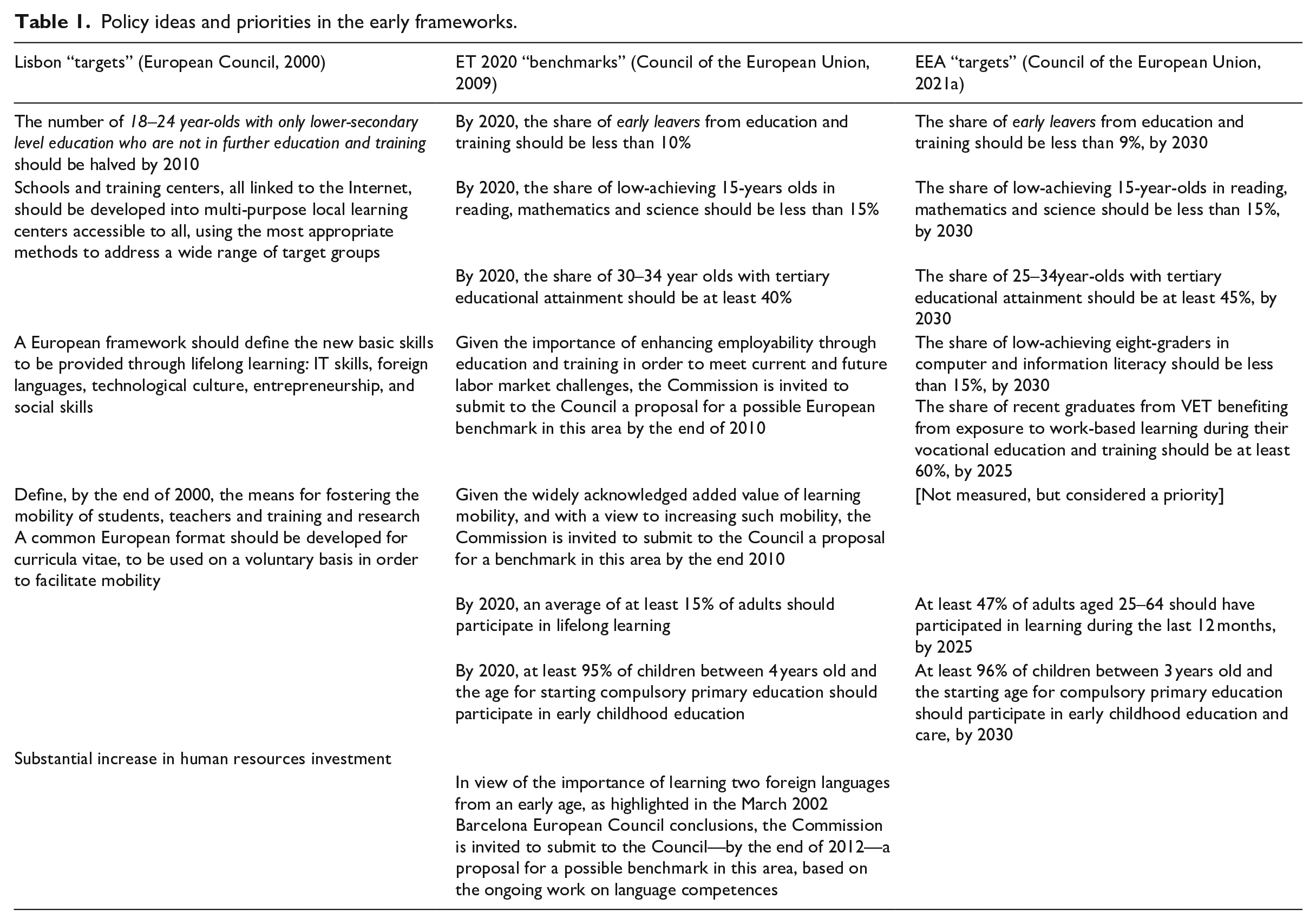
The early Education and Training 2010 framework, was a vehicle for the Lisbon strategy (and its revised 2005 and 2008 forms) that aimed to reform the EU economy, and actively identified policy problems and solutions for the modernization of European education systems, with an explicit desire to “adapt education to workplace needs” (Council of the European Union, 2011; European Commission, 2012). In 2010, the European Council confirmed these for the next ET2020 framework, and expanded their scope. At that moment, the ET2020 framework required that member states reach quantitative benchmarks on early school leaving, education participation and achievement, skills, learning mobility, early childhood education, and employability. Education and training continue to be defined as “critical factors” for the development of the EU’s “long-term potential for competitiveness as well as for social cohesion” (European Council, 2006).
The table captures common concerns with early school leaving, widening access, employability and skills acquisition in the three moments, consistent with a policy focus in the 2000–2020 period, on education as a means to equip individuals for competition in European labor markets. Additional areas of focus, such as mobility (of teachers, students, researchers, workers—a stable priority in all three periods), language learning, and participation in adult and early childhood education (featuring in 2009 and 2021 respectively), all promote human capital forms of investment in the productive capacities of individuals (Streeck, 2001). There is only one Lisbon target aiming at “increase in human resource investment,” which has the potential to point toward a more redistributive social policy requiring higher state investment in education.
In Table 2 we present the new priorities and ideas underpinning EEA as they are promoted in the Commission Communication (September 2020), and the Council Resolution (February 2021). These build into the earlier frameworks and take account of the Communication. Finally, we include an important 2021 European Parliament Resolution on the European Education Area.
Policy priorities and ideas of the European Education Area.
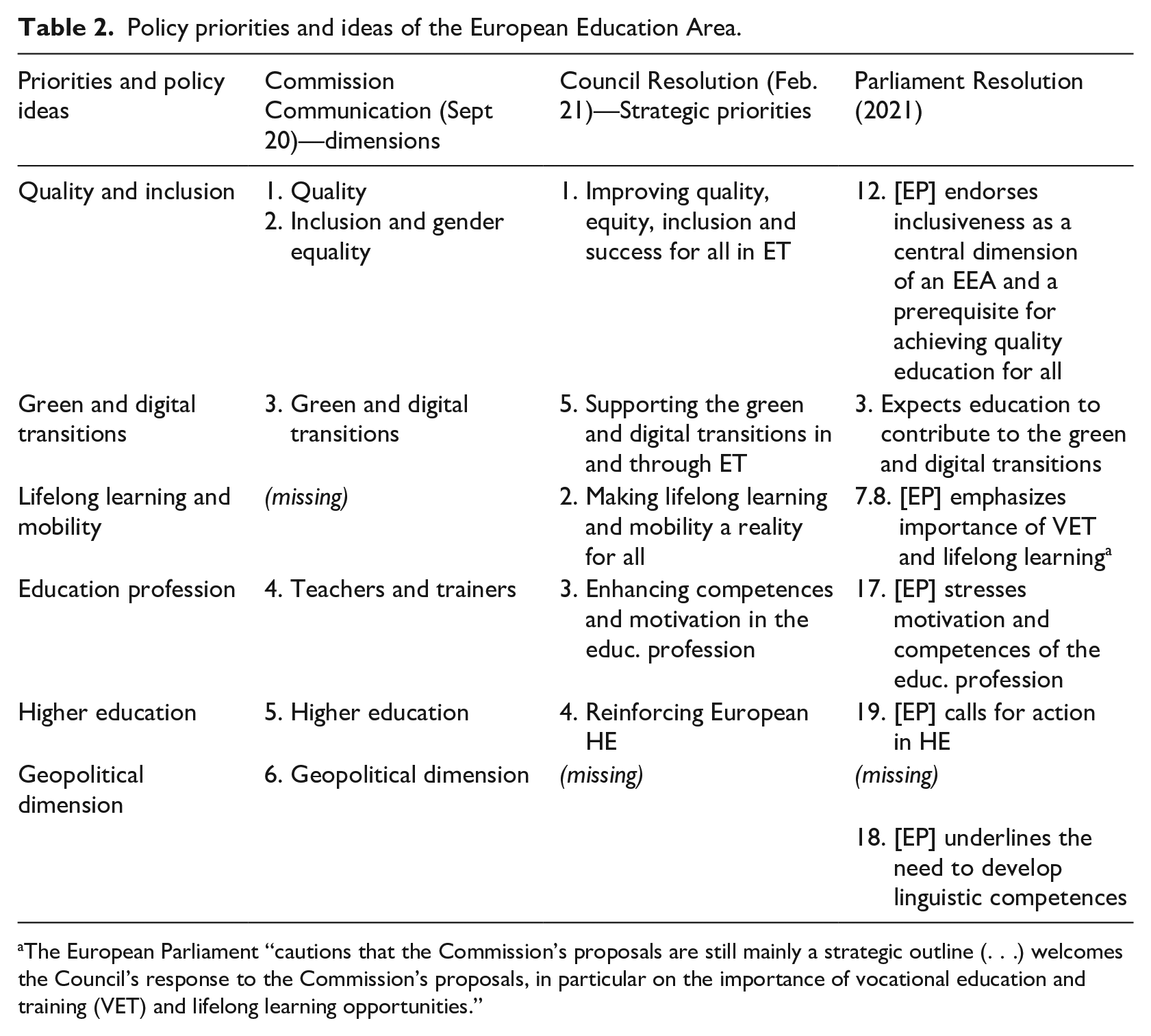
The European Parliament “cautions that the Commission’s proposals are still mainly a strategic outline (. . .) welcomes the Council’s response to the Commission’s proposals, in particular on the importance of vocational education and training (VET) and lifelong learning opportunities.”
Besides the different time frames for the next framework 3 there are some interesting observations regarding the articulation of the latest policy ideas. First, there is a considerable degree of continuity. Since 2000, the European institutions have maintained interests on educational quality and inclusiveness such as reducing early school leaving and improving attainment. In the post-2021 period, the EEA frames the old interests on skills and employability within the new priorities around the green and the digital transitions (promoted by the Commission, endorsed by the Council and the Parliament Resolution), and consolidates lifelong learning as a priority. Second, there are interesting discrepancies between the “six dimensions” promoted in the September 2020 Commission Communication, and the “five strategic priorities” specified in the February 2021 Council Resolution as the guiding policy ideas that should structure the next strategic framework. The Parliamentary resolution clearly lends support to the Council priorities.
Thus, Council and Parliament removed the focus on “gender” and the “geopolitical” as major dimensions. They also expressed an explicit interest in prioritizing lifelong learning and mobility, which are absent from the headline “dimensions,” and downplayed in the rest of the Commission Communication. By issuing an ambitious outline, the Communication of September 2020 opened a new type of coordinative conversation on education policy, which the Council and the Parliament joined and challenged the Commission’s approach. The three parties agree on the need to design a mode of governance, and here again we identify some possible tensions in positions. The European Commission (2020a: 26–27) invited the Council “to organize regular joint discussions between the Education, Youth, Culture and Sport Council and other Council configurations to help take a whole of government approach to education and training.” Actually, the Commission envisions an “enabling framework” that includes these joint discussions, a steering board of EEA, closer collaboration with the member states and stakeholders, and a permanent EEA Platform. The European Council (2021) accepts to work on a “suitable governance structure” while reiterating that the governance arrangements around cooperation in education and training should continue to draw on the existing toolkit of the OMC.
The identification of the priorities and the differences between (mainly) the Commission and the Council positions over what are the key education policy areas of focus, form a backdrop for further analysis, as we present in the next section.
Shifting and enduring policy ideas
Dimensions versus strategic priorities: Gender, quality, and inclusion
In its Communication of September 2020, the Commission recognized the earlier achievements of the ET2020 framework in “building trust and mutual understanding” and urges for an education policy that is “at the heart of the European way of life, strengthening social market economy and democracy with freedom, diversity, human rights and social justice” (European Commission, 2020a). According to one of the architects of the Communication, it is intended as “an enabling framework to reduce complexity” (Interviewee 2), but it has also changed the language and certain of the key ideas behind the ET2020 education framework. This is not merely a matter of semantics, rather an (attempted) cognitive shift, with the concept of dimensions intended to capture “a vision for that space and how to achieve it. . . there is an architectural dimension in this COM with a vision, and means and milestones” (European Commission, 2020a). Three of the dimensions of the 2020 Communication (green and digital transitions, higher education, teachers and trainers) were not controversial and are clearly visible in the Council Conclusions that endorsed the EEA framework. The “geopolitical dimension,” ties with the vision of the “Geopolitical Commission,” and appears in the Council Conclusions as an important “global perspective” through which to review education policy aims, albeit not as “strategic priority.” There were however some distinct tensions over two other dimensions of the Communication: Quality (dimension 1), and, Inclusion and gender equality (dimension 2). The gender dimension, “very important to Commissioner Gabriel” (Interviewee 5) proved to be a controversial normative idea, mainly for political reasons, with a number of interviewees pointing to gender politics as a terrain over which there are “fights within the Council”: We need to reach consensus or unanimous agreement. . . we now have four member states who totally reject, any reference to the term gender. So, we try to push for it. When we talk about inclusion we need to refer to issues of gender. . . all the other member states regret that it’s not possible to put (gender discrimination issues) clearly in the texts that have been approved by the Council for four years. (Interviewee 4)
As a result, the gender dimension did not convert to a strategic priority, instead it features under strategic priority 1 (“improving quality, equity, inclusion and success for all in education and training”). Avoiding the use of the verbs “have to,” “must,” or “should” as is common in the description of the priorities, “gender” issues are framed by fewer value-based discourses. Instead, it is addressed as part of “inclusive education and training (that) also entails developing gender sensitivity in the learning process and. . . institutions and challenging and dissolving gender stereotypes. . .” (Council of the European Union, 2021a).
But, what proved to be particularly controversial in the 2020 Communication, is the missing policy idea of “lifelong learning” and its re-packaging under other dimensions. The Communication presented “quality” and “inclusion” as distinct dimensions, following two main arguments. First, the term “quality” is decoupled from “excellence” and connected instead to the “basket of basic skills” that all pupils across the EU should acquire (this includes digital, transversal, language skills, and European perspectives). Second, the term “inclusion” is directly linked to “lifelong learning” and education achievement, it is coupled with “gender equality,” and treated as a substitute policy idea to that of lifelong learning: When you say ‘success for all’ it means success for nobody. . . for us, inclusion is not the “for all”, but precisely the decoupling between socio-economic background of students and their educational achievements . . .lifelong learning is essentially the inclusion dimension. When you’ve had a bad start, lifelong learning should allow you to, by combining work and education, to be on an upward trend. . . we take in zero account of the fact that when people have no education, it’s not because they lack it, it is because it has been a painful and negative experience. . . So, lifelong learning is really about paying attention to these bridges between work and education, and education has to find a way to heal those who have been hurt in formal systems of education. (Interviewee 2)
This part of the Communication stirred unease within certain parts of DG-EAC, with “inclusion” seen as too vague and not meeting the high demands of a cognitive policy idea that can support a whole framework (interviewee, 1).
The “missing” policy idea of lifelong learning
The omission of “lifelong learning” as one of the key “dimensions” was noted by parts of the Commission as well as the Council. It was seen as a radical departure from the policy ideas that provided focus, substance and structure to the earlier strategic framework, as well as from the preparatory work in advance of the new strategic framework (European Commission, 2020b). One of the DG-EAC officials who participated in the process since 2017, described the open education space of the original framework as “a little bit like the internal market, a space in which learning can take place, characterized by free movement of learners and by an attempt to eliminate the remaining barriers for transnational learning.” In this vision, lifelong learning discourses draw on multiple meaning domains that form the cornerstone of the past frameworks, with mobility, language learning, and automatic recognition of qualifications as the operationalizable areas for action and investment (interviewee 1).
Besides being an important policy idea, lifelong learning was the centerpiece around which a lot of operationalization policy work had taken place, including High-level group meetings, special seminars arranged by several Presidencies, stakeholder surveys and surveys of member states, a flash Eurobarometer, and consultations with member states (interviewees 5, 7; European Commission, 2020b). As such, lifelong learning represents a cognitive thread for continuity and for building on past decisions and existing institutional structures. The new strategic framework for EEA should be constructed as “evolution not revolution,” an argument that has been strongly promoted from the majority (but not all) of our interviewees within the Commission and the Council. In addition, and even more significantly, the emphasis on lifelong learning, is seen to reflect the political will of member states (interviewees 1, 4, 7, 8), and so, it also represents a policy idea with strong legitimating functions for the construction of an implementation program. Both the focus on lifelong learning and the member states’ ownership of the new program were important for all our Council interviewees, and for a significant number of the Commission officials: One of the main things that member states highlighted as being important in the strategic framework is the lifelong learning concept: from ECEC to adult learning, incorporating nonformal and informal learning. . . this was very much what the MS wanted to keep. (Interviewee 1) The ownership of the next framework should really come from the side of the member states, so the ownership should really be at a Council site. We were all very eager to try to influence this process. (Interviewee 9)
In the February 2021 Council meeting in Porto, these issues were “extensively discussed” with a focus on the highly controversial absence of lifelong learning as a core dimension in the Commission Communication (interviewee 8). The resulting Council Resolution reconfigured the six dimensions of the Communication into five strategic priorities (Council of the European Union, 2021a). The Education Committee, under the chair of the Portuguese Presidency, brought back “lifelong learning,” re-coupled “inclusive education” and “quality” under the same priority, and reintroduced more strongly the commitment to “learning mobility” (see Table 2). In this respect, even though the member states accepted the Commission’s new proposal for a “green and digital dimension” (the fifth strategic priority), they asserted their control of the process: Education is a national competence, so the decision on the document that will be presented to the Council for approval needs to be agreed on a consensual agreement – Within the Education Committee we discuss, and at the end of the examination of the documents, we ask if any member state has any red line or reservation. Then, the Chair of the Education Committee concludes that the Education Committee reaches a consensual agreement. The Commission are present in the Education Committee (meetings), we can discuss freely the issues. Even though they can share with us their mind on an issue, and as an Education Committee we listen to the Commission. . . because it’s a co-creation process and a collaborative way of working, but at the end the decision is with the member states. (Interviewee 4)
Tensions over defining ideas may be deliberated in the various committee meetings, but at the point of converting these into targets for member states to achieve, the political weight is firmly within the Council. In that case, the Commission proposals are considered, but it is the Resolutions that form the basis for action: I’m a bit old-school. . . The logical sequence is that we (Commission) come with a proposal, as in September last year. We said, ‘we think these are the priorities’, how we want to achieve these priorities, and we suggest to the member states to do it. And, ‘these are the targets we want to reach’. Then it’s up to the member states to come with a framework. They see it and decide, ‘this part I like, this part I don’t like’. For me, it is definitely the 18th February 2021 Resolution that is our guiding document. That decided the targets. It superseded the targets that were mentioned in the Communication. But I know there is not a clear consensus in-house about this. (Interviewee 7)
The compromise-basis and co-constructed nature of policy-making between the Commission and the Council are clearly visible in this process, also evidencing the strengthening role of the Council over education policy, especially since the 2009 Treaty of Lisbon, and arguably the role of the member states in the shaping of policy direction. The inclusion of education in “EU cooperation,” and the issuing of Joint Interim Reports with the Commission on the ET work program are further signs of the Council’s higher involvement in the process (DG-EAC, interviewees 1, 7; Council, interviewees 4, 8, 9).
“(Not) speaking with one voice”: Tensions between education and employment
At the back of the Lisbon strategy and the 2000 European Council ambition to make the EU the most competitive knowledge-based economy in the world, the field of education found itself as part of economic and social policies. The role of the Commission has also been strengthened, and it was an achievement of DG-EAC to make education policy an integral part of the Lisbon process, the Europe 2020 strategy, and later, the Semester process. But, this meant that other DGs are actively involved in, or contribute to different aspects of education policy work, and they do not always share the same position about education priorities. In the late 1990s, DG-Employment included lifelong learning as an area of cooperation under the European Employment Strategy, with employment ministers taking decisions on education issues. This was challenged in the early part of the 2000s by DG-EAC that successfully used the Lisbon strategy to create a new governance architecture through an education OMC. This was interpreted as a defense of the sector organized by DG-EAC, that acted as a policy entrepreneur (Gornitzka, 2018). But, it was not meant to last. Power struggles between DG-EAC and DG-Employment over the influence of education policy continued. The transfer of responsibility for adult and VET education from one DG to the other, is seen to create a bureaucratic split within the Commission. This results at, first, what one of our interviewees called “coordination in education through the back door of article 148” that governs the employment guidelines, and second, to administrative changes that are “not good for policy coherence”: the truth is that bureaucratic politics matters, having a different hierarchy, different commissioners. . . we now have a European Education Area managed by EAC, and on the other hand the skills agenda managed by Employment. And these are more or less competing frameworks. (Interviewee 1) . . .our fear from the beginning that there was a divergence between DGs Education and Employment. We (Council) really wanted to avoid fragmentation of education policy. And that was a central message in our non-paper. . . a focus on the whole life-cycle of education. . . we highlighted ‘seamless and holistic’. (Interviewee 8)
This is also the view from the Council that aims for better coherence, and where it is important that the Commission “talks with one voice.” But, this is compromised by other DGs seen to be “too powerful,” having a “direct link to a Treaty article” (interviewee 3), and with different views to those of the DG-EAC: the Communication on the achievement of the EEA was drafted by the DG-EAC, and then DG-Employment came. . . that’s why sometimes the final Communication is not balanced. . . . . .it’s not just Employment, it’s also Social Affairs, and they have a strong position within the Commission. For us in the Council, it’s truly important that the Commission acts as one. And sometimes we don’t feel that DG-EAC and DG-Employment speak with the same voice. We understand, their objectives are different. But then member states, instead of having a unique bilateral dialogue with the Commission, we have two bilateral, parallel dialogues. (Interviewee 4)
The von der Leyen Commission has not reversed the split of education areas between the different DGs, in fact, there are several policy spaces (DGs and Commissioners) where responsibilities include education in leading or supporting roles. For instance, officials in the country desks collaborate with DG-Employment over the production of the annual Education and Training Monitors, over the European Social Funds, and over “investment issues in education infrastructure” where both DG-Employment and DG-Regio are involved (interviewee, 6). The spread of education policy issues over several locations, is seen partly as a strength for the field of education that has been integrated into several processes as a core field, that also attracts direct investment (interviewee 6). It is also a weakness when the field becomes a terrain for conflicts between different DGs or Commissioners. The Semester process is driven by DG-Economy and DG-Employment as the main players in the process, often seen to have “dogmatic attitudes,” and “still at this very moment trying to slash education budgets” (interviewee 1). At the same time, there is recognition that the horizontal coupling of education to economic and labor market policies has several positive dimensions, not least in terms of the effectiveness of policy for outcomes: Education policies cannot deliver if they are not articulated with social and investment policies. (Interviewee 2) Member states profit from education being in the forefront. . . this was also due to the twin target in education under Europe 2020 on ‘early school leaving and education attainment’, which actually provides a good position for education in the Semester process. . . one third of the European Social Fund is devoted to education. (Interviewee 3)
The coordinative discourses around the definition of goals and targets for education policy draw on long-standing synergies between the Education and Employment fields within the EU, especially since the 2000s and the horizontal linking of education to other policy sectors. But, they also draw on tensions between them, over the direction and focus of policies as well as the definition of particular ideas.
Conclusion
The negotiations over how education policy is defined for the next 10 years, reveal the complex interplay between institutional structures and policy ideas, as well as interesting tensions within and across institutions. In relation to the European Education Area, the top decision-making bodies of the EU did not significantly modify their earlier agenda. Policy actors deployed “coordinative” and “communicative” discourses (Schmidt, 2010) to internally debate policy ideas within the institutions, and finally to communicate them with the wider public in official texts.
First, it is clear in our study that new ideas need to be grounded in existing institutional structures as well as to have critical support by a range of important organizational actors in order to have the ideational power to change the direction of policy. The Commission Communication of September 2020 put forward two new, and as it turned out controversial, ideas as headline dimensions for the new EEA framework: the replacement of lifelong learning by inclusion, and the introduction of gender. So far, the Commission officials who advocated these ideas failed to embed them in the new framework for education policy, and hence to challenge the existing architecture that operationalizes policies into a work program. Why did they fail, and what does this mean for education policy making at the EU level? We suggest that the explanations are to be found in the way in which policy over education has been organized and institutionalized within the EU since the early 2000s. With regard to the gender dimension, there is a clear link to the governance principle of consensus-based agreements required in policy fields such as education, covered by subsidiarity. The resistance of certain member states to the inclusion of “gender” as a key dimension, points to the national authority over education and to the supremacy of member states over the Commission when it comes to deciding future policy goals and priorities. The case of the lifelong learning dimension was suggestive of the same power balance in the institutional structure of the EU, although it was constructed over much more complex sets of arguments, that have maintained the discursive distinction between lifelong learning and inclusion over the last two decades.
The existing governance arrangements are patiently constructed institutional structures of cooperation in education, formed in the last 20 years with active contributions from the Commission and member states through the Education Council. Discarding of the policy idea of lifelong learning, the cornerstone of the two earlier education and training policy frameworks, was not merely controversial but also unlikely to prove successful since it did not garner support from within the Commission nor the member states. So, continuity and evolution have defined the particular process of the construction of the final Council Resolution that will drive the next EEA framework. We find that lifelong learning, a policy idea that gave content to the 20-years education governance architecture, has been supported by legitimating discourses around EU competence and article 165; sovereignty and the political will of the member states; and finally, history and the amount of work that had taken place to institutionalize education policy within the wider EU governance. These discourses point to the interactive nature of institutions and the ideas that “make them.” The new ideas did not carry enough convincing weight and found resistance both within DG-EAC (for lifelong learning) and more importantly within the Council (for both lifelong learning and gender). With regard to the process, in both documents and interview material, the Council is emphasized as the main body responsible for the definition of objectives, directions, and governance of education policy.
Our second observation is that lifelong learning has survived as an education policy idea that underpins the EEA framework, exactly because it falls between the education and employment policy terrains, and the ideas these sectors draw on to communicate and support different preferences. This is of course longstanding, and reveals the vulnerability of education for capture by other more politically powerful fields (such as Employment), and its continuing struggle to be an independent and autonomous policy space. The toolkit of the OMC and in particular “policy learning” managed to afford education policy versatility, while its horizontal integration within other policy fields, deprived it of autonomy but opened up the possibilities for significant financial investment in the form of ESF. The various articulations of education, skills and employment are not particularly addressed in the design of the European Education Area. This belongs rather to the policy space of the Semester, where lifelong learning may become an even more open policy idea that gets defined through the annual negotiations between the Commission and the member states and the distribution of funding for particular projects. The future will tell if lifelong learning is accompanied by discourses that draw on educationally-defined priorities (and hence, driven by DG-EAC and the Education Council), or by employment ones. The relationship between policy ideas and power over defining education goals will be constructed incrementally over the life of the next framework. It will be suggestive of both the direction of education policy, and the capacity of education to assert the contours of its own policy domain and role in the European integration project.
Footnotes
Declaration of conflicting interests
The author(s) declared no potential conflicts of interest with respect to the research, authorship, and/or publication of this article.
Funding
The author(s) received no financial support for the research, authorship, and/or publication of this article.
