




Abstract
This paper dwells upon what was agitated in a research methods workshop that invited postgraduate researchers to take seriously materiality, movement, bodies and affect – as a starting place to explore how ecopedagogies might become both more capacious and creative. We explored ways to contemplate how generating knowledge – about education and worldly relationalities to environments – might be pursued in less familiar ways. The workshop began with a brief introduction to the praxis of ‘childing’ that encouraged a willingness to embrace uncertainty, speculation and curiosity. This mode of pedagogy actively displaces more recognisable conventions that are typically in search of representation, knowability, linearity and solutions. The workshop introduced participants to a range of feminist theories and philosophies but Haraway’s invitation to: ‘serious play’, go visiting, and to engage in a praxis that might reorient both thought and practice became central. This paper dwells upon and among what was agitated through the workshop and how embracing this mode of enquiry resonates across disciplinary boundaries and has lasting affects – that can shift what we might understand by ‘environment’, ‘sustainability’, ‘child’ and ‘pedagogy’.
Eco-pedagogical theoretical re-orientations
‘Ecopedagogy’ has a long and contested history – critiqued on the basis of its essentialising logic, human exceptionalism and masculinist undertones – this is not something we have space to dwell upon in this paper, but it provides a cautionary note to start on given the theme of this Themed Issue, and given our position as critical feminist scholars. So, while we use the term with caution, following Gaard (2015), we contest that what we mobilise in our work with doctoral researchers is a queer, feminist, climate justice approach to critical pedagogy. Our work responds to the relatively recent resurgence of ecofeminism (which has also been the subject of critique since its emergence in the 1970s; again, for its essentialising, universalising and exclusionary logic). Furthermore, we take seriously Todd’s (2016) critique of ‘the subtle but pervasive power afforded to white scholarship’ and make a conscious effort to foreground knowledge traditions and practices by Black and Indigenous scholars in relation to environmental education (Bang et al., 2022; Bruce et al., 2023; Lees and Bang, 2023; Nxumalo, 2018; Nxumalo and Ross, 2019; Reynold, 2023). We recognise how tricky citational practices can be, especially in finding ways to work with Black and Indigenous thought without appropriating. As Arola (in Sackey et al., 2019: 395) expresses: ‘Don’t Columbus indigenous knowledge, but also don’t ignore it’. In this paper, we are therefore interested in thinking-with and researching-with these different traditions, not so much in the spirit of mastery, but in humility, bringing them into conversation for a more expansive approach to ecopedagogy (Boyle, in Sackey et al., 2019; Singh, 2018).
While we are not conflating these various traditions, we want to dwell upon the generative overlap among them. All these approaches share the central claim to behave in intelligent, attentive and caring ways towards each other and the more-than-human world. They also share a challenge to the overrepresentation of ‘Man’ (Wynter, 2003), and instead commit to inventing and imagining other modes of becoming that refuse gendered and raced determinisms. To overcome this compulsion to dominate, pedagogies must eschew traditional formats and hierarchical classroom structures, many of which duplicate the logic of domination. There are many possible ways to move away from traditional formats, pedagogies and structures in education. Inspired by this body of scholarship we sought to enact ways to refuse the logic of domination in a workshop that Jayne was invited to facilitate at Middlesex University which would be attended by doctoral researchers from across disciplines and stages of their PhD journeys.
Our first refusal was to question dominant ways of being in the world that actively promote the Cartesian mind-body dualism that so readily persists in HE pedagogy. Foregrounding, childing undoes this pervasive logic by creating fissures in knowledge production through which ecopedagogy can be reformulated. Inviting participants to engage in affective, embodied, speculative ‘serious play’ (Haraway, 1991) directly challenges how workshopping should be done. Second, we refused the elevation of the lone, expert, all-knowing Professor, proclaiming to profess how research methodologies should be done. Rather, Jayne proposed to jointly facilitate the workshop with Sid (who was at the time her PhD student) that would draw directly upon our collaborative work together in childhood studies framed by posthumanism, decolonialism and creative methodologies (Mohandas and Osgood, 2023; Osgood and Mohandas, 2020, 2021, 2022, 2024). There was no other such coupling among the line-up of workshops on offer to the doctoral students that day, flattening hierarchies in this way is a strategy used on several other occasions as a deliberate act of refusal, which left an imprint in various communities (e.g. Adventures in Posthumanism at Plymouth University; Post Qualitative Research Collective). Like others (see Mikulan and Zembylas, 2024 edited collection for examples) we view refusal as central to imagining and enacting pedagogy otherwise; for us it is a form of activism that directly upends convention to set in motion other ways to pursue knowledge.
Pedagogies of refusal: Letting the world in
In anticipation of the workshop, we prepared an abstract and set about loosely planning an afternoon that held the potential to foreground an embodied, sensory, affective approach that consciously moved away from more predictable, human centric pedagogies. Our objective was to respond to an urgent need for approaches in HE pedagogy that refuse human essentialism, human exceptionalism and human supremacy (Bang et al., 2022; Bozalek and Zembylas, 2023; Hohti and MacLure, 2022). ‘Refusal’ as a practice has emerged through the labour of feminist scholars, notably Indigenous feminist scholars (Byrd, 2020; Simpson, 2007; Smith, 1999; Tuck and Gaztambide-Fernández, 2013;) and Black feminist thinkers (Campt, 2019; Da Sliva, 2018; Wynter, 2003;), to ‘describe practices, stances, escape routes, and epistemic spaces opened by various forms of ‘no’’ (Tuck & Yang, 2024: xv). Therefore, we set about playfully refusing habitual ways in which ‘to workshop’ – and instead considered possibilities for affective encounters with the non-and-more-than-human to generate alternative forms of knowledge as they emerge from research pedagogy as ‘serious play’ (Haraway, 1991). We had wanted to choreograph a space that privileged being present in the micro moment, noticing the unremarkable, and attending to the in-between – which more often than not, are marginalised or completely overlooked in such doctoral training sessions. Our goal was to reanimate ways of being in the world that refuse adultist demands for mind over body; rational thought over speculation; seriousness over playful experimentation.
Drawing upon more-than-human scholarly traditions (Gaard, 1997, 2010; Gough & Whitehouse, 2018; Mikulan and Zembylas, 2024; Sundberg, 2014; Tuck and McKenzie, 2014, 2015) we responded to calls for a radical relational shift in how education is imagined and enacted. We were in pursuit of an approach where the human, the institutional community, and the non and more-than-human could come together to engage with each other in more robust and equitable ways than is currently the norm in HE pedagogy (and indeed across all educational phases). More-than-human pedagogy then is where learning takes place in more expanded environments (see Hodgins, 2019, for examples in early childhood). The emphasis is on locating or creating spaces and opportunities in which students experience embodied, sensed encounters and explore how relationalities take shape between themselves, the environment, and to contemplate histories, legacies and emergent ecologies of all kinds. This shift in both the place of education, and the definition of the ‘teaching/learning’ relationship, allows the ‘world’ to play a more prominent role in educational practice. The three key components of a more-than-human pedagogy then, include: the privileging of authentic dialogue; an emergent yet implicit thread of experiential education; and a critical philosophical stance.
More-than-human approaches to education recognise that knowledge is always situated and partial (Haraway, 1988) – it is neither possible nor desirable from these perspectives to occupy a vision of knowledge as disembodied, unlocated or all-knowing. Uncertainty is accepted as a fundamental condition of life. What Rose (2022) celebrates as ‘patchy terrain’ where knowledge is always, only ever partial, and the emphasis is placed upon situated intuition and the affective intensities of an encounter. For more-than-human childhood studies scholars the value of engaging with the ethics of outdoor learning (Nxumalo and Pacini Ketchabaw, 2017; Osgood et al., 2023; Vladimirova, 2023) has allowed new imaginaries to be explored, and for the future of ‘environmental education’ to be radically rethought. More-than-human approaches hold the potential to breakfree from a narrow concern with ‘sustainability’ with all its neoliberal humanist saviour-narrative residues and desires (Malone, 2020).
With these research lineages and philosophical legacies to hand we contemplated a further refusal – how might learning and ‘the learner’ become actively reconfigured by taking the workshop outside? ‘Learners’ in such encounters are best understood as embodied and emplaced phenomena – that extend beyond the bounded individual subject – beyond cognitive, emotional and physical capacities – towards ongoing processes of sympoiesis (Haraway, 2008). Encounters in such contexts are necessarily relational, complex, intra-active and transmogrifying as they emerge as new ecologies. Our next refusal, by taking our speculative knotty-(k)not-(k)nowing praxis outside, was to actively deny the privileging of knowledges and practices of the Adult huMan (Arculus and MacRae, 2022) through an invitation to ‘child’.
Childing as a methodology of refusal
Fifty or so postgraduate researchers were invited to choose a half-day workshop from a selection. Professors and other senior researchers at Middlesex University, from a range of disciplinary backgrounds provided a brief description of their workshop, and then gave a ‘pitch’ to the entire group in an attempt to secure participants. We presented our workshop by stressing the speculative, uncertain, open ended, exploratory nature of the session to students. On a rare sunny early Spring day, we suspect the fact that our offer of an escape from stuffy classrooms might have also held a certain appeal.
The workshop was attended by six participants from a variety of disciplinary backgrounds (Biomedicine; Anthropology; English Literature, Nursing; and Childhood Studies). An initial introduction to creative methodologies informed by ecofeminism and critical posthumanism was offered in a small meeting room, lasting around 15 minutes. Some of the participants had attended a workshop on Collage as Method (de Rijke, 2024) in the morning which meant that there was a sense of sociability and connection that carried through to our workshop.
As part of our brief presentation, an introduction to the praxis of childing (Kennedy and Kohan 2008; Osgood, 2023) was offered to participants. The concept ‘childing’ emerges first in the work of Kennedy and Kohan (2008). Through their analysis of Heroclitus’ statement aión país esti paízon, often translated as ‘time is a child playing’, they found that the literal translation of ‘paízon’ is ‘childing’, referring to a particular mode of activity – to ‘child’. Additionally, aión displaces chronos, in that, linear, progressive, numbered, ‘objective’ time becomes eclipsed by a conceptualisation of time as outside the constraints of numerical or chronos logic. In mobilising ‘childing’ as a methodology of refusal in this workshop, we were interested in actively rejecting adultist and anthropocentric modes of enacting research. We were not asking the participants to ‘behave like a child’ but rather to embrace the idea that ‘child’ shifts from noun to verb; and so, following Kennedy and Kohan (2008) they were offered an invitation ‘to child’.
But if childhood is understood as playing, curious, loving and inquieted life, then education might be approached as the caring, remembering and nurturing of childhood. If childhood can be born anytime, then education might be felt as what sets the conditions for the emergence of a childlike life at any age. (Kohan, in Tesar et al., 2021: 13)
‘Childing’ insists upon a willingness to attune to surroundings, the environment, the sedimented layers of history encapsulated within place, the atmospheric forces circulating and to embrace a willingness to be surprised. To play with scale, to speed up, to slow down, to spin, jump, balance – to encounter the world in ways long since forgotten or not yet imagined. As Kennedy and Kohan (2008: 7) stress ‘childhood seems to be a possibility, a strength, a force, an intensity, rather than a period of time’. Drawing from a range of feminist, Black, Indigenous and posthumanist thinkers outlined earlier, we stress that the urgency of life in the Anthropocene requires different ways of engaging with the world and thinking about our relationalities to space, place and time – child-ing is one such way. Our workshop invited participants to actively participate in a pedagogy that shifts and flattens ontological hierarchies by moving away from the ‘god trick’ of human exceptionalism and instead embrace embodied, relational, felt encounters as they engage in minor world-making practices that might shift ethico-onto-epistemologies through ‘serious play’ (Haraway, 1991).
‘Childing’ outside, on the green expanses of the university campus, accounted for the majority of the workshop. As facilitators we neither directed nor led, rather we presented provocations, and offered invitations (see Figure 1 below). Participants were encouraged to encounter the feltness of a place that was very familiar to them; where they come to study and socialise daily, that is imbued with certain rules, expectations, customs and habits. Childing in a familiar place in ways that felt taboo or somehow age-inappropriate agitated a raft of affective forces. The simple invitation to remove shoes and socks to experience the coolness of grass beneath feet; the invitations to balance on benches, to hide in small spaces, to get down low, to inhale, to close our eyes, to engage deeply, differently with a very familiar place worked on and through us in various unanticipated ways. Kennedy and Kohan (2008: 10) underline the potential for childing to deepen our engagements with the world: Childing might be [. . .] a specific kind of relationship to questions, one that opens the questioner to a movement that she or he cannot control or anticipate . . . it might be the kind of experience where questioning opens experience to the not-experienced, thinking to the not thought, life to the not-lived.
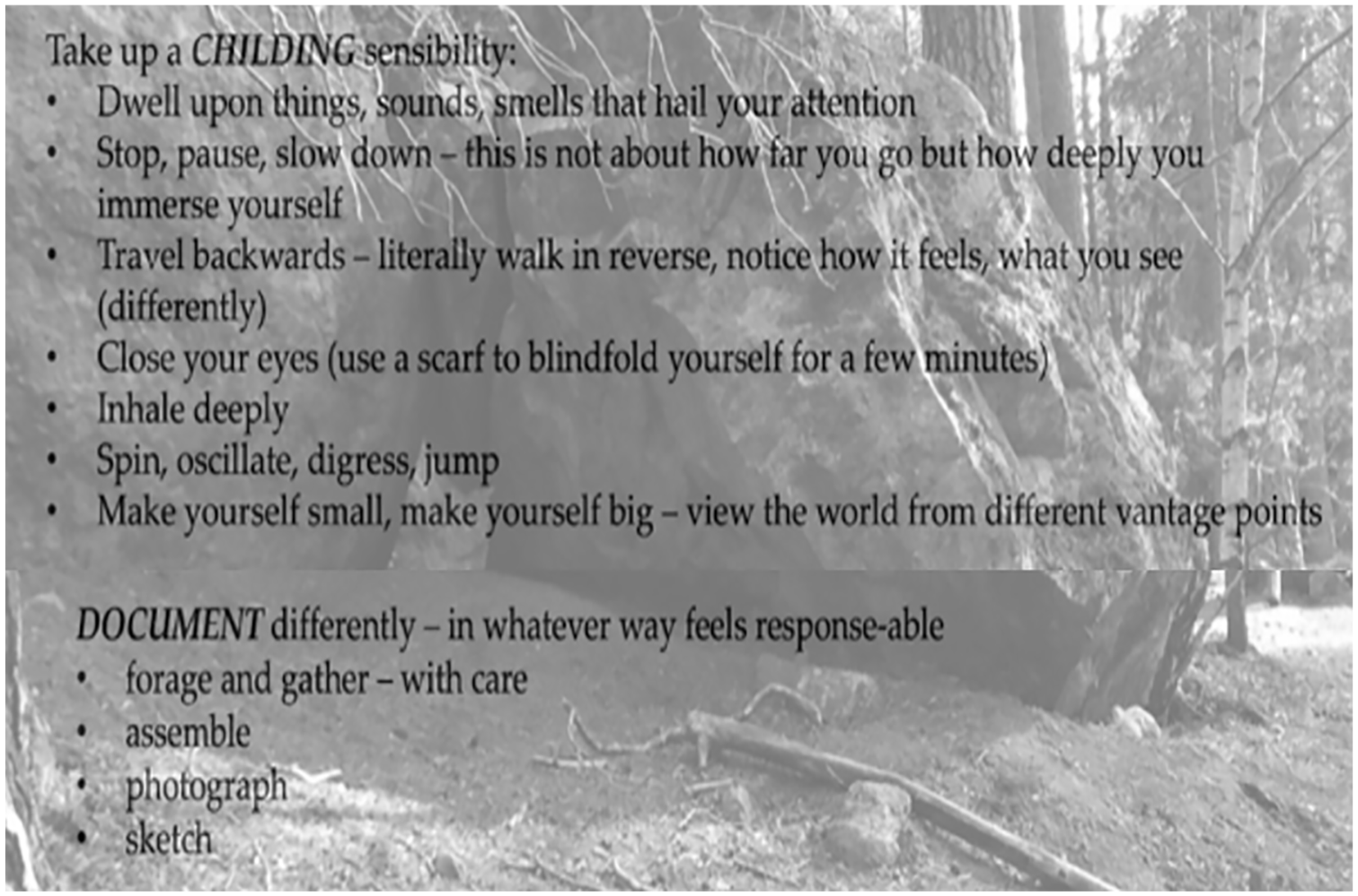
Workshop invitation to ‘child’.
For the Anthropologist in our workshop who was in the midst of preparing to undertake research with an indigenous tribe in India, childing was both curious and liberating: ‘I felt so grounded, I felt the importance of being still, being in the moment, it allowed me to put aside existing ideas and just be in that moment in a really immersed way’. She then elaborated on the opportunities that became available to encounter a familiar environment in ways that provoked fresh questions about how else research might be. Reflecting on the workshop she mused: ‘What might happen if research becomes a way of life?’ and then ‘What are the limits of my curiosity?’ The questioning that sprang forth from participating in the childing workshop might be thought of as ‘the not thought’, or giving life to ‘the not-lived’ emerging from embodiment and atmospheric forces: the infant, the young child . . . as well as painters, dancers, dramatists and musicians . . . question with their bodies—or, more precisely, with their embodied-minds/minded-bodies . . . which grounds logic in the lived body. (Kennedy and Kohan, 2008: 10)
For this participant, the questioning that ensued was an act of refusal, her willingness to abandon to spaces of incompetence, disobedience, and to refuse what ought to be thought, to do what ought to be done, was liberating and allowed for a different engagement with the world that provoked further questions. She questioned whether childing is innocent, pure, romanticised and concluded, like Kennedy and Kohan (2008) that ‘bad’ children are those who have broken free of ‘the Same’; they dare to ask the questions, they refuse to ‘grow up’ and conform to normativity and order. Childing as an ecopedagogy of refusal then becomes a space for the incalculable, the unpredictable, the uncontrollable; where opportunities to think what we are not supposed to think are celebrated; and where un-disciplining thinking is encouraged.
Meanwhile, for the Biomedic in the group, the experience was “. . . really hard, I couldn’t go to the maximum; I couldn’t do all those things . . . I was shy and a bit embarrassed to let other people look at me . . . but when I looked deeply into the environment it really affected me . . .” Child-ing was not as readily available to him, his inculturation into adulthood was firmly rooted. Although he later reflected on the liberatory potential for childing to shift how he encounters the world. Making connections to his current parenting he reflected on how children are constantly under surveillance, just as he had felt during the workshop – judged, observed, regulated by norms, expectations, disciplinary regimes embedded in educational institutions such as nurseries, schools and universities. He wondered whether children were ever really free to explore in the ways that we were in the childing workshop. He posed the question: ‘Is childing even really available to children?’ Again, drawing from Kennedy and Kohan (2008) the disciplinary role of adulting promotes ‘the Same’ and urges the child to become adult; conversely childing presents opportunities for protest and subversion – and a vital reminder to the adult of what it is to be active in world-making practices, ‘to child’.
All participants made immediate connections to their own childhoods through the praxis of childing. Kennedy and Kohan (2008: 21) stress that this readiness to connect to our child-ish experiences can be viewed generatively. As they explain: ‘“feelings” of childhood are retained into the “powers” of adulthood . . . to make the “power” of adulthood not the power of the Same, but rather a “force,” or “energy,” or “joy,” . . . through this tension there is the possibility of new adult voices emerging, ones which handle the opposition between Same and Different in alternative ways’. The forces, energies and joys that came to characterise the childing workshop were at times intense and also disquieting. Neither we, as facilitators, nor the participants could have predicted the work that encountering the world from a ‘logic of the lived body’ was capable of generating.
Here we could dwell further upon the affordances that come from a childing praxis that de-centres the researcher, flattens hierarchies; and opens up possibilities for connecting to place, community, environment, histories or as the Nursing student articulates: ‘getting your feet dirty, being in that moment to absorb what is happening, and where your thoughts might wander, and how it connects to surprises, is a really good methodology to occupy’. But we would contest that childing is more than ‘methodology’; more than a set of skills or techniques to be mastered. Our concern is with the on-goingness of refusal and how that manifests when orthodoxies and conventions are temporarily suspended; when participants are given permission to encounter the world differently, to embrace a ‘slow’ engagement with the world (Bozalek, 2021); to wit(h)ness relationalities to the non-innocence of place, matter, histories as they bubble up in seemingly benign contexts (Osgood and Bozalek, 2024). The remainder of this paper provides glimpses into how childing on that early Spring day, on a leafy green university campus worked on and through us in ways that we could not have predicted. Being open to the surprises that dwell within assemblages, that are at once situated, affective and have capacities to agitate hauntings and problematics of life in late-stage Capitalism, illustrate the huge potential for this mode of enquiry to reconfigure what is readily understood to be ecopedagogy.
Migration to the ‘Pavilion’
As already outlined, we refused to issue instructions, directions or state expectations for the workshop. Rather, participants were invited to explore the green expanses of the campus with a set of provocations in mind (see Figure 1). As facilitators we considered our role to be little more than providing conditions of possibility for childing to unfold. After a quarter of an hour or so we walked across campus to join the participants. We noticed the force of a large wooden framed structure had lured them from the grassy, daffodil infused meadows (Figure 2).
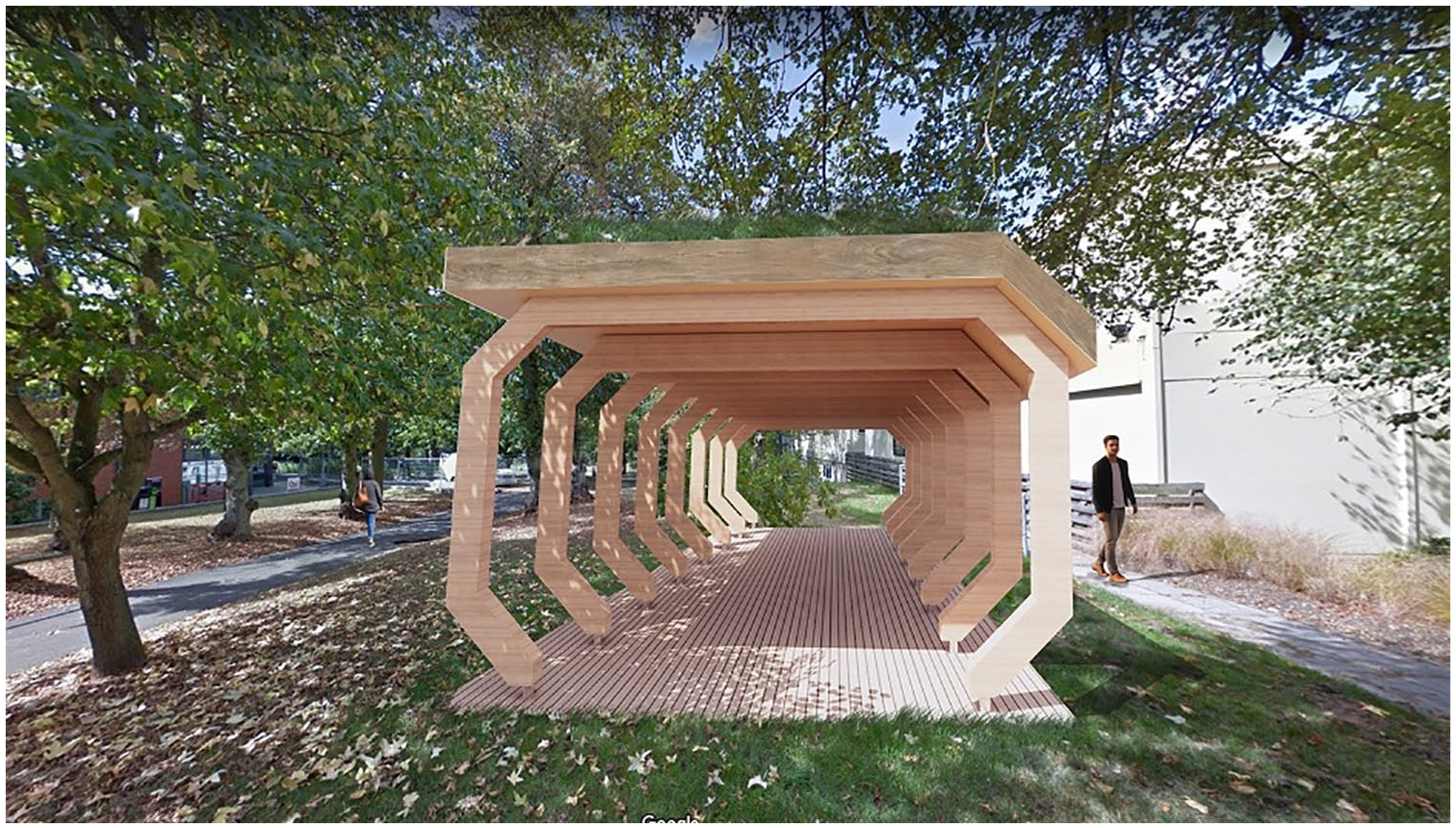
Architect image of The Pavilion at planning stage.
While familiar with an ‘outdoor classroom’ on campus neither of us were aware of its eco-credentials or its capacity to have brought together students, academics and the local community from planning, design, to eventual installation. These facts were only unearthed long after the workshop had agitated our curiosity. We later discovered that The Pavilion was created as a sustainably designed learning, event, community and wellbeing space. In 2017, Architectural Technology students led the design, in collaboration with industry professionals, as an opportunity to apply construction theory and technical skills learnt in undergraduate modules to a real-life project. The Pavilion is built upon the principle that it has ‘an evolving biophilic (intimately connected with nature) design’ which can be modified by future cohorts of Architectural Technology students. The university webpages declare that: ‘at the project’s core is sustainability, innovation, collaboration and practice-based learning’.
Originally conceived of as a tree house, the project evolved into a pavilion. It was intended to act as a flagship for collaboration between departments and between academics and students, with learning-through-doing opportunities extended to other disciplines through the use of the space. Proposed uses included a space for welcome events, speed meets, exhibitions, student societies and outdoor films; a learning space close to nature, provoking discussion on renewables and innovative materials due to its sustainable design; a venue for yoga and tai-chi classes; a quiet place for contemplation; and a space for community activities, such as STEM outreach events with local schools.
The Pavilion’s ecocredentials were somewhat wasted on us during the workshop, but it nevertheless provided a conducive outside space from which to child. It did, however, agitate a series of uncomfortable affects as we attuned to the space and its atmospheric forces that reverberated at the time and long after (Figure 3).
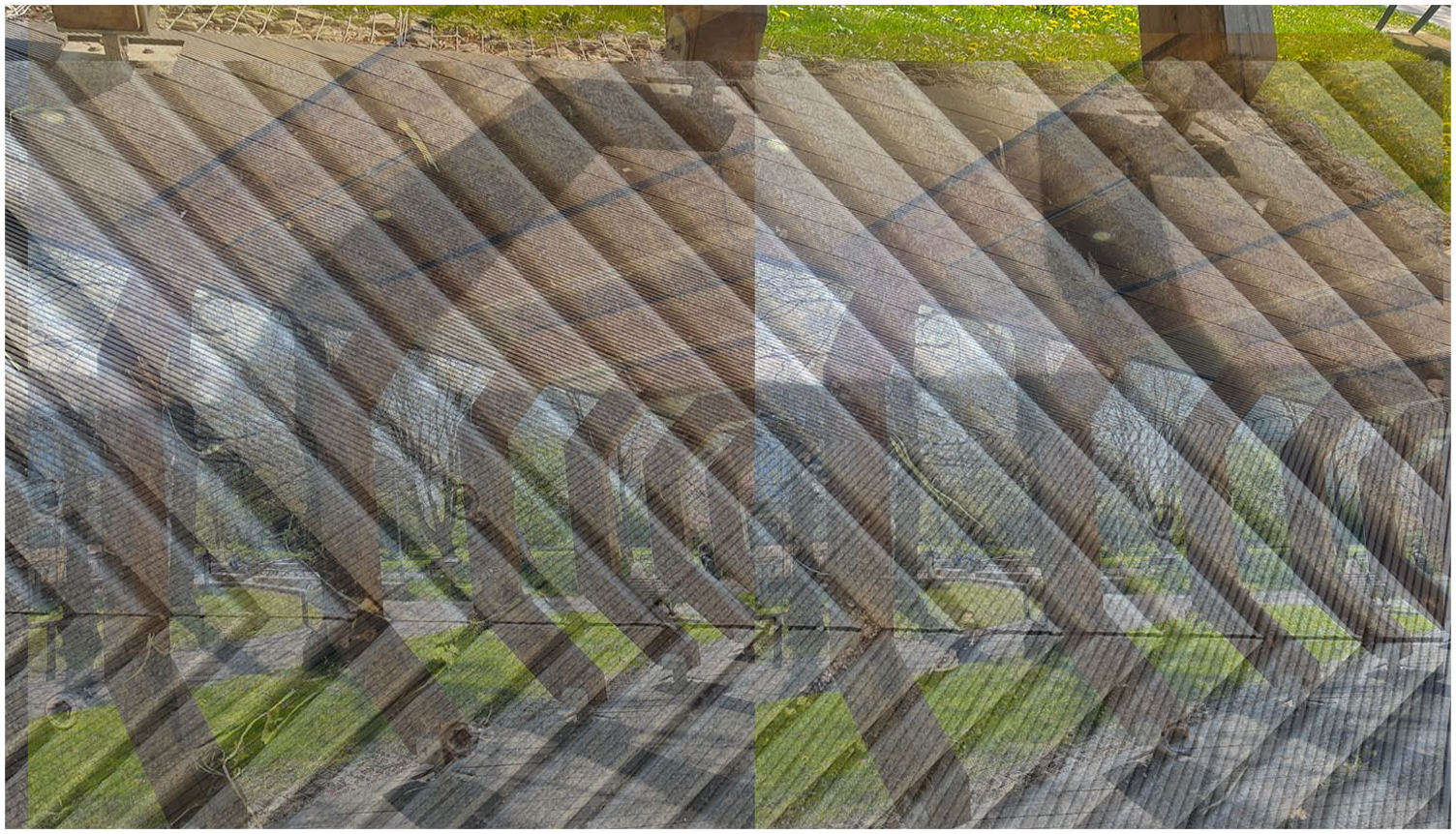
Pavilion agitations.
Re-turning to the Pavilion, we take a closer look at what it promises us and more squarely the promise of the University. A plaque adorning The Pavilion explains that the space is designed ‘to bring people together to meet and share ideas and create new ones’. Heroic stories of technological innovations to protect, rescue and prosper the planet through enlightenment knowledge dispensed by the University are proudly asserted. The burgeoning emphasis on ‘innovation’ in Higher Education discourse as Morris and Targ (2022) argue, incorporates knowledge and practice into existing business models and is reflective of the persistent neo liberalisation of University spaces. It is reasoned that it is possible to innovate ourselves out of planetary crisis by using the same logic that produced it in the first place (Bang et al., 2022). The promise of university, as its Latin root universitas suggests, is a promise to be included in ‘the universe, the whole, the world’. But as Manning (2024: n.p.) asks: ‘Whose world exactly does the university foster? What universe is populated by the knowledge it bestows?’
Tracing historical legacies of pavilions, we unearth that in 1924, not far from the University, grand pavilions were temporarily erected by the British government to host The British Empire Exhibition. The exhibition in Wembley Park brought together 58 colonial territories that constituted the ‘British Empire’, with each colony allocated a distinct pavilion to exhibit ‘exotic’ people, their culture and their work, ‘to stimulate trade, strengthen bonds that bind mother Country to her Sister States and Daughters, to bring into closer contact the one with each other, to enable all who owe allegiance to the British flag to meet on common ground and learn to know each other’ (Churcher, 2024). In his opening address, King George proclaimed: The exhibition is the work of the whole empire, and it shows the craftsmanship, the agricultural skill, the trading and transport organisation of all our peoples and all our territories. It gives a loving picture of the history of the empire and of its present structure. (Mixed Museum, 2021)
The exhibitions not only portrayed colonial subjects in racist and dehumanising terms, but also surfaced and exacerbated racial views that were prevalent in Britain at the time. The pavilions displayed the usefulness of the Empire in ‘taming the savages’, civilising and improving their lives, in order to convince the British public who after World War I, did not want to invest in colonial places (Schneider, 2009). As Wynter (1971: 96) asserts: ‘The emporialist forces and the imperialist forces are one’. The market (emporium) and the expansion of the empire, in other words, are inseparable. Neoliberalism, as an advanced form of capitalism, ‘is not something new, but a logical unfolding of something that was an integral part of the historical conditions of Empire that subsidised and created the possibility for the university as we know it’ (de Oliveira Andreotti et al., 2015: 34). Beneath the narratives of ecology and inclusivity that the university pavilion proclaims, much like the colonial pavilions, the inclusion of ‘the Other’ is extended on economic and rational capacities to sustain particular conceptions of ‘human’ (Wynter, 2003). The politics of inclusion here are not simply about being excluded but about being included differently. As Kelley (2016) explains: ‘The fully racialized social and epistemological architecture upon which the modern university is built cannot be radically transformed by “simply” adding darker faces, safer spaces, better training, and a curriculum that acknowledges historical and contemporary oppressions’. Embedded in ideas of scientific and technological innovations is the notion of ‘human supremacy’ that remains inseparable from white supremacy, in which the other-than-human world is turned into resources for consumption and extraction.
Childing in and from the Pavilion emerges as a practice of refusal that is intertwined with, and not separate from, the colonial and neoliberal rationalities that make up the University. However, we agree with Moten and Harney (2004: 101) in our refusal to accept the University as a place of enlightenment, instead we acknowledge it as a place of refuge for what they call the ‘Undercommons’, where the work gets done and subverted. Childing in and from the Pavilion does not resolve in being for or against – rather it involves ‘being in it and remaking it, rather than indulging in the misery of academia’ (Bozalek, 2024: 168) (Figure 4).

Pavilion hauntings.
Pavilions are temporary structures, there is an inherent impermanence to them but approaching them analytically from a place that activates childing makes visible the fact that even seemingly inanimate structures are imbued with vital materialism. When encountered from a childing orientation, the pavilion has profound capacities to reanimate, to open up indelible scars, to agitate and provoke on-going questioning that deepens our engagements with the world through time and space.
Encountering daffodils as refusal
The Pavilion is a notable landmark on Middlesex University campus, which is a relatively green space, especially given its city location in London. Participants were invited to convene on a large expanse of grassland adjacent to the Pavilion, which was carpeted with spring daffodils, edged by budding oak trees, and awash with audible birdsong. Student bodies were making their way across campus, and occasionally settling down to socialise on benches, and at tables (see Figure 5).
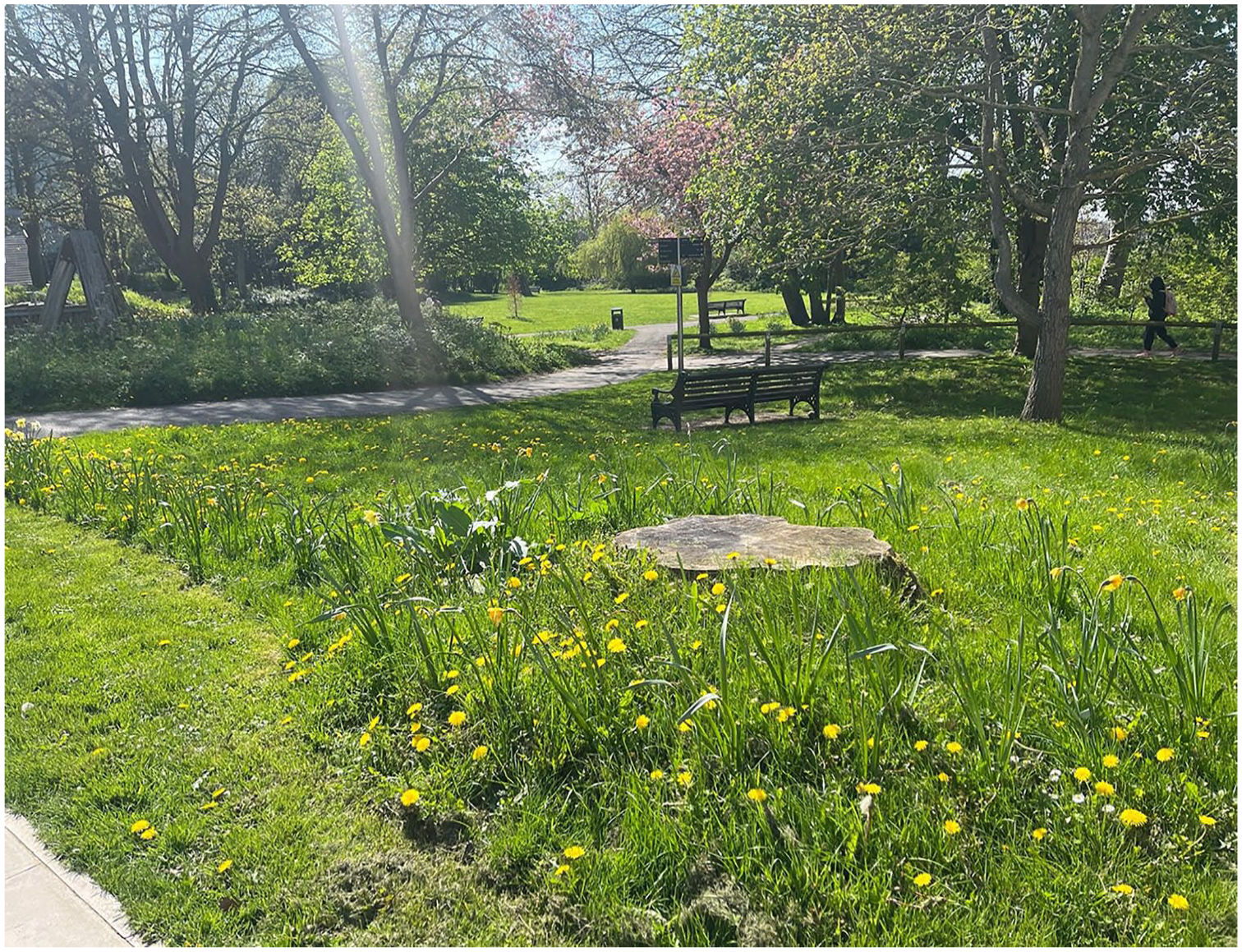
Campus springs to life.
The university’s founding institution, St Katharine’s College, was opened in 1878 and was one of the first teacher training institutes in the country. Over the years various other institutions merged to form Middlesex Polytechnic in 1973, which was later given university status to become Middlesex University in 1992. The founding institutions were renowned for being radically progressive, particularly in the fields of Art and Philosophy. The Student Union also developed a reputation for fervently pursuing students’ rights. In 1968 the union staged an overnight sit-in which became a 6-week occupation in pursuit of social and economic justice.
As feminist killjoys (Ahmed, 2023), we are similarly politically committed to the pursuit of social justice informed by creative methodologies and avant-garde philosophies. Our onto-epistemological positioning extends beyond a concern with only the social; our commitment to think beyond humanism underlines obligations to relationality, reciprocity and more-than-human ongoingness (Franklin-Phipps and Stout-Sheridan, 2024). Pursuing childing as an emergent ecopedagogy displaces romanticised ideas about the purity, innocence and inherent joy of childhood, towards accounting for the darker side of what constitutes ‘child’ which considers that innocence is not a luxury extended to all childhoods (see the adultification of Black childhoods as debated by Goff et al., 2014 and working-class childhoods by Burton, 2007). This has direct significance to how (white, privileged, able-bodied) childhoods are constructed as ‘nature’ and the so-called purity they inhabit. Re-attuning to the more-than-human worlds that constitute the ongoing unfolding of the Pavilion workshop involves taking seriously the affective resonances and residues that are produced through the specificities of bodily intra-actions and configurations.
Daffodils demand our attention . . .
The campus has not always been in its current location; for many years Middlesex University was located in Trent Park (see Figure 6). Following the second world war, in 1947 the university occupied a Grade II listed manor house, located in 413 rolling acres of meadows, enchanting brooks, lakes and ancient woodland. Originally part of the Duchy of Lancaster, Trent Park is the former estate of a nobility who deemed it to be the perfect venue for political and social entertaining, as evidenced through regular visits from King Edward VIII, Charlie Chaplin, Sir Winston Churchill and latterly Queen Elizabeth. The college carved out a reputation for provisioning specialist qualifications for teaching Art, Drama and Music, earning itself the epithet, ‘Bohemian College’ (Henry, 2024; Trent Park House, 2024). However, the vast manor house proved too expensive to maintain and by 2013 was largely derelict seeing Middlesex University relocate to an altogether more modest and pedestrian site. The relocation to a less esteemed locale remains a source of great consternation and sadness for staff who remember the ‘good old days at Trent Park’. Architectural grandeur and the antiquity associated with this learned place of stature; not to mention the sheer scale of the manor house came with certain gravitas that is not rivalled by the university’s current location in the heart of a London suburb.
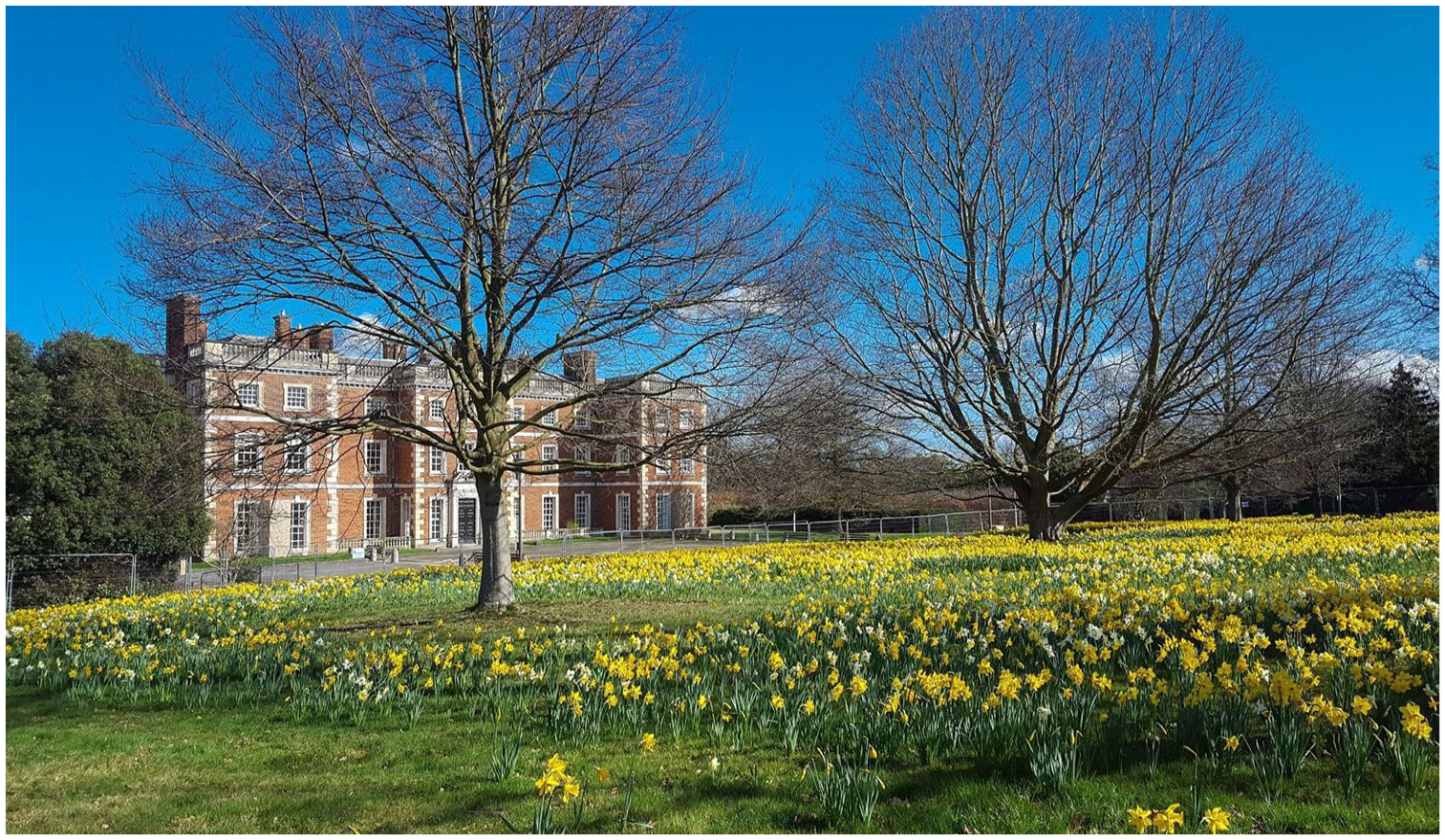
Daffodils, Trent Park, by Christine Matthews (www.geograph.org.uk-5321209.jpg).
Images of Trent Park manor house surrounded by a carpet of golden daffodils agitate myriad hauntings from Jayne’s childhood where a large mansion house is reanimated, flooding bodymind with patriarchal feudal relations that came from living on a farm shaped by the wealth and power of the landed gentry. Daffodils spilling across a vast meadow enliven affective forces from a buried childhood uncomfortably marked by gender, social class and aged power relations that were first encountered four decades ago but persist in bubbling beneath the surface.
Daffodils – their scent, their vibrant yellow hue, their swish in undulating waves of an early spring breeze have a profound capacity to reanimate. Sitting with the trouble that daffodils evoke is central to the childing praxis we are sharing in this paper. The feltness of place through materiality is reawakened through an eco-pedagogy of child-ing that attends to so much more than ‘environmental sustainability’. Rather, childing as ecopedagogy is best understood as a series of transformative processes, a metamorphosis for reanimating ourselves through a praxis of refusal that moves beyond narrow confines of rationality and autonomy and instead creates opportunities to become: ‘entirely a part of the animate world[s] whose life swells within and unfolds all around us’ (Abram, 2012: 3). Stepping into these temporally diffracted worlds allows adults to enjoy capacities to child once again, with full intensity and without age restriction, which is in itself an act of refusal (Figure 7).
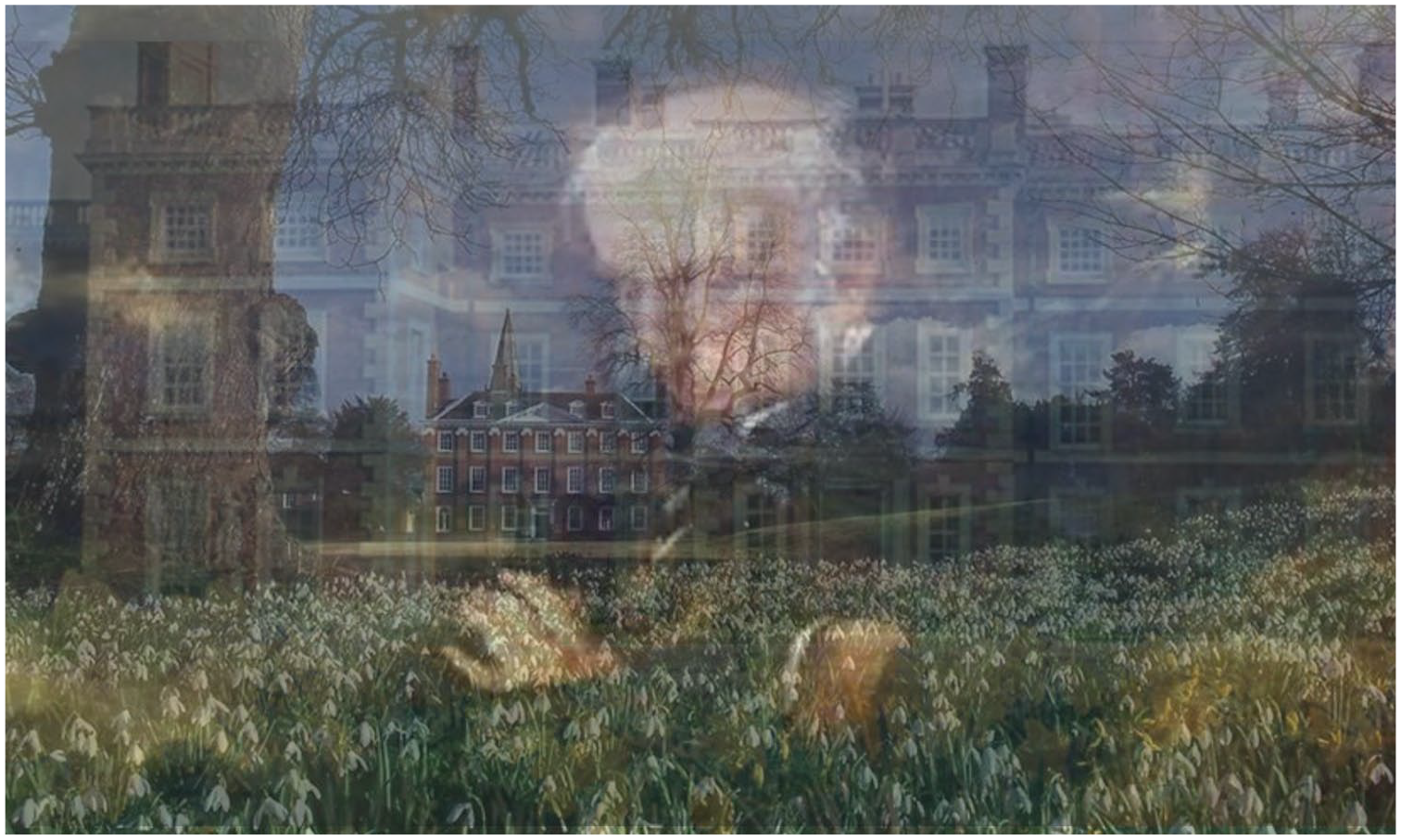
Patriarchal-colonial-daffodil-hauntings.
When daffodils are viewed as natureculture configurations, their status as natural, romantic and poetic becomes dislodged, instead they can be re-membered through their patriarchal, colonial and imperial inheritances. It is worth noting that plants and botanical sciences more broadly were at the forefront of the cultivation of colonialism and sustenance of the empire. Colonisation has been described as a ‘massive operation of planting and “displanting”’ (Mastnak et al., 2014: 364). As in Kincaid’s (1990) Lucy, daffodils were introduced during Sid’s childhood in postcolonial India as part of colonial education through Wordsworth’s romantic poem I Wandered Lonely as a Cloud. Rote memorisation, recitation and interpretation of the poem jarred with childhoods that had never witnessed daffodils. Sid first encountered them as a teenager on a family trip to the hill station Ooty. With its cool climate, Ooty was a desirable location for European colonists seeking respite from the stifling heat of the Indian plains. The landscape was subjected to numerous colonial transformations, especially the introduction of European trees and plants, including daffodils, to give a sense of ‘Englishness’ to ‘nature’. As Philip (2017) argues, planting daffodils exposes the messy power relations of natureculture imperialism and its civilising project. Colonial education and pedagogy thus ‘harnessed Romantic literature’s power to introduce a new subjectivity in order to create colonized subjects who are loyal to the British motherland’ (Stitt, 2006: 144).
Re-collecting the childing workshop and relating it to his experiences with parenting, the Biomedic shares how ‘nature is good for child development; it reduces anxiety and gets them off their phones’. Here, the association of childhood and nature re-surfaces and provokes thinking about the complexities and contradictions inherent within urban-nature childhoods. Childing presents possibilities to move ‘beyond sharp categorizations into working within a more porous space where creative intersections of concepts enable enlivened, complex, possibly messy multiplicities of re-imagined urban/nature childhoods’ (Duhn et al., 2017: 1358). We therefore immersed ourselves in this porous spatial sensibility, some of us experimenting with becoming-small, becoming-big, spinning and swirling-around with our mobile phone cameras. Childing-with-daffodils was set in motion by the re-orientations made possible through the swish-swashing of an iPhone camera moving through a host of not-so-golden daffodils.
The audio-video creation that ensued (scan Figure 8) registers childing-with-daffodils through refusals that deny, resist, reframe and re-member the logics of colonial and neoliberal education. Practices that persistently determine worlds along binaries of nature versus technology, childhood versus adulthood, past versus present, or human versus nonhuman, are refused by embodying a material reconfiguring (Reynolds, 2023). As Barad (2017: 63) explains, ‘an embodied practice of re-membering – which is not about going back to what was, but rather about the material reconfiguring of spacetimemattering in ways that attempt to do justice to account for the devastation wrought as well as to produce openings, new possible histories by which time-beings might find ways to endure’ (Figure 8).

QR code, childing-with-daffodils.
An opening: Refusal to conclude
This meandering, non-linear paper has been an act of refusal (against academic writing conventions) in the spirit of the childing ecopedagogy that we have more generally attempted to convey. We have sought to illustrate how ecopedagogies might become otherwise – as ripe with possibilities for capaciousness, uncertainty and hope. The praxis of childing has allowed an exploration into how knowledge can be creatively generated in ways that make room for speculation and curiosity that free us from more of ‘the Same’ (Kennedy and Kohan, 2008). This mode of ecopedagogy consciously displaces recognisable conventions so that we might attune to becoming-with the world in ways that are uncomfortable, disorientating but ultimately deeply political. Our aim has been to make visible the limits of human exceptionalism and how we are thoroughly and endlessly implicated in world-making through the non-innocence of non-and-more-than-human everyday encounters – with plants, outdoor structures and, and, and . . ..
Rather than concluding we offer an opening, an ongoingness of our child-ing praxis . . .
Tree Stump Lop Growth Rot Net zero Green hero Hijab Bench Chat Basking On bench Aeroplane noise Rustling branch Flaked paint Dilapidated building Signage Pathway Trespass Green campus Feathers Dog faeces Student fees Upgrade panel Dandelions JustParkApp Daffodils Vulnerable, conspicuous, ridiculous Security pass Balancing, bouncing Belonging A406 rumbling Cranes spiking Traffic warden patrolling Almond decaf cappuccino Reusable cup Costa franchise Food bank Minimum wage Hiding, seeking, peeking Strategic plan Curriculum review Visas Boat invasion Cruella Suella Black mould Asthma Security Patrol Rental Exploitation Exploration Childing Chiding Deriding Education An Investment? Employability Skills Critical thinking Third year sinking Momentary bliss Toes in grass Attuning Bemused Discomfort On campus In view But Who Knew This Would Resurface In ways unanticipated Worldview shifted Methodology drifted To something Less sure Circumspect And More . . .
Footnotes
Funding
The author(s) received no financial support for the research, authorship, and/or publication of this article.

