




Abstract
Purpose:
This article aims to reimagine education—and our selves—within the context of multiple, more-than-human worlds where everything and everyone are interrelated.
Design/Approach/Methods:
The aim is achieved by pursuing two speculative thought experiments to connect and bring into conversation seemingly unrelated knowledge systems across space and time—European “paganism” and 13th-century Japanese Buddhism, as well as excerpts from indigenous, ecofeminist, and decolonial scholarship. These thought experiments are conducted through a series of “and if” questions around education and schooling.
Findings:
The article proposes to radically reimagine education in two ways. First, it invites readers to reconfigure education as a “connective tissue” between different worlds, bringing together rather than hierarchizing them. Second, it proposes to reframe education as an opportunity to learn how to anticipate and animate our ongoing entanglement with more-than-human worlds.
Originality/Value:
Using the concept of “metamorphosis” as an antidote to Western metaphysics, the article re-situates education within a wider set of possibilities in relation to the taken-for-granted ways of knowing and being, as well as the notions of space and time.
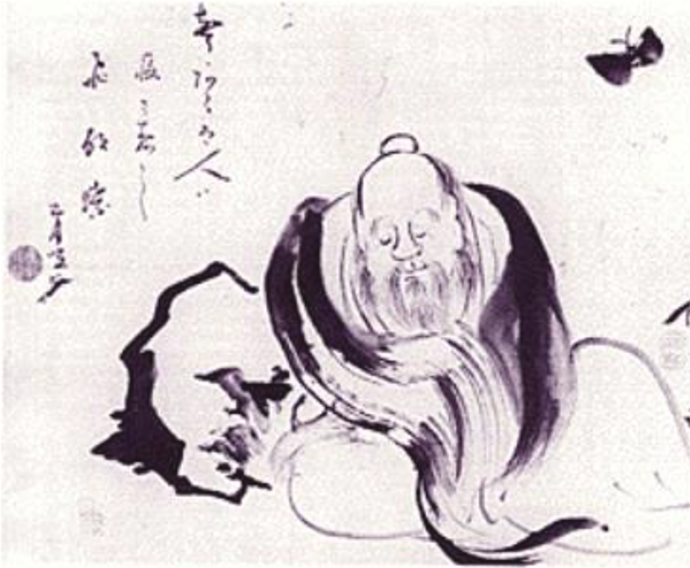 “Once upon a time, I, Zhuangzi, dreamt I was a butterfly, fluttering hither and thither, to all intents and purposes a butterfly. I was conscious only of my happiness as a butterfly, unaware that I was Zhuangzi. Soon I awakened, and there I was, veritably myself again. Now I do not know whether I was then a man dreaming I was a butterfly, or whether I am now a butterfly, dreaming I am a man. Between a man and a butterfly there is necessarily a distinction. The transition is called the transformation of material things.” (Zhuangzi, translated by Moss Roberts, 1979)
***
This translation of Zhuangzi’s dream appears in a book of Chinese Fairy Tales and Fantasies, published in the U.S. in 1979. Like many other dreams, it is presented to the Western audience as nothing more than a magic fairy tale or a pure fantasy. Yet, it is undoubtedly much more than that. Written by a preeminent Chinese philosopher around the 3rd-century BC, the “Butterfly Dream” blurs the distinctions between dreaming and waking, illusion and reality, confusion and clarity, raising important existential questions: What is the nature of reality? Are we the dreamers, or are we being dreamed? Furthermore, it fundamentally challenges modernity’s other stark dualisms that separate self and other, space and time, culture and nature, human and animal, and order and chaos. Ultimately, the “Butterfly Dream” gestures toward the existence of other, multiple worlds, which may not be immediately visible to our modern eye.
Inspired by decolonial literature, I will refer to these worlds—and ours—as a pluriverse (in contrast to a single universe), that is, a world where many worlds coexist (Escobar, 2018; Mignolo, 2011). My article will focus on the connections to and within these multiple, more-than-human worlds, while exploring ways in which education needs to be reconfigured to anticipate the pluriverse and animate our meaningful engagement within it. Taking the pluriverse as an ontological starting point means acknowledging that reality is constituted not only by many worlds but “by many kinds of worlds, many ontologies, many ways of being in the world, many ways of knowing reality” (Querejazu, 2016, p. 3, emphasis added). The pluriverse thus implies a nonhierarchical coexistence of different worlds—ranging from human to natural and spirit worlds—which are all interconnected in time and space. Furthermore, it entails a way of being where everyone and everything—both human and nonhuman—are always interrelated. From this perspective, “the transformation of material things,” which occurred in Zhuangzi’s “Butterfly Dream,” is a way of being, not simply a fantasy or a fairy tale.
Such a project would normally be discouraged in the context of modern schooling and “objective” science more broadly. After all, both modern schooling and science have been repeatedly used to reinforce modernity’s dualisms that privilege the (hu)man, while relegating “other” worlds to our collective pasts, childhood memories, fantasies, or imaginations. 1 Claiming a universality for Western knowledge, science has served to rationalize historical colonial violence and environmental destruction as justifiable consequences of greater advancement of certain kinds of human beings (see Grosfoguel, 2013). Those who attempt to resist or challenge the dominant “script” of Western modernity are inevitably accused of “betraying our destiny” (Stengers, 2014, p. 4), of not being sufficiently “reasonable,” “rational,” or “scientific” (Haraway, 2004, p. 88; see also Ideland, 2018). Moreover, looking for alternatives beyond the logic of Western modernity—especially if the search may lead us to “other” worlds—would surely be perceived by many (Western) academics as a “regress,” going against the evolutionary tale of modern science and its principles of progress, rationality, and reason. As Stengers (2012) reminds us, the academic commandment “Thou shall not regress!” produces “an obscure fear of being accused of […] betraying hard truth by indulging soft, illusory beliefs” (p. 1).
But my concern for and curiosity about the pluriverse is stronger than fear. Facing the environmental catastrophe, we cannot continue to pursue the myth of a single universe and insist on human exceptionalism and (neo)liberal individualism—the starting points of Western philosophy and the foundations of modern political economy—as a single vision for surviving on a damaged Earth. Although Zhuangzi’s butterfly is still alive in his dream and our imaginations, most butterfly populations across the world are on the verge of extinction.
2
 Yet, human domination of nature continues to escalate. In this context, there is no choice but to “regress” to acknowledge and reengage with more-than-human worlds, to “stay with the trouble” (Haraway, 2016). In Val Plumwood’s (2009) words, we need to urgently “re-imagine the world in richer terms that will allow us to find ourselves in dialogue with and limited by other species’ needs, other kinds of minds”—and other ways of being too—because it is “a basic survival project in our present context” (p. 128, emphasis added).
3
Yet, human domination of nature continues to escalate. In this context, there is no choice but to “regress” to acknowledge and reengage with more-than-human worlds, to “stay with the trouble” (Haraway, 2016). In Val Plumwood’s (2009) words, we need to urgently “re-imagine the world in richer terms that will allow us to find ourselves in dialogue with and limited by other species’ needs, other kinds of minds”—and other ways of being too—because it is “a basic survival project in our present context” (p. 128, emphasis added).
3
Central to this survival project is our capacity to reimagine education and schooling. For decades now, scholars have argued that education in its current form—one rooted in the “modernist Western paradigm” (Sterling et al., 2018, p. 325)—has been central in maintaining the Cartesian separation between material (physical) and immaterial (spiritual) reality, mind and body, objectivity and subjectivity, culture and nature among other dualisms. It has also been used to promote infinite economic growth, technocratic determinism, and (neo)liberal individualism at the expense of environmental concerns, further reinforcing the structures of dominance that privilege the (hu)man (see Bowers, 1995, 2002; Komatsu et al., in press; Orr, 2004, 2009; Schumacher, 1973; Zhao, 2018). The fact that the world is the most “educated” it has ever been and yet the nearest to environmental breakdown is a chilling reminder that education is directly implicated in perpetuating the status quo (Komatsu et al., in press; Rappleye & Komatsu, in press). From this perspective, “more of the same kind of education will only compound our problems” (Orr, 2011, p. 238). To reimagine the world, we need to reimagine education and schooling in much richer terms, too.
Sceptics may see such an effort as an attack on education and science. It is not. Neither is it “an argument for ignorance” (Orr, 2011, p. 238). Rather, it is an urgent invitation to resist—and to “regress” from—modern tendencies of human exceptionalism that continue to enact onto-epistemological divides through education and schooling, separating humans off from other species and other worlds (Taylor, 2017; Zhao, 2018). While there are many ways to resist and “regress” from the dominant education paradigm, I will follow the thread of speculative thinking as a way to reimagine education differently—as a way of giving rise to possibilities. Drawing on Whitehead (1966 [1938]), especially his appeal that “philosophy can exclude nothing,” 4 Debaise and Stengers (2017) elaborate that speculative thinking enables us to explore the multifariousness of the world and the multiplicity of modes of existence, “refusing the right every specialised thought grants itself: to explain, while eliminating anything that cannot be framed by the explanation” (p. 17). Speculative thinking, along with other forms of SFs, 5 opens the possibility of “creating relevant modes of togetherness between practices, both scientific and non-scientific; finding relevant ways of thinking together” (Stengers, 2018, p. 145).
With this in mind, I would like to pursue two speculative thought experiments, or two “regressions,” that will lay the foundation for reimagining education differently as we loosen the hold of anthropocentrism and attune ourselves to different worlds.
Speculative thought experiments and “regression”
The first “regression” is an epistemological one. It entails a deliberate expansion of the existing sources and patterns of knowledge to include—on a nonhierarchical basis—not only “scientific” knowledge but also more marginal and fragmented knowledge(s) that are normally excluded from thinking about education policies and practices. This regression combines philosophical and theoretical texts with knowledge(s) gleaned from nature, dreams, memories, fairy tales, myths, and imaginations across time and space. As a thought experiment designed to speculatively re-fabricate education in a more-than-human world, I will bring into conversation my Latvian “pagan” grandmother Anna (Oma) and a 13th-century Japanese Buddhist priest and dreamkeeper Myōe
6
(born nearly 900 years apart), periodically interrupting their insights with fragments from academic writing by philosophers, mythographers, as well as indigenous, ecofeminist, and decolonial scholars
7
—and shadows of butterflies fluttering at the edge of extinction . Similar to a “mosaic epistemology” (Connell, 2018) or a feminist concept of “braiding” (Bulbeck, 1998), my interweavings of these fragments of knowledge(s)—some more marginalized and forgotten than others, but all deeply situated and embodied—will help illuminate different worlds and worldviews.
The second “regression” is an ontological one. It requires the capacity to “see” and acknowledge pluriversal worlds as really real. However, it is not only a change of lens or a different viewing angle that is necessary to be able to “see” the world differently. As Jensen et al. (2016) suggest based on their work with Japanese spirit worlds, the ability to see spirits and spiritual world in everyday life also depends on who “we” are, meaning that there is also “an ontological dimension to ‘seeing’ aside from what immediately meets the eye” (p. 156). This ontological capacity to “see” is beautifully captured in a fairy tale my Latvian “pagan” Oma used to tell at bedtime when I was growing up and a dream by the 13th-century Japanese dreamkeeper Myōe which I read only recently. Although separated across time and space, there are eerie connections between the two. In Myōe’s dream (as retold by Kawai, 1995), he goes into a room in a temple where he sees the famous priest Kūkai (空海)
8
sleeping. Kūkai’s two eyes look like crystals, and they are lying beside a pillow. Kūkai gives them to Myōe who places them in a sleeve of his [kimono] robe. (p. 47)
Similar connections between human, spirit, and natural realms of existence have been common to many of the world’s spiritual and religious traditions, including indigenous peoples of the Americas and Oceania, “pagan” cultures of Europe, Daoism of China, Buddhist traditions across Asia, and many others. In the West, however, dreams became quickly devalued during the Enlightenment. In the ensuing “Age of Reason,” any notions of “other” worlds or realities have been discounted as myths, beliefs, or simply superstition (Kawai, 1995; Law, 2015; Querejazu, 2016). In this process, the multifaceted world was split into the “objective” world (i.e., universe and the universal laws of nature that can be discovered and proven through scientific modes of inquiry) and subjectivity (i.e., the diversity of human beliefs, understandings, and experiences about/of the world that are not based upon proven scientific evidence). Plurality of the world thus became confined to subjectivity. 9 With the emergence of this split, and the rise of a purportedly “objective” science calibrating a material world, multiple epistemological and ontological walls were diligently built to block “other” worlds and worldviews from our sight. As a result of continuous onto-epistemological marginalization, these “other” worlds gradually became invisible to our modern eye. So how can we regress and relearn to pay attention to what has been recklessly ignored (and often purposefully destroyed) and redevelop the art and the capacity to acknowledge, attune to, and engage with the pluriverse around us? What are the implications of ontological plurality for education in its current form?
Thinking about these questions implies a radical reimagination of education, which (in its current anthropocentric form) cannot possibly encompass the pluriverse and the existing connections between human and more-than-human worlds as part of a whole, same reality. Like the metamorphosis of a butterfly, perhaps education—and our selves too—could be transformed into something entirely unexpected:

As Warner (2007) explains, this kind of metamorphosis—shape-shifting—“breaks the rules of time, place, of human reproduction and personal uniqueness” (p. 27). It often occurs in moments of crisis (whether existential or environmental), signaling that crisis is also a moment of—and an opportunity for—transformation. In a way, metamorphosis acts as an antidote to Western metaphysics, enabling us to radically reimagine and transform the modern ways of knowing and being, as well as the taken-for-granted notions of space and time. 10
To begin such a radical reimagination and transformation of education and our selves, we therefore need “to resituate what is given within a much vaster set of possibilities …” and, as Stengers (1997) proposes, we can begin with the question “And if?” (p. 136.6). Evoking a much vaster imaginary than is normally associated with modern schooling, we may begin by asking: And if we imagined education as a space—temporal, cultural, or subconscious—that stands at the “crossroads, cross-cultural zones, points of interchange on the intricate connective tissue … between cultures,” between species, between materialities, and between worlds? (Warner, 2007, p. 17). And if learning was about attuning to and engaging with these interconnected different worlds, rather than differentiating, ranking, and hierarchizing them? And if there were pedagogies that enabled us to “see” and intimately connect with each other—humans, natures, spirits, ancestors, butterflies, cyborgs—in the process of “becoming-with” (Haraway, 2015, p. 161)? And if these imaginings, learnings, and pedagogies facilitated the metamorphosis of our selves, helping us move beyond an autonomous, rational selfhood, while animating “self-in-relation” to a more-than-human world?
11
“Everything is related to everything, and nothing can be considered apart from the relatedness of the whole.”
If education was premised on the deep interrelatedness of everything and everyone—both human and more-than-human—it would surely look very different. It would be no longer tasked with the “hyperseparation of humans as a special species and the reduction of non-humans to their usefulness to humans, or instrumentalism” (Plumwood, 2009, p. 116). Similarly, it would be no longer driven by the structure of dominance that underlies all modern Western dichotomies—nature/culture, female/male, chaos/order, self/other—and relegates the “other” side to a position of oppositional subordination (Rose, 2013). Rather, education would serve as “a connective tissue” between the different worlds and between the numerous dualities of the modern human psyche, connecting everything and everyone into the “relatedness of the whole,” a relatedness of the pluriverse.
Izutsu’s (1980) quote above refers specifically to the philosophy of the Huayan thought (or Flower Garland Sutra), 12 a tradition of Mahāyāna Buddhist philosophy practiced by Myōe. But it resonates very intimately with the European “pagan” practices and indigenous traditions, Chinese philosophy, as well as decolonial and ecofeminist thought in terms of practicing nondualistic and relational modes of knowing and being. 13 While there have been virtually no attempts to bring together feminist analysis with responses to Buddhism and environmentalism (Kaza, 1993; Tomalin, 2017)—let alone “paganism” or indigenous thought—I will braid them together through speculative thinking in an attempt to reimagine education around a series of ‘and if … ?’ questions. Although these fragments of knowledge(s) may appear seemingly unrelated (and perhaps even randomly assembled and free-floating), there is a connecting thread that brings them together. In various ways, these knowledge(s) present alternative “worldings” to the modernist status quo (Haraway, 2016). 14 When brought together into dialogue, they have the potential to help us elaborate new, generative directions for the future.
And if … education was a “connective tissue” between different worlds?
For education metamorphoses to occur, schooling (and learning more broadly) would need to be re-situated in spaces that stand at the intersection of different worlds, that is, “crossroads, cross-cultural zones, points of interchange” (Warner, 2007, p. 17). This is a deliberate attempt to shift schooling away from its historical function of reproducing dominant “worlds”—while differentiating and sometimes even erasing other “worlds” in the process—and instead reframe it as a “connective tissue” that brings different worlds into copresence with each other. Writing about multispecies worlds, Haraway (2017) explains that such “contact zones” are “ways of thinking and being that truly come from different kinds of experiences of living and dying.” It is not surprising that we come across references to such spaces in literature spanning vast spaces, times, and disciplinary areas, ranging from the most recent decolonial and ecofeminist studies, to indigenous shamanist and various animist practices, to early Japanese Buddhism and Chinese Daoism, to classical Greek and Roman mythology. These spaces may be referred to as “borders” or “borderlands” (decolonial literature), “zones of contact” (ecofeminist literature), “kugai” (苦界) defining the boundary realm between ordinary human community and other “worlds” (Mahayana Buddhism), or liminal spaces or spaces “in-between” reflecting the notions of impermanence or transition between locations, times, or stages of life (indigenous cultures, mythology, nature). The common thread here is the capacity to “see” and ultimately engage with “other” worlds and worldviews.
In academic literature, the concept of “border thinking” was first introduced by Gloria Anzaldúa (1999), a feminist Chicana/mestiza theorist, and further developed by various decolonial scholars (e.g., Mignolo & Tlostanova, 2006). The concept is based on the idea that there is a lived dimension to the theoretical and the epistemic knowledge and that this knowledge resides in (and sometimes beyond) the borders of the colonial matrix of power. The argument is that “other” worlds and worldviews may simply remain invisible if viewed from the categories of Western thought and experience, because these categories effectively block other realms. Mignolo (2013) argues that we need to delink from the concept of Western modernity, that is, we need to create categories of thought that are not derived from European political theory, and instead think in the borders we are inhabiting: “Not borders of nation-states but borders of the modern/colonial world, epistemic and ontological borders” (pp. 136–137). By dwelling in the borders, one can not only gain an awareness of coloniality and its legacies but also become attuned to “other” worlds.
Writing from the intersection of decolonial and feminist theory, Tlostanova et al. (2016) note that “border thinking” requires us to be in spaces “in between”—“a liquid negotiating bordering realm where new meanings, symbols, concepts and tactical identifications are generated to destabilise and erode the established and fixed geo-cultural, disciplinary and epistemic models, be they Western, non-Western, Northern or Southern” (p. 216). “Border thinking” is thus structurally pluriversal, enabling “many worlds to interact, co-exist co-relationally and communicate with each other” as a horizontal transversal mode of open and decentered encounter between Western and non-Western theories and practices (Tlostanova et al., 2016, p. 224).
While decolonial and feminist literature primarily focuses on human encounters within the colonial matrix of power, ecofeminist thought extends these concepts to more-than-human worlds. Drawing on post- and decolonial work (e.g., Clifford, 1997; Pratt, 1992), 15 Haraway (2017) writes about opening up the “zones of contact” that entail “taking responsibility for and with each other, inheriting the trouble of colonial histories, inheriting the troubles of exterminations and extractions but also inheriting the inventions of precious things.” For Haraway (2008), these “contact zones” (and their “unruly edges”) are spaces for “world-making entanglements” that include “species of all kinds, living or not” (p. 4, emphasis added). Similar ideas of “contact zones” of multispecies encounters resonate broadly across ecofeminist literature. Reflecting on Val Plumwood’s philosophical animism, for example, Rose (2013) talks about “multispecies, multi-cultural zones of inter-action,” thoughtfully reminding us that “we are in such zones all the time, of course: this is part of the meaning, the beauty, and the peril of being alive” (p. 103, emphasis added).
Returning to 13th-century Japan, we find Buddhist priest Myōe dwelling in similar “contact zones.” Yet for him these zones spanned even vaster realms, including spirit worlds and dream worlds. Myōe was known for spending much of his time in “kugai,” that is, “the boundary realm that lied between ordinary human community and the unspoiled nature, where Buddhas, bodhisattvas, and kami were said to have resided” (Abe, 2002, p. 104). 16 By dwelling in these boundary zones, he was deliberately striving to reconcile the persisting dualities such as the mind–body, rational–irrational, human–animal, and dream–awake, neither discarding one for the sake of the other nor settling for a simple dualism (Kawai, 1995). 17 Across other cultures and times, sorcerers, magicians, witches, healers, and shamans similarly dwell at the edges of their communities, “mediating between the human community and the larger community of beings,” which includes, along with humans, the multiple nonhuman entities that constitute the local landscape and lend specific character to the surrounding earth (Abram, 2017, p. 7). In these contexts, residing in the spatial periphery provides a symbolic (spatial) expression of their intermediary position between the human community and other worlds, enabling one to cross “the perceptual boundaries that demarcate his or her particular culture—boundaries reinforced by social customs, taboos, and more importantly the common speech or language—in order to make contact with, and learn from, the other powers in the land” (Abram, 2017, p. 9, emphasis added).
However, these multiple more-than-human worlds often remain invisible to our modern, civilized—and colonized—eyes. When we catch glimpses of these worlds, their images often appear severely distorted in favor of the Western order of things (see Komatsu & Rappleye, 2020; Takayama, 2020; Taylor, 2020 for further discussion). And if we deliberately stepped outside of the dominant culture and into the boundary zones between different worlds, paused, and allowed ourselves to attune to what is around us? And if we took the time and courage to see beyond what may initially appear as dangerous or irrelevant? And if these edges, these borders, these contact zones were precisely the spaces where learning would take place? There, lingering half within and half outside of our community, moving along those boundaries, edges, and walls, we may hope “to find the precise clues to the mystery of how these walls were erected, and how a simple boundary became a barrier”—only, that is, if the margin we frequent is “a temporal as well as a spatial edge, and the temporal structure that it bounds is about to dissolve, or metamorphose, into something else” (Abram, 2017, p. 29). And if?
And if … education was about learning to anticipate and engage with other worlds?
Located at the intersection of different worlds—connecting rather than differentiating, ranking, and hierarchizing them—education could be a space to learn how to anticipate and meaningfully engage with both human and more-than-human worlds in all of their multiplicity and diversity. It would enable us to recognize and appreciate our already existing entanglements in a “myriad temporalities and spatialities and myriad intra-active entities-in-assemblages—including the more-than-human, other-than-human, inhuman, and human-as-humus” (Haraway, 2015, p. 160). In short, learning would be a process of attuning to and becoming a part of “a pluriverse in the making” (Stengers, 2011, p. 61), where everyone and everything contributes to the process of making the pluriverse.
Any attempt to engage with “other” worlds is always inevitably complex, challenging, and contested (see Takayama, 2020). It can even be fatal.
18
But all encountering is an opportunity for learning. And as Stengers (2011) usefully reminds us, learning itself requires encountering and, in turn, encountering implies learning through comparison. From this perspective, comparative education is uniquely positioned to facilitate learning in the pluriverse. Stengers (2011) argues, however, that comparison as “a method of learning” entails one general rule: Encounters must occur in their “full force” and with no “foul play,” that is, without weakening one and ensuring the position of the other (p. 62). This means that comparison is only legitimate and meaningful if those engaged in a comparison—mutual learning—have the opportunity to present their own version of what the comparison is about, while avoiding the imposition of irrelevant criteria and categories on others (Stengers, 2011). Therefore, comparison must never be unilateral or based on “othering.”
19
When one-sided definitions impose on others categories that do not concern them, they assume “destructive character” and serve their historical function “to dismember, eradicate, or appropriate” (Stengers, 2011, p. 58). In short, “there is no comparison if the encountered others are defined as unable to understand the point of the comparison”: We are returned here to the Latin etymology of “comparison”: com-par designates those who regard each other as equals—that is, as able to agree, which means also able to disagree, object, negotiate, and contest. (Stengers, 2011, p. 63) Such ways of learning are already deeply embedded in many existing knowledge systems, including the fragments of knowledges assembled in this article, despite their seeming separation across space, time, and academic disciplines. I will illustrate this by interweaving these knowledge(s) together through a story (and a dream) about a stone, once again connecting the 13th-century Japan to present-day “pagan” Latvia, indigenous cultures of Australia and the Americas, as well as ecofeminist thought into the interconnected pluriverse.
In 13th-century Japan, Buddhist priest Myōe was known for his ability to see the common basis of not only humans and animals, but nonsentient existence as well.
20
For him, mono (matter) and kokoro (mind) stood in “a limitless relation of mutual interpenetration” (Kawai, 1991, p. 101). From Myōe’s perspective, even stones were alive and could move and speak. In one of his dreams, Myōe encounters a stone with spiritual power: I got a stone … There was an eye in the stone … The color of the stone was white, not pure white, but a bit darkened. Because of this eye, the stone had a spiritual power. It moved, jumping like a living creature. I held it in my right hand and showed it to my master. When I put it down, it moved like a fish in the sand. My master was very pleased to see it. I said that the name of the stone was sekigan (the word means Stone-eye). (retold by Kawai, 1995, p. 55)
In this learning exercise, there is no difference between a stone and a child—each one has its unique way of coming into existence and its important purpose in life (Silova, 2019). There are many indigenous stories about stones, ranging from ancient Inca Empire and present day Navajo nation in the Americas to the indigenous cultures of Australia. Across these contexts, stones are seen as animate, sentient, and sacred, playing a vital role in the unfolding of both human and earth histories (see Abram, 2017; Dean, 2010; Plumwood, 2007). In ecofeminist literature, Plumwood (2007) similarly writes about her reciprocal relationship with stones in “Journey into the Heart of Stone.” 22 Sharing a series of her intimate encounters with stones, Plumwood (2007) talks about “stones as teachers and travellers from worlds beyond our time, ancestral creators who made the character of their place” (p. 21). This essay echoes beautifully and directly the stories from Myōe’s dream, Latvian folktale, and many indigenous tales, suggesting that “even the smallest stone represents an amazing conjunction of earth forces” whose complexity makes humankind look simply as “the puny puzzlings” (p. 20). Entering into an encounter (and a relationship) with a stone—or any other animate or inanimate beings—thus requires a “radical openness” to the “Other,” which much too often is associated with “the unreality of magic, together with the naivety and primitiveness of childhood story, where stones speak and give advice” (Plumwood, 2007, p. 22). And if we refuse to confine this wonder to fairy stories or dreams and allow it to become a part of our everyday life, a part of our ongoing learning to anticipate other worlds? And if?
And if … learning was a becoming-with and worlding-with experience?
If education was about learning to encounter each other—with “full force” and “no foul play” (Stengers, 2011)—it would validate and further enable the “becoming-with” or “worlding-with” experience. Haraway (2016) convincingly writes that “becoming-with, not becoming, is the name of the game” (p. 12). It is what renders beings (partners) capable of encountering each other: “ontologically heterogeneous partners become who and what they are in relational material-semiotic worlding … Natures, cultures, subjects, and objects do not preexist their intertwined worldings” (pp. 12–13). At the crux of such worlding-with relationships is interdependence and interrelatedness that makes everyone and everything a part of the Earth’s ecological community. In such “worlding-with” configurations, the boundaries are no longer barriers that separate different worlds and beings: Myōe writes a love letter to the Island of Karumo,
23
Oma speaks with the plants in her garden (and they speak back), ecofeminist and Buddhist Stephanie Kaza engages in conversations with trees,
24
Affrica gets married to a creek, Weili dances with the wind,
25
Zhuangzi dreams he is a butterfly and wakes up no longer seeing the boundary between human and more-than-human worlds. These are all becoming-with and worlding-with experiences that offer meaningful avenues for learning.
Multiple and diverse visions of multispecies relationships are being historicized, fabulated, researched, and dreamt into existence on an ongoing basis. For example, Zhao (2018) historicizes the Chinese tianrenheyi (天人合一) thesis as an ethical–ecological–philosophical approach for rethinking modern education in China—and beyond—in a deeply relational sense. In particular, she explains how relational Confucian “personhood” and “correlative cosmology” have the potential to overcome the modern individualist and anthropocentric disordering of the world. In addition to contributing to the development of ethical human–human and human–nature relations, Zhao (2018) suggests that the Chinese tianrenheyi correlative cosmology can proffer “another form of onto-epistemology to re-envision education in a holistic sense of reconnecting humans with their cultural and natural environs and towards achieving an optimal co-creativity in a flourishing cosmos” (p. 1115). By resituating the human within an extensive network of cosmic relations and interrelations, tianrenheyi is thus a powerful example of a worlding-with practice recast in educational terms (see also Li, 2020; You, 2020).
Distantly echoing Zhuangzi’s dream, Haraway (2016) writes “Camille Stories” about a biological symbiosis of a human child and monarch butterfly as way of cultivating the arts of “becoming-with” while trying to avoid species extinction. Written as a speculative fabulation, the story takes place in the Communities of Compost, which appeared in the early 21st century on a damaged Earth. These communities committed to reducing human numbers over a few hundred years while practicing multispecies environmental justice whereby humans had been modified to take on aspects of other species. In the Communities of Compost, every new child had at least three human parents, and the pregnant parent exercised reproductive freedom in the choice of an animal symbiont for the child, a choice crossing several generations of all the species. Tracing the five generations of Camilles (between the birth of Camille 1 in 2025 and the death of Camille 5 in 2425), the story tells about how Camilles learned to reconfigure human relationships to the Earth and all its inhabitants through multispecies collaborations.
Taylor and her colleagues have been translating many of these ideas into “common world” pedagogies (Common Worlds Research Collective, 2016; Pacini-Ketchabaw & Taylor, 2015; Taylor, 2017). Originally drawing on Latour (2004) and further inspired by Haraway’s notion of “worlding,” “common world” pedagogies experiment with “worldly kinds of pedagogical practice,” pushing past the disciplinary framing of pedagogy as an exclusively human activity and remaining open to learning collectively with the more-than-human world rather than about it (Taylor, 2017, p. 1455). The focus is on “the hybrid naturalcultural real life worlds that children inherit and inhabit, along with all other life forms” (Taylor, 2017, p. 1455). “Common world” pedagogies include forms of collective learning that are generated by children’s more-than-human everyday encounters, including relations between children and place (Duhn, 2012; Pacini-Ketchabaw, 2013; Silova et al., 2014; Somerville & Green 2015; Taylor, 2013), relations between children and materials (Pacini-Ketchabaw et al., 2016; Rautio, 2013a, 2013b; Rautio & Jokinen, 2016), and relations between children and other species (Gannon 2015; Taylor et al., 2013; Taylor & Pacini-Ketchabaw, 2015, 2018).
These “common world” pedagogies extend beyond the established binaries, bringing into focus learning that stems from children’s everyday interactions with multiple worlds around them. As Taylor (2017) argues, many children (especially preschool age children) already practice a form of thinking and being together with the more-than-human world. Through formal schooling, however, children are gradually—and inevitably—acculturated into the foundational binary traditions of Western modern education that separate the world into humans and “Others.” As they grow older (moving through different stages of modern schooling), the world’s wonder is deliberately (and often unnoticeably) pushed to the realms of fairy tales and dreams. And if they could continue to learn to encounter “Other” with “full force” and “no foul play”?
Reanimating our selves and education
Echoing throughout this essay is the question Stengers has challenged us to consider: “And if?” As we engage with this question through a series of speculative thought experiments—connecting seemingly unrelated knowledge fragments across space and time—we begin to see more clearly the unfolding of the tragic consequences of what Plumwood (2001) called “the foundational delusion of the West,” that is, “the idea that human life takes place in a self-enclosed, completely humanized space that is somehow independent of an inessential sphere of nature which exists in a remote space ‘somewhere else’” (p. 26). Forming the foundation of modern schooling, this “delusion” has enabled the prioritization of “objective” science at the expense of many other ways of knowing—and being. As humans become more scientifically “literate,” they lose their basic Earth literacy: “stones fall silent … trees become mute, the other animals dumb,” and “the ancient stories lose their Dreaming power”—at least from the human-centered perspective (Abram, 2017, pp. 131, 177). Worse yet, as human “literacy” rates accelerate, forests disappear, species go extinct, and Earth’s ecosystems collapse.
But Stengers (2018) reminds us that to speak of such tragic destruction is also to speak of resistance that exists alongside the practice of reclaiming—“recuperating, healing, becoming capable once again of linking with what we have been separated from” (p. 81). It is a process of reanimating our selves—a practice of moving beyond the narrow confines of rationality and autonomy of our modern “selves” and becoming “entirely a part of the animate world whose life swells within and unfolds all around us” (Abram, 2017, p. 3, emphasis added). Such “recuperation” process always begins with the jolting realization that we are “truly sick, and have been for a long time, so long that we no longer recognize what we are lacking, and think of our sickness, and whatever sustains it, as ‘normal’” (Stengers, 2018, p. 81). The challenge is to begin the recuperation process—without getting trapped in the familiar “repertoire of the dualistic, the irrational and the romantic discourses that instrumental culture has set aside for us—the permitted realm of exceptionality and intentionality allocated for superstition, the haunted, or the supernatural, the eerily inexplicable” (Plumwood, 2007, p. 21). The challenge is to keep the space open for knowledge(s) of all kinds, both scientific and nonscientific, finding meaningful ways of thinking and being together. This recuperation process is exactly what Haraway (2016) calls “staying with the trouble,” the art of living and dying together on a damaged Earth.
In education, “staying with the trouble”—while recuperating and reanimating our selves—begins with the “the multi-layered challenge” of simultaneously unlearning old (humanist) habits of thought, “paying renewed attention to how we are affected by the world, and learning new modes of collective thinking” and being (Taylor, 2017, p. 1455). This multilayered challenge is thus an invitation to comparative education (and education more broadly) to reimagine its “business-as-usual” in several ways. First, it is an invitation to radically reconfigure education as a space for pluriversal encounters, “making the relay” not only across different disciplines but also across space and time—from Myōe, from Oma’s “pagan” ancestors, from indigenous cultures, from contemporary ecofeminists, from stones too … from all those who have been striving to nurture a world where many worlds coexist. Second, it is an invitation to comparative education as a field to fundamentally redefine the very notion of comparison itself—to shake off existing comparative theories, methodologies, and practices that are implicated in differentiating, hierarchizing, and “othering” processes. Instead, it is an opportunity to explore comparison “otherwise”— as a method and practice of learning to encounter “Other” and reanimate our selves—with “full force” and without “foul play.”
Such reclaiming is critical to our capacity to imagine, speculate, and fabulate different futures. While “daring to speculate will not likely save us,” Stengers (2011) argues, “it may provide words that disentangle us from this process and that affirm our closeness with those who have already been destroyed” in the name of Western modernity and human-centered progress (p. 58). It is therefore a complex challenge of looking beyond the modern Western horizon, as we “take back up a collective adventure that is multiple and ceaselessly reinvented, not on an individual basis, but in a way that passes the baton, that is to say, affirms new givens and new unknowns” (Stengers & Despret, 2014, p. 46). In this context, it is more urgent than ever for us to … make the relay, inherit the trouble, and reinvent the conditions for multispecies flourishing … in a time of human-propelled mass extinctions and multispecies genocides that sweep people and critters into the vortex. We must “dare ‘to make’ the relay; that is to create, to fabulate, in order not to despair. In order to induce a transformation … (p. 130)
Footnotes
Acknowledgments
I would like to thank Jeremy Rappleye, Hikaru Komatsu, Affrica Taylor, Keita Takayama, Janna Goebel, Weili Zhao, and Neil McGurty for their feedback on earlier drafts of this article. I am grateful to all participants of the Shanghai seminar for inspiring discussions. Special thanks to Hikaru and Jeremy for sharing with me a book of Japanese fairy tales and dreams, a butterfly connection, and many conversations, which weaved their way into this article.
Declaration of conflicting interests
The author(s) declared no potential conflicts of interest with respect to the research, authorship, and/or publication of this article.
Funding
The author(s) received no financial support for the research, authorship, and/or publication of this article.