




Abstract
In this article, I explore alternative ways of understanding ethics in preschool. In this, I draw on a posthumanist understanding of ethical concerns as entangled intra-actions of the world, rather than as a human affair. The examined data are part of an ongoing preschool project called ‘Children’s relations to the city’, in which children begin to investigate tall buildings in the immediate vicinity of the preschool and then turn their attention to other larger and more famous buildings in the world, such as Burj Khalifa, the World Trade Centre and Tapei 101. At first, the children seem to be interested in mathematics and science and collaboratively measure and compare the towers shown on pictures. The project then changes gear, and the children ask questions about the living conditions in faraway countries. This transfers the project from the local preschool to a global world in which complex ethical dilemmas emerge. The article discusses the ethics that can emerge when understanding children’s play and learning in preschool as always and already ethical and entangled with a more-than-human global world.
Introduction
A group of 4-year-olds are standing beside a large window in a room located on the top floor of a tall building and looking down at ‘their’ park and their preschool. As they jump up and down and point to the park, the sand pits, the swings, the preschool and the tiny figures walking about down below, they exclaim: ‘Is this building the tallest in the world? Is it taller than the World Trade Centre and Burj Khalifa?’
What happens when preschool children’s interests and questions stretch out into a world that is much bigger than the preschool, via the Internet, the media and new technology? What kind of ethical problems emerge when teachers follow the children’s interests, allow them to be curious and involved in many different issues and engage with their questions? Even if teachers’ intentions are to take the children’s questions seriously, help them to find answers and support them in their investigations, the task is not always easy (cf. Olsson, 2013: 231). A learning situation that is carefully enacted in relation to a locally situated problem that the children are involved with can escalate rapidly, speed off in different directions and lead to unpredictable ethically engaged encounters with a global world. What is unexpected in the episode described above is that it will soon zoom off into a bigger world and incorporate questions of injustice, extinction and terror. In this sense, global questions about faraway countries become part of children’s everyday life, play and creative investigations.
If we understand ethical concerns as always being entangled with a ‘more than human world’, and not detached from children’s questions, materiality, new technology, the Internet, learning theories and teachers’ professionalism, it becomes vital to investigate preschool learning endeavours as ‘worldly’ practices (Haraway, 2008). Building on Donna Haraway, researchers have expanded on children’s learning, their attendance at preschool and how they are constituted within a more-than-human world in order to stimulate new questions about relationality, power structures and ethics in preschool practices (Taylor et al., 2012, 2013; Taylor and Blaise, 2014). These researchers have developed some of Haraway’s concepts and raised new questions about relationality, power structures and ethics in preschool practices, which have in turn contributed to a rethinking of childhood and learning in a posthuman landscape that encompasses humans, nonhumans, the material and the social and relates to how we live together in the world (Taylor and Giugni, 2012). Their research has inspired me to investigate children’s everyday relations characterised by high mobility, diversity and digital technologies and how children are both constituted by and learn within a more-than-human world (p. 49).
Posthuman and immanent theories have also been productively elaborated on by several other scholars in early childhood research (de Freitas and Palmer, 2015; Jones, 2013; Lenz Taguchi, 2010, 2012, 2014; Lenz Taguchi et al., 2015; Olsson, 2009, 2013; Palmer, 2010, 2012). In two current books, Hillevi Lenz Taguchi (2010, 2012), with inspiration from Karen Barad’s (2007) concept of ‘intra-activity’, introduces an ‘intra-active pedagogy’ in early childhood that shifts our attention from interpersonal relations towards an intra-active relationship between all living organisms and the material environment, such as the things, artefacts, spaces and places that we occupy and use in our daily practices (Lenz Taguchi, 2010). The use of the term intra-active, instead of interactive, is a move towards a relational immanent ontology of mutual entailment and encounters between human and non-human agents. An intra-active approach makes it possible for teachers to include and make use of children’s own ideas and questions and to negotiate different understandings and ways of doing things in order to produce a deeper learning (p. 34). This work takes it starting point in children’s own questions and interests and a work with pedagogical documentation (see also Lenz Taguchi, 2013; Olsson, 2013; Palmer, 2012).
Work with pedagogical documentation involves trying to perceive and understand what is going on between children and in-between children and the environment, as well as listening carefully to questions and ideas and observing learning strategies without predetermined expectations and norms (Lenz Taguchi, 2010; Palmer, 2012). Teachers who choose to work with pedagogical documentation often use a camera to document the children’s explorations. The children are also involved in the documentation work and invited to take photographs and discuss the collected documentations. This is in line with the Swedish curriculum, which emphasises children’s participation in their own learning processes and the importance of including children’s curiosity and creativity and the flow of thoughts and ideas in the learning projects that are planned and realised in preschool (The National Agency for Education, 2010).
Examining ‘children’s relations to the city’
The aim of this article is to examine how ethical dilemmas emerge when preschool children’s explorative learning projects move from a local setting to a global, material and medial world. More precisely, the data that are examined in this article are pedagogical documentation from an ongoing preschool project called ‘Children’s relations to the city’, in which the children begin to investigate tall buildings in the immediate vicinity of the preschool and then turn their attention to larger and more famous buildings in the world, such as Burj Khalifa, the World Trade Centre and Tapei 101. At first, the children seem to be interested in mathematics and science and collaboratively measure and compare the towers shown on pictures. The project then changes gear, and the children ask questions about the living conditions in faraway countries. To investigate this, I turn to Barad (2007) and Haraway (2008) and their understanding of ethics, being and knowing as relational and entangled with a ‘more-than-human-world’ and including human as well as nonhuman concerns.
Posthuman and immanent theories have also encouraged me to reconsider my position as a researcher. By ‘flattening out’ the data, and reading it horizontally (Hultman and Lenz Taguchi, 2010: 529) and with and through a global world, and thereby making the intra-active relations between the different performative agents visible, it is possible to understand how things, technology, humans and discourses are mutually involved in the production of ethical dilemmas. Methodologically, as both Haraway and Barad have suggested, this can be understood as a practice of engagement – not a distanced research practice of reflecting from afar, but of being part of the world and its becoming.
The project has changed every time new facts, information or data are added. Thus, both the research process and the researcher are constantly related to a bigger world, charged with information, and thereby always in a state of change. As a researcher, I am entangled with data, theories and methodology and responsible for those who are entwined in the research process. This is in line with Haraway (1997), who writes that knowing and thinking are inconceivable without a multitude of relations to the worlds we think with: ‘nothing comes without its world’ (p. 137).
Ethics in the early years
Before presenting the empirical study and the analysis of it, I will give a short background to ethical thinking in the early years. Historically, ethics has been an important subject matter for early childhood research. Many accounts have challenged what has been labelled a universal ethics and critically explored different ways of understanding ethics in the early years. In the last decade, several important contributions to the field of early childhood have been made through the lens of philosophers like Emanuel Levinas (1985) and Zygmunt Bauman (1995). An example of this is Gunilla Dahlberg and Peter Moss (2005), who have productively shown what the concepts and ideas in this philosophy can do for teachers’ ethical thinking. From a transcendent philosophical perspective, they write that it is ‘/…/through and within the encounter with other people that we can connect, open up for difference and respect each other’ (p. 100). In this context, dialogue based on listening and on encounters between people is the most important ingredient in an ethical, pedagogical practice. Being responsible means caring for and showing respect in face-to face relations with the absolute Other (Levinas, 1985). This way of thinking has been, and still is, important for early childhood practices and pedagogy, and many scholars have developed and used these theories in research on early childhood settings (e.g. Halvars-Franzén, 2010).
Developmental psychology and an ethics of care is another and much older way of challenging a universal ethics in the field of early childhood (Gilligan, 1982; Kohlberg, 1976; Piaget, 1997 [1932]). Ever since the 1930s, children’s moral development and judgement has been a topic of interest for theorists from several disciplines, including early childhood education, in their understanding of how organised ‘caring’ can be thought about and implemented. As a model of thought and theory, an ethics of care focuses on connecting and building relations between people. The human is understood as a relational being and as a moral agent in a constant becoming together with other subjects. An ethics of care is based on critical theory and sees the good will of the human as a foundation for all decisions that are to be taken (Noddings, 2005). This way of thinking about an ethics of care is also often used in handbooks for teachers. Ethics is here explained as a kind of knowing that is not explicit but is a way of thinking, like a ‘sensibility’, ‘a radar’ or ‘an inner compass’ that can be cultivated and developed by teachers through experience and practice (Grønlien Zetterqvist et al., 2009: 7).
These human-centred understandings of an ethics of care have recently been questioned and challenged by Maria Puig de la Bellacasa (2012). She rethinks the understanding of an ethics of care using Haraway’s (1997) immanent thinking and thereby displaces and challenges earlier accounts. Instead of understanding an ethics of care as an individual, human-oriented way of thinking about how we take care of each other, she describes an ethics of care as thinking with a web of relations (p. 204), that is, as thinking with many people, beings and things and being part of a populated world (p. 199). This way of articulating an ethics of care puts responsibility and accountability in a different light and implies that we cannot be responsible for someone else because care is something that emerges from within the collective webs of which we are part.
Puig de la Bellacasa’s ethical stance works well with the theoretical platform I have chosen for this article. In relation to Barad’s (2007) immanent theory, the human being and human relations are not at the centre of the universe – nothing is considered to stand above or take a true or privileged position (p. 396). Barad calls this entanglement an ethio-onto-epistemology, according to which ethics, being and knowing become indistinguishable (p. 185). This will be explained and discussed in the next section.
Early childhood research on children’s relations with a more-than-human world
When understanding children’s investigative learning as an entangled web of relations that involves both humans and matter (Lenz Taguchi, 2010) and as ‘worldly’, as Taylor et al. (2013) express it (referring to Haraway, 2008), we need to look at the ethical thinking that emerges when considering the world as ‘more-than-human’. Barad (2007) writes that ethical concerns are always entangled with the apparatus of knowing and cannot be separated or detached from the world in its becomings (p. 185). She explains that a posthuman ethics emerges in relations in the world and includes the ‘other than human’ as well as the ‘human’ (p. 392). Ethics (as knowing and being) is therefore not just a human affair, but is seen as an entangled concern where people and the world intra-act in a myriad of different ways and jointly produce ethical dilemmas. These dilemmas are impossible to foresee and do not happen once and for all, but are constantly transformed by the relations that are set up. In this immanent way of thinking, ethical responsibility and accountability cannot be located outside these intra-active relations, but are rather effects of the intra-active relations, where cause and effect are blurred in indistinct and sometimes unexpected ways (p. 176).
Human responsibility and accountability
When reading immanent and posthuman theories on ethics, some readers might think that human responsibility and accountability disappears or is totally excluded. They might also think that humans are equal to all other agents in the world and that human interaction is not important. However, that is not the case. On the contrary, and as Barad (2007) writes, our responsibility is greater than it would be if it was ours alone (p. 394). If we imagine that ethical dilemmas emerge as effects of every intra-action in a learning situation, and that even the tiniest intra-action has consequences for all the agents involved, human as well as nonhuman (or more than human), the question of ethics is widened, and the requirement to take this seriously grows and broadens. Consequently, the knower/teacher/child/researcher cannot stand outside the world and look at it from a distance. Likewise, ethical dilemmas can only emerge in intra-active relations within the world and its becomings. Barad (2007) explains that when we understand ourselves as responding to and engaging with the world and its intra-active becomings, we can no longer ignore the world that we are part of (p. 396). ‘“We” (but not only we humans) are always already responsible to the others with whom or which we are entangled, not through conscious intent but through the various ontological entanglements that materiality entails’ (p. 393).
As the analysis will illustrate, human beings are unique in the world due to our ability to use language and communicate verbally, which makes us powerful and dominant in many situations. Hence, in a posthuman immanent thinking, language (words, sentences, quotes etc.) has no agency of its own, it is not until language comes across and intra-acts with other agents that agency emerges (Lenz Taguchi, 2010). Crucially, agency is a matter of intra-acting, in that it is an enactment and not something that someone or something has (Barad, 2007: 235). In the same way, materiality has no agency of its own; agency is produced intra-actively.
The assemblage of data
The data gathered for this study include pedagogical documentation from a preschool project undertaken by 15 children aged 4–5 years and two preschool teachers. 1 The transformation from pedagogical documentation to research data involves several ethical considerations. I visited the preschool twice – once to meet the teachers and the children and once to meet the parents. Informed consent to use the pedagogical documentation as research data were sought from the children’s guardians, the teachers involved in the learning project (Swedish Research Council, 2011) and the children themselves (orally). In addition, all the children’s and teachers’ names have been changed to protect their identity.
The assemblage of data consists of photographs taken by teachers and children during the project, the teachers’ field notes and facts about tall buildings in the world found on Internet sites. These fragmented pieces of data, which I have put together and set up as an assemblage, are presented in the next section. This story has developed as a result of my encounters with the photographs, notes, facts and e-mail conversations with the teacher Lisa. Reading the data and identifying patterns and contradictions (Hultman and Lenz Taguchi, 2010) makes it possible to identify the intra-activities that emerge within the data and in the intersections between the researcher, informants and data. The researcher has to follow the data as it transforms and travels into the world and be attentive to the ethical dilemmas that appear. Hence, data are never still, but is constantly connected to the world and all the agents entering the project.
In the writing of this article, I have made a few agential cuts, as Barad (2007) calls them, through the multiple agentic matters, bodies, discourses, organisms and human subjects taking part in this learning project. An agential cut slices through the thickness of what is going on and makes it possible to identify some of the many things that are happening in, for example, a learning project. It is a way of temporarily freezing the process and coagulating the flow of incidents in order to tell a (more or less linear) story and perform an analysis (Lenz Taguchi and Palmer, 2013). The researcher is not detached from these cuts, but is instead intensively woven into the studied phenomena through his or her engagement. This engagement also produces ethical questions for the researcher to consider when constructing a story: Whose story is this? Which agents are allowed to speak? From which starting points can ethical questions be addressed? Working and thinking with practice and trying to follow data as it transforms and travels is not an easy voyage, and the researcher is always responsible for the cuts made. In the next section, the agential cuts that have been made as a result of this journey are presented. These cuts are provisional and are mine as the researcher. Another researcher, or the teachers, may have made different agential cuts. I follow the flow of the project through the data and into the global world and highlight the various ethical dilemmas that emerge in the process. Let us then start where the children started – in a tall building across the street.
The children’s project begins
The building across the street from the preschool is very tall, and the children have talked a lot about what it would be like to stand on the top floor and look down at their preschool. In an attempt to satisfy the children’s curiosity, Lisa contacted the company localised in the building to ask if they could visit. The answer was positive, and they were invited to visit the top floor of the building and have a guided tour. The children are enthusiastic and excited and can hardly wait for the visit to take place.
Once inside the building, they take the lift to the top floor and enter the elegant boardroom, together with the teachers Lisa and Lena and a member of the company’s staff. From here, they can see the park and their preschool down below. The children jump up and down for joy, and the staff member lifts them one by one onto the boardroom table so that they can have a better view of the preschool and the park. The children’s wellingtons squeak on the shiny surface of the table and the sound intra-acts with other agents, such as giggling, talking, laughter and the background noises from the traffic below.
The children ask many questions, and Lisa and Lena try to write them down in their note books. How many preschools would you have to stack on top of each other to equal the height of this building? Which building is the tallest; this one or Kaknäs Tower? 2 Is this building taller than a mammoth tree? Which building is the tallest in the world, and where is it located? At this point, Lisa describes the children’s interest in tall buildings as a tumultuous wind blowing in all imaginable directions.
Drawing a map of the park as seen from above
Following the visit to the tall building across the street, the children sit on the floor in their classroom and start to draw a big map of the park as it looked from above. On a large piece of paper, they draw all the details they can remember of the park and the preschool (Figure 1). Then something unexpected happens. They start to draw other tall buildings in Stockholm that were not visible from the window, such as the Globe 3 and Kaknäs Tower. They also draw a long slide stretching from the preschool to the Globe. The teachers ask about these details, and the children say that they need the slide to be able to move quickly from the preschool to the Globe. Ethical considerations now emerge. Should the teachers tell the children that this way of travelling to the Globe is not possible? Or should they simply listen to the children’s questions and observe how fantasy, words and play intra-act with the map and other agents in the room? In any case, a question that all the children seem to agree on is: Which building is the tallest in the world? Is it the building across the street from the preschool, the Globe or Kaknäs Tower?
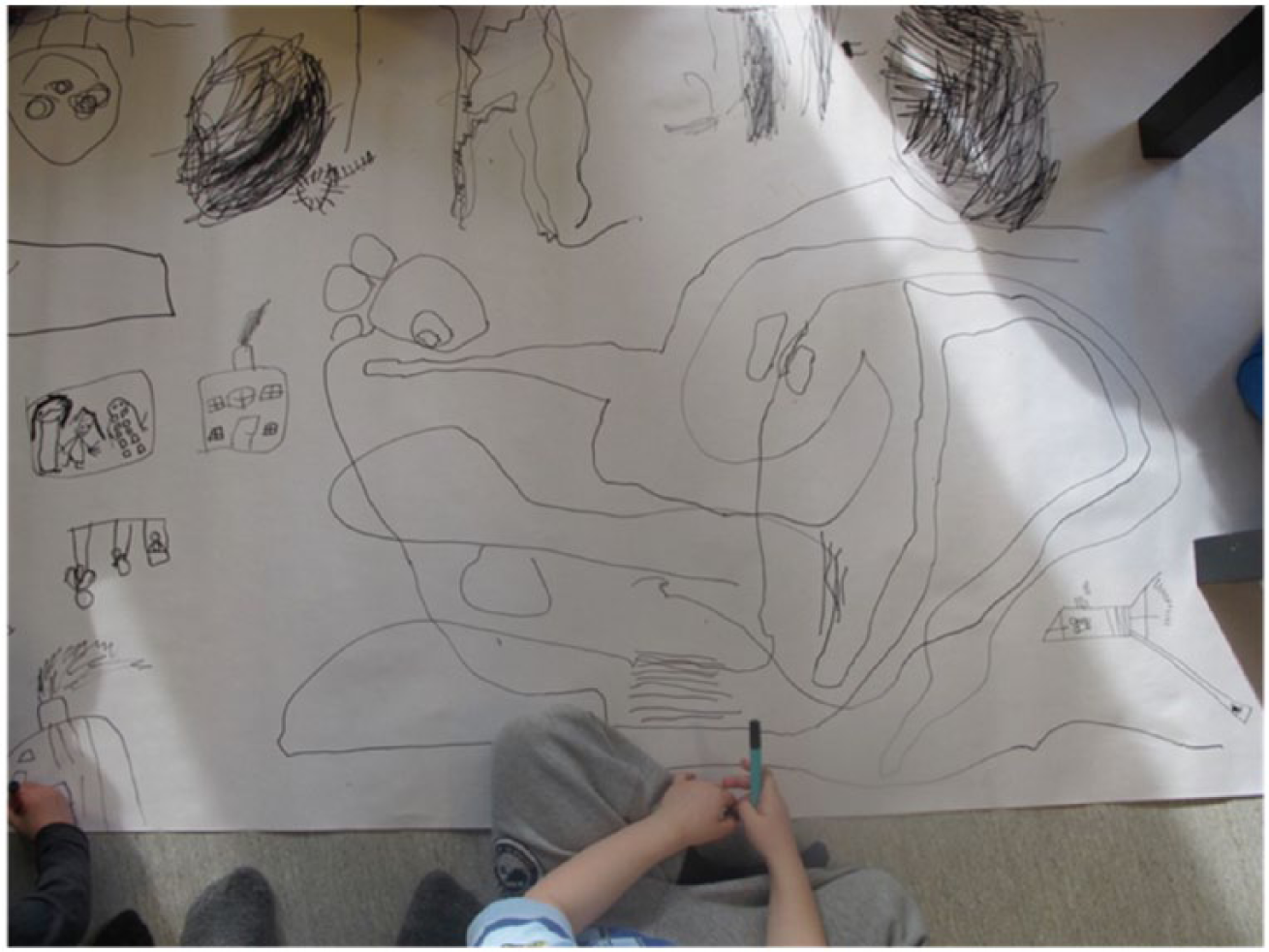
Showing the map of the park seen from above.
Here, the project begins to stretch out into a world that is much bigger than the preschool, in that it moves from the preschool to other places in Stockholm and eventually becomes more ‘worldly’ (Taylor et al., 2013). The children’s questions about tall buildings, together with the handcrafted map, memories from their visit to the tall building across the way and other stories about tall buildings they have heard, intra-act and produce knowing in terms of new questions to be investigated. Questions about other places in the world, far away from Sweden, start to bubble up among the children: Which country ‘wins’ the competition of having the tallest tower? In which country is the tallest tower in the world located? How tall is it? Issues of competition, politics and power emerge and each question intra-acts with the world around. The children want to know more.
Stretching out in the world through the Internet and investigating a printed diagram
When surfing on the Internet with Lisa and searching for information about tall buildings in the world, the children discover that the world’s tallest building is currently Burj Khalifa in Dubai, Saudi Arabia. Burj Khalifa is 2717 feet high (828 m), which is more than a thousand feet taller than its nearest rival and roughly twice the size of the Empire State Building (Goldberger, 2010: February). On the computer screen, the children watch a YouTube film clip of the Burj Khalifa’s windows being cleaned. The film shows a window cleaner climbing up the outside of the tower with a cleaning machine on his back, like a rucksack. Soft music is playing in the background. The sequence is filmed with a wide-screen lens, which draws the children towards the screen so that they almost fall into the monitor. Engaging with this video, it is easy for the children to recall the giddy feeling in their stomachs when standing at the top of the tall building across the street, close to a window, turning their heads towards every point of the compass or looking down at the ground. The children want to know more about Burj Khalifa. They want to measure it, explore its height and look closely at its architectural details. They are also interested in the people who work there. They ask questions like: How much do you get paid for cleaning the windows of Burj Khalifa? Is that the world’s best paid job?
The children find a diagram on a website, which they print and examine. The diagram shows Burj Khalifa and Pentominium in Dubai, Taipei 101 in Taipei, Petronas Tower in Kuala Lumpur, Willis Tower in Chicago and the Empire State Building and One World Trade Center in New York. They want the teachers to read the names of the buildings out loud so that they can encounter the concepts, ‘taste’ the new words and investigate what it feels like to say them (Stengers, 2005: 162). The materiality of the language, together with the agents and discourses floating around in the room, modifies the learning situation and produces knowledge, ideas and interventions and makes things happen. The first thing that the children notice is that Kaknäs Tower is not on the diagram; so they decide to redraw the diagram and include it. With scissors and glue, they squeeze a to-scale picture of Kaknäs Tower into the diagram next to Burj Khalifa. The diagram of the tallest buildings in the world has now been changed in a rather unpredictable way, putting Sweden on the map. This ordinary A-4 piece of paper can no longer be seen as innocent, passive or immutable. Rather, it is porous and permeable and in endless intra-action with other agents, where matter, discourses and facts are renegotiated and challenged. The world is not fixed or predetermined, but is always ‘in-the-making’ (Banerjee and Blaise, 2013). This transformation of the diagram invites ethical questions about what universal knowledge might be and what can be seen as the right way to picture the world. Actually, the local/global interaction forces both the children and the teachers to reconsider what they regard as ‘the world’ and what is included in it. When thinking of the world as an ongoing performative production of realities, as always ‘in the making’ and that each intra-action matters in the ‘very worlding of the world’, as Barad (2007) puts it (p. 160), the question of what counts as the world becomes evident.
Exploring the diagrams – A teamwork of many agents
The above photographs (Figures 2–4) can be read as a materialisation of an intra-active pedagogy that is reinforced by pedagogical documentation, where the children are invited to investigate, contribute and have their say. This creates an inclusive, ethical practice in which the children are seen as co-constructers of knowing and being (Lenz Taguchi, 2012: 18). However, this teamwork does not only involve humans, human dialogue, thoughts and negotiation, but other important participants such as the graphical details of the diagram, signs, letters and words, numbers, the contours of the buildings printed in red and black and the children’s hands. All these and much more (all the tiny organisms, the dust in the air, background noises and things that cannot be seen without technical instruments) work jointly to produce knowing, being and ethical dilemmas in this apparatus of knowing.
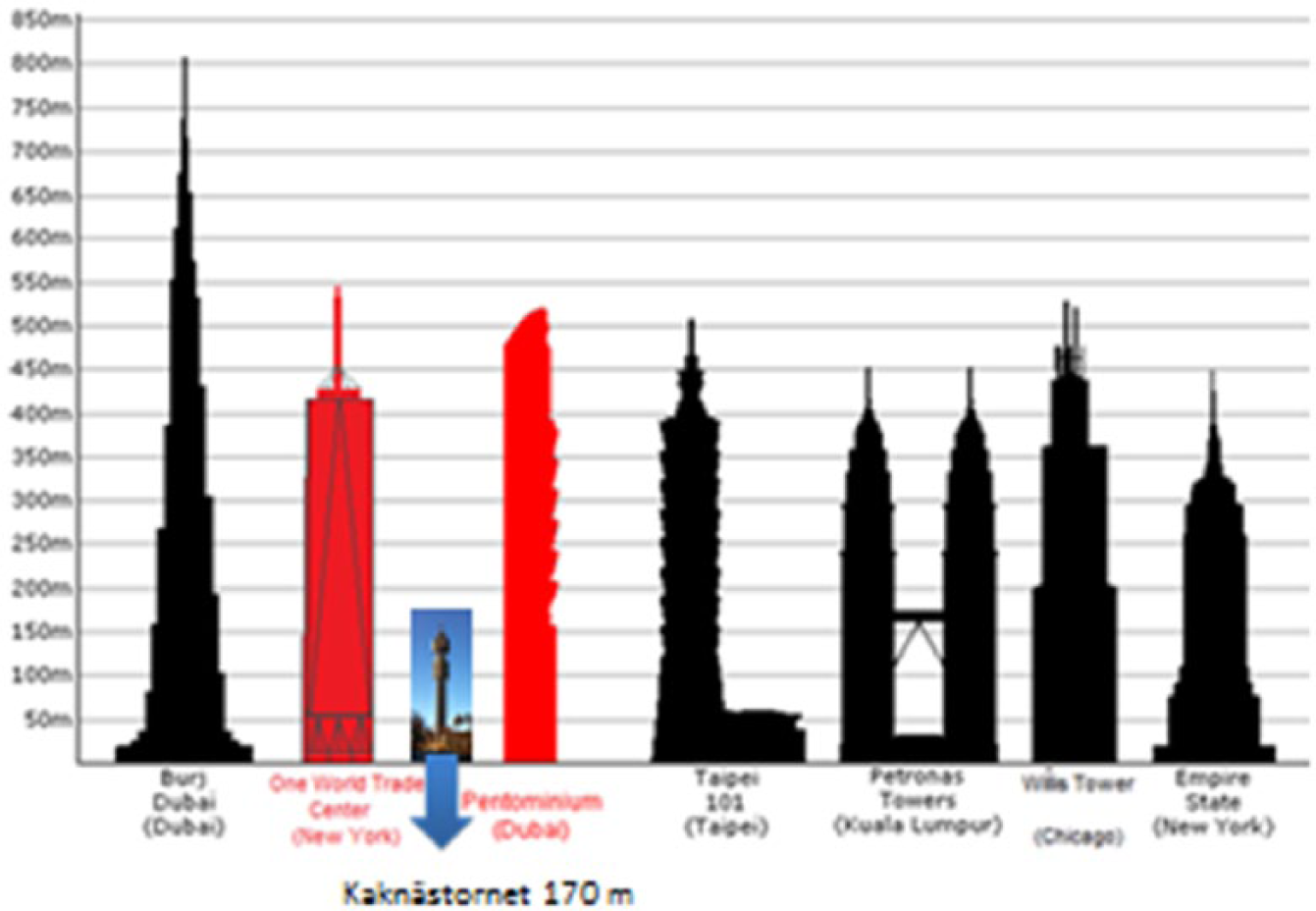
Showing the new diagram.
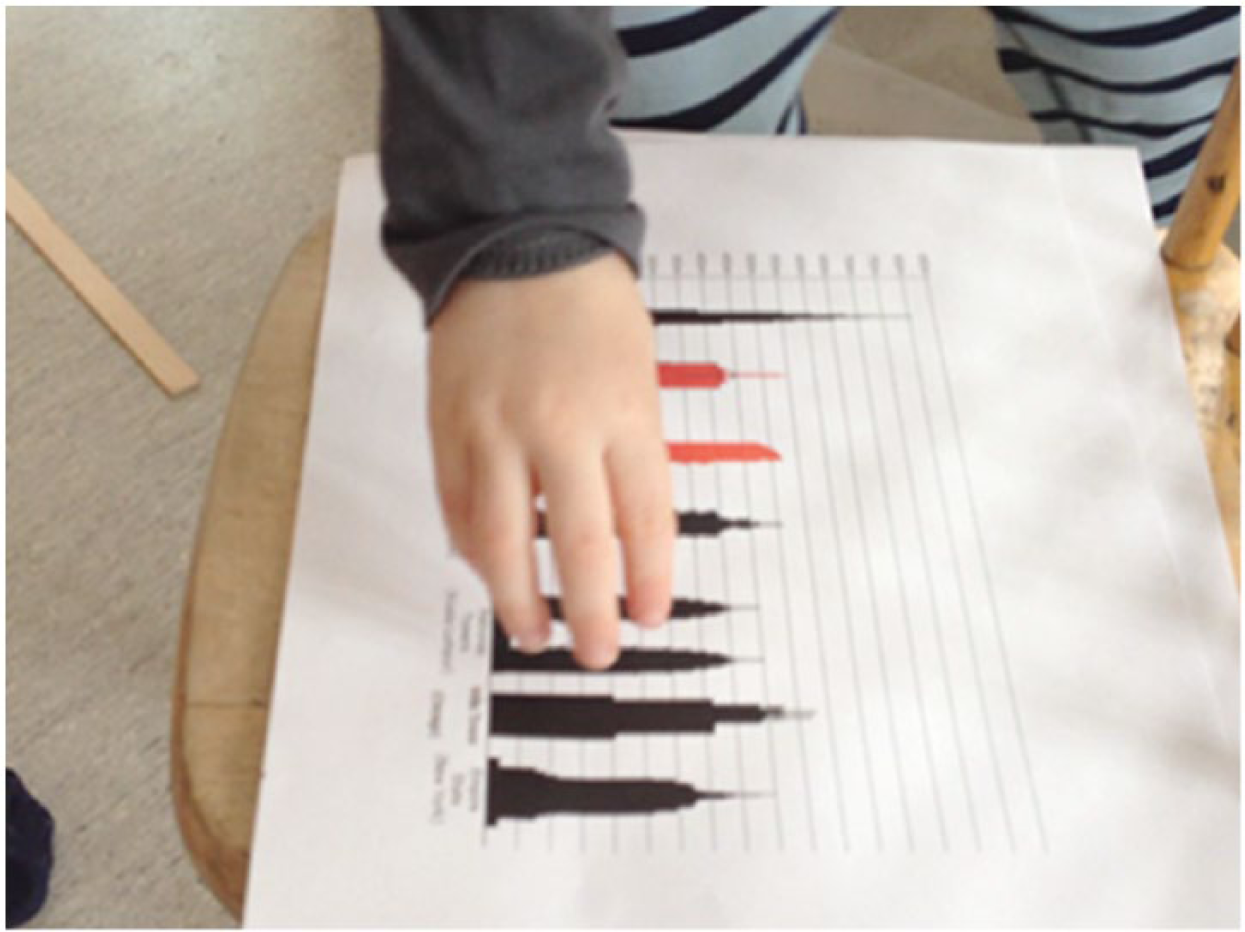
Showing the investigation of the diagram.
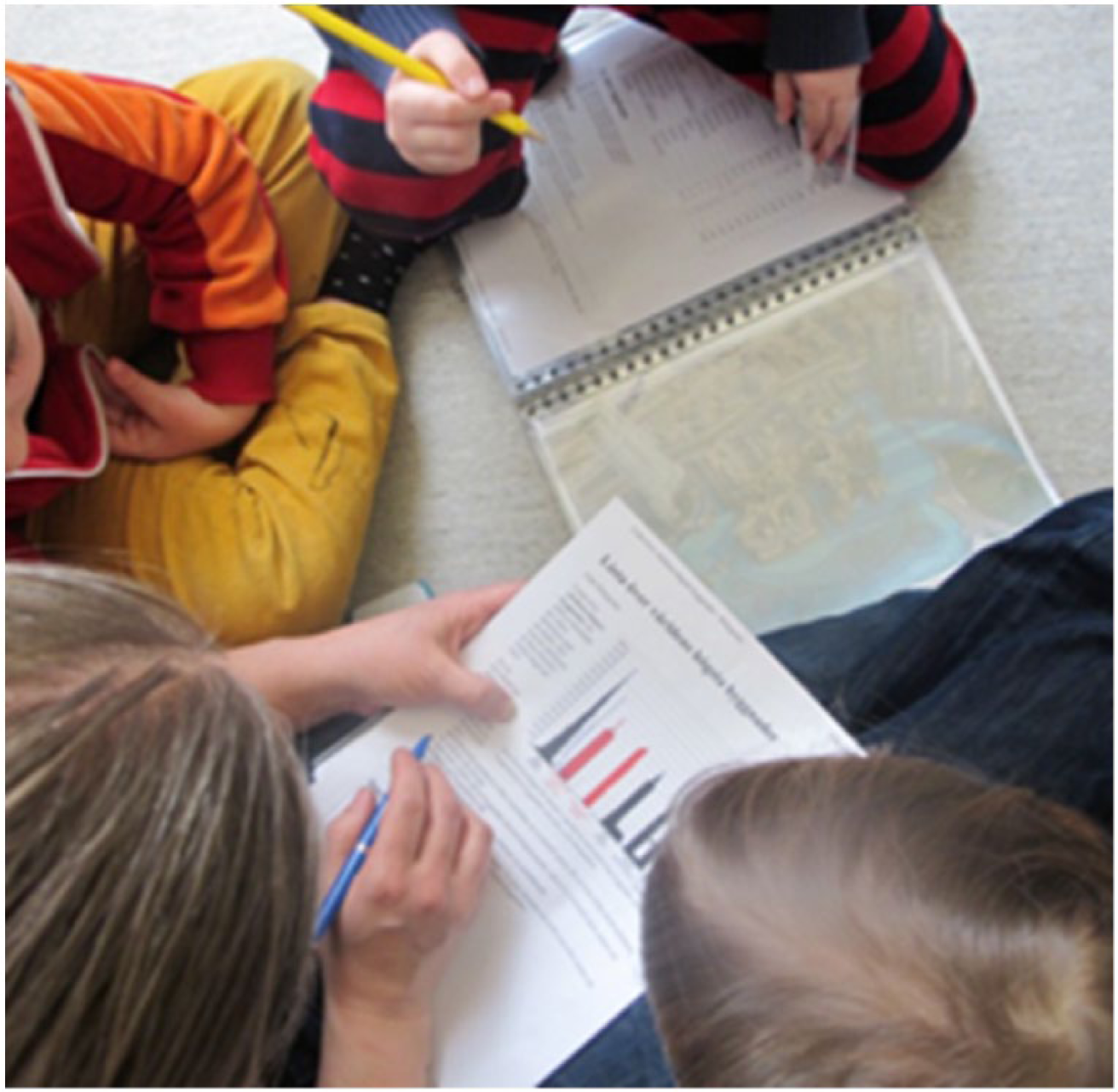
Showing the investigation of statistics.
The project continues, almost like a machine: Vincent counts the rims on Burj Khalifa to work out how tall the building actually is on the diagram, while Gunnar focuses on the thin lines behind the towers on the same diagram and counts them rhythmically with a confident strong voice, his finger pointing to each line (see Figures 2 and 3). Mia wants to look for more facts about the towers for the book they are creating using texts and photos found on the Internet (see Figure 4). The event is an inventive experimentation with no fixed goals. It is not defined in advance or separated from the world around, but is instead a vibration of potentialities. A myriad of intra-actions involving humans and non-humans, matter and discourses emerge from the learning event. The teachers try to navigate in the project and work out how to deal with all the parallel investigations that are going on and the ethical issues that are emerging in the learning process.
New questions emerge
Up to now, the project has touched on many different subject areas, all of which can be combined with the guiding principles of the preschool curriculum (The National Agency for Education, 2010), such as communication, mathematics, science and technology. So far it has been quite easy for the teachers to follow the children’s interests, make it possible for them to measure the towers on the diagram, discuss the architectural details and so on and thereby meet the requirements of the curriculum. As the children become more inquisitive and their questions get more complex and difficult for the teachers to answer, they turn to the computer to find out more about the tall buildings under investigation. Here, Lisa and the children watch film clips and search for facts about the world’s famous towers.
The questions that emerge now are about the gap between rich and poor people in Saudi Arabia and why many people cannot afford to take the lift to the top floor of Burj Khalifa. In the intra-action with photographs on the website showing luxurious restaurants and gift shops, ethical issues of justice and equality emerge. If it costs more than 500 Swedish crowns for one person to take the lift, what will it cost for a family of five? A discourse of economic injustice starts to grow in the group and intra-acts with the photos of the tower on the screen. The children are also taken by the story about how Sheikh Khalifa bought Burj Khalifa for 1.5 billion dollars and changed its name (the tower was previously called Burj Dubai). How much is this in Swedish money? What if someone bought Kaknäs Tower and changed its name? Was that really allowed? The children then ask questions about the death penalty and whether the guards in Burj Khalifa carry guns. Why do they need guns? Who will they aim their guns at? From here on, the project speeds up and quickly moves from one geographical place to another. With a click of the mouse, the children are able to travel from Asia to the United States across localities and cultures.
What happens is that Lisa and the children come across photographs of the World Trade Centre and the 9/11 attack. Tragic images of the burning towers suddenly appear on the screen in front of them. The intra-actions that emerge when these photos crash into the classroom immediately throw the teachers back to 2001. On the other hand, the children are not familiar with what they see on the screen and are unsure about this new encounter. In effect, the old and the new are meshed together and produce what can be understood as a new reality in this particular preschool. The photos and video clips of the burning towers stretch through the screen and ‘hit’ the children and Lisa, albeit in different ways. The computer screen, a passive and lifeless object when shut down, now comes alive in a rather unpredictable and violent way. The screen is wide open and intra-acts intensively with the children’s and Lisa’s eyes, ears and minds, as well as with the matter and discourses in the room. Images of terror and extinction flow into the preschool, and the teacher feels that it is like surfing on a sea of equivocal information, and that every click she makes is an ethical call. This project suddenly becomes very worldly, and turning back becomes impossible. Lisa and her colleagues discuss questions like: Which Internet pages can we rely on? Which pieces of information should we choose to read out loud? What should we not pass on to the children? The teachers view themselves as trapped in a mesh of constant and mutual responsibility for what happens in the numerous intra-actions emerging in the learning event, as they affect and are affected by all the inquiries taking place (Lenz Taguchi, 2010: 176).
A journey with transportability problems
When facts about what happened on 9/11, about Burj Khalifa, or any other information found on the Internet ‘land’ in this new geographical preschool setting, they are transformed and changed. Something happens when information travels from the wider world to the local context. The information that enters the preschool cannot be seen as universal, but must be scrutinised and questioned by the recipients in the local setting. As Annemarie Mol (2009: February) explains, the process of facts travelling often causes transportability problems because the meaning of the concept changes during the transportation. When facts travel into the preschool, the information is changed and reconstituted in intra-action with the bodies, matter and discourses occupying the room. Information about 9/11 or other information is then not possible to generalise. Information and facts – just like ethics – are renegotiated in the material-discursive settings in which they currently belong and can be understood as effects of the intra-active relations that emerge in the local context. This becomes an ethical dilemma for the teachers, in that they come across many Internet sites with questionable information and do not always know how to handle the situation. Their own reactions and memories also intra-act with the situation and become part of the learning event.
When children’s investigations become worldly, as in this project, and stretch out into the wider world – through the Internet and new technology – the preschool practice changes. In ongoing intra-activities, the preschool practices continually change with the new information and facts coming into the preschool, which means that they will never be the same again; ‘once we know, we cannot not know’ as Haraway (2008) writes (p. 287). At this point in time, the teachers cannot turn away from the medial and technological developments that are taking place in the world at present, but have to hold on and take every question as it comes. As Anna Lowenhaupt-Tsing (2005) writes, we are all part of the current high-tech revolution, global connections are everywhere, and knowledge travels rapidly over the globe. This travelling involves new ethical questions, what Lowenhaupt-Tsing calls ‘frictions’ (p. 6), that cannot be foreseen and that move rapidly into the preschool.
A slowing down movement creates a space for reflection and creativity
Lisa and her colleagues try to summarise the ethical dilemmas that have emerged so far and come up with the following questions: If they take the children’s questions about the death penalty and weapons seriously and help them to find answers and support them in their investigations, is it in line with the curriculum text? How can they investigate different religious ideas together with the children? How will the parents react if a learning project is constructed around the 9/11 attack at the preschool? How much should the teachers act as ‘neutralisers’ and protect children from difficult questions, and should we encourage children to be curious, politically engaged and involve them in ethical matters? Children are curious and want to continue exploring, while teachers often want to slow things down, or, as Lenz Taguchi (2010) writes, delay the movement of the creative collaborative process in order for a re-enactment of the event to take place (p. 114).
This was a crucial part of the project, and the teachers really struggled with how to move on. Lisa, who studied intra-active pedagogy as part of her teacher education and has been involved in this kind of reflective practice for many years, encouraged her colleagues to slow things down and to turn back to the documentation to ‘re-install themselves in the learning event’ (p. 172) in order to look at things from different perspectives. Lenz Taguchi (2010) explains this as a circular movement of re-enactments and counter-actualisations that makes it possible to identify the intra-activities that are taking place (p. 124). Slowing things down is also a way of temporarily ‘freezing’ situations in order to relive the situation and understand it in alternative ways. The teachers re-read the documentation together with the children and discussed how they could create an investigative project without dismissing or disqualifying any of the questions. In the email correspondence with Lisa, she writes, The greatest challenge is to engage with the children’s questions, without dismissing them or telling them ‘how it really is’, and also to let them know that I don’t have all the answers. I want to be open to different topics and areas of knowledge, even if I understand that many of them are not what you might call ‘child-friendly’, but perhaps more considered as difficult knowledge (at least by other adults). This is a great challenge.
These thoughts intra-act with the question of children’s influence and what kind of knowledge is considered valuable and investigable (Wall, 2010). Lisa wants to investigate the children’s questions together with them, even though at the same time she wonders whether the project involves knowledge that is too difficult. She is concerned about what the children’s parents might think if she raises questions about death and terror in the preschool. What is considered to be difficult knowledge is mostly often determined by adults (Britzman, 1998). Issues such as death, war, poverty and violence have been culturally and politically constructed as difficult for children to manage and are often considered as unsuitable for children in the preschool. What Lisa tries to do is to weave the children’s questions, curiosity and interests with her questions and put them into recognisable context so that they can be approached from alternative starting points. This does not mean denying or forgetting the questions that are at stake, but re-living some of the situations and working with them in different ways. Slowing down and temporarily ‘freezing’ the situation allows the teachers to enter the problem from a new place or point and to select different exits.
The teachers said that slowing down was necessary for the navigation of this project and led to the surfacing of new ideas. This enabled them to organise other investigations in different subject areas. Without deflecting the children’s interest, this slowing down movement enabled the teachers to be creative and inventive together with the children, which in turn allowed for a speeding up ‘horizontal’ movement and the creation of something new (Lenz Taguchi, 2010). In the next phase of the project, the teachers planned a study visit to Kista Tower (in Stockholm) so that the children could interview the staff there. They prepared a number of questions: How tall is the tower? How many people work there? What does it cost to go up there in the lift? Who takes care of the rubbish? Do they have weapons? Are they scared at work? Do they think about what happened in New York on 9/11? 4 The pedagogical strategy employed was to try to engage with the children’s thoughts and questions and follow them into the world and not put adults’ questions at the forefront. The teachers wanted to learn with the children and be open to their creativity and responsiveness to the world around them (Wall, 2010: 179–180). Although this was a somewhat daunting task, they agreed to try it out.
This ‘circular’ slowing down movement then served as a platform for a speeding up ‘horizontal’ movement, which Lenz Taguchi (2010) describes as creative and open to new possibilities. This gave the teachers and the children new energy and motivation to continue the project, despite the difficulties that lay ahead. Lisa and her colleagues learned the importance of being creative and of pursuing new ways of solving problems that arose (cf. Olsson, 2013: 251).
The effects of a posthuman understanding of ethics in the preschool and in research
In this project, the teachers really want to take the children’s questions seriously, think with them and support them in their investigations (Olsson, 2013: 231). However, responding to children’s questions as and when they emerge, here and now, can be a difficult ethical challenge. Allowing children to be curious and involved in many different issues, and thereby challenging the understanding of childhood could result in a more inclusive and ‘worldly’ preschool practice, where no questions are seen as difficult or impossible. This way of thinking about pedagogy distances itself from romantic understandings of childhood as sheltered and detached from the ‘real’ world. Rather, it invites children to feel included in the world, with all its problems and unsolved difficulties (Robinson, 2013). The tall building project shows that in the preschool, ethical issues often go beyond human-oriented models of ethical thinking and involve a myriad of ethically engaged agents. When children and teachers, and researchers, together dare to ask difficult questions and think with the problems that emerge, they are pushed into an ethical affective thinking-doing, where anxiety, sorrow and grief are unavoidable. It requires courage to stay with the problem and consider oneself as part of and folded into the ethical dilemmas that emerge.
However, it is difficult and sometimes inconvenient when children ask complicated questions about injustice, extinction and terror. As a teacher, one can try to think with the children and grapple with the complex ethical problems that emerge. Staying with the problem, as Haraway (2008) urges us to do, and thinking with children and all the living organisms and the material environment that we are connected to is akin to living with the problem. The problem might then become a ‘sticky knot’ of life that demands to be unpicked, rather than dismissed. Taylor et al. (2013) write that sticky knots confront us with serious ethical problems that arise when different parts of the world are thrown together. The ethical considerations that might emerge in a project, such as questions of equality in other countries, disaster scenarios resulting from terrorism or concern for the environment or the inevitable panic that follows these threats, become sticky knots that we need to grapple with and sort out.
This project illustrates some of the ethical dilemmas that might emerge in a preschool setting. It also shows what happens when researchers engage with data and follow children’s projects into the world. When reading data with and through a global world, an alternative understanding of ethics, responsibility and accountability materialises. Ethical questions emerge in every situation, both in research and in the preschool, and humans are not always in charge. Responsibility depends on one’s ability to respond and engage in mutual relationships with the world. Finally, even though we may not always be aware of it, we are constantly connected to other agents, for whom and which we are responsible. We are never alone, and each moment is an ethical call.
Footnotes
Acknowledgements
The author would like to thank Lisa, her colleagues and the children for sharing their pedagogical documentations with her and for showing her what it is like to live and learn together in the preschool.
Funding
The author(s) received no financial support for the research, authorship and/or publication of this article.