



Abstract
This paper explores children’s encounters with migration in global contexts through storytelling. Children from two primary schools in Manchester, UK and Cape Town, South Africa, developed stories of self through object elicitation, poetry and self-made artefacts. The children had either directly or indirectly experienced migration across borders. We combined objects that were brought from home, drawings and annotations in exploring the significance of children’s ordinary everyday encounters. While the children’s story work captures their individual perceptions of self, the collections of objects, drawings and artefacts reflect ideas about what it means to be a child in a world of mobility where human and more-than-human are entangled together. We explore children’s stories in relation to mobility, belonging and more-than-human connections. However, we acknowledge that the interpretation of the ‘final’ stories is incomplete as they continue to change in a process of becoming.
Introduction
This paper explores children’s encounters with migration through arts-based storytelling in two countries in the Global South and Global North. The research took place in two primary schools in Manchester, England and Cape Town, South Africa in areas characterised by socio-economic, linguistic and ethnic diversity. Children, aged 8 and 9 years, explored their sense of self through arts-based research methodologies. In both contexts, the focal point were the objects that the children selected and brought from home. The objects represented different aspects of childhood – toys, books, stuffed animals, pencil cases, fidget spinners, possessions acquired while on holiday, presents from family and friends, bought from shops, hand-made or found, each with their own story. The collections of objects in both contexts illustrate how childhood is experienced and shaped by the material. While thinking about their own objects, children also engaged with their peers’ objects, sharing stories of kinship and significance. We explore culture- and place-specific imaginaries of childhood, in different geographical and cultural contexts that are intertwined with a common history of post-colonial entanglement, migration patterns and linguistic diversity. We adopt a more-than-human perspective in thinking about children’s entanglement and kinship with the objects. We draw on Haraway’s ‘bag lady’ storytelling as speculative fabulation where developing stories and understandings of the more-than-human world makes kin (Latto et al., 2022).
Many of the children who took part had either directly experienced migration or were from families who had migrated previously. Within families, decisions about migration and the reasons for moving a country are made by adults, and children experience migration as something that happens to them, rather than as agents of their own mobility. This is at odds with the sociology of childhood’s agentic view of the child as competent, articulate and empowered, with potential to make change in the world (Prout, 2004). Children may inhabit marginal spaces where their voices are often not sought (Hammersley, 2017), even where they are within sight and under surveillance. Childhood as a stage of life is seen as a ‘temporary’ condition (Thompson, 2017) that is to be addressed through education so that children are taught how to be proper persons. This notion of ‘becoming’ (Prout, 2004) directs attention towards the supposed completeness through which adulthood is viewed, and adults’ ability to make life-changing choices, including about where to live. Despite adults having such agency, Nyamnjoh (2017: 253) argues that, particularly in the context of migrants’ identities, ‘incompleteness is the normal order of things’, in that adults too are always in the process of becoming, though society tends to view their identities as fixed and, in the process, ascribe labels of insider and outsider, migrant and local. We were thus interested in exploring children’s own agentic understandings of movement and ideas of home.
Children’s migration and mobility
In the Global North, the study of family migration is characterised by a ‘children-in-families’ approach that omits children’s experiences as distinct family members focussing on the ‘family’ experience as a whole (Moskal and Tyrell, 2016). Similarly, even while there is a recognition of the ways in which family and household can be very fluid in Southern Africa (Rugunanan and Xulu-Gama, 2022), by far the majority of the literature on migration in Southern Africa is focussed on the movement and experiences of adults. However, treating the family as a unit or focussing only on adults does not reveal the distinctive roles of family members, including children, and the ways these are conducted (Morgan, 2011). Children’s definitions of migration and mobility may differ to the definitions used by academics, or by the adults in their lives (see Van Blerk and Ansell, 2006).
While at face value family migration appears as a singular transitional event, it is in practice, a set of varying processes involving different family members, practical, agentic and structural considerations. Viewing children as bystanders (Morgan, 2011), to the process and impact of migration, omits their experiences of childhoods across borders. Migration is, in effect, a process of separation (Moskal and Tyrell, 2016), and children who move with families may experience developing a new sense of belonging while navigating their prior attachments to a country, school, place, context and culture. Devine (2009) characterises this as living within and between two different worlds where children feel ‘at home’ and ‘different’ in both places. Additionally, an explicit focus on first generation migrant children overlooks the complexity of experiences of second and third generation migrant children.
In schooling, children are often limited (by adults) in the ways they can ‘express their knowing, thinking, learning or doing’ (Reynolds, 2021: 112). Children subject to migration are seen as ‘resilient’ and therefore able to manage changes of context as means of integration and agency. Struggling with the transition into a new national context and school can be perceived as an issue to fix and as such children will be steered towards particular types of support to manage this transition more effectively (Kaneva, 2012). Thinking about children’s migration, thus, becomes an exercise of eliciting underrepresented voices, political stances and children’s non-hegemonic viewpoints (Thompson, 2017). Moving away from essentialising family and children’s experiences requires focus on generating authentic data ‘with’ participants and drawing upon lived experiences, thus employing resources that are part of children’s repertoires and lives. This project enabled us to somewhat connect children’s worlds at school and at home utilising objects that were brought into school enabling them to exercise agency and voice their stories.
Childhoods as more-than-human
Many of the objects and artefacts that signify, define and describe childhood are created by humans. However, while such objects represent children and childhoods through particular discourses, they also construct subjects because ‘objects make people’ (Miller, 2010: 53). Humanity and materialism are intertwined at every level of experience. Therefore, seeing childhood as a more-than-human encounter requires an engagement with the wider aspects of children’s lives beyond the social. According to MacLure (2013) words and the meaning of objects work together in shedding light on connection with ‘things’ and experiences beyond the verbal, meaning that discourse and matter are mixed in the emergence of ‘the world’.
Adopting this view, we invited the children to bring special objects into school. The objects we anticipated to see were, in effect, defining childhood. Barad (2007: 342) reminds us that ‘knowing is not an ideational affair, or a capacity that is the exclusive birthright of the human’. As knowledge production is located not only in the human, or adult human, in these stories there is a co-production of knowledge between the children, special objects (toys/artefacts/memories); telling of stories, the paper, drawings, oil pastels, poems, clay, water and so much more. Pacini-Ketchabaw et al. (2017) articulate that ‘thinking with materials’ encourages educators to notice the entangled lives of children and materials in the classroom whereby they shift and change each other through their mutual encounters.
By paying attention to these children and the specificity of the materials and stories they were telling and retelling in and through their memories, artefacts and co-created artworks in Manchester and Cape Town, the children and the more-than-human became co-participants in data generation. We were able to listen differently to their experiences of migration or ideas of home, which are not fixed or stable, but unfold as the storytelling with objects emerges.
Research design
This project was informed by participatory and arts-based research methodologies. Children from two primary schools in Manchester and Cape Town developed stories of self through object elicitation, poetry and self-made artefacts. Arts-based research methods employ art forms to generate, interpret or communicate research knowledge by working with the participants to uncover their lived experiences (Morris and Paris, 2022). We chose art-based methods to encourage engagement and the children’s motivation.
A total of 86 children, aged eight to nine, participated. This included 30 Year 3 students in England and 56 Grade 2 students in South Africa. The workshops took place during the last school term of 2022 (July in England and September in South Africa). Ethical approval was granted by both the University of Huddersfield and the University of Cape Town, and the Provincial School Education Authority in the Western Cape in South Africa. Access to the schools was facilitated by the headteachers. Parental permission was obtained for the children to take part in the project and children consented verbally.
Schools
The Manchester school is situated in a residential urban area characterised by high ethnic and cultural diversity and relative economic wealth. Formerly a predominantly middle-class area that then suffered economic decline, it is currently showing signs of gentrification by attracting a mix of professionals, mature university students and families with children. The school itself is a small inner city setting with a hyper diverse student population reflecting the diversity of the area. The school ethos is centred around high expectations and centredness within the local community. The positive relationships between staff and children are evident upon entering the school and children’s pride of their environment when taking visitors around. This school was chosen because of its diverse student body and similar characteristics of the local community making it a suitable space to discuss migration, belonging and children’s everyday stories.
The South African school 1 is situated in a suburban area of Cape Town, characterised by an extremely high diversity of household type and income level. It is situated in an area that is partly removed from wider Cape Town due to geography, in that it is on the other side of a mountain range. As such, the school draws its learners from a neighbourhood that can be seen as a microcosm of post-apartheid South Africa, in that it contains (in a relatively small area ) wealthy, often dual income households living in large, formal dwellings, often with big gardens; households sharing single room, informal ‘shacks’ where at least one parent is likely to be unemployed; and mid-income, formal government brick housing. The community in which the school is based is host in particular to migrants from Malawi and Zimbabwe, who are largely economic migrants in search of a better life for their family. The school has high linguistic diversity, with children’s primary languages varying between English, Afrikaans, isiXhosa (all common and official South African languages), as well as ChiChewa (Malawi) and ChiShona (Zimbabwe), both of which are common but not recognised as official languages in South Africa. The school is a fee-paying government school, meaning that it receives some funding from the state but uses fees to employ additional teaching staff. There are two classes of approximately 25 children per grade. The school is very aware of the diversity of its student body, and actively strives to bring children from different backgrounds together. Positive relationships between staff and children, and between children themselves, are evident. The school was chosen for its high levels of diversity – economic, racial and linguistic – which is fairly unusual in post-apartheid Cape Town, where economic and racial divides still often map onto geography, and thus can remain rigid in terms of school catchment areas.
Methods
Three sessions took place in each school:
An introduction with the research team where children brought their objects, shared with their friends, then they drew pictures of their objects.
A session led by a storyteller (England) and an artist (South Africa) where children were invited to think about their objects and draw, write or craft responses. In both contexts, we documented the process while children developed their stories and made their creations.
A debrief session led by the research team in each school inviting children to think about their experiences on the project.
The drawings produced by children acted as a social process of developing stories about their objects and thus their experiences. The drawings ended up being performative, wrapped in conversation (Thompson, 2017), a process to think-with and make-with (Latto et al., 2022). Involving the artists meant reducing barriers to participation but also developing commonalities in how the children engaged with the project and developed their stories as a shared social process and more-than-human kinship. As the research progressed, children had their own ideas about how to engage with both objects and set activities. For example, in Manchester, children crafted poems in addition to the visual storyboards about their objects. This was an unexpected, yet elating experience which consequently changed our approach to working with, analysing and interpreting the data.
Data analysis
To analyse the data in the form of drawings, artefacts, children’s annotations, fieldnotes and recordings of conversations, we employed Haraway’s ‘bag lady storytelling strategy’ (Taylor et al., 2013), in which encounters between ‘unexpected partners’ are analysed. Our ‘bag’ combined the objects that the children brought from home, their drawings and artefacts enabling us to consider the significance of the ordinary everyday encounters between these and the children. While the children’s story work captured their individual perceptions of self, the collections of objects and their collective drawings and artefacts reflect ideas about childhood migration in a world where human and more-than-human are entangled together. Children were encouraged to trace the history, prior ‘lives’ and ‘encounters’ of their objects, prompting active engagement with the ‘other’ in their stories (Haraway, 2008), with aspects of their objects’ migration and their own experiences of moving, finding and leaving behind.
We began our analysis with a collective reading of the data by focussing on ‘data that glows’, the fragments of data that exert fascination and have capacity to animate further thought as a framework for the analysis (MacLure, 2013), and specific events that prompted reflection. We utilised snapshot stories accompanied by artwork to centre children’s voices, enabling the making of their experiences, identities and possibilities visible through storytelling with the objects. Our analysis of human and more-than-human entanglements brings together the agency of children, objects, stories and the recorded data. We explored children’s drawings from both contexts as a team noting down commonalities and differences across the children’s experiences, stories and engagement and the pedagogical potential of the mundane and ordinary in how children engage with what is more-than-human.
Findings
We explore children’s stories in the context of their more-than-human connections. The wonder and curiosity in data, our focus on events, relations between children and objects, agency and movement and kinship is what moves us to understand better what the children in Manchester and Cape Town are sharing with us. Objects in both contexts were broadly the same and the focus on ‘making kin’ clearly evident, which allowed an opportunity to reimagine childhood in two different geographical and historical contexts. The assemblages of objects serve as representations of childhood – order and pattern in what children chose to bring into schools can be discerned, yet the objects leave openings for something new to emerge: a consideration of what it means to be a child now and how more-than-human encounters enact this. By bringing personal objects to school, children effectively disrupted school routines and expectations. Consequently, the agency children ascribed to their objects not only brought them to life, but also made them key companions to the children exemplifying more-than-human connections and their potential to hold, tell and retell stories. This shows the learning potential of objects in terms of getting to know the children, their stories and wider curriculum links.
We now share three vignettes exploring naming objects as belonging and kinship; the agency of gifted objects; and objects that speak to ‘home’.
Names as belonging and kinship
When children came into the hall in Cape Town, they brought chairs from their classrooms. We invited the children to sit on their chairs. They were able to place their own chairs in a circle, making a choice within a choice which they are not always freely given in their classrooms – of where to sit, as this remains an adult prerogative in schooling. Reynolds (2021: 228) argues that ‘this minor act (of making a circle) works to destabilise the adult/child binary and reconfigures the relationality’. The materiality of the circle also makes a different kind of learning possible, where child and teacher are co-enquirers. Murris and Haynes (2020: 28) problematise the concept of authority in schools and suggest that, ‘there are many layers to authority and teachers’ roles are embedded in larger systems of accountability, as well as social expectations regarding the nature of their role and how it is performed’. As researchers we also benefit from this assumed authority and so to engage with the children in a more just and democratic way, we chose not to work in their classrooms, but in a different space where the ‘rules’ could be co-created between us and the students.
The orientation of each of the pictures as stories offers a clue as to where each of the five children in the group (Figure 1), were sitting, drawing, creating, writing and telling ‘their’ story which has now become one of a group story of ‘self’. Each drawing and story is co-existing, alongside the others. The orientation is towards a centre, it is not linear and there is no right side up. Providing large sheets of paper was intentional as it allowed the small groups of children to work collaboratively, to talk, draw and create together while still telling their own stories to each other and through the drawings. Vecchi (2010: 111) reminds us that the ‘size, shape, colour, grain and surface quality of paper are not neutral, nor are the nature and quality of tools used to produce drawings’ meaning that we should actively recognise their impact. This poster has, therefore, created a canvas for the stories from the children to be in a different form, one they have created and are now sharing. Five images were taken before this one (Figure 1), and in them the progression from pencil outlines, to decisions being made about colours and the writing that the children chose to add to their drawings is evident. Ingold (2007: 1) argues that seemingly unrelated activities such as walking, weaving, storytelling, observing, drawing have a commonality in proceeding ‘along lines of one kind or another’. We have an opportunity to explore some of these ‘lines’ here. One line that drew attention in this image was the use of names which was also apparent when the children were sharing about their objects – generally the significance of naming of objects points to the relations that exist between child and more-than-human belongings.
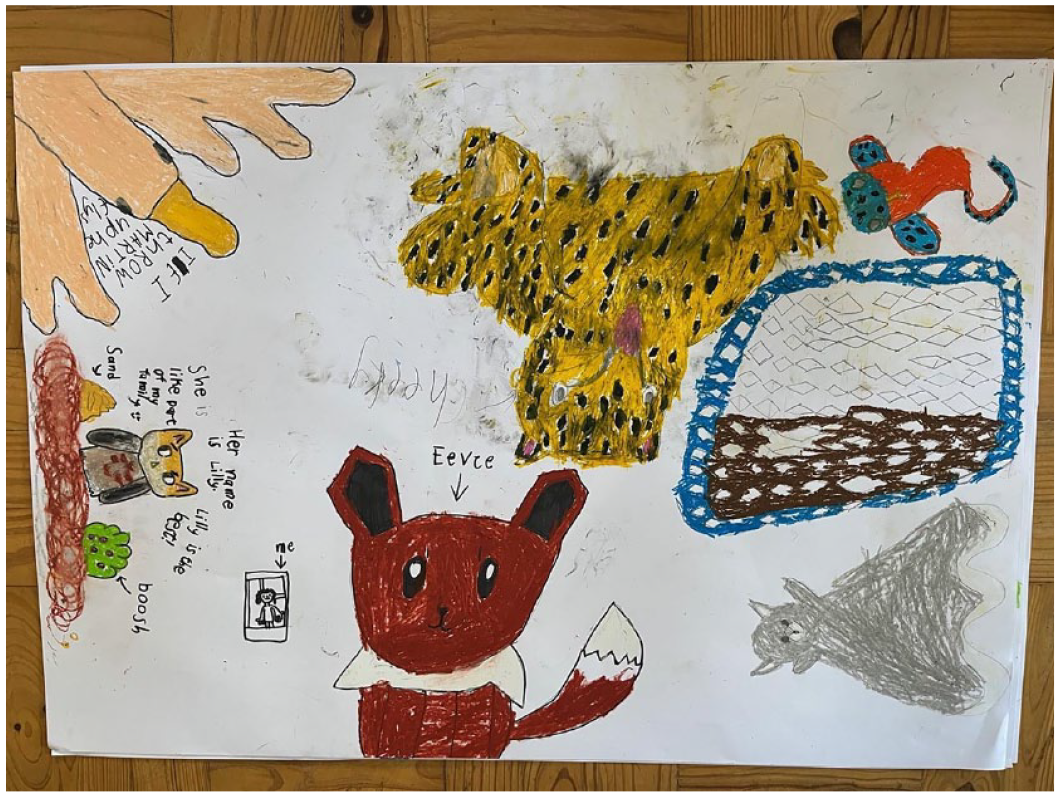
Group drawing: Cheeky, Eevee, Martin, Lily and me.
A child wrote, ‘If I throw Martin up he flys’ (Figure 1). In this statement, there is no need for an explanation such as ‘Martin is my stuffed duck’: the signifier Martin identifies this stuffed animal toy as already belonging and already having an identity and agency. Giorza (2021: 68) states that a name is ‘a threshold between our separateness as bodies in the world and an invitation to a more intimate connection’. The children in their act of naming are declaring their connection with something other than themselves, showing what else shares their world with them. The choices made by the children to write the names on this poster are also reminiscent of the other ways names perform in childhood and in families. Names connect and show what else they are a part of. Names indicate group participation in the classroom, their property like their notebooks and some schools even require children to wear name badges. Surnames can be clan names and show lineage. Names and surnames perform belonging.
Let us return to Martin. The stuffed toy is drawn almost the same size as it is ‘in real life’. Martin does indeed fly and is thrown into the air and caught upon his return. There is an assurance of who and what Martin is and what it is capable of because this is part of the relationship between Martin and this child, an established pattern: when Martin is thrown in the air, flying happens. This is an indication of a shared history and knowing – and we are being allowed into these aspects of the children’s lives which they are sharing with us.
The agency of objects
In Manchester, a child brought a small pale pink rock, a gift ‘from great grandma from Pakistan, a memory from my great grandma after she passed away’, the child explained. This was a gift, several children had opted to bring objects that fit into this category. Within our ‘bag’ of objects, the rock stands out as a natural or ‘found’ object and one that has been passed on between generations and members of the same family. It bears personal significance and illuminates a bond between child and object and a multi-sensory engagement, particularly around the child’s affectionate description: ‘a Rock called Rosey’. This naming practice, similar to what the children in Cape Town discussed, shows connection and making kin with the more-than-human.
The child tells a story: This is special to me because when I was zero my great grandma gave this rock to my mum. And on my first birthday, my great grandma died, and when I was three my mum gave me the rock. And I lost it, but my dad found it.
Several points in making sense of the child’s entanglement with the object emerge: the rock is named and writing about it is capitalised; family relations, kinship and belonging are illustrated by passing the object across generations including the notion of being ‘lost and found’, which can be seen as symbolic in the context of migration. The object originates from the child’s parents’ home country, Pakistan, which is not the child’s birth country. The rock is a symbol of the family’s migration, the passing on of physical belongings and a more abstract sense of belonging across generations. For the child, it symbolises a symbolic home.
In developing the object’s story (Figure 2), the description alludes to its agency by highlighting its human feelings and characteristics: ‘happy and precious’. These also reflect the child’s entanglement with the object as they share a life (the object ‘lives’ in the child’s bedroom) and a life story (made up of significant life events).
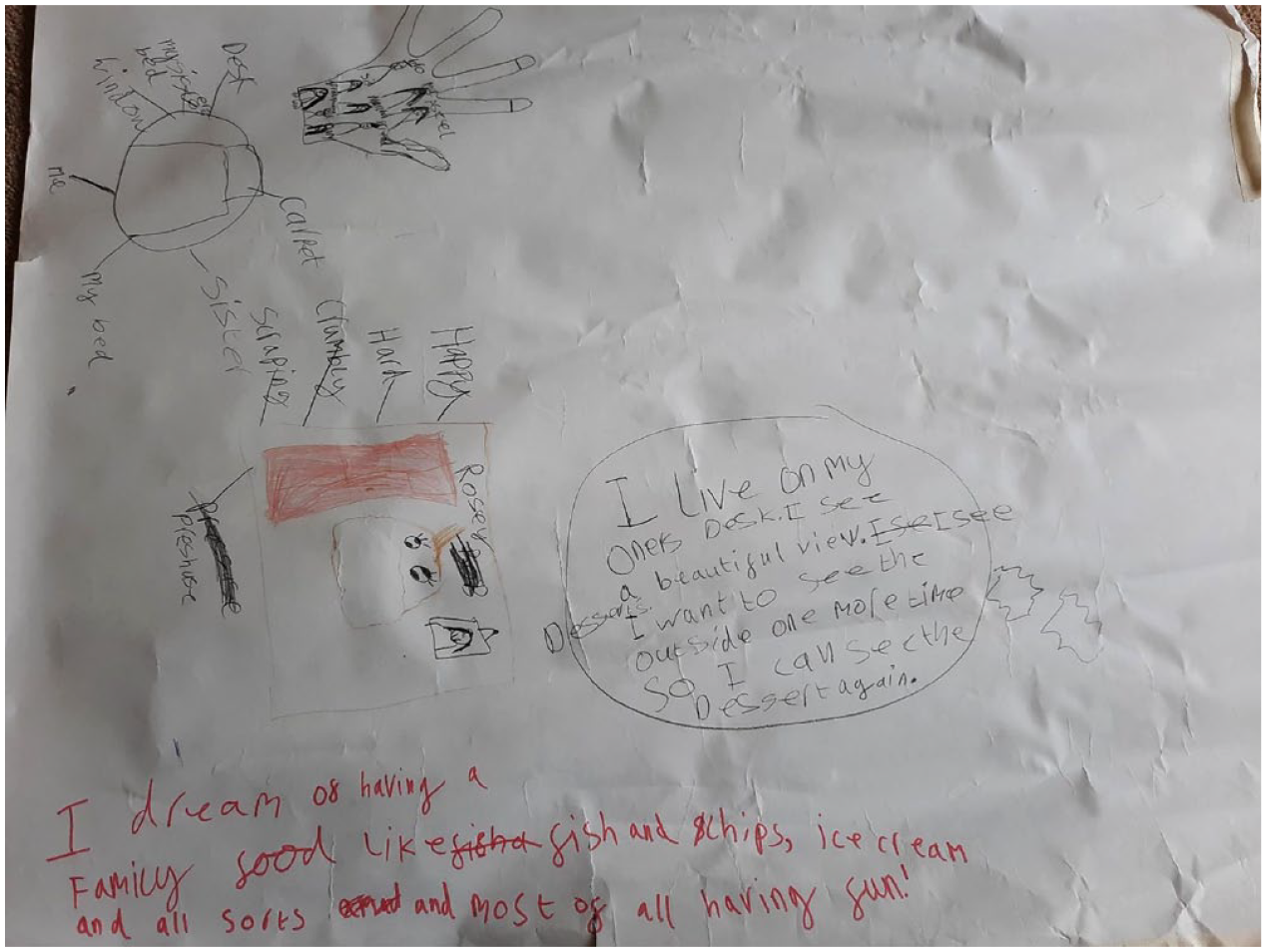
The story of Rosy the rock.
The story is represented multi-directionally, like the drawings in Cape Town. While writing the story, the child moved along the corner of the table so the story changed direction. This is reflected in the narrative moving from description of the object to its poetically represented agency:
I live on my owner’s desk.
I see a beautiful view.
I see deserts.
I want to see the outside one more time,
So I can see the desert again.
Longing for the past and the notion of going back, the child is mixing present and future – what the rock sees is a reflection of its past (deserts) and the landscape of the child’s experiences with their parents’ ‘home’ country, yet it is manifested as a current sighting that illustrates longing. The outside and the desert are linked to explain the object’s sense of loss in not being able to see its original landscape because it has been uprooted. The voice of the child and the rock become entangled and indirectly the child is talking about migration and the sense of loss when moving. What is interesting in this case is that the child herself had not experienced migration directly, yet she had a sense of the feelings associated with moving.
The final poem focusses on the object’s longing for experiences that are relatable to the child’s everyday life in England: I dream of having a family, Food like fish and chips, Ice-cream and all sorts,
And most of all having fun!
Here the object experiences the mundane, everyday aspects of childhood. While initially the experiences of the object and child are at odds, for example a desert versus an urban area and a house, the child would like the rock to experience her childhood – family meals, different foods and activities in order to know happiness from a shared point of view. Highlighted here are the importance of family and kinship, everyday experiences like eating together, being a child. In this animated dream of the object, the child also highlights their own experiences and agency of the object through mutual constitution (Miller, 2010) to long for a child-like life.
Objects that speak to ‘homes’
This final example is from children’s collaborative drawings in Cape Town. For his object, the child had brought a set of cards from the popular game ‘Top Trumps’. The child began by asking a teacher if he could use a ruler – we had provided paper, oil pastels and pencils and the children had also brought their own stationery boxes into the hall with them. On receiving an assurance that he could use the ruler from his stationery box, he carefully placed one of his cards on the paper and began to trace a rectangle, using the ruler to hold everything in place and make sure his lines were as straight as could be. Later, he rounded the corners, so that the picture looked more like a card and divided the rectangle into sections (Figure 3). At this point, he put his card to one side, and began to fill in his drawing without reference to it.
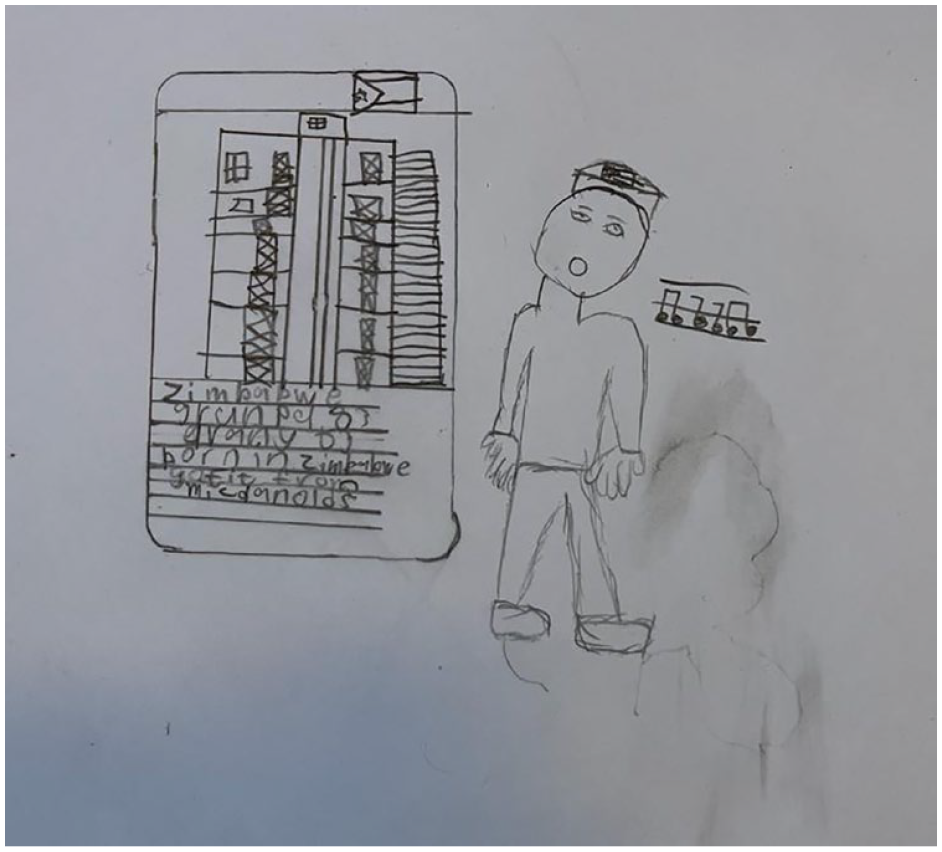
A Top Trumps card.
He drew a Zimbabwean flag in the top right corner representing a country which borders the north of South Africa, approximately two and a half thousand kilometres away. He then drew a very tall house, with multiple rooms. Underneath, in the style of the Top Trumps game, which always provides a number of categories on each card with numerical rating next to them, he first wrote ‘Zimbabwe’ and then began listing family members, with their age next to them in the place of the Top Trumps rating.
‘This is our house in Zimbabwe’, he said. ‘It is a proper house, not like the house we have here in Cape Town’. When asked what made it proper, he said that his grandparents lived there, and the walls were made of brick. He went on to draw a man next to the house, singing. ‘That is my Dad’, he said. ‘He is happy because he is in the yard in Zimbabwe.’
This drawing speaks to multiple themes: migration; family; and the ways in which the presence of extended family makes a home ‘proper’. The notion of personhood can be used as a means of understanding how individuals get socialised into becoming proper persons, recognising that the forms that proper personhood may take are not universal, but shift in different social contexts (Morreira, 2016). In much of the Southern African context, personhood is convivial and dividual, such that the extended family unit matters as much as does the individual in making ‘proper’ social life (Chekero and Morreira, 2020; Nyamnjoh, 2017). The drawing, and the child’s accompanying words, show that notions of convivial and shared personhood are already embedded in the ways in which this child imagined family.
Furthermore, the idea that a proper home is made of bricks reflects the realities of life in Zimbabwe versus that in urban South Africa, which reality belies the way in which most South Africans imagine Zimbabwe due to its current dire economic situation. In the South African imaginary, South Africa is a better place than Zimbabwe – while to many Zimbabweans, South Africa is a place to which they are forced to come in search of work, within which they live in worse conditions than they do in Zimbabwe, such as in tin shacks rather than brick houses. Having visited Zimbabwe, and seen for himself the life that his grandparents were able to live (most likely due to remittances from family members elsewhere), the child recognised and drew this discrepancy while also acknowledging the role of the material in making home.
An insight into children’s everyday lives
The research presented in this paper explored children’s sense of self, difference and migration through object elicitation. While the schools were located in different national contexts, there were striking similarities across the diversity of children in each setting, the objects and the stories that emerged from their working-with the objects. In each school, researchers and artists enabled children to move from describing their objects to thinking about their relationships with and connections between different objects in the classrooms. In England, the children developed visual stories about their objects that enabled them to describe the world through objects’ metaphorical ‘eyes’. This was unexpectedly extended by the children who developed poems told by their objects. In South Africa, the children created clay houses or hideaways for their objects which enabled stories about the objects’ needs and wants to emerge. It transpired that while the stories were about objects in both contexts, they reflected children’s worlds, authentic experiences, relationships and understandings of childhood.
In seeking to engage with fragments of data that illustrated unanticipated and curious encounters with the objects, three questions emerged for us: whose stories were told; what was the impact of the backdrop of the project taking place in a school setting; and what can children’s relationships with objects tell us about their lives in the context of migration? As a way of discussing the findings, we focus on each question.
Haraway’s (2019) questions ‘who owns stories, who has access to whose stories, who is safe enough to tell their stories’ guided our work as the stories that emerged were complex in the entanglement of children and objects. In a way, the stories, representing the ‘situated knowledges’ of both children and objects, were about the living histories of the children and their ‘companion species’ in the ‘contact zone’ of the classroom where human and more-than-human became entangled differently from ordinary practice (Haraway, 2008). Children developed particular, time and space bound stories, which focussed on the ordinary experiences of childhood. In working through prompts about their objects, children were able to illustrate their agency and lives through naming practices, agency and representation. The children quickly ‘got into character’ and started thinking about their environment through the eyes of their objects – seeing, hearing, doing, having their own life. This led to the crafting of new ways of knowing (Latto et al., 2022) and understandings of childhood in the context of more-than-human kinship. The stories as such belong to the children but they are co-produced with the objects. Enabling children to tell their stories meant that a safe environment was created for the stories to emerge and through the researchers they were broadcasted more widely. To us, this is an act of empowering the children to have their voices heard and their stories to make an impact on the world.
Carrying out the research in schools was informed by the practical consideration of where we find children. While schools are spaces for children, they are certainly not places that belong to children because of the inherent hierarchies and power dynamics between adults and children. Children’s engagement, behaviours and doings in schools are guided by teachers, the routines and academic focus of the school day (Reynolds, 2021). Asking children to bring objects into school was a way to somewhat disrupt routines in order to enable children to participate in child-centred ways. The focus on objects was deliberate because of the importance humans place on their belongings and their implicit roles in our lives. Bennett (2010: viii) argues for a ‘vitalist material reading’ of the objects we ‘find’ in the world. Miller (2010) goes further to suggest that objects are not always found, rather they ‘find’ us in their entanglements with our lives. In primary schools, objects are not usually afforded a vitalist materialist reading by most teachers. They are assessed in terms of their fit for expression of learning, for example, does an object enhance students’ learning in the narrow way learning is understood, and if not, it must be left outside, at home, thrown in the rubbish bin (Reynolds, 2021). By asking the children to bring special objects into school we disrupted such regular practices. This had a two-fold effect – children were empowered to share stories based on their personal belongings and lively conversations about similar objects were noted; and teachers acknowledged the importance of becoming familiar with children’s worlds outside of school, which in turn contributed to enriched learning opportunities and environments.
While children are constrained by family decision-making and school environments on the whole, through the project we focussed on their agency. Migration and its effects on the present could be seen in the conversations held around the objects, and in the drawings which spoke about movement and home as entangled. Children’s stories about and with their objects revealed the interconnected spaces of their everyday lives, including past, migration and present. Their belonging was actively produced (Ni Laoire et al., 2011) in the places and spaces discussed in their stories and through their more-than-human relations. Belonging is about origin, making and remaking home, kinship and stories about ordinary events.
Conclusion
In this paper we have considered ways in which children can construct narratives about their own lives through objects. We were particularly interested in what this might look like for children who had migrated, or whose families had migrated. The three vignettes we have drawn on were selected from a much wider range of data because of the themes they illustrate. Firstly, we have used the stories to show us what home might mean for children who have moved, and the ties – imagined or real – to another home in another geographical location. We have seen the ways in which we can unpack imaginaries of home and away through children’s relationships to the material. Secondly, we have shown how naming objects creates, connects and allows for a performance of self and relationality. In all this we have illustrated children’s agency, and in doing research that allows insight into children’s worlds. Thinking through migration and mobility through more-than-human relationships allowed us to explore children’s narratives that were both aware of past mobility but also firmly situated in the here-and-now. The shifting nature of the children’s narratives shows us that, for children, the here-and-now, is not fixed, but, like identity, in a constant process of becoming. As adults and researchers, we should not assume that the stories are complete, rather that they continue to change as children (re)tell their worlds at school and home.
Footnotes
Funding
The author(s) disclosed receipt of the following financial support for the research, authorship, and/or publication of this article: We thank the University of Huddersfield for the financial support from the International Collaboration Fund (ICF) awarded in January 2022.
