




Abstract
This study aims to provide a comprehensive understanding of belonging in early educational institutions based on key findings developed within the international project Politics of belonging: promoting children’s inclusion in educational settings across border (85644). The research questions are: What are the main empirical and theoretical contributions to the understanding of belonging in early childhood institutions? and What kinds of critical factors regarding belonging can be identified? This study applies Yuval-Davies’ theory about the politics of belonging. The data consists of key findings from 28 publications from the aforementioned project. Theoretically, the project provides a novel perspective regarding processes related to belonging in early educational institutions. Such processes involve transgressing, defending and defining borders dictating who is inside or outside these communities. Empirically, the project contributes knowledge about how belonging is performed in practice. Belonging manifests as a joint enterprise involving children, educators, parents and policymakers; it is also multifaceted and powerladen. This study delineates critical elements of children’s belonging. On a micro level, these elements require specific forms of agency amongst children and specific forms of responsibility amongst educators, which exert consequences on a macro level. The discussion concludes with five recommendations regarding policy and practice.
Introduction
This study derives from an international project concerning children’s (3–8 years) belonging in early educational institutions (ECE). 1 The project was initiated in 2018, 3 years after the ‘great migration’ to Europe, in a time of increasing diversity when questions about belonging appeared to be more important than ever. However, belonging in this project includes every child′s right to be valued equally regardless background, and is viewed as a political matter that is invariably tied to power and (in)equalities (Yuval-Davies, 2011).
The project was a collaboration between researchers from five universities in five countries: Finland, Iceland, The Netherlands, Norway and Sweden and both national and cross-national sub-projects were included. The aim of this study is to provide a comprehensive picture of the politics of belonging in early educational institutions 2 based on key findings developed within the project. The research questions in focus are: What are the main empirical and theoretical contributions to the understanding of belonging in early childhood institutions? and What kinds of critical factors for belonging can be identified?
Previous research
Curriculum can significantly support the role of educators in creating effective learning environments that provide young children opportunities for belonging, learning and caring (Einarsdottir et al., 2015; Piskur et al., 2019; Rayna and Laevers, 2011). However, in multicultural societies, governments may wish to create a skilled and knowledgeable workforce and prioritise shared values for building a sense of community in their curricula, while minority group families may be more concerned with transmitting native languages and customs to children. Therefore, curricula can contribute to balancing different expectations within the early childhood education context and to ensuring that the expectations and needs of different stakeholders are met (Siraj-Blatchford, 2010; Siraj-Blatchford and Woodhead, 2009).
Studies concerning children’s experiences of belonging have revealed that children’s sense of competence as group members can promote their positive attitudes towards their educational settings and contribute to their future social and academic success and their positive sense of identity as members of their communities (Allen and Bowles, 2012; Joerdens, 2014; Nutbrown and Clough, 2009). Belonging is important for all children, but research has demonstrated that experiencing belonging can be more difficult for children who differ from their peers in some way, such as in terms of culture, language or ethnicity (Guo and Dalli, 2016; Kalkman and Clark, 2017; Kernan, 2010; Sadownik, 2018).
Interactions with peers is important for children′s belonging (Boldermo, 2020; Juutinen et al., 2018), but the significance of educators in creating conditions for belonging has also been emphasised (Juutinen, 2018; Johansson, 2017), especially for children with diverse cultural and linguistic backgrounds (Arvola et al., 2017; Wang et al., 2019; Zachrisen, 2022). Furthermore, belonging has been found to be constructed not only through social relations but also through children’s relationships with their material environments in ECE (Juutinen, 2018). Thus, the physical environment can be a relevant factor of inclusion and exclusion in play situations both inside and outside of school settings (Moore and Lynch, 2018).
Studies have addressed educators’ crucial role in supporting children’s positive attitudes towards diversity and promoting their belonging (e.g. Harvey and Myint, 2014; Nutbrown and Clough, 2009; Purdue et al., 2009; Stratigos et al., 2014; Terhart and von Dewitz, 2018; Tillett and Wong, 2018). However, it has been noted that educators’ support tends to remain at the level of rhetoric (Phillips, 2010). For instance, studies have revealed that educators hold different understandings concerning belonging regardless of their worldwide centrality as curricular principles (Guo and Dalli, 2016; Tillett and Wong, 2018; Viljamaa and Takala, 2017). Research also suggest that educators’ knowledge regarding how children’s diverse linguistic and ethnic backgrounds influence their learning is limited (e.g. Acquah et al., 2016; Harvey and Myint, 2014) and that young children’s voices have been missing in the study of belonging in early years settings (Erwin et al., 2024). Therefore, the research calls for expanding and enhancing educators’ conceptualisations of belonging and paying attention to educators’ own sense of belonging (Purdue et al., 2009; Tillett and Wong, 2018).
In summary, research has suggested that belonging is a constant process involving ongoing negotiations between various stakeholders about who belongs and who does not. Therefore, the purpose of this paper is to contribute knowledge about belonging in relation to policy, theory and the perspectives of children, educators and parents.
Theoretical perspective
The concept of belonging has been problematised by several researchers, of whom one of the foremost-quoted researchers is Nira Yuval-Davies, specifically regarding her theory about the politics of belonging (Yuval-Davies, 2011). She developed her theory as a critique of the predominant perspective in previous research regarding the individual’s sense of belonging (Juutinen et al., 2018). The concept of politics directs attention towards structures and power relations in society and specific contexts, such as educational settings. Hence, belonging is more than an individual feeling; it is a relational and political issue with collective consequences (Yuval-Davies, 2006, 2011). A basic idea is that different collectives or groups always both produce and reproduce the borders dictating who belongs and who does not (Yuval-Daveis, 2011). In relation to this study, the aim is to uncover how politics of belonging operate in early childhood education contexts at both a micro and macro level with the purpose to identify critical aspects of importance for belonging processes in an ECE practice.
Yuval-Davies (2011) emphasises an intersectional approach when exploring belonging, arguing that belonging as a political phenomenon is both situated in time and space and multilayered. Such an approach concerns how situated knowledge and imagination construct varying means of seeing the world (Yuval-Davies, 2011). This situatedness affects how people both influence and become influenced by different social, economic and political projects (Stoetzler and Yuval-Davis, 2002). To be able to explore how belonging is constructed, Yuval-Davies (2011) differentiates between three interrelated analytical facets: (1) social locations and positionings which concern an individual’s belonging within particular categories, such as sex, age group, ethnic group, social class or nation, (2) human identifications and emotional attachments to various categories and groupings and (3) ethical and political value systems that accompany the ideologies, judgements and power related to categories and identifications. The different facets must be understood intersectionally and in relation to each other in terms of where they are situated and how they can be changed over time (Yuval-Davies, 2011). Collectively, these facets constitute the politics of belonging.
Methodology
The data consists of key findings from 28 publications from the project titled (name). For an overview of analysed publications, see Appendix A.
The analysis was carried out in different phases. First, the research consortium initiated a coding process with the purpose of identifying key findings in the different publications and manuscripts regarding the perspectives of educators, children and parents and within policies and theoretical concepts. This was a collective process of exploring various interpretations and patterning of meaning from the data. The coding process resulted in several initial codes that we all could agree upon. Thereafter, the codes were discussed in workshops with the purpose of further utilising particular meanings, similarities and differences within the dataset. From there, the analysis was continued by the authors of this paper.
In the next phase the codes formed the building blocks of the analysis that now shifted in focus from codes to themes, in the meaning that the codes now were clustered into potential themes (Braun and Clarke, 2022). A theme portrays important dimensions of the data in connection with research questions and the different perspectives of the study. For example, the themes included issues of dominance regarding language and ethnicity, belonging as an ad hoc enterprise in teachers’ work, children’s continuing border work as a political issue in defending their communities and parents’ concerns for their child’s belonging and their own sense of being marginalised. The analyses were performed in interrelated ways between the process of coding, developing codes and identifying themes. This was a to-and-fro process between the different analytical phases in the meaning that a first clustering of codes into a potential theme were further explored before it was settled as a theme (see Braun and Clarke, 2022: 79). Through this process we gradually turned more deeply towards the different themes, with the purpose of highlighting and synthesising (reconstruct) the empirical and theoretical findings of the project and identifying critical aspects of belonging and building a ‘comprehensive picture’. Thus, the data analysis has been a dialectical process balancing closeness and distance to the data, aiming to illuminate and sharpen the object of knowledge from the conducted research (Braun and Clarke, 2022).
Findings
The research questions focus on theoretical and empirical contributions of the project as well as critical aspects of belonging. The identified key findings are organised into two sections below: A political theory in the context of early education – a theoretical contribution, and A joint enterprise involving children, educators, parents and policymakers – an empirical contribution (Table 1). Thereafter follows a presentation of identified critical factors for children’s belonging in the context of early childhood education.
Identified findings: Overview.
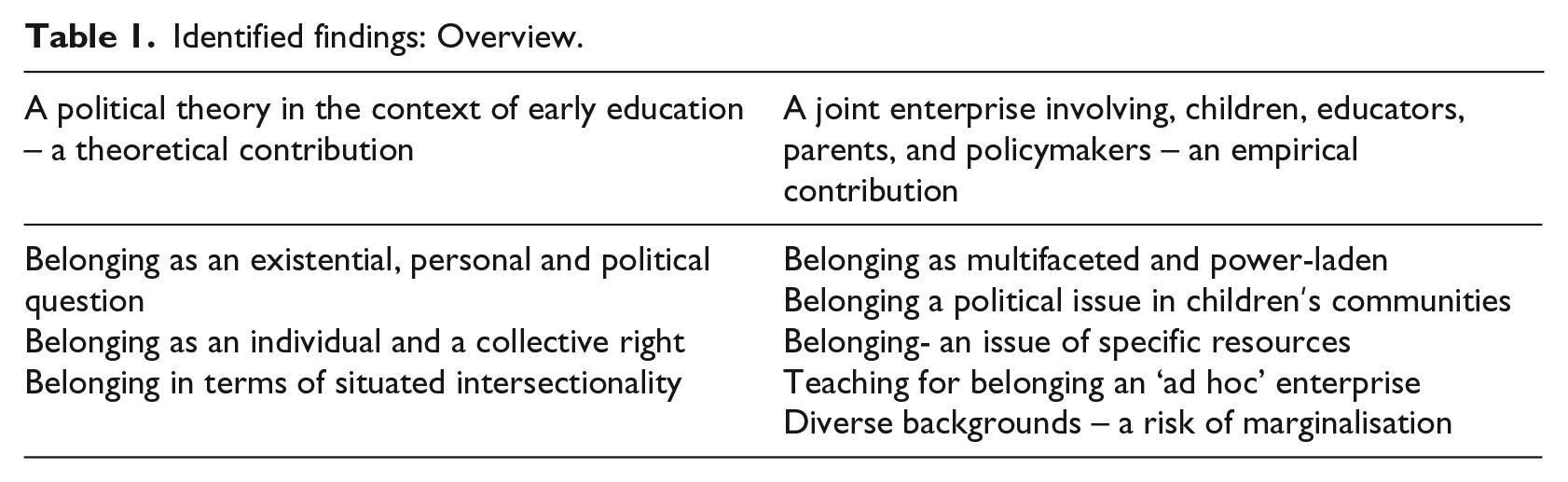
A political theory in the context of early education – a theoretical contribution
Based on the key findings, we suggest belonging in early education to be approached from multiple angles, presented below.
Belonging as an existential, personal, and political question
Belonging manifests as an existential, personal and a political matter, which provides a novel perspective regarding addressing children’s inclusion and exclusion in educational settings. Belonging starts from the existential and fundamental need to participate in continuing and inevitable emotional relationships with others. This refers to the desire to be part of a group, a community or a place (Emilson and Eek-Karlsson, 2022; Johansson and Rosell, 2021; Kess and Puroila, 2023; Kyrönlampi et al., 2021). On a personal level, the key findings reveal how everyday life in ECE institutions can be both an existential and political struggle regarding exclusions, rejections and humiliations. This is illustrated when children need to renounce values of importance to them to gain access to a specific community (Berge and Johansson, 2021; Einarsdottir and Ólafsdóttir, 2020; Emilson and Eek Karlsson, 2022; Johansson and Rosell, 2021). The political issue of belonging means for children to define, safeguard and defend a community of importance regardless of them being inside or outside. The key findings support these theoretical assumptions by demonstrating how children are prepared to restrain themselves and act against their own wishes to gain a place in the desired community. Children also appear to be prepared to defend their communities using various methods. Negotiations and power are important in this borderwork, and the intersection of dimensions such as social positions, emotional identifications with various communities and political and ethical values exert an impact on children’s belonging (e.g. Eidsvåg and Rosell, 2021; Einarsdottir et al., 2022; Emilson and Eek-Karlsson, 2022; Johansson, 2022; Johansson and Rosell, 2021). These findings refer to belonging as an existential, relational and political phenomenon rather than as a predominantly individual ability.
Belonging as an individual and a collective right
Belonging is also evident in the data as both an individual and a collective right, which often causes dilemmas for educators, parents and children (Berge and Johansson, 2021; Eek-Karlsson and Emilson, 2023; Eidsvåg, 2022; Johansson, 2022; Juutinen and Kess, 2019; Kess and Puroila, 2023; Puroila et al., 2023; Rosell, 2022). On the one hand, a prioritised expressed value is that all children, regardless of background, have the right to access different peer-communities. This was revealed in interviews (Ólafsdóttir and Einarsdottir, 2021) and surveys (Karlsudd, 2021a; Johansson et al., under evaluation). On the other hand, educators also describe children’s right to defend their play in a specific peer-community, which can lead to exclusions (Eek-Karlsson and Emilson, 2023). In the surveys, both educators and parents had high response rates for the notion ‘that all children have a right to be “as they are”’. (Johansson et al., under evaluation; also Einarsdottir and Rúnarsdóttir, 2022; Karlsudd, 2021a, 2022). Key findings from the study of national policy documents confirm this double right, albeit not truly addressing the dilemmas this may cause between individual and collective rights to belong (Piškur et al., 2022).
Belonging in terms of situated intersectionality
One theoretical contribution is the use of Yuval-Davies’ political theory in a context which has not been commonly addressed before, neither in a cross-cultural research context nor in research projects concerning inclusion in the early years educational institutions (Puroila et al., 2023). The project has demonstrated how very young children are involved in ongoing political work of protecting and accessing various communities.
Moreover, this theoretical approach has enabled an intersectional understanding of belonging processes and structures in early education settings. The use of intersectional analyses directed the attention towards social positions, emotional attachments and ethical and political values; these interrelated analytic lenses were fruitful for identifying complex processes of inclusion and exclusion, categorisations and positionings (e.g. Berge and Johansson, 2021; Eidsvåg and Rosell, 2021; Emilson and Eek-Karlsson, 2022; Johansson, 2022; Johansson and Rosell, 2021; Puroila et al., 2023). The analysis reveals that a situated intersectional understanding of belonging (Yuval-Davies, 2011) challenges the taken-for-granted views regarding including and excluding processes. The key findings illustrate how macro-level educational policies, meso-level organisational and institutional conditions and interactions at the micro level are intertwined in shaping children’s belonging (e.g. Juutinen and Kess, 2019; Piškur et al., 2022; Puroila et al., 2021; Berge and Johansson, 2021; Johansson et al., under evaluation). Many of the analyses build upon an intersectional understanding of interactions in early educational settings. Puroila et al. (2021), for example, analysed how children’s belonging is shaped in the intersections between educational policies (macro-level); organisational and institutional conditions (meso-level); and interactions in children’s everyday lives (micro-level) in Finland. The intersectional complexity of children’s belonging was highlighted – that is, how the multiple levels and interrelations operate in shaping children’s belonging and their unbelonging. Moreover, the researchers identified tensions that penetrate the various levels, thus forming crucial elements that shape children’s belonging: tensions between similarities and differences, majorities and minorities, continuity and change, authority and agency. Additionally, the study demonstrated how the language used, the practices enacted and positional power emerged as the resources through which children’s belonging was actively produced within and across the different levels of the educational system (Puroila et al., 2021).
Several key findings related to educators’ views regarding belonging in their practice have emerged from analyses of social positions, values and identifications (Berge and Johansson, 2021; Eek-Karlsson and Emilson, 2023; Fugelsnes, 2022; Johansson, 2022; Kess and Puroila, 2023; Puroila et al., 2021, 2023). These analyses have illustrated the complexities of the dimensions influencing educators’ role in categorising children according to their gender, age, ethnicity, appearance and needs. The educators largely took these categories for granted (Puroila et al., 2023). Approaching belonging as an intersectional enterprise appears to have pivotal consequences for research and educational practice. It also directs the attention of the study towards belonging as a political matter, raising questions about marginalisation, prioritised values and power. The intersectional analysis reveals children’s desire to defend their communities and determine who has a right to belong and who does not, as well as how positions and power influence such decisions and opportunities for belonging (Eidsvåg and Rosell, 2021; Emilson and Eek-Karlsson, 2022; Johansson and Rosell, 2021; Johansson, 2022; Juutinen and Kess, 2019).
A joint enterprise involving, children, educators, parents and policymakers – an empirical contribution
Based on the analysis, the empirical contribution appears to be multifaceted and concerns children′s communities. A significant contribution is related to different tensions framing children’s belonging. Several of the studies demonstrated how children’s belonging is an ongoing political process of protecting and accessing various communities. Power emerges as important in these processes. Generated themes are presented below.
Belonging as multifaceted and power-laden
To support children’s belonging, different views to converge is needed. Belonging, from the children’s perspectives, is strongly related to friendship, being surrounded by caring adults and being a member of the ECE community (Einarsdottir et al., 2022). However, the findings from the studies with the children indicate that values, language and ethnicity influence children’s access to various communities (e.g. Einarsdottir and Ólafsdóttir, 2020; Johansson, 2022; Juutinen et al., 2024; Ólafsdóttir and Einarsdottir, 2021; Zachrisen, 2022). Power emerges as important in these processes. Eidsvåg and Rosell (2021), for example, found children’s power to be contingent on the structural power of preschool. Children’s opportunities to position themselves and belong were both hindered and supported by their social group and their educators via relational and structural power. The call for educators is to become aware of these contradictory tendencies and to develop knowledge of how groups are formed via dynamic power relations that condition different social experiences, such as belonging.
Educators regarded language as the main cause of power inequality amongst the children (Johansson, 2022; Karlsudd, 2021a). Confidence in leadership and taking leadership initiatives bolstered their influence as well. The analyses reveal how educators encounter tensions in their daily interactions with children which also intersect with the entire educational system (Karlsudd, 2021b; Puroila et al., 2021). Karlsudd (2021b) demonstrated how a more structured, planned, group-oriented and inclusive individualisation can support the preschool’s mission to increase the sense of belonging amongst all preschool children. The planning appeared proactive and was primarily based on individual children’s strengths as opposed to preschool requirements and norms.
Belonging a political issue in children’s communities
The data provides support to establish that children’s belonging involves an ongoing political process of protecting and accessing various communities.
Based on the educators’ descriptions of children’s communities and interactions, similarities appeared to be central. Children’s similar backgrounds, personalities and interests were described as important for their communities and opportunities for belonging. The communities created by children could be based on friendship and collective identities as well as (similar) levels of cognition and a need for support. Moreover, the communities could be based on specific competences as well as conflicts, positions of power and adaptation. In addition, gender, and age as well as language and ethnicity and cultural backgrounds could also be foundations for communities (Berge and Johansson, 2019; Einarsdottir and Ólafsdóttir, 2020, 2023; Emilson and Eek-Karlsson, 2022; Johansson, 2022; Johansson and Rosell 2021; Puroila et al., 2021). This variety of communities places demands on children’s competences and could also cause tensions.
A Norwegian sub-study by Berge and Johansson (2021) demonstrated how children were sometimes placed in between family values and institutional values. This tension also caused dilemmas for the educators. Of particular importance was a community rooted in the majority culture. This taken-for-granted hegemonic community appears to be strongly based on institutional values rooted in the society’s majority culture (Berge and Johansson, 2021). Empirically, children and their families whose values differ from the dominant culture in the society were expected to adapt to the (pre)school’s values and practices (Berge and Johansson, 2021; Egilsson et al., 2021; Eidsvåg, 2022; Puroila et al., 2021).
The analysis also revealed that children’s linguistic preferences influence their communities. Both cultural backgrounds and language practices appear to be important for children’s participation in activities in their peer group and in terms of their choice of playmates (also Emilson and Eek-Karlsson, 2022; Ólafsdóttir and Einarsdottir, 2021). Children who were less proficient in the dominant language have been described as less likely to engage in play with children with dominant backgrounds. When the children described their playmates and best friends, they mentioned children with similar cultural backgrounds (Einarsdottir and Ólafsdóttir, 2020, 2023; Einarsdottir et al., 2022; Ólafsdóttir and Einarsdottir, 2021; Puroila et al., 2021). Johansson (2022), for example, illuminated how children’s desires to join communities were strong and a matter of their very existence.
Belonging- an issue of specific resources
The research project as a whole has provided rich insight into embedded ongoing belonging processes related to different kinds of communities in early childhood education. The findings highlight that the various communities require different resources, skills and agencies amongst children. In some communities, power processes and individual rights dominate communications; conversely, in other communities, friendships and collective identities appear to be at the forefront; furthermore, other communities are based on ethnicity and language. It has been suggested that children in their border work need various abilities to be able to negotiate. Moreover, they need access to power positions and must be familiar with the majority language and means of communicating in the community; they also need to be able to identify with and embrace the values aligned with the prevailing value system in the specific community. For some children, the desire to belong led them to adapt to the values and rules of the community even though they did not agree (Berge and Johansson, 2021; Eidsvåg and Rosell, 2021; Einarsdottir et al., 2022; Emilson and Eek-Karlsson, 2022; Johansson and Rosell, 2021; Johansson, 2022; Ólafsdóttir and Einarsdottir, 2021).
Another empirical contribution comprises tensions that frame children’s belonging; for instance, tensions between similarities and differences amongst children, majorities and minorities, continuity and change and agency and authority shape children’s (un)belonging (Puroila et al., 2021, also Einarsdottir et al., 2022). These tensions not only concern children’s daily interactions but also intersect with the entire educational system. For instance, a Finnish sub-study demonstrated how the national core curricula, while emphasising children’s equality, did not treat children as a homogenous group but rather categorised children based on their needs for support, their disabilities and their cultural backgrounds (Puroila et al., 2021).
Teaching for belonging – an ‘ad hoc’ enterprise
The study indicates a gap both in curricula and practice, wherein awareness of how to systematically create and implement ‘opportunity spaces’ for inclusion and belonging appears to be absent. Although analyses of teacher-child interactions in a Norwegian sub-study (Fugelsnes, 2022) revealed how educators in practice spontaneously create conditions for children’s belonging, our key findings confirm that educators often take children’s belonging for granted, and their educational work operates as an ad hoc enterprise, lacking intentional curricular goals (Berge and Johansson, 2021; Fugelsnes, 2022; Johansson, 2022; Karlsudd, 2021a; Puroila et al., 2023). Additionally, our analysis of the curricular guidelines reveals that belonging is barely mentioned and does not provide frameworks for promoting children’s belonging relevant to ECE and compulsory education (Piškur et al., 2022). In a broad sense, however, the surveys indicate satisfaction regarding belonging amongst the participants in the project (educators and parents). Nevertheless, educators and parents also express that they worry about whether educators excel in promoting all children’s belonging (Johansson et al., under evaluation; Karlsudd, 2022). According to Karlsudd (2022), both the staff and parents agreed that the obstacles hindering the creation of an inclusive preschool mainly related to staff skills and attitudes. The findings indicate that not all children and their families receive the support they need (Egilsson et al., 2021; Johansson et al., under evaluation; Karlsudd, 2021a; Puroila et al., 2021 Johansson). Parents and educators expressed concerns regarding whether the structures and resources of (pre)schools support all children’s belonging. Parents with non-dominant backgrounds were more likely to worry about their children’s exclusion in preschool because of their language and culture, and they wished for more support to ensure their children’s belonging in the group (Einarsdottir and Rúnarsdóttir, 2022; under evaluation). The educators also struggled with how to treat children equally and support children’s cultural and linguistic identities, especially in cases when the children had different backgrounds than the educators themselves (Kess and Puroila, 2023). The findings also highlighted a correlation between educators’ qualifications and pedagogical approaches directed towards children′s reasoning, judgement and collective insights regarding belonging (Johansson et al., under evaluation).
Diverse backgrounds – a risk of marginalisation
The data uncovers how parents of children from diverse backgrounds are often confronted by language barriers, both when receiving official correspondence from school authorities and in their interactions with other families. Furthermore, educational practices and student assessment frameworks are sometimes perceived as inadequate and unreflective of their children’s academic standing, and educators and administrators are too often reported as being unresponsive to the parents’ concerns (Egilsson et al., 2021, 2022; Eidsvåg, 2022).
The findings from the Islandic survey indicated that parents with foreign backgrounds were less likely than others to report that they were able to influence the preschool practices, and they had less confidence when presenting their views about the preschool. Despite that, the findings illustrate that the parents chose to adapt to the practices of the preschool and the children were expected to do the same. The parents trusted the educators to support their children’s belonging (Einarsdottir and Rúnarsdóttir, 2022). Educators assessed that it is easier to feel a sense of belonging within the preschool activities if the parents have roots in the dominant culture. Language and social status were the factors that were considered to be the ‘most frequent’ reasons why children exclude other children (Karlsudd, 2022).
A Finnish sub-study revealed that a tension between majorities and minorities framed children’s belonging in educational settings (Puroila et al., 2021). It appeared that local authorities have substantial power to determine how education for diverse linguistic and cultural groups is implemented, which emphasises municipalities’ crucial role in shaping children’s belonging. In ECE settings, there were practices for supporting children and families with minority backgrounds in their own language and culture. For example, children had the right to spend additional time in ‘preparatory pre-primary education’, and interpreters were available in contacts with parents. Anyway, the educational settings provided children with a social, material, and cultural environment that was dominated by the Finnish language and cultural habits.
A Norwegian sub-study (Eidsvåg, 2022) explored preschool as a public institution and its impact on migrant children’s and parents’ experiences of belonging in their neighbourhoods. The findings indicated that parenting events supported parents’ acquaintances outside the institutional context as well. However, these events did not occur frequently. In addition, the children’s communities in kindergarten influenced their communities in the private sphere as well as their parents’ opportunities to become acquainted with other parents. According to Eidsvåg, kindergarten can strengthen these ties by offering parents insights into belonging processes amongst the children and into how families’ sense of belonging to local communities can be strengthened.
Critical factors for children’s belonging
Based on the presentation of the key findings above, we have outlined the critical factors to ensure children’s belonging in the context of early childhood education. On a micro level, these aspects comprise both specific forms of agency amongst the children and specific forms of responsibility amongst the educators, which in turn will have consequences on a macro level.
Specific forms of agency amongst the children are necessary in terms of opportunities to do the following:
➨ Recognise different communities, their boundaries and necessary skills
➨ Know the current language and means of communicating in different communities
➨ Utilise their communicative resources to create and strengthen their communities
➨ Ensure access to highly valued, powerful and adaptable positions in the peer group
➨ Argue for and present ideas that are perceived as attractive to peers
➨ Accept (incorporate and challenge) current values and norms in the specific community
Specific forms of responsibility amongst the educators are necessary to do the following:
➨ Identify and critically examine the positions, identifications and boundaries of belonging that are negotiated and (re)created amongst children in different communities and the assumptions and values behind these
➨ Turn the gaze towards the values, categorisations and identifications and what is taken for granted
➨ Develop a pedagogy that challenges the children to explore positions, identities and values that are communicated in the preschool and in different communities
The following implications are present on a macro level and in educational institutions:
➨ Belonging is often taken for granted and must be regarded as a core value in the educational system. There is a need for an explicit framework supporting children’s belonging.
➨ Children’s belonging is a neglected area in teacher education. This necessitates professional training to provide educators with competence in promoting children’s belonging.
Concluding discussion
In this study, we aimed to present a comprehensive picture of the politics of belonging in early educational institutions based on key findings developed within an international project (number). The advantage of this type of study is that it explores belonging from a meta-perspective. We have investigated studies based on various methodologies, levels, and questions, all addressing political and interactional processes for belonging in early educational institutions. This ensures validity in the construction of knowledge about belonging, but it could also produce disadvantages, such as those related to coding and analyses, which can differ between the studies. The same theory has served as a point of departure for the project, imbuing strength and depth in the findings but also potentially reducing various perspectives to meet. The challenge for researchers is therefore to be aware of the possible bias this type of study may induce and to consider diverse interpretations.
The politics of belonging that emerged from the study appear to be built upon tenuous foundations. This is a neglected area in both teaching and curricula, in spite of previous research highlighted the importance of how curricula can significantly support educators in providing environments that support opportunities for belonging (e.g. Rayna and Laevers, 2011). To better support educational work with children’s belonging curriculum guidelines need to be imbued of belonging in different ways. Based on this study we suggest that belonging should be expressed as a human right in the curriculum. That means to ontologically understand belonging as a fundamental value for human beings. Furthermore, we suggest that the importance of multiliteracy and language as well as involvement in activities related to a child’s environment and cultural heritage should be stressed in the curriculum to better support teachers in their work with children’s belonging. Teaching methods need to be highlighted with regard for encouraging values such as inclusion, diversity, and solidarity to be able to support children’s relationships and sense of belonging. Furthermore, acknowledging the diversity of languages and reflecting on positive attitudes towards equity and equality also appear to be essential principles with teaching practices to promote belonging.
Similarity appears to be a significant prerequisite for children’s constructions of their communities; this causes challenges for educators. Our study has demonstrated that similarity, as the foundation for children’s communities and belonging, is taken for granted by educators (and children). The idea of similarity appears to create a binary paradox wherein diversity runs a risk of becoming a problem rather than an advantage. This contrasts with our analyses of curricula and educator interviews, where diversity is highly valued (at least on a rhetorical level). Preschool is part of a pluralistic society in which diversity is a value and a matter of fact. The call for the educators is to relate to both similarities and differences without allowing one to dominate the other. Previous research has suggested that experiences of belonging can be more difficult for children who differ from their peers in some manner (Kernan, 2010; Sadownik, 2018). This is supported by our study, wherein educators describe language and social status as frequent reasons why children exclude other children. Our findings add to this picture the multiple and complex skills children need to gain access to communities and experiences of belonging. Children with less influential positions, such as those who lack power, are less likely to join and influence communities. The strong desire to join communities could lead children to embrace adaptation even in conflict with their own ideas and preferences. This calls for educators to focus on children’s various resources and to consider differences as a positive contribution. Both similarities and differences may be dialectical aspects that are relevant when fostering belonging in early childhood education.
The study confirms previous research (e.g. Harvey and Myint, 2014; Tillett and Wong, 2018) indicating that educators’ knowledge about belonging processes is limited and that teaching to promote belonging runs a risk of becoming an ad hoc enterprise. Thus, belonging is not regarded as a core value in education (curricula); rather, it is often (un)defined. We argue that belonging should be regarded as an existential matter and a personal right for all children. To highlight belonging is not only a call to politicians but also to teacher educators to make belonging visible as a content in teacher education programmes.
Based on the conducted study we stress the need for well-defined curricular guidelines to promote belonging on macro, meso and micro levels; this confirms previous research arguing for the importance of national curricular guidelines (Peers, 2020).
This in turn connects to the significance of local authorities responsible for crucial decisions concerning inclusive education, resources, and local curricula. Politicians and decision-makers are responsible for the conditions relevant to children’s belonging. To support children’s belonging in policy and practice, we have developed the following recommendations based on our findings (see Figure 1):
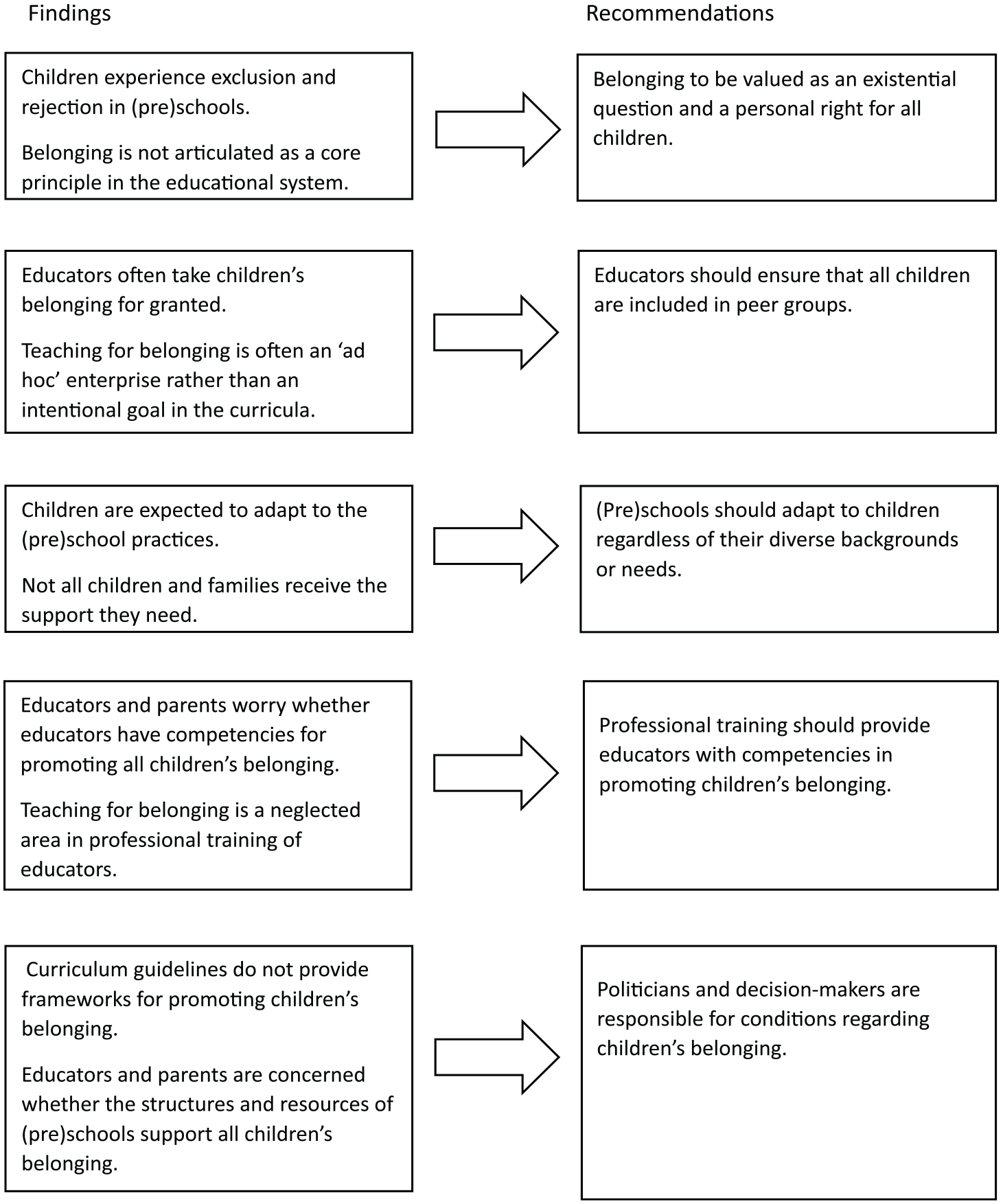
Recommendations for policy and practice based on findings.
Footnotes
Appendix A
Acknowledgements
The authors would like to acknowledge NordForsk and the support we have received during the project.
Declaration of conflicting interests
The author(s) declared no potential conflicts of interest with respect to the research, authorship, and/or publication of this article.
Funding
The author(s) disclosed receipt of the following financial support for the research, authorship, and/or publication of this article: The study is part of the research project ‘Politics of belonging: Promoting children’s inclusion in educational settings across borders’, funded by NordForsk research program ‘Education for Tomorrow’ (project number 85644).
Ethical approval
Each participating university followed national and international ethical guidelines and principals for research within human and social sciences. All participating universities have been reviewed and approved by their national ethical boards. The text is original and has not been published or submitted elsewhere.
