




Abstract
What leads young people to disengage and leave school early? This paper focuses on young adults’ educational trajectories, with the objective of identifying useful insights for improving school measures and strategies against early school leaving and school disengagement. Specifically, it draws upon an empirical study with young adults from the north of Portugal. Longitudinal bio-interviews took place with young men and women, aged 17 to 24, who were enrolled in secondary education at mainstream schools or in alternative learning contexts or who were early school leavers. A set of critical moments and circumstances were identified as turning points in the young adults’ descriptions of their school trajectories, revealing both obstacles and incentives to continue studying. Based on these narratives, the study identifies some risk and protective factors for early school leaving and makes suggestions about how to improve school-based measures to prevent school disengagement. Some key recommendations for schools include: increased support mechanisms during educational transitions; a firm stance on bullying and the creation of violence-free and secure learning environments; enhancing socio-emotional support and encouraging the emergence of relationships of care; and providing meaningful education by ensuring the school content is aligned with students’ motivations and needs.
Introduction
Education is a human right and one of the most important factors for success in life. Having an educational level of upper secondary or higher has been shown to increase opportunities in the labour market and, consequently, in life as a whole (Beekhoven and Dekkers, 2005; D’Angelo and Kaye, 2018). As Clycq et al. (2015: 7) noticed, ‘in a so-called European knowledge society, knowledge is constructed as one of the most valuable features to achieve’, which can break the ‘intergenerational vicious circle’ of poverty (Commission of the European Communities, 2001: 39). Concerns about the individual and social consequences for those who are not in the educational system, or those who have left it before achieving the essential knowledge and skills for full participation in society, have therefore been at the heart of recent European political debates (Gillies and Mifsud, 2016; Lamb et al., 2011; Van Praag et al., 2017). The need to effectively address educational inequalities and the processes of school disengagement has become a public priority (Alexander et al., 2001; Álvares and Calado, 2014; European Commission, 2013; Eurydice, 2014; Nada et al., 2018).
The discussions have encompassed topics from the very concept of early school leaving and its extension to early leaving from education and training, including the diversity of other pedagogical offers, to models of vocational pathways and compulsory school age. In relation to tracking students into vocational pathways, it seems that late school tracking aids students to remain in school for longer and have more opportunities; while early tracking may result in a larger concentration of children with learning problems in the same classroom (Crul and Keskiner, 2017). Regarding the extension of the compulsory school-leaving age, pros and cons have also been identified. Setting it as low as 15 years old often pushes disengaged young people out of school before they reach the early school leaving threshold, as defined by the EU (ISCED 3). 1 On the other hand, the educational systems that do not allow students to leave school before they reach 18 years old frequently face greater challenges in dealing with unmotivated students.
Furthermore, debates about the way school is organised to prepare students to face the uncertainties of the labour market and the new skills agendas have generated new trends in education. In line with the idea that ‘early school leaving in the EU is primarily a symptom of traditional education systems’ difficulties to adapt to changing societal dynamics resulting from shifting social and economic contexts’ (Van Praag et al., 2018: 1; see also Araújo et al., 2018), a set of educational and social measures for prevention, intervention and compensation is being implemented to support students, teachers and schools (European Commission, 2014).
As a result, early school leaving among young adults between 18 and 24 years old, who did not attain upper secondary education (ISCED 3) or equivalent, has become one of the EU’s most significant educational benchmarks. More than a mere statistical indicator, early school leaving emerges as a political concept shaped by various drivers and rationales (Macedo et al., 2015; Magalhães et al., 2015) that depend on the political and social context where they are produced (Dale, 2010). This is evident in view of the significant decrease in early school leaving in some countries, such as Portugal, which has managed to reduce the early school leaving rate from 44.2% in 2001 to 11.8% in 2018 (Eurostat, 2020). This improvement is owed to the growing investment in education and comprehensive long-term reforms. The milestone was the extension of compulsory schooling up to the age of 18 in 2009 and the implementation, thereafter, of a set of educational policies and pedagogical and curriculum measures concerned with young adults’ wellbeing and learning, especially from 2015 onwards. Greater flexibility and autonomy for schools around curriculum content, organisation, schedules and pedagogical practices, and the promotion of national strategies for citizenship and inclusive education are approaches that have come to shape the current educational agenda and policies to combat school disengagement.
However, less attention has been paid to the way in which the effectiveness of these measures is largely dependent on young adults’ participation (Crul and Keskiner, 2017; Nada et al., 2018), even though the value of listening to young adults’ voices about their school experiences has been emphasised in past decades (Fielding and Bragg, 2003). Following a Bernsteinian line of thought, Arnot et al. (2004) propose the concept of voice, built on emancipatory critical traditions, which recognises young people as key stakeholders in education, and emphasises the need to incorporate their voices in the analysis of their life contexts. Some aspects of this emphasis become clear in the debates that highlight the need to (a) include young people’s voices in the agenda and recognise them as key stakeholders (Angus, 2006); (b) build a system of confidence (Cook-Sather, 2002); and (c) have effective mechanisms of consultation and participation that encourage students ‘to see themselves as members of a learning community or, indeed, a learning society’ (Flutter and Rudduck, 2004: 21).
The current paper is informed by the view that ‘young adults’ trajectories are often only briefly touched upon in research and policy’ (Van Praag et al., 2018: 136) and by an awareness of the lack of ‘[. . .] high quality studies of dropout prevention measures or intervention’ (De Witte et al., 2013: 15). With these concerns in mind, this paper provides insights for educational institutions to help rethink their preventative actions towards school disengagement. The key research objectives are the following:
Understand how particular events and turning points in students
Provide suggestions on how to develop better school-based measures against early school leaving.
To answer these questions, the paper is based on young adults’ descriptions of moments and circumstances that may have constituted protective and risk factors for leaving school. Their experiences are then interpreted with the objective of providing schools with insights for rethinking the way they deal with school disengagement, and with the many and varied ups and downs that shape youth trajectories.
Fight or flight? Critical descriptions of early school leaving processes
Early school leaving is a gradual process (Janosz et al., 2008) and not an instantaneous decision (Christenson and Thurlow, 2004). For this reason, there is a need to understand educational trajectories in the interplay between individual, institutional and systemic factors. Previous research on educational trajectories has studied young adults’ relationship to education, but ‘few sources explore the processes occurring in school [. . .] as factors that are likely to affect dropout’ (Magen-Nagar and Shachar, 2017: 9; see also Furlong, 2013). This paper focuses particularly on the challenges lived by some young adults inside school, as a basis for important insights in understanding what actions institutions could take in order to work towards reducing disengagement (Ecker-Lyster and Niileksela, 2016; see also Abrantes et al., 2013; Silva and Abrantes, 2017). Going beyond the association of early school leaving with individual and intrinsic factors (such as gender, social class, parental education, etc.), or its portrayal as ‘a natural process’ in some families (De Witte et al., 2013: 15), this research suggests that institutional conditions and the processes experienced at school level emerge as extremely relevant. The first difficulty in analysing educational trajectories is to determine when a person should be considered an early school leaver or at risk of early school leaving. This relates to the complexity of early school leaving as an outcome of long processes of failure at school, truancy and disengagement marked by critical circumstances and moments that shape young adults’ perspectives, feelings and decisions.
In this paper, we use the expression critical descriptions to refer to young adults’ descriptions of specific unpredicted and critical moments lived at different points throughout their educational trajectories. These descriptions constitute starting points for understanding young adults’ experiences and we use them to provide suggestions for school change. By critical moments we do not refer to instantaneous decisions (Halse et al., 2017) but ‘unplanned, unanticipated and uncontrolled’ (Webster and Mertova, 2007; cit. in Halse et al., 2017: para. 8) events that assume particular significance for the individual involved. This research subscribes to the view that critical moments are characterised by changes that alter ‘the meaning structures of a life and ways of being in the world’ (Denzin, 1989; cit. in Halse et al., 2017: para. 8). Studying this impact on lives allows us to question what might have happened if the moment, and especially the way in which the school reacted to it, had been different. Several scholars have acknowledged the importance of critical moments for understanding individual trajectories. For instance, Boutinet (1989) speaks about ‘limit situations’ and Mezirow (1990) about ‘disorienting dilemmas’, whilst Giddens (1991) refers to ‘fateful moments’ in which individuals find themselves at a crossroads. Such moments have the potential to modify long-established routines and to disturb individuals’ ontological security, a feeling that carries individuals ‘through transitions, crises and circumstances of high risk’ (Giddens, 1991: 38). Considering the challenges that many young people experience inside schools throughout their educational trajectories, the identification of such moments by means of young adults’ critical descriptions may provide insights both into how institutions and educational practitioners can support students to go through such destabilising moments without leaving education, and on how these same situations may be avoided.
As we will see in young adults’ critical descriptions, when confronted with critical moments, individuals can react differently and choose between ‘fight’ or ‘flight’ reactions (McCroskey and Richmond, 1990: 29). In the present analysis, this decision may refer to the decision to stay at (fight) or leave (flight) school. Critical descriptions can be very relevant in analysing early school leaving processes, since the way in which students will react to different critical moments scattered throughout their educational trajectories will also depend on the institutional support they receive (Santos et al., 2018). In other words, school-based measures that take into consideration young adults’ critical descriptions of their educational trajectories can make the difference between ‘fight’ and ‘flight’, by providing students with more appropriate ways to overcome educational, social or personal challenges and continue in education.
Methodological approach and the context of the research
This article builds upon a part of the Portuguese data of the large-scale European research project RESL.eu, 2 which explores the mechanisms and processes that may lead young adults to leave school or training too early. Specifically, it sheds light on the trajectories of 12 young adults, aged 17–24, from three distinct groups: (a) those who left mainstream secondary education early and were not in education or training; (b) those who were still in mainstream secondary education but were labelled as being at risk of early school leaving; and (c) those who left mainstream secondary education early and were in alternative educational institutions, seeking to obtain an educational qualification. The ones who were still studying were enrolled in the institutions where the Portuguese data collection of the project was conducted: four public upper secondary schools and four alternative educational institutions in an urban area. Students considered at risk of early school leaving were categorised as such based on the following indicators: school engagement and school support, as well as students’ socio-economic status (based on parents’ qualifications and occupational status). The mainstream schools were selected for having low exam pass rates and being in areas of the city deemed a priority for social intervention. Regarding the four alternative educational settings, the selection was based on recognition of their work in the field of early school leaving. The rationale behind this selection relates to our intention to explore institutional measures implemented in diverse settings and to understand how different institutions deal with the issue of school disengagement and early school leaving.
In view of the complexity of the underlying processes that lead to early school leaving and school (dis)engagement, a qualitative approach was deemed more appropriate, owing to its potential to interpret the complex meanings and dimensions which young adults attach to their educational trajectories. Moreover, studies of this topic using predominately qualitative data are in short supply (De Witte et al., 2013). Even though wide generalisations are not the objective of this study, there are lessons to be learnt about young adults’ individual educational trajectories that may be relevant for institutions and professionals and their approach to young people in similar circumstances. The RESL.eu project, as a whole, conducted interviews with the same script in different countries and school contexts, revealing commonalities among young adults in a European context, which indicate that their lives are being informed by similar processes and challenges, as a generational trend. Despite the common aspects, the uniqueness of the subjects (Bernstein, 1996) is emphasised. This means that, despite being subject to the same type of constraints and opportunities, young people interpret and experience them in diverse ways. Thus, this paper is based on 24 bio-interviews conducted longitudinally, two with each young adult. The interviews occurred within a timeframe of approximately two years between the first and the second. This methodological choice allowed us to obtain a broader picture of students’ complex educational trajectories and their motivations, reaching a more in-depth understanding of the interplay of diverse (school) factors that may result in the decision to leave education. In addition, meeting with the research participants more than once allowed us to develop a deeper relationship with them and better understand the intricacies of their intricate lives, marked by numerous challenges and struggles.
Because this is an in-depth qualitative inquiry, our analytical strategy was structured in accordance with the need to make sense of the extensive amounts of data that resulted from the 24 bio-interviews. As observed by Webster and Mertova (2007: 114):
[C]ollection of data can easily lead to the collection of extensive amounts of data. Their transcription and subsequent analysis by current qualitative tools tend to encourage a narrowing view of the data and do not allow the story to evolve or identify those events that are critical.
To avoid such reductive views, the analytical strategy considered students’ educational trajectories as a whole, aware that different critical events in students’ lives may gain particular relevance if analysed in the context of their individual trajectories. In other words, we sought to look at each critical description individually, and organise the ‘sequence of events into a whole so that the significance of each event can be understood through its relation to that whole’ (Elliott, 2005: 3), and hence placed against the background of young people’s wider educational trajectories. This analytical strategy rendered visible the way their accounts were structured as ‘a vocabulary of motive’ (Plummer, 2001: 159), capable of providing relevant insights into the needs and challenges that young people face in their relationship to education.
Consequently, by listening to young adults’ critical descriptions about their educational trajectories, the analysis sought to identify a set of critical moments and situations that account for the tremendous complexity that characterises the processes of school disengagement and early school leaving. These were identified by means of a ‘holistic-form-based mode of analysis’ (Lieblich et al., 1998: 13), as mentioned previously, leading to an understanding of the events, and the meanings attached to them, in the wider context of each young participant’s educational trajectory. Some similarities in these trajectories allow us to rethink the wider conditions of students’ learning pathways and the educational experiences provided by institutions. Even though individual interviews might not provide the grounds for traditional quantitative generalisations, they can provide unique insights to inform the development of more appropriate measures to combat early school leaving and avoid school disengagement. In line with Plummer (2001), rather than looking for explanations or generalisations, the main aim of this approach is to provide rich understandings.
The appropriateness of using qualitative research to provide insights into institutional measures certainly relates to our epistemological assumptions, according to which the ultimate objective is not to generalise findings to wider populations, but to ‘hear individual accounts’ and understand what they ‘may reveal about wider social, cultural and historical’ issues, as explained by Trahar (2014: 221). Another point is that measuring the capacity of qualitative research for making wider generalisations may end up in ‘the epistemological negation of subjectivity’ (Ferrarotti, 2003: 59), inexorably erasing the meanings that young people construct throughout their biographical accounts.
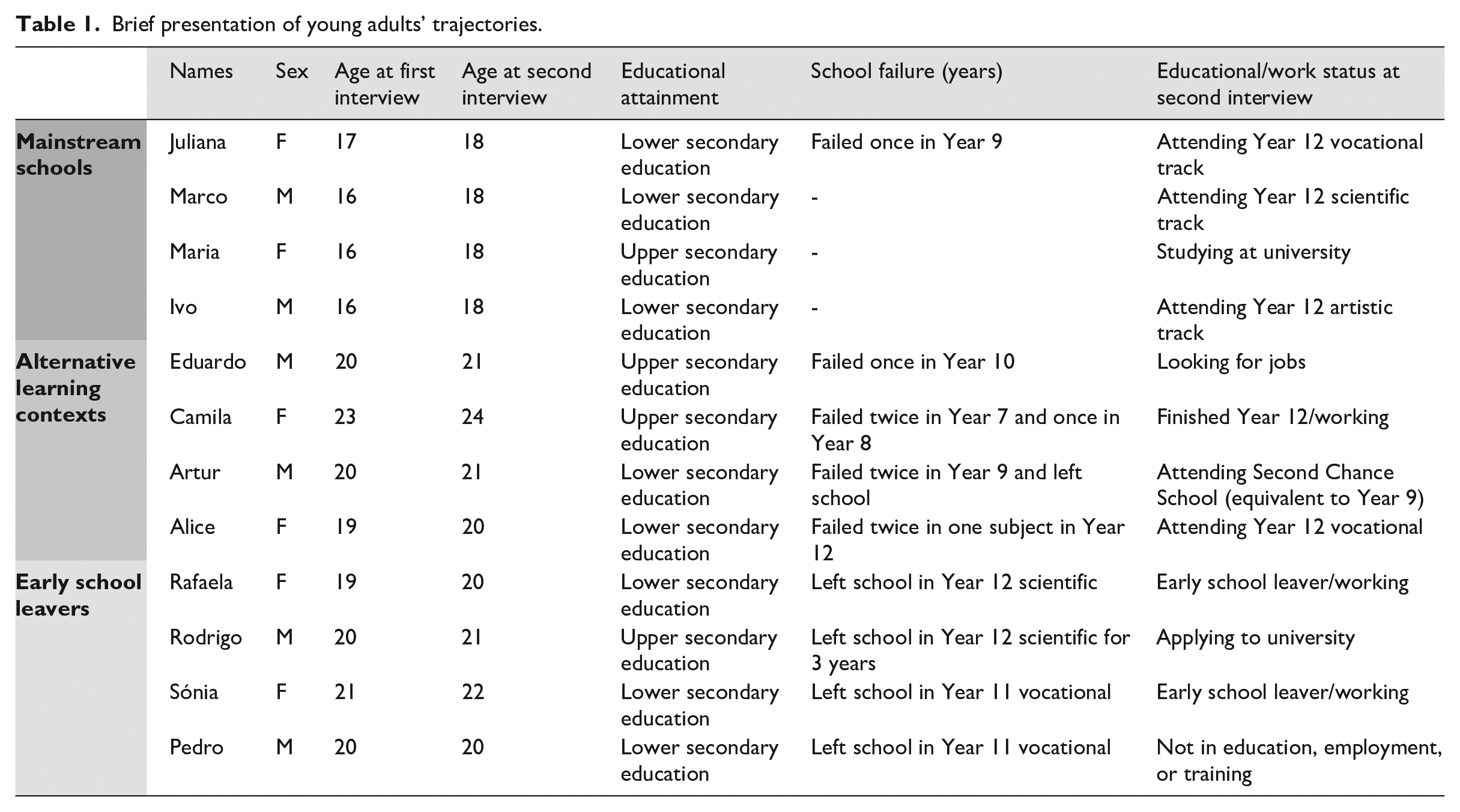
Table 1 in the following provides a brief presentation of the participants of this study. The 12 stories selected for this paper give accounts of a significant variety of educational experiences in different settings. Moreover, the selection of the same number of participants by gender per context aimed at ensuring the participant set is gender-balanced. There are six young men and six young women, including four who were studying in mainstream schools, four who had returned to education through alternative educational offers after leaving school, and four who had left school without completing compulsory education (ISCED 3). The latter group left school in the course of the research and were identified through a follow-up survey.
Brief presentation of young adults’ trajectories.
All face-to-face semi-structured bio-interviews took place within educational settings, except for those with early school leavers, whose interviews were conducted and recorded in public spaces (parks, gardens, train stations), at their convenience. Confidentiality and anonymity were ensured by using pseudonyms, and a consent form was used (Silva, 2013). Data analysis resulted in the identification of two main categories of findings about (a) challenges and (b) motivations to remain in education.
Educational trajectories: challenges and motivations to stay in school
A starting point for understanding early school leaving is to identify students’ needs and educational trajectories. In this sense, we start our analysis by presenting a set of critical descriptions, identified by young people, that give an account of their needs and struggles. Bringing the perspectives of those involved is of crucial interest to deepening our understanding of how young people experience processes of school disengagement. The collected accounts relate to their school experiences, which are depicted either as obstacles or as incentives to continue studying and, sometimes, culminated in turning points (Santos et al., 2018). Some were common to more than one participant; others were specific to one particular trajectory. As shown by Table 1, for instance, previous experiences of failure at school are common for those who are currently enrolled in alternative learning contexts. Another noticeable commonality is that all of the early school leavers interviewed had left school close to the end of upper secondary school.
To facilitate understanding, the critical moments experienced at school are gathered into several dimensions that are linked with three distinct levels: the conditions and resources each school is able to provide, the pedagogical processes and the development of relationships.
➢The adversity of school transitions: ‘the transition year was very confusing’
One critical moment that emerged from many students’ critical descriptions of their trajectories relates to transitions between educational cycles and/or schools. As shown in the following interview excerpt, such transitions are often perceived as particularly difficult and can negatively affect students’ wellbeing at school and, consequently, school results.
I was the best in primary school, then I went to the 5th grade and my grades dropped. It’s very different. Before, it was a smaller school, with people I already knew. In the 5th grade the school was bigger, I had more freedom, there were many disciplines, many books. . . I got lost. The shift was very confusing to me. Many children get lost. (Juliana)
Transitions between schools and cycles have long been identified as turning points in students’ trajectories. Moving to another school, a new building, a different organisation and curricula, meeting new colleagues and dealing with different teachers is pointed out as one of the biggest ‘silent’ problems that students face (Abrantes et al., 2013). As Juliana mentioned, leaving the ‘comfort zone’ behind and moving to the unknown may raise many challenges, insecurities and expectations for young people. In particular, the transition from primary school to lower secondary education emerges as an important milestone in students’ passage through compulsory education. As with other participants, Juliana’s educational trajectory was powerfully marked by the way these transitions developed. According to her, it was in those moments that her issues of truancy and academic failure at school started to develop.
➢Facing violence and bullying: ‘the school environment is horrible’
The impact of bullying was also highlighted as a cause of significant changes in young adults’ lives and school trajectories. The following critical descriptions show how difficult it was for these young people to cope with an oppressive environment.
I hate school. It’s hard for me to be inside it. The school environment is horrible. They started calling me names. (Rodrigo) I went through a rough phase because I was really teased. I began to wear braces, to wear glasses, I had lots of pimples on my face. I was the ugly duckling. It was very bad! (Juliana)
Frustration with bullying seemed to be a constant issue in the trajectories of most of the young adults interviewed, especially among early school leavers. In addition, Rodrigo and Juliana indicated that such moments had a tremendous impact on their wellbeing and willingness to stay in school. Many referred to these moments as crises and turning points. In reaction, feeling unsafe and alone led many of them to become aggressors themselves. This was the case of Juliana who, after years of being a target of bullying, became aggressive herself:
I was nervous. I couldn’t be there. [. . .] I couldn’t stand someone looking at me with a mocking expression. I exploded and reacted violently. [. . .] I felt really explosive. . . and I couldn’t keep anything to myself! The school support was almost none! So I did community service almost every month. (Juliana)
Another trajectory of dropout marked by bullying was brought by Pedro. He used to live in a care home, whose students experienced a sense of ‘collective victimization’ (Foody et al., 2017) as they felt they were discriminated against. As result, they became the most aggressive group in school, and everyone was afraid of them, which led to Pedro’s initial suspension and then expulsion from lower secondary school:
People from older year groups ran away from us. [. . . .] I was suspended. (Pedro)
The analysed trajectories suggest that not only being bullied, but also becoming a bully, affects school engagement in negative ways and can eventually lead to early school leaving.
➢Disconnection between school and day-to-day life: ‘school has a lot of unnecessary things’
Some students expressed the view that knowledge and competences acquired in school are somehow disconnected from ‘real life’. Practical knowledge seems to be preferred over more theoretical education. This describes another critical description observed in students’ trajectories, when they acquire a certain perception of uselessness of their education. The analysis of students’ trajectories also shows that such feelings regarding the value of education end up negatively affecting their willingness to stay in school.
Regarding the educational system, I think it has a lot of unnecessary things, many things [that] don’t make sense, which potentially we will never use in our future lives. (Ivo) To tell you the truth, it wasn’t really what I expected. When I got there [artistic school], it was completely different. I began feeling a bit discouraged because [in that school] they didn’t give much value to practical work. (Pedro)
Both Ivo and Pedro, together with other young adults interviewed, reported moments in which they felt that the knowledge they were expected to acquire was disconnected from their day-to-day realities. Teaching methods and pedagogical practices were also mentioned, in the sense that there seemed to be a gap between the way they would like to learn and the actual teaching methods. As a result, they felt disconnected from school life and they did not recognise it as a context of meaningful education or useful development.
Most interviewees indicated the excessive emphasis on academic achievement, the repetition of content and the transmissive classes as huge obstacles to their engagement with school. For instance, in the case of Pedro, the discrepancy between his expectations and the school reality was central in his decision to leave education.
➢Dealing with recurrent failure at school: ‘I got to a point that I said: I just can’t do it!’
Repeated failure at school appeared to have a considerable impact on young adults’ educational trajectories, bringing a sense of hopelessness and another stimulus to give up:
I got to the 12th grade and my problem was maths. I took the exam and failed. I spent a whole year just studying. I got to the exam and I didn’t pass. In the second phase I had a very low grade indeed. . . [. . .] When you have poor grades and start not managing to do it, you get to a point that you say: ‘I just can’t do it’ and drop out. [. . .] Sometimes our abilities are simply not enough. (Alice)
Alice’s problems with maths and her recurrent exam failures constituted critical moments that strongly affected her decision to leave school. She grew angry and started to develop very negative views about her own capabilities and, consequently, experienced a loss of self-esteem that eventually made her give up. This perception of oneself as ‘incapable’ was shared in Rafaela’s trajectory also:
[. . .] when we got to the maths class the teacher told us to do an exercise and then she was already solving it on the board. She did not give us time to think. If she would have given time to us, it would have been different. We ended up disconnecting [. . .] It is very important to give us time to think for ourselves, so we could try to understand what we were doing wrong and what we must do to get to the right point. (Rafaela)
As she stated, her lack of interest in maths began because she did not have time to understand the logic behind the exercises proposed by the teacher or to finish them. She began to fail her exams and ended up leaving school. In her account, the apparent lack of autonomy given to learners was the main cause of her demotivation. Rafaela calls for time and space to think and learn. Rafaela’s description identifies a certain lack of pedagogical awareness of her teacher as the cause of her year retention and, consequently, of her decision to leave school.
➢The dilemmas of following vocational pathways: ‘if I knew this before, I would have come straight away’
Together with the obstacles they found in their educational trajectories, the interviewees also identified a series of motivating factors and reasons for continuing in education.
In this section, we present some insights on the impact of choosing a vocational pathway in young people’s educational trajectories. Opting for a vocational pathway emerges, in some cases, as an incentive and, in others, as an obstacle to young adults’ school engagement. This issue raises questions about how and if processes of guidance and referral to vocational pathways are carried out in schools. The following excerpt from Eduardo’s critical description highlighted how returning to an alternative learning setting was key in giving him a second chance in education. After repeating a school year, he finally felt connected to education and regretted not having enrolled in the vocational pathway earlier:
The course gives more opportunities because I’m in a course that I actually like. Never in my life did I think I’d take this course, but I’m enjoying it and when I was having the work experience I really loved it. (Eduardo)
On the contrary, Alice’s description shows an opposing view of the moment she realised that enrolling in the vocational pathway was her only option to obtain an upper secondary education diploma. While Eduardo found his place in education through the vocational course, Alice was highly disappointed about having to follow that option, afraid of the societal stigma that persists regarding vocational education.
I couldn’t do maths. I was angry. I was not used to failing. I simply dropped out [because] there was one subject missing. That’s what made me come here [to the vocational pathway]. There is a lot of stigma about this. Someone who can’t do their subjects goes into vocational education, while someone who can, goes on the normal track. [Also], there is no information about the courses and their [future] opportunities. (Alice)
Both moments were described as critical in their trajectories and changed the way they dealt with school. As Eduardo shares, having an opportunity to attend work experience and the ability to clearly transfer school knowledge to future jobs and the labour market was crucial in motivating him to continue in education. In his case, the vocationally oriented school system emerged as an opportunity that helped him to make a smoother transition to the ‘real world’ and transformed his own trajectory of apparent underachievement into a more rewarding one.
On the other hand, Alice felt frustrated because she reproduced the social stigma attached to vocational courses. She also complained about the lack of information that leads young adults to opt for vocational courses as the last choice, as often they are redirected there after negative experiences in mainstream education.
This stigma was also the cause of Pedro’s reaction to teachers’ attempts to guide him towards a vocational path. He felt pressured and discriminated against, and threatened his teachers that he would drop out.
I said: ‘If you put me on a [vocational] course, forget about it! You’ll never catch me in school again’. What right did they have to plan my future?! (Pedro)
➢Finding inclusive measures: ‘when I was able to see, I realised I was quite skilled’
The following excerpt shows that those moments in which schools manage to efficiently support students and attend to their individual needs can become quite remarkable, and improve students’ wellbeing and school success. This sends an important message to educators and educational institutions.
I have a visual impairment. This condition was only identified at the beginning of the first school year. My mother had little notion of what she could do. I was frightened because I had no idea of the problem I had. But when I began to have school support lessons, my grades went up and I became a good student. [. . .] I cannot see to the board. In my school there was special support just for me, specialised in eyesight. It helped me a lot. There was nothing that I could not get around. (Maria)
Maria’s educational trajectory could have been very different if the school had not recognised, understood and dealt with her particular needs. School and peer support were fundamental to her educational inclusion. The provision of resources, including a ‘magnifying glass’, a ‘bending table’, moving her seat ‘closer to the board’, letting her get up to check things on the board, support in reading and enlarging worksheets, were concrete actions that helped mitigate the effects of her visual impairment, motivating her to stay in school. As she described, the moment in which the school acknowledged her needs was fundamental to improving her educational performance and positively influenced her school experience. In the interviews, Maria also warned about the potential effects of excessive support to students with special needs, which may lead to peer discrimination.
➢The value of socio-emotional support from teachers: ‘the moment they care [about you], everything changes’
Another relevant aspect in students’ trajectories relates to the importance of care and the feeling of being supported or not by teachers.
Teachers don’t even know why a person reacts in a certain way, or why he or she is more aggressive. They never go to the trouble of understanding [students] and, maybe if they did, students would get along much better with teachers and grades would be much better. (Alice) When I returned to school [after a short stop to take care of my mother] I felt I didn’t have the support I needed. Teachers said I stayed home because I wanted to. After that, I left school for good. (Sónia)
These experiences illustrate how much the lack of teacher support affects students and can become crucial in the decision to leave school early, which stands out in the trajectory of Sónia. In contrast, Juliana focused on how a specific moment linked to an accident made her feel visible and supported. She described her life at school as two completely different experiences – before the accident, when no particular support was given to her, and after the accident, when:
[. . .] the whole school cared about me. (Juliana)
The emotional relationship with teachers and the whole school community emerges as one of the most important aspects for keeping students in school. The sense of belonging and inclusion constituted a real turning point in some of the educational trajectories analysed in this paper.
➢Meeting new people and discovering new talents: ‘I never thought about it before’
If, on the one hand, bad relationships with peers and situations of bullying constituted critical moments for pushing students closer to the decision to leave school, on the other hand, building stronger relationships with peers emerged as crucial to keeping them motivated and engaged. This is the case with Artur, who enrolled in an alternative educational setting, after staying three years at home without studying or working.
I’d never thought about music before coming here. But since I’ve been here, yes, I got interested in it. [I felt] some interest, some fascination in learning. I’ve also met new people here, it was very important to me. People who I identify with because of this life path. I feel more comfortable with them. (Artur)
The moment he started to learn music, his willingness to continue in school increased, and this new found interest was enhanced by the good relationships he created with peers based on similar educational trajectories and backgrounds. This similarity and proximity made him feel more comfortable and motivated. These findings suggest that teachers and peers can often awaken students’ curiosity and support them in the process of finding out what truly interests them, even if initially they are not interested in a particular course. This can lead them to engage in a deeper way than they planned, to discover new areas of interest and to find extra motivations to continue in education.
Insights from young adults’ experiences to rethink school action
In this section, we discuss how the insights provided by these young adults’ educational trajectories in particular can inform and suggest more appropriate approaches to early school leavers and school disengagement. Certainly the reasons behind these processes do not lie solely at the institutional level, as showed by the interviewees, who often seem to be ‘piling up problems before the actual dropout decision is taken’ (De Witte and Cabus, 2013: 156). Since individual factors have been widely explored by research on early school leavers (Nada et al., 2018), in this paper we primarily focused on school-level factors and their influence in young people’s decision to leave or continue in education. A number of risk factors that may lead students towards early school leaving were identified, as well as some protective factors. The main protective factors underlined in the previously mentioned trajectories were as follows: appropriate school support for learning, through inclusive measures and more practical approaches; good relationships with teachers, school staff and peers; active measures against bullying; and the provision of meaningful education. The opportunity to explore their own talents was also highlighted as decisive for staying at school or giving education a second chance (which is in line with the findings of previous research such as Cefai and Cooper, 2010; Dale, 2010; Downes, 2011). On the other hand, the findings indicate a number of potential obstacles that might prevent students from engaging in education. These include lack of close and supportive relationships with teachers, school staff and peers; lack of attention to students’ social and emotional wellbeing; learning experiences which are not perceived as meaningful; repeating the school year; and the adverse effects of educational transitions (between schools, years and pathways). Peer culture, pressures and conflicts also emerged as risk factors for early school leaving, and as extremely important to the development of educational interventions (as observed also by Tukundane et al., 2014). Although these are the experiences of a few young adults studying in the north of Portugal, they appear to resonate with those of students at risk of early school leaving in Europe and beyond.
Bullying
One issue that appeared to have a strong impact on young adults’ educational trajectories was linked to situations of bullying and violence, both inside and outside the classroom. Tension and conflicts among peers were described as highly demotivating and, in many cases, led students to feel depressed and excluded. This had an aggravating effect on failure at school and eventually led to dropout. In the examples we examined, all students felt, at some point, disturbed by an unpleasant school environment caused by other students’ attitudes and aggressiveness. They had to learn how to deal with those conflicts, often in very difficult ways. Previous research has also demonstrated a significant link between experiences of bullying in school and subsequent social and emotional difficulties, truancy, lower academic achievement and early school leaving (Cornell et al., 2013; Foody et al., 2017). Therefore, investing in anti-bullying measures aimed at facilitating social support, and creating structures that students can appeal to, and which allow them to feel safe (Hall, 2017), appear as key to improving students’ experiences in school. Fostering positive relationships and moments of solidarity among peers can help them get to know each other and feel part of the wider school community. As shown by Eşkisu (2014), social support can have a ‘buffering effect’ on the negative consequences of bullying by improving young adults’ coping abilities, and reducing the harmful effects associated with it. This also implies an investment in teacher and staff training on issues related to bullying, so that they can acquire the necessary knowledge and competencies to deal with it (Lourenço et al., 2009).
Educational transitions
The data indicate that educational transitions play an important role in young people’s educational trajectories. The difficulty of adapting to new schools and new school cycles emerged from the analysis of many young adults’ critical descriptions, and their experience highlights the need to create institutional conditions to ease school transitions. A potential strategy to achieve that is to invest in the diversification of teaching and learning methods, to adapt to each student’s needs and specificities. As shown in a Eurydice report on structural indicators regarding early school leaving, ‘policies aimed at increasing the flexibility and permeability of education pathways have the potential to facilitate a smooth transition between education levels’ (Eurydice, 2016: 10).
This issue of educational transitions was also raised in relation to following vocational pathways. The work-based learning approach and the dual learning pathways (i.e. part-time school in combination with part-time work-based learning, apprenticeships, etc.) emerge within young adults’ descriptions of their trajectories as important tools to prevent and compensate for early leaving from education and training. The opportunity to gain professional and soft skills can compensate for the lack of practical training in mainstream education systems (Macedo et al., 2018). In this sense, more diverse educational offers and improved vocational guidance might benefit students in significant ways.
The importance of socio-emotional support and caring relationships
Analysing young adults’ experiences revealed that a crucial element of rethinking school measures aimed at fighting early school leaving appears to be the provision of a caring school environment, where positive relationships between different actors are actively nurtured. As Cefai et al. (2016: 257) pointed out, ‘many students cite a sense of isolation and lack of personally meaningful relationships at school as significant contributors to academic failure and to their decisions to leave school early’. Based on the descriptions provided by the 12 cases, it became evident how a close and caring teacher–student relationship was key in keeping students in school or, by contrast, how the lack of it stood at the core of students’ disengagement. This reflects Van Houtte and Demanet’s (2016) finding that lower dropout rates can be found in students who report positive and caring relationships with teachers. Many students complained about feeling relegated to invisibility, and demonstrated how being engaged as active members of the school community constitutes a tool to ‘fight’ different obstacles. Therefore, our data strengthen the idea that the provision of a holistic care system that simultaneously addresses emotional, learning and behavioural problems is a crucial element in the design of school strategies (Crul and Keskiner, 2017; European Commission, 2013). In this regard, Papatheodorou (2002: 445) also states that a successful teaching and learning environment is dependent on two essential conditions: ‘loving relationships with adults and safe and predictable environments that provide growth promoting experiences’. This system of care affects the teaching and learning processes, and the effect of the classroom climate on student engagement was clearly visible in the descriptions analysed. Most students perceived the environment in which they were learning as unsupportive at some point. Downes (2011) describes this as the ‘emotional education gap’ in early school leaving initiatives, and argues that investing in support services would offer an ‘emotional bridge to relevance in education’. All in all, our data suggest that developing care and support structures and investing in stronger relationships (between students and teachers, students and peers, students and the wider school community), may have an important role in increasing young people’s willingness to stay in school.
The need for a link between education and the ‘real world’
Another important insight provided by young adults for rethinking school organisation and the curricula was the need for a link between education and the ‘real world’. Several interviewees highlighted the need to be educated in a meaningful way, acquiring knowledge and skills that connect them to the ‘real world’, and are relevant for their personal, academic and professional futures. The importance of being engaged in meaningful education surfaced in other studies on early school leaving (such as McGregor et al., 2014). If students are supported in understanding the connection between school knowledge and their goals, interests and concerns, they will be more likely to value knowledge, and invest more time and effort in acquiring it. The gap between knowledge and real-life competencies will be reduced further if teachers seek to know more about each student’s life, interests and motivations, so they can adapt school content and pedagogical strategies to the social and emotional conditions that inform their students’ realities.
Final remarks
Certainly, teachers and schools cannot control all the factors that influence students’ trajectories. Nevertheless, they are key factors in determining how classroom dynamics develop – including silencing or promoting students’ voices. Based on these cases, it seems that teachers might recognise students’ social and emotional development, but do not prioritise it as an issue to invest training in. Allowing students to have a say, creating a space for self-expression and valuing their voices may lead to an increased sense of ownership of the design and implementation of school measures. This move could render programmes more effective and have a positive effect on teacher–pupil relationships. In this sense, the shift towards a more participatory educational system could have beneficial effects for all pupils, teachers and educational institutions. This message is reinforced by broader EU strategies for combatting early school leaving, which underline the importance of a whole school approach, referring to the need for ‘whole school measures aiming at improving the school climate and the creation of supportive learning environments’ (European Commission, 2015: 7).
As shown by the analysis of young adults’ descriptions of moments that appeared to be critical in their educational trajectories, schools and teachers can learn from listening to their students’ voices and from paying attention to their needs, challenges and motivations. Early school leaving is a complex process that culminates in the decision to leave school, and such a decision is often embedded within a broader and more complex interplay of factors. Our findings suggest that it is important not to focus solely on students’ individual challenges and lose sight of the influence that institutional and structural-level factors have. Schools have the potential to change students’ trajectories for the better, if they provide some of the contextual preconditions and protective factors mentioned previously.
Footnotes
Declaration of conflicting interest
The author(s) declared no potential conflicts of interest with respect to the research, authorship and/or publication of this article.
Funding
The author(s) disclosed receipt of the following financial support for the research, authorship and/or publication of this article: This work was supported by the European Union’s Seventh Framework Programme for research, technological development and demonstration under the project ‘RESL.eu – Reducing Early School Leaving in Europe’ (grant agreement no. 320223); and by the Portuguese Government, through the Foundation for Science and Technology (FCT), under the strategic funding awarded to CIIE – Centre for Research and Intervention in Education (grant no. UID/CED/00167/2013).
