




Abstract
The article investigates the ongoing reformulation of the institutional culture of early childhood education and care (ECEC) in Finnish evening ECEC. Educators’ practices in implementing evening ECEC were explored and viewed through the lens of young children’s belonging. Data were collected by observing the evenings of eight children aged 20–36 months in two Finnish centers offering flexibly scheduled ECEC and analyzed using qualitative thematic analysis. Three main themes of educators’ practices were identified: (1) managing a unique and changing social group, (2) fostering homeliness, and (3) maintaining routines and institutional order. While these practices mostly contributed to child-responsive interactions supportive of young children’s belonging, in some of them individual children’s initiatives were not responded to, thereby challenging their belonging. Overall, educators’ practices in implementing evening ECEC manifested the orientation of the institutional culture of ECEC toward the present ideals regarding young children’s belonging.
Keywords
Introduction
Previous research (Rönkä et al., 2017; Salonen et al., 2018) suggests that the traditional institutional culture of ECEC, characterized by adult-directed routines and norms, is being reformulated in evening ECEC. This development manifests in flexible, child-responsive practices that resonate with the cultural understanding of evening as a time for leisure, relaxation and intimacy (Nippert-Eng, 1996; Tammelin et al., 2019). Such child-responsive practices can be also seen as an effort by educators to support young children who are viewed as needing a homely environment and parental care during evenings (Jordan, 2008; Peltoperä et al., 2018).
Importantly, the reformulation of the institutional culture in evening ECEC seems to be following the National Curriculum Guidelines on ECEC (Finnish National Board of Education, 2018) highlighting children’s participation and belonging in ECEC. These policies have been found to contribute to children’s subjective wellbeing (Sandseter and Seland, 2015) and, in the specific context of evening ECEC, alleviate the tiredness-related challenges sometimes experienced by children (Salonen et al., 2018). Although these novel policies apply to all forms of ECEC, the unique social environment of evening ECEC – small groups with a low child-adult ratio – seems to offer particularly good opportunities for their implementation (Salonen et al., 2018).
Currently, knowledge on evening ECEC is mainly based on reports by mothers and educators, while observational studies on this specific form of ECEC remain scarce. To further understanding of the new institutional culture in the context of evening ECEC, the present study used observational data to explore educators’ practices in implementing evening ECEC, that is, in organizing social situations, activities and material affordances. Particular attention was paid to the reasons for these practices, and their influences on children’s belonging and hence wellbeing. The focus was on children aged 20–36 months, an age group the promotion of whose wellbeing in ECEC institutions calls for up-to-date research knowledge (Hännikäinen and Rutanen, 2013).
Finnish flexibly scheduled ECEC
The form of ECEC of interest here, evening ECEC, is a component of Finnish flexibly scheduled ECEC, a public service included in the national legislation on the provision of ECEC (Act on Early Childhood Education and Care, 2018). Flexibly scheduled ECEC is provided by municipalities for families who, owing to parents’ work or study schedules, require ECEC services during nonstandard hours, that is, evenings, weekends and/or nights. In the year 2016, around 7% of all the children in municipal ECEC in Finland attended flexibly scheduled ECEC (Säkkinen and Kuoppala, 2017).
This form of ECEC is usually organized in ECEC centers of two kinds: centers with extended opening hours from Monday to Friday and centers open 24/7. In their material environment and the training of educators, these centers resemble those offering standard daytime ECEC. Many practices are also similar: flexibly scheduled ECEC, like standard daytime ECEC, follows regular routines that aim at maintaining children’s normal daily rhythm (Salonen et al., 2018). Children’s ECEC schedules, however, vary according to their parents’ nonstandard work schedules, a factor that has a major influence on children’s social environment in ECEC (De Schipper et al., 2003). Due to their individual ECEC schedules, the children present in the group vary. For example, attendance tends to be lower during evenings and weekends, and age-specific groups are sometimes combined (Rönkä et al., 2017; Salonen et al., 2018.)
The presence of varying, small and sometimes multi-aged groups during evening and weekend ECEC present challenges for organizing pedagogical activities (Peltoperä and Hintikka, 2016). This social environment also influences daily practices, which have been found to show more flexibility and room for contributions by children, who may participate in decision-making on activities and toys (Halfon and Friendly, 2015; Rönkä et al., 2017; Salonen et al., 2018). These practices correspond to the cultural understanding of non-standard hours as a time for leisure and ‒ for young children ‒ a time for being at home in parental care (Peltoperä et al., 2018; Rutanen and Hännikäinen, 2019). In the present study, such practices, carried out by educators, are viewed as a sign of the ongoing transformation of the institutional culture of ECEC that is manifested in the everyday interactions between children and their educators.
A child’s belonging in ECEC
To deepen understanding on the institutional culture of evening ECEC, we view educators’ practices through young children’s belonging, or more specifically, two aspects of this multifaceted concept. First, we are interested in the politics of belonging: the everyday interactions through which an individual’s membership in a social group is negotiated, constructed and sometimes contested (Juutinen, 2018; Stratigos et al., 2014; Yuval-Davis, 2011). The politics of belonging concerns questions of inclusion and exclusion: through these interactions, the meanings and requirements of belonging are established and boundaries generated between those who belong to a given social group and those who do not (Nagel, 2011: 120; Yuval-Davis, 2011: 18). Second, we pay attention to sense of belonging, an emotional experience closely related to the politics of belonging. This experience encompasses feelings essential for social and emotional wellbeing, such as feelings of being valued, needed and accepted by other people (Hagerthy et al., 1992) as well as feelings of familiarity, comfort and ease in one’s social and material surroundings (May, 2013).
Belonging has its foundations in social interaction that is respectful of an individual’s membership. The most important question is whether an individual can contribute to shared decision making and thereby participate as a valued member of his or her social group (May, 2013; Yuval-Davis, 2011). The material world, too, plays an important role: it is an inseparable part of social interaction, and serves as a potential source of belonging in itself, as attachments are formed not only to other people but also to places and material objects (Duyvendak, 2011; Jack, 2010; May, 2013). In the flow of daily life, the diverse forms of belonging are negotiated and constructed through interaction. In this process, individuals – even young children – are active agents; in a sense, all our actions and expressions can be understood as attempts to enhance our belonging (see Juutinen, 2018; Salonen et al., 2016).
In the context of Finnish ECEC, a child’s belonging is a highly valued aim. In line with the United Nations Convention on the Rights of the Child (1989), the National Curriculum Guidelines on ECEC in Finland (Finnish National Board for Education, 2018) highlight the importance of listening to and taking into consideration children’s initiatives and thereby contributing to their belonging. These aims challenge the traditional institutional culture, which is informed by rather fixed practices and hierarchical positions between children and educators (Glaser, 2019). Although common to all forms of ECEC, the aim of children’s belonging is most likely to be realized in evening ECEC where it is underpinned by both the cultural assumptions concerning evening time and its unique social environment. With its more flexible, child-responsive practices, evening ECEC can be regarded as moving toward an institutional culture more supportive of children’s belonging. In their everyday lives in ECEC, educators are in a critical position to contribute to this change. Through their practices in implementing evening ECEC, they enable some interactions while hindering others, and thereby shape young children’s possibilities for constructing their belonging (Juutinen, 2015).
The study
This study aimed at understanding the institutional culture of evening ECEC through educators’ practices – their ways of organizing the social situation, material affordances and activities – viewed through the lens of young children’s belonging. Two research questions were set:
(1) What kinds of practices do educators use when implementing evening ECEC?
(2) What kinds of actions and expressions, interpreted here as signs of their belonging or not-belonging, do young children manifest toward these practices?
Method
Research contexts
The study was conducted within a cross-country research project “Families 24/7” that explored and compared the influences of parental nonstandard work on family life and children in three countries: Finland, the Netherlands, and the UK. Within the project, both qualitative and quantitative methods were used to gain understanding of the perspectives of ECEC personnel, parents, and different-aged children. In this sub-study, the daily lives of 1- to 3-year-old children in Finnish flexibly scheduled ECEC were explored through qualitative observation.
Participating ECEC centers and children
The data were collected in two municipal ECEC centers providing flexibly scheduled ECEC. Following their differing opening hours and attendance numbers, the two centers represented different ways of organizing evening ECEC. One of the centers was open from 5.00 a.m. to 10.30 p.m. from Monday to Friday. In this center, children spent their daytime hours in age-specific groups and were regrouped after dinner into a single multi-aged evening group. One of the educators worked evening shifts only. The other center was open 24 hours, 7 days a week. The organization of evening groups appeared to be more complicated in that center. During early evening, children mainly stayed in two age-specific groups, one for children under 3 years of age, and the other for children aged 3–6. At evening mealtimes, the groups were sometimes combined (depending on the number and age of the children present). Before sleep time, children were regrouped based on their individual ECEC schedules: those who were to be picked up later in the evening typically formed a multi-aged group, whereas those who stayed overnight prepared for their night’s sleep mainly in the two age-specific groups. In this center, evening and night shifts were worked equally by all the educators with nurse’s training. Despite changes resulting from the individual schedules of both children and educators, the evening groups were typically small and the child-adult ratio low in both centers.
Eight children participated in the study: three from the center with extended opening hours, and five from the center open 24/7. They comprised four girls and four boys aged 20–36 months during the data collection. The ECEC schedules of all the children comprised both daytime hours and early evenings (6.00–7.30 p.m.). Furthermore, three of the children attended flexibly scheduled ECEC during late evenings (7.30–9.00 p.m.) and two occasionally remained overnight. Their ECEC schedules were mainly irregular: seven of the children had two or three changing shifts of varying length, and one had a fixed weekly schedule. Importantly for this study, all the children were familiar with evening ECEC, as they had attended this form of ECEC for at least 6 months before the data collection as well as participated in evening ECEC at least once a week (except during their holidays) during the data collection.
Data collection
Observations took place during the 8-month period from May 2012 to December 2012. Altogether, 41 visits were made to the ECEC centers, each lasting from 0.5 to 2.5 hours. The visits took place at different times of a day, and 17 of them included evening hours (between 6.00 p.m. and 8.30 p.m.). During observations, the researcher followed the focus child’s/children’s pathway throughout the evening and took written notes in a running record format. Particular attention was paid to the child’s interactions with educators, peers and/or the material environment. During interactions, special notice was taken of the child’s actions and expressions, including diverse vocal, facial and bodily expressions. As the observations made by the researcher included subjective interpretation, care was taken to support interpretations by reference to observable aspects of interaction. Along with the written notes, video recordings were made during six of the evening visits. The use of video, although fraught with ethical tensions, provided possibilities to capture fleeting moments of interaction in more detail (Rutanen et al., 2018). After each visit to the ECEC center, the written field notes were expanded into fuller narratives and transferred to a computer. Video recordings were transcribed verbatim, and notes on the focus child’s social and material environments were included in the transcriptions to obtain more detailed narratives than those based on the field notes alone.
Overall, the observational data indicated that the institutional culture informing the ways in which evening ECEC was carried out differed somewhat from that of daytime ECEC. This impression supported the findings of our earlier study (Salonen et al., 2018), in which mothers and educators highlighted the special nature of evening ECEC. For example, evening was described by one mother as a different kind of time in ECEC that had “its own rules.” To gain deeper understanding of this issue, observations of evening ECEC drawn from the 17 visits were selected for the present analysis (see Table 1). The data did not include the arrivals and departures of the focus children, as they constitute important phenomena in their own right and have been studied elsewhere (see Endsley and Minish, 1991; Salonen et al., 2016).
Observations of evening ECEC.
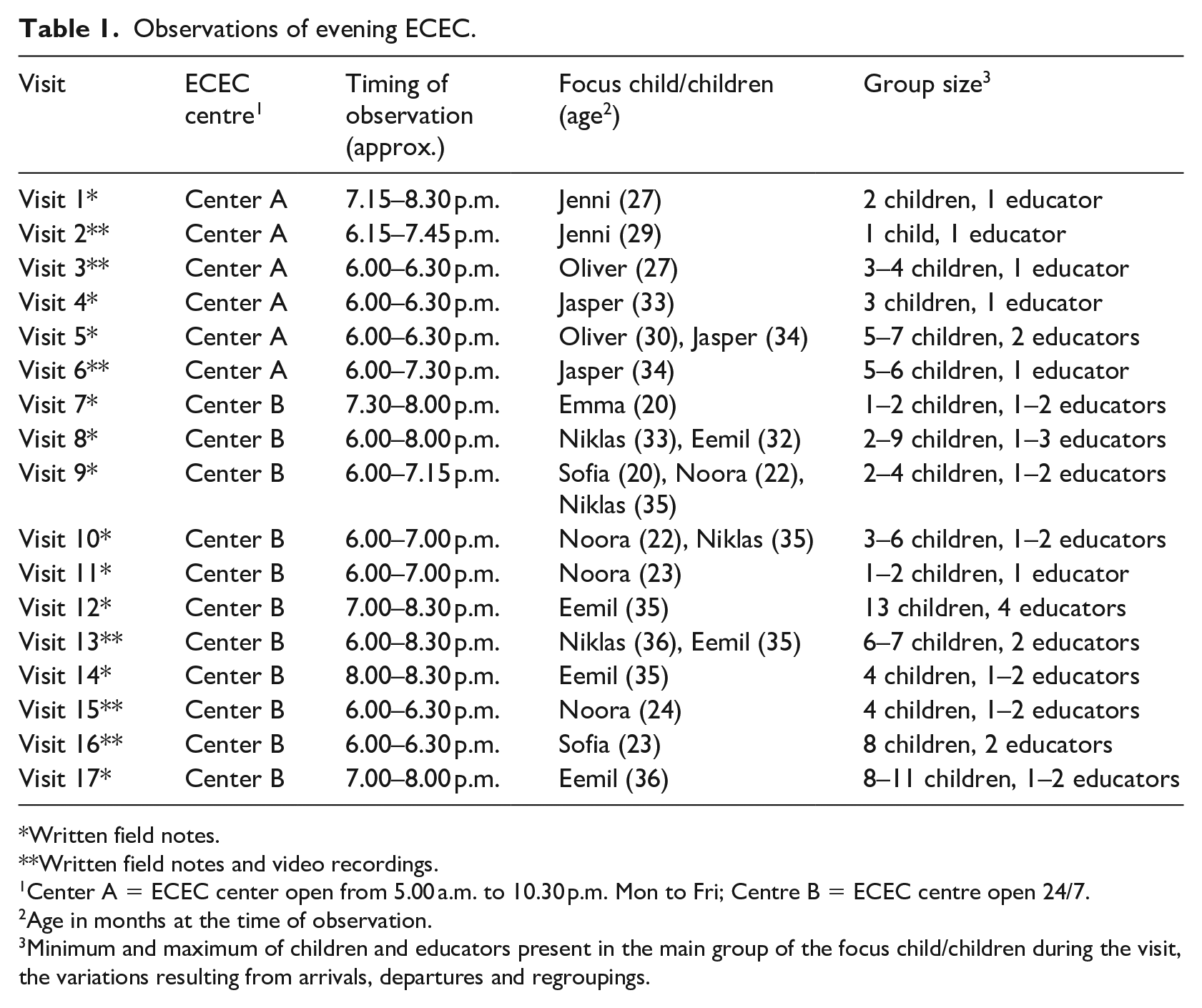
Written field notes.
Written field notes and video recordings.
Center A = ECEC center open from 5.00 a.m. to 10.30 p.m. Mon to Fri; Centre B = ECEC centre open 24/7.
Age in months at the time of observation.
Minimum and maximum of children and educators present in the main group of the focus child/children during the visit, the variations resulting from arrivals, departures and regroupings.
Ethical considerations
Prior to the study, the parents and educators of the children under age three in the two ECEC centers were given written information about the study. Parental informed consent for their children’s observation was obtained for all eight child participants. During observations, the children’s initiatives toward the researcher and the research procedure were responded to with sensitivity: their questions about the study were answered, and their expressed wish not to participate was respected. Educators gave their verbal consent to observation at the beginning of each visit.
The ethical tensions related to the use of video were carefully considered. This method was considered a useful means for capturing subtle nuances of interaction, including the multiple ways in which young children express themselves through their bodies and voices. Thus, the use of video contributed to listening to and interpreting young children’s experiences. Video research with young children, however, raises ethical challenges related to consent and privacy (Rutanen et al., 2018). To minimize these challenges, video was used only in situations where both the educator/educators and the young child/children present consented to this method of observation. Also, the findings were reported in such a way that the participants could not be identified.
Analysis
Educators’ practices refers here to their ways of organizing the social situation (main groups, small groups and presence of educators), material affordances (spaces, toys and other materials) and activities (daily routines, play and other activities). Such practices were expected to be at their most visible during micro-transitions, that is, moments during which at least one of the above-mentioned aspects was negotiated and reorganized through interaction involving an educator/educators, a child/children and their material environment. Altogether, 141 episodes, each of which consisted of a micro-transition and the chain of interaction until the next micro-transition, were identified. Even fleeting moments of minor change that seemed to receive subtle approval by an educator were understood as micro-transitions, such as taking up a new kind of activity during free play or beginning a new book during a reading-aloud session. Therefore, free play, reading to children and other activities typically included several episodes.
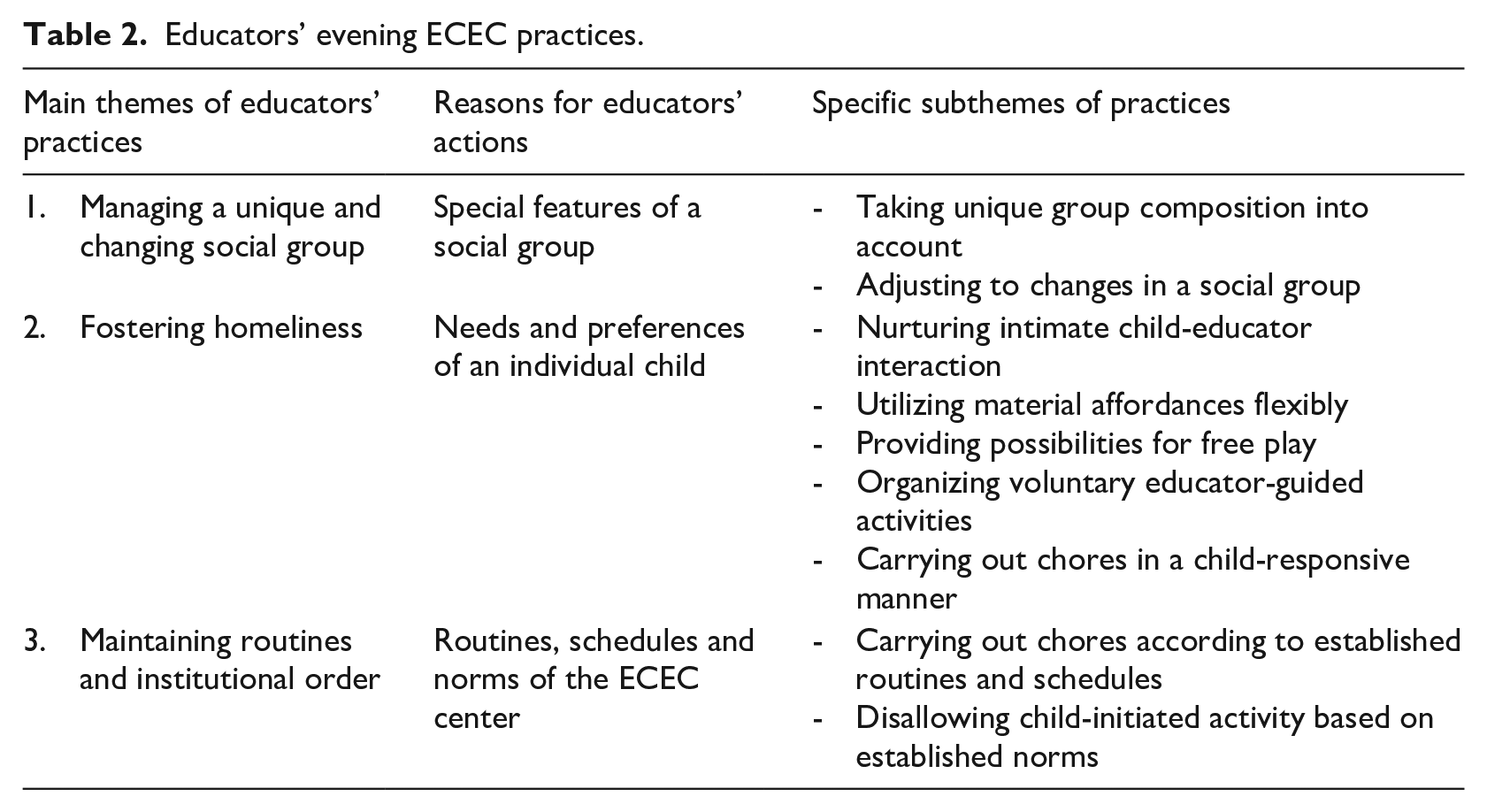
Episodes were analyzed qualitatively, using thematic analysis (Nowell et al., 2017) driven by a theoretical understanding of institutional culture and belonging. Thematic analysis was chosen to allow interpretation of the meanings behind educators’ practices and thereby promote a fuller understanding of the underlying institutional culture of ECEC (Crowe et al., 2015; Morse, 2008). To answer the first research question, episodes were explored with respect to the educators’ actions and the interpreted reasons for these (e.g. a child’s initiative or a predetermined schedule). These actions were categorized into three main themes according to the interpreted reasons for them (see Table 2). The subsequent more detailed exploration of the main themes yielded nine subthemes of educators’ practices.
Educators’ evening ECEC practices.
To answer the second research question, the focus child’s actions and expressions – bodily, facial and vocal – were carefully explored in each episode. Manifestations of the child’s belonging (i.e. his/her membership and/or feelings related to sense of belonging), such as voluntary participation, concentration, relaxedness, enthusiasm, smiling and laughing were noted. Manifestations of the child’s not-belonging, such as physical resistance and withdrawal, crying and facial expressions of confusion and sadness, were also noted. Furthermore, attention was paid to specific aspects of the politics of belonging, such as educators’ sensitivity to the child’s initiatives and possibilities to contribute to the ongoing event. Based on these observations, the researchers made interpretations of the influence of educators’ practices on children’s belonging.
Educators’ practices and young children’s belonging in evening ECEC
Multiple themes (see Table 2) typically coexisted in educators’ practices and were intertwined in the data: a single episode could manifest several subthemes and even different main themes. For clarity, however, the themes are examined separately below. The manifestations of young children’s belonging and not-belonging are discussed in relation to each subtheme of practice.
Managing a unique and changing social group
When implementing evening ECEC, educators adjusted their actions to better manage the unique and changing social group that resulted from their own and the children’s individual, uncoordinated schedules. This was fundamental to the organization of evening ECEC; for example, practices aimed at fostering homeliness often required taking the whole social group present into consideration, at least to some extent. Hence, as many as 128 of the 141 data episodes represented the first main theme of educators’ practices (see Table 2).
Taking unique group composition into account
As the numbers and ages of children in the evening groups varied from evening to evening, educators needed to take the evening’s unique group composition into account when organizing small groups, material affordances and activities. This was particularly evident in the center with extended opening hours, as the multi-aged evening group could include children with very different age-related skills, interests and needs. Such practices, manifested in 120 episodes, can be seen in the following example from visit 3 (see Table 1).
Hanna (educator) shepherds the two older boys into the hallway to play with a toy railway. The younger children are directed to their familiar playroom where Hanna remains with them. (Between these adjacent spaces there is a door with a window allowing Hanna to monitor the older children while keeping the younger ones company.) Oliver goes straight to the toy cabinet, finds a train and starts playing with it.
Hanna divided the evening group of different-aged children in two small groups, which she placed in two adjacent spaces. In doing so, she considered the age-related skills and needs of the children present: the younger children were placed in their familiar playroom with her, whereas the older children could play more independently under minor supervision. For Oliver, these practices seemed to offer possibilities for constructing his belonging: he initiated play in his familiar playroom without hesitation. Overall, the episode illustrates how practices of this kind typically helped in managing the interests and needs of different age-groups and thereby enhanced children’s possibilities for negotiating and constructing their belonging.
Adjusting to the changing social group
The composition of an evening group often went through changes during a single evening, as some children were picked up and new children arrived to stay overnight (the 24/7 center). Sometimes these changes were accompanied by the departure or arrival of an educator. Educators adjusted to such changes in the social group by reorganizing the children into small groups, along with material affordances and activities, and in the 24/7 center even combining the two main evening groups. Practices of these kinds, present in 24 episodes, took place during visit 9 (see Table 1).
While Niklas and Susanna (educator) read a book on the playroom sofa, one of the children is picked up. . .Maria (educator) goes to fetch the two older children, who join the under-three group, bringing their evening meal with them. . .Susanna departs for home, and Niklas is led to the table in the dining room to solve puzzles with Maria. Niklas concentrates on this task, solves a puzzle, and then asks Maria for another kind of game.
Due to the low attendance resulting from children’s departures, the two main evening groups were combined, after which one of the educators went off shift. These changes further influenced the material affordances and activities available to Niklas: book reading on the play-room sofa changed to puzzle-solving on the dining room table, where three of the children – all except Niklas, who was to be picked up soon – were about to have their evening meal. Niklas showed no problems in constructing his belonging in the face of these changes: he readily begun solving the puzzle and then made an initiative to get another game.
At times, however, the educators’ practices in adjusting to the changing social group challenged the young children’s belonging (manifested in 4 episodes). During visit 7 (see Table 1), for example, Emma lost her playmate through the regrouping that took place due to the children’s differing schedules (some staying overnight, some going back home later in the evening). As a result, Emma showed signs of confusion: she stopped playing and asked about her friend. Such challenges for young children’s belonging, although minor and momentary, were a possible outcome of regrouping.
Fostering homeliness
In their management of a unique and changing social group, the educators generally succeeded in creating room for interactions and activities that were characterized by intimacy, flexibility, voluntariness and child-responsiveness – qualities culturally associated with the home context (Daly, 2001; Duyvendak, 2011). Such activities were grounded in sensitive interpretations of the needs and preferences of individual children. During most of the observed evenings, despite changes in the social group, educators’ possibilities for such sensitivity were good due to the small group size and low child-adult ratio. Consequently, these practices (the second main theme; see Table 2) were manifested in 118 of the 141 data episodes.
Nurturing intimate child-educator interaction
It was common for educators to nurture intimate child-educator interaction by, for example, physical closeness (e.g. sitting side by side, holding a child in the lap), chatting and sometimes foolery (e.g. tickling). Such interaction, present in 52 episodes, took place during visit 7 (see Table 1).
Leena (educator) takes Emma into her lap and chats to her. Emma sits peacefully in Leena’s lap, sucks her dummy and fiddles with her hair. She looks relaxed and drowsy.
Leena provides Emma with unhurried time for intimate interaction, including sitting in her lap and chatting. Leena’s actions respond to Emma’s mood which, based on how she looks, sucking her dummy and fiddling with her hair, indicates that she is already tired. Although Emma does not express strong emotions, she is relaxed and comfortable, and the interaction can therefore be interpreted to support her belonging. Other moments of intimate child-educator interaction in the data included similar responses by children that demonstrated belonging.
Utilizing material affordances flexibly
Due to the low attendance in evening ECEC, educators were able to utilize the material affordances of their center flexibly, that is, in a way that was sensitive to individual children’s needs and preferences. Events representing this subtheme were very common and occurred in 78 episodes. Some of these episodes included the utilization of spaces, toys and other materials that were not available to young children during the daytime, such as spaces and toys for older children, and baths, water and water toys. Such material affordances were explored by Jenni during visit 2 (see Table 1). Before the following episode, Helena, an educator, had offered Jenni the possibility of having a bath, and Jenni had willingly accepted.
Jenni sits in a mini-pool in shallow water, surrounded by an array of different plastic toys: boats, ducks, cups, a can and a bottle. . .She pours out water from the bottle, smiles and laughs, then looks at Helena (educator) who also laughs. Jenni says “I pour the water”, smiles and laughs again.
Jenni showed signs of belonging toward her material environment: she participated (poured out water) and expressed feelings of comfort and joy (smiled, laughed). Such reactions were typical of the young children provided with evening-specific material affordances. Overall, the flexible use of material affordances tended to leave room for children to contribute and thus consolidate their membership. It is worth noticing, however, that the role of the educator was crucial in enabling, and sometimes encouraging, the utilization of material affordances.
Providing possibilities for free play
Educators also provided possibilities – unhurried time, spaces and toys – for free play. This was manifested in 56 episodes. During free play, the educator’s role varied from that of an initiating participant to that of a bystander. Depending on group composition, free play could include different-aged children, siblings or best friends, as was the case for Eemil and Niklas during visit 8 (see Table 1).
Eemil, Niklas and Anna (educator) go to the room for older children. The boys start to play together, while Anna sits nearby. They play enthusiastically, chat and succeed in taking turns with a toy ice cream that they both want to hold: Eemil asks for a turn, and Niklas gives him the ice cream. The play goes on for a good while.
Anna set the scene for free peer play involving Eemil and Niklas and then stayed in the background. Anna’s actions were responses to the children’s initiatives, as they had shown interest in playing together earlier in the evening. Given their enthusiasm, willingness to chat and negotiate and long-lasting concentration on shared play, the children were interpreted as manifesting their belonging. In this process, peer interaction was central, although the stimulation occasioned by the material affordances also mattered. The data included many similar moments of free play that contributed to young children’s participation and hence their belonging. Sometimes, peer conflicts resulted in a child’s withdrawal, accompanied with expressions of discontent, and thereby creating moments of uneasiness and not-belonging for the child. In these situations, the educators took a more active role in solving the disagreement.
Organizing voluntary educator-guided activities
Even when organizing educator-guided activities, such as reading, molding, drawing, and puzzles, educators commonly combined homeliness and educational goals in a delicate way. These activities, too, were voluntary and gave children room to make their own contribution. They were also sensitive to children’s signs of tiredness and their need for rest. These kinds of activities were present in 38 episodes, of which the following example occurred during visit 9 (see Table 1).
Susanna (educator) suggests that she reads to Niklas, and Niklas willingly agrees. Susanna lets him choose two books from the bookshelf and decide which of the books they will read first. . .After finishing the books, Niklas wants one more book, and Susanna agrees.
The moment of book reading enabled Niklas to contribute: he had a say both in the choice of the activity of reading and in the choice of books. A little later, on Niklas’ initiative, Susanna started one more book. Such chances to contribute to one’s own situation were common in educator-guided activities that typically evoked children’s voluntary participation, and thus could be understood as manifesting their belonging.
Carrying out chores in a child-responsive manner
Similar interactivity was observed in daily chores, such as the routines of the evening meal and night’s sleep. Although not wholly voluntary, these routines were scheduled and carried out in a child-responsive manner that entailed flexibility and particular sensitivity to individual children’s needs and preferences. Such practices were manifested in 19 episodes. For example, during visit 13, Eemil had his evening meal a bit later than the other children in his group so that he and his best friend Niklas were able to carry on playing together until Niklas was picked up. In another example from visit 2 (see Table 1), child-responsiveness in performing daily chores was manifested in the offering of choices to Jenni.
Helena (educator) cuts a slice of bread for Jenni and asks: “Would you like sausage on your bread? What about cheese, would you like cheese, too?” Jenni wants both sausage and cheese. Then Helena continues: “We have some buns left, too. You can have one for dessert, if you want.” Jenni starts eating the bread in a relaxed way and smiles.
When serving the evening meal, Helena respected Jenni’s preferences by offering her alternatives in making up her meal. One of these possibilities – having a bun for dessert – clearly outstripped the usual everyday choices. Jenni participated willingly: she responded positively to Helena’s questions and began her meal. Jenni’s actions and bodily expressions (being relaxed and smiling) indicated her belonging. The educators’ child-responsive way of carrying out daily chores evoked similar reactions in the other focus children, suggesting that this practice gave them good opportunities to construct their belonging.
Maintaining routines and institutional order
Despite the above-described tendency toward homeliness, some of the educators’ practices primarily contributed to maintaining institutional order in the ECEC center. The most apparent reasons for these practices were established routines, schedules and norms rather that the expressed needs or preferences of individual children. These practices (the third main theme; see Table 2) were not as common as those representing the first two main themes. They were manifested in only 34 of the 141 data episodes and were more likely to arise in the slightly bigger evening groups (e.g. during visits 8, 12, and 17; see Table 1).
Carrying out chores according to established routines and schedules
Although daily chores were often carried out in a child-responsive way, 26 episodes manifested more inflexible and routine practices: chores such as picking up toys, having an evening meal or preparing for the night’s sleep followed the established routines and schedules of the ECEC center. Although these practices involved less sensitivity to individual children, the children mostly participated fluently in them. For example, during visit 9, Niklas willingly picked up toys when asked by the educator. Fluent participation in such routines can be regarded as contributing to children’s belonging though their familiarity with the situation.
On the other hand, in 4 rare cases, an individual child’s expressed needs and preferences did not result in modification of the ongoing routine, thereby challenging his or her belonging. This is exemplified in the following extract from visit 14 (see Table 1). The events took place after Eemil had arrived at ECEC at bedtime and begun to cry for his mother.
Linda (educator) carries Eemil to the dormitory. . .In the dormitory Eemil continues crying. . .Heidi (educator) is reading a goodnight story. . .She tells Eemil that his crying is distrackting the other children. . .Eemil’s crying takes on an irritable tone.
The educators’ way of settling Eemil to sleep followed a fixed schedule and an established routine: children were expected to go to bed at a certain time and then quietly listen to a goodnight story. On this particular evening, Eemil was expected to conform to this routine, regardlesss of his crying, behavior that can be understood as a manifestation of his not-belonging, resulting from his separation from his mother and the immediate requirement of transitioning to sleep. Being unable to influence his situation, and thereby construct his belonging, finally made Eemil cry even more irritably. Such inflexibility, however, was very rare in the data.
Disallowing child-initiated activity based on established norms
Some activities initiated by children were disallowed by educators as they infringed the established norms of the ECEC center. Some of these practices stemmed from the traditional idea of evening as a time for settling down and relaxing. Children’s play initiatives were also checked based on educators’ perceptions of fairness in play and the safe and proper use of certain materials. Such practices were noted in 8 episodes. The following example took place during visit 8 (see Table 1).
Eemil and Niklas solve puzzles and chat together. . .The boys then start to play with pieces of the puzzle: they fly a plane and drive an ambulance (the pieces are in the shape of vehicles). The pieces land on the floor. Anna (educator) notices that the boys’ play has become too boisterous and puts the puzzles away. Instead, the boys are provided with playdough.
The play initiated by Eemil and Niklas – playing energetically with pieces of the puzzle – did not adhere to the unwritten norm regarding the proper use of puzzles and was therefore terminated by Anna. Such norms originally serve children by, for example, keeping toys from getting broken. If applied routinely, however, they may ignore children’s own interests and thereby challenge their belonging. In the present data, including the previous example, practices of this kind merely resulted in renegotiation of the young children’s membership, as they were provided with alternative activities through which to construct their belonging.
Discussion
In Finland, young children whose parents work evening hours have the possibility to attend evening ECEC. Our earlier study (Salonen et al., 2018) showed that this form of ECEC is characterized by a special kind of social environment – a small irregularly constituted group – that both calls for and makes possible a new kind of institutional culture. In the present study, we aimed at gaining deeper understanding of this culture by observing educators’ practices in implementing evening ECEC and young children’s actions and expressions associated with these practices. Based on the interaction observed between educators and children, interpretations were made concerning children’s belonging.
In the participating ECEC centers, educators’ practices often broke with the traditional institutional culture, which tends to adhere to more established, adult-directed routines and activities. This was evident in educators’ flexible management of their unique and changing social group which, consistently with previous findings on flexibly scheduled ECEC (Rönkä et al., 2017; Salonen et al., 2018), characterized evening ECEC. Furthermore, educators actively contributed to homelike interactions, such as intimate child-educator interaction, that were based on the recognition of individual children’s needs and preferences. Such practices, also found in earlier studies on evening time ECEC (Jordan, 2008; Salonen et al., 2018), can be understood as responses to tiredness-related challenges experienced by some of the young children present (Salonen et al., 2018). Moreover, these practices seem to be influenced by the cultural expectation of evening as “home time” that is likely to influence educators’ interaction with young children (Nippert-Eng, 1996; Peltoperä et al., 2018). Not all the educators’ practices, however, manifested a cultural reformulation of this kind; instead, some of them reproduced institutional order. This was most evident during the routines pertaining to night sleep or mealtimes which, in line with the ideas presented by Glaser (2019), tended to trigger a more adult-directed approach to ECEC.
When viewed through the lens of young children’s belonging, the educators’ reformulation of the institutional culture gave children favorable opportunities for constructing their belonging. Through careful consideration of the special kind of social group and the needs and preferences of individual children, educators enhanced children’s possibilities to contribute to the flow of events and thereby construct their belonging. These qualities of evening ECEC were in accordance with the prevailing conception of children’s rights (United Nations Convention on the Rights of the Child, 1989) and the associated aims presented in the National Curriculum Guidelines on ECEC in Finland (Finnish National Board for Education, 2018). While they are being increasingly applied in other forms of center-based ECEC as well, the present results suggest that they are emphasized in the small and irregularly constituted social groups attending evening ECEC. However, exceptions to this trend exist, as young children’s belonging during evening ECEC was at times compromised owing to changes in the social situation or resort to established routines that made it more difficult for educators to sensitively respond to an individual child’s initiatives.
Limitations
The major limitations of the study concern the method. The number of participating ECEC centers and young children was very small, and hence the study can only give an incomplete picture of evening ECEC in Finland. Another reason for caution is the small number and unsystematic timing of the evening observations; for example, some of the visits to the centers ended before the routines relating to the evening meal and night’s sleep began, and educators’ practices related to these routines are therefore underrepresented in the data. Evenings after 8.30 p.m. were not observed, as all the participating children had either left for home or settled to sleep by that time, and thus the study did not yield information on late evening practices and the challenges they may present for children’s belonging. Furthermore, the visits, which focused on the most significant times and critical moments of flexibly scheduled ECEC, only lasted from 0.5 to 2.5 hours. Due to the intensive concentration required from the researcher, longer periods of observation were not conducted. Therefore, the visits did not capture the big picture of flexibly scheduled ECEC; for example, the observations did not allow comparison between daytime and evening ECEC.
It is also important to notice that the researcher’s observations, although carefully conducted, could not reveal all the subtleties of the interactional situations. Moreover, the observations inevitably included some subjective interpretation. These challenges were partially overcome by using video and discussing the interpretations with the other two authors. However, for the ethical reasons presented earlier, the use of video was limited to few visits, and hence the data mostly comprise written field notes. These issues presented the analysis with some challenges, particularly in differentiating between the two subthemes related to carrying out daily chores. Further research is needed to surmount these methodological limitations and gain an even fuller picture of the target phenomenon.
Conclusion
The study shed light on the ongoing reformulation of the traditional institutional culture in Finnish evening ECEC. Through their practices in implementing evening ECEC, educators were found to work toward an institutional culture that, in many respects, comes close to the present ideal of young children’s belonging in ECEC and, importantly, contributes to children’s social and emotional wellbeing. In order to facilitate such favorable development in all forms of ECEC, attention needs to be paid not only to the values underlying ECEC but also to its practical preconditions – small group size and a low child-adult ratio – which need to be ensured to provide the kinds of ECEC services that are the most favorable for young children’s belonging.
Footnotes
Acknowledgements
We are most grateful to the young children and their educators for participating in this study. Also, we would like to thank the parents who gave consent for their children’s observation and the two ECEC centers that opened their doors for this research.
Declaration of conflicting interests
The author(s) declared no potential conflicts of interest with respect to the research, authorship, and/or publication of this article.
Funding
The author(s) disclosed receipt of the following financial support for the research, authorship, and/or publication of this article: This work was supported by the Academy of Finland (grant number 251410); and the Finnish Cultural Foundation (grant number 00180978).
