



Abstract
Belonging is a fundamental human need that impacts young children’s everyday experiences and wellbeing in group care. We know little, however, about how belonging works for infants in multi-age settings such as family day care. In this article, I use Sumsion and Wong’s three intersecting axes of belonging – categorisation, performativity, and resistance and desire – to analyse two segments of video data from a longitudinal case study of belonging for an infant in family day care. I draw on concepts from Deleuze and Guattari, in particular assemblage and desire, to develop understandings of how the axes appeared to be at work and what they meant for the infant’s belonging at family day care. I am particularly interested in what an examination of the axes might reveal about the roles infants can play in the politics of belonging in early childhood education and care. The data illustrate the important role played by material aspects of assemblages, the dynamic nature of social categories and the complex roles of desire and power in the politics of belonging for infants.
Introduction
In this article, I continue my project of critically interrogating how belonging works in early childhood education and care (ECEC) by adding another dimension to a longitudinal case study of the politics of belonging for an infant in Australian family day care 1 (FDC) (see also Stratigos, 2015a, 2015b). Belonging has long been recognised in psychology as a fundamental human need (Baumeister and Leary, 1995; Stratigos et al., 2014). In early childhood, belonging is considered essential to ‘any child’s well-being and happiness, and to the realisation of their rights as a citizen and a member of a variety of social groups’ (Woodhead and Brooker, 2008: 3–4). When children join ECEC settings, it is often their first contact with diversity and a time when they begin to develop understandings of the groups to which they do and do not belong (Vandenbroeck, 1999). Thus, belonging is linked to how children come to know themselves as well as respond to others (Vandenbroeck, 1999). The importance of belonging for young children’s wellbeing and everyday experiences in ECEC is recognised in curriculum frameworks such as Te Whāriki from New Zealand (Ministry of Education, 1996), Aistear from Ireland (National Council for Curriculum and Assessment, 2009) and Belonging, Being and Becoming: The Early Years Learning Framework for Australia (EYLF) (Department of Education Employment and Workforce Relations, 2009). In these curriculum frameworks, young children developing a sense of belonging becomes an explicit goal of ECEC.
Australia’s first national curriculum framework, the EYLF, guides the work of educators in all ECEC settings, including FDC, from birth until children enter school around 5 years of age. Belonging, along with being and becoming, is a foundational concept of the EYLF and is linked to all five learning outcomes. A sense of belonging is described by the EYLF (Department of Education Employment and Workforce Relations, 2009: 7) as ‘knowing where and with whom you belong’. Peers and Fleer (2013) argue, however, that there is a lack of clarity around the usage and definition of belonging in the EYLF, and they suggest there is a need for deeper theorisation of belonging beyond the everyday sense. Sumsion and Wong (2011) acknowledge a flexibility around belonging in the EYLF which they suggest creates space for critical interrogations of belonging. Antonsich (2010) argues that belonging is often vaguely defined, taken for granted and considered self-explanatory across a range of disciplines. In order for belonging to become a useful concept for educators in Australia and elsewhere, therefore, it is important to move beyond simplistic and romantic ideas about belonging and generate more complex understandings of what belonging might mean and how it might work in a range of contexts.
In an effort to contribute to understandings about how belonging works in ECEC, in this article, I analyse two segments of video data for evidence of Sumsion and Wong’s (2011) three analytical axes of belonging – categorisation, performativity, and resistance and desire. I am particularly interested in what the axes might reveal about the roles infants can play in the politics of belonging in ECEC. By providing a case study of the politics of belonging for an infant in FDC, I hope to contribute insights not only into how belonging operates but also what work belonging can do theoretically and practically in ECEC. The article begins with an examination of previous research in relation to the first axis of belonging, processes of categorisation. I then discuss the theoretical resources drawn on for thinking about belonging and how it was at work for Peter: the politics (Yuval-Davis, 2011) and axes (Sumsion and Wong, 2011) of belonging, and assemblage and desire (Deleuze and Guattari, 1987). Next, I provide information on the context of the research and how it was conducted before turning to the research data. Each of the two episodes is first described and then discussed in turn.
Processes of categorisation in ECEC
Research undertaken in ECEC settings in Australia indicates that for 3- and 4-year-old children, a range of categories may play a role in belonging including gender, skin colour, culture, ethnicity (Skattebol, 2005; Taylor, 2007; Taylor and Richardson, 2005), stage of development and age (Skattebol, 2006). Skattebol’s (2006) research findings suggest that age, maturity, physical size and posture can play a role in preschool aged children’s claims to socially powerful categories and older children can occasionally exclude younger children ‘on account of their status as “little”’ (p. 516). Research by Löfdahl and Hägglund (2006) with Swedish preschoolers suggests that ‘younger children are referred to as less attractive, having less social status and as being incapable of making decisions for the group’ (p. 191). Löfdahl and Hägglund (2006) also suggest that the older children shared the idea that it was legitimate to ignore and exclude smaller children. Dutch research with 2- and 3-year-old children found the most common type of conflict between older and younger children related to who could join in and children were more likely to become friends with those children who were closer in age (Singer and De Haan, 2011). A Finnish case study of a child between the ages of 2 and 3 suggests that the ‘division between small and big children [was] meaningful to [his] identity construction’ and implied ‘values, social status, and power relationships’ (Puroila and Estola, 2014: 195). The study child attempted to present himself as different to babies and distance himself from objects associated with babies such as highchairs and baby swings. These studies seem to imply that within the social context of ECEC, being categorised as a baby or being associated with objects that express ‘baby-ness’ might be undesirable and implicated in issues of inclusion, exclusion, status and power relations.
Theoretical resources
I draw on understandings of the politics of belonging from authors such as Yuval-Davis (2011) and Sumsion and Wong (2011). According to Yuval-Davis (2011), the politics of belonging relates to the boundaries of a community; how these boundaries are constructed, maintained, challenged and resisted; who is included and excluded within these boundaries; and who has the power to do so. Sumsion and Wong (2011) propose three intersecting axes of belonging which can be used to critically analyse the politics of belonging. First, categorisation refers to the ways in which social categories influence who belongs, who decides and on what basis. Social categories are ‘strongly implicated in inclusion and exclusion’ (Sumsion and Wong, 2011: 34) and can result in differential rights, constraints, access to resources (DeLanda, 2006) and power relations (Yuval-Davis, 2011). Thus, some categories may be more desirable or advantageous than others in particular groups, times or places. Second, resistance and desire are the ‘contesting, disrupting and/or subverting [of] imposed categories of belonging and positioning to which they give rise’ (Sumsion and Wong, 2011: 34). Third, performativity relates to how belonging is performed through ‘repeated enactments of conventions, norms and practices’ (p. 34).
I bring these understandings of the politics of belonging and the data into an encounter with concepts from the philosopher Deleuze and his co-author Guattari. Deleuze and Guattari were interested in how things happen; where, when and in what circumstances things occur (Deleuze, 1995). In particular, I look at how belonging was at work through Deleuze and Guattari’s (1987) concepts of assemblage and desire.
DeLanda (2006) writes that assemblage may be used as an analytical concept ‘concerned with the discovery of the actual mechanisms operating’ in social entities (p. 31, original emphasis). Deleuze and Guattari (1987) divide assemblages along two axes, the first axis having two dimensions – content and expression. The content dimension refers to things that play a material role such as bodies, places and objects (DeLanda, 2006). The expression dimension refers to, for example, spoken, written and body language and expressions of trust, solidarity and identity (DeLanda, 2006). The content and expression dimensions are not separable and constantly interact (Deleuze and Guattari, 1987). Any component may play a mixture of material and expressive roles (DeLanda, 2006). Thus, this axis can assist in revealing the complexity of the politics of belonging, not just the role of people and what they say and do but also the role of the material world such as bodies, objects and places and what these do and express.
The second axis along which the assemblage is divided refers to territoriality (Deleuze and Guattari, 1987). These are the processes in which the material and expressive components are involved which may stabilise (processes of re/territorialisation) or destabilise (processes of deterritorialisation) the assemblage (DeLanda, 2006). It is possible to see a link here between Yuval-Davis’ (2011) conceptualisation of the politics of belonging and the Deleuzian notion of territorialisation. Territorialising processes can stabilise or destabilise an assemblage by increasing or decreasing its ‘degree of internal homogeneity or the degree of sharpness of its boundaries’ (DeLanda, 2006: 12). Thus, the construction and maintenance of the boundaries of belonging can be linked with re/territorialisation and stabilisation of the assemblage, whereas the challenge and resistance of the boundaries of belonging can be linked with deterritorialisation and destabilisation of the assemblage. Processes of territorialisation, therefore, remind us that the politics of belonging is a dynamic, never finished process, just as assemblages are constantly ‘making and unmaking’, ‘coming together and moving apart’, ‘reterritorializing and deterritorializing’ (Wise, 2005: 79).
The politics of belonging ‘involves the exercise of power’ (Yuval-Davis, 2011: 19). Yuval-Davis (2011) discusses power in relation to belonging in two interconnected ways. First, particular social categories ‘tend to have certain positionalities along axes of power that are higher or lower than other such categories’ (Yuval-Davis, 2011: 13). Sumsion and Wong (2011) agree that power relations play an important role in processes of categorisation as well as the resistance of imposed social categories of belonging. Second, Yuval-Davis’ (2011) definition of the politics of belonging suggests that some people or groups of people have the power to decide the boundaries of the community of belonging, who is included and who is excluded, while others do not. For example, within a multi-age ECEC setting such as FDC, the social category of infant may be positioned differently to that of older children and may play a role in processes of inclusion, exclusion and power relations. This conceptualisation of power, however, appears to be based upon what Patton (2000) describes as the ‘widespread view of power as essentially repressive’ and which ‘assumes that power is by nature hostile to the interests of those over whom it is exercised’ (p. 59). Deleuze, influenced by Nietzsche, Spinoza and Foucault, offers an alternative notion of power which ‘is closer to the positive idea of power to’, a conceptualisation of power as affirmative of life (Colebrook, 2010: 215, original emphasis), even joyful.
Massumi (1987) explains that two words exist in French for power, puissance and pouvoir, and that for Deleuze and Guattari, these are very different concepts. Pouvoir is used to describe a ‘relation of force’ (Massumi, 1987: xvii). This is a power that allows some to ‘exercise control over the actions of others’ (Patton, 2000: 59) and which is evident in Yuval-Davis’ conceptualisation of the politics of belonging. In contrast, puissance ‘refers to a range of potential’ (Massumi, 1987: xvii) or ‘power of action’ (Boutang, 2011). This notion of power is inspired by Nietzsche’s will to power in which ‘[t]he power of a body is expressed when it acts with all of the force or energy with which it is endowed’ (Patton, 2000: 50). Deleuze explains that confusing powers of action (puissance) and power (pouvoir) is ‘costly because power always separates people who are subjected to it from what they are capable of doing’ leading to sadness, whereas fulfilling a power of action (puissance) leads to joy (Boutang, 2011). This new possibility for thinking about power means that it can be available to anyone within an assemblage, not just members of particular social categories.
This positive conceptualisation of power informed Deleuze and Guattari’s concepts of assemblage and desire (Patton, 2000). For Deleuze and Guattari, desire within an assemblage was more fundamental than power (Deleuze and Guattari, 1987) because they saw desire as ‘creating relations through which power might operate’ (Colebrook, 2010: 215). Desire is a ‘productive force that is a core part of every living being’, an ‘energy … in continuous motion … searching, striving to become more or different’ (Wolff, 2013: 330). Their conceptualisation of desire is not based upon lack or ‘unfulfilled need’, but is a force that flows through assemblages and ‘produces real connections, investments and intensive states within and between bodies’ (Patton, 2000: 70). Deleuze explains that we never desire something out of context, but always from within a context, within an assemblage, and when we desire, we are in the process of actually constructing new assemblages (Boutang, 2011). Thus, when thinking about how the politics of belonging worked for Peter, I keep in mind the questions Olsson (2009) suggests educators might consider in relation to young children in ECEC, ‘where are your desires, what kind of assemblages are you for the moment experimenting with?’ (p. 147).
Research context
This article stems from the Infants’ Lives in Childcare (ILC) study, the broad aim of which was to attempt to understand what life is like for infants (0–18 months) in Australian ECEC (Sumsion et al., 2011). The study aimed to generate multiple sources of data that could be interpreted from multiple perspectives in an attempt to develop a detailed picture of infants’ daily experiences in ECEC (Sumsion et al., 2011). My doctoral studies, conducted as part of the ILC, are particularly focussed on belonging and how it works, or the politics of belonging. I have taken a case study approach focussing on one infant, Peter, and have drawn predominantly on the video data I collected, my field and reflective notes, and an interview with Peter’s parents and educator Cheryl in which we watched and discussed select segments of video data.
Peter spent 3 days a week in FDC from 8 weeks of age. I made 26 visits to Peter’s FDC when he was aged between 8 and 18 months, collecting approximately 24 hours of video data of his everyday life. Each day, Peter shared the FDC setting with up to four other children who were significantly older than him, ranging in age from 2 to 4 years. When Peter was 14 months old, however, the social context at FDC changed. Toby, who was only 11 weeks older than Peter, joined the FDC setting 1 day a week. Cheryl, the FDC educator, believed that Toby acted as a kind of catalyst for Peter wanting to be what she called a ‘big boy’. For example, she described that when Peter saw Toby sitting at the meal table with the older children, he wanted to do the same rather than sit in his highchair. Whereas Peter was often categorised by the older children as a baby (Stratigos, 2015a, 2015b), Cheryl’s comments introduced another possible category emerging for Peter at FDC, big boy. Looking closely at interactions between Peter and Toby might provide a sense of how categories are constructed, resisted and performed, and what role Peter himself played in these processes. I made four visits on days that Peter and Toby were in FDC together over a 10-week period collecting around 5.5 hours of video. In this article, I draw predominantly on two episodes that I filmed 8 weeks apart. These episodes were chosen because they richly illustrate the two categories of baby and big boy. I will now describe and discuss these episodes in turn.
Episode 1: ‘Now he’s a baby’
Following lunch and a nappy (diaper) change, Peter (1.4) is having his bottle before going to bed. Cheryl is sitting on the couch cradling Peter. On the arm of the couch sits his dummy (pacifier) and the bottle lid. Toby (1.7) approaches. ‘There we are, look at that, he’s having a bottle, isn’t he’, says Cheryl. Toby points to the bottle in Peter’s mouth and says, ‘bah-bol’. ‘Yeah, bottle, yeah’, replies Cheryl, smiling at Toby. Toby moves to the other side of Cheryl and points to the dummy on the arm of the couch saying, ‘Ooh’ (see Figure 1). ‘That’s his soot’, says Cheryl. (Soot is a special name for a dummy in Peter’s family). Toby then picks up the bottle lid. ‘That’s the lid, off the bottle, isn’t it, it goes on the top’. Toby vocalises to Cheryl again, holding the bottle lid in his hand and Cheryl replies, ‘Yeah. I don’t think you have bottles at ALL, Mr Toby’. Toby laughs and says, ‘no-ho-ho-ho’, shaking his head and looking at Cheryl with his mouth wide open. Cheryl smiles at Toby and says, ‘No, I don’t think you do’, also shaking her head. Toby laughs again and turns to look at me, still laughing (see Figure 2). ‘I can’t quite imagine Peter getting to your stage and NOT having a bottle and a soot’, says Cheryl. Toby turns back to Cheryl. ‘No-hoo-hoo-hoo’ says Toby, again shaking his head and laughing. ‘Yeah, he’s not keen about giving those up’, says Cheryl. A little later Cheryl says, ‘He looks like such a big boy when he’s racing around the backyard’. Toby laughs. Cheryl looks down at Peter, ‘Hey? And now he’s a baby’, says Cheryl looking up at Toby again. ‘Baby’, says Toby inclining his head to the side and resting his body back on the arm of the couch. ‘He’s a baby’, says Cheryl also inclining her head to one side, ‘he’s MY baby’ (see Figure 3). (FDC07-080411-25-TS)
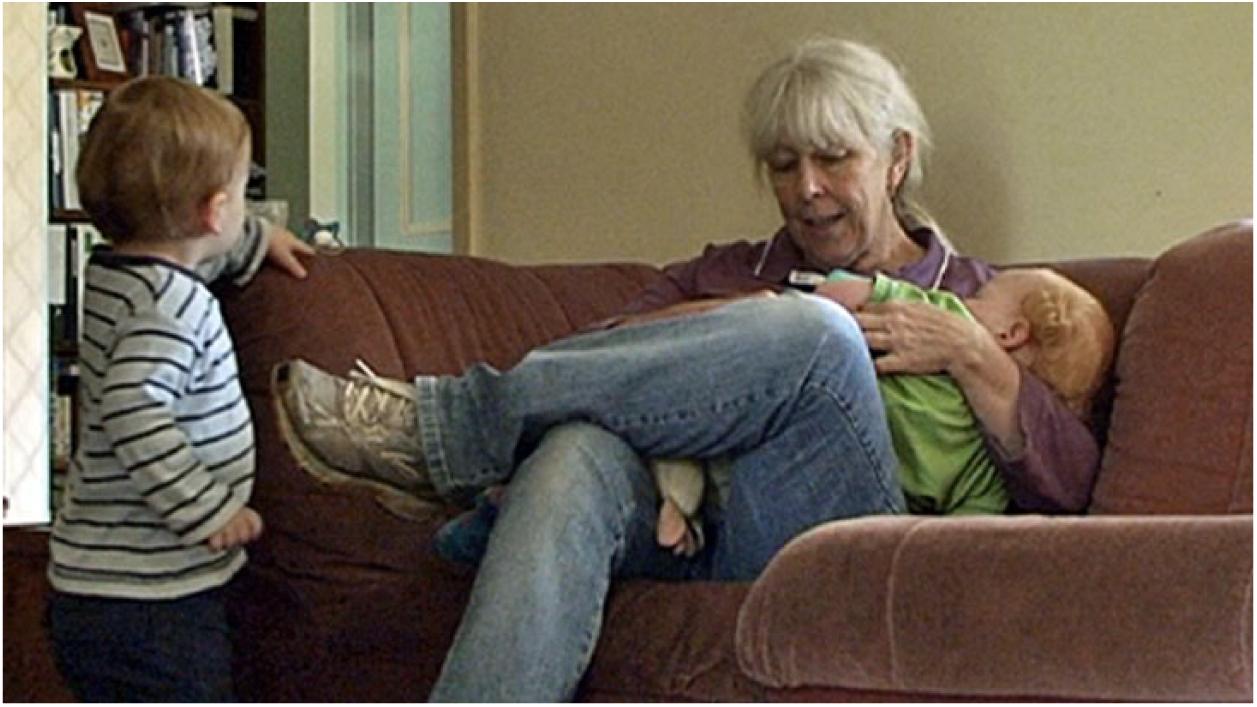
Toby points to Peter’s dummy (pacifier) or ‘soot’.
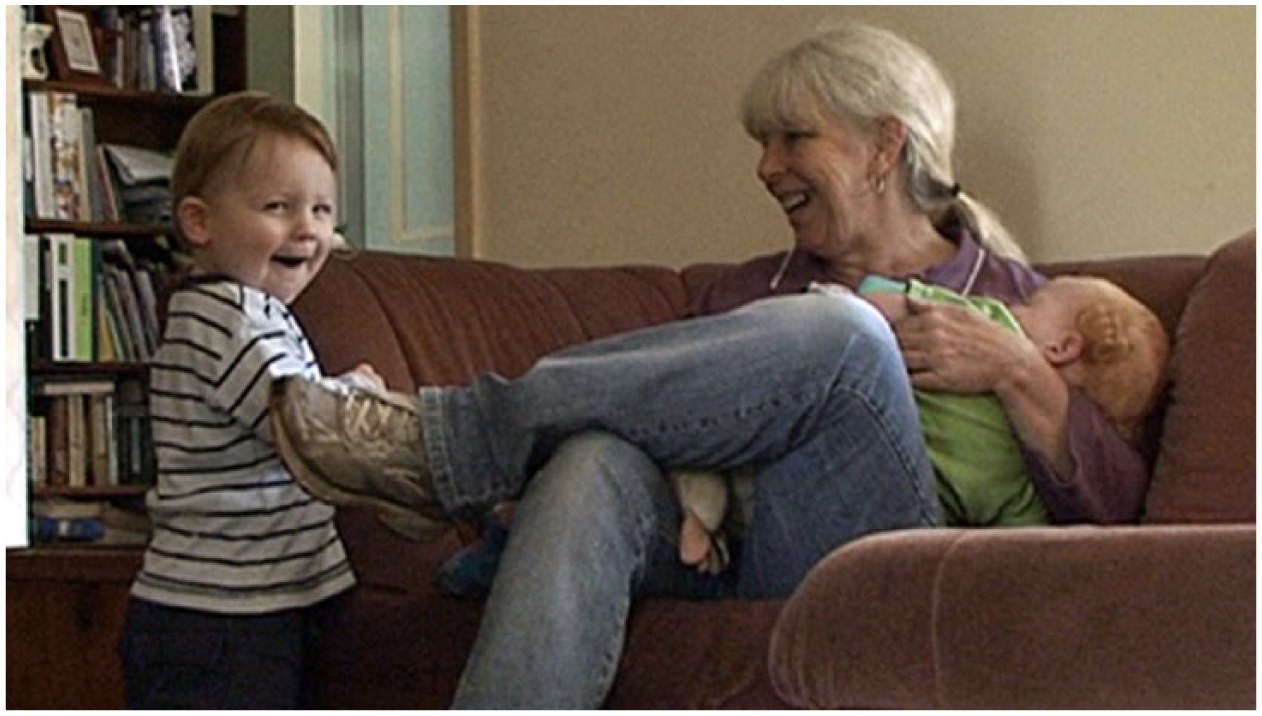
Toby laughs about not having a bottle.
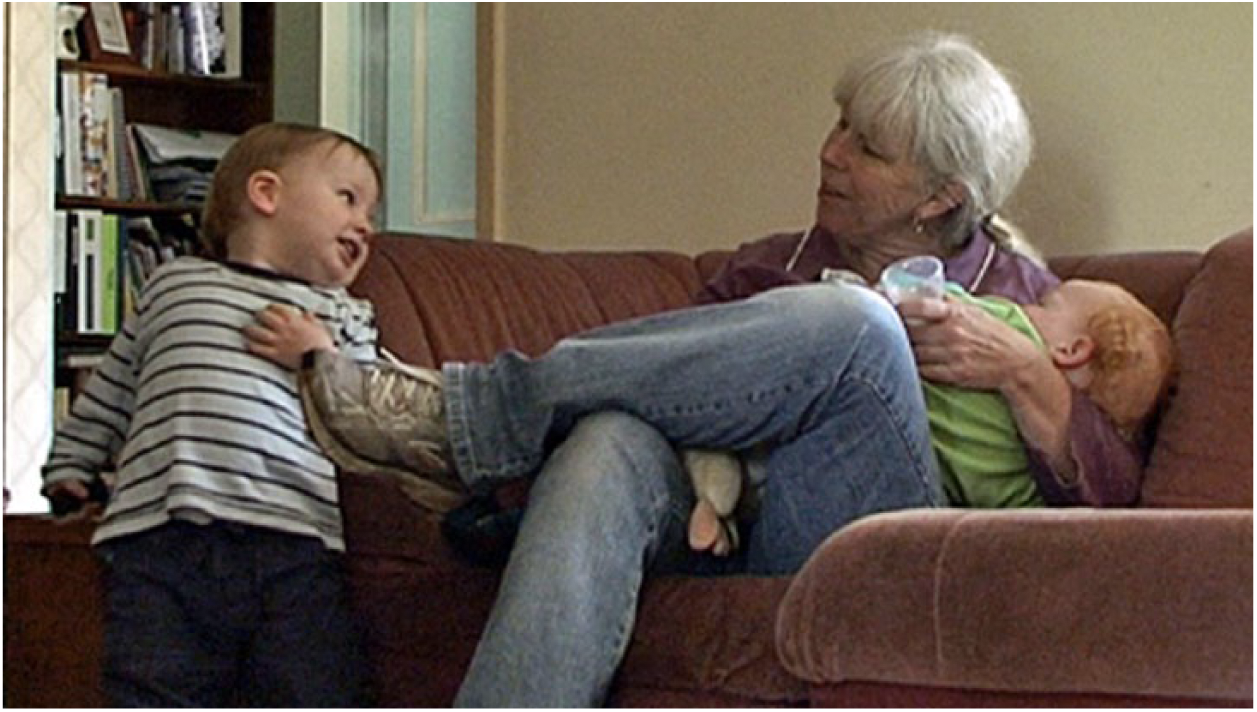
‘He’s a baby’, says Cheryl inclining her head to the side.
Constructing and performing ‘Baby’ in episode 1
In this episode, Peter appears to belong in a particular way. He is categorised as baby. A number of aspects of the assemblage work to construct Peter as baby. Material objects such as the dummy, the bottle and the arrangement of bodies play an important role because of the ‘baby-ness’ they express. Toby draws attention to the dummy and bottle, and these are linked by Cheryl in the conversation with being a baby, something that one gives up before moving onto the next ‘stage’ and becoming a ‘big boy’. Toby appears to find the suggestion that he might have a bottle amusing, perhaps because he also associates bottles with babies and not with his own ‘stage’, despite only being 11 weeks older than Peter.
It is not possible to know to what extent Peter is attending to the conversation between Cheryl and Toby. Peter appears to be quite passive throughout the episode, and it would be easy to assume that he does not play a role in the construction of this baby belonging. This passive role, reclining in Cheryl’s arms, however, may in itself be significant, a performance of baby. At the end of the episode, both Cheryl and Toby lean their head to one side as they refer to Peter as a baby, perhaps in imitation of his reclining position. Although Peter is a competent walker and has been for a number of months, being cradled in Cheryl’s arms expresses a baby’s posture. In Cheryl’s words, when he is ‘racing around the backyard’ he ‘looks like such a big boy’, but when he is cradled in Cheryl’s arms having a bottle he is a ‘baby’.
Peter’s participation suggests it is an assemblage that he desires. On another occasion when Cheryl was giving Peter a bottle she commented, ‘He can do it himself, but, no, most of the time we still do it this way’. When I enquired whether this was Peter’s preference or Cheryl’s own, she replied, ‘I think it’s a combination. If he didn’t want it he’d certainly let me know that’ (FDC07-200511-27-TS). Through desire, a connection is made between Peter and Cheryl, and an assemblage is constructed in which Peter belongs as baby. Why might Peter desire this considering that being categorised as baby had undesirable consequences for him at times (Stratigos, 2015a, 2015b)? Why might Peter choose what appears to be a passive role given Deleuze’s conceptualisation of power through Nietzsche as related to a body acting with all the ‘force or energy with which it is endowed’ (Patton, 2000: 50)? What ‘range of potential’ (Massumi, 1987: xvii) or ‘power of action’ (Boutang, 2011) did baby belonging afford Peter?
A possible answer lies in the close physical relationship between Peter and Cheryl. When Cheryl is feeding Peter in this way, her attention is focussed on him and she was often observed speaking in quiet, calming tones to him and stroking his face and arms. This kind of extended close physical contact and focussed attention was not available to any of the other children at FDC. This was a particular belonging that was only available to Peter and which gave him, at that moment, almost exclusive access to a powerful resource in the FDC assemblage, Cheryl. Peter appears passive and is allowing Cheryl to help him with something that she acknowledges he could do himself. By choosing to perform baby in this way, however, Peter is not, in Deleuze’s words, being ‘separated from a power of action’ but is ‘fulfilling a power of action’ (Boutang, 2011). This is the power of action that belongs to the baby, that through desire creates a particular kind of belonging for Peter and a powerful connection with Cheryl.
The idea that Peter desires this baby belonging is supported by his attempts to control Toby’s access to Cheryl. This appears to have resulted in him turning to the other kind of power, power over, to protect his position. Yuval-Davis (2011) suggests that some people or groups have the power to decide who is included or excluded from a community of belonging. It appears that Peter may have been trying to exclude others, in particular Toby, from this baby belonging. Given that Toby is only 11 weeks older than Peter, it seems appropriate that he might have the same access to this close, physical relationship with Cheryl. In an interview Cheryl stated,
When Toby started [in care] … he needed support from me to start and I had to stay really close to him for quite some time and support him through that … during all of that and STILL if Toby comes to sit on my lap Peter … will … attempt to push or pull Toby off. Peter OWNS me as far as he’s concerned and he’s not conceding his, he’s not conceding that he is my baby, that spot yet. (FDC07-300911-30-TS)
Cheryl used powerful language in this statement: ‘Peter
‘Baby’ as order-word
Of course, Peter is not the only person playing a role in this assemblage. Cheryl and Toby are also involved, particularly through the expressive aspect of the assemblage which includes the conversation between Cheryl and Toby and their bodily gestures. Three times Cheryl explicitly refers to Peter as being a baby although Toby is referred to as Mr Toby, a title usually reserved for adults. Toby also uses the word baby, perhaps in imitation of Cheryl. In an assemblage, the word baby can be thought of as what Deleuze and Guattari (1987) call an order-word. The order-word is described as a speech act because it accomplishes an act, it intervenes, does something. The act which order-words accomplish is an incorporeal transformation:
Bodies have an age, they mature and grow old; but majority, retirement, any given age category, are incorporeal transformations that are immediately attributed to bodies in particular societies. ‘You are no longer a child’: this statement concerns an incorporeal transformation, even if it applies to bodies and inserts itself into their actions and passions. The incorporeal transformation is recognizable by its instantaneousness, its immediacy, by the simultaneity of the statement expressing the transformation and the effect the transformation produces. (Deleuze and Guattari, 1987: 81)
Deleuze and Guattari (1987) describe the order-word as ‘a new relation between content and expression … the statements or expressions express incorporeal transformations that are “attributed” as such (properties) to bodies or contents’ (p. 504). Thus, Cheryl’s statement ‘now he’s a baby’, viewed as an order-word, intervenes to territorialise Peter, in that moment, into a baby category. Thus, the order-word is another aspect of the assemblage that converges to make Peter baby. This is a reterritorialisation of the assemblage. Peter’s role within the assemblage is reterritorialised from the ‘big boy … racing around the backyard’ back to the role he has historically held at FDC, the ‘baby’. The assemblage is stabilised and order is created, everybody in their place. ‘[O]rder-words mark stoppages or organized, stratified compositions’ (Deleuze and Guattari, 1987: 110). This is the death sentence that Deleuze and Guattari (1987) ascribe to the order-word: ‘A father’s orders to his son, ‘You will do this’, ‘You will not do that’, cannot be separated from the little death sentence the son experiences on a point of his person’ (p. 107). ‘But the order-word is also something else, inseparably connected: it is like a warning cry or a message to flee’ (Deleuze and Guattari, 1987: 107, original emphasis). There is a ‘revolutionary potentiality of the order-word’ if only one can ‘develop its power of escape’ (Deleuze and Guattari, 1987: 110). Within Cheryl’s use of the order-word ‘baby’ is the hint of another Peter, the ‘big boy … racing around the backyard’. Thus, although the order-word contains the little death sentence, it also contains the possibility of flight. Next, I turn to the second episode, again focussing on Peter and Toby, to see how Peter develops these powers of escape.
Episode 2: ‘Big boy … racing around the backyard’
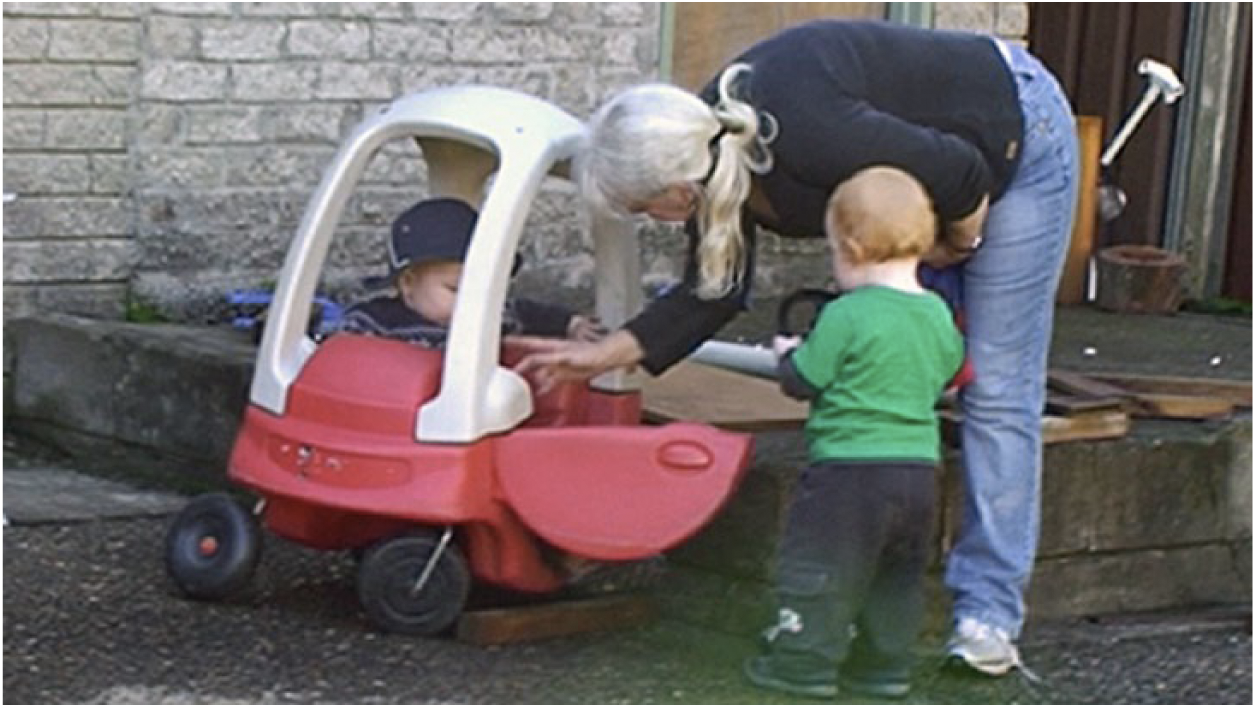
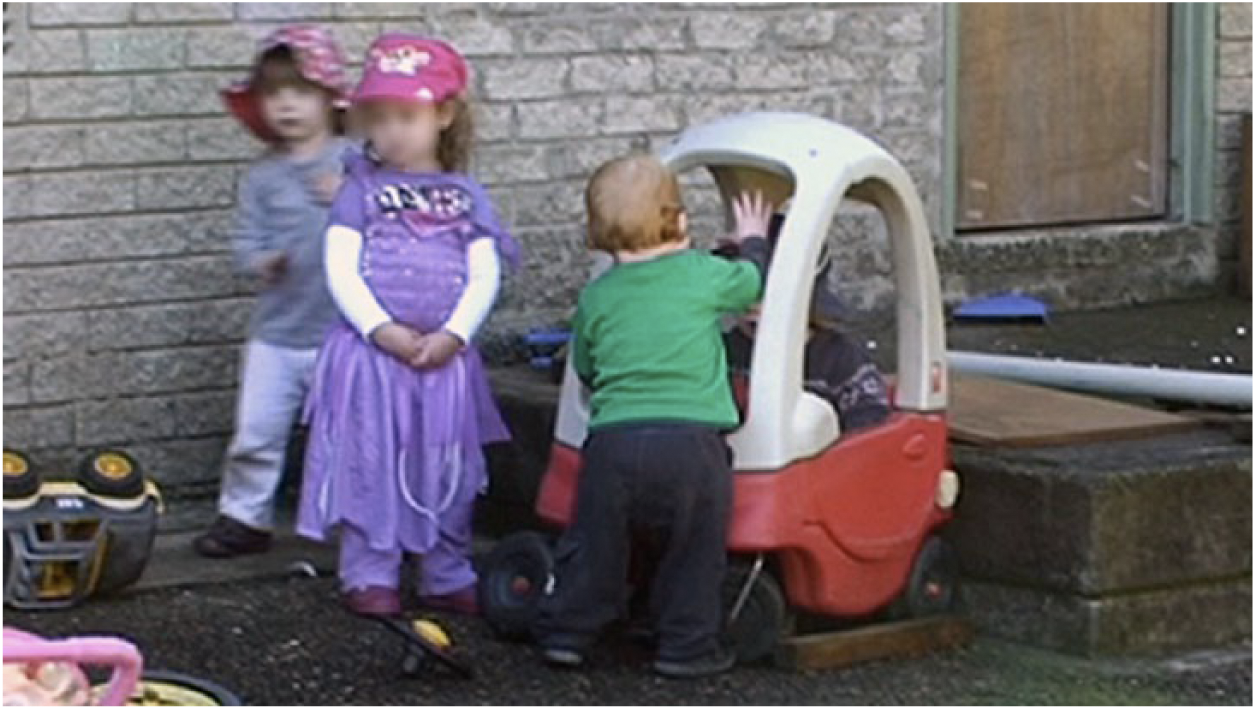
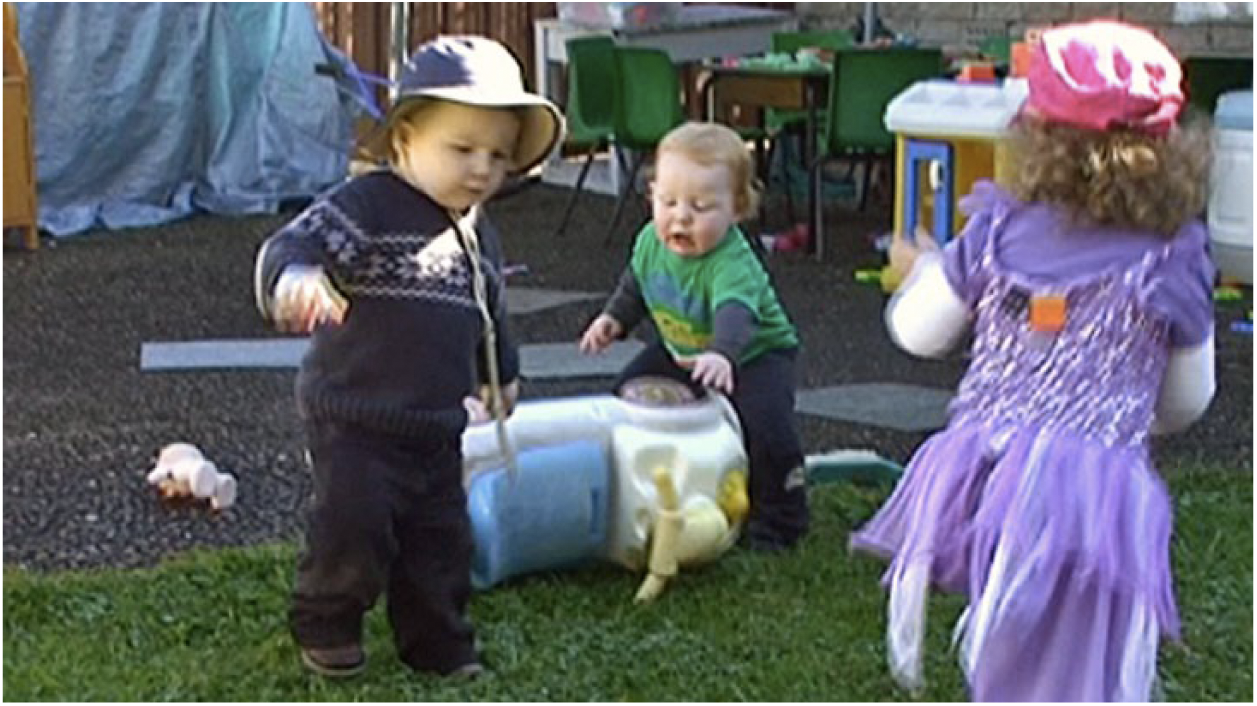
Outside play and Toby (1.9) is sitting on a toy bike. Peter (1.6) approaches and claps his hands together, close to Toby’s face. Toby lowers his head and rubs his eyes before getting off the bike and walking away. Peter climbs on the bike and pushes it forward briefly before abandoning it. Around 20 minutes later Toby is in the red car. Peter approaches, picks up the recently broken steering wheel from nearby and tries to put it back in the car. He leans his body in through the window making growling noises, looking at Cheryl (see Figure 4). ‘Oh, I think Toby’s in there’, says Cheryl. Toby opens the door and turns his body to get out. ‘Toby, you can stay in, sweetie. If it’s your turn, you can stay in and Peter can wait. Do you want to have a turn in the car?’ Cheryl has approached while talking and bends down to speak to Toby. Toby turns his body back into the seat. ‘Yeah?’ says Cheryl, closing the car door (see Figure 5). Peter continues to hold the steering wheel. He walks around to the front of the car, Toby watching him. Cheryl walks away. Peter drops the steering wheel, reaches into the car and hits the brim of Toby’s hat twice, making squealing vocalisations (see Figure 6). Toby gets out of the car and Peter picks up the steering wheel and gets in. After 20 seconds in the car, Peter throws the steering wheel away and abandons the car. He runs across the backyard and sees Toby, this time pulling along a toy bike. Peter approaches, making vocalisations and reaching for the bike. The bike begins to tip over. Toby turns to see Peter and immediately abandons the bike, looking at Cheryl. Peter turns the bike onto its wheels and gets on (see Figure 7). (FDC07-030611-28-TS)
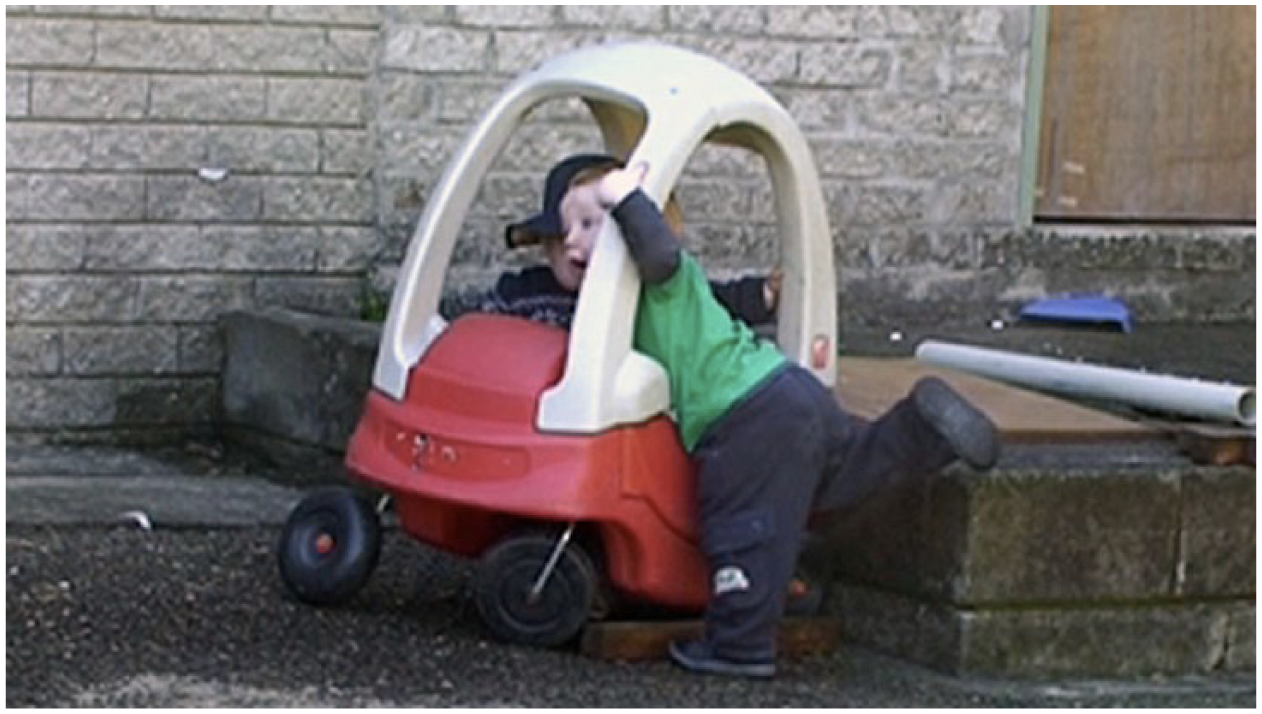
Peter leans into the car.
Cheryl tells Toby he can stay in the car.
Peter hits Toby’s hat.
Toby abandons the toy bike as Peter reaches for it.
Constructing and performing big boy in episode 2
The Peter in this episode is the ‘big boy … racing around the backyard’, very different to the passive, reclining ‘baby’ of the first episode. The material aspects of the assemblage are also very different. The dummy and bottle that expressed baby have been replaced by various ride-on toys that express big boy. The red car was a highly desirable object, particularly among the big boys, as discussed by Cheryl and Peter’s mother in an interview:
Oh, the red car (rolling eyes).
When that was given to me I thought, oh do I want to accept it because we’re going to have all these squabbles and negotiations or do I want to allow them the privilege of having that to play.
The discussion continued while watching footage of children negotiating access to the red car:
I’m surprised that at Hugh’s age (the oldest boy at FDC) he still wants to play in the big red car.
They ALL do.
I know, and whenever you go to anyone’s house and they’ve got one I’m always surprised that the four year olds and the five year olds, they all still try and get, like that’s a hot toy. (FDC07-300911-30-TS)
Just why the red car was such a desirable object is unclear. Perhaps it was simply because it was fun. Perhaps it was because if its exclusivity or because driving a car is associated with adult-ness and power. I suggest the red car afforded Peter the possibility of a new way of belonging at FDC, big boy belonging. This new way of belonging is made possible when Peter interacts with the red car, constructing a new assemblage. The red car affords this possibility because of its meaning within the FDC setting, what it expresses. Deleuze (Deleuze and Parnet, 2006) explains that ‘[t]here is always a social machine which selects or assigns the technical elements used. A tool remains marginal, or little used, until there exists a social machine or collective assemblage which is capable of taking it into its “phylum”’ (p. 52). The red car appears to have been taken up by the FDC collective assemblage as an object of desire that expresses power and big boy status. As Deleuze (Boutang, 2011) describes it, we ‘never desire something all by itself’, we always desire within the broader context of our lives. Through this desire and this new assemblage, Peter creates a movement of deterritorialisation, leaving baby territory and constructing a new big boy territory. Through this deterritorialising movement, the boundaries of belonging that separate baby and big boy suddenly become less stable and distinct.
Once Peter became mobile, the ride-on toys became a possibility for him, an opportunity to exercise his new powers of action. From a Deleuzian perspective, this is positive power and there is joy for Peter in expressing his new found abilities to interact with these highly desirable objects to their fullest. In Olsson’s (2009) terms, this is a new kind of assemblage that Peter is experimenting with at this moment. This new assemblage affords new connections and opportunities for power flows. It is possible, however, that as with episode 1, both kinds of power are at work in this assemblage, powers of action and power over. Peter appears to exercise power over Toby when he repeatedly takes objects from him before quickly abandoning them. These interactions appear to be less about Peter’s desire to interact with the toys and more about denying Toby access to powerful and desirable material aspects of the assemblage, just as at other times he tried to control Toby’s access to Cheryl. The desirability of possessing and controlling access to the red car was something that Peter appeared to learn from the other children. For example, on previous occasions I had watched many complex negotiations over the red car including an incident in which two older boys tried to deny Peter access to the red car through strategies such as pushing it away before he could get in, turning it so that the door was pushed up against a fence and ‘guarding’ the car. Perhaps Peter had learned from the older boys that one way to perform big boy was by controlling access to particular kinds of objects.
There appears to be a complex relationship between power of action and power over in this assemblage. The ability to control another child’s access to these toys is new for Peter. This is a new power of action. Deleuze suggests that the fulfilling of a power of action leads to joy. He also suggests that there is no ‘bad power of action’ but does concede that the ‘lowest degree of the power of actions’ is power over (pouvoir) (Boutang, 2011). Although we might not like to consider it, perhaps there is some joy for Peter in fulfilling the power of action that involves power over another. Deleuze (Boutang, 2011) explains that while fulfilling a power of action leads to joy, ‘all sadness is the effect of a power over me’. Presumably for Toby, sadness is the result of these interactions. It is curious that Toby doesn’t appear to attempt to resist or protest Peter’s actions. Peter wasn’t observed interacting in this way with any other children, so it is possible that Peter was particularly targeting Toby. Perhaps this was because Peter recognised Toby as being similar in age or because he was the newest member of the group. Cheryl felt that this was not the case, but that it was because of personality difference and that Toby was likely to concede with any of the children rather than risk conflict. She wondered, however, whether Peter might have recognised this personality trait of Toby’s and be capitalising on it. Regardless, just 8 weeks after episode 1 in which Toby categorised Peter as baby, in episode 2 Toby appears to accept Peter as big boy without question.
Concluding thoughts
The focus for this article has been how the politics of belonging were at work for Peter at FDC, particularly in relation to Sumsion and Wong’s (2011) three intersecting axes of belonging – categorisation, performativity, and resistance and desire. I have focussed on Peter’s relationship with another similar aged child and how the social categories of baby and big boy were constructed, resisted or subverted, and performed. I conclude with some thoughts in relation to three key ideas that are illustrated by the data: the importance of material aspects of assemblages and what they express, the complex role of desire and power in the politics of belonging for infants, and the dynamic nature of social categories.
Material aspects of the assemblage played an important role in the politics of belonging and, in particular, how social categories were constructed, performed and resisted. Similar to the findings of Puroila and Estola (2014), in Peter’s FDC setting, the children appeared to associate certain objects with either babies or big kids. Being associated with, or actively constructing an association with, particular objects can play a role in the resisting and performance of particular kinds of belonging. The relationship between babies and dummies or bottles seems common sensical, even banal. When the possibility of such objects playing an expressive and territorialising role in an assemblage is considered, they begin to take on new meaning. Likewise, toys such as the bike and red car are an expected part of the FDC environment, one that might not be given much attention. When we ask ourselves what new assemblages this toy makes possible, however, and what this might express, we begin to see them in a new way and realise the influential role they can play in the politics of belonging.
The data suggest that the role of desire and power in the politics of belonging is complex and interrelated with processes of categorisation. Contrary to the notion that Peter, as the youngest child at FDC, might be positioned as less powerful and have little influence on the politics of belonging, the data suggest that power can be available to very young children. Infants have access to both kinds of power, power to and power over, and they can play an active role through power and desire in processes of categorisation, how belongings are performed, constructed and resisted in ECEC. In addition, despite suggestions from previous research from the perspective of older children that the baby category might be undesirable in ECEC, for Peter the baby category had its own rewards and power and was something that he appeared, at times, to desire.
This seems to have been a time of transition for Peter in which he was able to draw on the power and rewards of both baby and big boy belonging, to experiment with many new assemblages, desires and power flows. Cheryl suggested that Peter spent time ‘reverting’, zigzagging between baby and big boy. This seems counterintuitive to more traditional ways of thinking about the development of young children. It is more common to think of children developing through a series of stages. Babyhood is something that is left behind, not something that can be returned to at will. Hickey-Moody (2013), however, uses Deleuze’s work on children and infants to challenge developmental or age-specific ideas of childhood and infancy:
Deleuze’s writings on children offer possibilities for rethinking the process of growing up. Through presenting childhood in a non-teleological manner, as affect and collective subjectivity that zigzag across time, Deleuze invites us to reconceptualise what growing up might be. Rather than leaving one state behind to enter a new one, through Deleuze, childhood mixtures are always possible. (p. 283)
This research has provided insights into the politics of belonging for an infant in a particular kind of ECEC. More research into how belonging works for a range of children in a range of services is important given the importance of belonging for young children’s wellbeing and happiness (Woodhead and Brooker, 2008) and the prominence of belonging in contemporary ECEC curriculum frameworks. I argue that such research would benefit from paying attention to the material world of the children, flows of power and desire, and the complex and dynamic nature of processes of categorisation.
Footnotes
Acknowledgements
Thank you to the Infants’ Lives in Childcare team and in particular my PhD supervisors Professors Jennifer Sumsion and Ben Bradley for the many collegial discussions of the data. Thank you especially to Peter, Cheryl and their families for their generous participation in the research.
Funding
The author(s) disclosed receipt of the following financial support for the research, authorship, and/or publication of this article: I gratefully acknowledge the support of the Australian Research Council Linkage Project LP0883913. I am also grateful for the financial and practical support of Industry Partners, Family Day Care Australia and KU Children’s Services.