




Abstract
Childhood states are commonly invoked by adult humans in derisory ways and as put-downs. While infantile and clownish ways of behaving are often met with insult, we argue that these ways of being could instead be seen in terms of their productive potential. Drawing on posthuman and feminist theories and invoking clownish qualities of Haraway’s Bag Lady, we explore affinities between the figures of clown and toddler. This challenges a history of childism that constructs child as a less-than-adult, proposing instead, that the figure of child as inherently developmental and progressive is inextricably linked with how we conceive of the category of human. Making the case for the more-than-Adult toddler, we explore ways that clownish antics intersect with toddler ways of be(com)ing. This helps us to reframe the less-than child (not-yet human subject) as a figure of potential through animistic becomings-with the world that spill beyond the bounded individual and self/other binaries. We use this as a decolonising strategy to undo bounded and linear constructions of early childhood. The common antics of both toddlers and clown are explored in terms of how they might productively inform the co-production of improvisational pedagogic practices with young children.
‘Oh, grow up!’
‘infantile’
‘stop being childish’
‘don’t be silly’
‘what a clown!’
‘Only grown-ups think that the things children say come out of nowhere. We know they come from the deepest parts of ourselves’.
Children and childhood states are commonly used by adult humans in disparaging terms. To lampoon an adult by comparing them to child/baby/toddler is intended as insulting. It is an insult often invoked by political commentators in relation to populist politicians such as ex-US President Donald Trump and UK Prime minister, Boris Johnson (e.g. Devega, 2020; Hyde, 2020; Thomas, 2021). To be childish and immature are derisory terms used to describe adults who are deemed to be lacking, unformed, behaving badly, irrationally and selfishly. While being silly is disapproved off in the everyday lives of children, the tropes of the egotistical/ irrational baby/infant are ones stitched into Adultist foundational figurings of the infant in developmental psychology and scientific research. This not fully human childish child is so ingrained in our language, speech and thinking, that it is often hard to think child(ish) differently. In this paper we will align ourselves with a ‘childist’ (Wall, 2019) turn in scholarly and social imaginaries that seeks to challenge the dominance of adult social norms. In this endeavour, we try to work productively with Murris and Osgood (2022), who suggest that to do this we also need to call into question how we configure the human so that we can refigure the category of the child. Following Castaneda in Lindgren (2020), we will use the term the ‘figure’ of child to distinguish it from the fixed and categorical notion of the child of Man (Kromidas, 2019). Accordingly, the concept of figuration can both help us to understand how child ‘is figured as the adult’s ontological origin, as a not-yet subject’ (Kromidas, 2019: 916), as well as to give form to new figurations. Considering the figure of the toddler alongside that of clown, we explore how the dimension of not-fully-subject might be seen as productive, rather than as a lack.
The focus of this paper is ways that the figure of the toddler sits in a curious proximity to the figure of the clown: another figure used to deride those in power (one that has also attached itself to both Trump and Johnson (e.g. Harvey, 2021; Kaplan, 2020; Mudie, 2021; Williams, 2019). We will suggest that the clown figure has, in common with the figure of the toddler (a word that is derived from ‘to toddle’ meaning to walk unsteadily), the capacity to embody a more-than-human potential which comically disrupts Adultist ways of knowing (Delpech-Ramey, 2010). Bakhtin (1981) noted that the figures of clowns, fools and rogues create special little worlds around themselves and inhabit their own timespace (‘chronotope’). While Bakhtin’s rogue, with his cheerful deceit is, perhaps, a good fit for Boris Johnson; clowns and fools exercise a right to be ‘other’, to not understand convention, to confuse, parody, and to muddle with the prevailing culture, as ‘they see the underside and falseness of every situation’ (Bakhtin, 1981: 159).
Just as Bakhtin’s (1981) fool exhibits an ‘unselfish simplicity and [. . .] healthy failure to understand’ (p. 162) while his clown figure parodies, disrupts and exposes convention, falsehood and power, Kennedy (1989) suggests that the animistic onto-epistemology of clowns, artists and children ‘announces what has been left out of the grown-ups’ bargain with time, self and world picture’ (p. 374). It is the worlds of clowns, fools, and young children that we explore in this paper. In particular we are interested in how both clown and toddler undo some of the fixed boundaries of Adulthood and this in turn disrupts how we think of ourselves as human. We will follow the generative promise of awkwardness (Lorimer, 2014) and the concept of the inhuman clown (Delpech-Ramey, 2010) to ‘dismember the unity of subjective experience’ (p. 133). In so doing, we acknowledge a longstanding critique of an ‘adultism’ that underpins developmental understandings of childhood (Desai, 2010).
There are, we think, serial affinities between clowns and toddlers. Ones that we would like to note are: sites of practice; corporeal modes of behaviour; non-verbal language making; relationships to time and the present moment; open-ended playfulness; and animistic relationships with objects. Taking inspiration from the concept of ‘childism’ that repositions childhood studies beyond an effort to include the child’s perspective, we are interested in how this might offer a ‘critical lens for deconstructing adultism across research and societies and reconstructing more age-inclusive scholarly and social imaginations’ (Wall, 2019: 1). We recognise that in some respects we align ourselves with the focus that Biswas (2021) brings to the corporeal and temporal capacities of toddlers, which allow us to re-position ourselves as ‘pedagogical addressee[s] in relation to children as temporal others’ (p. 288) in order to ‘influence’ our thinking and practices. In this case, however, alongside the toddler, we also think with the figure of the clown. We do this to suggest that the more-than-Adult child, like the figure of the clown, challenges tragic adult-ist constructions of infants which position the adult as ‘I’, an ‘I’ that is privileged over the ‘we’, the enduring ‘indivi-dualism. . .the story written in our [Adult] bones’ (Murris, 2016: 46).
The insult of being less-than-Adult
When we depict an adult such as ex-US president Donald Trump (arguably behaving unethically, selfishlessly, ruthlessly and stupidly) as a tantruming toddler, we not only disparage toddlers and childhood states, but perhaps at the same time we somehow also let these badly behaving adults off the hook. A harmful misuse of power is somehow softened and excused by the harmless corporeal and affective qualities of their silliness or stupidity. While UK Prime Minister Boris Johnson is ridiculed by the media for behaving like a child, simultaneously, it is his roguish tactics of awkward, shambolic buffoonery that seem to derail accountability for his off-the-cuff racist remarks. This allows him to evade proper debate with his more serious (and therefore less popular) opponents. However, while noting the figures of the cheerful charismatic rogues, we turn to clowns and fools and their indifference to human destiny and essentialism and their affinity with toddlers. It is this resonance that we take as our methodological starting point to explore what happens when we use the figure of the clown to think about the figure of toddler as more-than-Adult.
The ways in which the figures of clown and child both are deployed to disparage and dismiss, echo the ways in which figures of female, black, queer, neurodiverse, people (as well as animals) are used as insults. Kromidas (2014) notes ‘At one time or another, so-called savages, racialized Others, women, children and animals have all been conscripted outside the boundaries of “the human”. Only animals and children remain’ (p. 5). While colonised figurations of the child provide insult against the white Man – the yardstick of a fully (hu)Man, rational and sovereign subject, it is worth remembering that clowns never wanted to be part of the Adult club anyway! The clown/fool exists to disrupt and antagonise hegemonies in the world (Kennedy, 1989). If a child is less-than-(hu)Man, a clown is inhuman (Delpech-Ramey, 2010). Clowns are not of this world and possess ‘their own special rights and privileges’ (Bakhtin, 1981: 159). In spite of this difference, we offer toddler/clown onto-epistemologies productively as animistic and relational. In this case, the negative less-than-adult figuration of toddler, is reframed positively as possessing more-than-Adult qualities. We will also think with the (often derided) figure of the Bag Lady (Haraway, 2016; Le Guin, 1989) a clownish female figure who works with awkward, nomadic, comedic onto-epistemologies that disrupt the tragic (hu)Man Adult.
More-than-Adult
We have used the capitalised term Adult in a similar way as Man is used by both Wynter (2003) and in feminist posthuman theorising (Braidotti, 2013) to depict a White, hu(Man), anthropocentric figure who ‘teaches us that a body begins and ends in a skin envelope we can readily perceive’ (Manning, 2016: 114). The child of Man (Kromidas, 2019) accordingly is taught to background the intuitive and the relational, and instead, to foreground the rational and the individual. With Manning (2016) and Abram (2010) we suggest that over time young children’s animistic onto-epistemologies are traded for the agency that comes with Adulthood and so is reduced (through language) to singled out objects and subjects. ‘Again and again in young childhood we are given instructions that assist us in differentiating our skin from that of the world’ (Manning, 2016: 114). We use the term more-than-Adult in similar ways to the eco-philosophical term ‘more-than-human’ (Abram, 1996). In this understanding the child becomes more-than: more multiplicitous and more relational than the singular and individualised Adult. Haraway (2016: 30) asks of us: what happens when human exceptionalism and the bounded individual become unthinkable? In response to this question, we playfully think instead with the figures of toddler and of clown towards a more-than-Adult becoming.
We wonder how we might sense and learn from toddlers, and how this might intersect and overlap with the clown performance practices of improvisation, contemporary clowning and complicité (MacRae and Arculus, 2020). Invoking the figure of the ‘inhuman’ clown (Delpech-Ramey, 2010), we consider the practices of clowning as connective, disruptive, playful, de-anthropomorphising and potentially decolonising. Reflecting on how the intersections of figurations of clown/toddler are currently influencing Charlotte’s (author 1) creative and pedagogical work, we explore the transversal practices of improvising artists who work across art forms. Complicité, conversation, movement, gesture, affect, the sonic and the material, are all aspects of practices that draw on contemporary clowning (Lecoq, 2000; Peacock, 2009) and they expand on collective, rather than self/other emergence (MacRae and Arculus, 2020; Manning, 2009). A significant hallmark of this work is the talk-free encounter and the ethics and aesthetics that working without words affords. Drawing on clown tactics of (k)not-knowing (Osgood, 2020), and a tentacular sensing (Haraway, 2016), Charlotte is interested in how clowning practice, which lowers the adults’ status, nurtures a deep curiosity and makes space for emergent more-than-Adult ways of knowing.
Clown/toddler affinities
“the comic vision would imply that a certain inhuman excess is always already the essence of humanity” (Delpech-Ramey, 2010: 136)
The figures of the clown (and fool) are used to depict the inept, the contemptible, sometimes the scary, and even the evil. However, the practices of clowns have a deep and anomalous history reaching from beyond western traditions. The clown is an improvisor, carrying global associations with shamanism and ritual, an adult who can play to order and enter a state of presence and emergence that is both childlike and animistic, serious and frivolous (McConnel Stott, 2009; Peacock, 2009; Turner, 1982; Wright, 2006). Bakhtin (1981: 163) notes that clowns and fools are granted the right to not take part, to confuse and confound the order of things. Their disruptive refusal and inability to abide by rules cuts through the hegemony of the reasoned, Adult world exposing its absurdities. Delpech-Ramey (2010) understands the clown as exceeding the human and in particular, resisting Man’s tragic heroic sense of destiny. Indifferent to power and fate the figure of clown creates disorder through mockery of status and authority. This parodying makes another world where Adult power and ‘dignity is literally a joke’ (Delpech-Ramey, 2010: 134). Without the determination of an Adult, the clown lacks purpose, continuously forgetting what they are supposed to be doing and instead becomes entangled with a ‘nonhuman world of objects’ (Delpech-Ramey, 2010: 133). These things ‘use up human energies for no humanly discernible purpose’ (Delpech-Ramey, 2010: 133) making the clown’s business one that dwells in the present time, resisting both destiny and history, and creating its own timespace. Clowns are compelled to follow a more-than-Adult call through deep, uncontrollable relationships with things. They interrupt, transgress, subvert, interact with things that continuously lure them in incompetent or transversal ways. They exist as improvisors, untethered from plans, goals or objectives, living instead in an on-going unfolding present.
Clowns are made from Adult material but they express something more-than-Adult by tapping into child/animal/thing onto-epistemologies. They have developed ways to enter states of an unlearning that are time-less – as Walter Kohan puts it; a form of ‘childing’ (Kennedy and Kohan, 2008: 11). This is perhaps why such corporeal and affective, more-than-human kerfuffles happen around clowns, and why the ordinary becomes extraordinary in ways that defy meaning yet take on an anarchic sense-production (Martín-Bylund, 2018). Clowns puncture Adult normalcy, turning things on their heads or sideways revealing ‘the underside of what is being carefully avoided by normal people’ (Kennedy, 1989: 374). The toddler, like the clown identifies with a non-human world of things and is drawn to an obscure lure within things beyond human will or desire (Delpech-Ramey, 2010). For philosophers Guattari (1995), Abram (2010) and Manning (2012), whose theory/practices have close associations with temporal art forms and improvisation, this toddler way of knowing is not a developmental stage that is left behind and consigned to the past, but rather something that remains with us continuously throughout life. According to Guattari, who hung out with clowns (Thierrée, 2012) and who, like Manning, draws on Stern (1985) to explore the leaky and porus emergent self of very young children, this infant ‘self’ ignores oppositions of subject-object and self-other and exists ‘in parallel with all other self-formations and will haunt the adult’s poetic, amorous and oneiric experiences’ (Guattari, 1995: 66). We note how this state is also tapped into by clowns as they attend to the lure of the world and its more-than-Adult magic.
Clowns and toddlers embody both a corporal expressiveness combined with a faltering awkwardness. Løkken (2009) notes how gait is a part of toddler ‘style’ and that: ‘toddlers present themselves and are perceived in terms of corporeal motion’ (p. 35). A lack of familiarity with shoes/clothes that fit awkwardly affect movement and gait in both toddlers and clowns. Thinking with Lorimer’s (2014) notion of awkwardness and its distinct affective logics, we agree ‘that there is great ontological, epistemological and political promise in awkwardness’ (p. 204). We suggest awkwardness forms a key part of the clown’s potential to resist Adult aspiration and endeavour. The awkward register of the incompetent clown and toddler, clumsy yet transversal in its mode of corporeal thinking is, as Lorimer reminds us, ‘also to be generative, productively troublesome’ (Lorimer, 2014: 196). Løkken (2009), drawing on Merleau-Ponty (1962), understands the awkward, toddler body as anonymous and worldly. This low to the ground, leaky, flexible and bouncy body expresses its existence, and embodies intersubjectivity in response to, and called by, other toddler bodies and the world. We are reminded that size matters. Løkken describes toddler style as a social and corporeal communication between toddler body-subjects. Toddler style ‘also contains the children’s spontaneous utilization and inclusion of the means at hand, such as their own bodies, the actual space they are in and the general objects of that space’ (Løkken, 2009: 37). Through the motility of the awkward toddling body, children act and are acted upon as they playfully and clownishly jump, stumble, fuffle, fall, crawl, turn and run together. Lorimer understands this relational bodily awkwardness to be ‘premised on a knowing co-presence or felt connection [. . .] It makes little sense to talk of a non-relational awkwardness’ (Lorimer, 2014: 196).
Adultism/wordism
We will now consider the onto-epistemological status that language is granted and the consequential lack of status that absence of language is given whilst holding the figures of child and clown in mind. Following Barad (2003, 2007), MacLure (2013, 2016) and Abram (2010) we are interested in the potential in flattening the hierarchies and colonised discourses that privilege the status of language. We pay attention to children and clowns to sense and feel what other ontological conceptualisations might become tangible when language does not dominate.
With Viruru (2001), we ask, ‘what is lost when language is gained?’ (p. 31). The historic, progressive assumptions that underpin how we think about the development of children’s language and communication render the language-less child as somehow incomplete (Gallacher, 2005) and less-than-Adult. The term infant is etymologically related to language, and frames infancy precisely on the premise that to be without speech is to be without intelligence (Murris, 2021). Constructions of not-yet-speaking children as primitive and lacking any real knowledge or understanding of the world are a commonplace developmental trope (Gluschankof, 2019; MacLure, 2013) where speech is used as a measure to divide the barbaric child from the civilised proto-Adult. Leal (2005) notes that western history and society links childhood’s absence of experience as something deprived of its highest value, leading to the idea that the Adult universe must complete the child with what the child lacks (p. 113). In Leal’s (2005) words: ‘children have been educated much more in the interests of their submission to the rules of an adult centred world than to their own possibilities’ (p. 114).
Hu(Man) language and its problematic association with thought is the medium most fundamentally associated as making truth claims possible (Barad, 2003; Cannella and Viruru, 2004; MacLure, 2016). No language (or the wrong kind of language) becomes equated with lack: as underdeveloped thought, lack of substance – or the wrong kind of thought and substance. It becomes a tragic failure of Adult endeavour. Hence the figure of the (tantruming) toddler, deployed as Adult insult, denotes irrationality and carries a negative charge. Delpech-Ramey counters this story, by drawing our attention to the clown’s positive capacities to think beyond our individualist, subjective definitions of life, that are tragically limited to a single destiny and death. A clown makes thinking from infinite perspectives beyond the human possible (Delpech-Ramey, 2010: 140). Kennedy (1989) understands the Fool’s babbling and playing as revealing the ‘secret language of the world’, a language that cannot be revealed any other way (p. 374). We suggest, with Abram (2010) that the child can also be reconfigured as a more-than-Adult thinker, able to open up possibilities beyond the individualised subject and already, like the clown/fool, in conversation with the world beyond the human. Abram (2010) (who has worked as a magician, arguably a form of clown) notes how language begins to capture a child’s senses, creating a rupture between ‘her speaking self and the rest of her speaking sentient body’ (pp. 38–39). Murris (2016) suggests that we can radically rework conceptions of the child ‘by removing language as the main hub of knowledge production’ (p. 46) and with it the fully-human, language speaking, individualised, Adult as the sole producer of knowledge.
Clowns do not typically work with language. Clowning has never been a verbal form, but it has always been a nomadic one (McConnel Stott, 2009; Peacock, 2009: 24). Techniques and games for creating contemporary, improvised clown performance (Johnstone, 1981; Lecoq, 2000; Wright, 2006) use movement, sense, and affect to cultivate a distributed subjectivity or complicité (MacRae and Arculus, 2020) between players and between players and audience. These practices and the productions eschew spoken language in favour of different kinds of connection and conversation. Without verbal capacity (or sense of purpose), groups of toddlers and troupes of clowns will find a multitude of ways to do activities together and with the world. Observing toddlers Løkken (2009) recognises this un-Adult toddler style in ‘playfully varied ways of running, jumping, trampling, twisting, bouncing, romping, shouting, and falling and laughing ostentatiously’ (p. 36). Through this exuberant activity, rituals and routines are created, and friendships and peer cultures are built on an always emergent complicity-in-action. The non-human material dimensions of space also become complicit in these toddler style rituals. Løkken (2009: 36) notes how running between curtains, licking tables and paper, tapping boxes, kicking walls, falling to the floor become expressions of intersubjective celebration. Clown style involves similar corporeal and material encounters. Clown troupes develop their styles through finding non-verbal corporeal games together. This offers us ways to think about communication and conversation that do not privilege language and verbal speech acts but instead foreground a ‘mutually transformative sense of unfolding collective action’ (MacRae and Arculus, 2020: 43). When clowns and toddlers actually do play with the sound and rhythm of words, they draw our attention to the gestural and affective aspects of speech through their babbling. They invent languages, playfully utilising everything around them. The clowninsh art of developing complicité involves allowing our (adult/clown/toddler) bodies into awkward encounters with others. As Lorimer (2014) notes awkwardness ‘requires a mutual vulnerability and a sense of disconcertion’ (p. 196). As such complicité involves moving through the awkwardness of discomposure as the boundaries of our individualised and separate selves give way to sensing and feeling the collective and common becoming.
Bag Lady clowns
We now turn to Le Guin and Haraway for feminist concepts to methodologically work-with and think-with clowns and children. We also note associations here with Osgood’s (2021) reading of the flâneuse. While the flaneur is a ‘male figure of privilege and leisure, with time and money to amble around the city to be inspired by urban spectacle’ (Osgood, 2021: 56), the flâneuse has associations with prostitution, destitution and homelessness, which do not correlate with the dandy artist figure of the flaneur. The flâneuse is ‘required to blend into her surroundings, to attune, and to find ways to stretch her imagination, to grasp the contours of a world that becomes unfamiliar on close inspection’ (Osgood, 2021: 56). We welcome in here the figure of the Bag Lady, and work with Le Guin (1989) and Haraway’s (2016) carrier bag theory. These help us to ward off tragic, Heroic narratives or ‘Prick Tales’ (Haraway, 2016: 39). Bag Ladies are also clownish characters, assembling heterogenous components without a driving need, a clear outcome or a sense of purpose. Bag ladies experiment with putting unlikely and disparate things together in ‘particular powerful relationships to one another, and to us’ (Le Guin, 1989: 169). The figure of the Bag Lady is also used, like clown and child, as an insult. ‘Old Bag’ is a misogynistic, ageist term levelled at women. Here, we put clown, toddler, bag lady and politician together with language, not talking, animism, philosophy, art. Telling stories with collected things is a methodological carrier bag; sometimes working diffractively (Barad, 2007); sometimes thinking tentacularly (Haraway, 2016); and always working relationally (Le Guin, 1989; Tsing, 2005). Haraway (2016) encourages us to make carrier bag narratives that are ‘wonderful, messy tales to use for retelling, or reseeding, possibilities for getting on now’ (p. 119).
A Bag Lady relationship with the world deprives us of our anthropocentric and developmentalist tragic hero tales of a particular kind of knowing. Bag Ladies, like clowns, resist the linear, transcendental knowledge of Man in favour of a nomadic and mutable knowing ‘that is neither resolution nor stasis but continuing process’ (Le Guin, 1989: 169). Le Guin (1989) notes that the ‘Hero does not look well in this bag. He needs a pedestal or a pinnacle. You put him in a bag and he looks like a rabbit, like a potato’ (p. 169). According to Delpech-Ramey (2010), tragedy is bound up with a human exceptionalism, ‘a sublime set of unrealized potentials, a reserve of meaning and truth that would be, but never actually is, the fulfilment of human purpose’ (p. 134). Comedy on the other hand is the ‘incursion of the infinity of objects upon subjective finitude’ (Delpech-Ramey, 2010: 134). The Bag Lady gives us a figure who inhabits the messy comedy of myriad bag juxtapositions rather than wielding a linear arrow of domination.
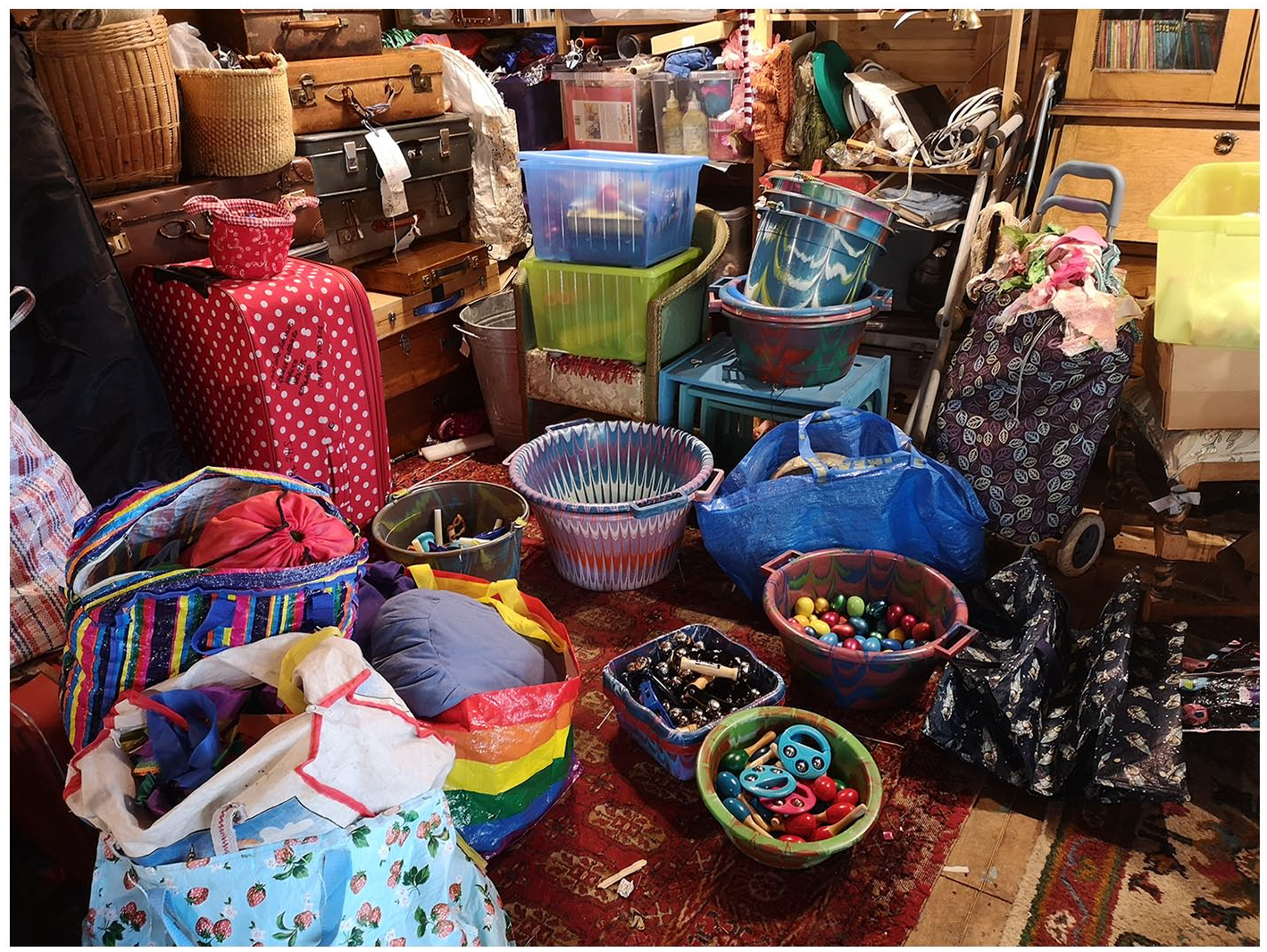
It is explicit intention in the work of both Charlotte’s More than Words doctoral research, as well as her ongoing work with Bag Lady colleagues (see acknowledgements) to create a kind of contagious knowledge/reality exchange with young children through carnivalesque (Bakhtin, 1984) encounters involving gesture, sound production, musicing, movement, material, objects and space. These practices adopt playful, improvisational, arts practices with young children, educators and parents where talk is discouraged. These are practices that are entangled with contemporary clowning (Wright, 2006) and improvisation (Johnstone, 1981; Lines, 2017). These talk-free time-spaces offer the possibility for child/clown animistic onto-epistemologies to arise without being shut down by Adult words that name, describe, narrate and question. They offer a potential exceeding of subjective experience where self/other inside/outside dissolves through practices of complicité (folding together), conversation (turning-with-together) (MacRae and Arculus, 2020) (Figure 1).
Bags (Charlotte’s studio).
Charlotte and her Bag Lady colleagues’ immersive practice quite literally involves copious amounts of bags, suitcases, containers and boxes. Not only do the bags move between the different time-spaces of events, but the contents of these bags are always changing through a process of ongoing (re)assembly. If we want to know what things can do, what they are capable of, we introduce them to toddlers. These bags contain things that lure, offering potentials for powerful juxtapositions. We have learned that whatever we think might happen when we un-pack our bags with toddlers, generally doesn’t happen. Uncertainty is the name of the game; to work with toddlers is to work with immediacy, improvisation and mess. Bags are packed, transported and unloaded, to create spaces of encounter where outcomes are never known in advance and never turn out the same. In these spaces, there is no single point of focus, just open-ended materials, often in multiples to be unpacked, arranged, sounded, rummaged, thrown, moved through. This corporeal relationally of the space between not only toddlers, but also the materials, bags, sounds and space that work on each other/us, becomes tangible as we start to sense the onto-epistemological shift out of our Adult ways of knowing.
In this Bag Lady practice, the removal of language (adults are asked to reduce words) is a key strategy that undermines mastery narratives that close things down. We suggest that not-talking honours the diversity of onto-epistemologies. However, for Adults, there is an awkwardness around entering into this contagious, corporeal world, stripped of its words and symbology. To become-clown/toddler is to relinquish logics and grown-up narratives as well as words; to move in awk-ward directions rather than for-ward (Lorimer, 2014). We lower our status as a deliberate practice, so that becoming-foolish becomes a gesture of welcome.
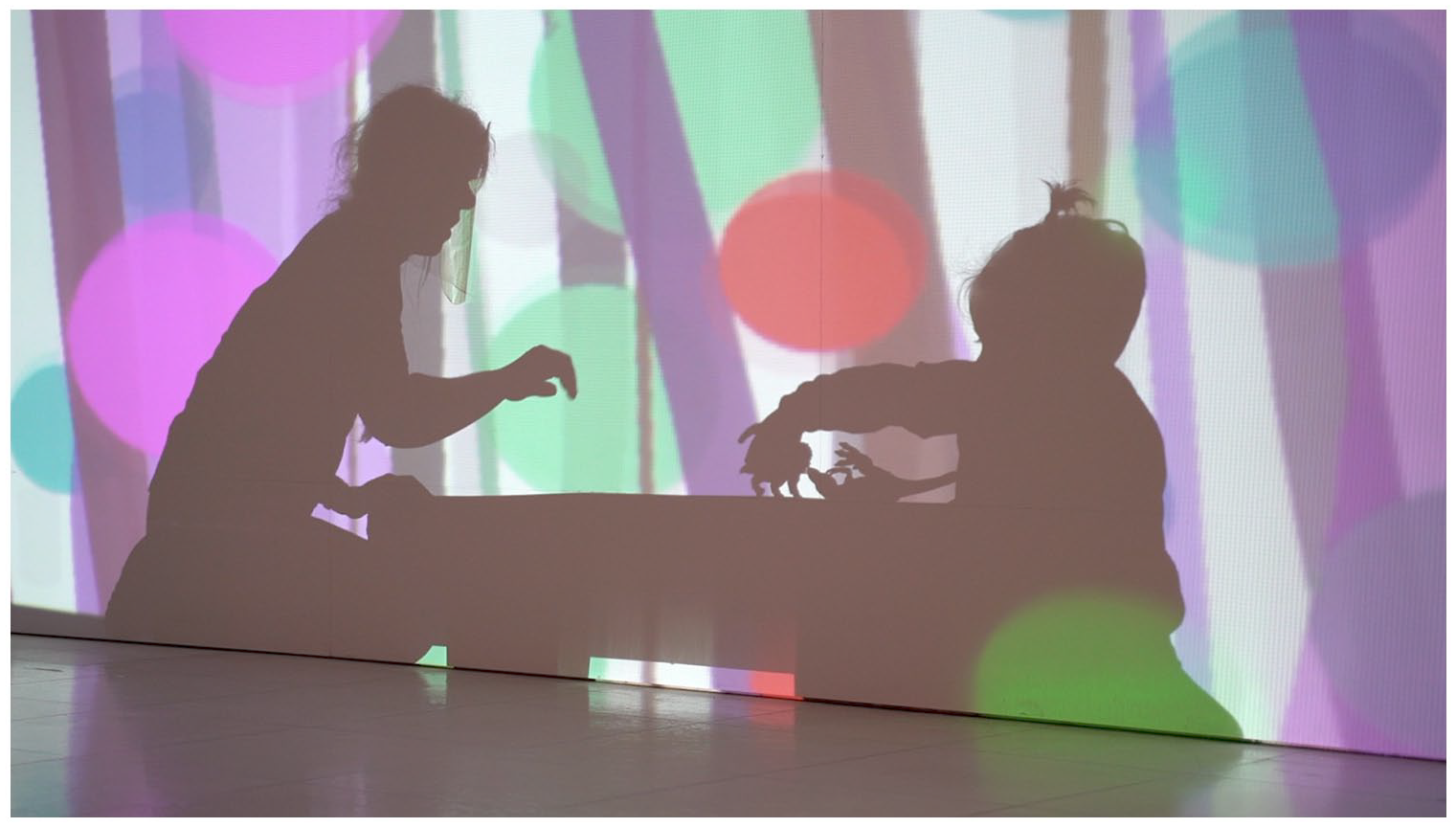
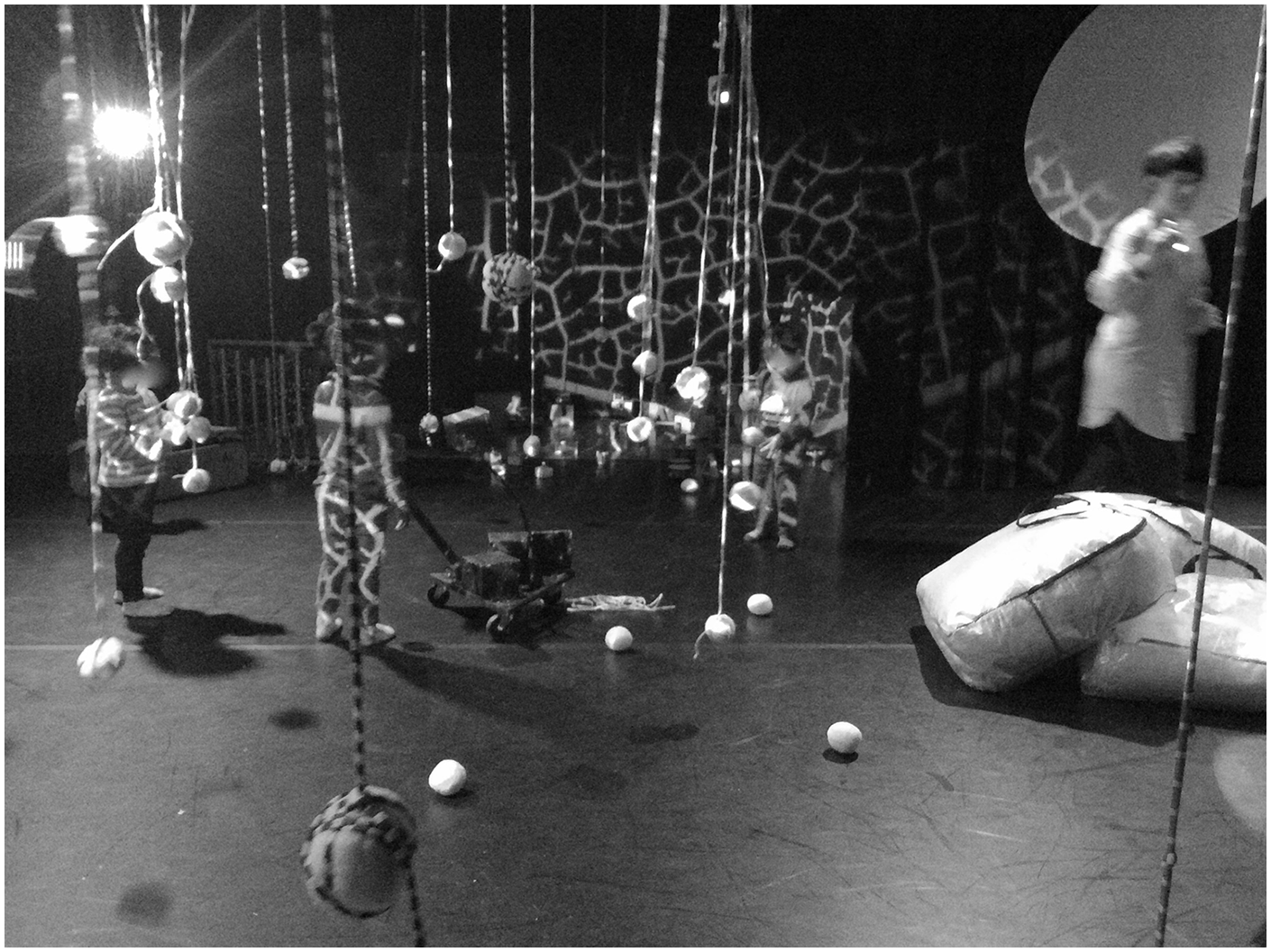
Charlotte’ s doctoral installation More than Words set in a university black box theatre and more recently In Between Spaces (Magic Acorns, 2021) a takeover of a disused department store, were, in Bakhtinian terms, carnivalesque spaces where a ‘temporary suspension of hierarchical rank generated a special type of communication impossible in everyday life’ (Bakhtin, 1984: 10). Neither spectacle nor performance, everyone, no matter how awkward, is accepted. To be open to this requires working with and celebrating uncertainty, as noted by Charlotte; ‘To prepare, we developed complicité, we playfully imagined journeys, held possibilities lightly and trusted (and hoped) that everything would go off-piste as soon as the children arrived’ (Arculus, 2021: online) (Figure 2).
In between spaces (Magic Acorns, 2021).
Biswas notes that ‘[B]eing-with-children can enable philosophical clearings for adults to re-cognise plural temporalities, as opposed to a singular clock-time perception of time’ (p. 289). Deep hanging out (Walmsley, 2018) with children can make more-than-adult perceptions of spacetime tangible. In these spaces children teach us how to be better clowns, and how foolish refusals of Adultism open up an ethics of uncertainty, undercutting epistemological hegemony, and unfolding the time of now. We relinquish our Adultness to improvise and ‘join with the world’ (Deleuze and Guattari, 2013: 363). We suggest these carnivalesque, word-free, spaces have a decolonising potential that offer a way to become more-than-adult. Within and during both More than Words and In Between Spaces installations colonising Adultist practices give way to the clownish, playful practices of Bag Ladies. Key to this is the reduction and removal of talk. Parents, educators and artists, stripped of talk, pass through awkward thresholds to arrive in a place of uncertainty where practices can be potentially transformed and reimagined. Without talk, all participants become more embodied and relational and this is a vital part of what it means to live and work with children. With Hackett et al. (2021), we agree that what is at stake here, is ‘the ways in which adults and children are moved by a more-than-human milieu, caught up in something bigger than themselves, and how this affects how bodies feel and relate to each other’ (p. 14).
Both installation projects, More than Words and In Between Spaces were created with diverse communities whose children are often problematised in terms of their delayed development. We think that the carnivalesque nature of these installation spaces has the capacity to undermine these framings and expectations. The sense in which the event space belongs to the whole people, and everyone is in it, differences of age, class, colour, neurology become aggregated (Saldanha, 2010) rather than hierarchised. Differences, rather than being homogenised or ignored, become activators of a carnivalesque rumpus, within which the agentic and relational onto-epistemologies of toddlerhood is celebrated (Figure 3).
More than Words (2019).
Conclusion
Responding to the call in this Special Issue we have thought-with and played-with clown/toddler affinities as a way to counter Adultist and developmental figurations of the young child. This has helped us to resist humanist child/adult binaries that are founded on the assumption that children are adults-in-waiting and, inspired by Kromidas (2014), it has assisted us in starting to work towards posthuman imaginaries. Adultist constructions are entangled with colonial constructions of what it is to be a (hu)Man subject and are tightly bound up in a privileging of language (Cannella and Viruru, 2004; Gallacher, 2005). As Kromidas (2014) notes; ‘humanism does not recognize that which cannot be articulated, that is not based on a rational or logical calculus, that is not cognitively-based’ (p. 434). By putting toddlers, clowns and Bag Ladies side-by-side we have attempted to begin to reconfigure what it is to be human. Thinking toddler-through-clown and clown-through-toddler has allowed us to think productively about the more-than-Adult qualities in toddlers, and the in(hu)Man dimensions of clown ways of behaving. This re-figuring has depended on a rejection of the (hu)Man ‘as it has been narrated and recuperating the human’s remainder into a new construct that can be signified with the posthuman’ (Kromidas, 2014: 434).
We have discovered that the figures of the tantruming Trump toddler by anti-Trump protesters, or Boris Johnson’s roguish playing of the awkward clown have interesting and ambivalent effects and affects with regard to Haraway’s Prick Tales. What makes Johnson’s antics popular is often ascribed to a personal charm, but thinking with the in(hu)Man aspects of the figure of the clown, we wonder perhaps if this is a more-than-(hu)Man charisma that carries a certain more-than-(hu)Man magnetism. This magnetism carries, perhaps, a similar charge to the curious frictions adults sometime encounter in the face of toddler ‘silliness’: while we may feel the need to express disapproval, it simultaneously makes us smile, even as we might try to repress our laughter. Connectedly, we wonder if there is a comedic potential to disrupt the tragic narratives of developmentalism in education and to think about the capaciousness of non-teleological becomings and collective and distributed subjectivities of early childhood (Hickey-Moody, 2013).
Western logic has always favoured Tragedy over Comedy. But the high and lonely destiny of human exceptionalism is made absurd by the clown. With Bakhtin and Delpech-Ramey, we recognise the clown and the carnivalesque are disrupters of tragic/comic, self/other, life/death, real/ideal, interior/exterior binaries. This helps us engage positively with the differences between bodies. We suggest, with Bakhtin (1984) that clown practices (and we tentatively include Charlotte’s installations) occupy a ‘borderline between life and art’ (p. 8). These can help us to physically embody the animistic zone between binaries of adult(culture)/child(nature) and human/nonhuman. Within this space the onto-epistemologies of children, animals and matter (the dispossessed Others), begin to enter our senses, and sometimes undo the edifices constructed by the ‘fold of knowers’ which has excluded all but Man for the last 2000 years (Barad, 2007: 378).
Welcoming our foolish and awkward multiplicities is an embodied practice of refiguring the toddler/clown through the posthuman. It helps us engage with young children in non-verbal ways that challenge ‘the traditional way that humans have been conceived and the anthropocentrism of humanism’ (Kromidas, 2014: 2). Acknowledging that what children know and say comes from the deepest parts of ourselves (Hooks, 1996) sees potential in toddler onto-epistemologies – what Guattari (1995) and Stern (1985) termed an emergent self and what Manning (2009) thinks of as a leaky and porous self – that exists in parallel with our own grown-up self-formations. The magic of Bag Lady practices, carnivalesque and talk-free installation spaces is not that they make the world any more or less magic for children, but that they are spaces of Adult uncertainty, places where Adults don’t know best, where Adults become more-than-Adults, re-trieving the timespace mattering of toddlerhood. As such they act as decolonising spaces. This activates a posthuman rethinking of Adult (hu)Man through the toddler, ‘a new vision of the human being in the world’ (Kromidas, 2014: 247).
Adult tales of human exceptionalism are woven into young children’s educational narratives of fulfilling (future) potential, developing a sense of purpose, and having a strong (fixed, definable) identity. With the discomfiture of linguistic-free, corporeal clown logics, concepts such as destiny, knowability and purpose are replaced by awkward as a vector (Lorimer, 2014) of unfamiliarity, disjunction, incompatibility and also humility, conviviality and humour. We wonder what the comedic arts of Bag Ladies and a carrier bag theory of education might bring to unsettle and decolonise Adultist narratives of predetermined destinies that dominate contemporary education. We see the potential of the spectacular and carnivalesque immersive spaces produced through Bag Lady practices as offering alternative and political pedagogies of limitless purposelessness; a form of resistance to the teleological end-result of an individualised Adult-hood that haunts childhood. At a time when neo-liberal education policies place children at ever younger ages into institutional care and education settings, we wonder what is opened up when we take seriously toddler/clown practice in early childhood education. We advocate experimenting with toddler/clown methods and practices, and exploring what these messy, disruptive time-spaces might equally do for us to transform some of our tragic Adult tendencies.
Footnotes
Acknowledgements
This paper draws on some of the improvisational practices and methodologies that were used in the More than Words doctoral research project. This was funded by the White Rose Training Partnership in collaboration with Curious Minds. Participating in the More than Words project were the children, parents, staff at Martenscroft Children’s Centre and dance artist Anna Daly. We acknowledge how their active involvement has influenced and shaped our thinking. Likewise, it draws from the In Between Spaces (2021) project by Magic Acorns, (funded by Arts Council, England), where Charlotte Arculus worked with colleagues Sophie Fox, Jessica Pitt, Joy Haynes and Lyndall Rosewarne.
Funding
The author(s) received no financial support for the research, authorship, and/or publication of this article.