



Abstract
Often used in the plural, tantrum denotes an uncontrolled outburst of anger and frustration, typically in a young child. In this paper we attempt to enact a feminist project of reclamation and reconfiguration of ‘the toddler tantrum’. Drawing on a range of theoretical traditions, this paper investigates the complex yet generative possibilities inherent within the tantrum to argue that it can be encountered as more-than-human, as a worldly-becoming, and as a form of resistance to Anthropocentrism and childism. We propose that the tantrum might be reappraised as a generative form of (child) activism. By mobilising the potential of arts-based approaches to the study of childhood we seek to reach other, opened out and speculative accounts of what tantrum-ing is, what it makes possible, and what it might offer to stretch ideas about, and practices with very young children. We undertake a tentacular engagement with children’s literature to arrive at possibilities to resist smoothing out, extinguishing or demonising the uncomfortable affective ecologies that are agitated by child rage. This paper brings together a concern with affect, materialities and bodies as they coalesce in more-than-human relationalities captured within ‘the tantrum’. In doing so, the unthinkable, the unbearable, the uncomfortable and the unknowable are set in motion, in the hope of arriving at a (more) critically affirmative account of childhood in all its messy complexity.
Introduction
A tantrum denotes an uncontrolled outburst of anger and frustration, typically in a young child, usually associated with emotional distress and characterised by crying, screaming, violence, defiance and resistance to pacification. A tantruming episode can be expressed through extreme physical and verbal outrage. Tantrums are wildly affecting, agitating fear and bewilderment in adults charged with the care of the seemingly out of control child. There is general intolerance towards the tantrum – being viewed as a behaviour in need of containment or control.
Our aim is to disentangle the conflation of the toddler tantrum from unreasonable adult behaviour, 1 and we do this by tracing how the toddler tantrum, as it is materially-discursively generated in late capitalism, becomes a spectacle that serves to intensify both chidism and Anthropocentrism. As feminist early childhood scholars we often find ourselves frustrated, controlled, neglected, and subject to certain forms of symbolic violence – as residing within a marginalised education sector, as female academics – we routinely find ourselves fighting against patriarchal systems that seek to contain and control us. It is through recognising the ways in which we are positioned as particular sorts of scholars, and then seeking out communities and networks that share our frustrations that we navigate through injustices and inequalities in ways that avoid performances of the spectacle of the adult tantrum. This is not to suggest that the bodily affective forces of the tantrum are not lurking beneath our skin, but it is our contention that such forces can generatively coalesce differently, as critically affirmative manifestations, as forms of activism.
As we cast our minds to tantruming children we are surprised by how few we have encountered in our many years working, living with and around very young children. As a mother I (Jayne) have no recollection of either of my children, or many of their peers, having tantrumed throughout their young childhoods. I also have scant recollection of ever having witnessed a child tantruming in one of the countless early years settings I have researched in over the past two decades. But the tantrum looms large as an omnipresent potential threat associated with working and being with young children. Fraiberg (1987: 65) warned that excessive pressure or forceful methods of control from the outside will guarantee the emergence of tantruming responses. She went on to implore that ‘if we turn every instance of pants changing, treasure hunting, napping, puddle wading and garbage distribution into a governmental crisis we can easily bring on fierce defiance, tantrums and all the fireworks of revolt in the nursery’.
There are numerous possible explanations for our lack of first hand experience of ‘the tantruming toddler’. Perhaps as ‘childhood experts’, well-versed in child-centred pedagogies, children’s rights, and taking children seriously – attuning to their ways of being, being genuinely interested in how they navigate the worlds around them, and curious about what we might un/re/learn as adults from childlike inquisitiveness – the conditions of possibility for the tantrum have rarely existed. There is little place for the tantrum in spaces where children are active participants whose views, experiences and curiosities are valued and valuable. It might also be because we are part of the adult apparatus surrounding contemporary childhood that makes the tantrum so unwelcome, and so we have rarely witnessed the spectacle of the toddler tantrum. We cannot know, but we are acutely aware that ‘the toddler tantrum’ is a thing, a phenomenon, a threat. For us, it seems that there is something of a pernicious mythology that frames ‘tantrum’ in particular ways, that works to position the young child as feral, wild, uncontainable, irrational (Halberstam, 2022; Rollo, 2018; Sendak, 1963); and that the tantrum therefore requires strategies and remedies that the adult must put into play to diffuse and extinguish. Tantrums have been socially and historically constructed as inherently bad and bewildering.
We believe there is value in exploring the tantrum more intensely, with a different optics that frames it as an atmospheric force field, something that is affective or felt. In her essay on atmospheric attunements, Kathleen Stewart argues that ‘an atmosphere is not an inert context but a force field in which people find themselves. It is not an effect of other forces but a lived affect’ (2011: 452). By ‘attuning’ to atmospheric forces, we are paying attention to the charged feelings or sensations of everyday life, but also -in relation to the suffering child- the concept of ‘attunement’ as developed by British psychoanalyst Donald Winnicott, where childhood attachments are created or broken through the attunement of the primary caregiver. We want to expand the notion of care-giving to include non-human and more-than-human environments and materials, as highly significant aspects of children’s multisensory experiences and expertise.
Arguing against developmental norms for ‘development as it takes place’, Klein’s (1921) psychoanalytic theory refreshingly counters the social construction of tantrums by claiming that rage is an innate instinct in every baby and young child, something acutely felt and sensed. She describes the child as finding the intensity of feelings so powerful, they experience them as dangerous, so they throw the hateful, terrifying and destructive feelings out as ‘projective identification’ – often projecting the feelings and aggression onto the mother (carer), toys, or the environment. In contrast, behavioural psychologists tend to refuse to engage with the generative possibilities inherent within the tantrum and instead seek to categorise and code childhood tantrums (see DSM-5 in the Diagnostic Statistical Manual of Mental Disorders, American Psychiatric Association, 2013). Tantrums are claimed to fall into one of four broad categories: fatigue/frustration tantrums caused by hunger, tiredness, inability to perform certain physical capabilities; attention-seeking tantrums; refusal or avoidance tantrums; and disruptive tantrums. The fact that tantrums have been codified in this way signals a preoccupation to assess and align the child against adult-centric logic. This is the ‘know and fix’ preoccupation of developmentalism that underpins so much early childhood pedagogy, research and child-rearing practices (Burman, 2008). The codified tantrum does important work in positioning children as particular sorts of subjects, as unreasonable and irrational. This construction was also conferred upon wild and unreasonable women in history; indeed, the ‘hissy fit’ can be traced through literature to denote the irrational and unreasonable behaviour (of subjugated, oppressed and intimidatingly talented women) and justify their sedation and incarceration. Indeed, Mukherjee (2013) argues that ‘aesthetic hysteria’ -as the great neurosis of Victorian melodrama- was assigned to women precisely as their artistic and political agency increased (Figure 1).
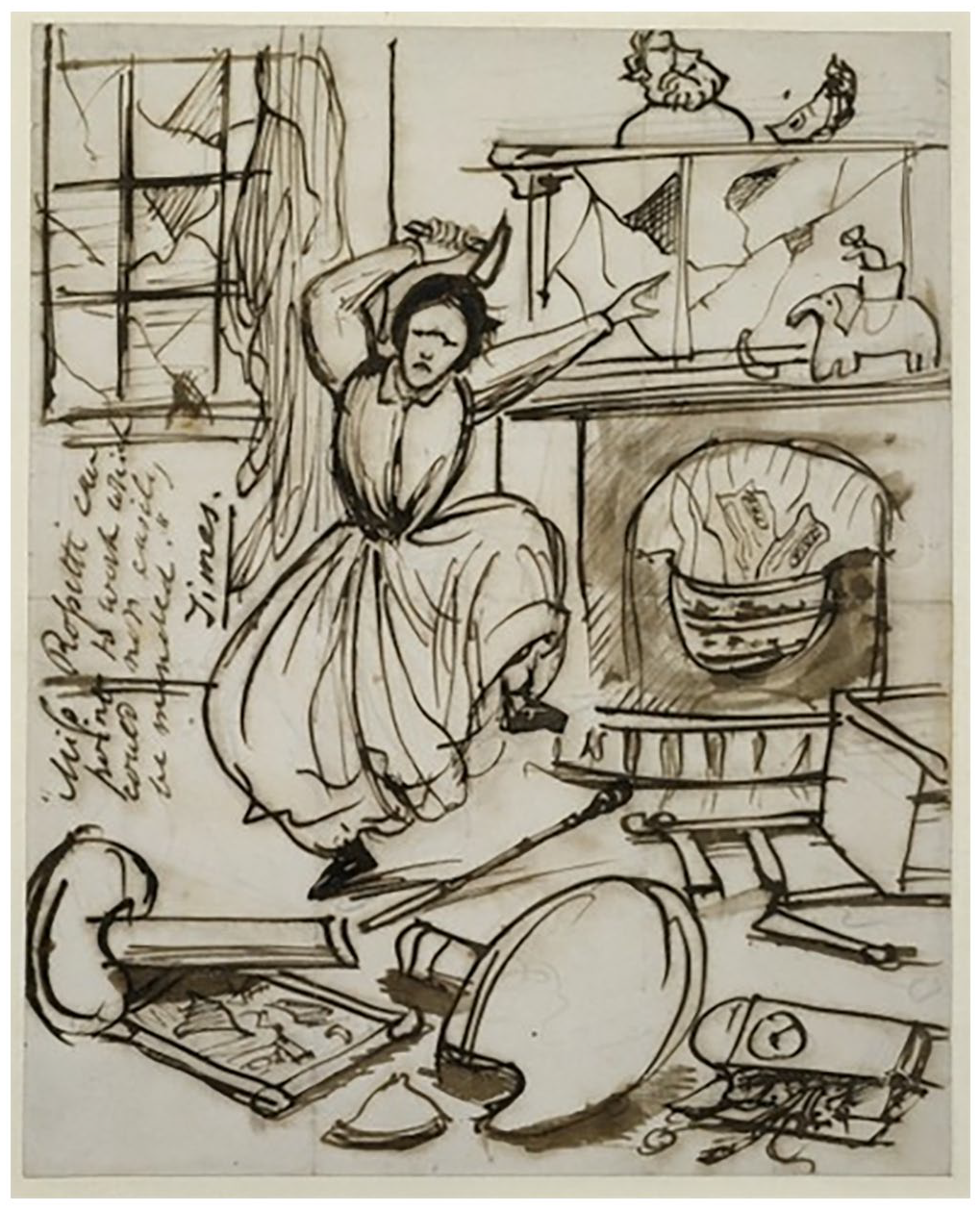
‘Christina Rossetti in a tantrum’ by Dante Rossetti (1862; pen and wash).
The coupling of women and children and their routine marginalisation and containment in early childhood education has been extensively debated (Burman, 2008; Cannella, 1997; Osgood, 2012) and it is worth revisiting in relation to what the tantrum is, and what it agitates. The intensity with which a range of disciplinary fields and professional bodies feel compelled to pathologise, control and ultimately eradicate the tantrum is fascinating. It has much to tell about the ways in which patriarchal systems work to contain and control seemingly wild and unfathomable bodies.
Capitalising on the tantrum
Tantrums are framed by an affective ecology; they agitate a raft of uncomfortable and fearful responses. Consequently, entire capitalist industries have become established, from the endless publication of parenting handbooks, behaviour management guidance and thousands of online blogs posts on ‘how to deal with temper tantrums’, to voyeuristic TV programmes such as Super Nanny. To further intensify the moral panic surrounding the toddler tantrum there are entire YouTube channels devoted to footage of young children tantruming. For example, ‘BabyFunnies’ (https://www.youtube.com/watch?v=jkUXIT0r6UQ), has back-to-back video clips of very young children in states of acute emotional distress which have been captured by parents as a source of ‘humour’, presumably to denote how unreasonable the behaviour of their children is considered to be. We found engaging with these videos incredibly traumatic as a raft of uncomfortable affective forces were set in motion. We are aware that there is a widely debated and contested disciplinary field on exploitative and exhibitionist tendencies in social media, beyond the scope of this article, but for us, the spectacle of the tantruming toddler that is captured in these short videos underlines the situational and relational, the more-than-human ecologies that materialise ‘the tantrum’. Together these industries place a focus on the individual, bounded human subject. Collectively, this apparatus reinforces the idea that children are malfunctioning, that the tantrum is an intolerable and frightening phenomenon that resides in the infant body, and must be managed to the point of extinction. The Royal College of Psychiatrists and The National Health Service are amongst numerous official sources to offer similar advice to parents and carers about how best to manage and prevent toddler tantrums, the ‘embarrassment’ of being seen in public with a tantruming toddler is noted as a cause of distress and concern (for the adult carer). The advice on how to handle a tantrum is very practical but ultimately reinscribes the notion that the tantrum is inherently problematic and that strategies need to be deployed that will ensure that the child understands boundaries, acceptable behaviour, and the consequences of public displays of unacceptable behaviour. It is interesting to dwell upon the omnipresence of adultism and developmental logic in response to the toddler tantrum.
Regulation of the tantrum in early childhood
Early years settings are offered similar guidance from hundreds of books on managing the problematic behaviour of young children, and again the readiness with which educators are encouraged to codify, pathologise and regulate is pronounced within the literature. The recent past has also seen a rise in popularity and sales of material apparatus designed to regulate children’s problematic behaviour. Time out on the ‘naughty step’ or ‘naughty chair’ is commonplace in contemporary childcare practices. Physically removing a child and positioning their enraged body on an object and in a context that insists they sit still, conform, reflect, is considered generally more humane than approaches taken in the past (though perhaps they take their precedence from the punishing ‘dunce’s chair’ in Victorian schools or the mediaeval ‘ducking chair’ typically used to punish disorderly women). It is unclear how the ‘naughty’ chair, as disciplinary technology that is both temporal and material, generates the conditions for an attunement to rage that can then be ‘simmered down’. These highly commercialised materialities that have capacities to order time and space with the intention to regulate, tame and eradicate child rage only serve to intensify the spectacle of the ‘tantruming toddler’. Whilst a child-body may be removed from the scene of rage, their bodies are marked as problematic, and the rage persists – or worse-still intensifies further (Figures 2 and 3).
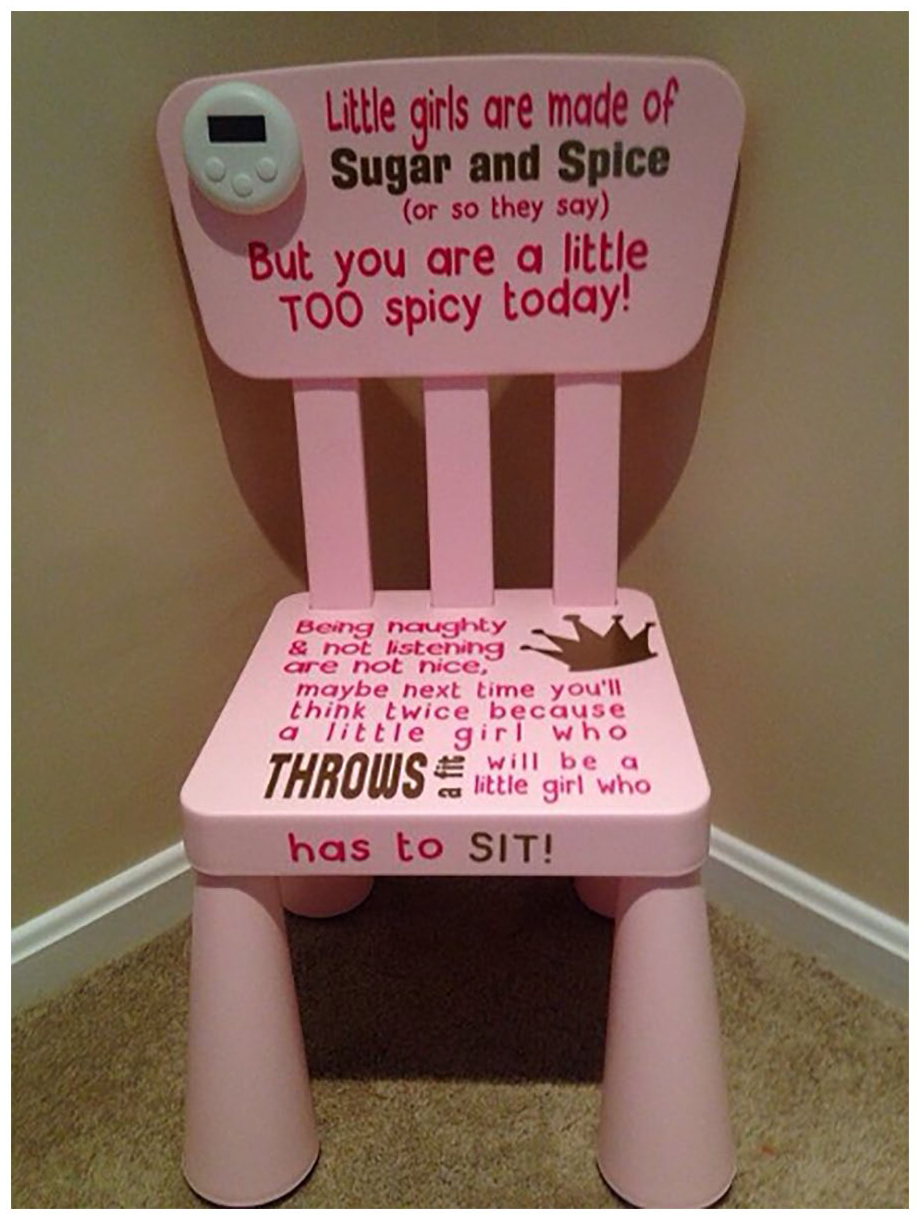
‘Girls’ simmer down chair.
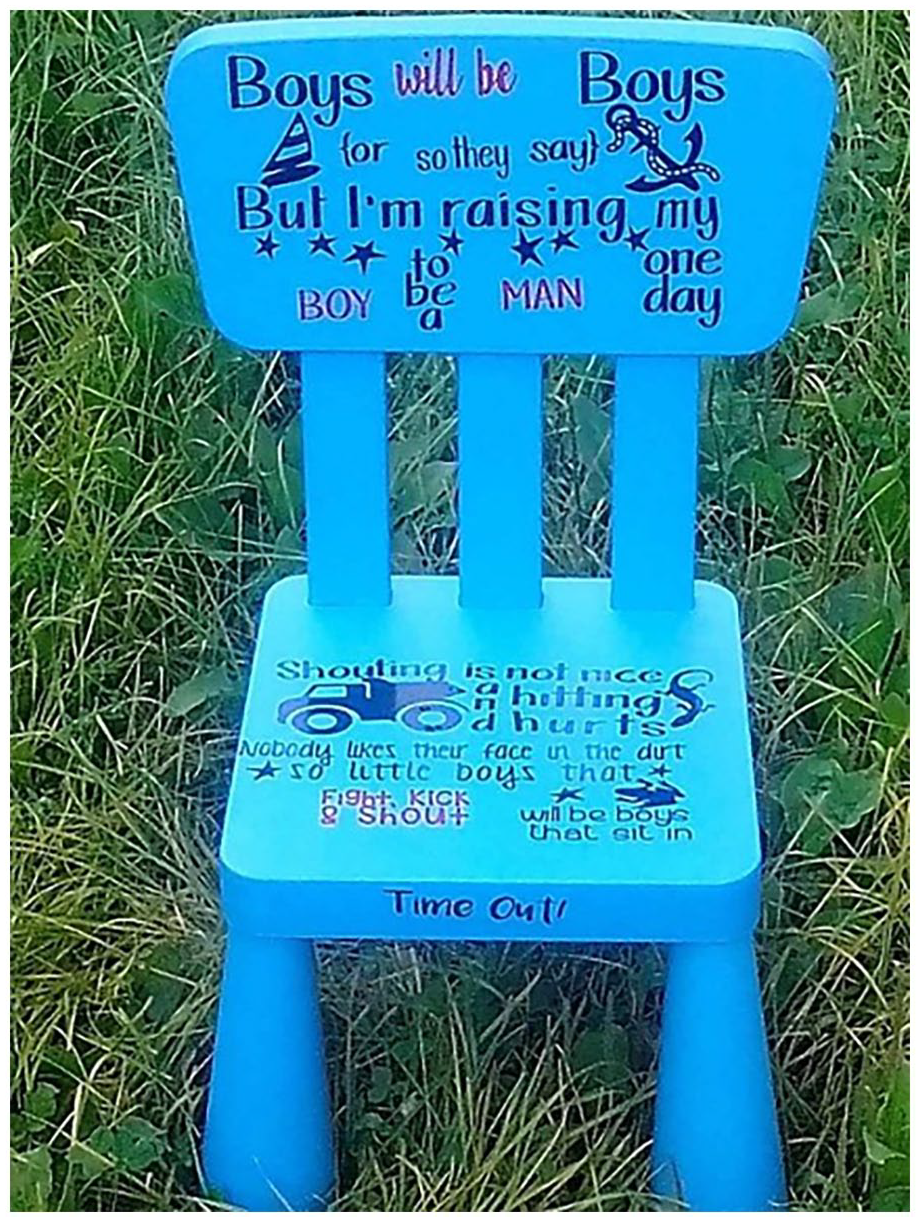
‘Boys’ simmer down chair.
when biologically a body becomes angry muscles tense neurotransmitter chemicals (catecholamines) released a burst of energy angry desire immediate, protective action heart rate accelerates blood pressure rises breathing quickens blood flow to limbs preparation for physical action a young face flushes crimson attention narrows locked on the target of anger impossible to focus on anything else quickly neurotransmitters, hormones adrenaline, noradrenaline are released: triggers readiness to fight. (What does a tantrum do? A poem by Osgood & de Rijke)
It is clear that hegemonic framings of the ‘tantrum’ in early childhood sets up a narrow conceptualisation of both ‘child’ and ‘tantrum’ that refuses to engage with what else might be unfolding in moments of rage. These images of highly gendered (colour-coded, heteronormative) ‘naughty chairs’ are deeply provoking, and, by wilfully perpetuating stereotypes, binarised gender and behaviourist operant conditioning (via the timer), are actually quite sinister. To gender a tantrum is particularly troubling and worthy of dwelling upon; to wonder how such practices might work to intensify childism and adult centric normative ideas about ‘child’ as belonging within particular categories. Gendered understandings are generated through powerful discourses, behaviour management practices and materialised figurations that collectively serve to further frustrate a child body. The (gendered) ‘naughty’ chair sets off affective forces and insists upon other ways to process what is unfolding bodily, hormonally – that which is felt and sensed in these hot moments of rage.
The disciplinary technologies of the ‘simmer down’ chair creates little room to consider what else might be at play; to entertain a more speculative and uncertain engagement with what a tantrum is and what it might generate; what we might learn with and from ‘tantruming toddler’. But this is precisely the objective of this paper, our attempt to enact a feminist project of reclamation and reconfiguration of ‘the toddler tantrum’ seeks to offer a rereading that argues for complexity, contradiction and the possibility that the tantrum might be recognised as a form of child activism against childism that positions ‘child’ in unhelpful and narrow ways. In ways that provide ongoing justification for regulation, marginalisation and creating possibilities for the tantrum to be an uncomfortable spectacle.
The mattering of the children’s picturebook
Undertaking an arts-based, feminist new materialist experiment with children’s picturebooks as our matter, it becomes possible to explore the generative possibilities inherent within the tantrum to engage with it as more-than-human, as a worldly-becoming, and as a form of resistance to both Anthropocentrism and childism. Children’s picturebooks are a curious paradox in and of themselves, readily assumed to offer naive and innocent tales aimed at the unformed or developing child audience, yet that ‘innocence’ has been exposed as an ‘impossibility’ given its adult authorship, publication and reader industries (Rose, 1984). Picturebooks typically offer a balance of artwork and language, intended to grab the attention of the young ‘reader’ and to feed imaginations. It is also a multi-million-pound industry that calls to account that which is celebrated as valid knowledge, that is, that which aligns with hegemonic notions of what children (and parents) need. Our interest is beyond the ‘best sellers’ or books winning awards for promoting children’s literacy, but lies with picturebooks that engage with difficult knowledge and that hold the potential to set in motion tentacular lines of enquiry that agitate the ‘somethings happening’ that Stewart (2007) writes of. Debates about children’s literature, and the picturebook genre more specifically, reveal that inside the often bold, bright and enticing pages are stories that are intricate, politically sophisticated and enduringly provocative. In rummaging through our bookshelves for picturebooks that address childhood rage and ‘the tantrum’ we encountered several that offered highly charged affective ecologies from which we might explore taboo, or otherwise ‘inappropriate’ themes with young children. We were especially drawn to picturebooks that offer surprises, that do not follow predictable tropes and conclude with a ‘happy ever after’ or promote a moralising refrain. For these reasons Angry Arthur (Oram/Kitamura, 1982) hailed and held our attention; a tale of a boy who becomes increasingly enraged when his mother announces bedtime.
Angry Arthur: Connections and hauntings
By engaging with ‘child tantrum’ as it is storied and illustrated in the picturebook Angry Arthur (Oram/Kitamura, 1982) we trace connections and hauntings to consider childhood innocence and taboo topics as a way to excavate how childism gets produced, how it circulates and how it gets fixed in place. Attuning to the intensities, affective forces and subversive narratives within this picturebook allows for an exploration of the uncomfortable characteristics of the Anthropocence: power, misogyny, greed, war, violence, terror, human exceptionalism and human induced environmental destruction. The hauntings that are agitated from engaging with Angry Arthur invite us to dwell upon the strange temporal shifts within the narrative; and to wonder how this temporal zigzagging maps onto images of the child. We wonder what might be done with these hauntings, how might we arrive at a re/appraisal of ‘the tantrum’ as a generative form of (child) activism. By mobilising the potential of arts-based approaches to the study of childhood we seek to reach other, opened out and speculative accounts of what tantruming is, what it makes possible, and what it might offer to stretch ideas about, and practices with very young children.
Firstly, encountering Angry Arthur invites us to wrestle with its historical location. The artwork offers the reader a blurred mix of 1950s London overlaid with matter and symbols from the 1980s, which we then engage with 40 years after its publication in 2022 with yet another set of optics. This uncertain, speculative, in-between timespace ignites hauntings and memories from our own childhoods, when concerns with human induced destruction of planet earth were frequently rehearsed, which have since resurfaced, and haunt imagined futures to come that will surely (also) be shaped by drought, famine, fires, floods, wars, and plagues (Tsing, 2022). Angry Arthur is as much about apocalyptic fears brought about by the terrors of the Anthropocene as it is about child rage. Kummerling-Meibauer (2011) suggests that anger is perhaps the most studied conceptual metaphor in children’s literature. Empathetic for the fact that young children do experience ‘stressful existential situations’, she sees Kitamura’s images for Angry Arthur as transforming the conceptual metaphor of anger as a natural force (such as ‘feeling stormy’) into ‘anger as a natural catastrophe’ (p148) where ‘hyperbole opens a fantastic dimension and has humorous effect’. Exploring images of chaos, flying debris and the zig-zag lines like lightning bolts to express Arthur’s mood, she draws comparison to the jagged lines and speech bubbles of comic-book tradition (an illustrative genre that Kitamura frequently works in).
In the tradition of Maurice Sendak’s (1963) Where the Wild Things Are, Angry Arthur functions imaginatively and empathetically with the child, rather than taking an adult (didactic) perspective. In this respect, it is unlike much other children’s literature depicting temper tantrums, in that it does not explore aggressive feelings in a safe and containing educational setting (eg: Tiger Has a Tantrum and Graves/Dunton, 2016), provide the adult-driven ‘solution’ (e.g. I Choose to Calm my Anger, Estrada 2021) or seek happy closure with peace restored, such as in Mollie Bang’s When Sophie Gets Angry, Really Really Angry (1999).
Arthur’s rage evokes what Anya Heise-von der Lippe (2017) termed the ‘posthuman Gothic’, a constantly shifting, inter-relational entanglement with ungovernable feeling, like that of Frankenstein’s monster, who suffers ‘a kind of posthuman anguish turned to rage’ at the moment it becomes self-aware. Mary Shelley describes how, unable to form friendship (with a child it ends up killing) and feeling trapped in the limits of its existence, the monster lashes out for total destruction of the subject, in a scale of monumental, apocalyptic rage. Like Arthur’s, this is the existential rage of primal rejection of its creator/controller, and the mobilising wrath of the subject. In Shelley’s case, her speculative fiction conducted an early feminist thought experiment into posthuman cyborg rage against Dr. Frankenstein’s thoughtless science or what Haraway (1988) terms the ‘God trick’. For Oram and Kitamura, the speculation is the catastrophic extent of child rage, raging against the adult and bedtime, conceptualised as literally earth-shattering.
Whilst Oram’s text repeats the calming (or possibly rage inducing) refrain ‘That’s enough’. from various members of Arthur’s family, the line also ends with the repeated warning ‘But it wasn’t’. In the images, Arthur’s anger is smashing up, cutting through, bending, fragmenting and spinning out the world and all that is in it. First toys and furniture are unbalanced and topple, (no ‘naughty chairs’ in sight) then trees, buildings, streets, sea and land. Arthur’s grandmother is transported to outer space and floats above him, knitting in a space helmet amongst the earth and stars, advising ‘That’s enough’ (but of course, it wasn’t). Kitamura’s double page spreads depict Arthur’s sense of self shattering into multiple repetitions (‘streaking’) or synchronistic reduplications, like those of animation and film denoting ‘motion blur’ (Figure 4).
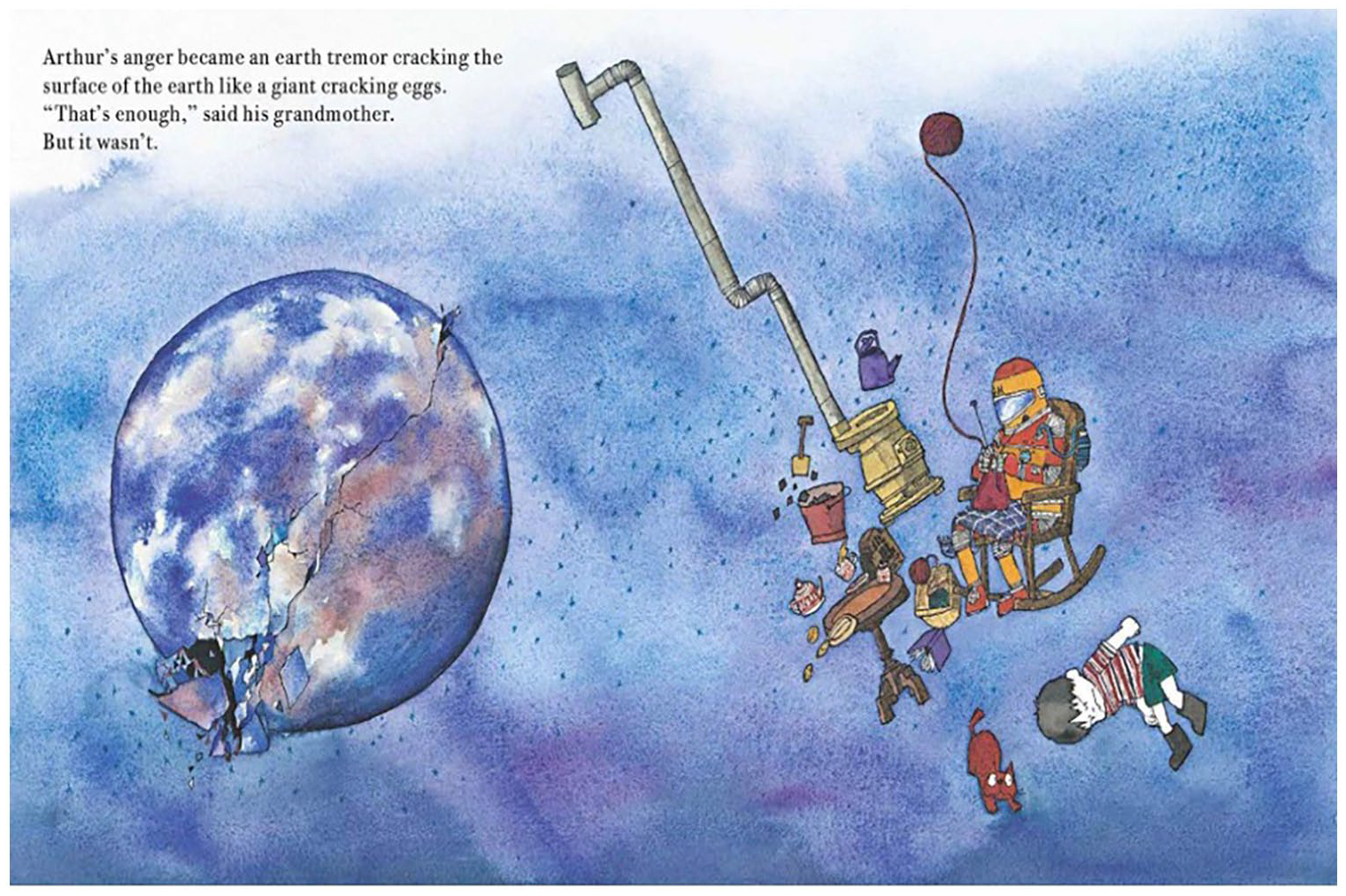
Cracking the surface of the earth.
Kitamura also plays with the early Renaissance technique of ‘anamorphic perspective’ as Arthur’s temper flattens spacetime dimension out, bends and stretches him, his cat, his country and town, ‘his street, his house, his garden and his bedroom’; totally disrupting all that was familiar or civilised, and hurling it in pieces onto the next page.
Drawing from queer studies, Jack Halberstam and Ira Livingston’s study of posthuman bodies (1995) point out the self disintegrates in queer narrative into a: . . .posthuman rage for disorder and uncivil disobedience. For the queer narrator, rage is the difference between being and having. It is a desire that the human be roughly shoved into the next century and the next body and that we become posthuman without nostalgia and because we already are.
Tensions present in Angry Arthur, such as the monstrous body of power in his temper holds the capacity to queer what we might normatively think of as the small, disempowered body of the child. Rage is the difference between being a child and having a bedtime he can call his own. His temper’s comic-inspired superpowers seems to call on what Jeffery (2016) terms the vision of posthumanity found in counterculture comic superheroes, drawing on motives from sci-fi, spiritualism, drug-induced trips, and notions of cosmic consciousness. Jeffrey points out that comic superheroes signify superpowers through motifs of -for the child- what we might call ‘dressing up’, such as in capes or masks. Arthur’s cosmic temper thus subverts readers’ usual constructions of childlike/childishness, transforming the usual anger metaphors of heat (hot under the collar; letting off steam; burning/ smouldering with rage; that is blood-boiling; I’m at boiling point) captive animals (snarling/ seething with rage; don’t bite my head off; unleashing anger/ lashing out) or military attack (outbursts; blowing a fuse; ballistic with rage) into that of comic-strip style hyperbole to the point of total planetary annihilation. A form of child activism, where the marginalised and regulated child body dramatically resists with unanticipated force. Here we begin to think with the child and youth activism of Greta Thunberg and Mala Yousafzai, among many others. Contemporary child activism has powerfully railed against worldly injustices brought about by capitalist, heteropatriarchal power systems of the Anthropocene and insisted that adults sit up and take note. As Colebrook (2017: 7–8) stresses: “One effect of the Anthropocene has been a new form of difference: it now makes sense to talk of humans as such, both because of the damage ‘we’ cause and because of the myopia that allowed ‘us’ to think of the world as so much matter. . .humans are now different; and whatever the injustices and differences of history and colonisation, ‘we’ are now united in being threatened with non-existence.’
Of course the reference to ‘we’ and ‘us’ in inverted commas denotes that differences and power asymmetries continue to shape humanity, with children persistently on the margins but most likely to face the heaviest costs and burdens of human-induced destruction and extractivism of the Anthropocene epoch, which is then further intensified by axes of differences in the form of social class, poverty, able-bodiedness, race, and gender (Strom et al., 2019). So it is entirely correct that young children and youth activism should rage with the intensity that it does. Young voices, shaking with rage, is precisely the form of activism that is needed to demand accountability and action – from another faction of the ‘we’ of the human species: privileged, rich, white, cishetero men, from whom the long history of the earth’s destruction can be traced back (Braidotti, 2022). As global temperatures rise perilously, and as the reality of fires, floods and plagues unfurl it is impossible to ignore the impassioned frustrations and the intensities of the hot rage of Generation Alpha.
In a study of conceptual metaphor, Kövecses (1986) argues that heat-related anger metaphors have the ontology of a mass entity, but also a scale, or limit point, since ‘we can only bear so much before we explode, or lose control’ (p.17). He suggests many anger metaphors turn on heat and being mad with rage to warn listeners that adding fuel to the fire or exploding is dangerous to more than just the heated, unbalanced individual. Emotional effects are thus understood as atmospheric affects, and ‘anger is understood as a form of energy’ (p. 22). Kövecses admits that there are recognisable forms of absolutely uncontrolled anger ‘for which there are no conventional linguistic expressions’ (p.43), and perhaps this is Arthur’s tantrum, unrepresented in the written text but fully represented visually, and experienced affectively (Figure 5).
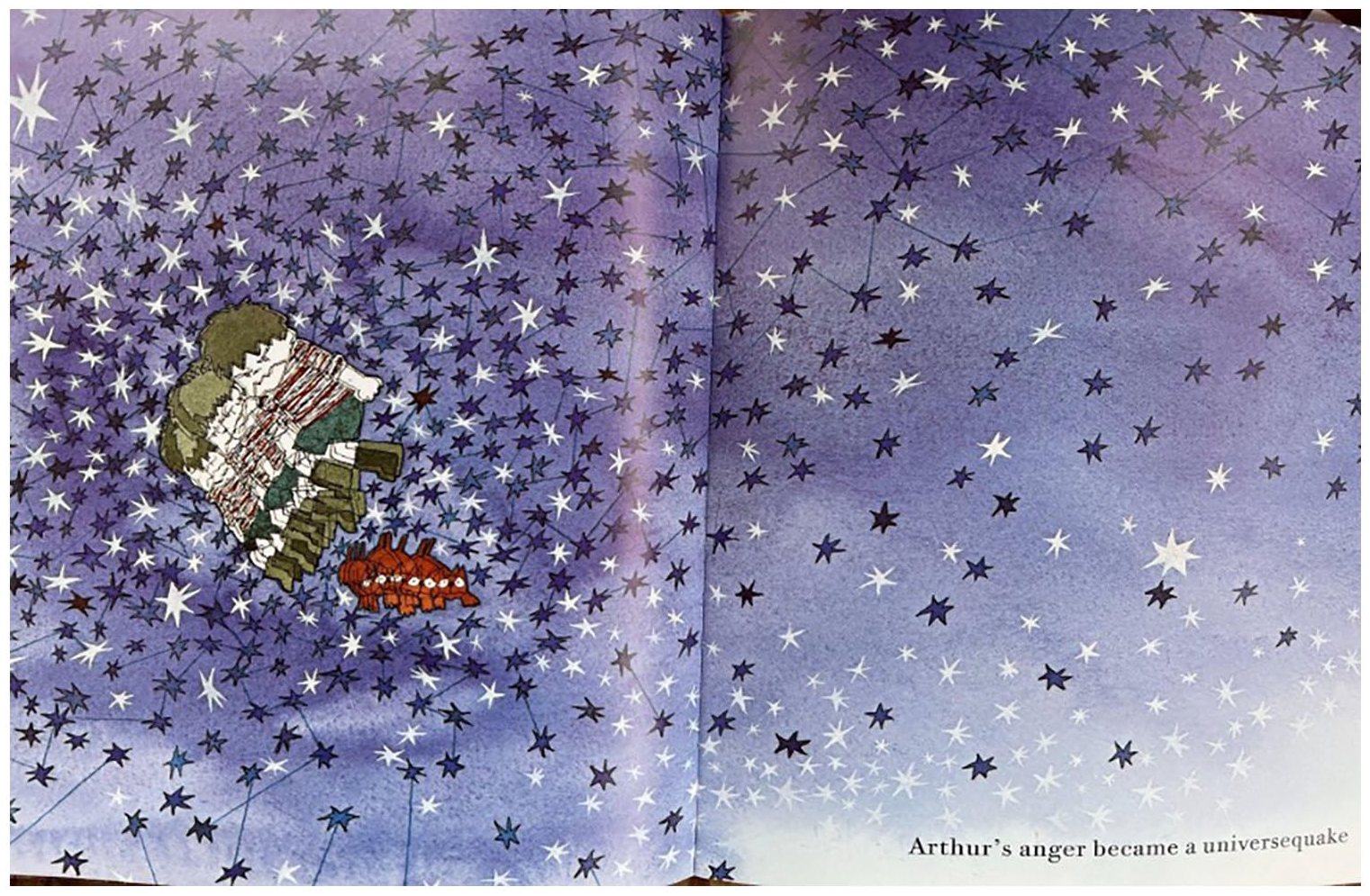
Anger became a universquake.
As Kitamura depicts it, Arthur’s anger has no limit. His temper is not that of heat, but like anger itself, ‘stirs things up’ or ‘mucks things up’: first into ‘a storm cloud exploding thunder and lightning and hailstones’ (whose jagged lines are also symptomatic of losing your temper until you ‘can’t see straight’). For Barad (2015: 390), ‘lightning mucks with origins. Lightning is a lively play of in/determinacy, troubling matters of self and other, past and future, life and death. It electrifies our imaginations and our bodies’. Arthur’s temper is electrifying matter: a hurricane hurling rooftops and chimneys and church spires’, then `a typhoon tipping whole towns into the seas’, ‘an earth tremor’, and finally, a ‘universequake’ until everything is an agency of things: ‘nothing more than bits in space’.
Since Arthur first flew into a rage at his mother telling him to go to bed, he takes off from his angry standing stance (arms crossed) and literally flies about, until both subject and matter are in constant, windswept entanglement, clinging to bending tree branches, spiralling in the sky, quaking and eventually falling through space back down to a last chunk of planet just big enough to hold his bed. The text reads: ‘Arthur sat on a piece of Mars and thought. He thought and thought’. Then, tucked in fast asleep on the last page, it reads: ‘Why was I so angry?’ he wondered. He never did remember. Can you?’
What might then be called ‘unfinished’ infantile rage (that has been ‘agonisingly’ repressed, in order to seem compliant) will resurface now and then dramatically, such as with a temper tantrum, which could be read as a form of activism against worldly injustices.
Happily ever after. . .?
This paper sought to bring together a concern with affect, materialities and bodies as they coalesce in more-than-human relationalities captured in encounters with ‘the tantrum’. An engagement with children’s literature has afforded us to contemplate the figure of the tantruming child to consider the possibilities that emerge to reimagine childhood, in ways that resist smoothing out, extinguishing or demonising the uncomfortable affective ecologies that have come to shape ‘the tantrum’. It is by dwelling upon ways that ‘the tantrum’ is emblematic of the Anthropocene – that is, attempting to attune to intensities, hauntings, frustrations of life on a damaged planet (Tsing, 2015, 2017) where adults determine the rules but take little responsibility, that we argue the child tantrum might be reworked as a form of (child) activism. Following Klein, we wonder whether hateful, terrifying and destructive feelings expressed as projected aggression – might instead be thought of as a generative force for change, as finding ways to rage against the trouble (as opposed to staying with the trouble - Haraway, 2016). Actively resisting adultism and Anthropocentric accounts of childing involves attuning to intensities, to the feltness of injustices and inequalities. Taking seriously the affective ecologies that shape the child tantrum offers possibilities to contemplate other ways to live that are shaped by: ‘intensities of living through things (that) accumulate and pool up in worldings and forms of attending to what’s happening to trauma cultures, redemption cultures, recreational worlds, public feelings fuelled by humour, sarcasm or rage, forms of critique or cocooning, worlds of volunteering or self help or activism or art or exercise. (Stewart, 2011:452)
This paper proposes that the toddler tantrum might be repurposed as the foundation for a form of activism within and against late capitalism. It is only by setting in motion, and engaging deeply with the unthinkable, the unbearable, the uncomfortable and the unknowable, that there might be hope of arriving at a (more) critically affirmative account of childhood in all its messy complexity.
Footnotes
Funding
The author(s) received no financial support for the research, authorship, and/or publication of this article.
