



Abstract
This article is a conceptual co-exploration of the relationship between philosophy and childism. It draws upon a colloquium in December 2021 at the Childism Institute at Rutgers University. Nine co-authors lay out and interweave scholarly imaginations to collectively explore the concept of childism in critical philosophical depth. Through diverse entry points, the co-authors bring a wide range of theoretical perspectives to this task, some engaging the term childism explicitly in their work, others approaching it anew. The result is an extended conversation about the possibilities for deconstructing ingrained historical adultism and reconstructing social norms and structures in response to what is marginalized in the experiences of children. Our own conclusion, having initiated this dialogue, is that we have learned to think about childism with greater plurality, that is, as childisms.
Introduction
Childism is a concept that has not generally entered the philosophical lexicon, unlike similar terms such as feminism, anti-racism, and posthumanism. 1 Growing out of the field of childhood studies, childism in its broadest sense refers to the critique of social norms and structures in response to what is marginalized in the experiences of children. As such, it challenges philosophy to think in new ways about ethics, politics, epistemology, hermeneutics, and the entire range of philosophical pursuits. And it does so in a somewhat different way than longer-established areas such as the philosophy of childhood and philosophy with/for children. Like here, childism places children’s voices and experiences at the center of inquiry; but, as explored below, it also critiques and rethinks the foundational historical assumptions on the basis of which children’s lived experiences are side-lined in the first place. This pro-child concept of childism can be distinguished from an anti-child use of the term outside of childhood studies to refer to prejudice against children. In this article, we explore childism in its positive sense as a stimulation to rethink ideas and practices in child-inclusive ways.
The article is made up of seven short essays and two concluding responses that started out as presentations at an online colloquium in December 2021 at the Childism Institute at Rutgers University on “Childism and Philosophy. 2 ” The presenters were asked to respond to the following questions: What does the notion of childism mean? How might it contribute, or not, to understanding human beings and relations? How is childism related to ideas in feminism, post-structuralism, and other philosophical perspectives? And how could childism change the discipline of philosophy itself? The resulting essays here have been substantially reworked in response to each other and to further discussions in order to formulate an interactive conversation. They progress in the following from relatively established explorations to increasingly critical and playful ones. John Wall starts by asking what childism could contribute to philosophy, followed by Ohad Zehavi calling for closer integration of positive and negative childisms, Hanne Warming considering in more detail the relation of childism to adultism, and Tanu Biswas connecting childism to decoloniality. David Kennedy then develops an Arendtian cautionary critique of childism, Karin Murris uses a work of art to develop a childist reflection on time, and Walter Kohan presents a playful meditation on the possibilities of childist academic research. Finally, Britta Saal and Toby Rollo offer concluding reflections on the article as a whole.
Our own conclusion, having initiated this dialogue, is that we have learned to think about childism with greater plurality, that is, as childisms. Much as in recent decades of feminism, childism can be understood as a core idea but with multiple and contested interpretations. Childism itself should play openly and messily with its own possibilities. Restructuring social norms also means unearthing prejudice. Fighting adultism can be tied up with fighting racism and colonialism. Childist philosophy is situated in multiple temporalities and it needs to avoid valorizing childhood while at the same time becoming more childlike. The prospects of childism in philosophy are many but still largely unexplored. We hope the following reflections inspire fresh critiques of ingrained adultistic assumptions and open up new philosophical pathways.
Why philosophy needs childism, John Wall
Childism challenges philosophy to think in new ways. It can do so just as radically as have other critical perspectives. Feminism, for example, has invested philosophical thought with generative concepts of relationality, narrativity, and embodiment; critical race theory with ideas of systemic privilege, internalization, and institutional oppression; queer theory with aesthetics of performativity, heteronormativity, and non-binary thinking; and decolonialism with new politics of the subaltern, imperial globalization, and epistemic injustice (Butler, 1990; Irigaray, 1993; Heywood, 1997). Childism stands in a similar position to call upon philosophy and critical theory to develop more complex ontologies, hermeneutics, and politics.
Childism is defined for me as a critical theoretical lens that empowers children’s experiences by transforming structural norms (Wall 2019, 2021). Taking a cue from third-wave feminism and critical race theory, childism does not aim simply for children’s equality; rather it strives more creatively to reframe the normative grounds that define equal social relations in the first place. It does so by expanding grounding assumptions to respond equally to the different and diverse lived experiences of children as children. The problem that needs to be confronted is not just young people’s lack of agency or voice. Rather, as Hanne Warming and Tanu Biswas suggest below, it is how agency and voice themselves, as well as social norms in general, are defined and structured in adultist or patriarchal ways that implicitly or overtly prioritize adult over child subjectivities.
Philosophy has just as long a history of adultism as it does of sexism, classism, racism, and colonialism. Indeed, the adult gaze predominates almost totally, whether one is speaking of ancient theories of reason, medieval developmental teleologies, or modern concepts of ontological autonomy, aesthetic subjectivism, or political independence. Even post-modernity, inflected as it is by feminism and deconstructionism, engages all kinds of experiential differences with barely a mention of children or age. This is because, I would suggest, post-modernity tends to assume that the needed structural critique can be performed only from the perspective of those already marginalized, rather than from a perspective of interdependent empowerment.
How might a childist approach restructure philosophical theories? Here are three schematic suggestions.
First, ontologically, human being in the world would have to be understood in terms of neither modernist individuality, postmodernist difference, or even feminist relationality. Rather, it would have to be more inclusively understood in terms of what I call deep interdependence. By this I mean that, as children in particular make clear, but as is the deeper reality for all, being (human and otherwise) consists in networks of inter-reliant difference, networks in which independent distinctiveness is also dependent on constructions by others. Humans are not just horizontally related but in a more complex sense both horizontally and vertically interdependent.
Second, hermeneutically, interpreting the meaning of being is neither reducible to premodernistically fitting existing worlds, nor modernistically constructing worlds for oneself, nor even post-modernistically deconstructing distortions in the world. None of these quite accounts for the interpretive agency that exists from birth. Hermeneutics needs to be reimagined instead as an act of reconstruction. It is a creative response to existing constructions of the world that apply lived experiences of difference to new imaginations of more expansive worlds.
Third, ethical and political theory need to be pressed beyond their existing adultist grounds in either modern universal reason or postmodern deconstructive difference. Instead, a childist perspective insists on accounting for human relations' deep interdependence by grounding moral responsibility in what could be called empowered inclusion (Josefsson and Wall 2020). By this I mean the basic political obligation both of and toward children and adults to respond actively to marginalized experiences by expanding social imaginations. Inclusion demands empowerment and empowerment demands inclusion.
Let me end with an example. In a recent book, I argue that current democracies are built on profoundly adultistic assumptions that only supposedly independent rational actors should possess the right to vote (Wall 2021). If, however, democracies are to be truly democratic, the entire demos would have to be empowered to vote regardless of biases of age. Other critical theories have grown up alongside suffrage movements, and childism likewise is interlinked with changing systems of power.
As with other suffrage movements, this means that the very meaning of voting would have to be reconstructed. Rather than simply extending the present adult vote to children, the real inclusion of children would involve creating imaginatively radical new practices. It might involve what I call a proxy-claim vote, that is, a proxy vote from birth to death for everyone, exercised by a close relation, that acknowledges that babies, young children, older people with cognitive disabilities and dementia, and many others in between have a certain dependence on others that prevents them from voting on their own behalf; combined with a claim vote that any child or adult is owed the right to claim to exercise on their own behalf whenever, including at any age, they so desire. This kind of imaginative rethinking of democratic norms and practices is one type of contribution of childism to scholarship and societies.
In these and other ways, philosophy needs childism. Philosophy needs childism not simply so that it can understand or listen to children better. Rather, it needs childism so that it can overcome its own normative historical limitations in order more critically to understand the human condition.
A potent, productive, double-edged concept, Ohad Zehavi
The following brief critical engagement with “Childism and Philosophy” is a very contemporary one, rooted in this particular moment (December 10, 2021) and stemming from my own perspective on the social landscape currently surrounding me.
While childism is a very potent and productive concept, it is also double-edged. This, I reckon, should not be overlooked but rather acknowledged and even embraced. We need to face up to the fact that the concept we are celebrating is inherently and fundamentally ambivalent. On the one hand, we have the childism that we are trying to promote here, the pro-children kind of childism, which is a set of theories and practices designed—as the slogan at the top of the Childism Institute website rightly declares—to empower children by critiquing norms and structures, a project resonating with older political projects such as feminism and post-colonialism. But on the other hand, the word childism also has an anti-children sense. In this sense it is akin to other reprehensible attitudes towards human beings, such as sexism, racism, and Orientalism (see, e.g., Young-Bruehl 2012). In this second sense, the notion of childism seems to denote a cultural attitude of not only prejudice towards children but even of deeply rooted contempt and animosity towards the young human being.
This other sense of childism haunts our common project. There are all kinds of ways of trying to wish it away, but to no avail. The shameful meaning of the word still lingers there, insistent and unwavering. We may try to call this attitude “adultism” (Wall 2019; Biswas 2021; and see also Hanne Warming’s section here), but I’m afraid that doesn’t really do the job, for childism in its anti-children sense isn’t just about favoring adults over children and treating the latter unfairly. Childism in its negative sense is a pervasive and profound, even if inadvertent, cultural hostility towards children, deeply embedded in social structures of domination and in state apparatuses of exploitation and subordination.
Just look at what children have undergone in the past 2 years in so-called liberal democracies. In my view, children are probably the greatest political victims of the COVID frenzy that took hold of the globalized world. Children have been repeatedly locked down, self-isolated, distanced, put in stringent capsules. They have been systematically barred from visiting public spaces. They have been tested, and jabbed, and tested again—and again, and again. They have had swabs shoved into their mouths and up their noses—mostly without proper consent—on a regular basis. They have been forced to wear masks for hours on end, debilitating their social interactions and reducing their much-needed supply of oxygen. They have been bullied and threatened, disgraced and defamed. They have been reproached and intimidated, portrayed as a living threat to their loved ones and a menace to society, irreparably wrecking not only their group image but also their very self-image. Tested, jabbed, masked, isolated, time and time again. And then tested again, with swabs in the mouth and up the nose. With no real justification and with no sense of humility or regret.
All this is taking place, let’s not forget, within Western childhood’s already extremely disciplined and restrictive environments and subjugating routines (Zehavi 2018). This is contemporary childhood going from bad to worse, another depressing chapter in the ongoing assault on children carried out by anti-children childist society. When I saw the invitation to this session on the Childism Institute’s website, featuring Paul Klee’s “Angelus Novus,” I, too, just like Karin Murris, couldn’t help being reminded of Walter Benjamin’s famous ninth thesis on the concept of history, where Benjamin—quite an enthusiastic pro-children childist ahead of his time—regards Klee’s angel as the angel of history, who witnesses the piles upon piles of wreckage and destruction, of the catastrophic human suffering heaping at his feet (Benjamin, 2003: 392). Regarding children I want to take this as a call to witness the great hardship of contemporary childhood, not to look away, not to ignore or overlook, but also not to abstract in order to make things somewhat better. We need to look anti-children childism in the eyes, for that is the real nemesis of the childism we wish to pursue here. The two childisms are not some dialectical opposites. Rather, they go hand in hand, the one wreaking havoc on children, the other trying to neutralize its adversary and radically overturn its ideology and correlate material structures. This is what we are really up against. That is our true mission.
There are, of course, all sorts of ways to accomplish this mission. One of the ways to go about it that I wish to propose here is to create a fresh new image of the child to battle the despised and degraded image of the child that the anti-children childism has managed to embed in our social and political imagination. This image can be drawn, I would suggest, from Friedrich Nietzsche, who in his Thus Spoke Zarathustra makes Zarathustra speak, in his very first speech, of the three metamorphoses: “how the spirit becomes a camel; and the camel, a lion; and the lion, finally, a child” (Nietzsche 1978: 25). As I see it, this is an allegory of Nietzsche’s emphatic disavowal of man, the all-too-human man, here represented by the submissive camel, willfully obeying all masters’ commands, in favor of the lion, who roars a defiant “No!” to all the great dragons, all people of authority, all the powers that be. The lion is still not emblematic of the ultimate Übermensch, the superman or overman, but he brings the spirit much closer. Finally, it turns out that the Übermensch is represented in this fable not by a menacing and fiery creature as you would expect, but by none other than… a mere child. In this image the child is not an inferior human being; neither are they a human being in the making; nor are they an adult’s equal: the child is the full potential of the human being before it has degraded into a subservient camel.
What is it about the child that makes him or her the ultimate goal of the spirit, according to Nietzsche’s Zarathustra? “The child,” he says, “is innocence and forgetting, a new beginning, a game, a self-propelled wheel, a first movement, a sacred ‘Yes’” (Nietzsche 1978: 27). The child is a self-propelled wheel, says Nietzsche, a notion that I have adopted as the title of a childhood studies seminar that I’ve been teaching for the past 10 years. This is an image that I believe we should all heed: a self-propelled wheel. So, no need to propel children, no need to compel them, no need to guide them and to govern them. All we need to do is “lay off” them, as Shulamith Firestone emphatically exclaims (Firestone 1971: 103), and let them be. And in doing so, let us all become-child (Zehavi, 2010, 2018); let us all join in a sacred “Yes.”
A critical stand toward adultism, Hanne Warming
I begin by focusing on the notion of childism in its childhood studies sense. For me, childism first and foremost is about a critical stand towards adultism, developmentalism and ageism in society and academia. Childism is rooted in the recognition of generation and age-based categorizations, as dimensions of the social order and of power relations and also in the recognition of how the generational order and age-based categorizations intersect with other various kinds of old power relations and oppressive dynamics. I see childism as against the discrimination and marginalization of children, though not only children. Childism, in my understanding, is fundamentally for recognition, social justice, and inclusion of all humans.
An essential assumption in childism is that the critical stand towards adultism, developmentalism, and ageism holds potentials to promote recognition, social justice, and inclusion for all marginalized groups. In childism, children’s lived experiences, critiques, and actions constitute an essential resource for identification and understanding of ethics of adultism and ageism, as also suggested by David Kennedy. However, childism does not grant epistemic authority to children, as first-wave standpoint feminism did to women. Children, like other people in marginalized positions, sometimes take their marginalization and oppression as natural, just as people in privileged positions do sometimes as well. Critical awareness of adultism, developmentalism, and ageism, as well as of other oppressive and marginalizing “isms,” is not conditioned by firsthand experiences nor related to the identity of being, for example, “child.” Rather, it is something which is achieved, as the second-wave standpoint feminist Alison Wylie formulated it, as “a particular kind of epistemic engagement, a matter of cultivating a critical awareness, empirically and conceptual, of the social conditions under which knowledge is produced and authorized” (Wylie 2012: 63). In that way, childism (and second-wave standpoint feminism) overcomes what John Wall identifies as a tendency of post-modernity to assume that critique can be performed only from the perspective of the marginalized.
I now turn to the question of how childism can contribute to better understandings of human beings and relations. Rooted in critical childhood studies, a central claim of childism is that if we understand childhood in a non-adultist and non-developmentalist manner, we will understand society better (Wall 2019). Therefore, insights gained from childist childhood research not only generate knowledge about children’s lives and perspectives but can potentially also shed light on human life, society, and social relations more broadly, thereby also helping to revise existing theories. Thus, childism contributes to better understanding by, firstly, identification and denaturalization of adultist, ageistic, and developmentalist norms and assumptions in society and academia, for example, the norms of what it takes to be a citizen, or assumptions of the relation between children and adults. Secondly, childism takes seriously children’s experiences, their ways of being in the world, including their efforts at affecting the present, as well as the future. Thirdly, it identifies how these adultist, ageistic, and developmentalist norms and assumptions intersect with other power relations and oppressive dynamics. Finally, by using a critical stand towards adultism, ageism, and developmentalism, it helps to rethink norms and assumptions in academia or, in other words, the bases for the reconstruction of theories.
Now I turn to the question of how the concept is related to and distinct from other philosophies. My entrance into answering this question is the acknowledgment of how much critical childhood studies, and thereby also childism, owes to feminism, post-colonial theory, and other philosophies that deconstruct and take a critical stand toward power relations and naturalized truisms. Therefore, it is easy to identify a lot of parallels, as well as conceptual inspirations, for example, the view on knowledge as situated, which we have learned from the feminist philosopher Donna Haraway (1988). There is also the idea from the second-wave of standpoint feminism, as mentioned earlier, which helps childism give epistemic authority to children. The generational order concept owes much to feminist philosophers’ similar concept of gender order (Connell, 1987) as well as the concept of doing generation, similar to doing gender (West and Zimmerman 1987). Likewise, the similar approach to childism known as “child as method” (Burman 2018a 2018b, 2019) owes to post-colonial approaches such as “Asia as method” (Chen 2010) and “border as method” (Mezzadra and Neilson 2013). I also point to parallel philosophical and conceptual moves away from liberalism and the dependency-independency dichotomy, towards deep interdependency and relational ontologies (Yuval-Davis, 1999; Barad 1996, 2007, Haraway, 2008). This parallel is reflected, for example, in more complex ontologies as a characteristic of childism (see John Wall) and childism’s “troubling of subjectivity” (see Karin Murris). Childism is distinct from these philosophies by means of the special attendance to adultism, ageism, and developmentalism, as well as to children’s lived experiences and acts. So far adultism, ageism and developmentalism seem to have been a hidden spot in feminist and post-colonial studies beyond critical childhood studies (Rosen and Twanley 2018), as well as in the broader social sciences and humanities (Huijsmans 2016; Wall 2019).
Now to the fourth and last question, namely, how childism constitutes a challenge to the discipline of philosophy itself. My take on this is that childism challenges the discipline of philosophy to the extent that philosophies build on adultism, developmentalist assumptions, or ideas of the autonomous self. Childism challenges the discipline of philosophy by addressing the marginalization of children in various theories and by insisting that children’s lived experience must impact philosophical thought. Let us take an example of social philosopher Axel Honneth’s philosophical theory of recognition (Honneth 1995), which I have worked quite a lot with and found very helpful to theorizing children’s experiences of their societal marginalized position (Warming 2006, 2011, 2015). However, Honneth’s work needed reconstruction because the theory draws on ideas from developmental psychologies which, among others, imply that children’s experiences and practices, for example, their practices of caregiving, are silenced, and because the theory takes children’s position as (only) becoming-citizens as natural. Childism challenges this, by identifying the adultist developmentalist underpinnings, and reconstructing the theory towards a non-adultist version. Another example is the philosophies of liberty and freedom as seen in the work of, for example, Rawls (1971) and Nedelsky (1990), which understand liberty negatively as freedom from interference by the state or other citizens. This understanding is based on an understanding of (adult) humans as (ideally) independent self-made and self-making beings, pursuing their individual self-interests (Moosa-Mitha 2005). Informed by developmentalism, young children then represent the otherness to this ideal. Childism dissolves this dichotomy of independent adults and dependent young children by emphasizing mutual dependency on various levels as a fundamental to human existence. Human beings’ emotions and agency are shaped through relations to other human beings (and their emotions and agency) as well as to non-humans, that is, animals, microbiomes, the climate etc. This challenges the notion of liberty and freedom and raises the question: What does freedom actually mean in the light of the understanding of social and more-than-social relations as characterized by interdependence, and in light of children’s experience and practices of this interdependence between human beings, as well as between humans and non-human species and materiality?
Pluralist kinship with decoloniality, Tanu Biswas
I start with acknowledging that much of my thinking has emerged because of reading and engaging with the works of my co-authors, so these are not just my ideas here, although it might appear sometimes to be based only on work that I’ve been doing. Childism is a perspective. It is a way of seeing that determines what, how, and why one would theorize. It could not and should not become a fixed theory that is passed on from generation to generation where new thinkers have to spend time fighting and debating about what their ancestors meant with each word and who can claim epistemological authority about right interpretations from a singular standpoint, and so on. Instead, childism could be and should be, in my view, a dynamic way of seeing that is at ease with simultaneously coexisting standpoints. In this sense childism is a pluralist way of seeing which is in constant change.
One of the reasons that childism, at least in its childhood studies sense, which is how I understand it, should be a pluralist way of seeing, is that one of the central premises of the field is that there is no single or universal childhood (James et al., 1998). There are only childhoods, with an S. This is central to childhood studies, so childism, in this sense, could also not become a singular view.
Childism emerges as a way of seeing in the early 21st century, which is a very peculiarly troubling, overheated time in history (Eriksen 2016; Biswas 2020). It is a time when the global children and youth movement for intergenerational climate justice is revealing how the fossil fuel-generated civilizational project of industrial modernity seems to stand strong on apathy towards children and childhood and future generations (Sacchi et al. vs Argentina et al., 2021; Juliana vs United States, 2015; Bandeira 2017; Pandey vs India, 2017). In November 2021, children and youth activists petitioned the UN to declare a global level-three climate emergency, which would be a global emergency, like the COVID-19 or the Iraq War emergency (Sacchi, 2019). And a recent qualitative study, published by Bath University, shows that children and youth, regardless of whether they’re from the Global North or South, share a deep sense of a moral betrayal, which is directly related to their perception of inadequate action by adults and governments (Hickman et al., 2021). The study reveals that there seems to be a solid structural and relational intergenerational barrier which is blocking adults from a responsible temporal relationship with children and their grandchildren (also see Ohad Zehavi’s discussion earlier regarding structural adultism and COVID-19).
Childism should not be limited to a way of seeing as a bystander. That way of seeing should extend into a way of intergenerational relating. It is to this human relating that I think childism could particularly contribute. It could help to understand existence as part of an intergenerational web of relations that transcends the privileged myth of a so-called developed individual autonomous existence.
In the philosophy of education and pedagogy, for example, this should entail contributing to reimagining the contemporary teacher-and-pupil relationship by explicitly highlighting that pedagogy is first and foremost an intergenerational mode of relating (Hoveid and Hoveid 2019). The “primary archetypal institution dedicated to the adult–child encounter—that is, the school” as David Kennedy addresses below, calls for reimagination. Could the contemporary role of the teacher constitute co-authoring that relationship with pupils instead of following a prewritten script that pupils have no say in? Could educational scripts themselves undergo critique as reproducing an era when fossil fueled economic growth was celebrated as the salvation of humanity? Could the philosophy of education respond to young activists who view fossil fueled economic growth as the damnation for their generations (Mattheis, 2020; Biswas 2023; Biswas and Mattheis 2021; Biswas 2021; Mattheis, 2020)? Could teachers and pupils be theorized as standing in a co-exploratory educational relationship in order to collectively navigate towards a future where children and their grandchildren do not end up in jobs that will largely comprise cleaning up the mess that their ancestors made (Biswas 2023)?
Questioning from a childist standpoint in pedagogy can be seen as a way of decolonizing educational philosophy to contribute towards sustainable community formation processes. Childism relates intimately with the decolonial project. The connecting thread here is pluralist ways of knowing, doing, and being that destabilizes the premise of individual autonomy as a telos of so-called development, development in both its psychosocial/physical and socioeconomic senses (Biswas 2020).
To conclude, childism challenges the discipline of philosophy. Here, it is a pluralist kinship of childism and decolonialism that challenges the Eurocentric institutionalized perspectives of philosophy, which also earned its so-called developed intellectual status by systematically excluding non-western understandings of philosophies, or by means of philosophical racism (Ramose 1999; Maris 2020). Childism troubles colonial logics, including the adultism its racism is entwined with. And it aspires to transcend their limitations.
Questioning the childist school, David Kennedy
We can identify two critiques of childism or its social implications which are, I would wager, endorsed by a majority of parents and teachers, in the Western bourgeoisie anyway. One is represented in Hannah Arendt’s (1959, 1961) critique of the childist principles that underlie progressive education as representing a cultural derangement in asking children to be heroes and change agents or to improve the world, bringing political battles into the school yard and undermining the natural authority of adults, thus leaving children vulnerable to an adult world in chaos. The other, related argument, possibly fed by Arendt’s own history, is the Pied Piper or children’s crusade critique, held especially by those who have experienced totalitarian regimes where they witnessed children of all ages subjected to reactionary mobilization showing both gullible and uncompromising commitment to the state or party or ideology, even against their parents. 3 Both of these critiques identify ideological indoctrination and psychological manipulation of children as a particular threat. Both may be labeled adultist and protectionist but should not, I think, be summarily dismissed as reactionary or historically retrograde, but rather as challenges that demand a response.
In fact, for me they beg the question: what sort of psychohistorical and institutional changes would it take to realize the material implications of childist assumptions, in particular the construct of the agentic child (Sorin, 2005) which I understand to represent the hallmark of the childist agenda? And what would be at least one engine of those changes? Protectionist and adultist challenges will be convincingly met and overcome, it seems to me, only, or chiefly, in providing material examples of children’s interests and capacities in the primary archetypal institution dedicated to the adult-child encounter—that is, the school understood as a setting co-constructed through adult-child dialogue and collaboration. And the childist school is, I would suggest, made possible in the historical emergence of a form of sensibility expressed in an attitude towards children and childhood that psychohistorian Lloyd deMause (1974) identified as the “empathic” or “helping” child-rearing mode. The empathic mode, as the expression of a form of culturally mediated modal personality, or psychoclass, may in turn be identified, not just with the childist sensibility, but with the democratic social character. According to deMause’s six-stage theory of the evolution of child-rearing modes, changes in parent’s attitudes and behaviors precede social change; the conflict between new and old psychoclasses is in continual process, and the evolution of child-rearing practices is a major impetus in human history. The democratic psychoclass that follows from, or leads to, the empathic mode of child-rearing—and here I think the causal relationship is mutual—is embodied in the culture of what Dewey (1916) calls social democracy, which is a prerequisite for political democracy, and which does not just mean representative government but the habits associated with what is often called “deep” or “thick” or “participatory” or “authentic” or “strong” (Barber 1984) democracy—relational habits that follow from the empathic mode and the childist sensibility.
As for the institutionalization of the empathic mode and strong democracy, we find it operating in progressive education generally, but not, or only sporadically, embodied in a form of school that is structured consciously as an intentional community, an adult–child collective. Such an institution recognizes, models, and promotes student voice, agency, and participation, not only in matters of what is studied and how, but in community governance in general, which is organized on principles of dialogue, critical deliberation, and what Erich Fromm (1976) referred to as rational authority. Dewey (1907) referred to this form of school as an “embryonic community life” (p.44), or miniature society which, as such, makes it an engine of social reconstruction and an institution structured to represent, facilitate and embody the childist agenda and to serve the agentic child.
In fact, such proto-childist institutions now exist, albeit in small numbers, all over the world, modeled on the original prototype of Summerhill school and, more recently, Sudbury Valley School, both of which feature collective governance through the weekly meeting, multiple committee responsibilities, including a judicial committee, and a curriculum that emerges from teacher–student dialogue concerning what is to be studied and how. 4 These features directly challenge adultist and protectionist attitudes towards children and childhood and work to construct a psychocultural and material space that not only recognizes but frames and nurtures children’s capacity for intrinsically motivated, self-organized learning and political agency. As such they respond to whatever truth there is in the Arendtian cautionary critique with living examples of a form of adult–child interaction that models a reconstructed adult–child relationship, one in which the childist agenda can become normalized.
Blasting adult/child binary, 5 Karin Murris 6
Central in my text 7 is Paul Klee’s Angelus Novus (1920) 8 ––referred to by Walter Benjamin as the “Angel of History” in his Thesis IX. Barely known during Klee’s life, it has become the artist’s most famous work largely because it has passed the hands of four well-known Continental philosophers before entering the collection of the Israel Museum in Jerusalem, where it has been kept since 1987. Benjamin bought the painting for 1000DM in 1921, hung it in his office in Berlin and refers to the Angel as his most treasured possession. Now why might that be? And why is that important for a text on childism and philosophy?
The angel stands suspended in a yellowish field; his wings are grand but inadequate, and he seems trapped between forward and backward motion. His face is turned towards the past. A storm is blowing from Paradise and has caught the angel’s wings with such violence that the angel can’t close them. This storm irresistibly propels him into the future. “This storm,” Benjamin wrote, “is what we call progress.” (Barad, 2017: p.32).
For Benjamin the Angel is History itself, helplessly turned the wrong way as it gazes at the wreckage of the past. For Benjamin the beautiful future promised by Marxism turned out to be somewhat different when the Second World War began. In 1940 as a Jewish refugee he committed suicide before reaching the Spanish border, because he suspected he would be sent to Auschwitz concentration camp. It is claimed that Hannah Arendt saved the manuscript about the painting and the painting itself, Benjamin handed to the author Georges Bataille. He in turn looked after it for a while and then handed it to Theodor Adorno––a fellow Frankfurter Schule who in turn gave it to Jewish philosopher Scholem. Benjamin’s passionate plea to the political Left is––Karen Barad puts it––“to purge itself of the idea of progress and the developmental conception of history that was inherent in German Idealism and interpolated into Marxism.” (Barad, 2017: p. 28). In the Theses, Benjamin identifies this progressivist temporality as “homogeneous, empty time,” the continuous flow of time as it marches forward without regard to any external forces (Barad, 2017: p 28). He is critical of the idea that Now is the thinnest slice of time: an empty speck. Each moment as being the same as all others. History tends to be seen as what happens in time, but time itself is independent of history.
Now let’s look at the art-work more closely 9 and see what we can learn from its materiality about Benjamin’s critique and how it informs ideas about childism. 10 It all has to do with time. As we know, the concepts of child and adult are intricately entangled with temporalities and unilinear notions of time (e.g., clock time). In fact, the Angel of History is not a painting at all and the materiality of its making is very important here. It was made by an oil transfer technique, a method of Benjamin’s own invention. It involved slathering a piece of tracing paper with printer’s ink, then placing a drawing paper underneath and scratching the top paper with a needle to make an impression on the one below. Now why does this matter and for whom?
A real inspiration for my more recent scholarship has been Karen Barad’s diffracting through Water Benjamin’s work: For both of them, questions of time and justice are inseparable. The potential for justice exists in the thick-now of the present moment—what Benjamin calls “now-time” (Jetztzeit)—and not in pinning political hope on some future time. Benjamin contends that “a revolutionary chance in the fight for the oppressed past” exists in this very structure of the thick-now—a rupture in the continuum of time—a break from the unilinear conception of temporality as the continuous unfolding of the past into the future (Barad, 2017: p.22).
Karen Barad suggests the methodology of material de(con)struction in order to “blast open the continuum of history” (Benjamin) as a way of bringing in “the energetics of the past into the present and vice versa” (with a nod to Henry Thoreau) (Barad, 2017: p. 23).
De(con)struction is a powerful methodology requiring thinking time anew. In the thick-now, time is diffracted through itself: past, present, and future enfold in infinite multiplicities. Each now is a quantum entanglement, troubling all binaries at their very core, including––the distinction “between” human and other-than-human, adult and child––particularly important for the notion of childism. The release of energy sufficient to effect transformation marks the enormous revolutionary potential condensed into a single point: the thick-now of the present.
What I propose is that childism troubles subjectivity full stop, not just child subjectivity. My research is about exploring the limits of human exceptionalism by acknowledging the role the adult human plays in what counts as knowledge and by moving towards the notion of the inhuman. This involves not taking chronological child and unilinear time as always already “given” but by blasting clock time and with it developmentalism.
In a recent interview with Helene Cixous, Derrida argues that language needs to be undone from adult constructions as a philosophical kind of unlearning. In that sense, “deconstruction is childlike” but also “the genius of childhood” (Derrida in Cixous & Derrida, 2019, p.153). A “childlike deconstruction” of concepts has little to do with age as the next author demonstrates in his childlike perspective on research. Agential realism involves a re-turning to a childlike diffractive engagement with the world through questioning the meaning of concepts we tend to take for granted and investigating the work these concepts do, also politically. Agential realism helps build different (childlike) relationships “between” questions and answers in the “now” (Murris 2022). In the thick-now of the present lies the revolutionary potential condensed into a single point.
A childlike perspective on research, Walter Kohan
Earlier in this paper, Hanne Warming affirms that childism “first and foremost is about a critical stand towards adultism, developmentalism and ageism in society and academia.” Following these steps, this section affirms, not only theoretically but practically, in its thinking and writing a childlike perspective. As Tanu Biswas stated here, “Childism is a perspective. It is a way of seeing that determines what, how, and why one would theorize.” So my aim is to write this section from childism as a perspective.
It seems to me that we are too fascinated by our adult rhythms and habits, so I would like to engage in a childlike presentation. I know I am not a child in terms of age, but I also think that childhood is not only, or not mainly, an age, but a time. I would like to offer you, if I am able, a childlike time that is a time of smiling, a time of joy, a time of love, a time of questioning, and a time of poetry. So I will not show PowerPoints like aged adults usually do, but I will show you my adult shirt, which is a lovely shirt. I don’t know if you have seen it before. This is an image of a very ancient rock drawing in the northeast of Brazil.
11
It seems to portray a kiss. It is 12,000 years old. It is probably the first kiss in our land, America, which is primary a continent, not a country. (See Figure 1 below). Original wiki image and Walter Kohan’s T-Shirt on a Zoom screen.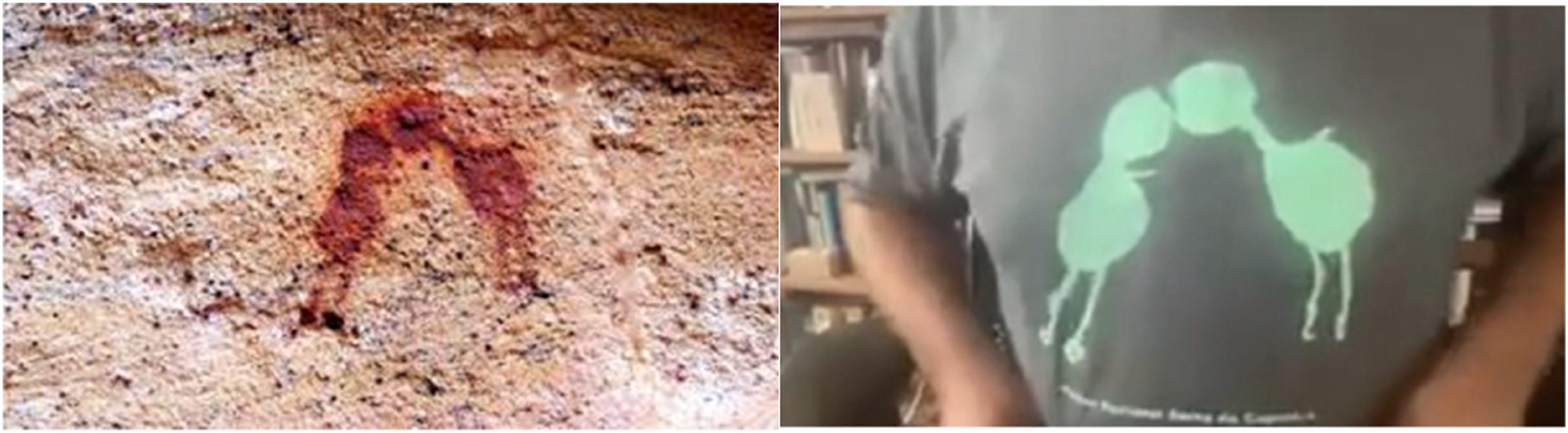
The Kiss
This image is linked to our ancestrality, to our ancestor child. This kiss, I’ve just visited the drawings, is in a reservation called Serra da Capivara Mountains in the state of Piaui in the Northeast of Brazil in a journey through this region, called “100 days to celebrate 100 years of a childlike life of Paulo Freire, a boy of 100 years” (Kohan 2021). Maybe because I am too touched by 100 days traveling 15,000 km meeting people of all ages, children of all ages, sharing the experience of a childlike pedagogy of the question, I feel the need not to do an adultocentric presentation, if that is possible or conceivable, being as I am age adult, but a childlike presentation showing you this childlike image and inviting you to engage in a childlike experience of time.
We don’t know exactly what this image is. Some may not be so sure that they are two children. It might be that they are two birds. It might be that they are kissing or touching their noses. We are not very sure. There are lots of studies about this image. It is 12,000 years old. If it is a kiss, it is probably the first kiss registered in our lands. I wonder if for those of us who are not very sure about what childism is, it would be nice to experience some kind of childism through this image: not knowing, not being sure, smiling, enjoying, feeling joy, maybe part of a childlike perspective at any age.
What is childism? It’s a child playing. It’s a child schooling. It’s a child questioning. It’s a child loving. Thus, childism requires the experience of the time of a child. John Wall has said and has spoken about giving privilege to a childlike subjectivity. Does the privilege of a childlike subjectivity require a body of a child? An image of a child? A feeling of a child? A loving child? A time of a child? Can childism be expressed in adultocentric forms? Or does childism require childlike forms of expression?
I hope with this image of a childlike kiss I have inspired you to ask questions about our relation to childism and our relation to childhood in our academic practices. If childhood is not an age but a time, isn’t the time of childhood a requirement to think about and experience childism? And also to relate to each other inspired in childism? To connect to each other? In our online times, extra questions might be offered: Can we connect to each other in a childlike way with our bodies being absent? Without smelling ourselves? Without touching ourselves? Without feeling ourselves? And without kissing ourselves? But in any time, a question to ourselves survives: can childism be expressed in adultocentric forms?
Concluding reflections I: A colorful bouquet, Britta Saal
The co-authors offer a variety of aspects of what childism might be, could be, or should be, and thus we find a colorful bouquet of innovative reflections and thought experiments. One kind of flower, maybe the most basic part of the flower arrangement, is to clarify which connotation of childism is used. Like Ohad Zehavi mentions clearly, childism can be understood in a pro-children and an anti-children way. The anti-children undertone is quite a bit more severe than adultism, since it contains a deeply rooted cultural attitude of prejudice, contempt and animosity towards children and youth. So, to state it clearly: All the authors in this article are committed to the pro-children sense of childism.
Another species of flowers turns around the question of what “childism” is. The suggestions range from a (critical) concept, a (critical) theoretical lens, and a (critical) perspective to an attitude and an agenda. For all, childism is not aimed at being or becoming a special and fixed theory, but rather a “pluralist way of seeing which is in constant change” (Biswas, above). Childism is also a challenge, since it has the potential to critically re-question philosophy, pedagogy, schooling, the sensation of time, the forms of presentation and expression, all the disciplines’ underlying adultism, and finally also the image of the human being in general. It really goes to the roots and “scratches beneath the surface” (Jackson 2004). It also remains the question raised by Walter Kohan whether childism could be expressed by adultocentric forms as most authors have done in this writing.
It appears that what is at stake is nothing less than the new creation of humanity in the form of a new co-humanity. The topics and notions which the authors offer primarily concern inter-human relations and human being-in-the-world. We find flowers like “deep interdependence,” “intergenerational relating,” “empathy” and “sensibility,” “empowered inclusion,” “reconstruction of the world,” “thick now” (now time; Jetztzeit) and a “child-like” mode. All of this is finally an invitation for us adults to go on a journey where, as Confucius says, “the way is the aim/goal” [der Weg ist das Ziel].
Concluding reflections II: Childism equips us, Toby Rollo
Presently, the discipline of philosophy struggles with childhood in two ways: first, with the concept of the child itself and, second, with addressing the plight of those who are conceptualized as children. The former issue is taken up in the intellectual traditions of ontology and metaphysics, while the latter issue is dealt with in the domains of ethics and politics. Each of our contributors attends to both aspects of childism as philosophical endeavor and brings into sharp relief just how radically disruptive the child is to philosophy as a whole.
As Hanne Warming points out, many of our ethical and political theories of recognition, freedom, and autonomy are deeply rooted in adultist developmental assumptions. This invites us to reconsider not just the first principles of traditional political philosophy, but the idea and practice of politics itself. For as Ohad Zehavi has argued, concepts of childhood are foundational to our social and political systems, and so childism speaks to much more than just another pattern of exclusion and discrimination among others. The concept of childhood and its application appear to structure the very meaning of living, not to mention what it means to live a political life.
In this sense, childism equips us to address adultist beliefs and practices, not just as a critical lens but as critical comportment. As Walter Kohan and Karin Murris point out, challenging adultism may require a more childlike philosophical inquiry together with a childist ethical orientation. This ethic is reflected in part in what David Kennedy refers to as a childist sensibility with respect to learning, which may prove necessary in the task of decolonizing educational practices, as described by Tanu Biswas. Education within communities is central to democratic life and here the ethic of childism overlaps with John Wall’s notion of deep interdependence and empowered inclusion, which offers a radical departure from adultist patterns of political belief and action to the extent that they avoid taking the political institutions historically established by adults for granted.
John Wall concludes that philosophy needs childism in order to expose and expunge historical adultism. This is true for all domains of philosophical inquiry, from metaphysics to politics. But philosophical inquiry itself is not a practice shared by all human beings. As those in critical disability studies have argued, not all of us have the capacities to engage in intellectual discourse, and to lament this fact as unfortunate or tragic is to recapitulate ableist logics which uphold the able-bodied/minded adult as the archetype of human freedom and agency. Clearly, it also imports an adultist metaphysics and politics, and so one significant question for childism is: what will be left of philosophy when we have abandoned all the adultist presuppositions?
Footnotes
Declaration of conflicting interests
The author(s) declared no potential conflicts of interest with respect to the research, authorship, and/or publication of this article.
Funding
The author(s) received no financial support for the research, authorship, and/or publication of this article.
Notes
 ).
).