



Abstract
This article presents retrospections on selected methodological explications of a slow research process with child citizens living in the urban, Sør-Trondelag region of Norway. The process was akin to what Gallacher and Gallagher have termed “muddling through” and was about primarily about ‘arriving at, asking and then attempting to answer the question: What is the scope for the philosophical blossoming of adults when they enter children’s playfully constructed worlds as guests? Particularly, I engage with a post-empirical phase colloquium with one of my main co-explorers, Enaya Mubasher, in the Child and Youth Seminar at the Department of Education and Lifelong Learning, University of Trondheim (Norway) in March 2017. Enaya, a (primary school student at that time) and I first met in 2012 during our commonly shared time in a kindergarten in Trondheim, where I was a kindergarten assistant for Enaya’s group and played with Enaya as part of my job. While I did not first meet Enaya as a “research participant,” our relationship evolved into a co-explorer dynamic after I had stopped working in the kindergarten. Playing with Enaya, included among other efforts, consistently playing with my understanding of what it means to be “me” as an independent “I,” and with it what was expected of me as an (adult) researcher within adult-centric institutional framings. The retrospections accentuate relationality as a defining dimension of rationality in research processes to advance conversations at the intersections of postqualitative and slow research with children from a childist standpoint.
Adults usually hold the space for asking questions and legitimizing what, when, how something should be asked about the lives of children, in turn determining what, when and how something can be known. To state the obvious: understanding lives of children for adults is determined by the questions adult researchers raise, and the relational position they raise those questions from. What seems to get lost in standardized approaches to research is that the questions are not only meant to answer something about “children,” but also about the adults who ask those questions to change or influence some characteristics of relationships they wish to advance with children. Indeed, asking a question about children also implies asking a question about adults from adult-critical standpoints.
Turning the analytical gaze to adultism in the personal and structural positionality, then is key to exploring these questions; an emphasis that is not observed as an explicit concern in feminist contributions to post-humanist and post-qualitative approaches like Taylor et al. (2020), Hodgins (2019), Bodén and Gunnarsson (2021). Recent childist interventions in posthumanist thought (Mattheis, 2022), adult-critical amendments to political philosophy and decolonial theory (Rollo, 2016), the troubling of adult-centric knowledge structures (Imoh, 2023; Sparrman, 2023) and the inclusion of childism in policy research on place-based education (Furu et al., 2023) are some examples what turning the collective concern to confronting adultism can reveal about the importance of recognizing children and childhood from adult-critical standpoints.
When I began my doctoral research I was seeking “child-friendly” ways of doing philosophy with children (P4C). After attempting different combinations of participatory methods of research with children, I realized that I was asking questions that positioned the adult securely as an expert in philosophizing. The question was about teaching children, and it could tell me nothing about what was possible to learn from them. Arriving at a question that would say something about adults learning from children, was one of the main “findings” of my research process. And it is this aspect that speaks to post-qualitative turns in research, which unlike conventional research methods does not have pre-existing methods of analysis for example, thematic analysis, and in fact terms like “data” and “data collection” are problematized (St. Pierre, 2019; also see St. Pierre, 2021 and Tesar, 2021). The central question in such approaches need not drive a research process but can be a significant outcome of it too.
In what follows, I retrospect on my exploration of describing the scope for the philosophical blossoming of adults when they play with children. 1 With reference to practices of doing philosophy with children, the exploration implied engaging with the question: what does it mean to do something with somebody? This required a conscious step toward looking for different forms of philosophizing which do not follow sitting and/or spoken dialog bound pedagogical formats such as philosophy for/with children (P4C) adhere to.
This article presents selected methodological explications of the “methodologically immature research process of muddling through (Gallacher and Gallagher, 2008)” with child citizens living in Trondheim city, in the former Sør-Trondelag region of Norway (Biswas, 2020). I focus on the post- empirical phase research colloquium with Enaya Mubasher in the Child and Youth Seminar at the Department of Education and Lifelong Learning, Norwegian University of Science and Technology in Trondheim March 2017. Enaya, (a primary school student in 2017) and I met in 2012 during our time in a kindergarten in Trondheim, where I worked as an assistant for her section. Time-tables in the kindergarten usually combined “educational activities” that required sitting training with breaks for play indoors, outdoors, as well as napping and eating. We played a lot together in this period and also developed a playful dynamic which continued through sitting-hours. Gradually our relation somehow developed a co-explorer dynamic as Enaya and her parents agreed to support my doctoral research, which I began after I left my kindergarten job in Norway and accepted a temporary research position in Bayreuth, Germany. Our time together before the systematic and institutionalized doctoral research began already mattered for my interest in childhood and philosophy. Enaya influenced this project through initial motivation, development of question and focus, empirical investigation, note-making, discussions, debates and presenting it in a scientific context. One of her strongest contributions was to my shift in looking at questions regarding childhood as implying a question regarding adults. In this case that: pedagogically oriented research questions need not be limited asking what and how adults should teach children, but also include what and how adults might learn from children.
The influence of my co-explorers on the shifts in my perspective renders it inappropriate to present the words in print as solely my own, even though the physical act of writing itself is mine. For this article, I re-connected with Enaya and consulted her regarding my retrospections, in addition to requesting her renewed consent for using her words which appear in the transcript, and our accompanying images. Enaya, now a 14-year-old pupil, appears as second author due to her substantive contribution right from the pre-systematic research phases. Through the course of the study Enaya became a principal co-explorer guiding the re-formulation of research focus and questions.
Children’s contribution to research and knowledge production should ideally be negotiated out of their obligatory school time, for example by affording them reduced school-work. Even when this cannot be the case, it need not limit the possibility of acknowledging children’s contribution to knowledge production resulting in research publications for adult authors—especially in humanities and social sciences, and the vast terrains in-between, where this work is located. Writing is necessarily a relational act, even though it might appear individual. Co-authorship then, as Enaya taught me, is also about me recognizing her influence that inspires my thinking conveyed through the physical act of academic writing for adult readership.
The article presents three excerpts from the transcript 2 of the research seminar with my retrospective comments highlighting some of the insights that emerged in the process. The seminar was a monthly meeting for the institute’s in-house and guest researchers with various disciplinary backgrounds to present and discuss their research on child and youth related questions. The participants were mainly in-house researchers who had consented to the seminar being filmed and transcribed for use in academic contexts. Their questions appear in the transcriptions below due to their significance for the flow of dialog. Who the questions came from, in this context, was of little relevance, and so I had only sought their consent to use the transcript for academic purposes. Consequently, their identities are not mentioned in sections where their questions are part of the conversation.
The first section presents how Enaya and I met and saw our relation, highlighting the place of taking time to know and engaging with the dynamicity of research relationships as an aspect of slow research with children. The second section describes thinking as a relational phenomenon which is a possible consequence of allowing time to know each other. The third section discusses understanding the other’s perspective, as implying a shift in one’s initial self-positioning and self-understanding. The conclusion aligns arguments for slow research (Adams et al., 2014; Kuus, 2015; Stengers, 2018) as complementing post-qualitative directions from a structural adultism-critical point of view.
The aim of this contribution then is to advance a conversation between slow research, particularly Isabel Stenger’s structural approach to speedy production in the knowledge industry (2018), and post-qualitative approaches in childhood and pedagogically oriented research. While acknowledging a close kinship with the ethnographic strand of research that takes its point of departure in the child perspective (Hallden, 2003; Sommer et al., 2009, 2013) and challenges adult-centric theorization by learning from children (Corsaro, 2020), speaking to overlaps of slow research and post-qualitative work would additionally entail confronting adultism in order to address “our responsibility to divest ourselves of our egotistical anthropocentrism, of our deep methodological habits of seeing ourselves as those who rule the paradigms and methodologies, and focus on openness and responsibility as we chart our methodological futures (Tesar, 2021: 226).”
Slow research: Getting to know and keeping on knowing
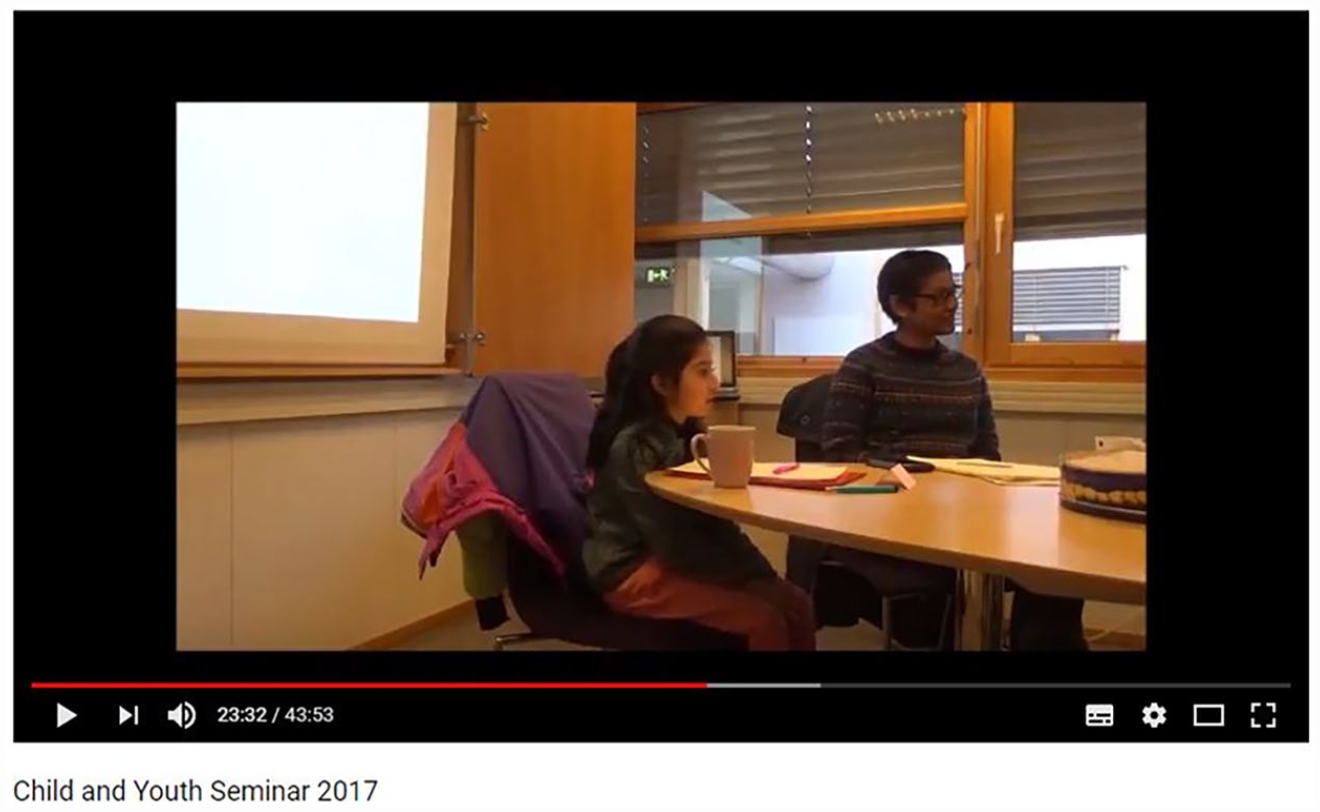
The transcript excerpt below introduces how Enaya and I got to know each other and how the gradually relationship developed. Our presentation addressed researchers attending the Child and Youth Seminar at NTNU.
[. . .]
(Uhm) Would you please tell me how Tanu and Enaya met. Like where they met or how they met?
So first when Enaya was (uhm) four (uhm) about to become five years old Miss Tanu started (uhm) like doing the Vikar-Job in our Kindergarten and then there they played together and Miss Tanu taught her to make sandcastles and in the gym we made the. like block
Ok, thank you.
And (uh) now I’m going to interview Miss Tanu . too . so we can see each other’s perspectives and (uh) because (uhm) it gets better when you take each other’s perspective 3 from both sides so that you get maybe different things like other what they mean or what their meaning is and what mine is. So .. Hello Miss Tanu.
Hello Miss Enaya.
Can you tell me about how Enaya and Miss Tanu met?
(Uh) Yes. (Uh) so they met in kindergarten in Trondheim when Tanu was working with (uh) as a Vikar there and . Tanu and Enaya played a lot and then something happened and Tanu had to leave and (uh) then Tanu continued studying and she wanted to meet Enaya again because she like . enjoyed playing with her so much and her studies were getting better because she was playing with Enaya so (uh) when she . she was very happy when she went to this festival in NTNU organized by the Bangladeshi community and there she saw Enaya and she saw other children as well and she asked if they would help her with the project and Enaya was one of those children and (uh) then Enaya’s mum said yes as well and then we started (uh) Tanu started visiting Enaya more often with the camera and had interviews and at that time Tanu did not really know what she was doing . very well but her mother and Enaya were open and were patient and then things started becoming clearer and there . there were new ideas (uh) that came . up and (uh) then (uh) Tanu stopped thinking of doing philosophy with children while sitting on a table but she thought that maybe a tea party was a nice idea because
[. . .]
Enaya and I had practiced this section the evening before because presenting in a scientific colloquium in a room with other adult researchers evoked nervousness in both of us. We agreed to present it playfully like an interview, as especially in the early systematic phase of the study Enaya had gotten used to interviews. The performative format seemed most promising to represent our process of becoming co-explorers. While we practiced we referred to ourselves in third person like we often did with some roles we performed when we planned what we were going to play. It was not a conscious decision, but something that happened when we were trying to figure out how our presentation would be. The spontaneous shift of self-referring in third person had also occurred with other co-explorers and had helped me experience myself from an “objective” point of view during the playful encounters. The self-other referencing also switched fluidly between third-person and first-person during play. In the transcript excerpt one notices that when we addressed each other we referred to ourselves in both third person and first person. The switches emerged spontaneously and reflect the playful relational modes we had gotten to know each other through.
One also notices, that in addressing the audience Enaya adds the title “Miss” to my name—a title she used to refer to me during our time in kindergarten as it was the convention to refer to adults, especially pedagogues, with a gender specific title in the institution. I sometimes playfully referred to Enaya as Ms. Enaya too and let her refer to me as just Tanu. This was to balance out the child-adult hierarchy and enable my own performing of the least-adult role (Mandell, 1988) as far as possible. In general, changing identities during my time as guest in the playfully constructed worlds was very common. Identity-switching had become an extension of the various role plays that was usual for our interactions both in and out of research contexts. Somehow, switching implied playing with the meaning of how I saw myself and helped expand what it meant to exist as “me” in relation to others.
Relationality: Thinking and letting think from and for both sides
Most acts we perform, as researchers or in any other social role in relation to children for example, teachers, require some questions in relation to others which may or may not be explicitly articulated. In many ways, our questions of being (and simultaneously being-with) in the world are inseparably connected to and boils down to questions of doing (and simultaneously doing-with). Questions of doing, inseparable from who we believe we “are,” are in various forms relationally alive during the life course.
Such questions arise with others who are experiencing related questioning for example, a teacher asking what shall I do in class today, might correspond to pupils having a similar question from a different position. Consequent answers depend on how one experiences the relational position one asks from. Thinking then seems both literally and metaphorically bound to certain positions with the possibility of taking new positions—what we do with the body.
While not every act performed through basic bodily postures such as sitting, standing and laying down are always done consciously 6 —these basic bodily postures and their variations are steered and formed over time by one’s philosophical pre-understandings whether or not, I assume, one is aware of them. The natural attitude or that which one takes for granted applies not only to concepts at a theoretical level, but also how the concepts become embodied and are repeatedly performed manifesting one’s mundane every-day self and the roles one performs.
If one must do something with somebody, it implies co-negotiating embodied meanings as well. Something as basic as sitting still—to eat at a table or to learn, as is common in most Westernized contexts—is up for negotiation in an child-adult dynamic (also see Corsaro, 2020). The posture refers to a picture one has of what it means to be human in a particular society and as an extension how new citizens in a particular society ought to be-have. Sitting for long hours (regardless of the activity being done in that posture and even if it implies a complete disconnect from the needs of the body), for example, seems to be increasingly what comes along with adulthood norms framing child-adult dymanics.
While there may of course be physical limitations to arriving at the kind of agility and flexibility a child counterpart could perform, the possibility to put oneself in different positions for different activities adheres rather to what it means to be adult in a particular world. Furthermore, when given the space, the very young might well be able to take limitations and needs of their adult counterpart into consideration. Their possibility of taking their adult counterpart into consideration is anchored in the fact that children also have knowledge of the adults they spend time with; perhaps more than adults might recognize. Knowing about children and childhood, can entail learning about the nuanced knowledge they have of adults, which is necessary for them to navigate daily life.
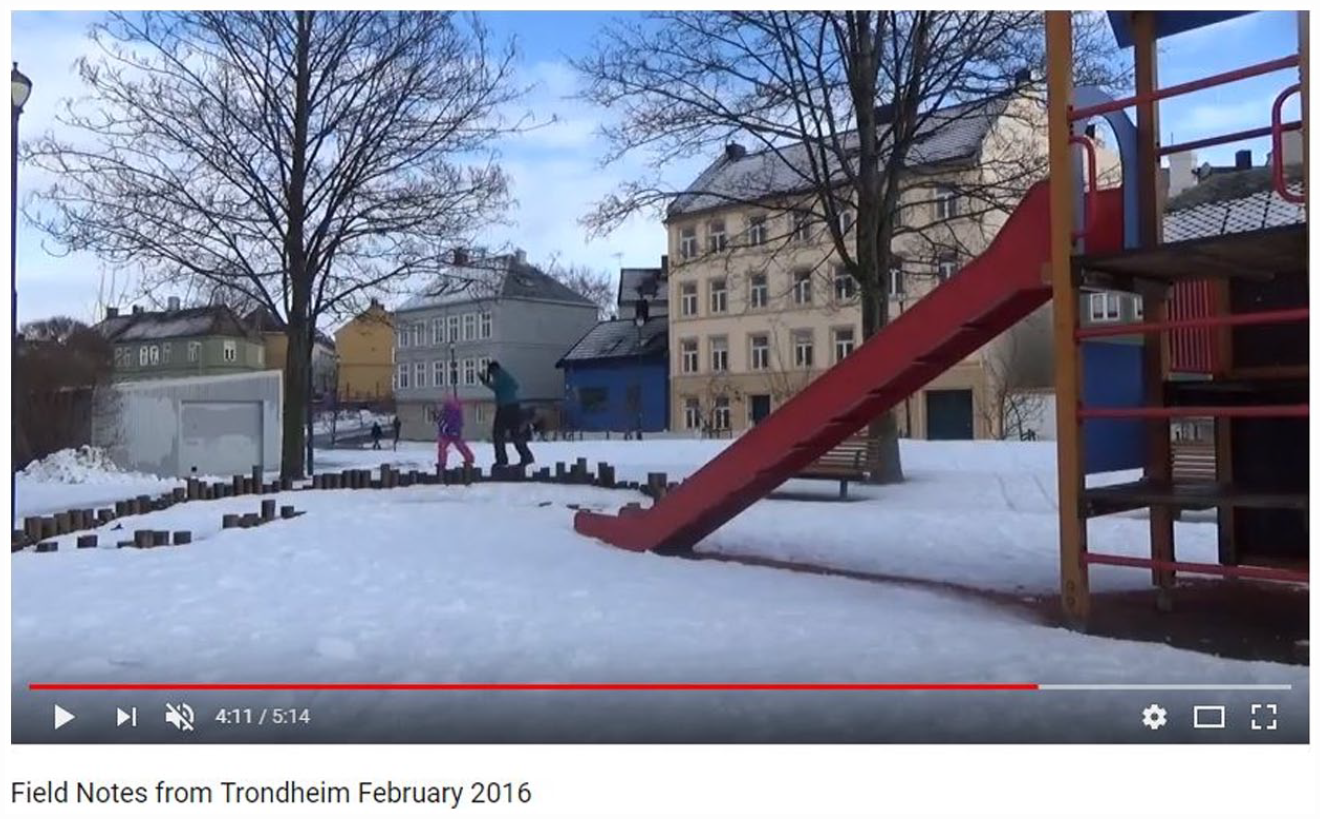
Through the course of my research process, I deliberately begun seeing myself as being a guest in the playfully constructed worlds of my co-explorers. When I played with the co-explorers, I often sensed that they took me into consideration as they improvised further. Enaya’s responses in the following excerpts confirmed this aspect. Here, an aspect of relationality in thinking together became evident. By thinking, I refer to the embodied processes of thinking including bodily motions—both subtle and gross. The pluralistic relationality in thinking that occurred by putting myself in a guest position and allowing myself to be hosted by my co-explorers manifested a temporary space-time continuum wherein both sides were thinking and letting think from and for the other side—at the same time. A large part of it was facilitated by imitating bodily movements of the smaller embodied host side (“child”) and being put into positions both figuratively and literally that “did not make sense” or felt “boring” in my “bigger adult picture.” While for me it was an experience of what I described as the unstiffening of conceptual muscles (Biswas, 2017), there were moments where a physical coordination in our bodily movements was also externally visible for example in Fieldnotes from Trondheim during 4.07–4.30 minutes (Biswas, 2018),
In the following excerpt Enaya responded to some curiosities of the researchers present which illuminate her side of the exploratory process:
[. . .]
Hello (uhm) I was just wondering what it feels like to have these play research encounters with Tanu (uh) like what you were thinking when she comes . if you want to teach her something or do you want to just . like what are you thinking when ..
Like . I’m thinking like from both sides like I want to help Miss Tanu with her studies also and I also want to (uhm) play with . like . get better at playing and see how it is to play with grown-ups because grown-ups don’t usually play like my mum and dad they don’t play. But like my little brother he wants to play . yeah . . . Anyone?
[. . .]
I know that Tanu comes to you and you discussed different things . so are there things which you think that is boring or maybe it’s not . you should be thinking of that or it’s something you know that you don’t like?
(Uhm) I sometimes think like wonder like those science things because I’m not like used to science so when I (uhm) just think it’s boring so when I . I like concentrate but I think it’s a bit boring that I start doing other things so I don’t get bored while I’m listening . so I do like really many things at one time 7 .
I can see you put lots of efforts . it’s a good work (uh) but is there something that
(Uhmm) No, but because that is like studying . like for example if I don’t like school so much but if I like go because I want to play and if I learn at home I get better at school so studies are important even . if they are really boring 8 .
<<laughing>> Very boring.
<<looking at another listener>> Yes?
It’s so interesting listening to you. Now I was just wondering about the playing thing is it . because you said that grown-ups don’t usually play but you play with Miss Tanu . does it differ after you played with her when you play with other kids? Is it different like . do you play differently now you think?
(Uhm) Not like connected with Miss Tanu (uhm) like (uhm) because I’m getting bigger then we play like not so . like with toys, we climb trees, run around and jump off big stones and we do like a bit . hard things but with Miss Tanu we do like the old stuff that I used to do 9 .
<<
<<To Tanu>> So Miss Tanu should start jumping off rocks and do hard play as well maybe?
<<laughing>> I try.
Sometimes we take it just so for granted you know it’s a . I mean they really do the hard things like they climb trees or . . .
No, it’s like . for me I am aware that we do the old things <<laughs>> like I can’t catch up with you <<Towards Enaya>> . you know all the time and it’s a . during the research I saw and I feel the difference of course (uhm) myself so then I try to see if I can fit into the game . in my way, you know? Which is also comfortable for me because I . we were in the park this . the . we were in this park and we were playing escaping like this . tower . I mean we had to do a lot of <<makes wave motion with her hands>> which was much easier for you . but this getting caught in like spider webs and stuff my body hurt the next day it was like . it was a bit like going to yoga or gymnastics or something and all happening because there is an
[. . .]
Can I ask another question? <<Enaya nods>> When you play with Miss Tanu is it also with like the philosophizing like . I mean do you talk while you’re playing or is it just the playing?
It’s playing and like a quarter or tenth that we are talking. But we are mostly playing 11 .
And what are you talking about?
(Uhmm) We talk about like a game 12 or so and sometimes well we have like a break when we’re playing and then we talk a bit about what’s going to happen. Like yesterday we were playing a lot and then afterwards we stopped playing and then we went to practice for . this. <<drinks from cup>>
[. . .]
Understanding: Dissolution of the initial self positioning
The transcript selections in this section elucidate certain implications of what could emerge in the process of taking each others perspectives. The conscious process of taking the other’s perspective, in this case the culturally distinct adult-child as self-other, was possible by speaking and being willing to tune into each other’s languages. Languages here do not narrowly refer only to spoken forms, but rather the multiple ways in which one’s being and becomingness 13 dwells in this world, with others. So, any inter-action in its most microsense appears to be essentially multilingual and does not imply that the parties involved are in fact speaking the “same language.” Nevertheless, spoken language in a shared cultural framework where Enaya learnt new words was also a part the possibility of our common understanding.
In the particular case of this longitudinal co-exploration, there were some shared concepts which facilitated the finding of mutually intelligible ways. One particularly mention-worthy concept was the word perspective, which Enaya had learnt in first grade. In my view, she practiced the meaning before with me; her getting a word for it only implied that by the time we reached the point where we could talk about our process, she knew how to use this word which made it easier for us to engage with some theoretical aspects of the study. During the colloquium there was both skepticism and curiosity regarding Enaya’s use of the word perspective which gave way to questioning whether there is any such thing as own thinking, and by this way—children’s or adult’s “own” thinking 14 :
[. . .]
Can I just ask one more question? When you were interviewing each other you told us that it’s very important to have other people’s perspective and there are different sides to stories. Is that something you’ve talked about or is that something you just sort of know or talked about with your parents or..
(Uhm) That I actually learned in first grade because our school has like units and there are difficult words and then we learn their meanings but sometimes I can’t keep the meanings but some words when I practice then I <<makes sliding motion downwards with her palms together>> better understand them.
I would like to add something to the word perspective because it was actually the first time that you used it yesterday and I was like, what is she . yeah like we were practicing that we can do this part like an interview and then Enaya just said, yeah now we’re going to do this and we can get the other perspective . and I was like, what did you just say there? (uh) and then I asked her where she learned the word and she said it was in school and (uh) what you actually just pointed out was you know that . if you don’t practice it you lose the meaning and like . so for me in a way I’m lucky that she got the word in school so we can practice the meaning like it gets easier because (uh) I was telling Enaya this morning that it’s a very, very important word for social science . well
Yeah you know in science it’s very much like this adult thinking [. . .] I think that is it really children thinking that they should have other’s perspective because it is what they’re learning or we teach children actually because she learned it from school, she learned it from elders, grown-ups that you should learn other’s perspective [. . .] so I don’t know really where is this child’s own perspective . the perspective of child. [. . .]
<<towards Enaya>> Do you wanna say something about that?
(Mmh) . Yeah I think it’s also like if you do this perspective it’s like if the grown-ups teach the smaller ones . like if they tell like . something like . if I . someone just told me a word perspective then I should . like sometimes the child finds . like if my mum says find . the teacher said to find the table so my mum said (uh) you do the nine-table and then I found a pattern that my mum and parents didn’t know . even if they taught me it. <<Listener laughs>> Children find out things themselves.
Yeah this is very good that you know . Children should . children’s own thinking . their own thoughts should . they . i-it’s just equally important not that I . yeah.
I sort of . tend to disagree a bit because what is an own thinking because we’re all part of . you know you have your parents and a brother and I have my people around me as well you’re never . that’s something that just doesn’t come from just inside and I mean . to say that . well I mean how else are you going to sort of .
Yeah <<looks at Enaya>>
Do you understand?
<<to Enaya>> Is there anything . like do you think there is like your
Like it’s actually I’m con- . I’m like thinking of both things because sometimes there is . with other people and sometimes there are only your person- . it’s only like one person and sometimes there are like really many of us.
[. . .]
Enaya points to a plurality in her experience of herself and how it fluctuates contextually. As I followed some of my co-explorers since infant and toddler stages—one thing seemed evident: They seemed to have a profound awareness of interdependency coupled with very high empathy for the surroundings and resilient forms of vulnerability that came along with it. 15 Conventional developmentalist positions operating through prisms of the deficit concept of the child (conf. Matthews, 2009) tend to interpret early childhood interdependency as an absence of the Self or Individual Identity in early stages of development, which “evolve” as humans age toward adulthood. Childist approaches however build upon the concept of vulnerabilty as an onto-ethical category coupled with the concept of agency arising from a child-inclusive view of what being human means. Deep interdependence (Josefsson and Wall, 2020) then, at all levels and throughout a lifespan, becomes an indispensable characteristic of human existence. We are, regardless of age, differently interdependent, interdependent nevertheless.
Other methods of philosophical investigation such as Vipassana meditation 16 for example, if practiced systematically can also reveal that even as adults one cannot empirically claim to possess a Self. Playing guest in a child’s playfully constructed world—implied allowing a disintegration of my world (as my network of meanings) in the process of negotiating some existentially fundamental meanings such as what it means “to be me” and what I understand and experience as ““time.” 17 One of the primary identities I bear and is borne to me by others is that of being “an adult”; through the inter-generational play encounters which often included changing roles, my adult role-play (conf. Goffman, 1990) in the “real” world became evident. Waksler (1986: 75) describes this engaging the notion of socialization in what can be described as a childist standpoint, “Consider that the process of socialization entails not children becoming adults, but learning to act like adults. We might ask: are children truly socialized or do they simply learn to translate their experiences into adult common-sense terms? Many of the adult ideas we claim to possess we may not fully accept, but only talk as if we did. The unsettling aspect of this consideration is, of course, that there are no adults, only adult actors—a sociologically plausible but common-sensically disorienting idea.”
The disorientation that Waksler mentions, I decipher, is a symptom of a self-positioning (and as a corollary one’s initial position) dissolving because of opening to another perspective. Seeing from another perspective implies understanding something from another point of view, which is not visible through one’s initial point of view. Given that one has understood something would necessarily imply some sort of transition in the initial position in the broadest sense. The re-oriented transition may involve an experience of disorientation. The Norwegian equivalent of the verb: to understand, the verb å for-stå illustrates the phenomenon rather beautifully. The prefix “for” in the Norwegian sometimes refers to a shift in position or being put in the state of what the stem verb indicates, as in the case of å for-elske, to be in love. In this case when stå (to stand) becomes for-stå (to understand), it may signify that having understood means standing in the position that one sought to understand in the first place.
Conclusion
Understanding another perspective implies a shift, however subtle, in one’s initial position—the place from where one sees and speaks. A pre-condition for that possibility is firstly an ontological validation that there is a perspective on the other side. Thereafter, engaging with matters regarding accessing, encountering and negotiating meanings with the worldviews and positions of the other sides, in light of both inter-generational research as well as pedagogy. An implication of understanding, in this sense, implies one arrives at asking earlier questions from a new standpoint; What and how can adults learn from children?
Philosopher of science Stengers (2018) argues for slower approaches to research, and the significance of slowing down in response to the institutional pressure to publish that is a feature of contemporary academia. Similar arguments can be read in medical anthropology and development and policy studies (Adams et al., 2014; Kuus, 2015). In research areas directly related to children’s lives for example, education, the pressure to publish, even in relatively well-funded Nordic universities, adds to structural adultism given that researchers might be highly restricted in terms of the time they can spend getting to know children and the knowledges that can emerge through the process of getting to know. Saying something too fast for the sake of publication points, might come with the risk of having to reproduce and recycle what is already known, from perspectives which they are known for example, children as default addressees of pedagogy (Biswas 2020; 2021b), and adults as their default teachers. Shifts in perspectives that occur as a result of taking time to get to know, and to keep on knowing someone in different ways over an extended period of time, cannot belong to speedy knowledge production. Post-qualitative turns that seek to go beyond pre-determined data-analysis methods complement the open engagement with relational dimensions of slow research with children, which implies also getting to know oneself in different ways through the temporal trajectory of research projects, which extends beyond their formal institutionalized lifespans.
Footnotes
Funding
The author(s) disclosed receipt of the following financial support for the research, authorship, and/or publication of this article: The author(s) received financial support for the research stays in Norway and student assistance for transcription from the Equal Opportunity Fund of the University of Bayreuth, and open access publication support from the University of Stavanger.
