




Abstract
Care is traditionally researched in ECEC as a dyadic, human phenomenon that relies heavily of tropes of females as care providers. The assumption that care is produced in dyadic relationships occludes material care practices that occur beyond the dyad. Drawing on Bernice Fisher and Joan Tronto’s care ethics and Karen Barad’s focus on the agency of materiality, I have sought to explore how care is produced outside of dyadic relations in ECEC and how that care relates to domestic practices and flourishing in ECEC.
Introduction
This article builds on a micro-ethnographic study of how care is produced beyond dyadic human relationships at a Norwegian early childhood education and care (ECEC) center for children under 3 years. The subject of care in education is usually understood through theories that use the mother-child dyad as model, and through a psychological lens, in relation to Bowlby’s (1988) attachment theory and/or care as an interpersonal process (Stern et al., 1985). These studies (e.g. Foss, 2009; Goouch and Powell, 2017; Hansen, 2013; Page and Elfer, 2013) discuss care and care quality as a human, dyadic phenomenon. To move beyond a dyadic conception of care, I drew on Fisher and Tronto’s (1990) feminist approach to care as a situated, not necessarily dyadic practice (p. 40), and Barad’s (2007) agential realism that emphasizes the intra-relations of human and more-than-human phenomena. During my analysis of photographs and field notes taken during this study, I became aware that the more-than-human processes I considered to be producing care were all related to domesticity, or processes of day-to-day living, and living well.
Living at all demands that someone and some things, care (Puig de la Bellacasa, 2017), though care is an undervalued aspect of daily human life. Suh and Folbre (2016) blame the devaluation of care in society on traditional associations of care with unpaid and untrained labor performed at home; estimating that including time spent on unpaid child-care in American households in calculations of the US gross domestic product (GDP) would increase the GDP by 43%. This figure is impressive, but even more impressive if we consider the time spent on domestic activities involved in child-care and the maintaining of home child-care environments that is not included in Suh and Folbre’s (2016) proposed model. Activities such as pet and adult care, errands, household management and other household chores are not counted as time spent on childcare. It is common to understand childcare as distinct from other domestic activities because the dominant conception of care locates care in human relationships and interactions (Bowlby, 1958; Noddings, 1984; Page and Elfer, 2013). However, care is increasingly understood in social research as situated (Fisher and Tronto, 1990), occurring beyond dyadic human relations (Barnes, 2015), and entangled in more-than-human practices (Puig de la Bellacasa, 2017).
Across the globe, daily care for our youngest has been re-located (Sevenhuijsen, 2003) from the home, to social and pedagogic institutions. The effects of structural qualities of ECEC environments on children’s opportunities for caring interactions with staff has been addressed (Hansen, 2012a, 2012b; Løkken et al., 2018). The effects of the increased focus on learning and professionalism, and the devaluation of care competencies in ECEC (Van Laere and Vandenbroeck, 2016) has also been investigated. These studies shed light on the effects of different environments and practices on dyadic care practices, but do not address how the non-home, material environment of ECEC centers produce or even engage in care practices.
More-than-human care and domesticity
Fisher and Tronto (1990: 40) extend the conversation about care from a private, dyadic phenomenon, to a politically relevant “species activity that includes everything that we do to maintain, continue, and repair our world so that we can live in it as well as possible.” This definition resists the association of care with women’s biological, cultural and historical position, extending the notion of care to include a whole array of activities performed by both men and women. For example, working to earn money to provide for children, building a home, preparing food and in any other way working to maintain, continue and repair a common and shared world is, from a care ethics perspective, a form of care. Within the framework of an ethic of care, laws and regulations are part of a caring practice when they support and protect the ethical foundations and material necessities of a caring practice (Fisher and Tronto, 1990; Tronto, 1993). It is not only the direct engagements between cared for and caretaker that define care, but all that is done to provide care.
Extending Tronto and Fisher’s (1990: 40) definition of care as all that is done to “maintain, continue, and repair our world” with Barad’s (2007), agential realism that emphasizes intra-action and the epistemic relevance of materiality, “all that is done” is not only done by people, but also by other phenomena. Drawing on examples from the entangled behavior of matter at a quantum level, Barad’s posthuman thought challenges the Cartesian idea of the human individual as a self-contained subject set apart from the material world and other life forms (Barad, 2007). A posthuman understanding of materiality assigns agency and thus epistemic relevance to other-than–human phenomena, as well as humans. Materiality exerts agency, understood as “the ability to act in such a way as to produce particular results” (Alaimo, 2017: 415). In other words, the things that we do care with also do care with us. Care is always co-produced and the result of cooperation (Aslanian, 2017). The “we” that maintain, continue and repair the world includes all phenomena such as objects, animals, weather, emotions and other life forms. Barad (2007) explains: “Intra-acting responsibly as part of the world means taking account of the entangled phenomena that are intrinsic to the world’s vitality and being responsive to the possibilities that might help it flourish” (p. 369). Here care is taking account, being aware that we act with the more-than-human world and acting in a way that helps the world flourish.
Puig de la Bellacasa (2017) describes caring as thinking with, taking account of our entangled world, emphasizing that all things that live are somehow held together by relations of care. While humans can think with, care relations are not always intentional. Our relational world renders care an ontological rather than only moral issue (Heidegger, 1962/1927ch), and draws attention to material care practices that are not intentionally done (i.e. the sun shining, a blanket warming, a pacifier soothing), but that none the less care in the sense that they provide the catalyst for the flourishing of the human and non-human environment. Care, like neglect is and can be both something done, something experienced and something that happens beyond our control. To flourish, a person or thing has to have its holistic needs met, including the biological, sensorial, emotional and intellectual (Kraut, 2009). Needs are related to what it takes to keep us alive and intentional caring is only the small part humans can do, while entangled with the non-human environment, and thinking with to promote flourishing and becoming “as well as possible.”
Domesticity and care in ECEC
Domesticity is devalued in society (Stovall et al., 2015) and women have been keen to disassociate their work in ECEC with domesticity and mothering (Ailwood, 2008; Aslanian, 2015). The Collins dictionary describes domestic life as “Domestic duties and activities are concerned with the running of a home and family.” All that is done to run a household is, from a care-ethics perspective, a process of caring. The family, described as “a haven in a heartless world” (Lasch, 1977 in Holstein and Gubrium, 1995: 894) can be understood as a contrast to the unforgiving and law-based public space. Western domesticity rests on ideas such as marriage, family, religion, and economy (Pilkey et al., 2015). Related ideas are central to the field of ECEC, such as community, pedagogy, economy and politics.
The power of the domestic is at the heart of traditional Nordic kindergarten pedagogy, tracing back to the 19th century popularity of Schrader-Breymann’s supplementation of Froebel pedagogy with domestic chores and activities and a home-like atmosphere (Johansson, 2020). Until the past few decades, children referred to kindergarten staff as “aunts” and though rare, “uncles.” Today, the Norwegian full day, universal ECEC system is both a social institution, providing opportunities for parents to work outside of the home, and a pedagogic institution. Echoes of family life continue to ring through ECEC work, even as the diversities of families that are involved in ECEC grows. Ideas about “home” are heterogeneous and ideas about professionalism are increasingly divorced from ideas about care (Aslanian, 2018). Despite varied ideas of what materialities and practices make a home a home, Harwood et. al (2013) found that an international group of kindergarten teachers described their work as “mothering, providing, performing, producing, facilitating, observing, creating environments and opportunities, role modeling, foundation building, and being an extended member of the child’s family and community” (p. 9). Domestic life differs in what things people use and make to do things with, but necessarily involves essential life-supporting work and material processes that support our basic needs for love, sleep, food, stimuli and play. Children under three increasingly spend large portions of their lives in ECEC institutions across the world (UNICEF, 2008). Daily life in ECEC includes playing together, learning together and exploring together, but also domestic practices relating to basic sustenance, sleep, hygiene and grooming needs.
Care work is implicitly understood as domestic (Moss et al., 2006) and the “many-sidedness” of home life has long applied to care and learning in kindergartens (Brehoney, 2014: 187). Modern discourses of professionalism in ECEC obscure the domesticity of everyday life in ECEC centers, contributing to the occlusion of the already nebulous subject of care (Moss et al., 2006). Full day ECEC centers are liminal spaces, with what can be called hybrid functions of both a “here and now” life sustaining function and a “for the future” knowledge building function. ECEC centers necessarily involve domesticity, or, “the minutiae of everyday life” (Bone, 2017) which easily goes unnoticed.
The Norwegian context
Norway adheres to a Nordic conception of ECEC in which learning, care and play are understood as intermingled (Kragh-Müller, 2017). Children have a right to a government-subsidized place in ECEC from the age of 1-year, and over 82% of children under 3 years attend full day ECEC (Statistics Norway, 2020). Kindergartens have been described as a “second-home” in which relationships with teachers are more friendly than authoritarian, children are expected to explore and rearrange a prepared environment, children’s free play is prioritized and the focus is on processual rather than outcomes-based goals (Kragh-Müller, 2017). Since responsibility for the sector was moved from the Ministry of Children and Families, to the Ministry of Education and Research in 2006, the field has been under pressure to professionalize pedagogic practice and policy (Nygård, 2017). Political pressure to systematize learning goals and increase learning outcomes in ECEC in order to prepare young children for school has not resulted in formal learning outcomes, but have increasingly marginalized the subject of care in Norwegian early childhood teacher education (ECTE) policy (Nygård, 2017; Aslanian, 2018). The term “care” was for example completely removed from the most recent Framework for ECTE in order to convey a more professional view of the education and render it more attractive to the public (Aslanian, 2018). Though the word was removed, neither the government nor the profession intends to reduce the amount or quality of care children receive in ECEC centers, nor of abandoning the Nordic social pedagogy tradition that combines care, learning and play (Norwegian Ministry of Education and Research, 2019–2020). At the same time, little time or money is invested in understanding the human and more-than-human production of care in ECEC.
Portraiture methodology beyond the dyad
The study took place at Browny Center, a fictively named ECEC center for children under 3 years in Norway. To explore how care is practiced outside of direct human relations, I participated passively in daily life for a few hours a day, 2 days a week over a period of 4 months. I engaged with the methodology of portraiture developed by Lightfoot (1997). Lightfoot (1983, 1997) developed a methodology meant to explore the good of professional practice in order to develop generative processes that foreground what can be learned from others as opposed to focusing on failures and shortcomings. Based on the idea of an artist making a portrait of a subject, the researcher, like the artist, spends time getting to know and observing her subject and writes up a narrative portrait. The resulting portrait is not understood as an objective account, but the result of a subjective experience and relationship with a person, thing or concept.
Approaching portraiture as a posthuman practice, I strived to understand Browny center and myself not as subject and object, but as intra-acting and related elements in a moving, living landscape, elements that slowly shaped each other. My strategy to look beyond human dyadic relations was to foreground the material by incorporating photography into my observation practice. I used an iPhone to photograph because it was inconspicuous and easy to handle. My goal was to photograph objects that I identified as involved in caring practices and to take field notes to collect things, activities and happenings going on around me that I identified as care. I found however that it was necessary to spend a large amount of time observing without recording. I was looking for care in places other than where I habitually found it (human dyadic relations). The act of looking became a search into the unknown, and a conscious move away from the known. To do this, I found inspiration in Wolff’s (1976) “surrender and catch” method of observing what one cannot yet know or expect to know. Wolff (1976) likens the process to observing with love, understood as “cognitive surrender.” This radical surrender to the field entails being aware with the senses, an aesthetic process that culminates in the “catch” of a sensorial impression that conveys a new understanding. The idea of cognitive surrender demands attention to sensorial experiences, and is related to love in the respect that everything one experiences in the field is understood as pertinent (Gherardi, 2015). This perspective was helpful when observing with a relational ontology wherein everything is considered pertinent, yet not everything can be analyzed or communicated.
My aim, in line with portraiture methodology and its focus on finding the good, is not to problematize, but to display generative practices of care. My understanding of “good” relates to Barad’s (2007) description of responsibility as being responsive to possibilities for life to flourish and Puig de la Bellacasa’s (2017) conception of care as relating, leading to flourishing. I looked beyond dyadic relations for events that were “conducive to flourishing” at Browny Center. My understanding of what was “good” or conducive to flourishing at Browny center was limited by my assumptions and ideas about what is good, and what I believe is good for children (Kraut, 2009), for example the children’s visible or audible happiness. My assumptions about what is good are related to the culture I have grown up in and continue to live.
To find an ECEC center in which I could observe “good” care, I first reviewed the parent satisfaction surveys for the ECEC centers in a municipality chosen for convenience. I first collected the centers with highest scores, and then checked for structural quality. Browny center had the recommended staff: child ratio of 1:3, and maximum group size of twelve children. I contacted the Director before contacting the Head teacher, with whom I planned a meeting with the entire staff. After describing my project, we agreed to work together. Parents were informed and their written consent was granted for me to participate in daily activities at Browny Center over the course of the semester.
I have used my sensorial impressions of a preschool teacher humming, the smell of bread baking, the sound of plastic toys crashing to the ground and the sound of knitting needles tapping that alerted me to materialized care as anchors in my narrative portrait. I regarded what I attentively heard, smelled, felt and otherwise sensed, as data. The sensory impressions stood out as moments that care imbued daily practice in unexpected or contentious ways. The narrative portrait below is based on my field notes, photographs I took of “materialized care,” and sensorial impressions and memories from field work, including formal and informal conversations with staff.
A portrait of care beyond the dyad
Browny Center is located in a leafy suburban neighborhood that borders on a forest. It is a lower-middle class neighborhood in a rich municipality, in the very rich country of Norway. The center is part of a complex that also includes a convalescent home with an outer wall of glass, so that the elderly can see the children playing outside, and the children can see the elderly. Inside the center, white walls reflect light from very large windows that reach nearly to the ground. The walls are sparsely decorated with children’s art and children’s books that are within the children’s reach. The building is aging, but kept clean and newly painted. Browny center serves up to twelve children under 3 years. The staff includes a head teacher, a preschool teacher, a youth worker, and an assistant. The staff to child ratio is one staff member per three children and two of four staff members are preschool teachers. Three of four staff members are educated to work with children. The assistant has 20 years’ experience in ECEC and there is an additional member of the staff, paid by Norwegian social services to gain work experience. Today, one staff member per 12 children under 3 years is a mandated staffing norm (The Norwegian Directorate for Education and Training, 2018), however, at the time this study was undertaken, it was only a recommendation that was more often than not unheeded in favor of larger, more economically rewarding groups.
My first impression upon entering Browny Center is a light and lively atmosphere. Upon entering, I am met with a small IKEA “Klippan” couch, filled with people large and small, various books and pillows. Three or four children and a teacher more or less buried underneath them sit chatting and wriggling. After a while, the children slide off the couch one by one and wander off to play. The comfort of the couch turned out to be the place I spent most of my time, with children stopping by and joining me, or observing the care unfolding around me.
While sitting on the couch, I heard the sounds of hard plastic crashing on to the ground, but no commotion to follow. I got up to see what was behind the sounds and found Olivia, 2-years-old, curled up inside the bottom tier of a low, secured wooden shelf in one of the playrooms, alone. I kept my distance, noting the scattered plastic toys she had thrown out of the shelf (Figure 1) so that she could curl up inside of it. She laid there quietly. After some time, she left and I inspected the shelf, to try to understand why she wanted to be inside of it, and whether or not this happening was an instance of care beyond the dyad. From my perspective, the bottom tier of the shelf did not look inviting. It was empty and hard. Still curious, I got down to the level of Olivia’s 2-year old body and looked again. From a perspective under three feet tall, the empty shelf looked more like an open, inviting space (Figure 1). It was just big enough to fit a 2-year old body. One of the teachers saw me examining the shelf and explained with a knowing smile that Olivia often empties out that tier of the shelf and curls up inside of it.
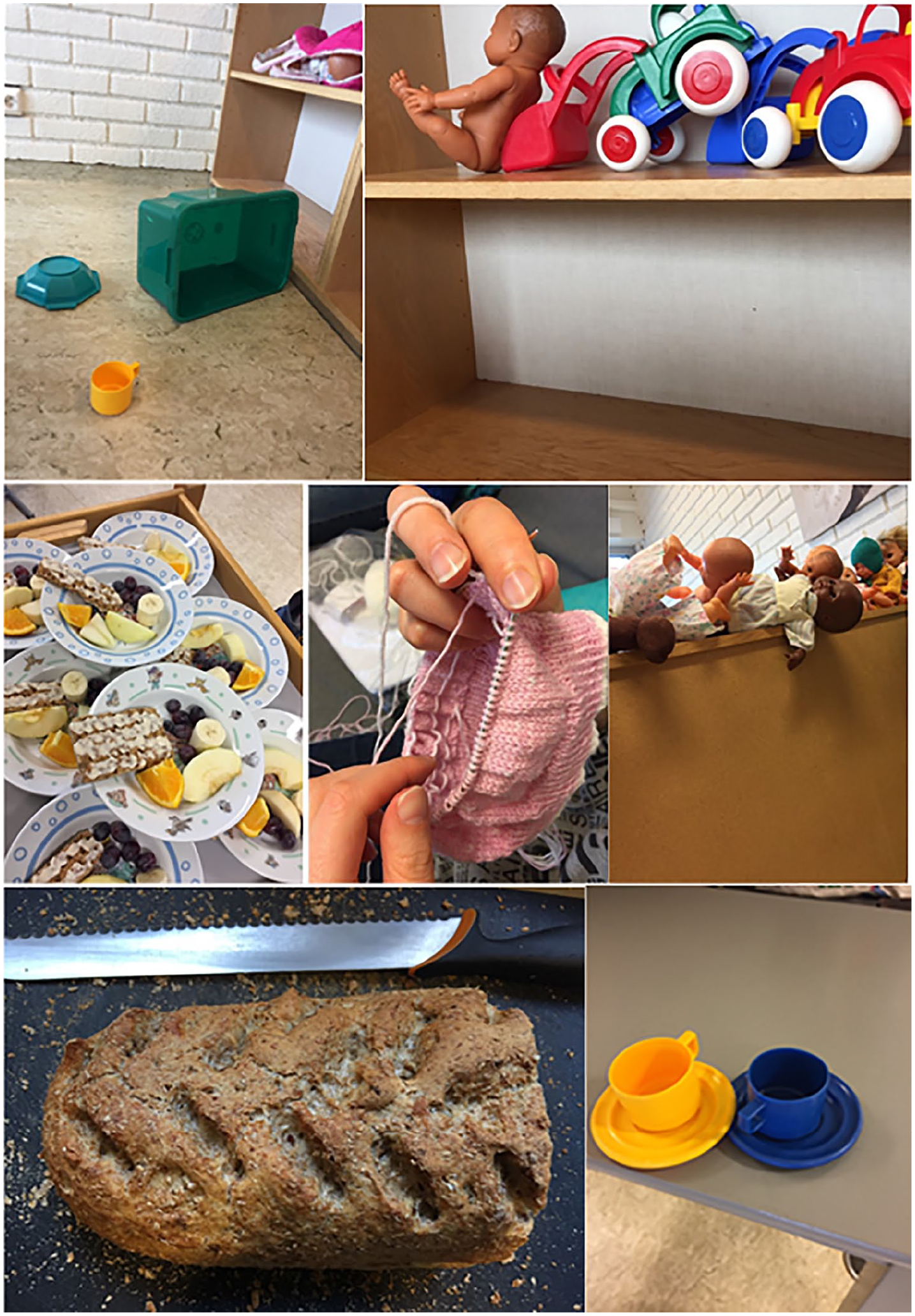
Photographs of care beyond the dyad.
One corner of the classroom is used as an office and has diverse information hanging on a bulletin board, including safety information, a map of the building and a brochure from a behavioral learning program the municipality, along with many other municipalities in Norway, has ordered all ECEC centers to follow. The head teacher explained that she did not agree with the methods taught in the program and chose not to follow the program, though herself and the staff had gone to the obligatory workshops. The learning program is a behavioral program that “aims to prevent and reduce behavioral problems, as well as strengthen children's emotional, social and linguistic development” (translated by the author, from the municipality’s website), has grown in popularity in Norwegian ECEC sector and is utilized in countless centers. The program is adapted from an American behaviorism based program for families with behavioral challenges and includes instructions as to how to respond to “unwanted” behavior from children ranging from giving praise, to ignoring and to placing children in a “time-out.” The methods are intended to reduce the use of corporeal punishment in troubled American families, and have been adopted for use in Norwegian ECEC. While the program is well intentioned, praised by the World Health Organization (2020) and has had positive effects for troubled families in the US and Norway, its use in ECEC centers for all children is contested within the profession (Pettersvold and Østrem, 2019).
Back on the couch, I smell bread baking and hear a pedagogue softly humming a tune as she passed me by on her way across the room. The humming preschool teacher was preparing lunch in the kitchen. She showed me the bread she has baked (Figure 1) and explained to me that she has been delegated the job because she likes to do it. She uses her own recipe and comes in early several days a week to start the bread before the children begin to arrive. The other staff members know this, and if there are few children left before her shift is up, she leaves early with everyone’s agreement. The staff valued this kind of flexibility and appreciation of each other’s work. During interviews, the staff agree that fresh baked bread offers children an important experience of good tasting and nutritious food. The food is served on ceramic plates with children’s illustrations that are common in Norwegian kindergartens (Figure 1), and the staff member responsible for preparing the meal sets the table. I am sitting on the couch, observing the setting of the table when Jacob (2-years-old) comes by and offers me a yellow plastic cup (Figure 1) with an undisclosed drink inside. “Drink” he tells me, intently with a smile. . .
After lunch was served, the staff helped the children in to their prams, lined up outside near the window into the play area and one by one, they fell asleep. Once the last child outside fell asleep, a quiet fell upon the classroom. I heard the tapping of knitting needles and, turning around, I found the young apprentice, sitting on the couch, knitting a light pink beginning of what seemed to be a baby hat (Figure 1). Having knitted before, I sensed the wooly, soft feeling of the tightly knit yarn. She explained that she had never knitted before she began at Browny Center, but learned recently from a preschool teacher at the center. She worked on the hat during her break, while the children slept after lunch and as the children slowly woke.
Making ourselves at home in ECEC
In this article, I asked how care is produced beyond the dyad in a robust ECEC care environment. I sought to understand care as all that is done to continue, maintain and repair shared worlds, and as “taking account of the entangled phenomena that are intrinsic to the world’s vitality and being responsive to the possibilities that might help it flourish” (Barad, 2007: 369). The materializations of care I observed and participated in involved domestic staples, such as toys, bread baking, shared mealtimes, dinnerware and knitting. In this section, I will discuss how materialized care relates to making ourselves “at home” and how domesticity can open up new ways of understanding care in ECEC through a care-ethics and posthuman lens.
The dominant Western discourse of domesticity “rests on a dialectic relationship between the symbolic and the real, the individual and the collective, and the public and the private.”(Scicluna, 2015: 175). The tensions between the symbolic, ideas of domestic bliss, and the realities of domestic violence underline how the domestic space is paradoxical and does not necessarily produce caring. Domesticity embodies the individual and the collective, both isolation from the outside world, and freedom from the outside world. The domesticity of ECEC produces possibilities for care and for oppression or even violence within center walls. However, domesticity also provides the possibility for individuals to produce “subtle modes of resistance to the dominant order” (Fraiman, 2017: 10). The power domesticity offers to resist from inside is illustrated by the staff at Browny Center, who hang up the poster about how to respond to children according to the program they are expected to follow, but do not change their practice as prescribed, as they deem the advice pedagogically questionable. Inside, we can and must, make the rules. Until feminists distanced themselves from the correlation between the feminine and domesticity, the domestic was used as a means to exert power and transmit pedagogic knowledge, values and traditions (Allen, 2005).
Many kindergartens in Norway continue to follow the Nordic tradition of creating an atmosphere that resembles a second home, and a couch has until recent years been a common feature (Kragh-Müller, 2017). However, the classic idea of the kindergarten as a second home is slowly losing sway. A new generation of kindergartens have developed since the goal of universal childcare available for all children over 1 year has been politically prioritized. Larger centers ensure universal coverage, and municipalities increasingly utilize pedagogic programs to ensure learning goals are met. Accordingly, ECEC centers look less and less like traditional Norwegian/Nordic home environments and more like “workshop” environments, organized around particular activities or subject areas. How are “life sustaining” practices produced in these environments, and can they be produced without domesticity? The actual absence of the couch in an ECEC center for children under three-years produced frustration and longing according to interviews with staff in a kindergarten built as a workshop who believed that a couch would improve their ability to care (Berge, 2019). What does a couch do? Couches are obviously not a part of all caring environments around the world. Humans care in many places without a couch; just as places with couches are not necessarily good care environments—but what does it produce in Norwegian ECEC environments that is missing when it is not there anymore?
I sat on the couch much of my time at Browny center, and it was from the couch I noticed the sounds and smells that alerted me to care beyond the dyad. The couch, perhaps the most central symbol of domesticity in Norwegian kindergartens, was so much a part of my approach to observation that I did not photograph it before it was moved and “out of place” during the last few days I observed at Browny center, when the floor in the center was removed and replaced (Aslanian, 2017).
Much like the absence of the term “care” in the Norwegian Framework plan for ECTE, the couch is absent in this article in terms of being visualized as materialized care, though it was present as the bedrock upon which I worked to observe care beyond the dyad. The couch was certainly a central co-producer of care.
The absence of the couch in my photographs leads me to wonder what else I did not see. The methodology of portraiture insists on the validity of the researcher’s vision. English (2000) criticizes the methodology, arguing, “The artist does not see what is there (p. 25). The artist sees only through the images of gender, culture, social mores, and relationships.” How did the cultural image of “baked bread” I am immersed in affect the way I perceived it? There are countless other ways of understanding bread baking, and if the children were for example forced to eat more bread than they felt they could, the smell of bread baking could produce sensations other than care. I saw, heard, felt and smelled care because I perceived it as involved in the vitality of the world shared at Browny Center. For the bread, the toys, the knitting and the plastic cups to co-produce care, they must be involved in a process of flourishing with a “multitude of relations that also make possible the worlds we think with” (Puig de la Bellacasa, 2012: 198).
Understanding domesticity as an aspect of co-producing “our world” and making ourselves at home in ECEC raises questions as to how the materiality of domesticity is produced in other ECEC centers and traditions. What do domestic processes produce in ECEC centers that are increasingly influenced by modern discourses of professionalism that exclude the private, domestic world of home and non-pedagogic play? For children, domesticity also rests on the relationship between the biological and the political, what children need to flourish as living beings and the political interest in what children do and learn from an early age. It remains to be seen how care is produced beyond the dyad in ECEC centers that are not influenced by Schrader-Breymann’s Froebelian vision. How does daily life and domesticity seep through different pedagogic ambitions? The minutiae of everyday life (Bone, 2017) is not usually appreciated as central to care and learning experiences. Van Lære and Vandenbroeck (2016) found that ECEC staff in Belgium perceived tasks relating to hygiene and daily care as an obstacle to teaching practices. I argue that recognizing domesticity in ECEC as a way to support belonging and a potential source of human and more-than-human care may bolster ECEC educators’ morale, as much time is necessarily spent on caring through planning, performing and thinking with materials needed to provide for basic needs.
Extending the concept of care beyond the dyad reconfigures deep seeded care discourses built around the idea of women as natural caretakers (Ailwood, 2008) that overlook and make invisible the non-dyadic complexities and fragility of care (Nussbaum, 2001) practices. The relationship between non-dyadic care and domesticity is thorny. Relating care to domesticity reinforces contested connections between the traditional material work women have performed with, to care for children and families; and the care work a largely female workforce continually performs in ECEC centers. This article contributes to the literature on care in ECEC through identifying domesticity in ECEC as a non-dyadic, more-than-human care practice, and discussing the political challenges to the comforts that domesticity produces in light of care ethics and a posthuman perspective. Care is always done with something. It may be knitting a baby cap, or a well-worn couch, toys that can be thrown from an emptied shelf, a hummed song, the scent of bread baking, or an imaginary drink in a plastic cup. The materialized care conveyed in the portrait are moments that may be considered by some to be banal and unrelated to professionalism or quality in ECEC. However, banalities are what daily life is built upon. Thinking about entanglements of materiality and care may offer new ways of understanding how care is co-produced by the human and more-than-human environment through domesticity in ECEC.
Footnotes
Declaration of conflicting interests
The author(s) declared no potential conflicts of interest with respect to the research, authorship, and/or publication of this article.
Funding
The author(s) received no financial support for the research, authorship, and/or publication of this article.
