




Abstract
This article explores how a template in documentation of preschool systematic quality development work acts to produce elements of quality. Assuming that documentation produces rather than represents preschool quality, and using a post-humanist agential realist perspective, the article shows how thematic work, care and education become elements of quality. But by turning care into a theme, education and care run the risk of being dichotomised, and care downplayed. The article concludes that when producing rather than looking back on and evaluating preschool quality, documentation has the potential to serve as a vantage point for preschool actors to discuss where they might be going and to think around qualities rather than quality.
Keywords
In Swedish preschools, rather than focusing on children’s learning outcomes, quality is referred to as the way that the content of the curriculum is realised and organised. This is also how quality is defined in the Swedish National Curriculum (Skolverket, 2016). In order to foster and safeguard quality, Swedish preschool teachers are required to monitor, evaluate and develop preschool quality through documentation of systematic quality work (Skolverket, 2016). Focusing on overall quality whilst refraining from assessing individual children’s learning outcomes might indicate a compromise within the national curriculum between, on the one hand, current general tendencies towards measuring and assessment and, on the other, critique of quality as one single measurable thing. For example, Dahlberg et al. (1999: 13) argued that ‘the concept and language of quality cannot accommodate issues such as diversity and multiple perspectives, contextual specificity and subjectivity’ and therefore, instead of ‘quality’, proposed the concept of meaning-making. This can be compared with what Jones et al. (2016: 32) say about reconceptualising ‘quality as always already in movement – a process of becoming’, and with Moss’s (2016) arguments about the problem with quality, asking whether ‘quality’ is necessary or an option. Despite this critique, quality has become a major issue for preschools in line with the overall growing trend of assessment in society, and documentation has become the means by which quality is supposed to be developed (Alasuutari et al., 2014).
Whilst it is not specified how to conduct systematic quality work, the National Agency for Education provides a national model in order to assist schools and preschools (Skolverket, 2015). This model is expected to be adapted to local conditions. This creates difficulties about how to relate to what quality might be, and how to use a model for systematic quality work that is not specifically adapted to preschool conditions, and what this means for preschool quality.
In line with a general wish to provide and maintain equal and high quality in Swedish preschools, there is a desire for methods that can capture, in order to develop, preschool quality. Thus, in the two studied preschools, the model was adapted into a local template. This article explores how this local template has a part in producing specific aspects of preschool activities as important elements of preschool quality. The article assumes that documentation using models and templates produces rather than represents preschool practices and quality, which also means that templates are not passive instruments (see Lager, 2010) but contribute to creating what quality can become. In addition, in line with what Fenech (2011) asks for, the article moves away from a paradigm that sees quality as measurable and objective to a widened perspective on preschool quality.
Taking as points of departure the compromise within the national curriculum, the difficulties of how to adapt a national model to local conditions, and the desire for easily applicable methods, all of which create dilemmas for preschool teachers on how to conduct and document quality work, the question asked is: What is produced as quality when taking into account that templates are agentic and that documentation produces rather than represents notions of preschool quality?
With a post-humanist approach, the idea of representation is challenged and the agency of the template is taken into account. Starting with documentation from one preschool group, the objective of the article is to explore what role a template plays in the documentation of preschool systematic quality work and what it produces as important and inevitable elements of quality. I think with Barad’s (2007) agential realism to take into account the complexity of the entanglement of preschool practices and traditions. With Barad, I explore how multiple entities produce preschool quality and put forward that documentation is an enactment, rather than a representation. In my analysis, I discuss how documentation templates connect and relate to previous preschool traditions, policy texts and different places, and what this produces. Finally, I argue that ‘qualities’ are produced through preschool documentation rather than the other way around.
Thinking with Barad
In this article, documentation of systematic quality work is seen as a relation between entities such as preschool teachers (writing it), children (participating in it), the Education Act (requiring it), cameras (recording it), computer software (saving it) and myself as a researcher (studying it). These relations can be seen as forming an apparatus. The systematic quality work is itself also seen as an apparatus, producing certain preschool practices in specific ways. This means that apparatuses are not instruments for passive observing. Also, the documents can be thought of as apparatuses that produce, rather than represent, a reality.
Whilst constantly being produced themselves, apparatuses produce objects and subjects through intra-action (Barad, 2007). The term intra-action, as opposed to interaction, means that entities are being constantly produced through entanglements, rather than pre-existing prior to any interaction (Barad, 2007). For example, when I entered the preschool, the situation – or the intra-action of my actions, of the attitudes of the teachers and children, of devices (such as the video camera) – produced me as a researcher and the preschool documentation practices as the object of study. Furthermore, neither humans nor non-humans are privileged; instead, they can be produced as active agents through intra-action.
Instead of being passive instruments, apparatuses enact agential cuts, which make temporary stops in ongoing intra-active entanglements. Thus, in systematic quality work, certain practices (such as documentation) are cut in, whilst others are cut out. In a similar way, certain other practices (such as producing and analysing empirical material) are cut in with the research apparatus. Thus, in Barad’s (2007: 148) terms, ‘apparatuses are boundary-making practices’.
As previously stated, rather than representing a reality that already exists in the studied preschool, documents are apparatuses which produce a reality and are produced, simultaneously. The entities involved are produced together in one ongoing movement through spacetimemattering (Barad, 2007; Lenz Taguchi, 2010). This means that the entities are produced as something specific through iterative intra-actions in which time and space are also involved and produced as something specific. Spacetimemattering emphasises phenomena as relations rather than as ‘things’ (Barad, 2007). I will illuminate this concept further in the analysis.
In the study, different documents were read and analysed by the author as part of the research apparatus. They were read as enactments rather than as representations (Jackson and Mazzei, 2012); what can be known is based on what is produced through intra-actions of the researcher/research process and the documentation. This means that my reading of the documentation is an important part of the research apparatus, as is its digital format. The documentation was also read diffractively through preschool policy texts and Swedish preschool documentation traditions. What comes out of reading diffractively leads in different directions, spreading thoughts and knowledge (Mazzei, 2014).
This approach enables the study of how the materiality of the template is entangled with previous thoughts and practices in preschool documentation, and how quality can be produced through this entanglement.
The agency of document(ation)s
There are numerous ways in which the form of documentation becomes agentic. Individual education plans in early childhood education are found to be agentic (and also resisted) in teacher–parent conferences, structuring discussions and defining agendas (Alasuutari, 2015). Worksheets (instruments used for documentation) participate actively during the observation and documentation of young children’s learning, producing and presupposing an institutionalised learning child, in a case study by Schulz (2015). In a study of documentation for students in residential care, Severinsson (2016) argues that forms, or templates, have strong agency in the documentation process. The presence or lack of different types of headings in the studied forms has a great impact on what the documents focus on. Somewhat unexpected by Lager (2010), documentation of preschool systematic quality work was found to focus more on tools and methods than on content such as children’s learning. The teachers in her study were occupied with ‘quality wheels/systems/templates/models’ (162) and with doing the right thing at the right time. Other research finds that templates direct the areas that the preschool documentation focuses on (Vallberg Roth and Månsson, 2008) and that teachers sometimes adjust their documentation to fit the templates (Löfdahl and Pérez Prieto, 2009). One method for documentation recommended by the authorities is pedagogical documentation (also proposed by Dahlberg et al. (1999) as a way of working with meaning-making). It is also mentioned as one basis, and tool, for systematic development work (Palmer, 2012; SOU 1997:157). As one part of, and intertwined with, preschool practice, pedagogical documentation is seen as actively producing a reality, as an active performative agent, rather than reflecting it (Lenz Taguchi, 2010). To sum up, several previous studies point out that methods, tools, forms and templates are active and agentic participants in documentation. The literature on preschool documentation evinces that not only forms and templates play a part in preschool documentation. Documentation has a long history in Swedish preschools (see Lenz Taguchi, 2000, 2010). The different aims and views of preschool practice from different times also influence present-day documentation. Furthermore, documentation is done in certain places and at certain times. It requires various kinds of materials and objects, such as cameras, paper and pencils, computers or tablets. All these factors are entangled in the documentation process and, from this, questions emerge about what this entanglement produces.
Intra-acting with a template
This article focuses on documentation from one preschool group (here referred to as the Lifebuoy group) out of a larger body of preschool documentation from two preschools (eight groups) in a small/medium-sized municipality in the southern part of Sweden. The documentation was produced within a digital template in PowerPoint format, containing 340 slides in all. The Lifebuoy group’s documentation comprises 37 slides, including 11 template slides. The template was produced by the head of these preschools as an adaptation of the national model (Skolverket, 2015).
Next, the local template from the studied preschools is presented. Thereafter, the template and the documentation from the Lifebuoy group play a part in a story of how thematic work is produced as an element of quality.
The local template consists of text and symbols in a PowerPoint file. When producing their systematic quality documentation, the preschool groups bring text and images (photographs, symbols) into the template. The template encompasses an introduction with instructions (five slides), followed by the actual template slides (see Figure 2). The introductory slides remain the same in the documentation from the different groups, while the template slides sometimes change place, text and figures are added, and new slides are inserted. The first slide of the introduction presents how the template is supposed to work: The model is based on the preschool team stopping and working on monitoring, evaluation and development five times a year. In between, thematic work and the collection of documentation proceeds. The documentation should then serve as a basis for evaluation at the five different stops and thus drive development forward. (Introduction of template, Slide 1; my translation)
This introduction produces preschool practices as consisting of, on the one hand, monitoring, evaluation and development (the pedagogical practice) and, on the other, thematic work and collecting documentation. A distinction between two kinds of activities is obvious. These could be theorised as two different working spaces – one that evaluates and develops and another that does thematic work and collects documents. Time is also built into these spaces through the visualisation of the instruction as a ‘year wheel’ (Figure 1, left), in which the five evaluation and development spaces, or stops, are marked with small circles, and the thematic work and collecting documentation spaces are marked with arrows. The year wheel is, in some Swedish preschools, used as a way of making sure that things are done at the right time (Lager, 2010). The working spaces are related to and produce time in different ways: evaluations should only be done at certain stops (circles), while thematic work and collecting documentation should be continuous (arrows) in between the stops. Preschool practices are produced as momentary (stops) and ongoing (proceeding) simultaneously. Different spaces where different activities are supposed to take place are produced, but these spaces are also connected, since (the ongoing) documentation is said to serve as a basis for the evaluation (at the stops). These working spaces also connect to different physical spaces: thematic work and collecting documentation are performed in classrooms or outdoors, while processing the collected documentation and discussing and writing down evaluations often take place in offices. Thus, the agency of the template produces thematic work and the collecting of documentation as the preschool’s main daily practices, as that which is going on continuously, whilst evaluation and development take place only at certain stops. These practices are of spacetimematter since they do not just happen in a specific time and place, but are both produced by and produce preschool documentation. This agentially cuts space, time and matter together, connecting the theorised and physical spaces with punctual and flowing time, and with the materiality of the template – all of which matter for what is produced through the documentation.
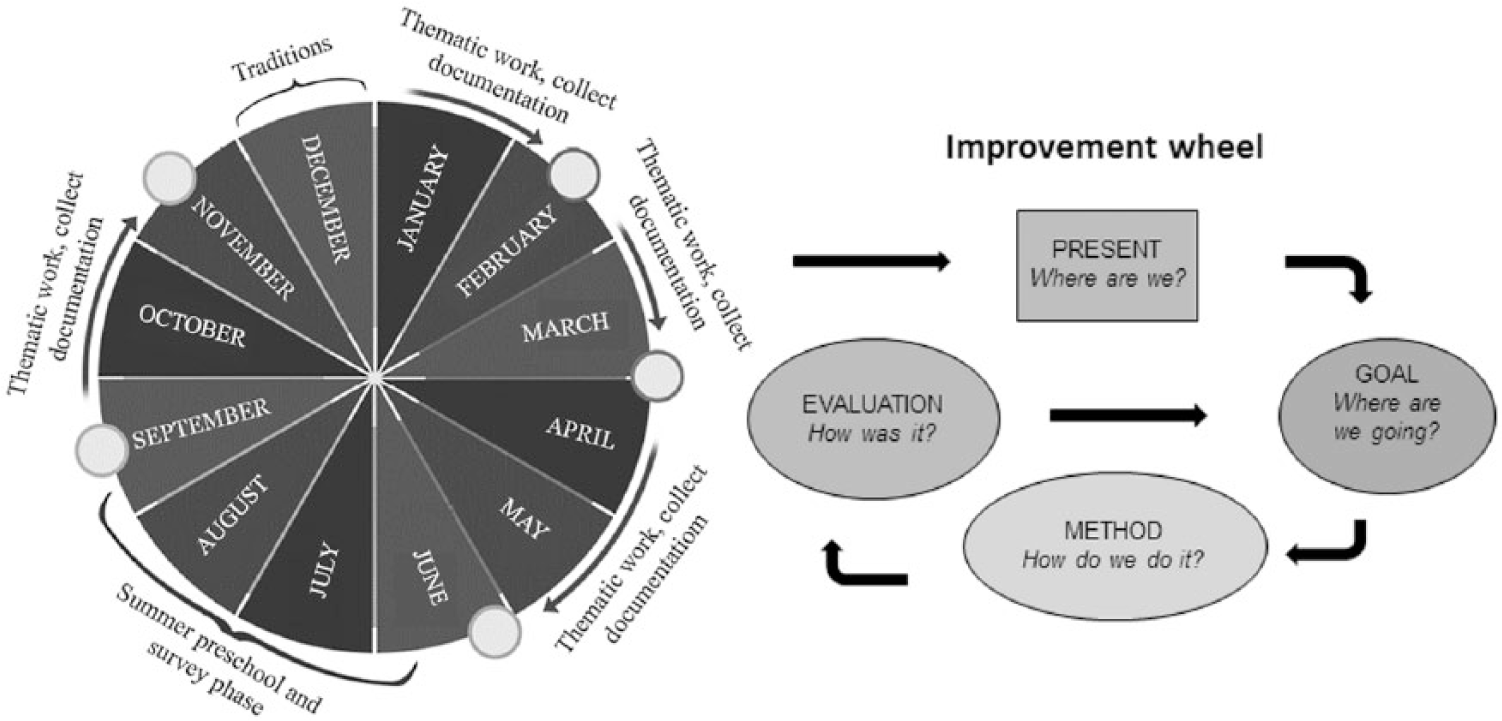
The ‘year wheel’ and ‘improvement wheel’ in Template 6 (my translation).
Another part of the introduction/instruction is the ‘improvement wheel’ (Figure 1, right). This is adapted from the national model and can be seen as a visualisation of the evaluation and development working space, which produces the systematic quality working space as a continuous process with certain marked phases. Reading these two wheels together produces a continuous process throughout the school year, disrupted by specified phases and stops. The last three phases of the improvement wheel (in ovals in Figure 1, right) are supposed to be active at each stop, producing a circular process that includes formulating a goal, describing a method of how to work towards it and evaluating the outcome in order to formulate a new goal, and so on. This also produces movement at the stops; the stops become stationary spaces where circular movement takes place. This cuts systematic quality work together and apart (Barad, 2007) with the everyday preschool practice: it is performed in the ongoing practice (collecting documentation) and momentarily at the stops.
Producing the inevitable theme
Apart from being included in the improvement wheel, the four phases are also located on separate template slides, with an additional slide titled ‘Theme of the school year’ (Figure 2). Whilst the ‘phase’ slides have subtitles, instructions and questions, the ‘Theme’ slide is empty, except for the title and the word ‘date’ in the lower-left corner. This slide is produced as different from the phase slides in two ways: by not being included in or part of the improvement wheel and by having a different physical appearance (i.e. almost blank).
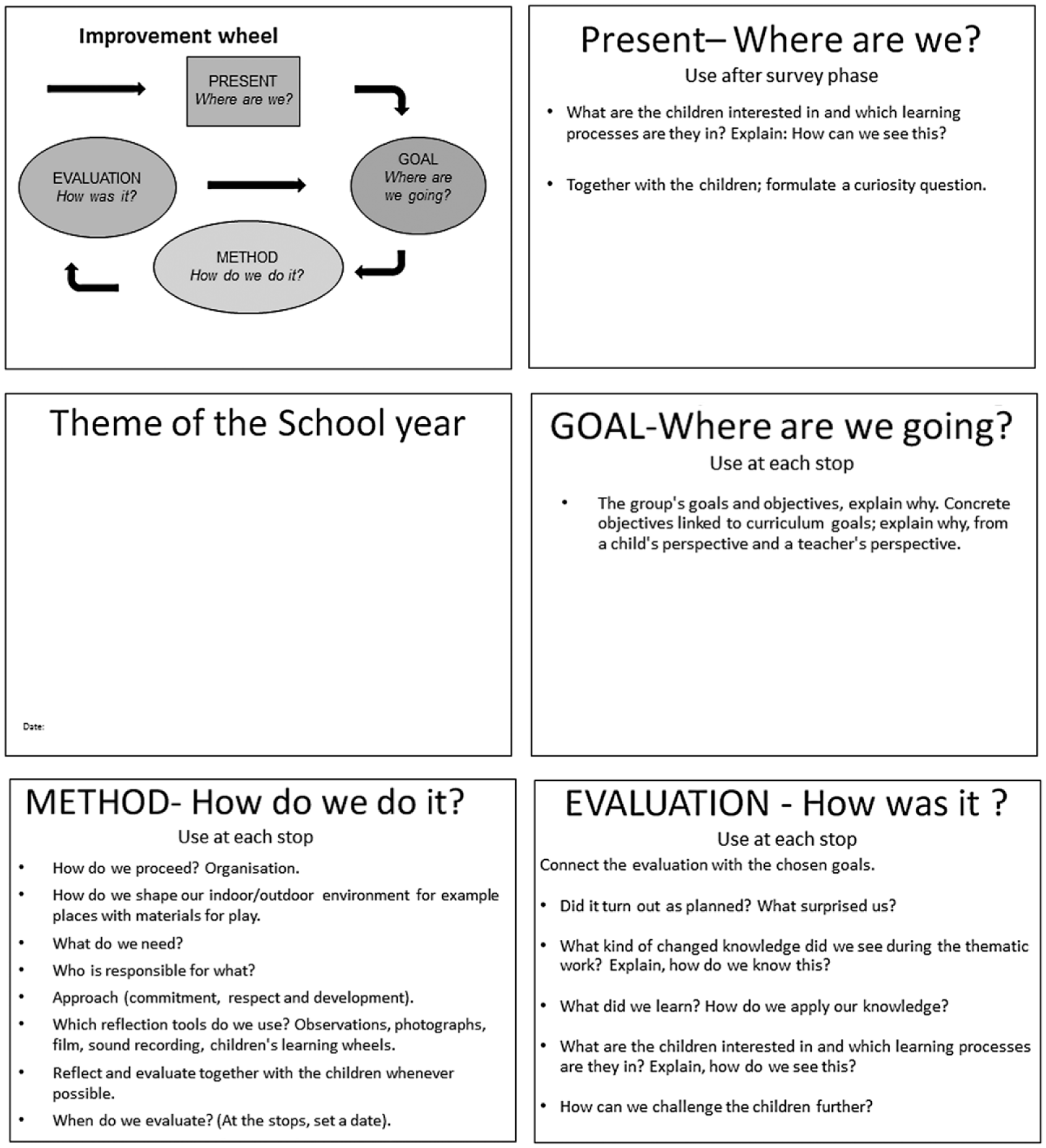
The slides in Template 7 (my translation).
The lack of subtitles, questions or further instructions produces the theme as obvious enough not to need further instruction. This could open up the possibility of several versions of what could be considered a ‘theme’. The existence of a separate Theme slide and the way it is produced as different from the other slides produces the theme as an inevitable part of the documentation. Working thematically is required by the curriculum, but instructions about thematic work could have been included on one of the other slides. Instead, in this template, the theme is produced as compulsory, as something that could not be easily overlooked, which might have been the case if instructions about thematic work were located in any of the other slides. Thus, the theme is both included in (compulsory) and excluded from (not part of the improvement wheel) the other slides in the template.
Reading the template as an enactment, the placement of the Theme slide, after the ‘Present’ phase and before the three phases that are supposed to be active at each stop, could suggest that the theme should be determined once and for all. But it could also suggest that it might be revised at each stop. However, the term ‘school year’ on the Theme slide produces an instruction: the theme should last for one whole school year – a specified, limited period of time rather than something continuous or indefinite, and a whole school year rather than a couple of days, a week or a month.
According to teachers in a study by Davidsson (1999), thematic work seems to be what distinguishes preschool practice from school, separating school and preschool spaces from each other. However, the term ‘school year’ in this template brings them together again (the shifting of Swedish preschools into the school system, from a previous placement within social services, may have resulted in the adoption of school-like terms such as ‘school year’).
Thematic organisation of preschool work has a long tradition in Sweden, originating in ideas from the late 1870s (Doverborg and Pramling, 1988). Thematic work is, in Sweden, considered suitable for preschool teaching and learning (Skolverket, 2016; Socialstyrelsen, 1987). It is supposed to depart from children’s interests and previous knowledge, and what teachers consider to be important for children. Thematic work can also connect to the way Italian Reggio Emilia preschools work on projects, which has inspired Swedish preschool practices (Lenz Taguchi, 2000). In the Educational Programme of 1987, which preceded the 1998 Swedish Curriculum for Preschool, knowledge-oriented topics related to nature, culture and society were seen as important for children to learn and develop through thematic work (Socialstyrelsen, 1987). The theme can start with some kind of problem or with an event that has occurred in the group. But not just anything can become a theme; a theme is supposed to develop children’s thinking and conceptualising, and it should be interesting for the children (Doverborg and Pramling, 1988). Thematic work can, depending on its focus and aims, last for a short or longer time period – from a single hour up to a whole year (Doverborg and Pramling, 1988; Socialstyrelsen, 1987). However, sometimes longer themes seem to be preferred by teachers, and a year-long theme can actually consist of shorter ones, but with an overarching name (Doverborg and Pramling, 1988). The Theme slide’s instruction folds back into this preference, and leaves no option for the studied preschools to choose how long to work with one theme.
In contrast to thorough descriptions of thematic work in the Educational Programme, in the most recent Curriculum for Preschool, thematic work is mentioned only once: ‘With a theme-oriented approach children’s learning can broaden and be continuous’ (Skolverket, 2016: 7). This produces the theme as connected to knowledge. Perhaps thematic work is currently obvious enough not to need further mention? This, too, folds into the lack of instructions on the Theme slide.
Through this diffractive reading of the template apparatus, the theme is produced as inevitable: the important thematic working space, the empty space of the Theme slide, its placement in the template and the instruction on its duration entangle and engage in this production. Also entangled are the previous and present notions and traditions around thematic work. Thematic work is supposed to be done at certain moments and in certain working spaces, and last for a certain period of time. All of these things matter to present practices around thematic work: ‘matter carries within itself the sedimented historialities of the practices through which it is produced as part of its ongoing becoming’ (Barad, 2007: 180).
The digital template actively produces the theme as an important and inevitable part of documentation. None of the preschool groups omit presenting a theme, using the template slide.
Turning care into a theme
In most of the eight groups, the theme remains the same during the school year. Two of the groups have knowledge-oriented themes – for example, learning about mushrooms or trees in the forest. In two of the groups, the themes are related to respect and the social atmosphere, starting from problems such as the children sometimes not treating each other nicely. And two groups have chosen themes in which creative materials are emphasised. However, in two of the groups, the theme changes during the school year: one has knowledge-oriented themes but in the other, the Lifebuoy, the orientation of the theme also changes. The first theme relates to care, trying to make young newcomers feel secure, and is titled ‘Security’ or, in Swedish, ‘Trygghet’. The Swedish word trygghet is not easily translated. The English version of the curriculum uses the terms ‘security’ and ‘feeling of security’. In this article, these terms refer to a ‘perceived feeling of being free of worrisome or threatening phenomena’ (Norlander et al., 2015: 146).
The Lifebuoy documentation relates loosely to the template. The slides do not follow the order of the template, and subtitles or questions are sometimes left out or changed. The theme, ‘Security’, is introduced in the Present phase: Where are we now? August Theme: Security Our curiosity question: Does the environment create security? We are starting out with a group of new children where we need to build a feeling of security between teacher–child, child–child and teacher–teacher. (Slide 8; my translation)
The reading of the documentation merges the Security theme with the Present phase. The Security theme answers to a present situation: newcomers’ need of security in order to benefit from preschool education (Commodari, 2013). A caring concern for young children’s introduction into a new environment is the main focus. Thus, this moment in space and time becomes agentic and shapes the choice of theme in the Lifebuoy group: space and time matter and materialise as the Security theme.
The second theme, ‘Water’, is knowledge-oriented. This is obvious in the following caption which is next to a series of photographs showing young children playing with water. The photographs are placed under the ‘Goal – Where are we going?’ part of the template: Water theme What can we do with water? … They inspired each other. Here, mathematics was also emphasised, as we focused on concepts such as big, small, decilitre measure, teaspoon, transparent, and counted how many decilitre measures they filled in their buckets. (Slide 29; my translation)
This connects to the Educational Programme, in which ‘water’ is suggested as one example of possible knowledge themes (Socialstyrelsen, 1987). Although the Educational Programme is no longer in use, it is part of Swedish preschool traditions and therefore influences current practices, connecting the past with the present. The Lifebuoy group’s objectives for the Water theme connect to different subjects – for example, ‘develop their curiosity for natural sciences’ (Slide 27), which produces the theme as educational and future-oriented. The Water theme is entangled with space and time, in traditions from previous practices and policy documents with present practices and future expectations of learning.
Turning to the first theme, security is highly important to many teachers in preschool and school (Persson and Tallberg Broman, 2002). It has been, and still is, presented in policy documents as a precondition that should shape preschool practice (Skolverket, 2016; Socialstyrelsen, 1987), meaning that security is not necessarily a topic to be taught. As a condition for learning, security is a way of caring.
In most countries, care and education traditionally are, or have been, separated. A growing international trend of combining education and care, which is seen as favourable for preschool quality across nations, has resulted in care and education becoming increasingly inseparable (Kaga et al., 2011). Swedish preschools employ a pedagogy signified by combining education and care – ‘educare’ (Kaga et al., 2011; Löfdahl and Folke-Fichtelius, 2015). Despite intentions to combine education and care, education is sometimes valued more highly (Vallberg Roth, 2016). This produces a divide between education and care, and may emphasise education methods commonly used in school – sometimes referred to as ‘schoolification’ (Kaga et al., 2011). In addition, research has found that in documentation of systematic quality work, care is sometimes downplayed in favour of education (Löfdahl, 2014; Löfgren, 2015). Thus, caring activities become invisible, and pedagogical practices are foregrounded. This is argued to be a paradox when using common templates, since ‘[t]he accounts that are supposed to make the preschool more visible may in practice make them more opaque’ (Löfdahl and Pérez Prieto, 2009: 267).
Ahrenkiel et al. (2013: 82) discuss how demands for documentation might downplay what they term ‘unnoticed professional competence’ – the skills needed in everyday care, such as changing nappies and activities around mealtimes, which documentation might not take note of. Another aspect is considered by Alasuutari et al. (2014: 128), who ask whether it is ‘possible that the agency of documentation overcomes the agency of the educators and that documentalized practices start to follow the principle of “papers first”?’ – that is, whether documenting becomes more important than the practice it is supposed to document.
Reading theme as connected to knowledge and security as connected to care, the Security theme could be read as an educationalisation of care. This may be compared with what Löfdahl and Folke-Fichtelius (2015: 268) term ‘transformation strategy’. Using security as a theme might mean that children should learn about security. This would then connect to the claims about documentation favouring the education side of preschool practice. Still, the Security theme might be a way of highlighting care in preschool practice, unlike previous research findings of documentation favouring education. Thus, security, as a theme, is entangled in notions of a good start for young children. It is also entangled in the divide between and integration of care and education, and in the difficulties or possibilities of emphasising care in documentation. Choosing security could be an answer to the problem of familiarising newcomers with the preschool environment. In this case, the new space and time for the newcomers matter for what is chosen as the initial theme.
In contrast to the Security theme, the Water theme is presented on a separate slide, with the words ‘Our new theme Water’ and a date: 1 January 2015 (Figure 3). The design of this slide resembles a title or chapter page, indicating something different – a new beginning or another focus. The date strengthens this impression, indicating a new beginning on New Year’s Day. Being a national holiday, the date is probably not suggesting when this slide was written.
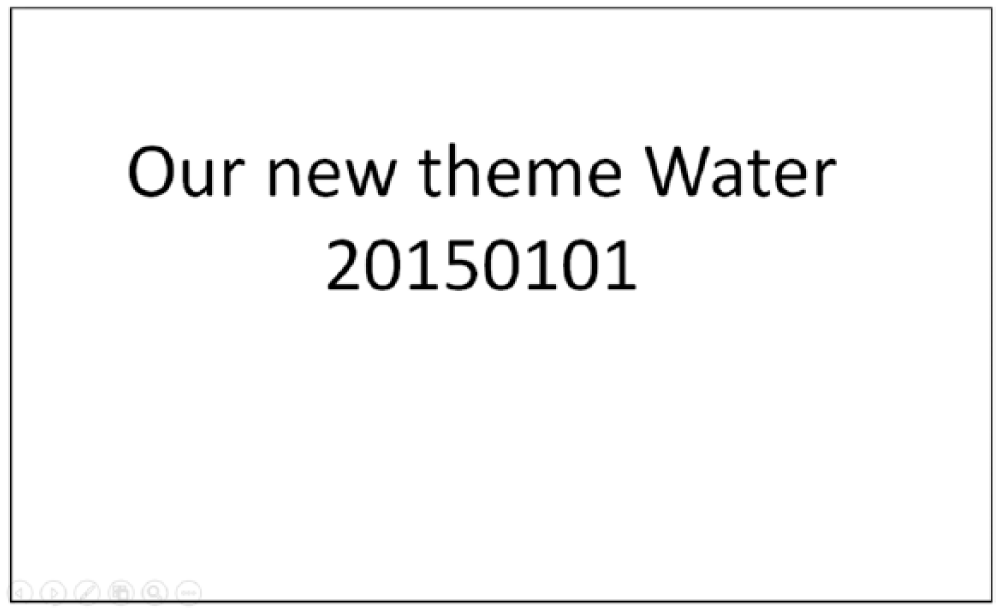
The Water theme (Slide 23).
The space (emptiness), the placement (on a single slide), the time (date) and the matter (layout of the slide) produce this theme as different – a new beginning, focusing on knowledge, in line with the curriculum. The Water theme is produced as more important, as ‘the actual’ theme of the school year, being explicitly marked, in contrast to the Security theme’s more subtle appearance as part of a phase. But most important is choosing, or producing, a theme at all. The theme itself becomes important and inevitable not because someone decides it is, but because of the intra-actions of different entities. Writing about thematic work in past and present policy texts and research, the layout of the template and the documentation of the Lifebuoy group are enfolded and produce thematic work as inevitable, and two different themes as important in different ways – one for the present situation and the other for future development. The care theme (Security), in the present, is needed to accomplish a knowledge theme (Water) for the future. They are cut together and apart simultaneously (Barad, 2007).
The entangling of education, care, thematic work and qualities
The above shows how what documentation of preschool systematic quality work becomes has to do with previous practices. Meanwhile, it connects to how preschools are thought of as producing education and care for a future generation. Also, what documentation becomes is connected to the kinds of practices and things that are presently involved in its production. Thus, past, present and future are enfolded, entangled, produce and are produced in the documentation (Lenz Taguchi, 2010).
Assuming that documentation is not about representation but instead is productive, this article has shown how a template for systematic quality work participates in producing different aspects of preschool quality. This resonates with thoughts of preschool quality as ‘qualities’ (Ritchie, 2016: 79; original emphasis), which goes against seeing quality as homogenous and universal. In line with Vallberg Roth and Månsson (2008) and Severinsson (2016), the template was found to be agentic, directing the documentation towards certain aspects. Through an agential realist perspective, I presented the ways in which the template and the documentation intra-act with previous traditions (and so on), producing certain elements as quality. However, systematic quality documentation is, according to the National Agency for Education, supposed to evaluate and develop preschool quality (Skolverket, 2015). Using a tool such as the template used in the studied preschool may be one way of trying to facilitate and make documentation more efficient. In contrast to the assumptions of this article, this kind of tool is generally seen as passive, and the documentation is considered to represent reality. The representations are supposed to be analysable to find out what actions are needed to fulfil the curriculum goals and to ensure and improve preschool quality, which means that quality is about fulfilling goals (Skolverket, 2015).
Thus, a tension between these different ways of relating to documentation is produced. Through the present study, quality becomes something different from fulfilling curriculum goals. This is expressed through the emergence of thematic work as an important element of quality, and by the different ways that care and education are highlighted. Education becomes important in connection to the curriculum and to previous preschool traditions. Care becomes important through an urgent need for teachers to make newcomers feel safe and secure. However, when teachers discern that children feel secure, a knowledge theme emerges as the main quality. This both confirms and contradicts the findings of Löfdahl and Pérez Prieto (2009), Löfdahl (2014) and Löfgren (2015) about care being downplayed and invisible in documentation of systematic quality work. Whilst the template was agentic in producing thematic work as an element of quality, intra-action within the practice (newcomers’ need for security) also had an impact on the content of the theme, shifting it towards care. Therefore, despite the focus on knowledge and, maybe, thanks to the inevitability of the theme, care is still forwarded as quality. Care and education are cut together-apart (Barad, 2007). Hereby, the question posed by Alasuutari et al. (2014) is answered with a yes and a no: the agency of the documentation sometimes does and sometimes does not overcome the agency of the educators – that is, in the present study, the agency of the documentation in intra-action with the agency of the practice (including educators) produces the theme and its content as care (and education). But when care becomes a theme, it also becomes temporary. All themes are signified by a salient beginning and an endpoint. In that way, care, in this context, differs from the preschool’s permanent mission of caring for children. Making care into a theme risks relegating to the background the everyday care that is still needed. This makes turning care into a theme highly problematic, as it risks making the relation between education and care dichotomous instead of entangled, further separating education and care. This contradicts research findings that emphasise the importance of their entanglement for children’s development and learning (see Kaga et al., 2011).
When documentation produces rather than represents preschool quality, it cannot be used to look back and evaluate what has been done or to evaluate the degree to which the curriculum goals have been fulfilled. However, whilst documentation of previous practices does not represent what has happened, it connects the past with the present, producing certain elements of ‘quality’. These qualities could point out for the preschool what to focus on next, and how this connects to the past and present. In this way, documentation connects the past, present and future. Perhaps, with impressionistic contingency, the entanglement of pastpresentfuture emerging with documentation could then open up a possibility for preschool teachers, children and parents to discuss pedagogical practices and how these are entangled in and produced with templates. Instead of being a question of quality (as one single thing), also a thinking around qualities emerges. The question of whether documentation represents or produces preschool quality then transforms into a question about how documentation is involved in producing preschool qualities. This does not solve the dilemma for teachers of how to conduct systematic quality work, but it may serve as a way of realising the impossible endeavour of finding out what quality is, and embracing the multiplicity and diversity addressed by Dahlberg et al. (1999) when they suggest replacing ‘quality’ with ‘meaning-making’. Hence, by proposing ‘qualities’, I suggest that multiplicity, diversity and meaning-making can be embraced whilst keeping up with the demands to do systematic quality work in Swedish preschools.
Footnotes
Funding
The author received no financial support for the research, authorship, and/or publication of this article.
