




Abstract
Caring relationships between children and educators in early childhood education and care centers become in an array of entanglements with spaces, materials, and the organization of time. An exclusively dyadic understanding of care is insufficient in the material, institutional, pedagogic, and professional environment of early childhood education and care. This article reports on an ethnographic study of material and organizational professional care practices in a high-functioning full-day early childhood education and care center for children less than 3 years in Norway. Drawing on Tronto and Fisher’s feminist care ethics and a posthuman perspective, the study’s aim was to gain knowledge about how early childhood educators perform care as a professional practice beyond the dyad. The article explores care through the lens of a disruption in daily activities, when the laying down of new flooring in the center produced changes in the otherwise highly functioning caring environment. Changes in the availability of materials and the organization of space and time are analyzed using Malabou’s concept of plasticity. The effects of the agentic force of material changes on the caring practices of the center, despite the already strong and established dyadic relationships between the children and educators, are discussed.
Introduction
Care is considered central to professional practice in early childhood education and care (ECEC), especially with children less than 2 years (Dalli et al., 2011). The concept of care in ECEC is traditionally theorized through the ontological lens of humanism, focusing on dyadic relationships between adults and children. Specifically the mother’s care and interest for her child has historically been the model for the “good” preschool teacher (Fröbel, 1980) promoting the idea of care in ECEC as a natural occurrence, rather than a professional practice (Ailwood, 2008). This habitual mode of understanding care in ECEC supports and upholds gendered and cultural stereotypes of care as something “outside of” that which can be addressed in education or involved in the professionalization of the field (Ailwood, 2008; Aslanian, 2015; Löfdahl and Folke-Fichtelius, 2015; Van Laere and Vandenbroeck, 2016).
Studies focusing on care in ECEC have focused mainly on care as a mode of interaction with children involving empathy and interest in the individual child (Foss, 2009, Goldstein, 1998, 2009; Noddings, 1984; Taggart, 2011). Löfdahl and Folke-Fichtelius (2015) found that preschool teachers perceived care as a concrete, stable activity associated with the unplanned and located beyond organized activities. Care is rarely understood in relation to planning and organization, to change or understood as a process. Rather it is associated with modes of interaction with individual children, to unplanned and intimate moments between teacher and child (Aslanian, 2014; Goouch and Powell, 2017). Because high-quality care in ECEC is widely understood to depend highly on the qualities of relations between staff and children (Garcia et al., 2016), research about the “care” in ECEC tends to focus on how individual teachers care for children (Van Laere and Vandenbroeck, 2016) or how they experience care work (Elliot, 2007; Nelson, 1990). In other words, the importance of relationships justifies a focus on researching the quality of dyadic relationships between staff and children, in order to improve quality of care. While I acknowledge the centrality and fundamental place of dyadic care, I would like to explore how professional care is performed in ECEC beyond the dyad. From an organizational and posthuman perspective, care also involves the ways ECEC educators shape and are shaped by the material environment and the organization of time and place.
Relationships are dependent on and become in relation to the material and organizational environment in which relations are situated. Hansen (2012) illustrates this point in his PhD work in which he found that the children who received the best care, defined as the most face-to-face time with caregivers, attended centers that were most highly organized, rather than those which had the highest staff:child ratio (Hansen, 2012). This finding highlights how educators’ care work in ECEC has an organizational dimension. I approach the concept of organization “not as an ontological stable object, but rather something that exists only in its duration” (Clegg et al., 2005), and ECEC centers as in a constant state of becoming.
I suggest that locating care as a stable activity involving primarily humans renders the specific ECEC environment within which care takes form, invisible from notions of care as a professional practice in ECEC. Though dyadic relationships serve as a foundation for professional care practices in early childhood education, I argue in this article that professional care in ECEC could rather be conceptualized as a collective practice in which both the material and social environment work together to produce well-being (Gherardi and Rodeschini, 2016). Furthermore, I argue for a concept of care as plastic; constantly and collectively produced within processes of becoming, wherein educators are actively entangled in care as a socio-material and organizational process. This is a departure from conceptualizing care primarily as a set of skills, knowledge sets, or mode of responding to individual children.
This article reports on an ethnographic study of material and organizational professional care practices at Browny Center, a high-functioning full-day ECEC center for children less than 3 years in Norway. The article explores how material and organizational care is practiced when daily activities are disrupted by the installation of new flooring at Browny Center, which produced changes in dyadic relations. To look beyond the dyad, I draw on Fisher and Tronto’s (1990) feminist care ethics and a posthuman perspective (Barad, 2007). The study’s aim was to gain knowledge about how early childhood educators perform care as a professional practice beyond the dyad. I aim to extend notions of professional care in ECEC beyond human relations, to challenge lingering gendered conceptions of care and discourses of care as unprofessional (Ailwood, 2008; Osgood, 2012; Van Laere and Vandenbroeck, 2016).
Care ethics, posthumanism, and professional care in ECEC
The global market economy depends on the vital, yet mostly unrecognized act of caring (Folbre, 2001). Back in the 1980s, Carol Gilligan (1982) related the devaluation and invisibility of care in formalized policy to the general undervaluing and invisibility of care work in a society dominated by psychological developmental ideas generated by men and on the basis of male perspectives based on ideas of justice and economic productivity (Gilligan, 1982). In a man’s world, woman has been “othered,” thus caring, has also been “othered” and left unexamined as an invaluable but taken for granted commodity. For Gilligan (1982), caring involves an ethic, which cannot be explained through a concept of justice, but only through the concept of mutual human need for care, a care ethic. Fisher and Tronto (1990) built on Gilligan’s work, and put forth a theory of feminist care ethics that approaches care as a situated process rather than particular types of acts carried out by particular types of people (i.e. women). A feminist theory of caring emphasizes the situated nature of caring. For example, for “Thelma” who has a weak economy, caring can entail working late and leaving a meal in the oven for her children in order to earn the money needed to pay the rent and keep the family housed (Fisher and Tronto, 1990). Caring involves all that we do for the good of another or a group, suggesting that caring should be viewed as “a species activity that includes everything we do to maintain, continue, and repair our ‘world’ so that we can live in it as well as possible” (Fisher and Tronto, 1990: 40). Fisher and Tronto’s generic definition of care expands the concept of care from a dyadic activity to a situated, species activity. The situated nature of care practices and interdependence are cornerstones of feminist care ethics.
Posthuman perspectives are increasingly informing ECEC research (Osgood and Giugni, 2015; Osgood, 2014; Otterstad and Nordbrønd, 2015; Rautio, 2014; Rautio and Jokinen, 2015; Rossholt, 2012a, 2012b, 2017; Tesar and Arndt, 2016). Within a posthuman ontology, human actors are not central, but rather play a part in a web of relations involving human and other-than-human phenomena. Maria Puig de la Bellacasa (2012, 2017) challenges the idea of care as something that humans do in isolation, extending Fisher and Tronto’s (1990) care ethics with a posthuman conception of care. Building on Barad’s (2007) concept of intra-action and Haraway’s (1991) concept of situated knowledges, Puig de la Bellacasa (2012, 2017) suggests a conception of care that turns away from idealized conceptions of care as always good, or pleasant, but rather describes care as “an ontological requirement of relational worlds” (Puig de la Bellacasa, 2012). We care because we must, as a result of our interdependence and connectedness. Care is conceived as a thinking-with the people, things, spaces, and other phenomena in the web of relations humans are at any given time involved in (Puig de la Bellacasa, 2012), in an effort to “maintain, continue, and repair our ‘world’ so that we can live in it as well as possible” (Fisher and Tronto, 1990: 40). Within organizational studies, posthuman theory has recently been utilized to analyze care practices in elderly care. Gherardi and Rodeschini (2016) approach care as a collective practice in a nursing home, illustrating how care “becomes” through collective acts invoking an ethic of care and constant negotiations with a common orientation toward care and the co-production of care between staff and material technology.
While Tronto and Fisher (1990) understand care as a species activity, a posthuman orientation understands “species activities” as always entangled with other-than-human phenomena. Thus “everything we do” and “the world” according to Barad’s (2007) theorizing, is done by both human and other-than-human phenomena, such as material, temporal, and organizational factors. From this perspective, things, including people, do not preexist their encounters, but rather are mutually determined and produced through intra-active meetings. Gherardi and Rodeschini (2016) describe care as an emergent process occurring within socio-material relationships. I would like to build on the idea of care as emergent and add that it is also evanescent. It diminishes as well as emerges. Through the lens of Barad (2007) and Fisher and Tronto (1990), professional caring practices in ECEC centers are understood as evanescent in as much as they do not exist outside of their duration, are contextual, situated and mutually produced with both human and other-than-human phenomena. From this perspective, the material environment, the teachers’ planning and cooperation with coworkers, the attention to the organization of the center and pedagogic activities, as well as laws and regulations that shape ECEC practice are important “co-producers” of care as it is practiced in ECEC centers. Thus, structural qualities such as ensuring enough, qualified teachers, enough space, enough/desired materials, enough freedom, enough rest, and so on are modes of caring in ECEC (Tronto, 1998). When thinking with care, all stakeholders share in the responsibility to care, rather than care being something assumed and left to “others” to do “naturally.” If we extend care ethics with posthuman thinking, professional caring practices in ECEC centers are seen as contextual and situated, but also as emerging and diminishing along with and as a result of the available material environment which early childhood educators receive, develop, and maintain.
Design and setting
Inspired by organizational ethnography (Nicolini, 2009) and Sarah Lawrence Lightfoot’s (Lightfoot and Davis, 1997) method of portraiture, I undertook a focused ethnography in a classroom for children less than 3 years. Nicolini (2009) describes the potential for organizational studies to analyze real-time practice as a web of social, material, and organizational phenomena through focused ethnography. A focused ethnography follows actors for a relatively limited amount of time, with a focus on specific activities and experiences, rather than whole social groups or fields of practice (Knoblauch, 2005).
Because I wanted to observe “good” care over a prolonged period of time, which I define as the process of the intra-active maintaining, continuing, and repairing of our world, so that we can live in it as well as possible (Fisher and Tronto, 1990), I engaged with Lightfoot and Davis’ (1997) method of portraiture. Portraiture bridges art and science through the production of narrative portraits of subjects or themes based on observation and interviews. The goal of portraiture is to portray examples of “goodness”—how organizations function well—what good practice looks like. Extending this concept with a posthuman orientation, I sought to observe an ECEC classroom looking for how things, routines, food, people, and organization worked together to produce the specific activity of caring. I chose an ECEC center in my own municipality, which had high structural quality, as well as very high scores on the most recent municipal consumer satisfaction report. I assumed a correlation between parent satisfaction and a strong care environment. I visited for a preliminary observation and found the care environment to be unusually stable, robust, and warm.
After gaining permission from the municipality, staff members and parents, I spent about 2 hours, roughly 1–2 days a week at the center over a 10-week period. I observed both passively and as an active participant, engaging with the children when they approached me, but not seeking out interactions. Data included my written field notes, photographs I took of objects involved in the care environment, and two group conversations with the staff which I recorded and transcribed. One conversation centered around general questions about how staff organized their work and why, and another conversation centered around how they organized their work in connection with the installation of new flooring.
Posthuman research carries with it a danger of creating a new binary, the privileging of material agency over social agency (Mol, 2013). In my observations, I tried to focus my attention away from dyadic relations and toward the ways in which materials, food, toys, routines, rules, space, and time together, both of their own agency and the volition of the children and staff, produced a care environment in which the children seemed to thrive. Indeed, I found it challenging to focus on care beyond the dyad, without ignoring or rendering irrelevant the dyadic care relations that were occurring in the same space. I tried to withstand the urge to privilege the one above the other as I tried to understand care as a cooperative practice between both social and material phenomena.
A plastic analysis
While my focus was on the “good care” happening at Browny Center, my analysis focuses on a disruption in the patterns of care I observed, when the flooring in the children’s wardrobe was ripped out and replaced during opening hours (Figure 1). Like a rock thrown into a pond, the ripples from the event disrupted the underlying patterns of “goodness” in the current; changing the patterns laying underneath. In order to analyze the diffractive (Barad, 2007) patterns produced by the material disturbances, I utilized Malabou’s (2005, 2007, 2008, 2009, 2010, 2011a, 2011b) concept of plasticity. Malabou theorizes the capacity for change—and change itself through the concept of plasticity. Plasticity refers to a philosophical and structural transformative potential inherent in things and texts. The term is taken from Hegel’s use of the term describing the ability of subjects to change over time—and as an aspect of or materialization of time. The term describes change, transformation and that which makes change possible. Plasticity is characterized by the ability to receive shape, to give shape and when the explosive properties of plastic are considered, to annihilate, or destroy shape. Plasticity can thus function in research both as a concept and a methodology (Ulmer, 2015).
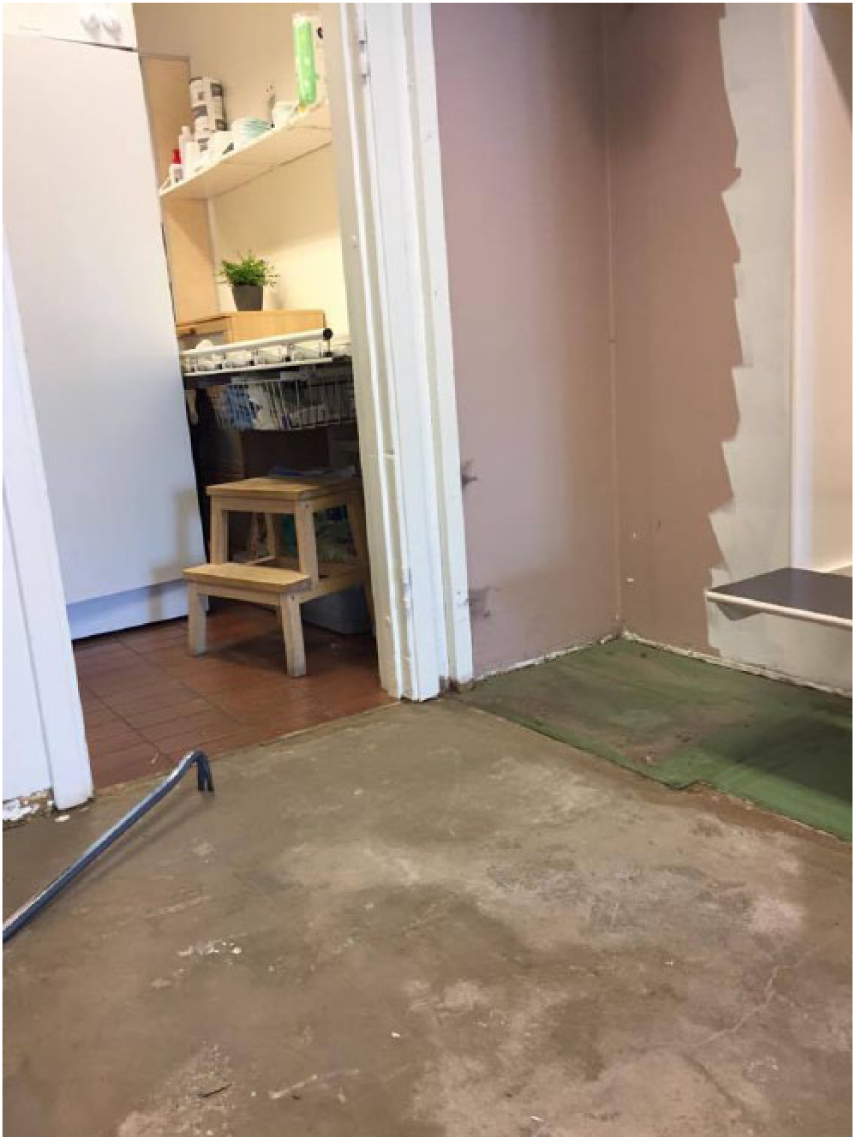
The exposed concrete floor in the children’s wardrobe. Photo: Aslanian.
In the narrative portrait below, I describe the dynamics and changes in the caring practices that occurred when the flooring was ripped out of the children’s wardrobe. In the following analysis, I use plasticity to analyze the evanescent and mutually determinate quality of care produced by both human and other-than-human phenomena in ECEC.
New flooring/beginning to be average/a disturbance in the force
There was no one on the couch. The couch, usually the site of several relaxed and playful children, books, toys, and adults, was empty. The couch was pushed away from the wall from which it usually stood, a wooden employee wardrobe now standing behind it, with 8 × 10 photographs of each staff member smiling out into the mostly empty playroom. The wardrobe was moved from the entrance hall so that the flooring could be ripped out and replaced during opening hours. The playroom was usually the site of children involved in a great many adventures. In the past I had observed children putting out fires with the help of light weight building blocks, checking their teacher intensely for broken bones and driving her to the hospital, or flipping through books about birds, cars, or the seasons while sitting on the lap of a teacher, beside a friend or alone with the book in their lap and between their fingers. The sounds were usually happy for the most part, engaged sounds of adults and children, as well as dropped, thrown, rolled, or squished objects. The sounds of shared worlds, and occasionally disputed worlds. A whimper or scowl of dissatisfaction was usually met with contemplative stares or smiles from other children and vaporized into the air or resulted in the hesitant exchange of a desired object from the hands of the most timid child to the hands of the most willful.
Today was different. The playroom was not filled with engaged children, instead, the children were scattered aimlessly, like ants whose anthill had been disturbed. They circled around the teachers who were in one of the playrooms that the teachers converted into a temporary children’s wardrobe. The children were looking for their displaced outer wear—and so were their teachers. The staff had made an ad hoc wardrobe as best they could, organizing a temporary cubby for each child by repurposing the toy shelves into cubbyholes and even printed out strips with the names of each child to attach to the cubbies (Figure 2). The teachers too were not doing what they usually did. Generally the teachers could be seen casually sitting with the children, protecting, participating, and observing play, one in each room as another teacher moved nonchalantly about, humming while tending to daily practical matters, such as baking bread or preparing lunch. Today their movements were more erratic. Their faces were different—eyes strained at the corners, focusing on finding the best way to do this or that. The children’s questions were met with shorter and stricter answers, rather than the leisurely, open questions or smiles with which teachers usually responded.
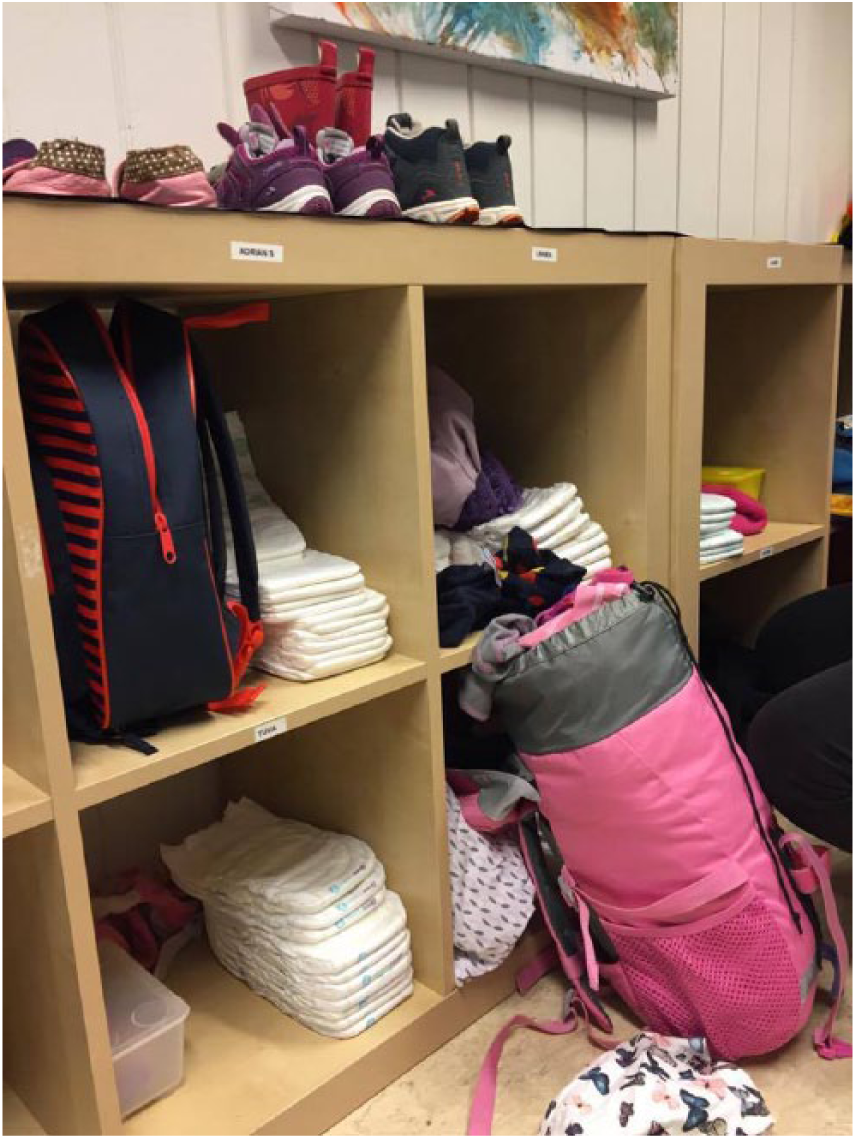
The children’s belongings in the ad hoc wardrobe. Photo: Aslanian.
I began to feel stress, for the first time since coming to Browny Center a month earlier. Halfway into my descent onto the couch, I realized I could not sit down and passively observe as was usual. Looking into the new makeshift wardrobe, I saw how the teachers were struggling to keep order and calm, and I offered to help. The teachers accepted my offer quickly and asked me if I could put on my outerwear and go out with the first group of children. This was the first time the teachers needed my help. I had offered in the past, but always felt more like a disturbance than a help. The degree to which the staff cooperated and organized their work together with ease and enjoyment usually rendered me useless except as a playmate to the children. Outside the rise in stress levels continued. A couple children cried during this unusual transition from indoors to outdoors. The cries were not met by contemplative calm—but rang out into the air, as both the head teacher and I were engaged in practical matters, leaving no one to respond quickly to children’s spontaneous questions, desires, or concerns. Feeling the tensions, I turned to the head teacher and said it’s beginning to feel like an average kindergarten here!
Plasticity and the socio-material production of care
In this section, I want to consider how the ripped out flooring produced changes, which staff members responded to by working with materials and the organization of time and space to “maintain, continue, and repair” their “‘world’ so that” they could “live in it as well as possible” (Fisher and Tronto, 1990: 40). An environment is always simultaneously the result of having already been shaped, and the continual effects of agentic forces giving new shape, as well as the inherent threat of destruction of shape (Malabou, 2009). In this way, care involves a continual shaping, as well as a being shaped by the environment one is a part of and a response to the inevitable destruction of shape that characterizes change.
Receiving shape: “you have to have good routines to get secure children”
Before the flooring was ripped out of the children’s wardrobe, the care environment had already received a shape. Browny Center was a high-functioning ECEC center. Structurally, it was an anomaly in the general Norwegian ECEC landscape. As new ECEC centers are increasingly planned to house over 100 children, Browny Center is a single classroom with room for 12 children less than 3 years. The children had access to three playrooms in a total of 68 square meters of space. In addition to these three rooms, there was an open kitchen, a wardrobe, and a bathroom. The center also had a spacious storage room and an office. The staff included two educated early childhood educators, an educated child and youth worker, and an assistant with over 10 years of experience in ECEC. The group had worked together for many years, two of them having worked together in another facility over several years prior to beginning at Browny Center. All four staff members are women between 40 and 60 years of age, with both personal and professional experience with children. The team shared a common understanding that their job was to create the best ECEC center for the children, and that children required both respect and guidance. Reflecting on how they had met the challenge of caring for the children during the renovation, the teachers reflected: We have good, established routines—we were able to follow our daily routines—as long as you have good routines as a fundament, children are able to tolerate changes for one, two or three days. The problem comes when you have chaos as a starting point. (Browny Center staff, conversation, 2017)
According to the teachers, the strength of their established routines rendered the group more robust in the face of change. The staff expressed a conscious relationship both to the creating of routines, a conscious shaping of the organization of time, and the need to respond when change in the environment changed their pedagogic practice in unwanted ways.
Giving shape: “we talked a lot about it and prepared for it—and that’s what made it successful”
The professional flexibility of the staff was put to the test after agreeing to install new flooring. To meet the challenge, the teachers planned among themselves how to construct an ad hoc wardrobe for the children, to minimize the chaos. They sent a letter home to parents, preparing them for the change, explaining to them how they were meeting the challenge and asking parents to provide a larger bag for their children’s clothing to be stored: We laid a plastic garbage bag up onto the shelf, for their shoes, so that it was relatively organized—so we could find the things, otherwise it could have been complete chaos. (Browny Center staff, conversation, 2017)
The staff worked as a team to prepare for the change and went so far as to print out name tags for each child for use during this short period. This care work involved no face-to-face contact with children, but was rather an active shaping of the pedagogic environment in an anticipatory response to how material changes would destroy the shape of the pedagogic environment they had worked to establish.
Destroying shape: “it was different, we had all the children at once”
In addition to receiving and giving shape, plasticity involves the inherent possibility of destruction (Malabou, 2008). Accidents happen, things break. Destruction generates transformation and new structures. Though the changes that occurred at Browny Center were planned, they took the form of an accident—ripping apart and tearing out established material and organizational practices—and bringing some social practices along with them:
We talked also about the fact that we would have to raise our tolerance for chaos among ourselves in this period, that we would tolerate it, but we didn’t experience it as chaos, even though …
… I think we had higher tolerance for it (chaos), there was less space and—it was different—we had all the children at once—it was harder to divide the group. (Browny Center staff, conversation, 2017)
While the staff reported that they did not experience the days as chaotic, I observed differences in dyadic caring practices as is evident from my field notes: New flooring—changed around move crying fighting in front of door—can’t find mittens—use borrowed mittens—improvising solutions—short and strict messages–more like the kinds I’ve experienced in other ECEC environments. Teacher 5 still sings while she works—the teachers discuss how to organize the children’s return inside. The things are chaotic—the teachers work to counteract it. (Field notes from Browny Center, 2017)
Despite the preparation and the close and warm relationships between staff and children, when the material environment underwent changes and upheaval, the atmosphere intensified, demanding a new kind of “work” from the staff. There was more crying, children seemed more tired and there were more strained voices, more “making do” or, becoming average.
Engaging with matter and the organization of time
Concerned with the concept of organizational learning, Clegg et al. (2005) claim that “learning, as a concept (…) exists in its creation and performance rather than in its definition” (Clegg et al., 2005: 149). In the above narrative, care also exists only in its creation and performance. Past care habits cannot provide care, it must be invoked and brought to be constantly along with and in response to the malleability of the material and the temporal environment. When existence is understood as plastic, being hangs always between the birth and the destruction of possibilities (Malabou, 2010). Considering care in relation to plasticity, the quality of care children experience is always the result of material, temporal, and social conditions of the ECEC environment. The professional practice of care entails educators’ constant negotiations between these “births and deaths” of possibilities. The planned and systematized organizational and material structure of the center was a consistently upheld common orientation held by staff members toward their care work, as well as a recognition of the agentic nature of the material and organizational structure, and a willingness to engage in change processes. Creating and upholding a professional care environment in ECEC entails care as thinking-with (Puig de la Bellacasa, 2017) material and organizational conditions, a continual process of shaping—and being shaped by material and temporal conditions.
Conclusion
In this article, I have argued for a concept of care as an intra-active material and organizational practice that is both a plastic and evanescent process, which “exists only in its duration” (Clegg et al., 2005: 159) and must therefore be addressed within the broad context of ECEC. Rather than primarily a set of skills, knowledge sets, or modes of responding to individual children “naturally,” care is a constant collectively negotiated engagement with the material and organizational environment which educators are both mutually and individually responsible for invoking and responding to.
I have described care in ECEC as that which transpires when people, things, time, and place organize into evanescent patterns that collectively create a world in which they can live “as well as possible” (Fisher and Tronto, 1990: 40). Conversely, when materials and time organize into patterns that do not make the world a better place to be, teachers’ ability to care through the strength of dyadic relations alone, diminishes. This article has contributed to the re-conceptualization of care in ECEC as a cooperative, intra-active, social, material, and organizational process. Plastic is malleable, but not elastic—it changes, but never returns to its original shape (Vahanian, 2008). The evanescent quality of care as an organizational and material practice expands the responsibility to care in ECEC beyond early childhood teachers’ relationships with children. Beyond the dyad, care emerges as a cooperative shaping and being shaped by the material and organizational environment, involving imposed rules and regulations, responsive engagements and entanglements of staff, children, materials, and the organization of time and space.
Footnotes
Funding
The author(s) received no financial support for the research, authorship, and/or publication of this article.