




Abstract
This article discusses one specific form of makerspace for children – hereafter, referred to as (un)makerspace – whose activities consist mainly in dismantling discarded toys and electronics, characterised as a global makerspace. The article presents the activities of children participating in a number of makerspaces in Melbourne, Australia. The ‘materials’ children engaged with, mostly discarded toys and electronics, the detritus of global capitalist flows, became of prime importance and active agents in activities undertaken. The participants’ engagement consisted predominantly of dismantling of the ‘waste’ and creating new assemblages from the remains. Aiming to answer the question of how much playing, creativity and learning opportunities could children encounter in an (un)makerspace, the article will be theoretically framed by posthumanism and new materialism theory. We end with the proposition that (un)makerspaces present underrepresented and underappreciated pedagogical and civic-engagement opportunities.
Keywords
Makerspaces: background and practices
Makerspaces are still relatively unknown in many parts of the world. There are huge disparities among countries. In the United States, the rise of the ‘maker’ movement championed by Make magazine led to a surge in interest. Nevertheless, educational institutions took some time to embrace them, with educators and researchers, respectively, adopting and discussing them in relatively recent times Thus, if the ‘maker’ term was coined in 2005 with the first issue of Make magazine, Maker Ed, as an Association and a community actively involved in introducing making in education was founded in 2012 (according to the Maker Ed website) and the first major book that promoted this movement in education was published by Sylvia Libow Martinez and Gary S. Stager in 2013. In Europe, one of the most advanced countries in introducing makerspaces in school, Sweden, started a national project of this kind in 2015 (Eriksson et al., 2018). A European study shows that there is an average of 1 makerspace per 400,000 people in Europe, with huge disparities among countries (Rosa et al., 2017), from less than 0.3 per 1 million people in Romania, to more than 18 for the same population in Luxembourg. Makerspaces have taken many forms and many labels (e.g. hackerspaces, fab labs, tinkering studios, community access spaces, see also Marsh et al., 2017) and serve a myriad of purposes, from community-driven workshops to commercially driven fabrication.
One of the most comprehensive and frequently used definition of such spaces is offered by Sheridan et al. (2014): ‘Makerspaces are informal sites for creative production in art, science, and engineering where people of all ages blend digital and physical technologies to explore ideas, learn technical skills, and create new products’.
Despite the enthusiasm that compares the maker movement as defined earlier with a new global industrial revolution (Anderson, 2012), there are many voices that challenge this idea, showing that by considering the Western model of making a panacea, one dismisses many other forms of making that are non-Western–culture rooted, such as some Indian, Brazilian or Chinese models (Dias and Smith, 2018; Irie et al., 2018), or that this model is even more narrow, only specific to White male middle-class culture from some western countries (Foote and Verhoeven, 2019; Gollihue, 2019; Schneider and Scholz, 2016).
The civic and environmental dimension of maker movement
If, as shown before, some praise maker movement for its entrepreneurial potential, others appreciate it more for its civic and environmental dimensions and its practices in recycling and upcycling materials (Clemente, 2014; Millard et al., 2018).
The disposal of the waste products of global flows is very urgent issues relating to recycling in Australia, as they are in most Western nations. The industry that has handled much of the collected recyclable material in Australia is under duress as the market (in particular, China) for this material is closing its doors or imposing greater restrictions. A significant proportion of imported products come from China (largest importer in December, 2019) and up until very recently, much of Australia’s recyclable waste returned to China (between 2016–2017 and 2017–2018 waste exports to China decreased with 41%).
Civic engagement has been intentional in some manifestations of makerspaces around the world, in places such as Brazil and Ireland. In these places, the spaces were seen as providing an opportunity for public engagement or according to Shea (2018), ‘Makerspaces have also been revealed as sites that encourage self-directed civic practices and the assembling of new civic identities, or DIY citizenship’. Brazil began experimenting with this idea as early as 2004, as makerspaces were used to attempt to bridge social divides and, as Dias and Smith (2018) argue, ‘Maker initiatives, [. . .] if negotiated appropriately [. . .] could have a positive effect on sustainability, inclusion and democracy’ (p. 44).
The place of waste in a makerspace
Plastic waste from digital devices is already an issue to be considered in makerspaces (Kohtala, 2017). In this context, some global movements of activists aim to raise awareness about the new possibilities for business that plastic waste allows. One such initiative is the Precious Plastic network (https://preciousplastic.com/), an open-source initiative that makes hardware construction instructions available. Some researchers documented attempts to create a circular economy in which plastic is first recycled into 3D printer filament and then upcycled in printed objects (Zhong and Pearce, 2018). Other studies approached the dismantling process of e-waste in a makerspace from a low socioeconomic status community highlighting the ongoing process of such a making (i.e. the objects created were considered intermediary steps in a greater picture-making endeavour and not finalised artefacts) and the greater importance that tools creation that support this process has to the detriment of a specific artefact non-linked with the sustainability of the makerspace itself (Vyas and Vines, 2019). But, if in such makerspaces fixing and reusing are core values, in today’s consumerist society, even the simple act of repairing and, more importantly, the right to repair are not always granted. The Repair Association (2019) is an activist association that is ‘working to pass Fair Repair / Right to Repair legislation at the state level, so that every consumer and every small business has access to the parts, tools, and service information they need’.
In this empirical context, in July 2016, Dr Greg Giannis set himself to create and document a makerspace for children that would tighten the loop of upcycling by only using electronic waste and discarded toys as materials. Later on, the other author joined Greg’s project for a while, the two authors together proposing to answer the following research question: how much playing, creativity and learning would children develop in such a setting?
Makerspaces for children
If in adults’ case making is by definition an interest-driven activity, in children’s case the interest-driven dimension should be recalibrated (Jornet et al., 2019). Most of the time, makerspace for children is either school-based (Halverson and Sheridan, 2014) or to be found in museums (documented in relation with parents by Blum-Ross and Livingstone, 2019) or libraries (Willett, 2016). All these are institutionalised spaces that have an educational end and/or a cultural dimension which pre-shapes the activities that would take place there as educational oriented. Beyond this unifying educational end, there are variations based on how structured the activities are (Farritor, 2017; Tan, 2019), from kit-based makerspaces, especially used for STEM learning (Cun et al., 2019), to the more unstructured and creative ones, especially used for arts.
Among the makerspaces that are not kit-based and are rather unstructured, some utilise dismantling as part of the process (Wohlwend et al., 2018) or utilise a subset of the materials already available in space, such as those organised more recently at the Exploratorium (2019). Wohlwend et al. (2018) reported for instance on using ‘toyhacking’ as the first stage – followed by a stage of digital storytelling/filmmaking and ending with the stage of digital editing – in a literacy playshop. Though such playshops acknowledge the agentic value of the materials that spur the creativity of the participants, they also assign a utility value to the dismantling process. Thus, toyhacking has an external final aim, the participants adopting a deconstructivist/ideological approach as ‘they physically hacked toys to alter their commercial characters and narratives’ (Wohlwend et al., 2018: 152).
Makerspaces have come under the attention of the education community as they have been shown to facilitate constructivist pedagogical opportunities (Cross, 2018). These are not new ideas (predecessors included Dewey, Piaget and Vygotsky), ‘but there is a new, widespread acceptance of this old set of ideas and new research in cognitive psychology to support it’ (Hein, 1991). Many international studies highlighted the overlapping between new pedagogies and the educational makerspace culture (Lahmar et al., 2017) and in their review of the literature, Vossoughi and Bevan (2014) showed how the makerspace culture of peer support and scaffolding aligns with Lev Vygotsky’s (1978) theory, the interest-driven activities from a makerspace reminding of the learner-driven approach and inquiry-oriented pedagogies and of Freire’s (2005) critical educational theory. But arguably, the most influential pedagogy was the constructionism (Papert, 1993), regarded as the foundational theory of the maker movement in education (Keune et al., 2019; Marsh et al., 2017; Martinez and Stager, 2013; Tan, 2019). Advocating for the use of technology in school not as an add-on for the instructional process, but as ‘object-to-think-with’ for children’s development (Papert, 1980), Papert considers that learning happens best when one concretely makes and publicly shares or displays objects. As a result, many schools are looking at ways of incorporating makerspaces into their facilities.
Makerspace in education and its promise for STEM learning
Apart from the alignment of new pedagogies with the pedagogical approach from makerspaces, another reason for which they are so appealing to the education system is the recent emphasis across the world on science, technology, engineering and mathematics (STEM) education and digital literacies and the promise makerspaces make in this regard (Barton et al., 2017; Keune et al., 2019; Marsh et al., 2017). As much need for STEM education as there is (Kelley and Knowles, 2016), this sole identification of makerspaces with STEM and digital technologies could create some problems with their implementation and the attracted audience. Thus, multiple studies showed that the artistic dimension has to be added to STEM dimensions for a successful and innovative makerspace (Farritor, 2017; Sheridan et al., 2014). In Australian schools, the few makerspaces that have been implemented tend to cater for the provision of STEM and digital technologies curriculum facilitation, to the exclusion of the myriad of other opportunities. Likewise, Eriksson et al. (2018) showed that the digital skills acquired in a makerspace should not be seen only through the utility lens of the future force labour, but as a necessary literacy that children need in their social life, as a means to discover the world.
The strategies adopted in one makerspace in Melbourne attempt and succeed to some extent to escape this reductionism, without excluding the opportunities for STEM and digital technology related activities (Giannis, 2017). These strategies or more appropriately ‘tactics’ (De Certeau, 1988) have attracted a diverse user base and not a restricted demographics that has become a characteristic and criticism of many makerspaces (Foote and Verhoeven, 2019). These tactics (Giannis, 2017) included sourcing discarded toys and electronics from the community as the materials with and on which to work (also mentioned as necessary in Eriksson et al., 2018), ample time for exploration (Tan, 2019), experimentation and play (see also Wohlwend et al., 2018), ongoing and open access, allowing participants to follow their own interests and line of enquiry (Tan, 2019), encouraging creativity (Burke and Crocker, 2019; Thestrup and Haugaard Pedersen, 2019), inviting parents and teachers to participate and observe (Blum-Ross and Livingstone, 2019), and most importantly, teaching the participants the correct and safe use of tools.
Play and creativity in an educational makerspace
Play is one of the most widespread human activities, both across time and space. Given the complexity of it, none of the classical socio-theory attempts to approach it has come to a satisfactory definition, but together, they enlightened it. Relying on Henricks’ (2018) review of classical approaches of play, we will define play in a makerspace as a creative and imaginative process, that is also about seeking pleasure and being able to control the elements of the situation that was created (Freud, 1958); in which one would learn by trial and error what is possible and not in a generally safe way (Piaget, 1962[1951]); it is also about social engagement, as the imaginatively created situations that challenge and therefore change children are the result of an imaginative intersubjectivity (Huizinga, 1955[1938]; Vygotsky, 1976[1933]). As defined above, play becomes a pillar of a makerspace, both for children and for adults. But whereas adults’ ‘playing’ in a makerspace would align with the cultural understanding of playing (Huizinga, 1955[1938]), children’s ‘playing’ in an educational makerspace would be rather regarded through the functionalist lens (Piajet, 1962[1951]) in which play helps them learn.
Even one of the most playful approaches of educational makerspaces that argues for introducing a special form of educational makerspace in school curricula, namely ‘playshops’ because play is at the very core of children’s activity, still considers learning as the final aim, while play is just a means for getting there (Wohlwend and Peppler, 2015).
The time and space to play is a recognised prerequisite for creativity. The importance of play cannot be underestimated. Many studies and reports highlight the importance – ‘play creates learning moments’. There were no prescribed outcomes and this seemed liberating for the children: ‘In play it is as though [the child] were a head taller than himself . . . play contains all developmental tendencies in a condensed form and is itself a major source of development’ (Vygotsky, 1978). Nonetheless, not all plays are equally creative (Resnick, 2017). Thus, building upon the distinction between the playpen – that gives children ‘limited room to move and limited opportunities to explore’ – and the playground – that ‘provides children with more room to move, explore, experiment, and collaborate’ (Resnick, 2017: 130) – shows that the most important things when analysing learning and playing is that playing leads to creative thinking.
Finally, studies showed that there are multiple forms of engagement children could have in a makerspace. For instance, Resnick (2017) talks about four types of engagement – patterners, dramatists, planners or thinkers – whereas Velicu and Mitarcă (2019) explore six ways in which children engage in a makerspace, which are the following: creative, playful, learning-driven, assistant engagement, storytelling-driven engagement and versatile engagement. Agreement among researchers was that regardless of the type of engagement children exhibit, an educational makerspace should offer conditions for everyone to reach their potential (Resnick, 2017).
The posthumanistic approach in education
A new approach of play arrives with the new materiality and posthumanistic paradigm, where things become active in the agentic assemblages they form with children and the latter answer by playing back (Wohlwend et al., 2017).
The posthumanism paradigm (Barad, 2007), according to which humans enter with materials they have at hand in different agentic assemblage that constrains (although not determines) humans behaviour/actions (Barad, 2000; Jackson and Mazzei, 2016) will theoretically frame our research.
Differentiating between the posthuman present we inhabit (as marked by hybridisation processes) and the posthumanistic paradigm (that is a theoretical critical perspective that opposes, among others, Cartesian objectivism and epistemic dualism), Kruger (2016) elaborates on the concept of educational research for a sustainable future. By relying on Barad’s (2007) concept of intra-action and on Braidotti (2019) concept of nomadic posthumanism, Kruger argues for a switch from a representational understanding of the world to a performative understanding (that aims to transform the world). Moreover, as ‘the ability to affect and be affected is not human specific’ (Kruger, 2016: 85), one should acknowledge the agency of the material. The other researcher also made a plea for adopting a posthumanist stance when approaching makerspaces for children, showing that ‘While (post-)Vygotskian research emphasises the purposefulness of human activity, posthumanist analysis shifts the focus to the rather unpredictable and messy process of the translation of multiple intentionalities into action (and vice versa)’ (Kontopodis and Kumpulainen, 2019).
Methodology
This article represents a case study (Yin, 2017) of a project that was developed by one of the authors (Dr Greg Giannis) in which the other author participated for a short period of time. The project consisted of a series of makerspaces developed by Dr Giannis (in which he played the triple-role of organiser, facilitator and researcher) in some schools in Melbourne and was intended mainly for children. Teachers, parents and volunteers were encouraged to attend and often did do so. The data were ethnographically collected, a methodology that observes and interprets everyday practices by researchers that are knowledgeable in their fields. Both authors kept field journals in which they write down their observations after the workshops. Sometimes (before or after the session), they would review their observations and discuss patterns of engagement or different episodes to which they assisted. Ever so often, the teachers from the class who attended the workshops, as experts that are connoisseurs of the group we worked with (LeCompte and Schensul, 2010), participated in these discussions, offering the authors their professional reflections on what happened in these workshops. One of the authors established a blog and recorded many of the activities and ideas, in order to facilitate the research and dissemination of findings and observations (Giannis, 2020). The blog has evolved into a repository of field observations, interviews and analysis of artefacts, videos and other documents that, along with the data collected by the participating researchers, form the basis of the data used for this research. Both authors also documented their observations with pictures and short videos. All the data have been thematically analysed for this article. In what follows, we start by offering a comprehensive description of the setting, and then present three vignettes that help us answer the question, how much playing, creativity and learning would children develop in this setting?
The dual role of facilitator and researcher needs a mention in the context of makerspace for children. Adopting an ethnographic methodology as researchers required careful and critical observation, but the necessity to facilitate and interject, especially where there was some risk of danger, often disrupted this. It was not possible to carefully and unobtrusively observe when you were often relied upon for simple tuition and instruction (e.g. in the correct and safe use of a tool) or to ‘open’ something. Therefore, it is inevitable and almost unavoidable in this scenario to disentangle (according to Barad, 2007) the observer and the observed. Having said this, a considerable effort was made to not guide the students’ outcomes, although anytime students asked for help, the researcher–facilitator helped as far as was feasibly (i.e. she or he has the physical ability, the knowledge and the time/availability). If we were to refer to these data collection in a traditional way, we would say they took the form of participant observation (McKechnie, 2008), but situating our research in a posthumanistic paradigm, there is an entanglement of intra-action, between the facilitator–researcher and the entire setting of the ‘field’ (e.g. participant children, materials in the space, activities) that makes even more difficult to clearly separate the makerspace by the researcher–facilitator.
Research data
Presenting the (un)makerspace
We report on the activities of a very specific type of makerspace (Giannis, 2017), that we will from now on call the (un)makerspace, as, in opposition with a classic makerspace where the maker activities start with raw materials, in our case, the process starts with the unmaking of the initial ‘materials’. In an (un)makerspace, the process is totally unstructured, the only fixed point being the starting point, that is, the use of discarded toys and electronic devices. The un-doing/dismantling process is therefore a prerequisite for the making, sometimes even replacing it, when children are satisfied with the dismantling process and do not go any further in reusing the elements they get from the devices for creating something new. The (un)makerspaces that this article addresses were situated predominantly in two schools, St. Stephens Catholic Primary School (SSCPS) and Collingwood English Language School (CELS). Principals and lead educators in the participating schools were most enthusiastic in allowing these ‘experiments’ to take place.
The (un)makerspace at SSCPS had a number of iterations and modes of operation. In the first instance, an incursion was conducted to demonstrate to the teachers what the (un)makerspace involved. Subsequent engagements involved researchers from the EU MakEY project, in more structured engagements as part of the ‘Global Makerspaces’ project which engaged students across three countries (Velicu et al., 2019). The last iteration was run as an afterschool activity that students volunteered to attend. There was very little structure imposed on the afterschool (un)makerspace and it was very well attended. In this article, we will report mainly on the last iteration.
The (un)makerspace at CELS was created in response to the principal’s desire to create an afterschool makerspace. The co-author, Dr Greg Giannis, was employed and ran the space for most of 2019. After a successful year, in 2020, the (un)makerspace commenced in two other affiliated schools. CELSs are predominantly P-12 schools for newly arrived migrant children, to assist with English language development, prior to their incorporation into mainstream schools.
Materials and processes in the (un)makerspace
It was observed throughout, many if not all of the iterations of (un)makerspaces that the materials themselves would shape the outcomes/assemblages facilitating an emergent creativity. This is not unlike practices (e.g. Brazilian Gambiologia, http://www.gambiologia.net/blog/) that utilise materials on hand out of economic necessity and expediency. Outcomes were highly unpredictable and student-determined. This was a consequence of the fact that in the first instance, it was not possible to predict what materials would be available for use until the discarded products were sourced and delivered to the (un)makerspace, and then, subsequently dismantled. Given these observations, it was not unusual to entertain the ‘concept drawn from Jane Bennett’s book Vibrant Matter . . . [where] she asks the question “what if materiality itself harbours creative vitality?”’(Foote and Verhoeven, 2019: 75).
Waste products of global flows: the materials with which the participants worked, waste, is a rich resource or in the words of Veena Sahajwalla from the University of NSW, ‘much of it is really a resource that’s waiting for its next life’ (cited by Nguyen-Robertson, 2019). Waste is available in abundance, partly due to capitalism propensity for planned obsolescence and rampant consumerism, and available for dismantling, for example, discarded toys, electronics and e-waste; essentially, anything that holds potential for stimulating a child’s curiosity, facilitates learning about materials, electronics, sustainability, STEM, the way things work, demystifies technology, opens the ‘black box’, encourages a culture of repair that can counter waste, excess and environmental degradation.
Dismantling, or (un)learning technology (Bogers and Chiappini, 2019), is the process of disassembling everyday human-made objects driven by curiosity and the potential to better understand how these objects work, what they are made of, their materiality, their politics and manufacturing processes. This simple provocation, providing the impetus for the subsequent emergent possibilities, was put to the students as a challenge, the only condition being that they operate the tools in a safe and responsible manner: Making at its most intriguing involves an ethic that drives people to ‘open up’ technology, to hack it, to create new uses and new forms. (Dias and Smith, 2018)
One episode is relevant here: At CELS, among the discarded devices available for children were some laptops that aroused great excitement among children. Some had started to dismantle them, but one girl was especially preoccupied by what was behind the screen. As this proved initially to be difficult, she gave up in the first session with pulling apart the screen, and focused on the other elements of the laptop (e.g. keyboard, CD-unit, etc.). The next time she attended the makerspace, she enthusiastically told the researchers how at home she had told her sister who was working in the information technology (IT) industry that she was allowed to ‘break apart’ a laptop and see what is inside. But, behind this satisfaction, she was puzzled by the issue of the screen, that she wanted to open, without breaking. Very determined and taking her time in this session, she finally managed to dismantle the screen, learning that nothing spectacular is hidden behind the screen, but just some seemingly translucid sheet of plastic (see Photo 1). Satisfied with her success, but a little disappointed about the plain plastic sheets, she eagerly listened to Greg’s explanation about how these sheets are in fact filters for different colours and in the end asked permission to take one sheet at home as proof for her activity.
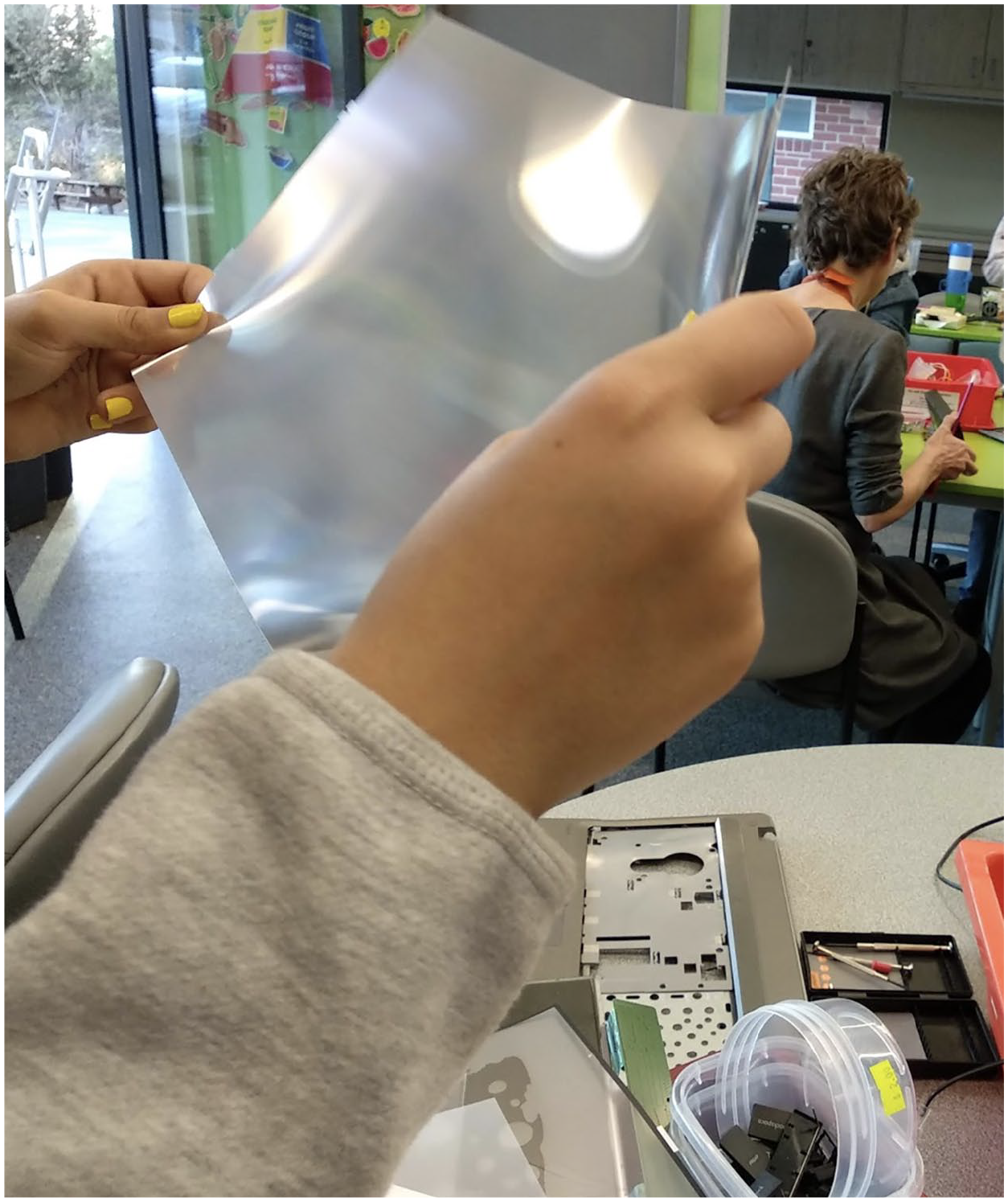
The plastic filter from the laptop’s screen (authors’ pictures).
The dismantling process provided opportunities for and was contingent upon learning how to use tools. Teaching young children how to use tools from an early age and the subsequent correlation to creativity, is cited as one of the reasons Iceland, for example, has such a high per capita creative output (Kerr et al., 2017). Understanding the use of tools facilitates confidence in making and creativity. This was apparent in the enthusiasm with which the children embraced the opportunity to use tools. Many claimed to have never used a screwdriver, so allowing them to do so gave them great pride and a sense of liberation, and opened the door for further learning and creation through the use of the tools.
A particular case needs to be mentioned: A 6-year-old girl, who, according to her teachers, was unable to concentrate, was medicated and soon to be moved to a ‘special’ school, took to the screwdriver with great relish and was able to focus on a task for most of the 50-minute class. She very proudly showed the facilitator her ability to dismantle a computer mouse that did not work and then proceeded to reassemble the mouse with no instruction or assistance. Much to her delight, the mouse now worked and teachers effectively reconsidered their assessment of her and the future of this child.
Play and creativity in the (un)makerspace
In one (un)makerspace organised at CELS, students took great delight in being able to activate a motor extracted from a DVD player, with nothing more than a few alligator leads and a battery. Much to the facilitators’ surprise, the motor was then embellished with coloured pipe cleaners to create a kinetic sculpture of sorts (see Photo 2). The student that created this had been attending the (un)makerspace for some time and had enjoyed the freedom of being able to roam and explore a myriad of interests from the internals of a laptop to the DVD player previously mentioned. The availability of crafting materials seemed to enhance the creative possibilities and allowed them to be merged with the internals of disassembled electronics and toys.
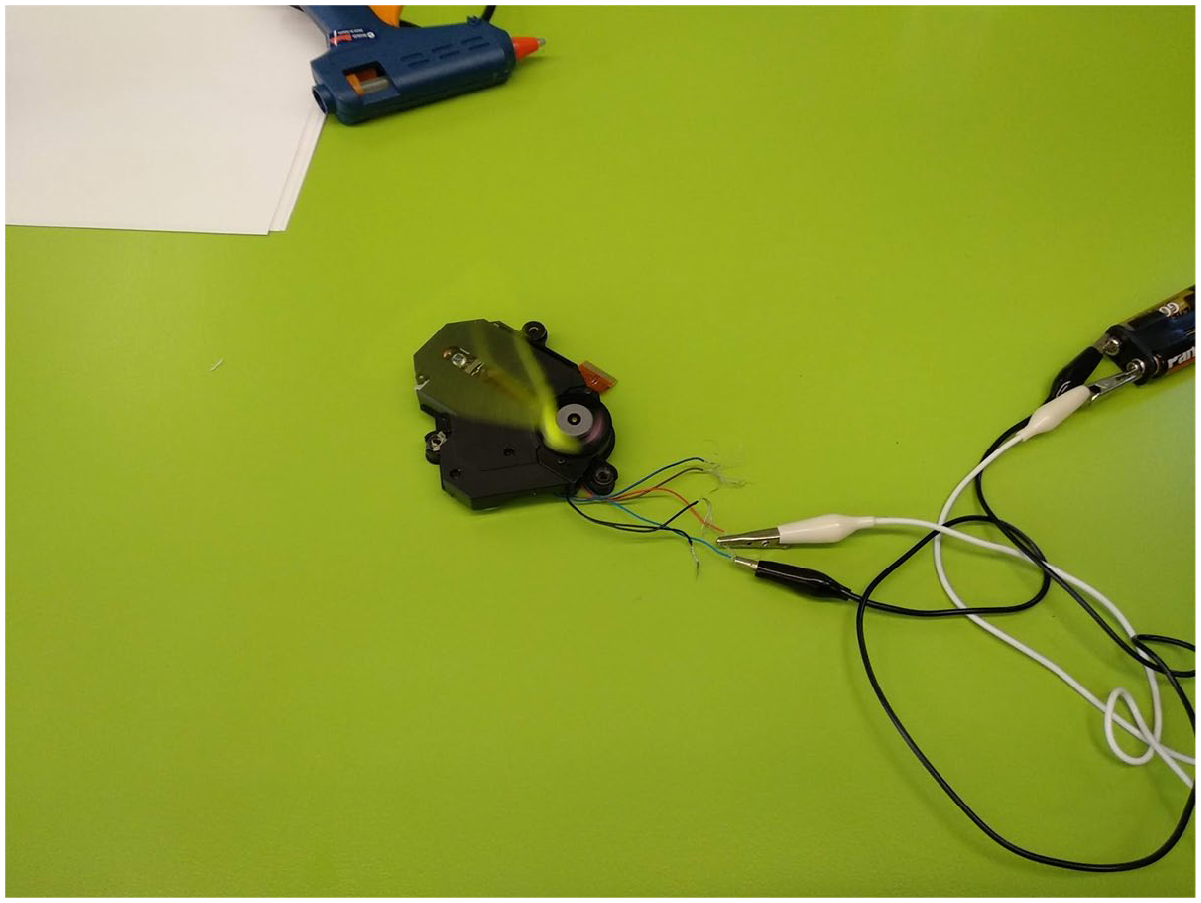
The fan made from a DVD player motor (working) (authors’ pictures).
Another enlightening episode about how creativity is spurred by the intra-action with others and with materials in a makerspace is the following: in line with researchers’ aim to let children be as free as possible (within the safety frame mentioned above), the only ‘direction’ children received was to follow their curiosity. But a 14-year-old, recent arrival to Australia, informed the facilitator that, in fact, she was not curious at all. Nevertheless, this student started constructing a model house after roaming around the space, observing others and the materials around. There is a propensity to want to instruct and guide the students, on the part of many teachers. Leaving students to their own devices was revelatory. Whereas many times, students’ quest for structured activities/instructions based is due to their lack of self trust – as it is the case with engagement in circuits activities where girls are 23 times more inclined to choose a structured activity over a free play one (McLean and Harlow, 2017), other times their reluctance is due to teachers’ attitude towards their lack of focus. As Velicu and Mitarcă (2019) showed, in an educational setting, teachers tend to dismiss as frivolous the ‘versatile’ types of engagement, but, as this episode clearly showed, these ‘idle’ moments are often the precursor of the creative act.
If, according to the posthumanism paradigm that frames our approach, the creative activities are spurred by the encounter children have with materials, in the case of the (un)makerspaces, the process is even more opened, and children’s creativity is further enhanced because the materials children use in the creative process are not pre-given to them as defined elements, but are to be discovered (revealed through the process of removing the cover) by children through dismantling.
Finally but certainly not least in importance, we will describe a case for highlighting the many levels at which creativity manifests in an (un)makerspace. From the first workshop at CELS, one of the boys dismantled a CD player and ‘made’ a city (see Photo 3) from it not by adding in or extracting elements from it, but by naming these elements with what a city should have. In his broken English but in a decided tone, he explained to the researchers the following:
This one is my city. This is the old city. This is different fabrica . . .
What does fabrica mean?
… fabrica that makes sugar . . . and this is energy . . . it makes energy from sun [indicating the LCD screen of the CD player that he imagined to be a solar panel – authors’ note]. It looks like Chinese country [laughing and indicating the higher vertical elements that look like skyscrapers – authors’ note]. This is White House, this is Black house. My problem is that my city does not have a beach.
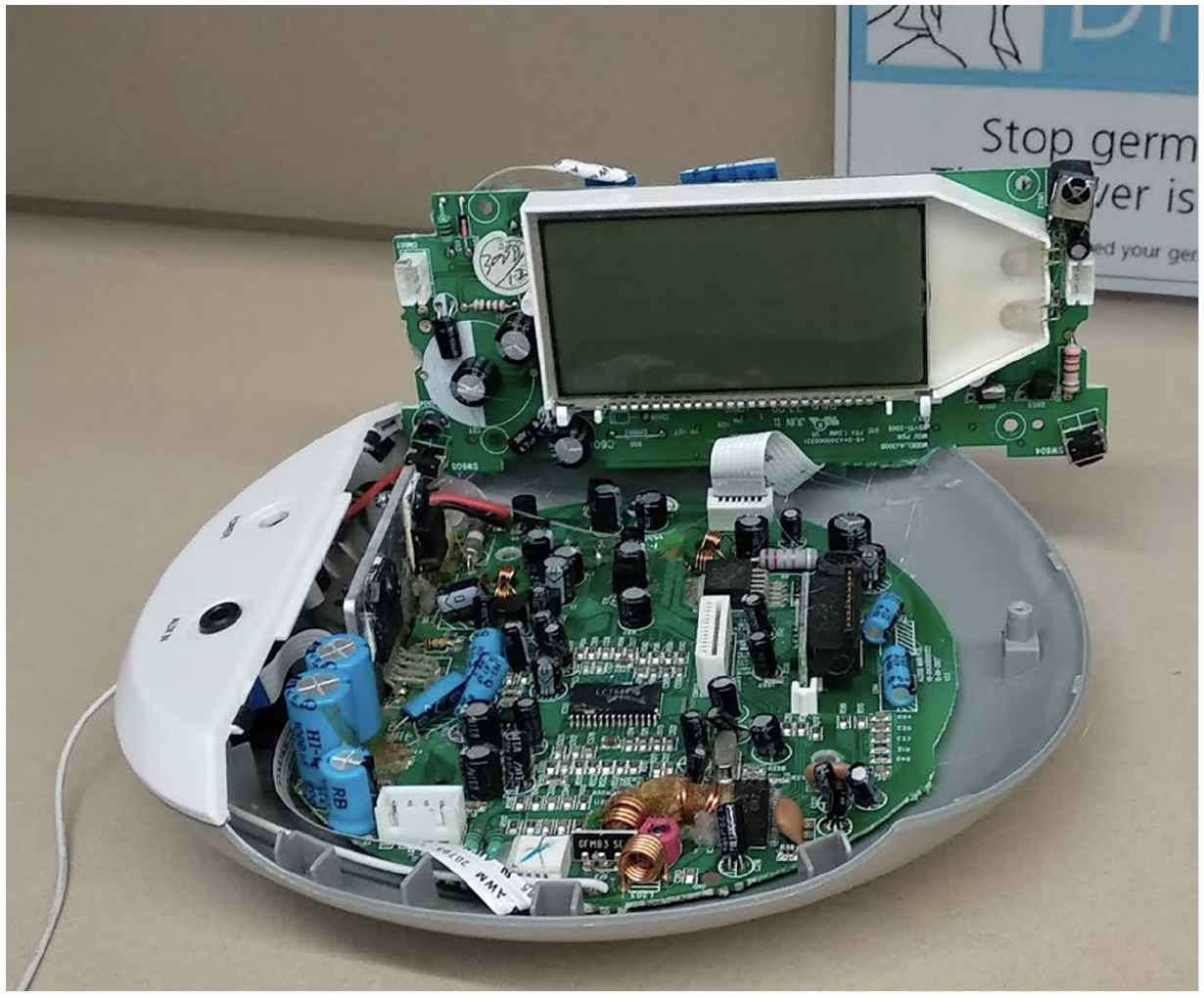
The city (the version not enlightened; authors’ photo).
Then, in the next session he did not add anything else to his city, but would eagerly tell the story of his city to whoever would ask. In the third session, as his colleagues would engage more with circuitry, he aimed to embellish his city with a light, but he did not manage to glue the bulb nor to properly create the circuitry. His efforts did not go unnoticed by his colleagues and some of them tried to help with the glue gun. The boy graciously accepted their help and made room for them to manifest, keeping, nonetheless, a vigilant eye on ‘his city’. In the end, the city was illuminated proving once more that collaborative play is an important element in the (un)makerspace.
The story shows how the creative process in a makerspace could take the form of stories. There are many studies that talk about the importance of displaying the output of the making process and sharing the process (Keune et al., 2019), studies that ground in general in Papert’s (1993) constructionism theory. The process of making-by-words within the storytelling-driven engagement (Velicu and Mitarcă, 2019) was not explored as much as the making process, but was nevertheless intrinsically linked with the materiality. And, as the evolution from one session to another has shown, this type of creation is not simply wordy, but mixes with materials in different stages: at the beginning, as the story was driven by what the boy found once he opened the CD player, but also later on, when seeing how the other colleagues use circuitry, he decided to alter his city, and his story consequently, and illuminate it.
Moreover, the story of the city also shows the utility of Papert’s (1980) concept of object-to-think-with. The child’s creation, the City, is a means for the child to make sense of his different experiences and pieces of knowledge getting to and rearrange the world’s map through the making process. Knowing about the existence of a ‘White House’ made the boy ‘create’ a new ‘Black House’; then he puts both these buildings in China, as its image or name was more common for him; in his city, he also kept ‘the old city’ from his natal country, but wanted to add the beach with which he got accustomed in Melbourne. All these layers of meaning reflect the children-driven process of learning (Papert, 1993).
The (un)makerspaces – pedagogical and civic engagement opportunities
Civic engagement was an unintended outcome of (un)makerspace and came about as a consequence of working with these materials through a recognition of recycling and waste issues. All (un)makerspaces were resourced with waste from households predominantly, and some small industries. This waste material would have ended up being disposed of responsibly or otherwise, but quickly piled up at the various collection points. Everyone seemed to have a surplus of stuff!
Through the use of waste materials, participants are engaged in sustainable practices and gain an appreciation of the impact of consumer culture. The (un)makerspace intentionally sought to provide an open and inviting space that, through its emphasis on open-ended play, created an inclusive space.
In the maddening frenzy to implement STEM (or STEAM) curricula, makerspaces in schools (where they have been adopted) have been co-opted for the delivery of a reduced interpretation of the range of subjects that the acronyms encompass (e.g. digital technology curriculum, design thinking). There is space for the full range of what this acronym encompasses and more, but this is inevitably hindered by pressures and forces (curriculum priorities, lack of resources, funding, etc.) that restrict the fullness of what a makerspace could offer and the imperatives to deliver curriculum. The (un)makerspaces, through adopting a very open and playful approach, have provided a small glimpse of what young people could achieve and learn, if given the time and space. (Un)makerspaces can also raise awareness of issues of global importance through the engagement with waste, encouraging a reassessment of that which was previously considered of no value. Children, teachers and other participants (e.g. parents) can be better informed and thus better equipped to tackle the problems of our times: civic agency, climate change, environmental degradation and consumerism.
Footnotes
Acknowledgements
Both the authors would like to express their gratitude towards the principals, teachers and children from the two schools that hosted the (un)makerspaces described. They also want to thank for the valuable comments and suggestions of the reviewers. Anca Velicu also acknowledges the financial support of the MakEY (H2020 grant agreement No 734720) project that makes the visit in Melbourne possible.
Funding
The author(s) received no financial support for the research, authorship, and/or publication of this article.
