




Abstract
There is a dearth of studies exploring how younger children engage in civic life, what may be expected of them given their age, and what instruments may be used to capture their levels of civic engagement. Addressing these questions, this article presents key findings from a pilot study that aimed to create a validated instrument designed to measure the civic engagement of primary school children. Based on a survey administered to 655 primary school children aged 9–11 across England, this article focuses on the new measure that was specifically designed, and then tested and validated through both exploratory and confirmatory analyses. The findings validate a tripartite measure of civic engagement that assesses the civic attitudes, actions and awareness of 9–11-year-olds. This measure was found to be both practical and efficient in its administration, and it has been shown to be easily comprehensible by this age group. This new measure addresses an important gap in the literature on civic engagement in children, providing researchers with a validated tool to effectively measure civic engagement in 9–11-year-olds. The findings have implications for both researchers and educators interested in designing and evaluating interventions aimed at promoting civic engagement among younger children.
Introduction
Participation in society is paramount for the functioning of democracy (Held, 2006). Ideally, democracy relies on the participation of citizens of all ages, including both adults and children. Indeed, the question of how children, in particular, should participate in society is important if we expect them to learn how to exercise their rights and corresponding responsibilities as citizens (Hauge & Rowsell, 2020; Torney-Purta, 2006). However, not only is the concept of ‘participation’, and how this may be operationalised and measured, often contested (Dahlgren, 2013; Scaff, 1975), but, when it comes to children and especially young children, there is a scarcity of reliable and validated measures that can be used to capture their engagement.
Grappling with these issues, this article is grounded in the conviction that children should be encouraged to develop, from a young age, a commitment to engaging in civic life, understood as incorporating elements of community involvement and acts of service as well as of political participation that are appropriate to their age (Arthur et al., 2017; Dahlgren, 2003; Moley et al., 2002; Torney-Purta, 2006). The task of promoting civic engagement among children is important if we are to create a more inclusive society in which the younger generations are enabled to express their voice and what matters to them. This is central to the work of parents and educators as well as that of researchers interested in measuring civic engagement among the youngest citizens. Formal and civic education is key to ensuring that children of all ages develop, at different stages, the attitudes and skills required to be civically literate and active (Hauge & Rowsell, 2020). Nevertheless, when it comes to research in this area, while many instruments have been developed to measure the civic engagement of different adult populations (e.g. Doolittle & Faul, 2013), the question of how to measure civic engagement amongst children remains under-explored. A few studies have focussed on the civic engagement of teenagers and adolescents (e.g. Flanagan et al., 2007; Schulz et al., 2018). However, there is a dearth of studies exploring how younger children engage in civic life, what may be expected of them given their age, and importantly what instruments may be used to capture their levels of civic engagement.
Addressing these questions, this article presents key findings from a pilot study conducted in the UK with a view to creating a validated instrument designed to measure the civic engagement of primary school children. This study was conducted as part of a project that aimed to evaluate the effectiveness of a school intervention in increasing primary school children’s levels of news literacy as well as to explore the relationship between their levels of news literacy and their civic engagement. In order to do this, the pilot study was conducted with a view to developing and validating new measures for both news literacy and civic engagement among this age group. Based on a survey administered to 655 primary school children aged 9–11 across England, this article focusses on the new measure that was specifically designed, and then tested and validated through both exploratory and confirmatory analyses, in order to capture different dimensions of civic engagement among primary school children.
This article contributes to the literature on how to operationalise and measure the concept of civic engagement. On the one hand, this article contributes to research in this area by focussing on children and the measurement of civic engagement. On the other hand, it has implications for both researchers and educators interested in designing and evaluating interventions aimed at promoting civic engagement among children. With this in mind, the first section below reviews the literature on civic engagement, with an emphasis on children and the gaps that exist in terms of how the concept may be approached, operationalised and measured. After a section on the research design behind this study, key findings and a validated measure are then presented and discussed, with a focus on their research and practical implications.
Literature Review
The concept of political participation, which is central to the functioning of democracy, is rather contested. On the one hand, it traditionally refers to the ways in which citizens participate in politics and in decision-making processes (Scaff, 1975). On the other hand, a vibrant democracy relies on a broader understanding of participation in society and, in practice, in both civic and political life (Ekman & Amna, 2012). Often juxtaposed to the notion of the political, the concept of the civic traditionally refers to participation in community life (Dahlgren, 2003, 2013). This concept revolves around the notion of community service, understood as including voluntary work and activities, which range from donating to a charity to volunteering, that are intended to help members of a community (Arthur et al., 2017; Moely et al., 2002; Toncar et al., 2006). The political, by contrast, has often been approached as relating primarily to issues and struggles of power, with leadership positions being challenged through acts of participation (e.g. voting or taking part in a demonstration; Mosca & Quaranta, 2016).
While such a distinction is conceptually useful, it fails to capture the extent to which the civic and the political are intertwined. For example, struggles of political power are often present within forms of community involvement. Similarly, political participation per se does not exclude the undertaking of activities that are community-focussed. This is why, as argued by Dahlgren (2013), the intersection of the civic and the political exists in practice within culture. For Dahlgren, it is through the expression of their voice and what matters to them that citizens take part in society. As he suggests, given the extent to which we live in societies that are highly mediated by technology, this may happen in ways that may (or not) be mediated by traditional media such as the radio and television and/or digital technologies, as in the case of sharing information about the news and politics on social media. As such, civic engagement, as broadly understood by Dahlgren (2013), encompasses not only more conventional forms of political participation such as voting and reading about political parties but also participation in informal politics (e.g. taking part in protest events or engaging with alternative media) as well as community service and involvement and the sharing of public life (volunteering or posting online comments about politics). What is more, whereas the notion of political participation traditionally refers to the undertaking of activities that aim to influence power and decision-making processes, the concept of civic engagement does not exclude, but is also not limited to, these activities, while also including a psychological dimension – that is, the values and motivations that underpin how citizens participate more broadly in society (Dahlgren, 2003, 2013).
Civic engagement, as understood here, is therefore a concept that can be used by researchers to capture the ways in which citizens take part in society and the extent to which they value civic life, understood as both community and political life. But how can it be operationalised in practice to measure specifically the civic engagement of children and what instruments can be drawn upon from the literature?
Measuring Civic Engagement in Young People
There is a vast literature on the importance of encouraging children to develop a positive attitude towards civic engagement as well as what is often referred to as civic or political literacy – that is, the skills and knowledge required to understand broader political processes and to act as citizens (Hauge & Rowsell, 2020). This literature comes from the field of education, with a focus on the formal and informal ways through which children can learn at different ages about the world around them and use their agency to participate in society. While it is hard to dispute that it is important to cultivate children’s literacy and dispositions needed to engage in civic life, the question of how young or old children should be to engage in civic life is a different issue. In the UK, for example, civic education in schools is taught at key stages 3 and 4, which means that schools begin to familiarise children with the broader civic and political processes from about the age of 11 (Department for Education, 2013). Some educationalists, however, argue that children should be encouraged to understand the importance of participating in society from a younger age, which is key to their political socialisation and to their development as citizens who will be more likely to take part in civic life as they become older (e.g. Torney-Purta, 2006). From this perspective, exposure to civic life from a young age, which may include forms of community service and involvement ranging from volunteering to donating money to charities, can encourage children to better appreciate the broader context in which they live and take action as part of members of their own communities and of society at large.
It follows that, from a research perspective, it is important to explore how children participate in civic life throughout the course of their childhood – that is, at different ages and prior to transitioning into adulthood. However, the empirical literature on how children, and especially younger children, engage in civic life is both limited and undermined by a lack of reliable measures. Most studies in the literature have explored the civic engagement of adolescents – that is, focussing on older children and young people over the age of 12 (e.g. Flanagan et al., 2007), 14 (e.g. Schulz et al., 2018) and 16 (e.g. Arthur et al., 2017; Cohen & Chaffee, 2013; Doolittle & Faul, 2013; Wallrich et al., 2021). Conducted in different countries including the US, Germany and the UK, these studies have approached civic engagement as incorporating different dimensions, with some focussing primarily on community service and involvement – for example, volunteering, donating to a charity (e.g. Arthur et al., 2017; Doolittle & Faul, 2013; Moely et al., 2002; Toncar et al., 2006) – and others taking a more comprehensive approach by including elements of political participation both in the present time (e.g. discussing politics with family and friends) and in the future (a willingness to vote or join a political party after reaching the age of majority) (e.g. Flanagan et al., 2007; Schulz et al., 2018).
Meanwhile, whereas a few studies have focussed on the relationship between the civic engagement of parents and their children’s likelihood to develop a positive disposition towards community involvement or political participation (Quaranta & Dotti Sani, 2016; White & Mistry, 2016), there is a dearth of research measuring the civic engagement of younger children under the age of 12. One notable exception is Nicotera (2008), who evaluated the effectiveness of a school programme that was delivered in the US with the aim of developing the civic engagement of children aged 5–13. Her study found that the programme was successful at increasing children’s levels of civic engagement. However, in this study, civic engagement was operationalised as incorporating only community involvement, with little attention to children’s attitudes towards participating in broader political processes.
Leaving this study aside, the question of how younger children engage in both community and political life remains under-explored in the literature. We appreciate that young children, because of their age, do not enjoy the same opportunities as young adults aged 18 and above in terms of their participation in political life. This is why it is fair to expect that instruments designed to capture their civic engagement should focus primarily on their involvement in community activities and service, with a focus on their sense of identity and responsibility as community members and their participation in voluntary work (e.g. Arthur et al., 2017; Moely et al., 2002; Toncar et al., 2006). At the same time, despite their young age, we argue that it is also fair to expect such instruments to incorporate elements of political participation that may range from understanding and discussing socio-political issues to cultivating a desire to vote in the future – elements accounted for by studies focussing on older children (e.g. Flanagan et al., 2007; Schulz et al., 2018). An instrument that captures both these aspects among young children is currently lacking in the literature. What is more, the measures used by research that have focussed on teenagers and adolescents were often designed without prior testing or validation, which calls into question the reliability of the data collected and analysed. Indeed, if we are to understand the development of civic engagement in children, we need to be able to use valid and reliable measures. However, not only are there challenges to establishing reliable questionnaires for children, who are in the process of developing psychologically, but self-report questionnaires can be less reliable (Muris et al., 2004). It follows that the reliability of the findings of research that has focussed on the civic engagement of teenagers and adolescents is undermined by a lack of use of psychometrically well-validated measures. For example, several studies in this area have adopted civic engagement measures that are face valid to varying degrees, but without conducting any exploratory and/or confirmatory analyses of the factor structure, or through using measures that were only validated with older children (Cohen & Chaffee, 2013; Nicotera, 2008; Quaranta & Dotti Sani, 2016; Wallrich et al., 2021; White & Mistry, 2016). This means, in short, that if we are to measure the civic engagement of younger children, new measures need to be created and validated.
Research Question
To address the gaps in the literature discussed above, this study gathered survey data from children aged 9–11 with a view to conducting exploratory analyses in order to understand the different dimensions of their civic engagement, followed by confirmatory factor analyses, which were conducted to preliminarily validate a civic engagement measure that can be used with children from this age group.
With this in mind, this study addresses the following question:
What are the dimensions of civic engagement in children aged 9–11?
Methods
This study was conducted as part of a larger project that aimed to evaluate the effectiveness of a school intervention in increasing UK primary school children’s levels of news literacy as well as to explore a correlation between their news literacy and their civic engagement. Given the gaps in the literature, a pilot study was conducted in order to create, test and validate new measures for both news literacy and civic engagement among this age group. Based on a survey administered to 655 primary school children aged 9–11 across the UK, this article focusses on the measure that was specifically designed, tested and validated to capture different dimensions of civic engagement among primary school children.
Participants
Six hundred and fifty-five primary school children aged between 9 and 11 years (M age = 10.5, SD age = .58) were recruited from seven schools located in different geographical locations in England. The schools were recruited through a purposive sampling strategy – aimed at maximising diversity among participants in terms of their age, gender, socio-economic background, ethnicity and geographical location – and convenience sampling – that is, through school contacts (e.g. teachers, head teachers) known to the research team. Three hundred and twenty-nine participants (52.2%) identified as being male and 301 (47.8%) identified as being female, with 25 missing responses. In MS Excel, we used the = RANDBETWEEN (1,2) function to randomly assign our participants into two separate samples. The first sample (n = 334) was used for initial exploratory factor analyses (hereinafter, EFA), while the second sample (n = 321) was used for confirmatory factor analyses (hereinafter, CFA). Minimum sample size suggestions for EFA and CFA vary, with suggestions normally being 5, 10, or 20 participants per item included in the analysis (Carpenter, 2018). With this in mind, we aimed for a 10:1 ratio.
Design
This study adopted a cross-sectional design: participants were asked to complete the survey at a single time point. The survey took approximately 20 minutes. Data collection was completed using a paper copy survey and entered into a .CSV spreadsheet manually by a Research Assistant afterwards, with the analysis being performed after importing the .CSV file into Jamovi version 2.2.5.
Civic Engagement Items
We created a list of 20 items that appeared to us to be face-valid measures of three dimensions of civic engagement, as encountered in the research literature. These were as follows: (i) attitudes towards community and political life and towards one’s own rights and responsibilities as a citizen (Arthur et al., 2017; Doolittle & Faul, 2013; Flanagan et al., 2007; Schulz et al., 2018), (ii) actual participation in community and political activities in the present time (Arthur et al., 2017; Doolittle & Faul, 2013; Flanagan et al., 2007; Schulz & Sibberns, 2004), and (iii) attitudes towards future involvement in community and political life (Arthur et al., 2017; Flanagan et al., 2007; Schulz et al., 2018). Participants responded to questions tapping onto these three dimensions on a five-point Likert scale (1 = ‘Strongly Disagree’, 2 = ‘Disagree’, 3 = ‘Neither Agree nor Disagree’, 4 = ‘Agree’, 5 = ‘Strongly Agree’). Additionally, participants had the option to respond ‘I don’t understand the question’ (scored as 6).
Procedure
Participants were provided with an information sheet about the study and their written opt out informed consent, as well as that of their parents, was sought. This was done to ensure that participants were fully informed about what the study would entail and that their participation was entirely voluntary. This was also read aloud by their teachers, who also provided pupils with an opportunity to ask questions. Those who wished to participate then completed the survey. Teachers then debriefed participants verbally and thanked them for their participation on behalf of the research team.
Ethics
Ethical approval was sought and obtained from the senior author’s university ethics committee. As explained to participants, all survey responses were collected anonymously and the data were stored on secure university servers in line with the university’s policy.
Results
Data Entry and Preparation
Data were entered into a spreadsheet from the paper questionnaires manually by a research assistant. In a minority of cases, participants responded by selecting two of the Likert scale responses. If this happened, these responses were treated as missing data. While all responses were scored on a Likert scale, included within that Likert scale was an ‘I don’t understand the question’ option. Affirmative responses to the latter were also treated as missing data. The minimum number of responses to the civic engagement measure was 514, leaving greater than 10 participants per item across the 20 items entered into the factor analyses, exceeding our minimum sample size target.
Preliminary Item Reduction
Before conducting the factor analyses, we excluded items with more than 30 ‘I don’t understand the question’ responses. In the absence of a clear guideline for excluding items based on comprehensibility, determining the cut-off criterion was subjective. We chose 30 ‘I don’t understand the question’ responses as a cut-off because we wanted to ensure that all included items were comprehensible by >95% of the sample, while also maximizing our initial item pool which would later be reduced during the EFA stage. Adjusting the cut-off to 30 ‘I don’t understand the question’ responses ultimately meant that any items we included in the factor analyses were understood by greater than 96.4% of the overall sample of participants.
Exploratory Factor Analysis
Factor Loadings for the Initial EFA Following Rotation and Suppression of Loadings Less Than.4.
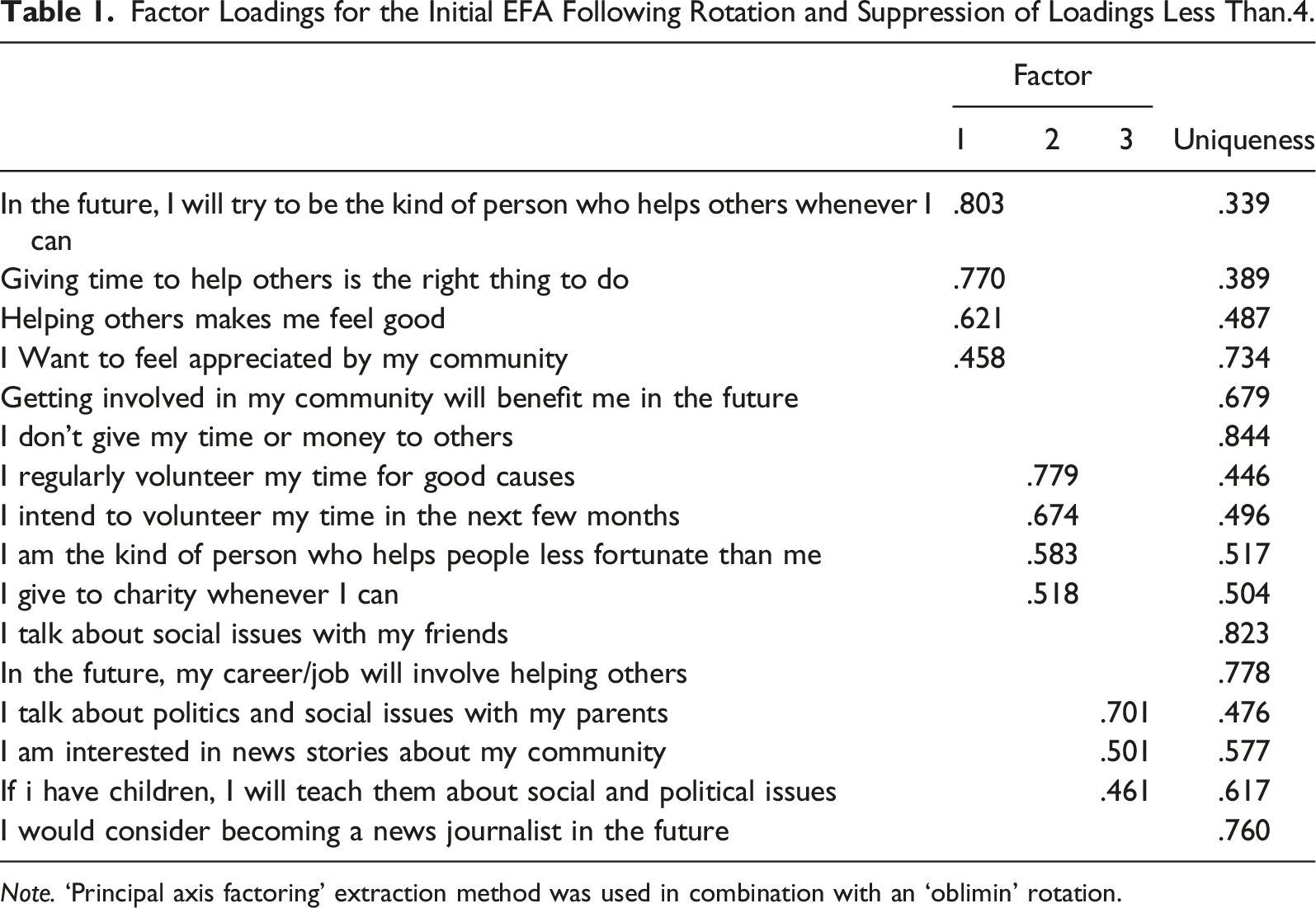
Note. ‘Principal axis factoring' extraction method was used in combination with an ‘oblimin' rotation.
Confirmatory Factor Analysis
The eleven items loading onto three separate factors from the exploratory factor analyses were entered into the CFA, conducted using the lavaan package (Rosseel et al., 2018) in Jamovi. This CFA showed excellent model fit (χ 2 [41] = 66.10, p = .008; CFI = .97, TLI = .96, SRMR = .04, RMSEA = .04 [CI = .02–.06]). These findings indicate that the model fit the data well in both the EFA and CFA phases across the two samples. There were two items within the second factor that shared a large (14.23) residual covariance modification index, suggesting that one or the other may be a redundant item (modification indices would ideally be below ten [Hopwood & Donnellan, 2010; McLoughlin et al., 2022]). In such cases, it is possible to exclude an item that fits less well, conceptually speaking, with the overarching factor (Brown & Moore, 2012; Schreiber et al., 2010). These items were ‘I intend to volunteer my time in the next few months’ and ‘I am the kind of person who helps people less fortunate than me’. In general, the second factor seemed to entail behaviour/actions related to civic engagement. However, the first of the two items mentioned above appeared to be a self-report measure behavioural intentions rather than providing a self-report on actual/general behaviour, giving us a theoretical reason to exclude the former item instead of the latter. We also looked at the frequencies of ‘I don’t understand the question’ responses from the dataset, and this was also higher in the former (23) compared to the latter (19). Finally, the former item, asking about how often they intend to volunteer in the next few months, had an unusually high frequency of ‘I don’t know’ responses (93), perhaps reflective of our participants’ limited autonomy given their ages. The final model, therefore, retained ten items across three factors. This had excellent model fit (χ 2 [32] = 44.20, p = .074; CFI = .98, TLI = .98, SRMR = .04, RMSEA = .03 [CI = .00–.06]).
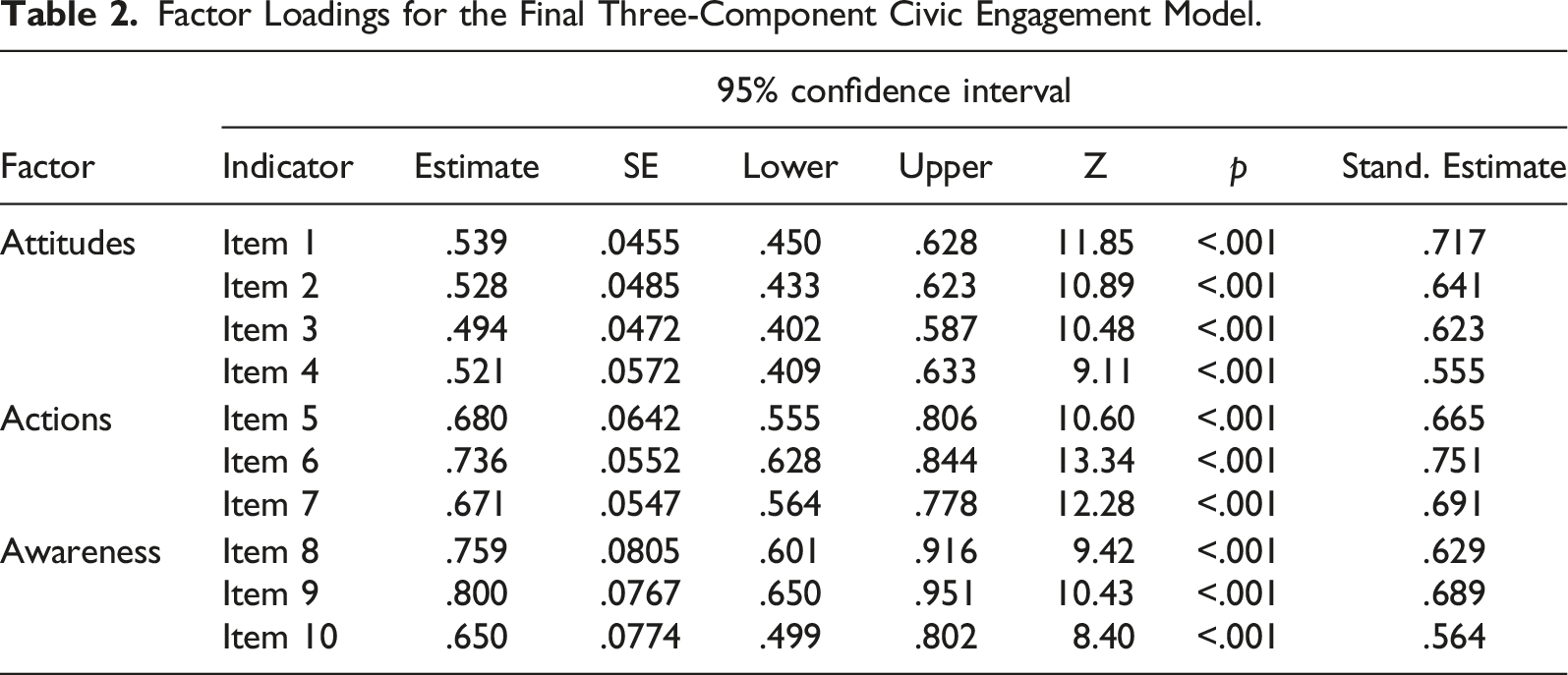
The ten items retained, along with their unstandardized factor loadings (SEs in parentheses) and factor covariances are presented in Figure 1. The first four items generally appear to measure civic engagement attitudes, as hypothesised when operationalising the concept (i.e. attitudes towards community and political life and towards one’s own rights and responsibilities as a citizen) (α = .70). The second factor, as mentioned above, appears to measure civic engagement actions (i.e. actual participation in community and political activities in the present time) (α = .74). Finally, as explained in the Discussion section below, whilst the third dimension of civic engagement was hypothesised to relate to attitudes towards future involvement in community and political life, the third factor appears de facto to measure civic engagement awareness (understood as awareness of the issues that pertain to the socio-political context) (α = .68). These measures showed relatively high internal reliability given the age group and brevity of the scales. Unstandardised factor loadings and standard errors for a confirmatory factor analysis of a tripartite measure of Civic Engagement.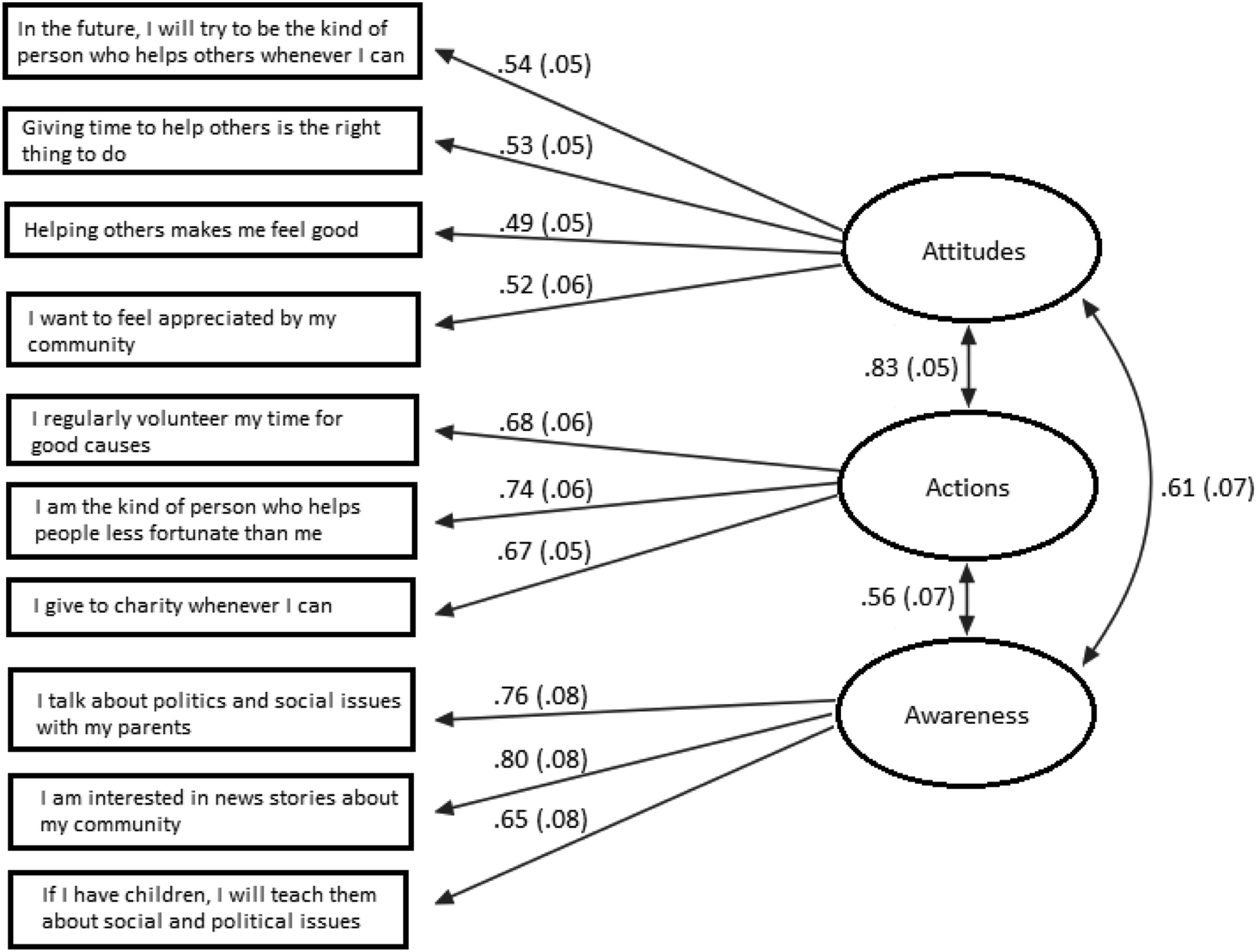
Factor Loadings for the Final Three-Component Civic Engagement Model.
Readability
Within the overall sample, the highest frequency of affirmative ‘I don’t understand the question’ responses was 28. The retained items had a Flesch Reading Ease score of 70.70 and a Flesch–Kincaid Grade-Level of 5.90 suggesting that the items were easy to read for children aged approximately 10–11. Although there were a small number of 9-year-old participants within the sample (n = 26), the Flesch Reading Ease and Flesch–Kincaid Grade-Level scores, combined with our a priori item exclusion criterion (i.e. that items were excluded if there were more than 30 instances of ‘I don’t understand the question’ for the whole sample), and model fit statistics, suggest that we can be reasonably confident in the age-appropriateness of this measure.
Cross-sectional Associations
Preliminary analyses of criterion validity suggest that attitudes correlates positively with action (r = .56, p < .001) and awareness (r = .44, p < .001), and action also correlates positively with awareness (r = .44, p < .001). None of the three civic engagement subscales correlated with age. Reading frequency correlated positively but weakly with attitudes (r = .17, p < .001) and action (r = .16, p < .001), slightly more strongly with awareness (r = .28, p < .001), but not with age. Finally, we tested for sex differences in civic engagement (see Figure 2). Attitudes were negatively skewed, so we used a Mann–Whitney U test to assess sex differences in attitudes. Independent t-tests were used for testing for differences in action and awareness as they were approximately normally distributed. There was no difference in attitudes between male and female pupils (U = 34343, p = .084, r
b
= .08). However, female pupils had greater civic awareness (t [551] = −2.86, p = .004, d = −.24) and greater civic action (t [517] = −2.19, p = .029, d = −.19). A linear regression was used to predict civic action with attitudes and awareness. Together, civic attitudes (β = .45, CI = [.37–.54]) and awareness (β = .23, CI = [.15–.31]) predicted 35% (r
2
adj
) of the variance in civic action (F [2469] = 129, p < .001). Sex differences in civic engagement.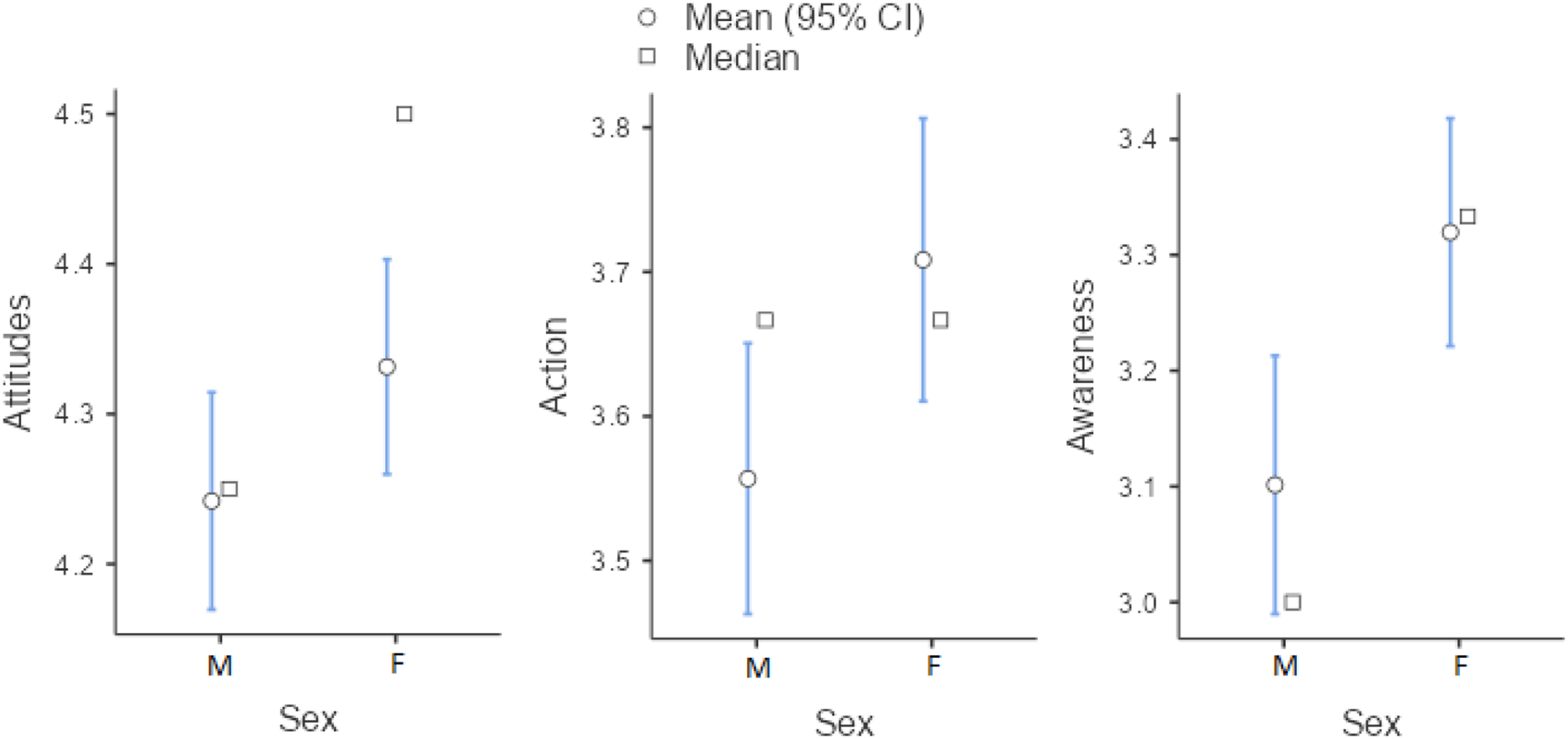
Discussion
For this study, which aimed to develop and preliminarily validate a civic engagement scale for young children, our research question was, ‘What are the dimensions of civic engagement in children aged 9–11?’ We answered this successfully here using an EFA, and this factor structure was confirmed in a second sample. For two out of the three factors identified (attitudes and action), these matched with the hypothesised dimensions of civic engagement (i.e. attitudes towards community and political life and towards one’s own rights and responsibilities as a citizen, and actual participation in civic and political life). The third hypothesized dimension of civic engagement (i.e. attitudes towards future involvement in civic and political life) was found, but only in part. One of the three items retained for this factor fitted with the third hypothesised dimension of civic engagement (specifically, the item ‘if I have children, I will teach them about social and political issues’). However, the other two items did not fit with this conceptualization. Instead, the conceptual commonality amongst items retained (see Figure 1) concerned broader awareness about the issues that pertain to the socio-political context.
Of the two dimensions used to predict civic actions, attitudes were approximately twice as strong a predictor as awareness. This may be due to the fact that those who have positive attitudes towards civic engagement are likely to seek out knowledge of civic life such that this increases their awareness, and in turn, they may be more likely to engage in civic duties. In other words, these three factors may be part of a cyclical feedback loop wherein initial motivations are iteratively reinforced. Further longitudinal research is needed to test this hypothesis.
Female pupils generally scored higher in civic engagement than male pupils, albeit not substantively. This difference is consistent with literature on sex differences in volunteering (Rotolo & Wilson, 2007). This is likely to reflect, in part, sex differences in the Agreeableness personality trait (Mac Giolla & Kajonius, 2019), which is, in turn, associated with the likelihood of volunteering (Ackermann, 2019). This temperamental divergence tends to appear amongst girls before it emerges amongst boys in early adolescence (De Bolle et al., 2015). There may also be sociological factors at play, but these are unlikely to account for the observed sex-based divergence; sex differences in values (Schwartz & Rubel-Lifschitz, 2009), interests (Jiang et al., 2018) and personalities (Mac Giolla & Kajonius, 2019; Schmitt et al., 2008, 2017) are largest in countries where men and women are freer from social coercion. There was no sex difference in attitudes towards civic engagement between males and females here, which perhaps suggests that males might be more likely to provide civic contributions in other ways (e.g. working longer hours; see Erosa et al., 2022).
Interestingly, there were no significant associations between age and civic attitudes, actions, nor awareness. This was perhaps unexpected, as we expected older children to have more freedom to engage civically than younger children. However, this may still be the case in general, with our null findings reflecting the restricted age range in this sample (the SD for age was only .58.). Therefore, we would expect that with a wider age range, there would be a significant association between aspects of civic engagement (especially actions) and age.
Strengths and Limitations
A strength of this study is that the measure was derived from a theoretical understanding of what the components of civic engagement should be. Drawn from the research literature on civic engagement with adolescents and adults, we expected that the three dimensions would be attitudes towards civic life, civic action in the present time and attitudes towards future civic involvement (Arthur et al., 2017; Doolittle & Faul, 2013; Flanagan et al., 2007; Schulz et al., 2018; Schulz & Sibberns, 2004). While not all of these dimensions were confirmed, this allowed us to begin with a more restricted range of items (20) than if we had adopted a completely a theoretical approach, which was important given the ages of our participants (i.e. the survey needed to be short). This allowed us to develop a measure with relatively strong structural psychometric properties and internal reliability in a very young sample, which is challenging given that children are still developing cognitively and temperamentally at this age (Mah & Ford-Jones, 2012). Another strength of this study is that we managed to collect data from a relatively large sample of children of a young age, exceeding commonly recommended ratios of participants to items for both the exploratory and confirmatory analyses. These recommendations range from 5:1 to 20:1 (Carpenter, 2018). Therefore, we have some confidence in the factor structure of civic engagement amongst 9–11-year-olds.
This study was limited in that it included a cross-sectional design only. This meant that we could not assess test-retest reliability. This would have to be established in future longitudinal studies. Another limitation is the limited number of tests of criterion and discriminant validity; we now know from these data that aspects of civic engagement do not vary much by age (at least within this restricted age range), and that civic engagement correlates with reading frequency, but there are a host of other variables that might be associated with civic engagement in future studies. For example, it is possible that those who score higher in civic engagement at this age might be more likely to read/understand the news and/or have elevated levels of well-being as a result of civic participation.
Conclusion
Civic engagement is a multidimensional concept that is relevant to both adults and children. When it comes to the latter, however, there are some existing measures of civic engagement for adolescents but not for younger children. What is more, these assessments lack proper psychometric validation and tend to primarily focus on community participation. Even though young children may not possess the autonomy to willingly participate in civic life, this study is grounded in the recognition that a more comprehensive understanding of civic engagement is necessary for the examination of civic engagement in young children.
In this current study, a tripartite measure of civic engagement was developed to assess the civic attitudes, actions and awareness of young children. This measure is both practical and efficient in its administration, and it has been shown to be easily comprehensible by this age group. The item development was informed by literature on the topic, yet the retained factors and corresponding items were determined through empirical means, providing confidence in the conceptual dimensions of civic engagement in young children.
This new measure addresses an important gap in the literature on civic engagement in children, providing researchers with a validated tool to effectively measure civic engagement in young children. The ability to measure civic engagement in young children allows for the identification and cultivation of civic-mindedness at an early age, potentially fostering a more engaged and responsible citizenry in the future.
Footnotes
Author’s Note
This study was funded by a grant from the Nuffield Foundation awarded to Prof Tom Harrison and Dr. Gianfranco Polizzi. Ethical approval for this study was granted from the University of Birmingham.
Declaration of Conflicting Interests
The author(s) declared no potential conflicts of interest with respect to the research, authorship, and/or publication of this article.
Funding
The author(s) disclosed receipt of the following financial support for the research, authorship, and/or publication of this article: This work was supported by the Nuffield Foundation, EDO/FR-000023246.
