



Abstract
In our research, we critique current curricular practices as enacted by teachers in kindergarten settings for five-year-olds (5K) in the United States. We explore how teachers of 5K students understand and implement early childhood integrated curriculum regulated by standards and assessments. In the United States, integrated curriculum guidelines are well known and taught throughout the pre-kindergarten community, are considered developmentally appropriate by Western notions, and are recommended for teaching children birth through age eight. Integrated curriculum is commonly modeled in early childhood classrooms; however, there is a dearth of research regarding implementation of such an approach at the elementary level (typically kindergarten through fifth grade). In fact, with a focus on accountability toward proficiency for all children in the United States (Race to the Top; Common Core Standards; Danielson Teacher Effectiveness Evaluations; edTPA), there has been an increased focus on discrete content area instruction. Our data include classroom observations and interviews with teachers in eight public and private 5K classes across a southeastern region of a US Midwestern state. We highlight the increased rigidity for “block content area” time in public school settings and the difficulty in following the interests of children and integrating curriculum across content areas. We call attention to the impact of increasingly regulated classroom time and subsequent regulation of teachers and childhood and suggest the creation of hybrid mentoring spaces to revisit the goal of early education and support teachers’ enactment of policy.
Keywords
Introduction
Molly recounts her day in a United States third grade public school setting and I listen as I unpack my laptop and shift from campus work to getting settled at home. In the middle of explaining her work of the day she mentions offhandedly that she can’t really pick what she does at school and I say “wait a minute.” I ask her to repeat what she has just said and immediately I am drawn back into my research and reminded that indeed the children “get it.” She continues, “Math is on the schedule, well I call it a schedule but my teacher calls it a menu, but it’s not really a menu because we can’t pick what we want to do.”
The vignette highlights how we, as teachers, may try to hide the regulation we are bound to by shifting labels from “schedule” to “menu” but the children can see past the rhetoric to the reality of limited choices. The goal of our research is to explore how kindergarten teachers of five-year-olds (5K) in the United States understand and enact integrated curriculum. In this research, we define integration as crossing both domains and disciplines. Our findings highlight the tension between teaching across content areas in an integrated manner and current regulations such as standards and block scheduling to address content area assessments for young children (e.g. Phonological Awareness Literacy Screening [PALS]). Through our research, we highlight examples of the regulation of time for children and connect this to teachers’ conceptions of integration or more specifically their ability to integrate. The findings show how increased regulation of time and pedagogy (e.g. content area block schedules) impact how teachers are teaching across content and disciplines and their understanding of integrated approaches to teaching. In addition, the data highlight differences in the choice and enactment of curriculum in public and private schools.
With a focus on accountability toward proficiency for all children (Common Core State Standards (CCSS), Race to the Top, 2013), there has been increased attention on discrete content area instruction in the early elementary grades. Through exploration of our research question, “How does an early childhood integrated curricular approach to teaching translate in US kindergarten classrooms?” we provide a pertinent analysis of curricular practice for classroom teachers as well as for administrators and curriculum policy writers as it sheds light on the continued regulation of early childhood education (ECE).
Theory
Policy as regulation
The image of the machine is useful to illustrate how we define integration in curriculum (Figure 1). In this model, the cogs (representing content disciplines and domains) move (representing the pedagogy of the teacher) within a larger wheel. The outer ring illustrates the power of the context binding the ability for teachers to teach in natural ways to support the unique needs of children. In our work, applying postmodern perspectives, we challenge the notions of policy as rigid text and time as linear. Using these theoretical tools, we consider policy as not only confining (the outer ring) but also holding possibilities through interpretation and enactment (the cogs and movement) (Ball, 1994). We also recognize that conceptions of time and, therefore, class scheduling may be fluid versus linear (Grosz, 2004). However, the state of our early education curricular system is becoming increasingly regulated. In our study, this regulation is expressed as a continued split between public and private settings in terms of the freedom to interpret and enact integrated curriculum. This regulating curriculum policy is most often translated as standards and assessments, block schedules, and scripted curriculum that bind the context in which teachers teach and exist under the auspices of universally supporting all children to achieve developmentally appropriate goals.

Machine.
Using postmodern perspectives that suggest power is fluid and shifting and there is no universal truth allows us to also see how interpretation and enactment of the goals then create hybrids of the policy (Ball, 1994; Derrida, 1978). In other words, standardized curriculum policy exists but it shifts in meaning as it is enacted by teachers and understood by children. Wien (1996) foreshadows what we saw in our research as she suggests, “I believe that the organization of time is the keystone holding institutional functioning together. To experiment with time organization is to disrupt all established scripts for functioning in a setting” (p. 399). This “disruption” allows teachers freedom to interpret and enact curriculum in ways that honor how children learn. Teachers’ shifting policy is powerful; however, it need not be done in isolation. Mentoring networks, collaboration within and across education settings, and sharing of publications and research to support individual action shift the outer ring (context) into new shapes that create more authentic ways of facilitating learning for both young children and educators (Zeichner, 2010). In telling complex curriculum stories, as we do in our research, new insights are gleaned about the interplay between policy and teaching that directly impact children.
ECE policy context and curriculum
Policy context
In the United States, pre-kindergarten curriculum (birth to age five) and kindergarten through third grade curriculum generally fall under separate governing agencies at the federal and state levels. With the movement toward public kindergarten for four-year-olds in the United States (National Institute for Early Education Research, 2014), the power in decision making for curriculum may shift; however, currently, schools in early education pre-kindergarten (Pre-5K) generally have more curricular freedom. Therefore, 5K is the point at which the focus on curriculum changes from one where schools and teachers choose their curricular approach to more standardized expectations. Generally, this also represents a shift from private care (although Head Start offers public programming in the United States based on income requirements) to public education. The kindergarten school movement (historically for 5K) in the United States started in the late 1800s and became a battle between private and public interests (Beatty, 1997). In the early 1900s, there was a pedagogical shift away from Froebel’s influence and a focus on family to a Freudian philosophy, and childhood independence became a new pedagogical approach (Beatty, 1997). The 1920s and 1930s showed an increase in standardization both in pedagogy and assessment and the focus shifted to developmentalism (Bloch, 1992). Currently in the United States, it is most common for children to begin their formal education in kindergarten at age five; however, the age requirement for compulsory schooling is dependent on state legislation and can begin as late as age eight (two states) (National Center for Education Statistics, 2014). Finally, in most states, 5K has been an option for families as a public, and therefore, free option for over a century with 46 of 50 states requiring districts to offer either a half-day or full-day learning experience (National Center for Education Statistics, 2014). Given the prevalence of public 5K in the United States, we consider how curriculum is instituted and enacted across these settings.
Early childhood curriculum
In consideration of what is currently viewed as “best practice” in the United States, we explore foundations of early childhood curriculum. Despite the fact that theories of curriculum differ, constructivist, developmental, and critical theories support authentic learning for children through meaningful and relevant experiences (Bredekamp and Copple, 2009; Erikson, 1950; Ladson-Billings, 1995; Piaget, 1977; Ryan and Grieshaber, 2004; Vygotsky, 1978; Yelland, 2010). Presently, it is suggested that children learn through domain (aesthetic, affective, cognitive, language, physical, social) and content (literacy, math, science, social studies) integration (Katz and Chard, 2000; Stevens et al., 2005). In other words, children “naturally integrate” their learning across content areas to solve problems and investigate new understandings. In addition, the National Association for the Education of Young Children (2009) has issued a position statement clarifying what many in the field in the United States currently view as best practices for curriculum for young children: Teachers plan curriculum experiences that integrate children’s learning within and across the domains (physical, social, emotional, cognitive) and the disciplines (including language, literacy, mathematics, social studies, science, art, music, physical education, and health) … Teachers plan curriculum experiences to draw on children’s own interests and introduce children to things likely to interest them … the experiences do not skim lightly over a great many content areas, but instead allow children to spend sustained time with a more select set. (p. 21)
In the United States, these guidelines are well known and taught throughout the Pre-K community, are considered appropriate, and are recommended for teaching children birth through age eight. For example, Head Start, a federally funded compensatory early education program in the United States, endorses the use of High Scope and Creative Curriculum. These somewhat universal approaches to teaching have been critiqued; however, the curriculum still allows for investigation and problem solving for children across content areas (Michael-Luna and Heimer, 2012). When addressing our research question, “How does an early childhood integrated curricular approach to teaching translate in kindergarten classrooms?” we define integration as teaching across both domains and disciplines. Typically in early childhood settings, integration is defined as teaching across domains—health/physical, social/emotional, cognitive, language, learning style. In K-12 settings, integration may include cross-domain learning but more often refers to content areas—science, social studies, math, literacy being the primary considerations with physical education, music and art shifting to “specials.” As we consider ways to support all children, we also critically examine and reimagine early childhood curriculum (Bloch et al., 2014; File et al., 2012; Hyun, 1998). In Pre-K (typically prior to age five), the child is more often the impetus for the curriculum, whereas in later years the curriculum package becomes the guide versus following the interest of the child.
Curriculum within the current policy context
A current curricular standards movement, Common Core State Standards (CCSS) is gaining traction at the 5K level in the United States. Pre-K standards are primarily controlled at the state level (e.g. Wisconsin Model Early Learning Standards, Massachusetts Preschool Early Learning Guidelines); however, 5K is increasingly tied to K-12 public education settings and, therefore, bound to certain regulatory standards and assessments. Typically, early childhood state standards in the United States are domain focused (health and physical, cognitive, social/emotional, and language); however, CCSS are discipline or content area focused (math, science, literacy as separate sets of standards). These categories for learning certainly overlap and can “communicate” with each other; however, the translation creates a tricky task as teachers work to support all children in increasingly scrutinized classrooms. For example, with the increase in standardized assessment in kindergarten settings (e.g. PALS), and evaluations of practice in pre-service (edTPA) and in-service settings (Danielson Teacher Effectiveness Evaluation), teachers are faced with a changing context that fails to honor appropriate curricular theory and practice for young children (SCALE, 2014; Danielson, 2007).
Policy reforms further constrain teachers in increasingly regulated kindergarten and early elementary classrooms. For example, in elementary schools in the United States, it is common to observe content-specific curriculum packages such as Everyday Math, Mondo literacy, and Jolly Phonics implemented in the classroom. Teaching using packages and discrete content blocks is becoming more common in earlier grades and even preschool. The policy context in the United States, with the increased focus on standardized child outcomes guided by implementation of the CCSS, has influenced the continued segregation of content-specific instruction. For example, curriculum packages include detailed reference for direct connections to the CCSS. In Everyday Math, one section is titled “A shared vision with the Common Core” and individual lessons outline the standards covered (Everyday Math, 2015). Given these curriculum policy pressures as evidenced in CCSS, content-specific curriculum packages, standardized child assessments, and scheduling constraints, our study offers insight on teacher understanding and implementation of integrated approaches in 5K. Integrated curriculum is commonly modeled in early childhood classrooms through approaches and packages such as the project approach, Creative Curriculum, and implementation of the Reggio Emilia model; however, there is a dearth of research regarding implementation of such an approach at the kindergarten and elementary levels.
Methodology
This research explores how kindergarten teachers of 5K in the United States understood and enacted teaching across content areas. This is a qualitative small-scale collective case study (Stake, 2005). This approach allows for the study of one issue, 5K teachers’ understanding and implementation of integrated curriculum, across eight kindergarten classrooms in the United States. The research question, “How does an early childhood integrated curricular approach to teaching translate in kindergarten classrooms?” is explored through an analysis of data collected through teacher interviews, observations, and artifacts.
Participants
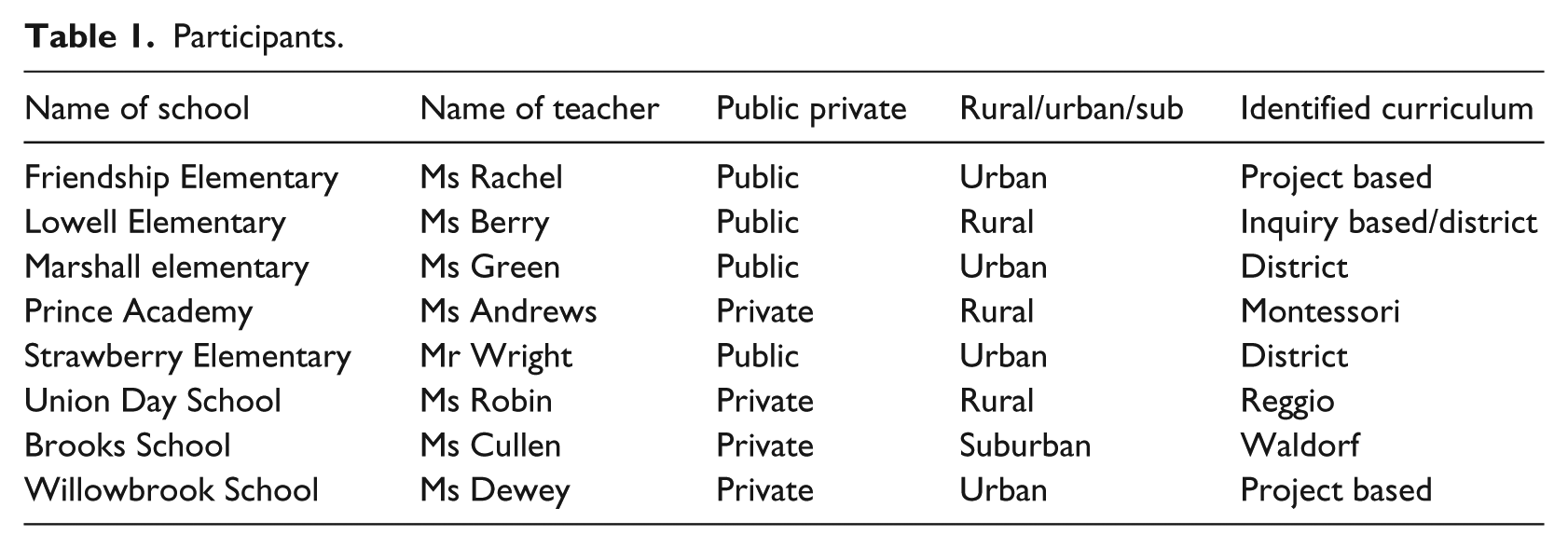
The focus of the research is on 5K in the United States as historically the move to 5K creates a shift for children from myriad settings (family care, private community care centers, Head Start, 4K) to seemingly more formal 5K education settings. The settings in this research are bound geographically within the southeast region of one US state, with a mix of urban, rural, and suburban classrooms. In addition, there is a mix of private and public education and a variety of curriculum used (see Table 1). Schools were selected using purposive sampling for a typical case with the intention of having a mix of urban, rural, and suburban settings that were seen as having potential for integrated curriculum based on prior field placements (Patton, 2002). In the initial contact, the researcher asked to observe and learn about a kindergarten classroom using integrated curriculum, projects, or units. Eight teachers responded and agreed to participate in the study and were given thank you gifts (gift certificate for US$25) for their participation. The teachers volunteered before they were told they would receive a gift. Written informed consent from the teachers and permission from the schools’ principals were obtained. This research was approved through our institution’s Internal Review Board (IRB) process.
Participants.
Data collection
Observation notes were written during a one half-day visit at each of the eight kindergarten classroom sites (Emerson et al., 2011). Teachers were interviewed using a semi-structured format one time with interviews lasting an average of 30–45 minutes. However, the Union Day School mirrored their philosophy: the gift of time. Children had time to learn and investigate, and the teacher was able to spend the entire morning visiting with the researcher versus public schools where the interview lasted about 30 minutes during a teacher’s preparation time. Finally, pictures of the environment were taken and copies of lesson plans were used as part of the data for analysis (Spradley, 1979).
Analysis
Interviews were transcribed and data including classroom observation notes, lessons, and pictures were analyzed and coded using open coding that sought to define the data through categories related to the research question (Strauss and Corbin, 2007). The five initial codes included the following: (1) environmental influences, (2) student interactions, (3) impact of routine, (4) teacher’s philosophy, and (5) curriculum. Grouping by code, across data sources and contexts, thematic memos were created (Graue and Walsh, 1998). The memos were crosschecked with the co-researcher, and a second level of coding emerged through the analysis. These secondary codes included the following: (1) impact of time and routines on integration, (2) interpretation of integrated approaches, and (3) influence of school philosophy on classroom practice. The data sources (observations, interviews, and artifacts) were used synthetically to formulate a description of the kindergarten curriculum and structure as a basis for an evaluation of how an integrated curricular approach is enacted in the classroom. Following this process, two key findings emerged: (1) content block schedules limit teachers’ ability to naturally integrate across disciplines and (2) articulation of integration varied between public and private settings.
Findings
The purpose of this study was to explore the complexity of applying theory to practice as it relates to implementing integrated teaching strategies with young children. In our findings, we call attention to the impact of increasingly regulated pedagogy and subsequent regulation of teachers and childhood.
Content block schedules and integration across disciplines
Set schedules and block times for content area instruction directly related to how teachers did or did not teach across content areas. For example, Marshall Elementary and Strawberry Elementary are public schools with posted schedules outlining the activities for the day (Figures 2 and 3). Strawberry Elementary also lists the times for each activity; however, it appears there is also “free choice” time. Typically in early childhood settings, “free choice” refers to a time when children are given options (although usually limited to three to four activities) for how they spend this time. The activities of the day include content area instruction (language arts, music, art), group time and free choice that might allow for integrated content learning.
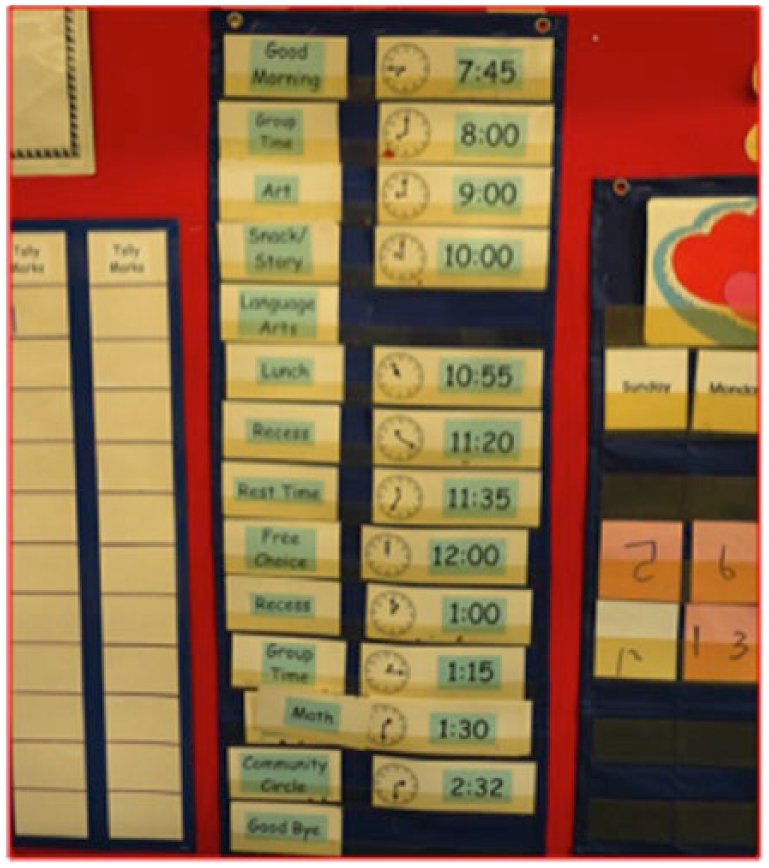
Strawberry Elementary.
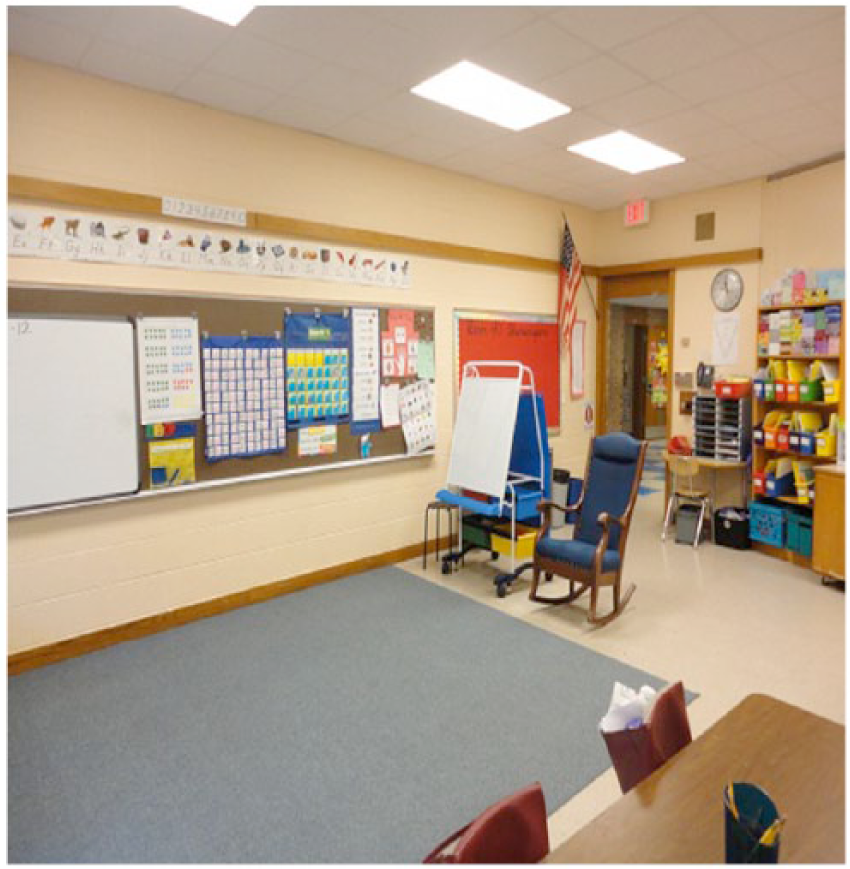
Marshall Elementary.
The physical appearance of these classrooms illustrates less child-initiated learning and more structured interactions. For example, in Figure 3 Marshall Elementary, there is a rug for large group work and individual tables for small group work, but “centers” such as dramatic play, blocks, and sensory are non-existent. Ms Green at Marshall explains, I have to have math groups, I have to have literacy. They give you like times that you’re supposed to have “this is how much time you should have set aside for this (math or literacy).” (Ms Green, Marshall Elementary, Urban, Public District)
Both her interview and the artifacts in her class indicate explicit scheduling of the curriculum. She refers to district administrators as “they” and connects the policy with the supervision of the policy. Little space is allowed to interpret the policy or deviate from the schedule to teach based on the interest of the child. Mr Wright suggests, It’s that balance and trying to figure that out. Ultimately if it was—if we didn’t have to worry about the standards I could see like the store in dramatic play and have the kids using items that are for sale—if it’s like five cents …. (Mr Wright, Strawberry Elementary, Urban, Public, District)
Mr Green names the standards as a “worry” and yet suggests that more natural integration would occur during exploration of individual centers; however, centers were non-existent for Marshall and Strawberry schools. In our research, it was powerful to line up the photos of the different settings. Figures 4 and 5 were taken at a private Waldorf 5K and the images alone suggest child exploration and greater potential for following children’s interests versus a schedule based on content area instruction. These images illustrate that materials are at the child’s level and offer space for exploration and freedom of movement.
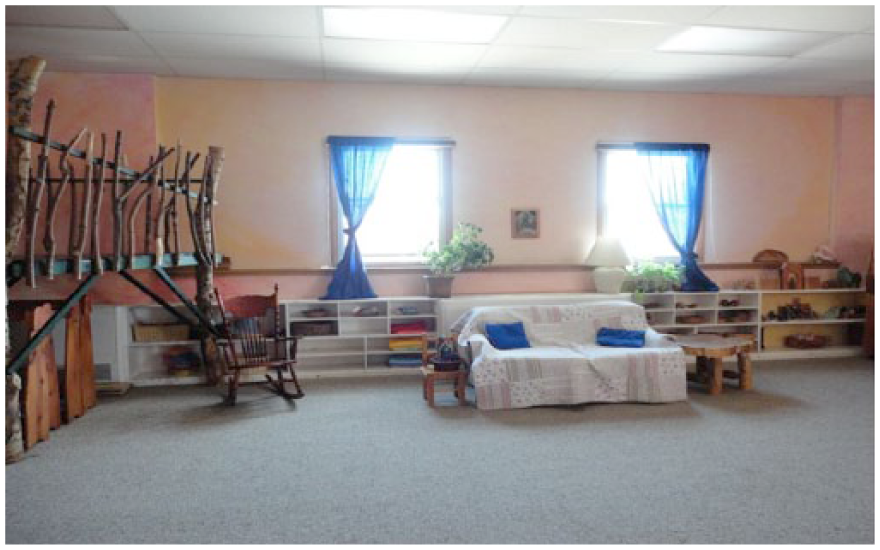
Brooks School classroom.
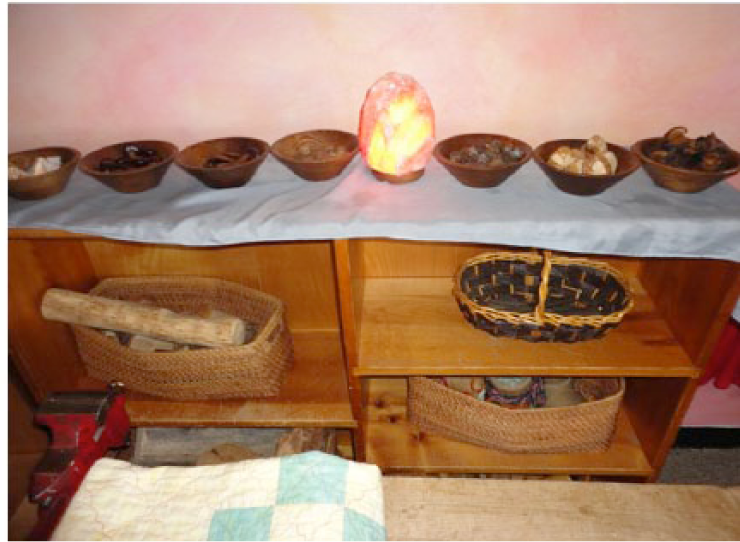
Brooks School learning materials.
The classroom is very natural, a few lamps by the dresser, wooden baskets on shelves … children start arriving with parents and some children were asking who was in the classroom today … A morning discussion with the children commenced I notice there is no schedule posted on the wall. There were different rooms with different purposes. Children will cook in the kitchen, etc. (Field notes, Brooks School, Suburban, Private, Waldorf, March 2012) … children are in the room, just getting in for the day. Teacher asks me not to talk with them, so I don’t disturb their playing. Teacher is walking around asking what the children are working on. (Field notes, Prince Academy, Rural, Reggio, March 2012)
The environment plays a role in the schedule, but as the researcher notes, there is also a culture for entering the learning environment that differs from the images of the public setting. So while both settings suggest that a routine exists, the rigidity by content areas is more explicit in two of the public school classrooms. We also found at Friendship, a public school that encourages “inquiry based learning,” the teacher has some freedom with her schedule. Ms Rachel explains, I just like it (integrating) because it gets them excited … It’s way more flexible for me cause I don’t have to say oh it’s 9:00 we have to stop and do this science experiment or we have to stop and do this. (Ms Rachel, Friendship Elementary, Urban, Public, Project based) So you’re not limited if you’re working on something and a student or teacher makes a connection to something else you can jump right in to it and you can connect it. We’re able to be responsive … It’s not like you’re in your math class so you just have to be thinking about math…anyway it just allows us to follow our curiosity when it’s happening. (Ms Dewey, Willowbrook School, Urban, Private, Project based)
In the second quote, Ms Dewey has a firm understanding of how to follow the interests of children and how that connects to integrating across content areas. Willowbrook School where she teaches is a private school in an urban setting, and the entire school follows a project approach philosophy not only at the class and grade levels but also school wide.
Our data as illustrated in photos, observations, and quotes provide evidence that support the idea that integration happens “naturally” when there is a flexible schedule and more time for children to explore outside of designated “block” content times. Based on this, we suggest that the standard-based curriculum found in 5K settings, specifically two of the district public schools, in the United States imposes time constraints through block scheduling by content area that inhibit integration of curriculum. Interestingly, we learned that schools with philosophies that allow children to critically think in an integrated learning environment have more flexibility in the schedule of the day. In recent work considering the conception of time and transitions in the early childhood classroom, Pacini-Ketchabaw (2013) suggests, … educators might begin by attending to the complexities, to the messiness that children’s bodies and actions bring into the classroom. This complex conception of childhood moves away from developmental ideas of childhood (Cannella and Viruru, 2004) and brings fluidity to early childhood practices and to linear conceptions of childhood. (p. 227)
This conceptualization of time and motion as integrated and fluid fits with how the classroom teachers in our study describe what is needed to follow the interests of children and more naturally integrate curriculum. However, we suggest that we are in crisis in the United States. We are conflicted in our understanding of how to conceive of time as fluid, and we are simultaneously constrained by policy that limits choices for children and pedagogical choices for teachers.
Articulation of integrated approaches: The public and private split
As the 5K teachers explain their understanding of integration across content areas in 5K classrooms, they refer to global concepts, and some include integration but also emergent, Developmentally Appropriate Practice (DAP) and child-centered approaches. A split between public and private school settings becomes apparent. When describing their integrated approach for teaching, some teachers conflate emergent ideas and integrated ideas and others are able to name and give examples of authentic integration: It should show that math, science, social studies and arts of all kinds are a part of our everyday life. Open space, providing lots of opportunities for exploration, using materials and touching should be included in the environment. You know, it’s basically letting five-year-olds use the scientific method all the time. They try something, it doesn’t work, they try it again. My role becomes more of a facilitator than a teacher. (Ms Dewey, Willowbrook Academy, Urban, Private, Project based)
Ms Dewey combines curricular notions of child-centered, facilitated, and integrated learning across domains and disciplines while describing her role as facilitator for learning. She teaches at Willowbrook Academy, one of the four private schools in our research. However, not all teachers were able to articulate their understanding in such a direct manner. For example, the following teachers seem to dance around the idea of integration mentioning personal to school connections and resources as examples of this approach: I think we integrate stuff but then it’s like to what extent—I think things feel like we’re the same as (4 year) kindergarten. I think it can happen pretty naturally if you’re authentically (integrating). A lot of times stuff comes up, someone was talking about they had a connection … I think it’s overlooked because again with standards and stuff I think people … so many other places are like we have business to take care of. I don’t really have a problem taking a little extra time—sometimes in the morning during the morning message or before that if they have something to share we’ll take time and talk. (Mr Wright, Strawberry Elementary, Urban, Public, District) Well resources are always a struggle … other struggles? I guess not having as much training I think. (Ms Rachel, Friendship Elementary, Urban, Public, Project based)
These quotes highlight some of the confusion regarding integrated curriculum. Mentioning authenticity and personal connections can be powerful integration tools; however, Mr Wright continues to separate the integration into pockets of informal sharing time. The second quote suggests a lack of training and physical resources to use an integrated approach. The idea that she would need “resources” to integrate across content areas suggests some confusion about the pedagogy. In other words, Ms Rachel’s quote suggests the need for further training to simply begin to understand a more integrated approach to teaching: Honestly I think it’s a little harder at this age just because half of the class cannot read … I will try to pull in some books into like say the mini lessons of writer’s workshop or to the mini lessons as part of the Daily 5 [literacy routine]. Currently we’ve been studying conventions of non-fiction. So when we make our anchor chart I’ll try to use just the books that we have over there for the desert [Foss]. I’ll try to pull it in that way. That’s the biggest thing. (Ms Berry, Lowell Elementary, Rural, Public, Inquiry based)
Ms Berry is required to use an “inquiry-based” curriculum as that is part of the charter for this public school; however, her examples appear to be more focused on superficial connections (e.g. reading books on the desert during Daily 5 literacy time). Her suggestion that “(integration) is a little bit harder” because the children can’t read suggests her expectation that children have achieved certain academic benchmarks to begin to think across content. Ms Berry suggests connecting across packages (Foss) and routines (Daily 5, writer’s workshop) that already exist in the classroom. This represents a more linear understanding of time management in the classroom and fails to follow the interests of the child and naturally integrate across content areas through activities and lessons. The quotes above and the following artifacts suggest implementation of an integrated approach to varying degrees.
The images represent long-term projects that spanned days to weeks of working on ideas that all came from the children. The study of water (Figure 6) was left open-ended with simple suggestions (tape on the floor) to allow children to follow the connections. The tree study (Figure 7) stemmed from a child’s curiosity with walnuts falling from trees and gradually advanced into studying different types of trees.
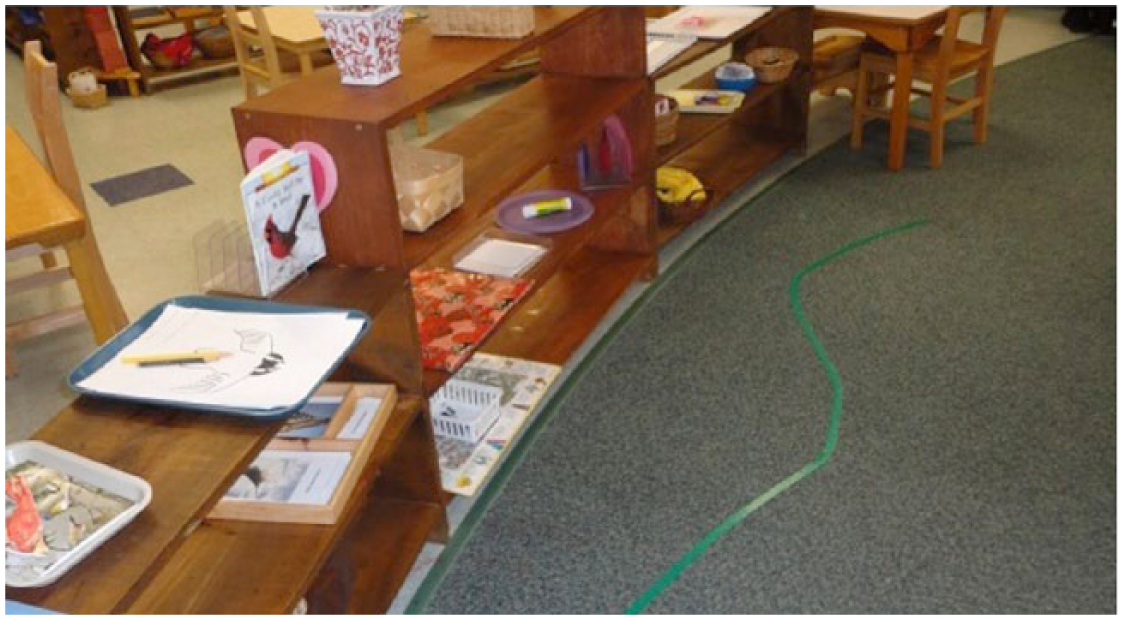
Montessori—river/bodies of water Prince Academy.
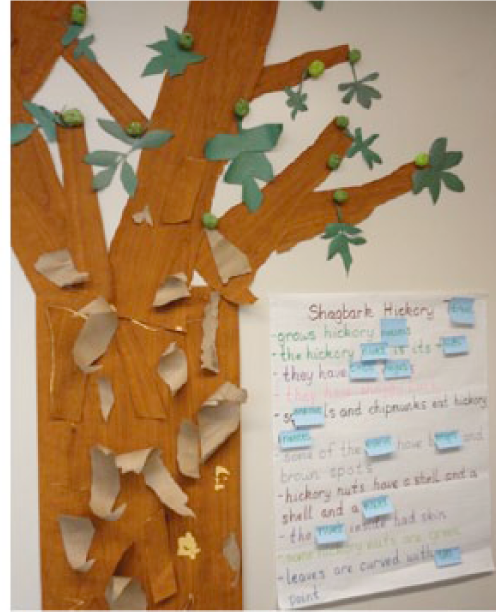
Shagbark Hickory tree, Union Day School.
The children recreated trees in the classroom with paper, made the little hickory nuts out of papier-mâché and painted them. … (A parent), who lives close to here, has a lot of apple trees in her back yard. So they took a field trip there … then they got into like a tree study … Yes there was the model writing and recording and documenting their learning but then also we have Spanish, we want to integrate that into the classroom. They replaced some of the English words with Spanish words. (Ms Robin, Union Day School, Rural, Private, Reggio)
The “tree project” provided opportunity to integrate and follow children’s interest, although some of the connections are superficial (papier-mâché hickory nuts). Ms Robin also described a project where the children studied and gathered mushrooms and then created imaginary worlds and wrote stories going to the extent to consider “perspective” by recreating the woods environment in the classroom: … and even made a little pond and then we created … stories … we drew ourselves … so I went to the copier and shrank their self-portraits until they were tiny and put them on little pieces of wood and they were able to play—so they could take their little people and play in the woods … inside the classroom. (Ms Robin, Union Day School, Rural, Private, Reggio)
Each teacher interprets and enacts their understanding of integration across content areas with children. All of the teachers in the study express a desire to meet children’s needs, and most, if not all, teachers share that they try to follow the interests of children with the belief that in doing so they are teaching in relevant and authentic ways that then integrate across content. Following the interests of children offers the most relevant and authentic way to teach as children are motivated by their expressed curiosity. However, projects may be teacher initiated and still naturally integrate across content areas. Yet, many teachers are constrained by curriculum policy and scheduling. The teachers in the private settings illustrate more freedom both in their descriptions of curriculum and examples of projects. Ball (1994) suggests that policy functions as both text and discourse, and it is in the discourse that teachers enact the policy in unique ways. Therefore, it is in the interpretation of policy that time can be reconstructed as more fluid. However, it is the reality that these teachers face, job loss based on low standardized scores in the class, repercussions for not following a published content block schedule, or being told to follow a packaged curriculum script, that truly raises the stakes for teacher enactment in the public settings. Teacher interpretation of curriculum becomes an act of individual defiance in the interest of the child but perhaps at a cost to the teacher. In the end, whose children are privileged to learn in the most authentic and relevant ways?
Discussion
By asking the question, “How does an early childhood integrated curricular approach to teaching translate in US kindergarten classrooms?” we learned that the use of CCSS and the implementation of effectiveness evaluations are confining and controlling teachers’ ability to teach in an integrated manner. Content block scheduling is simply one concrete example of how, perhaps well intended, policy can have detrimental effects on children. Curriculum packages and scripts in 5K are common, and as our data suggest, scheduling and pressure toward achieving developmental standards in public schools add additional constraints for teachers when interpreting and enacting curriculum with young children. Additional confusion occurs for teachers as the translation from early childhood to 5K settings shifts from integrating learning across domains (physical, cognitive, social) to integrating across disciplines (math, literacy, social studies, science, art). In addition, the public/private split in approaches indicates that even when focusing on teachers who identified as using an integrated approach, public school teachers experienced more regulation in the work they did with young children. We found that indeed, curriculum policy is regulated by standards, child assessment, and curriculum packages including schedules. Even as teachers interpret these regulations (power is fluid) children are still being regulated in their work as learners. As teachers grappled with implementing curriculum in relevant ways in a context that limited their choices and therefore the choices of the children, the notion of creating networks of support came to light.
Implications and conclusion
Is today a school day?
No it’s a “home” day, tomorrow is a school day.
Ugh, I don’t want to go to school.
But I said today is a home day tomorrow you go to school.
But I don’t want to go to school, I hate school.
What about school is hard for you?
There is never time to do what I want to do. I don’t even have time to eat.
Do you want me to come to visit you at lunchtime?
Yes.
Is there anything else you want to tell me about school?
If I don’t get my work done then I have to do it later and never have time to do what I want to do.
As the initial vignette illustrated through Molly’s quote, “Math is on the schedule, well I call it a schedule but my teacher calls it a menu, but it’s not really a menu because we can’t pick what we want to do” and the interaction above, children see beyond the policy rhetoric. At a young age they are aware of the limitations of time placed on them and the regulations imposed for how they “spend their time.” Therefore, the quandary still exists of how to enact confining curricular policy to meet the individual and group needs of young children.
Our findings are revealing, yet not new, as Wien (1996) stated in her study: But the organization of time as a production schedule-reflecting adult economies of work, and time as a scarce resource-is antithetic to the slow, unhurried time necessary for the development of young children. Their activity becomes fragmented, truncated, frustrated, rushed, and pressed. Teachers can see this happening, but may not see what can be done about it. (p. 400)
In our data, the issue of “time” constraints in 5K settings is accentuated with the layering of additional assessment, accountability, and curricular pressures. This rigidity with increasingly younger children binds and controls an already fragile relationship and understanding of what is best for children. It is the child’s voice that is missing when teachers and staff are panicked by linear and limited notions of time as content area “time” is linked to student success.
Reimagining with support
Standards, assessment, and efficiency may all have places in our ECE culture, but the question at the center of our learning, where private and public spaces meet, where competition becomes a factor at birth is what would we have for our children? What is the goal of early education? Is it to teach children to behave and work within a regulated environment or is it to problematize and explore the curiosity bursting forth from their beings? Our study suggests that classrooms are becoming increasingly regulated although teachers struggle to hang on to relevant ways to reach children and honor that individual desire to learn. When public school districts purchase curriculum packages aligned across kindergarten through fifth grade, kindergarten teachers hesitate to venture from the scripted manual in fear of being reprimanded. In school staff curriculum meetings, hallway conversations among teachers, and through online blogs, we must revisit the goal of early education. Curriculum is being purchased and expected for kindergarten students; therefore, it is our job as early childhood advocates to speak out about classroom experiences and what is required for high-quality learning in an early education setting: One thing I’ve learned in the process of starting this project (as a college student) and now ending it (as a kindergarten teacher), is how teaching with an integrated approach feels. As an observer who collected data, I was able to see how lessons were integrated or disconnected, and therefore developed a sense of connection as an observer. Now that I am a teacher in a classroom, I try to be in tune with how my students feel. I want to understand what their connections are and make learning meaningful. With four different manuals of scripted curriculum packages to follow each day, one can imagine the headache a teacher might get while trying to integrate all the ideas into one main topic. I now understand why teachers burn out or teach in a content-based format. However, I think it’s crucial that teacher educators continue to teach us (students and teachers in the field) about integrated curriculum. When I teach with an integrated approach in mind, my investment in each lesson is significantly higher. The students are more engaged in the opportunities offered around their environment. This past year I mentored practicum students from my alma mater. When connecting with them over lunch it was refreshing for me to hear from these university students “this is exactly what I’m learning in class.” The new articles they shared with me buoyed my commitment to integrated approaches. I’ve also found it rewarding to reflect on integrated teaching through blogging. At the end of each teaching day, I document the learning that happened in our classroom through pictures and descriptions. I’ve had excellent feedback and support from families and I feel like it is a great way to share concepts and experiences children are getting while in school. Blogging is also a great tool to help me connect with other colleagues or educators when they offer feedback for me to grow professionally. Children want to experience the world and make connections to their learning, and making connections is a natural integration we do in life. A teacher who is invested in teaching is a teacher who will enjoy teaching, and therefore students will enjoy learning. (Klefstad, 2014)
While we do not seek “quick fix” solutions, the insights of the 5K teachers are offered as support for teachers and teacher educators to reimagine our classroom worlds. In our work together, as illustrated in the reflection above, the authors have experienced a spiral of mentoring support: faculty with university students, university students with children in classrooms, graduates working in ECE classrooms mentoring current university students, students working in multiple contexts with families and children. This mentoring spiral creates a hybrid space for learning across agencies, institutions, policy, cultures, and contexts (Zeichner, 2010). This hybridity allows for a level of commitment, advocacy, and policy enactment that illuminates additional understanding regarding the dangers of rigid policy that directly impacts young children. Research suggests that the teaching context influences teacher retention and success. With few resources and no encouragement to teach in ways that best support students, highly educated teachers tend to leave the profession early (Darling-Hammond et al., 2005). We believe that teachers need the freedom to follow the unique cultural, social, and intellectual needs of children and that mentoring relationships and creating communities of practice offer a layer of support (Lave and Wenger, 1991; Meyer, 2002; Wenger, 2000). These communities encourage scaffolding and notions of apprenticeship not always possible in singular mentoring relationships. One way novice teachers can share and connect with others is through the creation of blogs about classroom experiences (Reynolds, 2015). Blogs help illustrate the shift from ideals and theory to application and practice subsequently highlighting the challenges imposed through district, state, and national policy. The ideas we present here are meant to support teachers such as those in this study, who want to connect with children and support learning in integrated and authentic ways. However, we see these as temporary solutions for addressing larger implementation issues of “universal policy” that disregard the needs of each child.
Children get it. They are the true philosophers and it is time educators and advocates share our curriculum stories so that we might continue to shift the shape of the policy context in ways that honor children. In our research, we found that the divide between public and private practice and policy for young children requires closer inspection to better answer the question: Whose children have access to meaningful, relevant learning?
Footnotes
Acknowledgements
We would like to thank the children and teachers of the schools in our study for sharing their time, insights and artifacts with us. We thank the principals for trusting us and allowing access to their settings and thank our colleagues and families for supporting us by allowing time to research, meet and write. We are very grateful to I-Fang Lee for the opportunity to submit our work, the reviewers for their meaningful feedback and to the editors of the journal for the detailed support.
Funding
This research received no specific grant from any funding agency in the public, commercial, or not-for-profit sectors.