




Abstract
The overall aim of this paper is to give a comprehensive picture of the marketization of early childhood education in Iceland. Our theoretical framework is based on Hursh’s (2007) analysis of how the governance of schools is reshaped to serve a neoliberal agenda with the help of internal and external privatization (Ball and Youdell, 2007). In this paper we explore charter schools in Iceland, categorizing them according to Fabricant and Fine (2012), and shed light on how the most dominant charter school chain in Iceland, Hjallastefnan (e.g. the Hjalla-policy), is leading the corporatisation of public education. Our main data sources are policy and media documents and data from Statistics Iceland. Content analysis is our method of inquiry. Our findings indicate that Iceland is on a similar route to other Nordic countries, where privatization has become an ‘inevitable’ part of the education system. Internal privatization is shaping the sector, based on technical methods of delivering predetermined outcomes. External privatization, in the form of educational programs, is growing along with charter schools.
Introduction
The early childhood education system, not only in Iceland but in the wider world, seems to be vulnerable to marketization (Simpson et al., 2014) which Moss has named ‘hegemonic globalisation’ (Moss, 2014). This has reduced early childhood education to simple formulas and technicality; ideas that have been traced to neoliberalism. In this paper we give an overview of how the Icelandic preschool system has been affected by such hegemonic globalisation, especially in the last decade.
Neoliberalism is a concept much used today, not just in connection with economics, but also schools and education. There is no simple definition of neoliberalism as a political ideology; it is many things and sometimes contradictory. What is common is the definition of neoliberalism based on the view that every aspect of ‘human life can and should be reduced to a set of economic relationships and values’ (Moss, 2014: 63). Part of this ideological journey has an underlying aim of changing public discourses; changing how we think and act (Ball, 2012; Hursh, 2012; Saltman, 2009, 2014b). This is done through changing the vocabulary of the educational world: from pedagogical and philosophical to industrial; from speaking about early childhood education or pedagogy to talking about childcare industries (Moss, 2008). In Nordic countries, early childhood education has historically been a part of the public sector and therefore under collective ownership, a part of what has been under public control, not part of the private sector or industry. Part of the neoliberal agenda is to systematically blur or obscure the boundary between public and private, to weave itself into the fabric of daily life, and this is what has happened in most of Nordic countries (Ahrenkiel et al., 2012; Arnesen et al., 2014; Lundahl et al., 2013). The implementation varies somewhat between different Nordic countries, but there are also similarities, especially along the early childhood spectrum.
Discussions about neoliberalism in relation to early childhood are not new. Dahlberg and Moss (2005) have written about the danger of early childhood education 1 becoming a target of accountability standards as well as technical solutions. The ‘childcare market’ is one of the fastest growing corporate sectors in the UK as well as in Australia and the USA (Moss, 2008). Woodrow and Press (2007) have analysed the Australian system and how the market and marketing solutions have taken over. Sumsion (2006) describes the concept of ‘corporate preschools’ in Australia. Vincent et al. (2010) have researched how parents’ school choices influence the early childhood education system in England, exacerbating latent inequalities. Ahrenkiel et al. (2012) have analysed how the pedagogy of Danish preschools is increasingly affected by neoliberalism. In Norway, ‘the competent and knowledgeable child’ has become a common theme in curriculum reforms, even for very young children (Arnesen, 2011). Consequently, the corporatism of preschools in Norway has reshaped preschool experience and pedagogy (Seland, 2011). In the USA, post-colonial, post-structural and queer researchers have written about the threat of a white worldview as well as about how standards are used to push pedagogy into a certain frame that supports, among other things, the needs of the market (Blaise, 2005; Cannella, 2005). Sweden, once the landmark of social democracy, with a centrally driven school system, has over the last 20 years developed one of the most neoliberal and market-driven school systems of all the OECD countries, with large school companies running the so-called free-school system (Lundahl et al., 2013).
Some scholars have questioned the ability of democracies to survive neoliberalism and are worried about the neoliberal worldview becoming hegemonic (Apple, 2004; Ball, 2012; Hursh, 2012). Saltman states ‘By reducing the politics of education to its economic roles, neoliberal educational reform has deeply authoritarian tendencies that are incompatible with democracy’ (2009: 24).
In Iceland there is almost universal attendance at preschools: 86% of children aged between one and five-years-old attend preschools for up to eight hours a day (41% of the one-year-olds and 93–97% of two to five-year-olds, Samband íslenskra sveitarfélaga, 2015: 14)). This has had a unique influence on women’s participation in the labour market (which is the highest level of women’s participation in the world and higher than for American and Norwegian men according to Magnúsdóttir, 2015a). Just after the millennium the Icelandic business world started to show some interest in the preschool system. This interest aligned with what was already happening in the USA, Australia and England where preschools were also a fast-growing ‘industry’ (Moss, 2008). This was fuelled by the interest that economists such as Heckman showed in the system, pointing out that money spent on early childhood is vital for the future of the global market (Heckman and Masterov, 2007; Young, 2014).
Studies within the Icelandic school system, where neoliberal educational policies are the main focus, are close to non-existent. It is therefore impossible to give an overview similar to the one Lundahl et al. (2013) have given of the ‘Swedish way’, which references many different studies. However, some work has been carried out on internal marketization, the impact neomanagerialism has had on the primary school sector (Hansen et al., 2008; Jóhannesson, 2006; Magnúsdóttir, 2013b) and how market values have changed the role of principals in primary schools (Guðbjörnsdóttir, 2001; Lárusdóttir, 2014). Similar studies have not been conducted for the preschool sector, however. In terms of accountability and technological practices, scholars have written about how standardized national tests have shaped learning, narrowed teachers‘ professional autonomy (Sigthorsson, 2008) and acted against inclusive practices (Jóhannesson, 2006; Marinósson, 2011). There is only one study on external marketization in the Icelandic education system (Dýrfjörð, 2011, 2012), which focuses on the corporatism of the preschool sector. More has been written about the neoliberalization of other social sectors (for example, Stefánsson, 2010).
The aim of this article is to give an overview of neoliberalism in the early childhood education system in Iceland. We look at neoliberalism from different angles, including how neoliberal ideas are shaping the educational system from within, how discourses connected to efficacy and technicality are dominant. We look at how forces outside the system are using and creating opportunities to reshape the system to serve their own purposes. Finally, we outline the role of charter schools in our system and how they are, in some cases, McDonaldized.
Methodological and analytical framework
Our epistemological framework is policy sociology, where policy is understood as text (Thomson, 2005). We have utilised content analysis as one of our methods of inquiry. Our data sources and materials are mainly: (a) policy documents from the state and the biggest municipalities; (b) statistics from Statistics Iceland; (c) the media, academic articles, websites and documents from different organisations and companies. Data collection began in 2003.
Our analysis 2 utilizes conceptual frameworks from Ball and Youdell’s (2007) division between internal and external marketization, Hursh’s historical framework (2007) and Fabricant and Fine’s (2012) analytical framework of charter schools with a special focus on the corporate model (Saltman, 2009) that can also been described as McDonaldization through charter school chains (Ritzer and Goodman, 2003). All have written extensively about the effect of neoliberalism on educational systems.
Ball and Youdell (2007) analysed the effect covert (and not so covert) privatization has on educational systems, employing the concepts of endogenous (internal) and exogenous (external) privatization of education to describe the appearance of neoliberal ideology in education. Internal privatization involves the importing of ideas, techniques and practices from the private sector in order to make the public sector more like a business and more business-like. External privatization is about giving the private sector space to design, manage or deliver aspects of public education (Ball and Youdell, 2007).
Hursh (2007) has put forward an analytical frame, defining the main characteristics of neoliberal schools according to a historical perspective. His key concepts include curriculum standards, assessment and accountability, privatization, (market) choice and diversity. He relates each of these concepts to neoliberal views of society and describes how these views is hidden within the language of democracy and rights. Hursh points out that what can be a choice for middle class families can in reality lead to social inequality for the lower classes. How, in the end, the focus of neoliberalism is the right of finance to shape the social environment.
Lastly, we use a historical analysis of charter schools in the USA and compare this with what is happening in Iceland. Fabricant and Fine (2012) explore the history of the charter school movement in the USA. They label these ‘Mom and Pop’ schools, and describe how they have gone from being innovative institutions where alternative ideas and methods could be tested and the system reformed from within, to being for-profit multi-million dollar companies and chains. The first charter schools were originally set up as schools where social justice as well as a strong commitment to the local community were the underlying principles. But big companies and hedge funds soon saw an opportunity to invest and make money out of the public system. Once political think tanks and corporate entrepreneurs arrived on the scene, the public schools were more and less left out to dry (Sturges, 2015).
Saltman’s (2009) article is a useful prism through which to examine the corporative elements of the school system. Saltman states: The corporate organization tends to be hierarchical if not authoritarian, sharing a form closer to the military than to that of participatory democracy. As public institutions, including schools, are remodeled on the corporation, their public and collective organization is replaced with authoritarian features. (p. 9)
These corporative elements have also been termed McDonaldization. This can be summarized as the way in which the principles of fast-food restaurants, such as McDonald’s, are increasingly coming to dominate sectors of American society as well as the rest of the world (Ritzer and Goodman, 2003). Key concepts according to Ritzer and Goodman (2003) are efficiency, calculability, predictability, control and finance. The same is true for Iceland, where marketing approaches are becoming stronger and branded school chains are consequently appearing, such as the Hjallastefnan chain. 3
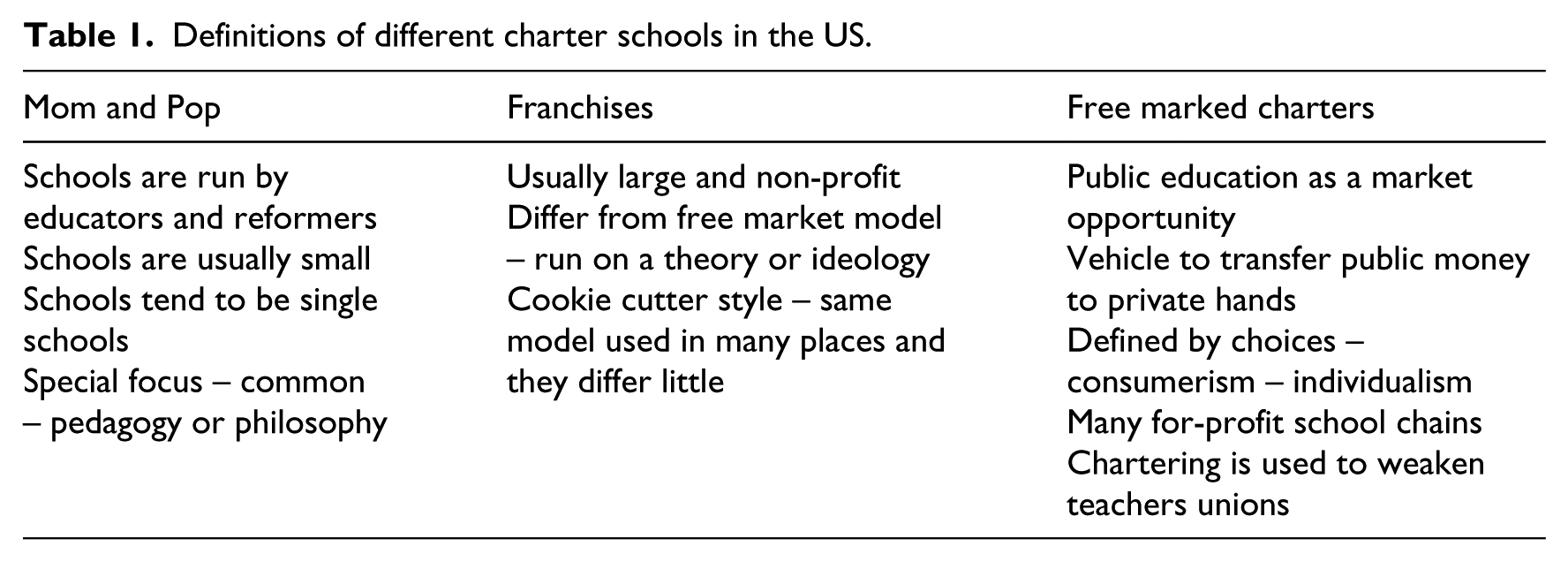
Fabricant and Fine (2012) describe how non-profit charter school organisations can and are making money out of the system. According to them the landscape of the charter schools can be divided into three main categories.
Table 1 uses Fabricant and Fine’s definitions of the three main categories of charter schools, each with their own characteristics. These can be used as an analytical tool to examine the Icelandic charter school system.
Definitions of different charter schools in the US.
Internal privatization
In this section we look at internal privatization and how policies reflect and go hand-in-hand with shifts in the political landscapes. In 1991 a preschool law was passed, whereby preschool enrolment was declared as the right of every child. This was followed in 1994 by the declaration that preschool was the first stage of the Icelandic educational system. At the time, most preschools were run by the municipalities; few were what one could call alternative preschools. No schools were run for profit or as a part of a school chain (Dýrfjörð, 2011). The early development of the Icelandic preschool system was more closely connected to women’s rights and the needs of the labour market than the rights of children to education and public life.
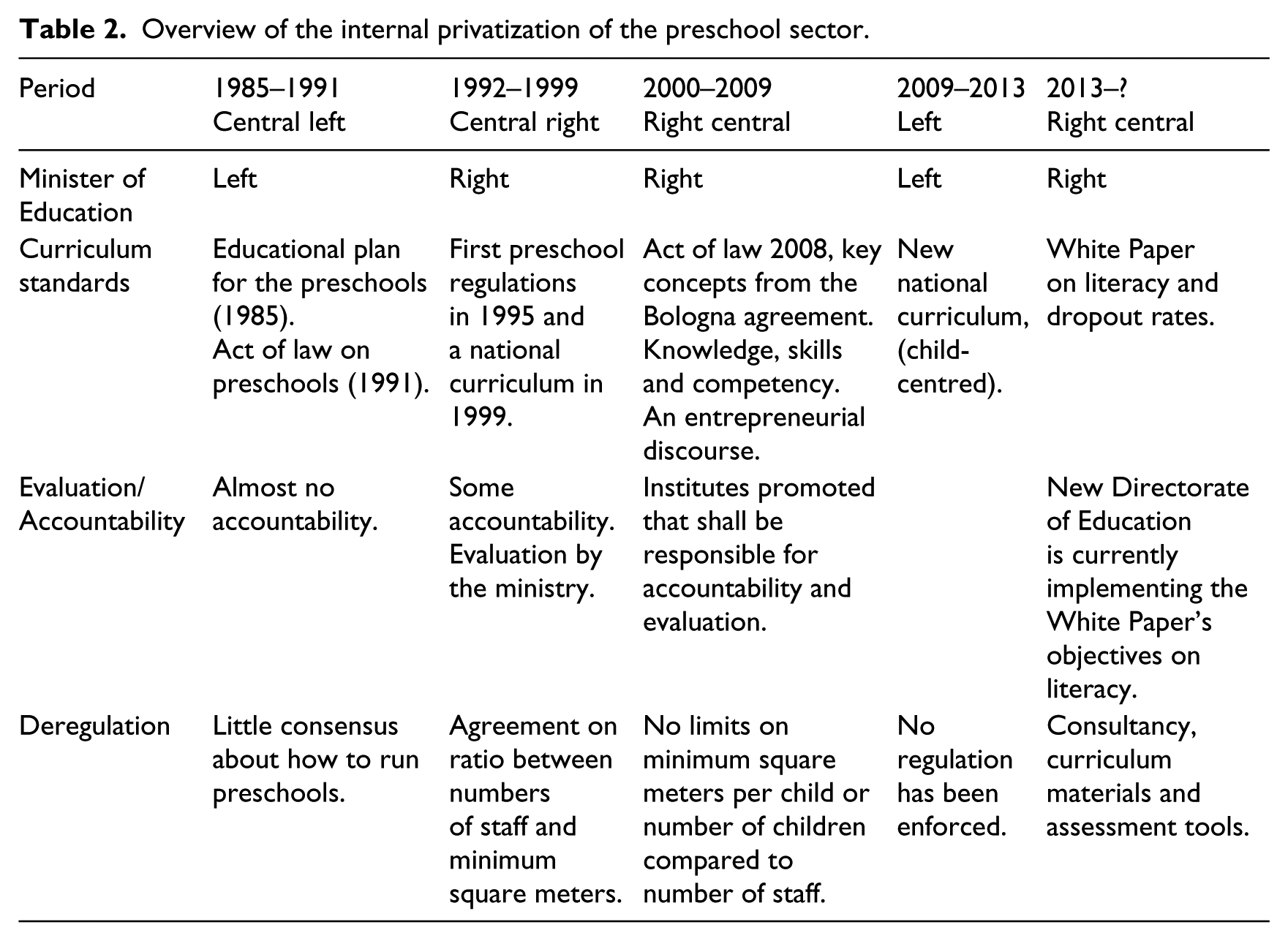
Table 2 is two dimensional. The first dimension is the political flow (shown by the terms and type of government) and the second is how new concepts have found their way into educational discourse. During the first term, a centre-left government got laws on preschool passed after much resistance. This was followed by centre -to-rightwing governments until the financial crash of 2009. The biggest change to the educational system came under the government of the rightwing Minister of Education Þorgerður Katrín Gunnarsdóttir, whose 2008 legislation opened the school system to further privatization. As a result the language of schools became more technical: terms such as accountability, knowledge, skills, competency started to appear and entrepreneurial discourse became dominant. During the global financial crisis (the ‘crash’) that followed a new leftwing government was voted in and was in charge for four years. When a rightwing government was re-established in 2013 it returned to the neoliberal agenda, as can be seen in a number of reports commissioned in the following years.
Overview of the internal privatization of the preschool sector.
Recent policy documents: shifting discourses
New legislation for the whole Icelandic school system was passed by the rightwing government in 2008, emphasizing deregulation and endogenous market approaches. This legislation brought opportunities to write new national curriculums for all schools, from preschools to upper secondary schools. Work on the new curriculum had just started when Iceland was hit very hard by the crash. This led many people to re-assess their own value base and reconsider the market values that had been the main driving force in Icelandic society prior to the crisis. The curriculum, in the making at the time, was dedicated to measurement and goals, with an emphasis on skills, competence and output (Magnúsdóttir, 2013b). The left-wing government, elected in 2009, kept this emphasis that was in accordance to the 2008 legislation. However, this tone was tempered by interweaving six ethical pillars into the National Curriculum Guidelines for all school levels. These pillars were to be democracy and human rights; sustainability; equality; literacy; creativity; and wellbeing and welfare. The intention was that each school should make these the base for their school curriculum (the Icelandic Ministry of Education, 2011).
The current minister has remained silent about these six foundations and changed the focus of education by setting out a new policy document. This white paper (Ministry of Education, 2014) has two main objectives: increasing literacy and lowering dropout rates from 2014 to 2018. 4 The minister has already visited every primary school in the country to discuss these objectives. In his speeches and articles on educational issues the base-line is: Education is the biggest economic issue (i. Menntun er stærsta efnahagsmálið), a reminder that the government’s aim is to change a social and educational relationship into an economic one. It is also clear that, by ordering a new white paper on education, the minister was able to bypass the idea of the six pillars of education with its wider, multimodal definition of literacy. The discourse on literacy has instead moved into the field of measurement and comparison and narrowed the definition of literacy in a neoconservative way (back-to-basics) focusing mainly on the ‘best practice’ of teaching phonics and vocabulary.
The white paper is mostly ‘policy borrowing’ (Lingard, 2010). Its discourse is based on Management by Objectives (MbO) or Management by Results (MbR) in which the objectives of educational policies are set against a background of visions of society’s future (Trippestad, 2011). Lyotard (1984) named this simply performativity as the performances of individual subjects or organizations serve as measures of productivity or output – encapsulating the worth, quality or value of an individual or organization. The logic of accountants and managers is made more powerful over and against the judgments of teachers and social workers (Ball, 2003). Everything rests on databases and annual reviews. Transnational organizations and surveys (especially the Organization for Economic Co-operation and Development (OECD) and the Program for International Student Amendment (PISA) and the national standardized tests for fourth, seventh and tenth grades offer the ‘knowledge base’ for these kind of policy priorities, as is evident in the reference list in the Icelandic white paper.
In 2013 a committee was put together under the umbrella organization, the Association of municipalities in the Reykjavík Metropolitan area. 5 The main goal was to make education a priority for the area from 2012 to 2020, as education is one of the ‘keys to a prosperous society’ (Samtök sveitarfélaga á höfuðborgarsvæðinu, 2014). The report emphasized that the area has to become one of the top performing school systems in Nordic countries (Samtök sveitarfélaga á höfuðborgarsvæðinu, 2014: 2). In a special report on literacy written for the municipality of Reykjavík, the main goals were very similar to those in the white paper. Evidence-based screening tests and external evaluation were supposed to be a regular part of the process. At the preschool level, regular screening tests concentrating on language, pre-reading skills and early intervention were also recommended (Birgisdóttir et al., 2015).
In all these recent policy documents there is a focus on a ‘failing education system’ that needs to be reformed. One way of attacking the public school system is to establish a discourse on failing schools, with the hope that the public will demand that public sector education be replaced by MbO and private education (Howley and Howley, 2015; Johnson and Salle, 2004). In Iceland, this has been an important part of the argument, and data from the PISA survey has been used to show poor performance, lack of competitiveness and low educational quality in the public system (Magnúsdóttir, 2015b). There has also been a lot of jargon on how the school system is favouring girls at the cost of the boys’ performance (Jóhannesson et al., 2009). Often, the fault is supposed to be the ‘rigid’ public system that places the teacher’s rights at the centre, not the children’s, and especially not the boys’. However, the biggest performance gap within the public school system is based on class difference (Jónsson, 2015), and this has been steadily widening in recent years. Drastic changes have occurred in the socio-economic context in Iceland, but the white paper and other recent policy documents overlook these issues. 6
Organizational reform of governance
In order to implement this policy it was crucial to reform the institutional structure of the education policy system by means of deregulation, performativity and privatization. One proposition was to merge two institutions– the National Centre for Educational Evaluation and the National Centre for Educational Materials into one, the New Directorate of Education (91/2015). This could be described as an important step towards social engineering in the education system, i.e. to have central control and an overview of the curriculum, evaluation and consultancy for schools, similar to the situation in Norway. Now, Iceland has one institution that is in charge of national curriculum materials, educational consultancy and the production of national tests and standard evaluation instruments.
The ratification of the new law for the Directorate of Education has shifted the early childhood education sector further towards a corporate education system. The rationale for the Directorate and its concepts are based on the same discourse found in the white paper and recent documents from the municipalities. 7 According to the act of the Directorate of education its practical aim is “…to enhance quality of school practice and contribute to educational progress in accordance to regulations and policies of governance, best knowledge and international benchmarks” (Act of the Directorate of Education, 2015/91). According to the act, the new Directorate has no governing board. Rather, responsibility for its running is solely in the hands of the proposed organization’s director and the minister. As a result the main stakeholders: municipal superintendents (i. fulltrúi fræðslustjóra sveitarfélaga), principals, teachers, parents and curriculum professionals, no longer have formal access to the decision-making process in the field of curriculum materials and evaluation. This arrangement is borrowed from the Norwegian government, who established a similar institution in 2004. The Directorate of Education Act (2015/91) includes a short person specification for the director’s role, but there is no requirement that the applicant has to have experience or qualifications in areas such as teaching, curriculum development or educational evaluation. In the hiring process the ministry required simply that the applicant possessed at least a master’s degree, with managerial and policy development experience and communication, leadership and entrepreneurial skills. Based on such limited requirements in terms of professional educational background and knowledge they were able to hire the head of the Education Department at the Ministry of Education, the man who edited the white paper, bypassing two women candidates with PhDs in Education and long experience in the field of schooling. This type of organizational reform is a good example of de-democratization and the placing of neomanagerial values above professional ones.
As part of the literacy reform every municipality is required to sign a convention with the Ministry of Education that declares that reading will be placed at the forefront of all educational reforms. The Directorate of Education has the job of implementing this policy and has recently hired ten reading specialists to promote methods that they deem appropriate, founded on evidence-based practice and supporting screening and tests. Interestingly almost half of those specialist are preschool teachers – but in the white paper itself the preschools/early childhood period are hardly mentioned, unless with reference to the educational system as a whole.
External privatization
This section is focused on external privatization, in terms of school choice, privatization of welfare provision and funding, outsourcing practices and external evaluation.
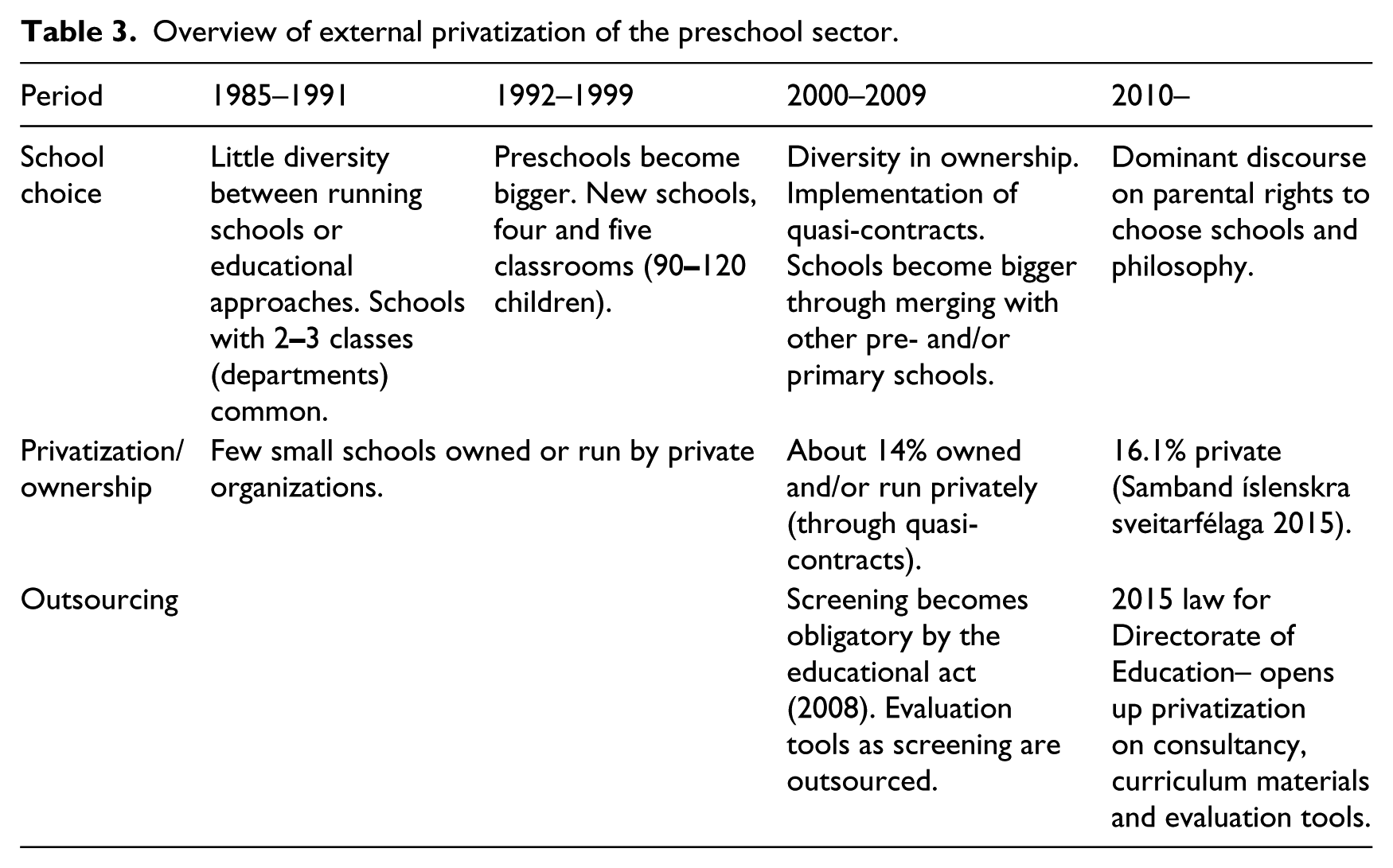
It is clear from Table 3 that there has been a shift in language and action. School choice, competition between schools, as well as diversity in forms of provision have become an inevitable part of discussions about schools and school systems in general. The preschool landscape was rather one-dimensional before 2000: all schools were run by municipalities, with some differences in curriculum or educational philosophy. With the growth of privatization, diversity and different ownership has emerged along with a focus on consumerism and exchange value. All schools, publically and privately run, have to ‘sell’ what they stand for to be compatible and to secure ‘customers’.
Overview of external privatization of the preschool sector.
It is worth mentioning that preschools seem to be growing in size: in 2000 the mean number of children in Icelandic preschools was 57, but by 2014 the mean had risen to 96 (an increase of 68%). This growth is evident both in privatized as well as public sector schools: a preschool run by a Reykjavík municipality had 88 children (Statistics Iceland) before it was privatized in 2003, ten years later there were 135, without any additional space provided in their building. In Reykjavík metropolitan area municipalities’ preschools have become bigger, the main reason being the emergence of between one and three preschools under one name and one principal, mostly as a response to the financial crash of 2008. According to Statistics Iceland (2015) in Reykjavík metropolitan area 12 out of 85 preschools had over 100 children in 2000 but by 2014 the number had gone up to 53 out of 155 or from 14.2% of preschools to 36.8% (see Figure 1).
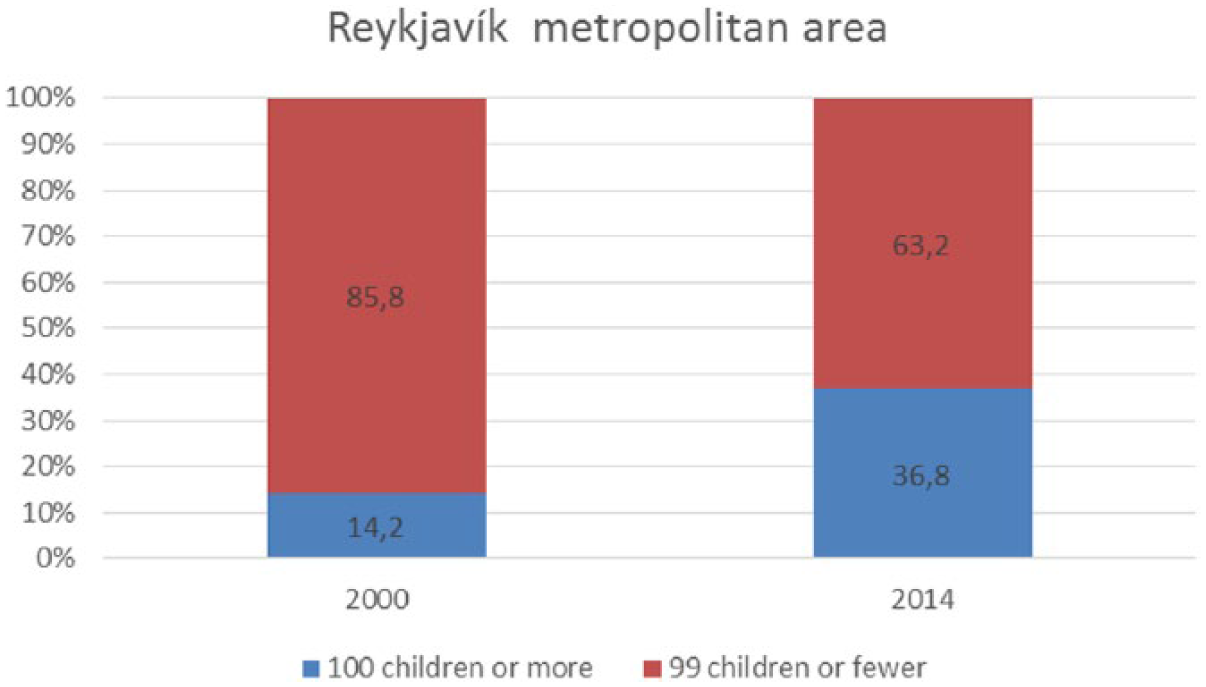
Number of children in each preschool in Reykjavík metropolitan area for the years 2000 and 2014.
The Act (91/2015) establishing the Directorate of Education widens the possibilities for the state to outsource projects in the field of tests, consultancy and curriculum materials. Worldwide, the services that have been created to promote this idea have increasingly been privatized (Ball, 2007). A space has been created for new consultancy firms that focus on the school system, the groundwork laid to establish a stable ‘educational market’.
The Education Act of 2008 encouraged competition between schools, diversity and the establishment of privately run schools, through its ‘money goes with child’ approach (Sigurðardóttir et al., 2014). However, its impact on public school choices within municipalities has only recently been felt, as the compulsory between-school-difference in terms of performance and equity in Iceland has been one of the lowest among the OECD countries (Halldórsson et al., 2010). In recent years residential segregation based on social class and ethnicity has increased, as it has in other Nordic countries (Arnesen et al., 2014; Jónsson, 2015). League tables were recently allowed after one parent accused Reykjavík city of hiding important information about school performance, preventing parents from making an informed choice, and won the case. As a result, there has been intense media discussion recently about the advantages and disadvantages of school rankings which will fuel the school choice agenda for both public and charter schools.
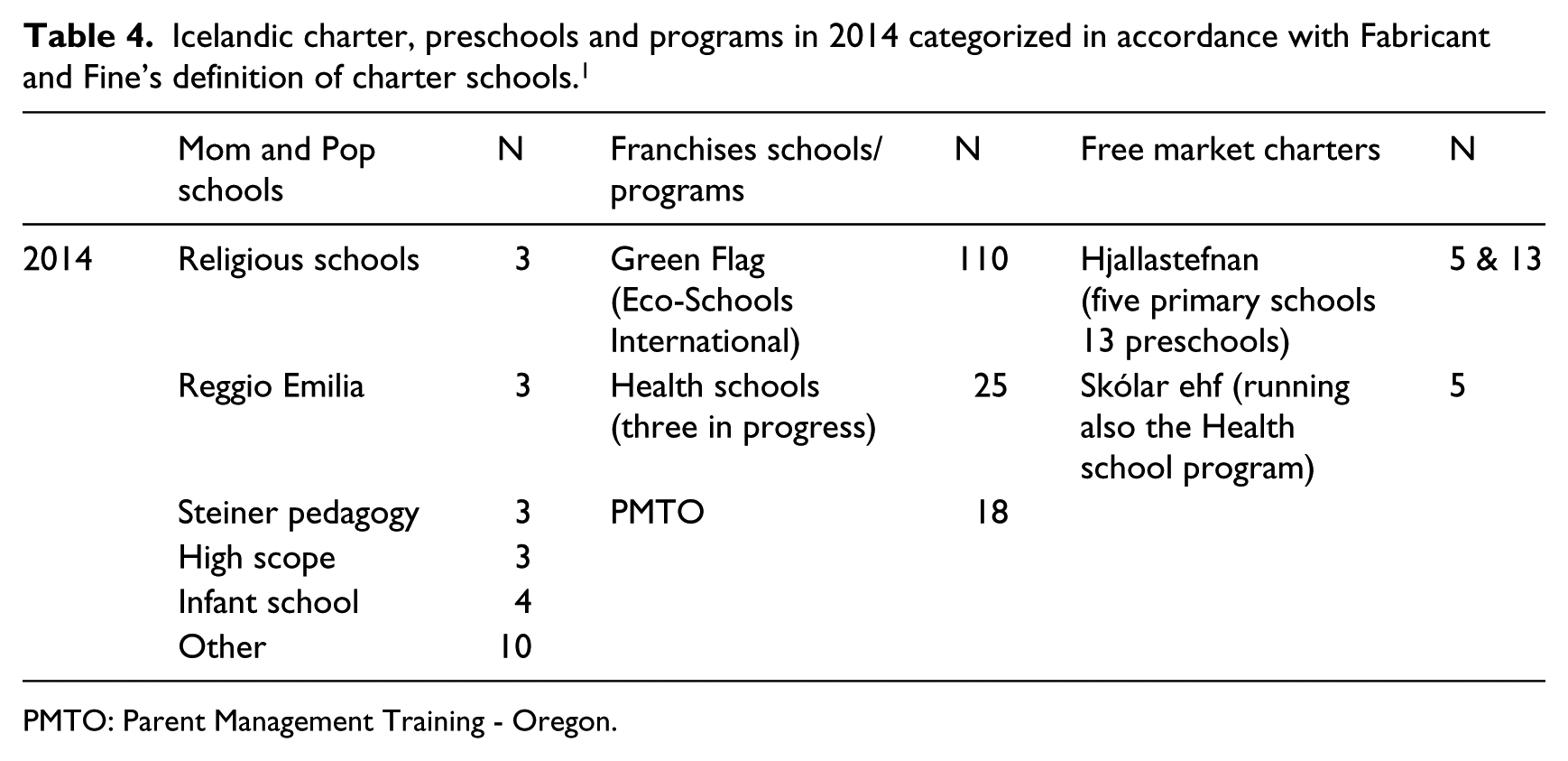
In Table 4 we categorize preschools according to the groups suggested by Fabricant and Fine (2012). All private preschools that could be considered alternative schools or schools that have special pedagogical approaches but are not franchised or part of a school chain are classified as Mom and Pop schools and these are in the first column. Franchised schools that are owned and run by municipalities but buy standardized educational programs such as the Green Flag or belong to the Health school movement 8 appear in the second column. In the third column, we have free market charter schools. In Iceland these are schools that are owned by companies and run on ‘cookie cutter pedagogy’, that is one size fit all.
Icelandic charter, preschools and programs in 2014 categorized in accordance with Fabricant and Fine’s definition of charter schools. 1
PMTO: Parent Management Training - Oregon.
Mom and Pop schools
From the beginning of charter schools in the USA some people have cheered for Mom and Pop schools and others have seen them as a threat to the public school system. Among those that look upon them as an opportunity to make a difference are people that belong to the Mom and Pop school movement. Darder (2015) reminds us that the charter school movement has also given some space to critical pedagogues to establish revolutionary schools, where solidarity and empowerment is embraced. We have chosen to call these schools that are run with certain philosophical or life values, such as Steiner schools. Similar trends can be seen in Table 3. Most of those who run Mom and Pop schools are people who want education based on certain life values. The schools tend to be small and usually not part of a chain.
Franchises schools/programs. Programs that are mostly sold to schools by various educational companies are found in column two. There is more than one way to standardize and mould the pedagogy of a school, for example importing external programs that modify and standardize working methods and learning. These exogenous privatization programs are a way of making schools homogenous and alike. Among programs sold to schools in Iceland are various behavioural programs that may have been originally developed as special educational behavioural programs, but are used to mould all of a school’s pupils. The health school program, PMTO (international program) and even the eco-school – Green Flag – can be categorized in this way. As schools compete for parents, teachers, public attention and acknowledgment, part of the requirement in this new educational market is for schools to establish an identity. This can be achieved by a cookie cutter program from one of the educational companies.
In Table 4 we name only a few of the largest of these programs. It is apparent that this is a growing sector and new companies are arriving on the market. Emerging companies sell speech therapy through Skype, reading consultants, school development, pedagogical programs and aids for teachers and principals as well as diverse behavioural programs. This is what Saltman (2014a) calls an austerity education, and it represents a new culture of control, ranging from: …narrow corporeal imperatives such as feet on the floor, hands on the desk, eyes tracking the teacher, biometric devices, to behaviorist cues, scripted lessons, standardization of space and time, to the modeling of entire schools on the prison and military. (Saltman, 2014a:42)
The trends Saltman describes are becoming well-known in Iceland and suggest the external privatization of the pedagogy as well as of the school system as a whole. Another tactic is to make the schools like every other business. Recently one of the privately-run universities advertised (in co-operation with the teachers’ union) special administrative courses for preschool teachers and principals. What is remarkable about this is that the lectures were given by people with no connection to schools, teaching or education, but with experience of running companies.
Free market charters are scarce in Iceland but they are increasing in number and tend to be bigger on average than Mom and Pop schools, especially free market charters found within bigger municipalities such as Reykjavík, and its metropolitan-area (taken together this area accounts for two-thirds of Iceland’s inhabitants).
To give an idea of how free market charter schools operate in Iceland we are going to present a case study of the biggest school chain and the company behind it. We will also trace the connection between free market charter schools and the concept of McDonaldization.
Hjallastefnan: the biggest charter school chain in Iceland
Hjallastefnan 9 is the biggest school chain in Iceland and runs 17 pre- and primary schools around the country. Hjallastefnan started out as a Mom and Pop school in 2000, but became a market driven chain school in 2001, when it made a deal with the municipality of Garðabær to run its newest preschool. Soon after this (2003) Hjallastefnan opened the first primary school in the same municipality. Garðabær happens to be one of the most affluent municipalities in Iceland. From there Hjallastefna expanded to other municipalities, taking over the running of municipality schools and building their own schools. Over the last few years the company has expanded into smaller communities around the country, where the chain may represent the only school option for parents. The chain views municipalities as fertile ground and at least seven schools that were formerly run by municipalities are now a part of the chain. This is actually in accordance with the growing aim of the Independent-school-movement, which stated in its last annual report that the best chance of increasing the number of private schools lies in taking over school provision in smaller municipalities (Samtök um sjálfstæða skóla, 2015). The main owner of Hjallastefnan also has a big share in a company that sells web solutions to preschools.
Pedagogy and the curriculum
Hjallastefnan’s educational approach has four main components: gender segregation; discipline; a stripped-down school environment (for example, almost completely white walls with little of the children’s art visible); and a strict, streamlined curriculum. Every school (both preschool and primary) follows six categories of main principles. Each category has a set of sub-rules. When describing the pedagogy we will put the number of indicated principle and/or rules in a bracket.
10
At a quick glance these schools look clinical and without history, there are almost no toys or children’s books visible. This is very clearly described in research carried out for Ministry of Education on literacy: In the Hjalli-schools, storytelling is privileged as a method over reading stories for children, Völlur [the name of the preschool] owns therefore very few children’s books and they are kept inside a closed cabinet and the children don’t have free or direct access to books. Every six week the children participate in storytelling at the public library and there the staff checks out books or the staff brings their private books to preschool, occasionally children bring books from home that are read to them. (Ingólfsdóttir and Sigurðardóttir, 2011: 12)
This approach is also found in the use of other materials. As part of the chain’s method children are supposed to use their imaginations and play with each other in an environment that is always the same and isn’t supposed to develop (P. 3.0). We suggest this connects to the idea of efficiency as the optimal method of accomplishing a task. Concepts such as simplicity, transparency and training are emphasized. Nothing hangs on the walls because it is seen as confusing for the children (P. 3.10 and 3.0) – the same is true for toys and art materials. Every day children have ‘circle time’ when they choose what they would like to do. The choices offered are always the same, the number of children who can choose each slot is constant, and so on (P. 3.13 and 3.14). This is part of the streamlined curriculum but also a part of the notion that children will not function in a cluttered or unorganised environment (P 3.0). There are special timeslots in the curriculum when both boys and girls are allowed to do some educational ‘exercises’ under the ‘supervision’ of teachers; otherwise there is total gender segregation. 11 All the schools look more or less the same, with lines on the floors and in cabinets to mark where every item has its place, even the spaces for each child at the table marked, while children and staff are dressed in uniforms with the company’s logo (P. 3.7, 3.12 and 6.8). Efficiency in McDonaldization means that every aspect of the organization is geared toward saving time. In schools that have little or no educational equipment there is no need for tidy up time. A part of the teachers’ job description is to control children’s behaviour and groups (P 6.9 and 6.10), to watch over – supervise. This does not necessarily mean involvement with children. And it may lead to fewer teachers per child being needed.
The language used to describe the curriculum and the role of both environment and teachers used to be dogmatic, a militaristic, authoritarian language not unlike that described by Saltman (2010). For example, main principle number two, concerning members of staff, says: Members of staff are supposed to focus their minds and know what constitutes their business and what does not. That way each and every one shows themselves and their work the respect not to interfere in other people’s business or jobs with attitude, words or actions unless the welfare of a child or the ideology of the Hjallastefnan are threatened in some way. … [P. 2.6] As part of social communications between individual members of staff or the staff as a group, outside the school environment all regulations that Hjallastefnan has put forward concerning responsibilities and respect are to be followed. Professional viewpoints shall always take precedent over personal needs. [P 2.7]
However, it must be pointed out that over the last few years there has been a move towards more positive ways of written communication from Hjallastefnan, and their new website is partly written in a style that differs from the older website and handbooks. The above quote is, nonetheless, taken from the six main principles that form the core of the new website. 12
According to the theory of McDonaldization, control and predictability are significant concepts. Standardized and uniformed services are key to standardized and uniform employees. For example, all Hjallastefnan schools are run with the same curriculum, everything is highly standardized within the chain. The placement of furniture in the rooms, how many crayons are supposed to be in a cradle, the colours of the sand buckets and spades, the children’s and staff uniforms. The daily schedule is the same in all the schools; each moves through the same phase of the curriculum in alignment. The curriculum cannot change without authorization from the founder and the main owner. As with Nike, Starbucks or Campbell’s, you are supposed to know what you are getting for your money, for your child.
Turning non-profit to profit
Understanding how the company is financed is the basis for understanding the power and growth of Hjallastefnan. The model that Icelandic society is built upon and identifies with is the Nordic social welfare model. For example, the Icelandic pre- and primary school system, both public and private, is financed through tax revenues from the municipality and the state. At the preschool level parents pay a low monthly contribution that may cover the cost of food. The mean cost covered for municipalities is 82% (Samband íslenkskra sveitarfélaga, 2015).
The main difference between publicly run preschools and the Hjallastefnan private chain is that the Hjalli schools are supposed to return profit to the company. In a newspaper interview, the main owner of Hjallastefnan states that the schools are supposed to be profitable but that the profit may not be used for the owners’ personal finance, but shall be used for school development projects as the company is a non-profit (Tómasdóttir, 2011). That is all well and good, remarkable even, given the official profit levels regularly stated in the media (for example in Viðskiptablaðið, 2015). The key question, however, is what constitutes school development? According to the owner school development is building new schools [houses], which is a rather different definition from the one used in educational literature on school development. A part of the model is that the ‘profit’ from the schools is lent to a holding company, with no return, and the payback of the loans is through renting the buildings to the mother chain for a marketing prize that tends to by quiet high (Hjallastefnan, 2011). Those holding companies on the other hand may be for-profit so in the long run the profit from owning and renting the buildings goes to the owner of the holding company. This prompts the question: is this really a non-profit company?
Discussion and conclusion
In recent years Iceland has experienced political instability, with a range of different laws, regulations and policy papers produced. The most drastic changes in terms of neoliberal trends came with the Education Act in 2008 and the recent policy papers published after 2013. As a result, Iceland has distanced itself from the Nordic welfare model. These changes have been led by actors using similar strategies and discourse to those found in the other Nordic countries. Most of the recent Icelandic documents are based on other sources (Lingard, 2010). These changes have been multi-layered; external, internal, hidden and obvious. In this paper, we have focused mainly on early childhood education, to explore the main changes that have happened there and the effect those changes have had on the early childhood sector.
It is our conclusion that the Icelandic preschool system has been reshaped over the last 10 to 15 years, and moved from being a financially homogenous system in terms of provision and funding towards a market-driven system. This has entailed: (a) more standardization in terms of objectives and output but concurrently a deregulation of the private sector so as to be able to choose customers and fuel school choice; (b) an intensified neomanagerialism evident in the increased size of the preschools; (for example, in 2000 the biggest preschool had 128 children but by 2014 the biggest preschool had 211 children); (c) opening up provision to the private sector to run schools and programs paid for by taxation. The growth of behavioural cookie-cutter-programs sold to schools is an indication of pedagogical standardization and the rise of the SEN-industry in Iceland (Tomlinson, 2012). Lastly, it has entailed (d) corporatism in the preschool sector when looking at the emergence of school chains and all kind of programs that shape daily life within schools.
Internal privatization has played a big role in reshaping the system, accountability in the form of evaluation projects, screenings and tests are the reality in most preschools. One can ask what the role of the new Directorate of Education will be in, for example, shaping curriculum guidance and material, evaluation tools and pedagogy in the preschools. The white paper and the policy papers from the municipalities focussing on literacy are also open to question. These are going to shape the pedagogy of preschools as well as parents’ views.
We can ask, as Dahlberg and Moss (2005: 2) have done, for preschools that can be sites for ethical and political practice: That these institutions can be places where the Other is not made into the Same, but which open up instead for diversity, difference and otherness, for new possibilities and potentialities. That they can be places where children and adults are governed less…through being able to confront dominant discourses that claim to transmit a true body of knowledge, and that seek to manipulate our bodies, mould our subjectivities and govern our souls. That they can be places, too for confronting injustice, in particular, structural domination and oppression.
There is a real possibility that with the arrival of the official publication of primary school league tables, the same will happen to preschools, with all those screenings, parent will be given tools to select preschools in terms of narrow ideas of education and school performance.
Slater and Griggs (2015) have pointed out the importance of changing language, using positive and democratic concepts such as choice and freedom to attain success and change mindsets. This can been seen in the case of Iceland: it is extraordinary to see how, for example, Hjallastefnan has transformed its language to a milder version of what it used to be, partly in response to the criticism it has received. Military and technical language used to dominate and it can still be found in their documents, but it has given way to a more positive language based on happiness, joy and peace. As we have pointed out above, it is important for the survival of neoliberal ideas that they come in a customer friendly package.
Struges says that neoliberalism in the USA has resulted in a shift whereby ‘collective good is replaced with the collection of goods’ (2015: 1). The Nordic welfare system is based on the principle of both equal and just distribution of common goods as well as the right of each citizen to have her/his fundamental needs fulfilled. However, in Iceland changes are on the horizon, we are leaning toward similar changes to those much debated and contested by many in the education sector, worldwide. In Iceland it can be argued that neoliberal changes have been implemented without much criticism at the political level, due to the fact that external marketization is mostly in the form of a quasi-market. The majority of Icelanders disagree with profitmaking in the welfare sector. We agree with Lundahl et al. (2013) that the quasi-market system fuels and legitimizes marketization as part of the welfare system.
Footnotes
Funding
This research received no specific grant from any funding agency in the public, commercial, or not-for-profit sectors.