



Abstract
The COVID-19 pandemic brought an education crisis that forced schools to abruptly shift to online distance learning. Regardless of the challenges in this migration, the teaching–learning process should continue. Self-regulated learning skills are essential in learning in an online environment; hence, the study aims to explore learners’ perception in an online learning environment, self-regulated learning skills, and academic achievement during a research methods course. Perception on the online learning environment, self-regulated learning skills, and academic achievement were collected periodically throughout the online course. The analysis included repeated measures of ANOVA to examine the trends between periods of measurement. A linear regression analysis was used to determine the impact of perception on the online learning environment to self-regulated learning. Results of repeated measures of ANOVA suggest a subtle decrease in the perception of the online learning environment at the start of the course. Still, ratings consistently increased viewing online distance learning the same with pre-quarantine set-up. On the other hand, self-regulated learning remained virtually the same throughout the implementation of research methods online course. A rise in the learning playlist scores has been observed at the start of the research methods course, but scores began to decline at the latter phases of the course. Results of regression analysis imply the influence of perception on the online learning environment on self-regulated learning skills. However, perception does not affect learners’ academic achievement. The study recommends using strategies to further develop perseverance in adjusting to online learning amid initial setbacks. Also, interventions specific to improving learners’ self-regulated learning skills are highly recommended.
Keywords
Introduction
The COVID-19 pandemic forced most governments to temporarily close educational institutions in an attempt to contain its spread. Several countries have implemented localized closures impacting millions of learners. These nation-wide closures have negatively affected over 89% of the world’s learner population (UNESCO, 2020). The loss of contact hours due to lockdowns resulted in adverse effects in the education sector (Reimers and Schleicher, 2020; Van Lancker and Parolin, 2020). Further postponement of schooling can negatively affect learners’ academic achievement (Sintema, 2020; Van Lancker and Parolin, 2020). Presented by the consequences of prolonged delays in schooling, educational institutions across the world are tasked to implement alternative interventions to continue the teaching–learning process amidst school closures. Hence, faculty are required to prepare lessons to deliver online teaching to their learners. Although online teaching is not a new mode of delivery in schools, there is always a chance that some teachers who are not techno-savvy will not be able to cope up with this mode (Sahu, 2020). Prior to the pandemic, several studies already reported adversities teachers face in creating and implementing online courses (Cottle and Glover, 2011; Donnelly, 2006; Graham, 2006; Jokinen and Mikkonen, 2013; Tarus et al., 2015). The most recent administration of Programme for International Student Assessment (PISA) in 2018 is evidence of this looming adversity. Results showed that most participating education systems are not ready to offer most students opportunities to learn online (Reimers and Schleicher, 2020). Due to the general unreadiness of school systems and teachers, the unprecedented massive “migration” from traditional in-class, face-to-face education to online education poses a struggle to the educational sector (Bao, 2020; Crawford et al., 2020).
Despite expected challenges educational institutions will face in implementing full online learning, literature reported features of online learning that prove its applicability in the educational set-up during a pandemic. Online learning promises to create transformative learning without prompting from teachers (Manning-Ouellette and Black, 2017), a situation that would be normal during the pandemic. Interestingly, about 92% of the studies found that online education is as effective, if not better, than traditional education (Nguyen, 2015). Also, studies reported that the majority of learners perceived their respective online courses positively (Kinsell and Tung, 2010; Rodriguez and Armellini, 2013; Walters et al., 2017). Although online learning during the COVID-19 pandemic is still an emerging topic of discussion in educational research, there is already literature that presented the feasibility of online learning through reports of actual interventions. A study applied a desktop analysis approach to explore the initial wave of responses universities worldwide to formulate a synopsis on how the world’s educational system dealt with the pandemic. Analysis showed that both developed and developing countries closed physical campuses, but developed countries achieved continuity of higher education through online instruction, a feat, unfortunately, is not that prevalent in developing countries (Crawford et al., 2020). China implemented its national educational emergency management policy, “Suspending Classes without Stopping Learning,” where they used an experimental large-scale online education program to continue schooling (Zhang et al., 2020). Chick et al. (2020) reported their implementation of several online-based interventions, including flipped classroom model, online practice questions, and teleconferencing in place of in-person lectures, involving residents in telemedicine clinics, procedural simulation, and facilitated use of surgical videos to mitigate the loss of face-to-face education for surgical residents while maintaining safety protocols for COVID-19 pandemic. The Emory University School of Medicine implemented online learning to continue its educational functions amidst its extended clinical functions due to the pandemic (Schwartz et al., 2020). Based on current literature regarding continuity of education during the COVID-19 pandemic, online learning is predominant.
Online learning probably is a suitable approach for the pandemic, and it is important to recognize that the quality of online materials is only as effective as the users’ self-regulated learning strategies (Voils et al., 2019), hence, emphasizing the significance of developing such strategies. Prior research has found that self-regulated learning and learners’ online learning outcomes showed positive relationships (Im and Kang, 2019). Given a learning environment characterized by minimal teacher prompting, learners need to effectively monitor their learning behaviors regarding goal setting, environment structuring, task strategies, time management, and help-seeking. By establishing self-regulated learning processes, learners could maximize their use of online materials (Chen and Su, 2019). The extent of engagement in self-regulated strategies was associated with higher academic achievement, supporting the point that the way a learner approaches the learning process impacts performance (Broadbent and Fuller-Tyszkiewicz, 2018). The urgent transition to full online learning due to the current educational crises brought by COVID-19 necessitates the use of self-regulation in an online learning environment. With this context, this study aims to explore the learners’ perception on the online environment, their self-regulated learning skills, and their academic achievement in a full online learning course during the COVID-19 pandemic.
The researchers believe that similar to other countries, educational institutions in the Philippines also experienced difficulties during the COVID-19 pandemic. Hence, research regarding perception on online learning environment and self-regulated learning skills in context with Filipino students during the pandemic is timely and necessary. This study was conducted in a certain private Catholic school in the Philippines. The participating school’s educational policy highly encourages the use of technology-supported learning environment years prior to the pandemic. Hence, the school enacts the Next Generation Blended Learning (NxGBL) program where it requires its faculty to use blended learning modalities. Online learning is being used in the school to complement face-to-face approaches and not as an independent teaching approach. However, academic year 2020–2021 forced the school to deviate from using its primary approach, blended learning, to a full online learning approach. The school launched the Online Distance Learning (ODL) program in response to the COVID-19 pandemic. It is new for the school to implement a completely online learning program disassociated with more traditional methods. Although the school is already known for using technology in the teaching–learning process, the situation during the time the study was conducted is still a good case to explore how Filipino schools transition from physical to online learning environment.
Education during the COVID-19 pandemic
Existing literature studies on education during the COVID-19 pandemic either offers guidelines in carrying out teaching–learning processes in a complete online environment, while other studies report experiences and insights in actual execution of online learning on their respective institutions. The first set of literature studies provides guidelines in implementing online education during the pandemic. A presented case in Peking University shared instructional strategies to ensure the effectiveness of online education in the time of the pandemic. Bao (2020) recommends that faculty should prepare contingency plans for the unexpected problem, divide the teaching content into shorter modules, speak in an appropriate volume and pace, solicit online support from teaching assistance, promote active learning outside of class, and effectively combine online synchronous and asynchronous sessions. Moreover, Bao concluded with five high-impact principles for online education: (i) high relevance between online instructional design and student learning; (ii) effective delivery on online instructional information; (iii) adequate support provided by faculty and teaching assistants to students; (iv) high-quality participation to improve the breadth and depth of student’s learning; and (v) contingency plan to deal with unexpected incidents of online education platforms.
Similar to the latter literature, the handbook on facilitating flexible learning during educational disruption describes strategies implemented during the COVID-19 outbreak in China. The handbook identified seven core elements of online education in emergencies: (i) ensure reliable network infrastructure, which can handle millions of users simultaneously; (ii) use friendly learning tools to avoid information overload; (iii) provide interactive suitable digital learning resources; (iv) share learners effective methods for individual and group learning; (v) adopt a variety of teaching strategies to promote effective instruction; (vi) provide instant support services for teachers and learners; and (vii) empower collaboration between governments, enterprises, and schools (Huang et al., 2020).
Likewise, Daniel (2020) also offered pragmatic guidelines on managing the educational consequences of the pandemic. Institutions had limited time to prepare for the sudden school closures. Where possible, preparation could have included picking-up of materials needed for home study (e.g., books and worksheets), finalizing year-end requirements (e.g., test results and reports), and staff preparation and training. He also added that an emergency school closure is not the time to implement complex pedagogy and technology, instead utilize what is familiar and available. He stresses the suitability of asynchronous learning. In addition, the curriculum should consider both standards and interests, and course construction should start with an assessment.
The second set of literature discusses reports on interventions implemented to curb the impact of COVID-19 on the education sector. A study explores the initial wave of responses from universities worldwide in order to make a collective synopsis on how the world’s educational system dealt with the pandemic. The study applied a desktop analysis approach with a meticulous screening of information sources. To assure holistic review, rough equality of countries across the World Health Organization’s six regions was considered. The analysis divided countries into developed and developing economies. The analysis shows that almost all of the developed economies closed their campuses and shifted to online instruction. While most of the developing economies also closed their campuses, only selected countries holistically shifted to online instruction. The study also shows that most countries that are closer to China or with a larger ratio of COVD-19 cases developed a digital strategy for higher education across the nation. Furthermore, analysis of higher education institutions within countries highlighted that the tendency of institutions to implement online instruction is largely based on the availability of resources needed for implementation. This was more observable in developing economies (Crawford et al., 2020).
Carrying on with interventions, Zhang et al. (2020) discussed the implementation of China’s national educational emergency management policy “Suspending Classes without Stopping Learning.” China’s management of the crises is mainly led and coordinated by the government, where schools, enterprises, and the general public widely participated. The government had extensive effort to come up with contingency plans in implementing the policy, but the problem of the information gap persists. Despite the encouragement for schools to locally contextualize educational policies, problems remain to be present due to several constraints. Planning for educational activities proves to be difficult due to the unpredictable duration of the pandemic. “Suspending Classes without Stopping Learning” may be a large-scale online education, the policy remains to be experimental. Hence, the authors suggested improvements in the policy. The government needs to further promote the construction of the educational information superhighway, consider equipping teachers and students with online learning equipment, conduct online teacher training, include the development of massive online education in the national strategic plan, and support academic research into online education.
Crawford et al. (2020) and Zhang et al. (2020) presented nation-wide educational interventions for COVID-19, the next set of literature will discuss school-wide strategies. Chick et al. (2020) presented innovative solutions for mitigating the loss of in-person academic and operative education for surgical residents while maintaining the safety of residents, educators, and patients. Their study proposed several interventions including a flipped classroom model, online practice questions, teleconferencing in place of in-person lectures, involving residents in telemedicine clinics, procedural simulation, and facilitated use of surgical videos. They encouraged cooperation between institutions and urged that the physical and mental safety of learners should be a priority.
Emory University School of Medicine reported in a study the strategies the institution devised to continue its educational functions amidst its extended clinical functions due to the pandemic. Schwartz et al. (2020) presented the following approach that needed to addend to match the institutional situations or needs. First is holding daily one-and-a-half-hour collaborative, teacher-led interactive learning sessions on a predetermined and scheduled topic. These are conducted online so that social distancing could be maintained. Second, providing online sessions with interactive, question-based learning to retain the engagement of learners. This can be accomplished with the traditional Socratic method style teaching or with an interactive multimedia platform. Third, implementing self-regulated learning that uses an online orthopedic curriculum system, where learners are assigned questions to complete each week.
Lastly, Basilaia and Kvavadze (2020) reported the case of a private school’s transformation from traditional to online approaches. The school created a structured virtual environment where the teachers can enter the classroom at their designated timetable. The teachers intensively used desktop screen sharing for presenting materials. In the online set-up, the duration of classes was shortened and the number of lessons decreased. The study declared success on the school’s first-week implementation of online education. The attendance of online classes reached more than 90%, suggesting the accessibility of their online education. Furthermore, a low percent of the teachers experienced technical issues, where problems were connected to the personal computer configuration or misusage of the functions.
Existing literature on online education for the COVID-19 pandemic aimed to provide counsel on how to implement amidst the adversities. Included literature shared either best practices for online learning or experiences from actual intervention. However, since the phenomenon of education during the pandemic is still emerging, there has been a dearth of empirical data on the effectiveness of online learning. Studies on the effectiveness of distinct educational interventions for the pandemic are highly encouraged by the reviewed literature.
Online learning environment
An online classroom is a space where quantities of learning content and tools are located (Manning-Ouellette and Black, 2017). Providing learning materials in online classrooms alone is usually not enough to foster learning (Rodriguez and Armellini, 2013). An online classroom becomes an online learning environment when the said space promotes personalized learning through interactions between teachers, learners, content, and tools (Brown et al., 2015). According to Rodriguez and Armellini (2013), there are three types of interactions that are crucial in making an online classroom a learning environment: learner–content interaction where learners engage with the learning content and tools provided in online classrooms; learner–learner interaction where learners are given opportunities to work and share ideas with their peers; and learner–teacher interaction where learners communicate with instructors who are regarded as experts in the subject they teach. In a completely online environment, instruction could be delivered through self-paced activities or live event sessions (Calamlam, 2020). Self-paced activities, commonly known as asynchronous instruction, refer to instructions that learners experience individually. On the other hand, live event sessions, also known as synchronous instruction, refer to teacher-led instructions where all learners participate at the same time.
Existing literature offers different components of an online learning environment. The Next Generation Blended Learning (NxGBL) framework suggests five components of an online learning environment: (1) Interoperability and Integration, the capacity to incorporate devices, exchange content, and learning data; (2) Personalization, the feature that allows learners to design of their learning environment; (3) Analytics, Advising, and Learning Assessment, the ability to gather and analyze learning data for self-assessment, self-improvement, and self-progress; (4) Collaboration, the attribute that promotes cooperation in creating distinctive pathways to achieve learning goals; (5) Accessibility and Universal Design, the utility that no longer demands for adaptation or specialized design (Magalong and Prudente, 2020). Another structure that could provide online learning components is the Technological Pedagogical Content Knowledge (TPACK) framework. TPACK conceptualizes the teacher knowledge required for effective technology integration by describing the relationships and complexities between technology, pedagogy, and content (Mishra and Koehler, 2006). Seven components are considered in the TPACK framework: (1) Technology knowledge that refers to the knowledge about various educational technologies; (2) content knowledge that refers to the knowledge about the actual subject matter taught; (3) pedagogical knowledge that refers to the methods and process of teaching; (4) pedagogical content knowledge that refers to content knowledge about the teaching process; (5) technological content knowledge that refers to the knowledge of using technology in representing specific content; (6) technological pedagogical knowledge that refers to the knowledge of using technology in implementing teaching process; and (7) technological pedagogical content knowledge that refers to the knowledge of integrating technology into teaching of any content area. Ng (2000) presented factors to consider in identifying the cost-effectiveness in implementing online courses: (1) Implementation of the online course (as an enhancement or primary teaching medium); (2) support to students in terms of access to computer facilities and internet; (3) payment and involvement of tutors in online courses; and (4) implementation of the project on a large scale.
Self-regulated learning
Self-regulation has been identified as a variable in this study. Schunk and Zimmerman (1998) explain that self-regulated learning (SRL) mostly transpires from learner’s self-generated thoughts, feelings, strategies, and behaviors in order to achieve the goals. Hence, promoting self-regulation is basically the process of developing agency over the learning process and will result to a learner’s ability to learn how to learn (Taranto and Buchanan, 2020). SRL has three cyclical phases (see Figure 1) namely forethought, performance, and self-reflection (Schunk and Zimmerman, 1998). In the forethought phase, learners exhibit their strategies in commencing on their learning tasks. This phase also shows how learners motivate themselves before engaging to actual teaching–learning processes (Taranto and Buchanan, 2020). The forethought phase could be further divided to five subprocesses: goal setting, strategic planning, self-efficacy beliefs, goal orientation, and intrinsic interest (Schunk and Zimmerman, 1998). The second phase of SRL is the performance phase which refers to learner efforts in promoting concentration and performance during the actual learning process. This phase includes the subprocesses of attention focusing, self-instruction, and self-monitoring (Schunk and Zimmerman, 1998). Self-reflection is the last phase of SRL. It occurs upon the completion of the learning tasks where learners’ ability to self-evaluate their performance is exhibited (Taranto and Buchanan, 2020). The phase involves four subprocesses namely self-evaluation, attributions, self-reactions, and adaptivity (Schunk and Zimmerman, 1998). Phases of self-regulated learning.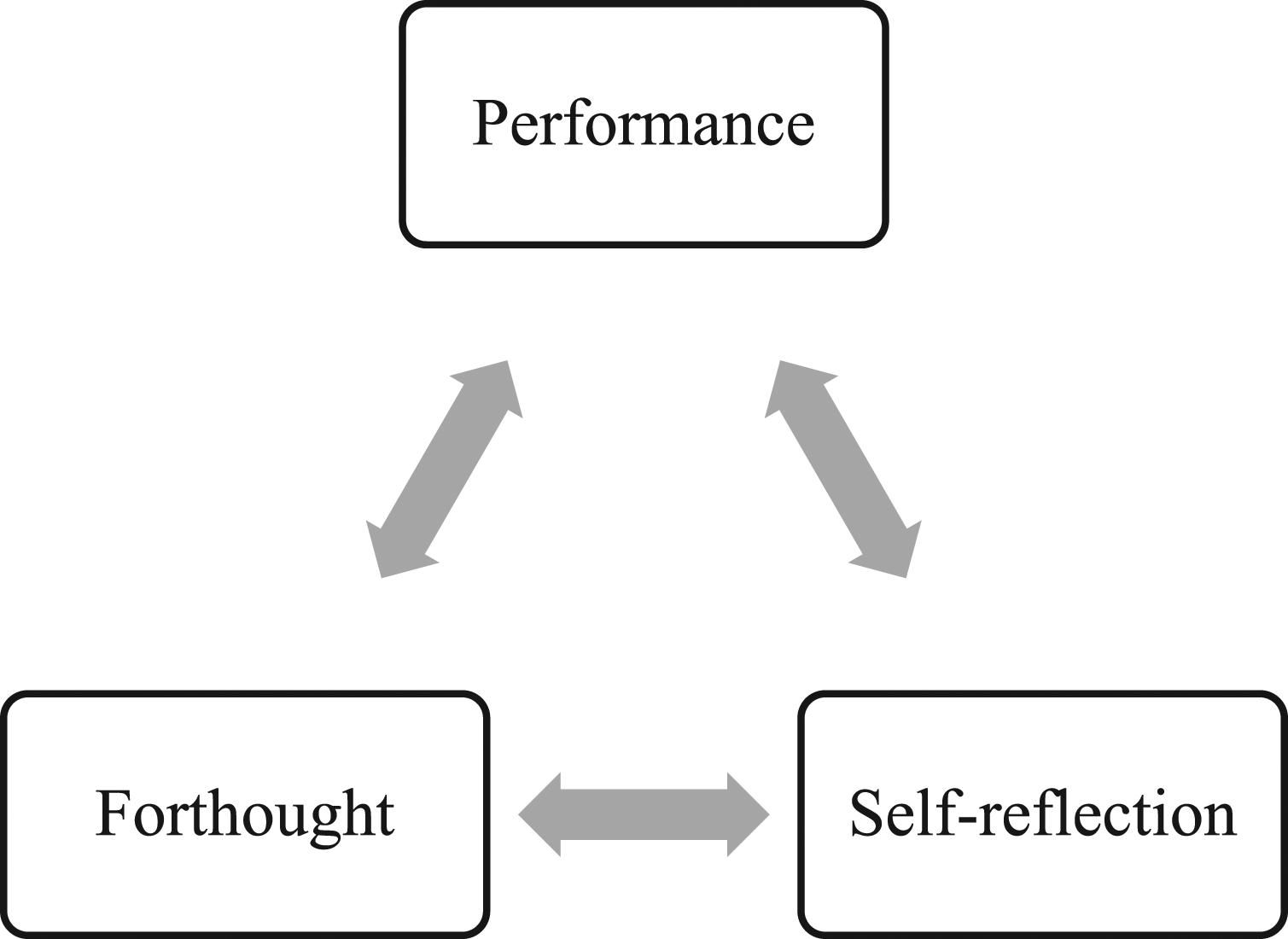
Although cyclical phases of SRL are uniform in several educational researches, specific strategies in promoting self-regulation are varied. SRL strategies, different from cyclical phases, refer to learners’ self-initiated actions that involve both goal setting and regulation of their efforts in reaching their learning goals (Chen and Su, 2019). To differentiate, if specific self-regulation strategies are effectively implemented to each phase of SRL, self-regulated learning occurs. Studies on SRL may have different way of categorizing self-regulation strategies; they are still expected to be implemented either in the forethought, performance, or self-reflection phases of learning. Araka et al. (2020) categorized SRL approaches into two: the first category involves approaches that enable data-driven and personalized learner support, while the second category includes approaches that gather metacognitive feedback through learner reflection. The following categorization is more focused on strategies teachers could implement to promote SRL. Different from the latter categorization, Yeh et al. (2019) categorized SRL strategies for learners. These strategies are categorized into five, namely (i) metacognitive skills which refers to self-evaluation of one’s learning practices; (ii) time management which involves self-management of one’s time as means increasing productivity; (iii) environmental structuring which refers to the ability to arrange one’s physical setting to reduce disturbances; (iv) help-seeking refers to the recognition of a solution through searching for academic support; and (v) persistence which refers to continuous effort despite challenges. Corollary to the aforementioned categories, Broadbent and Fuller-Tyszkiewicz (2018) categorize self-regulation strategies into three: first, cognitive strategies which refer to techniques that enable learners to remember new material by fusing new and existing information; second, metacognitive strategies which refer to the awareness to set learning goals and monitor attainment of such goals to achieve self-regulation; and third, resource management strategies which refer to the use of available resources and help to confront academic challenges. Magno (2010, 2011a, 2011b), in his endeavor to develop the Academic Self-Regulated Learning Scale (A-SRL-S), categorized specific learner strategies into factors using Factor Analysis. An SRL model was confirmed where it involves seven factors: memory strategy, goal setting, self-evaluation, seeking assistance, environmental structuring, learning responsibility, and planning and organizing.
Framework of the study
The study adopts the Next Generation Digital Learning Environment (NGDLE) as the contextual definition for an online learning environment. Hence, an online environment is defined as a space that involves teachers, learners, content, and tools where personalized learning opportunities are promoted (Brown et al., 2015). Moreover, self-regulated learning is defined as the process of developing autonomy over a learners’ learning process (Taranto and Buchanan, 2020). Self-regulated learning “strategies,” on the one hand, refer to learners’ self-initiated actions that involve both goal setting and regulation of their efforts in reaching their learning goals (Chen and Su, 2019). The study is anchored to the assumption that learners’ perception and compliance with the online learning environment are associated with the development of self-regulated learning strategies. The online environment may influence the way learners learn as they must adapt to their forced or chosen study mode (Broadbent and Fuller-Tyszkiewicz, 2018). According to Araka et al. (2020), an enhanced online learning environment has the potential to provide measurement and interventions that could be significant in developing self-regulated learning skills. Learners’ self-efficacy and task value on learning in an online environment are perceived to be essential in promoting self-regulated learning strategies (Lee et al., 2020). Broadbent and Fuller-Tyszkiewicz (2018) reported that persistent online learners are more likely to be superior self-regulators characterized by strongest time management, effort regulation, level of organization, and grade goals levels relative to other groups. Likewise, Chen and Su (2019) presented that their online learning system better support learners’ self-regulated learning, self-efficacy, and academic achievement in the course. On the other hand, developing self-regulated learning strategies may contribute to maximizing the effectiveness of online learning (Yeh et al., 2019). Learners’ achievement goal orientation, self-regulation, test-anxiety, and self-efficacy had positive effects on outcomes in their online course (Im and Kang, 2019). Chen and Su (2019) found that learners’ online e-book reading behaviors such as bookmarking, highlighting, note-taking, and page-turning were correlated to their academic achievement in this course. Consistently, Calamlam (2016) reported that the effectiveness of flipped classroom is significantly larger to high performing students compared to moderate to low performing students. He argued that this result is explained by the self-regulated learning skill required to accomplish online components of a flipped environment, where high performing students are more skillful. In this study, the quality of an online learning environment is based on the Next Generation Blended Learning (NxGBL) framework where five components were considered: Interoperability and Integration; Personalization; Analytics, Advising, and Learning Assessment; Collaboration; and Accessibility and Universal Design (Magalong and Prudente, 2020). On the other hand, self-regulated learning is divided into seven factors: memory strategy, goal setting, self-evaluation, seeking assistance, environmental structuring, learning responsibility, and planning and organizing (Magno, 2010, 2011a, 2011b).
Methods
The study used an interrupted time-series design where levels of a time series before and after the introduction of a discrete intervention, the research methods online learning course, are compared (McDowall & McCleary, 2014). The suitability of the design is largely attributed to the strength of the causal interferences it offers. The method included repeated collection of learner’s ratings of their online environment, appraisals of their own self-regulated learning skills, and scores to their learning playlists. The periodic changes on the aforementioned measures during the research methods course are analyzed to explore how the shift to a full online learning set-up affects online environment perception, self-regulation, and academic achievement, respectively. In addition to analyses of periodic changes, regression analyses were also performed to investigate the influence of positive perception on online environment to self-regulation and academic achievement. Regression analyses aim to provide additional inferences on the effect of an online course, specifically learners’ perception toward it, to the development of self-regulated learning skills and improvement of academic performance. The study implemented the research methods to answer these two research questions: Are there significant changes on learners’ perception of online learning environment, self-regulated learning skills, and academic achievement during the research methods online course? Is learners’ perception of their online learning environment during the research methods online course a significant predictor to their self-regulated learning skills and academic achievement?
Setting and participants
The study took place in a certain Catholic school in the Philippines during the first term of the academic year 2020–2021 (July 2020 to August 2020). The courses were completely taught through online mode to avoid the dangers of the pandemic. The school has been implementing blended learning prior to the pandemic; however, it is the first time for the school to implement a full online distance learning for a whole term. Participants of the study included grade 12 learners of the participating school. The level included three sections of science, technology, engineering, and mathematics (STEM), three sections of accounting, business, and management (ABM), and one section of humanities and social science (HUMSS). The sample group has a total number of 174 students, where 42% belonged to STEM, 46% belonged to ABM, and 21% belonged to HUMSS. Participants’ ages range from 16 to 17. As participants are considered minors, their parents/guardians gave consent for their child/wards’ participation through signing the school’s data privacy policy form. The data privacy policy form allows the school and its faculty to ethically collect learner data for improvement of educational practices, which includes research purposes.
Research methods online course
The research method online course is created for Practical Research 2 subject. Specifically, the online course exclusively covers quantitative data analysis. The online course is the collective effort of the research proponents. Development began with an orientation on learning playlist format and assignment of tasks. The learning playlists include content (teacher-made video or online handout) and activities in which the preparation took 3 weeks to complete. An orientation on implementing the online course was conducted before term one started. Due to school closures and modified senior high school research curriculum of the participating school, the online course included topics that were different from what was in the original K-12 curriculum. The online course covered the following topics: Introduction to quantitative data analysis; Independent means z-test; Independent means t-test; Dependent means t-test; Chi-squared test of independence; Pearson’s r correlation; Linear regression; and Analysis of Variance (ANOVA)
The research methods online course served as the intervention for the study. As previously stated in the introduction, the academic year 2020–2021 required a drastic shift from blended learning modalities to a full online learning environment. The development and implementation of research methods online course is an initial attempt of the participating school in this sudden transition. The conditions surrounding the said online course established merits of analyzing the online learning environment perception, self-regulated learning skills, and academic achievement of learners that underwent the said online course. Hence, observation of changes on such variables during the research methods online course could provide an empirical view on how learners adjusted to the transition from blended to complete online learning.
Data collection
The study collected data on learners’ online environment perception, self-regulated learning skills, and academic achievement. First, data for the perception of the online learning environment were collected through learners’ responses to the Next Generation Blended Learning Environment Questionnaire (NxGBLEQ). The instrument has 35 items that have been grouped into five domains: eight items for Interoperability and Integration; eight items for Personalization; seven items for Analytics, Advising, and Learning Assessment; seven items for Collaboration; and five items for Accessibility and Universal Design (Magalong and Prudente, 2020). Second, data for self-regulated learning skills were collected through learners’ response to the Academic Self-Regulated Learning Scale (A-SRL-S). The instrument is a 63-item questionnaire that is divided into seven factors: 14 items for memory strategy, five items for goal-setting, 12 items for self-evaluation, eight items for seeking assistance, five items for environmental structuring, five items for learning responsibility, and five items for planning and organizing (Magno, 2010, 2011a, 2011b). Third, data for academic achievement were collected through learning playlist scores. Each learning playlist includes activities that were manually checked by the researchers. The percentage of correctly answered items over the total number of items per learning playlist was recorded as the learning playlist score.
Prior to the actual collection of data, the researchers requested permission to conduct research in the school. The proposal and request were emailed to the senior high school principal and data privacy officer for approval. After which, participants were oriented on the purpose of data collection and their tasks and rights as research participants. Due to quarantine, all data collection procedures were done completely online.
Data for online learning perception, self-regulated learning skills, and academic achievement were collected periodically. The NxGBLEQ and A-SRL-S had been administered to the participants every 2 weeks. Academic achievement was collected per learning playlist, but was further grouped into four equal waves. Wave one included learning playlists 1 and 2, wave two included playlists 3 and 4, wave three included playlists 5 and 6, and wave four included playlists seven and 8. The prompt transition from blended to complete online learning is expected to cause changes in the teaching–learning processes that requires adjustments in part of the learners (Basilaia and Kvavadze, 2020; Crawford et al., 2020; Schwartz et al., 2020; Zhang et al., 2020). Measurements of online learning perception, self-regulated learning skills, and academic achievement on different parts of the research methods online course is relevant in exploring the different phases of learner’s adjustment to a full online learning environment.
Data analysis
Data on learners’ online environment perception and self-regulated learning skills were recorded four times with 2-week intervals. The analysis was focused on determining significant changes in data between intervals. The effectiveness of the research methods online course was based on significant increases in scores. Repeated measures of Analysis of Variance (ANOVA) were used since data were collected from participants more than once. In such a situation, using the standard ANOVA procedures is not appropriate as it does not consider dependencies between observations within subjects in the analysis (Singh et al., 2013), hence the decision to use repeated measures of ANOVA. Moreover, the analysis also aims to determine the relationship of learners’ positive perception of the online learning environment and the development of their self-regulated learning skills. Multiple linear regression was used to describe the simultaneous associations of several variables, the five components of NxGBLEQ, with one continuous outcome, the self-regulated learning skills (Eberly, 2007).
Results
This study to explore the learners’ perception of the online environment and to their self-regulated learning skills during the online distance learning program yields answers to these research questions: (1) Are there significant changes on learners’ perception of online learning environment, self-regulated learning skills, and academic achievement during the research methods online course? (2) Is learners’ perception of their online learning environment during the research methods online course a significant predictor to their self-regulated learning skills and academic achievement? Repeated measures of ANOVA were used to determine the degree and significance of the overall and periodic difference in next generation blended learning, self-regulated learning, and learner analytics scores.
Perception of the online learning environment
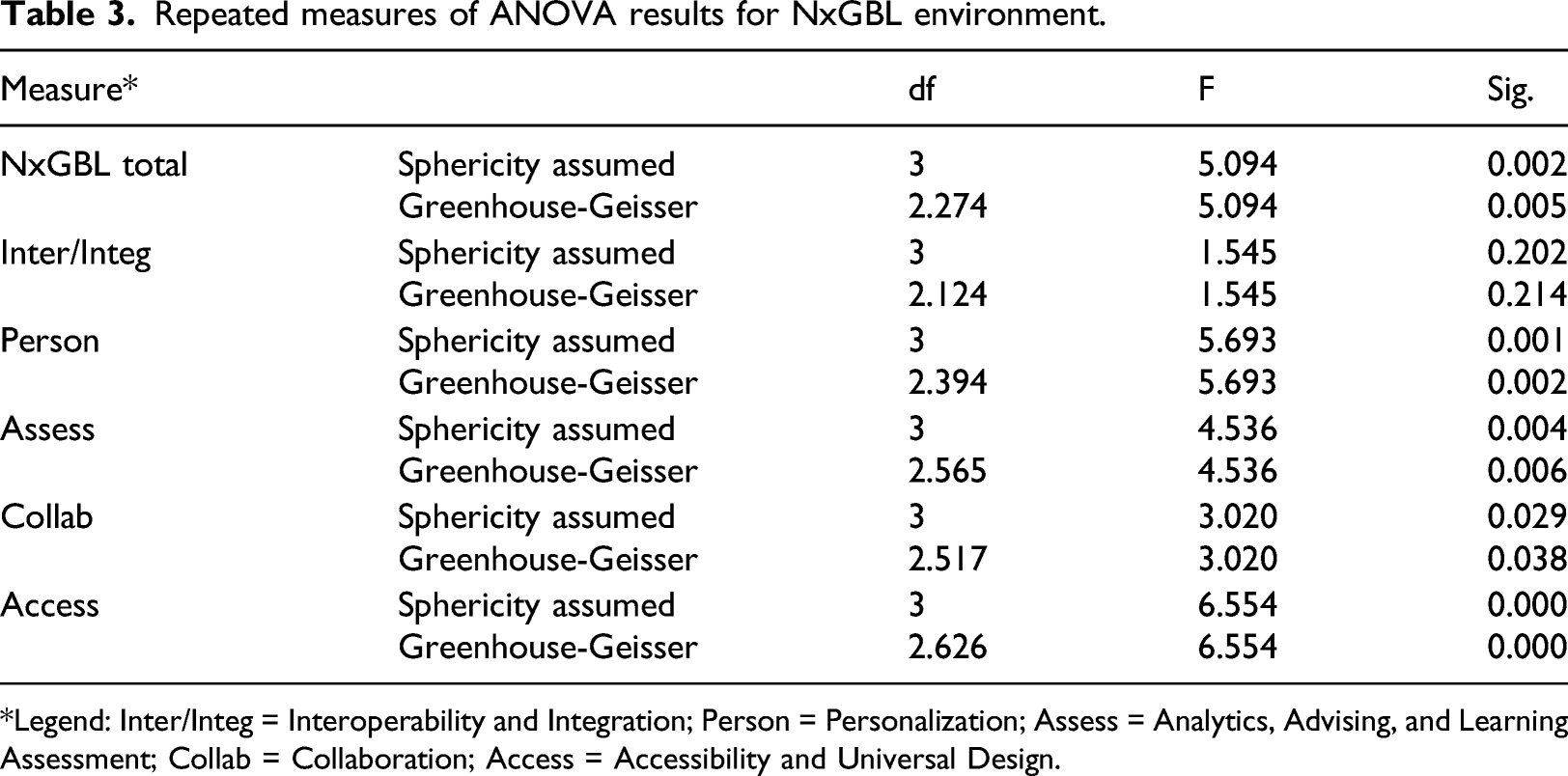
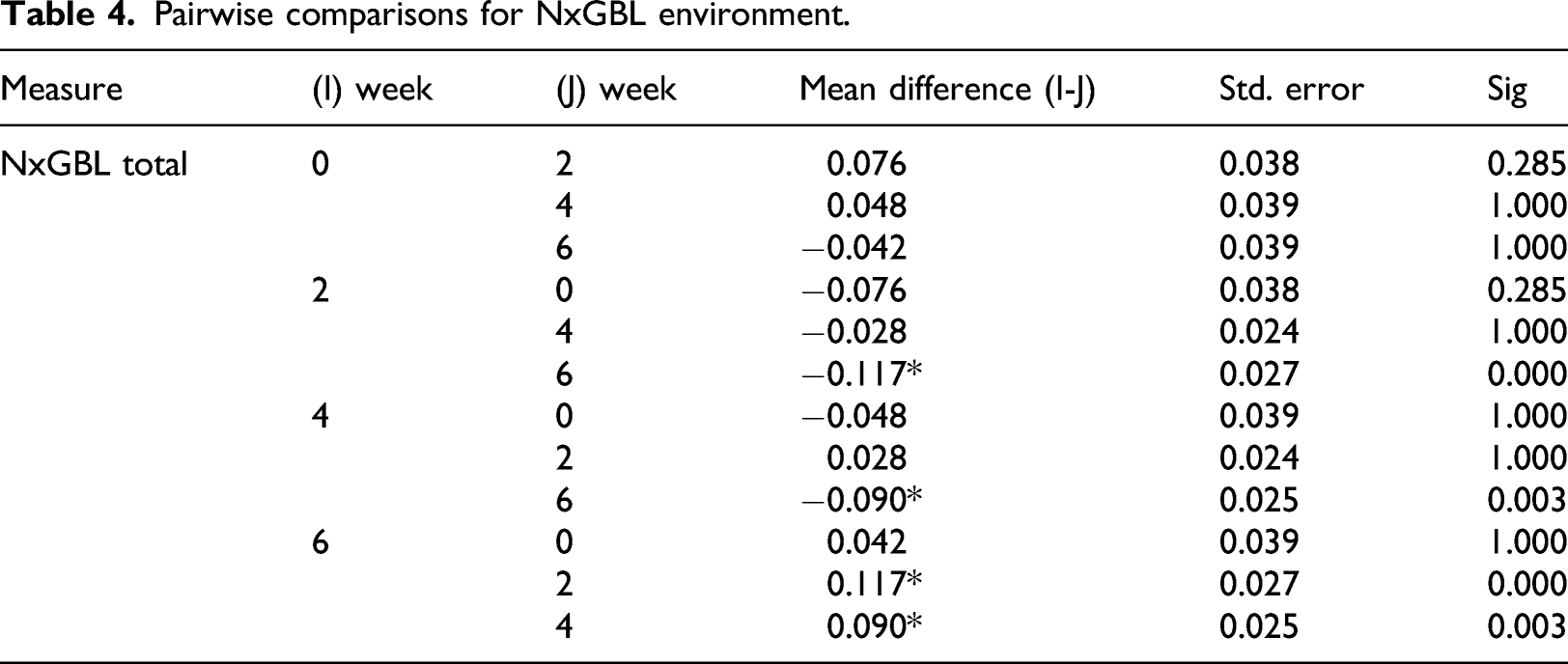
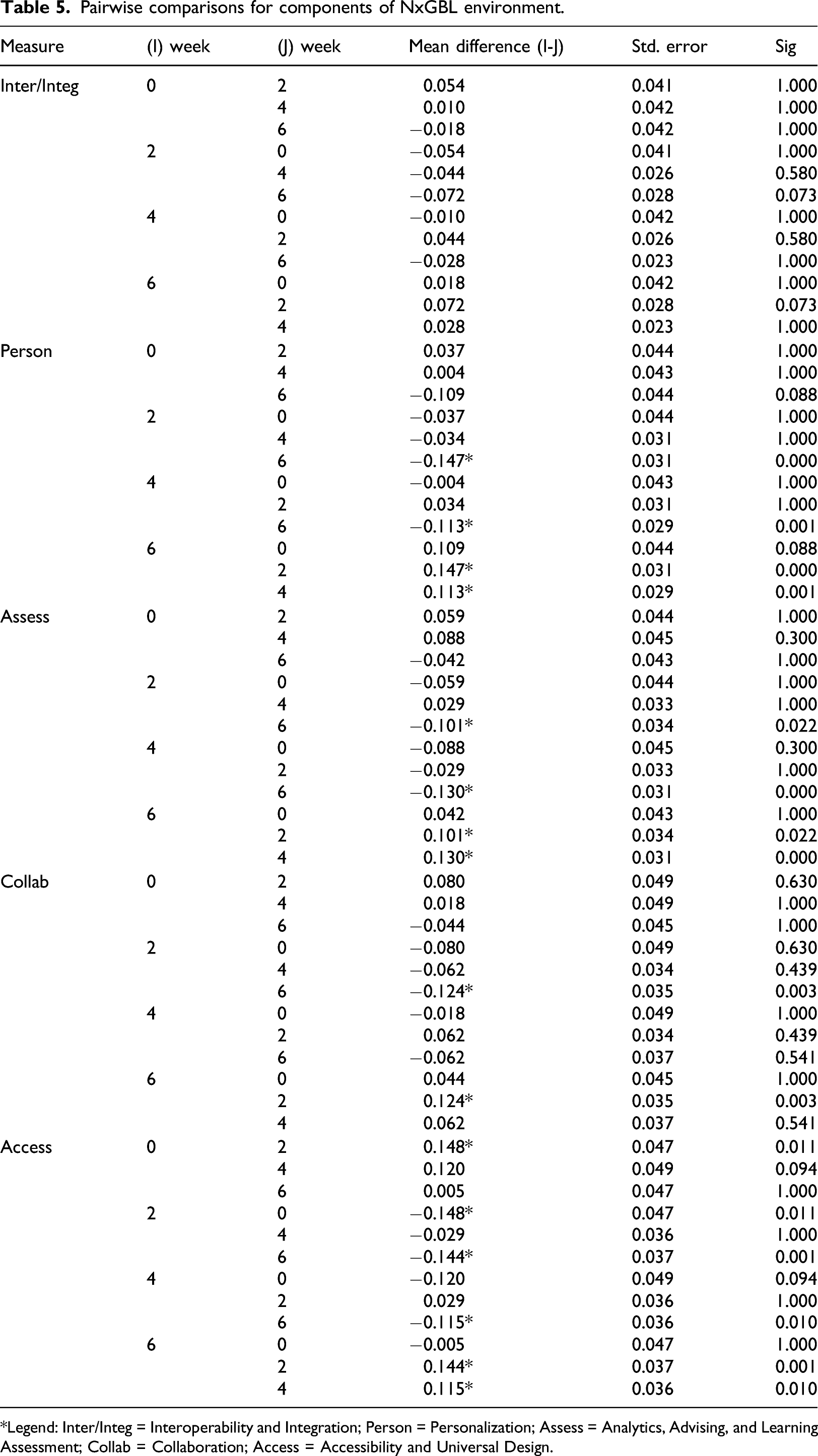
This section presents changes in the perception of the NxGBL environment during the research methods course. Figure 2 illustrates the periodic change in the mean rating on the blended learning environment in the span of 6 weeks. The total NxGBL environment had an initial rating (week 0) of 3.199 (SD = 0.475). This measure is based on the latent perception of learner’s last academic years. The first measurement of learners’ perception of the implemented online distance learning was conducted in the second week, where the rating dropped to 3.123 (SD = 0.532). Ratings increased in the following weeks, where the total rating for the blended learning environment reached 3.151 (SD = 0.529) in the fourth week, then ended with a rating of 3.240 (SD = 0.5041) in the sixth week. Means of NxGBL environment components. Inter/Integ = Interoperability and Integration; Person = Personalization; Assess = Analytics, Advising, and Learning Assessment; Collab = Collaboration; Access = Accessibility and Universal Design.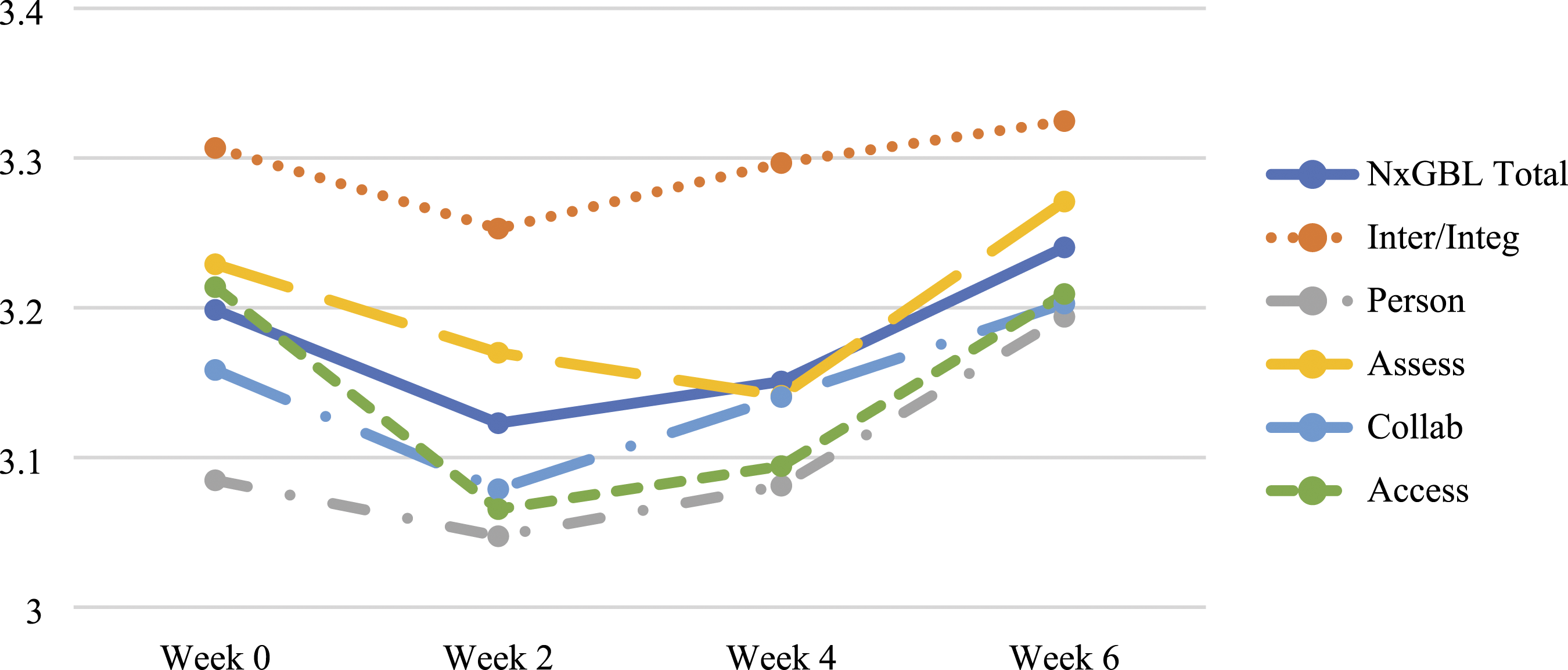
Descriptive for NxGBL environment.
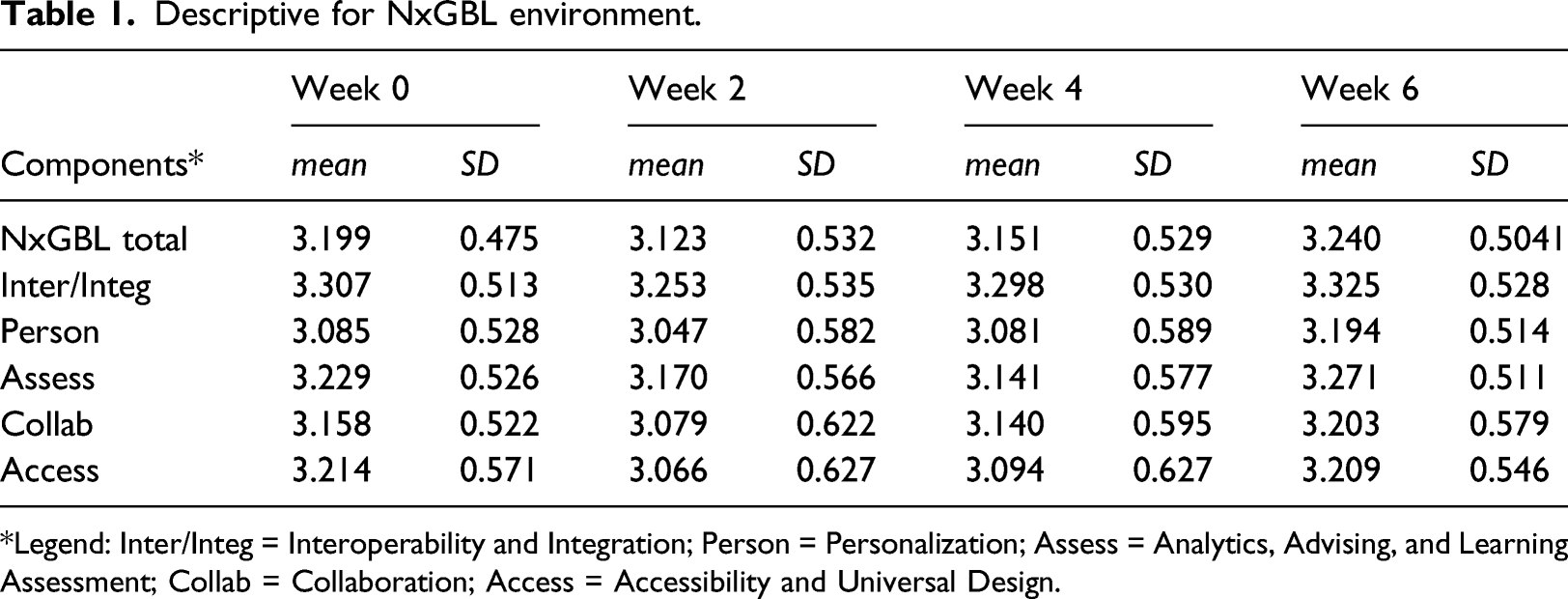
*Legend: Inter/Integ = Interoperability and Integration; Person = Personalization; Assess = Analytics, Advising, and Learning Assessment; Collab = Collaboration; Access = Accessibility and Universal Design.
Mauchly’s test of sphericity for NxGBL environment.
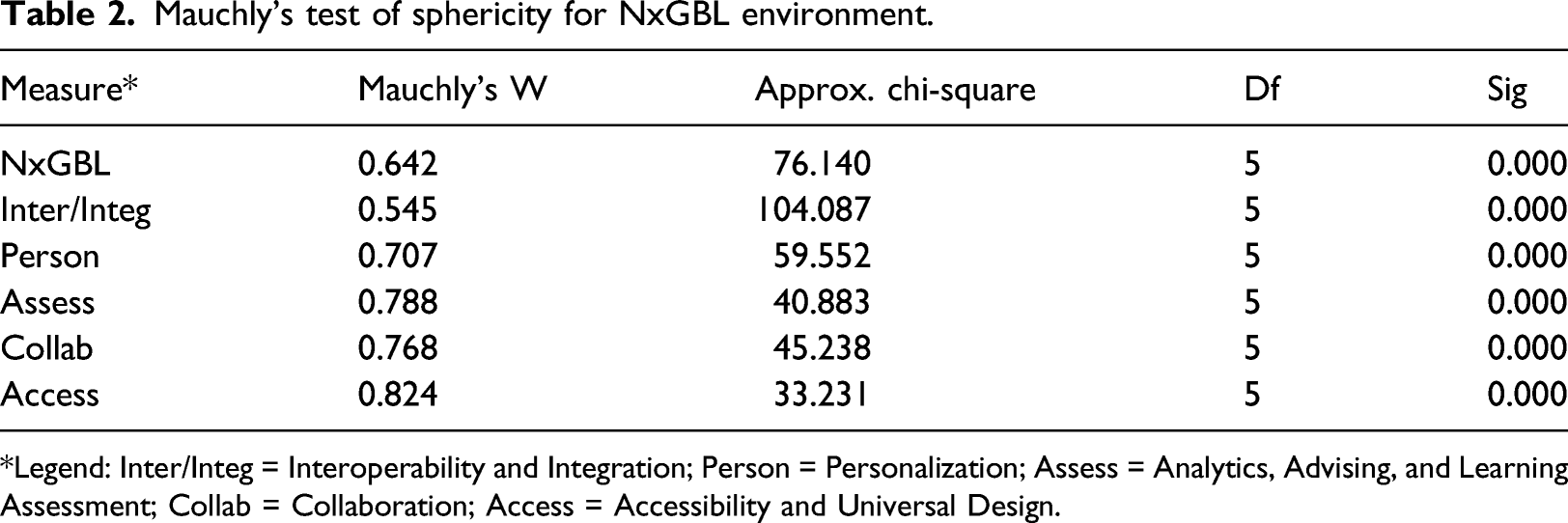
*Legend: Inter/Integ = Interoperability and Integration; Person = Personalization; Assess = Analytics, Advising, and Learning Assessment; Collab = Collaboration; Access = Accessibility and Universal Design.
Repeated measures of ANOVA results for NxGBL environment.
*Legend: Inter/Integ = Interoperability and Integration; Person = Personalization; Assess = Analytics, Advising, and Learning Assessment; Collab = Collaboration; Access = Accessibility and Universal Design.
Pairwise comparisons for NxGBL environment.
Pairwise comparisons for components of NxGBL environment.
*Legend: Inter/Integ = Interoperability and Integration; Person = Personalization; Assess = Analytics, Advising, and Learning Assessment; Collab = Collaboration; Access = Accessibility and Universal Design.
Self-regulated learning skills
This section examines variations of learners’ appraisal of their self-regulated learning skills during the research methods course. Figure 3 illustrates the periodic change in the mean score on self-regulated learning in 6 weeks. Self-regulated learning had an initial (week 0) total score of 3.154 (SD = 0.400). The score is based on learner’s appraisal of their skills for previous academic years. In the second week of online distance learning, the first time self-regulated for the program was measured, learners’ self-rated score slightly dropped to 3.134 (SD = 0.396). In the fourth week, the score slightly increased to 3.140 (SD = 0.431) and ended with a score of 3.164 (SD = 0.408) in the sixth week. Means of self-regulated learning skills. Memory = Memory Strategy; Goal set = Goal setting; Self-eval = Self-evaluation; Assist = Seeking Assistance; Enviro = Environmental Structuring; Respo = Learning Responsibility; Organize = Planning and Organizing.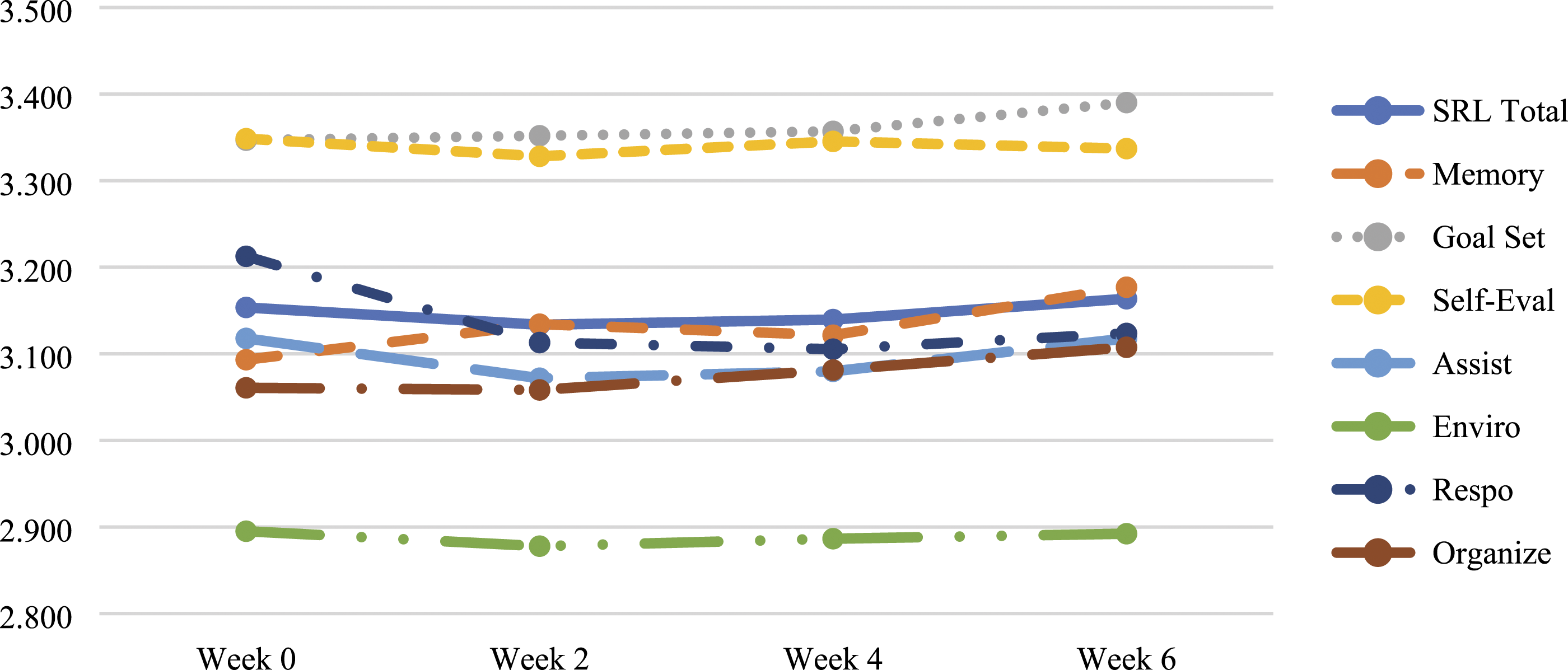
Descriptive for self-regulated learning skills.
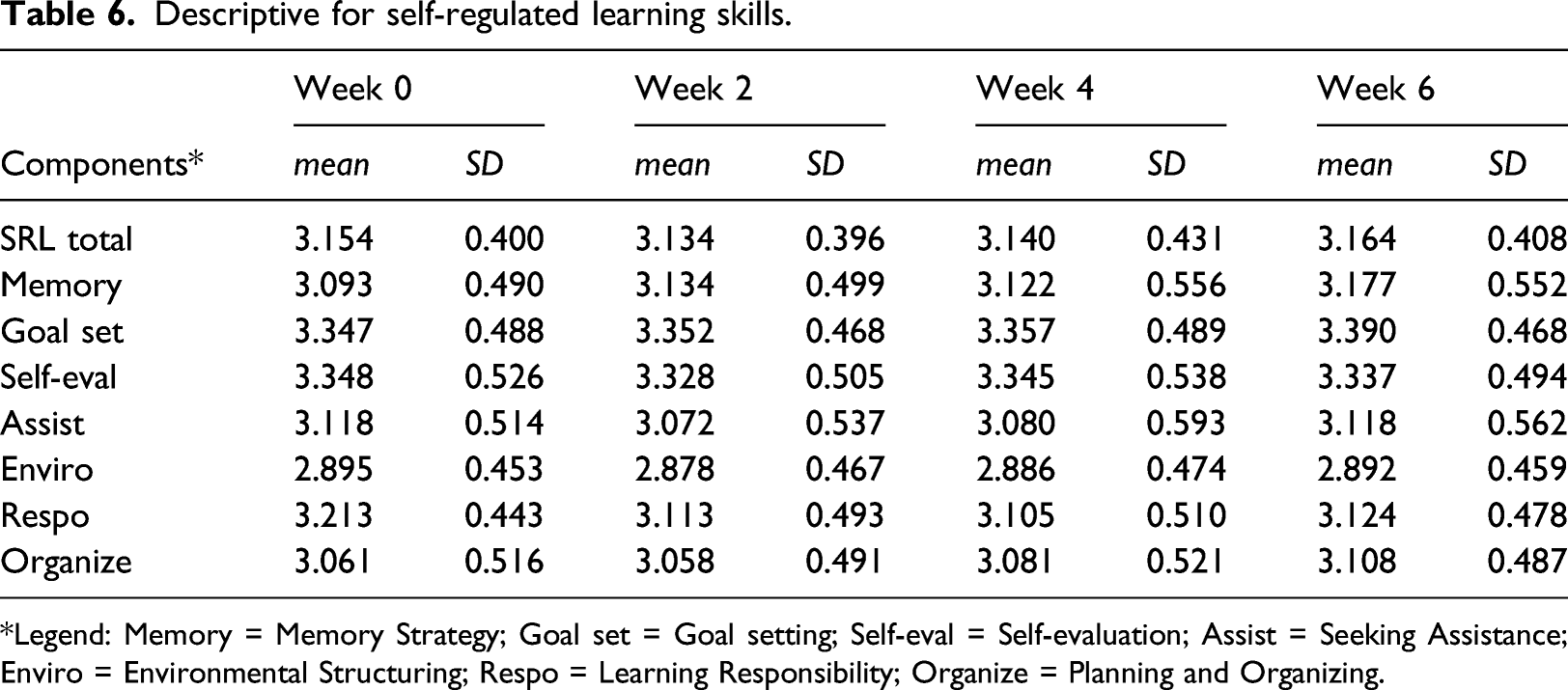
*Legend: Memory = Memory Strategy; Goal set = Goal setting; Self-eval = Self-evaluation; Assist = Seeking Assistance; Enviro = Environmental Structuring; Respo = Learning Responsibility; Organize = Planning and Organizing.
Mauchly’s test of sphericity for self-regulated learning.
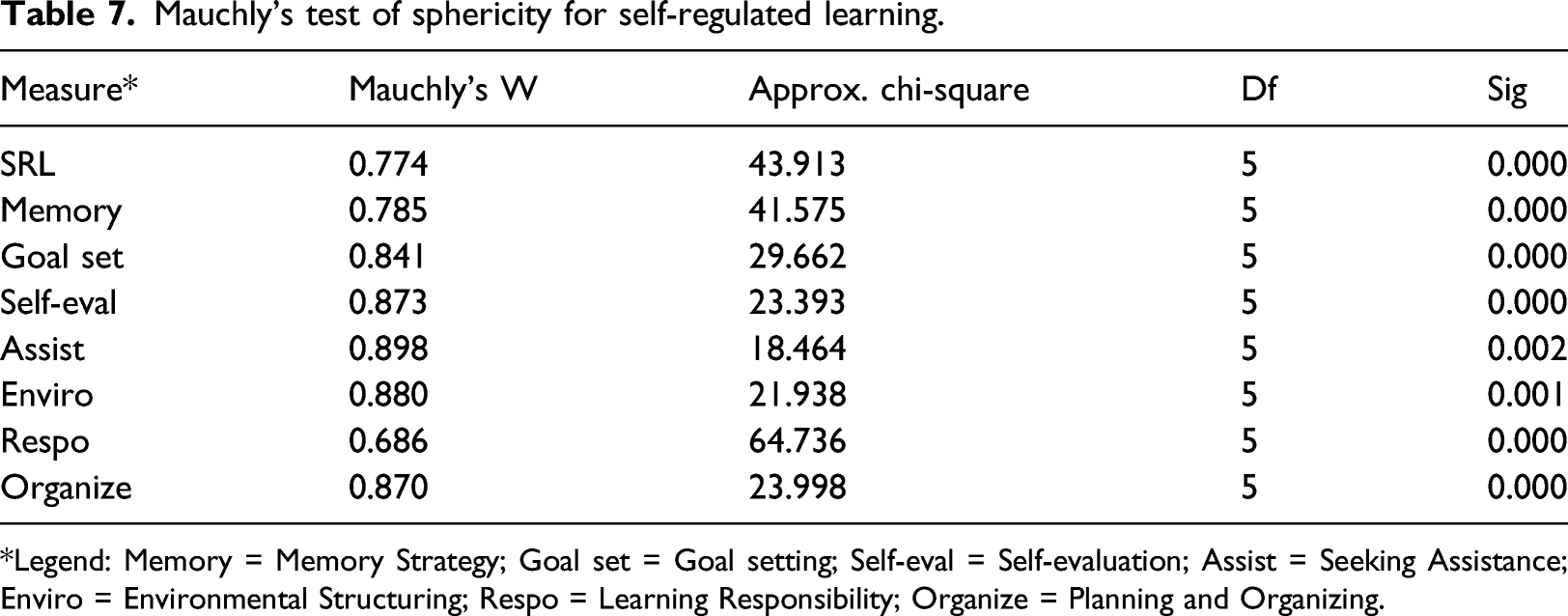
*Legend: Memory = Memory Strategy; Goal set = Goal setting; Self-eval = Self-evaluation; Assist = Seeking Assistance; Enviro = Environmental Structuring; Respo = Learning Responsibility; Organize = Planning and Organizing.
Repeated measures of ANOVA results for self-regulated learning.
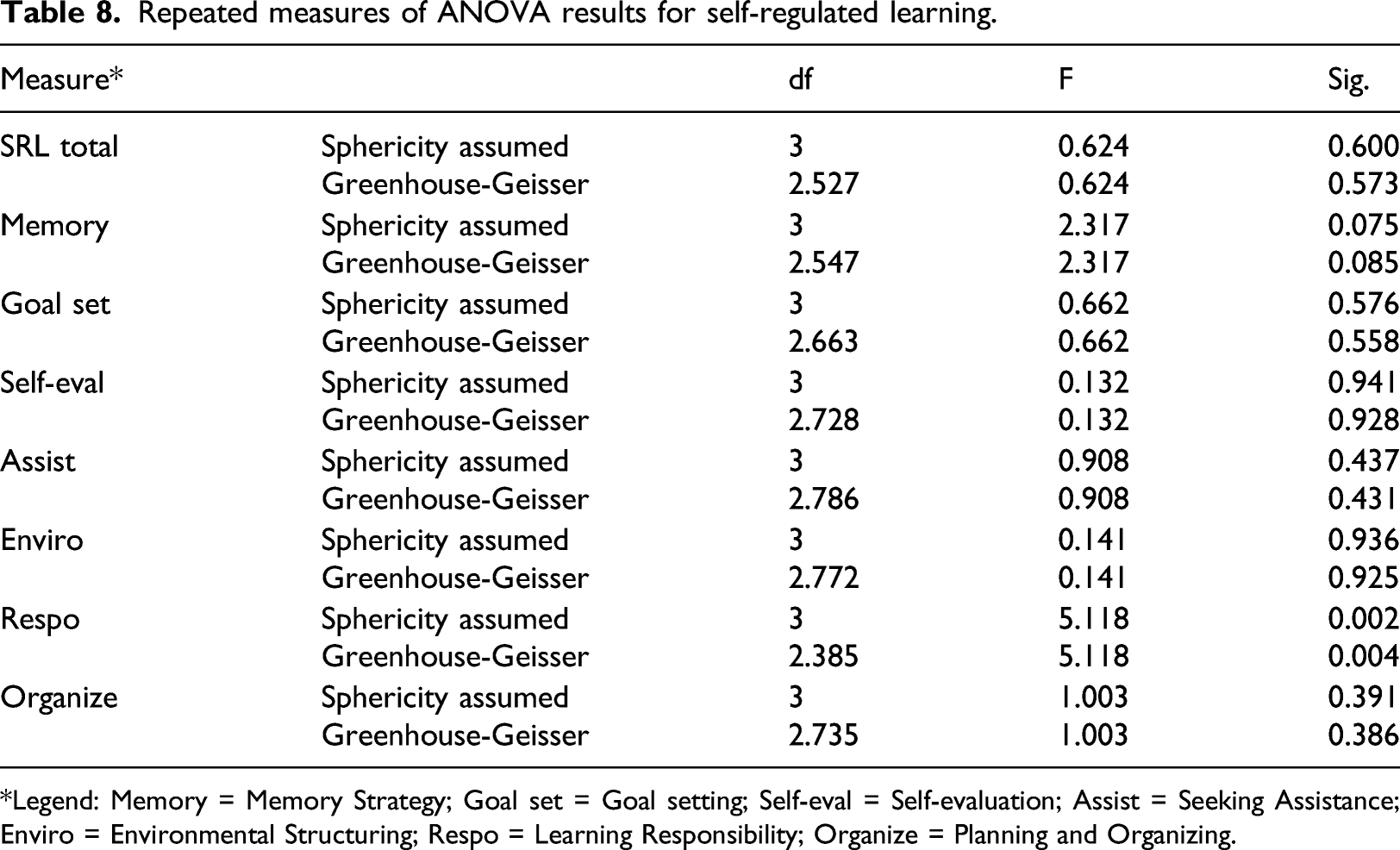
*Legend: Memory = Memory Strategy; Goal set = Goal setting; Self-eval = Self-evaluation; Assist = Seeking Assistance; Enviro = Environmental Structuring; Respo = Learning Responsibility; Organize = Planning and Organizing.
Pairwise comparisons for learning responsibility.
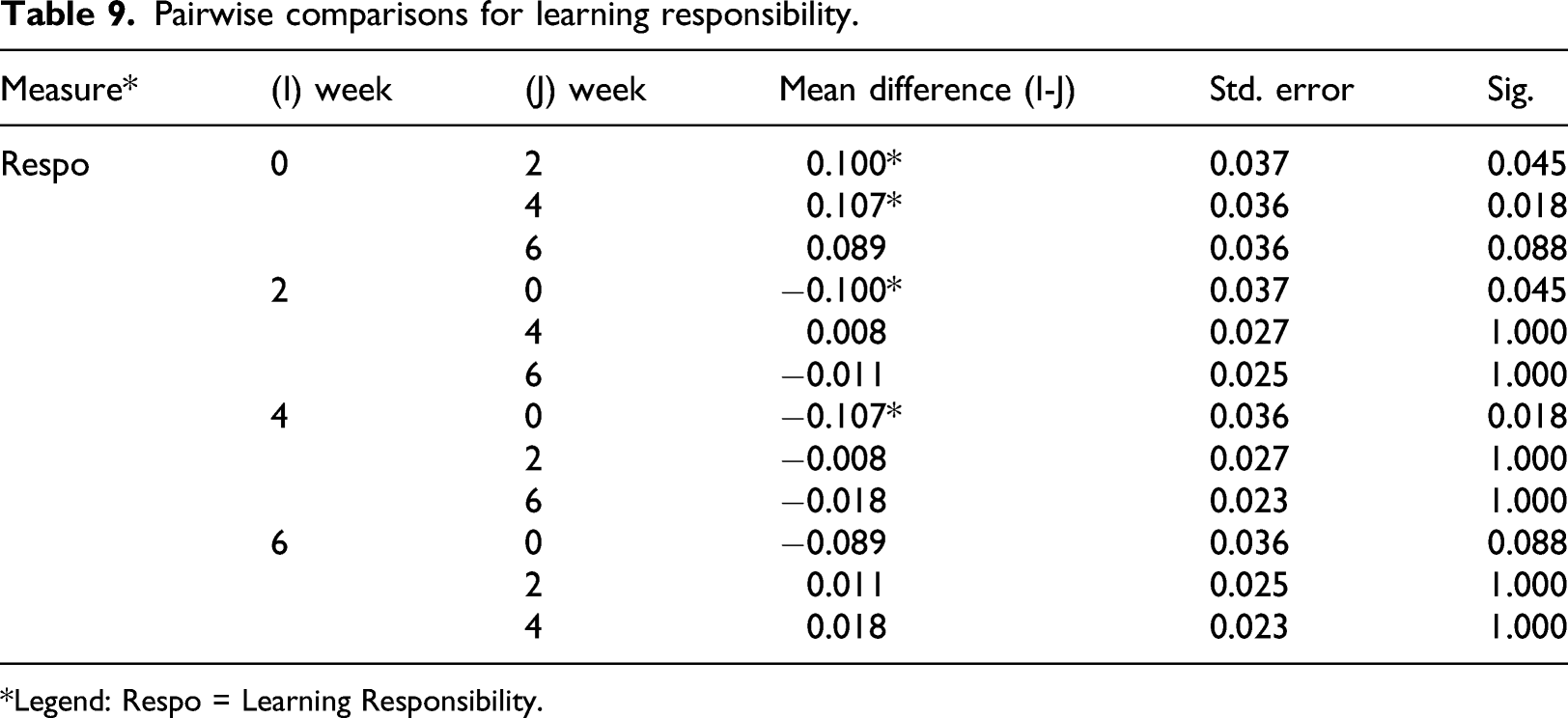
*Legend: Respo = Learning Responsibility.
Academic achievement
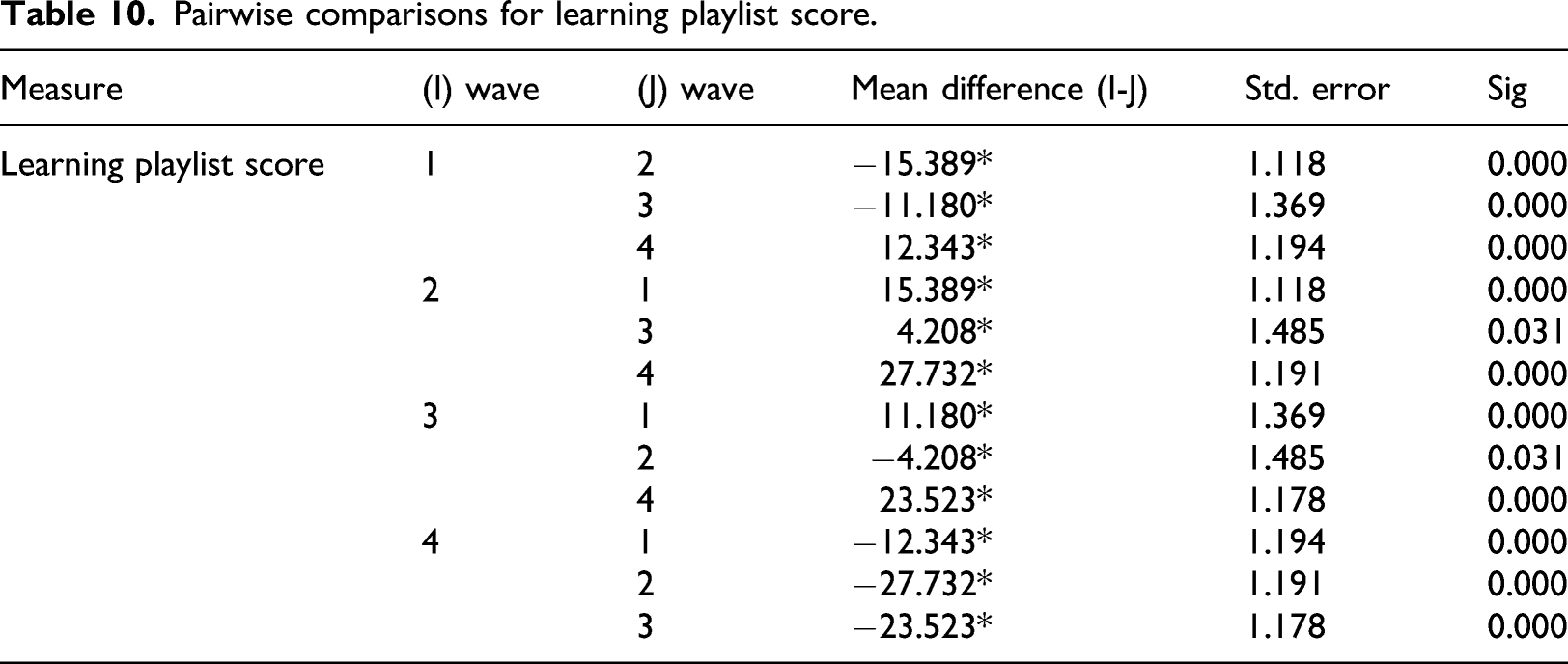
This section shows the trend in learning playlist scores for the online research methods course. Figure 4 illustrates the periodic change in learning playlist scores in the span of 6-weeks. For the first wave of learning playlists, learners’ go a score of 73.103 (SD = 19.211). Scores increased in wave two of learning playlists where students received a mean of 88.492 (SD = 18.704). A slight decline was observed on the third wave of learning playlists where learners got an average score of 84.284 (SD = 24.080). Scores further declined on the fourth wave of learning playlists with a mean of 60.760 (SD = 13.460). Means of learning playlist scores.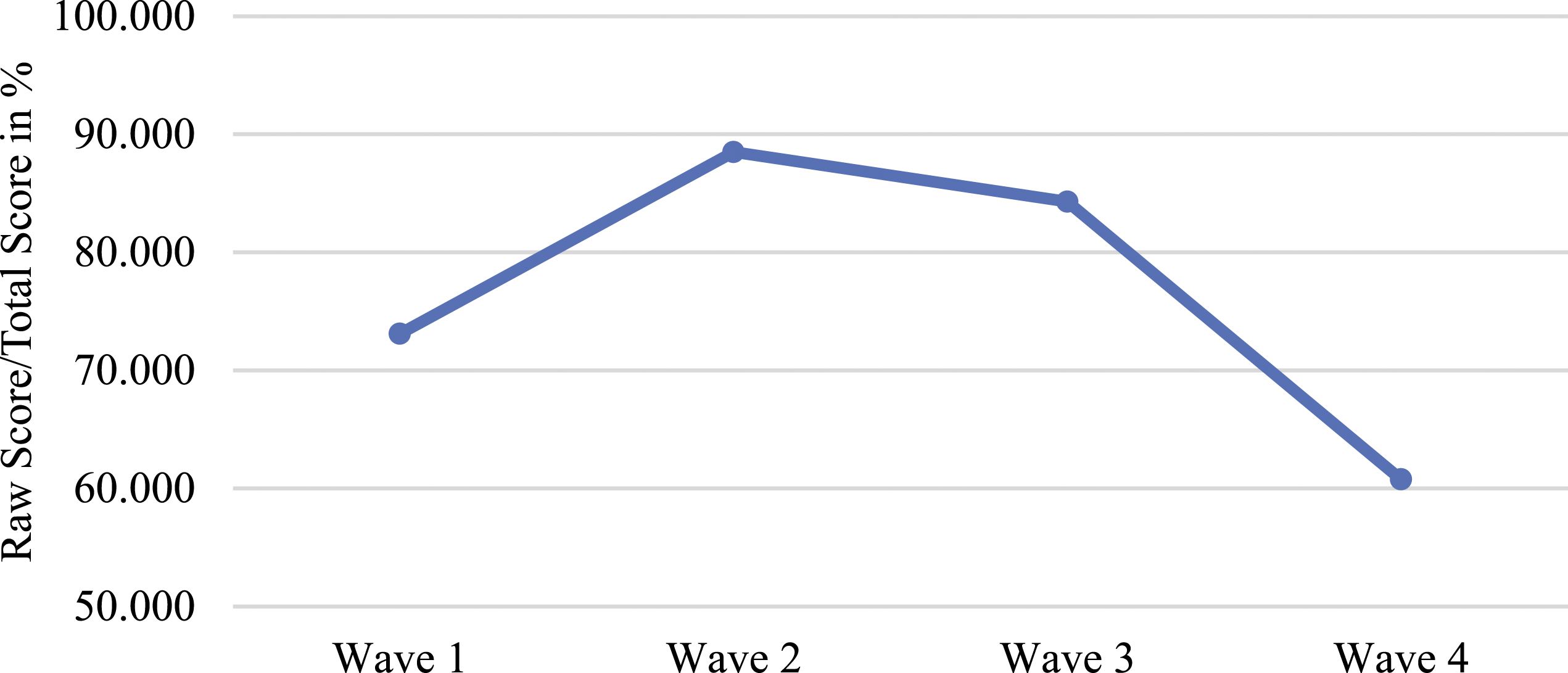
Pairwise comparisons for learning playlist score.
The second research question that aimed to explore the relationship between learner’s perception of their online learning environment and appraisal of their self-regulated learning skills yielded results. Linear regression was used to establish significance and measure the degree of relationship between the aforementioned variables. Data from the final period (week 6) of the NxGBL environment and self-regulated learning were used for this analysis, while the average of four waves of learning playlist was used to present the final learner score.
Relationship between perception of the online learning environment to self-regulated learning and academic achievement
Coefficients of components of NxGBL environment.
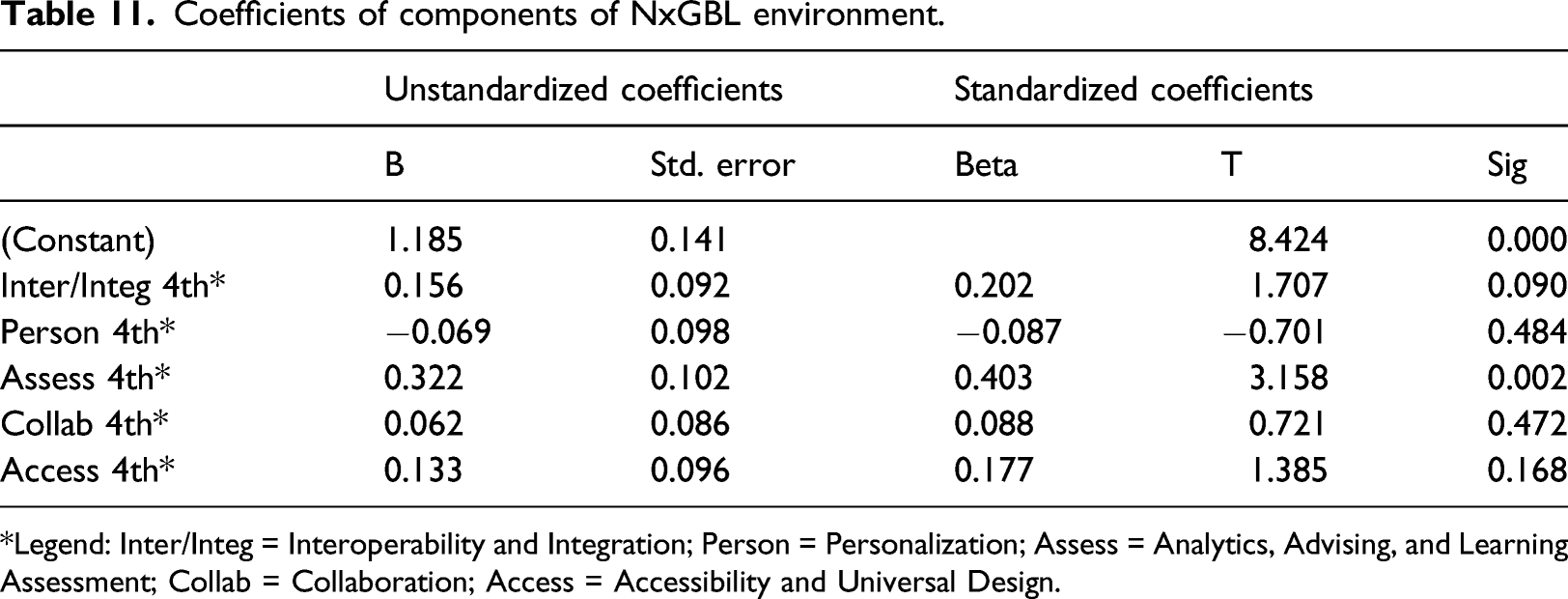
*Legend: Inter/Integ = Interoperability and Integration; Person = Personalization; Assess = Analytics, Advising, and Learning Assessment; Collab = Collaboration; Access = Accessibility and Universal Design.
On the other hand, results also show that the general perception in the NxGBL environment only accounts for 0.3% of the variance for learning playlist score, R2 = 0.003. The model that presents the relationship between the two is considered not significant, F(1,173) = 208.342, p > 0.05. Hence, the online environment perception has no relationship on academic achievement. Regarding the component of the NxGBL environment, the five-predictor model, which only accounts for 0.3% of the variance for academic achievement, is not significant to establish a relationship to learning playlists scores, F(5, 168) = 1.110, p > 0.05. This implies that even the components of the online environment perception also have no association with academic achievement.
Discussion
The COVID-19 pandemic brought an education crisis that forced educational institutions to abruptly shift to online distance learning. Existing literature studies on education for the COVID-19 pandemic provides counsel on how to implement online learning amidst the adversities; however, empirical data on the effectiveness of online learning remain to be rare. The importance of the online learning environment and self-regulated learning led the current study to explore the aforementioned variables as an indicator of the effectiveness of an online distance learning program during the COVID-19 pandemic. As a methodology, learners’ perception of the NxGBL environment, self-regulated learning skills, and selected learner analytics are collected periodically throughout the implementation of the research methods online course. The analysis included repeated measures of ANOVA to examine the trends between the four periods of a research method online course. Linear regression analysis was used to determine the impact of perception on the NxGBL environment on self-regulated learning skills.
Results of repeated measures of ANOVA for the NxGBL environment suggest that learners started to appreciate more the online learning environment for research methods in the latter part of the online course. Although the trend suggests an increase in perception at the end of the course, learners find the quality of their online environment still statistically the same with the online environment they had before the quarantine. The finding is similar to 92% of existing literature studies compiled by Nguyen (2015), which states that online distance learning is as effective, if not better, than traditional education. Online learning is perceived as a suitable, effective alternative for delivering instruction (Rodriguez and Armellini, 2013).
A subtle decrease in the perception of the online learning environment is observed at the start of the online course, but ratings consistently increased viewing online distance learning the same with pre-quarantine set-up. The decline could be attributed to the learners’ perceived overload of cumulative work from all courses at the start of the online distance learning program. For the first weeks of the research course, learners consistently commented on the said concern at the end of each learning playlist. A learner aired this concern in the comment section:
Like what most people [students] would say, the learning playlists have short deadlines and are piled up. It makes it hard for students to submit them on time because of the length and massive workload that is expected to be accomplished in less than a week.
Learners who may not have taken a class completely online before could be confronted by the challenges of having to do with the rigor of course work (Lotrecchiano et al., 2013). Alternatively, overloading cumulative work from all courses may be caused by a lack of organizational structure and collaboration between faculty members and school administrators—a formidable barrier to an online learning initiative (Vaughan, 2007). Another reason for the decline in online learning environment rating could also be explained by initial learner resistance to a completely unnatural shift to online learning. Learner resistance is not necessarily intentional and also understandable because they have had experiences of traditional method of learning for many years (Yemma, 2015). The mentioned concern is also a common comment among learners as exemplified in this sample statement:
Adjusting to the online switch is especially difficult as students are used to face-to-face discussions. Most of us learn best when things are discussed directly by the teacher, yet we are given playlists to self-study. I believe that it will take a long time to get used to this new way of learning.
Although in the initial phase of online distance learning, students perceived a subtle decline in their online learning environment; a gradual increase is observed at the latter parts of the research methods course. This could be explained when the school as a whole started to properly gauge the appropriate number of online activities as online distance learning proceeds. A shift to learners’ comments has been observed, claiming that online activities are already manageable. A learner exhibited this shift through his comment.
The teachers are finally beginning to handle the workload properly and I now can finally manage my time because of the extended deadlines and easy to follow playlists like these.
On the other hand, the gradual increase of perception could also be explained by the decrease of learner resistance as the program ensues. In the latter parts of the online course, several learners stated their adjustment with the program and started to appreciate its effects on their study habits. A common comment among learners is online distance learning’s capacity to teach management of priority and time. The observation is manifested in this learner’s written comment:
After a month I can say I'm used to all the tasks and activities given to us, and ODL taught us [students] an important skill like time management.
The researchers believe that retaining the perception of quality in the online environment amidst the difficulties brought by the pandemic could be considered evidence of the effectiveness of research methods online course. The span of the COVID-19 pandemic is not the time to implement complex institutional plans for online distance learning that were meant for long-term implementations (Daniel, 2020). Hence, an online course that could retain a learning environment similar to pre-quarantine set-up could be considered practically a success.
Self-regulated learning is the process of developing agency over the learning process can be summarized with the phrase, learning how to learn (Taranto and Buchanan, 2020). The asynchronous nature of the research methods online course promotes the development of self-regulated learning skills. Several comments of learners at the latter part of the research methods support the online distance learning program’s capacity to build time management skills, organizational skills, and learning responsibility. Selected statements by the learners drawn from the comments sections of learning playlists verbalized the promotion of self-regulated learning skills:
I am now used to the number of assigned materials and have a clearer picture of my priorities.
Although it has been quite difficult for me to adjust these past few weeks, I can say that online distance learning helps us in terms of managing our time and becoming more responsible students.
Online distance learning teaches us how to work independently and how to manage our time when working on assigned tasks.
Until now, online distance learning is still hard to adjust to, but nonetheless, it improves our time management and organizational skills.
Despite learners’ comments on online distance learning, the results of repeated measures of ANOVA revealed that self-regulated learning remained virtually the same throughout the implementation of the research methods online course. Apparently, the capacity of the online course to promote self-regulated learning is not reflected in their scores. The researchers offer explanations that could probably elucidate the unchanged self-regulated learning scores. Perhaps the learners involved in the study were already categorized based on their self-regulated skills, which means learners who already possess high levels of self-regulation before the pandemic remained to be self-regulated during the online distance learning program, while learners who initially possess low levels of self-regulation remained to be unregulated during the program. Such explanation is similar to the study of Broadbent and Fuller-Tyszkiewicz (2018) where they categorized their participants into four: super-regulators, self-reliant regulators, restrained regulators, and minimal regulators. Learners with lower self-regulation may reflect a relative lack of experience and exposure to successful learning approaches (Broadbent and Fuller-Tyszkiewicz, 2018); hence, this deficit restricted such learners to immediately develop self-regulated learning skills needed for the sudden shift to their learning conditions. The almost perfect and significant intraclass correlation of self-regulated learning scores between four periods of measurement, r = 0.900, F(173,519) = 10.023, p < 0.05 (Hemphill, 2003), supported the said explanation. Results imply that learners with higher self-regulation have consistently higher scores while learners with lower self-regulation have consistently lower scores throughout the four periods of measurements.
An alternative reason for retaining the same level of self-regulated learning could probably be explained by out-of-school influences. Previous researches increasingly show the impact of out-of-school factors on school achievement (Schunk and Zimmerman, 1998). The quarantine forced educational institutions to continue the teaching–learning process outside of school, hence increasing the restrictive effects of out-of-school factors in performing self-regulated learning. Another possible explanation is the limitation of self-report tools, such as the A-SRL-S, to measure self-regulated learning levels that do not represent actual learner behaviors. To address the challenges encountered when using self-report tools for measuring self-regulated learning in online learning environments, the use of learning analytics for measuring and promoting self-regulated learning is encouraged (Araka et al., 2020). It is important to take note that the last two explanations are different from the first one. The current study has no data to further support these claims, thus limiting them to mere speculations.
Learners’ academic achievement is measured through learning playlists scores. Evidently, the trend of scores followed an inverted U-shape pattern. A rise of scores is observed at the start of the research methods course, but scores begin to decline at the later phases of the course. The initial increase of scores could be explained by the school’s and learners’ adjustment to online distance learning. As discussed earlier, the perception of the online learning environment started to increase as the research method course ensues. Apparently, this increase in perception coincides with the second wave of learning playlists where an increase in score is also observed. On the other hand, the decline in score in the latter part could probably be explained by the stagnant development of self-regulated learning and the increasing difficulty of topics. The decrease of scores is recorded at the third and fourth wave of learning playlists. Compared to t-test analyses discussed in wave 2, the chi-square test of independence, Pearson’s r correlation, linear regression, and ANOVA which are covered in waves three and four are more difficult topics. Since the application of self-regulated learning is a significant factor to academic achievement in online learning set-up (Calamlam, 2016; Chen and Su, 2019; Im and Kang, 2019; Yeh et al., 2019), the unimproved self-regulated learning skills of learners is evidently inadequate to more complex topics at the second half of the course. Learners with initially high levels of self-regulation could still have the confidence and discipline to confront harder topics, while learners with initially low levels will begin to experience anxiety which leads to poorer academic achievement (Broadbent and Fuller-Tyszkiewicz, 2018).
The results of the regression analysis imply the influence of perception on an online learning environment to self-regulated learning skills. The relationship is supported by the findings of Lee et al. (2020) where learners’ self-efficacy and task value on learning in an online environment are perceived to be essential in promoting self-regulated learning strategies. Similarly, Araka et al. (2020) also concluded that an enhanced online learning environment has the potential to provide measurement and interventions that could be significant in developing self-regulated learning skills. Concerning components of the NxGBL environment, self-regulated learning is only affected by analytics, advising, and learning assessment. Evidently, only the ability of an online environment to gather and analyze learning data for self-assessment, self-improvement, and self-progress (Magalong and Prudente, 2020) significantly promotes learners’ autonomy over their learning process during the online course (Taranto and Buchanan, 2020). Learners find it easier to set their learning goals and regulate their effort to reach these goals if feedback on their learning is available (Chen and Su, 2019). It is perplexing to note that the perception of an online learning environment has no significant relationship on learners’ academic achievement. Researchers believe that academic achievers in the research methods course are internally motivated to learn. They are engaged in learning regardless of their views of the online environment. It is essential to recognize that lack of interaction with one’s online environment does not mean a lack of engagement or motivation to succeed academically (Broadbent and Fuller-Tyszkiewicz, 2018).
Conclusion and recommendation
As educators, it is important to recognize the limitations of the abrupt shifting to online distance learning due to the COVID-19 pandemic. This study exhibited initial setbacks in starting an online course. Nevertheless, such limitations could be compensated with continuous perseverance in adjusting to an online learning environment as the program ensued. Furthermore, the study highly recommends the implementation of interventions specific to improving learners’ self-regulated learning skills. An online course must allot time to activities solely intended in promoting such skills. The stagnation of learners’ self-regulated skills throughout the course is believed to cause detrimental effects on academic achievement as concepts continue to be more complex. Lastly, the perception of the online learning environment is related to self-regulated learning. The capability of an online environment to provide data for feedback is essential in developing skills that allow students to learn how to learn.
Footnotes
Declaration of Conflicting Interests
The author(s) declared no potential conflicts of interest with respect to the research, authorship, and/or publication of this article.
Funding
The author(s) received no financial support for the research, authorship, and/or publication of this article.
