




Abstract
The extension of technology in current society has encouraged teachers to introduce products based on VR and IVR in their classrooms, especially video games. In this paper the specific role of video games in cultural heritage and history teaching is analyzed. Moreover, the results of recent research on the application of video games in Secondary Education is discussed. The results advocate taking into account principles such as Civic Education, Historical Relevance, Engagement, Applicability and Multimodality (what has been called the CREAM Model) in the design of a video game. These principles are especially important if the video game aims to introduce archaeological and/or historical contents into the classroom. This model has been implemented in the design of the IVR video game Carthago Nova, which is discussed as an exemplar of how the proposed principles can be engaged. The educational sequence, in which the video game is contextualized, reinforces its educational aims.
Introduction
No one disputes the possibilities that new technologies currently provide for the dissemination of cultural heritage and, in particular, archaeological heritage. For an exercise that needs as much abstraction capacity as archaeology itself, tools like 3 D reconstructions, augmented reality and virtual reality help to make the abstract concrete. Good examples of this are found in the various volumes of this journal. Studies transferring these new technologies to educational contexts are also commonplace. However, although current literature claims the numerous advantages and benefits that the educational use of these tools entails, there is still not enough empirical evidence to conclude firmly what those benefits are.
In this regard, the authors had the opportunity to develop the evaluation process of a Immersive Virtual Reality video game (IVR) designed by and for schools by Fundación Integra. Fundación Integra is a public institution in the Región de Murcia (Spain) whose fundamental mission is to accelerate the implementation of the Information Society in the area. One of their projects was focused on the introduction of cultural heritage into Secondary Education by producing a IVR video game entitled El misterio de la Encomienda, which was used to tour and learn about the history of a 16th century building (La Encomienda) linked to the Order of Santiago in Ricote (Murcia, Spain) (Escribano-Miralles, 2016). The educational evaluation of this video game led to a series of conclusions that are embodied in the model presented in this paper. This model is formed by five basic principles (encompassed under the acronym CREAM) and seeks to establish some guidelines for the design of similar products.
But why has this model been created? We aimed to emphasize the need to think carefully about the objectives, content, methods, actions and resources used in the creation of any history and heritage serious game. The disconnection between developers and educators ended in the design of products with no special educational value. As a result, the content intended to be learnt is most times lost to the complexity and quantity of technological inputs (Egea-Vivancos et al., 2017; Martínez-Soto et al., 2018). Those specific principles were applied in a second video game named Carthago Nova. The main aims of this article are to show the process of reflection and evaluation of these video games and to define the CREAM principles.
Virtuality/virtual reality for incorporating cultural and archaeological heritage into education
Effective incorporation of cultural heritage into education has its problems. One of them is the usual approach used in education: cultural heritage is mostly used as a purely artistic element or an illustrative vestige of an era with no deeper reflection or profound understanding. Its symbolism, historical significance, or its important function as source of the historical discourse are normally not mentioned. The abstraction capacity often demanded when approaching cultural heritage is also a handicap. The temporal and historical remoteness of the element observed, the absence of a specific historical and geographical context, the lack of knowledge about the society that enjoyed it, etc., transform cultural heritage into places and artifacts with no special meaning for the current society.
A similar reflection can be made in the specific case of archaeological heritage. Apart from the decontextualization of cultural property, its interpretation is also a difficulty for the untrained eye. Recent research clearly highlights this aspect (Santacana and Masriera, 2012). The fragmentary and low height of the structures, the confusing superimpositions, the scarcity of physical elements that help to identify the places, functionalities, etc. complicate the task of understanding. In the words of Santacana and Masriera (2012), archaeological sites are almost always disciplinary data shown to the public “naked, fossilized” (p. 9). Those visits are also usually accompanied by plans that cannot be understood without the capacity for abstraction and the topographical understanding that the everyday visitor does not possess, and that the majority of students have not mastered (Noguera et al., 2012). Besides, the cryptic nature of the messages intended to guide the visit, full of technical names with no further explanation should also be added to this list. Visiting an archaeological site is therefore a challenge.
It is in relation to such aspects where new technologies are of great help. They make visualizing the absent information and recreating lost contexts possible. These new technologies allow for the recreation of different past scenarios that introduce the general public, and students in particular, to remote places. They allow to locate artifacts in specific historical contexts and to interact with elements of the past that are usually found inside the showcases, far from a direct experience. Therefore, new technologies give places and objects life and meaning (Froschauer et al., 2012).
In short, new technologies serve to introduce a great variety of experiences that facilitate interaction with the cultural property. In addition, they have a high power to capture the attention of the user, enhancing their educational value (Otero and Flores, 2011). In fact, numerous authors allude to their important motivational load, which per se has a positive impact on learning and make them valuable resources (Cánovas, 2017; Licona and Carvalho, 2001; Otero and Flores, 2011; Pantelidis, 2010; Ramos and Botella, 2016).
All of this has proven to be very useful in the specific case of archaeological heritage. The 3 D recreation of archaeological sites enables their understanding: they transform abstract explanations into detailed images (Rivero, 2011; Rivero and Feliu, 2017). As Froschauer et al. (2012) point out, “digital media have the power to foster the understanding of our cultural heritage in ways that written text or images will never achieve” (p. 283). Other authors are equally clear about the benefits of virtual reality applied to the recreations of archaeological sites. They point out that the benefits are even greater than those provided by physical recreations in situ. The only exception they mention is the empathy that physical interaction with reconstructed spaces provides (Santacana et al., 2015). However, IVR can alleviate this shortfall. In the IVR, all the places through which the visitor walks are decorated and animated, which facilitates a total immersion and the feeling of being submerged in another era (Ghani et al., 2016). Some paradigmatic examples of projects based on interactive virtual environments are compiled and described by Anderson et al. (2009) and Haddad (2016). If in addition to the mere interaction with these vestiges of the past a playful element is added, attention and motivation grow and learning seems to increase (Mortara et al., 2014).
Nevertheless, despite the wealth of virtual resources relating to history and cultural heritage that exist today, they have little impact on formal educational contexts. One of the main problems of integrating these resources into classrooms is highlighted by Luna et al. (2019). For the specific case of augmented reality and mobile technology, they allude to the conception of these resources as mainly recreational elements associated more with leisure time than with a classroom environment. In fact, most of the existing virtual resources do not have a clear teaching intention and, when introduced in educational contexts, do not usually represent a new approach in the discipline (Adell and Castañeda, 2012).
Hence, the importance of creating materials specifically designed for educational contexts, where the interactive and the playful element is in balance with the educational one. This is the case of the so-called serious games.
Using video games to teach history
There are numerous authors that allude to the many educational benefits of video games (Becker, 2011; Etxeberria, 2001; Gee, 2003, 2009; Gros, 2000, 2004; Gómez, 2007; Licona and Carvalho, 2001; López, 2016; Pérez and Ignacio, 2006; Pindado, 2005; Zimmerman, 2014). Among other advantages, and in addition to the attractiveness of their own design, video games provide players with constant feedback and trial-and-error strategies, adapted to the user's rhythm and skills, favoring interactivity and facilitating the correction of possible errors.
Equally prolific is the literature on the possible positive effects of incorporating video games into the classroom and how they favor new learning styles (Del Moral, 2014; Gros, 2000; Lacasa et al., 2007). Moreover, current research emphasizes the general satisfaction that video games provide when teaching any subject (Ak, 2012; Fu et al., 2009; Ghergulescu and Muntean, 2012; Martínez et al., 2002; Takatalo et al., 2011; Molins-Ruano et al., 2014; Tüzün et al., 2009). Apart from the students’ satisfaction and motivation, Felicia (2009) adds the degree of involvement and concentration that the player/student usually experiences in accomplishing any task. Without a doubt, this initial motivation and involvement in the teaching process benefits the introduction of diverse topics while facilitating the initial dialogue with the students. However, this motivation will not always lead to a significant increase in the knowledge of the subject matter in question (Froschauer et al., 2012). In education, it is necessary to go beyond the recreational and motivational and analyze in depth which benefits these resources really bring to the teaching-learning process.
The attractiveness of History and historical settings have made them the subject of a huge number of video games (Cuenca et al., 2011; Jiménez, 2016; Jiménez-Palacios and Cuenca, 2016; Rivero, 2009). In many of these, numerous cultural and archaeological properties are added (Haddad, 2016). Their presence in specific video games facilitates their introduction in History lessons and discussions (Ayén, 2010; Cuenca and Martín, 2010; Gálvez, 2006; Gee, 2003, 2009; Moreno, 2010) even though the educational element may be totally absent (Haddad, 2016). For example, in a classroom of the era of digital natives, following Prensky’s (2001) classic classification, one cannot speak of ancient Egypt, classical Greek antiquity or the Renaissance, without talking about the scenarios in the successful video game Assassin´s Creed. The impact of the video game on Secondary Education students is remarkable, and teachers know it (Evaristo et al., 2016; Grup, 1998; Jiménez-Palacios and Cuenca, 2016, 2017; Martín and Cuenca, 2019; Téllez and Iturriaga, 2014; Vicent and Platas, 2018).
However, this work does not focus on the analysis of this educational resource in general, but on the specific typology known as serious games of the edutainment type: video games created mainly for educational purposes (Becker, 2016; Gros, 2004; Levis, 1997; López, 2016; Ravyse et al., 2017; Trenta, 2014).
Products of these types abound. Mortara et al. (2014) classify them according to the main subject matter or typology (action, simulation, adventures, etc.). Examples associated with History and archaeological and cultural heritage have been also compiled and commented on by Haddad (2016). Examples created and developed in Spain are Libertus (Jiménez-Palacios and Cuenca, 2017), Codex del Peregrino (Jiménez-Palacios and Cuenca, 2016), and Sum (Arambarri et al., 2012). In the specific case of IVR video games, those developed within the frame of the REVEAL project (https://reveal-eu.org) should be mentioned: The Chantry and Augustus Forum (https://revealvr.eu/). History and heritage have an important role in both video games, although the main aim of the project is not the analysis of the learning process in educational settings, but the evaluation of the technologies developed in these Educational Environmental Narrative games (Habgood et al., 2017). Spanish examples of IVR video games are El misterio de la Encomienda de Ricote, La Catedral Vieja de Cartagena and Carthago Nova.
A specific evaluation of a IVR educational video game of cultural heritage and historical content
As mentioned earlier, the authors were responsible for the evaluation of the video game El misterio de la Encomienda (Egea-Vivancos et al., 2017; Martínez-Soto et al., 2018). The evaluation process was developed in two phases: a pre-pilot phase with a sample of 14 students in the third year of Compulsory Secondary Education (average age 13.5 years) and a pilot phase, with a sample of 34 students in the 4th year of Compulsory Secondary Education (mean age 15.4 years). The instrument used was a questionnaire called Historical Video Games – Opinion (HiVI-O) and served to analyze the opinions and evaluation of the players/students about the historical content of the video game and the pedagogical value they attributed to it. The questionnaire comprised 28 items: 3 were open questions and 25 were 4-Likert-scale questions to rate the opinion of the students regarding the experience provided. These questions specifically measured statements of agreement (agree/disagree) and quality (excellent/very poor). The answers were examined according to a mixed method approach.
The questionnaires revealed that there was indeed a positive predisposition on the part of the students to play video games of this type. They aroused great interest and motivation but, nevertheless, the knowledge they acquired from playing was very confusing and inconsistent (Martínez-Soto et al., 2018). This same research showed that the students retained much better the information that had been inserted into the video game through various channels. This led to the conclusion that there was a need to establish clear educational objectives, to choose minimum contents to be acquired by the students during the game, to select clear information, to focus the attention of the students in, precisely, those specific objects of learning, and to show them repeatedly through various media (audio, video and images) (Egea-Vivancos et al., 2017).
Together with these remarks, current research also emphasizes the idea that the combination of the video game plus the work of the teacher in the classroom is the most effective formula (Evaristo et al., 2016). It is therefore necessary to generate additional material that complement the integration of video games into the teaching-learning process (Šisler et al., 2012). Both video games and the supporting materials should aim to provide an adequate curricular context that goes beyond gamification and reinforces the contents and educational objectives of the game (Bautista, 2018).
These conclusions are decisive when it comes to outlining subsequent projects.
The CREAM model. Principles for the design of an educational video game
Designing an educational or serious game involves much more than just a story, design or software. Clear pedagogical principles are necessary too (Greitzer et al., 2007). It is also key to be aware of the factors that ensure success for the players (Ravyse et al., 2017). In this regard, there is already a rich vein of research on what characteristics a video game must have for it to be educational (Becker, 2011, 2016; Egenfeldt-Nielsen, 2011; Felicia, 2009; Gee, 2003, 2009; Prensky, 2011; Zin and Yue, 2009). Arambarri et al. (2012) summarize them, from those already mentioned by Felicia (2009), in the following ideas: video games must promote life skills, illustrate examples, motivate students, encourage the need of cooperating with others, reward achievements, and be immersive.
In the specific case of history and heritage serious games, a series of basic principles should be added to the previous enumerations. These principles make up what was called the CREAM Model (Figure 1).
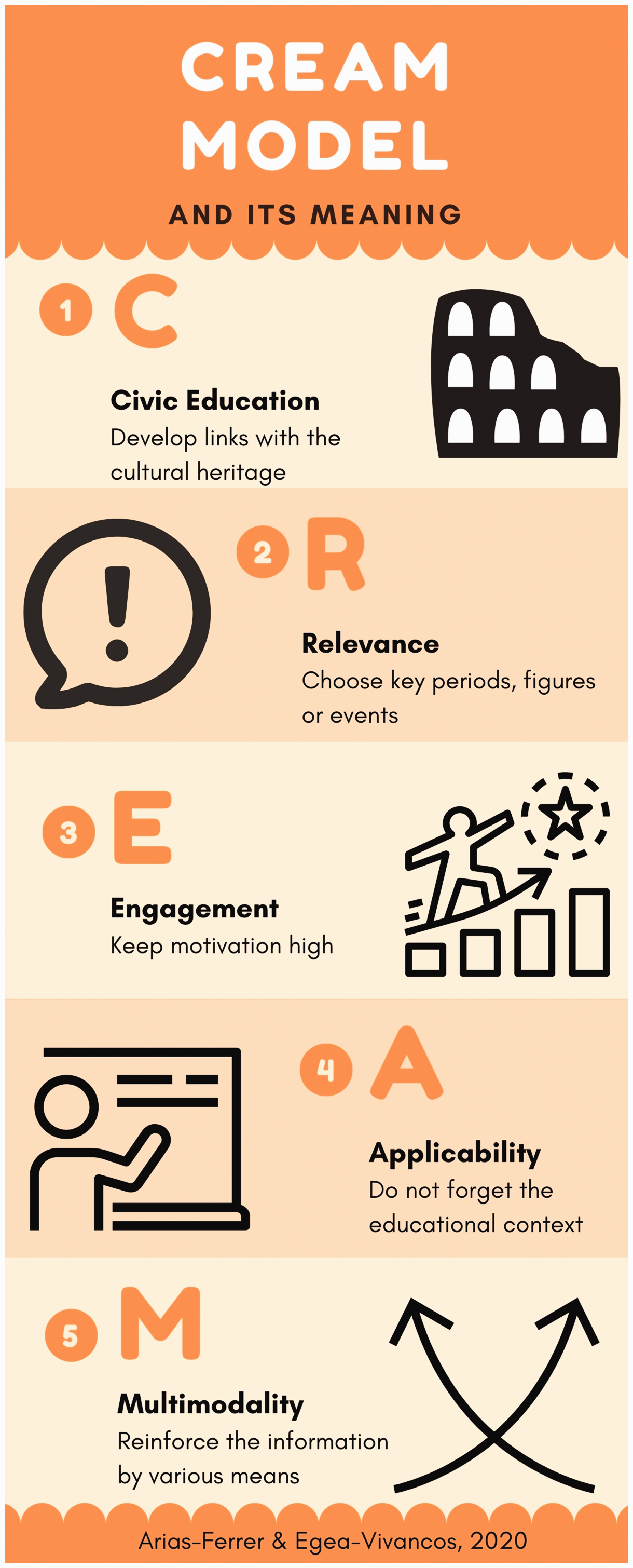
CREAM Model, its criteria and meaning (Source: Own elaboration).
The CREAM Model summarized and organized them with the aim of outlining the aspects that favor learning. They have been selected according to current scientific literature and taking into account the results obtained from the evaluation of the serious game El misterio de la Encomienda, conducted on secondary education students. During the first pre-pilot phase, a first questionnaire was used to analyze the levels of acceptance by the players, as well as their perception about what they had learnt (Egea-Vivancos et al., 2017). In the second study, the opinions and assessments of the students regarding the historical content in the video games and the perceived pedagogical value, were investigated (Martínez-Soto et al., 2018). The results of both studies showed that these type of resources increase motivation in students. 55.9% chose the highest value (4), manifesting they believed that with video games they could learn about History. They noted that the video game boosted retention, kept their attention, was fun and enjoyable, and that they learnt History merely because of the historical contents embedded in a fun game. Participants mentioned the historical period in which the events had taken place or the characters involved. However, when they were questioned about the specific content they had learnt, they showed some learning gaps: even though many of the participants remembered that characters, dates and events had been introduced, they were unable to give coherence to their answers. Only the resources that had been presented repeatedly via different means (introductory video, sequence of activities, video game) were generally presented by the students. This finding concurs with a third study conducted to research the use of audiovisual resources as a mean to teach social sciences. In it, it was determined that with the use of different channels to transfer the same information, stimuli were increased, improving retention and reinforcing learning (Arias-Ferrer et al., 2019). Additionally, the same study highlighted the importance of selecting relevant information. The lack of relevance of some information creates distraction (Seel, 2008), hinders learning and causes the so-called «redundancy effect» (Jin, 2012; Mayer et al., 2001). Besides, authors in a variety of fields remark the relevance of giving heritage a value beyond the purely artistic to promote greater awareness of conservation (Arias-Ferrer and Egea-Vivancos, 2017; Haddad, 2016). These suggestions and data were considered as guidelines to bear in mind when designing similar products to introduce students to cultural heritage and for the teaching of History. They are also part of the foundation of the CREAM Model principles that are presented below.
Civic education (C)
Knowledge, appreciation and respect for culture, history and cultural heritage is one of the objectives of the Spanish educational curriculum and appears as an evaluation criterion in a good number of subjects of Secondary Education and Baccalaureate (Real Decreto 1105/2014). Cultural heritage is also present in Primary Education, albeit to a lesser extent (Escribano-Miralles and Molina, 2015). This important presence of cultural heritage in education is not new and has been repeated and extended since 1990 (Meseguer-Gil et al., 2018).
Therefore, any video game that seeks to introduce cultural heritage into the classroom must ensure that the burden of civic values associated is not lost. An appropriate and respectful incorporation of cultural resources in the video game will serve to establish strong links between players/students, future citizens, and their cultural heritage (Haddad, 2016).
Historical relevance (R)
Educators (or in this case game designers) must reflect on what is really vital and relevant to each period, building, site, etc., to avoid the previously mentioned redundancy effect. It is therefore key to focus the attention on the specific aspects that make the selected topic in the video game unique and worthy of specific attention.
To work on historical significance is also to design activities so that students realize for themselves the importance and influence of specific events, facts or characters. Hence, raising and debating this issue is essential in the teaching-learning process. Spanish students have a wide range of contents to learn and memorize (López-Facal, 2014). But if one wants to create a motivating educational strategy, one cannot repeat a passive model of learning. For this reason, when it comes to contextualizing educational design didactically, it is necessary to propose missions and tasks that go beyond the conceptual, and advocate meta-historical concepts (Sánchez and Colomer, 2018). Those are the so-called historical thinking skills (Domínguez, 2015; Lévesque, 2008; Seixas and Morton, 2013). One of those meta-concepts or abilities is “historical significance” (Seixas and Morton, 2013). It focuses on the necessary reflection that students should develop when analyzing any historical event. Students should evaluate its consequences and influence in the past and in the present. If teachers are able to demonstrate and make them understand and analyze the significance of certain facts (both for humanity and for society as a whole and for the very construction of historical discourse), students will begin to see meaning in the discipline. A careful selection of contents included in the video game design would lead to the reflection and introduction of this important thinking skill.
Player engagement (E)
A serious game has the double challenge of teaching while maintaining the motivation of the players. Although the use of IVR itself is an incentive for the player, for the experience to be active and immersive, other elements must also be taken into account. For example, the aims or missions to be met must be made clear from the outset. Those missions must include tests or activities of variable difficulty so that any type of player is able to have a role in the game. It is also necessary to combine technical skills in tests with the application of knowledge tasks. Knowledge-based tests or activities can reduce the motivation of the player, but if the game combines the application of knowledge tasks with actions that demand technical skills, the engagement of the gamer increases.
Applicability (A)
Another principle that should guide the entire process of creating an educational video game is educational applicability. It should not be seen as mere amusement. It is also necessary to think especially about the teachers and the tightness of their calendar. Since they are asked to devote part of their school time to a video game, this should entail the introduction of specific contents of the educational level they are teaching. As noted earlier, the role of the teacher in the successful application of an educational video game is determinant. That is why the curricular and social reality of schools when developing such strategies should be always considered. The correct integration of the resource into the classroom practice is key to motivate teachers to introduce such resources.
Multimodality (M)
As previously mentioned, according to recent research carried out in the field of educational audiovisuals, when information arrives by various means, retention is enhanced (Arias-Ferrer et al., 2019). Elements accompanied by graphic support such as maps, photographs, or infographics, typical of the iconic mode of learning, are better remembered. The visual seems to have a greater capacity for attraction and retention than the textual (Bashman and Tradwell, 1995 , cited in (Mitra et al., 2010)) and, therefore, allows for the reinforcement of the information introduced through narrative and/or description. Images tend to increase the number of ideas by the viewer, giving meaning to what is being heard and acting like visual anchors. If combined with explanation, such as voice-over or written text, it facilitates cognitive processes (Eilam, 2012; Mayer, 2001). In short, educational research seems to confirm that if information is to be learned, the data should arrive through a variety of channels. The stimuli are going to be greater and, therefore, better retention is produced (Seel, 2008).
Application of the CREAM model to the IVR video game “Carthago Nova”
In 2010 the Fundación Integra created a 3 D model of the Roman Theater of Cartagena to be used in its successful feature film Carthago Nova. Years later, this 3 D model was optimized for its use in real time for the setting of the IVR video game Carthago Nova, produced in 2018 by Estudiofuture Producciones Digitales (Figure 2). This interactive content is developed with the Unity game engine for its use with HTC Vive system and Oculus Rift glasses. The game was part of a bigger project called “Heritage Heroes”, a narrative fiction designed by Fundación Integra as a framework for the development of young audience activities (http://heroes.patrimonio.digital/).
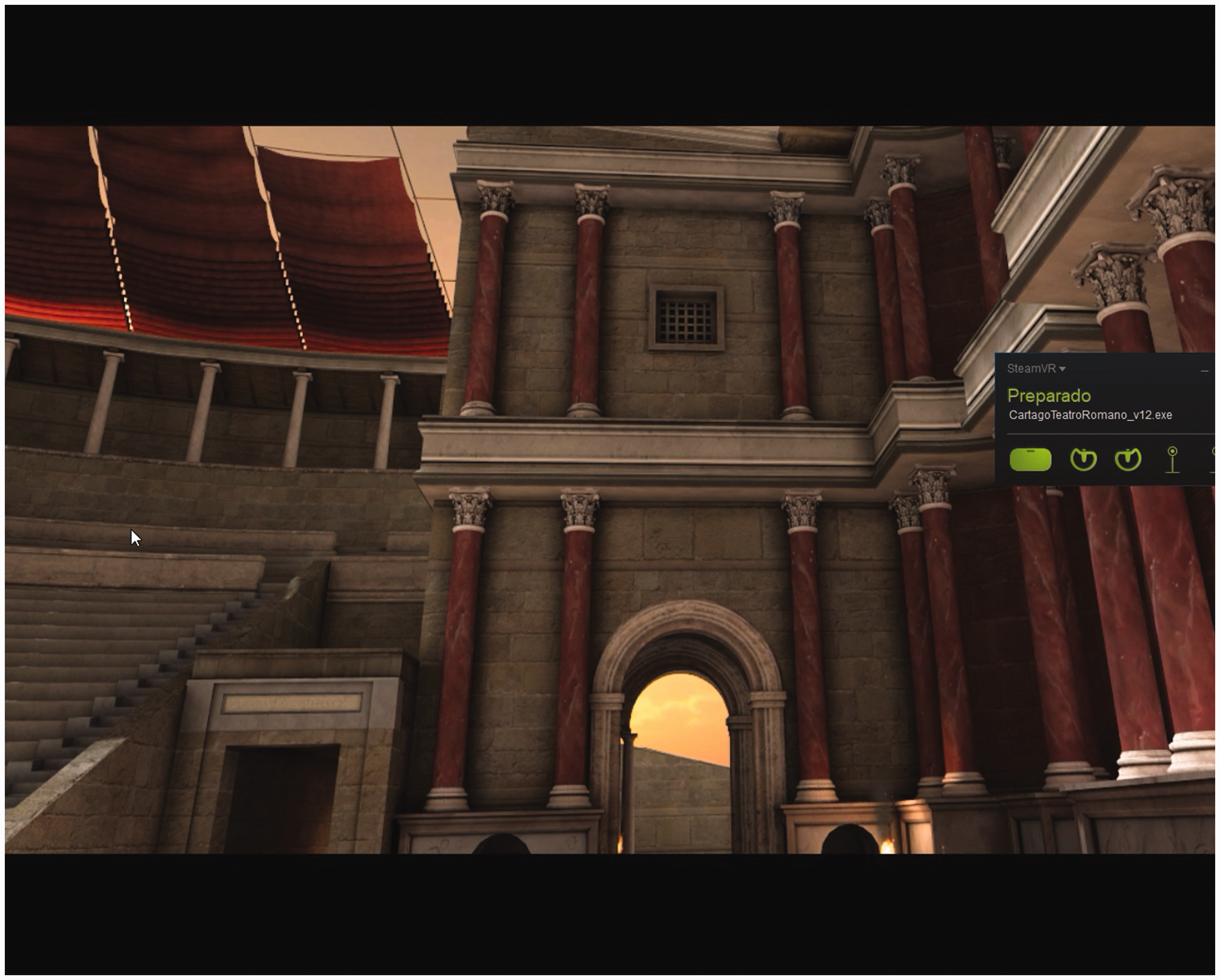
Reconstruction of a part of the scaena frons of the Roman theatre of Carthago Nova (Source: Fundación Integra).
During this specific action, students/players have to work as a team and, taking turns, participate in the IVR game. In this game-play dynamic, four students cooperate so that they can successfully complete every task. During the game they also have to demonstrate ability to use the controllers, execute actions and navigate the environment. At the same time, they have to look for the capsules of information that are displayed after the completion of tasks (Figure 3). These capsules display short texts and images with information about the theatre and the Roman era (society, economy, religion, etc.). The team should write down some of the information in order to answer key questions at the end of the experience. As for teachers, they have a fundamental role in previous and after the game activities, but not during the playing itself. The specifics of the activities and game dynamics can be consulted in Arias-Ferrer et al. (2018).
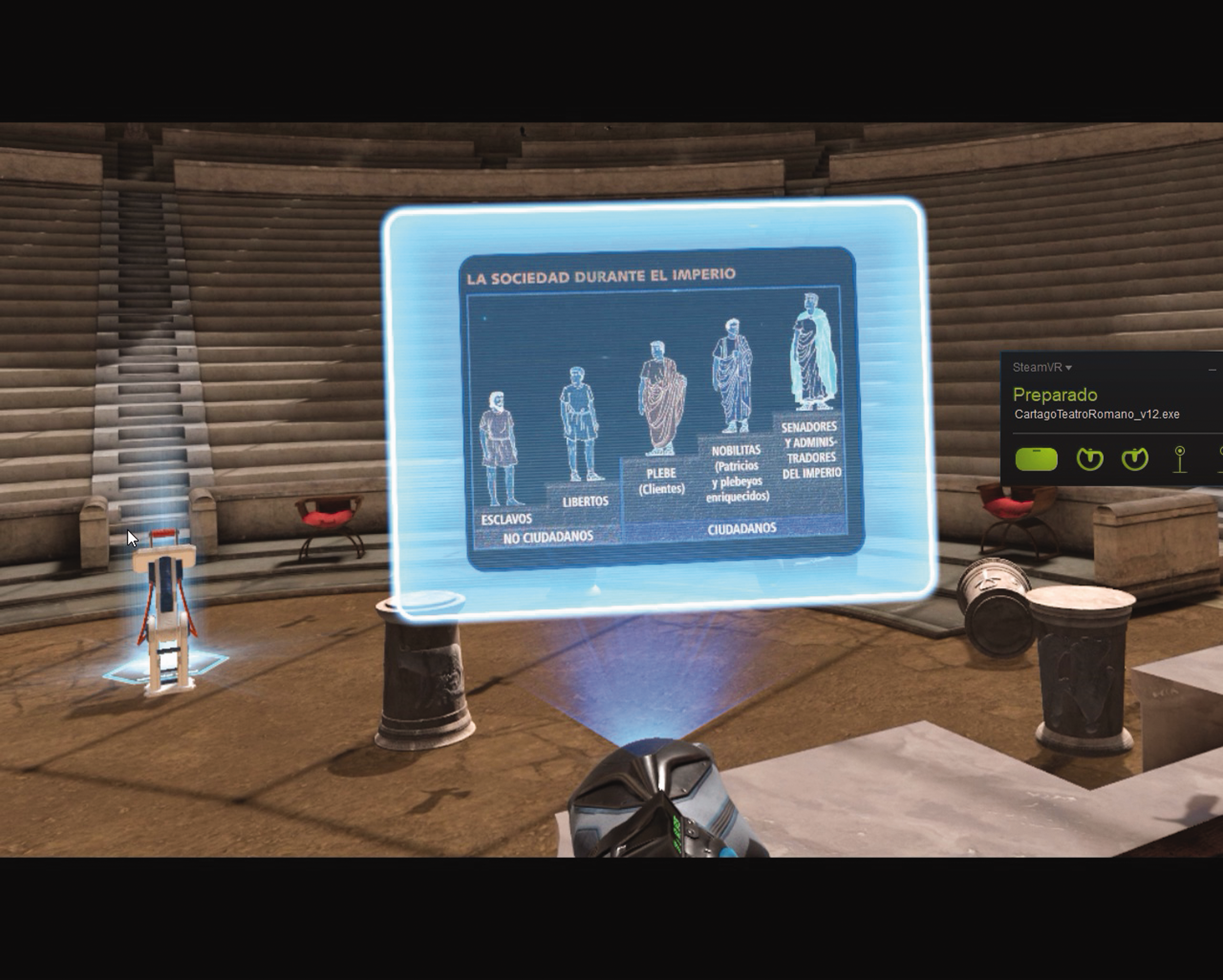
Example of an information capsule that participants encounter during the game (Source: Fundación Integra).
The general aim of the designed video game was to introduce the Roman theaters and historical and archaeological contents representative of this culture. Therefore, the contents selected were related to the social organization and religion at Roman times. On this basis alone, the video game could be considered an educational game (serious game-edutainment). However, in order to enhance its educational aspect, the basic principles mentioned above (CREAM Model) were followed not only in the video game itself, but also in the pre and post activities that contextualize the game.
Civic education
The archaeological heritage and therefore civic burden of the game dynamics is always present. The game was part of the narrative “Heritage Heroes”. This narrative includes specific missions for those who want to join the “Heritage Heroes” forces. The narrative is the next: An alien race wants to erase the past of the humans by distributing OOPArt (Out Of Place Artifacts) throughout the tangible culture of the place. In this specific case the Roman theater was the setting of the mission. The player, as the agent who has to prevent the past from being changed, has to identify and collect the OOPart.
Pre and post activities encourage students to reflect on and discuss the effect that the loss of cultural heritage can have in societies and to evaluate the need of preserve the past. That let students talk about relevance, which is the next principle introduced in the game dynamics.
Relevance
What should a 12–13-year-old student remember about Roman culture? When designing the dynamics of the game and the specific tasks involved, the elements that were considered most characteristic of Roman times, such as society (social organization, costumes), economy (consolidation of agriculture, trade and mining), architecture (techniques and infrastructures) or religion (mythology), were stressed. It is for this reason that throughout the Roman theater the player is confronted with different tests that reinforce those specific themes. For example, the Roman theater reflects perfectly the social organization of the Romans and its stratified nature. As it is known, in Roman times the social classes were distributed differently according to the cavea. The task involves taking different tags with the name of different social classes (slaves, leaders, wealthy people, etc.) and dragging them correctly to the specific part of the grandstand in which they should be located (proedria, ima, media, summa cavea) (Figure 4).
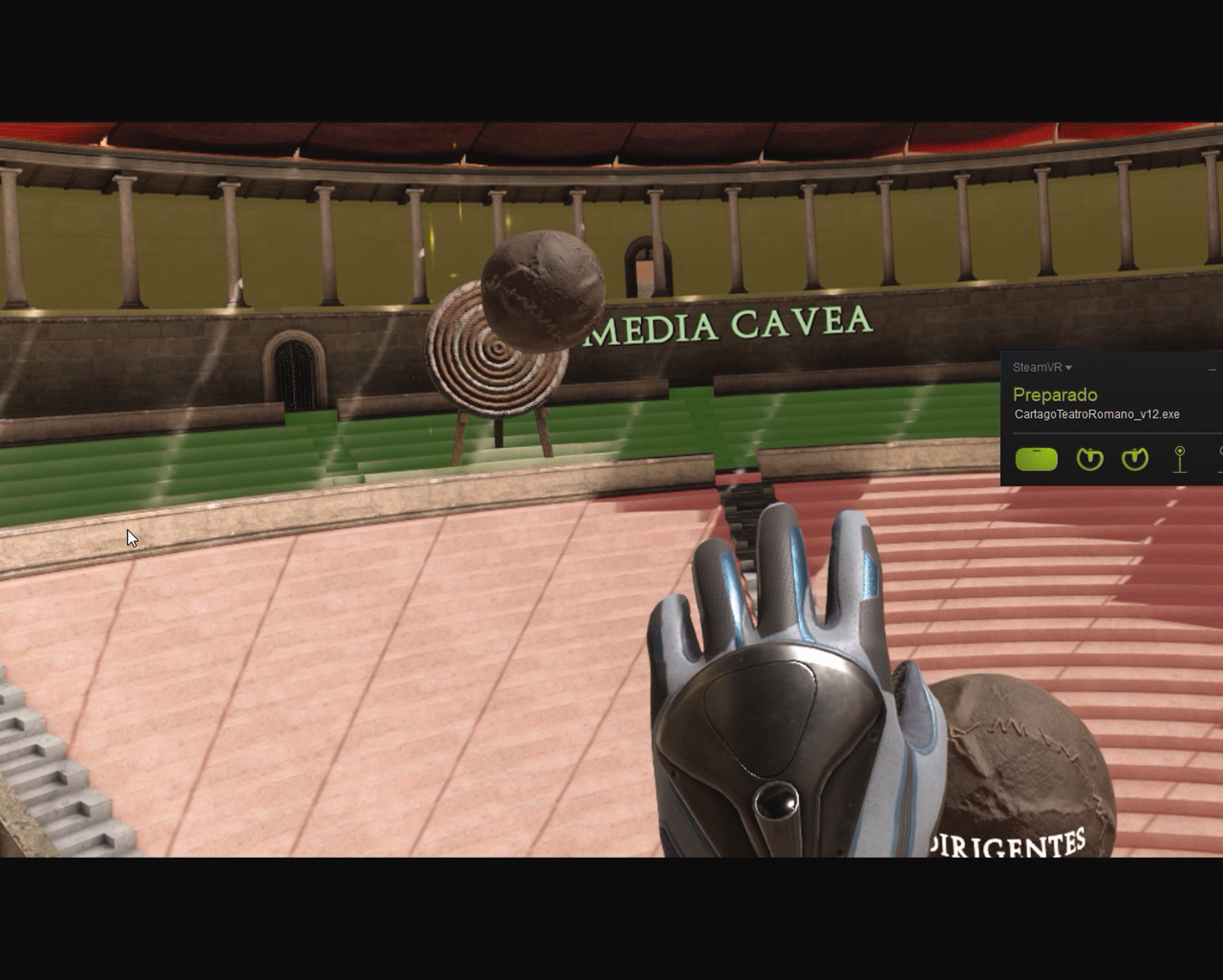
Task in which the participant has to organize social classes within the cavea (Source: Fundación Integra).
The historical significance of the period is also worked on in the activities that contextualize the game, making students reflect on which elements of the Roman past they consider most important.
Engagement
The game was conceived to be played with the immersive virtual reality devices HTC Vive and Oculus Rift. The medium itself proved to be motivating.
The role of students in the game and their engagement in the tasks were emphasized by their involvement in the storyline. That is why game and pre and post activities were included in a narrative in which players/students become “Heritage Heroes”. As mentioned before, they must prevent an alien race from a future world from destroying the past. Through this virtual simulator, students can gradually improve their skills and become members of the “Heritage Heroes” team of agents.
The integration of the game in a narrative, where the students have a role in the story and an aim to achieve, ensured the engagement of the students in the tasks along the whole process and also during the most knowledge-based tests or tasks.
Also the tasks to be solved combine both content knowledge with technical abilities and different visual aids. For example, although some tests can be defined as conceptual (social classes, parts of a column, etc.) they are worked in a visual way where the skills of the gamer are also valuable. There are no simple narration-question-answer mechanisms.
Applicability
The learning standards and contents of the 1st year of Compulsory Secondary Education curriculum (Real Decreto 1105/2014) were taken as the reference and starting point. Likewise, activities were designed to reinforce those contents considered most relevant by teachers. Social stratification and the polytheistic character of the Roman religion were mentioned among the most discussed topics in class. Both topics are represented and have specific tasks within the video game and during the pre and post activities. For example, one of the tasks consisted of identifying some divinities of the Roman pantheon through their usual allegories.
Multimodality
Contents considered key in the didactic sequence are reinforced by the game because they are essential for the successful completion of the tasks. Moreover, the player/student receives the information in different ways. Together with the 3 D reconstruction of the Roman theater there is the voice-over of the narrator which guides all the dynamics of the game. The voice-over is in charge, for example, of explaining certain information capsules that are displayed each time an OOPArt is destroyed. Also, during the tasks, the voice-over reinforces the action, visually represented, with more information that is sometimes accompanied by small written paragraphs. Audio, image and text are combined to deliver the information. The design and selection of the information given to the students is critical. Thinking carefully about what is important to be transmitted is essential to focalize the final message the student receives. Also, the language (visual and textual) should be precise, concise, and understandable for the students.
This video game has been implemented in both non formal and formal educational contexts. Although the game and proposal have not been assessed in an evaluative study yet, the observation of the first pre-pilot suggests its positive value as it favors a more motivational and creative approach to History lessons. For instance, after finishing the game, some students made comments about how “cool” they thought the game was, and how interesting History lessons would be, with such a resource, causing an improvement in their learning experience and knowledge retention. [ME 25] Alejandro: “Porque es una manera divertida, entretenida y dinámica de aprender” [Because it is a fun, enjoyable and dynamic way to learn] [ME 07] Pablo: “Además de jugar también aprendes. Yo personalmente he aprendido cosas que no sabía y el modo de hacerlo como un misterio está bastante bien ya que hace que te atraiga” [And on top of playing you also learn. I personally have learnt things I didn’t know, and the way to do it as if it was a mystery is pretty good because it makes you feel engaged] [ME 20] Daniel: “Porque la información se guarda mucho mejor en la cabeza si disfrutas de lo que estás haciendo” [Because the information it is much better kept in your head if you enjoy what you are doing]
Conclusions
The CREAM Model tries to underline the importance of the reflection process needed when developing any educational resource. Specifically, the CREAM Model achieves the aim of successfully introducing educational games in which archaeological and cultural heritage are protagonist. They are usually linked to History teaching, as it benefits the comprehension of tangible culture. Normally, the lack of this connection leaves the cultural properties decontextualized and no deep comprehension is developed. Therefore, the richness of cultural heritage as historical source loses its meaning.
In this specific case, the basic principles defined are focused on the need of game designers in providing the game with a civic purpose for students to reflect carefully on the selected contents and their role as citizens.
It is important to emphasize the civic load any designed product needs to have if the cultural and/or archaeological heritage is included in the theme. This civic orientation needs to be focused on the knowledge, appreciation and conservation of those cultural properties. It is essential to make students aware of the fact that tangible culture is an important part of history, of their common history. To promote greater awareness of conservation, students need to value it beyond the purely artistic (Haddad, 2016). The closeness and interaction produced by IVR helps to strengthen these links between tangible culture and player. Its immersive character is key to promote this link. However, for cultural heritage to be fully appreciated, it is essential to establish learning dynamics that go beyond a mere reproduction of contents or its mere aesthetic dimensions.
One thing that is also decisive for the teaching of history in general is to give meaning to the teaching itself. In this sense, a correct selection of contents is key for the success of the designed product if the aim is to be educational and developed in school contexts. Express reference is made to this aspect, since students tend to have difficulties in determining which historical events are key and why. This usually causes serious problems when it comes to understanding a historical discourse. In this case, the fact that designers and teachers ask themselves what they intend to teach and why (in terms of historical significance) is fundamental. A good selection of contents and a serious reflection about their relevance in the past and/or in the present, will let the player/student see a certain usefulness in the contents that are going to be interwoven in the plots of the video game. If this challenge is met, it will be easier to break the apparent uselessness that this discipline has for many students and the lack of motivation for learning (Fuentes, 2003).
It has already been pointed out how video games per se engage students, regardless of the discipline or subject introduced into the classroom. However, when educating, it is necessary to go beyond the mere entertainment; it is essential to design tasks with specific teaching aims and to contextualize the resource within an attractive strategy. This strategy should be attractive both for the students and the teachers if the product is to finally be used in the classroom. In today's whirlwind world, the success of a strategy cannot only depend on the teachers’ ability to seduce students, but also on their ability to motivate other teachers (Luna, 2019). This is called applicability.
Finally, in an era in which stimuli are so varied, it is vital to ensure that the information to be transferred arrives in all possible ways. In this sense, multimodality is basic: text, video, audio, images must be combined appropriately to ensure that the messages to be transmitted are effectively put across.
Thus, a deep reflection on the data, inputs, tasks and aids used prior to the design of any game experience becomes essential (Šisler et al., 2012). One must avoid the trap of thinking that a video game teaches by itself (Cabero, 2003). The interest and motivation of the students is initially granted, predisposing them to want to know more (Froschauer et al., 2012). Yet, it is important to remember that this does not ensure a greater understanding of the historical period that is being told.
Despite the positive results summarized in this paper, there are some limitations worth mentioning, such as the difficulty of organizing such immersive experiences in educational centers. There is a considerable deployment of media, expensive resources, and time investment involved. Additionally, it is hard to reach a large number of students at the same time precisely because of the costs of the materials used. Consequently, the possibilities of these games having a real impact on education are reduced, as it is the gathering of significative samples for their assessment.
The experience in Región de Murcia (Spain) has been an exception. The effort that Fundación Integra has made to integrate the products in the educational context (formal and non-formal) has allowed teachers and students access to these resources. It is because of this that assessing some of the products created has been possible, which at the same time has allowed for the reflection, based on the outcomes, on the link among technology, motivation, enjoyment and education.
From this reflection the proposed new model was born. Nevertheless, the researchers are aware that without specific results obtained from educational investigation and with no empirical data with a larger sample to validate the model, establishing the real relevance of the design of video games will be hard.
Besides, there are many questions left to answer regarding the application of video games in education. However, these queries should address more than the analysis of their usability and the knowledge to be acquired. There are multiple implications associated to the introduction of these resources in the classroom, and plenty of interrogations steaming from them: What social and cooperation dynamics can be developed with this type of experiences? What is the role that teachers could or must play? How receptive are educational centers towards this type of learning? Are they ready, or not? The research avenues being unlocked are boundless.
Footnotes
Declaration of Conflicting Interests
The author(s) declared no potential conflicts of interest with respect to the research, authorship, and/or publication of this article.
Funding
The author(s) disclosed receipt of the following financial support for the research, authorship, and/or publication of this article: This research was supported by the project EDU2015-65621-C3-2-R (Ministerio de Economía y Competitividad-Spain/FEDER) and the knowledge transfer contract 30915 (Universidad de Murcia-Fundación Integra, artículo 83 LOU).
