



Abstract
Virtual reality (VR) holds substantial potential for enhancing learning in physical education (PE), with applications ranging from exergames to more realistic sport simulations and motion-feedback systems. However, many assumptions regarding its usefulness in PE are derived from conceptual or laboratory-based research rather than from studies conducted in authentic school settings. This systematic review addresses this gap by examining the types of VR applications used in K–12 PE, including curricular and extracurricular contexts, modes of implementation, and the main outcomes reported in empirical studies. Following PRISMA guidelines, a systematic search was conducted across two databases (Web of Science and Scopus) and one meta-database (EBSCOhost). Eleven studies published between 2017 and 2024 met the inclusion criteria. The reviewed applications varied in their level of immersion and design features, including exertion interfaces, gamification elements, and degrees of sport-related realism. Proposed mechanisms of effectiveness primarily emphasized VR's engaging qualities and its potential to support personalized learning. In practice, low-immersive systems were frequently selected to address resource constraints such as limited facilities or instructional staff. The findings suggest that immersive VR can improve visual–perceptual and psychomotor skills and promote physical activity. While some evidence indicates benefits for beginners in sport-specific tasks, only a small number of studies integrated VR into established teaching practices. Overall, VR is predominantly used as an exercise-oriented tool to enhance general physical fitness and broader perceptual–psychomotor capabilities, rather than to support sport-specific skill learning or knowledge acquisition.
Keywords
Introduction
Background
Digital technologies increasingly shape educational systems worldwide, influencing teaching practices, curriculum design, and student learning experiences. In recent years, the integration of technology into the domain of physical education (PE) has attracted significant scholarly attention (e.g. Casey et al., 2017; Koh et al., 2022; Wallace et al., 2023), reflecting broader educational trends identified by Wang et al. (2024).
Virtual reality (VR) has seen substantial technological and commercial development over the past decade. While VR has a long-standing history in high-performance training contexts such as aviation and surgery (Jensen and Konradsen, 2018), VR gaming has expanded rapidly and now includes numerous sports and training applications (Elsholz et al., 2025). Interest in VR in compulsory and higher education has likewise grown, as evidenced by reviews by Di Natale et al. (2020) and Marougkas et al. (2023). Although bibliometric studies show an increase in VR-related publications within PE since around 2014 (Calabuig-Moreno et al., 2020), VR remains largely absent from reviews of digital technology in PE in K–12 education (Jastrow et al., 2022; Sargent and Calderón, 2021). This can partly be attributed to the time frames of those reviews, which include studies only up to 2020. Since then, several standalone VR headsets have been released, offering improved usability (Ramaseri Chandra et al., 2022; Rana et al., 2023). As a result, VR has become more affordable and practically feasible for educational settings.
Existing reviews highlight the potential of VR through exergames, sport simulations, and motion-correction applications, suggesting opportunities for reducing the risk of injury, personalized and enjoyable learning experiences, skill development, and access to otherwise unavailable sports (Kuleva, 2024; Pérez-Muñoz et al., 2024; Putranto et al., 2023). However, this remains an assumption, as there is little evidence from K–12 school settings, which are the focus of the present review.
Technical foundations and key concepts of VR
VR refers to computer-generated, three-dimensional environments that enable users to perceive and act while eliciting a sense of presence (Slater and Sánchez-Vives, 2016). A key advantage is the possibility of experiencing situations that would otherwise be difficult or impossible to access (Slater and Sánchez-Vives, 2016). It is important to note that VR is not new and goes back to the 1960s, with different iterations including high expectations followed by disillusionment (Walsh and Pawlowski, 2002). The latest technological advances can be attributed to progress in other technological domains, most notably advances in display technology driven by the evolution of smartphones (Polcak and Frantis, 2024).
VR is commonly described through three core attributes: immersion, the substitution of real sensory input with virtual information (Witmer and Singer, 1998); presence, the subjective experience of being in the virtual world (Witmer and Singer, 1998); and interactivity, the extent to which users can manipulate elements within the virtual environment (Steuer, 1992). VR systems rely on technologies such as head-mounted displays (HMDs), motion tracking, controllers, and haptic devices (Walsh and Pawlowski, 2002). Following Bowman and McMahan (2007), they can broadly be classified into immersive systems (e.g. HMD-based) and low-immersion systems, which lack head tracking for adaptive viewpoints and rely on single screens. In educational contexts, immersive VR has been associated with affordances such as embodied and experiential learning, increased motivation and engagement, creating otherwise inaccessible or unsafe scenarios, and promoting skill transfer (Di Natale et al., 2020).
VR application types and research evidence in sport and PE
A review of the existing literature in sport science and PE identified three primary categories of VR applications: sport simulations, exergames, and motion-correction systems. Across these categories, many authors emphasize the role of user experience, particularly the motivational and experiential qualities of immersive, well-designed VR environments, as a key factor influencing engagement and learning effects (e.g. Elsholz et al., 2025; Putranto et al., 2023; Richlan et al., 2023). The following section presents these application types, important theoretical assumptions, research evidence and conclusions, drawing mainly on existing reviews.
Sport simulations or sport training applications replicate essential elements of a sports discipline, including its rules, motor skills, and tactics (Elsholz et al., 2025; Neumann et al., 2018). Several reviews have analyzed the potential for learning and training in various sports (Faure et al., 2020; Le Noury et al., 2022; Neumann et al., 2018; Richlan et al., 2023). Skill transfer is a central issue in this context. Representative learning design (see Pinder et al., 2011) proposes that transfer occurs when VR preserves the informational variables and response demands of the real performance environment (Le Noury et al., 2022). Accordingly, sports can be simulated in various ways depending on their demands. For example, in golf, real clubs and balls can be tracked and transferred into a virtual golf environment (Lee et al., 2013). In exercise contexts, interfaces that measure exertion, such as ergometers, are used (Neumann et al., 2018). Table tennis simulations use HMDs with haptic controllers (Michalski et al., 2019). Team sports simulations often focus on perceiving and responding to tactical scenarios (Pasco, 2013).
Neumann et al. (2018) reviewed VR sport applications, which predominantly focused on endurance sports and reported positive effects on several performance outcomes. However, generalizability is limited because most studies involved novices and varied widely in conditions such as immersion level or design elements such as competition. In other sports, evidence shows effective transfer for novices in tasks such as table tennis and golf, whereas skilled golfers show no VR-based improvement (Le Noury et al., 2022; Richlan et al., 2023). In team sports, VR has been used to analyze goalkeeper performance and to enhance tactical awareness and decision-making through perceptual–cognitive scenarios (Faure et al., 2020; Pasco, 2013; Richlan et al., 2023). While VR can present perceptual stimuli, it remains limited in enabling adequate motor responses such as passing. As Pasco (2013) noted, VR is limited in its ability to improve complex open skills. More broadly, Richlan et al. (2023) argue that positive transfer should be treated with caution and may not occur in the same way as in the domain of surgical training. In sum, VR can promote skill transfer and performance enhancement, but its effects depend heavily on the sport, the specific skill, and the target population. Notably, negative outcomes have also been reported (Elsholz et al., 2025).
The practical availability of VR systems for PE varies widely, ranging from research-based or stationary installations to commercially available VR sports games (Kuleva, 2024). Elsholz et al. (2025) provide a taxonomy of immersive VR sport applications across various sports and non–sport-specific exergames and note that most focus on upper-body activities due to current headset capabilities, with few addressing full-body movements. They further report that commercial applications prioritize user experience and enjoyment over skill transfer, highlighting both their potential and limitations for PE.
Exergames combine gaming and physical exercise and are used to promote students’ engagement in physical activity (PA) (Vaghetti et al., 2018). Reviews of PE research mainly report low-immersive, motion-controlled systems such as the Xbox 360 Kinect (Jastrow et al., 2022; Sargent and Calderón, 2021), which have been linked to physical and motivational outcomes and, in some cases, to sport skill learning or dance instruction (Jastrow et al., 2022). Recent advances in immersive VR have expanded exergame formats, including rhythm games, omnidirectional treadmill systems, and flight simulators, which can elicit moderate-to-vigorous PA (Giakoni-Ramírez et al., 2023; Sousa et al., 2022); however, these newer formats are not captured in PE-focused digital technology reviews.
Motion-capture systems can provide real-time augmented feedback by comparing user movements with expert models (Kuleva, 2024; Pasco, 2013; Putranto et al., 2023). This type of feedback can also be implemented in motion-based VR games, which could be an effective format for PE contexts (Putranto et al., 2023). While HMDs often offer additional capability, they can restrict the user's view of their own body during movement learning (Kuleva, 2024). Systems such as the Cave Automatic Virtual Environment mitigate this limitation through multiple projection surfaces and have demonstrated superior results in martial arts training compared to HMD-based approaches (Kuleva, 2024). Finally, Pasco (2013) proposed that VR environments can be used for conceptual learning. For example, a tactical football simulation can be used not only to improve perceptual–cognitive performance, but also to promote conceptual understanding.
The present review
Although VR has considerable potential to support learning in PE, key limitations remain, including the management of diverse technical equipment and the achievement of skill transfer, which appears possible but requires careful instructional design. VR applications also vary widely in their intended purposes, ranging from promoting PA to offering immersive sport experiences, supporting skill practice, and fostering conceptual knowledge. Evidence from real school PE settings, however, is limited, particularly regarding how such applications are used and pedagogically integrated, for example through their alignment with instructional models. Reviews indicate that digital technologies in PE are predominantly employed with a focus on relatively narrow outcome dimensions, such as physical performance and student engagement (Jastrow et al., 2022; Sargent and Calderón, 2021). It therefore remains unclear whether VR applications in PE follow a similar pattern. Existing reviews on VR in PE (Kuleva, 2024; Pérez-Muñoz et al., 2024; Putranto et al., 2023) have not focused on empirical studies conducted in PE-related contexts, with only a limited number of studies situated in educational settings. As a result, there is limited evidence on which types of VR applications are used in PE, how they are implemented, and which outcomes are observed under more ecologically valid school conditions.
Accordingly, the following research questions are addressed: RQ1: What types of VR applications are used in PE research? RQ2: How has VR been used and justified in PE research? RQ3: What are the main outcomes of using VR in PE research?
Methods
We conducted a systematic literature review following Preferred Reporting Items for Systematic Reviews and Meta-Analyses (PRISMA) guidelines and the recommended protocol (Page et al., 2021).
Search strategy
The search was limited to publications from 2014 onwards, reflecting a period of growth in VR and increasing scientific interest (Calabuig-Moreno et al., 2020). Only peer-reviewed articles were included to maintain quality and consistency. As part of the predefined eligibility criteria, only studies published in English were included. This language restriction was applied to ensure consistency in data extraction and interpretation, to minimize potential bias introduced through translation, and to maintain feasibility within the scope of the review. The limitation of this restriction is acknowledged as a potential source of language bias and is reported transparently in accordance with PRISMA guidelines.
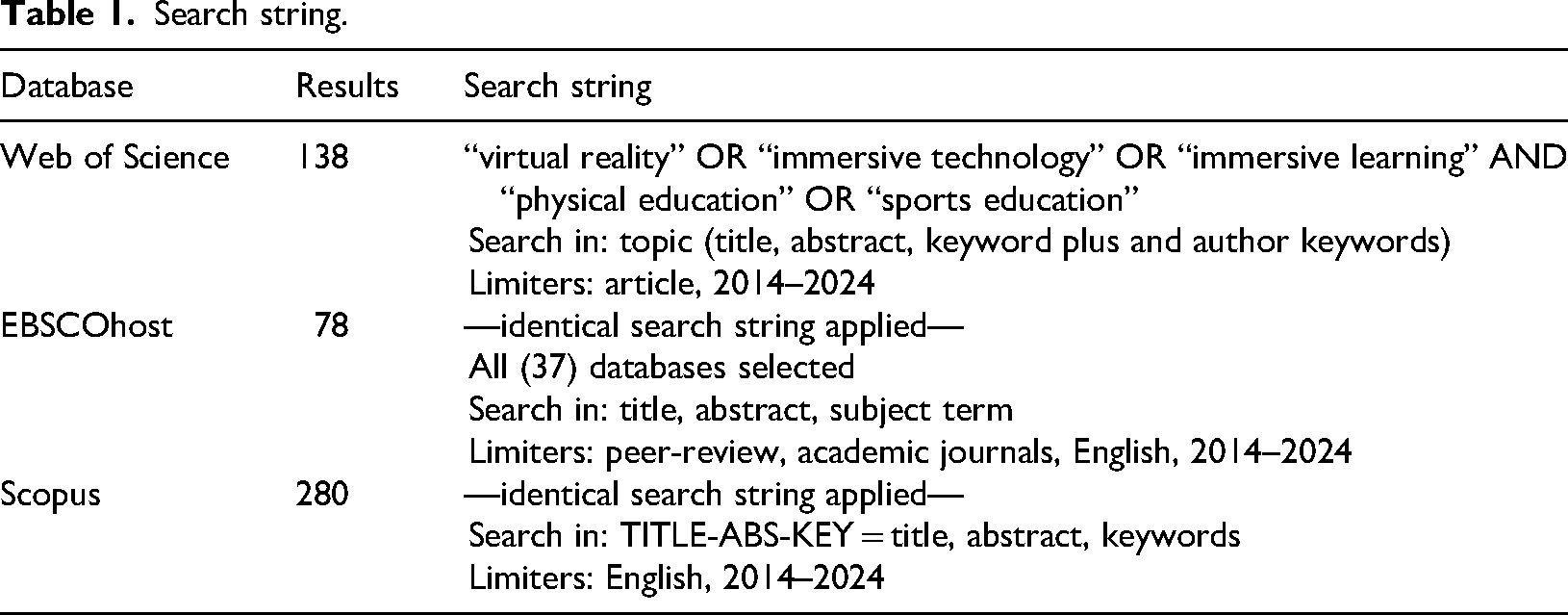
The databases used for the search were Web of Science, Academic Search Premier (EBSCOhost), and Scopus (see Table 1).
Search string.
Keywords
Initially, we conducted a preliminary search to gain an overview of the scope in terms of applications, methodologies, theories, and concepts. To identify relevant VR applications, we used “virtual reality” as the primary search term. Additional terms like “immersive technology” and “immersive learning” were included, but yielded only a few additional results. For the second part of the search, we focused on relevance to PE in schools. Thus, we applied the terms “physical education” and “sports education.”
Data extraction and analysis
A total of 496 articles were identified from searches conducted between September and October 2024. After manually removing 113 duplicates, 383 articles remained for screening based on title and abstract. An additional three studies were added using citation searching (Page et al., 2021). The exclusion of records based on title and abstract is documented in the flowchart (Figure 1), following the predefined exclusion criteria outlined in Table 2.
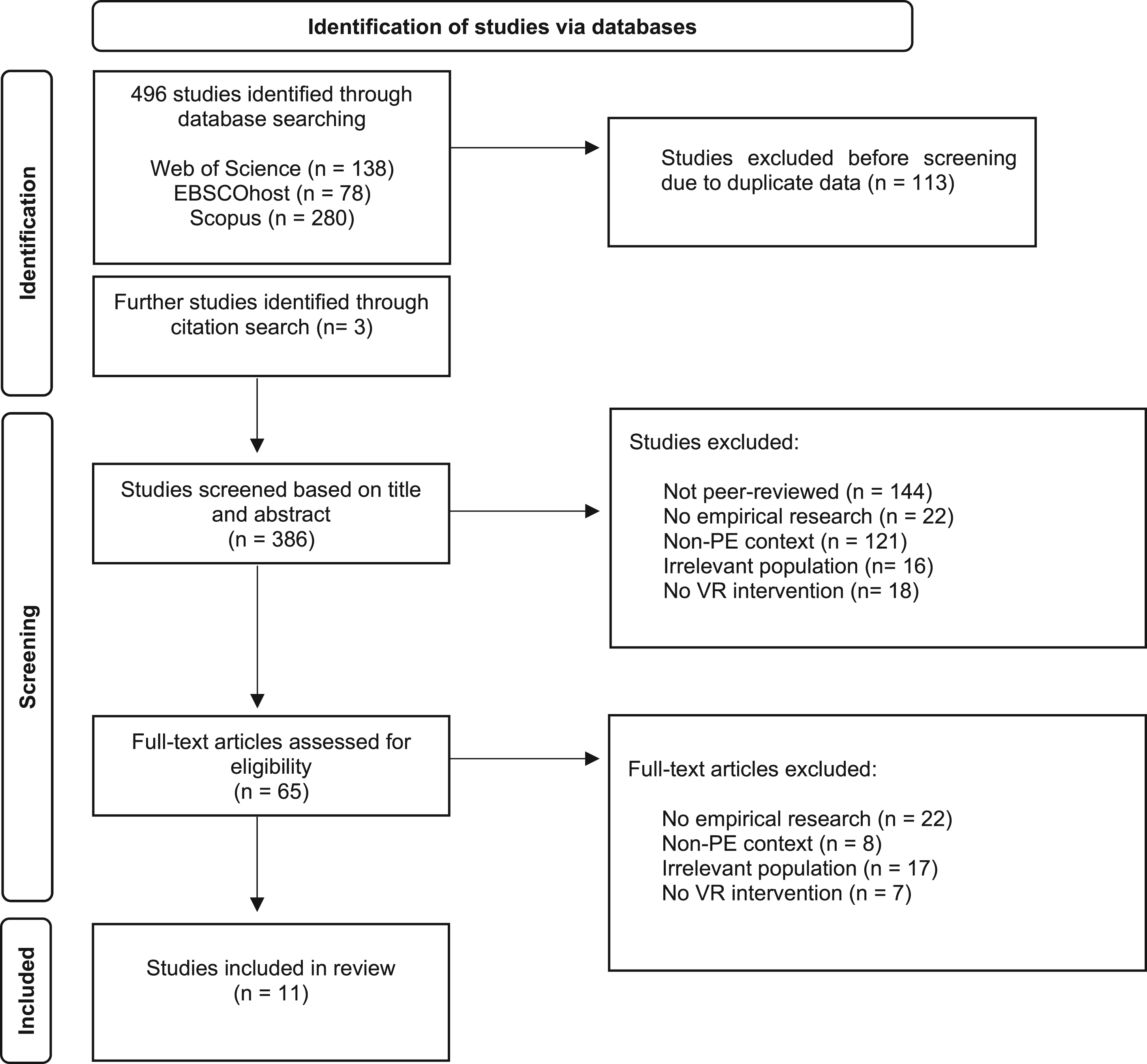
PRISMA flowchart diagram of the study selection process (based on Page et al., 2021).
Eligibility criteria.
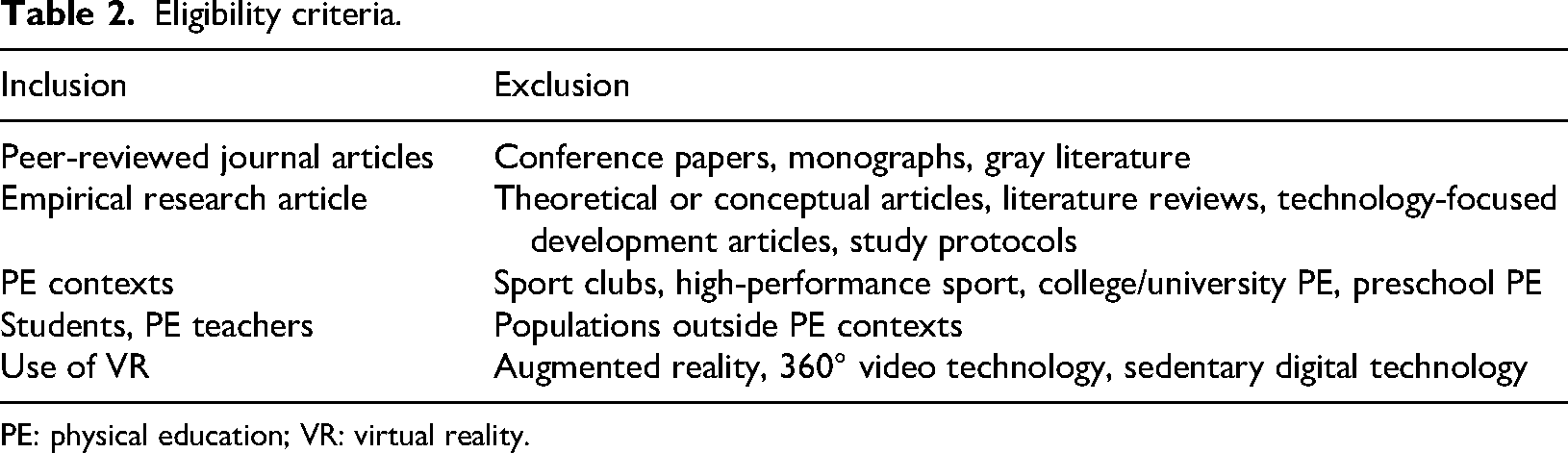
PE: physical education; VR: virtual reality.
To define eligibility with regard to PE contexts, we adopted a broad understanding in line with Balz et al. (2020), encompassing regular curriculum-based PE as well as school-based PA programs and extracurricular PAs. These contexts share key pedagogical characteristics, as they are typically located within school environments or are organizationally embedded in the school institution. Accordingly, PE teachers serve as the primary professionals responsible for PA-related topics, with students representing the target population.
On this basis, full texts were subsequently assessed for eligibility. The first author and an additional researcher conducted this process independently, resulting in 100% consistency in the final selection.
To address RQ1, we categorized the heterogeneous VR applications by beginning with the distinction between VR exergames and sport applications oriented toward realism. Applications that did not fit either category were subsequently grouped into two additional types: VR-based assessment and VR learning tasks. The classification was based on study descriptions and visual material, supplemented where necessary with publicly available information.
With regard to RQ2, we examined how VR was implemented and justified in the included studies. This involved analyzing the intended objectives of the VR-based programs as well as the ways in which VR technology was integrated into lessons. Justification was defined as the authors’ stated reasons for considering VR appropriate for achieving these objectives, as well as for its broader implementation in school contexts.
For RQ3, we compiled an overview of each study, summarizing the VR applications used, educational level, country, study objectives, research design, participant characteristics, and main outcomes.
Quality assessment
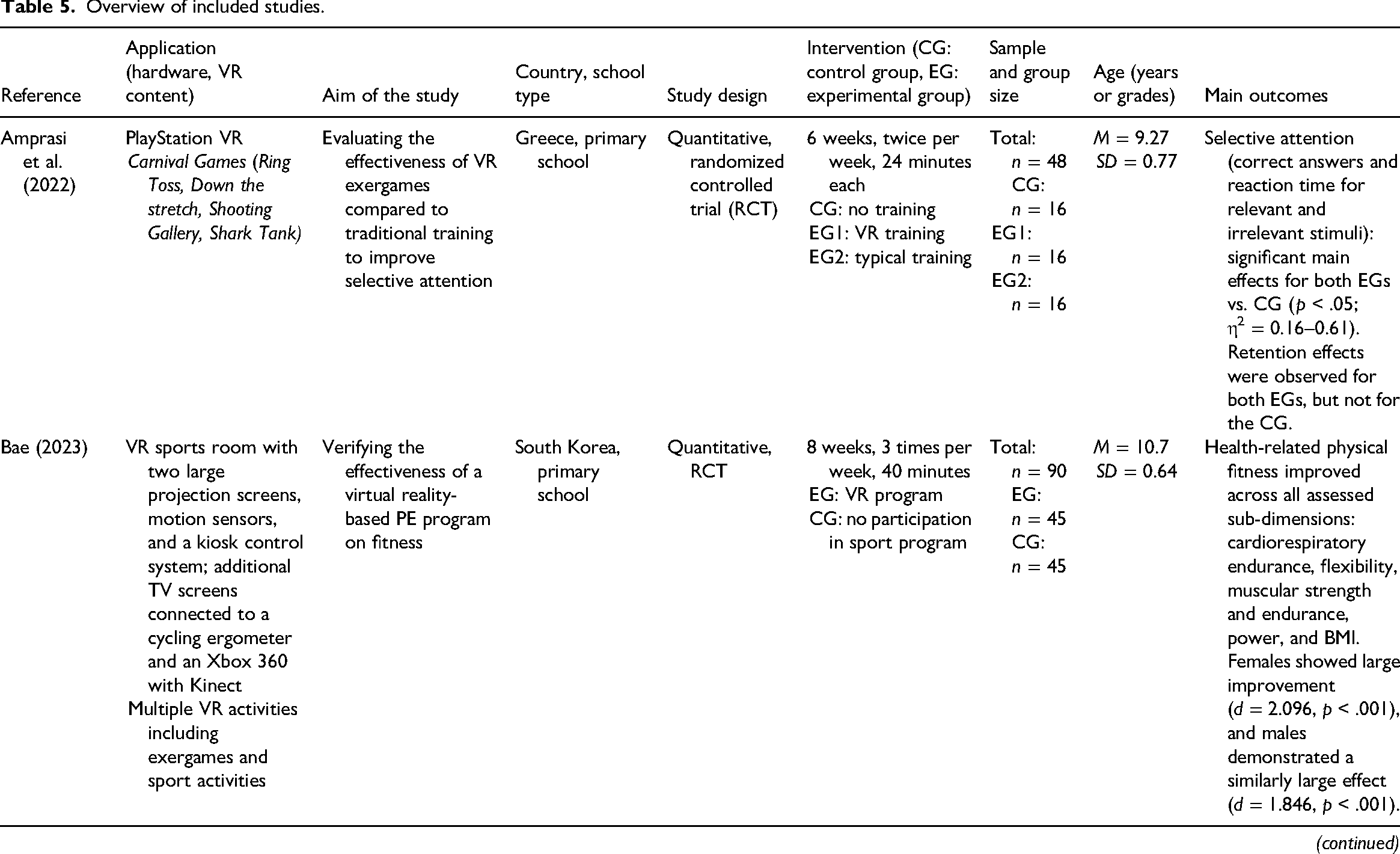
The Physiotherapy Evidence Database (PEDro), a 10-item scale used to assess the methodological quality of the included studies (Maher et al., 2003), was applied to quantitative and mixed-methods studies. Overall, eight studies employed a quantitative design, one used a mixed-methods approach, and two adopted a qualitative design, as shown in Table 5.
The PEDro scale was applied independently by two researchers, resulting in full agreement (100%). It has been used in various reviews in the field of PE (Mödinger et al., 2022; Müller and Wagner, 2025; Zhou et al., 2021). A score of five or higher indicates high methodological quality, whereas lower scores reflect lower quality (Cancela et al., 2014).
Overall methodological quality was rated as medium (see Table 3), primarily due to the lack of group blinding. This limitation can be partly attributed to the authentic school setting, which enhances ecological validity but limits control over variables compared to more controlled laboratory conditions. Studies whose designs did not align with PEDro's focus on controlled interventions were not rated, i.e. Polechoński (2024) and Lorås et al. (2023), as well as the qualitative studies by Bores-García et al. (2024) and Geisen et al. (2023). Further details on these studies are provided in Table 5.
Quality assessment.
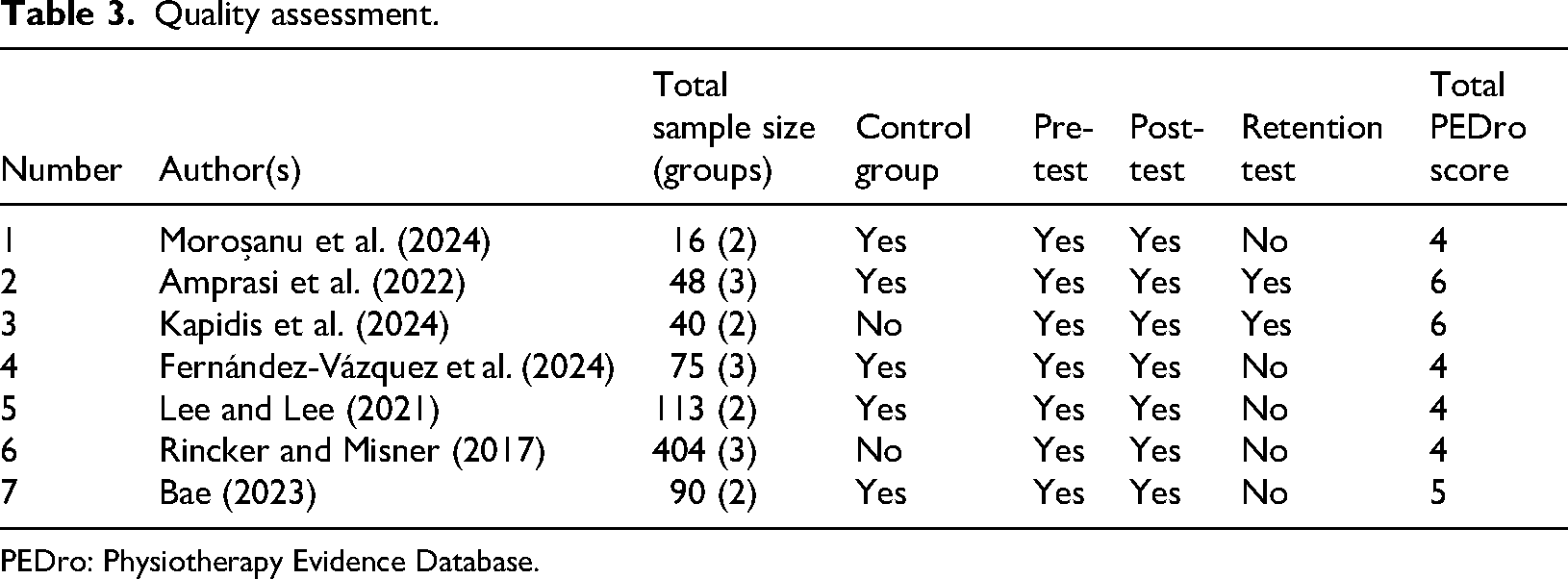
PEDro: Physiotherapy Evidence Database.
Findings
General bibliometric overview
This review included 11 studies published between 2017 and 2024, involving participants from primary to high school and, in two cases, PE teachers or researchers (see Table 5). One qualitative sub-study, conducted by Bores-García et al. (2024) as part of the larger project reported by Fernández-Vázquez et al. (2024), examined PE researchers’ experiences of conducting VR research. Most studies were conducted at the primary level (n = 6), followed by middle school (n = 3), two of which originated from the same project, and one at the high school level. Geographically, eight studies were carried out in Europe, two in Asia, and one in North America (see Table 5). The research contexts varied. Five studies were implemented during regular PE lessons (Bae, 2023; Bores-García et al., 2024; Fernández-Vázquez et al., 2024; Lee and Lee, 2021; Rincker and Misner, 2017). Others were conducted in school-based programs outside regular PE lessons (Amprasi et al., 2022; Kapidis et al., 2024; Moroșanu et al., 2024). Geisen et al. (2023) examined an extracurricular dance class, whereas Lorås et al. (2023) used a laboratory-style setup within the school. Polechoński (2024) was the only researcher to conduct a study in an external laboratory, also assessing PE teachers’ perceptions of VR's applicability in PE contexts, which was the reason to include this study.
What types of VR applications are used in PE research? (RQ1)
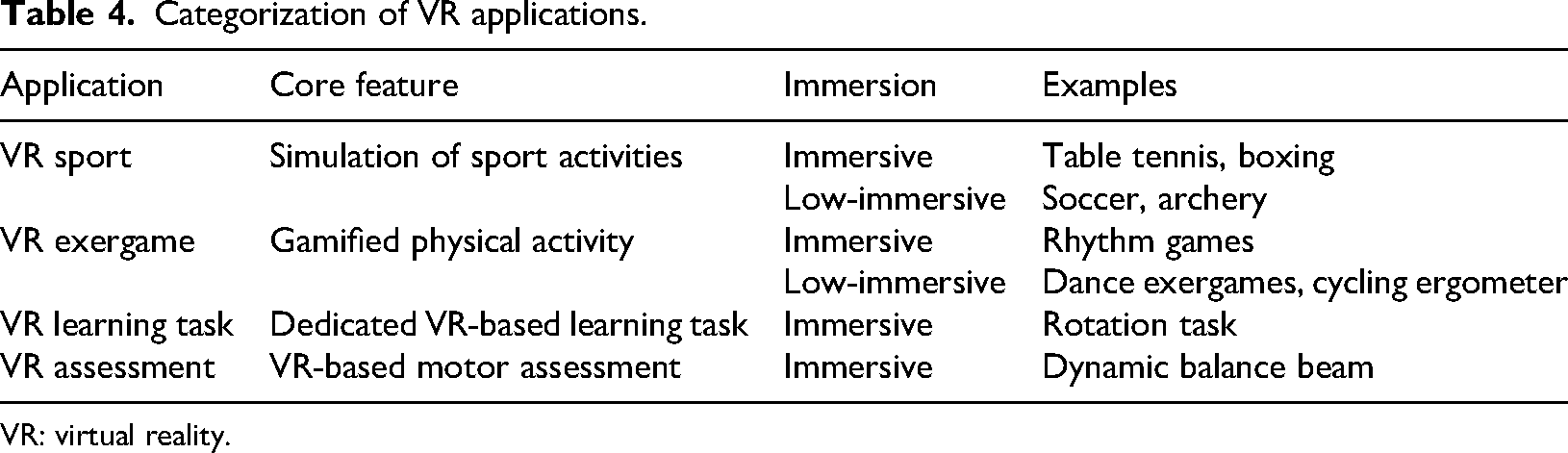
The applications identified in the reviewed studies were classified into four categories (see Table 4). It is important to note that this categorization does not reflect their practical use, as many studies implemented bundles of different activities. These combinations, including the hardware, are listed in Table 5.
Categorization of VR applications.
VR: virtual reality.
Overview of included studies.
PE: physical education; VR: virtual reality.
First, several studies employed VR sports applications. Immersive applications included table tennis, with Kapidis et al. (2024) and Moroșanu et al. (2024) using Eleven Table Tennis and Polechoński (2024) using Racket Fury: Table Tennis VR. Other sports represented were climbing, through The Climb (Fernández-Vázquez et al., 2024), and boxing, through The Thrill of the Fight (Moroșanu et al., 2024). These studies all used HMDs with handheld haptic controllers as the main interface, without additional sports-specific equipment. Low-immersive sports activities were implemented in projection-based VR rooms. For example, Lee and Lee (2021) used soccer shooting, while Bae (2023) additionally included archery shooting and baseball batting. In these studies, real equipment was used.
Second, many studies utilized exergames. Immersive exergames included Carnival Games (Amprasi et al., 2022), Oh Shape and Reakt Performance Trainer (Moroșanu et al., 2024), and Beat Saber (Fernández-Vázquez et al., 2024; Kapidis et al., 2024). Low-immersive exergames were also frequently used, such as Just Dance 2022 (Fernández-Vázquez et al., 2024) and a custom-developed cultural dance exergame by Rincker and Misner (2017). Bae (2023) incorporated cycling on an ergometer as well as skiing, boxing, and dancing games on the Xbox 360 using the Kinect motion sensor.
Third, Geisen et al. (2023) implemented an immersive VR-based perceptual–cognitive task using a rotating platform for bodily rotation and a virtual avatar for mental rotation. Finally, Lorås et al. (2023) employed a VR environment to assess gross motor skills using a dynamic virtual balance beam.
How has VR been used and justified in PE research? (RQ2)
VR was predominantly used to provide engaging PAs that functioned primarily as exercise-oriented tools. In most cases, tasks performed within VR environments were of instrumental value, serving to enhance targeted outcomes such as visual–perceptual skills, general motor skills, psychomotor and cognitive abilities, or physical fitness (Amprasi et al., 2022; Bae, 2023; Fernández-Vázquez et al., 2024; Kapidis et al., 2024; Moroșanu et al., 2024). Accordingly, the specific content of the VR application was often secondary to the functional demands it imposed. For example, an immersive VR rhythm game and a table tennis simulation were treated as functionally comparable when both were used to improve hand–eye coordination (Moroșanu et al., 2024).
Nevertheless, some notable exceptions can be identified in which VR content was more closely aligned with specific learning content. Rincker and Misner (2017) employed a low-immersive dance exergame to support the learning of basic dance movements, while Lee and Lee (2021) used VR-based soccer tasks to practice shooting skills. In addition, the rotation task developed by Geisen et al. (2023) was directly linked to the learning problem itself, as it explicitly addressed perceptual–cognitive challenges related to mental and bodily rotation.
With regard to implementation, VR activities were most often positioned as the core activity of the intervention (Amprasi et al., 2022; Bae, 2023; Kapidis et al., 2024; Lee and Lee, 2021; Moroșanu et al., 2024; Rincker and Misner, 2017), while additional elements such as warm-up routines or brief reflection phases were peripheral to the intervention and not central to the targeted outcomes. A distinct approach was represented by the VR rooms used by Bae (2023) and Lee and Lee (2021), which were specifically designed for primary school PE and offered multiple VR-assisted activities within one stationary facility. By contrast, Fernández-Vázquez et al. (2024) integrated immersive and low-immersive VR games into a lesson unit as one activity among several, embedded within a gamified, practice-oriented teaching style. Geisen et al. (2023) further departed from the dominant pattern by using VR as a pedagogical stimulus to support collaborative learning, thereby examining not only individual learning processes but also instructional implications for subsequent dance activities.
Regarding justification, VR was mainly framed as a means to enhance student engagement and motivation, support self-directed and personalized practice, and enable progressively challenging activities with high levels of repetition and intensity (e.g. Fernández-Vázquez et al., 2024; Kapidis et al., 2024; Lee and Lee, 2021). In addition to these pedagogical rationales, VR was also justified on practical grounds, such as addressing structural constraints including limited facilities or physical space (Bae, 2023; Lee and Lee, 2021), limited instructional capacity (Rincker and Misner, 2017), or a lack of sport-specific equipment (Polechoński, 2024).
What are the main outcomes of using VR in PE research? (RQ3)
The results are organized into three thematic areas. Because several studies reported multiple outcome measures, some are referenced under more than one theme (see Table 5 for details). Psychological outcomes were assessed in only a few studies and are reported within the relevant thematic sections. Bores-García et al. (2024) and Lorås et al. (2023) are not included in the main text, as the former is a qualitative sub-study and the latter focuses on motor assessment.
Perceptual, cognitive, and psychomotor skills
The use of immersive VR was frequently explored as a means of improving perceptual skills, including selective attention (Amprasi et al., 2022) and visual–perceptual skills (Kapidis et al., 2024), psychomotor skills (Fernández-Vázquez et al., 2024; Moroșanu et al., 2024), and decision-making under incongruent bodily and cognitive stimuli (Geisen et al., 2023).
Two studies investigated the impact of structured VR interventions by comparing VR exergames with traditional teaching methods in primary school students (Amprasi et al., 2022; Kapidis et al., 2024). Amprasi et al. (2022) found significant improvements in all four indicators of selective attention, operationalized using correct answers and reaction time (RT), with η2 values ranging from 0.16 to 0.61. The control group showed no significant gains on any of these measures. In a study measuring visual pursuit, Kapidis et al. (2024) identified a significant main effect of time (p < .001, η2p = 0.457). No significant group effects were observed, indicating comparable time-related improvements across both programs.
Psychomotor skills were significantly enhanced in high school students not otherwise engaged in sports, as observed by Moroșanu et al. (2024). Their participants demonstrated reduced RTs and improved hand–eye coordination after immersive VR sessions (p < .05). Fernández-Vázquez et al. (2024) reported significant pre–post improvements in coordination-related measures. In Geisen et al. (2023), students perceived the rotation task as demanding and reported increased awareness of their own body, attributed to the discrepancy between physical and mental rotation.
Motor skills
Rincker and Misner (2017) reported increases in dance mastery scores among novice learners following the intervention. The VR-based instruction yielded a slightly smaller, yet still large, effect size compared to face-to-face instruction (d = 1.02 vs. d = 1.36). Similarly, Polechoński (2024) identified VR table tennis as a promising tool for novices, based on PE teachers’ assessments. Lee and Lee (2021) reported that VR shooting instruction led to significantly higher confidence, challenge, and perceived control (p < .05) than traditional teaching, although no direct measures of skill improvement were collected.
Regarding general motor skills, Fernández-Vázquez et al. (2024) conducted a mixed-methods study that integrated immersive and low-immersive VR into PE classes. All groups showed significant improvements in handgrip strength (p < .001) and balance (flamingo test; p < .05). Some students perceived VR as not physically demanding, which led them to question its transfer to real-world motor skills.
PA and fitness
Three studies examined VR-based exercise interventions aimed at engaging students in PA. Bae (2023) found that upper primary students showed significant improvements in flexibility, muscular strength, and power after participating in a low-immersive VR fitness program, although cardiorespiratory endurance remained unchanged. The large effect sizes (female d = 2.096; male d = 1.846) suggest that VR can enhance several fitness components while maintaining student engagement. Similarly, Polechoński (2024) reported higher exercise intensity and enjoyment in the Arcade Mode compared to the Simulation Mode, as reflected by a significantly higher mean heart rate (119.93 bpm; d = −0.826). Lastly, Rincker and Misner (2017) examined heart rate responses during low-immersive dance exergames delivered via face-to-face instruction and VR-based instruction. Both approaches elicited substantial physiological responses in beginners; however, face-to-face instruction showed a slightly larger effect size (d = 1.32) than VR-based instruction (d = 1.16).
Discussion
VR applications in PE: Delivery formats and sport skill learning potential
Our analysis revealed substantial diversity in VR applications used in PE research, which were categorized into four application types. Many studies relied on commercially available VR games running on console-based hardware in both immersive and low-immersive settings. Although we distinguished between exergames and sport-oriented applications, this boundary is gradual when sport is used primarily as a thematic background, as illustrated by Polechoński's (2024) comparison of an arcade-like and a more realistic table tennis mode. Notable exceptions that could not be clearly assigned to either category included a VR learning task (Geisen et al., 2023) and an exploratory movement task for motor assessment (Lorås et al., 2023).
Across application types, additional sport-exertion interfaces were used in only a small number of studies. Where such equipment was implemented, it was located in dedicated VR rooms or extracurricular settings (Bae, 2023; Geisen et al., 2023; Lee and Lee, 2021), suggesting practical constraints for use in regular PE lessons. Research on skill learning and transfer suggests that additional equipment may be necessary to address limitations of controller-based interaction, particularly the lack of physical properties such as weight and resistance (Elsholz et al., 2025; Richlan et al., 2023; Wilkins and Middleton, 2025).
Within the category of VR sport applications, two main approaches could be identified. One approach involved low-immersive systems for shooting activities using real balls, as demonstrated by Lee and Lee (2021). Other studies employed immersive simulations of sports such as table tennis or boxing (Kapidis et al., 2024; Moroșanu et al., 2024; Polechoński, 2024). Evidence beyond the present review suggests that individual applications, such as table tennis or golf simulations, may support skill transfer in novice players (Michalski et al., 2019; Wilkins and Middleton, 2025).
Many applications were best classified as exergames. While low-immersive exergames have been extensively reviewed (Jastrow et al., 2022; Vaghetti et al., 2018), the present review extends this body of work by including immersive HMD-based exergames, particularly rhythm-based games. Overall, this analysis of application types contributes to a clearer understanding of how the term “VR” is used in PE research.
Implementation of VR in school contexts and teaching
The present review indicates that VR in PE research is predominantly used to deliver engaging PAs, reflecting a usage pattern closely aligned with earlier applications of exergames in PE (Jastrow et al., 2022). Consistent with Jastrow et al. (2022) and Sargent and Calderón (2021), VR interventions mainly targeted physical outcomes, motor skills, and motivational variables. Accordingly, VR was used to structure physically and cognitively demanding activities intended to elicit training effects, which explains why non–sport-specific exergames and sport-oriented VR applications were often treated interchangeably. Notably, this usage pattern was largely independent of immersion level. Instead, adaptive difficulty and immediate feedback appeared to be the most relevant technological features supporting learning activities (e.g. Fernández-Vázquez et al., 2024; Lee and Lee, 2021).
Two exceptions with stronger instructional implications can be identified. First, the VR rotation task by Geisen et al. (2023) examined how a VR-based stimulus influenced students’ interaction and collaborative practice within an extracurricular dance context, thereby introducing a qualitatively new learning task rather than merely enhancing existing ones. Second, Lee and Lee (2021) investigated a VR-based soccer setup using real balls and projected targets, enabling long-shot practice in confined spaces with visual feedback. However, this application was restricted to shooting and excluded passing or tactical play, resulting in isolated skill practice misaligned with game-based instructional models such as Teaching Games for Understanding (Bunker and Thorpe, 1982).
High costs and organizational effort are frequently reported challenges in VR implementation (e.g. Calabuig-Moreno et al., 2020; Kuleva, 2024). In the reviewed studies, VR was often implemented as part of broader institutional strategies. For example, the VR rooms used by Bae (2023) and Lee and Lee (2021) were designed to provide primary PE programs that would otherwise not have been feasible. Similarly, the cultural dance exergame described by Rincker and Misner (2017) can be understood as a supplementary approach, aimed at enabling PE instruction under challenging conditions and with limited resources. By contrast, Fernández-Vázquez et al. (2024) integrated VR as a supplement to regular PE lessons, with a primary focus on enhancing student engagement and learning conditions, rather than on the provision of otherwise inaccessible learning opportunities or clearly differentiated motor learning content. This more additive use of VR raises questions regarding the additional organizational effort required of teachers.
Evaluating VR's effectiveness in PE contexts
The studies included in this review indicate that immersive VR-based exercise, implemented through different VR games, can improve visual–perceptual, cognitive, and psychomotor skills in primary and secondary school students (Amprasi et al., 2022; Kapidis et al., 2024; Moroșanu et al., 2024). Kapidis et al. (2024) proposed multisensory engagement and adaptive game design as key mechanisms underlying these effects. Although PA levels were not directly assessed in these studies, immersive VR has been shown to elicit moderate-to-vigorous PA, for example, in VR table tennis (Polechoński, 2024), consistent with findings by Giakoni-Ramírez et al. (2023). As improvements in perceptual and psychomotor skills indicate sustained engagement, comparable PA levels may be expected, depending on task characteristics.
Studies implementing VR in regular PE or alongside non-PE tasks further highlight the importance of task and goal alignment. Fernández-Vázquez et al. (2024) reported that students questioned the transferability of VR-acquired skills and perceived VR climbing as physically undemanding. These findings suggest that VR applications should be evaluated in terms of their perceptual, motor, and action demands before being implemented in PE. Moroșanu et al. (2024), for example, deliberately selected VR games such as boxing, table tennis, and coordination-focused exergames that require rapid reactions and hand–eye coordination. Similarly, Geisen et al. (2023) demonstrated that VR can impose substantial cognitive demands, as reflected in students’ perceptions and subsequent engagement in reflective discussion.
Turning to low-immersive VR applications, the available evidence suggests positive effects across several outcome domains. Studies reported improvements in dance-related motor skills, physical fitness, and motivational outcomes (Bae, 2023; Lee and Lee, 2021; Rincker and Misner, 2017). Many of these interventions closely resembled conventional PE activities, but with instruction, feedback, or task structure provided through VR-based systems. In this sense, low-immersive VR often supported familiar movement forms, such as dance, ball shooting and throwing, or cycling, rather than replacing them with controller-based interaction.
When translating these findings into school practice, contextual constraints need to be considered. With the exception of Polechoński (2024), teacher involvement was largely absent across the reviewed studies, despite evidence highlighting teachers’ central role in integrating digital technologies (Koh et al., 2022; Wallace et al., 2023). Practical challenges related to the physical learning environment, such as noise, limited space and lighting conditions, can affect the feasibility and quality of VR use in PE contexts (Bores-García et al., 2024). As user experience is associated with learning outcomes in technology-enhanced settings (Putranto et al., 2023), the suitability of specific PE contexts for VR implementation requires careful consideration. Some of these challenges were addressed in studies using permanently installed VR rooms (Bae, 2023; Lee and Lee, 2021), which represent a distinct institutional strategy that is typically not accessible to regular PE teachers and limits transferability to everyday school practice.
Limitations and future directions
This review has several limitations. The search strategy relied on the broad term “virtual reality” to capture a wide range of studies, which may have led to the omission of more specific exergame research. Conversely, the terms “physical education” and “sports education” may have been too narrow, potentially excluding relevant educational studies conducted in school settings. As the review was limited to English-language publications, relevant research on VR in PE published in other languages may not have been captured. In addition, the small number of included studies and their methodological heterogeneity limit the generalizability of the findings, and the interpretation of VR effects was sometimes complicated by multi-component interventions.
Future research should further differentiate key functional components of VR, such as gamification elements, instructional design, feedback mechanisms, and the task representativeness of VR sport applications. Studies would benefit from mixed-method designs, stronger theoretical grounding, and more sensitive assessment tools where appropriate. Greater attention should be given to the pedagogical integration of VR into teaching practices, including PE teachers’ and students’ perceptions. In addition, different educational goals, such as conceptual knowledge and tactical understanding, warrant closer examination.
Conclusion
The main contribution of this review is to extend research on PE and digital technologies by providing a systematic examination of VR use in school PE. The findings show that VR is applied in diverse ways, including VR sport applications, dedicated learning and assessment tasks, and various forms of exergames; however, it is most often implemented as an exercise-oriented tool. These applications differ substantially in their level of immersion, technical requirements, and degree of sport specificity. Across studies, VR was primarily used for its motivational potential, drawing on immersive environments, game-based elements, and adaptive difficulty. Evidence for sport-specific skill instruction remains limited, which may reflect current constraints in facilitating skill transfer through VR applications. Nevertheless, the findings indicate that VR can positively affect a range of physical and perceptual–motor learning outcomes. Despite these promising results, a substantial gap remains in the pedagogical integration of VR in PE, as teachers are rarely involved in the design or implementation of VR-based learning activities. Strengthening teacher involvement, embedding VR within instructional practices, and exploring additional educational goals therefore represent key directions for future research.
Footnotes
Acknowledgments
Not applicable.

Consent to participate
There were no human participants in this article and informed consent was not required.
Consent for publication
Not applicable.
Funding
The authors received no financial support for the research, authorship, and/or publication of this article.
Declaration of conflicting interests
The authors declared no potential conflicts of interest with respect to the research, authorship, and/or publication of this article.
Data availability statement
Data sharing is not applicable to this article as no datasets were generated during the current study.