



Abstract
Video games have become a significant component of popular culture, with the reasons why players pursue particular gaming experiences being a heavily explored topic within games research. Player motivations toward games have seen classification in many motivation models, resulting in diverse outcomes covering a variety of scopes within games media. We performed a meta-ethnography to explore the findings of this diverse topic and provide a comprehensive overview of the existing body of knowledge, resulting in our synthesized 28 Dimensions of Play. Through the definition of these Dimensions, we are able to observe the gaps present in explored sources and propose a more complete model of player motivations.
Since the initial popularization of the field with Bartle's Taxonomy of Player Types (Bartle, 1996), reasons for player engagement in games have been explored at length, with many contrasting theories and classifications proposed to represent these ideas (Hamari & Keronen, 2017). The body of research around player motivation is vast, yet scattered, leading to difficulty in extracting meaning due to conflicting ideas and partial overlaps between existing models. Studies within this field also span a variety of research disciplines, which leads to terms that suffer from semantic overload.
Starting with a broad question of “What motivations drive players to engage in games?”, a meta-ethnography was performed. This examination aimed to explore overlaps presents in the existing research and identify any gaps that warrant further research.
In this work, we provide a synthesized view of player motivation across the existing literature. This synthesized view contributes a standardized language to describe the variety of motivations players can experience; further developing our conceptual understanding of player motivation. Such an aim requires interpreting an existing body of knowledge and aligns with a meta-ethnography (France et al., 2019).
Meta-ethnographies are interpretive by nature, making them ideal for exploring qualitative themes across existing research, and for creating a comprehensive overview of the body of knowledge. The findings of this approach would allow game developers to make informed decisions about which motivations best fit their use case, enable analysis of how existing models can be improved, and provide a foundation for the future development of new models.
We define the term Motivation to mean a specific underlying reason for players to pursue a particular gaming experience, as in why a player would choose one game over another. These reasons take the form of observed or self-reported behaviors from players. For example, it may be observed that some players enjoy taking on difficult challenges that could take them many tries to succeed. These players may make self-reported statements similar to: “I like playing games that challenge me.” These observations would form the basis of an identified Motivation.
This research organizes these Motivations into a framework of 28 Dimensions of Play. These Dimensions each describe a group of qualitatively similar Motivations as defined through our examination of existing literature. For example, we define the Dimension of “Competence” as a cluster of motivations related to feeling “effective in one's actions”. In the case of this Dimension, it is a synthesis of Motivations that describe the abstract drive for challenging experiences in games, along with the derivation of satisfaction from overcoming tests of skill. We specifically use the term Dimension to encourage the idea that each of these unique groups of Motivations should be viewed as a measurable scale. This is because players can feel Motivations within a particular Dimension to different extents, and potentially even be discouraged by something another player would find motivating.
Background
The literature regarding player motivation is diverse, with many differing motivations identified for different gaming experiences (Hamari & Keronen, 2017). We use the term Model to refer to an organized collection of identified motivations. Authors may have referred to their Model as a Taxonomy, Typology, Questionnaire or Scale, so we have collated those under one term for consistency.
In this section, we will explore extant models and emergent trends within the games industry which infer new reasons to play.
Existing Player Motivation Models
Bartle (1996) laid the groundwork for the field of research with the Taxonomy of Player Types, which defined four player types through a series of online discussions between players of their MUD (or Multi-User Dungeon). These types were Achievers, Explorers, Socialisers and Killers, each of which likened to suits from a deck of cards. Achievers are Diamonds because “they're always seeking treasure,” Explorers are Spades because “they dig around for information,” Socialisers are Hearts because “they empathize with other players,” and finally Killers are Clubs because “they hit people with them.” These types exist on two axes that define the source of a player's interest; the first axis exists between Imposition (Acting Upon) and Interaction; the second axis exists between the game World and Players. Achievers and Killers impose/act upon the game world and other players respectively, while Explorers and Socialisers interact with the game world and other players, respectively.
Bartle's model has faced criticism, primarily for being derived in an old era of games predating graphics (Bateman & Nacke, 2010; Tondello et al., 2016). These factors lead to questions of its suitability in the context of modern games, which have evolved increasingly complex interaction methods and graphics. These criticisms are likely what has led to the research becoming more diversified, as emergent trends and ideas were explored regarding player motivations.
For example, Yee (2006) elaborated upon the categories initially presented by Bartle (1996) to create the first empirical model of gameplay motivations for MMORPG players (Patzer et al., 2020). The author proposed three concise “components” through factor analysis and had them evaluated by 3,000 players from several different popular MMORPGs. These components were Social, Achievement, and Immersion. These were unique from Bartle's (1996) types, as they were not considered mutually exclusive “boxes” and instead closer to “scales.”
Yee and Ducheneaut (2019) then collaborated to form the market research company Quantic Foundry, extending Yee's research further and proposing Quantic Foundry's Gamer Motivation Model. This new model added three more categories of motivations, Action, Mastery, and Creativity. Action and Social are grouped into a cluster called “Bright,” being players who desire excitement, immediacy, and adrenaline rushes. These can stem from the game itself or through interaction with other players. Mastery is grouped with Achievement into a cluster called “Tall,” being players who enjoy long-term gaming, seeking out mechanics which support growth over time, gradually accumulating quantifiable progress. Lastly, Creativity is grouped with Immersion into a cluster called “Wide,” players who seek out expansive and expressive styles of play.
As the game industry has evolved over the years, and as new trends have emerged, many additional models have been proposed (Hamari & Keronen, 2017). For example, Herodotou et al. (2015), while limited to high-level players in Blizzard's World of Warcraft, explored social motivations in more depth. The proposed MGM model displays increased nuance within social motivations, through Collaboration, Competition, Relationships, Collocation, Social Influence, and Effective Gameplay.
Emergent Trends in Digital Games
Further models explore prevalent emerging trends within the games industry, including serious games (Djaouti et al., 2011; Tondello et al., 2016), social media (Kaytoue et al., 2012), and e-sports (Martončik, 2015; Rambusch et al., 2007). These trends have enabled new reasons to play, and therefore satisfying previously unknown or unaddressed motivations within games which necessitate further study.
Serious Games are defined as “games that do not have entertainment, enjoyment or fun as their primary purpose” (Michael and Chen, 2005; as cited in Djaouti et al., 2011). Some examples of games from this category include applications targeted toward education/training (“Edugames”) as well as health/fitness (“Exergames”).
Multiple platforms exist where influencers and content creators can create gaming-related content, often forming communities around their creations. A popular form of gaming content on sites like YouTube is a style of video known as a Let's Play, where the creator will film themselves playing a game, along with their commentary and reactions. This creates an experience similar to that of watching a friend while they play. On top of pre-recorded videos, streaming has also become very popular on both YouTube and other platforms like Twitch and Facebook Gaming.
Electronic sports, commonly abbreviated to Esports, involves organized competitions ranging from amateur to professional. Players are able to earn a living competing in tournaments, some having prize pools in the millions. This leaves significant reason to believe that there could be motivations related to earning an income from playing, something worthwhile exploring within our meta-ethnography. Between newly observable reasons to play and comparisons drawn with psychology, the research became further diverse. The Gamification User Types Hexad (Tondello et al., 2016) explored applications in Serious Games and drew inspiration from the theoretical framework called Self-Determination Theory or SDT (Deci & Ryan, 1985), and its various subtheories.
Recent research suggests study into player motivation should shift focus from establishing player types and instead investigate the reasons why people pursue particular gameplay experiences over others (Greenberg et al., 2010, as cited in Patzer et al., 2020). Sherry et al. (2006), for example, applied principles from uses and gratifications theory (Ruggiero, 2000) to explore the underlying reasons why people play in more detail. With this additional confounding factor of diverse approaches, the field could clearly benefit from a broad overview and synthesis of explored ideas.
Surveys Into Gaming Motivation Literature
Two significant works have attempted to synthesize the large body of existing literature on player motivation: Tuunanen and Hamari (2012) and Hamari and Keronen (2017). The rapid evolution of the games space means that these models are dated, resulting in a lack of coverage for many of the modern trends.
Tuunanen and Hamari (2012) identified 7 “Concepts,” or ideas that recurred across several papers: Gaming Intensity and Skill, Achievement, Exploration, Sociability, Killer, Immersion, and In-Game Demographics. Tuunanen and Hamari (2012) performed a meta-synthesis, which is qualitative in nature. This methodology is used “to interpretatively integrate results from different inter-related studies” (Walsh and Downe, 2005, as cited in Tuunanen & Hamari, 2012). Tuunanen and Hamari's (2012) study was narrow in scope, examining 12 sources and identifying gaps in all of them. This demonstrates the necessity for synthesizing the extant body of literature on a larger scale.
Hamari and Keronen's (2017) meta-analysis was self-described as quantitative, defined as “a mathematical and statistical method for combining the results of previous studies that address a similar research problem (or the data/results which can be used to address a similar research problem)” (Glass, 1981, as cited in Hamari & Keronen, 2017). Hamari and Keronen's (2017) paper was larger in scale, examining 49 sources, and identifying 11 “Variables.” Any variables that occurred less than 3 times were omitted from the study, the downside of this is under researched or emergent motivations could have easily been overlooked. Hamari and Keronen's (2017) “Variables”’ were: Playing Intention (INT), Enjoyment (ENJ), Perceived Ease of Use (PEOU), Attitude (ATT), Perceived Usefulness (PU), Subjective Norms (SN), Flow, Perceived Playfulness (PP), Satisfaction (SAT), Critical Mass (CM), and Gender. Hamari and Keronen's (2017) quantitative meta-analysis uses an abstract approach, though this provides a lack of conceptual depth regarding what leads players to find a game enjoyable (ENJ) or pursue/continue particular gaming experiences (INT).
In both cases, underlying motivations could have been missed, either due to a limited scope or the culling performed within their methodological approach. This is a gap that can be addressed by an updated and broad investigation of extant literature, which a qualitative method can achieve. There has been no large-scale qualitative analysis of player motivation that attempts to bring all the current literature variables from the existing body of knowledge together.
Methods
Research Design
Although aggregative approaches such as a thematic analysis (Braun & Clarke, 2006) were considered at this stage, a qualitative evidence synthesis (Flemming & Noyes, 2021) was determined to be better aligned with the desired outcomes. This research is focused on individual motivations and how often they appear, extracting qualitative metaphors and translating them into general terms that can be synthesized; as opposed to an examination of implications drawn from the structure of existing research.
To inform future guidelines and develop new high-order constructs, a meta-ethnography method was selected. This is a systematic method for gathering data, extracting concepts presented in the existing literature and synthesizing the findings. The concepts extracted in this research are each of the unique motivations for play that have been identified in the current body of knowledge.
Though meta-ethnographies are typically used in health-centered research, it is ideal for translating different disciplines into one another. Player motivation exists at a unique intersection of computer science, sociology, and art; therefore, a meta-ethnography can be used to strengthen understanding of this complex topic through the synthesis of these different research disciplines.
Our methodology followed the seven-phase process outlined in eMERGe, targeting the 19 reporting criteria (France et al., 2019, p. 6). This exploration will be summarized within the following sections, describing our search strategy, concept translation, and synthesis process. Our search strategy defines how we selected papers for inclusion for further analysis and synthesis. Concept translation is the extraction of ideas presented within the text of included papers. We use the term Concepts to refer to these ideas, but these are sometimes called “metaphors” or “themes” within other meta-ethnographies (France et al., 2019). Concepts were often explicitly defined within the text, given a term and accompanying definition, such as Achievement by Boyle et al. (2011) as “a thing done successfully with effort, skill, or courage.” Lastly, synthesis process describes the steps taken to combine the identified Concepts into or proposed Dimensions of Play.
Search Strategy
Due to the breadth of the existing body of research, we opted to perform a “purposeful search” (France et al., 2019). The goal of this type of search is to achieve a cross-section of the most meaningful contributions for synthesis. The search does not aim to identify all sources, striving instead for immersion in the research field and translating Concepts until theoretical saturation is achieved. Campbell et al. (2011, p. 35) suggest “a maximum of about 40 papers … because it is difficult to maintain sufficient familiarity with >40 papers.” Due to this, a data set of 30–40 papers was targeted. This establishes the scope for this qualitative analysis as similar to Hamari and Keronen's (2017) quantitative analysis.
The literature search was led by the primary author, with co-authors performing additional searches and passing on relevant studies for screening. We developed a list of search terms which we combined as demonstrated in Figure 1 to collect sources: “Player”, “Human”, “User”, “Motivation”, “Psychology”, “Intention”, “Interaction”, “Desire”, “Classification”, “Taxonomy”, “Typology”, “Types”, “Categories”, “Categorization”, “Video”, “Digital”, “Serious”, “Games”, “Interactive”, “Experience”, “Entertainment”, “Health”, “Education”, “Training”, “Income”, “Job”, “Twitch”, “YouTube”, “Esports”, “Professional”, “Gamification”.
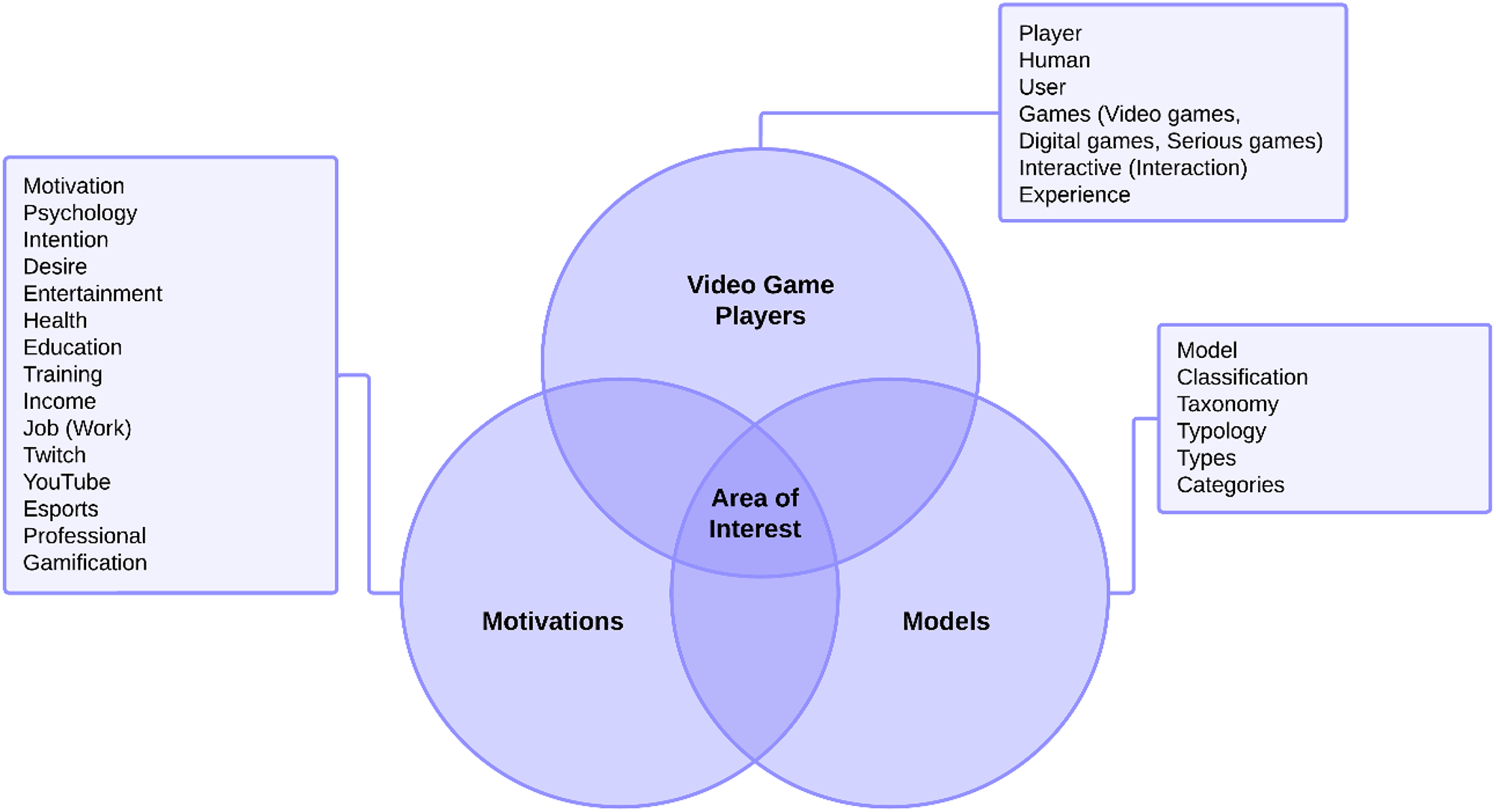
Search terms Venn diagram. Venn diagram showing the clustering of search terms used within the search strategy.
Searches were conducted on the following databases: Google Scholar, Microsoft Academic, BASE (Bielefeld Academic Search Engine), and our university's online library collection. Reference lists were examined to find additional sources, and further recommendations were made by consulted experts within the game development industry, as well as games research. To ensure the scope of included papers remained tightly focused, we applied a strict set of inclusion criteria:
The source must be peer-reviewed. The source must have a version published in English. The source must discuss motivations related to digital games—in either entertainment or serious contexts. The Concepts identified in the sources must have been derived through a qualitative process. The source must be conceptually rich (discussing a variety of motivations), with a focus on those that have made a significant impact on the research field (highly cited).
To be inclusive of the seminal research by Bartle in 1996 and reflect current gaming attitudes, any sources published after and including this work were considered for inclusion, up to and including 2022. This allowed for a comprehensive examination of how the research has evolved over the past three decades.
Literature collection was performed iteratively to achieve immersion within the data, allowing for time to reflect on current findings, as well as identify additional areas of inquiry. The literature collection was repeated until we determined that data saturation had been achieved, which was defined as when a new set of sources is identified to present no additional Concepts.
Study screening was performed by the primary author using the inclusion criteria above, and occurring in three phases. Phase 1 threw a wide net, compiling a list of potentially relevant titles; phase 2 examined the abstracts; and phase 3 reviewed the full text. If the study met the inclusion criteria above it would then be included for further analysis and synthesis. Each included source was reviewed, going through a process of extracting both explicitly and implicitly defined motivations. Explicit motivations are those given definitions within the text, and implicit motivations are those discussed but not given an explicit definition within a presented Model.
Each source approached classification in different ways, with many sources providing their own hierarchy of Motivations, using unique terms to group “similar” or “aligned” motivations. For our analysis, we evaluated each study's second-order constructs at their lowest presented level of abstraction, focusing on all identified motivations rather than how they may have been grouped together. This allowed us to focus on the foundational qualitative data, and extract as many unique Concepts as possible. Once we had accumulated a body of motivations from the final collection of 36 included papers, an alignment and clustering process was undertaken to synthesize the findings.
Concept Translation
Concepts were extracted and tracked in a dataset, recording any defined name, as well as a description of its discussion and source. To minimize loss of meaning and to have a visible origin for the concepts within translation, the wording and naming conventions for each Concept were kept as close to the original source as possible. In this section, we examine some key examples of how we performed our concept translation process. Careful consideration was required to translate the extracted Concepts, as there were several cases where sources used different terms while describing similar Motivations. For example, Martončik (2015), who based measures off the Pöhlmann et al. (2010) GOALS questionnaire, defines the term Intimacy as referring to “giving or receiving affection and love, or having deep trusting relationships” 1 . Demetrovics et al. (2011, p. 820) define “the pleasure of getting to know people, being with others, and playing together with other persons” as Social. Both of these would later be defined as qualitatively similar based on both discussing the building of relationships, demonstrating the importance of retaining the language used in the original source.
A combination of reciprocal and refutational translation (France et al., 2019) was performed to determine concepts that were similar to each other, as well as exploring their differences, making note of exceptions, incongruities, and inconsistencies to assist in the final synthesis. The primary author led the translation process, with co-authors providing alternative perspectives and critiques on the interpretation of concepts and the resulting translations.
As an example of reciprocal translation, Concepts from different sources would be grouped based on qualitative similarity, then translated to the same level of abstraction. For example, Yee's (2006) Immersion as discussed by Zackariasson et al. (2010, p. 281), was simultaneously defined as: “Discovery: Exploration, lore, finding hidden things”; “Role-playing: Story line, character history, roles, fantasy”; “Customization: Appearances, accessories, style, color schemes”; and “Escapism: relax, Escape from reality, avoid real problems”. These were determined to discuss a variety of distinct motivations when compared to Concepts from other sources which were presented in finer detail. In cases such as this, subdivision of the Concept was performed to achieve a standardized level of abstraction, allowing for further synthesis.
Concepts from a source were sometimes contradictory or failed to group neatly with others that had already been identified. These would then be contrasted against Concepts from both the original source as well as others; an example of refutational translation. Hilgard et al. (2013) describes “Loss-Aversion” or the “Tendency of a loss to frustrate or to ‘spoil the fun.’ [subsuming the] search for challenge.” which infers a distinct motivation in contrast to “Defeating impossibly difficult foes, struggling until they achieve victory, and beating other players.” as identified by Nacke et al. (2014).
Synthesis Process
Through the comparison of Concepts, the grouping used within the translation process evolved and these groups became more defined. These groups would become the output of our synthesis process, manifesting into our list of Dimensions. We defined criteria to explain which Concepts fit together, developing synthesized translations by combining the terms used within the clustered Concepts.
Studies varied in how they defined Concepts, some describing motivations through player types such as “Competitors” (Kahn et al., 2015) or “Killers” (Bartle, 1996), while others defined motivations by related game elements such as “Mechanics” (Scharkow et al., 2015) or “PvP/Competition” (Tychsen et al., 2008). The style of each noun used to name the Dimensions was standardized; we opted to focus on the underlying motivations instead of existing mechanics or tropes of players. Making use of terms such as the significantly repeated “Fantasy” or “Escapism”, while specifically avoiding terms with semantic overload like “Social” or “Challenge,” as demonstrated through possessing significantly different definitions under the same term.
The resultant terms were collectively brainstormed, with the Dimensions being tested to determine if any motivations would fail to obviously fit into one of the Dimensions. Each author provided input to explore potential alternative interpretations, as well as collectively scrutinize the criteria used for grouping Concepts under Dimensions.
Results
Search Outcomes
Through the literature search and screening process, a total of 47 sources were identified for inclusion within the meta-ethnography. After this literature search, 11 of the identified sources were excluded due to lacking the desired level of conceptual richness or industry impact within their text. The final list of 36 included studies carried into further stages are outlined in Table 1, and originated from a variety of geographical locations, primarily within North America and Europe.
Summary of Included Sources.
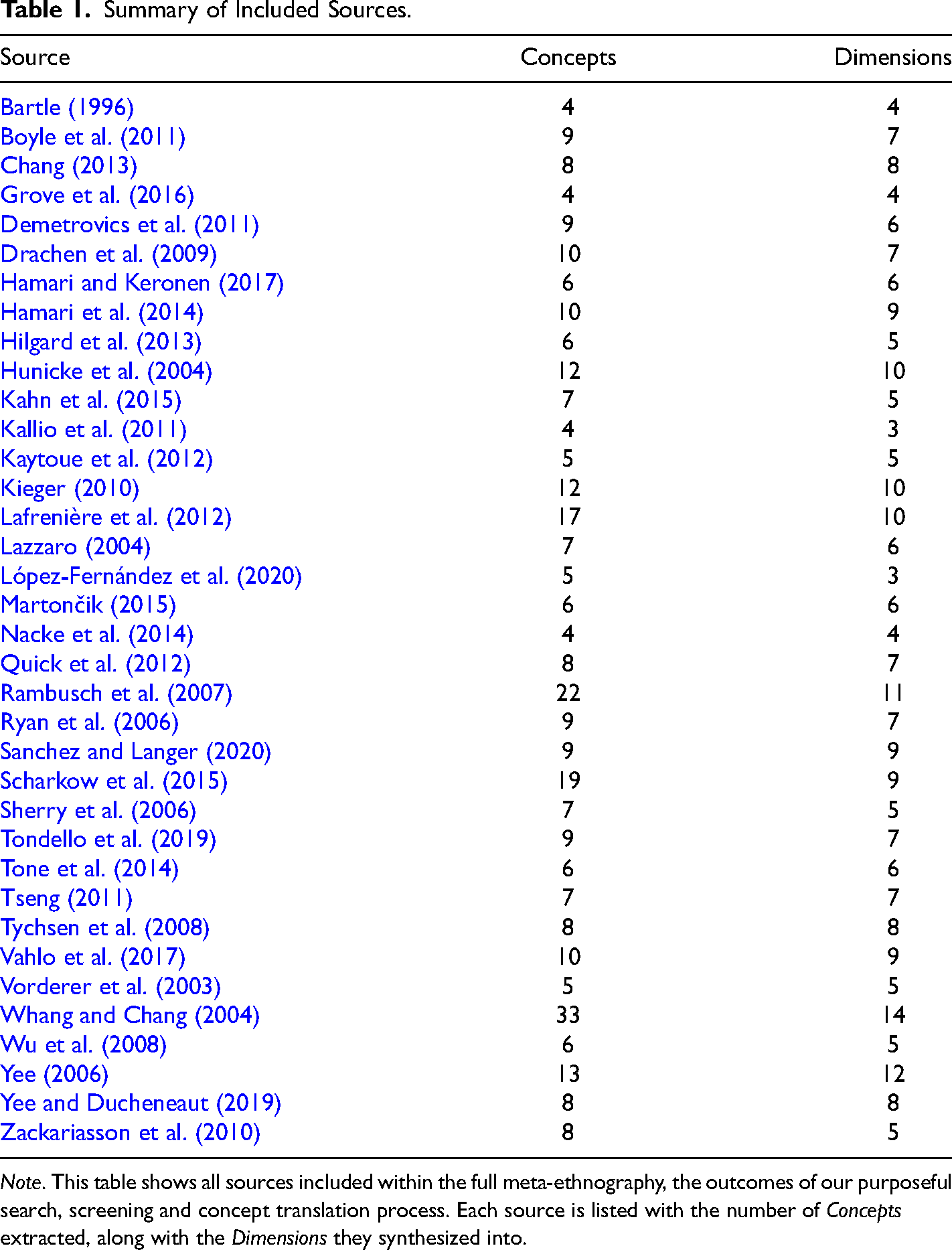
Note. This table shows all sources included within the full meta-ethnography, the outcomes of our purposeful search, screening and concept translation process. Each source is listed with the number of Concepts extracted, along with the Dimensions they synthesized into.
All of the included studies presented a model or categorization of Motivations, describing reasons that drive players to engage in particular gameplay experiences. These were extracted and translated into our list of Concepts, using the process outlined in our methodology.
Upon completion of the third and final iterative search process, it was determined that data saturation had been reached. The additional Concepts presented in newly included sources were determined to not be qualitatively distinct from any of those presented in prior included studies. Therefore, the inclusion of further studies would not result in further value.
Translation Outcomes
The translation process resulted in an identified total of 332 Concepts across the literature, with each of the included papers presenting a varying number of Concepts ranging from 4 to 33. Due to the varying levels of abstraction presented by the studies, several explicitly defined ideas had to be subdivided. For example, Yee's (2006) Immersion as discussed by Zackariasson et al. (2010, p. 281), was broken into six unique translated Concept definitions: Relaxation; Roleplaying & Fantasy; Appearance, Accessories, Style & Color schemes; Exploring & Finding things; Escape from reality; and Avoiding real problems. This was performed in such a way that Concepts were extracted at the most atomic level possible, standardizing the breadth of each translated Concept definition for synthesis.
While subjective interpretation and decision making is required within this type of qualitative analysis; by breaking down each of the ideas presented in the included sources as much as possible, this can be reduced and replicability can be improved.
Concepts translated from these studies would share qualitative similarities, and were grouped based on this similarity. This was done iteratively after Concepts were extracted from papers, and was used to determine the qualitative uniqueness of concepts presented by each study and determine when data saturation had been reached.
Synthesis Outcomes
Concepts were grouped together during translation, growing into their own synthesized definitions which we call Dimensions. This synthesis process is illustrated in Figure 2, with each Dimension providing a synthesized term and definition to encapsulate the qualitatively similar Concepts that were grouped together. A full list of these Dimensions can be observed in Table 2, recorded alongside the criteria we used for grouping each Concept.
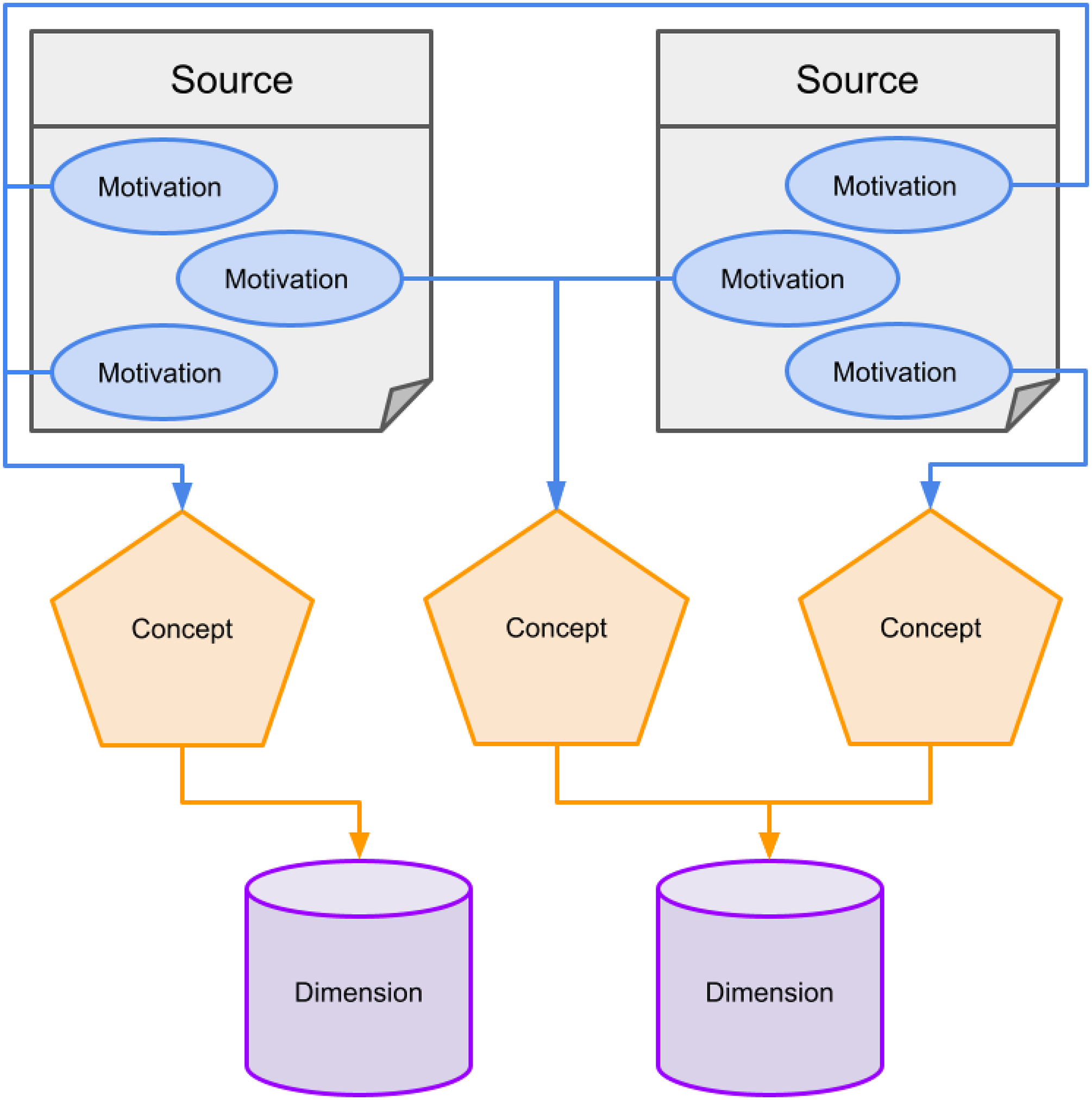
Dimension synthesis flow chart. Flow chart visualizing the process of translating Motivations discussed in each of the included sources into Concepts, which were then synthesized into our proposed Dimensions of Play.
Synthesized List of Dimensions.
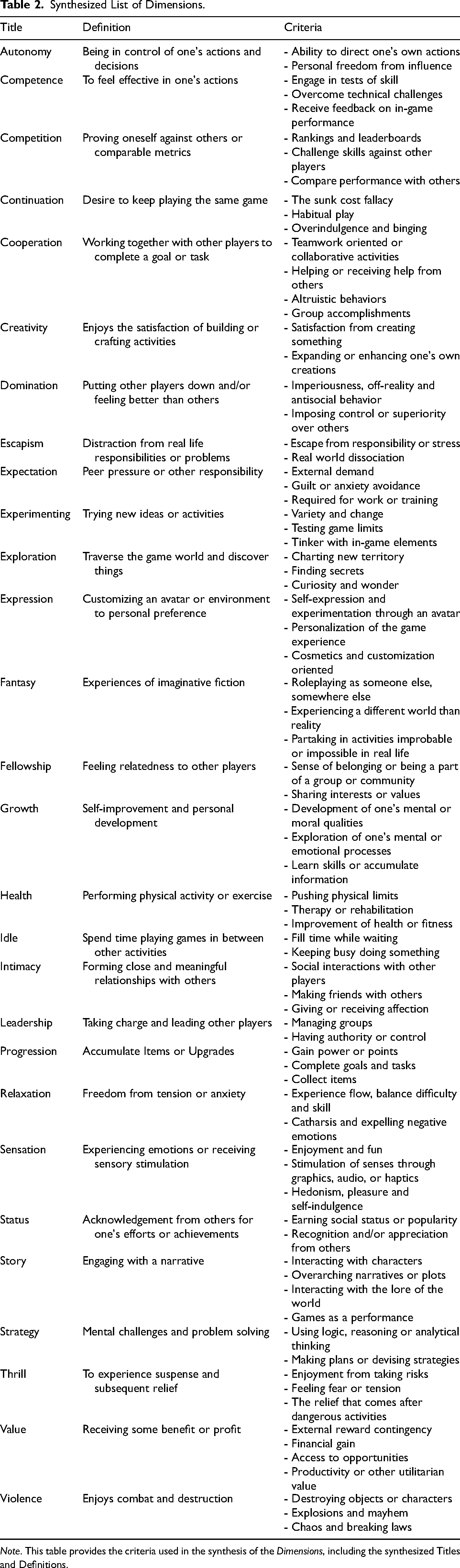
Note. This table provides the criteria used in the synthesis of the Dimensions, including the synthesized Titles and Definitions.
Separate Concepts emerging from the translation process were occasionally grouped under the same Dimension even if they were defined as separate in their original source. For example, Yee and Ducheneaut (2019) defined “Power” as “Powerful Character. Powerful Equipment.” and “Completion” as “Get All Collectibles. Complete All Missions.”; after translation, these were grouped under the Dimension of
The number of Concepts grouped under each Dimension, as well as the number of sources they originated from, are displayed as an Occurrence Chart in Figure 3. The Relational Table in Figure 4 shows a visual representation of which Dimensions were addressed within each of the sources through the Concepts extracted from their text.
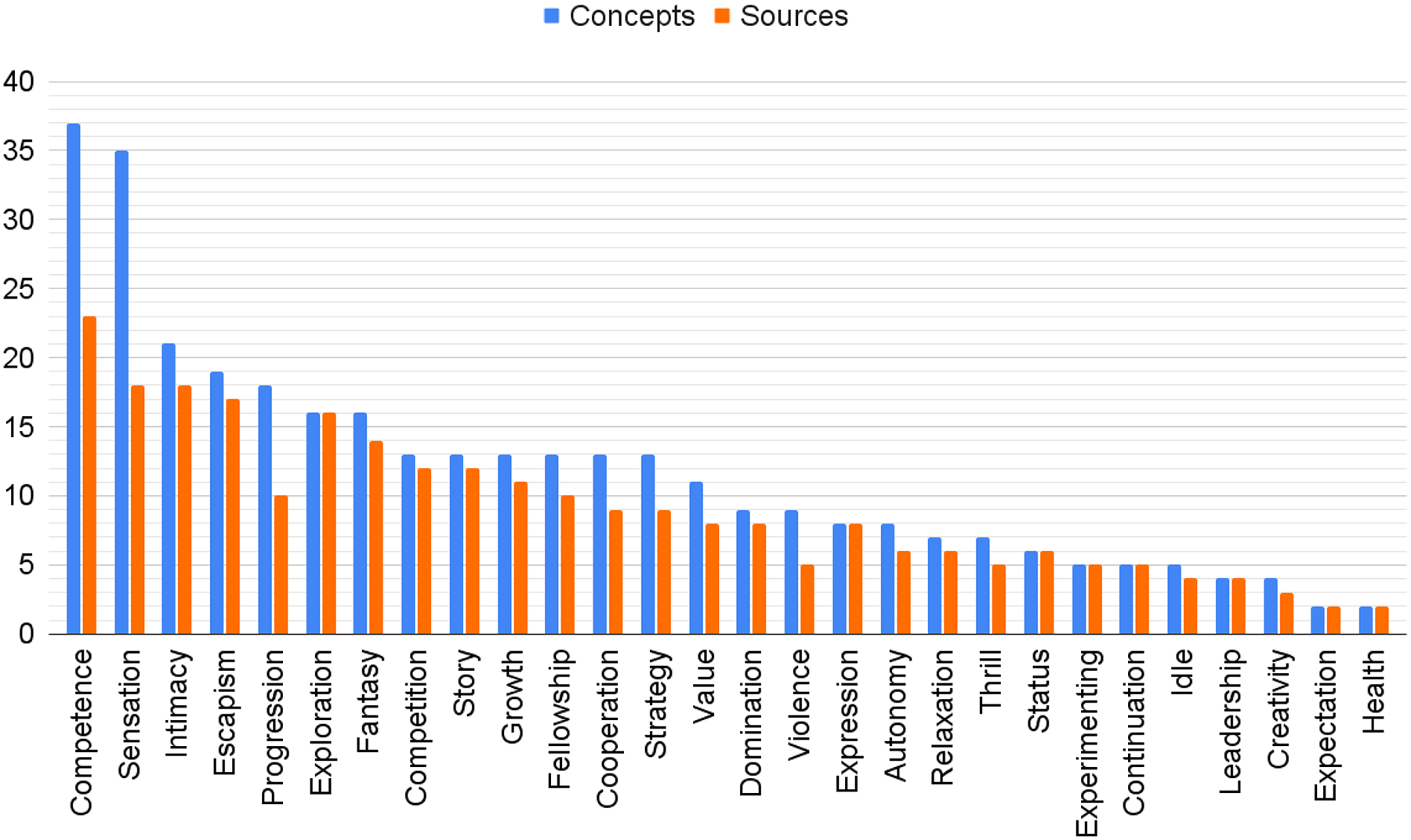
Dimension occurrence chart. Chart displaying the number of extracted Concepts aligned with each Dimension, next to the number of sources they were extracted from. Displayed from most frequently discussed to least frequently discussed.
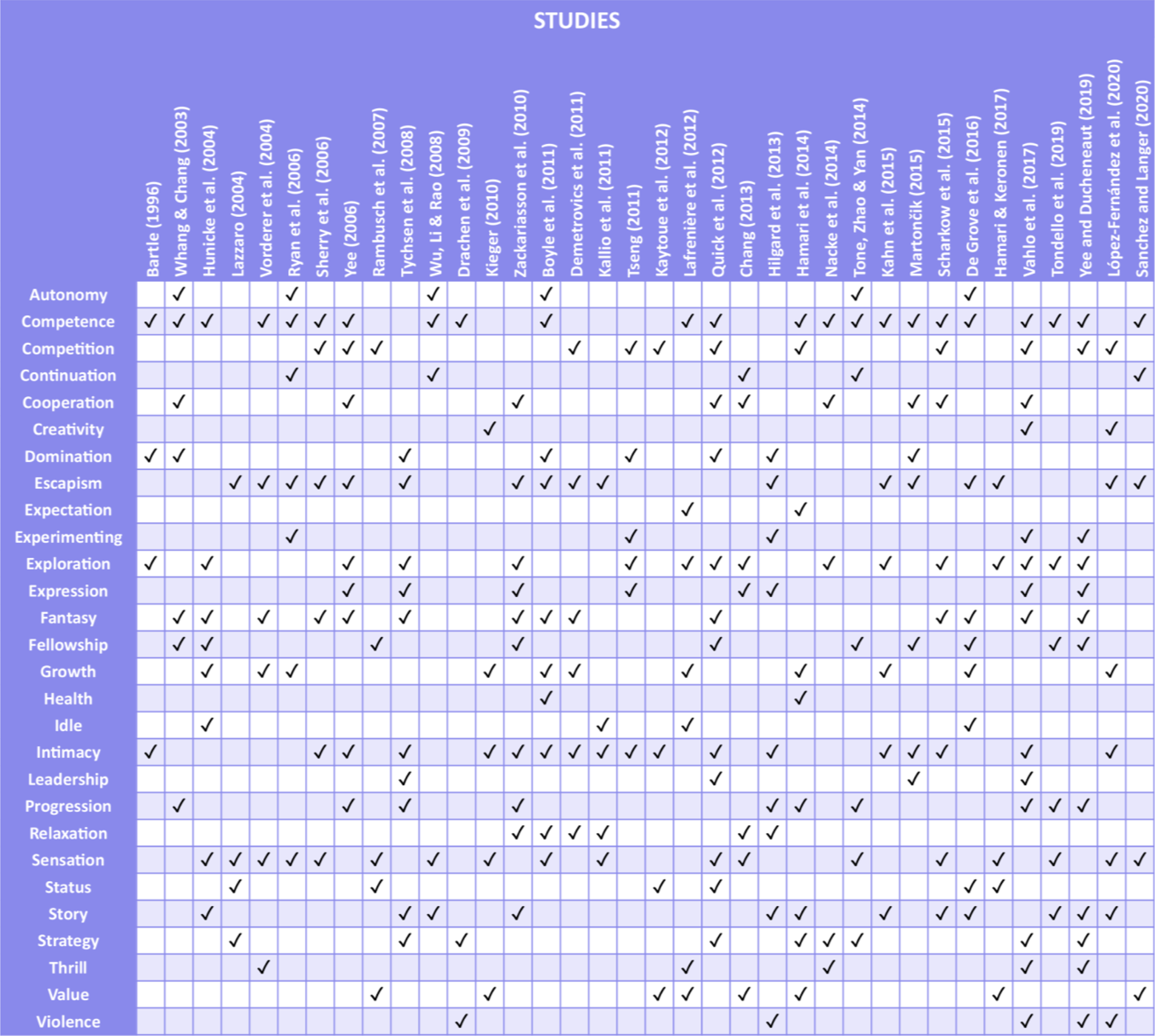
Dimensions relational chart. Visual representation of which Dimensions were discussed within the text of each included study. Arranged by publication date, oldest to newest.
The most discussed Dimension was
Conversely,
The number of Concepts addressed within each study varied significantly, which resulted in the coverage of the synthesized Dimensions being just as varied. The median of Dimensions addressed by each study was 7 and a mode of 5. This meant that on average the included studies only addressed 25% of these identified Dimensions, and most only addressed approximately 18%.
Vahlo et al. (2017) discussed the most Concepts within their text; with a total of 33 being identified. This high amount was achieved due to their isolation of observed game rules at an “atomic” level. Through these 33 presented Concepts they addressed 14 of the 28 Dimensions, which was the most addressed by any individual study included in our meta-ethnography. Vahlo et al. (2017) address the most of our identified Dimensions when compared with other included studies. They discuss half of the Dimensions we have observed throughout the research field across the other included studies, demonstrating the diversity of the literature and the extent of the gaps present.
Drachen et al. (2009) and Kallio et al. (2011) discussed the fewest of the Dimensions, only addressing three of 28, or approximately 11%. The Drachen et al. (2009) study was very narrow in scope, focusing on Crystal Dynamics’ Tomb Raider: Underworld as a specific gameplay experience. Kallio et al. (2011) focused on “At Least Nine Reasons to Play” which were divided among “Social”, “Casual”, and “Committed” mentalities, defined as “Gaming with Children, Gaming with Mates, and Gaming for Company”; “Killing Time, Filling Gaps and Relaxing”; and “Having fun, entertaining and Immersing”, respectively.
Discussion
Through our study we have developed a vocabulary for describing player motivations within games, giving game designers, developers, and researchers the language to discuss these ideas. The scale and disparity of the existing body of knowledge is likely overwhelming and unapproachable for most developers, and it would be difficult for them to determine which models would best fit their use case. Developers would likely have to focus on only one or two of the existing models, which could lead to them lacking coverage within the vast scope of player motivations. Our synthesis provides a useful collation of the existing body of knowledge, the variety of Concepts extracted during our analysis, exemplifying the diversity in existing player motivation models.
We extracted 332 Concepts from the 36 investigated studies, a number that would be practically unusable for developers. Our synthesized list of 28 Dimensions, summarizes all the qualitatively verified reasons why a player might engage in a particular gameplay experience which have been observed within the explored body of knowledge.
The way motivations are explored has evolved over time, with a shift in perspective from putting players into “boxes” to trending towards identifying isolable traits players possess.
Using Bartle's (1996) Player types as an example, Figure 5(a) demonstrates the original design, placing a player in a box of Achiever. A scale type of model demonstrated in Figure 5(b), provides more information about a player rather than simply calling them an Achiever because they score highest on that associated trait. By simply putting them in the “box” of an Achiever, important information about how this particular player interacts with games and their unique motivations is lost. By using negative numbers on the scale, the player's avoidance behavior can also be captured. In the above example, + 5 indicates the player is highly motivated to pursue games of that style, while 0 would indicate no impact or a lack of motivation towards games of that style, and −5 indicates the player is highly motivated to avoid games of that style. Our Dimensions would follow this modern design shift, with each of the Dimensions able to be represented as an individual scale.
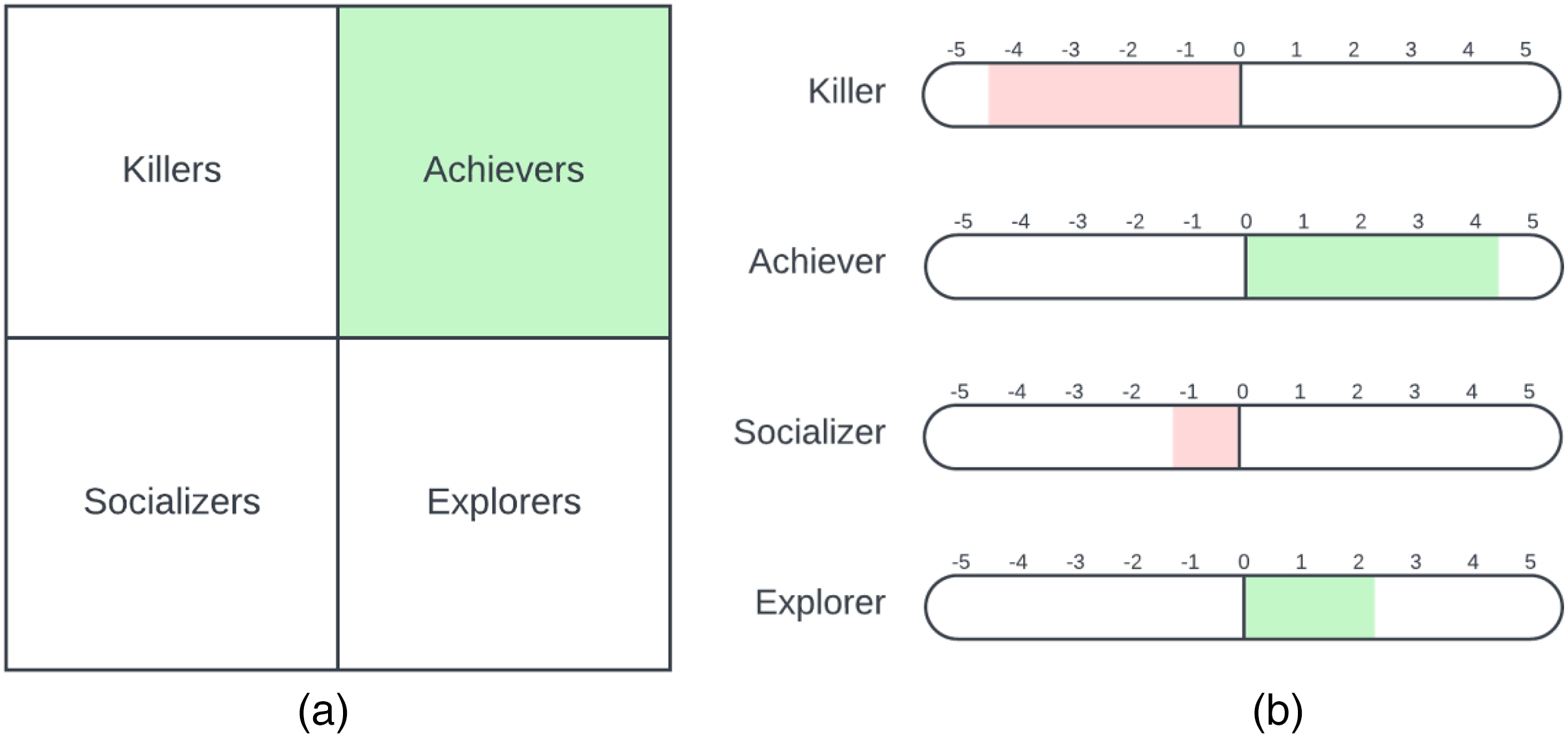
Model type comparison. (a) Box model and (b) scale model. Two diagrams representing different ways models can be represented, Bartle's (1996) player types as an example. (a) The original four “boxes” while (b) shows these as scales from −5 to 5.
This change in trends also led to more nuanced differentiation between these traits, with things like social motivations in games being further explored and subdividing to better describe observed social desires. For example, the desire to feel part of a community and make group accomplishments is defined as
This also exposes how other Dimensions may also have social implications, such as
These similar ideas, while related, have seen nuanced distinctions made within the existing literature, which is important in understanding the diverse motivations felt by players. Further exemplified by the desire to be recognized for one's accomplishments, or
Concepts relating to the
When it comes to social media and e-sports, there is now a significant industry surrounding these. Players are able to turn professional and earn incomes and pursue gaming as a career. This presents opportunities for unique social interactions, forming communities, gaining popularity, and fame. These factors could influence both play and purchasing behavior, but the full extent may not have been fully explored with the current lack of coverage.
Through our analysis we have demonstrated significant gaps present in existing models within the industry, highlighting the diverse and nuanced nature of the body of knowledge surrounding player motivation. Out of the models we explored, even the one with the highest coverage only explores half of what has been observed, with most not even covering a quarter of the Dimensions. While it is worth noting that not all Dimensions will likely be relevant to all projects, the existing coverage presented by models in the industry is incredibly limited.
Future Work
The next steps for this research are to create and verify high-level categories in order to make these 28 Dimensions less overwhelming to approach and apply within game design. The framework could also be applied in a quantitative way to develop a survey of games and gamers of different demographics.
Another avenue of future exploration would be investigating particular gaming trends and examining correlation to the emerging Dimensions in literature over time. For example, how the Nintendo Wii console's motion controls in 2006, and games like Nintendo's 2007 Wii Fit and balance board, could have influenced
Limitations
As the games industry is evolving at a rapid pace, there is a likelihood that the proposed Dimensions will become dated with time, and would likely require updating. By shifting focus from existing game mechanics to the underlying Motivations that drive players, the Dimensions stand to be more resilient to change. However, as games and the interaction methods surrounding them develop further, previously unobserved Motivations could emerge. This would require further analysis which may necessitate additional Dimensions.
The analysis we performed has a heavy focus on language, leading to a reliance on studies with English publications. This led to a vast majority of included studies within our meta-ethnography being Western in origin, primarily North American and European. With the inclusion of studies from Eastern origins being limited, further study would be required to guarantee the cross-applicability of the identified Dimensions.
In its current state, the Dimensions provide a novel insight into the observed motivations of players, but not how these relate to target markets or designable outcomes. Further study would be required to develop the Dimensions into a workable model for application within the game development cycle.
Conclusion
Through immersion in the existing literature surrounding player motivation, and undertaking a meta-ethnography, we were able to identify and define the proposed set of 28 Dimensions. These represent all the themes addressed within the extant research field via our examined cross-section of the industry. This first-of-its-kind study shows just how diverse the literature within the field has become and demonstrates verifiable factors missing from even the most comprehensive of existing models. The synthesized Dimensions empower designers, developers and researchers to expand their awareness of player motivation providing a more comprehensive list of “What motivations drive players to engage in games?”. This also allows for a more nuanced understanding of Motivations, such as those discussed regarding social factors.
This work moves the field forwards, toward new improved models of player motivation for the modern game industry.
Footnotes
Declaration of Conflicting Interests
The author(s) declared no potential conflicts of interest with respect to the research, authorship, and/or publication of this article.
Funding
The author(s) disclosed receipt of the following financial support for the research, authorship, and/or publication of this article: This research was supported by the Commonwealth Government via the provision of an Australian Government Research Training Program (RTP) Scholarship..
