




Abstract
This exploratory sociolinguistic study examined D/discourses and writing modes in a Grade 10 English literature classroom wherein students answered literature-based questions by means of both traditional and new literacies approaches. Studies conducted at the intersection of classroom instruction and online affinity spaces are still surprisingly under-reported in the academic literature; thus, the purpose of this small study was to contribute to new literacies studies research within classroom contexts by examining what happened when students responded to teacher-given prompts in two distinct modes: a traditional, essay-style response and a live, backchannel chat. This study compared the language use and some of the discursive moves that students made when composing written answers via both modes in order to provide insights for educators who may seek to use new literacies in their classrooms. Findings add to the discussion about what I see as the self-limiting aspects of traditional essayist-literacy (i.e. Academic English) favored by schools and the benefits of socially constructed literacy events facilitated by classroom-based online affinity spaces. Interestingly, findings suggest that this is not an either-or dichotomy, but that students in this study seemed to co-construct their literary analysis in the liminal space between Academic English and online chat discourse.
Despite the near constant development of digital technology over the past 40 years, many high school courses in the U.S. still favor language practices that replicate traditional, academic writing practices. These strongholds of formalist literacy (such as five-paragraph essay writing, written responses to reading comprehension questions, or quoting and citing research documents) perpetuate and reproduce institutionalized linguistic patterns (i.e. writing conventions expected in schools), especially in high school English/Language Arts classrooms. These discursive moves remain the primary means through which students are expected to “do school,” even though a significant body of research shows that standardized practices may not best facilitate learning in modern classrooms (see, for example, Gee and Hayes, 2011; Meier, 2002; Sleeter and Carmona, 2016; U.S. Department of Education, 2012; Welsh et al., 2014).
At the same time, students are spending more and more of their time online. Smartphone access for teenagers in the United States has climbed to 95%, and at least 85% of American teens use a social media site such as Facebook, Snapchat, Instagram, and YouTube (Anderson and Jiang, 2018). Seventy-two percent of U.S. teenagers have said that they check their smartphones for messages as soon as they wake up (Jiang, 2018). Despite this, and the burgeoning accessibility of laptops and other internet-ready devices in schools, some English teachers still hesitate to incorporate digital technologies in their classroom teaching (Shelby-Caffey et al., 2014; Zoch and Myers, 2017).
Hesitant or not, teachers are now seeing that “literacy events” (Barton and Hamilton, 2000)—that is, tasks in which literacy plays a part—mediated by new literacies happen every day for many students across the U.S., both in and out of school. New literacies is an area of research that focuses on the influence or role of digital technologies in/on literacy practices (although not all new literacies require new technologies) and the ways that different modes of discourse and other forms of literacy are affected by and affect digital media. These new literacies include such practices as blogging, creating a website, online storytelling, making and sharing videos, podcasting, collaborating in digital spaces, designing memes, photoshopping, and creating other digital mashups, to name a few (Lankshear and Knobel, 2011). The various digital media and networks by which students participate (and will participate) in classrooms impact what, how, when, and where students learn (Marsh, 2018; Powell et al., 2015; Sackey et al., 2015).
In the following section, I discuss the background and theoretical framework of a focused study that examined what happened when an online chat space was introduced into a Grade 10 English in the classroom (specifically a chat-based affinity space) as a way to respond to a reading comprehension prompt. I provide a review of literature distinguishing between discourse practices in Academic English and online chats, as well as on new literacies and affinity spaces in classroom learning.
Theoretical framework
Language and discourses
James Gee’s theory of d/Discourse (Gee, 2015) is the undergirding theoretical framework for this study. According to Gee, discourse (with a lowercase “d”) is defined as broadly communicative exchanges (whether verbal or non-verbal), whereas Discourse (with a capital “D”) comprises the language practices, cultural artifacts (such as clothing or tools), and ways of getting things done attributable to and recognized by a specific group of people. For example, a person recognized as an ‘honors student’ will use certain words (e.g., specialized subject-area terminology), act in certain ways (e.g., studying for exams, completing assignments thoroughly), wear or carry certain things (e.g., textbooks, notebooks), and use certain tools (e.g., an online thesaurus, graphing calculators), all identifiable as aspects of this way of being. Each person acquires a primary Discourse at the beginning of life by means of being born into a particular family or growing up with particular caregivers, imbuing that person with a culturally specific set of values, language, and behaviors. Countless other Discourses can be picked up, merged, or jettisoned throughout one’s life (Gee, 2015). These secondary Discourses—associated with institutions rather than family or caregivers—acquired early in one’s life are integral to one’s likelihood to thrive within other institutions, such as schools (Gee, 2015; Heath, 1983).
Traditional educational institutions tend to inculcate learners into reproducing one specific secondary Discourse: Standard English, or what I refer to in this paper as Academic English. In the U.S., Academic English practices emerged from the standardization of education systems at the beginning of the 1900s (Gee, 2004, 2012; Kaestle, 1985; O’Brien and Bauer, 2005). American schools subsequently prioritized Academic English (described in more detail below) and consequently drove out other linguistic practices by promulgating “the idea that a discourse should be recognized if and only if it conforms to the legitimate norms” (Bourdieu, 1977: 650, emphasis added) of, in this case, schools. These standardized language practices thus have formed a “deep grammar of schooling” (Lankshear and Knobel, 2003: 30).
Academic English is still today the language practice privileged in school spaces (Brisk and Tian, 2019; Flores and Rosa, 2015; Kessler et al., 2018; Lankshear and Knobel, 2003). That is, it is a specific method of writing (especially) and speaking that requires the student to engage with abstract ideas using language in particular ways (e.g., using formal grammar and syntax, using nominalizations over verbs, making connections across texts, synthesizing other people’s ideas) in a—usually—teacher-centric classroom. Academic English may jive easily enough with certain children’s Discourses (Gee, 2004; Street, 1995), but it isolates or excludes others who are outsiders to this language variety (Gebhard, 2019; Gee, 2004; Heath, 1988; O’Brien and Bauer, 2005; Schieffelin and Ochs, 1986).
The ascendency of any one language variety is problematic, regardless of which variety it is. In the words of Deleuze and Guattari (1988), “Language is made not to be believed but to be obeyed, and to compel obedience” (Deleuze and Guattari, 1988: 84). When students participate in school-based “literacy events” (Barton and Hamilton, 2000) that require Academic English, teachers reward (with good grades) students’ literacy “proficiency” on a scale or sense of “rightness” based on Academic English standards. Secondary school students often are therefore motivated to chase after illusory skills that proffer little but the mastery of a shibboleth. Like many other states, New Jersey’s Student Learning Standards seek to prepare students for careers beyond academia (New Jersey Department of Education, 2019), but, ironically, Academic English alone (without the intermix of other literacy practices) is unlikely to best prepare secondary students for future work in current times.
New literacies and affinity spaces
New literacies are ways of and means for “creating, sharing, and negotiating meanings using forms of inscription that have emerged and evolved with the development and proliferation of digital electronic technologies and networks” (Knobel and Lankshear, 2018: 4). This includes multimodalities, digital literacies, online storytelling, multiliteracies, computer literacies, multiple literacies, and many others (Alexander et al., 2017; Coiro et al., 2014; Lammers, 2016; Masny and Cole, 2012; Thibaut and Curwood, 2018). As such, new literacies require and promote sociocultural learning in ways that often are impossible in traditional, Academic English-oriented classrooms.
New literacies are very much a part of the free flow of information and relational networks across geographic spaces and communities. No group of people is more greatly impacted by the advent of global networks and new literacies than adolescents (Black, 2009; Fields et al., 2014). Furthermore, smartphones, high-speed broadband, and mobile networks have led to the meshing and remixing of languages and Discourses (Knobel and Lankshear, 2018), which places adolescents at the intersection of new digital technologies and novel discursive practices. Thus, one of the motivations for this study was to comparatively examine how new literacies might play out in students’ written responses in a Grade 10 Advanced English classroom.
Confluence between new literacies and classroom discourse can occur in online affinity spaces (Curwood et al., 2013; Gee, 2004; Lammers et al., 2012; Padgett and Curwood, 2016). Affinity spaces are theorized as (usually) online sites where people gather to pursue a common passion, instantiating “participation, collaboration, distribution and dispersion of expertise, and relatedness” (Knobel and Lankshear, forthcoming). “Portals” (Gee, 2004; Magnifico et al., 2013; Marsh, 2018 ) are sites or networks, such as Facebook or FanFiction websites, where participants congregate but do not themselves instantiate an affinity space.
Affinity spaces are usually informal learning spaces outside of formal academic institutions (Gee, 2004; Knobel and Lankshear, forthcoming; Marsh, 2018; McKenna, Conradi, Lawrence, Jang, and Meyer, 2012). Indeed, Gee and Hayes (2011) argued initially that affinity spaces could not exist in contemporary schools because of academia’s institutionalized nature—its insistence on standardized practices and Academic English. But the authors (2012) recast their earlier assertion, writing that even a “high school news room” (Gee and Hayes, 2012: 6) could be an affinity space. Recent research has picked up that notion, arguing in favor of shaping the theory of affinity spaces to fit existent academic structure (see, for example, Bommarito, 2014; Marsh, 2018).
Ad hoc affinity spaces in classrooms (such as backchannel chats) deviate from traditional conceptions of affinity spaces, challenging scholars to recast affinity space theory to meet pragmatic actualities. Students in traditional academic settings will continue to operate within the “deep grammar of schooling” (Lankshear and Knobel, 2003: 30), but this does not preclude them (when concurrently occupying online affinity spaces) from also slipping into other discourse practices.
Literature review
Students’ acquisition and use of academic english
One practice associated with Academic English is the exact reproduction of formal academic language patterns. Students who have been labeled academically successful are more likely to take on the words and phrases of educators and model writing samples provided to them (Samuelson, 2009; Skilbeck, 2018). Revoicing, or “ventriloquation,” is the discursive move of copying another speaker’s words to purposefully socially situate oneself. Samuelson (2009) argued that this process is crucial for students in obtaining fluency in Academic English because students take on the vocabulary and language practices of this specific group. [Note: “Revoicing,” as it is used in this study, is distinct from “teacher revoicing,” a spoken discursive move that teachers use to invite additional student responses (O’Connor and Michaels, 2019).]
Two literacy practices of Academic English that invite ventriloquation are essayist-literacy and content-literacy (Gee and Hayes, 2011). Essayist-literacy is a practice that students engage in for producing reports, biographical essays, editorials, or research papers (Gee and Hayes, 2011). However, essayist-literacy is problematic. For one, academics whose essays have been published are often passionate experts. In contrast, students are novices by definition. Frequently, they are not passionate about their school-set writing assignments. Additionally, many (economically) successful people never write essays in their adult lives (Gee and Hayes, 2011), and in an age of multimillionaire YouTubers and Instagram influencers, many current students may question the role of this school-based practice in “becoming successful.”
Issues with Academic English also abound with respect to content-literacy: that is, the “knowledge” of curricular subjects, much of which is distilled into “disciplines” that are “commoditized into textbooks” (Gee and Hayes, 2011: 66). According to Gee and Hayes (2011), there are seven issues with content-literacy:
Learning facts does not reveal the processes that led to the uncovering of those facts. Academics collaborate on interdisciplinary topics, yet schools winnow material into single subjects. Information is produced outside of classrooms, such as in the field or in laboratories, so students receive knowledge second-hand. Reproducible content is easy to find these days, undermining intellectual ‘work.’ Much of the content in schools today is simply not true or grossly oversimplified. School divorces “content” from its actual application—i.e., solving problems. Content delivered in schools is likely not the information that students will need to know throughout their lives.
In short, content-literacy in schools runs into trouble with often being a watered-down or even erroneous version of disciplinary knowledge and understanding. In-school literacy (i.e., Academic English) stresses superficial aspects of language, the mechanics and “correctness” (Gee, 1989). The main purpose of such a practice is to act as a shibboleth (i.e., a sorting gate) to prestigious, powerful positions in society.
Online chat discourse practices
This study focuses on quasi-synchronous chat spaces, where multiple people can write and send messages in real time. Although messages are exchanged quickly, like oral conversations, quasi-synchronous chats (Garcia and Jacobs, 1999) entail message creation and sharing as two distinct events, distinguishing them from synchronous conversation during which both creation and sharing occurs simultaneously (Meredith and Stokoe, 2014).
Because of differences in message lengths, typing speeds, and other variables, respondents cannot entirely control where their responses will appear (González-Lloret, 2011). Furthermore, users can also choose to break up their messages into smaller parts as they compete to respond more quickly than others, as the farther a message appears from its referent, the more likely it is to be ignored (ibid.). Consequently, these shorter messages are less likely to have the hallmarks of grammatical and semantic proprietary that appear in written Academic English. Participants rely upon “virtual adjacency,” cerebrally maintaining distinct message threads among many, to decode and respond to chats (Schönfeldt and Golato, 2003).
Chat messages are also limited in how they signal discursive turn-taking since, unlike in oral speech, more than one participant can create a message at the same time (González-Lloret, 2011). In order to combat potential confusion and disorder, participants can address their messages directly to others (Garcia and Jacobs, 1999; González-Lloret, 2011; Herring, 2011; Schönfeldt and Golato, 2003). For example, users may use the symbol “@” followed by a username to address another participant directly. Without the ability to convey facial or hand gestures, participants in chats can use emojis or emoticons to simulate emotion (Berard, 2018; Hu et al., 2017).
Message creation in chats is also a “discontinuous process” (Beißwenger, 2008) that entails writing, rewriting, revising, and retrospective correction. One discourse practice in online chats is to correct an error in a previous message by posting a follow-up message marked with an “*” (Collister, 2011). Meredith and Stokoe (2014) suggested that message “repair” extends beyond simple typo correction, insofar that any attempt to recast a previous message to receive the writer's desired response is cognizant self-repair. Self-repair signals that participants adjust discourse practices to “the appropriate form to do this action in this sequential place” (Drew et al., 2013: 93, original emphasis). To actively participate, people must show vigilance during online chats, responding to various types of feedback through self-repair of messages, leading to a collective, developing space wherein individuals pursue their own contribution goals while remaining cognizant of and responding to their audience’s responses (or potential responses).
Teacher use of new literacies and affinity spaces in classrooms
The take-up of truly new literacies (and not simply “digital technologies;” i.e., digitizing existing classroom literacy practices) in classroom teaching is consistent with an attempt to align education practices with students’ multiple Discourse practices (Chase and Lautenberg, 2011). Indeed, online-based messaging long has been noted as a way that young people communicate in ways that are not often valued in schools (cf., Lewis and Fabos, 2005). Research into teaching with new literacies thus inherently challenges the “tyranny” of traditional Academic English (Alvermann, 2008; Marsh, 2018; Schwartz, 2014).
Some studies have found that new literacies (with unique affordances such as anonymity, quasi-synchronicity, and the ability to give “likes”) and online affinity spaces benefit learning, but the preponderance of research on affinity spaces and literacy has been outside of the classroom setting (e.g., Black, 2008, 2009; Curwood, 2013; Knobel and Lankshear, 2018; Korobkova and Black, 2014; Lammers and Marsh, 2015). Adolescents participating in these online affinity spaces receive immediate feedback, placing them directly “among the audience” (Lunsford and Ede, 2009). Users are more likely to consider how their (anonymized) audience would evaluate their finished products (Lammers, 2016; Magnifico, 2010; Schwartz, 2014; Smith, 2018). The bifurcation of new literacies into those occurring outside or inside the classroom may be a false dichotomy anyway because students use technologies to collaborate on schoolwork even without teacher direction (Beach, 2012; Leander et al., 2010).
A limited number of studies have considered how online affinity spaces can facilitate student learning via new literacies in the traditional classroom. Affinity spaces for peer feedback in creative writing in secondary schools produced collaborative exchanges between students of different skill levels, but they also retained hierarchical structures in classroom spaces (Marsh, 2018). McWilliams et al. (2011) reported on student use of microblogging through Twitter to facilitate a classroom unit on The Crucible. Students were assigned a character to both act as (in class when they performed the play) and tweet as in a role-playing assignment through social media. The authors found that students were more likely to collaborate when they viewed their contributions as necessary parts of the shared task (cf. Jenkins et al., 2009; Shirky, 2008).
However, there is a dearth of research regarding student anonymity through new literacies-based aliases, and most available classroom-based anonymity research focuses on peer feedback, not collaboration. One quasi-experimental study in Belgium compared secondary students’ peer feedback scores given face-to-face with those recorded anonymously online and found that students felt less peer pressure and preferred this web-based form of evaluation (Vanderhoven et al., 2012). In a separate study, Raes et al. (2013) supplemented raw scores with anonymous written peer feedback. The researchers found that the inclusion of written feedback allowed students to provide argumentative comments for their peers while maintaining positive attitudes and feelings of comfort. Another study examined student participation under aliases but did so for college students in an online-only classroom (Chester and Gwynne, 2006). In this twenty-year-old study in which students created their own pseudonyms (known to the researchers, unknown to one another), some students reported participating significantly more than in face-to-face classrooms.
This review of the literature did not find research that examined the use of quasi-synchronous online chat affinity spaces with participant “managed ambiguity” in secondary classrooms. This exploratory study hopes to begin this conversation while also offering insight into new literacies and affinity spaces.
Research design
Setting
This research study was conducted in a public high school of approximately 750 students in an affluent suburb in northeast New Jersey (USA).
Participants
The 14 participants in this study were from my Grade 10 Advanced English classroom. Of the 14 students in the classroom, 12 identified as white and two identify as Southeast Asian. Five students identified as male and nine as female. The privileged setting (i.e., as students in an affluent district, many will be “good” at Academic English) necessarily shaped findings. I was nonetheless curious to see how these students’ fluency with Academic English would play out in a backchannel chat literary discussion (e.g., would Academic English remain their dominant discourse as they enacted being “good” students?).
This study follows a strong new literacies tradition of studying people who are proficient at a certain task—in this case, students who were good at navigating the secondary d/Discourse (Gee, 2015) of school and Academic English in order to excel in academic institutions. Students in my Advanced English class had been reading The Crucible by Arthur Miller during the three weeks prior to data collection. Data collected were parts of students’ everyday schoolwork and received an IRB exemption. One limitation to note is that, due to the role of anonymity in this work, I chose to not conduct follow-up member checks with my students.
Research question
What linguistic patterns and “discursive moves” are visible in students’ individually written responses to a reading comprehension question compared to those made when students respond to similar questions in a quasi-synchronous backchannel chat, and in what ways do these patterns seem to convey students’ understanding, ideas, or analyses?
Design
Data, in the form of written responses, was collected during two subsequent class sessions. On Day 1, students responded individually to open-ended reading comprehension questions. On Day 2, students were introduced to a backchannel chat and then answered (similarly worded) reading comprehension questions collaboratively in the chat.
Reading comprehension questions
I provided two sets of five prompts about Act IV of The Crucible (see Appendix A). Each began with a ‘what’ question and was followed by a ‘why’ question. For example, “According to Hale, what has happened to Salem? Why will this lead to rebellion?” or “What does Parris reveal about his fears? Why does Abigail run away?”
Data collection point 1: Independently typed responses
On the first day, students were assigned five reading comprehension questions posted to a Google Doc. Students independently typed their responses to these prompts on school-issued laptops and then submitted their answers to me through an identifying online content management system, Schoology.
Students had 50 minutes to answer all five open-ended questions, but according to time stamps from Google Docs, actual writing time per question ranged from two to five minutes.
Data collection point 2: Backchannel responses
The next day in the classroom, students joined a backchannel chat where they would exchange messages in real time. A “backchannel” is a live, online chat room often used in educational contexts (DeCosta et al., 2010). It requires students to “chat” by typing their responses and sending them to the group. In this case, students sat at their desks in the classroom and used their school-issued laptops to participate.
The interface selected for this assignment was http://backchannelchat.com. Students were permitted to choose their own usernames: five students decided to use their actual names while the majority created aliases. Students could “like” messages by clicking a “thumbs up” icon.
Prompts and time remaining were projected in the front of the classroom, not in the chat. Students had ten minutes for each open-ended reading comprehension question. When students’ discussion about a prompt was completed, they indicated so in the chat. For example, one student wrote “Shall we move on?” at the end of a discussion, prompting the beginning of the next question. The discourse analyzed for this study occurred over 8 minutes and 5 seconds.
My role
At the time of this study, I had seven years of experience as a high school English teacher and believe that teachers play a critical role in creating student learning contexts (Feuerstein et al., 2002; West, 2019). To somewhat reduce my impact on students’ linguistic practices, I was not an active participant in the backchannel chat (cf. a similar strategy in Lindstrom and Niederhauser, 2016). The students were nonetheless aware that they were engaging in academic assignment work, although neither task was graded.
Data analysis
This exploratory study focused on responses to one prompt from each of the two days (14 responses for Day 1 and 54 separate “turns” during Day 2), selected at random by an online generator. This narrowed scope facilitated a fine-grained, comparative analysis for this pilot study. I used discourse analysis (Gee, 2004) to examine my data by means of three cycles of analysis. The first focused on analyzing students’ independently written responses (first data collection point). The second cycle focused on analyzing their entire backchannel discussion (second data collection point). The third cycle looked across both sets of data. Adapting from Fairclough (1992), I opted to systematically analyze a smaller set of text to conduct a more granular analysis (Jørgensen and Phillips, 2002). Although I did not closely analyze the other collected responses, they appeared to be similar in structure.
In terms of my specific focus, I analyzed the ways in which students positioned themselves, their classmates, and their “audience” through discursive moves in order to see what happened with students’ literacy practices when introducing an online affinity space that offered participants “managed ambiguity” through aliases. Some specific lines of inquiry were the following:
How students used (or did not use) personal pronouns. How students developed their ideas, particularly their transition usage. For example, some students began to develop their ideas in the backchannel chat by using an @ sign with the person’s username to directly respond to that individual. In one exchange (see Figure 1), a student who Live Action Role Played (LARP’d) as “abigail,” one of the characters in the play, was answered by another student who used “@abigail” to directly reference the original poster. How and when students provided evidence to support their claims. What words and syntax constructions students used. How students self-identified. How “turn-taking” occurred between writers. How often students participated and the length of each response.
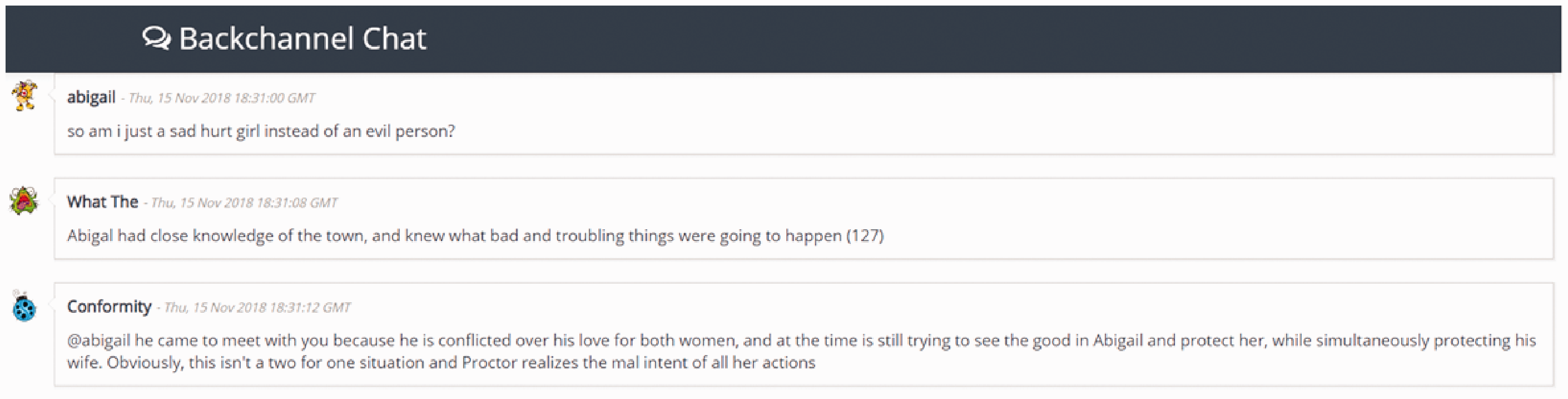
A student Live Action Role Plays (LARPs) the character of “Abigail” from The Crucible, and students respond in ways that continue the LARP. Students use the @ sign to directly address another person in the chat.
Findings and discussion
Based on my findings, I refer to the two data sets as immobile responses (students’ independent responses, see Figure 2) and participatory response-based discourse (students’ collaborative, backchannel chat responses, see Figure 3).
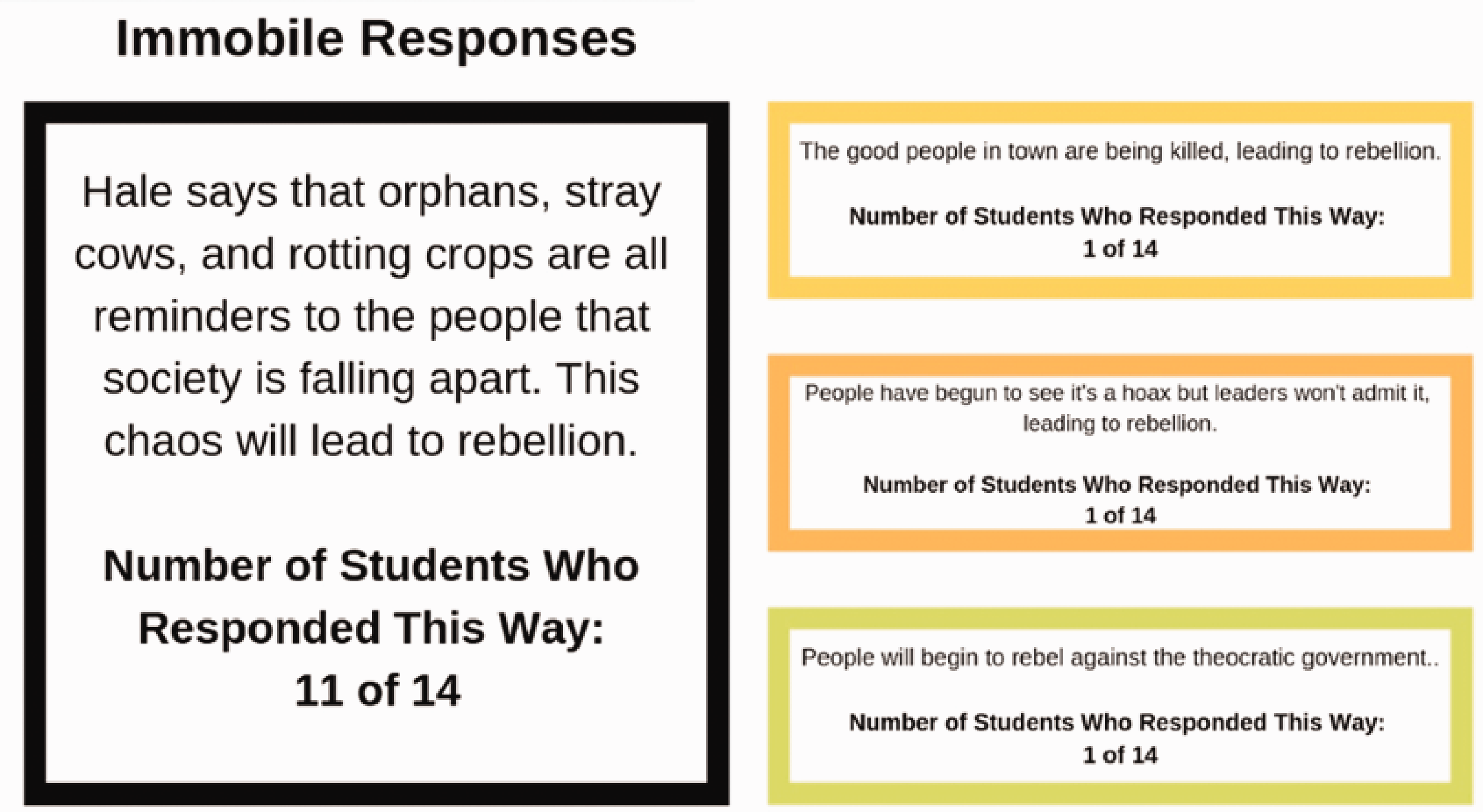
A graphical organization summarizing student responses in the ‘Immobile Responses,’ indicating that 11 of 14 students responded to the prompt in nearly the same way.
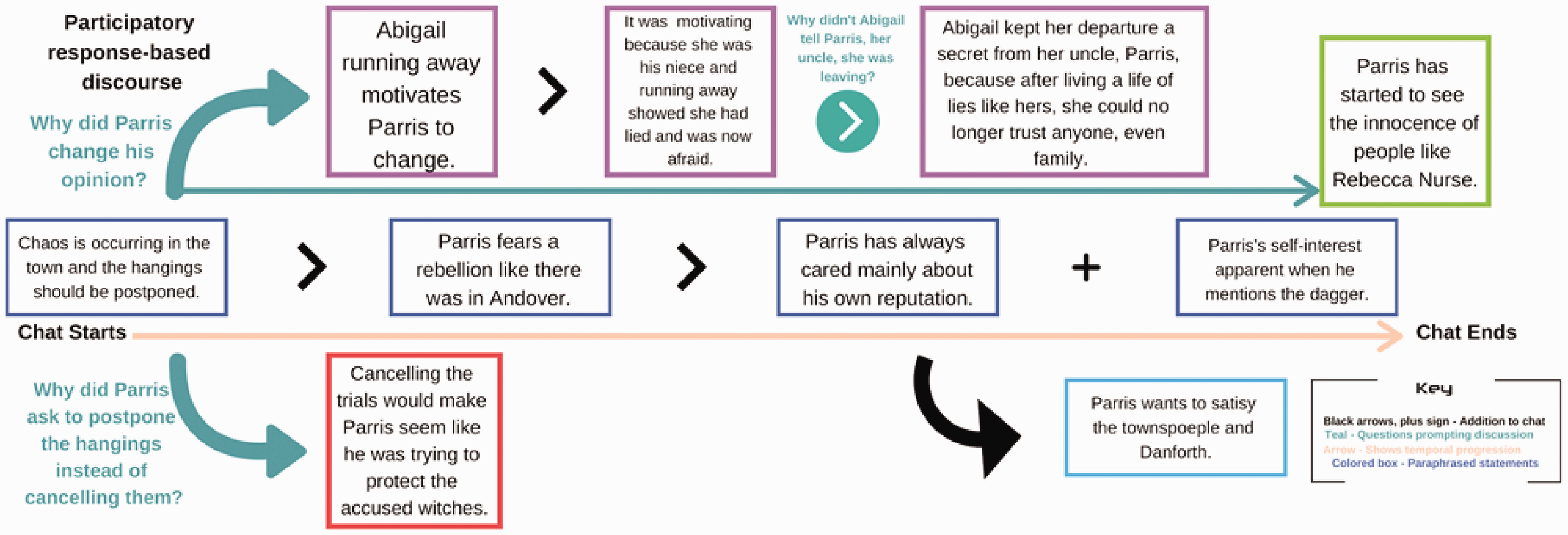
A graphical interpretation showing the progression of the participatory response-based discourse over time. The center orange line depicts passing time, from start to finish. The colored boxes contain paraphrased student responses grouped by theme (a box may represent one or multiple student’s responses summarized together). The text in teal font represents a student-posed question, and the corresponding teal arrows connect a question to when and how it was answered in the discussion.
The following themes emerged from my analysis: 1)
From immobile responses to participatory response-based discourse
The reading comprehension question for students’ immobile responses analyzed for this study was “According to Hale, what has happened to Salem? Why will this lead to rebellion?”
Immobile responses were notable because eleven of the fourteen students wrote responses that closely echoed the following: Hale says that orphans, stray cows, and rotting crops are all reminders to the people that society is falling apart; this chaos will lead to rebellion. Example responses included: “According to Hale, orphans are wandering from house to house, cattle are being abandoned, crops are rotting, and everyone is on edge because they don’t know if they will be accused next”; “According to Hale, there are orphans wandering from house to house, abandoned cattle on the roads, stink of rotting crops everywhere, and nobody knows when the next victim will be chosen, or if they will be chosen”; and “Hale says there are orphans and cattle roaming everywhere, crops are dying and everyone is scared for when it might be their turn to be accused” (see Figure 2). As visualized in Figure 2, the individually written responses were single-dimension (i.e., immobile) explanations.
In contrast, what I call students’ participatory response-based discourse (see Figure 3) occurred when students in the same classroom responded to a similarly structured question (also about Act IV of The Crucible) on Day 2. The question was “What does Parris suggest to Danforth? Why does he suggest it?”
The participatory response-based discourse occurred in a live, backchannel chat in which students could assume pseudonyms (“managed ambiguity”), choose avatars, and “like” one another’s posts by clicking a small thumbs-up icon. The term “participatory” describes how students responded to one another in quasi-synchronous real time.
Most notable about the participatory response-based discourse were the linguistic choices that propelled the students’ collective responses to new ideas. Figure 3 captures the “movement” of the conversation (from left to right), propelled both by developing ideas (black arrows) and critical questions (teal text and arrows). In Figure 3, students’ statements (organized by “virtual adjacency”) have been paraphrased and surrounded by a colored box, a visual cue to indicate which lines of inquiry and explanations were linked.
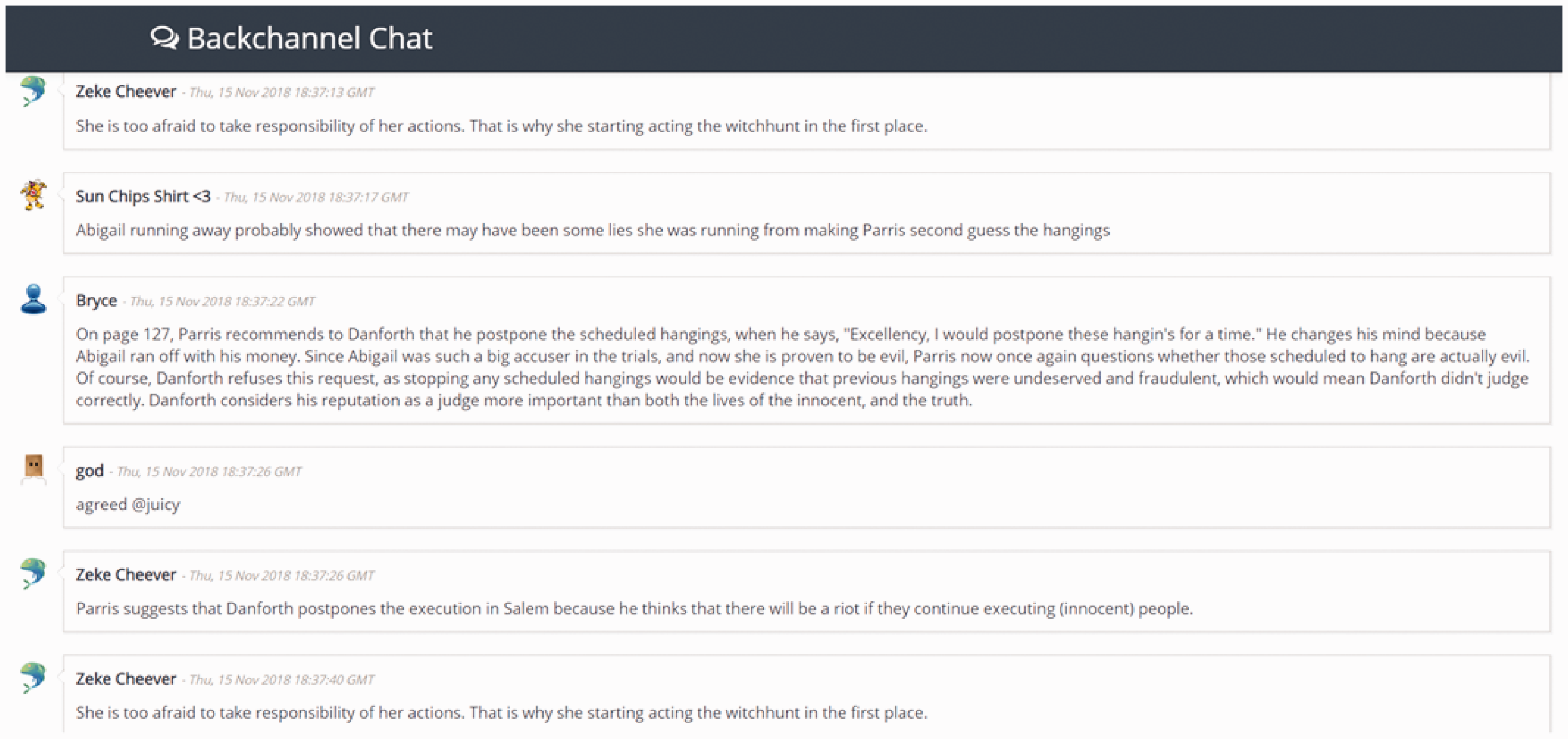
At first, students responded to the reading comprehension question by explaining that chaos was occurring in Salem so hangings should be postponed. Then, the discussion branched out into multiple explanations as students a) expanded on the original reasoning, and b) problematized the initial response with questions (see, as an example of student questioning, Figure 4). Unlike the immobile responses in which students gave one explanation, the participatory response-based discourse resulted in no fewer than ten separate concepts and five probing questions that generated new avenues of inquiry.
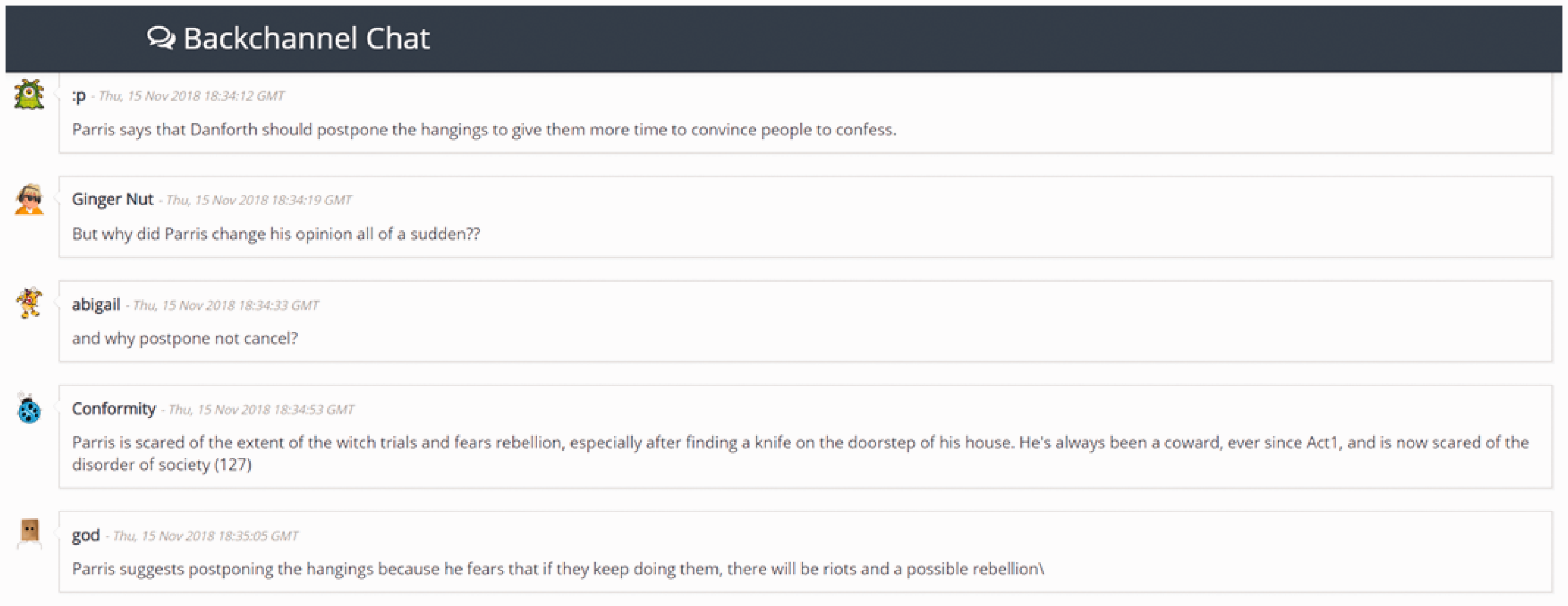
Students begin to raise questions of their peers’ responses within the first two minutes of the discussion.
On Day 1, students’ immobile responses perpetuated traditional, school-based writing practices. Students used Academic English language practices that indicated an essayist- and content-literacy (Gee and Hayes, 2011) style of response, such as remaining formal, staying on a single topic, using an intellectual voice, and addressing a fictionalized audience through impersonalized language (cf., related comments in Gee and Hayes, 2011). Most significantly, students’ responses were immobile, remaining focused on a single explanation that was similar to those written by classmates—even though they did not collaborate.
One explanation for the near universality of students’ answers in their immobile responses are the implicit commands in a classroom for responding to reading comprehension questions. Teachers’ distribution of reading comprehension questions implies a directive for students to respond in a certain way. Deleuze and Parnet (1987) explained, “When the schoolteacher explains an operation to the children, or when she teaches them grammar … she transmits ‘order words’ to them, necessarily conforming to dominant meanings” (Deleuze and Parnet, 1987: 22). Although the assignment did not specify a way of responding, students (in their immobile responses and at the beginning of their participatory response-based discourse) nevertheless conformed to the commands implicit in a traditional classroom, such as avoiding personal pronouns and writing in complete sentences.
In contrast, on Day 2, the participatory response-based discourse elicited interaction between students and movement away from initial Academic English responses, as depicted in Figure 3. When students first responded in the participatory response-based discourse, they did so in a manner that was markedly similar to immobile responses. But new ideas soon emerged. Unlike in the immobile responses where students could not see what others had submitted, during the participatory response-based discourse students were active participants. I suggest that students went through moments of self-repair when they saw that their initial ideas had already been submitted and, instead, chose to either expand on the initial response with new information or pose problematizing questions.
From revoicing to online voices
On Day 1, in their immobile responses, students showed a propensity for “revoicing” (ventriloquizing) the exact words that been used in the reading comprehension question (According to Hale, what has happened to Salem? Why will this lead to rebellion?). By revoicing, students were “doing school,” albeit with little depth or evidence of understanding. The occurrences of revoicing practices (diction, grammatical structure) were significantly more frequent during Day 1’s immobile responses compared to Day 2’s participatory response-based discourse (see Table 1). Students’ Day 1 immobile responses frequently revoiced either the original reading comprehension question or the text of The Crucible. Half of the students in their immobile responses used the exact phrasings of “According to Hale” or “lead to rebellion” that were in the original question. Additionally, the smaller verbal-phrasings of “has” and “will” (words from the prompt) were revoiced extensively. This revoicing suggests that students saw the reading comprehension assignment as implicitly commanding a reproduction of preconceived models (Samuelson, 2009).
Comparison of students’ “revoiced text” in immobile responses and participatory response-based discourse.
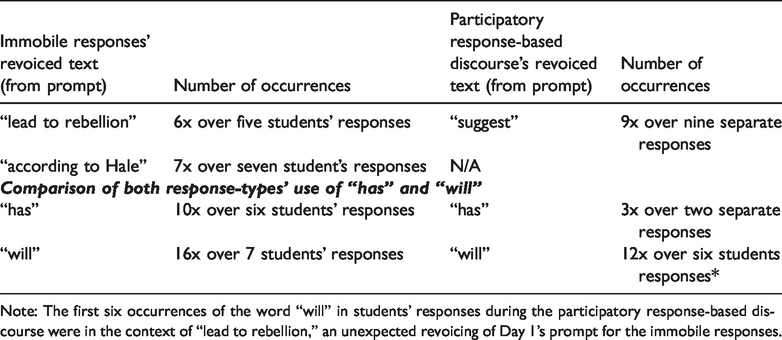
Note: The first six occurrences of the word “will” in students’ responses during the participatory response-based discourse were in the context of “lead to rebellion,” an unexpected revoicing of Day 1’s prompt for the immobile responses.
On Day 2, the responses to the prompt (What does Parris suggest to Danforth? Why does he suggest it?) during the first minutes of the participatory response-based discourse were similar to those from the immobile responses. Indeed, throughout the duration of the chat, the verb “suggest,” originally in the prompt, was used nine times in student responses. However, five of nine messages with “suggest” occurred during the first two minutes (of the more than eight-minute discussion). Over the remaining six minutes of the discussion, students gradually revoiced less and less.
One unexpected outcome during Day 2 was the abundant use of the word “will,” which I had assumed would not appear in any significant way. However, the opposite was true. The word “will” appeared 12 times in the participatory response-based discourse. The surprising reality, though, was that each of the first six iterations was an exact revoicing of Day 1’s reading comprehension prompt (“will lead to a rebellion”). That is, students’ revoicing practices that had appeared on Day 1 carried into the participatory response-based discourse. But, over time, revoicing diminished. Students gradually reduced passively reproducing institutional structures and began co-constructing responses (Kavanagh and Rainey, 2017; Latour, 1993). This change over time may have signaled a shift toward an authentic affinity space.
From “perfect” paradigms to online chat discourse
Students showed more adherence to Academic English when writing their immobile responses on Day 1, eliciting only one formal error over the 1,025 words in the data set. On the other hand, Day 2’s participatory response-based discourse data set had 38 non-standard practices throughout its 1,478 words and sentences.
These online chat practices in the participatory response-based discourse included the following: 1) missing end punctuation, 2) a lowercase first letter of sentence or name, 3) *-use to correct spelling, 4) an accidental backslash at the end of a sentence, 5) tildes for emphasis (e.g. “∼was∼”), 6) the @ sign with a user-selected name to reference another user, and 7) an elaborate shrugging emoji (¯\_(ツ)_/¯) .
The linguistic practices in the immobile responses were traditional, aligned with the discourse practices seen in Academic English’s essayist- and content-literacy writing practices. Students were well aware of what it took to “do school” (see similar discussions in the work of Anyon, 1980; Gee, 2015; Giroux, 1992; Heath, 1983; Lareau, 1987; Street, 2005). When these same students responded to the prompt in the participatory response-based discourse on Day 2, they gradually moved away from formalized essay-writing. At the beginning of the participatory response-based discourse, students only posted a few messages without proper capitalization or end punctuation. However, these discursive moves (signaling online chat practices) exponentially increased toward the end of the discussion.
After interpreting how students’ discursive moves changed over the discussion, I theorize that students engaged in Day 2’s backchannel chat in three sequential stages:
Overall, students’ discursive moves shifted from school-based revoicing of Academic English to social semiosis (i.e., co-constructed responses) to online chat discourse. Most new ideas—as captured by their written responses—occurred during the Liminal Voices Stage, the middle of the three stages.
My findings suggest that an affinity space in classroom teaching might be an outcome of both space and time. In other words, it is not enough for teachers to direct students to portals deemed to be affinity spaces; those are just chat rooms. Educators must also facilitate circumstances in which students, who likely will initially use Academic English (in this traditional school setting), gradually collaborate in ways that transform quasi-synchronous online chats into academic affinity spaces.
From being known to unknown
On Day 1, students’ immobile responses were all linked to their actual names, but students were able to adopt pseudonyms during the participatory response-based discourse. Of the 14 students, five elected to keep their first names and the others created pseudonyms.
Three different categories of username were apparent: 1) Names Related to Classroom Literature, 2) Unrelated Names, and 3) Ambiguous or Unclear Affiliation (see Table 2). Based on the data, students who participated the most were those who chose aliases related to the book being discussed.
Student self-selected usernames in the participatory response-based discourse and number of times that student participated in the backchannel chat.
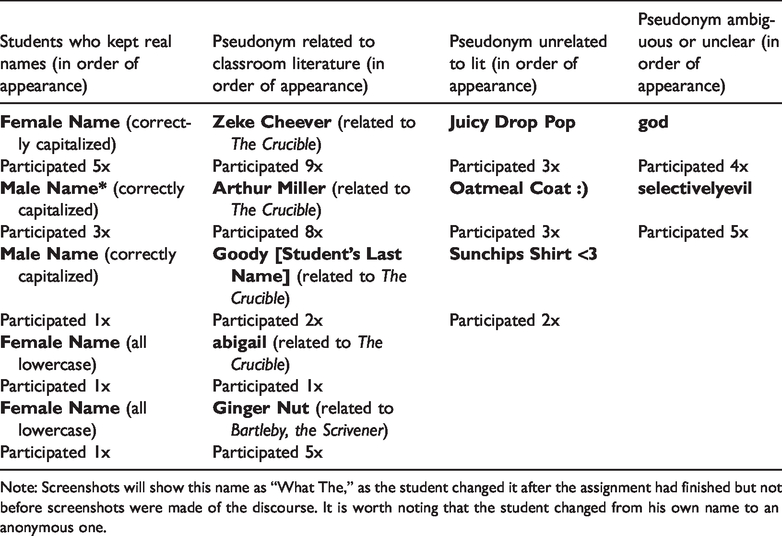
Note: Screenshots will show this name as “What The,” as the student changed it after the assignment had finished but not before screenshots were made of the discourse. It is worth noting that the student changed from his own name to an anonymous one.
In a different lesson not captured by this study, I noticed that students from a different class responded differently (in backchannel chats) when they were using their real names. Students who had been “doing school” gradually shifted into online chat discourse practices when they switched to pseudonyms. This foregrounding experience partially prompted the present study. Tellingly, during the participatory response-based discourse, students who did not choose aliases but instead used their own names were also more likely to continue to use Academic English.
Jaffe et al. (1995) described the self-selection of an online alias as “managed ambiguity.” They found that spaces in which people had control over their own identities online improved interpersonal communication. In this study’s live classroom setting, students’ “managed ambiguity” may partially explain their willingness to participate more freely in the Backchannel chat.
Yet while students may have ostensibly chosen anonymity in the chat, did (some) students know one another’s usernames? During one exchange (see Figure 5) in which a student praised his/her own response, another student responded: “@ gingernut way to pat yourself on the back pal” [sic]. While the word “pal” is technically gender-neutral, modern discursive colloquial usage suggests that this refers to a male student. Thus, it is possible that while students were anonymous to some of their audience, others knew one another’s identities, implying that “managed ambiguity” gives students more control over their public identities.
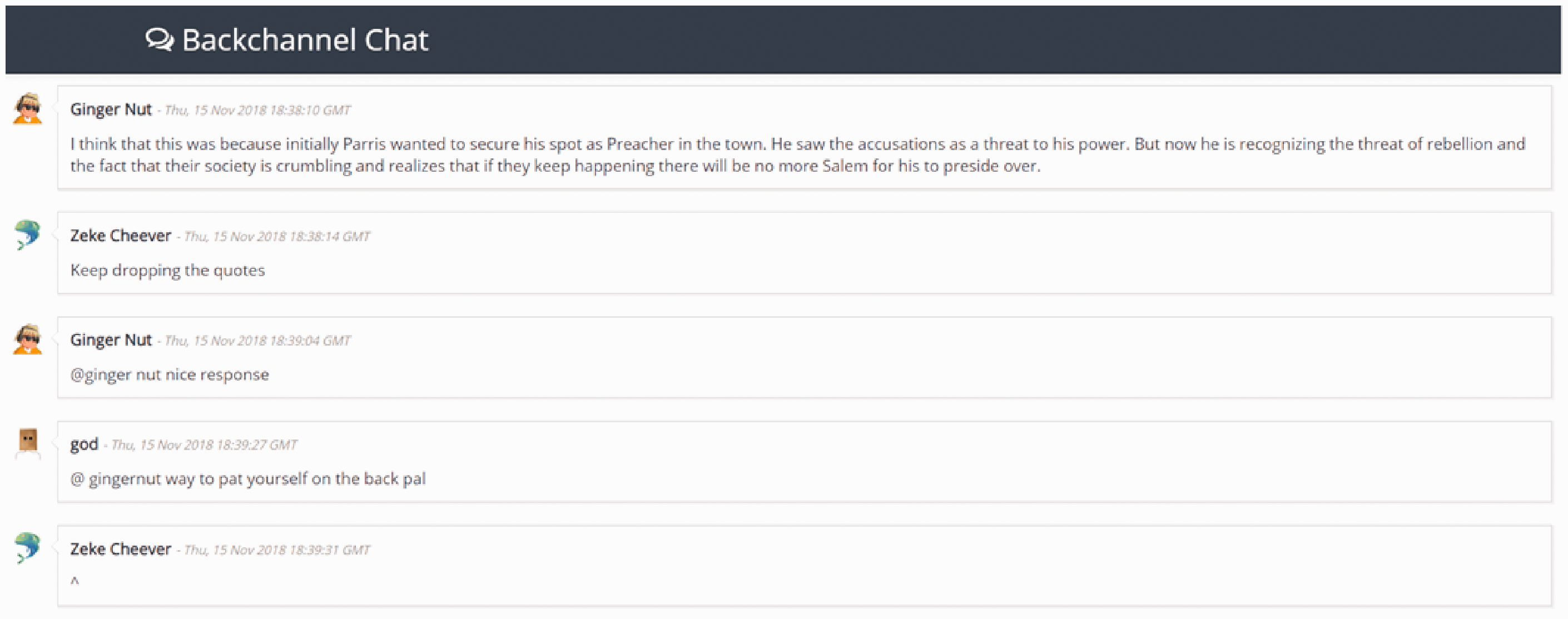
Students respond to a classmate’s self-praise.
From proper to pronouns
In their immobile responses on Day 1, students barely used pronouns. In contrast, on Day 2 students quickly used pronouns to refer to characters during the participatory response-based discourse. There were numerous iterations of first-person referents, such as “I” and “me.” Every single use of these first-person pronouns was in the form of a hedge regarding a cognitive process. Students referred to themselves with phrases such as “I believe,” “I think,” “I mean,” “I would assume,” “It seems to me,” and “I guess.”
Despite frequent pronoun use during the backchannel discussion, only a single second-person pronoun (“yourself”) was used. Students’ liberal and unprompted usage of the @ sign to directly address another user might explain the lack of second-person pronouns. Considering that new literacies lead to new social practices and deitic language use (West, 2019), the @ sign replaced the pronoun “you.”
Students’ pronoun usage during the backchannel chat indicates that they were actively reading one another’s responses and participating in the chat, rather than passively writing disjointed responses. As seen in Figure 6, by shifting to a pronoun to reference a character’s name, the student showed that they were engaging in the quasi-synchronous discussion, both reading and creating text.
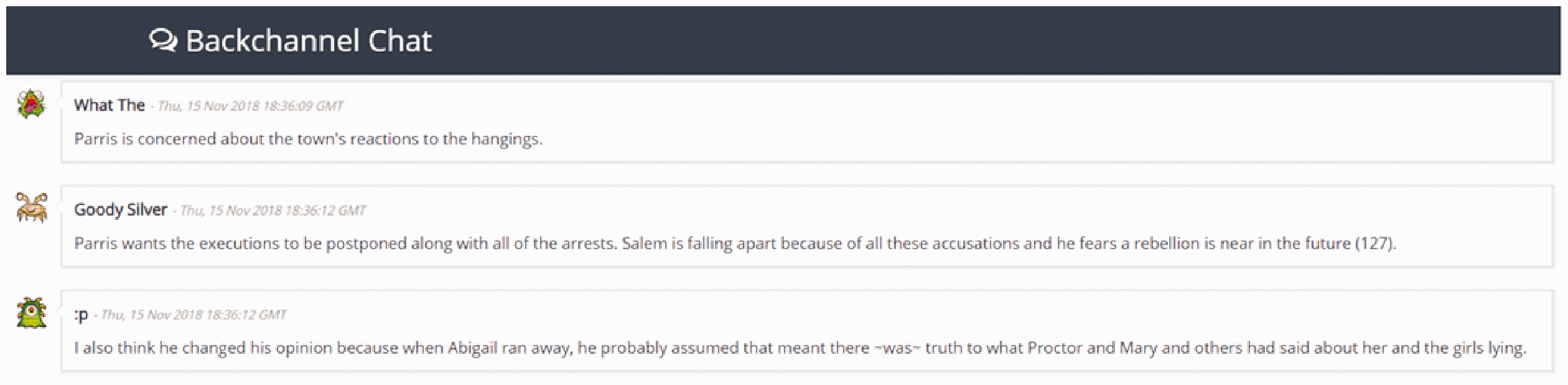
Students discuss the actions and motivations of Parris, a character in The Crucible. A third student adds to the development of this idea but uses a pronoun to address Parris rather than his proper name.
The writing-reading dialectic in the participatory response-based discourse seems to have facilitated the transition from the Revoicing Stage to the Liminal Voices Stage through self-repair. When students entered the Liminal Voices Stage, they switched from using revoiced essayist-literacy language and practices to online chat discourse practices. During this theorized stage, students started using first-person pronouns more frequently, signaling that their responses had moved from revoiced explanations (like the 11 similar answers from the immobile responses) to co-constructed responses. That students were hesitant about their new lines of inquiry was apparent through their use of hedge words and mitigators, all of which related to cognitive functions (e.g. “I guess,” “I believe,” and “I think”).
From teacher approval to peer approval
Since for the immobile responses students’ only audience was their teacher, students likely answered in ways that they believed would result in teacher approval. The linguistic strategies students used were consonant with ways of “doing school.”
However, during the participatory response-based discourse, students’ focal audiences seemed to gradually shift to include their fellow students. In fact, recognition from peers was actively sought. The backchannel chat rooms on http://backchannelchat.com allowed students to “like” one another’s messages (including their own) by clicking a small thumbs-up button next to a post. In one instance, when a student posted a response and received no “likes,” the student then reposted the same message verbatim (see Figure 7). After the repost of the message received two “likes,” the student moved on.
A student whose comment received neither a direct respose nor “likes” repeats the same statement verbatim five messages later.
Most messages received zero to three “likes.” One message, however, received seven likes, a significantly higher number than any other students’ responses (see, earlier, Figure 5). After the discourse sequence in Figure 5, one student wrote “Stop liking your own comments guys” in a value-laden statement. Since this student saw “likes” as having importance, the student wanted any self-distribution of “likes” to stop and, instead, earned from one’s peers.
Over the course of Day 2’s participatory response-based discourse, receiving “likes” and feedback from peers became an influential motivator for students. The apparent desire to receive recognition demonstrates just how powerful a live peer audience can be to students (Schwartz, 2014; Smith, 2018; Sweeney, 2018).
From commanded to commanders
In their immobile responses, students showed little autonomy. They answered the prompt in a perfunctory, mechanical fashion. Yet during the participatory response-based discourse, students not only moved into new territory, but they also took charge of the discourse. They commanded other students to “Keep dropping those quotes” in a supportive appraisal of their peers’ use of evidence. Additionally, as aforementioned, one student commanded others to “Stop liking your own comments guys [sic].”
The same students whose immobile responses were passive, communicated in an altogether different manner during the participatory response-based discourse. Students directly challenged one another’s responses (using conjunction-openers of “And” or “But” followed by a question). Even without follow-up teacher questions, students created their own problematizing inquiries. They themselves began to act as teachers by repurposing structures traditionally ascribed to educators, such as the initiate-response-evaluate (IRE) cycle (Cazden, 2001): students posed their own questions, responded to one another’s inquiries, and then evaluated with either statements or “likes.”
Conclusions
This study examined students’ linguistic patterns and discursive moves in both independently written responses and a quasi-synchronous live chat, which was conducted on a backchannel interface. Although much research on affinity spaces has been conducted in informal, out-of-school contexts, the results of this research suggests that students in traditional high school English classrooms may be able to tap into the benefits of affinity spaces. Features such as managed ambiguity, quasi synchronous discussion, and the ability to evaluate (with “likes”) peer responses fostered a level of complexity and nuance in the backchannel chat that had been simply absent from students’ independent responses. As a practicing high school English teacher who values creative thought over near-identical responses, the methods described in this paper resulted in an intermix of Academic English and online discourse coalescing into new, co-constructed understandings.
At first, students in their immobile responses demonstrated their ability to “do school,” responding with Academic English in an essayist-literacy style that provided a single explanation. In contrast, during the participatory response-based discourse, students gradually created new explanations and problematized earlier responses by asking questions. The transitioning discursive moves—from revoicing/Academic English to online chat discourse—suggested that online affinity spaces in school classrooms are as much a product of time (and deliberate planning on behalf of the educator) as they are of physical access to new digital literacy portals. Upon analysis, three progressive stages of discussion emerged during the backchannel chat (Revoicing, Liminal Voices, and Online Voices). As both time and the stages progressed, students used more online chat practices, such as @ signs and emojis. The most generative stage of co-construction was the Liminal Voices stage when students used both Academic English and online discourse practices, rather than when they were predominantly using one practice or the other.
Unfortunately, many school systems continue to perpetuate hierarchical models of Academic English despite the advent of new literacies and digital technologies in classrooms. However, the findings of this exploratory study suggest that teachers in diverse contexts can use affinity spaces in their classrooms to great effect. While not without its limitations, this study adds to the argument that teachers may openly welcome ¯\_(ツ)_/¯ emojis and online aliases into their classrooms, for traditional academic structures are not prerequisites of authentic learning. Teachers may instead create classroom affinity spaces through new literacies, making opportunities for students to co-construct meaning.
Supplemental Material
sj-pdf-1-ldm-10.1177_2042753020946284 - Supplemental material for Students’ discursive moves in two distinct literacy modes: Comparing approaches in a grade 10 English classroom
Supplemental material, sj-pdf-1-ldm-10.1177_2042753020946284 for Students’ discursive moves in two distinct literacy modes: Comparing approaches in a grade 10 English classroom by Jason Toncic in E-Learning and Digital Media
Footnotes
Declaration of Conflicting Interests
The author(s) declared no potential conflicts of interest with respect to the research, authorship, and/or publication of this article.
Funding
The author(s) received no financial support for the research, authorship, and/or publication of this article.

Supplemental Material
Supplemental material for this article is available online.
Author Biography
References
Supplementary Material
Please find the following supplemental material available below.
For Open Access articles published under a Creative Commons License, all supplemental material carries the same license as the article it is associated with.
For non-Open Access articles published, all supplemental material carries a non-exclusive license, and permission requests for re-use of supplemental material or any part of supplemental material shall be sent directly to the copyright owner as specified in the copyright notice associated with the article.
