




Abstract
Drawing upon notions of symbolic representation and transcultural repositioning, this study uses visual and critical discourse analyses to examine a multimodal photo essay created by seventh- and eighth-grade immigrant youth in an English as a New Language (ENL) class. Collectively titled “I am from aquí and allá” by the students, the photo essay was installed as a public exhibit for an Open House culminating a year-long literacy inquiry the students called “the culture project.” Through analyses of students’ images and captions, I point to examples of symbolic convergence: the practice of bringing together the multiple sites/sights of students’ diasporic identities; offering others alternative sites/sights from which to understand them; and creating new sites/sights from which to position themselves to learn, participate, and contribute to change. The article discusses how this particular multimodal artifact suggests the need for further dialogue about the value of local, learner-centered literacy pedagogies and practice in a time of increasing commercialization and standardization of curriculum, instruction, and assessment.
Keywords
As classrooms reflect the changing demographics of global movements, rich sociocultural studies of the literacy practices of immigrant youth in their everyday lives have theorized the critical relationships between literacy, identity, and agency (Gutiérrez, 2008; Lewis, Enciso, & Moje, 2007). Reading translated Japanese comic books has been related to the construction of border discourses and identities (Eva Lam, 2004), writing online fan fiction to the enactment of cosmopolitan identities and transnational social networking (Black, 2009), translating or “para-phrasing” for immigrant family members to the complex negotiation of words and worlds (Orellana, 2007), and developing a repertoire of biliterate practices to the literacy socialization involved in negotiating transnational spaces (Rubinstein-Ávila, 2007). These studies and others have broadened notions of literacy practices, expanded understandings of transcultural identities as multiply situated across sites and spaces, and argued for responsive practices in education that acknowledge the sophisticated literacies and knowledge immigrant youth bring to school by developing critical pedagogies that mobilize their cultural identities in the classroom.
There are strong examples in pedagogies that draw on the funds of knowledge of immigrant students, communities, and educators (González, Moll, & Amanti, 2005); grow from immigrant, migrant, and refugee students’ critical inquiries into their family histories and lived experiences through reading, writing, and remembering (Campano, 2007); privilege students’ identities through the making of multimodal identity texts (Cummins & Early, 2011); create third spaces by honoring the hybrid discourses and literacies of transcultural youth (Gutiérrez, 2008; Gutiérrez, Baquedano-Lopez, & Turner, 1997; Moje et al., 2004); consider the various communities with whom students must effectively communicate in writing for transcultural citizenship (Guerra, 2008); and acknowledge the material and symbolic objects students value through artifactual literacies (Pahl & Rowsell, 2010). However, the commitments that ground such pedagogical stances, and the practices that stem from them, still contrast significantly from those dominating education in the United States (Olsen, 2008; Suárez-Orozco & Suárez-Orozco, 2001; Suárez-Orozco, Suárez-Orozco, & Todorova, 2008; Valdes, 2001; Valenzuela, 1999; Valverde, 2006). In the context of this study outside a midwestern U.S. city, for example, it was suggested by some teachers that immigrant and migrant Latina/o students learning English as an additional language should not be there until they could read, write, and speak proficiently in English; they were considered a burden on their limited time and classroom resources (Fieldnotes, 2008). If students were suspected of being undocumented, their right to be in the classroom—and to a free public education in the United States—might also be questioned in the space of an interview (Interview, 2008). Despite strong advocates for immigrant students in administrative positions, the discourses that circulated within the school and community were situated in broader anti-immigration and assimilationist politics and educational policies and practices that seemed to penalize the school district for its English Language Learners (ELLs) and condone inequities in students’ opportunities to participate, learn, and succeed.
Affecting change in practice within contested contexts and the larger structural inequities around them requires local examples that illustrate the critical and transformative power of situating students’ cultural identities in pedagogies of agency. Local examples can be connected and put into symbiotic relationship with more global movements for social action by identifying and analyzing the broader epistemological and ethical shifts (Blackburn & Clark, 2007) that shaped their practice, like those that framed this study: First, the shift to complicate pedagogy by allowing it to be dialogic. This implies taking an inquiry stance, nurturing curriculum by observing, documenting, questioning, and appreciating the ways in which students mediate pedagogy through their own experiences, literacies, and ways of knowing (Cochran-Smith & Lytle, 2009; Goswami, Lewis, Rutherford, & Waff, 2009; Nieto, 2010). Second, the move to complicate the literacy practices valued and supported in the classroom. This involves looking more closely and critically at the oral, written, and multimodal texts students create and tracing their connections to the people, places, events, objects, and media and systems that circulate through them (Black, 2005; Campano, 2007; Dyson, 1997; Hull & Nelson, 2005; Medina, 2010). And third, the shift to complicate students’ identities by challenging the social categories that marginalize them in school. This requires recognizing them as cultural citizens (Rosaldo, 1997) with interests in defining individually and collectively what it means to be literate, to participate, and to use language and literacy in ways that matter.
As an example of such shifts, this study was designed to explore what happened when students’ cultural identities became the focus of literacy pedagogy in an Advanced English as a New Language (ENL) class for seventh- and eighth-grade students. More specifically, in this article I examine a culminating photo essay the students created titled “I am from aquí and allá.” In a context where many of these students were negotiating the social, educational, and political constraints of their undocumented status, the study explores the ways they chose to represent and reposition both aquí and allá as legitimate social locations (i.e., sites) from which to learn, participate in, and dialogue with their school and community, as well as to create new perspectives (i.e., sights) on their transnational identities from which they and audiences of their work could view themselves. In examining the visual and rhetorical practices of the students in the photo essay as the work of symbolic representation (Hall, 1997) and transcultural repositioning (Guerra, 2007), I argue that a notion of symbolic convergence can help literacy scholars and educators understand the multimodal literacy practices through which students bring together the multiple sites/sights of their diasporic identities, offer others different sites/sights from which to understand them, and produce new sites/sights to position themselves to learn, participate, and contribute.
Theoretical Framework: Literacy, Identity, and Representation
Theoretically, the study understands literacy, identity, and agency as social, cultural, and political, and thus situated in local and global discourses of immigration, citizenship, and education. Having been connected to this site for several years as a researcher, I sought theories in the literature that aligned with those at work in the pedagogy of the classroom: the consideration of students’ identities and experiences as epistemic resources in their learning, the use of social issues as the “stuff” of a parallel curriculum for language learning, and the positioning of students as participants in the solution to those issues. Also important was the need to conceptualize the tensions inherent in that work, framing literacy, identity, and representation to make visible the discourses and structures against which students were struggling for full membership and participation.
Discourses of Immigration and Immigrants
Discourses are “ways of representing aspects of the world”—linguistic, sociocultural, and ideological constructions of the material and social world that shape our “thoughts, feelings, beliefs and so forth” (Fairclough, 2003, p. 124). Discourses transform the world around us by adding dimensions of social and cultural significance, but as Blommaert (2005) reminds us,
This kind of meaning-construction does not develop in vacuo, it does so under rather strict conditions that are both linguistic . . . and sociocultural . . . and this set of conditions cannot be exploited by everyone in the same way. (p. 4)
Similarly, Fairclough (2003) explains that discourses represent different ways of seeing and understanding the world, “associated with the different relations people have to the world, which in turn depends on their positions in the world, their social and personal identities, and the social relationships in which they stand to other people” (p. 124).
Discourses are powerful framing devices (Lakoff, 2004). Although immigration encompasses a complex array of geo-political, economic, and social issues, immigration and immigrants are often framed in essentialist and dichotomous terms in anti-/pro-immigration debates. For example, the strategic framing of undocumented immigrants as “illegal” in anti-immigration rhetoric is evoked to justify policies and practices to exclude, criminalize, and marginalize immigrants in U.S. society (Pérez Huber, 2009). Scholars have argued that such framing “targets Latina/o undocumented immigrants, powerfully linking race and immigration status” (Pérez Huber, 2009, p. 705). In her research, Pérez Huber has demonstrated how racist nativist framing constructs “Latina/os as ‘non-native’ to the United States and, thus, not belonging to an ‘American’ identity that has historically been tied to social constructions of whiteness” (Pérez Huber & Cueva, 2012, p. 394). Unfortunately, education is not impervious to the discourses circulating in society: In her study of undocumented and U.S.-born Chicana/Latina students in California schools, for example, Pérez Huber (2011) found that students experienced “systemic everyday forms of racist nativism” through “subtle, layered, and cumulative verbal and non-verbal assaults” (Pérez Huber & Cueva, 2012, p. 395). While they may be unconscious, such “naturalized” forms of racism in education can have profound negative, long-term effects on students (Pérez Huber & Cueva, 2012). In response, Pérez Huber and Cueva (2012) have found power in testimonio “to document and inscribe a social witness account reflective of collective experiences, political injustices, and human struggles that are often erased by dominant discourses” (p. 393).
Schooling continues to perpetuate colonialist discourses of assimilation and socialization, and thus, for many Latina/os, schools represent sites “of contestation, negotiation, and struggle over cultural meaning and social violence” (Rosaldo, 1997, p. 36). Rather than create learning environments that tap the funds of knowledge of immigrant youth and their cultural communities (González et al., 2005), a strong deficit culture pervades schools. Against a set of socially constructed criteria that are culturally biased, Latina/o immigrant youth are identified and labeled according to the linguistic, social, and academic capital they lack (Olsen, 2008; Suárez-Orozco et al., 2008; Valverde, 2006). Compounded by accountability pressures, such as the performance of English learners in standardized tests, discourses of accountability and standardization (Honeyford, 2010) justify the long-term use of often under-resourced English language programs or isolated classrooms that become a “dumping ground” for students, reducing education to scripted instruction and worksheets, and further “ghettoizing” immigrant youth from their peers (Olsen, 2008; Suárez-Orozco et al., 2008; Valenzuela, 1999). As Fairclough (2003) argued, discourses “constitute part of the resources which people deploy in relating to one another—keeping separate from one another, cooperating, competing, dominating” (p. 124).
Discourses of immigration and immigrants also circulate through schools in and through the curriculum. Representations of immigration and immigrants that students encounter in school often look far different than those they see in the mirror or reflected in their own stories and experiences. In a summer program for ELLs, for example, Ghiso and Campano (2013) describe how immigrant children reproduced the discourses of immigration represented in the commercial ELL literacy curriculum. In a unit on immigration, children were given handouts with sequences of illustrated panels, depicting narratives of adults effortlessly traveling to the United States via sanctioned means (e.g., by boat and airplane) to realize financial success and a new life (e.g., represented by a suburban home with a white picket fence, and the emergence from a “California Style” store with a new wardrobe). Tasked with producing “an immigrant’s story” orally and in writing, the young immigrant children responded by retelling the immigration narratives they saw depicted in the images. When encouraged instead to make a picture of her own story of coming to the United States, one child explained, “No, that’s too complicated!” Ghiso and Campano (2013) and other literacy researchers argue for the diversification of “representations of immigration and what it means to be American” (p. 264) in the curriculum. Inviting students to create multimodal identity texts (Cummins & Early, 2011), bring meaningful artifacts and tell their stories (Pahl & Rowsell, 2010), and explore the creative works of immigrant artists (Danticat, 2010) contributes to educational spaces that compel youth to name and critique dominant discourses, as well as to articulate new representations of themselves and their stories. For Fairclough (2003) reminds us that discourses also have a critical function: Not only do they “represent the world as it is (or rather is seen to be), they are also projective, imaginaries, representing possible worlds which are different from the actual world, and tied in to projects to change the world in particular directions” (p. 124).
Transcultural Identities as Epistemic Resources in the Classroom
Situating students’ lived experiences as resources in the classroom suggests that the transcultural identities of immigrant youth offer unique perspectives from which students can create and mobilize knowledge. The notion of “epistemic privilege” of minority identities suggests “a special advantage with respect to possessing or acquiring knowledge about how fundamental aspects of our society operate to sustain matrices of power” (Moya, 2002, p. 479, as cited in Ghiso & Campano, 2013, p. 254). Informed by philosophical realism, a postpositivist realist theory of identity understands identity as an “epistemically salient and ontologically real entity” (Alcoff, 2006, p. 5). From this perspective (see also Alcoff, Hames-Garcia, Mohanty, & Moya, 2006; Alcoff & Mendieta, 2003; Moya, 2002; Moya & Hames-Garcia, 2000), specific gendered, racial, and ethnic categories are more than simply socially constructed; they reflect a reality that exists beyond or outside them. In other words, a socially shared construction of an identity (e.g., an eighth-grade female Mexican immigrant in the ENL class) reflects a very real set of circumstances by which a 13-year-old Latina will experience school. Moreover, those experiences are not ideologically neutral; they are always situated in contexts of power influenced by the values and assumptions circulating through them. Thus, realist theorists argue for an understanding of truth that is partly referential while still embedded in context.
Such a stance affirms that the identities students bring to the classroom are deeply connected to their ways of knowing. How students understand and make sense of their world is shaped, among other things, by people, places, experiences, and beliefs. These aspects of their identities provide them with rich resources for learning (Nieto, 2010), which, when recognized in the classroom as epistemic resources, create opportunities for students to mobilize them, drawing “out their knowledge-generating potential and allow them to contribute positively to the production and transmission of knowledge” (Moya, 2006, p. 96).
A realist orientation to identity emphasizes the role of dialogue within and across communities of difference as critical to realizing the goal of humanization (Campano, 2009; Moya, 2002). Within that dialogue, space must be created to acknowledge the significant differences that exist as a result of the sociocultural, economic, and political disparities associated with identity categories. Although issues of power and inequity related to race, class, gender, or ethnicity may be perceived as too “risky” to read, write, or talk about in the literacy classroom, others (e.g., Lewison, Leland, & Harste, 2008) have argued that it is far more risky not to engage students in better understanding—and critiquing—social injustice; in fact, that, “it is the refusal to acknowledge the importance of the differences in our identities that has led to distrust, miscommunication, and thus disunity” (Alcoff, 2006, p. 6). Rather, by expanding the canon to include the voices of historically marginalized groups and the curriculum to invite students to contribute their own diverse narratives, literacy classrooms can become spaces where all participants are better positioned to understand themselves in relationship to others, and therefore “to develop a more productive understanding of our universal humanity” (Moya, 2002, p. 104).
Representational Practices in Literacy: Power, Participation, and Positioning
Similarly, the new literacy studies (NLS) have called for responsive shifts in literacy education that do more than provide “explanations based on models of ‘cultural diversity’ or ‘multilingualism’” (Luke, 2008, p. xiii) by considering how education should address “epistemological diversity, where students bring to classrooms complex, multiple and blended background knowledges, identities and discourses, constructing identity and practice from a range of scripts” (Luke, 2008, p. xiii). Studies of literacy practices in everyday life across cultural sites and contexts have demonstrated the ways literacies are improvised, hybridized, and deeply connected to identity (Barton & Hamilton, 1998; Gee, 1996; Street, 1984). NLS research of youth in formal and informal learning spaces has contributed to making more visible how categories of race, class, gender, and ethnicity within social and educational structures position particular groups of young people on the margins. However, researchers have also shown the sophisticated literacy practices through which marginalized youth talk back and resist in solidarity—through silence and gesture (Carter, 2007), spoken word poetry (Fisher, 2007), and photography (Wissman, 2007), for example. Acknowledging students’ agency and identity in their texts emphasizes the circulation of power through them (Lewis et al., 2007).
Literacy practices are thus motivated, as youth, “like adults, act transformatively on the cultural stuff that they have to hand” (Kress, 1997, p. 146), purposefully meshing materials and modes from their experiences with texts and literacy environments to mediate new meanings in the texts they create. That youth are motivated to create and transform texts, media, and spaces has inspired calls for “a different kind of pedagogy, one in which language and other modes of meaning are dynamic representational resources, constantly being remade by their users as they work to achieve their various cultural purposes” (New London Group, 1996, p. 64, italics added). At the same time, research in this area recognizes “the complexity of the idea of literacy and the fact that much of our understanding of it is not obvious” (Barton, 2007, p. 24).
Hall’s (1997) notion of the visual as a form of symbolic representation alludes to the semiotic complexity of visual forms as well as the identity work accomplished through them. According to Hall (1997), representation is “a practice, a kind of ‘work’” mediated through “material objects and effects” (pp. 25-26). As Britsch (2005) described, representation and action cannot be separated, and the visual—just as much as any other semiotic system—enables us to engage in the action of representation. For “action and representation . . . [are] two components that, because of their identity in these discourses, cannot be separated. Image here accomplishes action” (Britsch, 2005, p. 308). Thus, it is possible to examine the visual and written components of multimodal texts as actively engaged in the work of helping others see, and therefore, begin to understand things differently. In the photo essay that is the focus of this article, I suggest that the students were
not simply representing an environment . . . Instead, they [were] mediating; that is, they [were] modifying the situation “ . . . as part of the process of responding to it” (Cole & Scribner, 1978, p. 14) through elements of different kinds. (Britsch, 2005, pp. 307-308)
Notions of representation and mediation in visual literacy also point to practices of convergence, of bringing media and experiences together in creative and sometimes unexpected ways. In media studies, convergence signals “a new paradigm for understanding media change” through “the flow of content across multiple media platforms, the cooperation between multiple media industries, and the migratory behavior of media audiences who will go almost anywhere in search of the kinds of entertainment experiences they want” (Jenkins, 2006, p. 2). Convergence is facilitated by new technologies, but those have emerged as a result of “industrial, cultural, and social changes” (p. 3). Thus, Jenkins (2006) describes the emergence of convergence culture “where old and new media collide, where grassroots and corporate media intersect, where the power of the media producer and the power of the media consumer interact in unpredictable ways” (p. 2).
The notion of convergence adds another dimension to theorizing visual literacy and symbolic representation, as well as to challenging the limited literacy practices and discourses available to immigrant youth in schools. A convergence culture is participatory, involving a convergence of the roles of producer and consumer. New aesthetics with new demands, like transmedia storytelling (Jenkins, 2006), invite consumers into “the art of world making” by requiring them to actively “seek out new information and make connections among dispersed media content” (p. 3). Individually and socially, “Each of us constructs our own personal mythology from bits and fragments of information extracted from the media flow and transformed into resources through which we make sense of our everyday lives” (Jenkins, 2006, pp. 3-4). The sharing and exchange of created content suggests that expertise can reside in anyone, anywhere, and there is evidence that “collective meaning-making within popular culture is starting to change the ways religion, education, law, politics, advertising, and even the military operate” (p. 4).
In their work with youth media, Soep and Chávez (2010) suggest the term “converged literacy” to “articulate what it takes for young people to claim a right to participate as citizens of the world and agents in their own lives” (p. 21). In the powerful example of Youth Radio’s Emails from Kosovo series, Soep and Chávez (2010) explain that the design and analysis of youth media learning are guided by three principles of converged literacy:
An ability to make and understand boundary-crossing and convention-breaking texts; . . . to draw and leverage public interest in the stories you want to tell; and . . . [to access] the material and imaginative resources to claim and exercise your right to use media to promote justice, variously defined—a right still denied young people marginalized from full citizenship as producers of media culture. (p. 24, italics in original)
The notion of convergence in a broader discussion of representational practices in literacy suggests that literacy research must attend to the ways youth navigate power and positioning through their participation in creating new texts. It also reminds researchers that learning is unpredictable, for “when young media producers examine power and its effects, and when their products reach real audiences, the meaning attached to their emerging literacies [and identities] can be hard to predict and not always what we think” (Soep & Chávez, 2010, p. 24).
Transcultural Repositioning: “Here” and “There” Social Locations
The ability of transcultural youth to flexibly mediate specific situations through adapting their language and discourse is central to Guerra’s (2004, 2007) notion of transcultural repositioning. The notion of transcultural repositioning acknowledges how immigrant youth experience their transcultural identities as having “something of both” cultures, while also “always different from each of them” (Ortiz, 1940/1947, p. 103) and how they adapt by moving back and forth
between and among different languages and dialects, different social classes, different cultural and artistic forms, different ways of seeing and thinking about the increasingly fluid and hybridized world emerging all around us. (Guerra, 2004, p. 15)
This “reflective sensibility” (Guerra, 2007) of transcultural youth allows them to reposition themselves in their multiple social worlds through the “selective, generative, and inventive nature of linguistic and cultural adaptation” (Zamel, 1997, p. 350). The concept of transcultural repositioning illuminates the hybrid identities and practices of transcultural youth, while not losing sight of the larger structures of power prevalent in the dominant sociocultural practices in which youth are inducted and instructed in school. Transcultural repositioning frames this struggle as significant to understanding “how identities and cultures can be hybrid and transcultural, even as they are situated in and constructed through local and particular practices” (Guerra, 2007, p. 138). Thus, the notion of transcultural repositioning also works as a methodological construct, as it does in this study, for understanding how youth “engage in rhetorical practices that allow them to reposition themselves across cultures and to enact more productive and meaningful identities within” (Guerra, 2007, p. 138).
As a theoretical construct and a methodological orientation, the notion of transcultural repositioning affords a framework for examining the photo essay as an act of participation through representation. Lu (1990) described how, in rhetorical instances, transcultural repositioning offered writers a way to acknowledge multiple, competing discourses and use the dissonances among them productively rather than ignoring them. Moreover, while identifying transcultural repositioning as a set of rhetorical practices, the concept is still broad enough to invite the study of the particular practices used by youth within specific contexts. Through this research, I wanted to examine transcultural repositioning in the context of students’ practices at work in their photo essay—a collectively produced, multimodal artifact created by the students to orchestrate their response to the dominant discourses that positioned them as belonging “there” but not “here.”
Research Context and Methods
Context of Study
Located in the U.S. Midwest, Eastside Middle School (all names are pseudonyms) experienced an influx of immigrant families, predominantly from Mexico, over the decade prior to my introduction to the school. At that time, the ENL teacher, Beth, was a volunteer at the school, helping small groups of new immigrant children with their homework. I had first met Beth 4 years prior to the study, when I visited her classroom as a researcher studying the impact of a grant that had allowed the school to provide laptops for every student with the goal of using them for problem-based learning. I spent considerable time in Beth’s classroom and had maintained a connection with Beth over the years, returning to her classroom as a participant observer, volunteer, and collaborator in the various projects Beth co-designed with her students around the problems they identified: discrimination and racism at school and in their parents’ workplaces; access to the public library; a better transition to the middle school for new immigrant students (Honeyford, 2013a). Keenly aware of how the immigrant community was positioned in the school and beyond, Beth made room alongside the required curriculum for a “second classroom” (Campano, 2007) through projects intended to foreground students’ cultural identities as strengths, situate them as contributing to their communities as problem-solvers, and promote dialogue through community partnerships and audiences for their work.
Familiar with my presence at the school as a researcher and aware that I regularly visited Beth’s classes, many teachers at Eastside Middle School told me in my interviews with them that they were “doing what they could” for the growing numbers of English learners in their classes (e.g., by providing Spanish-language materials, giving students more time to complete tests, reducing the number of questions they might assign). Many admitted that they still felt unprepared to adequately support English learners, lacking the professional development, resources, and time to learn. There were classrooms known to be more friendly than others to English learners; the students in the ENL program were quick to identify those they considered allies—teachers who took an interest in them, had learned a few words of Spanish, and worked to facilitate students’ engagement in their classes. However, there were also a few whose classrooms were quite inhospitable to immigrant English learners, where, as students had confided to a group of pre-service teachers, they were assigned seats in the back of the room and largely ignored. My observations confirmed students’ reports, as well as other practices that created quite hostile spaces for Mexican immigrant youth, for example, in using Spanish as a disciplinary measure.
The Advanced ENL class in which the study took place was a pull-out class that included an hour for advanced instruction in ENL as well as an hour of academic language support for students’ content area classes. The class had an intentionally small student-to-teacher ratio, but it was particularly small that year. During the data-collection phase of the study, there were six students. Five of the six students in the class were born in Mexico and had lived in the United States between 3 and 8 years (the other student was born in the United States to Mexican immigrant parents). All spoke Spanish as their home language, but their proficiencies in Spanish and English varied (see Table 1).
Descriptions of Students.
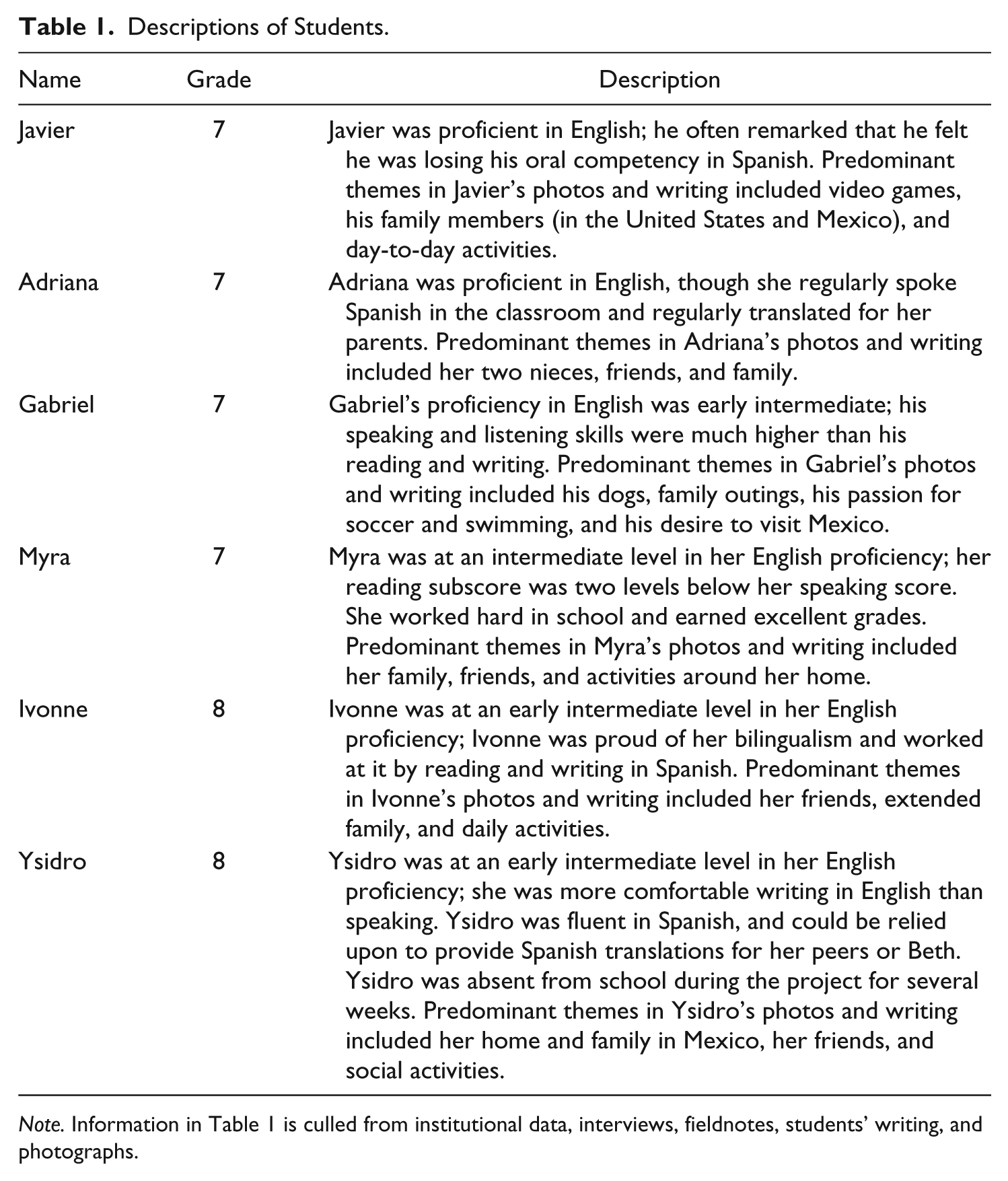
Note. Information in Table 1 is culled from institutional data, interviews, fieldnotes, students’ writing, and photographs.
As was her practice, Beth prompted the students to begin thinking about a problem that would be the focus of an extended project. She was surprised by the response: With high school just a year or two away, the students feared that they would not be prepared for the academic demands of a high school English class, not having had access to the same kinds of literacy activities (e.g., reading novels and poetry, writing papers and essays) as their middle school peers in “mainstreamed” English Language Arts (ELA) classes. Beth was eager to respond to the students’ concerns, but she was also adamant that she did not want to simply adopt the ELA curriculum. She wanted to maintain a focus on cultural identity, but she was unsure where to begin. She asked if I would be willing to collaborate and suggested she liked the idea of a class read aloud. After reviewing several novels together, Beth began reading The House on Mango Street (Cisneros, 1984) to her students. The class’ strong responses to several chapters then prompted us to find poems to use as “dialogic texts.” Upon reading and discussing the work of a few Latina/o and immigrant poets, we wrote a collective class poem together. That sparked an interest in poetry writing, so we adapted Christensen’s (2000) “Where I’m From” and “My Name Is” poem-writing activities. In the process of composing their poems on the laptops, a few students began finding images on the Internet to accompany their texts. That piqued students’ desire to take their own photos, and the poems evolved into narrated movies (Honeyford, 2013b). A series of literacy activities grew from there—a 6-month inquiry into cultural identity that was squeezed into the spaces around the official curriculum—as students studied murals and public art, read immigration memoirs, wrote letters to first generation Latina/o college students, presented their digital poems at a workshop for pre-service teachers, and wrote college application essays.
With the school year and what had come to be known as the “culture project” coming to a close, Beth and the students planned an Open House to share their work with their families, friends, teachers, peers, and community members. As they prepared invitations and posters for the event, the students asked about the possibility of displaying the hundreds of digital photographs they had taken for their poems. Together, they brainstormed possibilities, deciding that they would create a photo essay about what the “culture project” had come to mean to them. In a subsequent lesson, Beth pushed them to think about a title that would help them in choosing their pictures and writing about them, asking, “What would be a good theme for the pictures you’ve taken? . . . What do you want to show people?”
. . . So think about that. What kind of pictures do we as a class (gesturing around the room) want to choose from your collection of photographs? What kinds of pictures do we want to choose to display?
Show family.
(nodding) You want to do family? (1:02) I think that’s a . . . that’s one idea (She gets up from where she’s been sitting on a student chair in the semicircle to write on the white board at the front of the room. As she writes on the board, she continues to talk.) So, everyone can take pictures and show pictures of their family. (Beth writes on the board.) What else?
[The things we do
Friends]
Friends.
(Repeating his idea more loudly) Like, things we do.
Where we’re from? I don’t know.
Yeah (nodding and writing on the board); that’s good.
Pulling a few books from the shelves in the classroom, Beth prompted the students to think about their responses to the titles. A book of children’s poems titled I Am of Two Places (Carden, Capellini, & Gonzalez, 1997) elicited several more ideas from the students: “How I am Latina/o,” “How I am Bilingual,” and a question about whether the title could be in both Spanish and English. Beth affirmed that yes, a bilingual title would certainly represent their cultural identities. The students continued to make suggestions, now in both Spanish and English: “I am From Mexico y es estatas unitos”; “I am from aquí y allá”; “I am from Mexico, not from the United States”; “Who I am now”; “Latina/o culture in the United States of America”; “Yo soy como soy” (I am how I am). After writing them on the board, Beth read them all, then asked for votes: “Which one would best represent everyone’s pictures?” A few slight changes were suggested, the students voted, and although it was not unanimous, they all agreed the title “I am from aquí and allá” reflected a prevalent theme in their photos and the larger project.
Method
The larger study was designed as an ethnographic case study (Dyson & Genishi, 2005; Stake, 1995) of the “second classroom” within Beth’s Advanced ENL classes. A study of a wider phenomenon, examined within its context—the boundaries of a system—a case study has as its goal the provision of “a rich and holistic account of the phenomenon” (Merriam, 1998, p. 41). Over the years of my involvement in Beth’s Advanced ENL classes, what was of interest to me was the phenomenon of drawing on a problem-based learning pedagogy as a culturally responsive, “parallel space” for engaging immigrant youth in language and literacy learning with a focus on social justice and equity. I had observed how, through these projects, students worked to negotiate their cultural identities within this unique (but still contested) school space as a source of epistemic privilege (Campano, 2007). In this case, I wondered what would happen when the focus of the project was turned more on themselves—when, in fact, the problem they had identified was linked to what they considered to be a gap in their own academic readiness? How would they represent and position themselves in this work?
Over the 6 months of the data-collection phase of the study, I visited the ENL class two or three times a week. My role was that of participant observer, and I regularly observed the “official” ENL curriculum, which began with Daily Oral Language (e.g., editing sentences for punctuation, grammar, and spelling) and then a lesson from the textbook. The second hour of the 2-hr block began with Sustained Silent Reading (a school-wide practice), and then Beth would allocate time for individual and small group instruction to support students in their other courses. The students knew that I was available to help, and they often asked me for my assistance with their homework. The remaining time was allocated to the project, when I sometimes joined Beth in facilitating activities we planned together.
Although I attempted to maintain a consistent presence in the classroom, and thus, to build trust with the students in the study, my relatively lengthy commute to the school, my affiliation with the university, and my White European immigrant identity were constant reminders of my position as an outsider. As a qualitative researcher, I worked to be thorough and reflexive in my collection and analyses of the data, challenging myself to identify my assumptions, question my interpretations, and substantiate my tentative understandings through triangulation, peer review, and member checks. The students shaped my ongoing analyses through class discussions and activities, individual invitations to “tell me about your work” and “help me to understand it and you better” and interviews. Beth also played an integral role in that process; throughout, we together studied student work, reflected on students’ learning and participation, and shared our observations. Later, she provided feedback on drafts of manuscripts, including an earlier draft of this article. 1
Data Collection
The data were collected over a 6-month period, following visits to plan with Beth and get to know the students. Data collection during the study included the following:
Observations and fieldnotes
My observations in the ENL classroom were conducted mostly through my active engagement with students in the activities of the classroom. Although it was impossible to write detailed notes while participating, I used a notebook (much like the students’) to take scratch notes, jotting down details and bits of conversation to jog my memory later. I used a video camera, usually perched on a tripod or a cabinet at the back or front of the classroom, to record the classes for transcription and analysis. I also audio-taped the classes with two digital voice recorders placed closer to the students and used a digital camera to document students’ work. After each site visit, I recorded my fieldnotes in detail and composed observational, theoretical, and methodological memos (Corbin & Strauss, 2008; Maxwell, 1996; Schatzman & Strauss, 1973).
Student work
The literacy pieces the students created (e.g., their digital poems, letters, photo essay, and essays, as well as their notebooks and digital file folders of work) were the focus of my analysis. For each student, I regularly collected and made copies of their reading/writing notebooks, written work, project work, and other writing they did in the classroom. The students’ unofficial writing was also of interest. For example, I discovered that Ivonne collected fragments of Spanish poetry and calligraphied them on her folder. Myra wrote notes to friends. Javier communicated with his friends through text while playing online video games with them. In class, much of the students’ writing was done on laptops. In file folders on the school’s server, the students also saved their digital pictures, drafts of their work, and assignments for other classes. I was able to get a download for research purposes once a month.
Interviews
Because of my role and the small number of students, I interacted with them all regularly. During the second hour of class, students’ homework and class assignments gave us opportunities to talk about school. Sometimes these informal discussions were planned, but most often, the students would open up a conversation with a comment or an anecdote, and I would continue to ask questions to learn more. During the time devoted to writing, I audio-recorded my “desk-side” conferences with students about their work. Near the end of the school year, I conducted 20 to 30 min one-on-one interviews with each of the students using a topical interview protocol with open-ended questions.
Additional data collected for the larger study included observations of students in their content area classes and interviews with teachers and administrators, relevant classroom- and school-level artifacts, including data related to students’ performance in school, and the collection of school division- and community-level documents related to broader discourses about immigration, education, and language circulating in the context of the study.
In this article, I turn my attention specifically to the photo essay as a data set. In the scope of the larger study, a progressive focusing (Parlett & Hamilton, 1972; Stake, 1995) on the notion of transcultural repositioning through multimodal representation led me to think about the significance of the photo essay as it (a) functioned at both an individual and collective level as a culminating activity of the “culture project,” (b) was conceived out of a need students felt to share their visual images (documenting who they were/their identities) explicitly for the purposes of a public audience, (c) was most explicit in its purpose to convey students’ transcultural identities in opposition to discourses about where they were from, and (d) was the most multimodal in its representation through image and caption. The purpose of the analysis was to examine more closely the photo essay as a literacy artefact (Pahl & Rowsell, 2005) or identity text (Cummins & Early, 2011), an “ideal” (Heath & Street, 2008) sample within the larger ethnographic case study of a student-created, multimodal text purposefully designed by students to represent their understandings of their transcultural identities to a school and community audience. Thus, the photo essay and its related data sources (see Table 2) offered an opportunity to better understand transcultural repositioning through multimodal literacies. Toward this end, I had several questions: How do students, individually and collectively, inventively represent their transcultural identities through a multimodal text? How do they communicate through visual and written semiotics what it means to them to have “something of both” cultures, while also “always different from each of them” (Ortiz, 1940/1947, p. 103)? In what ways does the photo essay contribute to diversifying “representations of immigration and what it means to be American” (Ghiso & Campano, 2013, p. 264)? What discourses of immigration and immigrants do they draw on through their work and how do they position themselves in relationship to them? What is the power of the piece as a multimodal text? In what ways, for example, did the students explore notions of convergence—not just in the title, but through the modalities of the text? What new perspectives on transcultural repositioning do they offer? And what is the effect on the viewer/reader/audience? What is it that we might see and/or comprehend from the text?
Related Literacy Activities and Data Sources.
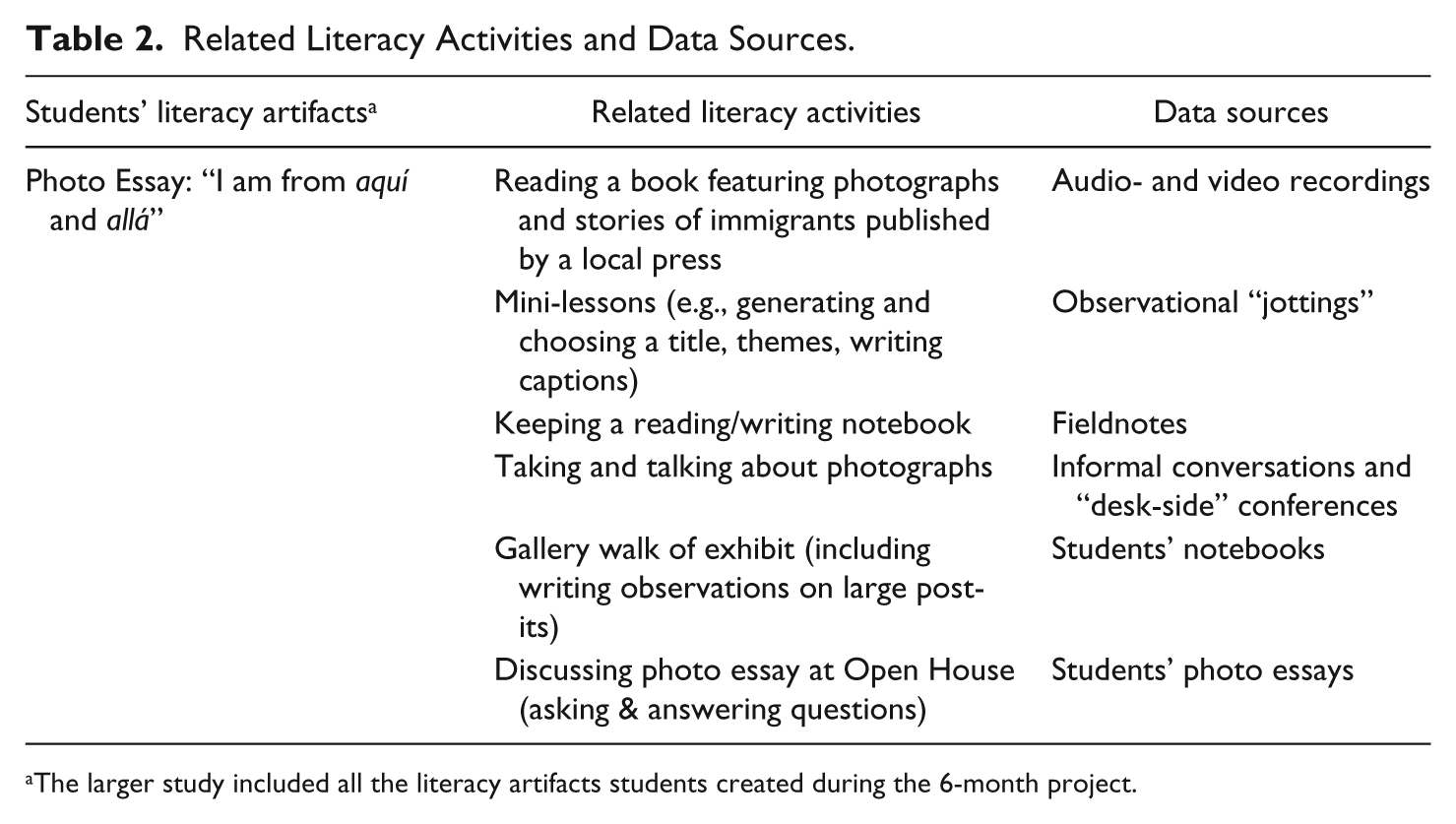
The larger study included all the literacy artifacts students created during the 6-month project.
Data Analysis
By May, the classroom walls were filled with an audit trail of students’ work and other displays, so the photo essay was designed as an exhibit on the doors of two large metal storage cabinets. Due largely to these space limitations, the students selected just three pictures, writing a caption for each to convey how the image spoke to the theme “I am from aquí and allá.” Each captioned picture was printed in color, and all 18 were arranged on the cabinets with magnets (see Figure 1).
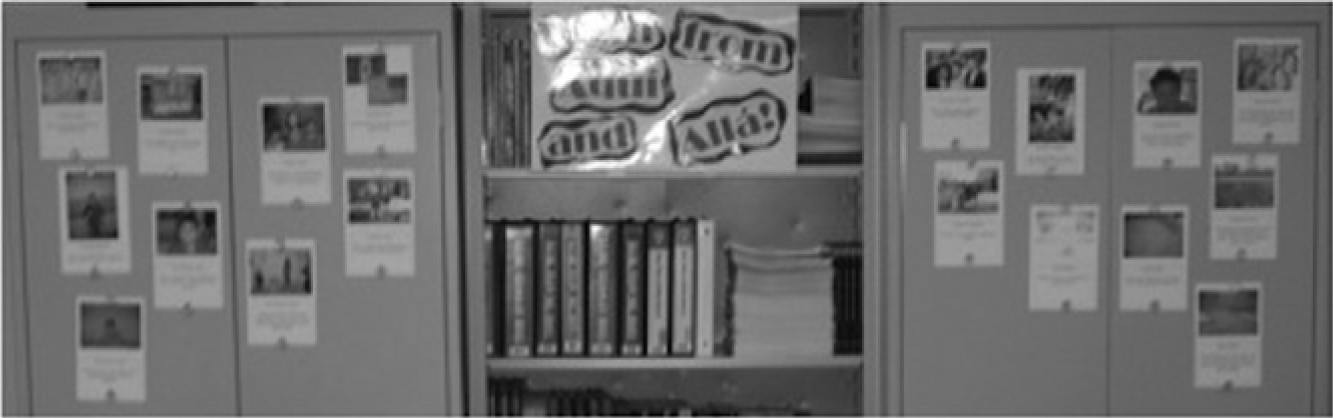
The photo essay exhibit.
Representing the notion of being from both aquí and allá was, of course, not a simple task—each student’s unique immigrant experience stretched across borders and years, invoking people, moments, and emotions not easily represented. Rising to the challenge, the students demonstrated their capabilities as creative appropriators, including with the “new” pictures they had composed throughout the project pictures of the “old”: pictures of photographs around their homes (e.g., framed photographs hanging on the wall or sitting on a bookshelf) or digital pictures sent from their families in Mexico. While many of the students had also incorporated “found” images from the Internet in their earlier project work, none of these were selected by students to be included in the photo essay.
The analysis and interpretation of the data were guided by several principles informed by the theoretical framework for the study, as well as other digital storytelling and multimodal photo projects (e.g., Hull, 2003; Hull & Katz, 2006; Hull & Nelson, 2005; Vasudevan, Schultz, & Bateman, 2010). First, both the students’ photos and captions were considered texts; as elements of a social event, they were understood as communicating meaning, able to cause social change, and inherently ideological (Fairclough, 2003). As Hull and Nelson (2005) discuss in their analysis of students’ digital stories, multimodal composing is not simply an “additive art,” but one capable of transcending “the collective contribution of its constituent parts” (p. 225). Furthermore, the meaning of the visual and written texts was understood as mediated by the students through their choices in selecting the photos and writing the captions (Cole, 1996; Kress, 1997; Wertsch, 1985). The analysis was also guided by the understanding that identities can be felt and expressed in spatial-temporal, relational/positional, and sociocultural terms, and that these have different affordances and constraints for literacy practices in various contexts (Bloome, Carter, Christian, Otto, & Shuart-Faris, 2005; Holland, Lachicotte, Skinner, & Cain, 1998; Leander & Sheehy, 2011). Literacy was defined broadly; in this case, the visual and rhetorical practices students drew on to represent and position themselves were understood as literacy practices, which are always situated in larger ideological discourses (Gee, 1996; Street, 1984). Thus, students’ representation and positioning of their cultural identities was recognized as ideological: their claims were understood as situated within and responding to discourses of immigration, assimilation, and identity.
My approach to analyzing the photo essay drew on methods and tools developed in the fields of social semiotics (Halliday, 1978) and critical discourse analysis (CDA; Blommaert, 2005; Bloome et al., 2005; Fairclough, 2003; Gee, 1999). Most broadly, the analysis was framed by a process of coming to understand the interplay among the production of the photo essay (i.e., the text), the photo essay as a text itself, and the interpretation of the photo essay (Fairclough, 2003). For Halliday (1978), this process involves understanding the metafunctions of a text, common to all semiotic modes: the ideational, interpersonal, and textual.
As the photo essay was both a visual and written text, I drew on the analytic framework developed by Kress and van Leeuwen (2006) for reading the grammar of visual texts. Their framework extends Halliday’s linguistic functional analysis to cue the viewer of an image to attend to how the image represents things in the world (the ideational metafunction), how the viewer interacts with the image (the interpersonal metafunction), and how the signs in the image achieve their purpose (the textual function). The theories and tools embedded in Kress and van Leeuwen’s framework are integrated into Mullen and Fisher’s (2004) three-stage process, an “elaboration” of techniques devised for reading public art (Foss, 1994). Each stage of the process attends to each of the metafunctions. This process guided my analysis of how students represented and positioned themselves in the images, which was aided by the writing of pages of analytic memos (Corbin & Strauss, 2008) and annotations of the images.
First, I examined the presented elements in the image (see brief summary of analytic memos included in the column “Key Elements” in Table 3)—the images’ aesthetic or visual elements (e.g., line, color, space, framing, setting, objects, or participants and their relationship to one another), production elements (e.g., camera angle, distance, lighting, perspective), and interpersonal elements (e.g., how the image invites the viewer to interact with the image—things such as gaze, head tilting, smiling, body position, and eye contact). The second stage of analysis involved examining the way the presented elements in the images influenced one another, considering the relationships between the connotative and denotative meanings of the elements (e.g., the social, cultural, religious, symbolic meanings associated with them). In Kress and van Leeuwen’s terms, this means considering the spatial composition of the image—how the representational and interactive meanings of the image relate to each other through their information value (i.e., the location of the elements in various zones—left, right, top, bottom—of the image), salience (i.e., the visual weight or ideological importance given to the elements through size, location, focus, and light), and framing (e.g., the use or absence of framing devices, patterns, lines, and shapes to show the relationship of elements in a visual text to one another). The third stage in Mullen and Fisher’s (2004) approach is to determine the extent to which the aesthetic, production, and interpersonal visual elements contribute to the function of the image(s). At this level, the ideological dimensions of the function of the image(s) are considered: What values does the image evoke or promote? In this case, informed by my theoretical framework, I considered how the elements of the images functioned to communicate the students’ chosen theme, “I am from aquí and allá”: How are aquí and allá represented? How does the image communicate being from aquí and allá?
Analytic Memos of Repositioning and Representation.

These photos have been edited in the article to protect privacy and confidentiality.
These photos were not included for issues related to copyright or because they could not be reproduced like the original.
To this, I added another stage examining the written texts of students’ captions through CDA. As Blommaert (2005) describes, though the term CDA encompasses a diverse set of theories and practices, it prominently features the use of systemic-functional linguistics (e.g., Fairclough, 2003; Halliday, 1978). The purpose of layering CDA to the analysis was to look more carefully at the “linguistically defined text-concepts” in students’ captions, with the understanding that “linguistic-discursive textual structures are attributed a crucial function in the social production of inequality, power, ideology, authority, or manipulation” (Blommaert, 2005, pp. 28-29). Through the theoretic tools of microethnographic CDA (Bloome et al., 2005; Fairclough, 2003; Gee, 1999; Halliday, 1978), I examined how the students used the concise language of their captions to represent and position themselves, attending to the use and function of repetition (e.g., for emphasis and effect), metaphors (e.g., for implied comparisons and symbolism), deixis (e.g., to reference other times, people, and places), nouns and pronouns (e.g., to name and draw boundaries of inclusion/exclusion), possessive pronouns (e.g., to indicate claims of power, ownership, and belonging), verb tense (e.g., to reference past, present, or future), and sentence structure (e.g., to emphasize position through the order or type of sentence). As Kress and van Leeuwen (2006) pointed out, while both the visual and the verbal structures in a multimodal text can communicate meaning,
the two modes are not simply alternative means of representing “the same thing” . . . Only a detailed comparison can bring out how in some respects they realize similar types of meaning, though in different ways, while in other, perhaps most respects they represent the world quite differently. (p. 76)
The layering of this level of discourse analysis focused on understanding how the young photo essayists drew on the linguistic mode to texture, complicate, or imply different meanings around the framing, salience, and values of the visual elements and thus to cue the viewer’s interactions with the exhibit. Situated within the larger theme, “I am from aquí and allá,” the discourses within the texts pointed to how the students were representing a particular aspect of their world but also the particular perspective from which they were representing it (Fairclough, 2003; see the summary of analytic memos included in the right two columns in Table 3).
This process initially yielded a number of concepts that, through axial coding, were related to broader level concepts (Corbin & Strauss, 2008; see Table 4, left column). These in turn were grouped into categories and defined (see Table 4, middle column). These categories indicate how, individually (e.g., in their three photos and captions) and collectively (in the photo essay as a whole), the students drew on image and text to represent and reposition themselves in three key ways: through symbols and discourses of spatiotemporality (references to space, place, and time), identification and belonging (references to people, places, and ideas to whom/which students demonstrated alliance and allegiance), and ideological positioning (implicit expressions of values and beliefs, explicit claims made through the language of their captions, and/or the positioning of their values, beliefs, and claims vis-à-vis those of others). In the process of integrating these categories into an “analytic story” (Corbin & Strauss, 2008), I generated theories to explain what I was learning in terms of transcultural repositioning in this multimodal literacy artifact. Refining these ideas led me to the notion of symbolic convergence: That multimodal transcultural repositioning occurs through the inventive practices of bringing together symbols and discourses (in this case, of spatiotemporality, identification and belonging, and ideological values, beliefs, and claims) to represent and reposition an identity (and/or an identity group) in society.
Concepts, Categories, and a Theory.
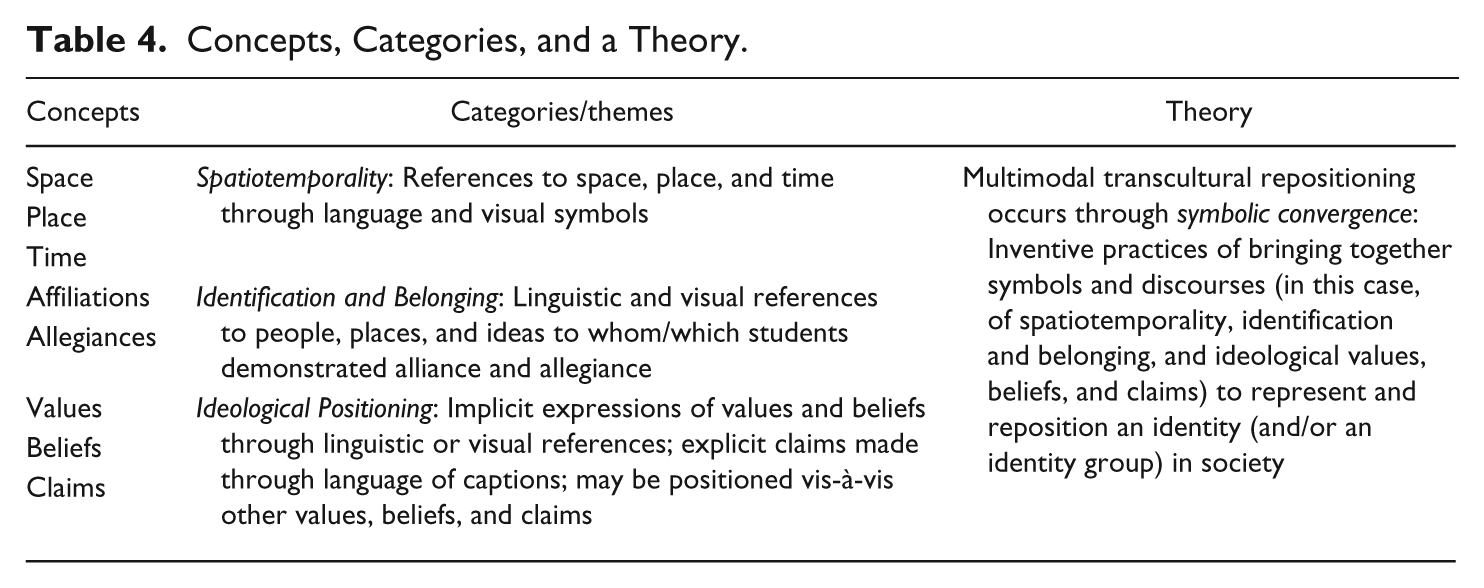
In the following section, I discuss the analysis more thoroughly, pointing to examples of symbolic convergence in students’ efforts to (a) represent their diasporic identities as the merging of multiple places, times, and spaces (sites) and multiple perspectives (sights); (b) offer others different contexts (places, times, and spaces, or sites) and perspectives (sights) in/from which to situate their identities and understand them; and (c) create new locations (or sites) and vantage points (sights) from which to position themselves to learn, participate, and contribute.
The full photo essay (18 photos and captions) was included in the analysis; however, for the discussion of the findings that follows, I have selected particular examples to explore in more detail. These examples were chosen to provide illustrations of symbolic convergence across the various concepts and categories (see Table 4) through the most disparate of pieces—a collection of religious artifacts, an advertisement for a soccer match, pictures of a backyard landscaping project, a group of friends, and the American and Mexican flags. The selected images include both “new” and “old” images and represent a range of practices of representation (see Table 3). They include samples from five of the six students. (Ysidro was not in class during the time the students were working on the photo essay, though she did manage to contribute to the photo essay upon her return, just in time for the Open House.)
Representation and Repositioning as Multimodal Literacy Practices
Bringing Together the Multiple Sites/Sights of Students’ Diasporic Identities
From a semiotic perspective, Hall (1997) argued that the meaning communicated through representation
depends, not on the material quality of the sign, but on its symbolic function. It is because a particular sound or word stands for, symbolizes or represents a concept that it can function, in language, as a sign and convey meaning. (pp. 25-26)
This is perhaps most clear in the pieces Adriana selected for the photo essay, as she draws attention to the symbolic work of representation in her images through the rhetorical repetition of the verb “represents” in her captions. In the picture of her three friends that Adriana photographed from an existing photo displayed in her locker (see Figure 2), Adriana symbolizes how the English language that she speaks with her American friends represents her. She suggests that speaking English is both a personal and a public marker of her identity as an American: “The language that they speak and that I speak represents me. It tells me and other people that I’m from the U.S.” Her ability to speak the English language with her friends marks her as belonging to aquí, and she suggests that others should understand language as a “site” from which to understand her identity, more so than the “sight” of her visible identity from which people typically judge her nationality, particularly vis-à-vis her White, American-born friends.
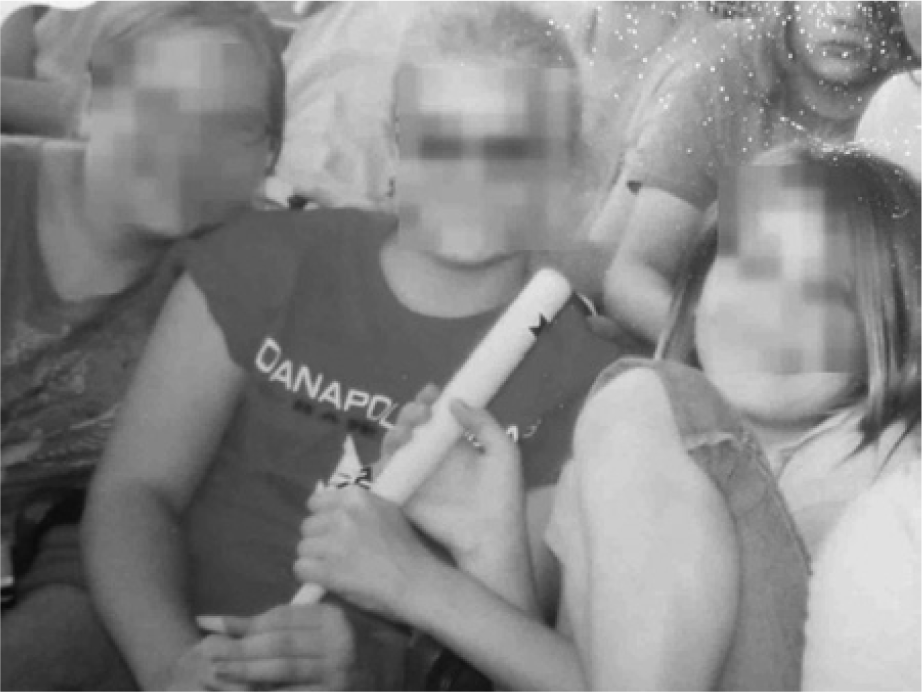
“Friends.”
In the second image (see Figure 3), Adriana chooses the brown color of her nephew’s eyes to represent her family and her family’s country of origin: “The color of his eyes represents my family and also where I’m from. I’m from Mexico.” The day after her nephew was born—about 1 month into the study—Adriana proudly shared the news with Beth and me. Pulling up a stool to join us at Beth’s desk, Adriana compared him with her two nieces when they were born: “His eyebrows are like yellow, and his eyelashes too, and his eyes are like dark green; it looks kind of weird” (Fieldnotes, 2008). In the photo, we can see that his eyes have become a beautiful brown. Although her nephew is by birth an American, born aquí, she suggests that the color of his eyes speaks to his heritage, that he is part of a family that is from allá. As a symbol, her nephew’s eyes suggest the convergence of places (sites): To Adriana, they are a reminder that she and her family are both aquí and allá. Her nephew’s eyes are also a powerful and very fitting symbol of the convergence of “sights”— upon looking into those eyes Adriana sees the duality of her identity. And she has taken the picture to evoke a similar experience for the audience of the photo essay: The close personal distance and frontal angle afford the viewer a certain sense of intimacy with the child; our eyes cannot help but be drawn to his. The baby does not return our gaze, an “offer” (Kress & van Leeuwen, 2006) to let our eyes linger, inviting us to see in his eyes what Adriana does—a powerful connection to her dual identity.
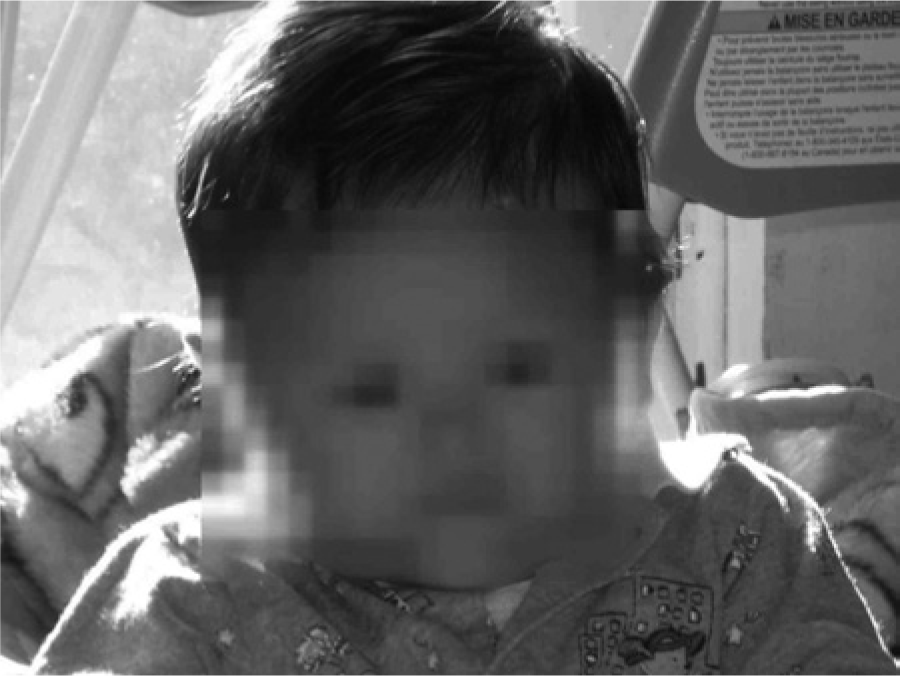
“Nephew.”
Adriana’s third photo features an enduring cultural and political symbol—the land (see Figure 4). That she speaks of growth through an image of a garden is especially apt. The growth is visible in the green plants pushing up in rows from the dark earth, as it is in the tools of the gardener: the sprinkler and the watering can, the fencing and chicken wire. The visual symbolism suggests that she, like a plant, took root and grew in one land and was transplanted in another. “The land here,” Adriana writes, indexing her family’s garden, “represents me.” But the connection to another land remains: “I am from Mexico and the United States. Both these lands have seen me grow.” Through the symbols of the land, language, and color of her nephew’s eyes, Adriana makes possible an identity that both simultaneously spans and is rooted in two countries and cultures. She also provides the viewers of the photo exhibit with three different symbolic contexts from which to see and understand who she is.
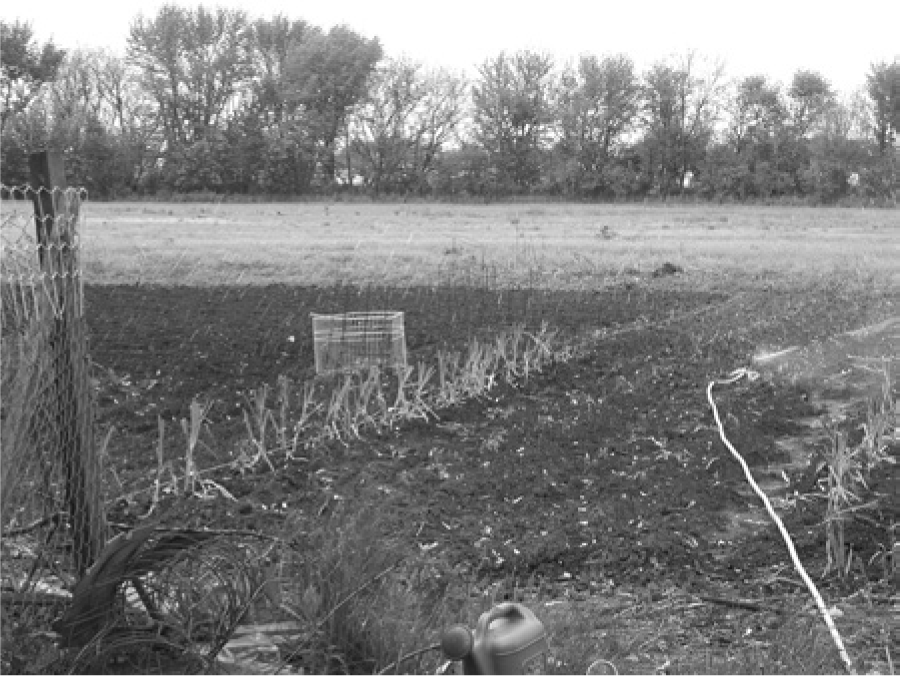
“The Land.”
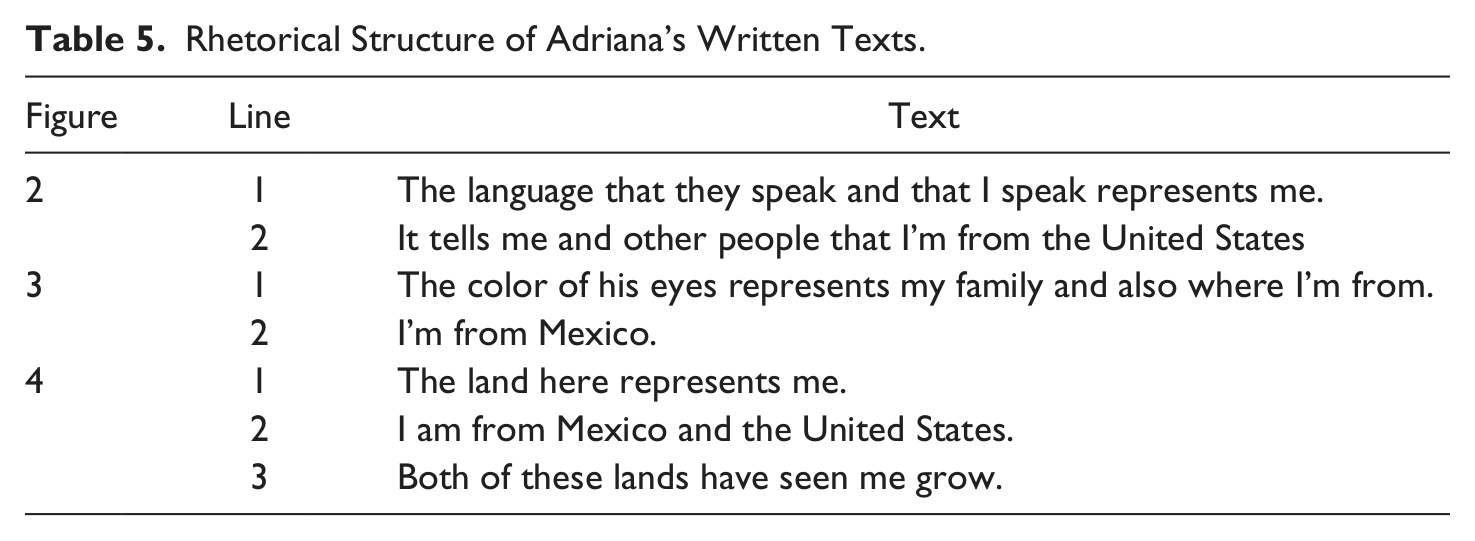
In her three written texts, Adriana follows a similar rhetorical pattern, each one exploring the image as a visual symbol of her transcultural identity (see Table 5). She claims her social location as being from aquí (Figure 2, Line 2; through her ability to speak English with her American friends, expressed in Line 1), allá (Figure 3, Line 2; through the visible identity of her nephew as Latina/o, expressed in Line 1), and from both aquí and allá (Figure 4, Line 2; through her connection to the land here). In an additional third line, functioning as a thematic conclusion to what could be considered a poem, she extends the visual metaphor to the land, “Both these lands have seen me grow.” Through symbolic convergence, Adriana has brought these images into dialogue visually and linguistically. Her photo essay is a multimodal representation of her multisited experience, illustrating and speaking to those who view and read it of the dynamic nature of her diasporic identity and the claims she makes from it.
Rhetorical Structure of Adriana’s Written Texts.
Javier’s “Jesus is everywhere” image (see Figure 5) is another powerful example of symbolic convergence. Javier’s caption emphasizes the universality and transcendence of Jesus and the Virgin Mary: “This is a picture of Jesus and Virgin Mary. Jesus is everywhere and all Catholics believe in the Virgin Mary.” Without the accompanying photo, Javier’s text might evoke iconic images of the Virgin Mary cradling her infant son at birth or holding his crucified body (as in Michelangelo’s La Pietà). But in Javier’s photo, the positioning of La Virgen de Guadalupe at the center of the image—and group of religious artifacts—connotes a possible significance beyond the religious. Folklorists, anthropologists, and cultural studies scholars point to La Virgen de Guadalupe as a symbol of unparalleled significance for Latin Americans that crosses religious, national, gendered, and generational lines. For Javier, aquí and allá is represented in a cultural symbol that transcends social, cultural, or geographic boundaries. His choice of pronouns “everywhere” and “all” evokes a sense of unity and solidarity across his social locations: “Jesus is everywhere and all Catholics believe in the Virgin Mary” (italics added). The image attests to a religious but also a cultural and national faith that has traveled with him—perhaps even as this group of objects has moved from home to home in his family’s journey from Mexico to the United States. Javier’s transcultural identity is represented and repositioned in the symbolic convergence of this local collection of artifacts on his family’s kitchen counter with the global cultural beliefs and practices of which he is also a part. His image and caption merge the personal/local and universal/global, offering a position for himself (and for others to understand him) as a member of larger religious and cultural identity groups. He thus repositions his identity from a marginalized, minority position in the community to identifying himself with the majority, offering the audience of the photo essay a different context and perspective from which to understand him and situating himself in a new way in the school and community.
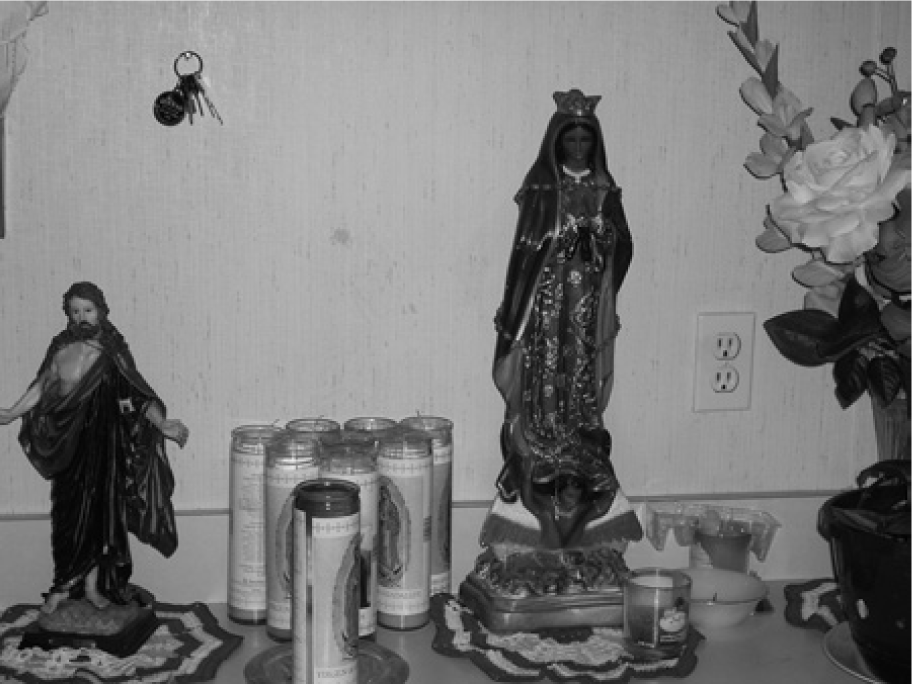
“Jesus is everywhere.”
A more local symbol, perhaps limited in its reach to soccer enthusiasts, Gabriel’s photo of a poster advertising a soccer match was nonetheless a convergence of two powerful symbols of national identity for him. While the poster was probably read by many on campus that day 2 in terms of its informational value, Gabriel includes the image in the photo essay as a visual marker of his transcultural identity. In fact, in another piece of writing, Gabriel copied and pasted a digital image of the game announcement from the university soccer team’s website. Gabriel explained that the juxtaposition of the two logos—the most reputable university soccer team in the state with the acclaimed Mexican national team—effectively brought together in oppositional rhetoric the “here” and “there” for him. And, while the elements of the sign (e.g., the circle of stars around the logo, the use of the color red, the positioning of the logo to the left, or prior in our reading from left to right, of the other team, and larger font size) show the bias in favor of the university’s soccer team in the match, Gabriel’s text—“Mexico can prove that they are good at soccer”—repositions the game as a demonstration of the Mexican national team’s dominance in the sport.
Gabriel may also be suggesting that as a symbolic convergence of his transcultural identity, the commonly understood oppositional markers (marked by “vs.”) could be re-presented in his aspirations to merge these identities as a successful Mexican soccer player in a well-ranked American university team—a goal he talked about achieving on his way to becoming a pro-soccer player: “Yeah, I want to play for a university’s soccer team. That is where it all starts.” Through the image of the poster and his caption, Gabriel thus symbolically merges the sites of his geographical identities (the state where he resides and the country he was born) and his passion for playing soccer to suggest the “sight” he has for his future: his dream of playing soccer. Although the realities of their undocumented status very much affected many of these students’ dreams for their futures, Gabriel repositions them here: The poster is a sign of a future he claims for himself.
Offering Others Different Sites/Sights From Which to Understand Them
Similarly, Myra’s representation of the American and Mexican flags together in one image shows her mutual affiliation to the two countries.
3
This demonstration of dual allegiance (i.e., the “waving” of these two flags) that prompted hostility, fear, and rage in response to the first immigration rallies on May 1, 2006 (see Chander, 2007), is re-presented in the photo essay through a visual symbolic convergence as Myra calls for the need—even among her peers at school—for greater acceptance of cultural diversity. Myra explained, “And some people here, even in this school, tell us . . ., ‘Stop like, stop speaking Spanish. You’re supposed to speak English not speak Spanish. If you want to speak Spanish then go back to Mexico.’” Myra described other instances where she felt excluded because of difference:
I have P.E. and I don’t have another friend of mine that is Mexican, so it kind of feels really sad when . . . we have free day because I have, like I have friends but they have other friends in P.E. so they gather up with their other friends, and then I have to play all by myself and some people, I just like see in their eyes, like they keep on looking at me and then, like, they talk and then they keep on looking at me and sometimes I think that they’re talking about me . . . That kind of feels bad.
In her image, Myra brings the two cultures together symbolically, but acknowledged that such a convergence required action. Her voice filled with conviction, she added, “I want people to change.” She suggests the flags offer a new vision (sight) for inclusion in a community and country that respects and welcomes diversity as part of its citizenry.
Perhaps more directly than some of the others, Gabriel uses his pieces to reposition himself within prevalent stereotypes about Mexican immigrants and advocate for change in the perspectives of others. Gabriel’s three pictures include two of his backyard that he took especially for the photo essay. The first picture (see Figure 6) features the landscaping work Gabriel’s family has done to accommodate them and add value to their home: a wood privacy fence, a concrete driveway for off-street parking, an area of grass for playing sports, and a terraced rose garden. The square and rectangular shapes of the materials—fence, concrete, grass, railroad ties—evoke a sense of order and design; the “rectangular shapes . . . [suggest] the building blocks with which we construct our world” (Kress & van Leeuwen, 2006, p. 54). Although he complained about spending his spring break helping his father make the driveway and parking area, Gabriel also wrote about the pleasure he derived from mowing the lawn and the pride he felt in his family’s home. In his digital poem, Gabriel had written about the terraced gardens his father made for his mom’s roses. He had also showed me several photographs he had taken of a room his dad and brother had finished in the basement for the family to watch soccer together. The image points to Gabriel’s sense of his family’s investment in the “here,” contrary to the discourse Gabriel invokes in his written text: “Not all Mexicans come only to go work and send money back to Mexico. Some clean their houses so they can live better.” Gabriel’s photo essay acknowledges the prejudice he experiences as a result of his transcultural identity, and challenges such stereotypes through the (counter-)example of his family. In his family’s backyard, he offers both a site from and a sight through which to challenge dominant discourses about immigrants and immigration.
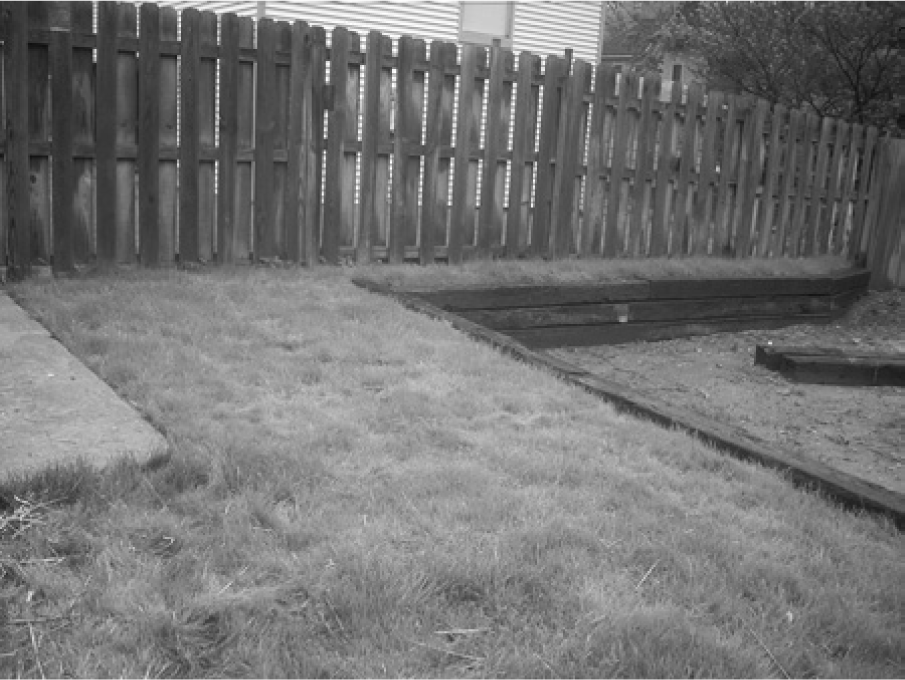
“Backyard.”
In this second photograph (see Figure 7), Gabriel features an area adjacent to the part of the yard featured in Figure 6 (“Backyard”), where grass has just been seeded and covered with hay. At the edge of the border between the existing lawn and newly seeded area stands Gabriel’s father, though we see only his legs and feet. It is the ground that demands our attention, but the positioning of Gabriel’s dad in the frame—at the corner of the new and old (Kress & van Leeuwen, 2006)—suggests his interaction with it. Again, Gabriel’s caption positions the image as counter to discriminatory generalizations about Mexican immigrants: “When some Mexicans work, they do a really good job in the end.” Through his family’s yard, Gabriel provides “a context to understand and transform established belief systems” (Solórzano & Yasso, 2002, p. 36), a new site/sight from which others can see Mexican people and their labor.
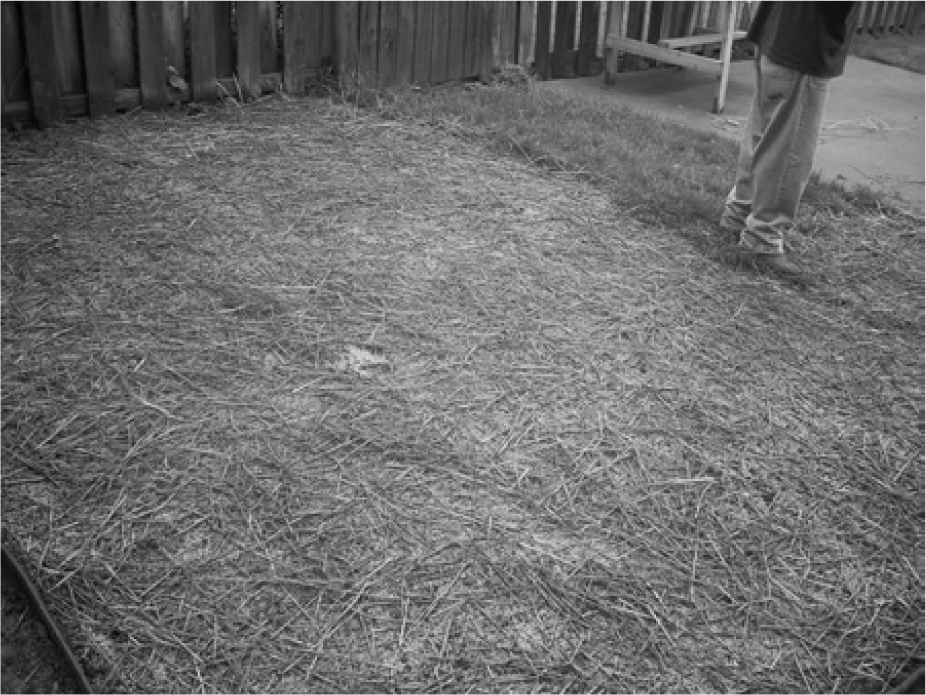
“Grass.”
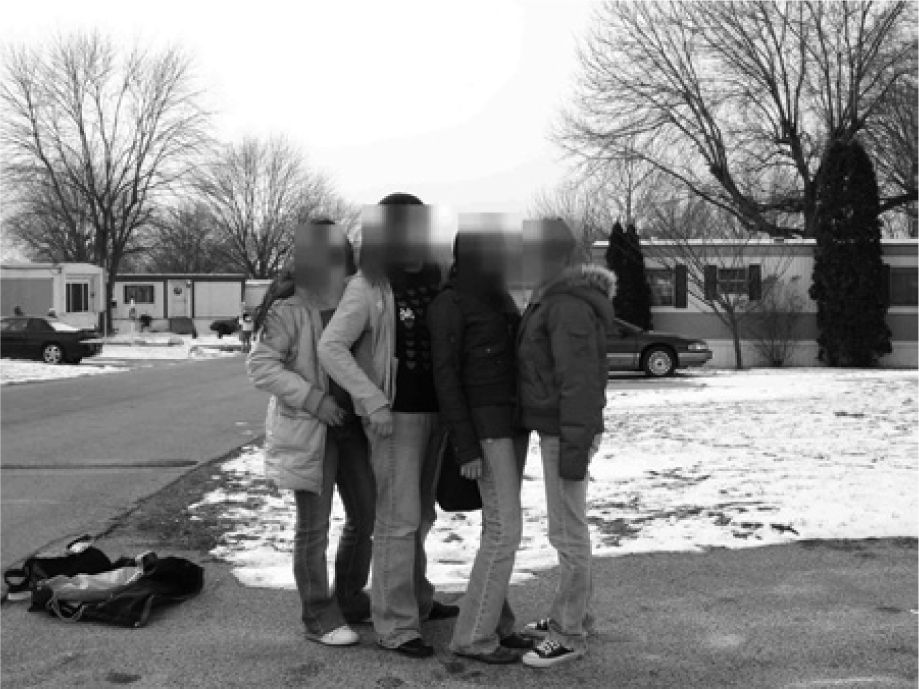
“Ellas.”
Creating New Sites/Sights From Which to Position Themselves
Ivonne’s image “Ellas” (see Figure 8) also offers a representation and narrative that could be understood as countering the discourses of immigrants and immigration circulating in the school and community. This is a photo Ivonne composed with her friends after getting off the school bus one day in the trailer park where they lived. In it, Ivonne and three of her friends, all immigrants from various areas of Mexico, are posed standing closely together in a row centered in the foreground. Ivonne’s friends are turned to the side all in the same direction, facing right. In contrast, Ivonne, on the far right of the other three, stands facing them, her body turned fully sideways and straight, facing left. Thus, it is possible to look at the group of girls in two ways: as a group of three plus one (Ivonne), or as a feature pair (Ivonne and her best friend who are facing one another, their heads much closer together than the others), with the other pair to the side. Either way, the viewer’s attention is drawn to Ivonne’s relationship to the others in the image, a relationship Ivonne had struggled with throughout the year. When Ivonne developed some close friendships with boys, others began to talk. Ivonne confided in an interview,
That’s what parents don’t understand. Sometimes they tell you, don’t talk to this girl . . . There’s a friend that she couldn’t talk to me because sometimes I go out with a lot of boys. Girls talk about you. They talk about me a lot. Boys don’t talk about you; that’s why I like more boys than girls.
Despite her differences with her best friend that year, this is an image of group identification for Ivonne, a strong statement of her affiliation with her Latina friends. Her title, “Ellas,” serves to linguistically centre the girls, who are also in the visual center of the image, the “space of the central message” (Kress & van Leeuwen, 2006, p. 202). The size of the girls (a full two thirds of the image) and their location in the foreground all contribute to the visual “weight” or salience of the girls in the image. Although not intentionally planned by the photographer, there is for the viewer a sense of connection between the girls in the center and the elements in the margins that occurs through repeating patterns of color (e.g., a red jacket with a red car and a red street sign; blue denim jeans with blue trim trailer siding), the near-identical elements (of trailers, trees, and cars) in the right and left margins, and the road, which functions as an element connecting the girls to the community behind them. The effect of this visual (though coincidental) connection of the spatial elements is a sense of “group identity”—that the elements belong together (Kress & van Leeuwen, 2006, p. 203).
Ivonne’s decision to include this image—locating herself and her friends in a community dominated by Mexican immigrant families—as part of the photo essay was consistent with her transcultural identity. “I’m proud of being a Mexican because that’s where I grew up and that’s who I am,” Ivonne explained. She added, “There are Mexicans who when they are around English, they speak English and forget Spanish. I don’t like that.” In the title (“Ellas”) and caption, she chooses to claim her affiliation with her home language and her girlfriends: “We like to be together as friends, Latinas.” Yet, Ivonne stands apart, just as she did in challenging the gendered norms that had caused her so much grief with her friends. When asked, after celebrating the birthday of Martin Luther King, Jr., to write and talk about their dreams for change in society, Ivonne passionately addressed the need for greater gender equity in Mexican culture. The topic also came up in my interview with her:
Mexicans, fathers, they think if you go out with a friend, a boy, you’re going to do something bad. Oh, but boys can go anywhere. They say it’s different, but I say there’s no difference. We always fight about that as a family. I ask, can I go, my father says no. My brother asks, he says yes. When I ask why he can go, my father says you’re a girl, he’s a boy, there’s a difference. There’s no difference! . . . We’re both equal. But they think there’s a difference. I get frustrated about this.
The image and caption speak to Ivonne’s strong identification with her Mexican culture, but also perhaps, as raising questions about the inequitable ways she sees herself and friends positioned as “Ellas” in that culture. Standing together with her friends at the site of the crossroads in front of their community, Ivonne may be suggesting that change comes from the center and that their aquí and allá perspectives (sights) might provide them with different ways of defining what it means for them to be together, be friends, and be Latinas.
Discussion
The notion of symbolic convergence suggests specific multimodal literacy practices by which students were engaged in the “work” of representing (Hall, 1997) and repositioning themselves. In some instances, the symbolic convergence of different times and places represents a form of memory work (Kuhn, 2002). Through the visual—often prompted by a photograph—Kuhn (2002) contends that memory work can connect the local experiences of an individual to the more global experiences of many. Memory work makes it possible to “connect personal stories with public events, structures of feeling with relations of class or national identity. Memory work takes into consideration the cultural and historical embeddedness of a family photograph—its capacity to touch broader political and social meanings” (Trafi, 2008, p. 58).
The photo essay points to the agency of the students in (re-)positioning their identities through symbolic convergence. By inventively bringing together multiple contexts, locations, and times, they demonstrate literacies that enable them to creatively work “at sites of conflict, at borders which divide academic and other discourses but which are contested and constructed anew each time one writes” (Lu, 1990, p. 20). In the process, they create some unexpected new sites to situate their identities, locations from which to contest marginalizing discourses of immigrant and immigration and to contribute new ways of thinking about and acting toward a more inclusive, equitable society.
The eye-catching images in this multimodal literacy text also point to how the students were creatively working at affording and taking up new “sights” for their immigrant identities. As photographers, the students offer a range of vantage points and perspectives in their photographs, literal and figurative sights from which to share their experiences and identities. Viewers/readers of the photo essay are thus invited to see from their angle, to try on their perspectives, and to perhaps have their “sights” challenged through new ways of seeing immigrant youth.
Thus, the notion of transcultural repositioning is expanded by the students, as the rhetorical, visual, and symbolic convergence of semiotic “strategies that help them move across cultural boundaries by negotiating new and different contexts and communicative conventions” (Guerra, 2008, p. 299). The students drew on their experiences and perspectives as productive locations, as sites/sights where they were able to create and produce but also to “contest and construct anew”—on their own terms—the discourses and images that define what it means to be from aquí and allá. In many cases, they were positioning their transcultural identities in contrast to the pejorative images and rhetoric that permeated the discourses around them, including, for example, the racist graffiti targeting immigrant students from Mexico on a bathroom wall in the school.
Despite its simple installation, the photo essay was a focal point at the Open House. Among the students’ friends, family members, teachers, as well as school and district administrators and community members, the photo essay sparked a dialogue about what it is like to be both “here and there.” Positioned within “a much wider communicational landscape” through the Open House, the photo essay exemplified “how children’s meaning making, viewed in a multimodal analytic context, is tied to the local, and expresses local concerns and identities” (Pahl & Rowsell, 2006, p. 8). For example, Ivonne’s mother commented that this was the “perfect project” to “talk about Mexico and America and how both are connected.” Myra’s mother shared how Mexico still meant a lot to her because she left behind her family to come to the United States. “It is my heart,” she said. Gabriel’s father added that he felt the United States held more opportunity for his children, but that Mexico “remains dear” because their family is there. The photo essay invited its audience to consider the perspectives afforded by the students’ pieces. As Gabriel suggested to the audience, they “wanted to show everybody that not one is better than the other, . . . they are both cultures that we come from.”
As such, the photo essay represents a local literacy activity through which a small number of students explored their particular experiences as immigrant youth. Yet, by understanding the “global patterns” in the literacy practices of the students, it is also possible to better understand their moves as social practices used to position themselves within and against larger public discourses (Hamilton, 2000) about citizenship and nationality, gender, and religion. In response to the prejudice he felt, Gabriel used the site/sight of his backyard to challenge larger discourses about immigrant workers. Through the site/sight of four Latina friends standing at a crossroads in her neighborhood, Ivonne confronted the gender discrimination she experienced by contesting prevalent cultural notions about Latina women and suggesting the need for change. Myra merged images of the two flags in her home to speak back to those who would make her choose to be aquí or allá; instead, she claims the symbol as a new site/sight from which to position herself and other immigrant youth. In the unwavering brown eyes of her nephew, Adriana captured the site/sight of the next generation—citizens by birth, but still strongly connected to the culture and home country of their parents. Thus, the photo essay illustrates the students’ social locations in a generation of undocumented immigrant youth experiencing a unique struggle for their civic, cultural, and human rights. But as a work of symbolic convergence, the photo essay also suggests their agency in that struggle: the critical synthesis of the multiple sites/sights of their diasporic identities, the creative generation of new sites/sights for others to view and understand them, and the assertion of alternative sites/sights from which to position themselves to learn, participate, and contribute.
Implications
Like other studies of youth as multimodal text creators (e.g., Cummins & Early, 2011; Hull & Katz, 2006; Hull & Nelson, 2005; Pahl & Rowsell, 2010; Vasudevan et al., 2010), this research demonstrates the powerful insights that students bring from their lived experiences into the texts they create. Their photo essays represent their epistemic knowledge as immigrant youth (Campano, 2007; Ghiso & Campano, 2013), making meaning of their lived experiences through converging representations of their transcultural identities. In their photographs, we catch a glimpse of what is important in the eyes of these students: their family, friends, homes, cultural celebrations, beliefs, and interests. These indicate the sites they are from. They are valued aspects of their identities and they represent in many ways, the significance of movement and migration in their lives. As artifacts, the photo essay pieces infuse stories. They “uncover people and epistemologies” (Pahl & Rowsell, 2010, p. 10) that these immigrant youth carry with them and through which they see and understand their worlds. As other literacy researchers have suggested, these texts create rich dialogic spaces for literacy and learning.
The notion of symbolic convergence is not an entirely new idea in the field of multimodal literacies. Hull and Nelson (2005) make the argument that “by virtue of being juxtaposed,” images and words (in this case) “increase the meaning-making potential of a text” (p. 225). As they point out, notions of “braiding” (Mitchell, 2004) and “orchestration” (Kress & van Leeuwen, 2001) also point to the idea that a “multimodal text can create a different system of signification, . . . a different kind of meaning” (Hull & Nelson, 2005, p. 225). While building on this work in multimodality, the notion of symbolic convergence adds a critical dimension specific to the cultural locations of immigrant youth. Here, this work contributes to expanding our understandings of the ways in which immigrant youth inventively bring together symbols and discourses to represent and reposition themselves within and against the symbols and discourses that seek to position them.
The photo essay was the culmination of a project intended to address students’ concerns about their access to academic discourses and literacies. Thus, it raises questions about “the relevance of dominant models of literacy as it is currently taught in the majority of schools around the world in relation to the communicative and technological requirements of contemporary, digitalized society” (Jewitt, 2008, p. 248). Already a decade ago, there were calls “to expand our conceptions of what it means to be fully literate in new times” (Hull, 2003, p. 230). This includes “ways of thinking about stories, self, and community, and ways of interacting and participating” (Hull, 2003, p. 230), but more than ever, our conceptions of being literate also need to value “border thinking” (Mignolo, 2000), the kinds of knowledge, and “epistemologies that emerge from the location of the border” (Ghiso & Campano, 2013, p. 253). How can we, as literacy researchers and educators, complicate notions of academic literacy and critical thinking in schools to value “a capacity for critique in both directions” (Alcoff, 2007, p. 94, cited in Ghiso & Campano, 2013, p. 253)? How can we work from the location of the border, as the students in this study did, to reposition academic discourses more equitably?
The students wrote college application essays as part of the “culture project” too. They were also on display at the Open House. But it was the photo essay that captured the attention of the audience. My photos of that evening show school administrators, parents, peers, siblings, and teachers standing three-deep in front of the display. Many stood there for quite some time. They were reading, viewing, and thinking—some, I believe, pushed in new directions to see and understand, while others were pulled in with the recognition of their own lives and experiences reflected in the students’ work.
Footnotes
Declaration of Conflicting Interests
The author(s) declared no potential conflicts of interest with respect to the research, authorship, and/or publication of this article.
Funding
The author(s) received no financial support for the research, authorship, and/or publication of this article.