




Abstract
Prompted by calls for research on technology-focused professional development, this ethnographic case study investigates how teachers’ participation in learning communities may influence technology integration within the secondary English curriculum. In this article, I draw on educational psychology, cognitive anthropology, and sociolinguistics to build a theory of teacher learning. I then take a microethnographic approach to discourse analysis to show how teachers’ use of language and contextualization cues within a learning community reflects their cultural models, or everyday beliefs, about technology. This study addresses two gaps in the literature. First, it explores the role of situated language in constructing English teachers’ cultural models related to technology. Second, it examines micro-level interactions within a professional learning community to understand how teacher learning occurs in social and cultural contexts. The analysis suggests that the implementation of educational reforms, including reforms associated with technology integration and literacy education, is often dependent upon teachers’ skills, values, and cultural models.
Keywords
Introduction
Scholars have argued that professional development is a cornerstone of educational reforms that seek to improve student achievement and engagement (Wei, Darling-Hammond, Andree, Richardson, & Orphanos, 2009; Wenglinsky, 2002; Wilson & Berne, 1999). Professional development can play a critical role in developing teachers’ instructional practices in the content areas, knowledge of standards-based assessment, and innovative use of new tools and strategies (Lawless & Pellegrino, 2007). Each year, the United States federal government spends billions on professional development (U.S. Department of Education, 2012). This level of investment, coupled with that at local and state levels, demands a solid empirical foundation to guide policy and practice (Wayne, Yoon, Zhu, Cronen, & Garet, 2008). To that end, a substantial body of research has identified five core features of effective reform-oriented professional development, which includes a content area focus, opportunities for hands-on and active learning, coherence with previous professional experiences, collective participation with colleagues, and a considerable duration of contact hours (Desimone, 2009; Desimone, Porter, Garet, Yoon, & Birman, 2002; McLaughlin & Talbert, 2001). However, due to issues with time and cost, professional development available to teachers remains “woefully inadequate” (Borko, 2004). This is particularly evident in terms of technology integration.
The vast majority of professional development related to digital tools and new literacies are short-term, workshop-based, and organized around available technologies (Harris, Mishra, & Koehler, 2009). Consequently, such technocentric approaches (Papert, 1990) focus on the affordances and constraints of specific tools rather than addressing how technology can enhance pedagogy or promote student-centered learning. Culp, Honey, and Mandinach (2003) argue, “Technological innovations favored by the research community, intended to support inquiry, collaboration, or re-configured relationships among students and teachers, continue to be used by only a tiny percentage of America’s teachers” (p. 22). Despite initiatives such as the National Education Technology Standards and the 21st Century Skills Framework, there is a paucity of research on technology-focused professional development (Lawless & Pellegrino, 2007). Most studies rely on data collected post hoc and “successful professional development has typically been judged by measuring participants’ satisfaction with the experience and their assessments regarding its usefulness in their work” (Lawless & Pellegrino, 2007, p. 579). Only a few studies document the relationship among professional development, teacher learning, and technology integration (e.g., Hughes, Kerr, & Ooms, 2005; Keller, Bonk, & Hew, 2005; Mouza, 2009; O’Hara, Pritchard, Huang, & Pella, 2013; Walker et al., 2012).
For the present study, I designed and facilitated a professional learning community focused on technology integration within the secondary English curriculum. Over the course of one school year, the learning community met regularly to engage in hands-on learning with digital tools, design lessons, analyze student work, and critically consider the role of technology in the English classroom. Coiro (2005) suggests that effective technology professional development is ongoing, job-embedded, and interactive. Within professional learning communities, teachers engage with their colleagues in long-term, continuous meetings that value active inquiry, collaboration, and reflection (DuFour, DuFour, & Eaker, 2008). Learning communities are a model of reform-oriented professional development, as Darling-Hammond and Sykes (1999) explain:
In the new paradigm, staff development is a shared, public process; promotes sustained interaction; emphasizes substantive school-related issues; relies on internal expertise; expects teachers to be active participants; emphasizes the why as well as the how of teaching; articulates a theoretical research base; and anticipates that lasting change will be a slow process. (p. 134)
As a result, professional learning communities may enhance the fidelity of educational reforms and promote teachers’ adoption of new literacies and new technologies.
Research by the Pew Internet and American Life Project indicates that 80% of young adults use online social network sites, 38% share original creative work online, and 21% remix their own transformative works, inspired by others’ words and images (Lenhart, Ling, Campbell, & Purcell, 2010; Lenhart et al., 2011). Inside and outside school, today’s youth use digital tools and online spaces to create, collaborate, and communicate through multiple modes and semiotic resources (Curwood & Cowell, 2011; Curwood, Magnifico, & Lammers, 2013). When young people write fan fiction, participate in online role-plays, modify wikis, create digital poems, they are engaging in multiliteracies (New London Group, 1996). For teachers, these digitally mediated literacy practices may challenge their traditional practices, beliefs, and cultural models. Consequently, it is imperative that they have access to ongoing professional development related to technology.
In this article, I draw on educational psychology, cognitive anthropology, and sociolinguistics to build a theory of teacher learning. I then take an ethnographic approach to discourse analysis to show how teachers’ situated language within technology-focused professional development reflects their learning and sense making processes. This study addresses two gaps in the literature. First, it explores the role of situated language in constructing teachers’ cultural models, or everyday beliefs, about technology and literacy pedagogy. Second, it examines micro-level interactions within a professional learning community to understand how teacher learning occurs in social and cultural contexts. The analysis suggests that the implementation of educational reforms, including reforms associated with technology integration and literacy education, are often dependent upon teachers’ skills, values, and cultural models. This analysis was guided by the following research questions:
Theoretical Framework
A Situated Perspective on Professional Learning
Theoretical and empirical work within educational psychology has drawn our attention to the situated nature of cognition (J. S. Brown, Collins, & Duguid, 1989; Greeno, Collins, & Resnick, 1996; Lave & Wenger, 1991). This challenged previous theories that conceptualized cognition as an internal state and learning as the acquisition of knowledge. A situated perspective on cognition highlights how physical, social, and cultural contexts are integral to the learning process. J. S. Brown et al. (1989) argue, “The activity in which knowledge is developed and deployed . . . is not separable from or ancillary to learning and cognition. Nor is it neutral. Rather, it is an integral part of what is learned” (p. 32). Learning, then, is fundamentally situated. Consequently, school-based activities are situated in specific contexts, which can foster students’ critical thinking and problem-solving skills. Such authentic activities involve the “ordinary practices of a culture” (J. S. Brown et al., 1989, p. 34) and are central to learning. In the English classroom, for instance, students may struggle to memorize the definition of literary terms or identify themes within a canonical poem. However, students will readily engage with similes and metaphors, make intertextual connections, and draw on multiple modes when poetry is situated in a personally meaningful context and shared with an authentic audience (Curwood & Gibbons, 2009).
Recently, scholars have applied a situated perspective to professional development. Putnam and Borko (2000) argue that teacher learning is situated in specific contexts, social in nature, and distributed across people, tools, and resources. Instead of focusing on how a teacher individually constructs knowledge, this perspective attends to the role of the environment and social interactions in the learning process. Moreover, professional learning is distributed across people (such as colleagues, students, community members), physical tools (computers, student artifacts, books), and semiotic resources (visual representations, metaphors, gestures). From a situated perspective, professional learning “is usefully understood as a process of increasing participation in the practice of teaching, and through this participation, a process of becoming knowledgeable in and about teaching” (Adler, 2000, p. 37). This process can be seen in terms of enculturation (Lave & Wenger, 1991). Professional development, in this sense, is not about explicit instruction in the use of new tools or strategies. Rather, the purpose of professional development is to enculturate teachers to a community’s practices, beliefs, and discourses (Putnam & Borko, 2000). Enculturation occurs through engagement in authentic activities. Within technology-focused professional development, this may entail hands-on learning with digital tools, close analysis of student work, collaboration with colleagues, and critical discussion. This kind of professional learning moves beyond a technocentric approach to consider how technology shapes the consumption and production of texts as well as the negotiation and contestation of meaning (Lankshear & Knobel, 2007).
If learning is inherently situated, social, and distributed, then the enculturation process may be evident within professional learning communities. Vescio, Ross, and Adams (2008) argue that learning communities are grounded in two key assumptions. First, knowledge is situated in teachers’ everyday experiences and best understood through engaging in social interaction and critical reflection with others who share the same experience. Second, participation in learning communities will increase teachers’ professional knowledge and, in turn, promote student achievement. Learning communities privilege collaboration, discussion, and shared values (Newmann, 1996). Working together, teachers examine their own beliefs and practices to understand how they impact student learning. In addition, learning communities are situated in school contexts, where the sociocultural environment and available resources directly inform teachers’ professional development. It is within this context that newcomers are enculturated to a community’s ways of thinking, believing, and acting. However, this is not a unidirectional phenomenon and newcomers bring innovative ideas and fresh perspectives to the community (Putnam & Borko, 2000). But all communities are “connected by more than their ostensible tasks. They are bound by intricate, socially constructed webs of belief, which are essential to understanding what they do” (J. S. Brown et al., 1989, p. 33). Teachers’ everyday beliefs, or cultural models, directly influence their professional learning. To understand why and how teachers integrate technology into the secondary English curriculum, we must examine the contexts and social interactions that shape their cultural models.
Professional Learning and Cultural Models
The concept of cultural models originates in cognitive anthropology (Holland, Skinner, Lachicotte, & Cain, 1998; Shore, 1996; Strauss & Quinn, 1997). Quinn and Holland (1987) define cultural models as
pre-supposed, taken-for-granted models of the world that are widely shared (although not necessarily to the exclusion of other, alternative models) by the members of a society and that play an enormous role in their understanding of that world and their behavior in it. (p. 4)
In other words, not only are cultural models shared by particular communities, but they also function to organize each person’s perception, motivation, and action. Whether they are tacit or overt, cultural models serve as resources that guide people’s actions and interpretations in new situations (Gee & Green, 1998). Gee (2008) explains that cultural models are not all wrong or all right: “Like all models, they are simplifications of reality. They are the ideology through which we see our world” (p. 29). Cultural models are not stored in any one person’s head. They are distributed across the community’s skills and viewpoints (Gee & Green, 1998). Furthermore, cultural models are always subject to revision, modification, and reconstruction as needed within particular communities (Gee & Green, 1998). They are dynamic and malleable, not static, and inflexible.
Cultural models reflect a cognitive approach to cultural knowledge. Specifically, people use cultural models to perform a variety of everyday cognitive tasks. Quinn and Holland (1987) explain,
Sometimes these cultural models serve to set goals for action, sometimes to plan the attainment of said goals, sometimes to direct the actualization of these goals, sometimes to make sense of the actions and fathom the goals of others, and sometimes to produce verbalizations that may play various parts in all these projects. (p. 6)
However, cultural models do not always translate simply and directly into behavior (Gee & Green, 1998; Quinn & Holland, 1987). A complex relationship exists between what people say, what they believe, and how they act; very often, this is dependent upon the context. For instance, Chandler-Olcott and Lewis (2010) find that most English teachers in their study held a cultural model that positioned students as digital natives and adults as digital immigrants. This dichotomy was first posed by Prensky (2001), but it has subsequently been refuted by empirical studies (C. Brown & Czerniewicz, 2010; Helsper & Eynon, 2010). However, this pervasive cultural model directly impacted teachers’ instructional practices and pedagogical beliefs. For some teachers, it allowed them to view students’ experience with technology as a valuable resource that they could draw on. For others, this cultural model caused them to relegate technology to out-of-school spaces. Only one teacher questioned this cultural model and its inherent dichotomy. By positioning students as digital natives, teachers made sweeping assumptions about students’ access to and expertise with technology. Similarly, by situating themselves as digital immigrants, some teachers felt that their classroom authority was threatened. Clearly, cultural models about technology influence teachers’ cognitive processes and pedagogical beliefs.
Drawing on Cohen (1989) and Sarason (1990), Putnam and Borko (2000) argue that school-based teaching and learning have historically been resistant to fundamental change. This resistance may be rooted in powerful cultural models that function to enculturate teachers into specific ways of thinking, doing, and being. For example, cultural models related to English as a discipline (Applebee, 1996; Green, 1988) may privilege canonical literature and analytical essays within the curriculum. Cultural models also influence what skills, knowledge, and dispositions teachers believe are essential for students in the English classroom (Caughlan, 2007). However, cultural models are not only held in the minds of a group of people, but they “are also ‘held’ in the material structure and organization” of the physical environment (Bloome, Carter, Christian, Otto, & Shuart-Faris, 2005, p. 50). Whereas blackboards and overhead projectors focus students’ attention on a single, print-based text and tend to emphasize the authority of the teacher (Hodas, 1993), individual laptops and online spaces may help to encourage inquiry, communication, and collaboration (Leander, 2007). According to Lewis (2007), technology integration demands that teachers acquire new orientations to time, space, performance, and design. She adds that it’s not just middle-aged teachers who are ill at ease with this shift—pre-service teachers are often uncomfortable as well. She explains, “Popular technologies are to be used and shared out-of-school. To do so in school challenges the materiality of what it means to be a teacher, in their minds” (Lewis, 2007, p. 235). Therefore, teachers’ cultural models significantly shape their approach to technology integration. These cultural models emerge, either explicitly or implicitly, within technology-focused professional development.
Cultural Models and Discourse
If cultural models shape teachers’ beliefs and practices in the classroom, how can we attempt to identify their current cultural models? We can do so through a close analysis of teachers’ discourse within a learning community. According to Quinn and Holland (1987), discourse is one of the most important ways in which people negotiate understandings and accomplish social ends. Quinn (2005) elaborates,
Discourse, rather than other kinds of human activities or behavior, is the object of investigation for all of us because we deem it to be the best available window into cultural understandings and the way that these are negotiated by individuals. (p. 3)
As culture involves the tacit and taken-for-granted assumptions that are shared within particular communities, cultural understandings are evident in how people tell stories, make meaning, and perform any number of cognitive tasks. However, cultural knowledge often goes unquestioned because it is part and parcel of our daily lives. Within communities, people use language according to unspoken expectations and implicit common knowledge. The listener, then, must infer missing information through what is stated and how it is presented (Holland & Skinner, 1987). “Cultural knowledge is typically acquired to the accompaniment of intermittent advice and occasional correction rather than explicit, detailed instruction; but it is learned from others, in large part from their talk, nonetheless” (Quinn & Holland, 1987, p. 22). Therefore, cultural knowledge about digital tools and online affinity spaces is often constructed through discourse.
In any conversation, there are many signals that show how people assemble situated meanings for words and phrases (Gee & Green, 1998). Gumperz (1982) calls these contextualization cues. Rooted in sociolinguistics, the analysis of contextualization cues focuses on prosodic and nonverbal cues such as pitch, stress, intonation, pause, juncture, proxemics, eye gaze, and kinesics in addition to lexical items, grammatical structures, and visual dimensions of context. These cues shape the social interaction and inform the dialectical relationship between language and context. Consequently, situated meanings do not reside in individual minds. Instead, they are frequently negotiated between people in and through social interaction (Gomez, Schieble, Curwood, & Hassett, 2010). According to Gee and Green (1998),
Cultural models “explain,” relative to the standards (norms) of a particular social group, why words have the range of situated meanings they do for members and shape members’ ability to construct new ones. They also serve as resources that members of a group can use to guide their actions and interpretations in new situations. (p. 123)
Therefore, cultural models are often expressed, contested, and modified through social interaction.
As technology may challenge teachers’ cultural models related to the secondary English curriculum, a close analysis of a teacher’s language and contextualization cues can shed light on how cultural models shape (and are shaped by) his or her cognitive processes and instructional practices. In this article, I take a microethnographic approach to discourse analysis, which involves a particular perspective on discourse and social action (Bloome et al., 2005; Gee & Green, 1998). By situating professional learning in social and cultural contexts, I focus on how language operates at a micro level within learning communities and how it reveals teachers’ cultural models about technology. My approach to discourse analysis in this article is directly informed by the research on professional learning and cultural models that positions both as social, situated, and distributed. To understand how cultural models about technology are expressed within a learning community, I developed a three-layer approach to microethnographic discourse analysis that begins with an examination of teachers’ situated language and contextualization cues, moves to a focus on the social interaction, and ends with an analysis of emergent cultural models. In the following section, I share some key findings from the overall study and provide relevant information on the school context and participants.
The Present Study
In this ethnographic case study, I designed and facilitated professional learning communities at two high schools, Avon High School and Milltown High School, in the Midwestern United States during the 2009-2010 school year. Merriam (1998) explains that ethnography is a set of methods for data collection as well as the written record that results from the use of ethnographic techniques. Wolcott (1980) emphasizes that ethnography is defined by the concern for cultural context. Throughout the study, I examined how the culture of the school and the English department influenced teachers’ use of digital tools. In particular, I found that it was not enough to have technology readily available or create local policies that supported technology integration. In other words, a technology-rich school culture does not guarantee meaningful technology integration. For some teachers, time constraints, issues with students’ out-of-school computer access, and concerns about their own technical expertise acted as barriers. However, certain practices of the learning community provided a way for teachers to gain technical skills, collaborate with colleagues, and consider their beliefs related to school-based learning and technology. These practices included creating a mission statement that focused on student learning objectives, engaging in hands-on and collaborative learning with digital tools, examining student work, and considering the role of technology in the English curriculum.
In this study, some teachers found it challenging to conceptualize how technology would impact their instructional design and their assessment of student learning. For instance, one teacher sought to infuse technology in her Harlem Renaissance unit. Instead of asking students to make a paper poster, she had them work in small groups to use Glogster and create an interactive poster that included text, images, and video. Despite students’ use of multiple modes of representation, the teacher still used a print-centric framework for assessment. Another teacher initially used online discussion boards to ask factual questions about setting and characterization within Chinua Achebe’s Things Fall Apart. I suggested that she consider questions like, “What does it mean to be a father?” that would allow students to draw on their own experiences as well as textual references. This approach was successful and created an online space for students to critically discuss themes within the novel.
The difference between these two examples is partially related to the culture of the English department. In the latter example, English teachers at Avon High School (all names of cities, schools, and research participants have been changed) were much more open to discussing their beliefs, questioning their pedagogy, and collaboratively analyzing student work. This reflects different cultural models of English pedagogy, particularly in relation to technology integration.
In previous analyses from this study, I examined teachers’ interviews and written reflections, transcripts of learning community meetings, and observational notes to outline the key features of effective technology-focused professional development (Curwood, 2011, 2013) and I have analyzed instructional materials and student work to investigate how an individual teacher designs and implements technology into the secondary English curriculum (Curwood, 2012). In this article, I focus on the learning community at Avon High School to examine how teachers used language and created situated meanings. Specifically, I attend to how language operated at a micro level to reveal teachers’ cultural models about technology. From these micro-level constructions of cultural models, I then consider how they reflected the broader social and cultural context as well as impacted technology integration in secondary English classrooms.
Research Design
School Context
Avon High School is located within close proximity to a large city, Lakeland, in the Midwestern United States. The town of Avon can be characterized as suburban and surrounded by farmland. In the past two decades, Avon’s population has more than doubled to its current 7,000. However, district boundaries extend into part of Lakeland and the neighboring town of Durden. Due to population growth and changes in district maps, the demographics of Avon students have shifted over time. When many of the teachers in this study began working at the school, their students were primarily European American, middle class, and native English speakers. In 2009, 1,500 students attended Avon High School, including 74% who identified as European American, 10% as African American, 10% as Latino, 5% as Asian, and 1% as Native American. In addition, 8% of students were English language learners and 27% received free or reduced lunch. In terms of technology integration, this demographic shift has led some teachers to be concerned about issues of equity and access to digital tools outside of school.
Avon High School can be considered a technology-rich school. Compared with other high schools in Lakeland and the surrounding area, Avon has a higher number of computer labs, more recently updated hardware and software, and an increased use of interactive white boards and hand-held devices. Avon High School has support staff, such as library media specialists and technology coordinators, who are available and interested in working with classroom teachers to design, implement, and reiterate lessons that integrate technology. In addition, one of the school’s four annual goals specifically addressed educational technology and stated that teachers should strive to integrate technology into all classes to improve students’ problem-solving abilities. While Avon is a technology-rich school, the learning community was conscious of the ever-changing nature of technology. As a result, we decided to focus our professional development efforts on integrating free or low-cost digital tools available online, such as Google Docs, Diigo, Ning, Animoto, Bubbl.us, and others.
Participants
Within the learning community, I served as the professional development facilitator, along with Alice, the head of the English department. In our role as facilitators, we shared specific digital tools, led discussions, and guided hands-on learning. Alice has also worked to integrate digital tools into her instruction. In our initial interview, Alice explained her comfort level with technology: “I’m okay with not being an expert. But I’m not comfortable when not knowing the purpose. I need critical thinking behind it.” At the outset of this ethnographic case study, I recognized that my positionality and self-reflexivity (Geertz, 1988) would shape my interactions within the professional learning community as well as my process of conducting discourse analysis. My own language and contextualization cues are included in the data, and I have sought to problematize my role within the learning community in this analysis. I am a former secondary English teacher, and I now work as a teacher educator and researcher. In both capacities, I have engaged in participatory research to examine my own process of technology integration. I am adept at using digital tools, I integrate media and technology frequently in my own instruction, and I have served as a writer and producer of educational videogames.
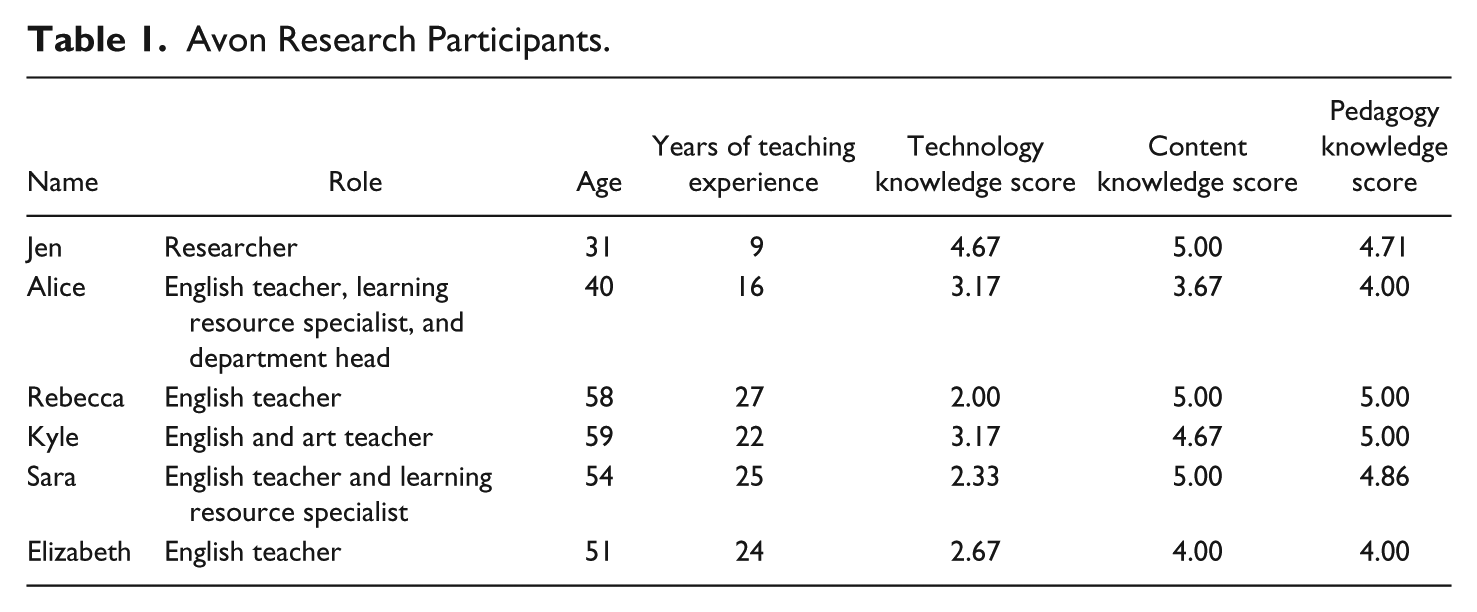
Participants in the learning community included Rebecca, Kyle, Sara, and Elizabeth. Over the year, they regularly shared their own lessons, brought in examples of student work, and engaged in critical dialogue about the role of technology in the English curriculum. They are veteran English teachers who have between 16 and 27 years of teaching experience, and they all identify as European American. Each of these teachers described themselves in initial interviews as newcomers to technology. While they used computers regularly for emailing and word processing, they were not familiar with other digital tools. As Sara put it, “I’m aware of the advantages of technology, but I know little about hardware and software.” She was motivated to take part in the learning community for this same reason, and concluded, “As teachers, we need to come to the table.”
While this was designed as a qualitative study, I used part of a quantitative survey developed by Schmidt et al. (2009) to assess teachers’ knowledge of technology, content, and pedagogy. I employed this survey at the beginning of the study to measure teachers’ self-reported knowledge in these areas. Mishra and Koehler (2006) propose that thoughtful pedagogical uses of technology require a complex, situated form of knowledge called Technological Pedagogical Content Knowledge (TPACK). They extend Shulman’s (1986) work and argue that an integrative view of content, pedagogy, and technology is essential for teachers to effectively integrate digital tools into school-based learning. Table 1 illustrates participants’ relevant demographic information and shows their self-reported knowledge (on a scale of 1-5) of technology, English as a content area, and pedagogy. Notably, teachers report substantially less knowledge of technology compared with the other two areas. However, as veteran English teachers, Avon participants were able to bring their years of experience in the classroom to bear on their work to integrate technology.
Avon Research Participants.
Data Sources
To answer my research questions about language and cultural models within professional learning communities, I collected multiple forms of data. This included (a) initial survey of teachers’ knowledge of technology, content, and pedagogy; (b) audio recordings of two semistructured interviews with each research participant; (c) video and audio recordings of all learning community meetings; (d) field notes of my observations within the learning communities; (e) teachers’ mid-year written reflections; and (f) artifacts, including school district policies and teachers’ lesson plans. The learning community met once during the summer and bimonthly over the school year. All told, this yielded 20 hr of videotaped discussions of the Avon learning community as well as 2 hr-long interviews with each individual participant.
Data Analysis
Events and utterances
While substantial research has shown the affordances of professional learning communities (Ball & Cohen, 1999; Little, 2002; McLaughlin & Talbert, 2001; Putnam & Borko, 2000), relatively little research has examined the specific interactions within learning communities that lead to transformations in teachers’ beliefs and practices (Horn & Little, 2010; Wilson & Berne, 1999). I take an ethnographically grounded approach to discourse analysis, which involves “a particular perspective on discourse and social action through language that forms an orienting framework for research design and implementation as well as for data analysis, interpretation, and explanation” (Gee & Green, 1998, p. 121). In this analysis, I focus on an event, which Bloome et al. (2005) define as “a bounded series of actions and reactions that people make in response to each other at the level of face-to-face interaction” (p. 6). According to Bloome et al., the theoretical construct of an event focuses on how people act and react to one another. These actions and reactions are not isolated or linear. Rather, “just as there is no separation of people from events, there can be no separation among meaning, significance, and interaction” (Bloome et al., 2005, p. 6). Interactions are intricately related within an event and inherently involve situated language and contextualization cues, which can be broken down to distinct utterances.
Within an event, utterances are acts that are part of a series of actions and reactions (Bloome et al., 2005). More specifically, utterances are constructed between socially related and positioned people. As utterances organize experience (Voloshinov, 1986), each person is strongly affected by the position he or she is cast into within interactions (Holland et al., 1998). In this analysis, I broke each utterance into a line, which generally consisted of one to two clauses. To closely focus on teachers’ situated language within the learning community, I found that the use of lines highlighted the work that an utterance was doing within a given event. The focal event for this analysis involved a discussion on the use of social networks in the English curriculum. This discussion is representative of what took place within the learning community over the year because participants explicitly addressed their beliefs about technology, investigated specific digital tools, and engaged in sustained dialogue. In what follows, I situate the event within the study and then explain the three layers of analysis that I used to understand the relationship between teachers’ situated language and cultural models about technology.
Situating the event
In the first meeting of the learning community, held in August 2009, I inquired about the skills, dispositions, and habits of mind that teachers wanted students to acquire in their high school English classes. After some time to consider this, Kyle said,
I’ll start. I don’t know quite how to tackle this given your interests and my interests. Bottom line, because I’m in English, I’m still interested in their taking away solid critical thinking skills . . . The question is how does technology help them with that, how does it get in the way of that, so how can we use technology to augment their richness, their thinking, and their willingness to scratch beneath the surface?
Kyle began by speaking directly to me and noted our different positionalities. Kyle, as an English teacher, valued specific skills and practices. He positioned me, as a researcher interested in technology integration, as someone who perhaps held different values and interests. Kyle then turned to the learning community and asked how technology could promote students’ critical thinking within the English classroom. Through the course of our discussion, we generated an extensive list that spoke to the teachers’ personal beliefs and instructional practices. We then examined how technology could be a tool to facilitate students’ learning and participation in the classroom. By the end of the meeting, we created a mission statement that would lay the groundwork for our learning community.
In the mission statement, we proposed that students should be able to (a) think critically to solve problems; (b) access, evaluate, and utilize multiple resources for a specific objective; (c) learn and troubleshoot digital tools; (d) become involved in the global community and develop a curiosity about the world around them; and (e) communicate with various audiences for various purposes. While we sought to avoid a technocentric perspective within the learning community, we recognized that the ever-evolving nature of technology meant that our ability, as students and teachers, to quickly learn and troubleshoot digital tools was critical. As a result, one of the five points specifically addressed this while the other points instead focused on the nature of learning, meaning making, and social interaction engendered by technology.
During our second meeting, in September 2009, we examined how online social networks, such as Nings, can be used in the secondary English classroom. I suggested that teachers could use social networks to facilitate students’ collaboration and critical engagement, particularly with works of literature or research projects. Rebecca, along with the other teachers, embraced a critical pedagogy and she immediately expressed concern about social networks. As experienced educators, the Avon English teachers immediately had concerns about issues of power and access in relation to social networks. But it is not until Rebecca introduces the notion of teacher responsibility that the event begins. The event includes a series of actions and reactions around language, learning, and technology, and closes with Rebecca returning to her responsibilities as a teacher. In effect, Rebecca initiates and ends the event through her situated language.
Rebecca, Kyle, Sara, Elizabeth, and I take part in the 4-min event presented here. Alice leaves midway through this event due to a prior commitment. We are all seated around a large table, facing one another. While my research questions centered on language and cultural models, I intentionally did not ask teachers about their beliefs on technology. D’Andrade (2005) suggests, “It is better not to ask informants directly about their models, but rather to ask something that will bring the model into play; that is, something that will make the person use the model” (p. 90). Consequently, as the facilitator of the learning community, I focused on how social networks function and explored their possible role in the English curriculum.
Analyzing the event
I began this analysis by reviewing all transcripts and watching all video recordings of our meetings. In my first pass through the data, I intentionally looked for places where teachers talked about their practices and beliefs related to technology. In terms of practices, teachers discussed lesson plans as well as related technical skills. Teachers’ beliefs often emerged as they talked about the affordances or constraints of specific digital tools and how these tools shaped student learning. Teachers’ beliefs included their hopes, intentions, fears, and concerns, and they often emerged through first-person statements. Before I could look at how cultural models about technology changed through participation in professional development, I needed to identify teachers’ initial cultural models. Therefore, in my second pass through the data, I focused on the transcripts from our first two meetings (mentioned earlier). I sought to identify one event, or a bounded series of actions and reactions, in which teachers discussed their beliefs. In the September 2009 meeting, Rebecca introduced a topic related to teacher responsibility and social networks. Because this event involved multiple speakers, I decided to focus on the utterances within this event to understand if, when, and how teachers’ cultural models emerged.
As I began my micro-level analysis of this event, I realized that it would be insufficient to simply examine teachers’ language. The video recordings suggested that teachers’ contextualization cues, including their gestures and intonation, worked with their utterances to carry meaning. Moreover, this meaning was not constructed in isolation. Situated meanings were inherently tied to the context and constructed within the interaction. As an active participant in the learning community, I chose to include my utterances in the analysis because my role positioned me as part of the professional development system. This is not an unproblematic process, because I brought my own cultural models about technology to bear on this study. During our meetings, I was often not consciously aware of when or how I expressed my cultural models or proposed alternative cultural models. It was only through closely analyzing language and interactions that I gained insight into my own cultural models and how they operated within the context of the professional learning community.
In this analysis, I asked: How does a discourse analysis of teachers’ situated language within a professional learning community reveal their cultural models? What are English teachers’ cultural models about technology? How do teachers’ cultural models shape their approach to technology integration in the secondary English curriculum? To answer these questions, I examined teachers’ utterances within this singular event, which encompassed 61 lines and 11 turns at talk. I began with a transcript of the event and broke it down by speaker and then by utterance. I developed three layers of analysis, which build from the micro level to the macro level:
Situated language and contextualization cues: How does the speaker use language and related contextualization cues within this utterance?
Social interaction: How does this utterance contribute to social interaction?
Cultural models: How does the speaker’s utterance reveal his or her cultural models of technology?
Situated language and contextualization cues
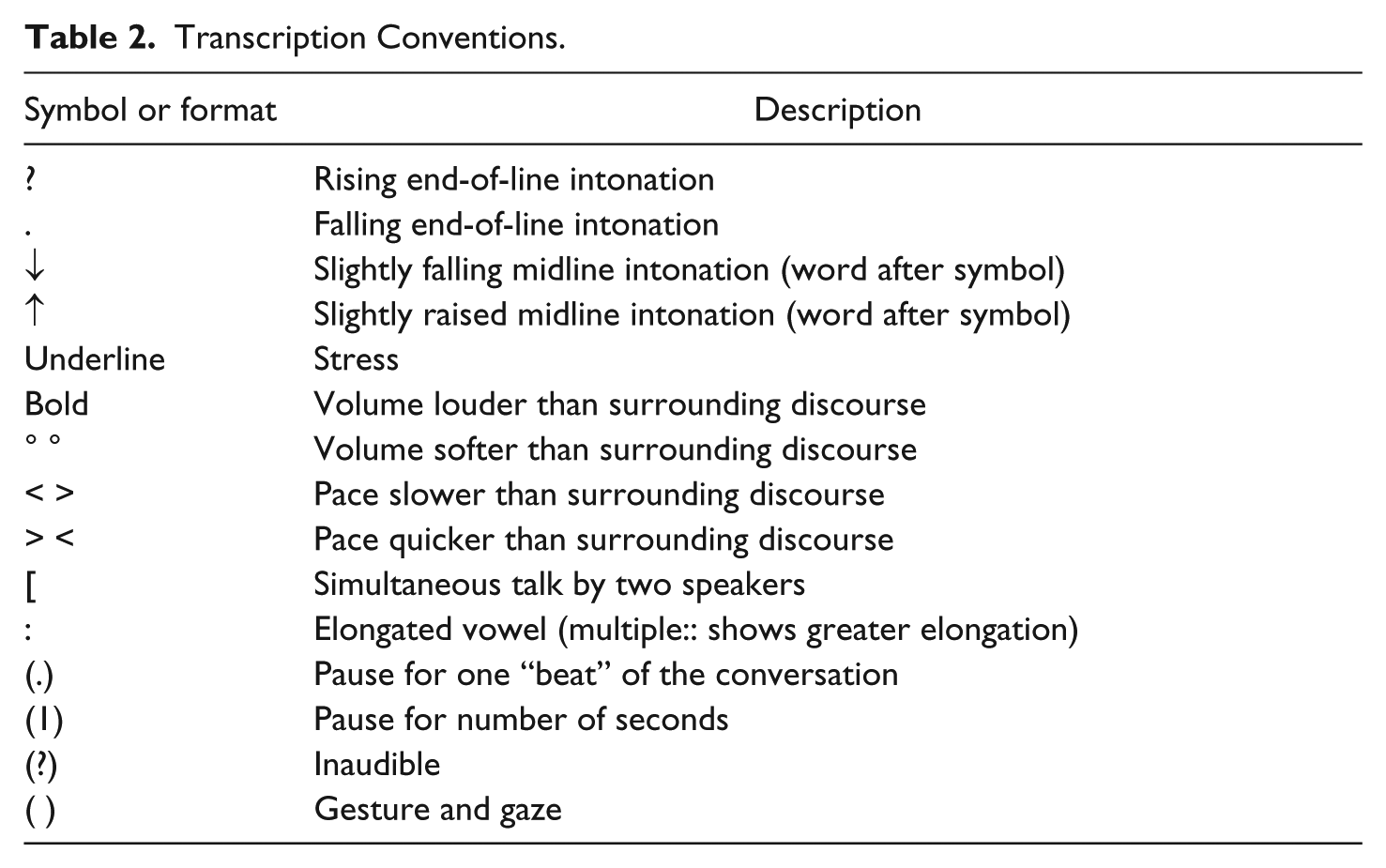
I started with a close sociolinguistic analysis of individual utterances within the event. Here, the emphasis was on language as well as the salient contextualization cues, which included gesture, gaze, intonation, stress, volume, pace, and pauses. I used transcriptions conventions (see Table 2), adapted from Juzwik and Ives (2010), Atkinson and Heritage (1984), Gee (1999), and Tedlock (1983).
Transcription Conventions.
Social interaction
In the second layer of analysis, I turned to examine how the utterance functions within the event. Specifically, I looked at how language and contextualization cues contributed to social interaction. I drew on a situated view of professional learning and microethnographic methods (Bloome et al., 2005) and I asked a number of specific questions.
Is the speaker:
Claiming or holding the floor?
Staking a social position?
Interacting with the group?
Responding to a particular individual?
Initiating an interaction?
Continuing an interaction?
Asking a rhetorical question?
Stating a fact?
Offering confirmation or validation?
Positioning themselves or others?
Cultural models
In the third and final layer of analysis, I considered how situated language and social interaction highlighted teachers’ cultural models related to technology. I asked,
How does the speaker use language to signal the cultural model?
How does the speaker use contextualization cues to signal the cultural model?
Is one speaker’s cultural model verified or challenged by other speakers? How is this evident through language or contextualization cues?
How do cultural models shape the social interaction?
In this layer of analysis, I sought to identify specific cultural models at a particular point in time, not to generalize about English teachers’ cultural models about technology. D’Andrade (2005) notes,
The exploration of cultural models is not yet well enough established for there to be sufficient experience to justify good prior expectations for appropriate sample sizes. However, data collected so far indicates that cultural models tend to be strongly shared. (p. 99)
By developing this analytical approach and applying it to this data, I am interested in complicating our understanding of language, interaction, professional development, and technology integration.
Results and Discussion
Within this 4-min event, teachers used language and contextualization cues in complex ways to advance the social interaction and express cultural models related to technology. This illustrative example is representative of interactions in the learning community that I observed over the course of the year. By engaging in a three-layer approach to microethnographic discourse analysis, I was able to break the event into sections: (a) Lines 1 to 13, which serve to initiate the event and introduce cultural models related to pedagogy and technology; (b) Lines 14 to 50, which turn to cultural models on language and technology; and (c) Lines 51 to 61, which conclude with cultural models related to learning and technology.
Cultural Models of Pedagogy and Technology
Rebecca
what I’m
I need to
so they won’t be >shut out from access to the information<
>because they lack the skill< (2)
but (.) the <ot:her part> of it
they
if they were
would they be able to ask the
Researcher
9. how is it different from the classroom setting, though.
10. it still is a
11. the classroom is a physical space (.)
12. Ning’s an online space
13. where questions can be answered >or knowledge can be created< .
Rebecca initiated the event when she turned our discussion from social networks to issues of teachers’ pedagogy and responsibility. The first part of the event, depicted in Lines 1 to 13, shows how language and contextualization cues can contribute to social interaction. Rebecca began the event with a first-person statement, “What I’m saying is that I feel like as a teacher, I need to teach kids how to use [social networks].” Here, she claimed the floor and introduced a new topic. She elongated the vowel in the word “feel” to emphasize the word and the fact that she was turning the discussion from technology to her own pedagogy. Rebecca frequently used contextualization cues such as pauses, gesture, and gaze to emphasize her spoken language. For instance, in Line 1, she gestured toward the group with her hands, palms up, in an appeal. With her right hand, she picked up a pen and put it to paper at the same time that her left hand touched her heart. In Line 2, Rebecca staked a social position and emphasized that she had a responsibility to teach her students how to use social networks.
In Lines 6 to 8, Rebecca emphasized words such as “critical” and “questions.” She also used gaze to direct her comments to particular members of the group. For example, at the end of Line 6, she looked up from the paper in front of her and turned toward me. In Line 8, she used rising intonation and asked a question, “Would [students] be able to ask the questions of the people who do have the power?” and turned her gaze to Kyle and Elizabeth. Rebecca used gaze to invite others in the learning community to take part in the social interaction. In Line 9, I responded to Rebecca’s question. While this response was phrased as a question, the falling intonation at the end of the line indicated otherwise: “How is it different from a classroom setting, though.” While Rebecca’s rising intonation invited participation from others in the learning community, my falling intonation can be interpreted as a move to hold the floor. I gestured toward Rebecca with my palm facing up, indicating that my response was directed to her. In Lines 10 to 12, I proceeded to answer my own question and put an emphasis on the word “space.” Here, I gestured with my hands to create a box that was representative of the physical space of the classroom. In the first 13 lines of the event, Rebecca and I used language and contextualization cues within the social interaction in different ways.
Within the first part of the event, two competing cultural models of pedagogy were presented. While Rebecca had no experience with social networks, she suggested in Lines 1 to 2 that she had a responsibility as a teacher to instruct students on the function of such online spaces. Her elongation of the vowel in “feel” emphasized this point. Her gestures (touching her heart and motioning toward the group) seemed to indicate that this was a cultural model that she held strongly and that she sought to share with others. In earlier interviews, Rebecca noted that many of her students were well versed in social networks, particularly with Facebook. This is supported by research by the Pew Internet Project (2010) that shows that 73% of all teens participate in online social networks. However, Rebecca presented a cultural model of learning that was unilateral, from teachers to students. In effect, she did not account for her students’ prior experience with social networks or consider how she could capitalize on this knowledge within her classroom.
In Lines 3 to 4, Rebecca added that if students do not have the technical skills to access social networks, the consequence was that they will be denied access to information. In this respect, Rebecca held a cultural model that conceptualized knowledge as a commodity that could be given or withheld by an authority figure. In contrast, critical theorists propose a cultural model of knowledge as a social construction, which is “linked to norms and values . . . [and] serves very specific economic, political, and social interests” (Aronowitz & Giroux, 1993, p. 132). Depending on which cultural model a teacher applies to their pedagogy, it will shape their instructional design and how they position teachers and students in the learning environment. In Lines 5 to 8, Rebecca referred to a previous discussion, in which she posited that whoever starts the social network controlled the content, asking, “But the other part of it, they may or may not have control over it. If they were critical about it, would they be able to ask the questions of the people who do have the power?” Although Rebecca recognized the tension between power and knowledge, she didn’t seem to consider her role in exerting power, whether learning occurred in a physical classroom or an online social network.
In Line 9, I responded to Rebecca’s rising intonation, gesture, and gaze to compare learning in different spaces. In the subsequent lines, I used a parallel sentence structure to reinforce the conceptual similarities between the two settings. My gaze moved from Rebecca to the other members of the learning community, seemingly to invite them to participate in the social interaction. In Line 13, I stated that physical and online environments were spaces “where questions can be answered or knowledge can be created.” Here, my language and contextualization cues seemed to validate Rebecca’s cultural model that viewed knowledge as a commodity. As a facilitator, it was critical that I valued the knowledge and beliefs that teachers brought into the professional learning community. However, I expanded on her cultural model and proposed one that positioned knowledge as a social construction. The former cultural model aligns with transmission models of teaching. Meanwhile, the latter cultural model supports new literacy and critical literacy practices that value the collaborative construction of knowledge across diverse spatial and temporal contexts. A cultural model that conceptualizes knowledge in this way allows teachers and students alike to exert identity and agency while challenging traditional assumptions about power in the classroom.
Cultural Models of Language and Technology
Researcher
14. the one thing I noticed is different is
15. in a classroom (.) everything is happening at the same time
16. with the Ning↑ you might post something one day (.)
17. and someone’s going to reply (.) a couple hours later and you may come back↑ to it (.)
18. well so things like time (.) and then permanence
19. and what if you post something and then a bit later (.) I guess I shouldn’t have posted that.
20. you can
21. but if people have
22. what does that mean?
Elizabeth
23. and if I say something (.) and then tomorrow I change my mind
24.
25. the first comment is still
26. somehow it seems
Researcher
27. because if you said it like in a meeting or in a class↑ (.) that might still be in their memory
28. but (.) if it’s
Kyle
29. [accessing the permanent record is not always protection
Elizabeth
30. right
Kyle
31. there was a follow-up to that thing and we all see (.) that.
32. so I get that
33. that’s
Sara
34. and in a classroom (.) at least we can say that our students are on an even playing field in a sense
35. they’re all (.) hea:ring the message (.) at the same time (.) in the same context.
36. and all of the nonverbals that follow that make communication what it is (1)
37. that’s not so (.) it seems to me that (.)
38. one explanation at least once a week on the same things.
Researcher
39. but there’s still interpretation.
40. > because I
41. you say one thing but a student would still hear another
42. have you had that experience?
43. one time I remember talking about some social issue
44. I said one thing but then (.) later on (.) a student said that she
45. so↑ even in
46. we still filter↑ it.
47. we still interpret↑ it.
48. and so online you don’t have the gestures there but you still have (.)
49. it’s a different kind of interpretation
50. but it’s still
In the second part of the event, I turned the topic away from teachers’ pedagogy to instead focus on language in online and physical spaces. Specifically, I addressed issues related to time, which included synchronous and asynchronous communication and permanence. In Lines 14 to 22, Elizabeth nodded repeatedly in response to the hypothetical examples that I offered to illustrate my points. I used rising intonation and gaze to ask an open-ended question in Line 22, “What does that mean?” This invited others in the learning community to contribute to the discussion, and Elizabeth immediately chimed in. Specifically, she took up the hypothetical example and applied it to her own life, “And if I say something and then tomorrow, I change my mind.” Her volume in Lines 23 to 24 was significantly louder than the surrounding discourse, and it served to emphasize her language. Elizabeth also used gesture, such as when she said, “the first comment is still in everyone’s memory” (Line 25) and used her hand to point around the table. In response, Sara and Rebecca nodded in affirmation.
In this event, speakers used gaze and gesture to further the social interaction. For instance, gaze was often used to appeal to others to contribute to the conversation. In Line 34, Sara used her thumb and forefinger to create a circle to represent the classroom. This gesture echoed the one that I made in Line 10 to illustrate the same physical space. Other gestures, such as nodding, offered affirmation to the speaker. In addition, rising and falling intonation served to emphasize certain words. For example, in Lines 39 and 50, I used falling intonation and a short pause to emphasize the concept of interpretation. In the middle of Lines 46 and 47, in contrast, I used rising intonation with the words “filter” and “interpret.” These are the actions that take place in both online and physical spaces, and my situated language and contextualization cues served to emphasize the commonalities in both spaces.
Within secondary English, learning has traditionally occurred through oral language, contextualization cues, and written language in synchronous contexts. Online spaces, such as social networks, offer the possibility of asynchronous communication in both written language and other modes of representation. Technology, in many respects, challenges the world in which English teachers have lived and worked in for decades. In this part of the event, two cultural models of language were evident. In Line 14, I introduced the topic of time and synchronicity. I drew parallels between online spaces and physical classroom spaces before observing,
The one thing I notice is different is time. In a classroom, anything is happening at the same time. With the Ning, you might post something one day and someone’s going to reply two hours later and you may come back to it.
Over the course of these utterances, I presented a cultural model that viewed asynchronous communication as an affordance of online spaces. This view is supported by research that shows that asynchronous dialogue allows individuals time to reflect, clarify their thoughts, and present their ideas in an orderly fashion (Garrison & Anderson, 2003).
With online spaces, the asynchronous nature of communication is related to the perceived permanency of language. In Lines 20 to 22, I wondered aloud, “You can delete [an online post] but if people have seen it and it’s out there, what does that mean?” By using rising intonation and posing this question to the group, it created space to discuss the perceived permanency of written language within social networks. In Line 23 to 25, Elizabeth picked up on this and expressed her reluctance to participate in social networks due to the permanency of language. She noted that even if she deleted her post, it was “still in everyone’s memory.” In Line 26, Elizabeth concluded, “Somehow it seems different when it’s in writing.” She emphasized the word “different” and spoke the final two words at a softer volume. Here, I picked up on the concept of difference and questioned the qualitative differences between online and classroom spaces. The ensuing discussion between Kyle and Sara presented conflicting cultural models with regard to the permanency of (and, along with that, the ability to access) written language in online spaces.
In Lines 27 to 33, Kyle, Elizabeth, and I discursively negotiated how time and permanency operate. I stated, “Because if you said it like in a meeting, or in a class, that might still be in [students’] memory. But if it’s online, maybe more long-term, they can access it” (Lines 27-28). Kyle’s response overlapped mine and countered this conceptualization. He said that even if students had the option of accessing information online, it didn’t offer “protection” (Line 29) and that “we all see that” (Line 31). Here, he directed his gaze to Elizabeth, which served to reinforce their social positions within the interaction. He referred to the physical space of the English classroom that privileges oral and written modes of communication. Sara responded to Kyle’s utterance and added that nonverbal and gestural modes are privileged in this space (Line 36). In Lines 34 to 35, Sara presented a cultural model that synchronous communication is an affordance of physical spaces.
In Lines 39 to 50, I addressed the two cultural models about the role of language in online and physical spaces. To do so, I presented a cultural model that all language is subject to interpretation. This cultural model posits that there may be critical disconnects between what we intend to communicate and what our students take away—and that this disconnect can be present regardless of the medium or the context. In terms of the social interaction, I again used rising intonation to ask a question directed to the other group members, “Have you had that experience?” (Line 42), but then I did not pause and answered my own question. I used the words “interpret” or “interpretation” four times in this part of the interaction to emphasize the ways in which individual agency and meaning making shape learning in online and physical spaces. Rather than comparing modes in online and physical spaces, as had happened earlier, I instead used parallel sentence structure, personal anecdotes, and hypothetical situations to draw comparisons between these spaces. In doing so, I reiterated the cultural model that holds knowledge to be a social construction.
Cultural Models of Learning and Technology
Rebecca
51. >I see the value of teaching in Google Docs<
52. >because I think that’s a real function that happens in organizations<
53. I
54. all I’m saying to you
55. is that along with each
56. and questions of power and access that need to be asked.
57. and that’s what I’m brainstorming with you all
58. it’s not just introducing the tool
Elizabeth
59. and I
60.
61. with kids (.) at the same
In the third and final part of the event, Rebecca reclaimed the floor. She returned to the notion of teacher responsibility and stated that she could “see the value” (Lines 51 and 53) of technology that facilitated online collaboration and communication. Rebecca’s gaze during Lines 51 to 54 was directed at the table, but then she looked to Researcher when she stated, “Along with each tool, there are advantages and limitations and questions of power and access that need to be asked” (Lines 55-56). In Line 58, Rebecca’s volume increased and her gaze turned toward other members of the learning community to emphasize, “It’s not just introducing the tool” (Line 58). Her falling intonation indicated that she had made her statement. Elizabeth immediately expanded on this, and said, “And I definitely want to share that with the students” (Line 59). Her use of the word “philosophical” (Line 60) echoed her observation prior to the event that they were asking “metaphysical questions.” While her previous comment had elicited laughter from the group, here both Kyle and Rebecca nod in response. This gesture offered affirmation.
Over two decades of research on technology integration in schools has consistently shown that professional development often takes a technocentric approach that privileges digital tools rather than social practices (Culp et al., 2003). In this part of the event, the teachers recognized that this approach was insufficient, both for their own professional learning and for their pedagogy. In Line 2, Rebecca suggested that teachers needed to teach kids about social networks. At the end of this event, Elizabeth used similar words but expanded on the concept to include metacognitive and reflective discussions. This cultural model, then, holds that teachers need to take a critical approach to technology integration. Along these lines, Elizabeth also responded to the cultural models about knowledge construction presented earlier in the interaction. Rather than conceptualizing the teacher’s role as the expert who imparts knowledge to students, she suggested that students and teachers should jointly construct knowledge about technology through ongoing, reflective dialogue. This cultural model isn’t taken up again during this particular meeting. In fact, rather than taking up the issues of communication and interpretation, Rebecca returned to her original cultural model that situated knowledge as a commodity in Line 51. However, when Rebecca later integrated online discussions into her English class, she consciously solicited students’ feedback, demonstrated how critical dialogue occurs in online spaces, and prompted students to develop a metacognitive awareness of their own learning with digital tools.
At earlier points in this discussion, and again in Line 52, a future orientation was clearly present. This cultural model holds that in the future—in college and workplaces—students’ success will depend on their access to and experienced use of technology. Therefore, to operate in this future world, students will need to have technology skills. As Rebecca emphasized, “That’s a real function that happens in organizations.” Implicit in this cultural model, however, was that technology might not be essential in today’s classrooms but that it will be in some ambiguous future context. For students to be active participants in the future spaces in which they will live and work, Rebecca proposed that technology will be paramount.
Conclusion
By studying discourse within a professional learning community, this micro-level analysis shows some of the ways that teachers use situated language and contextualization cues to contribute to the social interaction and express cultural models related to technology. It reflects previous macro-level analyses that suggest that teachers’ practices and beliefs related to technology are significantly influenced by participation in the learning community (Curwood, 2011). In this 4-min event, a three-layer approach to microethnographic discourse analysis revealed some of our cultural models:
Knowledge is a commodity
Knowledge is a social construction
Asynchronous communication is an affordance of online spaces
Synchronous communication is an affordance of physical spaces
Teachers must take a critical approach to technology integration
Students’ future success depends on their access to and experience with technology
These cultural models, or everyday beliefs, directly inform teachers’ approach to technology integration, instructional design, and assessment within the secondary English curriculum. Notably, member checking revealed that these cultural models are not ones that teachers could have readily identified prior to this analysis but that they nonetheless possessed. As tacitly held beliefs, cultural models influence teachers’ cognitive processes and daily practices. If our aim is to promote students’ achievement and engagement through the use of digital tools, we must begin by understanding teachers’ relevant cultural models and how these may afford or constrain the process of technology integration.
Within this event, two of the teachers, Rebecca and Elizabeth, revealed that the notion of professional responsibility was a driving force in their interest in technology. Statements such as “I see the value in teaching Google Docs . . . and Nings” and “I definitely want to share that with the students” used first-person pronouns and positioned the speaker as the subject of the utterance. When I introduced new topics or ideas, I often employed words such as “but,” “because,” and “you” to justify my knowledge and direct my words to the other members of the discussion. However, such comments were often tempered with words such as “maybe” or phrased as questions instead. My utterances sometimes met with resistance, such as when Kyle directly contradicted my statement and Elizabeth affirmed his response by stating, “Right” in Lines 29 to 30. However, as a relative newcomer to the school, this social interaction functioned to draw attention to the teachers’ prior relationships with each other, offer validation to their current cultural models, and introduce new cultural models related to technology. As the facilitator of the learning community, I came into the discussion with a decade of teaching experience and a commitment to technology integration in the secondary English curriculum. The other teachers entered the discussion with more extensive teaching experience, which was marked by print literacy. However, they were also committed to rectifying issues of access, taking a critical stance, and promoting student learning. While we held competing cultural models at times, it doesn’t make some good or bad (Gee, 2008). Rather, this approach to microethnographic discourse analysis helped to explain why some teachers choose to integrate technology into the secondary classroom and how participation in professional development influenced this process.
Not only do cultural models shape how we see the world but also guide our thoughts, actions, and beliefs. For today’s English teachers, cultural models contribute to how they see their role in the classroom, how they design the learning environment, and what skills, knowledge, and dispositions they seek to cultivate in their students. But cultural models are often invisible to us. They are such an integral part of our identity that, on a day-to-day basis, we are not aware of how they structure our interactions with people, tools, and spaces. By focusing explicitly on one event, this article sought to identify and trace how cultural models emerge, transform, and operate within the situated language of a professional learning community. If professional development is designed to support teachers’ learning and growth, then it can be useful to examine how teachers use language and contextualization cues to express cultural models related to technology.
This three-layer approach to microethnographic discourse analysis provides a way to identify teachers’ initial cultural models around technology. Future research must examine how cultural models change over time and focus on how this can be traced through the situated language and social interaction inherent in teacher professional development. For teacher educators, it is critical to value teachers’ cultural models, even as we consciously propose competing cultural models. Some teachers, for instance, may willingly embrace technology but struggle to change their assessment practices to value multimodal compositions within the English classroom (Curwood, 2012). While extensive research shows features of effective professional development, this article draws attention to the micro-level interactions that shape teacher learning in social and cultural contexts. As Little (2002) suggests, “Looking close up at teacher interaction, across a range of settings . . . will further open the black box of professional community and show when and how it is conducive, or not, to the transformation of teaching” (p. 940). To understand how social interactions contribute to teacher learning, researchers need to closely examine the language and contextualization cues inherent in professional development. In this study, our interactions created a space where we could critically reflect on our own practice, analyze students’ engagement in online environments, and design effective learning opportunities. This article sheds light on how teachers’ cultural models shape this process from the onset.
While a growing body of research highlights students’ digitally mediated practices and teachers’ technology-rich instruction, I argue that we must now focus on the role of professional development to move forward with technology integration. For over a decade, nearly all American teachers have had access to technology-focused professional development (U.S. Department of Education, 2000). However, conventional literacies dominate school-based learning (Lankshear & Knobel, 2006). Perhaps it is time to examine how this disconnect is further perpetuated by the kinds of professional development offered to teachers. In fact, the National Education Technology Plan (U.S. Department of Education, 2010) calls for “episodic and ineffective professional development [to be] replaced by professional learning that is collaborative, coherent, and continuous and that blends more effective in-person courses and workshops with the expanded opportunities, immediacy, and convenience enabled by online learning” (p. 40).
Learning communities embody this kind of reform-oriented professional development, whether the community is situated in a school environment or in an online space. Furthermore, investments and policies at the local, state, and federal levels need to value teachers’ professional development that occurs within learning communities.
Decades of research suggest that learning communities embody the core features of effective teacher professional development (Desimone, 2009; Desimone et al., 2002; McLaughlin & Talbert, 2001). However, we know relatively little about how teachers’ interactions within the learning community serve to promote critical reflection, collaboration, or the development of new skills and strategies. Horn and Little’s (2010) analysis offers compelling insight into the functions of teachers’ discourse within learning communities, which includes normalizing instructional problems, sharing specific accounts of classroom practice, and offering general lessons from past experiences. However, they also noted significant differences between two groups of teachers: “When considered from the perspective of teachers’ opportunity to learn, the groups demonstrated quite different orientations toward problems of practice and were positioned to marshal quite different resources for engaging such problems when they arose” (Horn & Little, 2010, p. 212). I would argue that the ways in which teachers access resources and construct meaning are directly informed by their cultural models. My approach to microethnographic discourse analysis, then, offers insight into how teachers’ cultural models shape their interactions within learning communities.
Professional learning is a complex process, often marked by disequilibrium (Ball & Cohen, 1999). When professional development challenges long-held beliefs and practices, some teachers may feel disengaged or even threatened. Consequently, it is crucial to attend to the role of teachers’ colleagues and facilitators in shaping professional learning. At the end of the school year, Rebecca reflected on her involvement in the learning community:
It’s sort of a dance, like finding your mate . . . I think that there is that ambiguity and that uncertainty, and sometimes a feeling of irritation or frustration. But it’s hard . . . It’s really hard to take out the time to do it for yourself. Or for your students. But I trusted my fellow teachers that were in it with me and I trusted the process.
Above all, professional learning is a process. It takes time and space. It involves commitment and patience. And it requires trust. In our focus on high-stakes assessment, school achievement, and teacher accountability, this understanding of professional learning has often been absent. Learning communities can be instrumental in supporting teachers as they engage in understanding and implementing educational reforms, including technology integration. Through social interaction, hands-on learning, and critical reflection, teachers can express, challenge, and, perhaps, adopt new cultural models related to technology.
Footnotes
Declaration of Conflicting Interests
The author declared no potential conflicts of interest with respect to the research, authorship, and/or publication of this article.
Funding
The author disclosed receipt of the following financial support for the research, authorship, and/or publication of this article: This study was supported in part by a grant from the Wisconsin State Reading Association.