



Abstract
Attending to current affairs and news within schools’ curricula is a potential pedagogical strategy that holds promise for addressing children’s knowledge, perspectives and agency in the world. However, our research suggests teachers’ good intentions may be compromised by tension between the details of news media content and the curriculum as enacted and planned. We report here on a study investigating two children’s news media publications designed to support Aotearoa New Zealand’s school curriculum. Our research enquires into content produced as children’s news and associated discourses about Aotearoa New Zealand, Aotearoa New Zealand life and the world. A dominant category of news reporting in the texts was sport (national and international). Analysis of this category identified particular discourses and constructions of New Zealand, New Zealanders and ‘others’ within the texts. Individual and collective sporting heroism was a dominant discourse in both the news items and children’s published responses. Furthermore, a construction of Aotearoa New Zealand as a relatively safe and non-corrupt place to live was also observed. Questions of what is important to know, how children are engaging with such valued knowledge and implications for teaching and teachers’ practices are raised from this research. Importantly, we ask: is this preoccupation with sports and heroism within children’s news made at the expense of opportunities to engage with children about a fuller range of real-world issues, including ‘difficult knowledge’, that potentially impact upon their lives?
Introduction 1
Attending to current affairs and news within schools’ curricula is a pedagogical strategy that holds promise for addressing aspects of Aotearoa New Zealand’s school curriculum in domains like social science (Ministry of Education, 2009, hereafter MOE). Likewise, in early childhood education, the curriculum, Te Whāriki (Ministry of Education, 2017b), encourages the provision of environments for learning where ‘connecting links with the family and the wider world are affirmed and extended’ (24) and children are able to ‘develop working theories for making sense of the natural, social, physical and materials worlds’ (25). Teaching with current affairs in mind is a means of addressing children’s knowledge, perspectives and agency in the world, particularly when high profile events and issues spill into children’s consciousness and experiences, spurring them into action.
Friday, 15 March 2019, was a day when New Zealand school children were leading marches and rallies up and down the country to protest global climate change. A lot of pride in this activism was articulated in the local and national press and many adult Kiwis were privileged to act in support of it. Aotearoa New Zealand student-led activism in relation to world events is on the increase and has included, for example, fundraising for earthquake-affected Nepalese children, waste reduction and sustainability activism (Education Gazette Editors, 2017, 2018). That Friday’s protests were overshadowed by the Christchurch terror attack. In Aotearoa New Zealand, we would have typically seen, heard and read about such (overseas) events through the news media and internet communications. Our sense of safe harbour, brought about by our relative geographical isolation on the world scene, was shaken. As the weeks and months have passed and the news media saturation over what happened in Christchurch has diminished, the news media remains an important source of information for making sense of these and other world events.
At first glance, reading the daily news or using news publications produced in support of official curriculum policy may appear a straightforward approach for teachers wanting to engage with current affairs and news issues in their curriculum, particularly given the long history of this practice nationally, in the United States and in Europe (Claes and Quintelier, 2009; Dresner, 2014). However, producing news for children and understanding what’s learned from engaging with children’s news at school is not quite so straightforward. A great deal depends upon how teachers engage with children over news media texts (Jordan and Massad, 2014; Journell, 2014; Moore, 2013; Van Rooy and Moore, 2012) and on the quality of the texts themselves (Pescatore, 2007). In this article we suggest teachers’ intentions for rich and locally relevant curriculum design involving the use of children’s news media may come into tension when the details of news media content undermines the planned and enacted curriculum. Thus, teachers’ plans to address children’s agency, knowledge and perspectives on world issues may be compromised.
Curricula produced with news media texts
Curriculum theorists (see for instance McGee, 1997; Pinar, 2004) have repeatedly reminded us that curricula are multifaceted and highly interpretable phenomena heavily influenced by place and time, as well as people and things. Moreover, curriculum has many meanings, some of which are directly relevant to our exploration of news media texts as a curriculum resource for use at school. We know, for instance, that curricula can be official, as in any national or state-wide policy produced by a government outlining what should be taught and learned in early childhood education or at school. The planned curriculum may also be considered official in that it reflects a teacher’s intentions on a given day or in a particular lesson. The enacted curriculum, in retrospectively reflecting what actually happened when the teacher added people, curriculum resources and the day to their intentions, may or may not approximate what was planned. The learned curriculum is what children or students actually take from their experiences. The hidden curriculum reflects any unintentional learning that occurs. Lastly, Eisner’s (1994, 2000) null curriculum reflects the content that we agree not to teach. Each of these versions of curricula are in play when teachers make decisions about the teaching and learning experiences they plan and conduct in early childhood education or at school.
It is curricula as planned, enacted, learned, hidden and null that are of interest to us in this article. Specifically, we are interested in the potential contributions of children’s news media to curricular experiences and to children’s learning about themselves, others and the world. We know that teaching that addresses issues of social, political, institutional and historical injustice can help develop students’ capacities to participate in local issues and to bring about change (Alarcón et al., 2017). The New Zealand Curriculum (MOE, 2006, hereafter NZC) and Te Marautanga o Aotearoa (MOE, 2017a, hereafter Te Marau), official curriculum policy for English medium and Māori medium forms of schooling in Aotearoa New Zealand, refer to aspirations for Aotearoa New Zealand children to develop skills and knowledge to be able to participate in and contribute to their local and global worlds. Te Whāriki (MOE, 2017b) also expects children’s theories about and connections to the wider world to be expanded through their early childhood education. As the examples earlier illustrate, engagement with current social issues and current events through news media texts can support such aspirations (Claes and Quintelier, 2009; Degirmenci and Ilter, 2017; Jordan and Massad, 2014). When children and teachers embark on activist-oriented curriculum initiatives, possibilities for recognising existing knowledge and perspectives and the development of understandings about the self, the world and the other may be enhanced. However, the quality of news media texts available to support such teaching intentions is key, a point we return to later.
International research into the effectiveness of the long-established Newspapers in Education programme
2
suggests an increased likelihood of students following the news as an outcome of participation in the programme. Moreover, these studies highlight an increase in student interest in current affairs and political knowledge (Claes and Quintelier, 2009). Whether or not participation impacted students’ political knowledge, political attitudes, social capital and open mindedness towards minority populations is not discernable from Claes and Quintelier’s study into programme effects, principally because of the short duration of the programme. Nevertheless, merit is seen in teachers using news media sources to support learning activities in the classroom because they can open up democratic debate, make visible multiple sides of an issue and challenge the barrier of so-called thin news narratives, to bring more critical and informed views and understandings of real-world events and issues to the fore (LeCompte, Blevins and Ray, 2017; Journell, 2014). Arguably, this work can support students’ preparation for effective participatory citizenship in democracies through the development of social consciousness (Alarcón et al., 2017; Claes and Quintelier, 2009; Degirmenci and Ilter, 2017). As McCafferty-Wright and Knowles (2016) state: If citizenship and teaching for social justice are goals, then schools, administrators, teachers, and communities have the responsibility to create open classroom climates that empower students of all ages to engage with complex issues, stand up for their positions, and work to understand differing opinions. By creating a democratic ethos in our classrooms and moving beyond simply reading and summarizing the news, teaching current events has the tremendous potential to change how students respond to their world and to, ultimately, make the world a more equitable place (117).
Aotearoa New Zealand – the present context of children’s lives
Fostering critical, informed views and understandings of real-world events and socio-historical–political issues is a key project of Aotearoa New Zealand education if aspirations for children to develop and exercise their citizenship rights and capabilities as members of society are to be realised. In a context where Iwi 3 and Crown relations are regularly construed as tenuous and where inequality, racism, sexism and extremism in all its forms are increasingly visible, socio-historical–political issues playing out in the world through such issues as Brexit, the Syrian crisis and President Trump’s election are clearly being mirrored locally. Contemporary debates about racial intolerance, homophobia and sexism are regularly (re)ignited and reported in Aotearoa New Zealand’s news media. Understanding how children are making sense of such issues is a teaching imperative if teachers are to support children to live well in and contribute to the world.
Despite a strong historical narrative of colonised Aotearoa New Zealand as a land of milk and honey replete with opportunity and natural abundance (Bell et al., 2017) and a sense that we punch above our weight globally (Falcous and West, 2009), Aotearoa New Zealand has developed into a modern but unequal society (Perry, 2017). An estimated 20% of Aotearoa New Zealand children aged 6–17 years are living in circumstances where they experience material hardship, including restricted access to food, clothing and other routine household items (Duncanson et al., 2017). Child Poverty Monitor (2017) reports that income poverty affects around 27% of children aged birth to 17, about 290,000 individuals. Unicef’s (2017) Innocenti Report Card 14 indicates that the youth suicide rates in Aotearoa New Zealand top the statistics across 37 Organisation for Economic Co-operation and Development (OECD) and European Union (EU) countries; many complex social and economic factors are pinpointed as contributing to these figures, including high rates of family violence, families with parents out of work, high teenage pregnancy statistics and a school bullying culture (Ilmer, 2017). Recent government policy focused on prioritising child wellbeing and making Aotearoa New Zealand ‘the best place in the world to be a child’ (Department of Prime Minister and Cabinet, 2018) is indicative of the level of growing concern. Current health policies are aimed at reconnecting with a supposedly ‘lost’ adventure-loving, physically capable and fit Kiwi kid (Burrows, 2010).
Discourses of Kiwi kids as adventure-loving, physically capable and fit reflect the major role sport plays in defining our national identity, as evidenced through self-referential notions of Aotearoa New Zealand as ‘the great little sporting nation’ (John and Jackson, 2011: 425) and the wide array of sports featuring across all forms of Aotearoa New Zealand’s news media. In particular, our identity has been forged through the national sport of rugby union (Bruce, 2013). Promoted and patronised as an equaliser (Chattington and Slade, 2015) – a game played on a ‘level playing field’ (Falcous, 2007) – rugby became a prominent vehicle in Aotearoa New Zealand for coloniser–colonised reconciliation and the ‘assimilation’ of Māori (Falcous, 2007; Falcous and West, 2009), despite its ethnicised, classed and gendered nature (Falcous, 2015). The sport remains a powerful symbol of nationhood in Aotearoa New Zealand, embodying the illusion of meritocracy, unity, egalitarianism and inclusivity (Falcous, 2007).
Our colonial history has popularly construed New Zealanders as practical and pragmatic, with an ‘essentialist national character, made potent by its articulation to selected individuals who embodied the characteristics of the mythical “kiwi bloke” [who] sits at the core of hegemonic New Zealandness’ (Falcous and West, 2009: 166). That this bloke tends to be rural, white, manly and invested heavily in the sport of rugby (Keppel, 2012) indicates the degree to which sports prowess is closely entwined with a national psyche. Sport has retained a high profile and status within schooling since the early 1900s (Pollock, 2018). National entities, including sports media companies and publications, impact on imaginings of national identity, including what Falcous and West (2009: 159) describe as ‘the lionization of hyper-masculinities’ as forms of subjectivity to which individuals may come to aspire. It is within this myriad of contradictory discourses, imaginings and realities that the child in Aotearoa New Zealand is situated; our concern is to see how such a reality is represented in and utilised within a reading of the news as it has been produced for teachers in their work within the curriculum.
We argue that by using children’s news media texts to support the curriculum, teachers who are committed to practising a localised curriculum relevant to children’s lives will support aspirations for Kiwi kids to be knowledgeable social actors and informed contributors to their world. Yet, as described earlier, the quality of the curriculum as enacted relates closely to the resources drawn on to assist learning. We therefore embarked on an examination of two media texts produced for Aotearoa New Zealand children that are designed to support the implementation of the NZC. Specifically, our research enquired into content produced as children’s news and associated discourses therein about New Zealand, New Zealand life and the world. Children’s responses to the news media were examined for their interaction with dominant discourses in the texts. Questions of what seems important to know, how children are engaging with such seemingly valued knowledge, and implications for teaching and teachers’ practices are raised.
Our news texts/data sources
We selected one national children’s news publication and one regional children’s news publication to explore in this project. The first of these, Kiwi Kids News (hereafter KKN), is an internet site that has been publishing news for schools, students and teachers for eight years. Designed to align with the NZC, KKN targets the curriculum in the primary and secondary years, specifically Year 4 to Year 9. Children at these levels are generally between about 8 and 13 years of age. Each day of the school year, several news articles are published on the website across any of three categories: national (sub-divided into politics, health and animals), world and sport. Once a week, a feature article is also published. Children can post responses to the articles. Supporting activities complementing the articles include reading comprehension tasks, a weekly quiz and a homework booklet.
EXTRA!, our second news media text, is produced by a regional daily broadsheet publisher, two to three times per school term. The newspaper has a standard 16-page content format comprising pages of social science activities, current events news, facts, quizzes, ‘key topic’ materials, student letters to the editor, creative writing, book reviews, and news reports contributed by student reporters and columnists from schools. An annual plan of topics to be addressed is published and is ‘designed to complement the social sciences and English curriculum’ (Otago Daily Times, 2017). Annual short story and poetry competitions also feature.
The timeframe for collecting data for analysis from the two news publications differed. Every article published to the KKN website was collected across a six-week period between February and March 2018, whereas EXTRA! issues were collected over the period February 2015–June 2016. While each of these publications are aimed at the curriculum for school-aged children, the evidence we present and subsequent discussion points to all teachers’ awareness of texts they’re using to support the curriculum, be it in early childhood education or at school.
Data analysis and high-level findings
To progress our reading of the children’s media texts, we engaged in two forms of analysis: critical literacy (Luke, 2014) and discourse analysis (Foucault, 1969, 1978; Gee, 2008). Critical literacy adopts specific kinds of reading practices that inquire into an authors’ motives, readers’ interpretations, power relations and the intended/unintended meanings that may be produced when reading a text. The NZC encourages critical literacy as a particular form of reading practice (MOE, 2012). In early childhood education, teachers are encouraged to help children articulate and develop working theories about the natural, social, physical and material worlds and to listen to alternative points of view. In accounting for actual and intended meanings, critical literacy analyses accept that words and images are infused with power. Analysis aims to raise readers’ consciousness of the workings of power and power relations, to interrupt taken-for-granted norms, assumptions and inequities, and to promote critical engagement with texts in everyday life. Complementing our critical literacy readings, we sought to identify discourses at work in the texts and how these promote specific forms of reasoning and truth-making about people, phenomena and life. As will become clear in the next section, we came to explore sports, sports heroism, the world and constructions of Aotearoa New Zealand in the media we collected.
We gathered a total of 80 KKN articles to study: six national (politics) articles; nine national (animals) articles; 28 world articles; 30 sports articles and seven news feature articles were published during the timeframe. 4 Drawing attention to an overwhelming preoccupation with sports news within KKN, the high number of sports articles (30/80) was unexpected but perhaps predictable given the role sport plays in our national identity. Children’s responses to many of these articles entered into a particular kind of discourse that valorised the reporting and sports prowess (23/30 identified articles). Most of the articles directly involved Aotearoa New Zealand athletes or teams (28/30 identified articles); the content of a number of these served to discursively construct Aotearoa New Zealand sports persons as sporting heroes (12/28 identified articles). Numerous posts from children engaged with this heroism discourse either through their reaction to content and/or to other children’s posts. 5 These early analyses caused us to question the kind of news that was being reported and why, and we wondered how Aotearoa New Zealand and its populations were being construed within the children’s news. With that idea in mind, we entered into a particular reading of our second news source, Extra!.
Fourteen copies of EXTRA! were gathered during the specified collection period. Front-page topic and focus articles addressed socio-historical–political world events concurrent with the paper’s production dates. For example, Off to Gallipoli, February 2015, recognised centenary commemorations of World War 1, and World Rugby Cup was published in August 2015. More localised news items with a national profile also featured on the front page, such as ID Fashion Week in April 2016 and Refugees in New Zealand the following month. Twenty-two topic or feature articles were published across the 14 issues of EXTRA!. Sections of the paper featured in every edition included ‘Knowing New Zealand’, ‘Quiz Time: New Zealand Quiz World Quiz’, opinion letters, letters to the editor and students’ own writing.
After our interpretation from KKN that sports news was featuring strongly in children’s news reporting, we planned to test this theory with an exploration of the content domains and discursive framing of sports content in a selected section of EXTRA!. Furthermore, because we were interested in what the news texts constructed as important to know (and therefore to learn), as well as how the text construed Aotearoa New Zealand, its people, the world and how children engaged with sports, we agreed that the ‘Quiz Time: New Zealand Quiz World Quiz’ and ‘Opinion’ sections of the paper would be analysed.
‘Quiz Time: New Zealand Quiz World Quiz’ is a regular inclusion in EXTRA!. It comprises a two-column spread of 20 short questions across categories of New Zealand and The World. The layout invites a particular reading suggestive of ‘us’ and ‘them’, which when extended into the analysis provokes some interesting constructions of Aotearoa New Zealand and its people in the global landscape. A total of 568 questions were read through a critical literacy lens for their subject matter (who is represented, and how?) and discursively for representations of people, Aotearoa New Zealand, and the world. With regard to the sports-related news in particular, we found that facts about sport featured in the New Zealand Quiz at a rate of 2:1 in comparison with the World Quiz. Of 284 questions in each set, 38% of New Zealand questions were sports-related (108/284). The World Quiz contained 19% sports-related questions (54/284); in almost half the New Zealand sports-related questions the sports persons or events were constructed as heroic or through heroism discourses (47/108), whereas this was interpreted on only four occasions in the World Quiz questions (4/54). Approximately one third of the world sports questions (16/54) referenced some drama or crisis associated with the sports person or event, for example pollution, drug use and corruption. Only six of the 108 New Zealand sports-related questions raised the possibility that Aotearoa New Zealand sportspersons were not infallible. There were very few opinion responses where students were commenting on sports events (n=12), but heroism discourses were evoked in three quarters of these (9/12).
In the data we present next, we illustrate how these children’s news media texts hold fast to a construction of Aotearoa New Zealand as a safe, pioneering, sports-preoccupied haven. We place this image under scrutiny for how it may undermine the curriculum’s intentions for children to engage with media in a way that supports democratic debate and learning about significant socio-political events worldwide.
Aotearoa New Zealand sports persons construed as sporting heroes
Where sport was the object of news articles or quiz questions in the media, sports persons from Aotearoa New Zealand teams were routinely construed as heroes. Turning to some KKN examples, the article ‘Walsh wins world indoor crown’ (Kiwi Kids News, 2018a) provides a factual account of this Aotearoa New Zealand athlete’s achievement at the 2018 Indoor World Athletics Championships while illustrating the construction of New Zealanders as sporting heroes, through emphasis on both his win and what this represents. As the commentary states: ‘In his final round, with the gold medal secured, Walsh then hurled the shot out a further 18cm for a championship, Oceania record and New Zealand record distance of 22.31m’ (Kiwi Kids News, 2018a). The term ‘hurled’ conjures images of Walsh’s physical prowess, a notion reinforced in the concluding statement: ‘Walsh’s victory means [he] has won the last three world shot put titles he has contested and further strengthens his favouritism heading into next month’s Commonwealth Games’ a message board comment from a reader saying ‘he is strong . . .’, followed by an icon of a flexed bicep, also reinforces this image (Guest, 2018a). Similarly, the article ‘Black Caps beat England T20’ (Kiwi Kids News, 2018b) uses language that elicits images of physical prowess through the word ‘blazing’: blazing half-centuries [a score of 50 or more runs in a single innings by a batsman] from Martin Guptill and Kane Williamson have guided New Zealand to a 12 run win over England in their Twenty20 cricket international in Wellington.
Children’s posts, including ‘go NZ, NZ for days’ (Guest, 2018b), ‘go NZ YAS!!’ (Guest, 2018c) and ‘nz rules’ (Guest, 2018d) invoke patriotism, a value learned in the context of family, community and nation (Kiwi Kids News, 2018b).
Within the EXTRA! papers, Aotearoa New Zealand sporting prowess was underscored by quiz questions that pointed out sustained high performance. Examples include: ‘Name the . . . team . . . which won . . . the title, for the fourth time in five years’ (Extra!, 2015a: 2), ‘. . .61st international race win in succession (Extra!, 2015b: 2). . .’ and ‘. . .kayaker who again won gold. . .’ (Extra!, 2016a: 2). Sporting prowess was also underscored by questions highlighting world dominance or number one ranking in a sport or title, including, ‘Which teenage golfer . . . number one in the world. . .’ (Extra!, 2015a: 2), ‘. . .world leading outdoor distance. . .’ (Extra!, 2015c: 2) and ‘. . .win a world cup regatta. . .’ (Extra!, 2015d: 2). The idea of being number one was readily engaged in by students, whose views on sports performances were published periodically. A student’s enthusiasm is illustrative: ‘. . .and what about Lydia Ko becoming world number one golfer and also the youngest. I feel proud and the whole country should feel proud! Something else we should be proud of is our mighty All Blacks. . .’ (Extra!, 2015d: 8).
Even when sporting losses were reported in KKN, the construction of New Zealanders as sporting heroes persists. In ‘Australia beat New Zealand in T20’ (Kiwi Kids News, 2018c), the term ‘hero’ is specifically used: The hero of New Zealand’s total was openers Martin Guptill and Colin Munro. The two put on a 132-run stand before Munro was caught on 76. Guptill went on to make 105, his second T20 century and fastest hundred by a New Zealander. (Kiwi Kids News, 2018c)
The focus here on ‘heroes’ Guptill and Munro, and Guptill’s speed, arguably diverts attention from the fact the team was beaten. In another report of a sporting loss, the athlete referred to in the article ‘Kiwi snowboarder finishes 5th’ (Kiwi Kids News, 2018d) ‘narrowly missed’ a medal at the Winter Olympics after crashing. Had he retained his initial lead, ‘he would have been the first New Zealand male to win a medal at the [Winter] Olympic Games’, a point that similarly diverts attention from the particular loss. In focusing on the importance of making an effort when pursuing a goal rather than the loss, children’s posts, including ‘you tryed’ (Guest, 2018e) and ‘yes u tried so hard’ (Guest, 2018f), imply an understanding that heroes experience set-backs and must work hard before their efforts pay off.
As pointed out earlier, KKN posts from children engage with the sporting heroism discourse, but the degree of that engagement is not readily ascertained. However, across children’s posts, patriotism, or more specifically an appreciation for and pride in Aotearoa New Zealand’s sporting identity and individual athletic and team achievement, is clearly evident. Examples of these kinds of posts can be seen in their responses to the articles ‘Double medals at Winter Games for New Zealand’ (Kiwi Kids News, 2018e), ‘Black Caps win Hamilton thriller’ (Kiwi Kids News, 2018f) and ‘Ross Taylor guides Black Caps to sensational victory’ (Kiwi Kids News, 2018g). They include, ‘well great job in the olimpices’ (Guest, 2018g), ‘GO! NEW ZEALAND!!!’ (Ethan, 2018), ‘Good black caps nice job’ (Louis, 2018) and ‘nice Ross Taylor nice job. go black caps’ (Ryan, 2018). This appreciation and pride extends to disabled athletes, as illustrated in the posts ‘I think thats good for 1 leg’ (Tommy, 2018), ‘the things that people with out limbs can do these days now’ (Guest, 2018h) and ‘awesome go NZ’ (Harriet, 2018), in response to the article ‘Bronze for NZ at Paralympic Winter Games’ (Kiwi Kids News, 2018h).
International sports and sports persons construed differently
In contrast to the dominant construction of Aotearoa New Zealand sports persons and sporting prowess as heroic, the framing of sports events and people in countries other than Aotearoa New Zealand within EXTRA!’s New Zealand Quiz World Quiz questions was imbued with discourses of crisis and risk. Almost 30% of the ‘World’ questions (16/54) highlighted problems of illicit drug use, pollution, corruption, danger, racism and disease. In comparison, 6/108 questions (6%) raised issues around sports in Aotearoa New Zealand; these were in the form of embarrassments and concern over players’ performance and wellbeing rather than crises: the dropping of a team member, a gaffe made by officials that led to a team relegation, and a student prank that led parents to threaten legal action against a school are illustrative.
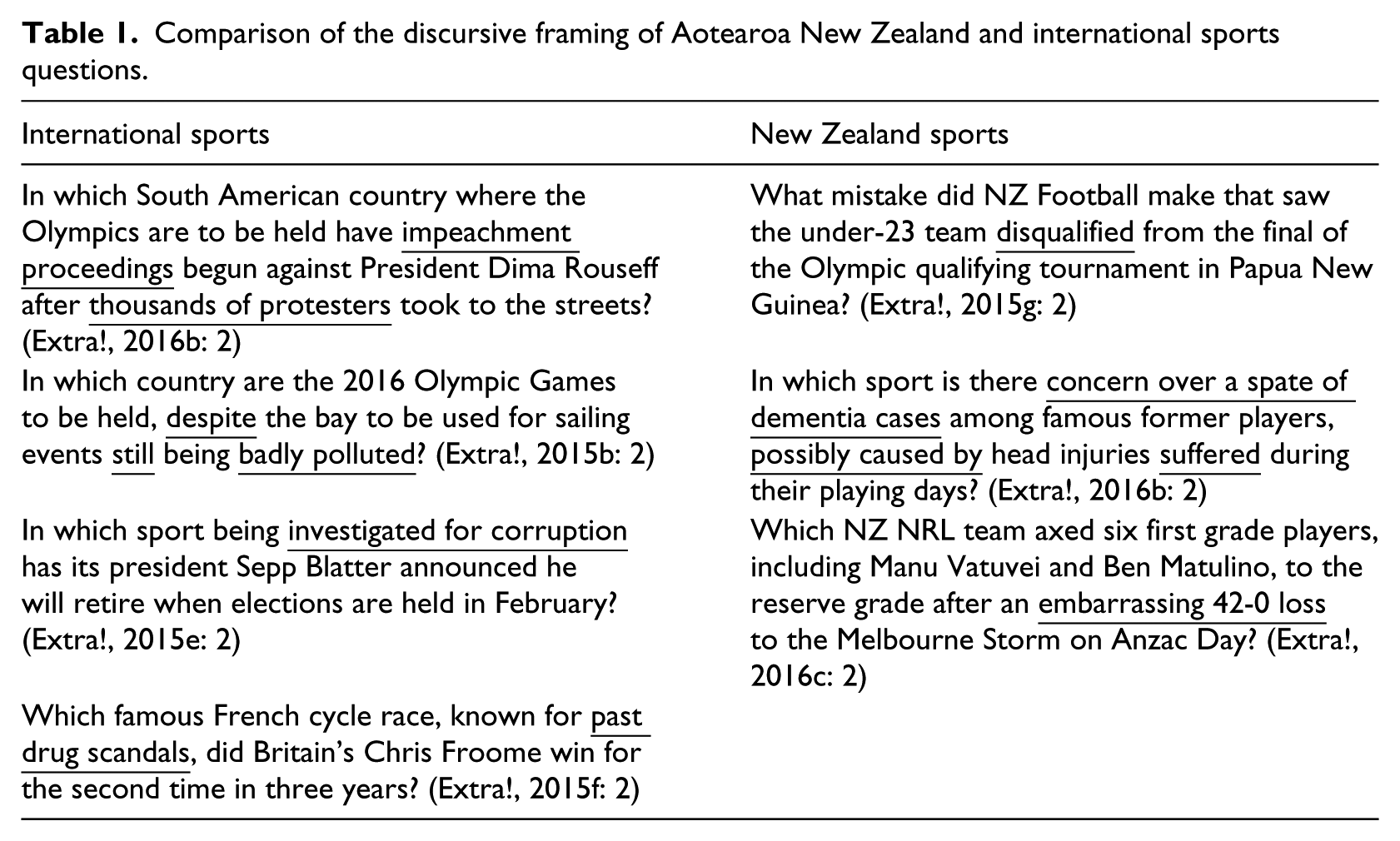
The kinds of facts about sports in Aotearoa New Zealand in comparison to the world mobilised very different discourses, as the examples in Table 1 show. Underlined text in the international sports examples indicate where discourses of risk and crisis are being used to frame ‘facts’ about sports in the world (other than New Zealand). In the New Zealand questions, underlined text indicates discourses of concern over an individual’s welfare and team underperformance; however, these examples were rare.
Comparison of the discursive framing of Aotearoa New Zealand and international sports questions.
We think that the quality of the news content matters if children’s news publications are to support the kinds of aspirations for democratic participation held in curriculum policy in Aotearoa New Zealand. Our analyses of these two forms of children’s news raises questions about what teachers might be able to do with them to support the engagement of children in curriculum experiences that recognise their perspectives and knowledge about the kinds of socio-historical–political issues introduced earlier. We found the texts we analysed reported a thin news narrative, preoccupied with sport, and with narrow or limited engagement with other major issues. We turn now to a discussion of the potential implications of this staging of children’s news for the curriculum in Aotearoa New Zealand schools.
Conclusions and implications
In our estimation, the preoccupation with sports and heroism within the children’s news media texts, and some of the specific messages interpretable from these, mirrors messages in sports media coverage aimed at the general public (Falcous, 2007; Falcous and West, 2009; John and Jackson, 2011). Moreover, this preoccupation reinforces national imaginings of we Kiwis as egalitarian and inclusive (Kane, 2010) and of Aotearoa New Zealand as a safer and less corrupt nation in which to live and grow up in comparison to other nations. Sport is construed as relevant to us all – something we should not only know about but be able to recall facts about – a unifying thread within our social, cultural and political milieu. In our data children are observed readily urging others to partake of the same, even though, as described earlier, many have more pressing social, economic and cultural issues to live with and address.
We suggest that the abundance of sports news reported and expected to be remembered shifts attention away from other newsworthy reporting. It serves to protect the veneer of the iconic Kiwi childhood and of Aotearoa New Zealand as that magical land of milk and honey, despite the fact we are demonstrably not immune to the issues of extremism, political instability, war and conflict being raised around the world. The protection of this veneer is detrimental to learners’ sense of wellbeing when they are confronted with traumatic local and global events. It also works against news texts’ potential utility for actualising aspirations within the Te Whāriki, NZC and Te Marau. By placing so much emphasis on constructions of the iconic adventure-loving, physically capable and fit Kiwi kid described by Burrows (2010) and the reproduction of a particular Aotearoa New Zealand subjectivity to which others should aspire, teachers’ capacity to use these news texts to recognise and respond to those not represented in this imaginary is impeded, and those missing continue to be underserved. Rather than avoiding the very real issues we face, we want teachers to be able to work with children and the news to foster meaningful understanding and democratic participation.
Our critical literacy and discourse analyses of the children’s news media texts in this article serve as a timely reminder that the texts we produce are never neutral; some are potentially more useful than others in facilitating curriculum aspirations. A critical reading of these can lead to deeper understandings and a more relevant and local curriculum that supports children’s participation in democratic processes, and recognises their awareness, activism and agency in our world.
Footnotes
Authors’ note
Nicola Surtees is affiliated with School of Educational Studies and Leadership, College of Education, Health and Human Development, University of Canterbury, New Zealand.
Funding
The authors received no financial support for the research, authorship and/or publication of this article.