




Abstract
Working on team projects is a common feature in higher education as a way to foster team learning and collaboration. For a team to work well towards achieving project objectives, it is important that there is effective team communication. Conventionally, face-to-face interactions allow students to interact with each other in multiple communication channels, simultaneously sending and receiving verbal and nonverbal messages in real time. Today, modern mobile technology offers students a variety of alternative digital communication media for collaboration. Unlike a full-channel communication medium such as the face-to-face interaction, a digital communication medium like instant messaging does not normally transmit nonverbal cues. As a result, to compensate for insufficient nonverbal cues, users of instant messaging services have to put more effort and time into understanding each other. If more effort and time is required to understand each other better, then why is it that today’s students prefer instant messaging to face-to-face interactions for collaborative project work? To answer this question, this study conducted a questionnaire survey to collect responses from university students who have been involved in team projects. This study analysed students’ copresence (a second-order formative construct consisting of two first-order constructs: self-copresence and partner-copresence) and its relationships with media satisfaction and communication effectiveness. It investigated whether these relationships differed between the students who used instant messaging and those who used face-to-face interactions. In addition, this study also examined whether media satisfaction played a mediating role between copresence and communication effectiveness. The findings of this study could help explain how different communication media can facilitate teamwork in collaborative learning environments.
Keywords
Introduction
The ability to work well with others in the workplace is often emphasised by employers as a vital skill (Cavanagh et al., 2015) and companies today are looking for people who have high social intelligence and are able to interact well with others (Jackson and Chapman, 2012). Recognising that teamwork skills are essential for graduate employability and that these skills can be better learnt through experiential learning (Sancho-Thomas et al., 2009), universities have been utilising team-based assignments to help students develop these skills (Fidalgo-Blanco et al., 2015). In fact, there is now research to show that university graduates who have benefited from team-based assignments often find themselves more employable and are more likely to find a job (Lindsjørna et al., 2016; Suleman, 2016; Teijeiro et al., 2013).
The widespread adoption of mobile devices has resulted in an ever-increasing mobile penetration rate and data usage (Infocomm Media Development Authority, 2019a, 2019b). Also commonly referred to as computer-mediated media, digital communication media has transformed how people communicate in this technology era (Bakardjieva, 2016). The use of digital communication media for everyday activities and interpersonal communication has become the norm among university students (Walther, 2011). Besides direct face-to-face discussions, today’s university students can choose to communicate using a variety of digital communication media such as instant messaging, video chat, email, and so on.
The successful completion of team-based assignments requires effective communication among the team members. At a local university (that the authors are familiar with), it is observed that students tend to use instant messaging more frequently than face-to-face communication when collaborating on assignments. Instant messaging applications such as WhatsApp, Skype, WeChat, and so on are popular among the students. These applications meet the needs of students for instant gratification and are generally multifunctional, allowing students to not only send texts and emoji, but also to do video chats or voice chats (Vrocharidou and Efthymiou, 2012).
As the students seem to be familiar with instant messaging, and use it in their social activities, we reason that it is quite possible that they also find instant messaging convenient and easy to use for academic work as well. According to Nowak et al.’s (2005, 2009) efficiency framework, people tend to use communication media that they consider most effective towards achieving their objectives, that require less cognitive and behavioural effort, and less time. A full-channel communication medium like face-to-face interaction does just that, transmitting verbal and nonverbal messages in multiple channels simultaneously, e.g. sight, hearing, touch, and so on (Tubbs and Moss, 1981). However, unlike face-to-face interactions, text-based communication media lack the capability to transmit nonverbal cues. As a result, people have to spend more effort to understand each other better (Watt et al., 2002).
So why would students choose instant messaging as a medium of communication for team collaboration? Does instant messaging really help students to achieve greater communication effectiveness, or is it just a perception myth? In an attempt to provide answers to these questions, this study investigated why students chose to use instant messaging or face-to-face interactions as their preferred communication medium for team collaboration purposes. Using Nowak et al.’s (2005, 2009) efficiency framework, this study attempted to examine whether there was a relationship between copresence (modelled as a second-order formative construct which consists of two sub-constructs: self-copresence and partner-copresence) and media satisfaction or communication effectiveness. The study further investigated whether there was a mediating effect of media satisfaction between copresence and communication effectiveness. It also examined whether these relationships differed between the students who used instant messaging and the students who used face-to-face interactions for team collaboration.
The following sections provide the research background on communication effectiveness, communication media, the concept of presence in computer-mediated communication, and Nowak et al.’s (2005, 2009) efficiency framework; explain the research model; describe the research method; present the data analyses; and conclude with a discussion of the research limitations and future research directions.
Research background
Communication effectiveness
When one person interacts with another person, for work or social discussion, the interpersonal communication involves basic elements such as a sender and a receiver, the message, a channel, noise, and feedback. Both persons can send and receive messages, verbal or nonverbal, through a channel using a medium of communication such as face-to-face, phone call, email, text messaging, and so on. During the communication, there may be noise either disrupting the sending or receiving of the message, or feedback from the receiver (Gamble and Gamble, 2013).
Three generic models of communication, i.e. linear, interaction, and transactional models, illustrate how a sender and a receiver interact. The linear model depicts a one-way message from the sender to the receiver. The interaction model depicts the sender and receiver taking turns to send and receive messages, e.g. replying to a text message from a friend. The transactional model depicts both sender and receiver sending and receiving messages simultaneously, e.g. having a face-to-face discussion (Narula, 2006). In interpersonal communication, there are two types of messages: verbal and nonverbal. Verbal messages consist of words or symbols and are discrete. Nonverbal messages are continuous and are more difficult to control (Pearson and Spitzberg, 1990).
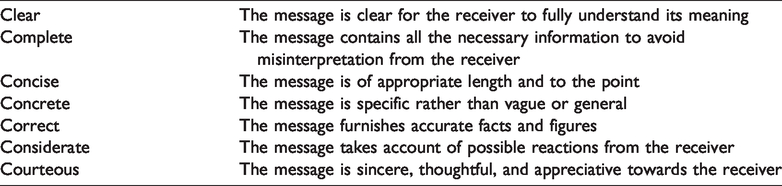
Irrespective of the medium of communication, for communication to be effective people should observe seven Cs (Table 1). The seven Cs prescribe that messages must be clear, complete, concise, concrete, correct, considerate, and courteous (Verma, 2014).
Seven Cs of effective communication.
Effective communication is an essential part of successful teamwork (Sancho-Thomas et al., 2009) and results in a high level of team cohesiveness and trust among team members (Ku et al., 2013). For a team to work well, and be effective in their communication, the team members should communicate frequently and understand each other well (Lindsjørna et al., 2016). In general, practitioners agree that effective communication requires team members to listen to each other to ensure that all members understand in the same way, i.e. there is a shared or common context for understanding messages within the communication. Despite these efforts, it is probable that there may be ambiguity and misunderstanding, especially in computer-mediated communication, when the senders and receivers come from different cultural backgrounds (Xie et al., 2009).
Communication media
Communication takes place via a communication medium. The communication medium provides the channels that deliver the message between the sender and the receiver (Chen et al., 2008). Communication media can differ in the richness of information transmitted. The face-to-face communication medium is the richest as it allows simultaneous exchange of verbal and nonverbal messages as well as real-time feedback (Kock, 1998; Richardson and Smith, 2007; Suh, 1999). The study of communication has long championed the idea that the best communication occurs over channels that are rich (Behring and Xu, 2014; Okdie et al., 2011), providing support for face-to-face communication. Today however, apart from face-to-face communication, digital communication media such as email, video chat, and instant messaging provide alternative ways for people to interact and communicate.
Communication media can also be categorised based on the extent to which each facilitates synchronous communication and transmits nonverbal messages. Face-to-face interaction is the best as it works fully for both aspects, whereas communication media that only facilitate asynchronous communication, like email, are at the opposite end – low on both synchronisation and nonverbal messages (Baltes et al., 2002). A rich communication medium, like face-to-face interaction, transmits both verbal and nonverbal messages, while allowing real-time interaction. A lean communication medium like email does not transmit nonverbal messages and is asynchronous. However, a rich communication medium is not necessarily better than a lean one. The choice of rich or lean communication medium depends on the type of information and the purpose of the communication (Chen et al., 2008). For example, Watt et al. (2002) noted that email was popular because of its convenience but that face-to-face provided the richest information for moderate to complex tasks.
Media richness theory posits that two factors, i.e. media richness and message equivocality, influence how people decide which communication medium to use. Message equivocality is concerned with the ambiguity of the communication situation. If the communication situation is ambiguous, richer communication media are more appropriate (Richardson and Smith, 2007), whereas lean communication media are more appropriate for structured communication situations (Suh, 1999). Communication situations can be both uncertain (because of lack of information) and equivocal (because of lack of knowledge). To reduce uncertainty, the communication medium has to be able to transmit a large amount of information; to reduce equivocality, the medium has to present sufficient cues to avoid ambiguity (Kock, 1998). In a way, a lean communication medium is appropriate to reduce uncertainty while a rich medium reduces equivocality (Chen et al., 2008).
However, media richness theory cannot fully explain the preference for certain communication media. People might still use a lean communication medium in a complex problem-solving situation (Kock, 1998). For example, in an ambiguous communication situation, although email might not be the richest communication medium, people might still choose to use email despite its limitations in resolving message equivocality (Richardson and Smith, 2007). In a study of five groups working on process improvement projects, although they had the choice of face-to-face interactions or phone calls, Kock (1998) reported that all of the groups chose to use email conferencing as the main communication medium because it was easier for them to interact at a convenient time. Aware of the limitations of using a lean communication medium, the group members adapted to the medium and still produced good task outcomes.
Various other communication theories have also attempted to explain the use of communication media. For example, social influence theory posits that the members or norms of the community can influence people’s perception of the richness of a communication medium (Richardson and Smith, 2007). Social information processing theory suggests that the social environment as well as the characteristics and constraints of the work environment influence the choice of media (Suh, 1999). In addition, the communication medium itself can convey certain messages, e.g. formality, respect, and so on (Richardson and Smith, 2007). This might explain why students prefer to use email (because of its perceived formal nature) for communicating with academic staff (Vrocharidou and Efthymiou, 2012).
Concept of presence in computer-mediated communication
Lee (2004) advocates that the concept of presence in computer-mediated communication characterises ‘a psychological state in which virtual objects (para-authentic or artificial) are experienced as actual objects in either sensory or nonsensory ways’ (37). Past studies have used different terms to explain this concept. Examples of these terms include self-presence and copresence (Lambropoulos et al., 2012); physical presence, social presence, and self-presence (Lee, 2004); copresence, social presence, and spatial presence (Skarbez et al., 2018); spatial presence and copresence (Rodríguez-Ardura and Meseguer-Artola, 2016); and co-location and copresence (Zhao and Elesh, 2008).
Amid the large number of terms, two terms are frequently discussed in past studies, i.e. social presence and copresence. Social presence in general refers to the feeling of being with others in a virtual environment (Lee, 2004; Skarbez et al., 2018). Croes et al. (2016) suggest that stronger social presence helps in improving interpersonal attraction. Nevertheless, Nowak et al. (2009) contend that the conventional measures of social presence are in fact about media satisfaction but not about the relations with the partners. Hence, social presence in the efficiency framework is operationalised to measure media satisfaction instead.
On the other hand, copresence in general refers to the feeling of interacting with others in a virtual environment (Nowak et al., 2009; Rodríguez-Ardura and Meseguer-Artola, 2016; Skarbez et al., 2018; Xu et al., 2011). Lee (2004) and Nowak et al. (2009) emphasise that for copresence to exist, it is necessary that one mutually engages oneself and the partners in communication. Zhao and Elesh (2008) concur with this idea that in copresence, the interaction and engagement between one and the communication partners is a two-way social relationship. Campos-Castillo (2012) supposes that the levels of copresence one experiences can vary depending on the characteristics of the virtual environment as well as the communication interactions between one and the partners. Thus, users of asynchronous computer-mediated communication media may observe lower levels of copresence as compared with synchronous media (Campos-Castillo and Hitlin, 2013).
The efficiency framework proposes that copresence can be further examined as the perception of one’s own involvement in the interactions (i.e. self-presence) and the perception of one’s communication partners’ involvement (i.e. partner-copresence) (Nowak et al., 2005, 2009; Watt et al., 2002). Xu et al. (2011) support that partner interactions are a key to enhancing one’s perception of copresence in computer-mediated communication, and pinpoint three antecedents of copresence, i.e. prior use of the medium, perceived critical mass, and commitment in the relationship.
Nowak, Watt, and Walther’s efficiency framework
Nowak et al. (2009) explain that communication media are different in terms of features and characteristics. These different features and characteristics affect the communication medium’s efficiency, how users interact in a communication situation, as well as users’ satisfaction with the medium. High-cue communication media require less communicative effort and thus, are more efficient in facilitating communication as compared to low-cue communication media. With low-cue communication media, users not only require more communicative effort to process information, but they also need to learn to adapt their communication behaviours to these media accordingly. The extra effort required may result in less satisfaction with low-cue communication media but may help enhance the levels of copresence (i.e. the users perceive that they and their partners have all contributed meaningfully to the group) and group effectiveness. Additionally, with the extra effort and common interaction goals, the users are more likely to achieve successful interaction outcomes. It is interesting to note that users’ satisfaction with their preferred communication medium does not necessarily result in a successful interaction outcome (Walther, 2011).
The efficiency framework, proposed by Nowak et al. (2009), depicts the relationships among the constructs copresence (consisting of self-copresence and partner-copresence), perceived group effectiveness, media satisfaction, and outcome success. When interacting with others, self-copresence is how someone perceives his or her own involvement in the interaction, whereas partner-copresence is how someone perceives others’ involvement in the interaction (Nowak, 2001; Nowak et al., 2005; Watt et al., 2002). Media satisfaction is how one perceives the usefulness of the communication media in facilitating satisfactory interaction. The closer the interaction experience is to that of face-to-face communication, the more satisfactory one feels (Nowak et al., 2009).
The efficiency framework suggests that people will make extra effort in adapting to a chosen communication medium to compensate for its lack of communication cues. Due to the extra effort, people might perceive a higher level of self-copresence and a higher level of involvement from others during the interaction. To test their hypotheses, Nowak et al. (2009) conducted a study in which university students used face-to-face interactions or one of four computer-mediated media when working in groups: synchronous video conference (synchronous high-cue), synchronous web chat (synchronous low-cue), text-based conference (asynchronous low-cue), and asynchronous audio-visual collaboration (asynchronous high-cue). Their findings showed that communication media with fewer communication cues contributed to higher levels of partner-copresence than media with more cues (but they did not find the same support for self-copresence). Synchronous communication media contributed to higher levels of self and partner-copresence than asynchronous media. Communication media with more communication cues or that were synchronous contributed to greater media satisfaction than media with fewer cues or asynchronous. Media satisfaction was also higher with face-to-face than computer-mediated media (Nowak et al., 2009).
Research model
Past studies have used various theories to examine why people choose to use certain communication media in different types of situations. Examples of these theories include uses and gratifications theory in Ku et al.’s (2013) study of gratifications from social networking sites, instant messaging and email; media richness theory in Kahai and Cooper’s (2003) study of the effects of cue multiplicity and feedback immediacy on decision quality in face-to-face meeting, electronic meeting, electronic conferencing and electronic mail; social information processing theory in Wilson et al.’s (2006) study of trust and cooperation development in computer-mediated and face-to-face teams; social network theory and media synchronicity theory in Ou et al.’s (2013) study of the effects of instant messenger, email, and knowledge sharing forum on communication facilitation and work performance; theory of electronic propinquity in Walther and Bazarova’s (2008) study of the effects of media characteristics on user propinquity and satisfaction in face-to-face, desktop video, audio, and text-based chat communication; time, interaction, and performance theory in Shin and Song’s (2011) study of the relationships among communication time, social cohesion, task cohesion and task performance in groups using both face-to-face and social networking sites in their communication; and functional theory in Li’s (2007) study of the differences in the decision-making process and performance between face-to-face and text-based chatting groups.
Despite the use of various theories in past studies, there has not been an attempt to investigate the extent to which copresence is relevant and applicable to explaining why students consider instant messaging or face-to-face communication more effective for team communication when collaborating on team-based projects. Nowak et al.’s (2009) efficiency framework was deemed to be suitable in providing a strong theoretical basis for the research model of this study. With reference to the efficiency framework, this study proposed a research model (Figure 1) to examine the effect of copresence on media satisfaction and communication effectiveness, in a situation where university students used either instant messaging or face-to-face communication for team collaboration purposes.
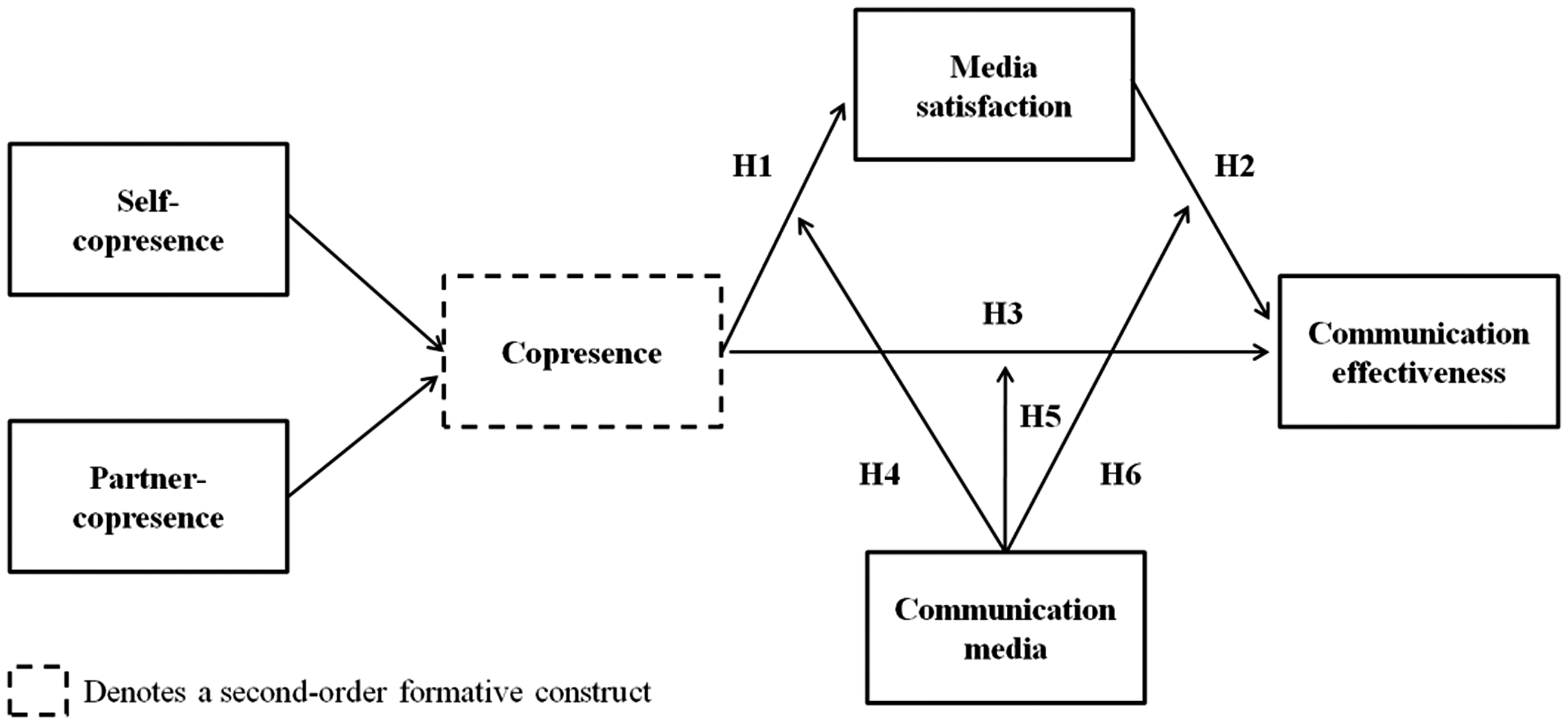
Research model.
The research model followed the partial least squares structural equation modelling (PLS SEM) approach. A PLS SEM model consists of a measurement model (or outer model) and a structural model (or inner model). While the measurement model depicts the relationship between each construct and its indicators, the structural model depicts the causal relationships among the constructs (Gefen et al., 2000; Hair et al., 2014). The direction of the indicators to a construct in the measurement model may be reflective or formative (Henseler et al., 2009). The indicators of a reflective construct point outwards from the construct, whereas the indicators of a formative construct point inwards towards the construct. In the case of a formative construct, each indicator denotes a specific conceptual aspect of the construct (Jarvis et al., 2003).
When a construct is multidimensional, it can be conceptualised at a higher level of abstraction (e.g. second-order, third-order) (Diamantopoulos et al., 2008; Petter et al., 2007). Jarvis et al. (2003) discuss that there are four possible second-order models, i.e. type I (reflective first-order, reflective second-order), type II (reflective first-order, formative second-order), type III (formative first-order, reflective second-order), and type IV (formative first-order, formative second-order).
In this study, copresence was conceptualised as a second-order formative construct consisting of two first-order reflective constructs: self-copresence and partner-copresence (MacKenzie et al., 2005). Supposing that students who were satisfied with their use of a communication medium would perceive communication effectiveness to be better, it was hypothesised that a higher level of copresence should contribute to a higher level of media satisfaction (H1), a higher level of media satisfaction would eventually result in a higher level of communication effectiveness (H2), and a higher level of copresence should also contribute to a higher level of communication effectiveness (H3). Assuming that there might be an underlying difference in terms of perceptions between the respondents who used instant messaging or face-to-face communication as their most frequently used communication medium, it was hypothesised that different communication media would have an effect on the relationships between copresence, media satisfaction, and communication effectiveness (H4, H5, and H6).
Research method
Instrument development
To operationalise the constructs, some scale items were adapted from Nowak et al. (2009) and some new ones were developed. As a second-order formative construct, copresence consisted of two first-order reflective constructs, i.e. self-copresence and partner-copresence (each had a six-item reflective scale). Both media satisfaction and communication effectiveness were first-order reflective constructs. Each was operationalised using a six-item scale and seven-item scale (after the seven Cs of effective communication), respectively.
The questionnaire consisted of three sections. Section A asked three questions about the frequency of use, the reasons for choosing, and the challenges of using the preferred medium of communication (i.e. instant messaging or face-to-face) for team collaboration purposes. If the respondents used instant messaging, an additional question asked them the application they used, e.g. WhatsApp, WeChat, Viber, Skype, and so on. Section B asked four questions relating to the constructs of self-copresence, partner-copresence, media satisfaction, and communication effectiveness. All items were measured using a five-point Likert-type scale, 5 being ‘strongly agree’ and 1 being ‘strongly disagree’. Section C asked two questions related to the projects the respondents worked on.
Data collection
Full-time students at a university, who were working in teams on coursework assessment projects in various subjects, were invited to complete an online questionnaire. The teams worked on projects to produce a project management plan, a business research report, or a case study analysis report. For the project management plan, each team elected a project leader and worked together for about nine weeks. For the other projects, the teams worked together for about six to eight weeks. At the end of assessment period, all teams submitted their plans or reports for grading purposes.
One hundred and two students provided the responses. Of these 102 responses, 12 did not meet Mahalanobis distance criterion (Tabachnick and Fidell, 2007) and were discarded as outliers. Thus, in total, 90 responses were analysed.
Respondents’ demographics
Of the 90 respondents, 55 respondents (61.1%) chose instant messaging as their most frequently used communication medium. Forty-five of them used the application WhatsApp (81.8%), eight WeChat (14.5%), and the remaining two Line and Facebook Messenger (3.6%). The respondents reported that they used instant messaging for team communication interactions as infrequently as 1–5 times in a week (21.8%), 6–10 times (25.5%), 11–15 times (21.8%), 16–20 times (7.3%), to more than 20 times (23.6%). On the other hand, 35 respondents (38.9%) indicated that face-to-face communication was their most frequently used communication medium. The majority of respondents reported that they met face-to-face for team communication interactions, in order of frequency, 3–4 times in a week (45.7%), followed by 1–2 times (37.1%), 5–6 times (11.4%), and more than 6 times (5.8%).
The characteristics of the communication medium the teams used had, in fact, an influence on the number of times the teams interacted in a week. The teams that used face-to-face communication would more likely interact in just one or a few weekly face-to-face meetings in which the team members met in a physical location either on or off campus at a specific time. In comparison, the teams that used instant messaging might interact online multiple times even in the same day and at any time, even though the team members were in different locations. Hence, the number of team communication interactions differed considerably between the face-to-face teams and the instant messaging teams.
A high percentage of the teams had four members (36.7%), followed by five members (30%), three members (21.1%), and two members (11.1%). (One team did not indicate the number of team members.) The teams mainly worked on three different types of projects, i.e. business research (26.6%), case analysis (36.7%), and project management plan (36.7%).
A cross-tabulation analysis was performed to examine if there were any statistically significant differences between the face-to-face teams and the instant messaging teams in terms of respondents’ demographics on their choice of communication media. Results showed that there were no statistically significant differences.
Data analysis and results
Reasons and challenges
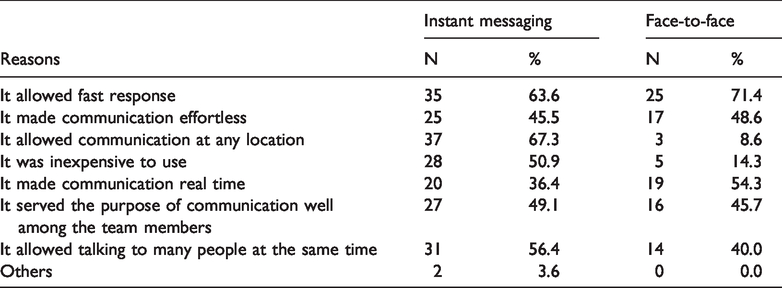
Table 2 shows a summary of the reasons the respondents chose to use instant messaging or face-to-face communication for team collaboration purposes. The top reason chosen by 67.3% of the respondents for using instant messaging was, ‘It allowed communication at any location’. The second reason, chosen by 63.6% of the respondents was, ‘It allowed fast response’, and the third reason, chosen by 56.4% of the respondents was, ‘It allowed talking to many people at the same time’. The top three reasons for face-to-face communication were, ‘It allowed fast response’ (71.4% of the respondents), ‘It made communication real time’ (54.3% of the respondents), and ‘It made communication effortless’ (48.6% of the respondents).
Reasons for using instant messaging and face-to-face communication for team collaboration purposes.
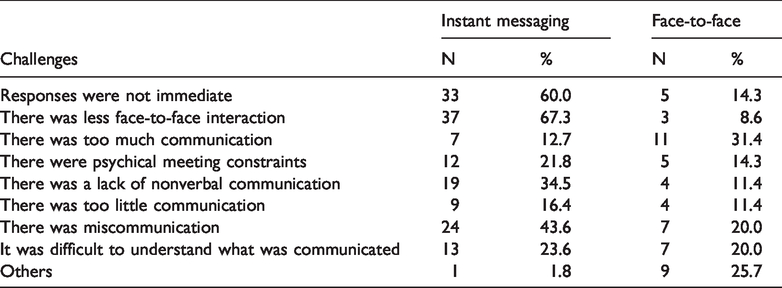
In addition to the reasons for choosing a particular medium, respondents also reported the challenges of using their chosen communication medium. Table 3 shows a summary of the challenges the respondents faced when using instant messaging or face-to-face communication for team collaboration purposes. The top challenges of using instant messaging were, ‘There was less face-to-face interaction’ (67.3% of the respondents) and ‘Responses were not immediate’ (60% of the respondents). Interestingly, only 43.6% of the respondents chose ‘There was miscommunication’ as a challenge of using instant messaging. Respondents did not report any significant challenges in using face-to-face as a communication medium.
Challenges in using instant messaging and face-to-face communication for team collaboration purposes.
Confirmatory factor analysis
This study followed the PLS SEM approach and used the SmartPLS software to perform a confirmatory factor analysis. There are two approaches to performing SEM, i.e. covariance-based SEM (using software like SPSS Amos) and variance-based or component-based PLS SEM (using software like SmartPLS) (Hair et al., 2014; Petter et al., 2007; Urbach and Ahlemann, 2010). The main use of covariance-based SEM is to compare the overall goodness-of-fit parameters of alternative theoretical models for theory testing, while that of PLS SEM is to explain the variance of endogenous constructs for theory development (Hair et al., 2014; Henseler et al., 2009; Urbach and Ahlemann, 2010).
As the objective of this study was more for prediction than parameter estimation (Urbach and Ahlemann, 2010), the PLS SEM approach was appropriate for the study. In addition to being a suitable approach for predictive analysis, the PLS SEM approach also provides support for the research model which consisted of both formative and reflective constructs, as well as the rather small sample size of the study (Henseler et al., 2009; Urbach and Ahlemann, 2010). Moreover, the study needed to conduct a multi-group analysis (MGA) to test the moderating effect of communication medium. SmartPLS provides the appropriate analysis method for such an analysis (Henseler et al., 2009).
Following the two-step approach recommended by Gerbing and Anderson (1988), the measurement model was first assessed, followed by the structural model. The measurement model was assessed for internal consistency reliability, convergent validity, and discriminant validity. The structural model was assessed for significance of path coefficients and R2 (Hair et al., 2014). To assess the higher-order reflective-formative model (i.e. the two first-order reflective constructs form the second-order formative construct), this study followed the suggestion by Hair et al. (2014). First, latent variable scores of the two first-order reflective constructs were saved and used as the indicators of the second-order formative construct.
Measurement model
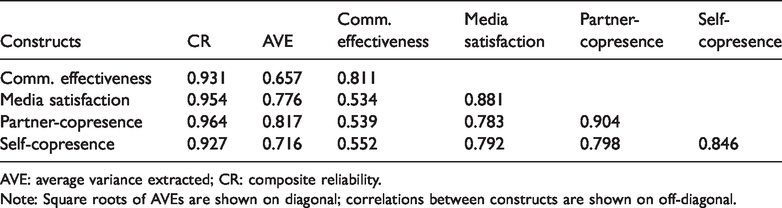
Internal consistency reliability – For satisfactory internal consistency reliability, composite reliability (CR) of individual reflective constructs should be above 0.7 (Fornell and Larcker, 1981; Gefen and Straub, 2005). Table 4 shows a summary of the CRs, average variances extracted (AVEs), and correlations of the first-order reflective constructs. It was evident that these constructs showed good internal consistency reliability (CR > 0.7).
CRs, AVEs, and correlations of first-order reflective constructs.
AVE: average variance extracted; CR: composite reliability.
Note: Square roots of AVEs are shown on diagonal; correlations between constructs are shown on off-diagonal.
Convergent validity – For satisfactory convergent validity, AVEs of individual constructs should be above 0.5 and loading of individual indicators should be above 0.7 to be statistically significant (Fornell and Larcker, 1981; Gefen and Straub, 2005). Table 4 shows that the AVEs of the first-order reflective constructs were above 0.5. Table 5 provides evidence of high indicator reliability, as the loadings of individual constructs were above 0.7 (and were statistically significant at 0.000). The loading of one indicator, ‘I participated during our team interactions’, of the self-copresence construct was below 0.7 (0.671) and was removed from further analysis.
Factor loadings and cross loadings of first-order reflective constructs.
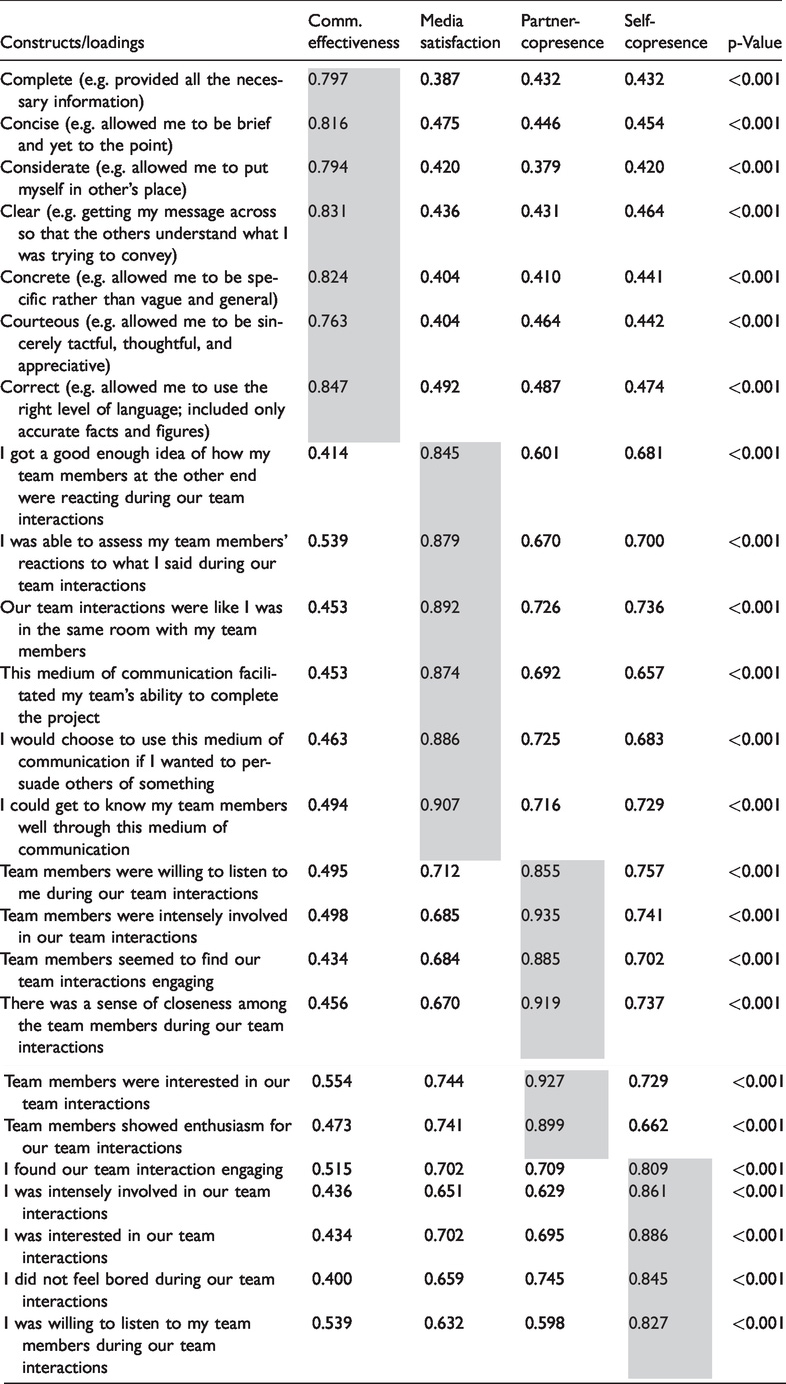
Discriminant validity – For satisfactory discriminant validity, indicators should load above 0.7 on their intended construct and meet the Fornell–Larcker criterion (i.e. square root of the AVEs of each construct should be larger than its correlations with any other construct) (Fornell and Larcker, 1981; Gefen and Straub, 2005). Table 5 shows the cross loadings of the indicators across the constructs and it is evident that the indicators loaded above 0.7 on their intended constructs. Table 4 shows that all the constructs met the Fornell–Larcker criterion.
Second-order formative construct – Using the latent variable scores of the two first-order reflective constructs (self-copresence and partner-copresence) as the indicators of the second-order formative construct (copresence), the outer weights of the indicators were assessed. The weight of the indicators indicated their relative contribution to the formative construct. The weight of partner-copresence was 0.489 (p = 0.001) and that of self-copresence was 0.566 (p = 0.000) and both were statistically significant at 0.05 level. Thus, self-copresence contributed more, relatively, than partner-copresence to copresence. To assess if there were collinearity issues, the variance inflation factor (VIF) and tolerance level of each indicator were calculated. The VIF of both indicators was below 5.0 (2.758 for both) and the tolerance value was above 0.2 (0.363 for both). Thus, collinearity problems did not exist (Hair et al., 2014).
Structural model
A bootstrapping procedure of 5000 sub-samples was used to calculate the t-statistics of the path coefficients between the constructs (Gefen et al., 2000). Figure 2 shows that copresence had a statistically significant relationship with media satisfaction (β = 0.831; p = 0.000) and explained about 69% of its variance (R2=0.690). Media satisfaction did not have a statistically significant relationship with communication effectiveness (β = 0.180; p = 0.304). Copresence had a statistically significant relationship with communication effectiveness (β = 0.425; p = 0.000).
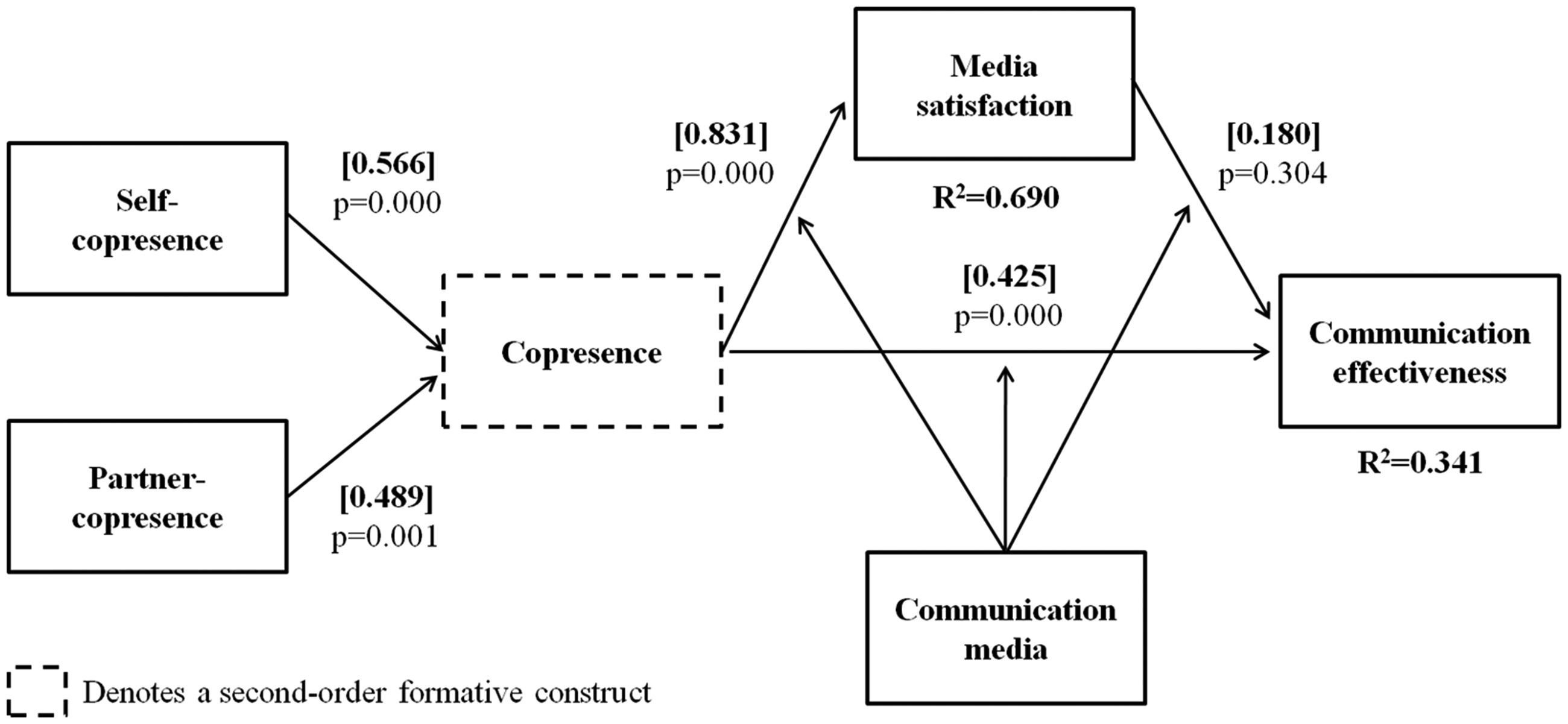
Structural model.
Media satisfaction did not have a mediating effect between copresence and communication effectiveness. The direct effect between copresence and communication effectiveness was significant (β = 0.575; p = 0.000), but when media satisfaction was included, the indirect effect between copresence and communication effectiveness was not significant (β = 0.150; p = 0.309). When the indirect effect is not significant, there is no mediation (Hair et al., 2014).
MGA
A PLS-MGA was used to test if communication medium had a moderating effect on the relationships between copresence and media satisfaction, media satisfaction and communication effectiveness, and copresence and communication effectiveness. A comparison was made to see if the path coefficients differed significantly statistically between the communication media (i.e. instant messaging and face-to-face) (Hair et al., 2014). The results of the analysis showed that all path coefficients did not differ significantly statistically (copresence to communication effectiveness, p = 0.587; copresence to media satisfaction, p = 0.327; media satisfaction to communication effectiveness, p = 0.447). Thus, communication medium does not moderate the relationships between copresence and media satisfaction, media satisfaction and communication effectiveness, and copresence and communication effectiveness.
Discussion and conclusions
The result shows that copresence had a positive significant relationship with media satisfaction, supporting hypothesis H1 that copresence would contribute positively to media satisfaction. Considering that, the level of copresence indicates the extent to which the members perceive that they and their partners have all contributed meaningfully to the team; if there is high copresence the members are more likely to be satisfied with the choice of medium used for communication. This result indicates that, whether using face-to-face communication or instant messaging, the team members perceived that the chosen communication medium had allowed for adequate interactions. This may also be a reason why teams choose to use a particular communication medium; when team members use the medium and perceive that it allows for adequate interactions, they may be inclined to use it again.
If there is high copresence, and team members are satisfied with the communication medium, the satisfaction with the medium could result in a high level of communication effectiveness. However, the result shows that media satisfaction did not have a statistically significant relationship with communication effectiveness. Hence, there is no support for hypothesis H2. Additionally, media satisfaction did not have a mediating effect between copresence and communication effectiveness. This result indicates that in the case of either face-to-face communication or instant messaging, it is possible that the seven Cs of effective communication (Verma, 2014) were not met despite the team’s satisfaction with the communication medium.
This rejection of hypothesis H2 also supports the observation that users’ satisfaction with their preference for a particular communication medium does not necessarily result in a successful interaction outcome (Walther, 2011). This may also suggest that the reason for choosing a particular medium is not related to whether that medium supports effective communication. It may well be that the choice is impacted by the team members’ need to be able to communicate with each other from any location. (This was the top reason reported by the participants in this study for choosing to use instant messaging.)
Copresence had a statistically significant relationship with communication effectiveness, supporting hypothesis H3 that a higher level of copresence would contribute to a higher level of communication effectiveness. Therefore, this relationship supports the argument that irrespective of the medium of communication, effective communication still occurs if messages are clear, complete, concise, concrete, correct, considerate, and courteous (Verma, 2014). This result may suggest that teams’ perception of communication effectiveness is based on copresence, i.e. self and members’ contribution to the team rather than the communication medium itself.
Further, the findings did not provide support for hypotheses H4, H5, and H6; communication medium does not moderate the relationships between copresence and media satisfaction; media satisfaction and communication effectiveness; and copresence and communication effectiveness. These findings are in line with the previous outcomes regarding the impact of the communication medium, which seems to indicate that the participants did not regard the communication medium as highly as was hypothesised.
Overall, the findings of this study reveal that satisfaction with the communication media did not have an impact on the effectiveness of communication. Furthermore, communication media did not have any significant moderating effect on the relationships among copresence, media satisfaction, and communication effectiveness. This may be an indication that the interpretation of prior research in today’s digital communication context needs careful consideration. While the idea that the best communication occurs over channels that are rich (Behring and Xu, 2014; Okdie et al., 2011) may still be relevant, its impact on the choice of communication media used for team collaboration may be of less consequence. Based on the findings of this study, it may be argued that today’s students appear to find using instant messaging as effective as face-to-face communication.
Prior research indicates that communication media that allow for synchronous communication and the transmission of nonverbal messages are better than media that are asynchronous and provide low transmission of nonverbal messages (Baltes et al., 2002). Besides, Chen et al. (2008) suppose that the choice between using a rich or a lean communication medium depends on the purpose of the communication and the type of information to be delivered. This implies that the types of project should matter in the choice of communication medium as well. However, the cross-tabulation analysis result suggested that the influence of project types on the choice of communication medium was negligible. This is quite understandable as the rich content of today’s instant messaging apps allows users to communicate an array of nonverbal messages using emoji and emoticons. These apps also allow pictures, verbal messages, and recorded videos to be transmitted as part of a text conversation. From this perspective, instant messaging may be more akin to face-to-face communication in the richness of the channel than previously recognised.
Considering the findings of this study, and all that has been discussed, it may be concluded that in today’s context, the choice of digital communication medium, and satisfaction with that medium, has less of an effect on the perception of communication effectiveness. Instead, copresence (more specifically self-presence and partner-presence) has a greater bearing on one’s perception of communication effectiveness and media satisfaction. This study may provide an explanation for why students choose instant messaging as a preferred medium of communication for team collaboration.
Research limitations
Three research limitations should be highlighted. First, this study did not consider the type of projects undertaken by the students, the size of the project teams, or the length of projects, all of which can also affect the choice of communication medium. It may be that when teams comprise a large number of students or part-time students, or when projects require extensive discussions or long project duration, the features and characteristics of communication media could have much stronger effects on how students choose to use certain communication media. Second, the study did not take into account the cultural backgrounds of the students. For example, in high context cultures, people prefer face-to-face contact, while in low context cultures, they may be more comfortable with the use of instant messaging. Third, this study could not isolate the effect of instant messaging or face-to-face communication. It is possible that the teams made use of other digital communication media to supplement what they reported in the survey as their most-often-used medium for team collaboration. In addition, teams that reported using instant messaging could have also used informal face-to-face discussions when they met during classes, leading to a confounding effect.
Future research directions
To further our understanding of the use of digital communication media for team collaboration purposes, four future research directions can be considered. First, examine and compare groups of synchronous, asynchronous, low-cue, and high-cue digital communication media, e.g. Facebook, video chat, voice call, and so on. Second, examine the use of digital communication media in business for team collaboration purposes, e.g. project management. Third, extend the research model to include a construct to measure project outcome, e.g. grade obtained for a team project, team performance on meeting different project criteria, and so on. Fourth, examine and compare the use of face-to-face and other digital communication media in different countries or cultural settings.
Footnotes
Declaration of Conflicting Interests
The author(s) declared no potential conflicts of interest with respect to the research, authorship, and/or publication of this article.
Funding
The author(s) received no financial support for the research, authorship, and/or publication of this article.
