



Abstract
Being literate has traditionally meant being able to read and write using the media of the day. In the 21st century, being literate requires additional skills such as competence with digital media creation. Until recently, those who could afford and use equipment and applications to produce digital media content were typically developers and technicians. With the development of prosumer electronics, in conjunction with the use of mobile devices and tablets, a shift has occurred in the accessibility of these tools, becoming more affordable for the general population. Video sharing services, social software and Web 2.0 applications have made it possible to host a digital media ecosystem on the Internet, and this has led to the proliferation of User-Generated Content. These technological advances have changed how we communicate, socialise and learn. Effective communication using digital media is underpinned by a set of design principles which most students are not likely to be aware. This paper built on two previous papers on the Digital Media Literacy Framework and the Taxonomy of Digital Media types for teaching and learning. It argues the importance of digital media principles to develop effective communication in the digital space. Students now require knowledge of these principles, in conjunction with conceptual and functional skills, for effective communication in the digital space.
Keywords
Introduction
Historically, the concept of being literate meant to be able to read and write, speak and listen (Ohler, 2009). It has been argued that conceptualisations of what it means to be a literate need to be extended to reflect the requirements of the digital age (Alexander et al., 2016; Bates, 2016). Digital media creation in the form of audio, graphics, digital story, animation, video, and blended media is a desirable skill for university graduates (Hall et al., 2013; Nix et al., 2012).
The emergence of digital media competency as a desirable skill set is due to several factors. First, the development of prosumer electronics or equipment that hovers between producer and consumer regarding functionality (Bruns, 2007). This equipment (e.g., audio recorders, video cameras, digital SLR/mirrorless cameras), in conjunction with inexpensive software and applications, made digital media production more accessible for inexperienced content creators. Second, the Internet became faster and more ubiquitous with the development and extension of mobile and Wi-Fi networks (Lehr and McKnight, 2003). Additionally, the development of powerful smartphones (since 2007) and tablets (since 2010) (Islam and Want, 2014) contributed to the growth of a digital media ecosystem on the Internet. Online content is increasing at an exponential rate, for example, 300 hours of video is uploaded to YouTube server every minute (Robertson, 2014). All these factors created an opportunity for the users to shift from consumers of digital media to producers (Couldry, 2012).
Several authors have discussed the concept of digital literacies (Bhatt, 2012; Cooper et al., 2013; Ting, 2015), and there is a wide agreement that there are many skills required to be a citizen of the digital age (Hobbs, 2017). The necessary skills encompass technical, audiovisual, behavioural, critical and social components. These skills are now required for all disciplines at different levels. Some careers required professional knowledge, for example, marketing professionals require web design skills, video editing and Search Engine Optimisation. Other careers require digital literacies as soft skills, for example, knowing how to find a YouTube video (Snelson, 2016), use LinkedIn for professional networking (Archambault and Grudin, 2012), or using Google Drive for everyday work (Hall et al., 2013).
This paper focuses on the importance of digital media principles. These principles tend to be taught in specific subject disciplines, namely, media, graphic design, visual design and film. In other disciplines, digital media principles have not been formally incorporated into the curricula. University-aged students are likely to be skilled in digital technology due to having been exposed to technology over the lifetime (Prensky, 2001). Current research suggests that is not necessarily the case (Alexander et al., 2016; Bennett et al., 2008). Importantly, it appears that demographics (gender, race, educational background and socioeconomic status) has a crucial role in digital literacy skills (Hargittai, 2010). Across many subject areas in university settings, there is a reluctance to implement learner-generated digital media (LGDM) as an assessment tool, as many educators are not comfortable creating and evaluating digital media content (Ohler, 2009; Watson and Pecchioni, 2011).
Learning to produce digital media that follows digital media principles is a highly desirable skill for graduates, regardless their discipline (Hobbs, 2017). Effective communication and engagement with the audience in online settings require knowledge and application of these principles in conjunction with critical literacy to be able to understand societal issues and how one’s media creations can have an impact on others (Parker, 2013). Digital media literacies, in conjunction with other literacies, could potentially make new graduates better digital citizens (Ilomäki et al., 2016).
This paper aims to discuss the importance of the digital media principles and its implications for learning and teaching.
The digital media explosion on the Internet
This section presents a discussion of technological innovations that dramatically affected the production of digital media artefacts. In the past, digital media creation was a privilege of capital-intensive industries that had access to the tools to create digital media content (Van Dijck, 2009). The cost of equipment and the skills required to produce digital media were a barrier limiting the adopting of digital media by the broad community. The term ‘prosumer’ emerged in the early 80s in the literature, referring to those users who hover between producer and consumer (Bruns, 2007). An example to illustrate this was the video industry where expensive cameras and video editing machines were required to produce the analogue video. It was not until the early 1980s that the first camcorders were available in the market using magnetic tapes (VCR) and users started to record homemade videos (Lardner, 1987). Users shared the content through lending videotapes to family and friends; no home editing was available at this stage. In the late 1990s, the tapes (VCR, Micro MV, Video8 and Mini DV) were replaced by memory cards, internal storage, and the video workflow became tapeless (Arman, 1999). The use of storage solutions facilitated the easy transfer of media from a camcorder to a computer via USB interface, and users could edit footage using video editing software immediately. Currently, users can create a video using their smartphones and tablets, camcorders that record 4K resolution (Ultra High Definition) (Van Wallendael et al., 2016), DSLR and mirrorless cameras, action cams and recently, 360° video cameras (Qian et al., 2016). This advance in technology has shifted ‘some’ users from consumers to producers of digital video, resulting in a rapid growth video uploads to video-sharing services such as YouTube (Robertson, 2014).
In the web design field, in the early 1990s, to be able to create a website required an understanding of HTML, JavaScript and CSS coding (Frain, 2012). It also required visual design skills to apply to the website interface. During that decade, creating a website was made from concept/prototype to implementation (Sfetcu, 2014). Now with web-hosting services such as Wix (Kennedy and Charles, 2009) and Weebly (Roe, 2011), which feature a drag-and-drop website builder, users can construct a website within an hour if the content is ready to go. These services have built-in professional templates, contact forms, blogs, interactive photo galleries and so on without the need of coding. The easy-to-use interface of these platforms has resulted in a proliferation of websites offering services and information, thus likely putting an end to the web developing market (Nouvel, 2015). Indeed, there has been a dramatic reduction in the salaries of web designers over the last decade. It can also be explained by supply and demand and more people having web design skills these days (Payscale, 2016).
In the field of motion graphics, to develop an animation took a long time as the designer needed to draw the characters or objects and their movement for at least 12 frames per second and use Flash Professional to bring the animation alive (Ulrich, 2012). Knowledge of ActionScript code was required to produce a smooth animation. This language is straightforward, but it took the time to learn and master the skills (Moock and Epstein, 2001). With the development of mobile devices and tablets, Flash became obsolete in 2012, replaced by HTML5 (Reyna, 2012), due to technical reasons related to touchscreen devices and battery draining. There are now services such as VideoScribe (DeCesare, 2014), PowToon (Graham, 2015) and GoAnimate (Stratton et al., 2014) that allow users to create professional looking animations in comparatively minimal time. This type of animation is called whiteboard animation or whiteboard video (Türkay, 2016).
Currently, there is a broad range of online tools (Web 2.0) to create digital media, some of which are free of charge (Edjudo, 2016). In conjunction with social software such as Facebook, Twitter, Vine, Instagram and video-sharing services, this has resulted in a growth of the digital media ecosystem on the Internet and the rise of User-Generated Media (UGM). Individuals use UGM in three ways: (i) consuming, (ii) participating and (iii) producing (Shao, 2009). There is an economic perspective of UGM; nothing is free on the Internet. Users who develop content, for example, a digital video on YouTube, do not need to pay any membership but contribute to the system by sharing their details at the time of account setup. Consequently, they are monitored for their preferences, and they may see relevant ads and buy items/services online. On the other hand, other users will engage with this video and data will be recorded based on their preferences. Notably, users have no power over data gathering and distribution. Their role as data provider is more important as their role of content creator (Van Dijck, 2009).
Research suggests that only 1% of Internet users create content, 10% interact with the content such as commenting or liking (digital curators) and 89% will just view it (Arthur, 2006; Daugherty et al., 2008). These studies were completed before the widespread use smartphone and tablet technologies, and arguably these percentages are likely to have increased in the 10 years since the studies were published. The claim that the Internet is a participatory space (Kim et al., 2015) is an optimistic view, as participation does not necessarily translate to active contribution in many cases. Furthermore, the digital divide between technology-rich and technology-poor continues (Buckingham, 2007) and it is the inequality nature of the digital age (Selwyn, 2015).
Tertiary educational institutions outside media education are focusing on developing student digital media skills and using the approach ‘education through media’, in many cases assuming the ‘digital native myth.' Examples are the use of LGDM assignments (Blum and Barger, 2017; Hoban et al., 2015; Kearney, 2013; Nielsen et al., 2017). This approach means that no formal training is needed for students. In other words, the students use/using digital media opportunistically as a pedagogical agent. In contrast, media education does not focus solely on developing technical skills but the reflective use of media (Buckingham, 2007).
In summary, the proliferation of prosumer electronics, hardware, software, social media and applications had a massive influence on the ‘relative’ democratisation of digital media creation on the Internet in the last decade. This is relatively due to the inequitable nature of access to technology (Selwyn, 2015). The proliferation of these tools represents the notion of liquid times, as technologies changed in emphasis from a hardware focus to software-based modernity, creating uncertainty what tomorrow will bring (Bauman, 2013). This technological growth empowered everyday users who have access to technology and tools, motivation, time and some skills to experiment for the first time with digital media creation and sharing on the Internet. The technological evolution is causing the Internet to be a convoluted space with content that is inaccurate, has poor usability and accessibility and fails to engage the audience. Imagine if everyone could write a book and place it into a library, what the experience will be for users to visit a library? The authors believe that education on digital media principles to create engaging content is a required strategy to foster effective communication in the digital space across all careers.
Digital media principles to create engaging content
In a previous paper, the authors proposed the Digital Media Literacies Framework (DMLF) composed by three interdependent domains: (i) Conceptual, (ii) Functional and (iii) Audiovisual (Figure 1) (Reyna et al., 2017a). The planning stage or storyboard (conceptual domain) is an industry standard practice for the effective production of digital media artefacts. The functional domain is based on the appropriate use of devices, software/ applications and programming/coding to develop digital media artefacts. In contrast, the audio-visual domain is related to understand and apply the digital media principles in the production of digital artefacts. The DMLF is crucial for planning student training when LGDM is used as an assessment tool in the classroom. For example, the conceptual domain is used in workshops to introduce storyboarding for digital media creation. The functional domain is used to train students in basic video editing techniques during tutorials. Finally, the audio-visual domain (digital media principles) is delivered via face-to-face or online lectures. With knowledge of these three domains, students are prepared to engage in the creation of LGDM assignments. Consequently, LGDM assignments are using with a dual purpose: (i) learning subject content and (ii) developing communication skills using digital media.
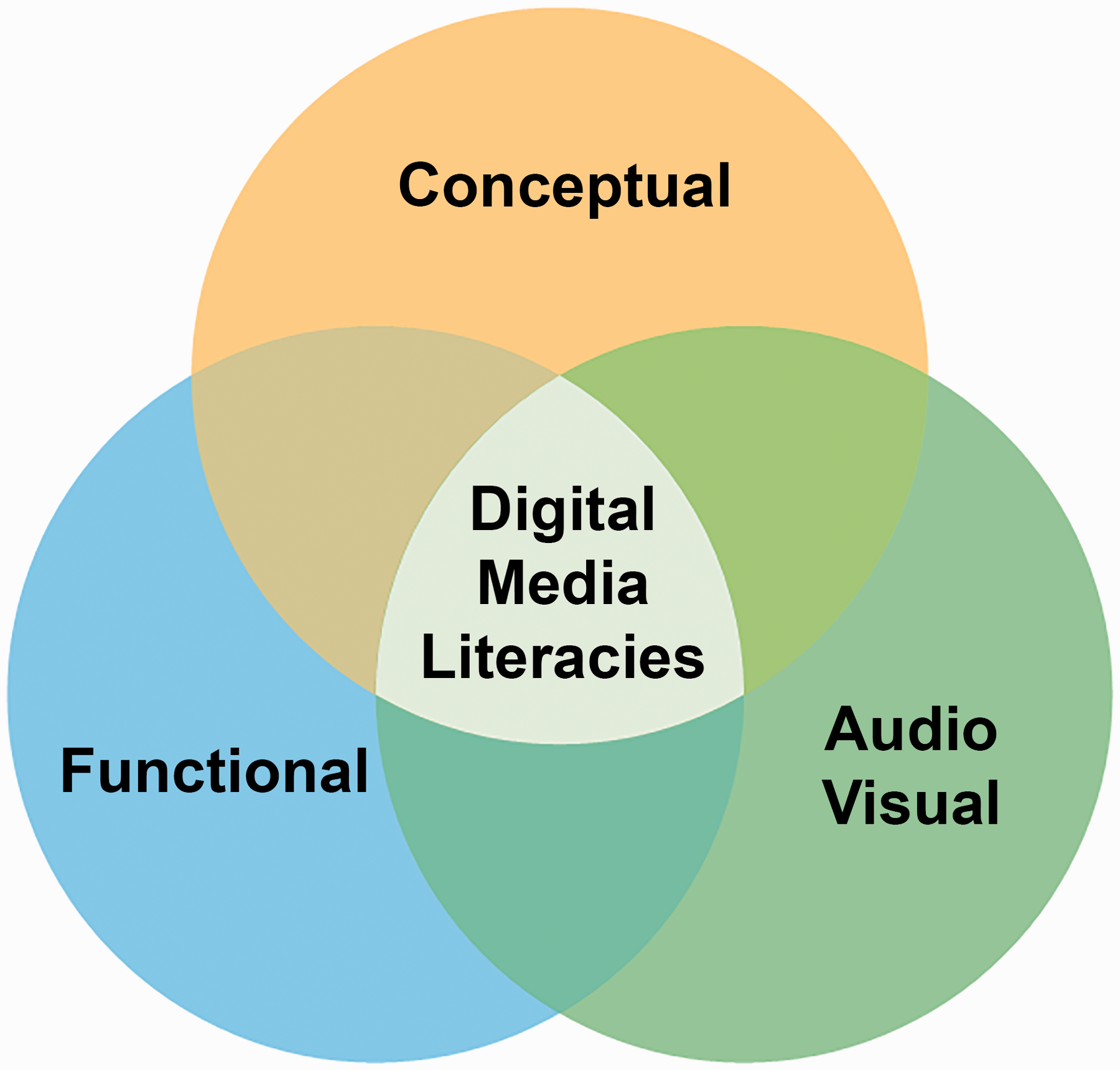
The Digital Media Literacies Framework for teaching and learning.
Additionally, the authors proposed a second model: the Taxonomy of Digital Media Types for LGDM based on these three domains (Figure 2) (Reyna et al., 2017b). This taxonomy conceptualises the production of LGDM based on skills required and the inclusion of Technological Proxies (Hanham et al., 2014). The proposed taxonomy is being used for educators to understand the complexity of different digital media artefacts, consider LGDM assignment weighting, and find whether individual or group work is appropriate for the task.
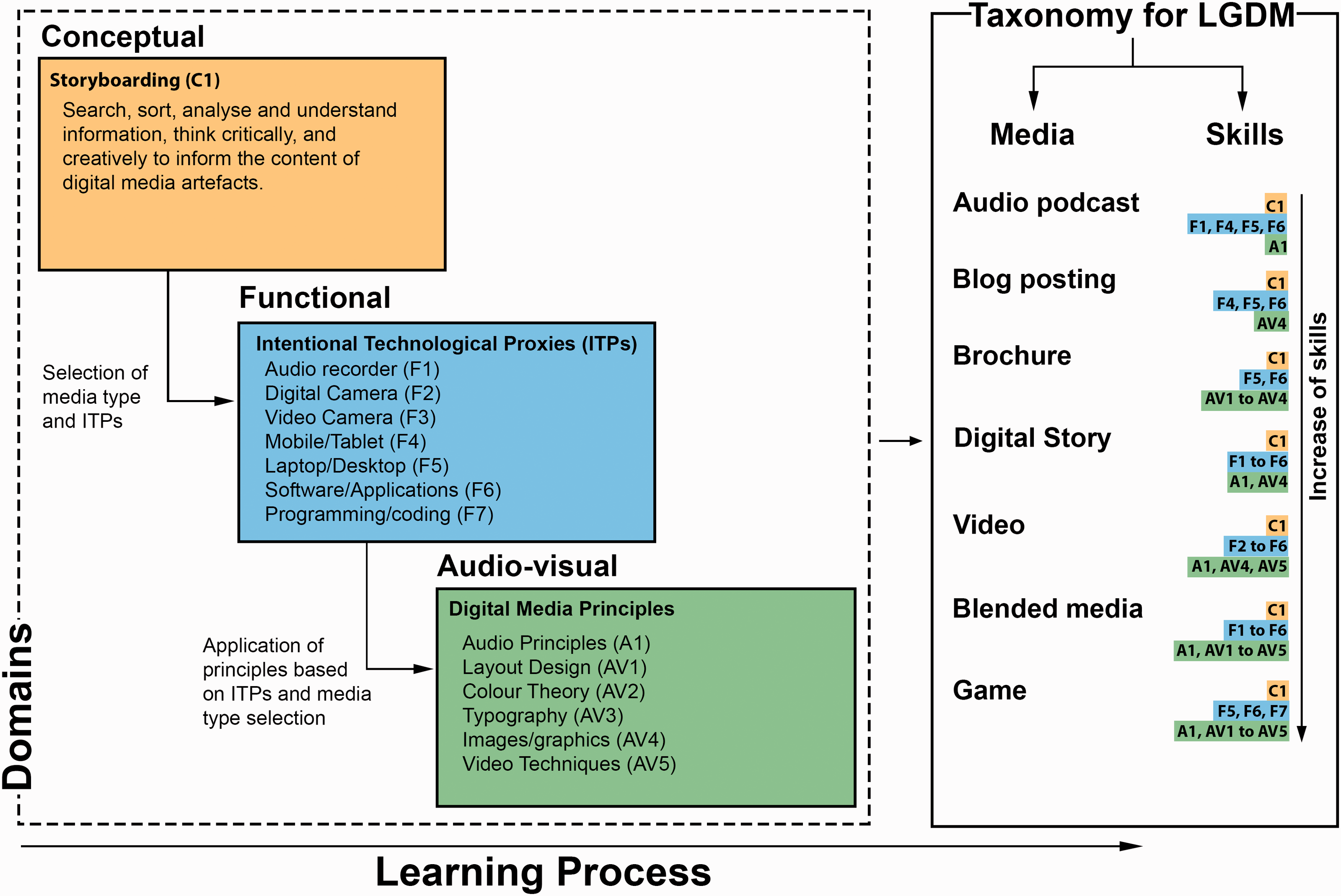
The taxonomy of competencies of digital media types for LGDM.
The purpose of this section is to explain succinctly the audio-visual (green rectangle, Figure 2) domain comprising the basic design principles that apply to the development of effective digital media artefacts (audio-visual domain). The purpose of the paper is not to discuss examples of these principles, as they can be found elsewhere, but to emphasise their importance in the digital media creation process. The latest NMC Horizon Project mentioned that the digital divide in the USA is not only about access to technology but also a fluency in using it (Alexander et al., 2016). That is why digital media principles are crucial skills to teach to students. This area is supported by evidence in four different disciplines such as neuroscience (LeDoux, 1989, 1992), psychology (Fulks, 1997; Koffka, 2013; Smith-Gratto and Fisher, 1999), visual design (Hashimoto and Clayton, 2009; Malamed, 2015) and multimedia learning principles (Mayer, 2005, 2008; Moreno and Mayer, 2007).
The evidence behind the digital media principles
In neuroscience, a group of neurones has been found to regulate the amygdala and mediate the reception of visual stimuli from the eye. This response occurs in few milliseconds before the brain interprets that stimuli (LeDoux, 1989, 1992). In other words, the response to visual stimuli is considered to be visceral (Norman, 2004). Therefore, emotion can precede cognition (Damasio, 2000). For instance, an experiment conducted in web design confirmed this fact. Participants in a study identified a website to be credible based on the layout design and colour scheme (visual stimuli). This website was aesthetically appealing, but the content was not accurate. This finding was demonstrated in web design usability tests where users form an opinion on the visual appeal of home pages after a short period of exposure of 50 milliseconds (Buxton, 2005; Fernandes et al., 2003; Lavie and Tractinsky, 2004; Lindgaard et al., 2006).
A psychological approach called Gestalt theory is the foundation for instructional screen design (Koffka, 2013; Smith-Gratto and Fisher, 1999), and it is accepted that its application can improve comprehension and learning (Chang et al., 2002; Dix, 2009). This theory is expressed in laws and explains how design elements on screen need to be organised into fields or structures to achieve effective visual results (Koffka, 2013). Some of these laws include balance/symmetry, continuation, focal point, closure, isomorphic correspondence and so on (Smith, 1988). These laws are similar to the ones used in visual design (Hashimoto and Clayton, 2009; Malamed, 2015). It has been reported that applying these laws in the development of educational material improves educational outcomes from the users’ perspective (Chang et al., 2002). This finding is in accordance to what visual designers described before; the visual design has an impact on how people sense information presented, usability, credibility and appreciation for good design (Hashimoto and Clayton, 2009; Malamed, 2015).
The role of visual design in creating engaging digital media artefacts is crucial to communicate a message successfully. The rules that apply to digital media are colour theory, layout design, typography, C.R.A.P principles (Contrast, Repetition, Alignment and Proximity), appropriate use of images and basic video techniques (Hashimoto and Clayton, 2009; Malamed, 2015; Williams, 2014). These digital media principles have a close relationship with multimedia learning principles (Mayer and Moreno, 2002) and can be considered cognitive principles that promote interaction, integration, and understanding of a message. In particular, multimedia learning principles such as spatial proximity principle, the signalling principle and the dual scripting principle can support the user, attract their attention and facilitate information processing and semantic integration of complex material (Mayer, 2008). Visual design helps to create a pleasant environment and facilitate cognitive processes for the user to focus on the message (Galitz, 1992).
Colour theory
There is a body of literature in psychology for the last century that has studied colour reactions as functions of personality and its effects on emotions and behaviour (Valdez and Mehrabian, 1994). Bright colours (blue, red, lime and pink) provoke more positive reactions (e.g., amusement, excitement) than darker colours (black, grey and brown) (Hemphill, 1996). Red colour stimulates athletes to perform better in a competition (Elliot and Aarts, 2011), stimulates willingness to pay in online auctions (Bagchi and Cheema, 2013) or affects exam performance negatively (Elliot et al., 2007).
Colour schemes have a significant role in the visual design and also in the development of digital artefacts (Hashimoto and Clayton, 2009), and its use should aim to enhance the readability of content (Malamed, 2015). For example, in web design, the role of colour as a salient stimulus will affect the visual appeal of the site (Knutson, 1997). It is important to consider a neutral colour scheme, soft backgrounds with black/grey text rather than bright and highly saturated primary colours (Fernandes et al., 2003). The colour clash occurs when a design contains bright and saturated colours that compete each other creating an unpleasant effect to the eye (Hashimoto and Clayton, 2009). For example, a PowerPoint slide that uses white as background with light yellow text it will be almost unreadable. In contrast, if we replace the background for bright red and the text for electric blue, it will tire the eyes and readers may experience dizziness.
Screen layout
The screen layout refers to how the objects are arranged on the screen to promote attention and engagement. Symmetrical and clean layout achieves balance and stability, and it is highly desirable as it directs the user’s focus on the central concepts and ideas (Malamed, 2015). The screen layout is directly linked to multimedia learning principles and cognitive load processing (Clark et al., 2011). Combining this with principles such as coherence, redundancy and segmentation (Mayer and Moreno, 2002) will help users to concentrate more efficiently. By contrast, an asymmetrical layout is likely to have the opposite effect and may distract users’ attention to other elements on the screen (Reyna, 2013). It is important to ensure the layout design is clean and easy to follow, avoiding the use of distractive elements or overwhelming patterns. A chaotic layout on a website will make hard to navigate, and the user experience will not be the best. The user may disengage relatively quickly (Buxton, 2005). Screen layout will apply to, for example, a digital presentation such as an animation, screencast, video or blended media, poster or brochure.
The C.R.A.P principles
Principles of graphic design such as C.R.A.P (Contrast, Repetition, Alignment and Proximity) are also considered important when developing posters/brochures that can be distributed online or print (Williams, 2014). Contrast refers to the difference in visual properties that contribute to an object or image being distinguishable from other objects and the background. It can be achieved using, colour, size, shape and position. Repetition is the process of repeating elements across the design to give a unified look. This process will add consistency to the design. Aligning elements in a particular way in a screen design (e.g., PowerPoint slides) creates a hierarchy or visual connection with each other. When these elements are placed randomly, a sense of confusion and chaos is created, which could disengage the audience. Finally, proximity is achieved by grouping similar elements together and creating a relationship between those elements. A typical example can be a website with a complex navigation structure where the designer uses different types of buttons but place them together in submenus. It also provides a focal point and can give the reader an idea of where they should start and finish reading (Hashimoto and Clayton, 2009; Malamed, 2015). For example, developing a poster that does not follow the C.R.A.P principles may confuse the viewers, and the message may not come across.
Typography
Regarding typography for the screen, it is recommended to use clear font types such as Arial, Courier New, Times New Roman and be consistent in type and size (Friedman and Bryen, 2007). Limiting the use of italic for Latin names only and using bold for emphasising words will make a paragraph more readable. Also, avoid writing in red, as it is tiring for the eyes and can cause dizziness to some students and has been associated with adverse effects on learning (Elliot et al., 2007). Typography is a complex discipline, but the basic understanding can be summarised in using font faces that are easy to read.
Use of images
When using images, illustrations, graphics or icons to produce any digital media, careful thought and consideration are essential. The rationale to use these elements is to make the artefact visually appealing and engage the users/audience with the object. The use of these visual elements must have a purpose (Sfetcu, 2014). Otherwise, it will not give any benefit to the message. In web design, the addition of a visual element on a page just to fill up space has no impact on the visitor (Fernandes et al., 2003). Before using visual elements, consider the benefits of its use, whether it helps the audience to understand a concept, whether the visual element creates appeal and what message the image sends (Malamed, 2015). Effective images and illustrations will tell a story and reinforce the message of a digital media artefact (Kress and Van Leeuwen, 1996).
Video principles
Basic video techniques include how to shoot a video using a tripod, avoid what is called Vertical Video Syndrome, planning the shots (long shot, medium shot and close-up) and the rule of thirds as well as audio manipulation and special effects (Geoghegan and Klass, 2008), the use of text on video, transitions, and shot duration. These basic principles will enhance credibility and engagement of the audience (Stockman, 2011).
In summary, digital media principles such as colour theory, screen layout, typography, C.R.A.P principles, use of image and video framing are required to produce the different types of digital media artefacts effectively. This effectiveness can be measured by user’s engagement with the content and understanding of the material. Figure 3 presents a summary of this section. Following these principles for digital media creation will enhance the look and feel of the artefact, user engagement and motivation (Malamed, 2015).
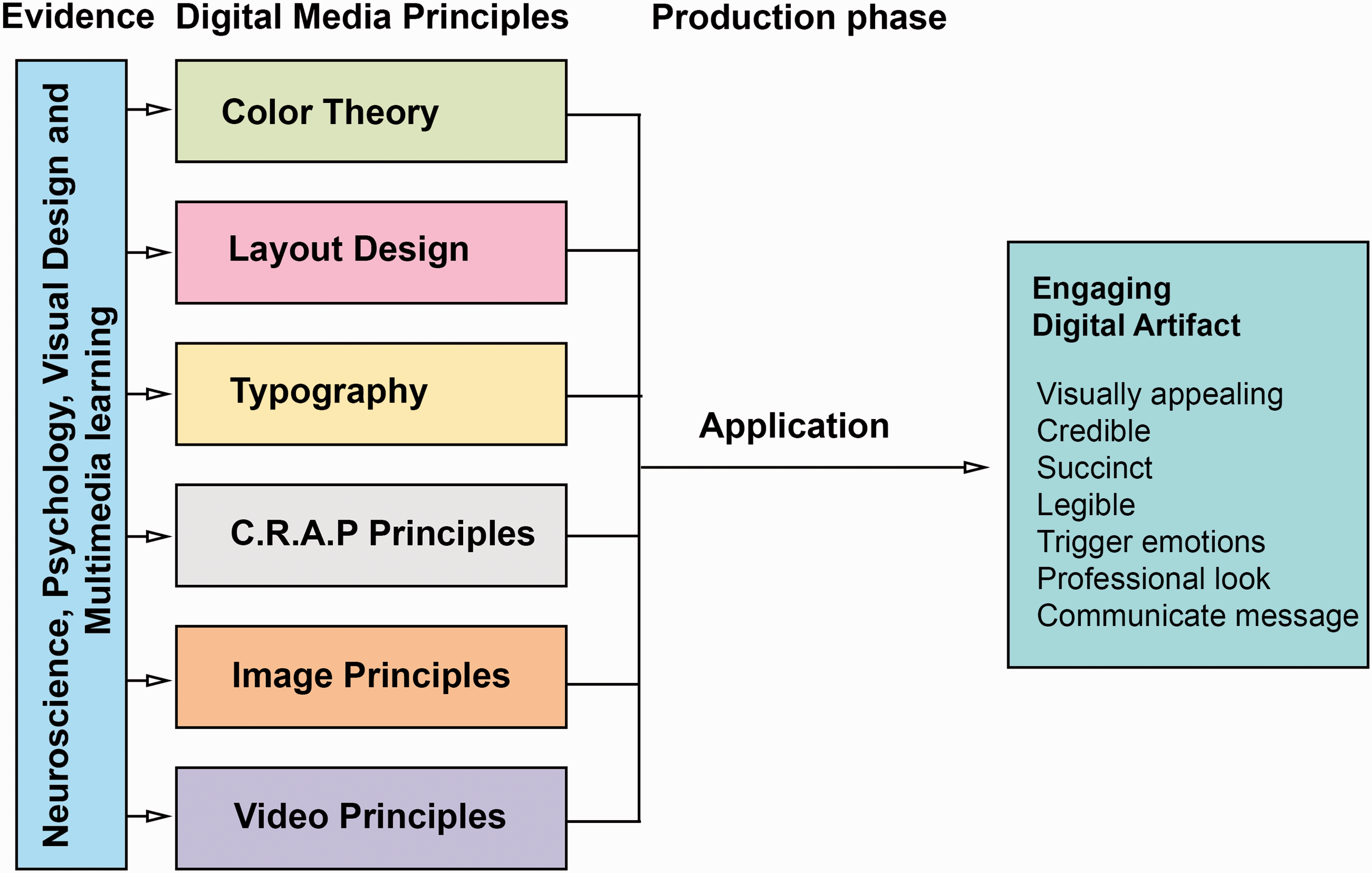
Digital media principles and effective creation of a digital artefact.
Effective communication in the digital space
Scholars have explored the use of analogies with grammar and filmmaking (Bowen and Thompson, 2013) and grammar and visual design (Kress and Van Leeuwen, 1996). In filmmaking, the grammar of the film refers to a set of principles and visual elements that guide the effective production of movies (Bowen and Thompson, 2013). The film industry applies these commonly accepted rules. Viewers have been trained, implicitly over many decades, to observe, decode and comprehend the different shots used in motion pictures creation (Stockman, 2011). For example, in a scene from a movie where two actors are interacting, and it is a close-up scene, the camera will emphasise on the person talking and make the second person look slightly out of focus. The out of focus feature happens naturally with our vision, if we focus on a near object, the background will look slightly out of focus. So, the film is recreating the way the eyes function and create a real effect on the screen. In visual design, the grammar of visual design was proposed by looking at the visual design elements and structures such as colour, perspective, framing and composition. This analogy approach examined how images communicate meaning based on a wide range of everyday examples (Kress and Van Leeuwen, 1996).
This section proposes an analogy between grammar and digital media principles. The rationale to use this analogy is due to not only the measurement of similarities between grammar and digital media principles but the promotion of inquiry, the engagement, and discussion that produces. For an analogy to be effective to explain a concept, it should challenge thinking, and the analogue should be a familiar situation that the audience has been exposed to in the past (Aubusson et al., 2006). In other words, the purpose is not, for example, to compare film shot and the sentence, or the film sequence and the paragraph, but the narrative and representation across digital media principles and grammar. In this case, the analogue is the grammar and the target, the digital media principles.
Grammar is required for effective communication in both formal and informal settings. To illustrate this notion, a poster that has a convoluted layout, different font types and sizes and the colour clash will not communicate the message to the audience; improper grammar can likewise affect the meaning and clarity of an intended message. Not being aware of the digital media principles (audio-visual domain) when developing digital media can cause the audience Emotional and Cognitive Overload (ECO). Symptoms of ECO overload include irritability, pressure and confusion while cognitive overload is perceived as not able to process, handle or cope with a task (Rutkowski and Saunder, 2010). The ECO will be reflected in a lack of engagement with content, and the intended message could fail to reach the audience.
Grammatical errors can include punctuation, misplace of commas, spelling, subject/verb tense and sentence structure. In the case of digital media creation, poor choice of the font, text over a busy background, poor colour scheme, busy design layout and misuse of images can limit the way users engage and understand the information (Hashimoto and Clayton, 2009; Malamed, 2015; Williams, 2014).
When grammar rules are applied, it makes written content easy to understand and more engaging for the reader. If the flow of a paragraph gets interrupted by a poor sentence construction, spelling mistake or ‘unusual’ word, the idea will not be communicated properly. A video developed that does not consider, for example, shots (smallest unit of visual information captured by a video camera) and length, use of overwhelming transitions, distractors on screen and so on can result in outcomes like those associated with the poorly written text. The cognitive load is audio visual, and the brain can be easily overloaded (Mayer and Moreno, 2002). Reading text written using appropriate grammar structure will not have issues with cognitive load unless the text is written using fonts that are hard to read, or has complex graphics or bright colours with the lack of contrast between fonts and background. Usually, print books and articles have standard layouts and fonts.
Grammatical inconsistencies can make powerful slogans less effective. This issue can be observed in digital media artefacts, for example, an interactive poster (infographic) that has a poor colour scheme and layout design will not lead the eyes of the person to engage and try to understand the message. Another example, a website with poor navigation and bad choice of fonts and colour scheme will not convey credibility; visitors will be reluctant to put their credit card details to buy a product or service. In the case of video, a talking head video vignette that runs an hour long and has been recorded vertically (Vertical Video Syndrome) with distractive transitions and poorly designed graphics regarding layout design and colour will not convey professionalism and credibility. Users will not engage with this artefact.
In summary, digital media principles are as important as grammar rules, and they are necessary for everyday situations, clarity of meaning and intent for communicating in the digital space. Moreover, understanding digital media principles will not be enough to communicate in the digital world; it will require good use of grammar. The production of effective digital media artefacts is guided by a storyboard that needs to practice proper grammar such as be written succinctly, use a conversational style, use precise and plain terms, list items, keep sentences and paragraphs short, chunk information and so on (Carroll, 2014; Felder, 2011).
Discussion and implications for learning and teaching
The digital media explosion on the Internet due to the rise of prosumer electronics, Wi-Fi availability, ubiquitous devices, software and applications contributed to the growth and development of the digital media ecosystem on the Internet. The privilege of capital-intensive industries that had access to the tools to create digital media content shifted to include users who can afford these prosumer technologies. In this regard, a ‘relative’ democratisation of the digital media production has been observed since last decade which continues to shape the Internet towards a participatory culture (Van Dijck, 2009). This phenomenon empowered User-Generated Content on the Internet. Users with no digital media expertise are creating digital media content and uploading on the Internet. In many cases, the content fails to engage the audience due to poor quality. Examples of this can be Vertical Video on YouTube channels, blogs using fonts that are difficult to read or websites with complex navigation and poor colour scheme. We are leaving this unattended, and we can see the results with the massive amount of online content that is inaccurate, has issues with usability, accessibility and credibility due to poor understanding of digital media principles. Fostering digital media principles in a new generation of professionals could alleviate this growing issue. As we discussed previously, these principles to create engaging content are linked to different disciplines: neuroscience, psychology, visual design and multimedia learning principles. This paper discussed its importance in the creation of effective digital artefacts. The analogy of these principles with grammar was discussed not as an absolute match, for example, shot with the sentence, but as a way to generate an inquiry. Grammar and digital media principles work together to help to establish a clear communication in the digital space.
As educators, it is essential to ensure the students not only learn how to write reports, assignments, monograph and so on. They need to know how to communicate effectively in the digital space, regardless of their discipline of study. LGDM assignments should be used as pedagogical and digital media agent. We should aim to teach the digital media principles and to scaffold student digital media learning during their stage at the university. Currently, we think about the tools to produce digital content but not the principles. The lack of understanding of digital principles is evident in the latest NMC Horizon Project Report that discussed the tools for digital literacy (Alexander et al., 2016) and did not mention the theoretical foundations that govern the development of effective digital artefacts. Additionally, the Visual Literacy Standards in Higher Education (Hattwig et al., 2013) focused on the use of images and neglected other visual elements such as layout design, colour, theory, typography, C.R.A.P (Contrast, Repetition, Alignment and Proximity) principles and video techniques. Communicating using digital media implies not only functional knowledge on the application and tools to produce the content but also audio-visual skills. If we do not teach students how to communicate with the digital media principles, how can we expect them to communicate effectively in the digital space?
Conclusions
It is not about being able to create content online anymore; it is about effective communication to engage the audience in the digital space. This paper contributes to the body of knowledge by presenting the basic digital media principles for effective digital media production. Grammar is one set of rules to talk and write which is bimodal. In contrast, digital media principles are a wide range of rules that lay on, in most of the cases, multimodality. Students now are pushed to learn additional skills; it is not enough anymore to be able to write, read and speak, but they need skills in audio, imaging, animation, and video creation. Grammar works in synergism with digital media principles; without good grammar, effective digital media artefacts cannot be developed. In the digital age, grammar and digital media principles are closely related. In an ideal scenario, they should coexist in a ‘symbiotic’ relationship.
As educators, we need to foster digital media skills in our students. We need to teach or train students not only on using the software or tools available but also the principles behind to communicate effectively using digital media. We acknowledge most educators outside of the media and design courses that do not have the skills to teach these principles. We are currently working on guidelines for the effective practice to produce digital media content for educators and students. Hopefully, these guidelines will engage both educators and students in LGDM assignments.
Footnotes
Declaration of Conflicting Interests
The author(s) declared no potential conflicts of interest with respect to the research, authorship, and/or publication of this article.
Funding
The author(s) received no financial support for the research, authorship, and/or publication of this article.