




Abstract
In Kuwait, unsuccessful attempts to use and integrate technology into classrooms and lecture halls are currently being witnessed in schools and higher education institutions. Such failure is believed to be the consequence of various challenges, such as cultural, technical and contextual challenges. In this exploratory study, the researcher has tried to shed some light on these and make recommendations on how to address them. In order to explore these challenges, the method of document analysis was applied, collecting data exclusively from documents related to the Kuwaiti context. These data were analysed using a thematic analysis approach and NVivo10. The results show that such challenges (i.e. cultural, technical and contextual challenges) exist in the Kuwaiti context and lead to the failure of E-learning projects. As a final point, a conclusion was drawn and some recommendations made and presented.
Introduction
There is currently widespread interest in technology integration into schools and higher education institutions (HEIs) around the world, including Kuwait University and the Public Authority of Applied Education and Training (PAAET) in Kuwait. These are public institutions, supported and funded by the Kuwaiti Government, although there are also private academic institutions in the Kuwaiti context (e.g. the American University of Kuwait and the Arab Open University). Nevertheless, it is worth mentioning here that public HEIs and schools in Kuwait have the highest number of students. In contrast, private HEIs and schools, which may have been established more recently, usually accept fewer students, due to their limited campus space and staff. For example, according to official notices from PAAET, published in Al-Anba Newspaper (2014), its faculties accepted 12,597 students in the academic year 2014/2015, thus exceeding its absorptive capacity. This was confirmed by one faculty member at PAAET, Al-Ali (2010), ‘The number of students enrolled in all colleges and training institutes under PAAET is around 30,000 with a yearly increase of 2%’ (Al-Ali, 2010: 5).
The situation in Kuwait University is roughly the same, with 6900 students being accepted in the same year (Alrai Newspaper, 2014), which is beyond the University’s capacity. These student numbers in state institutions have motivated some enthusiastic teachers and educators – including a few school teachers – to search for new ways of delivering their lessons. For example, there have been some attempts to integrate different types of technology (e.g. PCs, Email, learning management systems (LMSs) and, more recently, smartphone apps and using twitter) into teaching and learning approaches. Furthermore, specific projects have been launched, such as distance learning projects, to deal with the increasing number of students and to cut the cost of delivering instruction.
Unfortunately, most of these attempts have been unsuccessful, and so in this research some of the papers produced in the Kuwaiti context have been analysed to identify the challenges commonly faced by teachers and educators. In other words, the question posed in this research, namely why most attempts to integrate or use technology in classrooms and lecture halls in this context (Kuwait) have been unsuccessful, has been addressed. This was undertaken using a qualitative document analysis method and a qualitative analysis package, NVivo10. Subsequently, some recommendations are presented.
To the researcher’s knowledge, no study or paper has previously tried to use a document analysis method alone to analyse or evaluate this phenomenon (i.e. the unsuccessful attempt to integrate technology into the classroom in the Kuwaiti context). Furthermore, no evidence has been found in the local literature to indicate there have been any attempts at a systematic collection of data related to such challenges. However, globally, there have been some dedicated forms of qualitative research that depend solely on this approach. For example, Wild et al. (2010) carried out a ‘diary study’ to explore required information for engineers and their document usage, finishing up by producing new ‘document use’ scenarios. Another example, provided by Gagel (1997), involved in-depth document analysis to examine the topic of literacy and technology, adopting a process of hermeneutic inquiry. This shows the capacity of the method to stand alone and provide high-quality, trustworthy data, at least as an exploratory study.
Methodology
Defining document analysis
According to Bowen (2009), document analysis is a systematic process which can be used to review and evaluate both printed and electronic materials. It is similar to other analytical qualitative methods, where data must be examined and interpreted to extract meaning, improve practical knowledge and gain understanding (Corbin and Strauss, 2008; Rapley, 2007). Analytical processes involve findings from the selection, evaluation (sense-making) and summary of data which exist in documents (Bowen, 2009).
Rationale for document analysis
Most of the studies and papers produced in the Kuwaiti context have applied quantitative, rather than qualitative, methods, with an experimental (positivist) method being widely used over time. The majority of researchers in the above context are therefore familiar with this approach, and it can in fact be more suitable in some cases (i.e. when comparing variables, or studying causal relationships). It is less detailed than qualitative research, and sometimes less time-consuming, amongst other things. It can also have higher credibility for certain people (e.g. stakeholders and policy-makers), with data being collected more easily (over the phone, through online surveys, or even through TV advertisements). The data may also be more generalisable, where the sample is random and will encompass criteria and measures that provide an ‘empirical warrant’ for the results (Cuff and Payne, 1979).
However, using positivist/experimental methods and statistical analysis approaches (e.g. the SPSS software package or surveys) to explain a human being’s actions, attitudes, perspectives and relationships with others might not be a suitable approach for measuring human feelings, emotions or perspectives. According to Tesch (1990: 1), ‘such observable behaviors and statistics merely scratch the surface’.
In addition, the experimental approach can sometimes be a poor way to offer an in-depth explanation of certain phenomena, or an individual’s actions (Jayarante, 1993; Jupp and Norris, 1993), due to the complexity of human nature (Cohen and Manion, 1994). Consequently, it is better to use a qualitative (interpretive) method to gain an in-depth understanding of social and educational phenomena, particular as it is more flexible (Maxwell, 1996). For more on quantitative and qualitative methods see, for example, Burrell and Morgan (1979) and Cohen and Manion (1994).
In general, the common modes of collecting data when using qualitative methods involve interviews, focus groups and participant observation (Fossey et al., 2002). Document analysis is usually combined with other methods as a means of triangulation – ‘the combination of methodologies in the study of the same phenomenon’ (Denzin, 1978: 291) – in the search for credibility and validity. However, in this investigation, only the document analysis approach was adopted for the initial phase of a more comprehensive and long-term study, to be completed later. This was in order to discover some of the challenges talked about earlier, in a bid to find solutions and make recommendations. Light et al. (2009: 213) argue that, ‘no design is ever so complete that it cannot be improved by a prior, small-scale exploratory study’.
Mogalakwe (2004: 221) illustrates that, ‘this method is just as good and sometimes even more cost-effective than social surveys, in-depth interviews or participant observation’. He adds that researchers can use this method with confidence, as it is a scientific approach, useful for consolidating evidence from other sources. According to Payne (2004), it is a technique utilised to classify, explore, interpret and find the limitations of written documents. Moreover, both Stake (1995) and Yin (1994) emphasise that document analysis is applicable for rigorous qualitative case studies that offer rich descriptions of an event or phenomenon. Hakim (1982) points out that original research can be completed by utilising old data and Bowen (2009: 31) presents diverse advantages of this method:
It is less time-consuming – it requires data selection, instead of data collection Availability It is cost-effective Documents are ‘unobtrusive’ and ‘non-reactive’ Stability – as a corollary to being non-reactive, documents are stable Exactness – the inclusion of exact names, references and details of events makes documents advantageous in the research process (Yin, 1994) Coverage
Nevertheless, conducting research which depends on a single method raises some concerns; for instance, about the researcher’s experience and research skills. One of the threats to the validity of qualitative conclusions is researcher bias (Maxwell, 1996). Furthermore, there is the issue of his closeness to, or distance from the environment under study, which will impact the accuracy of his judgements and impartiality of his decisions. In addition, what sort of data will be reviewed and analysed and why? Is this method adequate for obtaining the answers the researcher is looking for? All these questions need to be answered beforehand when carrying out such an investigation.
In addition to the above, there are some limitations to the document analysis method, such as its possible failure to offer sufficient detail in responding to the research question (Bowen, 2009). It might also be hard to retrieve some data, because it is deliberately blocked (Yin, 1994) and inadequate document collection will be subject to ‘biased selectivity’ (Yin, 1994: 80). However, Bowen (2009) argues that the advantages noticeably prevail over the limitations, because of the efficiency and cost-effectiveness of this method.
In this instance, the researcher can add one more advantage of the document analysis method, which is that it avoids having to deal with so many ethical issues, since human beings are not directly involved. In the end, maximising the benefits and minimising harm is the key to ethics in research (Gibbs, 2008). However, one of the concerns here is the appropriateness of this method. This is a tricky question to answer at this time and it should be left to the conclusion of this study. However, it is important to bear in mind that this investigation is merely an exploratory study to gain insight into and more understanding of the challenges teachers and educators face in the Kuwaiti context. This means it is not expected to necessarily apply elsewhere, or to other issues.
Data collection
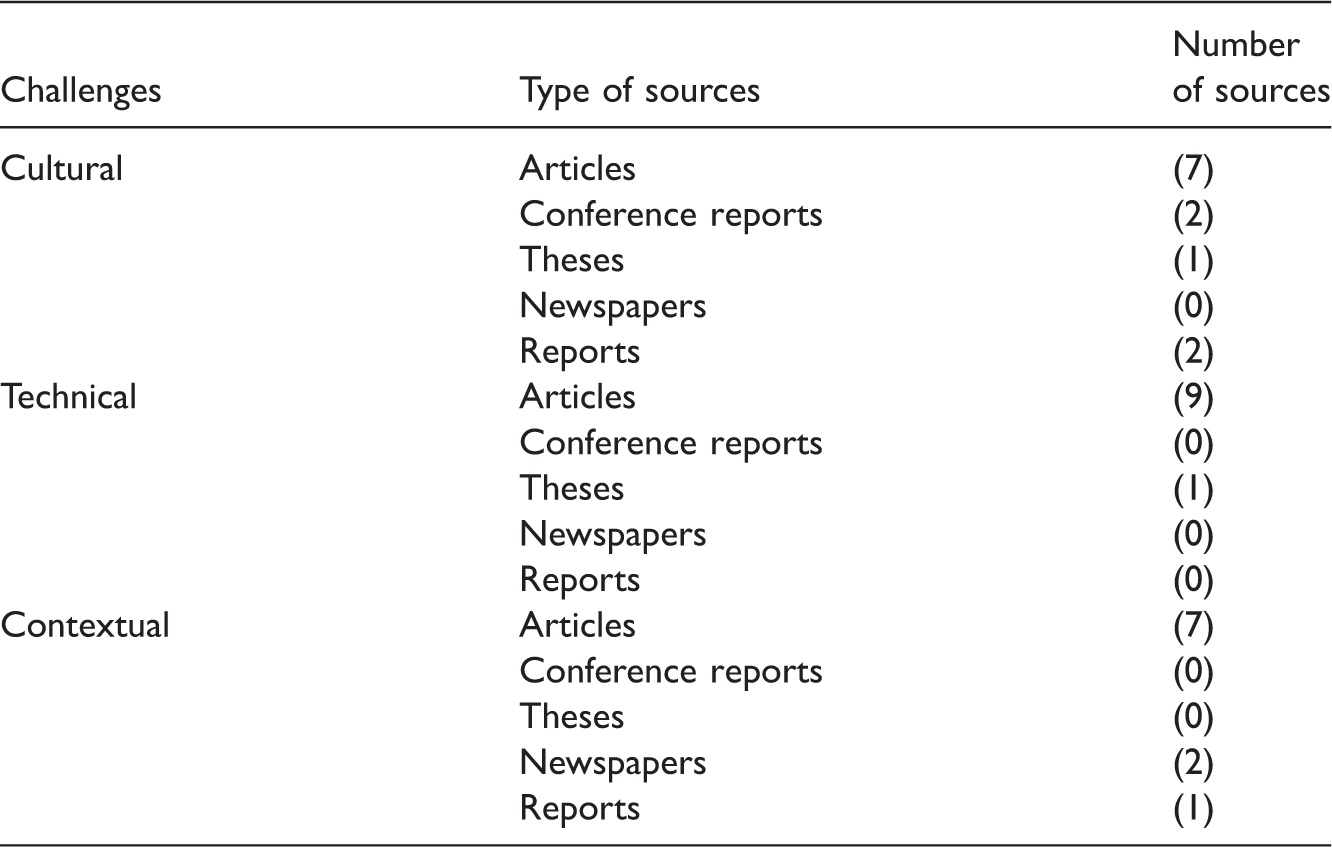
Type and number of sources examined.
Data analysis
According to Bowen (2009), the process of document analysis involves finding, choosing, evaluating (making sense of) and summarising data from documents. To follow such an analytical process, a thematic analysis approach was adopted here, since Braun and Clarke (2006) consider this to be a method in its own right and a flexible one at that. Furthermore, the above authors define thematic analysis as ‘a method for identifying, analysing, and reporting patterns (themes) within data. It minimally organises and describes your data set in (rich) detail’ (Braun and Clarke, 2006: 6).
The above authors argue that a thematic analysis commonly focuses either on a single level – a semantic approach, with the themes being identified within the explicit or superficial meanings of the data – or on a latent level, which ‘goes beyond the semantic content of the data, and starts to identify or examine the underlying ideas, [and] assumptions’ (Braun and Clarke, 2006: 13). From a constructionist perspective, the focus in this case is on a latent level, since the present aim is to theorise on the socio-cultural context and structural conditions surrounding the Kuwaiti environment.
However, because of the lack of explicit guidelines for adopting thematic analysis, the ‘anything goes’ critique of qualitative research (Antaki et al., 2003) might be a justified allegation. Braun and Clarke (2006) suggest six clear and workable phases observed in this type of investigation: Phase 1: Familiarising yourself with the data. Phase 2: Generating initial codes. Phase 3: Searching for themes; sorting the different codes into potential themes and collating all the relevant coded data extracts within these identified themes. Phase 4: Reviewing themes; verifying that the candidate themes are valid and have enough data to support them, rather than being too diverse. Phase 5: Defining and naming themes. Phase 6: Producing the report.
It is worth mentioning here that different sources were used to generate the codes and final themes (see Table 1). In addition, 16 codes were generated: 1. poor English language proficiency; 2. heavy workload 3. lack of time; 4. fear of change; 5. lack of awareness; 6. large class sizes, 7. insufficient numbers of staff, 8. poor management, 9. religion and 10. politics were further issues, along with a 11. teacher-centered approach, 12. resistance, 13. cost, 14. lack of appropriately equipped classrooms, 15. insufficient support as well as 16. lack of teaching skills. These were then categorised under one of the three final themes: cultural, technical and contextual challenges.
The researcher also wrote notes as memos from the very beginning in NVivo10, as Gibbs (2008) suggests, for the following two reasons:
To help apply the code consistently. To help share records with others, if working with a team.
Findings
As Braun and Clarke (2006) suggest, after searching for documents (e.g. conference reports, articles, etc.) that match the simple systematic approach established earlier (see section: Data collection), the researcher started to familiarise himself with the data and imported it into NVvivo10. This step was followed by generating initial codes, searching for themes, reviewing those themes and defining and naming them. Finally, key concepts were identified to produce the story in a concise, coherent and logical report.
The researcher found many challenges which are commonly faced by Kuwaiti teachers, educators and policy-makers when trying to use or integrate technology into classrooms or lecture halls. In most cases, the challenges are similar, so they could be viewed as part of a phenomenon. In this paper, the most important themes are discussed and categorised below. To be more specific, all the challenges are organised under three main themes: cultural, technical and contextual challenges.
Cultural factors
The theme of cultural factors comprises many challenges; for instance, cultural and social values, religion, politics and the dominance of traditional teaching methods. According to Al-Fadhli (2008), in Kuwait, cultural and social values are commonly centred on gender segregation and norms. For instance, Kuwait lays down many boundaries as regards female students, particularly if they are married or raising children (Al-Ali, 2010). This often leads to a lack of interaction, lowered self-confidence, or limited opportunities to meet people of the opposite sex when seeking to exchange ideas (Al-Fadhli, 2008).
Noticeably, approaches like E-learning or blended learning may not be desirable to all teachers (e.g. at Kuwait University, some sessions combine both male and female students), because they may lead to a conflict of culture and norms, given that it becomes difficult to control patterns of interaction between male and female students (e.g. interaction through the discussion board in an LMS) (Al-Huwail et al., 2008). In such a culture, Al-Huwail et al. (2008) point out that religion and politics are sensitive issues which need to be considered by instructors when trying to adopt E-learning.
However, a major challenge in the Kuwaiti context is the dominance of traditional methods of teaching and teacher-centred approaches, even in this technological era. For example, in PAAET on the teacher preparation programme, the students are familiar with a learning style which involves a teacher-centred approach (Alayyar et al., 2009). Here, methods of teaching and assessment are still dedicated to indoctrination and discourage dialogue, discussions or active learning among students in schools and HEIs in Kuwait (Ghaith, 2013).
Furthermore, high student numbers, combined with a shortage of faculty members at PAAET, represent another major challenge. The expanding number of students has put facilities, for example classrooms, computer labs and libraries, under a great deal of pressure. Heavy workload and a shortage of time, especially once teachers want to manage virtual classrooms, are amongst the many problems faced in the Kuwaiti context. Since public HEIs, for example Kuwait University and PAAET, already suffer due to a shortage of faculty members, it is expected that the latter will experience excessive workload and reject extra tasks, like planning to use or integrate technology (Al-Ali, 2010; Ali and Magalhaes, 2008). Even if they do plan to use technology, The Kuwaiti distance learning project does not suggest any pedagogical model or raise any pedagogical issues concerning the e-learning environment. It is left to the faculty members to find out ‘what to do’ and ‘how to do’ (Al-Ali, 2010: 6).
To illustrate the above, Al-Ali (2010) found that some teachers resist using technology or engaging in E-learning projects, due to suspicions about hidden agendas, while Alayyar et al. (2009) allude to the amount of time it would consume to create effective blended learning environments as a crucial factor in the rejection of technology. In fact, according to Al-Ali (2010), faculty members of the Education Technology Department (ETD) at PAAET, who are supposed to use and encourage others to use technology, in fact refuse to do so. This bizarre finding confirms the need for more investigation in order to understand the reasons behind their attitude and how to encourage them to use technology.
Notwithstanding the above findings, it must be acknowledged that shyness and a lack of self-confidence are further issues in the Kuwaiti context. The dominant traditional teaching method does not help students to be self-reliant or to become critical and creative thinkers. Such traditional methods actually isolate students, increasing their shyness and decreasing their self-confidence. One of the reasons behind the failure of some of the projects run in this context is actually the suppression of faculty and student voices (Al-Ali, 2010).
What then compounds this reticence, and eventually increases resistance to technology use amongst both students and some teachers, is poor English language proficiency, particularly in schools. This is especially because the most effective LMSs or educational tools are designed through the medium of English (Al-Fadhli, 2008; Al-Hunaiyyan et al., 2008; Ali and Magalhaes, 2008). Significantly, a total of 700 undergraduate students from the College of Education (COE) at Kuwait University have requested more Arabic-medium courses (Safar, 2012).
To summarise, students’ reasons for resisting the use of technology in education are sometimes similar to those cited by teachers; for instance, a fear of change and excessive workload, combined with the amount of time and effort expected. However, the reasons for resisting the use of technology are sometimes unique to the individual. For example, the choice of unengaging, laborious or irrelevant technology by officials in schools and HEIs could increase such resistance (Fullan and Langworthy, 2014).
Technical factors
There are many technical challenges which have also led to unsuccessful attempts to integrate technology into education in Kuwait. For example, inaccessibility, low usability, inconvenience, slow Internet speed, a lack of infrastructure and the unavailability of computers have all been found to be contributing factors, as regards teachers’ and students’ perceptions of the use of technology in education (Al-Ansari, 2006; Alfajjam, 2013; Ali and Magalhaes, 2008; Alkhezzi and Abdelmagid, 2011). In actual fact, Al-Fadhli (2008) found on one course that more than 55% of students (from a small sample size: Information Systems students at Kuwait University) had technical problems accessing the LMS provided. What is more, all 175 participants in the investigation carried out by Safar (2012) in the COE at Kuwait University emphasised the importance of developing and maintaining the system (the online training system) on a regular basis, in order to reduce technical errors.
More fundamentally, the term ‘E-learning’ is relatively new in education, especially in Gulf Cooperation Council countries, and only a limited number of local suppliers offer E-learning systems (Al-Fadhli, 2008; Ali and Magalhaes, 2008). Regrettably, after 7 years (i.e. up to 2015), the situation remains the same. Searching for suitable and easy-to-use LMSs that fully or partly support Arabic is still difficult. Thus, many E-learning projects in schools or HEIs in Kuwait have failed, although this is not the only technical reason for unsuccessful attempts to integrate technology in education; for instance, there is also a lack of consideration for teachers’ and students’ voices, a lack of clear pedagogical vision (Al-Ali, 2010) and a lack of understanding of what it takes to transfer printed materials to an online format (Al-Hunaiyyan et al., 2008).
In addition to the above, there is the problem of limited time available for training (Ali and Magalhaes, 2008), combined with a shortage of well-trained teachers. Moreover, there is an absence of instructions on how to use ICT in the classroom (Alkhezzi and Abdelmagid, 2011; Al-Sharija et al., 2012) and a lack of supplementary materials, for example, no recorded online lectures and no supporting CDs (Sharafuddin and Allani, 2012). It could be added that there are no demonstration videos on how to use some of the suggested websites and technological tools presented by teachers or officials in HEIs in Kuwait, particularly in Arabic. Overall, there is a general lack of technical support and resources (Alkhezzi and Abdelmagid, 2011).
In two state elementary schools in Kuwait, Alkhezzi and Abdelmagid (2011) found that, Despite the fact that computer labs are present, teachers face some challenges in using them with their students due to 1) the lack of connection reliability, 2) the lack of frequent computer maintenance, 3) an insufficient number of computers for each student, and 4) the lack of electrical jackets that allow all computers to be connected (Alkhezzi and Abdelmagid, 2011: 11).
Contextual factors
As mentioned earlier, a major problem for HEIs in Kuwait is the large number of students, as compared with a shortage of staff members (Al-Ali, 2010). However, this does not apply to schools, where there is one teacher for every 11 students in Kuwait, which is actually better than the average rate of one teacher for every 17 students in Economic Cooperation and Development (OECD) countries (for Tony Blair’s vision for education in Kuwait, see the Arabic Society for Academic Freedom, 2009). Unfortunately, an adequate number of teachers will not offset insufficient numbers of computers. According to Alkhezzi and Abdelmagid (2011), publicly funded schools in Kuwait suffer due to a shortage of computers in the classroom.
Another problem was raised by one principal from a Kuwaiti secondary school, when questioned whether he thought the Ministry of Education in Kuwait considered ICT integration as a priority. His immediate response was, ‘Of course not!’ (Al-Sharija et al., 2012: 95). An example of this can be seen in the insufficient financial support (or lack of financial autonomy) provided for schools by the Ministry of Education, when it comes to acquiring new and effective technology. This would verify this allegation. According to Al-Sharija et al. (2012), the Ministry’s neglect of this area has negatively influenced efforts to integrate technology, as well as impacting the performance of teachers. The present researcher believes that in this situation, principals and teachers are not to be blamed for abandoning the concept of technology in education, or if they are less motivated and reject its use.
Moreover, some of the E-learning projects in Kuwait have failed or been ineffective because their objectives have not aligned with the respective organisational goals (Ali and Magalhaes, 2008). According to the above researchers, ‘The lack of strategic planning in training schemes by management [has] resulted in questioning the value of e-learning to the organizations’ (Ali and Magalhaes, 2008: 46). Furthermore, cost may lead to the failure of some E-learning projects, since such initiatives depend on technology, which can be expensive (Al-Ali, 2010). For example, in the initial stages of implementation, buying hardware (e.g. computers) and software (e.g. programs), followed by the ongoing cost of upgrading systems will surely require significant financial outlay (Ali and Magalhaes, 2008).
As specific examples of unsuccessful projects, Alfelaij (2008) used Blackboard LMS (available in Kuwait University, but not in PAAET) on two occasions and these were not entirely fruitful experiences. This LMS was chosen as a channel for communication (e.g. the discussion board) between the above author and his students and also as a vehicle for module content (e.g. materials, activities, announcements and grades), purely because it was familiar to him. However, Alfelaij (2008) was simply overenthusiastic and insufficiently prepared and, in fact, no E-content was ready to be used. He merely used the course textbook and collaborated with the module teacher to transfer the printed material to E-material, but this was inadequate. Some of the students even struggled to enrol in Blackboard (there are many components, so it is difficult to navigate and requires high-speed Internet, which is costly) (Alfelaij, 2008).
Later, Alfelaij (2016) carried out a semi-structured interview with three teachers from the ETD at PAAET. The meeting revealed important insights. Mostly, it confirmed many of the challenges faced by teachers and educators in Kuwait when trying to integrate technology into the classroom. These include poorly equipped lecture halls; a shortage of technicians; a lack of maintenance; outdated software; insufficient numbers of computers; a shortage of trained teachers, and a lack of training sessions.
In addition to the above, psychological and cultural barriers emerged (e.g. students are not commonly trained to collaborate with others or to take on new roles; they also tend to be shy and lacking in confidence, with men and women being segregated. This could potentially hinder the exchange of ideas and experiences). However, one unique challenge became evident, relating to the age and years of experience of teachers, where Alfelaij (2016) noted that the youngest teacher of the three in the sample (and the most recent incomer to the campus) was more experienced and enthusiastic in the use/integration of technology into the modules he taught. It highlights the problem of how to deal with those academic staff who are unwilling to accept and use technology in their teaching. However, answers to this last question are outside the scope of this study.
Finally, as mentioned earlier and at the time of the study, most of the available LMSs around the world were in English and there was no satisfactory equivalent in Arabic (Alfelaij, 2016). Like other researchers in Kuwait, Alfelaij (2016) found that many people in the respective context were impeded in their use of an LMS, due to their low English language proficiency.
All of the above issues raise a significant question: why do some teachers and educators, including the researcher, insist on only using technology they are familiar with (e.g. LMSs), instead of concentrating on technology that the students prefer? Integrating an LMS, like Blackboard, WebCT, or Moodle into the classroom will not guarantee full engagement or acceptance, particularly in the Kuwaiti context, as Alfelaij claims to have noted in the past. This is especially true of new technologies, such as computers, handheld devices and software applications, which are unlike traditional pedagogical technologies branded with specificity (e.g. a pen is for writing), stability (pencils and chalkboards have not witnessed big changes over time), and transparency of function (a pen’s job is simple and obvious, besides it is directly related to its function) (Simon, 1969).
On the contrary, according to Papert (1980), new technologies are adjustable (can be used for many tasks), unsteady (they evolve quickly) and opaque (not all their functions are immediately evident to users) (Turkle, 1995). In addition, it is expected that specific barriers will emerge (e.g. social, institutional or contextual in nature) (Mishra and Koehler, 2007). Mishra and his colleague provide some reassurance when they stress there are no such things as ‘perfect solutions’, but rather solutions which are suitable for each particular situation or environment. Thus, there needs to be some awareness and flexibility about using the solutions/technology preferred by the students.
Conclusion
The aim of this study was to understand why most attempts to use and integrate technology into classrooms and lecture halls in Kuwait have been unsuccessful. Relevant sources were collected and analysed through a document analysis approach, considered as a helpful method of addressing the researcher’s exploratory questions, saving a great deal of effort and time. However, it is difficult to count on this research beyond an exploratory stage and so such an analysis would need triangulation in order to be successful in future studies.
The collected and analysed data reveal many challenges contributing to the failure of technology integration in classrooms and lecture halls in Kuwait (e.g. cultural, technical and contextual challenges). To overcome these, those in charge should consult both teachers and students in the first instance and start to offer training sessions before attempting to integrate any technological tools. This would increase confidence and decrease resistance. Furthermore, teachers, educators and policy-makers in this context (i.e. Kuwait) could look at changing their traditional teaching methods and encourage others to do so. In other words, they need to move from being presenters of information towards the role of facilitator (e.g. adopting constructivist theory), in order to keep pace with new styles of teaching and learning.
In addition to the above, teachers must look at what students actually need and begin adopting new approaches, for example integrating technology and collaborative learning activities, while also encouraging critical thinking and group discussions. This will help establish an effective and engaging educational environment. However, just as teachers are required to adopt new roles, students also need to participate differently, assuming more responsibility for their learning and becoming more active, as opposed to passive, once they are provided with an appropriate environment.
Recommendations
What is actually required, therefore, is a rethink of the tools and teaching and learning models necessary for meeting the needs of today’s students, who are eager for ‘greater autonomy, connectivity and socio-experiential learning’ (Mcloughlin and Lee, 2007: 667). The new tools with pedagogical affordances, which are handheld, offer privacy and permit connection to other devices and networks at any time and from any location. In addition, there are solutions suitable for the Kuwaiti context, like the more familiar and widely used smartphone (i.e. iPhone, Samsung Galaxy and BlackBerry).
However, one of the most important things observed by the researcher in this instance, and which is worth mentioning here, is that this kind of study (integrating/using technology in classrooms) is not about the teacher or the technology, but rather the students’ needs and preferences. How do they prefer to learn? With or without technology? Why do they need it? How can teachers/educators benefit from this? Without answering these questions, most attempts to integrate technology into the classroom will be fruitless.
Thus, based on these experiences, some recommendations can be made for educators and teachers, as follows:
Give students what they want, not what the teacher wants. For instance, try to use the technology that most Kuwaiti students own, favour and are familiar with, for example a smartphone instead of an LMS (see Alfelaij 2015). Do not overdo it; no tool will replace effective support from the teacher. The skilled teacher will always be in demand amongst students, to offer help, support and guidance and to scaffold learning. ‘The teacher has a fundamental role to play in creating the conditions and engineering the interventions in children’s learning’ (Burton, 1996: 442). Think about how the students will feel about the tool and how they will use it in the real world. Be specific and clear, asking the question: ‘Why must they use this tool?’ Teachers who intend to integrate technology into the classroom must first consider what their students feel about the suggested tool (e.g. anxious or content) and how easy it is to use in real situations. Most importantly, things need to be kept as simple as possible. In the words of one teacher encountered in the course of this research: ‘I use it [technology] for a purpose and because I need it, not for show’. Consider what Cathy Moore (n.d.) – speaker and writer on instructional design and E-learning, who advises large organisations, such as Microsoft, Pfizer, the US Army and Barclays Bank (to name but a few) – emphasised: ‘Our job is to design an experience, not present information’. Think carefully about the local context, norms, cultural effect, technical barriers and perspectives. For instance, recording videos for students to measure their performance, especially in the case of female students, can raise ethical issues (i.e. religious and cultural barriers) and consequently, may increase resistance. Eliminate top-down orders. Consult the students themselves and encourage them to share their thoughts and ideas before deciding on the technology which will suit them best. Furthermore, allow more collaboration between students to engage them in the decision-making process.
Footnotes
Declaration of Conflict of Interests
The author(s) declared no potential conflicts of interest with respect to the research, authorship, and/or publication of this article.
Funding
The author(s) received no financial support for the research, authorship, and/or publication of this article.