



Abstract
The Chinese government has attached great importance to the development of e-learning since its emergence in the 1990s. As a consequence of the implementation of a series of policies, China has made significant achievements in the e-learning arena with respect to infrastructure construction, production of resources, academic education, non-academic training, and education for disadvantaged groups. However, due to the constraints of China’s traditional culture, information literacy, and educational mechanisms, challenges have emerged in the implementation of e-learning that need urgently to be addressed. As e-learning in China continues to grow, major research areas such as students’ and teachers’ perspectives on developments in e-learning, teachers’ pedagogical capacity and ongoing professional development in e-learning settings, and the production of more convenient and useful e-learning resources, are likely to be topics of continuing research interest.
Development of e-learning in China
This paper will explore the challenges to and opportunities for e-learning in China from the perspective of integrating ICTs into China’s educational systems. According to the National Educational Technology Plan 2000, ‘E-Learning: Putting a world-class education at the fingertips of all children’, e-learning has the potential to enhance learning and improve student achievement using new and emerging technologies (US DoE, 2000). Such technologies are transforming the sources of knowledge – from teachers to computer networks, multimedia, learning websites, e-libraries, and online courses (Research Institute of Shanghai Academy of Intellectual Development, 2001). The use of ICTs in education has given rise to diversified pedagogical models and methods, including networked learning, multimedia education, online and open education, and blended learning. In China, the term ‘ICT in Education’ is used interchangeably with the more general term ‘e-learning’.
China first initiated the integration of ICTs into education in the 1990s. Major programmes such as the ‘211 Project’ (MOE, 2011a), ‘985 Project’ (MOE, 2011b), ‘Education promotion plan of action for the 21st century’ (MOE, 1998), ‘Rural elementary and secondary school distance education project’ (MOE, 2005), ‘Campus computer network construction project for universities in West China’ (MOE, 2002), ‘Networks between schools project’ (MOE, 2001) and a series of other ICT in education projects have been launched by educational administrative authorities at all levels, including in schools. The goal of these projects has been to enhance regional network penetration and promote e-learning. A discussion of the main aims of these projects now follows.
The ‘211 Project’, which was launched in November 1995, following approval by the State Council, aimed to construct about 100 higher education institutes and a group of key disciplines. The main outcomes of the ‘211 Project’ included the construction of universities and the further development of key disciplines and public service systems for higher education (MOE, 2011a).
The ‘985 Project’ was launched to reach the national goal of having ‘several top universities of advanced world level’ and involved developing mechanisms to promote innovation, platforms to support team work and more efficient and effective conditions to aid international exchanges and cooperation (MOE, 2011b).
The ‘Education promotion plan of action for the 21st century’, formulated by the Chinese Ministry of Education (MOE) on 24 December 1998 and approved by the State Council on 13 January 1999 (MOE, 1998), is a programmatic document outlining the Ministry’s vision for the holistic advancement of educational reforms to develop the quality of education and to support innovation. It emphasizes the development and implementation of leading-edge distance education programmes, the construction of an open educational network, and life-long learning systems (MOE, 1998). The term ‘modern distance education’ was coined in this document and the enhancement of transmission capacity and the networking capability of CERNET (China Education and Research Network) was emphasized.
The ‘Rural elementary and secondary school distance education project’, which started in 2003, delivered quality educational resources to rural areas via ICTs and included broadcast stations, instructional CDs, satellite reception stations for instruction, and computerized classrooms. The aim of this project was to promote the sharing of quality educational resources between urban and rural areas, and to enhance the quality and efficacy of education in rural areas (MOE, 2005).
The ‘Campus computer network construction project for universities’, in West China, was a key national project launched by the Ministry of Education in 2002. The main goal was to construct a computer network infrastructure at 152 universities in West China (in about one year), and develop high speed networking between campus networks and CERNET. This also included the building of systems for instruction, research and administration based on the campus network (MOE, 2002).
The Ministry of Education announced the launch of the ‘Networks between schools project’ at the National Information Technology Conference for Elementary and Secondary Education in 2000 (MOE, 2001). The goal was to achieve Internet access in about 90% of the elementary and secondary schools across the country, share online educational resources among elementary and secondary teachers and students, enhance educational quality of all the elementary and secondary schools, and offer continuous professional development for teachers to enhance their ability in the development and delivery of quality instruction within 5–10 years (MOE, 2001).
In 2003 the ‘Modern distance education project-pilot demonstration programme’ (MOE, 2003) was launched in China to integrate the use of satellite communications with optical fibre networks.
The ‘Education promotion action plan 2003–2007’ (The State Council of the P.R. China, 2004) promulgated by the State Council in 2004 emphasized the enhancement of transmission capacity and the networking of CERNET, together with hardware and public service platforms. And, finally, in 2012 ‘China’s 10-year development plan for ICT in education (2011–2020)’ (MOE, 2012) identified broadband network access in all types of schools and in all educational levels in all regions.
To ensure steady progress of all the projects, the Ministry of Education and relevant departments have not only provided funding but have also conducted several evaluations. The evaluation criteria include quantitative indicators such as hardware and software coverage, and the impact of these projects. In essence, these projects have improved computer and network infrastructure coverage, particularly in China’s rural areas and remote mountain areas, but hardware maintenance, software updates and rising costs have impeded the full realization of information technology in teaching. Zou (2013), a researcher at the Prospective Industry Research Institute, argues that whilst China has invested more than US$32 billion in ICTs in education since the 1990s, it would seem that China’s Ministry of Education, including universities, and businesses, are struggling to address these challenges. The ‘10-year development plan of ICT in education (2011–2020)’, issued by the Ministry of Education of China in 2012, laid out the action plan of ‘China’s digital education 2020’, which included several key projects covering high quality resource sharing, ICT in schools, ICT in education administration, sustainable development capability and fundamental capacity of ICT in education (MOE, 2012).
China initially focused on network construction in the implementation of e-learning; but more recently the emphasis has been on the development of public service platforms and information technology platforms (Jiao et al., 2014). As a consequence of these policies and projects, considerable achievements have been made with regard to China’s integration of ICTs in education. China has constructed a large number of digital resources, including national-level quality courses, quality video open courses, five-minute classes, MOOCs (Massive Open Online Courses), micro-lectures, and diverse types of digital resources databases. With the ‘National training programme’ (Xiong and Luo, 2011) China has completed large-scale teacher training in the use of educational technology, benefiting tens of thousands of teachers. As a result of instructional reform, some novel instructional technologies, such as MOOCs, have emerged alongside the development of Internet technology – including many related business models leading to major changes in education and instruction. In terms of business outreach, China has a strong demand for diverse e-learning products, and there is a significant profit margin for e-learning products.
With over 20 years of development, China has achieved major growth in the e-learning domain. In China, e-learning currently occurs in both basic education and higher education, and can be categorized into formal education and informal education, involving teachers, students and learning resources. Chinese e-learners therefore come from a wide variety of sectors; for example, schools, enterprises, government and community organizations. However, despite these achievements, the development of e-learning in China has faced many challenges.
Opportunities for e-learning in China
e-Learning has changed people’s concept of time and place for learning (Ji, 2010), and claims have been made that it is now possible for people to learn at any time and in any place (Al-Azawei et al., 2016). Without leaving their homes, the argument runs, people can engage in quality e-learning, with resources from around the globe. This is an important development for China with its vast geographical territory and uneven economic and cultural development.
Infrastructure construction
On 5 September 2012, at the National Teleconference on ICT in Education, Vice Premier Yan-dong Liu (when she was a State Councilor) proposed the ‘Three links–two platforms’ programme (Liu, 2015). This targeted the development of broadband networks between schools, educational resources between classes, virtual learning spaces between individuals, public service platforms of e-learning resources, and an information system platform for educational administration (Liu, 2015a). The programme has made considerable progress.
According to Ren and Lu (2015), in relation to the development of ‘Broadband networks between schools’, by September 2015 Internet penetration reached 85% in both elementary and secondary schools nationwide (learning centers as informal schools are not included), and 81% in rural schools. With respect to ‘Quality resources between classes’ (Ren and Lu, 2015), e-learning resources have been used in some 64,000 learning centers and 37% of the elementary and secondary schools nationwide in their daily instruction. With regard to ‘Virtual learning space between people’ (Ren and Lu, 2015), 42.17 million e-learning spaces have been created for teacher–student communication; 4.2 million teachers are carrying out pedagogical teaching and research online; and 3.27 million teachers are integrating virtual learning space with classroom instruction.
The ‘Public administration platform for educational resources’ (Ren and Lu, 2015) has had nearly one billion accesses and has become the largest and most influential ‘supermarket of e-learning resources’. The ‘Public service platform of educational administration’ (Ren and Lu, 2015) has been constructed to administer the information of students, teachers, staff, and elementary and secondary school buildings nationwide. The ‘Students’ record administration system for national elementary and secondary schools’ has been built to achieve ‘One student, one PIN’. In addition, administration platforms for examinations, enrollment, student records, and student degrees have been developed, serving colleges and universities across the country.
Construction of e-learning resources
In 2000 the Higher Education Department of the Ministry of Education launched the ‘Project of constructing networked courses for the new century’ (MOE, 2004), with the aim of constructing (within about 2 years) approximately 200 networked courses, a case database and a test-questions database. In 2003 the Ministry of Education initiated the ‘National high quality course construction project’. More than 3900 national high quality courses were selected from courses nationwide and submitted by universities, colleges, higher vocational colleges, and networked education institutes (including military academies) between 2003 and 2010. In addition, tens of thousands of provincial-level and school-level high quality courses were also constructed (MOE, 2013). With the popularity of online video courses produced by more than 20 elite universities (such as Yale University in the USA) since 2010, well-known websites such as Netease.com have opened up special course channels for online video courses (Yuan and Liu, 2014).
The Ministry of Education also launched the ‘National high quality open course construction project’ (MOE, 2013) in 2011 to promote the production of high quality open video courses and resource sharing courses. Between 2011 to 2013 more than 200 well-known universities in China participated in the construction of the high quality open video courses, and more than 120 courses have been offered free of charge to the public (MOE, 2014). With the global surge of interest in and availability of MOOCs in 2012, Chinese universities have, since 2013, started developing and implementing MOOCs. Another development worth noting is that Tsinghua University, Beijing University, Hong Kong University and Hong Kong University of Science and Technology joined edX (edX, 2014). edX was founded by Harvard University and MIT in 2012, and is best described as an ‘online learning destination and MOOC provider, offering high-quality courses from the world’s best universities and institutions to learners everywhere’ (edX, 2014). Other universities, such as Beijing University, Fudan University, Shanghai Jiaotong University, National Taiwan University, Chinese University of Hong Kong and Hong Kong University of Science and Technology, have joined Coursera (Coursera, 2014). Coursera is a venture education company that was founded in 2012 and offers online courses, specializations, and degrees in a variety of subjects (see, for example,: REF https://en.wikipedia.org/wiki/Coursera). Interestingly, Beijing University and Hong Kong University of Science and Technology joined both edX and Coursera. In December 2013, Shenzhen University proposed the formation of the UOOC (University Open Online Course) Union during the MOOCs Development Seminar for regional colleges held in Shenzhen. The proposal was supported by 28 regional colleges in China. In May 2014 the UOOC Union of regional colleges was established, with 56 affiliated institutes of higher learning distributed in 40 cities around the country. Among these, 18 affiliated institutes were in Guangdong Province (Yuan and Liu, 2014). In June 2014 Fudan University, Shanghai Jiaotong University and FutureLearn signed a memorandum of cooperation in London on the construction of MOOCs on the Future Learn platform (Dong and Lin, 2014). Future Learn is a digital education platform founded in 2012 and wholly owned by the UK’s Open University.
Academic education and non-academic training
e-Learning applications in China can be categorized into two main areas: academic education on campus; and adult education. Academic education on campus involves both basic education, mainly in the form of e-schoolbag projects and one-on-one e-learning projects, and higher education enriched by MOOCs, micro lectures and flipped classrooms – where in-class time is devoted to discussions and exercises.
Adult academic educational provision in China is mainly delivered by the radio and TV universities, farmers’ colleges and universities, administrative staff colleges, teacher training colleges and independent correspondence colleges (MOE, 2008). From the introduction of its pilot programme in open education in 1999, up to 2010, The Radio and TV University has enrolled some 6.5 million students and 3.3 million graduates cumulatively. This has promoted the popularization of higher education in China to a significant extent and has led to the construction and sharing of quality educational resources, the establishment of basic open talent training frameworks with Chinese characteristics, and new quality assurance mechanisms for personnel training in distance and open education (Yang, 2011). In China, e-learning developments in relation to academic education are still the principal areas receiving attention.
Non-academic e-learning education is implemented through educational institutions, social organizations, and commercial enterprises. The largest non-academic domain of e-learning in China is the training of teachers and government officials. The ‘National training programme for elementary and secondary school teachers’ (Department of Teacher Education of MOE, 2010), is an important initiative started in 2010 by the Ministry of Education and the Ministry of Finance to enhance the overall quality of elementary and secondary school teachers’ teaching practice, especially in rural areas. The programme, which involves full time training and large scale distance training, is funded by the central treasury to the value of US$8.124 million and includes two projects: the ‘Pilot training project for elementary and secondary school teachers’ and the ‘Midwest rural backbone teacher training project’ (Xiong and Luo, 2011). According to a report from West China City Daily (Xiong and Luo, 2011), in 2011 a cumulative total of 4507 teachers were trained in Zigong City alone (a prefecture level city in Southwest China). In May 2015, 3.26 million elementary and secondary school teachers in China participated in the selection for ‘A teacher with a good lesson, a lesson by an excellent teacher’ and through this initiative demonstrated 2.07 million sessions of courses, thus improving the capability in building and using learning resources (Ren et al., 2016). The programme ‘Government officials training’, developed by the Chinese Communist Party, aims to improve officials’ theoretical knowledge, professional expertise, working attitudes and capabilities in order to enhance their work performance. This online training helps to reduce commuting costs and enables many officials to be trained at the same time. From 2008 to 2010 this large-scale government official training programme included about 1.75 million party and government officials, 100,000 business management personnel, and 2.1 million professional and technical personnel (CPC News Network, 2011). As can be seen, non-academic training through e-learning has grown substantially in China and has become a crucial supplement to academic education.
Education for disadvantaged groups
Two other important areas of e-learning development in China relate to the narrowing of the ‘digital divide’ and a focus on supporting disadvantaged groups. At the National Conference on Rural Education held by the State Council in September 2003, the decision by the State Council to further strengthen rural education was issued. Through this initiative the State Council proposed ‘to launch a modern distance education project in rural elementary and secondary schools, to promote the sharing of quality educational resources between urban and rural areas and enhance quality and efficiency of education in rural areas’ (The State Council of the P.R. China, 2003). In this particular educational pilot, around US$161 million and US$147 million respectively were invested by the central government and local authorities (China Education and Research Computer Network, 2005).
This investment is reflected in the infrastructure to support the delivery of e-learning to disadvantaged groups. For example, 20,977 broadcast stations for instructional CDs, 48,605 satellite reception stations for instruction, and 7094 computerized classrooms have been built in 12 provinces in West China (autonomous regions and municipalities included). This also includes investment in six provinces in Central China, (Shandong Province) including Xinjiang Production and Construction Corps, covering 25% of rural elementary and secondary schools in provinces in West China (autonomous regions and municipalities included), and 21% in the six provinces in Central China (China Education and Research Computer Network, 2005). Some 9.25 million elementary and secondary school students in pilot provinces in West China (27% of the total) and 6.44 million elementary and secondary school students in pilot provinces in Central China (21% of the total) have benefited from these developments (China Education and Research Computer Network, 2005).
In addition, e-learning is also actively applied to education for people with particular educational needs, such as hearing-impaired individuals and migrant workers from rural areas (Liang, 2012; Song, 2014). Furthermore, China has been exploring the application of e-learning for the aged and lifelong education. The ‘Declaration of the construction of the learning city of Beijing’ and the ‘Main features of learning cities’ were passed at the First International Conference on Learning Cities held in Beijing in 2013 (Shanghai Institute for Lifelong Education, 2013), and the legislation on lifelong education has also been accelerated.
Market growth
With the continuing improvement of Internet infrastructure, the content and form of e-learning has been greatly enriched, including aspects such as flexibility and convenience. Consequently, many outstanding e-learning training organizations have emerged, such as YY’s 100 Education, and Hujiang.com (Jiang and Wang, 2015). More and more users seem prepared to accept this new learning mode, because of its convenience (Cui et al., 2014). According to the Study Report of China’s Online Education Platforms by iResearch (2015), in 2014 there were about 59.9 million e-learners and the e-learning market was estimated to be worth US$16.1 billion dollars in China. With the increasing number of Internet users and support of national policies, it is evident that e-learning will continue to develop. It is estimated that the scale of China’s e-learning market will reach about US$32.9 billion by 2018 (see Figure 1). At present China’s e-learning covers pre-school education; K12 education (from kindergarten to high school); higher education; and vocational education (Chen and Bao, 2014). While each level of e-learning has very good market potential, achieving that potential in full is a major challenge. Until now, e-learning in higher education and vocational education has occupied a larger market share.

Scale of China’s e-learning market, 2013–2018.
The Chinese government has invested significantly in the development of e-learning in China. In April 2013 the Ministry of Industry and Information Technology, the National Development and Reform Commission, and selected other departments, jointly issued the ‘2013 special action agreement on implementation of broadband Internet in China’ (MIIT, 2013). In this document it is stated that 3G base stations would be increased to enhance broadband penetration. In addition, 5000 elementary and secondary schools in poor rural areas would have access to broadband and that the project ‘Broadband networks between schools’, would be launched to provide infrastructure support for e-learning in rural areas (Wang and Fang, 2014). The policy ‘Outline of the national medium: Long-term programme for education reform and development (2010–2020)’, put forward by the Chinese government, outlines the plans for the construction of a National Open University and the concept of an ‘educational information network’ (MOE, 2010). It has now formulated the ‘Construction of the Open University of China’ (OUC, 2011). The Ministry of Education is also promoting the construction of MOOCs (the ‘985 Project’) in universities. The Chinese government is committed to developing e-learning and this has become a huge driver for its implementation in China.
Challenges of e-learning in China
China is confronted with many challenges familiar in other parts of the world. For example, Kisanga and Ireson (2015) have argued that there were five barriers to implementing e-learning in Tanzanian higher education institutes: poor infrastructure, financial constraints, inadequate support, lack of e-learning knowledge and teachers’ resistance to change. Khan et al. (2012) discussed e-learning in Bangladesh, which has faced similar challenges related to ICT infrastructure, insufficient funds, unclear plans, political factors, cultural factors, corruption, teachers’ attitudes, ICT skills and lack of time. From the literature, Carliner and Shank (2008) have summarized four key challenges of e-learning: organizational barriers, and pedagogical, technical and financial issues. China is faced with most of these issues, together with some unique challenges.
Barriers from traditional culture
Confucianism is deeply rooted in Chinese culture and the tradition of showing great respect to teachers is widely shared and practiced (Zhang, 2005). It is commonly accepted that to learn is to listen to the teacher. Teachers are viewed as authorities who impart knowledge; and students tend to accept knowledge passively (Chen, 2017). However, the learning environment, learning objects and learning approaches are qualitatively different with e-learning compared with traditional face-to-face learning (Ji, 2010). For example, e-learners can obtain learning materials at any time and in any place (Al-Azawei et al., 2016), and are also usually able to construct their own personal knowledge system as part of their studies. Adopting such a ‘free’ style of learning is somewhat challenging both for students and teachers in China. However, because many young people are growing up with a variety of technologies they are becoming more adept at using them. They now have many more opportunities to explore what interests them, and many prefer active learning and participation (Gu et al., 2012). Another barrier from traditional culture is how examinations are viewed – something which is more difficult to overcome. The culture in China strongly respects a good education, and degrees and diplomas signify a virtuous education (Oh, 1991). Whilst e-learning patterns such as flipped classrooms, micro lectures, MOOCs and so on are considered innovative to higher education (Yuan et al., 2014), many students would only accept these forms of learning if it could help them obtain a degree or diploma with less effort. Thus e-learning appears to be confronted with more obstacles in primary education. Because of the heavy workload of teachers in primary educational settings, with a normal teacher-to-student ratio of 100:1, teachers can hardly spare any time to design and implement e-learning in addition to the usual instructional tasks. Equally, parents of elementary school students often have many concerns about e-learning, such as screen time and the quality of learning resources (West China City Daily, 2016).
Uneven level of information literacy
Information literacy is a basic capability for people wishing to live in an information society, and is also a prerequisite for e-learning. It could be argued that e-learning offers learners a novel method of acquiring, processing and generating information, and as such offers new forms of engagement for tutors, learners and administrators. However, the uneven economic, cultural and educational development in China – in particular the large gap between East China, West China and Central China regarding ICT applications – and the very slow development of ICT in schools and learning stations in rural areas of Central (remote mountain areas) China and West China (minorities’ communities), has resulted in a critical lack of information literacy in some areas. With large amounts of investment and favourable policies developed recently in West China, ICT in education in Central China has become a blind spot (Wu et al, 2016). Due to the lack of information technologies, teachers and students in some areas in Central China only have hard-copy books, and television, as sources of information. Furthermore, since in some areas in China schools local educational authorities and government do not have a proper awareness of the importance of ICTs in education, e-learning resources and equipment have not been used to realize educational opportunities. Meanwhile, lack of security awareness has emerged in relation to networked information and fundamental data in education.
Lack of favourable e-learning environments
Learning content and learning support are also crucial components of e-learning environments. Although there are already many e-learning resources in China, there is still a lack of quality educational resources. Currently, e-learning resources in China are either produced by corporations or made by teachers. The corporations often sacrifice reusability of the resources for quantity (Zhao et al., 2006), while the quality and professionalism of resources made by teachers cannot be guaranteed. The lack of intellectual property protection mechanisms (Chen and Xu, 2012; Li, 2015; Zhao et al., 2006) also dampens teachers’ passion in designing and creating quality e-learning resources. The construction standards of quality resources between regions and schools are not aligned, and there are no adequate channels or mechanisms for sharing; isolated information islands have become a serious problem (Lian, 2009; Wei, 2016; Zhong, 2005).
There are three main challenges with regard to Chinese e-learning support. First, there is the large gap between different regions concerning technological infrastructure, such as multimedia and networking technologies (see Figures 2, 3 and 4). Schools in large cities have many more ICT facilities than those in underdeveloped rural and remote areas, where the instructional demand for technologies is still not met (MOE, 2016a).
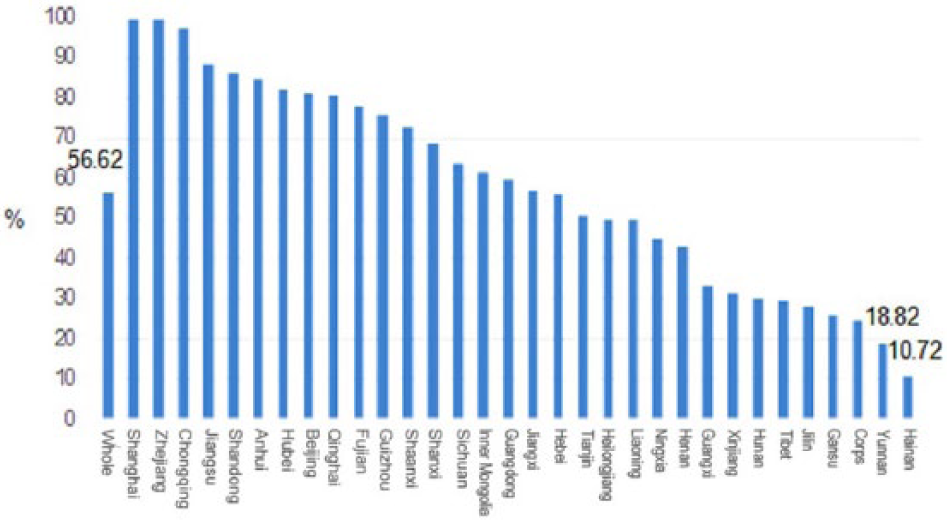
Percentage of elementary and middle schools with multimedia facilities nationwide in 2016.
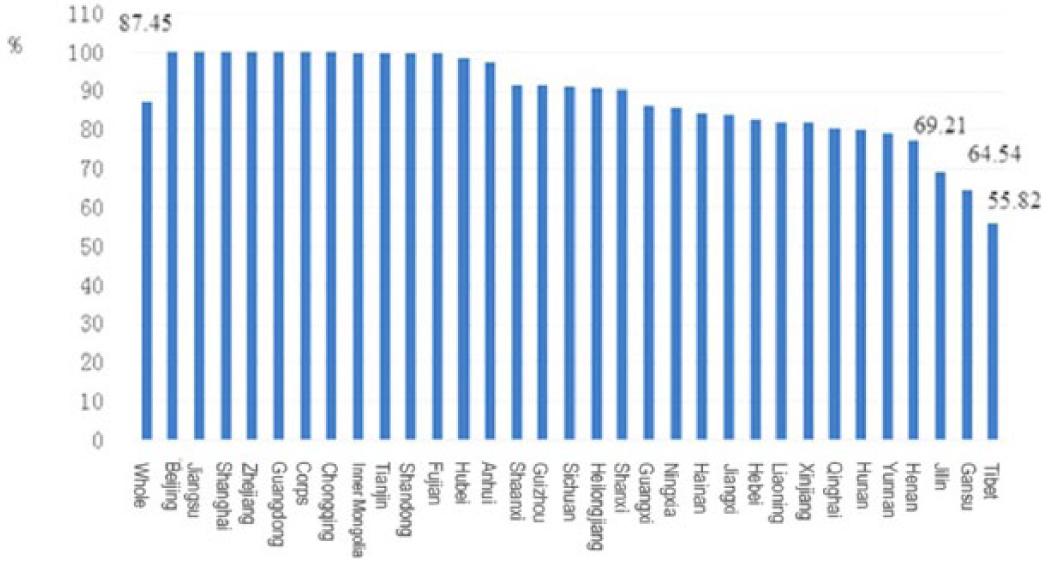
Percentage of elementary and middle schools connected to Internet nationwide in 2016. Source: MOE (2016a).
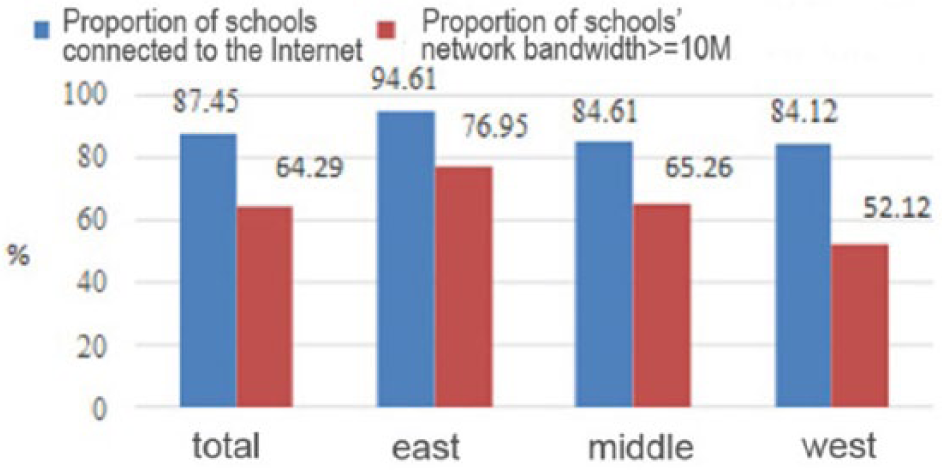
Proportion of elementary and middle schools connected to Internet in various regions of China in 2016.
The second challenge is the poor maintenance and sustainability of technological infrastructure due to insufficient funding for replacement of old equipment (Ren et al., 2016). It has been pointed out in the ‘Special supervision report of national educational informationization 2016’ (MOE, 2016a), that effective and financially guaranteed maintenance of educational ICT facilities needs to be urgently addressed. At present, technological maintenance relies mostly on project funds or special funds, while there is a lack of long-term funding support for equipment maintenance, upgrades, networking charges, teacher training, purchasing of resources, and applied research.
The third challenge is the lack of ICT teachers. For example, it was found that there were only 1129 ICT teachers in the 1970 middle schools and 425 ICT teachers in the 17,000 elementary schools in Gansu Province, most of whom were physics and mathematics teachers interested in computing; and the number of technical support staff is even smaller (Guo et al., 2003). Most of the ICT teachers focus on teaching computing rather than integrating ICT in their pedagogy (Zhang, 2014).
Inadequate guaranteed mechanism for resources construction and application
At present, there is no long-term investment mechanism for ICTs in education funding in China. Supply and demand for high-quality education information technology and resources are not aligned. There is no effective mechanism for communication between resource construction units and demand units, resulting in the situation where teachers and users cannot find appropriate and genuine e-learning resources, despite their large quantity. In the existing administrative system for ICTs in education, the powers and responsibilities of each party are not clearly defined and coordination between parties is inefficient. According to a survey by Mingzhuo Liu (Liu, 2016), MOOC projects are usually administered by multiple offices, including offices of academic affairs, information centers, resource centers, multimedia centers, and so on. It is also common for one government unit to oversee administration, operation and evaluation at the same time. In addition, the education administrative departments need to enhance their coordination, leadership, and operation, and the systems for information security also needs to be strengthened.
Discussion
China has its own particular issues in e-learning development. Many researchers place infrastructure as the major challenge to e-learning (Khan et al., 2012; Kisanga and Ireson, 2015); and yet China has achieved national computer coverage. All kinds of schools in cities and developed regions have campus networks and are connected to the Internet, and it would seem that schools in rural areas are gradually catching up (MOE, 2012). According to the Statistical Report of China Internet Development, up to December 2015 the population of Internet users in China had reached 0.731 billion and that of networked citizens using mobile phones had reached 0.695 billion (China Internet Network Information Center, 2017). The penetration of the Internet has reached 53.2%, with more than 50% of the Chinese people linked to the Internet (China Internet Network Information Center, 2017). Thus there is not such a large infrastructure gap in terms of e-learning. However, China has experienced a period of stagnation in e-learning development for the past 5 to 7 years, due to facilities being unused, underused, or used only for demonstration purposes (Zhang, 2014). This is the biggest issue to be resolved in the near future. As in many other countries, teachers’ capabilities and interest in e-learning are significant challenges in China. Aside from the lack of ICT teachers discussed above, the examination system in China has a major impact. The examination-centered educational system, together with the deeply rooted lecture-based learning system (Zhang, 2014) has, to a certain extent, marginalized e-learning in basic education, which means teachers are less inclined to drive it forward in this sector.
Many studies have shown that insufficient financial support is another major hindrance to e-learning (Khan et al., 2012; Sife et al., 2007; Tarus et al., 2015). In China, however, the funding for e-learning is significant; but due to its large population and area, e-learning funding per school is inadequate and the funding is unevenly distributed. According to Jingtao Zhang and Xiaoyong Hu (Zhang and Hu, 2008), e-learning facilities in east China are much more advanced than in Central and West China. In some schools in East China, the student-to-computer ratio is 5.5:1 and teacher-to-computer ratio is 0.6:1, whereas in some elementary schools in Central and Western rural areas, there is only one computer or DVD player for the whole school.
Despite the large quantities of e-learning resources in China, the matter of poor application has been perplexing. This is partly due to the priority of quantity rather than quality in the production of resources. There is no effective evaluation system for e-learning resources in China. The current evaluation systems, such as the ‘Quality course evaluation system’ and the ‘Networked course evaluation system’, have not included users’ evaluations as an integral component. Moreover, lack of both intellectual property rights (IPR) and effective sharing mechanisms has restricted the application of some excellent resources.
Conclusions and prospects
After more than a decade of development, China has experienced significant achievements in e-learning development – for example, in terms of infrastructure, resources, number of learners engaged in e-learning, and market growth. However, much needs to be done in the future to tackle the issue of sharing e-learning resources, teacher training, and the apparent gap between different areas and levels of commitment to e-learning on the part of the parties involved. Zhanyuan Du, Vice Minister of Education of China, has stressed that there are three key tasks for e-learning development in China: teachers’ and students’ acknowledgement of e-learning, teachers’ capacity for integrating ICT with daily instructions, and production of sufficient quality resources so that teachers can focus on pedagogical design (Liu, 2015).
In 2016, the ‘13th five-year plan for ICT in education’ (issued by the Chinese Ministry of Education) proposed that, by 2020, a globally advanced system for ICTs in education, with Chinese characteristics (in alignment with the national educational modernization goals), would be built up in China in order to realize the goal that ‘anyone can learn any time and any place’ (MOE, 2016b). ICTs will be innovatively integrated with education to promote all-round development of students, support comprehensive reform of education, and facilitate innovative, balanced and quality development of education in China. To achieve these goals, the government, schools, social communities and businesses will need to co-operate and harness their respective strengths in the following areas.
First, there must be the establishment of an effective assessment and incentive mechanism. E-learning in China is mainly supported by the government, while school administrators, teachers and students, particularly those in the basic education sector, do not have the initiative, because of China’s traditional evaluation system. For instance, students’ scores in standard tests and examinations are still the sole criterion adopted by schools, society, and parents, for teacher appraisal in China. As a result, teachers would rather focus on enhancing the students’ test scores than attempt innovative instructional patterns with unknown results. An evaluation and incentive mechanism that can encourage teachers’ and students’ initiatives is crucial to the success of e-learning in China.
Second, promotion of the information literacy of school administrators, teachers and students is needed. The success of e-learning implementation relies on the school administrators, who formulate school policies; teachers, who take the advantages of e-learning to optimize classroom instruction; and students, whose information literacy is a prerequisite for future development. Training programmes offered jointly by government and schools, together with academic exchanges and research, are possible ways to enhance the information literacy of the school administrators and teachers. The improvement of students’ information literacy can be effected with quality instruction, excellent educational products and services and positive learning feedback, which calls for the cooperative endeavor of enterprises, society, schools and families.
Third, expansion and deepening of lifelong learning using modern communication technologies is a consideration. As a critical challenge in this era, the way in which lifelong learning is promoted with ever-developing information technology is an important area to explore in China. When a college graduate is confronted with various complicated issues in real life or work, it is likely that informal learning, especially assisted by information technology, will be the most effective means by which to enhance their skills, knowledge and abilities to meet these challenges.
Fourth, the establishment of a ‘production–utilization–research’ model for information technology products to optimize e-learning resources construction is required. After more than 20 years of development, China has generated a large quantity of e-learning resources, keeping pace with global levels. However, the focus on resource construction at the expense of application has been a serious problem in China, and these resources need refinement and utilization. Generation of e-learning resources in the future in China will be application-oriented, with an emphasis on design optimization, redevelopment, and greater efficiency. A ‘production–utilization–research’ model will provide strong support for the development of application-oriented e-learning resources so that e-learning resources with the most elaborate design and highest practical value can be constructed and utilized.
Footnotes
Declaration of conflicting interests
The author(s) declared no potential conflicts of interest with respect to the research, authorship, and/or publication of this article.
Funding
The authors disclosed receipt of the following financial support for the research, authorship, and/or publication of this article: This work is partially supported by the ‘12th Five-year Plan of National Science of Education: The Key Research Topics’ of the Ministry of Education (DIA140316).