




Abstract
Until the discovery of insulin in 1921 there were no effective treatments for diabetes mellitus. After the advent of long-acting insulin, the first oral agents, sulfonylureas became available in the mid-1950s, quickly followed (outside of the United States) by metformin. It was then another three decades before newer agents became available, with alpha glucosidase inhibitors, thiazolidinediones and meglitinides following in the 1990s. Since the turn of the century, several new classes have also been launched. But how do these agents fit into the management of type 2 diabetes? How does one choose which drug class to use after metformin? This review looks at the agents launched since 2000 and how and when they can be used. It also deals with some of the controversies that have arisen and how decisions have changed as a result, in particular moving away from the use of HbA1c as the driver for decision, but rather the cardiovascular safety of these agents and their use in the prevention of premature cardiovascular morbidity and mortality. Now that some of these agents have shown cardiovascular benefit, will this lead to a change in the treatment paradigm?
Keywords
Introduction
Between 1922 and the early 1950s the only effective medication available to treat diabetes mellitus was insulin. In the late 1950s, sulfonylureas and metformin became available and were the only agents available for the treatment of type 2 diabetes until the late 1990s, when acarbose, thiazolidinones and nateglinide became available.1–5 Since 2000 we have had a number of new agents licensed for use in treating type 2 diabetes, including colesevelam, bromocriptine, sodium glucose linked transporter-2 (SGLT-2) inhibitors, and the ‘incretins’ [glucagon-like peptide-1 (GLP-1) receptor agonists and dipeptidyl peptidase 4 (DPP-4) inhibitors].6–9
This review will focus on the use of the newer agents and some of the controversies about some of the older agents, looking at their places in prescribing and the data emerging from some of the new clinical trials.
Changes in prescribing practice
It was the publication of the United Kingdom Prospective Diabetes Study (UKPDS) that propelled the use of metformin as the main first-line agent for treating diabetes in 1998. 10 Since then many national and international guidelines have promoted the use of metformin as the first-line agent to treat type 2 diabetes.11–16 However what should be the second line has been a matter of conjecture and debate for some time. Given that sulfonylureas have become so cheap their use as second-line agents has been very common until the appearance of the agents that were launched in the 21st century. 11 However, with the suggestions that their use is associated with an increase in severe hypoglycaemia and cardiovascular mortality their use has been in decline.17–19 The most recent data are now suggesting that in the UK the DPP-4 inhibitors have now overtaken the use of sulfonylureas as second-line agents, with the most common third-line agents now being SGLT-2 inhibitors.20,21 The use of thiazolidinones was rising between 2000 and 2006, but then declined sharply after the publication of data suggesting that at least one of these agents, rosiglitazone, was associated with an increase in cardiovascular mortality.20–22
The result of these newer agents being much more commonly prescribed, is an associated increase in cost, such that on average in the UK it costs £100 per patient with type 2 diabetes per year to treat them with glucose-lowering drugs. 20
In 2015, the European Association for the Study of Diabetes and the American Diabetes Association updated their recommendations for the management of type 2 diabetes. 11 After the use of metformin as the first-line agent, they suggest that any of the other treatment classes, including basal insulin, could be second line, and then any combination of the remaining classes could be third or fourth line, although they recommended injectable therapy as the ideal fourth line in addition to the preceding agent. 11
Whilst there are increasing numbers of head to head studies looking at the new agents with older agents, there are still no clear data to suggest which agent should be used as second or third line in preference to any other. This has led to a huge variety in prescribing practice, and therefore spending. In those geographical areas which continue to use metformin and sulfonylureas as the preferred agents, prescribing is associated with the lowest cost, whilst those areas that use some of the newer agents are increasing in cost, with a range of between £60 and £200 per person per year in the UK. 20
What happened in 2007?
Rosiglitazone came under scrutiny by the cardiologist Steve Nissen, who did some statistical analysis in the published data to show that the use of rosiglitazone was associated with an increased risk of myocardial infarction and death from cardiovascular causes. 22 This led to a re-evaluation by many diabetes doctors around the world as to what they were doing and why they were doing it, and in particular the role of the regulators and the influence the pharmaceutical industry had on prescribing. 23 This re-evaluation led to an understanding that HbA1c should not necessarily be the primary aim for diabetes trials even though this was mandated by the United States Food and Drug Administration (US FDA). 24 As a result, the US FDA developed some guidance for the pharmaceutical industry, specifically looking at evaluating cardiovascular harms as a result of antidiabetic therapy used to treat type 2 diabetes. 25
What they came up with was a hierarchy of recommendations and requirements for post-marketing studies looking at cardiovascular safety depending on the phase II and III study outcomes.
If the upper limit of the 95% confidence interval (CI) hazard ratio (HR) of a clinical trial remained <1 it showed superiority over the comparator agent, and thus no post-marketing studies were needed.25,26 This is shown in Figure 1. When the a priori hypothesis was that the drug was noninferior to the comparator agent and the upper limit of the 95% CI remained <1.3, then again, there was no need for a post-marketing study. However, if a noninferiority study was performed and the upper limit of the 95% CI was >1.3 then the post-marketing cardiovascular safety study was required. If the upper limit of the 95% CI was >1.8, or the lower limit of the CI was <1 and the upper limit >1.8 then this was underpowered and in both of these later situations the drug was not approved by the US FDA.25,26
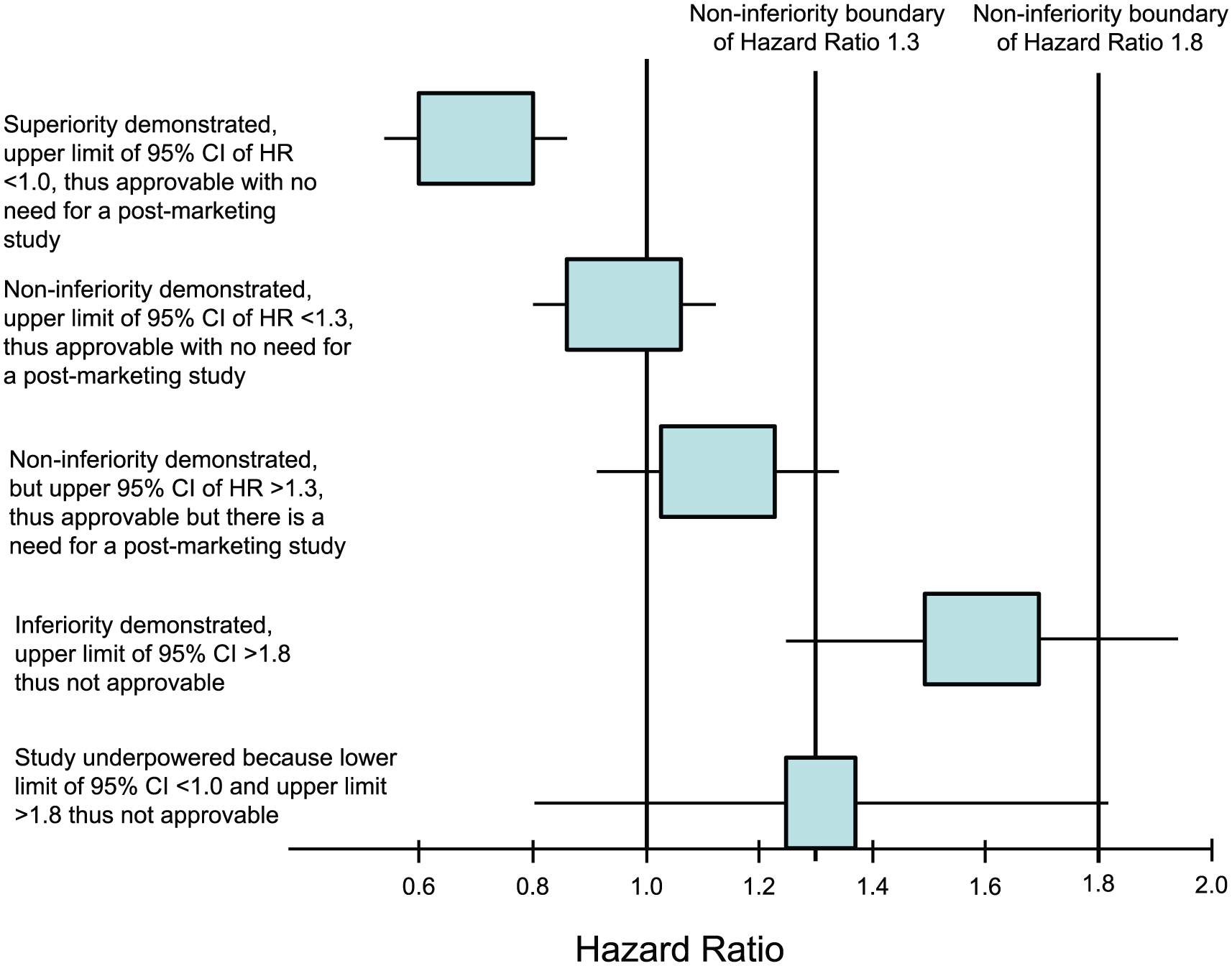
The statistical requirements from the United States Food and Drug Administration about whether a post-marketing cardiovascular safety is required. Adapted from Hirshberg and Raz. 26
Cardiovascular outcomes with a focus on GLP-1 agonists and SGLT2 inhibitors
Diabetes is associated with a higher risk of cardiovascular disease, in particular coronary fatal and nonfatal myocardial infarction and all forms of stroke. 26 When one looks at all-cause mortality in the older studies comparing tight glycaemic control to standard of care at the time, then there was a 21% risk reduction in mortality in the UKPDS,10,27 a 4% reduction in the primary endpoint of the PROactive trial,28–30 a 7% reduction in the ADVANCE trial, 31 and a 9% increase in risk in the VADT trial. 32 However, none of these studies showed any statistically significant reductions in all-cause mortality with tight glycaemic control. In addition, the ACCORD trial showed a statistically significant 28% increase in risk of death from all causes. 33 However, a subsequent analysis suggested that the increased deaths were predominantly amongst those who had the poorest glycaemic control, and were not accounted for by an increase in hypoglycaemia. 34
Subsequently all of the newer agents have undergone or are undergoing, cardiovascular safety studies. 35 These include long-acting insulins, 36 the DDP-4 inhibitors,37–42 the GLP-1 receptor agonists,43–49 and the SGLT-2 inhibitors.50–53 All of those published so far have proved to be essentially neutral or noninferior when looking at cardiovascular outcomes and safety. The exceptions to this are 2 SGLT-2 studies, EMPA-REG (empagliflozin), 50 and the CANVAS study (canagliflozin), 51 and 2 GLP-RA studies, LEADER (liraglutide), 44 and SUSTAIN-6 (semaglutide). 45 Together, these are the first large outcome studies to show that these agents are associated with a reduction in cardiovascular mortality in people at high risk of cardiovascular death.
There are however some risks associated with the use of these agents. In particular the use of canagliflozin was associated with a significant increase in the risk of lower extremity amputation (LEA). 51 Whilst a post-hoc analysis of the empagliflozin data showed a neutral effect on lower extremity amputation, 54 a recently published post-hoc analysis of the LEADER data has shown that in those at high cardiovascular risk, liraglutide use significantly reduced the risk of major amputation. 55 The two recent comparisons of the use of SGLT-2 versus other glucose-lowering agents have reached the same conclusions with respect to the risk of lower extremity amputations.56,57 Chang and colleagues suggested that the use of SGLT2s was associated with a numerically higher risk of amputations than DPP-4 inhibitors and GLP-1 agonists but that this was not statistically significant (adjusted HR 1.5, 95% CI 0.85–2.67). The authors also showed that the risk of lower extremity amputation (LEA) with SGLT-2 use was statistically significantly higher when compared with sulfonylurea, metformin or thiazolidinedione use (adjusted HR 2.12, 95% CI 1.19–3.77). 57
Of course, there are other data which are of concern, especially in the use of SGLT-2 inhibitors with diabetic ketoacidosis. However, one of the issues with these is that diabetic ketoacidosis (DKA) was not adjudicated as an outcome for these studies and therefore there has recently been a call for standardization of the definition of DKA, particularly in clinical trials, 58 and also a call for an update in how DKA should be defined. 59 This lack of adjudication and formal definition resulted in the canagliflozin trials suggesting that they had a very low incidence of DKA. They published data to suggest that only 12 people developed DKA in their large trial programme of over 17,000 participants. 60 On closer inspection of the data however, 6 of the 12 patients, had no pH, no bicarbonate, anion gap or ketone concentration reported, and one individual not even having blood glucose reported. 60 Looking at the data for dapagliflozin, most of the individuals (to date presented in abstract form only) had no pH, no bicarbonate, no glucose and no ketone concentrations reported, and yet were deemed to have DKA. 61 Thus, there are several organizations that have produced documents highlighting the risk of DKA with the use of these agents.62–64
These agents are clearly used far more frequently as shown by the recent prescribing data from the UK.20,21
What about type 1 diabetes?
Because the SGLT-2 inhibitors work in an insulin-independent mode of action, there is interest in using them for people with type 1 diabetes. However a new agent, sotagliflozin, an SGLT-1/2 inhibitor, is currently going through the regulatory process and has been submitted for approval by the US FDA early in 2019. 65 The use of sotagliflozin in people with type 1 diabetes has recently been shown to result in a statistically significant reduction in HbA1c with no increased risk of severe hypoglycaemia. 66 There was however a statistically significant increase in the risk of (adjudicated) diabetic ketoacidosis, 3.0% versus 0.6% with placebo. Whether this leads to the approval of the drug and how this changes the treatment paradigm and education offered to people with type 1 diabetes remains to be seen.
Conclusion
In summary, over the last few years the treatment paradigm for the management of type 2 diabetes has changed. In particular there has been increased use of DPP-4 inhibitors, SGLT-2 inhibitors and now, GLP-1 analogues. The latter two classes have shown cardiovascular benefits, in particular for those people already at highest risk. For people with type 1 diabetes, in addition to insulin there is increasing interest in the use of agents such as the SGLT-2 and SGLT-1/2 inhibitors. Currently at first glance, with the data suggesting that a lot more money is being spent on diabetes care, for no overall benefit in HbA1c on a population level, there seems little justification for moving to the newer agents. However, there need to be more data on the economic benefits of moving to the newer agents, in particular on hypoglycaemia avoidance and cardiovascular benefit. Clinicians should consider whether they can justify prescribing medications that do not show benefits in these clinically appropriate endpoints. HbA1c-lowering should not be the goal, preventing avoidable hypoglycaemia and premature cardiovascular mortality should remain the goals. We will have to watch this space.
Footnotes
Acknowledgements
KD conceived and wrote this commissioned manuscript. It was based on a talk he gave at the Royal Society of Medicine in London, UK in September 2018.
Author’s Note

Funding
This research received no specific grant from any funding agency in the public, commercial, or not-for-profit sectors.
Conflict of interest statement
KD has received honoraria and/or and travel support from Novo Nordisk, Sanofi Diabetes, Lilly, Lexicon Pharmaceuticals, Genentech and Urgo Laboratories.