




Abstract
Introduction:
The number of citations an article receives is an important indication of its impact and its contribution to academia. There is a paucity of literature concerning top article citations in diabetes. The main objective of this investigation was to bridge this gap and to provide readers with a practical guide in evaluating diabetes literature.
Methods:
Scopus Library was searched to determine the citations of all published diabetes articles. A total of 100 articles were included in our investigation under the subject category ‘Diabetes, diabetes mellitus, and diabetics’. Two databases were used to extract citations. We did not apply any time restriction in our search. The top 100 cited articles were selected and analyzed by two independent investigators. We extracted immediacy index from ResearchGate.
Results:
The journal with the highest number of top 100 cited articles was The New England Journal of Medicine with 23, followed by 22 in Diabetes Care. The top article on the list received 17,779 citations. A statistically significant association was found between the journal impact factor and the number of top 100 cited articles (p < 0.005). The United States had the highest number of articles (59). Contrary to bibliometric analyses published in other medical fields, the largest subset of the diabetes articles (n = 54) were published in the 10-year period between 2000 and 2009.
Conclusion:
Our analysis provides an insight on the citation frequency of top cited articles published in diabetes to help recognize the quality of the works, discoveries and the trends steering the study of diabetes.
Introduction
There is a rapid incline in the incidence and the prevalence of diabetes. While previous reports projected an increase in the total number of people with diabetes from 171 million in 2000 to 366 million by 2030 [Lago et al. 2007], newer literature states that the increase observed from 2000 to 2007 has almost reached the World Health Organization (WHO) prediction for 2030 [Monesi et al. 2012]. Thus, diabetes represents a formidable economic burden on US healthcare due to increased health resource use and lost productivity. In 2007, diabetes was projected to cost $174 billion in healthcare services, medications and increased absenteeism at work [American Diabetes Association, 2008]. In 2013, National Institutes of Health (NIH) spent over $1 billion to support diabetes research.
The goal of our investigation was to identify the 100 most frequently cited articles that describe the advances in diabetes research. While the value of citation rates has been debated, analysis of citation frequency can be valuable in identifying important issues and discoveries within the medical realm. Hence, a bibliometric analysis of scientific literature may be used to identify the impact of influential scholarly work, subjects, authors, etc. While various journals provide statistics of their own publications, we did not encounter an across-the-board bibliometric analysis of diabetes research. Therefore, we present the findings of our bibliometric analysis intended to assess important characteristics of the 100 most cited articles that focused on diabetes.
Methods
In December 2014, we used the Scopus Library database (www.scopus.com) to determine the 100 most cited diabetes articles using the subject category ‘Diabetes, diabetes mellitus, and diabetics’. The articles identified by these search terms were accessed and reviewed online through the NIH library. In cases where electronic copies were unavailable, hard copies were sought from the interlibrary loan service. The articles from the database were sorted from most-to-least citations by using the option ‘times cited’. The list of articles identified was exported into a spreadsheet and cross-referenced with Google Scholar to ensure an accurate count of citations obtained from Scopus. Clinical studies of diabetes were included in the investigation. However, to maintain focus on diabetes research, articles with a primary focus on a single disease other than diabetes were excluded. Also, articles that focused on blood glucose measurement studies, epidemiological or observational cohorts of blood glucose variations linked with different diseases, exercise and sleep were excluded.
Using the modified approach of the methods used by Lim and colleagues [Lim et al. 2012], 2 independent investigators (W.S., J.L.C.) reviewed the 100 articles and the following data were compiled: number of authors; publication year; journal name; impact factor; country of origin; and article type (guidelines, observational study, randomized clinical trial, basic science, review article, and meta-analysis). Observational studies included case-control studies, cohort studies and case series. Randomized clinical trials included both single and double-blind studies. The immediacy index was obtained using ResearchGate (www.researchgate.net).
Using the Pearson product-moment correlation coefficient, we evaluated the strength and direction of the linear relationship between the impact factor of the journal and the number of top 100 cited articles included in the list. The statistical software packages used for data analysis were Stata\MP 10.0 (Stata, College Station, Texas, USA). Data are presented as medians and interquartile ranges. A significance level of α = 0.05 was used for all the comparisons.
Our investigation did not require Institutional Review Board (IRB) approval as routine data were used in the analysis.
Results
The number of citations for the top 100 cited articles ranged from 964 to 17,779 (Table 1). The median number of citations was 2967 (interquartile range: 2395). The median number of authors was 6 (interquartile range: 7). The top 100 articles were published between 1960 and 2013, with most articles (n = 20) published in the 5-year period between 2000 and 2009 (Figure 1). We found that the earliest top cited article was published in 1962 [Neel, 1962], while the most recent one was a guideline paper published in 2013 [American Diabetes Association, 2013].
List of 100 most cited articles on diabetes.

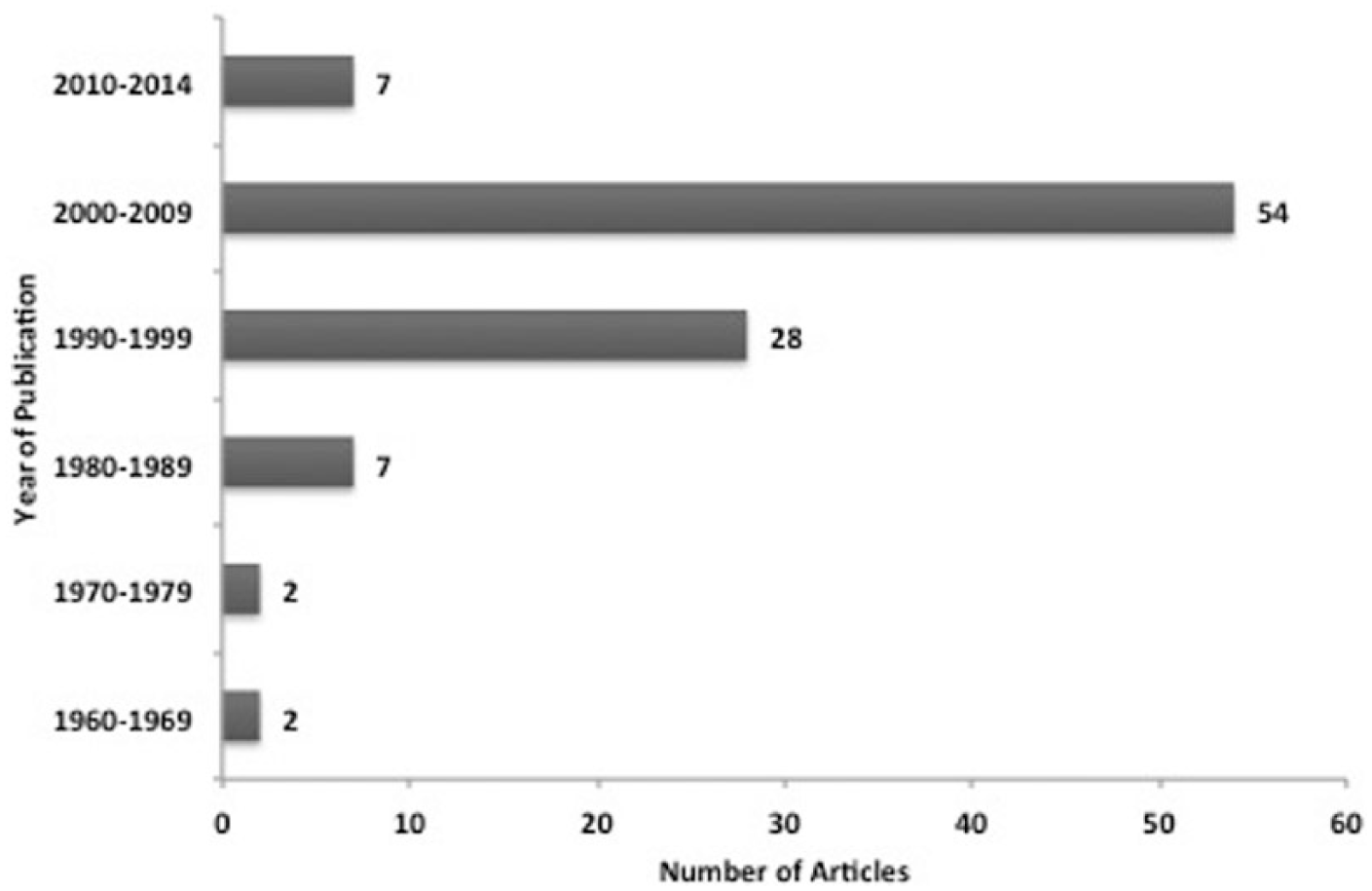
Top 100 articles and the year of publication.
The journal with the highest number of top 100 cited articles was The New England Journal of Medicine with 23 (Table 2), followed by Diabetes Care with 22. Diabetes, The Lancet and Nature each had 8 highly cited articles. The impact factors for journals with the top 100 cited articles ranged from 2.8 to 54.4. The highest immediacy index also belonged to the journal with the highest impact factor. We found a statistically significant association between journal impact factor and the number of top 100 cited articles (p < 0.005).
Article citations, impact factor and immediacy index according to journal.

There were 13 different countries of origin for the highly cited articles. The United States had the largest number of articles with 59. The United Kingdom published a total of 17 articles. Australia, Canada, Denmark, Finland and Japan each had three or more articles (Figure 2). Most of the articles were either randomized controlled trials (RCTs) (29%) or basic science (24%) (Figure 3).

Distribution of top 100 articles by countries.

Distribution of top 100 articles by article type.
The top cited article was ‘The effect of intensive treatment of diabetes on the development and progression of long-term complications in insulin-dependent diabetes mellitus’ published in The New England Journal of Medicine in 1993 [Diabetes Control and Complications Trial Research Group, 1993].
Discussion
In our comprehensive list of the highly cited articles, we found that most of original reports that made the top 100 list were clinical (52 clinical observational and RCTs) compared with pre-clinical (24 basic science) studies. It is our understanding that the higher prevalence of clinical studies might be related to the fact that most of them appeared in high-impact journals, which also have a higher immediacy index that indicates how quickly articles in a journal are cited. However, frequently issued journals may have an advantage because an article published early in the year has a better chance of being cited than one published later in the year. Additionally, a previous bibliometric analysis suggests that the distribution of clinical findings is rapid [Rosas et al. 2013]. A total of 12 of the highly cited articles in our investigation were guideline papers, which were all published in diabetes specialty journals. Several analyses have reported that highly influential reports/guidelines are often published in the specialty journals [Brandt et al. 2010; Eshraghi et al. 2011; Hennessey et al. 2009; Loomes and van Zanten, 2013].
Our analysis found that the most highly cited articles were published in 16 of the journals. A total of 39 of the articles were published in diabetes specialty journals that have an impact factor ranging from 2.8 to 8.5. Our findings support the application of Bradford’s law, a bibliometric concept suggested by Brookes and Siegelman [Brookes, 1969; Siegelman, 1988]. The main idea behind Bradford’s law is that the majority of researchers obtain their citations from a few main journals in their respective field of expertise. When the researchers diverge from these core journals, their citation frequency and impact is weakened. Therefore, this tendency leads to a large percentage of citations stemming from a few core journals [Brookes, 1969; Siegelman, 1988]. We found that 5 of the top 10 articles were published in diabetes specialty journals. This indicates a growing trend of publishing highly influential articles in specialty journals compared with other higher impact factor journals. Other bibliometric analyses also tend to support this notion [Brandt et al. 2010; Eshraghi et al. 2011; Hennessey et al. 2009; Loomes and van Zanten, 2013].
We also demonstrate that the majority [n = 54] of the most highly cited articles were published between 2000 and 2009. This is contrary to the most of the other bibliometric analyses, which generally found that the peak period for citation was between 1980 and 1995 [Lefaivre et al. 2011; Ponce and Lozano, 2010]. In a citation classic of general surgery journals, the authors reported that approximately one-third of the highly cited works were published before 1960 [Paladugu et al. 2002]. The dynamic field of diabetes, in which the body of literature has flourished tremendously in recent years and clinicians tend to rely on the latest guidelines, may explain this contradiction. However, some elapsed time is needed for the articles to accrue citations and gain significant coverage. This lack of elapsed time explains the relatively few top cited articles published during 2010–2014. Future bibliometric analyses can confirm this notion and help to better delineate the timeline associated with peak citation trends. In contrast, the lack of any paper before 1960 in the highly cited list suggests the limited usefulness of old articles in the modern era. However, it is important to realize that this trend could be due to a combination of issues. Limitations in databases for tracking older articles, lack of online and internet resources in the pre-1990s, and the inclination at that time towards publishing original contributions in textbooks rather than in manuscript forms might have all added to this downward trend.
Overall, a large majority of the most highly cited articles in diabetes focused on treatment and associated diseases secondary to diabetes. This can have important implications for the stakeholders and journal editors in selecting and evaluating scientific works in the field. It is also vital to recognize the possible effect of publication bias towards these articles and the fact that diabetes literature is heavily tied to the pharmaceutical and other lifestyle modifying industries. Nonetheless, understanding the features inherent to highly cited work will help young researchers publish effectively. We also observed that 59% of the studies were from the United States, which could be due in large part to the funding support of NIH and other private sectors.
We recognize that our results were subjective due to our choice of questions to investigate, the inclusion/exclusion criteria and limitations of the databases. Firstly, this type of study usually favors older published articles and omits landmark articles from the past 10 years [Gisvold, 1999]. However, in contrast, in this study, approximately 50% of the most highly cited articles were from the past 10 years. Secondly, there are potential shortcomings in the database used and the exclusion of textbooks in this methodology. This might have resulted in the omission of articles before 1980 as Scopus is reported to often miss older citations [Bakkalbasi et al. 2006; Falagas et al. 2008]. However, to safeguard our methodology, we included general medical journals such as The New England Journal of Medicine to prevent missing highly cited articles during our search. Thirdly, we cross-referenced our citations with Google Scholar to ensure an accurate account of citations. Fourthly, articles published in languages other than English might have received unfair citation counts because of bias and poor recognition in the field. Also inherent problems associated with citation analyses such as the bias linked to relying on the total number of times an article is cited must also be noted. Although minimal, self-citation was not taken into account in our study. Despite these limitations, our investigation provides some insights into the most read and cited articles in the field of diabetes research during the past century.
Conclusion
Our analysis provides an insight on the citation frequency of top cited articles published in diabetes to help recognize the quality of the works, discoveries, and the trends steering academia in diabetes.
Footnotes
Declaration of Conflicting Interests
The authors declare no conflicts of interest in preparing this article.
Funding
This research received no specific grant from any funding agency in the public, commercial, or not-for-profit sectors.