



Abstract
Objective
To use bibliometric analysis to understand characteristics and trends in the research on chronic venous disease (CVD), which affects patients’ quality of life by causing pain, swelling, and ulceration.
Methods
We searched the Thomson Reuters Web of Science citation indexing database to identify the 100 most-cited manuscripts on CVD. The resulting articles were analyzed by title, author, institution, topic, year of publication, and country of origin.
Results
The Journal of Vascular Surgery published the most manuscripts on CVD (n = 36) and was the most-cited journal (n = 5356). The United Kingdom was the country with the greatest number of publications (n = 32). Imperial College London was the institution with the highest number of publications (n = 6). Endovenous thermal ablation was the most widely studied research specialty (n = 30).
Conclusions
Our analysis showed that the majority of CVD research is carried out in Western countries, and that the number of research studies is increasing in line with recent advances in CVD.
Introduction
Chronic venous disease (CVD) is a common condition in Western countries, typically affecting 164 people for every 1000 individuals. 1 Among the various clinical manifestations of CVD, varicose veins are the most common, 2 and can cause symptoms such as pain, swelling, throbbing, cramping, and itching. In more severe cases, CVD can cause superficial thrombophlebitis, bleeding, and lipodermatosclerosis, as well as ulceration, which can affect patients’ quality of life. 3 In Asian populations, the prevalence of CVD is reportedly lower than that in non-Hispanic white populations. 4 However, the lower rates of superficial venous surgery among Asians residing in the UK have been reported as resulting from cultural and religious differences rather than from inherent differences.
CVD research is a well-established field of study, which has diversified with the recent introduction of various treatment modalities. Bibliometric analysis allows research trends to be analyzed by evaluating authors, journals, countries, and trends of publication. 6 The aim of the present study was to understand the characteristics and trends in CVD research using bibliometric analysis. Given the large number of publications on CVD in the literature, we performed bibliometric analysis on the 100 most-cited articles, with citation ranking considered to reflect the level of influence. 7
Methods
The Institutional Review Board of Hallym Medical University approved the review of medical articles using a publicly available database (approval no. HKS 2019-05-025). A search of the Thomson Reuters Web of Science citation indexing database and research platform was completed on January 17, 2019. The terms used in the search were “varicose vein”, “saphenous vein”, “chronic venous disease”, and “chronic venous insufficiency”. Inclusion criteria were CVD limited to lower extremities, superficial CVD, and multiple clinical manifestations of CVD including varicose vein, venous ulcer, and lipodermatosclerosis in the CEAP classification. 8 Synonyms included varicose, varix, varices, and varicosities. Exclusion criteria included deep vein disease and venous disease in locations other than the lower extremities. The resulting dataset was filtered to include only full-text manuscripts in English. These manuscripts were subsequently sorted by number of citations, a method initially developed by Paladugu and colleagues. 9 Analysis of individual articles was performed by two independent reviewers (HJ and JWH) to verify the relationship to CVD. The 100 most-cited manuscripts were identified, and the resulting dataset was further evaluated for title, first and senior author, institution, topic, year of publication, and country of origin. The individual and 5-year impact factors of the journals in which the papers were published were recorded. To prevent potential bias for older manuscripts having had more time to be cited, the citation rate was determined by dividing the citation number by the number of years since publication.
Results
The Web of Science database search returned 7639 full-length English language articles. Table 1 lists the 100 most cited of these articles. The number of citations ranged from 403 for Evans et al. 10 (“Prevalence of varicose veins and chronic venous insufficiency in men and women in the general population: Edinburgh vein study”) to 86 for Gillet et al. 11 (“Side-effects and complications of foam sclerotherapy of the great and small saphenous veins: a controlled multicenter prospective study including 1025 patients”). The mean number of citations for all articles was 150.4 ± 73.1. The citation rate was highest for the review article “The care of patients with varicose veins and associated chronic venous diseases: clinical practice guidelines of the society for vascular surgery and the American venous forum” by Gloviczki et al. 12
The 100 most-cited articles on chronic venous disease.

The 100 selected articles were published between 1983 and 2014, with half of the articles published after 2000 (n = 60) (Figure 1). The oldest article was published in 1983 by Raju et al. 13 (“Venous insufficiency of the lower-limb and stasis ulceration – changing concepts and management”). The most recent article, published in 2014 by Eberhardt et al., 14 was a review article on chronic venous insufficiency.

Number of publications in each 5-year period.
The 100 articles were published across 25 journals in total, with the number of manuscripts published per journal ranging from 1 to 36 (Table 2). The Journal of Vascular Surgery published the most articles (n = 36) and had the most citations (n = 5356). Circulation had the highest impact factor (18.881) and 5-year impact factor (17.902), and had published three of the most influential articles (582 citations).
Journals of the 100 most-cited chronic venous disease articles.

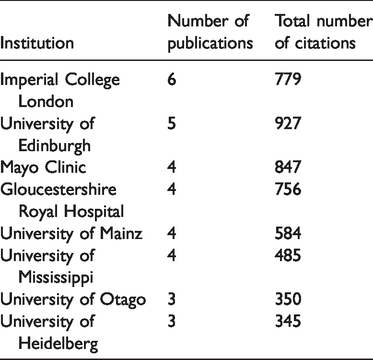
The country with the greatest number of publications among the top 100 articles was the United Kingdom, with 32 articles, closely followed by the United States with 30 publications. Among the 100 articles, 98 research studies has been performed in Western countries and the remaining 2 research studies had been performed in Japan and Turkey (Figure 2). Imperial College London was the institution with the highest number of publications among the top 100 articles, with 6 publications, followed by the University of Edinburgh with 5 publications (Table 3). Thirteen authors contributed to four or more papers, among which Thomas Michael Proebstle contributed to seven publications as a senior author (Table 4).

Distribution of the 100 most-cited articles by the country of origin of the contributors.
Institutions with the most articles in the 100 most-cited articles.
Authors that contributed four or more articles in the 100 most-cited articles.

The number of articles in each main research area is shown in Figure 3. Endovenous thermal ablation (ETA) was the most widely studied specialty, with 30 articles among the top 100, followed by nonthermal ablation (NTA) and symptoms, with 14 articles each. Twelve articles studied surgical therapy, whereas 11 were related to epidemiology. Nine articles examined disease recurrence after treatment, five articles were on pathogenesis, and five on other topics.

Number of publications among the 100 most-cited articles by topic (ETA: endovenous thermal ablation, NTA: nonthermal ablation).
Regarding the number of publications in each 5-year period as shown in Figure 1, 2001 to 2005 had the highest number of publications, with 39 articles (39%). Twenty articles out of 39 (51.2%) were on techniques such as ETA and NTA. During this period, research on treatment modalities was actively introduced. As shown in Figure 3, ETA and NTA were the most widely studied topics. In the 10 years from 2006 to 2015, 17 out of 21 articles (80.9%) were on ETA and NTA.
Discussion
Regarding the history of surgical treatment for CVD, Trendelenburg introduced saphenous vein ligation in 1890 while Homan introduced ligation of the saphenofemoral junction in 1916. In the 1890s, excision of the great saphenous vein was introduced by Charles Mayo, and can be considered as the beginning of stripping. In the 1990s, ETA techniques including laser ablation and radiofrequency were introduced and adapted as an alternative treatment to traditional stripping. 15 More recently, ETA techniques have undergone rapid development, and in 2013, the National Institute for Health and Care Excellence recommended endovenous thermal ablation as the preferred treatment for symptomatic varicose veins. 16 NTA, including ultrasound guided foam sclerotherapy with a lower risk of nerve injury, has recently been adopted and is widely used at present while research is ongoing. Furthermore, NTA alternatives such as mechanochemical endovenous ablation and endovenous delivery of cyanoacrylate tissue adhesive are also being studied. 17
Bibliometric analysis is a research method that allows the analysis of publication quality as well as the scientific productivity in a field of research. 18 The citation of articles, in particular, is a robust method for analyzing the quality and impact of publications. 19 For these reasons, the 100 most-cited articles were analyzed to evaluate the characteristics and trends in CVD research in the present study. In Table 2, the top four cited journals on CVD were related to surgery. To date, surgical journals have played an important role in CVD research. Although new treatment modalities for CVD have recently been adopted, the cited manuscripts discuss the ongoing role of surgeons with a general understanding of the disease and ability to provide appropriate treatment.
Our study found that CVD research initially focused on the characteristics of the disease, including epidemiology, symptoms, recurrence, and pathogenesis. With recent developments in technology, treatment for CVD is becoming less invasive and less complex. Alongside this trend, CVD research is becoming more focused on new treatment modalities. Thus, comparative studies and meta-analyses on newly developed modalities are likely to continue to increase.
Limitations of this research include potential biases related to the bibliometric analysis, including language bias, institutional bias, and influential researcher bias. Older articles have a greater potential for citation because of their relatively longer period of time in the publication domain. To control for this, the number of citations was divided by the number of years after publication to yield a citation rate, which is provided alongside the citation number in Table 1. Despite these mitigations, more recent relevant articles may have been underrepresented in this study.
Conclusion
Our bibliometric analysis of CVD research examined the characteristics and trends of publications. Research on CVD is typically carried out in Western countries and is continuing to increase with the introduction of new treatment modalities.
