



Abstract
Objective
To identify the top 100 most impactful articles in nasopharyngeal carcinoma (NPC).
Methods
Articles on NPC from 1970 to 2018 were retrieved from the Web of Science (WoS). These articles were ranked in descending order based on the number of times they were cited, and all titles and abstracts were screened to identify the top 100 most-cited articles.
Results
The earliest and most recent articles were published in 1971 and 2016, respectively. The most prolific decade was the 2000s, with 51 articles published. The highest citation count reached 1223 and the lowest was 155. Thirty-four journals contributed to the 100 articles, with the International Journal of Radiation Oncology Biology Physics contributing the most articles (n=16). Notable contribution origins were Hong Kong (n=34), the United States (n=26), and China (mainland, n=12). The top three contributors were Chan ATC, Lee AWM, and Lo KW who were from Hong Kong. The types of articles included basic research (n=50), clinical research (n=36), and reviews (n=14).
Conclusions
This study identified the top 100 most impactful articles in NPC and stressed the multidisciplinary and multimodal nature of NPC management. Understanding historical articles may guide future NPC study.
Introduction
Over the past decades, the mortality rate associated with nasopharyngeal carcinoma (NPC) has decreased, 1 reflecting years of research that was focused on innovative techniques for controlling and managing NPC. However, an abundance of NPC literature involving different researchers, countries, specialties, and scientific journals has emerged and it is difficult to identify the important papers.
Citation analysis is a bibliometric analysis method 2 that evaluates the influence and importance of an article in a certain field by analyzing the citation count. 3 It is also an affirmation to authors, institutions, and countries that have made important contributions. This method has been frequently applied and widely recognized in various disciplines, such as orthopedics, 4 neurosurgery, 5 ophthalmology, 6 and otolaryngology.7,8 However, few articles have analyzed the highly cited NPC papers. Therefore, we aimed to identify the top 100 most-cited NPC articles from 1970 to 2018 using citation analysis.
In addition, recently published papers may not have sufficient citations mainly because of the time-dependent citation analysis. 9 For example, none of the clinical articles published from 2013 to 2018 were in our top 100 most-cited list. Therefore, to more comprehensively reveal the NPC development trend and research focus, we also conducted a corresponding analysis to identify the top 10 clinical research articles from 2013 to 2018.
Methods
Search strategy
We searched “TI = (nasopharyngeal carcinoma* OR nasopharyngeal cancer* OR nasopharyngeal neoplasm* OR nasopharyngeal tumor*)” on the Web of Science (WoS). The articles ranged from January 1970 to August 2018 and the document types were original articles and reviews. The retrieved articles were ranked from highest to lowest based on the number of citations. Two researchers reviewed and screened the title and abstract of the articles. If necessary, some studies with mixed NPC factors, such as head and neck cancer and Burkitt lymphoma, were excluded. Because no human subjects were enrolled, ethics approval was not required for this study.
Data extraction
After filtering the articles, we extracted the contents including the title of each article, the number of citations, the source journal, the first author, and the research institute and its country. Next, based on the type of article, the literature records were further divided into basic research, clinical research, and review. We extracted the type of study and the clinical evidence.
Statistical analysis
Data were analyzed using IBM SPSS 22.0 package (IBM Corp., Armonk, NY, USA). Descriptive statistics are presented as the count or percentage of the parameters. This study did not involve statistically significant differences.
Results
Our literature search yielded 17,116 articles between 1970 and 2018, and the top 100 articles on AR were identified based on the number of times they were cited (Table 1).
The top 100 most impactful articles on NPC.

There were 6675 articles between 2013 and 2018, and the top 10 most-cited clinical research papers were identified (Table 2).
The top 10 most impactful clinical research articles on NPC from 2013 to 2018.

Number of articles published
The Top 100 articles were mostly published from 1971 to 2016 (Figure 1). Among them, the greatest number of articles was published in the 2000s (n=51), followed by 1990s (n=24). The number of articles in the 2010s was equal to that in the 1980s (n=10) and the 1970s had the fewest articles (n=5).

Number of articles published by decade.
Number of articles cited
In these articles, the highest and lowest citation counts were 1223 and 155, respectively. The average citation count for a single article in the 1970s, 1980s, 1990s, 2000s, and 2010s was 293.2, 239.0, 271.2, 274.5, and 195.3, respectively.
Published journals
The 100 most influential papers were published in 34 journals. Among these journals, those with more than one article published and their impact factor are presented in Table 3. The top three journals were International Journal of Radiation Oncology Biology Physics (n=16), Journal of Clinical Oncology (n=14), and Cancer Research (n=11).
Journals with more than one published article.

Origins
These articles were mainly from 12 countries/regions (Figure 2). Among these countries/regions, the top three were Hong Kong (n=34), USA (n=26), and China (China mainland, n=12). The second tier of countries/regions were Britain (n=7), France (n=5), Taiwan (n=5), Sweden (n=3), and Singapore (n=3). An equal number of articles originated from Canada, Germany, Italy, and the Netherlands (n=1 each).
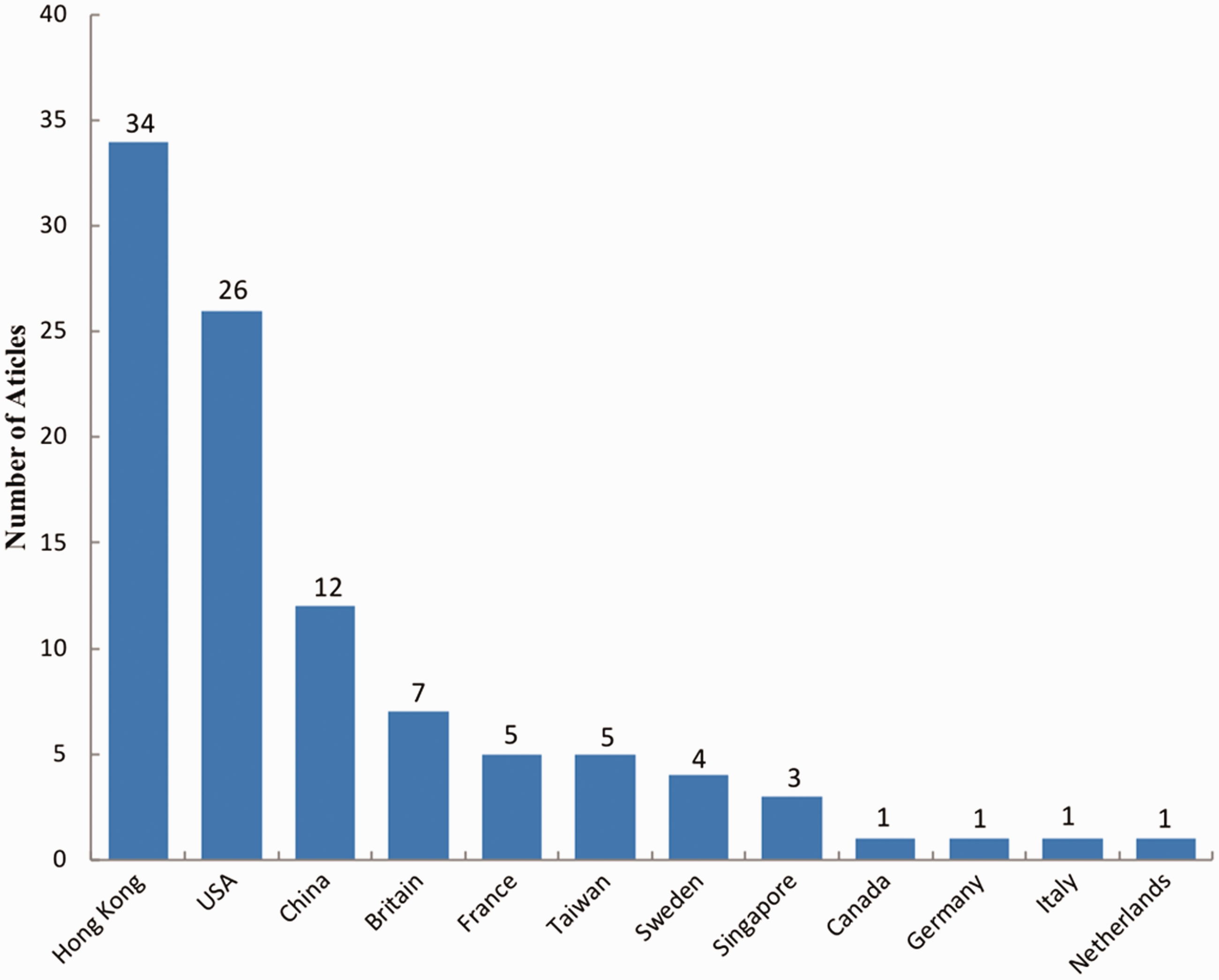
Origins of the top 100 most impactful articles on NPC.
First authors
There were 81 first authors who had contributed to these articles. Nine of the first authors had published more than one article. The top three authors were Chan ATC (n=6), Lee AWM (n=4), and Lo KW (n=4). They were followed by Kam MKM and Lo YMD (n=3 each) and by Lin JC, Pathmanathan R, Raab-Traub N, and Yu MC (n=2 each).
Institutions
These articles came from 55 institutions. There were 15 institutions with more than one published article (Table 4). Among them, the top three were the Prince of Wales Hospital (n=13), Sun Yat-Sen University Cancer Center (n=8), and Queen Elizabeth Hospital (n=5).
Institutions contributing to more than one published article.

The type of articles
Among the 100 articles, the number of articles on basic research, clinical research, and reviews was 50, 36, and 14, respectively. Most of the basic research articles focused on the pathogenesis, detection, and diagnosis of NPC (Figure 3).

The type of articles.
Study types of clinical articles
The types of studies were 36 clinical articles, of which most were randomized trials (n=18), followed by case-series (n=15), systematic reviews (n=2), and non-randomized controlled cohort study (n=1).
The level of evidence
Among the 36 clinical articles, two, 18, one, and 15 articles were graded as having Level 1, 2, 3, and 4 evidence, respectively, based on “The Oxford 2011 Levels of Evidence” (Figure 4).

Level of 36 clinical articles based on “The Oxford 2011 Levels of Evidence”.
Classification of treatment methods
The 36 clinical articles were mainly divided into nine treatment categories (Table 5). The top three were concurrent chemotherapy (n=11), intensity-modulated radiation therapy (IMRT, n=10), concurrent chemoradiotherapy plus adjuvant chemotherapy (n=4), and radiotherapy (n=4).
Treatment reported by 36 clinical articles on the top 100 list.

IMRT, intensity-modulated radiation therapy.
Comparation between 1970–2018 and 2013–2018 in the top 10 most-cited clinical articles
Based on the level of clinical evidence, the ratios (1970–2018 vs. 2013–2018) of Level 1, Level 2, and Level 4 evidence were 1:2, 5:4, and 4:4, respectively. None of the top 10 most-cited articles described Level 3 evidence (non-randomize controlled cohorts).
Comparing the clinical treatment patterns, the ratios (1970–2018 vs. 2013–2018) of concurrent chemotherapy, IMRT, radiotherapy, neoadjuvant chemotherapy, T lymphocytes, and recombinant vaccinia virus were 4:5, 4:2, 2:0, 0:1, 0:1, and 0:1, respectively.
Discussion
In our study, bibliometric analysis was used to identify the top 100 most impactful articles in NPC. These articles are representative of the many landmarks that have taken place in NPC over the past decades.
Our study showed that the highest ranking article was published by the Journal of Clinical Oncology in 1998. 10 It suggested that concurrent chemoradiotherapy was superior to radiotherapy alone and that patients benefited from progression-free survival and overall survival. Because it had a large enough sample size and was a randomized controlled trial, it provided reliable evidence for clinicians to use for treating patients with NPC in the future.
The second highest ranking article was a review of NPC that was published by The Lancet in 2005. 11 It provided researchers with a notable and useful summary of the pathology, clinical symptoms, diagnosis, tumor grading system, and treatment methods for NPC, and thus, it was well accepted and cited by other researchers.
The third highest ranking article was the application of IMRT in NPC, which was published by the International Journal of Radiation Oncology Biology Physics in 2002. 12 It showed that IMRT can better control the recurrence of primary tumors and can protect salivary glands and adjacent important tissues to the greatest extent. Thus, this result had a significant impact on the future application of IMRT in NPC.
With the exception of the 2010s, the number of articles increased by decades. Thus, over half of the articles in our study were published in the 2000s. The finding is consistent with those of other bibliometric studies.6,13,14 The result demonstrates that new articles with novel discoveries and advanced technologies continue to be published.
Based on the average citation count for a single article over the past decades, the highest citation count was the 1970s, whereas the lowest count was the 2010s. This finding shows that because of the time-dependent citation analysis, 9 previous articles have more citations compared with current articles.
Some bibliometric studies reported that journals with high impact factors, such as NEJM and The Lancet, were the leading journals.15,16 However, we found that the International Journal of Radiation Oncology Biology Physics was the most productive journal, despite having an impact factor of 5.6. This result shows that highly impactful articles are published in a specialized journal and are not limited to well-known general medical journals.
It has been shown that the most productive authors and institutions were always from the USA.13,16,17 In our study, Hong Kong was the most prolific region and Chan ATC, who contributed six articles, was from the Prince of Wales Hospital in Hong Kong. NPC has regional characteristics such as being common in the eastern and southeastern parts of Asia and eastern Africa. Thus, there are enough clinical research cases in Hong Kong. The findings indicate that Hong Kong has advanced technology and management concepts, and this region is good for researchers to learn and collaborate.
For the type of article, basic research articles on NPC accounted for half of the articles. They were mostly concerned with the epidemiology, pathogenesis, detection, and diagnostic techniques, such as Epstein−Barr virus (EBV)-associated DNA, microRNA, and its associated genomes. Among them, a noteworthy article was published in 1976 by Henle and Henle 18 in the International Journal of Cancer, which was a study on NPC and EBV. It revealed the close relationship between EBV-related immunoglobulin A and NPC in serum, which was a milestone and laid the foundation for the determining the diagnosis and prognosis of NPC.
Some bibliometric articles on surgical tumors reported that more than half of the articles were of low-quality (Level 4). 19 In our study, most clinical articles were scored as Levels 1 or 2 on the level-of-evidence grading scale. These results indicate that a high-quality NPC study was relatively easy to conduct and receive more citations compared with a low-quality study.
One of the Level 1 articles 20 showed that concurrent chemoradiotherapy can confer survival benefits to patients with NPC, which was consistent with another highly cited article. 21 This article also pointed out that the efficacy of induction chemotherapy and intensive chemotherapy before concurrent chemoradiotherapy would need to be further confirmed.
Based on the only article regarding surgery in the top 100 articles, the NPC tumor in patients with stage T1 or T2 did not disappear after radiotherapy, and radical resection of the tumor can prolong their survival time. For patients with stage T4 NPC, palliative cytoreductive surgery failed to confer benefits because of extensive tumor invasion of the skull base and cranial nerves. 22 However, surgery is mostly used for some patients who needed a biopsy to confirm the diagnosis or who had tumor recurrence after radiotherapy based on a recent guideline (NCCN Clinical Practice Guidelines for Head and Neck Cancer, Version 3, 2019).23
Among the top 10 clinical articles from 1970 to 2018, one article on retrospective analysis written by Lee AWM in 1992 suggested that radiotherapy can increase the local tumor control rate and prolong overall survival and progression-free survival. 24 His subsequent and highly cited article published in 2005 described a retrospective analysis of 2687 patients in Hong Kong, and confirmed the therapeutic effect of radiotherapy. 25 Therefore, his articles provided a basis for future randomized clinical trials of IMRT.
For the top 10 clinical articles from 2013 to 2018, half were focused on concurrent chemoradiotherapy, while IMRT was described in only 20% of these articles. The findings show that the effect of IMRT was confirmed26,27 and related research was reduced accordingly. Additionally, neoadjuvant chemotherapy, 28 T-lymphocyte immunotherapy, 29 and recombinant vaccinia virus gene therapy 30 had emerged. The results show that these new therapies are the current research priorities and the trends for future treatments.
There are some limitations in this paper. First, the citation count used for the citation analysis did not include self-citation. Second, because of the influence of certain time factors, it would be unfavorable for the most recently published articles in the citation analysis. Third, the database used in this article was the WoS. Although it is the most commonly used database with citation analysis capabilities, a small number of articles may have been missed.
Conclusions
To the best of our knowledge, this study is the first bibliometric study to identify the most impactful articles in the area of NPC. The findings indicate that articles with novel discoveries, advanced technologies, and a high quality level of evidence will receive more citations. Recognition of important historical contributions to this field may guide future investigations into NPC.
Footnotes
Author contributions
All authors were involved in the study. Q.-T. Yang and M.-Y. Chen conceived and designed the study. Q.-W. Wu, T. Yuan, and Z.-P. Zhang analyzed the data and wrote the paper. Q. Wang, H.-Y. Deng, and H.-J. Qiu performed the search strategy. X.-Y. Wang, and X.-K. Huang collected the data.
Acknowledgements
We thank Wenhao Zhou and Weifeng Kong (Department of Otolaryngology-Head and Neck Surgery, The Third Affiliated Hospital of Sun Yat-sen University) for assistance with the statistical analysis.
Declaration of conflicting interest
The authors declare that there is no conflict of interest.
Funding
This work was supported by the National Natural Science Foundation of China (Grant No. 81670912 and 81870704), the Industry-Academic Cooperation Foundation of Guangzhou (No. 201704030046), Sun Yat-sen University Clinical Research 5010 Program (No.2019006), and Science Technology Innovation Commission of Shenzhen Municipality (No. JCYJ20180305163629056).
