



Abstract
Integrating the leadership literature with Job Demands-Resources (JD-R) theory, we conducted a pre-registered meta-analysis of the relations of different leadership behaviors with followers’ work engagement and burnout. We found that constructive leadership relates positively to followers’ work engagement (k = 588,
Plain Language Summary
In organizations, leaders can act constructively or destructively toward followers, and that behavior can substantially influence followers’ wellbeing. In the current meta-analysis, we combine all prior research about the relations of different constructive and destructive leadership behaviors with followers’ work-related wellbeing. Work-related wellbeing was assessed based on how engaged and burned-out followers are at work. Summarizing data from more than 1,000 studies, we find that leaders’ constructive behavior relates positively to their followers’ engagement at work and negatively to their levels of burnout, whereas the opposite holds true for relations of leaders’ destructive behavior. Importantly, followers’ work engagement and burnout can also help to explain the well-established relations between leaders’ behavior and followers’ job performance.
In organizational hierarchies, leaders often hold power over their followers (Krackhardt, 1990), meaning that followers are reliant on their leaders and leaders are able to enforce their will upon followers (Sturm & Antonakis, 2015). As such, leaders are a critical characteristic of the work environment that affects followers’ work-related wellbeing (Skakon et al., 2010) and performance at work (Gottfredson & Aguinis, 2017). In search of the most effective way to lead, scholars have studied many different constructive leadership behaviors (e.g., transformational, servant, authentic, or ethical leadership) and their relations with a wide range of wellbeing measures (for reviews, see Pajic et al., 2021; Skakon et al., 2010). However, leaders may also behave in destructive ways that harm followers’ wellbeing and performance (Schyns & Schilling, 2013; Tepper, 2007). In the current meta-analysis, we test the relations of constructive and destructive leadership with two forms of followers’ wellbeing through the lens of Job Demands-Resources (JD-R) theory (Bakker et al., 2023). JD-R theory holds that job characteristics can be either motivational (i.e., increase work engagement) or health-impairing (i.e., increase burnout) for employees. Because leadership is such a key job characteristic, it is not surprising that JD-R theory has been used by many scholars as a theoretical framework when studying the relations of leadership with followers’ wellbeing (for a systematic review, see Tummers & Bakker, 2021). This abundance of studies provides an excellent opportunity to meta-analytically test the unique motivating or health-impairing effects of various types of leadership. A rigorous and simultaneous test of these dual processes comprises a substantial improvement over the piecemeal examination of JD-R theory that has dominated the literature (Montano et al., 2017; Pajic et al., 2021).
Our pre-registered meta-analysis makes a number of contributions. First, based on JD-R theory and the challenge-hindrance stressor framework (Crawford et al., 2010), we explicitly test and compare the unique relations of (different) constructive and destructive leadership behaviors with followers’ work engagement and burnout. In their recent overview, Bakker et al. (2023) explain how hindrances and challenges play a unique role in JD-R theory. Here, we argue that constructive leadership acts as a valuable higher-order job resource and/or as a higher-order challenge job demand to followers, and that destructive leadership acts as a higher-order hindrance job demand. Meta-analytically testing these hypotheses will advance our understanding of which leadership behaviors demonstrate the strongest association with followers’ work engagement and burnout. This will contribute important criterion-related insights to the debate about a lack of integration of different leadership constructs (Derue et al., 2011; Montano et al., 2023; Shaffer et al., 2016). We also provide a fine-grained analysis of the differential relations of the various behaviors that make up a particular leadership construct (e.g., the four I's for transformational leadership) and of the most common subdimensions of followers’ work engagement (i.e., vigor, dedication, and absorption) and burnout (i.e., emotional exhaustion, depersonalization/cynicism, and reduced personal accomplishment).
Second, we examine whether constructive leadership relates more strongly to followers’ wellbeing (i.e., work engagement) than to their ill-being (i.e., burnout), and whether the opposite holds true for destructive leadership. In doing so, we test one of the core propositions of JD-R theory, namely that job resources are more strongly related to work engagement than to burnout, whereas (hindrance) job demands mainly relate to burnout and to a lesser extent to work engagement (Bakker et al., 2023; Crawford et al., 2010). Evidence for these relations will bridge the leadership and JD-R theory literatures, and will offer a theoretical basis for the link between leadership and follower wellbeing.
Third, we examine the unique sequential relations of constructive and destructive leadership with followers’ job performance via followers’ work engagement and burnout, and thereby demonstrate how job demands and resources relate to job performance. Although Montano et al. (2017) already found that followers’ mental health partially mediates the relation of constructive and destructive leadership with followers’ job performance, the motivational and health-impairment processes postulated by JD-R theory have, to the best of our knowledge, never been examined simultaneously in a meta-analysis. As such, it remains unclear whether leadership primarily relates to followers’ performance through motivational or health-impairing pathways, and whether relations of constructive and destructive leadership with followers’ job performance can be explained by different mechanisms. Integrating JD-R theory with the leadership literature suggests that constructive leadership should relate to followers’ performance primarily via followers’ work engagement, whereas destructive leadership should relate to performance primarily via followers’ burnout. We will test these core propositions of JD-R theory simultaneously for constructive and destructive leadership, which allows us to illustrate and disentangle their relative importance in the prediction of followers’ work engagement and burnout as well as their job performance.
Finally, we will examine moderators for the relations of interest, such as the studies’ design or the used measurement instruments. Taking these moderators into consideration is crucial because it addresses some of the major concerns with the leadership literature, such as the lack of sophisticated study designs and the possible confounds between the measures of leadership and their supposed outcomes (e.g., Ashford & Sitkin, 2019; Van Knippenberg & Sitkin, 2013). We will meta-analytically examine the extent to which these concerns are substantiated by existing research.
Constructive versus destructive leadership
As Northouse (2018) rightfully notes, there are almost as many definitions of leadership as there are people who have tried to define it. As such, categorizing leadership as either constructive or destructive is challenging and only few attempts have been made. Surprisingly, while the leadership literature is dominated by what most people would consider research on constructive leadership behaviors (e.g., transformational and servant leadership), there is more discussion about what constitutes destructive leadership (e.g., inclusion of intent and physical behaviors) (Mackey et al., 2021; Schyns & Schilling, 2013). One of the most commonly used frameworks to distinguish constructive and destructive leadership is that of Einarsen et al. (2007). Their framework holds that leader behavior can vary in the extent to which it is pro-follower or anti-follower and pro-organization or anti-organization, and as such, is constructive or destructive. For the purpose of the current meta-analysis, which is to study the relations of leadership behavior with followers’ wellbeing, we define constructive and destructive leadership along Einarsen et al.'s (2007) pro-follower and anti-follower-oriented behavior dimension. As such, constructive leaders act in their followers’ best interest and show behaviors that stimulate followers’ wellbeing, motivation, and job satisfaction, such as praising followers, supporting followers, and taking care of them. Destructive leaders undermine their followers’ wellbeing, motivation, and satisfaction with work, by showing behaviors such as bullying and manipulation.
Critics may say that these definitions of constructive and destructive leadership include a reference to their outcomes. This is true to some extent, but we do not consider this problematic because these definitions refer to the leadership behaviors that either undermine or stimulate followers’ wellbeing and motivation and not to the outcomes themselves (Schyns & Schilling, 2013). Additionally, we focus on these specific leadership behaviors as inclusion or exclusion criteria, rather than solely focusing on their specific outcomes. These definitions of constructive and destructive leadership are also in line with other theoretical and empirical studies (Derue et al., 2011; Kaluza et al., 2020; Pajic et al., 2021).
It is, however, important to note that there is no universally accepted and all-encompassing classification of the individual leadership behaviors that comprise the broader categories of constructive and destructive leadership. In the current meta-analysis, we therefore rely on expert ratings to classify individual leadership behaviors as either constructive or destructive (see below). Leadership behaviors commonly regarded as constructive include visionary, relationship-oriented, moral, and task-oriented leadership behaviors (e.g., transformational leadership, leader-member exchange [LMX], ethical leadership, or instrumental leadership) (Derue et al., 2011; Pajic et al., 2021). Leadership behaviors commonly regarded as destructive include both passive and ineffective forms (e.g., laissez-faire leadership) as well as active forms (e.g., abusive supervision and toxic leadership) of deviant and harmful behavior toward subordinates (Schyns & Schilling, 2013; Thoroughgood et al., 2012). 1
Job demands-resources theory
According to JD-R theory (Bakker & Demerouti, 2017), job characteristics can be classified as either (challenge or hindrance) job demands or as job resources. Job resources refer to all aspects of work that help employees to achieve their work goals, reduce the impact of job demands, and/or contribute to employees’ personal growth and development. Examples include autonomy, feedback, and social support. These resources initiate a motivational process through which employees gain high levels of energy, become enthusiastic about their work, and feel like time flies when they are working (i.e., heightened work engagement; Schaufeli & Bakker, 2004). The initiated motivational process is ultimately also beneficial for employees’ job performance (Bakker & Demerouti, 2017).
Hindrance job demands are all aspects of work that cost energy and hinder employees to achieve their goals, such as role conflict and role ambiguity. Hindrance job demands initiate a health-impairment process through which employees become more exhausted and cynical about their work, and feel that they are ineffective (i.e., increased burnout; Schaufeli et al., 2009). Not too long ago, however, researchers realized that although all job demands cost energy, not all demands are necessarily “bad” or “hindering” (Cavanaugh et al., 2000). Certain job demands challenge employees and contribute to their personal growth and goal achievement when they are overcome. Such demands are called challenge job demands because they deplete employees’ energetic resources but also offer opportunities to develop and learn. Examples of challenge job demands include having responsibility in one's job or experiencing time pressure when completing a certain task. Thus, whereas job resources and challenge job demands have motivating potential, leading to higher levels of work engagement, hindrance job demands have health-impairing effects that lead to burnout (for a meta-analysis, see Crawford et al., 2010).
Although initial conceptualizations of JD-R theory suggested that the motivational and health-impairing process are independent, researchers have suggested more recently that “the health impairment and motivational processes should be studied jointly” (p. 59; Schaufeli & Taris, 2014). In other words, although job resources mainly exert their positive influence on employees’ work engagement, they also have the potential to reduce employees’ burnout. Evidence for this proposition comes from meta-analytic effect sizes indicating that the relation of job resources with work engagement (ρ = .36) is stronger, in absolute terms, than the relation with burnout (ρ = −.27) (Crawford et al., 2010). 2 Similarly, although hindrance job demands have the greatest positive influence on employees’ burnout, they also reduce employees’ work engagement (Crawford et al., 2010). Meta-analytic evidence indicates that hindrance job demands correlate stronger, in absolute terms, with burnout (ρ = .30) than with work engagement (ρ = −.19). These findings demonstrate the importance of simultaneously examining and comparing the motivating and health-impairing potential of constructive and destructive leadership behaviors.
Finally, JD-R theory proposes that job demands and resources affect employees’ job performance through their effects on employee wellbeing: Engaged employees perform their work well because they are dedicated to invest energy into their work, whereas burned-out individuals lack the energy and willingness to perform at work (Crawford et al., 2010). Support for some of these propositions comes from meta-analytic evidence demonstrating that work engagement mediates the relations of several job resources with performance (Christian et al., 2011), and that work engagement relates positively and burnout relates negatively to job performance (Halbesleben, 2010; Swider & Zimmerman, 2010). However, to the best of our knowledge, the indirect relation of job demands with job performance has not yet been tested meta-analytically. The same holds for the proposition that job resources relate primarily to performance via work engagement, whereas job demands relate primarily to performance via burnout. In the current meta-analysis, we examine these pathways simultaneously.
Leadership within JD-R theory
Leaders play a substantial role in their followers’ levels of work engagement and burnout (Schaufeli, 2015). Constructive leaders safeguard their followers’ engagement and make sure that followers do not burn out during work, whereas the opposite holds true for destructive leaders. Integrating JD-R theory with Einarsen et al.'s (2007) conceptualization of leadership and building on arguments by Tummers and Bakker (2021), we argue that leadership can be regarded as a higher-order job demand or job resource. In other words, leaders can act as a demand or resource themselves, they can generate other demands or resources, or they may influence the allocation and impact of demands and resources on followers (Bakker & Demerouti, 2018). In the present study, we propose that constructive leadership behavior may either constitute a higher-order job resource and/or a higher-order challenge job demand, whereas destructive leadership constitutes a higher-order hindrance job demand for followers.
It is particularly important to focus on leadership as a higher-order job resource or demand because leaders have an immense impact on the lives of their followers (Skakon et al., 2010), which may exceed the impact of any other type of resource or demand. For example, two independent meta-analyses show that, compared to colleagues, family, and friends, supervisors were the most important source of support in reducing employee burnout (Halbesleben, 2006; Lee & Ashforth, 1996). At the same time, leaders are often seen as the most important source of stress to followers (Hogan & Kaiser, 2005). The reason why leaders play such an important role in their followers’ lives is simple: Employees strive to obtain, maintain, and regain vital resources in the workplace (Hobfoll, 1989) and leaders hold the power to distributing key resources and demands within an organization (Fiedler, 1992). As such, leaders may be a source of numerous and unique resources and demands. For example, because leaders have access to certain materials and/or information, they are able to provide instrumental support to help followers cope with job demands (Breevaart et al., 2014b; Breevaart & Bakker, 2018). Additionally, because of their top-down influence, leaders may create structural changes in resources and demands that simultaneously affect large groups of people (Parker, 2014). As such, leadership can be conceptualized as a higher-order job resource or demand.
Although prior studies (Breevaart et al., 2014a; Pajic et al., 2021) often did not and we also cannot empirically distinguish between job resources and challenge job demands in our analyses of constructive leadership, we do think it is important to conceptually make this distinction. That is, both job resources and challenge job demands have motivating potential, leading to higher levels of wellbeing and job performance, yet they are two distinct factors that are reflected in various constructive leadership behaviors.
Constructive leadership functions as a job resource when leaders, for example, give followers control over their work schedules (cf. autonomy) or demonstrate that they care about them (cf. support). Constructive leaders can also help followers to craft their own resources (Tummers & Bakker, 2021). Such constructive, resourceful leader behaviors are commonly captured in various constructive leadership concepts, such as transformational, empowering, or servant leadership. However, constructive leadership can also function as a challenge job demand, for example, when leaders trust their followers with important tasks (cf. job responsibility) or when they request fast but excellent work from followers (cf. time pressure). As long as these behaviors remain within certain reasonable limits (e.g., do not overload or unnecessarily stress followers), they are generally aligned with followers’ interests because they provide opportunities for growth and development. Importantly, these behaviors are captured in various constructive leadership constructs, such as transformational, instrumental, and development-oriented leadership.
Further support for the approach of conceptualizing constructive leadership as a job resource and/or as a challenge job demand comes from the notion that some constructive leadership constructs capture behaviors that simultaneously function as a job resource and as a challenge job demand. For example, transformational leaders represent a job resource for followers by acting as a role model or by taking the needs of individual followers into account, but they also act as a challenge job demand by intellectually stimulating them and by motivating them to think out of the box. Categorizing constructive leadership as a job resource and/or as a challenge job demand therefore properly reflects the content of constructive leadership. Following this reasoning, we argue that constructive leadership acts as a valuable higher-order resource and/or challenge demand for followers and is therefore mainly associated with increased levels of followers’ work engagement, but also with decreased levels of followers’ burnout. Importantly, constructive leadership should relate more strongly to work engagement than to burnout (in absolute terms) because the motivating potential of job resources is greater than their health-protective benefit. It follows logically that constructive leadership should then mainly relate to followers’ job performance via work engagement, and, to a lesser extent, also via burnout. 3
In contrast, destructive leadership can be conceptualized as a higher-order hindrance job demand because such leaders do not communicate clearly with followers about their tasks (cf. role ambiguity) or might even insult or otherwise abuse followers (cf. emotional demands). Such leadership behaviors are also captured in existing leadership constructs that can be regarded as destructive (e.g., abusive supervision or toxic leadership), highlighting the strong conceptual overlap between hindrance job demands and destructive leadership. In addition to constituting and creating hindrance job demands for followers, destructive leaders also reduce available job resources, for example by failing to support and coach them, which would be especially valuable and necessary when dealing with hindrance job demands. In line with the definition of hindrance job demands, destructive leader behaviors drain followers’ energy (Harvey et al., 2007) and undermine their motivation as well as their work-related wellbeing (Montano et al., 2023; Schyns & Schilling, 2013). We therefore conceptualize destructive leadership as a hindrance job demand. This process results in higher levels of followers’ burnout, but also somewhat lower levels of followers’ work engagement (Crawford et al., 2010). As such, we expect that destructive leadership relates positively to followers’ burnout and negatively to their work engagement. However, we argue that the relation with burnout is stronger than the relation with work engagement (in absolute terms) because the health-impairing potential of destructive leadership, conceptualized as hindrance job demands, is greater than its (de-)motivating potential. This pattern of relations should also extend to relations of destructive leadership with followers’ job performance in a way that the indirect relation via burnout should be stronger than the one via work engagement.
Following these arguments based on JD-R theory, on theoretical arguments conceptualizing constructive leadership as a job resource and/or as a challenge job demand and destructive leadership as a hindrance job demand, and on previous scientific findings (Breevaart & Bakker, 2018; Breevaart et al., 2014b; Montano et al., 2017; Nahrgang et al., 2011), we hypothesize that constructive leadership relates positively to followers’ work engagement (
Constructive versus destructive leadership
Although Baumeister et al. (2001) find that bad events exert a stronger influence on behavior than good events, meta-analytic findings comparing constructive and destructive leadership do not find evidence for a stronger relation of destructive leadership with followers’ attitudes and behavior compared to constructive leadership (Schyns & Schilling, 2013). However, our arguments holding that constructive leadership acts as a job resource and/or as a challenge job demand and that destructive leadership acts as a hindrance job demand (Bakker & Demerouti, 2017; Breevaart et al., 2014b), paired with meta-analytic findings demonstrating that the relation between job resources/challenge job demands and work engagement is stronger than the relation between hindrance job demands and work engagement (Crawford et al., 2010), suggest otherwise. In other words, we expect that constructive leadership exhibits a stronger correlation with followers’ work engagement than destructive leadership. This prediction is also aligned with theoretical arguments based on the outcome-specific effect hypothesis (Rook, 1998), which holds that outcomes aligned in valence (i.e., constructive leadership and work engagement) correlate stronger with each other than outcomes not aligned in valence (i.e., destructive leadership and work engagement). Support for this theoretical notion also comes from primary studies demonstrating that constructive leadership behaviors (e.g., ethical leadership, considerate leadership) relate more strongly with work engagement than destructive leadership behaviors (e.g., abusive supervision and tyrannical leadership) (Bormann, 2017; Glasø et al., 2018). We therefore hypothesize that the relation between constructive leadership and followers’ work engagement is stronger than the relation between destructive leadership and followers’ work engagement (
Next, empirical findings demonstrate that the relation between hindrance job demands and burnout is stronger than the relation between job resources/challenge job demands and burnout (Crawford et al., 2010). This finding can be explained using the primacy of loss principle (Hobfoll, 1989), which holds that resource loss (i.e., hindrance job demands) has a stronger impact on stress (i.e., burnout) than resource gain (i.e., job resources/challenge job demands). Applied to the context of constructive and destructive leadership, we therefore expect that destructive leadership correlates more strongly with followers’ burnout than constructive leadership. This expectation is also aligned with the outcome-specific hypothesis mentioned above (Rook, 1998) and with theoretical arguments based on JD-R theory suggesting that “leadership behaviors influencing followers’ job demands affect followers’ burnout more strongly compared to leadership behaviors influencing followers’ job resources” (Breevaart et al., 2014b, p. 113). We therefore hypothesize that the relation between destructive leadership and followers’ burnout is stronger than the relation between constructive leadership and followers’ burnout (
Specific leadership behaviors and followers’ wellbeing
We will also explore whether the relations of leadership with followers’ work engagement and burnout differ depending on the specific type of leadership (e.g., transformational leadership, authentic leadership, and LMX) and depending on the various subdimensions of leadership constructs (e.g., the four I's of transformational leadership). It is important to separately examine these subdimensions because two subdimensions could exhibit differential or even opposite relations with a predictor or outcome, cancel each other out, and therefore obscure the overall relation when studied as a composite (Pletzer et al., 2020, 2021). We refrain from formulating specific hypotheses for different leadership constructs because this would be an intricate and too extensive endeavor given the abundance of different leadership behaviors that are being studied in the literature. In fact, the last decades have witnessed an unprecedented increase of interest in the topic of leadership, coupled with the development of many new leadership constructs. This construct proliferation in leadership research (Shaffer et al., 2016) has been heavily criticized by leadership scholars. For example, DeRue et al. (2011) argue that “leadership research is plagued by a lack of integration” (p. 8) and they criticize leadership research for not comparing and contrasting the validity of different leadership constructs. The current meta-analysis provides a prime opportunity to do exactly that.
Subdimensions of work engagement and burnout
We will also examine all hypothesized relations separately for the most commonly studied subdimensions of work engagement (i.e., vigor, dedication, and absorption) and burnout (i.e., emotional exhaustion, cynicism/depersonalization, and reduced personal/professional accomplishment/efficacy), which will contribute important insights about relations with leadership that past meta-analyses have not yet examined. Although some have argued that vigor is the most important subdimension of work engagement (Perko et al., 2016; Shirom, 2010), meta-analytic findings largely demonstrate that all three subdimensions exhibit similar relations with a wide variety of organizational outcomes (Halbesleben, 2010). Taken together, we therefore do not have a priori expectations about the relations of constructive and destructive leadership with followers’ vigor, dedication, and absorption, but will examine these relations in an exploratory manner. Regarding the subdimensions of burnout, Breevaart et al. (2014b) reviewed the literature and concluded that constructive leadership mainly affected the professional efficacy/reduced accomplishment burnout subdimension, whereas destructive leadership seemed most strongly related to the other two burnout subdimensions—emotional exhaustion and cynicism. We will provide a meta-analytic test of these preliminary findings.
Moderating effects
Another important objective of the current meta-analysis is to examine possible moderating effects. We expect that the relations of leadership with followers’ work engagement and burnout are stronger in cross-sectional than in longitudinal studies (
Open science statement
An overview of all pre-registered hypotheses can be found in the Supplemental materials and in the pre-registration on the OSF project page (https://osf.io/b7g9h/). All codings, the main R scripts, and all Supplemental materials, including the references of all included studies, can also be found there.
Method
Literature search
We tried to locate suitable studies in multiple ways (see the flowchart in Figure 1). First, we conducted a systematic literature search on Web of Science on August 3, 2022, using the following search terms: TS = ((leader* OR “abusive supervision”) AND (“work engagement” OR “job engagement” OR “employee engagement” OR “role engagement” OR burnout OR “burn-out” OR “burn out” OR vigo*r OR dedication OR absorption OR exhaustion OR cynicism OR depersonali*ation OR disengagement OR “reduced personal accomplishment” OR “personal accomplishment” OR inefficacy OR “reduced efficacy” OR “reduced professional efficacy” OR “reduced professional accomplishment” OR fatigue))
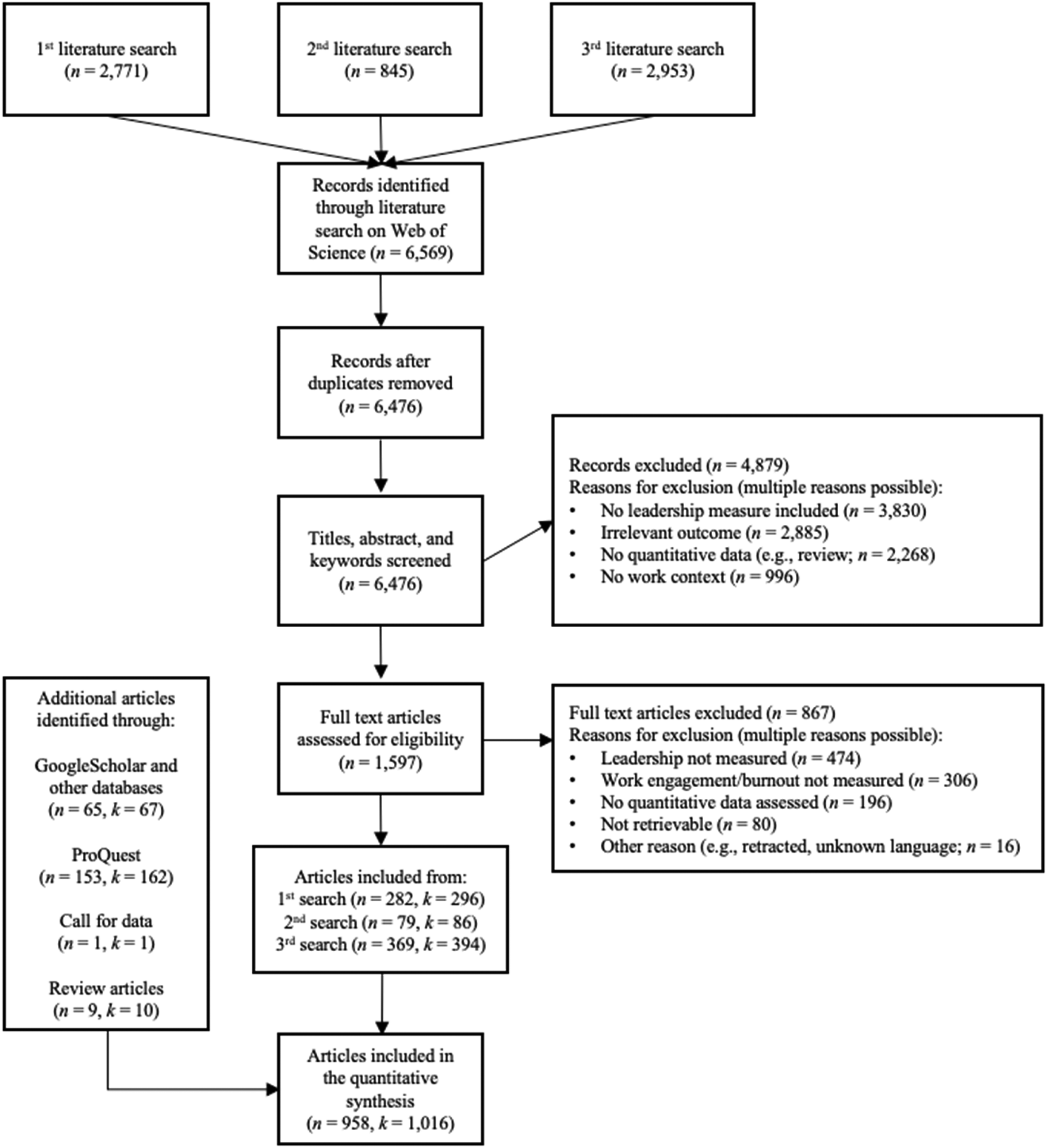
Flowchart outlining the literature search process. Note. n = number of documents; k = number of studies.
After removing 93 duplicates, 6,476 results remained. For all of them, the first author screened the title, abstract, and keywords to decide if an article included a quantitative study assessing a leadership construct and followers’ work engagement or burnout. 4,879 documents were excluded, and the remaining 1,597 documents were examined in full by the first author. Seven hundred and thirty documents (282 from the first, 79 from the second, and 369 from the third search) met the inclusion criteria (see below) and were included in the meta-analysis.
Second, we conducted a systematic literature search on ProQuest for dissertations and theses with an available full-text on August 13, 2022. We searched for the same terms in the abstract, which resulted in 2,428 results, after removing 15 duplicates. The first author then screened the title, abstract, and keywords of all search results using the same criteria as above. 2,067 documents were excluded, and the remaining 361 documents were examined in full by the first author, of which 153 were included in the meta-analysis.
Third, we examined the reference lists of 15 review articles about related topics. 4 This way, we included nine additional documents. Fourth, we issued a call for unpublished data on different websites (i.e., SIOP and EAWOP), which resulted in the inclusion of one additional document. Fifth, we conducted a nonsystematic literature search on Google Scholar using the same search terms mentioned above, including 65 additional documents.
In total, we included 958 documents with 1,016 independent studies assessing at least one of the relations of leadership with followers’ work engagement or burnout. The majority of these documents were published in peer-reviewed journals (n = 790), but we also included 156 dissertations/theses, 10 conference proceedings/pre-prints, and two book chapters. The included documents were published between 1984 and 2023, with a median publication year of 2019. The meta-analytic dataset included 3,142 effect sizes based on data from 420,571 participants (average N = 414, median N = 277), and the included studies were conducted in 73 different countries.
Criteria for inclusion
To be included in the meta-analysis, a study had to assess at least one leadership behavior as well as followers’ work engagement (or its subdimensions) or burnout (or its subdimensions). To determine what can be considered leadership, we relied on the definitions of constructive and destructive leadership provided above (Einarsen et al., 2007). We excluded related constructs that did not directly measure leadership behavior, such as leaders’ personality traits. Studies also had to report the correlation coefficient r for the relation of leadership with followers’ work engagement and/or burnout along the respective sample size N, or statistics that allowed for the calculation of r, such as Cohen's d. Whenever statistical information was missing or unclear, we contacted the author(s) and requested zero-order correlations of the relation of interest. In total, we contacted authors of 90 documents and received necessary information for 20 documents. We only included studies that recruited adult employees (18 years and older). Experiments that manipulated a leadership behavior were excluded. We also only included studies that were published in a language that we understood (i.e., Dutch, English, or German). These criteria also provided the basis for our calls for additional data.
Coding procedure
A coding protocol was developed to increase consistency in codings. Following this protocol, two individuals—a combination of the first or second author with one of two trained research assistants—coded effect sizes and study characteristics from approximately half of all included studies (k = 459; 45.18% of all coded studies). Agreement between raters was 95.5% for all codings. All inconsistencies were resolved by revisiting the respective article and discussing the coding. The first author then proceeded to code the remaining studies (k = 557).
Whenever a study reported effect sizes for two or more forms of a predictor or an outcome but not for the overall form (e.g., for individualized consideration and intellectual stimulation but not for transformational leadership, or for vigor, dedication, and absorption but not for work engagement), we aggregated effect sizes using composite formulas, taking into account the intercorrelations between variables, to guarantee the independence of effect sizes in the overall analysis (Hunter & Schmidt, 1990). When the intercorrelation was not reported, we conservatively assumed perfect redundancy (i.e., r = 1). We conservatively coded the highest reliability of one of the to-be-aggregated dimensions. We followed the same procedures when aggregating to the higher-order constructive or destructive leadership category.
Expert ratings
To categorize leadership behaviors as either constructive or destructive, we followed Anderson and Gerbing's (1991) content validation approach. Specifically, we acquired expert ratings from 11 JD-R theory and leadership experts, which is slightly more than the median number of experts used in organizational psychology content validation studies (Colquitt et al., 2019). We provided these experts with the definitions of constructive and destructive leadership mentioned above, and with definitions and sample items for each leadership behavior to be categorized (see Supplemental materials). The experts could categorize a leadership behavior as either constructive, destructive, or as inconclusive. Following guidelines from Colquitt et al. (2019), we categorized a leadership behavior as constructive or destructive if the proportion of substantive agreement among raters (psa) and the substantive validity coefficient (csv) were strong (i.e., psa ≥ .82 and csv ≥ .61). We assigned all leadership behaviors for which experts did not reach sufficient agreement to an inconclusive category. In total, we classified 33 leadership behaviors as constructive, 13 as destructive, and 20 as inconclusive (see supplemental materials). The definitions, sample items, and expert ratings can be found in the Supplemental materials.
Constructed correlation matrix for constructive and destructive leadership.
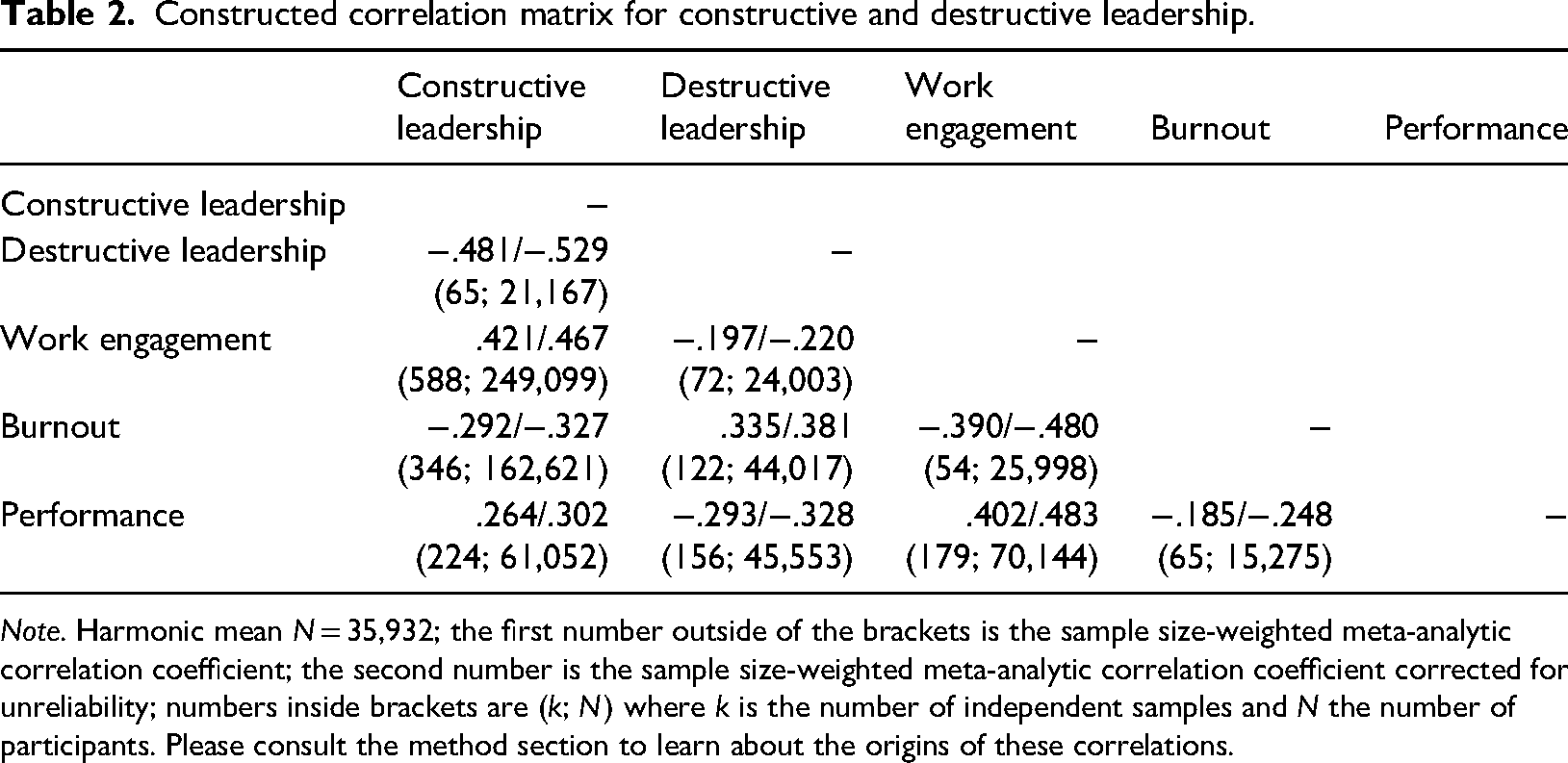
Note. Harmonic mean N = 35,932; the first number outside of the brackets is the sample size-weighted meta-analytic correlation coefficient; the second number is the sample size-weighted meta-analytic correlation coefficient corrected for unreliability; numbers inside brackets are (k; N) where k is the number of independent samples and N the number of participants. Please consult the method section to learn about the origins of these correlations.
Definition of variables
Leadership
Most studies included in the overall analysis assessed constructive leadership (k = 939), while destructive leadership was assessed in k = 194 of all included studies. 5 A leadership behavior that was classified as inconclusive was assessed in k = 130 studies. We further report meta-analytic effect size estimates for all individual leadership behavior—outcome combinations with at least three included effect sizes.
We also coded the measures that were used to assess a certain leadership behavior. In the moderator analyses, we compare the most commonly used leadership measures with all other employed measures, a procedure that is employed in other meta-analyses as well (e.g., Wang et al., 2011). 6
Work engagement
Work engagement was assessed in k = 638 studies included in the overall analyses. Some studies also assessed the subdimensions vigor, dedication, and absorption, or other forms of work engagement, such as cognitive, emotional, physical, or organizational engagement. We include these forms in the overall analyses, but do not analyze them separately as the number of studies that assessed these forms of work engagement was relatively small across leadership categories. We also coded the measures used to assess work engagement, and compare effect sizes based on the Utrecht Work Engagement Scale (Schaufeli et al., 2002) with effect sizes based on all other work engagement measures (e.g., Rich et al., 2010).
Burnout
Burnout was assessed in k = 445 studies included in the overall analyses. Emotional exhaustion was the most studied subdimension of burnout. Cynicism/depersonalization and (reduced) personal/professional accomplishment/efficacy were studied in fewer studies. We reversed effect sizes for professional efficacy or personal accomplishment to indicate reduced professional efficacy or reduced personal accomplishment, and use the term reduced accomplishment to refer to all of these constructs. A few studies assessed different forms of burnout, such as work-related burnout, interpersonal strain, or personal burnout. We include these forms in the overall analyses, but do not analyze them separately as only one included study assessed each of these burnout forms. We also coded the measures used to assess burnout, and compare effect sizes based on the Maslach Burnout Inventory (Maslach et al., 1986) with those based on all other burnout measures (e.g., Demerouti & Bakker, 2008).
Study design
Most studies employed a cross-sectional study design (k = 824), but we also included studies with a longitudinal design (k = 169). A few studies also employed a diary design (k = 21), but this does not allow meaningful moderator analyses as effect sizes are distributed across the different relations that we examine (e.g., just two diary studies assessed the relation of destructive leadership with followers’ burnout). 7
Analytic plan
Main analysis
We base our analyses on the Pearson correlation coefficient r. Analyses were conducted using the metafor package in R (Viechtbauer, 2010) with a random-effects model using the Hunter-Schmidt type-approach (Hunter & Schmidt, 1990). We report sample size-weighted correlations to account for differential sampling error and correlations corrected for unreliability (e.g., Cronbach's alpha) in the predictor and in the outcome (Spearman, 1904). We use local reliabilities to correct effect sizes for unreliability. Whenever studies did not report internal reliabilities, we corrected effect sizes with the weighted average reliability estimate for this particular variable across all other studies included in this meta-analysis (see Supplemental materials for the weighted average reliabilities). This was the case for 15.8% of all coded effect sizes. For one-item measures, we assumed perfect reliability (i.e., α = 1).
We report the following results for all relations with at least three coded effect sizes: the number of included studies (k), the total number of participants (N), the sample size-weighted, uncorrected mean correlation (r), the standard deviation for the sample size-weighted, uncorrected mean correlation (SDr), the sample size-weighted mean correlation corrected for unreliability in the predictor and outcome (
We conduct moderator analyses whenever k ≥ 3 for both comparison groups. We use subgroup analyses based on the Hunter and Schmidt (1990) approach for categorical moderators whenever the comparison groups include independent cases. We test moderation hypotheses in which the comparison groups can contain data from the same studies using Robust Variance Estimation (RVE) (Hedges et al., 2010; Tanner-Smith & Tipton, 2014). For example, when comparing effect sizes for relations of leadership with work engagement and burnout, the comparison groups are not independent because some studies include measures of both work engagement and burnout. Such dependencies occurred when testing H1, H2c, H6a, and H6b, and we therefore test these hypotheses using RVE, which can handle dependent effect sizes. We conduct correlated effects RVE with random-effects weights using the robumeta package in R (Tipton, 2015). In these analyses, we use dummy coded variables (e.g., 0 = work engagement, 1 = burnout) to compare effect sizes corrected for unreliability. 8 We further test these hypotheses using relative weights analyses to compare the relative contribution of constructive and destructive leadership to the amount of explained variance in work engagement and burnout (Tonidandel & LeBreton, 2011).
Constructed correlation matrix
To test the mediation hypotheses, we constructed a correlation matrix using results of the current study and of prior meta-analyses (see Table 2). Specifically, we use correlations from the current meta-analysis for the relations of constructive and destructive leadership with followers’ work engagement and burnout. For all other relations, we use those effect size estimates from prior meta-analyses that were based on the largest sample size. As such, we use effect size estimates from Hoch et al. (2018) for the relation of constructive leadership with followers’ job performance (k = 224, N = 61,502, r = .264,
Based on this meta-analytic correlation matrix, we fit a structural equation model using the lavaan package in R (Rosseel, 2012) with the harmonic mean across all analyzed cells as the sample size (Viswesvaran & Ones, 1995). More specifically, we tested a model with direct effects from constructive and destructive leadership to followers’ job performance and with indirect effects via both work engagement and burnout. Constructive and destructive leadership as well as work engagement and burnout were allowed to covary. Because this model is a just identified (saturated) path model, the goodness of fit indices are not applicable and the chi-square statistic for the model is 0 (Cheung, 2015).
This analytic approach is common in organizational psychology (e.g., Lee et al., 2019), but suffers from the limitation that analyses based on such a constructed average meta-analytic correlation matrix treat the correlation matrix as a covariance matrix, which ignores the sampling variance across studies (Cheung, 2021). This can result in underestimated standard errors, ultimately overestimating the statistical significance of the tested relations. The results of these analyses should be interpreted with this limitation in mind.
Results
Results of the overall analyses can be found in Table 1. Constructive leadership correlated positively with followers’ work engagement (
Overall meta-analytic results for the relations of constructive and destructive leadership with followers’ work engagement and burnout.
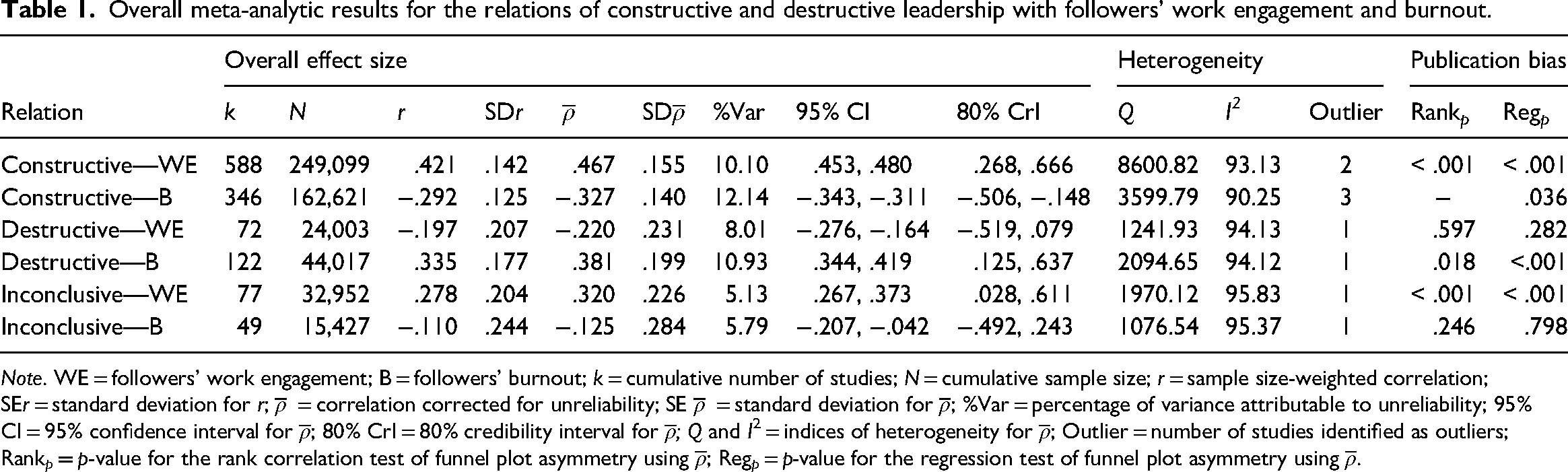
Note. WE = followers’ work engagement; B = followers’ burnout; k = cumulative number of studies; N = cumulative sample size; r = sample size-weighted correlation;
SEr = standard deviation for r;
Constructive leadership correlated negatively with followers’ burnout (
The relation of constructive leadership with work engagement was stronger in absolute terms than the relation with burnout (p < .001; see Supplemental materials for detailed results of all moderation analyses based on RVE), supporting H1c. Further evidence for this hypothesis comes from a relative weights analysis demonstrating that constructive leadership (relative R2 = .194, rescaled weight = 88.72%) explains more variance in work engagement than destructive leadership (relative R2 = .025, rescaled weight = 11.28%).
Destructive leadership correlated negatively with followers’ work engagement (
Destructive leadership correlated positively with followers’ burnout (
The relation of destructive leadership with burnout was stronger in absolute terms than the relation with work engagement (p < .001), supporting H2c. This hypothesis is further supported by a relative weights analysis which shows that destructive leadership (relative R2 = .103, rescaled weight = 61.45%) explained more variance in burnout than constructive leadership (relative R2 = .064, rescaled weight = 38.55%). Note, however, that this difference in explained variance is smaller than the one for work engagement.
The relation of constructive leadership with followers’ work engagement (
Relations of leadership with the subdimensions of work engagement and burnout
The detailed results of the following analyses can be found in the Supplemental materials. Constructive leadership exhibited similar relations with the work engagement subdimensions vigor (
Constructive leadership also exhibited similar correlations with the burnout subdimensions emotional exhaustion (
Relations of different leadership behaviors with work engagement and burnout
In general, results demonstrate that the most commonly studied constructive leadership behaviors exhibit correlations of similar magnitude with work engagement, and that these correlations are stronger, in absolute terms, than the ones with burnout (detailed results can be found in the Supplemental materials). The correlations of destructive leadership behaviors are stronger for burnout compared to work engagement. Passive forms of destructive leadership (i.e., laissez-faire and passive-avoidant leadership) exhibit weaker correlations with follower work engagement and burnout than more active forms of destructive leadership (i.e., abusive supervision).
The most commonly studied leadership behaviors generally exhibited similar relations with the work engagement subdimensions vigor, dedication, and absorption (see Supplemental materials). The same holds for relations with the three burnout subdimensions emotional exhaustion, cynicism, and reduced accomplishment, but some exceptions exist: Laissez-faire leadership correlated more strongly with emotional exhaustion (
Moderator analyses
We conducted subgroup analyses if k ≥ 3 for all comparison groups (see Supplemental materials for detailed results). We hypothesized that correlations from cross-sectional studies would be stronger than those from longitudinal studies (H7a). The hypothesis was supported for the relations of constructive leadership with work engagement (
In the Supplemental materials, we also present detailed analyses in which we conduct these analyses for individual leadership behaviors, and in which compare effect sizes from studies that used different measures to assess leadership and work engagement or burnout.
Meta-analytic test of the mediation hypotheses
We tested the mediation hypotheses simultaneously for constructive and destructive leadership (see Figure 2). The following results are based on correlations corrected for unreliability; results based on sample size-weighted correlations not corrected for unreliability can be found in the Supplemental materials. Work engagement (ß = .232, 95% CI [.225, .240], p < .001) and burnout (ß = −.012, 95% CI [−.014, −.010], p < .001) significantly mediated the relation of constructive leadership with job performance. The direct relation between constructive leadership and job performance remained statistically significant, but has reversed in sign (ß = −.041, 95% CI [−.053, −.030], p < .001). 13 These results confirm H3a and H3b. H5a, which postulated that the indirect effect via work engagement is stronger than the indirect effect via burnout, was also supported because the confidence intervals of these two indirect effects do not overlap.
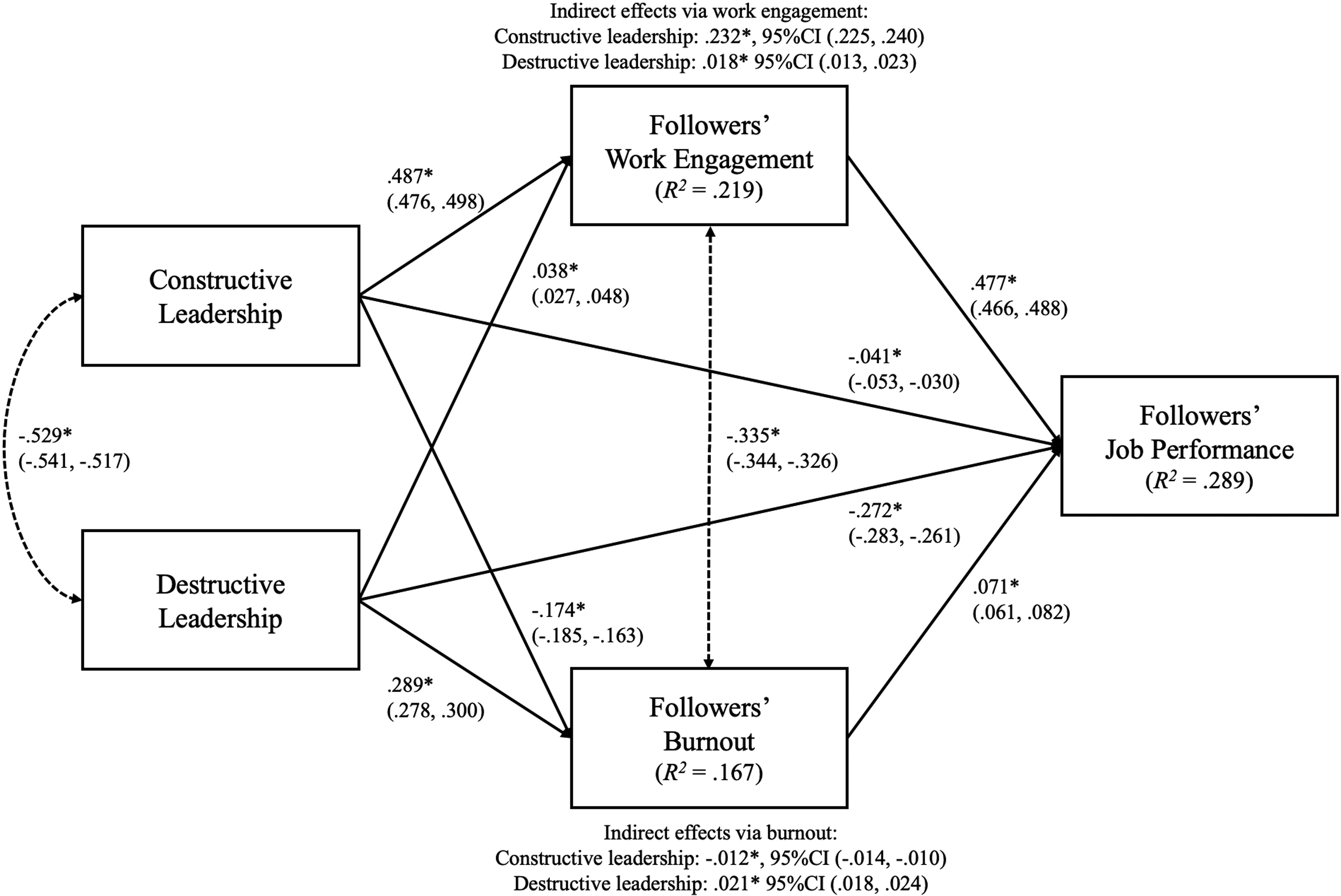
Mediation results for constructive and destructive leadership. Note. Results are based on sample size-weighted correlations corrected for unreliability: Harmonic N = 35,932.
Work engagement (ß = .018, 95% CI [.013, .023], p < .001) 14 and burnout (ß = .021, 95% CI [.018, .024], p < .001) also mediated the relation between destructive leadership and job performance. The direct relation between destructive leadership and job performance remained statistically significant (ß = −.272, 95% CI [−.283, −.261], p < .001). These findings support H4a and H4b. H5b, which postulated that the indirect relation via burnout is stronger than the one via work engagement, is not supported because the confidence intervals of these two indirect paths overlap. 15
Discussion
Based on more than 1,000 studies, we present results of a pre-registered meta-analysis about the relations of constructive and destructive leadership with followers’ work engagement and burnout. We also performed a meta-analytic test of the unique health-impairment and motivational pathways linking leadership behavior with followers’ job performance. Our pre-registered study integrates the leadership literature with research on JD-R theory, and thereby makes important theoretical and practical contributions to both research streams because rigorous and theoretically grounded reviews provide the foundation for future empirical research and for evidence-based recommendations to practice (Snyder, 2019). We generally found meta-analytic support for the theoretical notion that leader behaviors substantially relate to followers’ psychological wellbeing: Constructive leadership relates positively to followers’ work engagement and negatively to their levels of burnout, whereas destructive leadership relates positively to followers’ burnout and negatively to their work engagement. Importantly, these relations extend to followers’ job performance as both followers’ work engagement and burnout partially mediate the relations of constructive and destructive leadership with job performance.
Theoretical implications
The current meta-analysis provides general support for the utility of JD-R theory (Bakker et al., 2023) in a leadership context and therefore has important theoretical implications. Our results provide criterion-related support for the theoretical notion that constructive leadership can be conceptualized as a job resource or as a challenge job demand as it related to both followers’ work engagement and burnout in the expected directions. Constructive leadership also relates more strongly to work engagement than to burnout, confirming theoretical arguments based on JD-R theory and previous meta-analytic findings for job demands and job resources more broadly (Crawford et al., 2010). The same empirical support was found for the idea of conceptualizing destructive leadership as a hindrance job demand, as destructive leadership relates to both followers’ burnout and work engagement, but more strongly to the former. In other words, constructive leadership as a job resource or challenge job demand initiates a stronger motivational process, whereas destructive leadership as a hindrance job demand initiates a stronger health-impairment process, but both types of leadership behavior predict those outcomes not aligned in valence as well. These findings largely resemble those by Pajic et al. (2021), who also found stronger relations of constructive leadership with positive compared to negative wellbeing, whereas the opposite pattern was found for destructive leadership.
Importantly, we also found that constructive leadership correlates more strongly with work engagement than destructive leadership does, and that destructive leadership correlates more strongly with burnout than constructive leadership does. This confirms previous meta-analytic findings demonstrating that the relation between job resources and work engagement is stronger than the relation between hindrance job demands and work engagement, and that the relation between hindrance job demands and burnout is stronger than the relation between job resources and burnout (Crawford et al., 2010). The latter finding provides direct support for the outcome-specific effect hypothesis (Rook, 1998) and for the primacy of loss hypothesis (Hobfoll, 1989), which both suggest that job demands have a stronger effect on stress than job resources. Our findings do, however, contradict recent meta-analytic findings by Lesener et al. (2019) who found that job demands do not relate significantly to work engagement. A possible explanation can be derived from the fact that these authors did not distinguish between challenge and hindrance job demands, which affects relations with work engagement (Breevaart & Bakker, 2018; Tadić et al., 2015). The distinction seems necessary to avoid obscured relations between overall job demands and work engagement (more about this below under limitations), a notion that Lesener et al. (2019) also mention as an explanation for the nonsignificant relation that they found between job demands and work engagement. It is also important to note that our findings are in line with Schyns and Schilling's (2013) conclusion that the effects of destructive leadership are actually not stronger than those of constructive leadership. This is, however, dependent on the outcome: Constructive leadership explains substantially more variance in work engagement than destructive leadership (88.72% vs. 11.28%), and destructive leadership explains more variance in burnout than constructive leadership (61.45% vs. 38.55%). Importantly, the difference in relative weights is much more pronounced for work engagement than for burnout, suggesting that resourceful and challenging leadership behaviors are the most promising approach when trying to foster followers’ motivation and work-related health.
Another important contribution of the current meta-analysis is that we investigated whether the relations of leadership with followers’ work engagement and burnout extend to followers’ job performance, which was not examined in previous JD-R theory meta-analyses (Alarcon, 2011; Crawford et al., 2010; Lesener et al., 2019). Examining a model simultaneously including constructive and destructive leadership allowed us to disentangle the unique relations of the motivational and health-impairing pathways to job performance. JD-R theory proposes that job demands primarily affect performance via burnout, whereas job resources influence performance mostly via work engagement. We do find support for the latter notion as the relation of constructive leadership with followers’ job performance was more strongly mediated by followers’ work engagement than by their burnout. This demonstrates that constructive leadership behavior stimulates followers’ job performance primarily because of its motivating potential, and less so because it prevents health-impairments among followers. Destructive leadership behaviors related negatively to followers’ performance similarly via burnout and work engagement, indicating that destructive and hindering leadership behaviors relate to followers’ job performance because they are equally demotivating and health-impairing. This contradicts JD-R theory, which holds that (hindrance) job demands (i.e., destructive leadership behaviors) predict job performance primarily because of their health-impairing nature. One interpretation of these findings is that destructive leadership has associations with a broad, as opposed to specific, range of follower outcomes: Working under a destructive leader might make everything seem negative, which aligns well with the fact that destructive and ineffective leadership is the primary reason why employees leave their jobs (Zenger & Folkman, 2022).
Importantly, the indirect path from constructive leadership to followers’ job performance via work engagement was, by far, the strongest out of all four examined indirect paths. This demonstrates that—next to refraining from destructive behaviors—leaders should particularly engage in constructive behaviors if they want to foster job performance among their followers, and that this will be successful primarily because such behaviors motivate employees to be vigorous, dedicated, and absorbed at work. This highlights that leaders primarily act as motivators – they constitute, create, and offer resources and challenges to their followers, suggesting that leaders could do more to improve and safeguard their followers’ mental health and wellbeing. One explanation for this could be that constructive leaders are particularly promotion-focused (Kark & Van Dijk, 2007), neglecting the need to also monitor and safeguard followers’ mental health and wellbeing. Previous meta-analytic findings (Nahrgang et al., 2011) demonstrating that indirect relations of job demands and resources with safety-related outcomes were generally stronger via engagement (operationalized as compliance) than via burnout align well with our results. Together, this suggests that job resources, and constructive leadership in particular, relate to job performance primarily because they are more motivating and not so much because they are health-impairing. Hindrance job demands hinder job performance because they are equally motivating and health-impairing.
Examining the correlations on which these results are based, it becomes clear that the weaker link between burnout and job performance, compared to the link between work engagement and job performance, is one of the reasons for these findings. An explanation for why this relation is weaker could be that employees with burnout symptoms tend to cope with demands by working even harder, attempting to maintain their performance levels (Bakker & de Vries, 2021; van Dam et al., 2013). It therefore seems important to distinguish between volatile and chronic demands, the severity of burnout symptoms, and individual differences in coping with demands. Findings might also differ depending on the outcomes under investigation. For example, it seems reasonable to expect that burnout plays a more important role than work engagement does as an explanatory mechanism linking job demands and resources with health-related outcomes, such as long-term sick leave or psychosomatic complaints (e.g., headaches, sleep problems). Future research needs to examine this, and theorizing about JD-R theory can benefit from these insights when developing more specific propositions about the outcomes predicted by engagement and burnout.
We also examined whether relations differed across the subdimensions of work engagement and burnout. For work engagement, we found that relations were generally similar for the dimensions of vigor, dedication, and absorption. This finding indicates that it is the shared variance among the work engagement subdimensions that drives relations with constructive and destructive leadership, which aligns with other meta-analytic findings demonstrating that all three subdimensions relate similarly to work-related outcomes such as commitment, performance, or turnover intentions (Halbesleben, 2010). These findings therefore contradict arguments suggesting that vigor is the most important subdimension of work engagement (Perko et al., 2016; Shirom, 2010).
Findings did, however, differ for the different subdimensions of burnout. When examining relations with destructive leadership, emotional exhaustion emerged as the subdimension with the strongest relation, followed by cynicism. Reduced accomplishment exhibited the weakest correlation with destructive leadership. These findings are in line with the stress-strain-coping sequence of burnout (Leiter, 1989) and with conservation of resources theory (Hobfoll, 1989), which both suggest that emotional exhaustion is the primary response when experiencing a psychological stressor (i.e., destructive leadership), whereas cynicism and reduced accomplishment are ancillary. Cynicism can be conceptualized as a defensive, protective behavior when experiencing stress (Ashforth & Lee, 1990), and it can be regarded as an indicator of a lack of motivation or coping ability, which relates less strongly to destructive leadership than emotional exhaustion does. Reduced accomplishment is often regarded as an aspect of self-efficacy (Leiter, 1992) and thus as a more distal outcome of the stress-strain-coping sequence. It is therefore the burnout dimension least affected by a stressor, which aligns with our finding that it does not even relate significantly to destructive leadership. In line with this argument and with our findings, many studies even explicitly exclude this subdimension when measuring burnout (Rothmann, 2008; Taris et al., 2017). Our findings are also aligned with research indicating that job demands relate most strongly to emotional exhaustion and exhibit weaker relations with cynicism and reduced accomplishment (Alarcon, 2011; Demerouti et al., 2001; Janssen et al., 1999).
Relations of constructive leadership with the three burnout subdimensions were generally of similar magnitude, indicating that it is the shared variance among these burnout subdimensions that drives relations with constructive leadership. This finding is not entirely in line with meta-analytic evidence indicating that job resources relate most strongly to reduced accomplishment and fairly consistently to emotional exhaustion and cynicism (Alarcon, 2011). The fact that some leadership behaviors that were categorized as constructive in the current meta-analysis might rather be perceived as a challenge job demand (e.g., intellectual stimulation) than as a job resource can potentially explain these discrepant findings.
Findings for specific leadership behaviors
The major constructive leadership behaviors exhibited similar relations with both followers’ work engagement and burnout (see Supplemental materials). The number of included leadership behaviors (i.e., construct proliferation; Shaffer et al., 2016) in combination with these findings clearly highlight the need to integrate complementary and overlapping leadership behaviors to reduce redundancies (Avolio, 2007; Derue et al., 2011). Although some progress has already been made in past decades by creating hybrid theories of leadership (House & Shamir, 1993; Sanders et al., 2003), findings of the current study suggest that current research on leadership behaviors could be more focused. Support for this notion comes from evidence indicating that the major constructive leadership behaviors share substantial variance (Baek-Kyoo & Nimon, 2014; Banks et al., 2016) and exhibit only modest incremental validity over one another (Hoch et al., 2018).
This problem is, however, less pronounced for destructive leadership. In the current meta-analysis, we conceptualized destructive leadership as leader behavior that functions as a hindrance job demand to followers. As such, this definition includes both behaviors that actively harm followers (e.g., abusive supervision), but also more passive and ineffective forms of leadership (e.g., laissez-faire leadership) (Krasikova et al., 2013). In our hypotheses, we did not distinguish between actively destructive and passively ineffective leadership, but past research has demonstrated that both are equally detrimental to followers (Fosse et al., 2019; Pajic et al., 2021). We, however, do not replicate these findings as we find that abusive supervision correlates more strongly with followers’ burnout (
A few findings with regard to the Full Range of Leadership theory (Bass, 1985, 1996) are noteworthy as well. First, relations with followers’ work engagement and burnout as well as with their respective subdimensions were generally similar across the four subdimensions of transformational leadership, providing criterion-related evidence for the shared variance among these components. This is an important finding given that several primary studies (Corrigan et al., 2002; Zineldin & Hytter, 2012) found differing relations of the transformational leadership subdimensions with work engagement and burnout, sometimes even in opposite directions. Although the ongoing debate about the unitary nature of transformational leadership (e.g., Van Knippenberg & Sitkin, 2013) will not be resolved based on these findings, the current findings do indicate that research and practice can rely on the overarching transformational leadership construct when examining relations with followers’ work engagement and burnout. Yet, questions regarding the validity of transformational leadership measures remain salient due to a lack of empirical distinctiveness from other leadership measures and from subjective ratings of leadership effectiveness (Van Knippenberg & Sitkin, 2013). These construct validity issues need to be resolved.
Relations with work engagement and burnout differed substantially across the dimensions of transactional leadership. Contingent reward generally proved to be beneficial for followers’ work-related wellbeing as evidenced by a moderately positive correlation with work engagement and a moderately negative correlation with burnout. Management-by-exception active did not correlate significantly with work engagement and burnout, whereas management-by-exception passive exhibited a moderately negative correlation with work engagement and a moderately positive correlation with burnout. These findings indicate that transactional leadership is not a unitary construct, and are in line with Bass (1999) notion and with meta-analytic evidence suggesting that management-by-exception active is neither effective nor ineffective (Judge & Piccolo, 2004). Taken together, these findings suggest that clear and unambiguous leader behaviors (i.e., contingent reward) are not just beneficial for followers’ performance, but also for their levels of work engagement and burnout. As such, grouping transformational leadership together with contingent reward might be beneficial when trying to maximize criterion-related validity for work engagement and burnout (Breevaart et al., 2014a). Management-by exception passive together with laissez-faire leadership, which are often also called passive-avoidant leadership, can be regarded as an ineffective or even destructive form of leadership.
Practical implications
Findings of the current meta-analysis offer several implications for practice. When leaders’ primary goal is to keep followers engaged, motivated, and performing, they should act in constructive ways toward followers. Importantly, all major constructive leadership behaviors are equally suited to achieve this goal. But when leaders are particularly concerned about their followers’ mental health, they should make sure to refrain from acting in destructive ways toward their followers (which ideally, should always be the case). It needs to be noted, however, that constructive leadership also correlates negatively with followers’ burnout and destructive leadership correlates negatively with followers’ work engagement, suggesting that engaging in constructive leadership behaviors while abstaining from destructive leadership behaviors is the most promising strategy to promote followers’ work-related wellbeing and performance. To actually implement this in practice, leaders’ self-control, and particularly their ability to inhibit destructive and initiate constructive behavior (de Boer et al., 2011), seems crucial (Barnes et al., 2015). Organizations can also try to promote desirable leader behavior by offering leadership training, which have been shown to be effective to promote constructive leadership (Barling et al., 1996), to prevent destructive leadership (Gonzalez-Morales et al., 2018), and to ultimately benefit followers’ work-related wellbeing (Biggs et al., 2014).
Organizations can also rely on these principles by publicly endorsing leadership values to create organizational norms, by communicating the pathways through which leadership relates to performance, or by incorporating leadership performance in evaluation criteria to reward constructive and punish destructive leader behaviors (e.g., Zhang & Bednall, 2016). Interventions to improve employees’ work engagement (Knight et al., 2019) and reduce their burnout levels (West et al., 2016) might also improve their job performance.
Limitations and ideas for future research
The current meta-analysis is not without limitations. First, the majority of included studies relied on methodologically weaker study designs consisting of cross-sectional, single-source data, which suffer from common method bias and cannot be used to establish causality. As such, it is possible that reverse causality might be at play. For example, followers who are more engaged at work might elicit more constructive and less destructive leadership behavior from their superiors (Rudolph et al., 2022) or followers’ job performance might affect their levels of work engagement or burnout. In fact, some of these reversed paths are even explicitly theorized by JD-R theory (Bakker & Demerouti, 2017; e.g., via job crafting and self-undermining) and meta-analytic evidence supports these reciprocal relations (Lesener et al., 2019). However, we could not test reversed paths in this meta-analysis. Related to this, endogeneity further threatens the (external) validity of our findings, highlighting the need for studies with more sophisticated designs to move the leadership field forward. The use of instrumental variables might offer another remedy (Bastardoz et al., 2023).
Second, in developing our hypotheses we relied on theoretical arguments that constructive leadership functions as a higher-order challenge job demand or as job resource, whereas destructive leadership functions as a higher-order hindrance job demand. Although we used expert ratings, which exhibited high levels of agreement, to classify leadership behaviors as either constructive or destructive, neither the current study nor the included studies specifically assessed the extent to which leadership behavior functions as or affects job demands and resources. Exploratory (meta-analytic) results from Pajic et al. (2021) do indicate exactly that: Job autonomy and self-efficacy (i.e., a job and a personal resource) mediate the relations of constructive and destructive leadership with followers’ wellbeing, whereas the job demands work pressure and cognitive demands mediate only the relation of destructive, but not of constructive leadership with followers’ wellbeing. These results provide support for our theoretical argument that leadership behaviors serve as higher-order job demands and resources. Future research should examine if this also holds true for other job demands and resources, and if certain leadership behaviors might affect certain specific demands and resources to a different extent (e.g., supervisor support might relate strongly to the job resource feedback but not to autonomy). A more nuanced examination distinguishing challenge job demands from job resources would also be beneficial to gain a better understanding of how and why leadership relates to work engagement and burnout. For example, the intellectual stimulation component of transformational leadership might be perceived as a challenge job demand, whereas individualized consideration seems to be a job resource. Although we did not find differences in effect sizes between these two transformational leadership components, how and why they relate to followers’ work engagement and burnout might actually differ. Future research should therefore specifically assess how resourceful, challenging, or hindering certain leadership behaviors are (Gerich, 2017), and examine if this subsequently affects followers’ work engagement and burnout.
Future research should also test relations for constructive and destructive leadership simultaneously in a primary study, which would allow for tests of the interaction effects postulated by JD-R theory: Job resources buffer the negative effect of job demands on burnout, whereas (challenge) job demands strengthen the positive relation between job resources and work engagement. Applied to the leadership context, constructive behavior by one leader could mitigate the detrimental consequences of destructive behavior by another leader (or by the same leader at a previous point in time). It is also conceivable that the positive effects of constructive leadership behaviors will become less positive if followers are repeatedly also confronted with destructive leadership by the same leader. For example, Mullen et al. (2011) show that the predictive validity of transformational leadership for followers’ safety behavior is attenuated when leaders also engage in passive behavior. Future research should examine these predictions derived by integrating the leadership literature with JD-R theory. For that purpose, more studies are needed that either examine daily or weekly alternations of both constructive and destructive leadership in the same leader and sample (Bormann, 2017; Breevaart & Zacher, 2019; Tröster & Van Quaquebeke, 2021) or that ask employees with two leaders to rate both of them. Recently emerging research on mixed or inconsistent leadership might also help in this endeavor (Schilling et al., 2023).
Third, we only found evidence for a partial mediation of followers’ work engagement and burnout for the relations of constructive and destructive leadership with followers’ performance, and especially the direct relation between destructive leadership and followers’ job performance remained relatively strong, raising the question which other variables might explain these relations. For example, meta-analytic evidence demonstrates that various affective and exchange-related variables can explain the relations of leadership with followers’ performance (Lee et al., 2018; Martin et al., 2016; Ng, 2017), and future research should examine if these alternative mediating mechanisms can incrementally explain the relations of constructive and destructive leadership with followers’ job performance over and above the indirect effects via followers’ work engagement and burnout.
Fourth, we observed high variability in effect sizes, but could only explain some of this heterogeneity with the moderator analyses that we conducted, indicating that other moderators might be at play. For example, based on JD-R theory, one might expect that constructive leadership is more strongly related to followers’ work engagement in jobs that regularly challenge employees, or that destructive leadership is less strongly related to followers’ burnout when other job resources, such as regular feedback or support, are available. In addition, leadership could relate differently to followers’ wellbeing and job performance across cultures. For example, research has shown that transformational leadership is more effective in cultures in which values do not align with those propagated by transformational leadership (Crede et al., 2019). It seems as if leadership should be perceived as novel and stimulating to be effective in promoting job performance. It was beyond the scope of the current manuscript to examine this, but future research could examine if these findings also translate to relations with followers’ work-related wellbeing, and should generally test additional moderators for the relations tested in the current meta-analysis.
Finally, although we included many unpublished effect sizes, the relations of constructive leadership with work engagement and burnout and the relation of destructive leadership with burnout seem to be affected by publication bias. Interpretation of the publication bias analyses suggests that this led to an underestimation, not to an overestimation, of effect sizes. Although this underestimation of effect sizes is contrary to common observations in psychological research, it is not necessarily less worrying. For constructive leadership, relations with both work engagement and burnout seem to be affected, which makes it unlikely that the conclusions regarding our hypotheses were affected. However, for destructive leadership, only the relation with burnout was affected, making it possible that destructive leadership, also in comparison to constructive leadership, explains more variance in burnout and also that the indirect path via burnout is stronger than indicated by our results. Our results should therefore be interpreted with this limitation in mind. Selective reporting of significant results within primary studies might have further affected the results of this meta-analysis.
Conclusion
By meta-analytically integrating the leadership literature with JD-R theory, we find that both constructive and destructive leadership relate to followers’ work engagement and burnout. Constructive leadership relates more strongly to work engagement, whereas destructive leadership relates more strongly to burnout. Both work engagement and burnout mediate relations with followers’ job performance, but the indirect effect of followers’ work engagement for the relation of constructive leadership with followers’ job performance is particularly strong. Taken together, these findings clearly suggest that leaders play an important role when it comes to followers’ wellbeing and performance.
Supplemental Material
sj-docx-1-opr-10.1177_20413866231197519 - Supplemental material for Constructive and destructive leadership in job demands-resources theory: A meta-analytic test of the motivational and health-impairment pathways
Supplemental material, sj-docx-1-opr-10.1177_20413866231197519 for Constructive and destructive leadership in job demands-resources theory: A meta-analytic test of the motivational and health-impairment pathways by Jan Luca Pletzer, Kimberley Breevaart and Arnold B. Bakker in Organizational Psychology Review
Supplemental Material
sj-docx-2-opr-10.1177_20413866231197519 - Supplemental material for Constructive and destructive leadership in job demands-resources theory: A meta-analytic test of the motivational and health-impairment pathways
Supplemental material, sj-docx-2-opr-10.1177_20413866231197519 for Constructive and destructive leadership in job demands-resources theory: A meta-analytic test of the motivational and health-impairment pathways by Jan Luca Pletzer, Kimberley Breevaart and Arnold B. Bakker in Organizational Psychology Review
Footnotes
Acknowledgements
We thank Tamara Phromrung and Magdalena Lesch for their valuable help with data coding.
Funding
The authors received no financial support for the research, authorship, and/or publication of this article.

Supplemental material
Supplemental material for this article is available online.
Notes
Author biographies
References
Supplementary Material
Please find the following supplemental material available below.
For Open Access articles published under a Creative Commons License, all supplemental material carries the same license as the article it is associated with.
For non-Open Access articles published, all supplemental material carries a non-exclusive license, and permission requests for re-use of supplemental material or any part of supplemental material shall be sent directly to the copyright owner as specified in the copyright notice associated with the article.
