



Abstract
Implementing sustainability is a complex and challenging process that requires the collaboration and commitment of multiple stakeholders within supply chains. Existing research has largely overlooked the role of individual employees who can act as change agents and proactively initiate and facilitate sustainability initiatives. In this paper, we propose a proactive job design perspective to understand how these sustainability champions can balance the demands and resources related to sustainability in and across organizations. We suggest that they can use a combination of self- and partner-focused sustainability regulation strategies to influence the sustainability resources of their supply chain partners and create inter-organizational Job Demands-Resources dynamics that can enhance or hinder sustainability implementation. We develop a set of propositions that can guide future research on this topic and offer practical implications for organizations that want to foster employee proactivity and sustainability in their supply chains.
Plain Language Summary Title
Sustainability Champions: How Employees can Redesign their Work Environment to Implement Sustainability in Supply Chains.
Plain Language Summary
Although most people agree that sustainability is a critical issue, it appears to be rather difficult to integrate sustainability in supply chains because multiple players have to change their behaviors, it is generally costly, and people lack the resources that are needed to make a difference. In the current paper, we focus on the role of individual employees in this process and describe what they can do to work more sustainably. We propose that employees who operate at the borders of organizations where important sourcing decisions are made may function as sustainability champions that can drive sustainable development from the bottom up. When these actors are motivated to contribute to supply chain sustainability, they can proactively regulate the sustainability demands, such as additional costs or know-how, and the sustainability resources, such as managerial support or autonomy, in and outside their organization. In doing so, they can enable themselves to work more sustainably and stimulate their supply chain partners to do the same. This proactive behavior may eventually trigger a sustainability movement throughout the supply chain in which individuals are simultaneously challenged and supported to generate and share more sustainability resources. Our paper can inspire researchers to conduct research on the role of proactive employee behavior in complex inter-organizational collaborations and support organizations toward the successful implementation of supply chain sustainability.
Keywords
The United Nations has set 17 goals to achieve sustainable development by 2030. These goals cannot be achieved without transforming how businesses operate and interact with their supply chain partners. However, implementing supply chain sustainability (SCS) has proven particularly challenging (Bouchery et al., 2024). Organizations depend on the sustainability practices of their supply chain partners that may not have the expertise, know-how, means, or motivation to change their operations (Villena & Gioia, 2020). Unlike regular economic exchanges, SCS is an ongoing inter-organizational change process requiring change agents to initiate and shoulder this process at the interface between organizations where critical sourcing decisions are made. SCS, therefore, is not only a product of regulatory pressures (Huang & Atasu, 2024), but largely depends on the sustainability motivation of individual employees in the supply chain (Swaim et al., 2016; Unsworth & McNeill, 2017). Although systematic and contextual factors frequently override individual influence in large-scale organizational change processes (Johns, 2017), employee behavior and motivation remain crucial in achieving sustainability outcomes (Zacher et al., 2023). We know, however, very little about the impact of individuals at the organizational interface (i.e., boundary spanners, Mell et al., 2022) on sustainability implementation. This lack of behavioral insights hinders the implementation of SCS (Bai & Satir, 2022; Patil et al., 2022). We address this by developing an action-oriented behavioral framework for inter-organizational sustainability regulation.
SCS management is typically demand-focused; including governmental regulations, strategic policies, and managerial decisions. This is, in isolation, often ineffective in stimulating sustainable development (Bai & Satir, 2022) due to insufficient resources for employees to adopt sustainable behavior. Recently, the supply chain management literature has started to recognize the importance of resource regulation as an organizational strategy to improve buyer-supplier collaborations and, ultimately, their firm performances (i.e., supplier development, Yawar & Seuring, 2018, 2020). While this literature primarily addresses the exchange of resources and demands at the organizational level, it often overlooks their impact on employees. Although these broader sustainability factors do affect employees indirectly through management layers and team dynamics (Bakker & Demerouti, 2018; Zacher et al., 2023), the connection is not always apparent. Considering the varying perceptions of organizational resources among employees (Nishii & Wright, 2008), and recognizing that individual perceptions are key drivers of employee motivation and behavior (Bakker et al., 2023), we emphasize the connection between the organizational exchange and proximal sustainability challenges and resources faced by employees operating at the heart of the supply chain (i.e., organizational interface) where critical sustainability decisions are made.
From Job Demands-Resources theory (JD-R theory; Demerouti et al., 2001), we know that demands and resources are interlinked processes that may mutually influence or reinforce each other, shaping employees’ motivation, well-being, and functioning. Implementing SCS appears to be an effortful, straining, and complex change process. Literature on organizational change repeatedly supports that such processes do not occur automatically by providing top-down pressures (Petrou et al., 2018). It requires motivated individual change agents that can engage in crafting the sustainability process. Implementing SCS comes with specific demands (e.g., costs, conflicting priorities) and requires specific resources (e.g., know-how, managerial support) and only works when these are balanced. A critical characteristic of SCS is that it is an inter-organizational responsibility and that its implementation process imposes demands on and requires resources stemming from different interdependent organizations (Soosay & Hyland, 2015). Individual supply chain actors 1 not only need to optimize their own sustainability resource pool to initiate this process from the bottom up, but they also need to draw from the resource pool of their supply chain partner(s). This inter-organizational dependency implies that each proactive attempt to balance sustainability demands and resources triggers an update in the sustainability resources and demands of their supply chain partner(s).
In the current paper, we argue that the proactive behavior of these change agents operating on the interface between supply chain organizations can be the key to driving SCS implementation. Building on the significance of mutual resource exchange for establishing SCS in supply chain partnerships on the organizational level (Balaisyte et al., 2024), we propose that sustainability champions should focus on optimizing their supply chain partner's balance of sustainability demands and resources to indirectly optimize their own balance. This is because, in SCS, the demands and resources of both sides of the organizational boundary are interlinked, and successful implementation of sustainability requires the activation of change agents throughout the supply chain. Our action-oriented framework aims to provide sustainability champions with the tools they need to succeed at SCS. It extends JD-R theory to the inter-organizational context by describing an interpersonal demands and resource-regulation cycle. 2 The theory proposes individual-level loss and gain cycles, where loops between demands and resources, proactive work behavior, and outcomes strengthen over time (Bakker & Demerouti, 2018). This paper extends this concept by illustrating how proactive actor- and partner-focused sustainability regulation strategies can offset interpersonal gain- and loss spirals of sustainability demands and resources, proactive work behavior, and sustainability outcomes, ultimately influencing the success of SCS implementation.
We aim to make three contributions to the literature. First, we contribute to the SCS literature by suggesting a bottom-up behavioral solution to optimize the balance between demands and resources that may assist employees in the supply chain to implement desired sustainability transformations. Doing so expands the scarce literature on micro-level enablers in SCS development (Jia et al., 2021) and may provide the missing behavioral link therein (Bai & Satir, 2022; Patil et al., 2022). Second, we contribute to JD-R theory by suggesting that employees’ crafting behavior (i.e., attempts of individuals to adjust the level of demands and resources) can activate employees from another organization to become proactive. Building on the notions that crafting behavior can be triggered from within and from outside an individual (Zhang & Parker, 2018) and that it has interpersonal effects (Fong et al., 2022; Tims & Parker, 2020), we illustrate how crafting may trigger joint sustainability efforts across organizational borders. Consequently, we describe how these dynamics may accumulate into gain or loss spirals of sustainability demands and resources, proactive work behavior, and sustainability outcomes that may explain why and when SCS thrives or fails. Third, we contribute to the organizational change literature by spelling out how individual supply chain actors may act as change agents and collaboratively implement change from the bottom-up by specifying the concrete role of different actors (i.e., initiator, resource-providing partner). In doing so, we illustrate how these employees can leverage their unique and interdependent role for the greater good by (in)directly influencing their supply chain partners, both up- and downstream, to craft their sustainability demands and resources. These so-called trickle effects are expected to be transmitted through social exchange and/or social learning processes (Wo et al., 2019).
Theoretical background
Supply chain sustainability
In light of SCS, it is vital first to understand what sustainability entails. Sustainability can be defined in numerous ways. The most widely accepted definition stems from the Brundtland Report (WCED, 1987), which describes sustainable development as “development that meets the needs of the present without compromising the ability of future generations to meet their own needs” (pp. 16). Building on this, Elkington (1997) came up with the triple bottom line of corporate sustainability consisting of economic prosperity, environmental quality, and social equity, also referred to as the triple P framework: people, planet, and profit. The main idea of this framework is that organizational success should not only be measured in terms of finance but also in terms of social and ethical standards and their environmental impact. This idea became influential in business and academic contexts because it allowed, albeit loosely, to measure and manage organizations’ sustainability levels (Norman & MacDonald, 2004). Drawing from this sustainability definition, SCS refers to organizational efforts to consider the people, the planet, and the profit during their products’ journey through the supply chain, from raw materials sourcing, to production, storage, delivery, and every transportation link in-between. Despite these three P's’ societal appeal, most research on SCS has only focused on one single aspect of sustainability (Atasu et al., 2020). The current paper will draw from the triple P framework because it emphasizes that implementing SCS is about conserving resources in a broader sense.
The SCS management literature is rooted in the early 2000's (Patel & Desai, 2019). As is typical for a young and evolving research field, much of the focus has been on defining and measuring key concepts. Additionally, various reviews have examined the enablers and barriers that influence SCS at the societal or organizational level (e.g., Locke et al., 2007). Characteristic of this literature is that it merely focuses on the regulation of demands at the macro level. For example, how SCS is impacted by external pressures (e.g., regulatory pressures, pressures from trade unions, customer demands), how it is associated with supply or reputation risks, and how focal firms can check the compliance of suppliers with sustainability standards or codes of conducts (Patil et el., 2022). More recently, scholars started to take a more micro-level perspective, to understand the social and psychological factors that play a role in implementing SCS (see Table 1 for an overview of the micro-level SCS factors studied so far). This literature revealed that the individual motivation of supply chain actors plays a critical role in the decisions to purchase and produce more sustainably (Roehrich et al., 2017; Swaim et al., 2016).
Overview of micro-level factors that have been studied in the SCS literature.
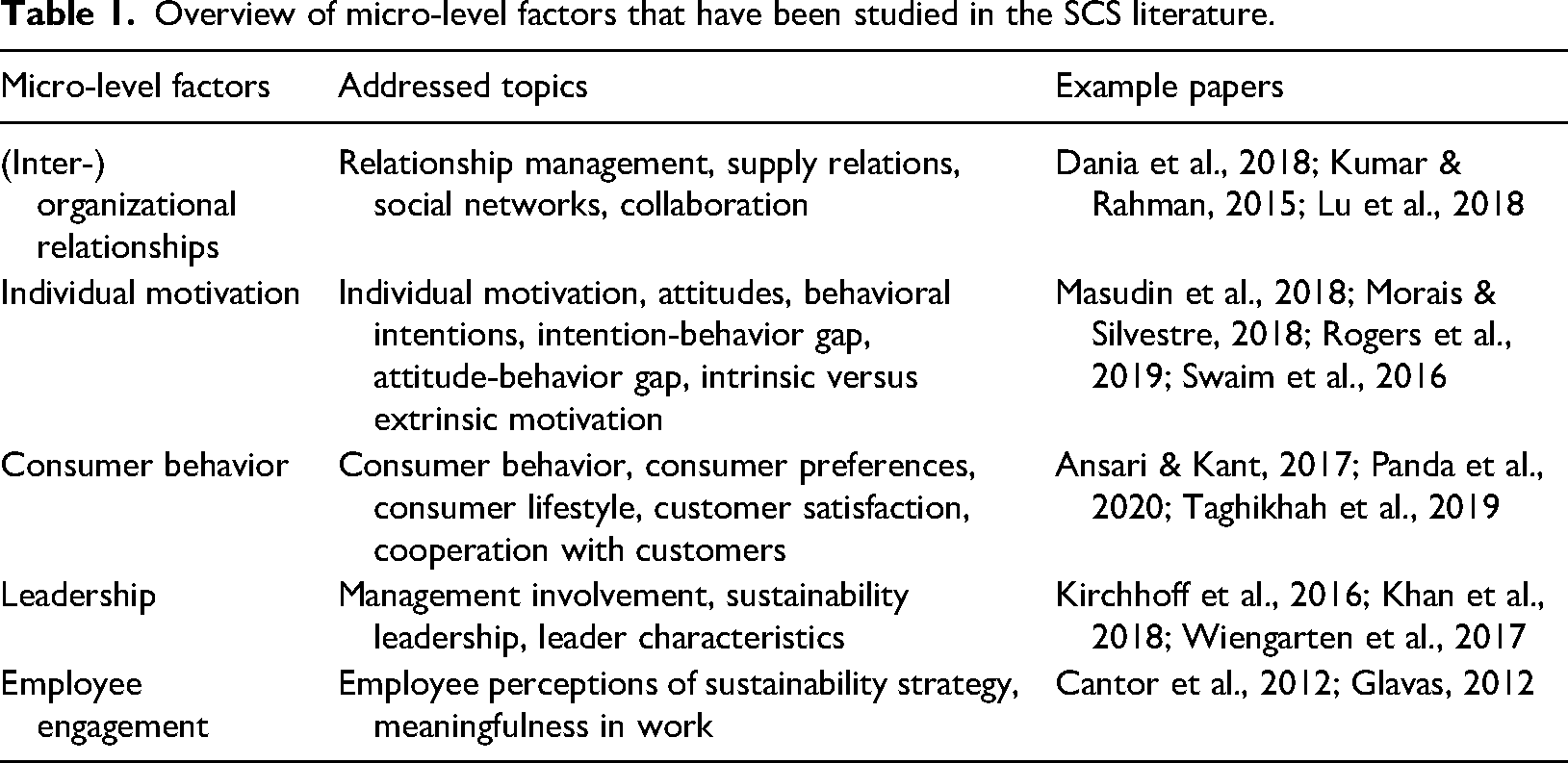
At the same time, it became clear that despite supply chain actors’ individual motivation to implement SCS, sustainability decisions must be made within contexts that are limited in resources and characterized by tradeoffs between cost savings and potential SCS initiatives (Rogers et al., 2019). Hence, one of the most pressing themes is the implementation of SCS. Echoing trends in the broader sustainability literature (Groening et al., 2018), findings repeatedly show that relations between sustainability intentions and SCS performance are weak. A study among operational managers (working at the supplying firm) revealed that their behavioral intentions to contribute to SCS were not related to SCS-promoting behaviors (Masudin et al., 2018), and another study showed that the behavioral intentions of supply chain managers (working at the buying firm) were highly influenced by organizational-level barriers and norms (Rasheed et al., 2020). Although scholars have started to explore and identify the theoretical reasons behind this gap, there is an urgent need to offer potential behavioral solutions to what individual employees can do to bridge this gap and increase the SCS level in their work themselves (Bai & Satir, 2022; Jia et al., 2021). The current paper builds upon the work design literature to offer a behavioral solution that helps individual actors make better sourcing and operational decisions, enhancing social, economic, and environmental responsibility (cf. Atasu et al., 2020).
Implementing supply chain sustainability as an inter-organizational change process
From a psychological perspective, implementing SCS can be viewed as an inter-organizational change process because different actors across the supply chain (e.g., purchasing professionals, production workers, and marketers) need to change how they act and make decisions. However, when these actors are confronted with an organizationally communicated “threat of change,” their natural anxiety toward change may hinder their ability to acquire and process new information, often leading to a rigid and non-collaborative response (Fawcett et al., 2015). The change management literature typically views employee resistance to change as an irrational and dysfunctional phenomenon that managers and organizations must “overcome” to implement changes successfully (Dent & Goldberg, 1999). A newer perspective, however, sees resistance to change as a valuable resource that can raise awareness and identify and remove obstacles in employees’ work design (Ford et al., 2008). Adopting this perspective, we argue that understanding employees’ resistance to change is crucial, as it may play a critical role in sustainability decisions made at the intersection of different organizations. One approach to managing resistance to change is to adapt change communication in supply chains from the top down (Armenakis et al., 1993). This strategy, typically adopted by large firms in supply chains, has yielded mixed results.
Psychological literature suggests that individual employees can facilitate their adaptation to organizational change through proactive behavioral strategies (Petrou et al., 2018), thereby increasing their adaptivity and encouraging them to initiate changes themselves (Grant & Parker, 2009). This is promising because those closest to day-to-day sustainability decisions are best positioned to improve an organization's social and environmental impact (Lamm et al., 2015). They are often the first to identify areas for improvement, making it crucial to nurture their sustainability motivation. The main idea is that employees with a compelling reason to change seek ways to optimize their work environment and acquire necessary resources (Demerouti et al., 2021; Petrou et al., 2018). Through this lens, we introduce our proposition-based framework, showing how motivated supply chain actors can proactively manage sustainability demands and resources to enable themselves and their partners to implement SCS.
A conceptual framework on proactive inter-organizational job design dynamics of sustainability implementation
Our conceptual framework on employee proactivity steering inter-organizational job design dynamics of sustainability implementation is displayed in Figure 1. We focus on supply chain actors (e.g., purchasing professionals working at the focal firm) and partners (e.g., suppliers working at the first-tier supplier) operating at the intersection of organizations where the inter-organizational exchange between sustainability demands and resources takes place. Our focal representatives are intentionally named actor (initiator) and partner instead of buyer and supplier to indicate that the implementation of SCS can go either up- or downstream in the supply chain dependent on the type of industry, market power, or the individual motivation of the respective involved (Vachon & Klassen, 2006). In essence, our framework is triadic as it captures the three entities involved in each sustainability decision; namely, an initiating supply chain actor (and its work environment), a supply chain partner (and its work environment), and the (organizational) exchange in sustainability demands and resources between the two. In the following, we will use the JD-R theory to describe the proactive behavioral processes linking these entities within one sustainability exchange and between exchanges over time.
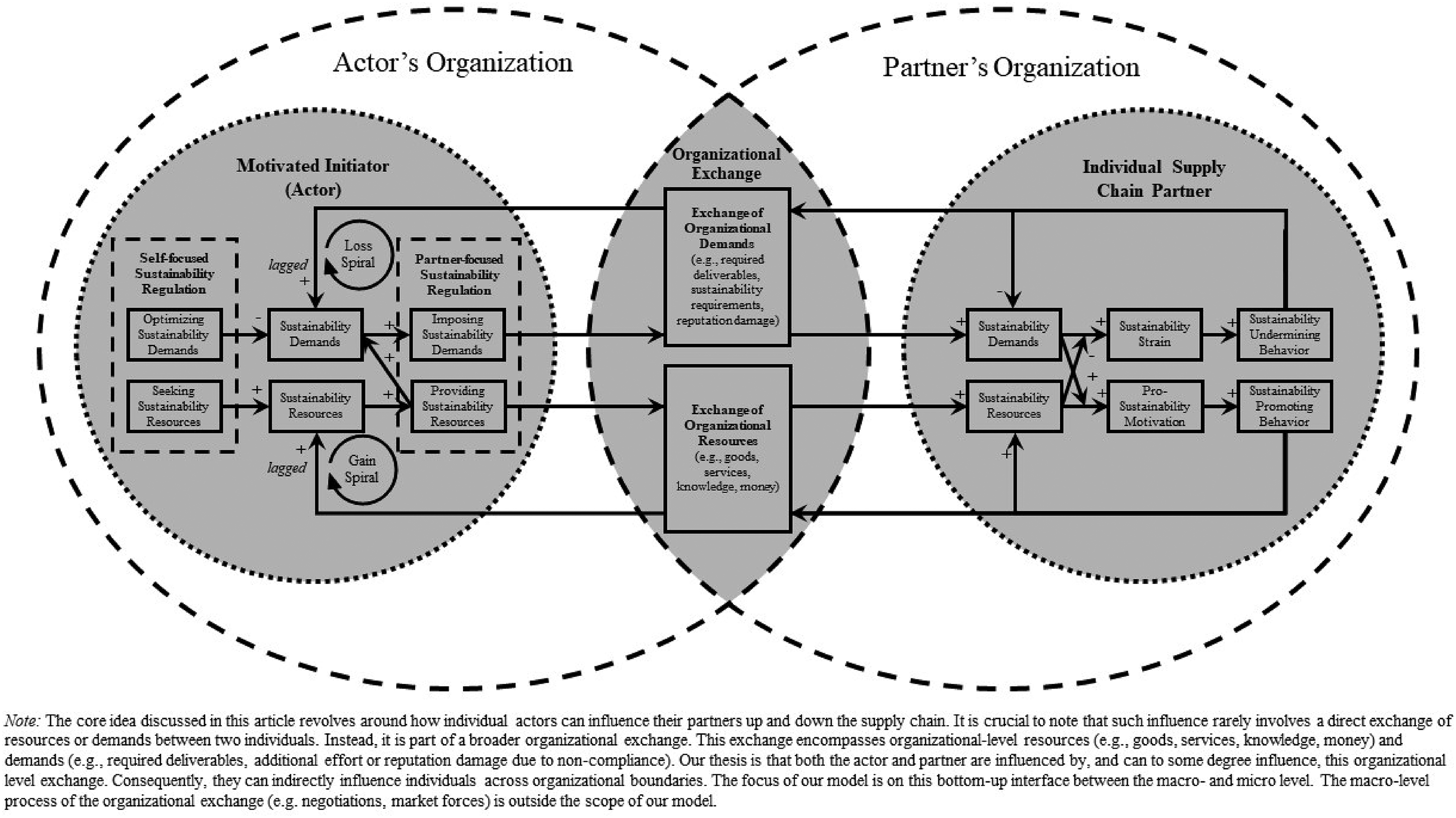
Conceptual framework on proactive inter-organizational job design dynamics of sustainability implementation.
Individual motivation of sustainability initiators
Our framework begins with the sustainability motivation of an individual change agent (the initiator) in the supply chain context. Just as organizations may be driven to implement SCS for business, legitimacy, or development goals (Windolph et al., 2014), individuals can have an internal desire to implement SCS, significantly influencing their information-seeking, decision-making, and actions (Schaltegger et al., 2014). For key employees like supply chain managers, whose roles involve using sustainability criteria in sourcing decisions, this individual motivation can greatly impact SCS implementation. Research shows that individual sustainability motivation drives workplace sustainability decisions, especially when organizational objectives are unclear. This motivation is influenced by personal attitudes, perceived social norms, and perceived control over implementing sustainability (Swaim et al., 2016).
Our conceptual framework highlights the crucial role of individual motivation in supply chain actors as the “spark” for SCS. Rather than focusing on the development of sustainability motivation (Masudin et al., 2018; Swaim et al., 2016), we examine what happens next: the implementation of these intentions (cf. Atasu et al., 2020). For this spark to ignite a behavioral momentum through the supply chain, initiators need empowerment and SCS management tools (Windolph et al., 2014). A resourceful work environment, with sufficient job resources like autonomy, social support, and growth opportunities (Demerouti et al., 2001), is essential for motivated employees to effectively drive sustainability initiatives across organizational borders.
Sustainability implementation requires a motivated and proactive initiator who can mobilize sufficient sustainability resources in its own work environment.
Sustainability demands and resources
SCS affects the work environment of buying and supplying actors by adding sustainability criteria to existing economic and operational demands (Ardakani et al., 2022; Lamm et al., 2015). Such additional demands at the organizational level directly influence daily tasks, such as an operations manager investing in pollution prevention instead of just efficiency, or a purchasing professional vetting suppliers for fair labor practices over cost (Swaim et al., 2016). These initiatives often do not align perfectly with the actors’ traditional work environments, requiring them to balance sustainability efforts with their regular duties, such as meeting deadlines and ensuring quality (Ramus & Killmer, 2007). Thus, SCS implementation disrupts the balance between individual supply chain actor's job demands (e.g., time and financial pressures) and job resources (e.g., capital, network, knowledge), which forms the foundation of our conceptual framework.
Job-Demands Resources Theory (Demerouti et al., 2001) explains that work environments can be divided into job demands and resources. Job demands are those physical, physiological, social, or organizational aspects of work that require sustained physical and/or psychological effort and are associated with certain physiological and/or psychological costs. Job resources are those physical, psychological, social, or organizational aspects of work that (i) help to achieve work goals; (ii) reduce job demands and their associated costs; or (iii) stimulate learning, personal growth, and development (Bakker & Demerouti, 2017). The core idea of the theory is that job demands drain energy, whereas job resources can generate motivation (Demerouti & Bakker, 2022). JD-R theory further postulates that job demands and resources should be balanced for individuals to thrive and improve their functioning (Demerouti & Bakker, 2022). Our conceptual framework is based on the idea that SCS implementation imposes additional sustainability demands on supply chain actors and partners like sourcing new products, requiring additional information, searching for new storage and transport ways, cultural differences, hazardous working conditions in the manufacturing process, or compliance checks (Villena & Gioia, 2020). At the same time, the framework also emphasizes that SCS implementation requires additional sustainability resources from both partners, such as capital, sustainability training, autonomy, and know-how (Yawar & Seuring, 2018) to meet these sustainability demands.
Implementing SCS influences individual supply chain actors and partners’ balance between job demands and resources by imposing additional sustainability demands and requiring specific sustainability resources.
Interdependent updates in sustainability demands and resources
Supply chain actors’ and partners’ sustainability demands and resources are interrelated through the organizational exchange that binds their organizations (Ardakani et al., 2022). This means that when a supply chain actor starts to implement SCS, the status quo is challenged, and there is an urge for the partner to update its sustainability resource pool to adhere to the sustainability requirements. For example, when an initiating actor requires more sustainable packaging from its supply chain partner (e.g., an operational manager working at the supplying firm), this partner has an additional demand to develop or outsource sustainable packaging to meet this new criterion. In other words, an additional sustainability demand in the organizational exchange requires the partner to seek additional sustainability resources. Importantly, in supply chains, sustainability expertise and knowledge are distributed across various organizations, making the resource pool of one organization insufficient (Ardakani et al., 2022). Thus, knowledge integration and resource sharing are essential to meet new sustainability demands (Mell et al., 2022). For instance, a focal firm might optimize a supplier's processes with its specialized knowledge or pay more to support sustainable production. Hence, in the SCS context, sustainability demands and resources do not stay within one organization, they cross organizational boundaries. Moreover, when sustainability demands and resources cross an organizational boundary, they may change in nature (cf. Fong et al., 2022; Tims & Parker, 2020): A sustainability resource for a supply chain actor may mean an additional demand to meet for the supply chain partner and vice versa.
The idea of shared and interrelated demands and resources is underexplored in the literature. JD-R theory has predominantly been applied using an individual perspective (Zhang & Parker, 2018). Although social, team-, and organizational level factors are considered in the make-up and content of demands and resources impacting the work experience of one employee (Bakker & Demerouti, 2017), this influence is typically considered as unidirectional, and there is less attention on what these demands and resources may mean to another individual. Scholars have started to explore how changes in one employee's demands and resources may impact a colleague's demands and resources and, in turn, the colleague's well-being (Tims & Parker, 2020; Tims et al., 2015). Results showed that decreases in the hindering job demands of one employee (e.g., administrative tasks) were positively related to increases in the workload of a closely related colleague (i.e., who had to take over these tasks). Hence, resources for one actor may turn into demands for the partner when the partner needs to invest. We propose a similar mechanism exists between interdependent supply chain actors and partners when implementing SCS. Their relationship is comparable to the previously studied employee dyads in the sense that actor and partner need to collaborate and interact with each other closely (Fong et al., 2022; Tims et al., 2015) but differs in the sense that they work at different organizations that negotiate with each other on the “costs” of their shared SCS responsibility.
Supply chain partners’ sustainability demands and resources are (inversely) related, causing changes in the demands and resources of one partner to prompt corresponding updates in the other.
Activating the sustainability motivational process in the supply chain partner
Changes in the sustainability demands and resources of actors in the supply chain are expected to impact the balance between sustainability demands and resources of their supply chain partner, which impacts the partners’ sustainability motivation, and, in turn, their sustainability behavior. Through the lens of JD-R theory (Bakker & Demerouti, 2017; Demerouti et al., 2001), changes in the composition of demands and resources trigger two processes: A motivational process and a health-impairment process. In the motivational process, resources foster motivation through opportunities for growth, learning, development, or achieving work goals, which, in turn, leads to improved performance. In the health-impairment process, chronic demands deplete employees’ cognitive and physical resources, leading to strain and, in turn, impaired performance. Instead of looking at the sole existence of demands or resources, JD-R theory draws attention to the balance (i.e., interaction) between them (Demerouti et al., 2001). That is, resources are expected to weaken or buffer the depleting effect of job demands on well-being, in the sense that demands are considered less effortful and less straining when an employee has sufficient resources (i.e., buffer hypothesis). Furthermore, demands tend to accentuate the beneficial effects of resources by prompting motivational processes or by stimulating the active use of resources (i.e., boosting hypothesis; Bakker & Demerouti, 2017).
Drawing from these theoretical principles, we propose that supply chain actors who are about to implement SCS (i.e., initiators) trigger these JD-R processes in their supply chain partner (see right-hand side of Figure 1). The interrelatedness of sustainability demands and resources across supply chain partners (Ardakani et al., 2022) implies that when an actor initiates SCS implementation through the inter-organizational exchange (e.g., by imposing additional sustainability demands on the supply chain partner), this will impact the sustainability demands and resources of the partner (see Proposition 3), which consequently will influence the partners’ sustainability motivation and behavior. More specifically, we propose that when a supply chain partner is challenged with additional sustainability demands by the initiating supply chain actor, this will cost resources. However, the depleting effect of these additional demands will be buffered when the partner has ample access to sustainability resources in its work environment. In a resourceful work environment, the partner will experience more sustainability motivation and respond with more sustainability-promoting behavior than in a resource-constrained work environment (Ardakani et al., 2022; Porteous et al., 2015).
Fong et al. (2022) have recently started to explore these interpersonal JD-R processes by showing that when an actor is proactively increasing challenging demands and job resources in a collaborative context, the work enjoyment of co-workers seems to increase, which in turn, increases their willingness to collaborate with the actor. We propose that these interpersonal processes also seem to be at play between employees from different organizations collaborating in the inter-organizational SCS context. However, until now, these dynamics have only been theorized or examined on a more macro-level. Specifically, the SCS management literature suggests that the intra-organizational processes to incorporate sustainability within supply chain companies are strongly dependent on inter-organizational processes in which access to valuable resources strengthens the efficacy of SCS implementation (Ardakani et al., 2022). Empirical firm-level research confirms that when focal firms offer their suppliers sustainability resources, like training for improving social and environmental performance or price premiums, along with sustainability demands, like enforced codes of conduct and audit systems, supplying firms reduce their sustainability violations (Porteous et al., 2015; Yawar & Seuring, 2018). Thus, sustainability resources seem to have the capacity to buffer the potential draining effect of sustainability demands, leading to sustainability-promoting behavior of supply chain partners. Our framework provides a comprehensive behavioral explanation of such firm level observations.
Individual supply chain partners who are challenged with sustainability demands from the initiating supply chain actor will experience more sustainability motivation, and, in turn, respond more with sustainability-promoting behavior when they have high (versus low) access to sustainability resources.
Activating the sustainability impairment process in the supply chain partner
Unfortunately, SCS implementation often fails to positively influence the demands and resources of supply chain partners. Instead, many focal firms merely impose additional sustainability demands on their suppliers without providing essential resources for adaptation (Patil et al., 2022; Porteous et al., 2015). These firms primarily focus on monitoring supplier compliance through auditing systems and resort to punitive measures, such as fines or contract termination, to enforce sustainability standards (Patil et al., 2022). Although such explicit use of market power may initially appear as an effective shortcut to SCS, research indicates that relying solely on “sticks” (i.e., demands) without offering “carrots” (i.e., resources) often proves ineffective in fostering long-term improvements in SCS (Porteous et al., 2015). It can, for example, backfire by compelling suppliers with limited sustainability resources to conceal information from auditors (Plambeck & Taylor, 2016), which we identify as a form of sustainability-undermining behavior (i.e., behavior that creates obstacles and may undermine sustainability performance; Bakker & Costa, 2014).
Such a demanding and resource-constrained process can be linked to the health impairment process of JD-R theory, stating that, on an individual level, chronic job demands and low job resources represent a high-stress work environment that may cause impaired functioning (Bakker & Demerouti, 2017) and eventually even lead to self-undermining behavior (Bakker & De Vries, 2020). In line with this principle, we propose that supply chain partners working in a work environment with high sustainability demands (e.g., standards) and low sustainability resources (e.g., know-how, capital) may experience sustainability strain, which may eventually result in sustainability-undermining behavior such as hiding practices or audit fraud (Plambeck & Taylor, 2016). It is likely that this sustainability impairment process is triggered when initiating supply chain actors start to impose additional sustainability demands on their partners without providing them with (access to) the required sustainability resources. Indeed, recent research shows that employees can trigger the health impairment process in co-workers when they provide unbalanced job demands and resources in the collaborative context leading to decreases in the work enjoyment of both employees, and increased experiences of relationship conflict (Fong et al., 2022). Building on this initial support, we propose that individual supply chain actors may activate a sustainability impairment process in their supply chain partners when they challenge them with high sustainability standards without providing access to sustainability resources.
Individual supply chain partners who are challenged with sustainability demands from the initiating supply chain actor may experience sustainability strain, and, in turn, respond more with sustainability-undermining behavior when they have low (versus high) access to sustainability resources.
Proactive sustainability regulation
Until now, we have outlined that SCS implementation is linked to increased sustainability demands and requires specific resources in the work environment of supply chain actors and partners. We have discussed how (inter-organizational) changes in these sustainability demands and resources can trigger motivational and behavioral responses in supply chain partners. Shifting focus, while the SCS management literature emphasizes top-down influences on sustainability demands and resources (Ardakani et al., 2022; Locke et al., 2007), we draw on JD-R theory to emphasize the bottom-up influence of employees on job demands and resources (Demerouti & Bakker, 2022). Particularly relevant during times of change (Petrou et al., 2018), employees can proactively influence the demands and resource balance to optimize their own and their co-workers’ motivation and functioning (Fong et al., 2022; Tims & Parker, 2020). Hence, we propose that motivated supply chain actors may proactively adjust the balance between sustainability demands and resources in their own and their partner's work environment to facilitate SCS implementation, utilizing self- and partner-focused sustainability regulation strategies.
The proactive regulation of demands and resources is called job crafting. Through job crafting, employees make changes in the design of their work to create a better fit between their job and their preferences which eventually contributes to increased well-being and goal attainment (Tims & Bakker, 2010). There exist different job crafting strategies, including seeking (social and structural) resources, seeking challenges, and reducing or optimizing demands (Demerouti & Peeters, 2018; Tims & Bakker, 2010). While research has predominantly concentrated on job crafting to attain personal goals (e.g., individual attitudes, behaviors, or well-being; Zhang & Parker, 2019), it also holds potential as a means to attain organizational goals. For instance, it can increase compliance with safety procedures (Demerouti et al., 2021) and contribute to broader societal progress in terms of sustainability (i.e., responsible crafting, Bizzi, 2020).
Building on this idea, our framework suggests that motivated supply chain actors may engage in job crafting to regulate the necessary sustainability demands and resources. Given the interconnectedness of sustainability demands and resources across supplying and buying organizations (Ardakani et al., 2022), we propose that motivated actors should regulate these aspects not only within their own work environment but also in that of their partners to facilitate sustainability initiatives. This idea is innovative, as job crafting is typically viewed as self-directed and independent of others (Zhang & Parker, 2019). However, the latest insights into job crafting indicate that crafting may unintentionally affect co-workers’ well-being and proactive behavior because co-workers are often exposed to similar job characteristics, meaning that proactive changes therein can have effects that go beyond the crafter (Bakker et al., 2015; Fong et al., 2022; Peeters et al., 2016). Taking this idea further, we propose that actors may intentionally extend their regulatory efforts to the work environment of their supply chain partner.
Partner-focused sustainability regulation
For supply chains to remain viable and competitive, buying firms must actively invest (non)-financial resources in activities aimed at enhancing the capabilities of their suppliers (Dalvi & Kant, 2018). This supplier development process includes strategies such as investments, supplier visits, certification, auditing, training, education, and knowledge transfer (Yawar & Seuring, 2020). These resource-providing activities are crucial, particularly in coping with the demands and challenges associated with SCS implementation (Porteous et al., 2015; Yawar & Seuring, 2018). Supplier development activities can be distinguished into direct strategies (e.g., investments, training) in which buying firms systematically invest resources to enhance supplier capabilities, and indirect strategies that require minimal resources from the buying firm (e.g., certification, auditing). In line with multi-level JD-R theory (Bakker & Demerouti, 2018), direct resource-providing strategies are most effective in fostering supplier-buyer collaboration, improving their long-term relationship, and increasing supplier motivation (Yawar & Seuring, 2020). So, at the organizational level, actively providing resources to address sustainability demands optimizes the partner organization's demands and resources balance, fostering a motivated and collaborative response.
In our conceptual framework, we propose that such inter-organizational resource regulation can proactively be fueled by individuals from the bottom up. Individuals who play a key role in this are so-called boundary spanners – those who operate at the juncture of different teams, departments, or organizations (Mell et al., 2022) such as the supply chain actors and partners that we focus on. The boundary-spanning literature indicates that the meta-knowledge of boundary spanners – insight into each other's resource pool – is a crucial factor driving effective resource mobilization and integration (DeChurch & Mesmer-Magnus, 2010). Beyond this ability, boundary-spanners need to be motivated to invest additional effort (i.e., being proactive) in positively influencing this interpersonal resource exchange process (Reinholt et al., 2011) to ultimately foster inter-organizational collaboration. Consequently, supply chain actors (initiators) can proactively improve the balance between sustainability demands and resources of their supply chain partners by sharing the right knowledge and resources to trigger their partner's sustainability motivation and performance. An important prerequisite seems to be having clear insight into the work design of the supply chain partner (i.e., meta-knowledge; Mell et al., 2022) as it may dictate the optimal regulation of sustainability demands and resources. Meta-knowledge on supplier-specific sustainability issues may determine which level of demands is still manageable for the partner, and which specific resources are needed to evoke an optimal (collaborative) response in them (cf. Sillanpää et al., 2015).
Supply chain actors can use proactive partner-focused sustainability regulation strategies to positively influence the balance between sustainability demands and resources of their supply chain partner to trigger sustainability motivation and sustainability-promoting behavior.
Partner-focused sustainability regulation through job crafting involves reallocating sustainability demands and resources (cf. Berg et al., 2010). In the interdependent context of supply chains, these resources and demands are mutually exclusive (Ardakani et al., 2022). When supply chain actors share or provide sustainability resources to their partners, they must draw from their own resource pool, making partner-focused sustainability regulation costly. Organizational-level research indicates that companies initiating supplier development face costs by providing technical support and training to their suppliers (Praxmarer-Carus et al., 2013). While these investments are beneficial long-term (Yawar & Seuring, 2020), they can initially imbalance in the demands and resources of the initiator's demands and resources. Balancing these investment costs with the costs of partner unsustainability is crucial for SCS implementation (Patil et al., 2022).
We propose that this tradeoff is also manifests at the individual level. JD-R theory acknowledges that self-regulation to alter one's own work environment requires energy, which cannot be used for other tasks, potentially causing negative effects (Demerouti et al., 2015). Indeed, studies show that job crafting can lead to role conflicts and feelings of disappointment and regret in the short term (Bakker & Oerlemans, 2019; Berg et al., 2010). These costs likely also apply when crafting someone else's work environment, where the long-term benefits of this regulatory behavior are even more uncertain. To illustrate, supply chain managers often struggle to balance short-term investments, such as late deliveries, sharing knowledge, or price reductions, with the long-term rewards of SCS initiatives (Swaim et al., 2016).
Supply chain actors who use proactive partner-focused sustainability regulation strategies may need to draw from their own sustainability resource pool thereby risking an initial disbalance in their own sustainability demands and resources.
Self-focused sustainability regulation
The work environment of supply chain actors often does not support sustainability implementation (Villena & Gioia, 2020), nor the regulation of sustainability demands in their partners’ work environment. The costs of partner-focused sustainability regulation, such as proactivity, extra effort, and attention to other's work environments, come from the actor's own resource pool. Since sustainability behaviors are usually voluntary (Ramus & Killmer, 2007), these investments are not automatically replenished from above (i.e., the organization). Internal sustainability support and collaboration are often lacking (Patil et al., 2022), posing challenges for supply chain actors motivated to initiate SCS activities. They typically lack resources such as autonomy, managerial support, sustainability training, capital, cross-functional collaboration, and decision-making latitude (Lamm et al., 2015; Swaim et al., 2016). Combining Conservation of Resources (COR) theory, which posits that individuals need an initial pool of resources to invest rather than to protect (Hobfoll, 1989), with JD-R theory (Bakker et al., 2023), we propose that actors can proactively regulate sustainability demands and resources in their own work environment to facilitate partner-focused sustainability regulation.
Given the conflicting demands and lack of sustainability resources in supply chain roles (Villena & Gioia, 2020), we propose that actors can benefit from proactively optimizing their demands and resources (see Figure 1). Research shows that optimizing demands and seeking resources enhance daily proactive sustainability behavior (Pekaar & Demerouti, 2023). Moreover, individual demand management and social-oriented competencies seem crucial for employees in sustainable purchasing and supply management (Eltantawy, 2016; Schulze et al., 2019).
Supply chain actors can use proactive self-focused sustainability regulation strategies to optimize their own balance between sustainability demands and resources such that it facilitates partner-focused sustainability regulation.
Gain and loss spirals of sustainability resources
Implementing SCS is a journey, not a destination (Bouchery et al., 2024). Organizations must continuously meet sustainability goals, evolving this effort in a sustained collective practice over time (Da Silva & Figueiredo, 2020). This ongoing process is essential for structural improvements in supply chain's working and environmental conditions (Meinlschmidt et al., 2016). We have emphasized that a sustainability initiative by one actor triggers a response from partners; however a one-time response is insufficient to drive SCS implementation (Da Silva & Figueiredo, 2020). We propose that supply chains require gain spirals of sustainability resources in which the partners stimulate and strengthen each other in SCS implementation (Luu, 2019). Applying JD-R theory's boosting hypothesis, which posits that resources become more valuable in light of high demands (Bakker & Demerouti, 2017), to inter-organizational change, we explain how such spirals evolve. Elevated sustainability demands imposed by one actor underscore the significance of partners’ sustainability resources, prompting their proactive and motivated pursuit of resources (Bakker & Demerouti, 2017; Hobfoll, 1989). This process fosters proactive SCS behavior, extending from the initiating actor to the partner and potentially reciprocating back to the initiating actor in the form of sustainability resources. Ultimately, this dynamic may instigate a gain spiral of sustainability resources that permeates throughout the supply chain.
This gain process requires a balanced organizational resource exchange, providing individuals facing sustainability demands with sufficient resources to motivate proactive resource-seeking behaviors (Halbesleben et al., 2014). Employees in resource-rich environments tend to engage in resource-expanding, extra-role behaviors, including sustainability initiatives (Hobfoll, 1989; Villena & Gioia, 2020). For instance, Luu (2019) demonstrated that employees with access to sustainability resources via their organization's HR practices were more likely to invest in sustainability, leading to sustainability resource gain spirals including enhanced knowledge, new skills, and community-oriented values. Partner-focused sustainability regulation, such as support from colleagues and managers, was identified as the active mechanism driving this spiral, aligning with our conceptual framework.
We suggest that this dynamic also extends to supply chain actors and partners across different organizations. Macro-level research indicates that the exchange of SCS knowledge between buying and supplying firms fosters SCS capabilities in both, leading to continuous improvement (Meinlschmidt et al., 2016). We offer a behavioral mechanism at the individual level. Drawing from JD-R theory's boosting hypothesis (Bakker et al., 2023), actors may increase challenging sustainability demands on their partner, thereby activating their partners’ motivation and resource-seeking behavior, while mitigating hindering demands through support (cf. Luu, 2019). Consequently, partners may seek sustainability resources within their organization, eventually sharing and contributing to the actor's resource pool to collectively balance future demands
Balanced organizational resources exchange is related to a gain spiral where high sharing of sustainability resources (initiator) and sustainability-promoting behaviors (partner) influence each other over time through successful regulation of sustainability resources of both parties.
Because most supply chains face challenges in implementing SCS effectively due to sustainability demands in resource-constrained work environments (Bai & Satir, 2022; Villena & Gioia, 2020), sustainability resource gain spirals are not likely to develop. Following JD-R theory, individuals in such high demands – low resources situations experience strain, triggering maladaptive, self-undermining regulation processes that exacerbate the situation (Bakker & De Vries, 2020). Within a similar vein, COR theory states that individuals with limited resources may resort to defensive regulation strategies to avoid further resource loss (Hobfoll, 2011). These maladaptive regulation strategies, such as poor communication, careless mistakes, or interpersonal conflicts, only compound existing demands, ultimately undermining individuals’ ability to cope (Bakker & De Vries, 2020). In interpersonal supply chain dynamics, such self-undermining behaviors not only hinder the individual but also impact the partner, creating a spiral of increasing demands over time. Fong et al. (2022) demonstrated that an actor's crafting behavior, driven by avoidance and prevention-oriented goals (Zhang & Parker, 2019), led to reduced partner cooperation and increased relationship conflict. Essentially, this results in increased demands for both parties, complicating access to knowledge, experience, or support from each other, thus posing challenges in coping with (collective) future demands.
The SCS management literature highlights the role of loss spirals in sustainability implementation. For instance, suppliers in resource-constrained environments often face overwhelming demands, especially concerning audits from multiple buying firms, leading to audit fatigue (Patil et al., 2022). This fatigue can divert their focus from actual sustainability improvement and may even result in audit fraud, where suppliers conceal information through deceptive or corrupt practices (Plambeck & Taylor, 2016). Such practices not only fail to drive real improvement but also reduce supplier accountability, posing a risk of severe brand damage when exposed. We provide an individual level explanation within the supply chain context on why employees with limited access to sustainability resources (such as training, knowledge, and rewards) decrease their proactive sustainability efforts. This weakens the connection between organizational sustainability goals and their actual implementation, ultimately impeding structural improvement (Luu, 2019). We suggest that an imbalanced exchange of organizational demands (high sustainability demands coupled with low resources) triggers an ineffective regulatory process among individual actors and their supply chain partners.
Unbalanced organizational demands exchange is related to a loss spiral where low sharing of sustainability resources (initiator) and sustainability-undermining behavior (partner) influence each other over time through unsuccessful regulation of demands.
Discussion
We developed a conceptual framework that integrates insights from the job-design, proactivity, organizational change, and supply chain management literature to provide a dynamic micro-foundation of the SCS implementation process through the lens of an actor motivated to implement sustainability. This behavioral and proactive approach crosses organizational borders in the supply chain and alters the design of prevailing conditions initiating organizational change and inducing long- and short-term dynamics. Our primary theoretical contribution lies in proposing a conceptual framework that places individual actors operating at the interface of organizations at the forefront, emphasizing the role of behavioral adaptation in balancing sustainability-related demands and resources across the supply chain. By delving into these micro-level dynamics, we shed light on why macro-level sustainability implementation often encounters challenges.
This approach does not discard top-down models (Ardakani et al., 2022; Bai & Satir, 2022), which underscore the impact of contextual forces on SCS (Johns, 2017). While our focus has been on proactive bottom-up work design for SCS, we acknowledge that local work designs are shaped by contextual factors at multiple levels, including global and industrial (e.g., governmental regulations, technological development), organizational (e.g., strategy, initiatives, climate), and team factors (e.g., social dynamics, leadership; Parker et al., 2017; Zacher et al., 2023). These contextual influences primarily operate through social norms (Ardakani et al., 2022) communicating expectations about supply chain actors’ sustainability behavior (Mani & Gunasekaran, 2018), and whether proactivity is valued (Costantini et al., 2022). Social norms shape supply chain actors’ self- and partner-focused sustainability regulation (cf. Tims & Parker, 2020), with their evolution over time continually influencing proactive sustainability behavior (Douglas et al., 2022). Apart from normative influences, the context may directly create a disbalance in the sustainability demands and resources of supply chain actors and partners through external crises like the pandemic, technological disruptions, or new regulations (Kuzemko et al., 2022; Lehmann et al., 2021) necessitating adaptation and optimization of their work environments to facilitate SCS in the new situation.
Applications of the proposed framework
The current paper introduces a research agenda on bottom-up SCS management through testable propositions. To stimulate empirical research on this topic, we offer several recommendations. A crucial aspect is collecting data from employees in different organizations interconnected within the supply chain (i.e., both sides of the dyad; Halbesleben & Wheeler, 2011). Such a multisource perspective is vital to understand how changes in the sustainability demands and resources of actors impact those of partners and vice versa. The propositions are intentionally framed in a generic way (i.e., using ‘actors’ and ‘partners’) to allow testing at any point within the supply chain. Since most of our propositions involve interpersonal behavioral responses, we encourage researchers to carefully consider the appropriate time frame for their research. For example, when a buyer demands a more sustainable logistics process, the salesperson in the partner organization may need time to proactively seek for resources. Multi-source (i.e., data from both partners) event sampling or diary studies (to capture more proximal responses; Halbesleben & Wheeler, 2011) or a multisource longitudinal panel design (to capture more distal responses) could be suitable for this purpose. The gain and loss spiral propositions explicitly require multiple measurement designs, and linking these to higher-level organizational exchanges may necessitate collecting data at multiple levels (Huang et al., 2016). To analyze these multisource datasets, we encourage scholars to employ Actor-Partner Interdependence Models to distinguish actor and partner effects and to examine proactivity bidirectionally (Cook & Kenny, 2005). Additionally, modeling approaches such as Agent Based Modeling or System Dynamics may be used to rigorously test the gain and loss dynamics over time.
Extending the dyadic framework to longer supply chains
Although our conceptual framework adopts a dyadic perspective by focusing on the relational exchange between a supply chain actor and partner in two different organizations (e.g., the focal firm and a first-tier supplier), it can be extended to longer chains. The beauty of our framework is its reversibility. Once a supply chain partner becomes motivated and responds with sustainability-promoting behavior, the partner can become the “initiator” in interactions with a so-called sub-supplier (e.g., a first-tier supplier and a second-tier supplier), thereby propagating sustainability further along the chain. For successful SCS implementation, supply chain actors and partners should thus fulfill a dual role; meeting the lead firm's sustainability demands by mobilizing sustainability resources and acting as a change agent to pass these demands and resources onto their supplier. Research supports the extension of our dyadic perspective to longer chains, showing that the resource availability at first-tier supplier firms (i.e., the partner in our framework) determines their ability to drive SCS implementation to the second-tier suppliers (Wilhelm et al., 2016). The proactive job design dynamics outlined from a dyadic perspective in the current framework can create a ripple effect, setting SCS in motion and propagating it upstream and downstream in the supply chain.
Proactive work design dynamics in other contexts
Our conceptual framework on inter-organizational job design dynamics can be viewed as a dyadic extension of JD-R theory (Bakker et al., 2023). While the literature has noted that the antecedents of crafting can originate from both within and outside individuals (Zhang & Parker, 2018) and that its consequences can be both intra- and interpersonal (Fong et al., 2022; Tims & Parker, 2020), we are the first to integrate these interpersonal dynamics within an overarching JD-R framework operating at the intersection between organizations. We have applied our conceptual framework to SCS implementation as this offers a unique context in which motivated individuals need to drive ongoing change across mutually dependent organizations (Patil et al., 2022). While every organization aspires to become more sustainable, individuals must navigate negotiations on costs and tradeoffs with other performance outcomes (Yawar & Seuring, 2020; Zacher et al., 2023). Notwithstanding, we believe that the scope of our framework is wider than SCS. For instance, research on inter-organizational exchanges in emerging markets highlights the significance of knowledge sharing, communication, and collaboration among boundary spanners in fostering positive inter-organizational relationships. Findings stemming from 225 manufacturer-distributor dyads reveal that resource-providing behaviors at lower levels (i.e., between salespersons and individual buyers) have a stronger relationship with beneficial inter-organizational exchanges compared to similar behaviors at higher levels (between top executives; Huang et al., 2016). This indicates that partner-focused resource regulation between employees working in different organizations can make a significant impact beyond SCS as well. It is our hope that synthesizing proactive self- and other-focused JD-R regulatory strategies (cf. Tims & Parker, 2020) in the context of inter-organizational demands and resource exchanges may advance both the job design and the organizational change literatures.
Practical implications
Our conceptual framework emphasized the crucial yet often overlooked role of employees’ proactive behavior and their work design in implementing SCS. In doing so, we provide key guidelines for employees, leaders, HR practitioners, and supply chain managers aiming to enhance sustainability. Supply chain actors and partners should recognize their sustainability demands and resources, and craft their jobs to create opportunities for implementing sustainability (Pekaar & Demerouti, 2023). Additionally, they need to invest in understanding their partners’ sustainability demands and resources to facilitate effective partner-focused resource regulation (Mell et al., 2022), leading to more collaborative responses (Huang et al., 2016). This can be achieved through developing more effective and transparent communication strategies. Leaders play a crucial role by modeling proactive and sustainable behavior and promoting it through resource-providing and empowering leadership (Bakker et al., 2023). Organizations should consider selecting buyer and sales team leads based on these criteria or invest in leadership training. In addition, buyers and salespersons should be provided with additional resources to support sustainability initiatives and minimize tradeoffs with other performance outcomes. This can for instance be achieved by incorporating sustainability performance into KPIs (Bouchery et al., 2024). Organizations can further boost SCS by implementing job crafting training (Pekaar & Demerouti, 2023). Finally, supply chain managers should encourage resource-sharing across all organizational levels to foster a supply chain environment that stimulates the implementation of sustainability.
Conclusion
With this paper's conceptual framework, we introduced a proactive job design perspective in the inter-organizational change process of implementing SCS and discussed its relevance for individual supply chain actors and partners who are motivated to contribute to this issue. We explained how behavioral regulatory strategies operating at the micro-level between organizations might steer SCS implementation from the bottom up eventually accumulating into gain or loss spirals of sustainability resources throughout the supply chain. Our aim is that the framework may offer new explanations of why inter-organizational sustainability development may be stimulated or withheld resulting from interdependent job crafting dynamics and support the implementation of SCS.
Footnotes
Funding
The authors disclosed receipt of the following financial support for the research, authorship, and/or publication of this article: This work was supported by TKI Dinalog (grant number 2017-2-132TKI).
