




Abstract
Background:
Dementia prevalence is increasing worldwide, and dementia is frequently comorbid with depression during its disease course. Additionally, safety concerns are rising regarding the prescription of psychotropic agents to patients with dementia. Thus, our study assessed the influence of prescribing antidepressants in dementia with depression on mortality risk, and the differences between classes of antidepressants.
Methods:
This study was a population-based retrospective cohort study that utilized the National Health Insurance (NHI) medical claims data on mental illness in Taiwan between 1998 and 2013. We identified 25,890 cases of newly diagnosed dementia with depression and divided them into two groups: antidepressant users and nonusers. All-cause mortality between the two groups and the effects of different antidepressants were analyzed.
Results:
Antidepressants reduced all-cause mortality in patients with dementia and depression after adjusting for all covariates. Furthermore, the effect was significant when antidepressant exposure was more than 168 cumulative defined daily dosages, and most classes of antidepressants had this protective effect.
Conclusions:
Antidepressant treatment showed significant protective effects in all-cause mortality for patients with dementia and depression. Most classes of antidepressants were effective, especially with longer treatment duration or higher dosage.
Background
Dementia prevalence is increasing worldwide, with more than 80 million people estimated to be affected by dementia by 2040. 1 A dementia study estimated a prevalence of 3.8% across mainland China, Hong Kong, and Taiwan. 2 Additionally, dementia is frequently comorbid with depression, and approximately 50% of patients with dementia have suffered from depressive episodes during its disease course. 3 Studies have indicated that depression in later life results in poor prognosis and increased all-cause mortality.4–7 Another study revealed increased all-cause mortality in those who had depression at baseline before incident dementia. 8
Recently, concern has been raised about the safety of prescribing psychotropic agents, especially to elderly patients.9–11 An increased risk of mortality from prescribing antipsychotics in patients with dementia has been observed for many years.11,12 However, the safety of prescribing antidepressants to patients with dementia remains debatable. Some studies have reported increased mortality,10,11 but another showed a protective effect. 13 Dementia is frequently comorbid with depression, and the risk of antidepressants in treating dementia with depression has not been fully investigated.
We investigated the influence of antidepressants in treating dementia comorbid with depression regarding all-cause mortality and analyzed any differences between antidepressants. Thus, the aims of our study were to investigate the risk of mortality in prescribing antidepressants for patients with dementia and depression, and to explore if any difference exists in protective effect among classes of antidepressants.
Methods
Patient selection
This study obtained the approval of the Institutional Review Board (IRB) from Chang Gung Memorial Hospital (IRB No:2017017141B1). The IRB committee received full accreditation from the Association for the Accreditation of Human Research Protection Programs in 2018. This study utilized a deidentified medical dataset, and the IRB waived the requirement of obtaining informed consent. Figure 1 shows the procedure of participant selection.

Study selection protocol.
The data were extracted from the Taiwan National Health Insurance Research Dataset (NHIRD) of medical claims that were registered from 1998 to 2013. The National Health Insurance (NHI) is a compulsory universal health care program for Taiwanese residents and was established in 1995 its dataset covers nearly the entire population. The dataset comprises patient medical information, including demographics, outpatient visits, outpatient diagnoses, admission dates, discharge diagnoses, and prescriptions. The diagnosis system used by the NHI is the International Classification of Disease, Ninth Revision, Clinical Modification (ICD-9-CM). 14
In step 1, we recruited those who were newly diagnosed with dementia based on ICD-9-CM code (290.X, 294.1X, 331.0) between 2000 and 2011; those who were diagnosed with dementia before 2000 were excluded. There were 356,622 cases after step 1. In step 2, those who received depression diagnoses (296.2X, 296.3X, 300.4, 311) after the diagnosis of dementia were defined as the study participants. We excluded those without depression diagnoses during 2000 to 2011 and those whose depression was diagnosed before dementia. After step 2, 28,065 cases remained. In step 3, we excluded those diagnosed with dementia at an age younger than 60 years. The index date was defined as the date of incident diagnosis of depression. Finally, 25,890 patients with dementia who subsequently experienced depression were recruited, and we divided them into two groups for further analysis based on antidepressant use. We used the data from only between 2000 and 2011 (with follow-ups through 2013), because the data from 1998 to 2000 were used to determine whether the diagnosis of dementia was new, and whether the patient had depression before the dementia diagnosis. Specifically, without previous diagnostic data, we could not determine whether a person diagnosed with dementia in the 1998 data was newly diagnosed. Additionally, we could not determine whether a patient had dementia or depression first using 1998 data. Therefore, we assumed that if a person did not have a diagnosis of dementia from 1998 to 2000, a diagnosis of dementia given after the year of 2001 indicated newly diagnosed dementia. Additionally, if a person with dementia diagnosed in year 2001 had a diagnosis of depression between 1998 and 2000, we removed that person because of the possibility that depression came before dementia. Apart from the initial year’s data, we could analyze data through 2011 (and follow-up to 2013) because the released dataset was from 1998 to 2013. As a result, follow-up results after 2013 were not available.
Antidepressants and other covariates
The antidepressants prescribed to the study participants were identified using the Anatomical Therapeutic Chemical (ATC) Classification System of the World Health Organization. Prescription dosage was operationalized by cumulative defined daily dosage (cDDD), 15 and we classified it into three different exposures: <28 cDDDs, 28–168 cDDDs, and >168 cDDDs. Antidepressant nonusers were defined as <28 cDDDs.
Other covariates we collected comprised area of residence; annual income; severity of depression; antidepressants use within 1 year before index date; general physical conditions as assessed using the Charlson comorbidity index (CCI); 16 and other comorbidities, including hypertension, diabetes, malignancy, coronary artery disease, heart failure, end stage renal disease (ESRD), and chronic obstructive pulmonary disease (COPD), that were recorded before the index date. Those who received depressive diagnostic codes of 296.2X and 296.3X were defined as major depression, and those of 300.4 and 311 were defined as minor depression, respectively. All diagnoses of dementia, depression, and other physical comorbidities in our study were operationalized as having an inpatient diagnosis or at least three medical records of outpatient care within 1 year. Antidementia drug prescriptions, including acetylcholine esterase inhibitors (AChEIs) and memantine, were also recorded as covariates.
Statistical analysis
Sociodemographic data, severity of depression, CCI, antidepressant use, comorbidities, and antidepressants exposure before the index date were compared between patients with and without antidepressant prescriptions using Pearson’s chi-square test for categorical variables. In addition, we also displayed effect size to show the magnitude of effect. 17 The primary outcome event was defined as all-cause mortality. Mortality risk was analyzed using the chi-square test. Additionally, Kaplan-Meier survival curves by different cDDD of antidepressants exposure were compared using log-rank test. The time from index date until death or until the end of 2013 was calculated as time to event. Cox proportional hazards models were performed to calculate the hazard ratio (HR) with 95% confidence intervals (CIs). The covariates included gender, age, urbanization, income, and year of index date. The cumulative effects of prescribing antidepressants were calculated according to cDDD. Those who were still alive or ceased follow-up before the end of 2013 were defined as censoring data. In order to avoid immortal time bias, Cox models were analyzed using time-dependent covariates.
In order to examine the consistency between antidepressants use and mortality risk, several sensitivity analyses were performed by adding other potential confounders, including severity of depression, antidepressants use within 1 year before index date, different comorbidities, CCI, and antidementia drugs. Consequently, we examined the outcome stratified by age, gender, severity of depression, and antidepressants use within 1 year before index date to test the potential effects of modifiers. All data were analyzed using SAS 9.4 software (SAS institute Inc., Cary, NC, USA).
Results
Characteristics of participants
Through selection in accordance with the protocol in the Figure 1, we identified 25,890 cases of newly diagnosed dementia with incident depression. Of these, 18,226 cases were defined as antidepressant users (cDDD ⩾28), and 7664 cases were defined as antidepressant nonusers (cDDD <28). Demographic data, clinical variables, severity of depression, underlying diseases, dementia treatment, and antidepressants use within 1 year before index date were compared between the two groups; the comparisons are displayed in Table 1. Antidepressant users were younger and had higher income, lower CCI, fewer comorbidities (including heart failure, ESRD, and COPD), more severe in depression, and more exposure to antidementia drugs (p < .0001). All-cause mortality was significantly lower in antidepressant users than in nonusers (p < .0001).
Demographic data and clinical characteristics of all patients with dementia and incident depression.

ADs: Antidepressants; df: degrees of freedom.
Interpretation of Cramer’s V: (1) in df = 1, small: 0.10, medium: 0.30, large: 0.50; (2) in df = 2, small: 0.07, medium: 0.21, large: 0.35; (3) in df = 3, small: 0.06, medium: 0.17, large: 0.29.
Associations of antidepressant prescription and clinical variables with all-cause mortality
In the adjusted Cox regression (Table 2), all-cause mortality revealed no differences when cDDDs were between 28 and 167 when compared with cDDDs <28, but it was significantly lower if cDDDs were ⩾168 (HR: 0.65, 95% CI: 0.62–0.68, p < .0001). In sensitivity analysis, mortality risk was similar when including other potential confounders. Additionally, the protective effect of antidepressants was still significant in the subgroup analysis when the data was stratified according to gender, age, severity of depression and the antidepressants use within 1 year before index date. Furthermore, the result showed the consistency that using antidepressants still could reduce mortality risk in time-dependent model (Table 3). In Figure 2, the mortality of different cDDDs was illustrated by Kaplan-Meier survival curve. The result was identical and the log-rank test also revealed statistical significance (p < .001).
Adjusted hazard ratios of all-cause mortality associated with antidepressants use during the follow-up period in all recruited patients.

Main model was adjusted for gender, age, urbanization, income, and year of index date.
The models were adjusted for covariates in the main model as well as each additional listed covariate.
cDDD: cumulative defined daily dosage; HR: hazard ratio; CI: confidence interval; ADs: antidepressants; CCI: Charlson comorbidity index.
Antidepressant prescription and all-cause mortality analyzed by time-dependent model.

Adjusted for gender, age, urbanization, income, and year of index date.
cDDD, cumulative defined daily dosage; HR, hazard ratio; CI, confidence interval.

Survival curve of by different cumulative defined daily dosage (cDDD) of antidepressants use during follow-up period.
Prescription of different antidepressants and all-cause mortality
Cox regression was conducted to evaluate the effect of the exposure of different antidepressants on all-cause mortality in patients with dementia and depression. After adjusting for all covariates, prescription of most antidepressants was not associated with a difference in mortality in participants with cDDDs 28–167 when compared with those with cDDDs <28 (Table 4). However, mortality significantly decreased in those with cDDDs >168. Among antidepressant classes, selective serotonin reuptake inhibitors (SSRIs), serotonin norepinephrine reuptake inhibitors (SNRIs), norepinephrine dopamine reuptake inhibitor (NDRI), mirtazapine, tricyclic/tetracyclic antidepressants, serotonin antagonist and reuptake inhibitor (SARI), and monoamine oxidative inhibitors (MAOIs) consistently showed protective effects against mortality. Furthermore, most classes of antidepressants revealed the similar trend of protective effects as well when analyzed by time-dependent model (Table 5).
Antidepressant prescription and all-cause mortality in patients with dementia and incident depression.

Adjusted for all covariates including all kinds of antidepressants, gender, age, urbanization, income, and year of index date.
cDDD: cumulative defined daily dosage; SSRI: selective serotonin reuptake inhibitors; SNRI: serotonin norepinephrine reuptake inhibitor; NDRI: norepinephrine dopamine reuptake inhibitor; SARI: Serotonin antagonist and reuptake inhibitor; MAOIs: monoamine oxidative inhibitor; ADs: antidepressants.
Different antidepressant prescription and all-cause mortality analyzed by time-dependent model.
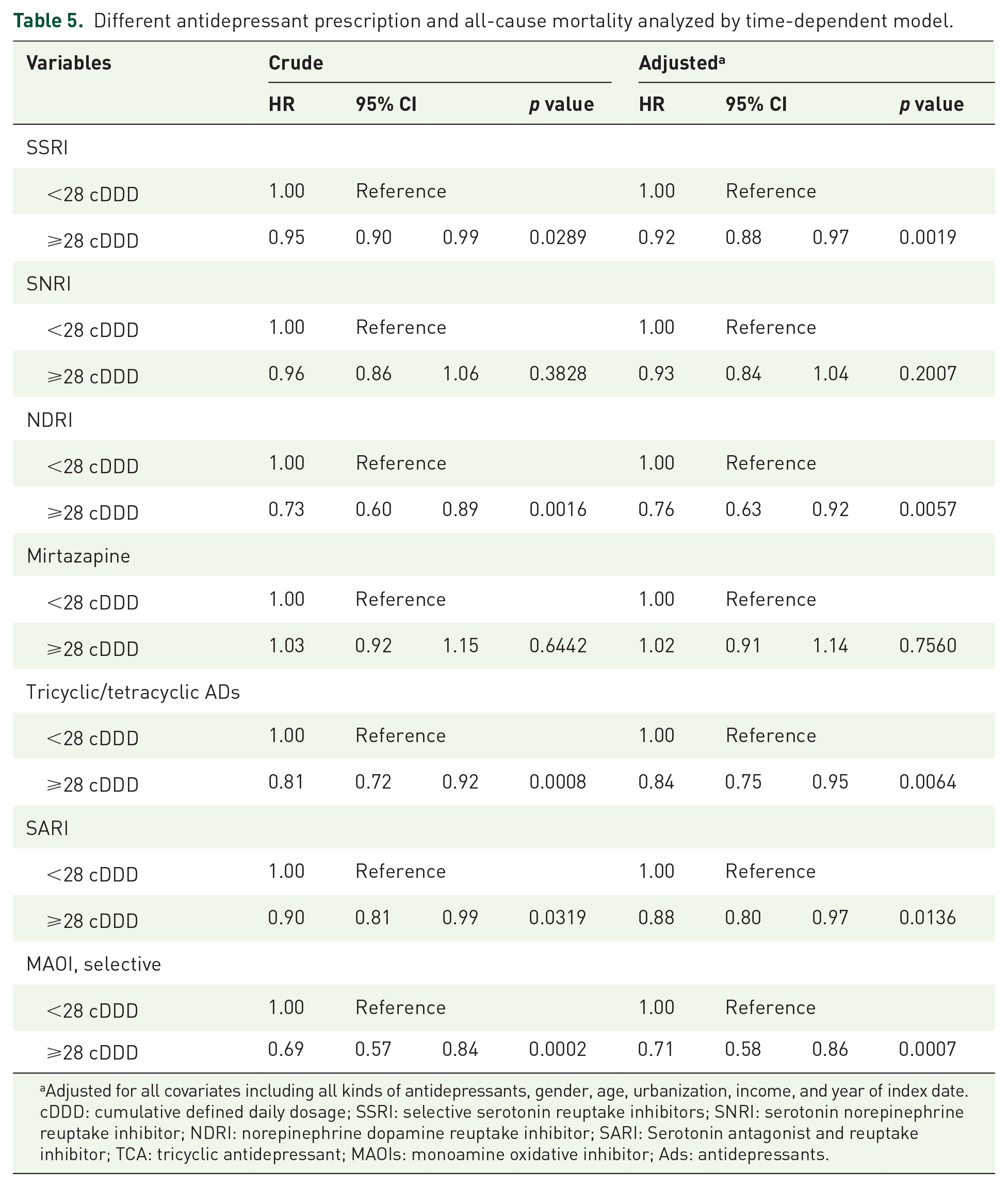
Adjusted for all covariates including all kinds of antidepressants, gender, age, urbanization, income, and year of index date.
cDDD: cumulative defined daily dosage; SSRI: selective serotonin reuptake inhibitors; SNRI: serotonin norepinephrine reuptake inhibitor; NDRI: norepinephrine dopamine reuptake inhibitor; SARI: Serotonin antagonist and reuptake inhibitor; TCA: tricyclic antidepressant; MAOIs: monoamine oxidative inhibitor; Ads: antidepressants.
Discussion
Our study indicated that antidepressant treatment significantly reduced mortality risk in patients with dementia and depression, especially with higher cDDDs. Furthermore, most antidepressant classes (i.e., SSRIs, SNRIs, NDRI, mirtazapine, tricyclic/tetracyclic antidepressants, SARI, and MAOIs) were effective at decreasing mortality.
The influence of depression in increasing mortality has been reported in studies on both the general population and elderly patients.4–7, 18,19 A meta-analysis of 293 studies showed a relative risk of 1.52 of mortality among participants with depression. 18 A 10-year prospective cohort study conducted in community elderly in the United States indicated that depression, especially when combined with low self-rating of health, strongly predicted mortality. 7 Another 10-year prospective study conducted in Amsterdam revealed that chronic depression was associated with higher mortality. 19 Additionally, studies have found that more severe depression is linked to higher mortality.19,20 However, few studies have focused on the effects of depression on all-cause mortality in patients with dementia. Lara et al. 21 recruited individuals aged >65 years to investigate the relationship between Alzheimer dementia and depression. They assessed the depressive symptoms at baseline, and the results indicated that depression was significantly associated with higher mortality in the overall sample and in those with incident Alzheimer dementia. 8 In our study, the mortality in patients with dementia and depression was approximately 35.9%, which was almost triple the mortality in the matched controls without dementia and depression (~12.5%). The result was similar to that of an aforementioned study that associated dementia with mortality. However, in our further analysis, antidepressant use in the control group led to higher mortality than nonuse did (18.1% in antidepressant users and 12.2% in antidepressant nonusers), implying that antidepressant prescription to older adults requires careful consideration of the costs and benefits.
We propose some mechanisms for the association of depression and increased mortality. First, depressed patients may be prone to unhealthier lifestyles (e.g., smoking, alcohol drinking, unfavorable diet, insufficient outdoor activity) that may result in inadequate physical condition. 21 Moreover, they engage in infrequent medical treatment irrespective of their physical condition. 20 Many biological pathways play roles in the pathophysiology of depression.3,22,23 Increased inflammatory cytokines, alteration of the hypothalamic–pituitary–adrenal (HPA) axis, neurotrophin deficiency, reduced heart-rate variability, and increased catecholamine levels are all biological mechanisms that might lead to cardiovascular events and mortality.22,24 Our study showed antidepressant treatment could decrease mortality, likely because antidepressants alleviate depressive symptoms and attenuate the effect of depression on mortality. Similar studies have showed the protective effects against mortality in patients with late-life depression.25,26 Notably, the major limitations of these studies were that they recruited later-life patients with depression instead of patients with dementia and depression. Some double-blinded clinical trials have demonstrated improvement after antidepressant treatment for patients with dementia and depression.27–30 However, these studies have analyzed only the efficacy of antidepressants and ignored mortality outcomes. Clinical studies specifically investigating the mortality risk of antidepressant treatment in patients with dementia and depression are scant. In the future, further well-designed clinical investigation is warranted to replicate results suggesting the protective effects of antidepressants.
In terms of the medical care system in Taiwan, patients can visit a specialist in the hospital directly without a referral from general practitioners. Accordingly, most patients with depression were diagnosed and treated by psychiatrists (including geropsychiatrists) or neurologists. All of these doctors were well trained in this field; therefore, we believed that our results were not influenced by different specialties among these doctors.
Our study revealed that antidepressant exposure reduced mortality among patients with dementia and depression by 4%; additionally, SSRIs, SNRIs, NDRIs, mirtazapine, and MAOIs all exhibited a protective effect in the Cox regression model. The effect was significant if the prescription exceeded 168 cDDDs. In addition, most antidepressants showed the protective effect in time-dependent model, except for SNRIs and mirtazapine. In clinical practice, SSRIs are the most commonly prescribed medications. However, SSRIs might be switched to other classes of antidepressants, such as SNRIs or mirtazapine, if patients showed poor response. In this circumstance, it implied that their depression was relatively difficult to treat. On the other hand, the side effects (e.g., nausea in SNRIs and somnolence or dizziness in mirtazapine) might be prominent, 31 which may subsequently result in poor drug compliance. Regarding the possible mechanism of protective effect of the antidepressants we proposed above, depression in patients taking SNRIs and mirtazapine might still be persistent, i.e., the protective effect was not observed. Furthermore, comparing to the Cox regression model, the time-dependent model is more conservative, and therefore our study results should be interpreted with caution. Accordingly, in clinical application, long treatment duration and high dosage are warranted when treating patients with dementia and depression. A study on the Swedish Prescribed Drug Register dataset showed a similar result that antidepressant exposure for more than 3 years consecutively before dementia diagnosis can significantly lower mortality risk. 13 Another study focused on the association of mortality risk and psychotropic prescription in a nursing home population with cognitive impairment or dementia diagnoses. 26 The results showed a protective effect of antidepressant treatment with appropriate indication, optimal dosage, and a treatment duration of >90 days. These findings suggest the importance of correct diagnosis and treatment. We emphasize the necessity of adherence and maintenance of therapy to confer the survival benefit. Depressive symptoms could be part of the behavior and psychological symptoms of dementia (BPSD) and were associated with increased mortality. 32 Antidepressants can alleviate depression in BPSD and may reduce the risk of mortality.33,34 Other possibilities are that antidepressants can reduce HPA axis activity, increase levels of brain-derived neurotropic factor, or promote neurogenesis and neuron plasticity.35,36
Our study was limited by factors affecting all similar medical dataset studies. First, drug adherence and the exact exposure dosage and duration were impossible to assess. Second, smoking, lifestyle, nutrition, and exercise habits may affect mortality, but this information was unavailable in the dataset. Third, the diagnosis of depression was through clinical diagnosis by using the ICD-9-CM without confirmation through a structural diagnostic interview. Fourth, our study was not a randomized controlled trial. Therefore, our results should be interpreted cautiously.
Our study also has a number of strengths. This was a large population-based cohort study that was representative of all cases of dementia with depression in Taiwan. Additionally, we investigated the topic of mortality risk, which is rarely addressed when prescribing antidepressants, using a respective cohort study design because it might take many years to observe outcomes. Moreover, we conducted sensitivity analyses by stratification to clarify the potential confounders, and the results showed no significant changes in HRs between different models.
Conclusion
Antidepressant treatment can reduce mortality risk in patients with dementia and depression, especially at higher cDDDs. For clinical physicians treating patients with dementia and depression, sufficient dosage and duration are warranted to provide the benefit of decreased mortality risk.
Footnotes
Acknowledgements
The authors would like to thank Health Information and Epidemiology Laboratory of Chang Gung Memorial Hospital, Chiayi Branch, for its assistance in data analysis and Wallace Academic Editing for editing the manuscript.
Author contribution
J-AS and C-CC contributed equally. J-AS and C-CC initiated the study and wrote the first draft of the manuscript. K-JC and Y-HY analyzed the data. C-YL and H-MW interpreted the data, and C-YL critically revised the manuscript. All authors read and approved the final manuscript.
Funding
The author(s) disclosed receipt of the following financial support for the research, authorship, and/or publication of this article: This research was supported by the Chang Gung Memorial Hospital (grant number CFRPG6J0011).
Conflict of interest statement
The author(s) declared no potential conflicts of interest with respect to the research, authorship, and/or publication of this article.
Availability of data and materials
The datasets generated and analyzed in this study are not publicly available because of patient privacy and ethical concerns. They are available from the corresponding author upon reasonable request.
