



Abstract
Extremist groups frequently leverage online spaces in recruitment and organization efforts. This research assessed how basic psychological need expression among users of extremist chatrooms was related to forum engagement and hate term use. ∼20,000,000 posts from ∼90,000 users on 233 Discord chatrooms were scraped from a publicly available database. Using a natural language processing approach, users received scores on three needs based on semantic similarity between posts and needs measures. Multilevel models assessed associations between need expression and number of posts, length of chatroom activity, and hate term use. Results indicated that users who expressed more autonomy and competence were more engaged and used hate terms less. Smaller and less robust effects were observed for relatedness. Results suggest that basic psychological needs are associated with behaviors in extremist chatrooms and that the decades of research on basic psychological needs can be leveraged to better understand radicalization and extremist behaviors.
Far-right extremist groups and ideologies have seen a resurgence in recent years (Kruglanski et al., 2020), partly enabled by the extremist use of social media and internet forums facilitating communication (Gaudette et al., 2022). This resurgence is contributing to a global increase in ethnic and religious violence (Leidig, 2020; Yakutenko, 2021), the growth of far-right political parties (Golder, 2016), and increases in the prevalence of ideologically motivated mass shootings (Anti-Defamation League, 2022). Given these consequences, understanding the genesis of extremism and what factors contribute to radicalization is of global importance. Yet our understanding of the mechanisms behind extremism and radicalization, both far-right and otherwise, remains limited, despite decades of research. One domain curiously left untapped for application to radicalization research is the major theories of the decades-established motivation literature. This research uses natural language processing to assess how basic psychological needs may be associated with extremist group participation in ∼20 million leaked posts from ∼90,000 users among 233 online extremist chatrooms.
Psychological factors underlying extremism, which have been explored in recent years with varying success, include mental illness (Trimbur et al., 2021), psychopathy (Victoroff, 2005), irrational fanaticism (Mink, 2015), rational action (Abrahms, 2008), and relative economic or social deprivation (Adam-Troian et al., 2021). A relatively recent perspective focuses on needs thought to be consistent across most of humanity (Baumeister & Leary, 1995; De Charms, 2013; Tajfel et al., 1979), positing that radicalization processes are often driven by desires for acceptance and social companionship (Abrahms, 2008; Atran, 2021), personal meaning (Ferguson & McAuley, 2021), and empowerment (Kruglanski et al., 2014; Miconi et al., 2022).
Critical to the present work, the notion that group membership can serve as an avenue for empowerment and companionship is consistent with basic psychological needs theory (Ryan & Deci, 2000), a sub-theory under the broader framework of self-determination theory, one of the most well-supported frameworks in motivation research (Vansteenkiste et al., 2020). Basic psychological needs theory posits that individuals are driven to attain a sense of personal fulfillment by satisfying three psychological needs: Autonomy, or the need to feel authentic in one's thoughts and actions; Competence, or the need to feel capable of doing what one wants or needs to do; and Relatedness, the need to feel that one has meaningful relationships with other people. Under this framework, group dynamics that satisfy needs can arise whether the group is contextually normative (e.g., sports teams or political organizations), deviant (e.g., youth delinquent groups or cults), or extreme (e.g., violent extremist groups).
This theoretical framework unifies various disparate radicalization findings in the literature. Social networks appear to be one of the most important factors in the radicalization process (Hamid, 2020; Mink, 2015), and a lack of social connectedness is a risk factor for joining both extremist groups and online extremist forums (Abrahms, 2008; O’Malley et al., 2022). Evidence also suggests that extremist groups provide members with feelings of significance, empowerment, control, and freedom (Adam-Troian et al., 2021; Ferguson & McAuley, 2021; Jamieson, 1990; Kruglanski et al., 2014).
These dynamics would apply to both participation in extremist groups and activity on extremist web forums. Existing research on the role of extremist internet use suggests it plays an important role in the radicalization process (Gaudette et al., 2022; Winter et al., 2021), bypassing traditional barriers to communication and organization. Extremist forums and chat groups can provide avenues for identity formation (Sardarnia & Safizadeh, 2019; Scrivens et al., 2020) and camaraderie (Veilleux-Lepage et al., 2022), which may be especially appealing to adolescent males or young adults (Hassan et al., 2018). Such findings are entirely consistent with basic psychological needs theory, but the association between needs and online extremism participation has not yet been comprehensively assessed.
Research on extremist internet use provides several benefits to complement research on offline extremism. Extremism is a rare phenomenon, and sample recruitment is often difficult and restricted by geographic boundaries. These obstacles are mitigated when studying natural cultural products (i.e., posts) of online spaces. The oftentimes anonymous or pseudonymous nature of online interactions is also less susceptible to social desirability bias and fear of disclosure. However, users on public forums are likely to tone down extremist rhetoric and discussions to avoid legal action or deplatforming. One method of circumventing this concern is to examine private extremist chats that have been made public, or “leaked.” Such datasets are a valuable cultural product for extremism research, as users would be expected to be more forthcoming and honest in their expressions, maximizing external and ecological validity. Furthermore, while ethical considerations limit the opportunities for traditional (e.g., experimental) research designs to study extremism, such datasets provide rich opportunities for naturalistic observational or correlational research.
A further limitation pertains to the large scale of such data, typically limiting analyses to relatively small subsets of content. This research mitigates this limitation through the use of natural language processing techniques, previously used to evaluate corpora of text on a large scale, including hate speech detection, sentiment analysis, identifying conspiracy theories, and fake news, among others (Giachanou et al., 2020, 2023; Mathew et al., 2019).
Early research probing whether basic psychological needs theory can be a framework for understanding extremism-supporting attitudes has yielded promising results, suggesting the predictive power of this framework in this context (Briki, 2022; Rappel & Vachon, 2024). Building on this research, here we investigated the association of basic psychological needs with posting behaviors in a large sample of leaked extremist chatroom data. Essentially, we assessed whether people whose posts reflected greater needs expression were more active in the extremist Discord chatrooms, and whether need expression was related to the use of hate terms in the chats. Such a result would suggest a viable avenue (addressing people’s psychological needs) for reducing extremist engagement.
Method
Source of Data
Our sample consists of users of extremist chatrooms on the popular messaging platform Discord, collected from a publicly available database of 292 extremist Discord chat logs (Unicorn Riot, 2023). These chatrooms cover a broad range of groups and ideologies, including fascist and Neo-Nazi groups, white supremacists, militia organizations, and conspiracy theorists, among others (see Supplemental Materials). Discord chatrooms are typically composed of multiple “channels” or boards for specific topics, and tend to be unbalanced in terms of activity. We selected the most active discussion channel (measured by total number of posts) for analysis, as it constitutes the majority of forum use and is best suited to capture the social context of inter-user discourse. Smaller channels are typically limited to a single topic (e.g., online gaming, newsfeeds, or vetting) and are less representative of group discussion norms. Chatrooms were excluded for being empty (n = 2), non-English (n = 9), or not discussion-centered (n = 48). The remaining 233 channels were scraped using the R packages rvest and xlm2 (Wickham, 2022; Wickham et al., 2021). In total, we evaluated 20,229,010 posts from 86,111 users.
While valuable for high external validity, leaked data can be ethically complicated in research. The current data preclude informed consent from participants, and because Discord users post under pseudonyms, it does not offer the ability to withdraw from research. To treat these public data as ethically as possible, we followed guidelines pertaining to the use of leaked data (Boustead & Herr, 2020; Darnton, 2022; Egelman et al., 2012; Ienca & Vayena, 2021; Michael, 2015; Thomas et al., 2017). Specifically, we anonymized the data further, transparently conveyed the source of the data, and received approval from the McGill University ethics board for conducting this research (File #22-09-032).
Because collecting additional data would be impossible given their leaked nature, we adopted an exploratory–confirmatory framework to reduce spurious conclusions from overfitting. Fifty percent of chats were assigned to an exploratory dataset on which we ran exploratory models and assumption checks, and 50% were placed in a “hold out” or confirmatory dataset, on which we only ran the final models determined via testing in the exploratory set. To ensure both datasets were similar in size, chats were assigned to these datasets pseudo-randomly by first sorting by size and then alternating assignment to either set.
Semantic Structure
To quantify need expression, we adapted a relatively novel approach initially developed in other areas of research, similar to distributed dictionary representation (Garten et al., 2018), contextualized construct representation (Atari et al., 2023), or latent semantic analyses (Kjell et al., 2019). We first selected two well-established basic psychological needs measures: sentence-like statements to which traditional respondents would respond on a Likert-type scale (Figure 1). We then quantified the semantic content of each statement and each user post by scoring them on 512 “embeddings” of semantic content using the Universal Sentence Encoder (Cer et al., 2018), a tool that encodes text to create a vector of meaning scores reflecting a semantic structure for a given statement.
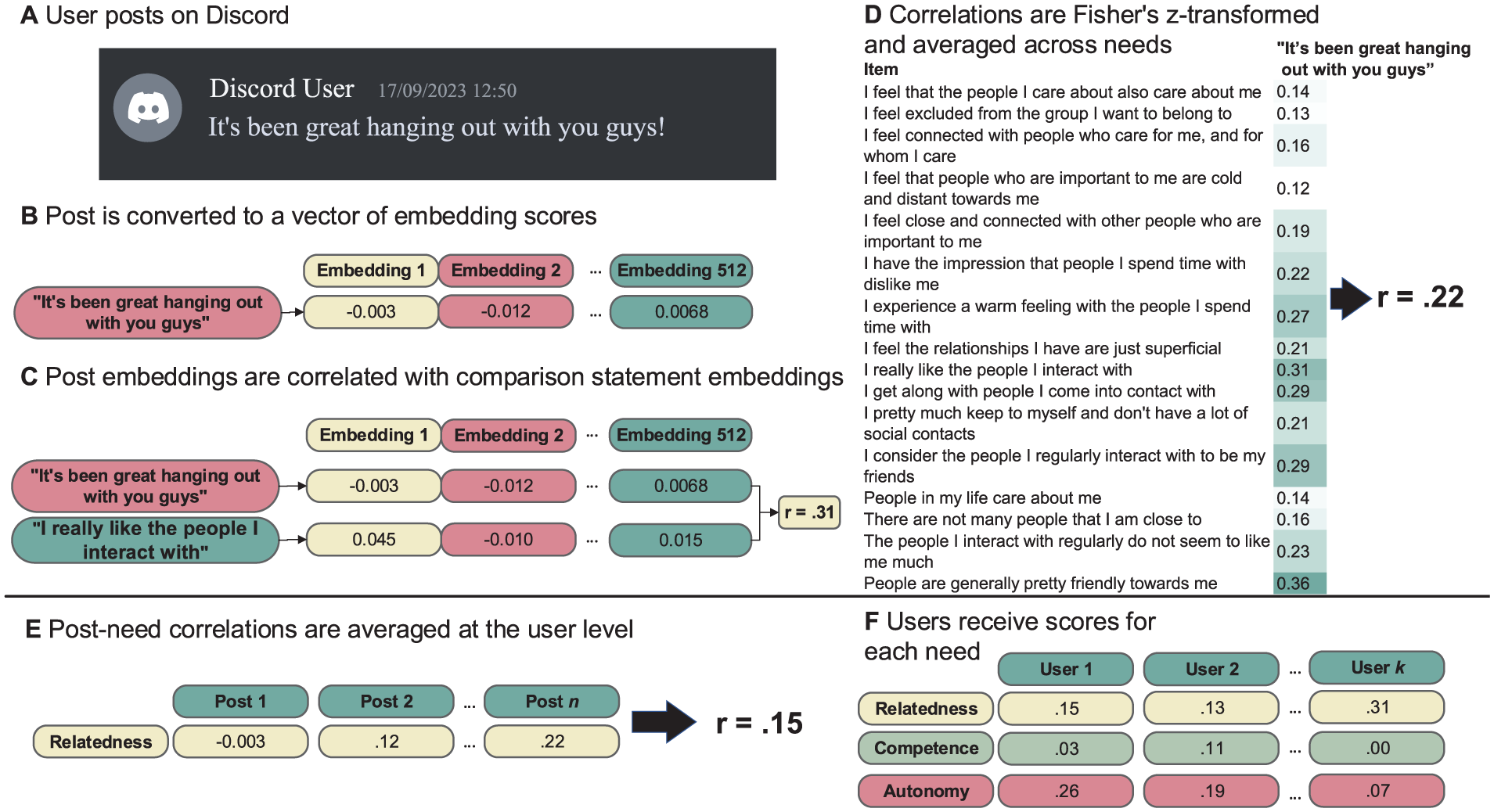
Procedure for Quantifying User Autonomy, Competence, and Relatedness
The universal sentence encoder tokenizes a given input statement and assigns each word and bigram weighted scores (or embeddings) based on co-occurrence with other words and bigrams in a large training set, including Wikipedia and public web forums. The embeddings for each word and bigram in the input statement are then averaged together, and the averaged embeddings are run through a deep neural network or deep averaging network to produce an overall vector of semantic content.
User posts in the dataset were processed via the same system. The semantic content scores of posts could then be compared to our chosen basic psychological needs statements. Version 4 of the Universal Sentence Encoder was implemented using Python 3.8 (Van Rossum & Drake, 2009) and its associated tensorflow package (Abadi et al., 2016), using a deep averaging network architecture. The Universal Sentence Encoder is ideal for use in this context as it was trained using discussion forums, provides output on an easily interpretable correlation metric, and some research suggests it may outperform alternative systems such as SBERT when analyzing forum data (Reimers & Gurevych, 2019).
This process enabled comparison of the semantic content of each Discord post with every basic psychological need comparison statement on a correlation metric. Such post-level correlation scores were averaged across each need, and every user was scored on their basic psychological needs based on the average of their own posts’ scores. Thus, user-level estimates of autonomy, competence, and relatedness were our units of analysis. Following best practices, all correlations were Fisher z-transformed prior to averaging (Wicklin, 2017) and back-transformed after averaging for interpretation.
Evidence of associations of basic psychological needs in these chatrooms would be present if user scores were associated with observable behaviors in the chatrooms. The behaviors assessed were those consistent with increased engagement in online spaces, including the number of posts made, the length of activity in the chatroom, and the use of hate terms. We considered both the number of posts and the length of activity measures to capture engagement. Consistent results across both measures would be evidence of a relationship robust to operationalizations. Hate term use, on the other hand, is viewed as an expression of prejudice and may be used as a signal of attitudes toward other members of extremist forums. We assessed associations in multilevel negative-binomial and linear models in a Bayesian framework. Importantly, we controlled for generic language use to maximize certainty that similarities in semantic structures were specific to basic psychological needs. We first performed assumption checks and exploratory analyses on the exploratory set, and replicated final models in the confirmatory set, analyzed only once. We report only results consistent across both.
Directionality and Language
Posts scoring high on needs could express either need satisfaction or frustration, as the semantic structure approach would not differentiate the directionality, or valence, of post content. To gain insight into the distribution of satisfaction and frustration expression in the data, we manually coded the top 100 posts correlating most strongly with each need in our exploratory dataset (300 posts total). Three coders, blind to the study procedure and hypotheses, independently assessed whether each post expressed need satisfaction, need frustration, or was ambiguous or unrelated to need expression. Initial interrater reliability was moderate (Overall κFleiss = .56, 95% confidence interval (CI) = [.51, .60]). Disagreements between coders were settled by majority decision. 41.52% were coded as expressing frustration, 31.83% expressing satisfaction, and 26.64% as directionally ambiguous, suggesting that our semantic scoring procedure is capturing both need frustration and satisfaction. Furthermore, when breaking out scores into these two dimensions, the user-level correlations between satisfaction and frustration were high (rRelatedness = .84, rAutonomy = .77, rCompetence = .88). As such, we conclude that the Universal Sentence Encoder does not reliably distinguish whether a given post is expressing satisfaction or frustration. We run our models with both satisfaction and frustration items included, and results reflect need expression, rather than clear satisfaction or frustration. We return to this issue in the General Discussion.
A related concern is the potential for our scoring system to capture indirect speech or broader needs-adjacent language, such as discussing the well-being of others. While such statements will correlate more strongly with the semantic structure of our comparison statements than need-independent text, they will be associated less strongly than need expression. For example, the semantic structure of “I really like the people I interact with” (one of our comparison statements) correlates with the semantic structure of “He hates the people at his work” at r = .25. The equivalent correlation between “I really like the people I interact with” and “I hate the people at my work” at is almost doubled at .46. We conclude that our scoring system is capturing need expression more strongly than broader need-related language.
Measures
Basic Psychological Needs
Basic psychological needs scales included the 24-item Basic Psychological Need Satisfaction and Frustration Scale (Chen et al., 2015) and the 21-item Basic Psychological Needs in General scale (Gagné, 2003). We selected two scales to better capture the breadth of the construct and to avoid results being due to idiosyncratic aspects of a single scale.
User Engagement
To assess engagement, we derived two metrics for each user. The first, number of posts, tallied the number of posts made by each user. Second, we computed the length of activity metric, counting the number of days between users’ first and last posts.
Hate Terms
Use of hate terms was coded as the total number of posts made by users containing hate terms. English-language hate terms were identified from relevant databases (total n = 1,601; Anti-Defamation League, 2023; Hatebase, 2022). Posts containing at least one hate term were coded as hate posts. To reduce false positives, terms were excluded if they had common non-hateful meanings (e.g., “girl,” “Chad”; n = 93), leaving 1,514 terms for comparison. The total number of posts containing hate terms was recorded for each user.
Generic Language Use
Correlations between user posts and needs statements might arise both due to shared content (i.e., a post reflecting needs) or shared language use (e.g., word order, conjunctions), less related to the content of the comparison statements. To better isolate language reflecting needs, we created a semantic structure from the 10-item Food Neophobia Scale (Pliner & Hobden, 1992)—measuring the willingness to try new foods—to act as a covariate. This scale was selected for its theoretical irrelevance to basic psychological need fulfillment, extremism risk, and typical post content. Thus, variance shared between the semantic structures of the food neophobia and basic psychological needs scales is driven by language structure, and not the latent factors they purport to measure. By doing so, we could partial out this irrelevant shared variance, and better conclude that any relationships between estimates of needs and engagement activity arise from needs. Identical to the needs scales, the semantic structures of each user’s post were correlated with the 10 food neophobia items, averaged, and then averaged at the user level for analysis.
Analytic Approach
To clean the data, posts were converted to string format, and artifacts from encoding or HTML were removed. Posts without text were excluded. We flagged potential automated accounts via a list containing usernames for 15,870 bots scraped from Discordbotlist.com (Discord Bot List, 2023). After manually inspecting the data, 73 additional usernames were also flagged as bot accounts. Our primary analyses excluded these usernames, though exploratory results are identical when these usernames are included.
Analyses were conducted using multilevel modeling, with users nested within chatrooms. Based on the distributions of data (e.g., hate terms and posts as a count variable; length of activity as a continuous variable) and assumption checks in the exploratory set (e.g., overdispersion preferring negative-binomial models over Poisson models), we implemented either multilevel negative-binomial or multilevel linear models, depending on the analysis. To account for differences in absolute post engagement, a log offset of overall user posts was included in each hate term model. In all models, generic language use was included as a covariate to better identify the association between basic psychological needs and user engagement. Variables were group-mean centered within cluster, with cluster grand means saved out and entered into the models to enable estimation of within- and between-cluster effects. Multilevel models were maximal, including random slopes and intercepts. Users were excluded for being outliers (i.e., ≥3 standard deviations) on the total number of posts, although exploratory results are identical when these users are included. We performed analyses in a Bayesian framework using the brms package in R (Bürkner, 2017). All models contained weak (i.e., uniform) priors, and Markov-Chain Monte Carlo procedures comprised four chains and at least 5,000 iterations. We report posterior mean estimates, 95% credible intervals, and intraclass correlation coefficients.
Transparency and Openness
Leaked data preclude participant consent and withdrawal, and so for ethical reasons, we are precluded from sharing data from this project. However, research materials, including web scraping code, universal sentence encoder scoring methods, and analysis scripts, are available at https://osf.io/e82fa/. This study was not pre-registered, and we instead adapted an exploratory–confirmatory approach to data analysis.
Results
Only exploratory results replicating in the confirmatory set are reported. For brevity, coefficients are reported from confirmatory models. See Supplemental Materials for full reporting.
Models 1–4: Number of Posts
First, we regressed the number of posts on users’ scored competence, autonomy, and relatedness in a multilevel negative-binomial model, controlling for generic language use. The intraclass correlation coefficient was .19, indicating most variability in activity length was within cluster (i.e., within chatrooms), rather than between-cluster (i.e., between chatrooms). All needs were associated with the number of posts across both exploratory and confirmatory datasets, suggesting a role of basic psychological needs in online extremist forum use (Figure 2). Competence (b = 27.05, 95% CI = [19.94, 34.04]) and autonomy (b = 7.68, 95% CI = [.95, 14.39]) were associated with more posts, and relatedness with fewer (b=−19.85, 95% CI=[−24.37, −15.13]). Of the three needs, competence was the strongest predictor, followed by autonomy and relatedness. As the three needs are moderately correlated (Chen et al., 2015), shared variance was partialled out in our regression approach. Accordingly, as a robustness check, in Models 2–4, we regressed the number of posts on each need separately. For competence and autonomy, results were totally consistent with the full model in both the exploratory and confirmatory sets, while the effect of relatedness was smaller and not consistent across both sets, and we consider this relationship less robust. See Supplemental Materials for full reporting.
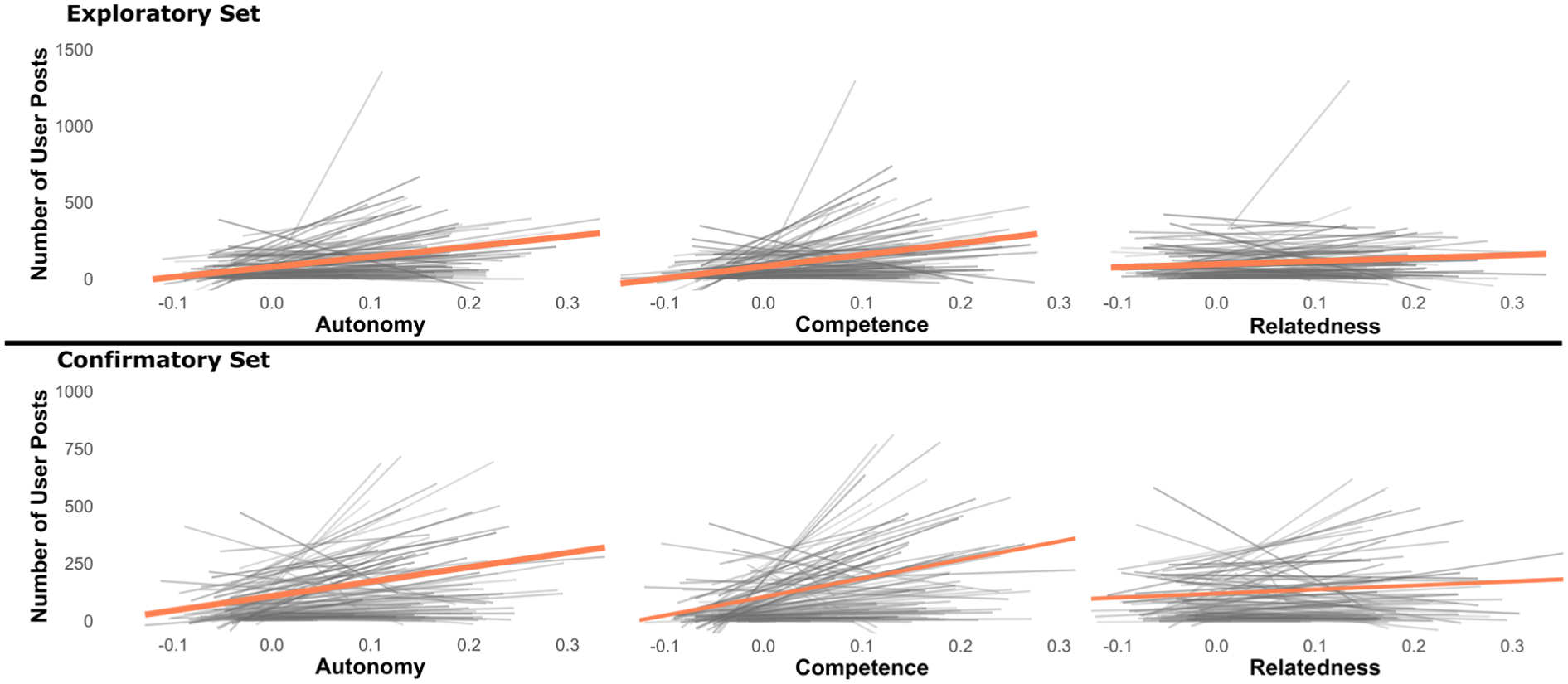
Spaghetti Plots Representing the Multilevel Linear Relationships Between Number of Posts and Needs
Models 5–8: Length of Activity
Similar to above, another metric of engagement is the length of activity within the chatrooms. We assessed this association by regressing the length of activity on needs in a linear model, controlling for generic language use. The intraclass correlation coefficient of .13 indicated most variability in activity length was again within chatrooms. Results revealed relationships with all three needs across both exploratory and confirmatory datasets (Figure 3). Relatedness was negatively related (b = −134.83, 95% CI = [−185.09, −84.38]), followed by positive relationships for competence (b = 76.17, 95% CI = [14.61, 136.94]) and autonomy (b = 68.39, 95% CI = [8.84, 127.84]). Again, as a robustness check, in Models 6–8, we regressed the length of activity on needs in separate models. Results indicated robust effects of autonomy and competence, while relatedness was not consistently associated with activity across both datasets. See Supplemental Materials for full reporting. Together, results across Models 1–8 are consistent in suggesting that needs are associated with online engagement across a variety of activity operationalizations.
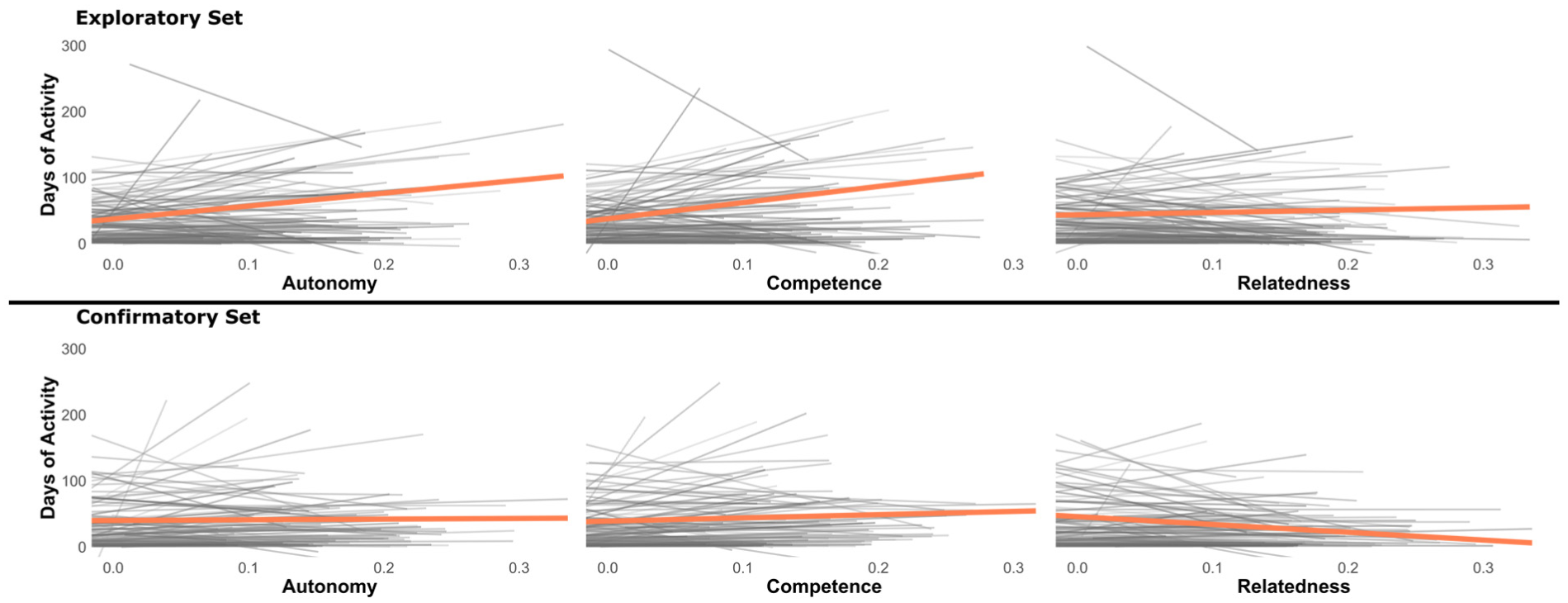
Spaghetti Plots Representing the Multilevel Linear Relationships Between Length of Activity and Needs
Models 9–12: Hate Term Use
Finally, we regressed hate term use on user needs in a set of multilevel negative-binomial models, again controlling for generic language use. The intraclass correlation coefficient was .08, indicating most variability in activity length was again within chatrooms. Results across both datasets indicated all needs were significantly associated with hate term use. The patterns were generally the reverse of engagement results. Competence (b = −6.79, 95% CI = [−10.75, −2.80]) and autonomy (b = −10.67, 95% CI = [−14.34, −7.18]) were associated with reduced hate term use, and relatedness with greater use (b = 4.95, 95% CI = [2.34, 7.51]). Like above, in Models 9–12, we again regressed hate terms on needs in separate models. Results across all datasets revealed negative associations with all three needs (see Supplemental Materials). Overall, Models 9–12 suggest robust relationships between higher competence and autonomy with reduced hate term use.
Discussion
Here, we explored how behaviors of extremist chatroom users were consistent with basic desires for agency, competence, and acceptance, thought to be common across humanity. Adopting this perspective, we find consistent and robust evidence that the basic psychological needs of autonomy and competence are associated with a variety of online engagement behaviors. The third need, relatedness, also appears to have associations with these behaviors, but results tend to be less robust and contingent on model specification (i.e., other needs in the models).
Engagement
Users whose posts reflected more autonomy and competence posted more frequently (Models 1–4) and engaged with the chatrooms for longer (Models 5–8). Because we find this relationship across multiple needs, models, operationalizations of engagement, and both datasets, we consider this relationship robust. Among the needs, competence had the strongest association with the number of posts, while relatedness had the strongest association with length of activity, suggesting that users who express these needs are more likely to make additional posts and remain active with the group. An alternative interpretation is that it may reflect an increase in need expression over time. However, this analysis precludes assessing the directionality of post content (e.g., whether users are venting about need frustration to a supportive audience, or cultivating need satisfaction). Future research might further explore the longitudinal change in engagement and the qualitative nature of posts being made across time.
Hate Terms
A different pattern emerged for hate term usage. Users who scored higher on autonomy and competence expressed fewer hate terms. One possible interpretation is that users who feel less agentic or competent are more inclined to express explicit outgroup animosity as a method of buffering their esteem. Such an effect has been documented, in which people seeking to maintain their own self-esteem engage in downward comparisons (e.g., Buunk & Gibbons, 2007). Inversely, users who are more satisfied with these needs would not seek such buffering, manifesting as less hate term usage. Further research is necessary to tease apart the role of these needs in hateful expression toward outgroups.
The positive relationship between relatedness and hate term usage might reflect instrumentally seeking group acceptance. Past research has noted that “fringe” or new group members adopt and express the norms of the group to a greater extent than established users (Gregory & Piff, 2021), theoretically to gain acceptance by the group. Members of extremist organizations frustrated in outside social contexts may express hate terms to facilitate their acceptance. Members having their social needs already met, on the other hand, would have a reduced need to express hate terms for acceptance. But like findings with engagement, relationships with relatedness were less robust and contingent on model specification.
The differential effects of relatedness from the other needs tentatively suggest that it may contribute to initial associations with extremist peers, while the other needs influence the degree of conformity to group norms. Future research could benefit from exploring the temporal dynamics of hate term usage, desire for relatedness among extremist recruits, and how differences across needs may influence behavioral outcomes.
In addition, we view the hate term results as a validation for our approach. While engagement behaviors are multiply determined and multiply interpretable, we view hate term usage in a messaging forum as less ambiguous in interpretation. That our natural language processing approach can reliably find associations between needs and this form of hateful expression suggests we are capturing explicit, interpretable behaviors on these forums and further validates the approach.
Basic Psychological Needs in Understanding Radicalization
While results with autonomy and competence are consistent with the literature (Kruglanski et al., 2014), the less robust association between relatedness and online engagement is somewhat surprising. Previous work has highlighted social connections as a stronger motivating factor in extremist recruitment (Abrahms, 2008; Mink, 2015), and relatedness was found to have the strongest relationship of the three needs with extremism in prior research (Briki, 2022; Rappel & Vachon, 2024). This discrepancy may arise due to different operationalizations of extremism and needs. Here, we used engagement and hate terms as measures of extremist group participation and attitude signaling, respectively. Prior research, however, used more traditional self-report measures of extremist-supporting attitudes, in addition to self-report scales of need satisfaction or frustration (Briki, 2022; Rappel & Vachon, 2024). Yet most models still suggested that relatedness was associated with engagement and hate term use, in some cases (Model 5) with a stronger effect than the other needs, consistent with previous work. We suggest tentatively that relatedness needs are still an important component for future extremism and radicalization research to consider.
We believe that the strongest implication of this research is the potential to leverage the existing body of research on basic psychological needs to inform prevention and deradicalization efforts. For example, if need satisfaction is a protective factor, then primary prevention approaches, which seek to build social ties and educational or professional development, may dampen the appeal of extremist ideologies or groups. If extremist contexts act as a source of need satisfaction, then intervention programs may benefit from providing alternative, non-radical sources of needs.
Limitations
Our analyses were limited to text posts made by users, excluding data from posts only containing images, videos, or emojis. We are also unable to make inferences about “lurkers”—users who view channel content but make few or no posts. However, the core content of most chatrooms is the text exchanges between users, and posting implies higher engagement than non-text-based interactions, making text posters a crucial sample to analyze.
Need scores were derived from semantic embeddings using the Universal Sentence Encoder. This approach does not necessarily capture differences in the valence of a given statement (e.g., “I do feel welcome” and “I don’t feel welcome” score similarly), and directionality of needs—whether users are expressing need satisfaction or frustration—cannot definitively be determined. We note that as the coding system does not differentiate between the directionality or valence of statements, these effects should be interpreted as need expression, rather than need satisfaction or frustration. Our sentiment analysis suggested that posts present in the forums reflected both frustration and satisfaction. Thus, while it’s clear that chatrooms serve as an important avenue of need expression, future research can explore the unique impact of satisfaction versus frustration on extremism risk.
Finally, basic psychological needs are considered essential for growth and well-being (Vansteenkiste et al., 2020), motivating individuals to seek need satisfaction when unfulfilled or faced with need frustration, often through social contexts. The positive associations between need expression and engagement can be interpreted as either users expressing statements consistent with their needs being met (presumably by the group) or users expressing need frustration. Either interpretation supports the role of basic psychological needs in extremist social contexts and the radicalization process, although the mechanisms and causal implications might differ according to whether need satisfaction or frustration is at play.
For example, consistent with significance quest theory, need frustration may be a stronger risk factor for radicalization than a lack of need satisfaction (Di Cicco et al., 2025; Webber et al., 2018). Need satisfaction, or sources of potential need satisfaction (e.g., social integration, employment), may still act as a protective factor for non-radicalized individuals (Ohls et al., 2024). For already radicalized individuals, need satisfaction may act as a maintenance factor if a given extremist context acts as a conduit for psychological needs (e.g., Florez-Morris, 2010). Lacking the ability to tease apart whether need expression takes the form of satisfaction or frustration is a limitation of the current work. We note that the data presented here are correlational in nature, and assessing the causal impact of need satisfaction and frustration is more suited to longitudinal or experimental designs.
Conclusion
Together, our results suggest that basic psychological needs provide an important and largely untapped theoretical framework for understanding extremist participation and radicalization. Our results have implications for intervention and prevention efforts, as seeking to provide alternative sources of basic psychological needs satisfaction may reduce ideological commitment and minimize initial engagement with extremist spaces. Future research on extremism may benefit from leveraging basic psychological needs, and its existing body of research, to inform theory, research, and practice.
Supplemental Material
sj-docx-1-spp-10.1177_19485506251389642 – Supplemental material for Basic Psychological Needs Are Associated With Engagement and Hate Term Use in Extremist Chatrooms
Supplemental material, sj-docx-1-spp-10.1177_19485506251389642 for Basic Psychological Needs Are Associated With Engagement and Hate Term Use in Extremist Chatrooms by Jeremy J. J. Rappel, David D. Vachon and Eric Hehman in Social Psychological and Personality Science
Footnotes
Handling Editor: Tullett, Alexa

Author Contributions
Conceived research: all authors; Data curation: J.R.; Methodology: J.R., E.H.; Investigation: J.R.; Analysis: J.R.; Visualization: J.R.; Writing—Original Draft: J.R. Writing—Review and Editing: J.R., E.H.
Funding
The authors disclosed receipt of the following financial support for the research, authorship, and/or publication of this article: This work was supported by the Social Sciences and Humanities Research Council (Grant 435-2020-0314) to EH.
Declaration of Conflicting Interests
The authors declared no potential conflicts of interest with respect to the research, authorship, and/or publication of this article.
Supplemental Material
The supplemental material is available in the online version of the article.
Author Biographies
References
Supplementary Material
Please find the following supplemental material available below.
For Open Access articles published under a Creative Commons License, all supplemental material carries the same license as the article it is associated with.
For non-Open Access articles published, all supplemental material carries a non-exclusive license, and permission requests for re-use of supplemental material or any part of supplemental material shall be sent directly to the copyright owner as specified in the copyright notice associated with the article.
