




Abstract
This study investigated the mediating role of basic psychological needs at work in the association from work values to job satisfaction. Using a four-factor model of work values, we tested how each work value factor was related to basic psychological need satisfaction and frustration at work. The sample included 228 workers (72% female) surveyed twice over a 7-week interval. Results showed that need satisfaction at work was positively predicted by intrinsic and social work values and negatively predicted by extrinsic work values. Need frustration at work was positively predicted by extrinsic and status work values and negatively predicted by intrinsic work values. Also, need satisfaction fully mediated the relationship from intrinsic, extrinsic, and social work values to job satisfaction. These findings suggest that organizational and career development interventions aiming to enhance employees need satisfaction at work should aim to promote growth-oriented work values endorsement rather than instrumental work values.
Work values are frequently examined to understand career behavior. They are defined as beliefs specific to the career context that serve as criteria or goals for assessing jobs and work environments (Ros et al., 1999). Work values are a central aspect of several career development theories, such as the theory of work adjustment (Dawis & Lofquist, 1984), Super’s life-space, life-span theory (Super et al., 1996), and the values-based theory of occupational choice, satisfaction, and success (Brown, 2002). Furthermore, several studies showed that work values are associated with work satisfaction (Knoop, 1994) and work engagement (Sortheix et al., 2013). Work values have also been linked to psychological need satisfaction (PNS) and frustration (PNF) at work, both as outcomes (Schreurs et al., 2014; Vansteenkiste et al., 2007) and mediators in the relationship of work values with wellness indicators, such as work engagement (Schreurs et al., 2014), job satisfaction (Vansteenkiste et al., 2007), and turnover intentions (Unanue et al., 2017). PNS and PNF at work are particularly important variables to consider given their contribution to psychological growth and decay, respectively (Rouse et al., 2020; Vansteenkiste et al., 2020). Unfortunately, previous studies (e.g., Vansteenkiste et al., 2007) that examined their association with work values only included intrinsic and extrinsic factors of work values. Several studies in the work values literature showed that representing the full array of values is better achieved using a four-factor structure (Busque-Carrier et al., 2021; Ronen, 1994; Ros et al., 1999), considering that (a) each factor has a distinctive relation with several variables like personality traits and vocational interests (Hirschi, 2008) and educational aspirations (Duffy & Sedlacek, 2007); (b) each factor has a unique developmental pattern (Jin & Rounds, 2012); and (c) a four-factor model showed superior data fit when compared to the intrinsic–extrinsic model (Busque-Carrier et al., 2021). Moreover, identifying how each of these four factors of work values is related to PNS and PNF at work would contribute to a more refined understanding of workers’ value system and functioning. This knowledge would help improve the efficiency of interventions in the workplace by identifying which work values will contribute to workers’ well-being and predicting workers’ dissatisfaction at work based on their endorsement levels of work values. Therefore, the present study examines the association of work value factors with PNS and PNF at work.
A Self-Determination Perspective on Work Values
Self-determination theory (SDT; Ryan & Deci, 2017) is an organismic-dialectical theory that defines individuals’ development and functioning as resulting from the combined interplay between individuals’ social environment and their innate dispositions. According to SDT, some values are more aligned than others with individuals’ innate tendency toward psychological growth and organization and therefore contribute more strongly to wellness (Kasser, 2002). These are intrinsic values, which are fundamental for individual development, growth, and self-actualization and lead to intrinsically motivated actions (Kasser, 2002). A second type is extrinsic values, which refer to values that do not contribute to optimal growth because they prompt controlled behaviors such as actions oriented toward obtaining rewards or instrumental outcomes, improving self-worth, and receiving praise (Ryan & Deci, 2017). Values identified within SDT are categorized depending on whether they tend to serve psychological thriving and development or represent substitutes and derivative desires (Kasser, 2002).
Although the intrinsic–extrinsic categorization allows distinguishing values based on their content, several studies showed that a four-factor model is more adequate to represent work values (Busque-Carrier et al., 2021; Ronen, 1994; Ros et al., 1999), such as the four-factor model of work values (FFM-WV; Busque-Carrier et al., 2021) that underlies this study. The intrinsic factor groups work values for which the source of satisfaction is inherent to the tasks accomplished at work and which allow self-actualization at work. The second factor, social, includes work values where the source of satisfaction comes from significant and meaningful work relationships. Extrinsic work values are those for which the source of satisfaction is found in instrumental outcomes, like a reward. Finally, the fourth factor is labelled status and groups work values that promote personal success and a desire to manage others.
Following SDT’s postulate that some values are more aligned than others with individuals’ innate tendency toward psychological growth, intrinsic and social work values factors are expected to support psychological thriving and contribute to wellness. Growth-oriented work values such as intrinsic and social factors are expected to contribute to the expression of the psychological needs, by helping individuals to select experiences that would lead to psychological thriving (Kasser, 2002). In contrast, extrinsic and status factors are expected to interfere with psychological thriving and well-being. According to SDT, psychological needs are essential for individuals’ integrity, adjustment, and growth (Ryan & Deci, 2017). The following sections describe the concept of basic psychological needs and their relations with work values.
Basic Psychological Needs
The SDT postulates that all individuals have three innate psychological needs, namely, autonomy, competence, and relatedness (Deci & Ryan, 2000; Vansteenkiste & Ryan, 2013). The need for autonomy refers to individuals’ need to act with volition and to endorse their actions and behaviors. The need for competence refers to individuals’ need to perceive their actions as having consequences and to effectively interact with their environment. The need for relatedness refers to individuals’ need to feel socially connected and cared for by significant individuals in their environment. These needs have been contextualized to different life domains, like work, school, and family (Deci & Ryan, 2008). When psychological needs are satisfied, individuals grow and experience wellness. Despite the fact that individuals are persistent and oriented to satisfy their needs (Deci & Ryan, 2000), they may evolve in environments depriving their PNS, or even worse, thwarting it (Vansteenkiste & Ryan, 2013). For example, when someone develops meaningful relationships at work, their need for relatedness is said to be satisfied. Alternatively, a worker feeling disconnected from their work colleagues would see their need for relatedness at work is deprived (i.e., low satisfaction). However, if a worker is bullied by their coworkers, their need for relatedness at work becomes frustrated. PNS and PNF have to be considered separately, because they have distinct antecedents and predictors (Rouse et al., 2020), such as work values.
The Contribution of Work Values to Psychological Needs at Work
The relation between work values and psychological needs at work can be observed at two levels. First, work values predict the satisfaction and frustration of psychological needs (e.g., Schreurs et al., 2014; Vansteenkiste et al., 2007). By endorsing intrinsic work values (i.e., values promoting psychological thriving), individuals are more prone to behave in ways that will promote their psychological development, which will facilitate their PNS. Conversely, endorsing extrinsic work values (i.e., values that are substitutes to psychological thriving) leads individuals to orient their actions toward goals that are detrimental to their optimal functioning (Kasser, 2002). The association of work values with psychological needs at work has received strong empirical support (e.g., Schreurs et al., 2014; Vansteenkiste et al., 2007) as intrinsic work values are associated positively with PNS and negatively to PNF, whereas extrinsic work values correlate negatively with PNS and positively with PNF. The effect size of these associations is generally moderate.
Second, PNS and PNF mediate the relation of work values with wellness and illness indicators (Ryan & Deci, 2017; Vansteenkiste et al., 2007). Individuals endorsing growth-oriented work values may behave to fulfill their psychological needs, which in turn would lead to more wellness. In contrast, individuals endorsing instrumental work values may behave in a way that thwarts their psychological needs, which in turn would lead to more illness. In both situations, work values are expected to predict wellness and illness indicators through their contribution to PNS and PNF at work. Previous study showed evidence that PNS at work mediated—either partially or fully—the association from a work value index (i.e., extrinsic, relative to intrinsic, work value score) to work engagement, job satisfaction, work–family conflict, emotional exhaustion, and turnover intention (Schreurs et al., 2014; Unanue et al., 2017; Vansteenkiste et al., 2007). Psychological need frustration was also shown to mediate the contribution of a work value index to work satisfaction and burnout (Unanue et al., 2017). In the SDT literature, it was shown that PNS contribute to wellness outcomes, whereas PNF predict illness outcomes (Rouse et al., 2020; Vansteenkiste et al., 2020). However, small cross-over effects can also occur (Vansteenkiste et al., 2020). Specifically, besides contributing to wellness outcomes, PNS can also negatively predict illness outcomes by playing a buffering role against their emergence. A similar cross-over effect is expected with PNF as it can negatively predict wellness outcomes by impeding on their fulfillment.
Previous studies showed that PNS and PNF at work mediate the association of work values with several positive and negative work-related outcomes. One of these criteria is job satisfaction, defined as a positive or pleasurable emotional state resulting from appraisal of their job or their job experiences (Locke, 1976). Previous studies showed that job satisfaction is positively related to PNS at work and negatively related with PNF at work (Longo et al., 2016; Unanue et al., 2017). To our knowledge, no study has examined if PNS and PNF at work mediate the association of each factor of a four-factor model of work values with job satisfaction. Investigating how these variables are related will contribute to a more specific understanding of predictors of job satisfaction. Job satisfaction is essential for employees given its importance for promoting positive outcomes (e.g., commitment) and warding off negative ones (e.g., stress) (Cantarelli et al., 2013).
The Present Study
The goal of this study was to test a mediation model where psychological needs at work mediate the contribution of work values on job satisfaction. Three specific objectives were pursued. The first objective was to examine the predicting role of work value factors on PNS and PNF at work. Growth-oriented (i.e., intrinsic and social) work values are expected to positively predict PNS at work (arrows a1 in Figure 1) and negatively predict PNF at work (arrows b1 in Figure 1) because they are conceptualized as processes supporting the unfolding of individuals’ natural growth tendency and optimal development. Also, instrumental (i.e., extrinsic and status) work values are expected to negatively predict PNS at work (arrows a2 in Figure 1) and positively predict PNF at work (arrows b2 in Figure 1). Since these work values are conceptualized as oriented toward extrinsic rewards, praise, and security, they should not contribute to psychological thriving and in fact will thwart it. The second objective was to examine the association of PNS and PNF at work with job satisfaction. Based on previous studies (Longo et al., 2016; Unanue et al., 2017), PNS at work is expected to contribute positively to job satisfaction, whereas PNF at work would contribute negatively to it (arrows c in Figure 1). The third objective was to examine the mediating role of PNS and PNF at work in the relation between work value factors and job satisfaction (arrows d in Figure 1). Although this mediating association has not yet been tested with a four-factor model of work values, PNS and PNF at work is expected to mediate the relation between work values and job satisfaction, as observed in Unanue et al. (2017). . Proposed (top section) and obtained (bottom section) models. Note. *p < .05.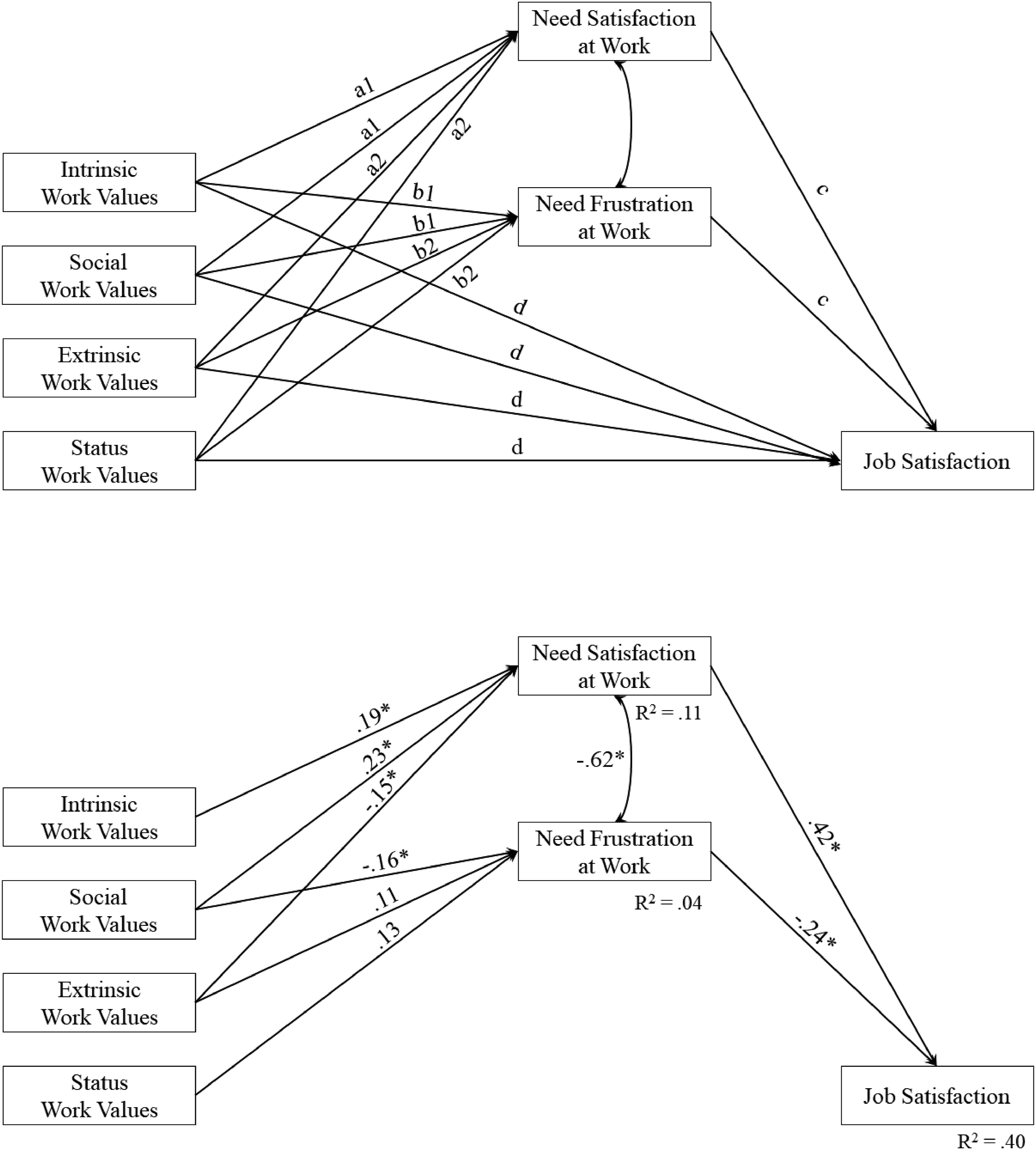
Method
Participants and Procedure
Participants were workers from a Canadian governmental organization from a larger study on work values. This organization was selected through a process of convenience based on first author’s contacts. After institutional research board approval, a total of 476 workers participated to the first wave of the larger study (Time 1; T1). However, only 228 (47.9%) participants at T1 gave their consent to be contacted to participate in the second assessment (Time 2; T2). Therefore, in the present study, we only used data of participants who accepted to be invited to participate in T2. From the 228 participants at T1, 128 filled a questionnaire at T2 (44% attrition), where the average interval between T1 and T2 was 47.4 days (SD = 5.9). At T1, the selected sample consisted of 228 workers (72% female; 28% men), aged between 21 and 63 years (M = 43.0; SD = 8.7). Most participants were born in the province of Quebec (84%), held a full-time job (97%), and spoke French at home (96%). Participants were mainly working in government and public administration (72%) and in business management (13%). Median annual family income was above $100,000 CAN, which is higher than the median household income in Quebec ($59,822 CAN; Statistics Canada, 2016). All participants earned a high school diploma and more than half of them (57%) earned a college degree. Participants cumulated an average of 16 years of schooling (SD = 3.8). During the fall of 2019, they received an email from their human resources department inviting them to participate in this study. They filled a consent form and completed an online questionnaire assessing the variables of the study and sociodemographic information. Both the consent form and the questionnaire were hosted on a secure, university-based server. Participants were invited to complete an online questionnaire (T2) 6 weeks later.
Measures
Work Values (T1)
Omega and Correlation Coefficients Among Factor Scores for Variables of the Study (N = 228).
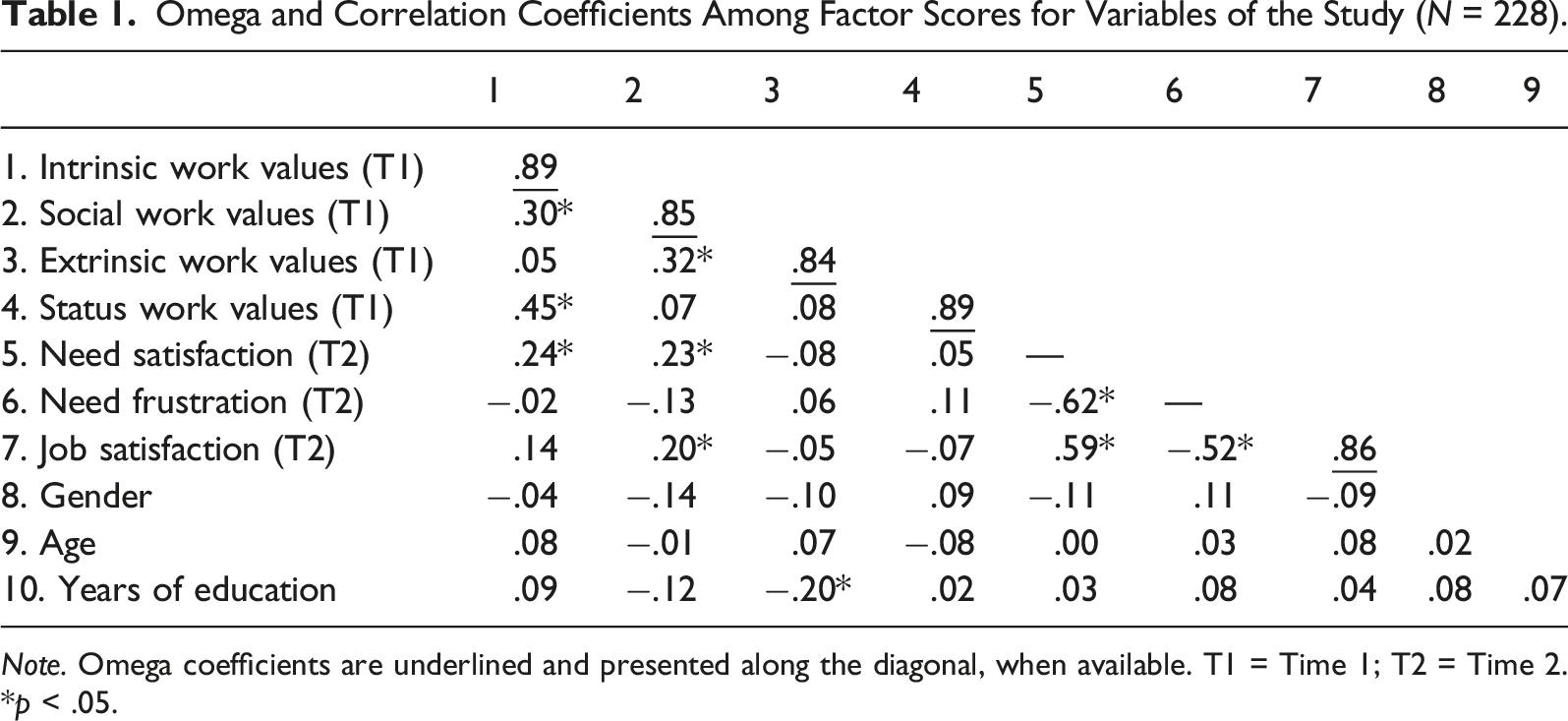
Note. Omega coefficients are underlined and presented along the diagonal, when available. T1 = Time 1; T2 = Time 2.
*p < .05.
Psychological Needs at Work (T1–T2)
The French version (Chevrier & Lannegrand, 2021) of the Basic Psychological Need Satisfaction and Frustration Scale (Chen et al., 2015) was used to assess psychological needs at work. To contextualize items to the work context, the label “At work” was added. Participants indicated the extent to which they agreed with 24 statements using a 5-point Likert-type scale ranging from not true at all (1) to completely true (5). Twelve items assess PNS at work, covering autonomy (4 items; e.g., “At work, I feel a sense of choice and freedom in the things I undertake”), relatedness (4 items; e.g., “At work, I feel that the people I care about also care about me.”), and competence satisfaction (4 items; e.g., “At work, I feel confident that I can do things well.”). Similarly, 12 items assess PNF at work, covering autonomy (4 items; e.g., “I feel pressured to do too many things”), relatedness (4 items; e.g., “At work, I feel the relationships I have are just superficial”), and competence (4 items; e.g., “At work, I feel like a failure because of the mistakes I make”) frustration. Previous research supported the psychometric qualities of this scale (Chen et al., 2015; Chevrier & Lannegrand, 2021). In the present study, omega coefficient for these scales was generally acceptable (ranging from .67 to .83; Md = .74).
Job Satisfaction (T1–T2)
The French version of the Scale of Satisfaction with Professional Life (Fouquereau & Rioux, 2002) was used to assess job satisfaction. Participants indicated the extent to which they agreed with five statements (e.g., “I am satisfied with my professional life”) using a 7-point Likert-type scale ranging from strongly disagree (1) to strongly agree (7). The scale was found to be reliable and valid in past research (e.g., Fouquereau & Rioux, 2002). For the present study, omega coefficient was satisfactory (ω = .86).
Sociodemographic Information
Participant answered questions regarding their age, gender, language spoken at home, birthplace, family income, job domain, highest level of education, and years of schooling.
Statistical Analyses
Model Estimation
All analyses were conducted using Mplus 8.4 (Muthén & Muthén, 2019). The measurement models were estimated with the robust Maximum Likelihood (MLR) estimator because it provides fit indices and standard errors that are robust to the Likert nature of the items and to the non-normality of the data (Hair et al., 2010). Model fit was assessed with the Comparative Fit Index (CFI), the Tucker–Lewis Index (TLI), the Root Mean Square Error of Approximation (RMSEA), and the Standardized Root Mean Square Residual (SRMR). According to typical interpretation guidelines (e.g., Marsh et al., 2005), values greater than .90 for the CFI and TLI and smaller than .08 for the RMSEA and SRMR are considered to indicate adequate fit to the data whereas values greater than .95 for the CFI and TLI and smaller than .06 for the RMSEA and SRMR indicate an excellent model fit.
Measurement Models
A first, series of models were tested to generate factor scores to use as variables in the mediation model. Factor scores partially control for measurement errors (Skrondal & Laake, 2001) by giving more weight to items with higher factor loadings. Thus, factor scores preserve the measurement latent structure better than scale score. Factor scores are also standardized (i.e., mean = 0, standard deviation = 1), which makes them directly comparable and easy to interpret.
Work value factor scores were generated based on a second-order confirmatory factor analysis (CFA) for each value factor, which involves a hierarchical structure. A second-order CFA is used to assess a structure where a second-order latent factor (e.g., intrinsic factor) causes first-order factors (e.g., variety and creativity and autonomy), which in turn cause the indicators (i.e., items; Hair et al., 2010). The social work value factor is the only factor with two work values (i.e., altruism and supervisors). To ensure that the model was over-identified, the two first-order factors were constrained to be equal. Measurement models yielded acceptable fit to the data fit for intrinsic (x2 = 431.76, p < .05, df = 247, CFI = .933, TLI = .925, RMSEA = .057, SRMR = .060), social (x2 = 31.92, p < .XX, df = 34, CFI = 1.00, TLI = 1.00, RMSEA = .000, SRMR = .033), extrinsic (x2 = 216.35, p < .05, df = 115, CFI = .915, TLI = .899, RMSEA = .062, SRMR = .072), and status (x2 = 295.61, p < .05, df = 148, CFI = .929, TLI = .918, RMSEA = .066, SRMR = .062) work values.
Goodness-of-Fit Statistics of Invariance Measurement Models for Basic Psychological Needs at Work and Job Satisfaction (N = 228).
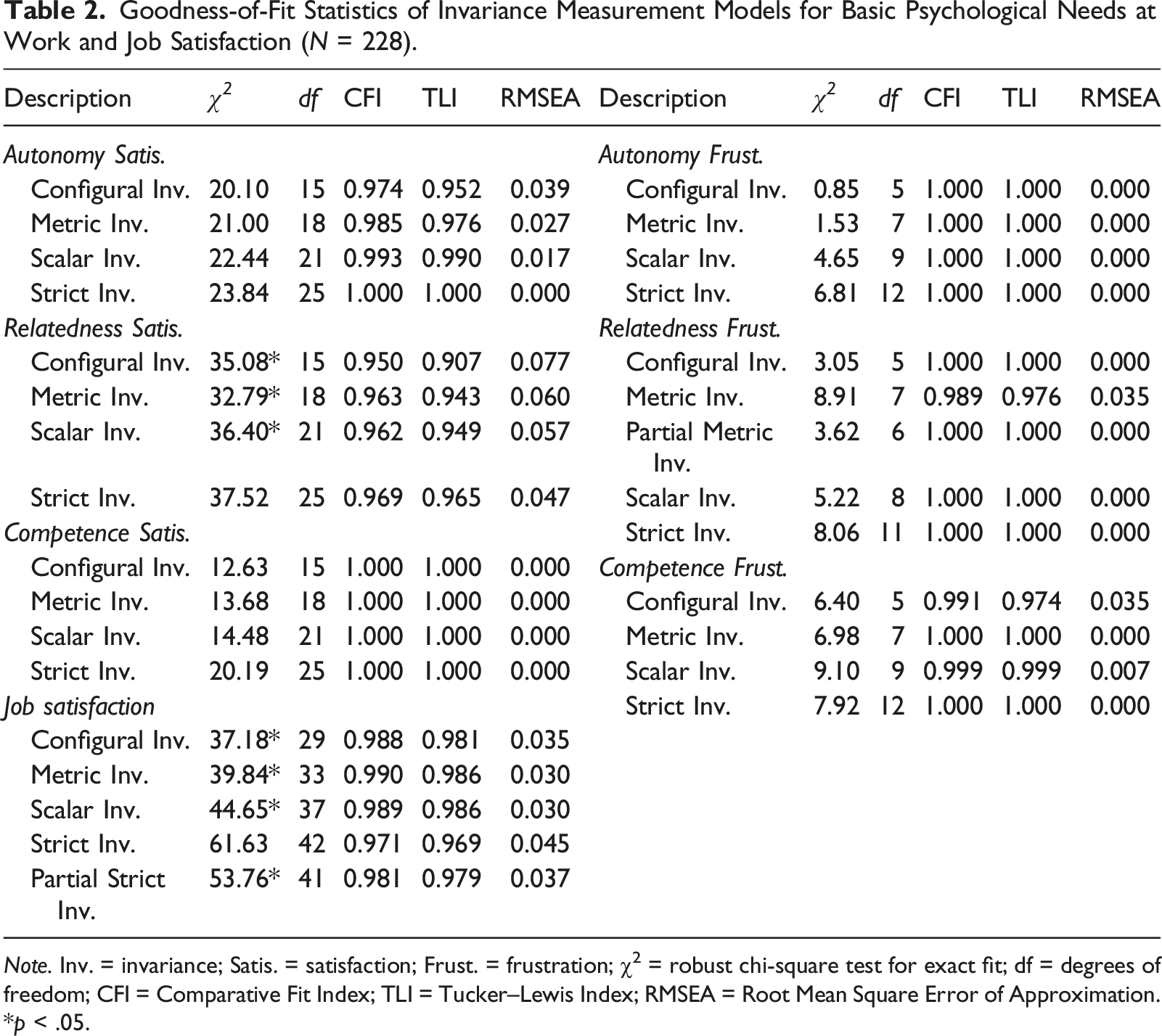
Note. Inv. = invariance; Satis. = satisfaction; Frust. = frustration; χ2 = robust chi-square test for exact fit; df = degrees of freedom; CFI = Comparative Fit Index; TLI = Tucker–Lewis Index; RMSEA = Root Mean Square Error of Approximation.
*p < .05.
For job satisfaction, longitudinal invariance evaluation was conducted following the same procedures previously described. Job satisfaction factor score was derived from the partial strict longitudinal invariance model, after freeing the error uniqueness of one item. Fit indices, details of all measurement models, and longitudinal invariance are also reported in Table 2.
Missing Data
The Full Information Maximum Likelihood (FIML) procedure was used to treat missing data. FIML allows the estimation of a model using the data of participants who completed at least one measurement time, which was useful for the estimation of measurement models of PNS and PNF and job satisfaction. In this sample, proportions of missing data between T1 and T2 for participants who agreed to participate to both waves of the study was 44%, whereas missing data at the item level ranged from 0% to 5%. The FIML procedure is a better alternative than other missing values procedures such as deleting missing cases or using a mean substitution procedure since it yields unbiased parameter estimates, even with a very high level of missing data (e.g., 50%; Enders, 2010; Graham, 2012). When there is a high proportion of missing data, it is recommended to use auxiliary variables to more accurately predict missing values and improve the estimation (Enders, 2010). Therefore, for participants who did not participate to T2 of this study, scores of PNS and PNF at work and job satisfaction were computed based on their T1 data from the most longitudinal invariant model, as described previously.
Mediation Analyses
To test the mediating effect of PNS and PNF at work on the association between work value factors and job satisfaction, factor scores derived from measurement models were used in a path analysis. To demonstrate mediation, three conditions have to be met: (a) the work value factor must predict PNS and/or PNF at work, (b) PNS or PNF at work must predict job satisfaction, and (c) prediction of a work value factor has to be reduced (partially or totally) after controlling for the contribution of PNS or PNF (MacKinnon et al., 2012; Schreurs et al., 2014). Because the path model only exposes the direct link from each work value factor and job satisfaction, indirect effects were estimated. In mediation analysis, the indirect effect represents how an outcome (e.g., job satisfaction) is associated with a predictor (e.g., work values) through a sequence in which the predictor contributes to a mediating or intermediary variable (e.g., PNS), which in turn predicts the outcome (Hayes, 2018). The bootstrap resampling method (Hayes, 2018) with a series of 500 random samples from the initial sample was used to estimate indirect effects. Because the bootstrap procedure is not available with MLR estimator in Mplus, the maximum likelihood estimator was used for the path analysis. The resampling bootstraping method is robust to violations of data normality conditions and produces a bias-corrected 95% confidence interval (CI) for path coefficients of the indirect effect (Hayes, 2018). The path coefficients were interpreted in line with Cohen (1988) thresholds, where the strength of association can be qualified as small (.1), moderate (.3), or strong (.5). The proposed model is just-identified, which means that it has 0 degrees of freedom and has perfect fit by definition (Hair et al., 2010). Consequently, fit indices were not presented.
Results
Testing the Proposed Model
Correlations among all factor scores and sociodemographic variables are presented in Table 1. Results showed that sociodemographic variables were either unrelated or, at best, weakly correlated with the variables of the study. Therefore, controlling for these variables in path analyses was unnecessary. As exposed in Figure 1, PNS at work was positively predicted by intrinsic and social work values and negatively predicted by extrinsic work values, and status work values did not predict PNS. PNF at work was positively predicted by extrinsic and status work values and negatively predicted by social work values, and intrinsic work values did not predict PNF. All effect size coefficients were small (ranging from −.16 to .23). The model estimated how job satisfaction could be explained by needs (proximal predictors) and work values (distal predictors). Results revealed that PNS at work was a moderately strong and positive predictor of job satisfaction while PNF at work was a small-to-moderate and negative predictor of job satisfaction. Furthermore, none of the work values at T1 had a direct contribution to job satisfaction at T2, despite intrinsic and social work values being positively correlated with job satisfaction at the bivariate level. The proportion of explained variance by work values was small for PNS and near-zero at work for PNF at work. Furthermore, the proportion of explained variance in job satisfaction was moderate.
Indirect Effects
Results based on 95% CI estimated by the bootstrap procedure revealed three indirect effects. A first indirect effect from intrinsic work values to job satisfaction was obtained, for which the total indirect effect was .09 (p = .07; 95% CI [−.01, .18]). This effect appears to be explained by PNS at work, for which the specific indirect effect estimate was .08 (p = .05; 95% CI [.01, .16]). A second indirect effect was detected as the sum of indirect effects from social work values to job satisfaction was at .12 (p = .01; 95% CI [.04, .21]). Again, this indirect effect was mainly explained by PNS at work, with an effect size of .09 (p = .01; 95% CI [.03, .16]). A third indirect effect was obtained where the total indirect effect from extrinsic work values to job satisfaction was −.10 (p = .02; 95% CI [−.02, −.19]). The indirect effect was also explained by PNS at work, for which the effect size was −.07 (p = .03; 95% CI [−.02, −.14]). The relationship from status work values to job satisfaction reflects a sequential relation (i.e., status work values positively predicted PNF at work, which, in turn, was negatively associated to job satisfaction) since no indirect effect was detected. The results also revealed that PNF at work was not a mediating variable in the association of work values with job satisfaction.
Discussion
This study tested a model in which BPS and PNF mediated the contribution of work values, grouped into factors, on job satisfaction. Importantly, this study is the first, to our knowledge, to test this mediating association by including both PNS and PNF at work to predict job satisfaction, which allows to identify how each mediated specific contribution of each value factor. The first objective was to examine the predicting role of work value factors on PNS and PNF at work. As hypothesized, growth-oriented (i.e., intrinsic and social) work values predicted higher levels of PNS at work. Social work values also predicted lower levels of PNF at work, whereas intrinsic work values were surprisingly unrelated to it. Instrumental (i.e., extrinsic and status) work values predicted more PNF at work, as expected. Extrinsic work values also negatively predicted PNS at work, whereas status work values were surprisingly unrelated to it. The second objective was to examine the association of PNS and PNF at work with job satisfaction. In line with our hypotheses, PNS at work contributed positively to job satisfaction, whereas PNF at work contribute negatively to it. Finally, the last objective was to examine the mediating role of PNS and PNF at work in the relation between work value factors and job satisfaction. Results revealed that PNS at work mediated the relation between job satisfaction and three work value factors, namely, intrinsic, social, and extrinsic. Hence, the reason why intrinsic and social work values contribute to job satisfaction seems to be because these values promote PNS at work. Conversely, the reason why extrinsic work values contribute negatively to job satisfaction appears to be because these values impede on PNS at work. When testing for indirect effects, there was no direct contributions of these work values to job satisfaction, which indicates that the contribution of the work values fully operated through PNS at work. This mediating effect was not observed for status work values, for which only a sequential effect was obtained. Contrary to expectations, PNF at work did not mediate the contribution of work values on job satisfaction. The next section develops on the contribution these findings have for research and practice.
Implications for Theories and Research
The results of this study contribute to the SDT literature in several ways. First, these findings offer supporting evidence for the usefulness of a four-factor conceptualization of work values that is anchored within SDT. Results of this study supported a previous SDT proposition that some values are aligned with the inherent tendency toward psychological growth and contribute to wellness, whereas others are more oriented toward rewards or praises, which consequently leads to lower well-being (Kasser, 2002). Foremost, the fact that intrinsic and social work values contributed to PNS suggests they can be defined as growth-oriented values, which means that pursuing them should improve psychological thriving, growth, and wellness. Alternatively, the fact that extrinsic and status work values contributed to PNF at work suggests that they do not contribute to psychological thriving and can even thwart it. Therefore, these work values can be defined as instrumental. It is important to note that intrinsic work values did not negatively contribute to PNF at work and that status work values did not negatively predict PNS at work, contrary to our expectations. One possible explanation might be related to the asymmetrical interplay between PNS and PNF, which means that low PNS does not always lead to PNF but high PNF necessarily implies low PNS (Rouse et al., 2020; Vansteenkiste & Ryan, 2013). With respect to intrinsic work values, results showed that they contribute to PNS at work, but that they are unrelated to PNF at work. In other words, intrinsic work values appear to promote psychological growth, but they are not protecting against need frustration. This result is consistent with the asymmetrical interplay between PNS and PNF. In contrast, results showed that status work values contribute to PNF at work but are unrelated to PNS at work. The association of status work values with PNS and PNF at work seems inconsistent with the asymmetrical relationship. By contributing positively to PNF, status work values are thereby expected to contribute negatively to PNS, which was not the case with this sample. Further research is needed to replicate this finding and identify explanatory mechanisms.
Second, the present study further supported the mediating role of PNS in the relationship between work values and job satisfaction. Here, the findings showed that PNS but not PNF mediated the relationship from work values to job satisfaction. This result offers empirical support regarding the importance of distinguishing PNS and PNF in a same model since both processes have different antecedents and outcomes (e.g., Vansteenkiste et al., 2020). Results from this study are also in line with the dual processes of psychological functioning (Vansteenkiste et al., 2020) in which PNS (i.e., bright side) promotes psychological growth whereas PNF (i.e., dark side) thwarts it. More specifically, when individuals strongly endorse intrinsic and social work values, they should experience need fulfillment (i.e., acting with volition and endorsing their actions, perceiving that they effectively interact with the environment and feel socially connected with others at work). Psychological need satisfaction are crucial to optimal functioning and facilitate the psychological growth process, which contributes to wellness (Rouse et al., 2020). This study demonstrated this bright path by showing that PNS is a mediating variable in the association between work values and job satisfaction. Therefore, supporting the satisfaction of individuals’ psychological needs at work seems important to improve individuals’ satisfaction toward their job. Without a negative outcome, it was not possible to test the dark side of the dual process of psychological functioning.
Third, most theories that acknowledge the importance of work values in career development do not take into consideration that some work values might more strongly contribute to positive work outcomes (e.g., job satisfaction) independently of the work environment. For example, the theory of work adjustment (Dawis & Lofquist, 1984) and the values-based theory of occupational choice, satisfaction, and success (Brown, 2002) proposed that job satisfaction is obtained depending on the congruence between someone’s endorsed work values and those reinforced in their work environment, without differentiating the type of work values. In other words, every work value can lead to job satisfaction if similar work values are promoted by the work environment. In contrast, SDT assumes that endorsing intrinsic work values or being in a work environment that promotes intrinsic work values lead to positive outcomes, which is not expected for extrinsic work values. Results from this study support SDT’s assertion, which was also supported by a large cross-national study on personal values (Van den Broeck et al., 2019).
Implications for Interventions
These findings have several implications for applied settings. In career counseling, work values are usually assessed to identify the fit between an individual’s characteristics and those of different occupations or work environment (Greene & Messer, 2018). Although person–environment fit interventions are useful to predict job satisfaction, this study showed that it is important that individuals’ work choices or decisions be aligned with their endorsement of intrinsic and social work values rather than extrinsic and status work values. In other words, when assessing someone’s work values, career counselors and professionals should emphasize intrinsic and social work values when identifying career opportunities that may be a good fit.
Moreover, stakeholders should promote interventions that are considering the promotion of growth-oriented work values. To this effect, providing an autonomy-supportive environment to employees contributes to increase their level of intrinsic work values and PNS at work (Zhang et al., 2019). Supervisors can adopt autonomy-supportive behaviors by providing meaningful rationale for requested tasks, emphasizing choice rather than control, and acknowledging employees’ perspectives (Hardré & Reeve, 2009). In contrast, when supervisors adopt controlling behaviors (i.e., neglecting or frustrating employees’ motivation, pressuring employees to behave in a specific way, and use of contingent rewards), they contribute to enhancing their level of extrinsic work values and PNF at work (Zhang et al., 2019). By encouraging the endorsement of intrinsic over extrinsic work values, organizations contribute to improving their employees’ well-being and their engagement toward their job (Unanue et al., 2017).
Strengths, Limits, and Future Research
In addition to the several strengths of this study (i.e., using an empirically validated model of work values, having a repeated measures research design, and estimating factor scores to partially controlled measurement error), some limitations need to be considered when interpreting these findings. A first limit pertains to the sample size of this study, which prevented testing the model with latent factors (i.e., by including items in the model). Future studies should replicate these results in larger samples, which would allow the estimation of latent factors as well as a better control over measurement error. A second limit pertains to sample characteristics, which limit the generalizability of our findings. Participants were workers from a single organization who reported a higher average education level and a family income that was substantially higher than the median familial income in Canada. These results might reflect the reality of participants with a higher socioeconomic status. It would be important that future research replicate these findings with a sample that is more representative of the general population. A last limit pertains to the descriptive nature of the present study, which precludes us from drawing causal inferences.
Future research should aim to extend the present study and to develop our understanding of the contribution of work values with psychological growth. In line with SDT propositions (see Ryan & Deci, 2017) and their application to the work context (see Deci et al., 2017), the present study showed that work values (also labelled aspirations in the SDT literature) predicted PNS and PNF at work. However, SDT also posits that when social contexts interfere with psychological growth and thwart PNS, people can neglect intrinsic values and endorse extrinsic values (Deci & Ryan, 2000), considered as need substitutes (Vansteenkiste et al., 2020). In such cases, it can be argued that PNS and PNF at work also predict work values endorsed by individuals (Zhang et al., 2019). Hence, longitudinal studies should investigate developmental patterns and bidirectional contributions of work values with PNS and PNF at work. In doing so, it would increase our understanding of the interplay between needs and values in SDT.
Another suggestion for future research would be to examine the association between the four factors of work values and other constructs that are central to SDT such as work motivation and general causality orientations (i.e., characteristic ways of perceiving and organizing perceptions and information; Ryan & Deci, 2017). In line with SDT research (see Deci et al., 2017), wellness indicators like job satisfaction are expected to have several antecedents, such as work values, work motivation, general causality orientations, and PNS and PNF. Based on the basic SDT model in the workplace (Deci et al., 2017), work motivations and PNS and PNF at work are expected to mediate the association between general causality orientations and work values with wellness indicators. By including all these predictors in a single model, the role of work values in SDT and its contribution compared to other well-established variables could be identified.
Footnotes
Declaration of Conflicting Interests
The author(s) declared no potential conflicts of interest with respect to the research, authorship, and/or publication of this article.
Funding
The author(s) disclosed receipt of the following financial support for the research, authorship, and/or publication of this article: This study was supported by the Social Sciences and Humanities Research Council of Canada and the Fonds de recherche du Québec—Société et culture (FRQSC).
