



Abstract
Several studies conducted in the mid-20th century found evidence to suggest that perceived incompetence leads to higher levels of conformity. However, there have been very few replications of these studies in the last 40 years, which casts doubt upon their relevance to contemporary human social behaviour. To address this issue, the present research involved a conceptual replication of these original studies within a self-determination theory perspective. Using a sample of 126 participants, participant feedback was manipulated to induce either perceived competence (competence satisfaction) or perceived incompetence (competence frustration), and then the effects of these manipulations on levels of conformity was measured. As expected, competence frustration led to higher levels of conformity, whereas competence satisfaction led to lower levels of conformity. These findings support the idea that the relationship between perceived competence and conformity is analogous to the relationship between frustration of the basic psychological need for competence—as outlined by self-determination theory—and controlled behavioural regulation. Implications of this successful replication and potential future directions are discussed.
Introduction
Social influence theory is noteworthy for its enduring empirical foundations involving several famous studies conducted in the mid-20th century (Smith & Haslam, 2017). The Asch (1951) conformity research was particularly influential in this regard and inspired many follow-up studies, several of which sought to investigate the relationship between perceived competence and conformity (Costanzo et al., 1968; Ettinger et al., 1971; Hollander, 1960; Wiesenthal et al., 1973). In each of these studies, the researchers manipulated participant feedback to induce either perceived competence or perceived incompetence, and then measured the extent to which participants conformed to a group majority. Each study found evidence to suggest that perceived incompetence leads to higher levels of conformity.
However, there have been very few replications of these studies in the last 40 years, which is an important issue for several reasons. Firstly, more recent research suggests that there has been a general decrease in levels of conformity measured in studies over time (Bond & Smith, 1996). This trend could reflect cultural, social, and ideological changes that have occurred since the original competence and conformity studies were conducted, such as a proposed increase in individualism (Santos et al., 2017; Twenge et al., 2013) which itself is linked with lower levels of conformity (Bond & Smith, 1996; Kim & Markus, 1999). Secondly, additional factors—such as the need for uniqueness, which has been found to reduce the effects of social influence (Imhoff & Erb, 2009)—have been identified that point towards a more complex picture of conformity than considered in the original competence and conformity studies. Thirdly, there are suggestions that, due to their enduring popularity, observed effects in social influence studies may have been exaggerated and misinterpreted by both academics and the public (Jarrett, 2008). When considering these issues together, it remains unclear whether the findings from the original competence and conformity studies are representative of contemporary human social behaviour in the absence of meaningful replications.
It is important to note that these issues are not unique to conformity research. Social psychology in general is currently undergoing a crisis of confidence in the validity and reliability of its research, which arose after several high-profile incidents involving failed replications of observed effects, scientific fraud, questionable research practices and low statistical power in studies (Kerr, 1998; Pashler & Wagenmakers, 2012; Rossi, 1990; Simmons et al., 2011). Contemporary publication practices have also contributed to these issues by prioritizing novel, high-impact research over replication studies and null findings (Ellemers, 2013), despite the importance of replication studies and null findings to verify research and develop theory (Schmidt, 2009). In light of these issues, there have been calls for greater transparency in research and an increased emphasis on close and conceptual replication studies as a means of verifying the validity and reliability of previously observed effects (Brandt et al., 2014; Earp & Trafimow, 2015; Makel et al., 2012).
As such, there is a clear need to re-examine the relationship between perceived incompetence and conformity, and to also reframe and integrate any replicated effects within the context of contemporary theories and models. Indeed, the social influence literature has become fragmented with theories that effectively model specialized psychological and behavioural effects but fail to identify broad commonalities across research domains (Ellemers, 2013; Ferguson & Heene, 2012; Healy, 2012; Kruglanski, 2001; Nowak et al., 2003; Vallacher & Nowak, 1994).
There have been significant developments in macro-theories that are suitably predisposed for theoretical integration. Self-determination theory (SDT) is one such macro-theory that could be applied to reframe the relationship between perceived incompetence and conformity. SDT considers the internal psychological and motivational dynamics that underlie human behaviour, and argues that satisfaction of three basic psychological needs (BPN) for competence, autonomy, and relatedness underlies autonomous behavioural regulation, whereas frustration of the BPN underlies controlled behavioural regulation (Deci & Ryan, 2000, 2008; Ryan & Deci, 2000a).
There are clear conceptual parallels between perceived competence as outlined in the original competence and conformity studies and the BPN for competence to justify a re-examination of the links between competence and conformity within the framework of SDT. For example, Cialdini and Trost (1998) defined competence within the social influence literature as involving a desire to be effective and to gain accurate perceptions of reality in social situations, while SDT defines the BPN for competence as a fundamental need to experience a general sense of confidence and effectiveness in one’s actions (Ryan & Deci, 2002). In addition, since conformity is considered a form of controlled behavioural regulation by SDT (Ryan & Deci, 2000b, 2002), the relationship between perceived incompetence and conformity is analogous to the relationship between frustration of the BPN for competence and controlled behavioural regulation.
The Present Study
While previous studies provided evidence to suggest that perceived incompetence leads to higher levels of conformity, there have been very few replications of this proposed relationship in the last 40 years. As such, it is important to re-examine and verify this relationship in light of both the current replication crisis in social psychology and the inevitable social, cultural, and ideological changes that have occurred over time. It is also important to re-examine these effects within the context of contemporary models of human behaviour such as SDT as a means of integrating the fragmented social psychological literature.
Therefore, the aim of the present research was to re-examine the relationship between perceived competence and conformity by conducting a conceptual replication of the original competence and conformity studies. As in the original competence and conformity studies, participants’ perceived competence was experimentally manipulated to be either frustrated, satisfied, or no manipulation (control), and then the number of times participants conformed to a group majority was measured. However, this conceptual replication is novel in that it utilised an online task (the original studies were in-person) and frames competence and conformity within the context of SDT. It was predicted that competence frustration would lead to higher levels of conformity, whereas competence satisfaction would lead to lower levels of conformity.
Method
Participants
A sample of 126 participants (52 male, 72 female, 2 nondisclosed) with a mean age of 24.4 years (SD = 7.7) took part in the current study. Participants were recruited from the School of Psychology participant pool at the University of Lincoln and through advertisements on social media (Facebook and Reddit). All experimental manipulations and measures were conducted online using the school’s Qualtrics® platform.
Design
The experiment involved a between-subjects design with one factor (perceived competence) that comprised three conditions (frustrated, satisfied, control). The dependent variable was the number of conforming responses. Participants were randomly assigned to one of the three conditions using the Qualtrics® randomizer function. There were 43 participants in the frustrated condition, 43 in the satisfied condition, and 40 in the control condition.
Procedure
Participants took part in a novel estimation experiment to examine the effects of perceived competence frustration versus perceived competence satisfaction on conformity. The experiment involved 10 trials. In each trial, participants were asked to estimate the number of black dots in an image. Images were presented for 10 seconds to prevent participants from counting the number of dots. After viewing each image, participants estimated the number of black dots by selecting one of four predefined response options (see Figure 1). Example estimation trial.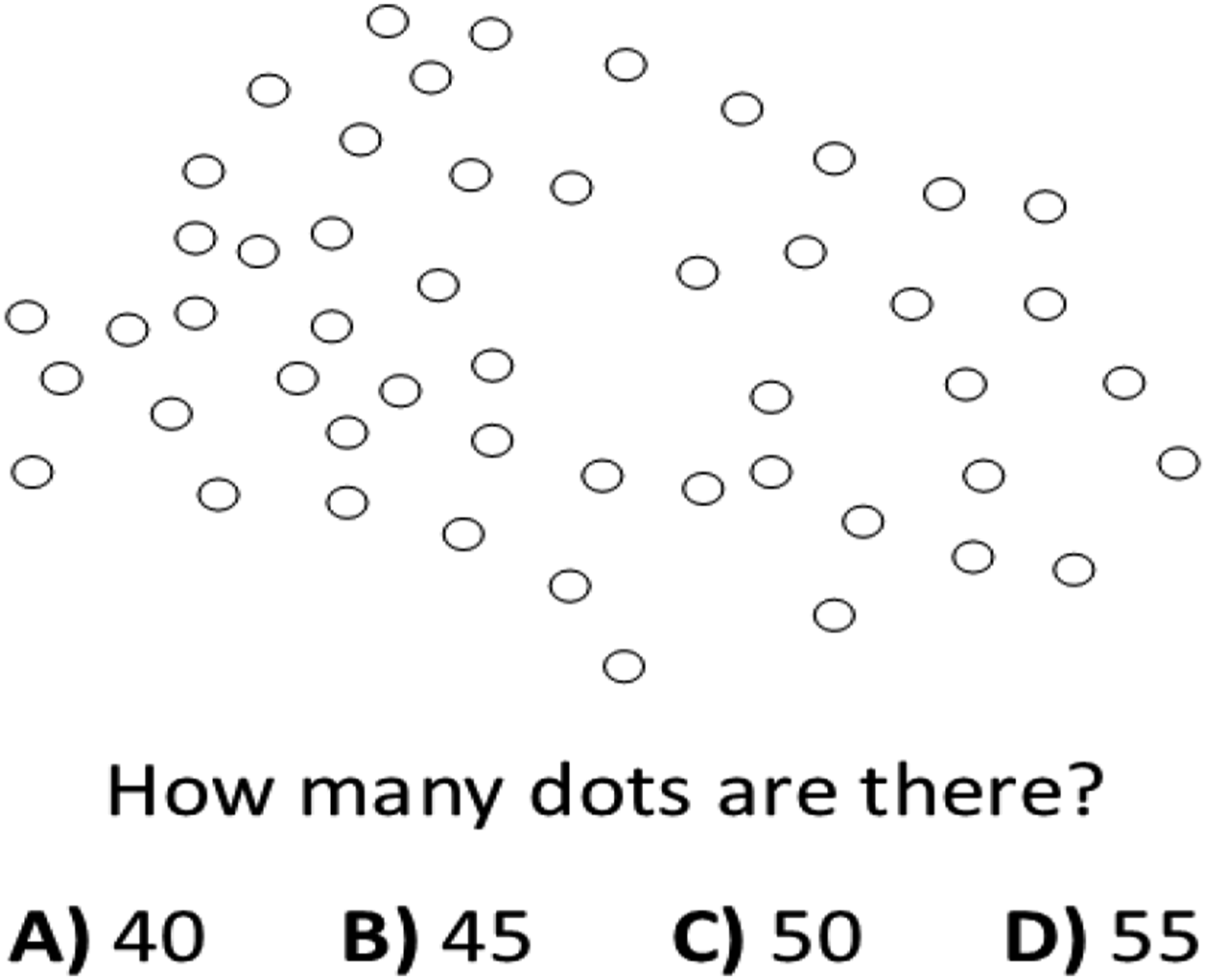
To manipulate perceived competence, predetermined feedback was provided to participants after the first five trials. In the frustrated condition, feedback indicated that responses were incorrect; in the satisfied condition, feedback indicated that responses were correct; and in the control condition, no feedback was provided.
The remaining five trials were then used to measure conforming responses. To do this, fictitious percentages were displayed alongside each response option (see Figure 2). Participants were told the percentages represented how many people responded to each option in a previous testing session. The highest percentage was the target response to measure conformity. Example estimation trial with percentages.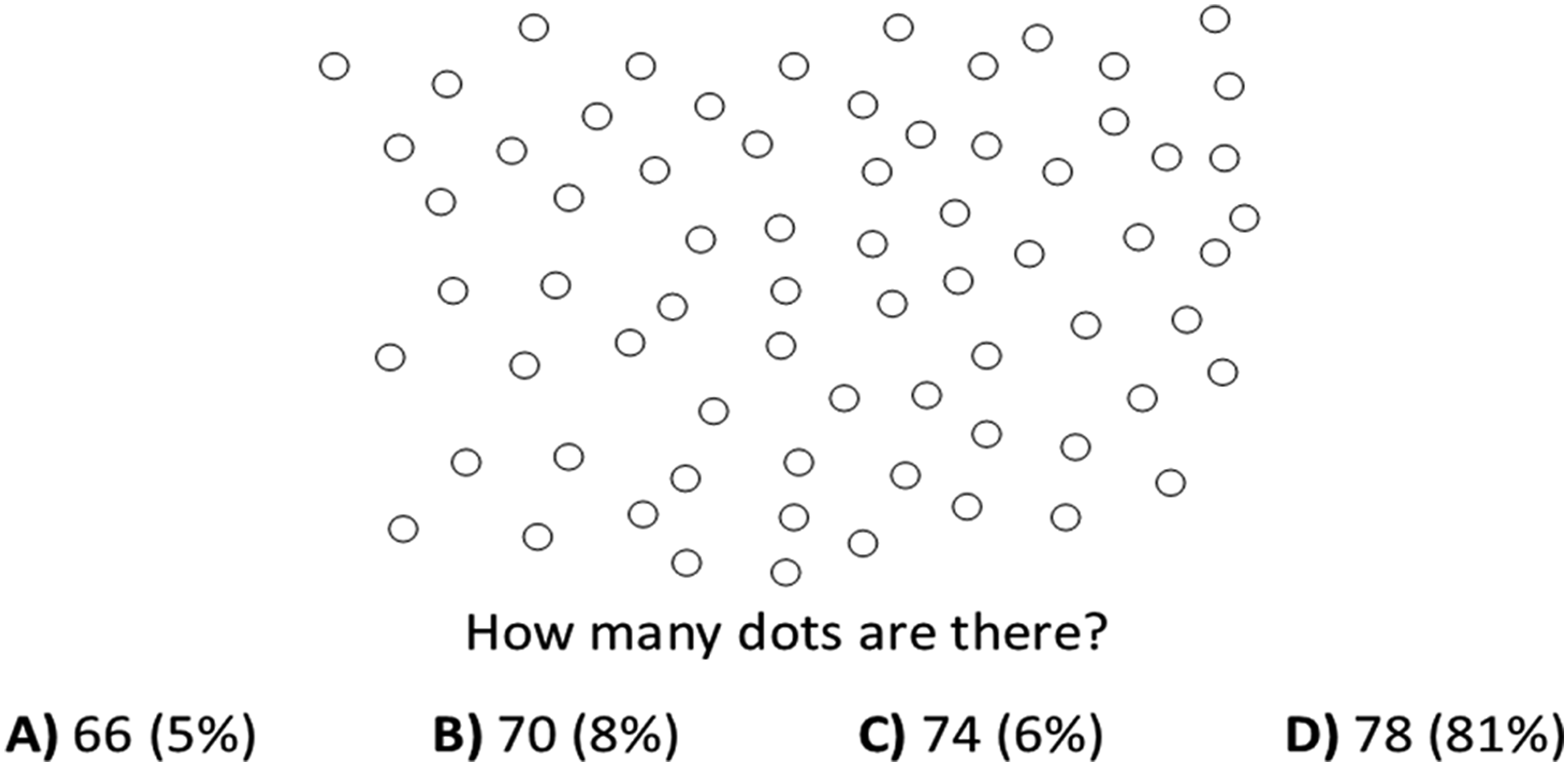
Ethics
This research adhered to the ethical guidelines of the British Psychological Society and received ethical approval from the University of Lincoln Research Ethics Committee. Informed eConsent was obtained from all participants via Qualtrics®.
Manipulation Check
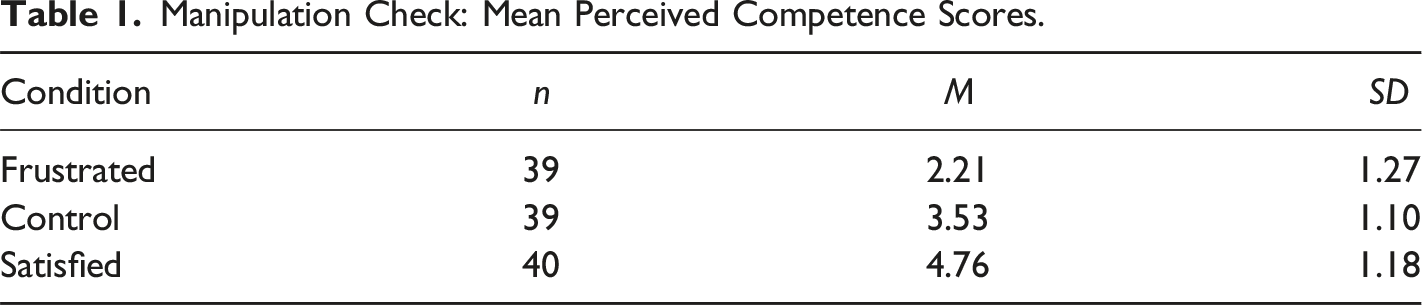
To examine whether the predetermined feedback successfully manipulated participants’ perceived competence, a manipulation check was conducted on Qualtrics® (N = 118 participants; 30 male, 87 female, 1 nondisclosed) following the same procedure, but only presenting the first five trials with the relevant predetermined feedback, with 39 participants in the frustrated condition, 40 in the satisfied condition, and 39 in the control condition. Perceived competence was measured using three adapted items from the Perceived Competence Scale (Williams et al., 1998; “I feel confident in my ability to estimate,” “I now feel capable of estimating accurately,” “I am more confident about estimating now than before starting this study”) and one additional item (“How competent do you think you are at estimating?”). For the Perceived Competence Scale items, participants were asked to what degree they agreed with each statement and responded on a scale from 1 (strongly disagree) to 7 (strongly agree). For the additional item, participants were asked to rate their competence on a scale from 1 (not at all competent) to 7 (very competent).
Manipulation Check: Mean Perceived Competence Scores.
Results
Figure 3 displays the mean number of conforming responses across the frustrated (M = 2.35, SD = 1.48), control (M = 1.65, SD = 1.27), and satisfied (M = 1.09, SD = 0.92) conditions. A one-way ANOVA showed significant differences in conformity across the three conditions (F[2, 123] = 10.99, p < .001, ƞ2 = .15). Planned contrasts showed that participants in the frustrated condition conformed significantly more often than participants in the control condition (F[1, 123] = 6.54, p = .01, ƞ2 = .05) and the satisfied condition (F[1, 123] = 21.89, p < .001, ƞ2 = .15); and participants in the control condition conformed significantly more often than participants in the satisfied condition (F[1, 123] = 4.15, p = .04, ƞ2 = .03). Mean number of conforming responses in the frustrated, satisfied, and control conditions. Note. Error bars represent standard errors.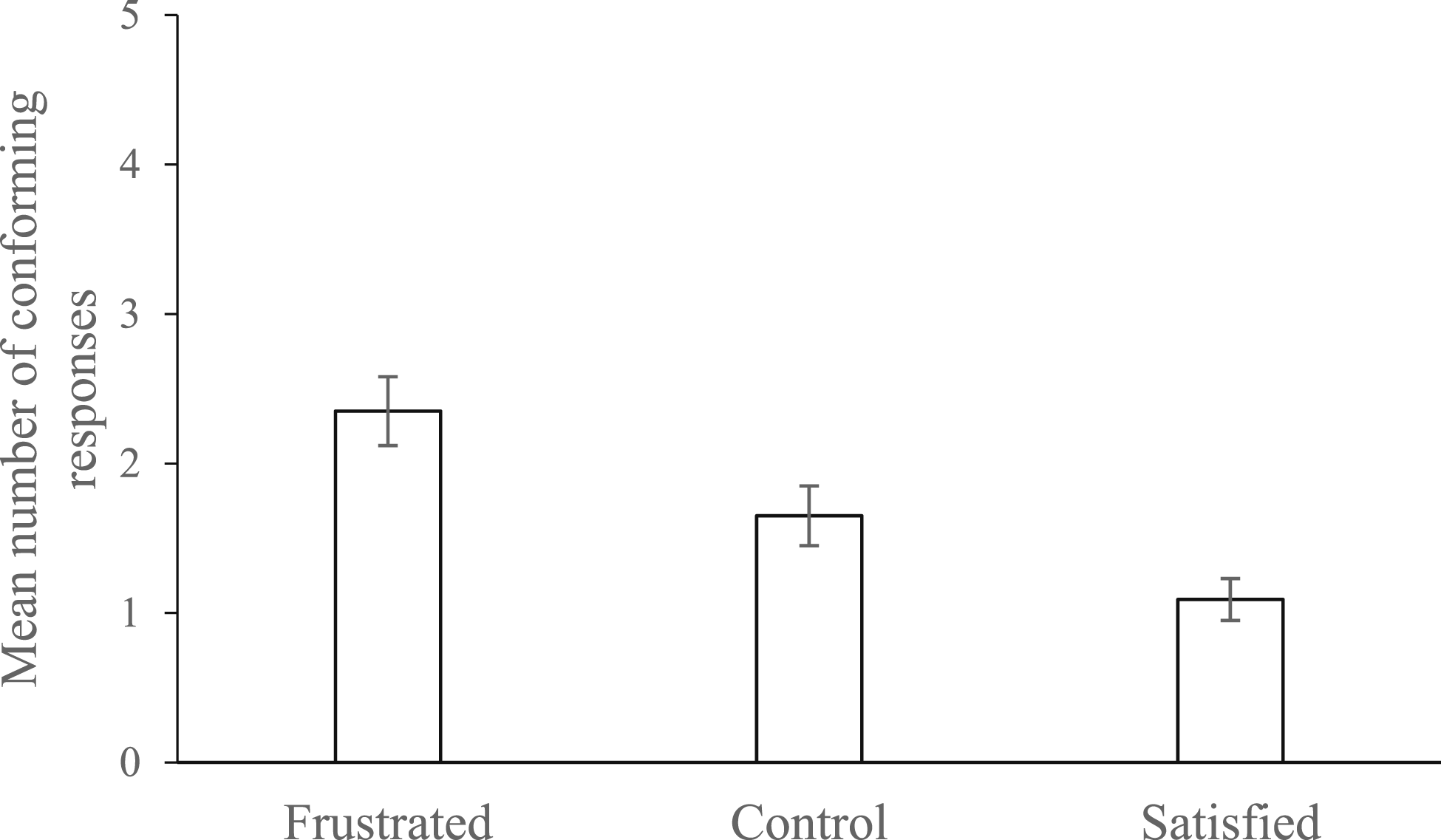
Discussion
The aim of the present study was to investigate the extent to which competence frustration leads to higher levels of conformity. To do this, a conceptual replication of the original competence and conformity studies was performed which involved manipulating perceived competence to be either frustrated, satisfied, or no manipulation (control), and then examining the effects of these manipulations on levels of conformity.
As expected, there was a large main effect of perceived competence (ƞ2 = .15) on levels of conformity (where an effect size of ƞ2 ≥ .14 is considered large by Cohen, 1988). Specifically, results showed that participants who experienced competence frustration conformed significantly more often than participants who experienced competence satisfaction as well as participants in the control condition. Participants in the control condition also conformed significantly more often than participants who experienced competence satisfaction. The present study therefore successfully replicated the observed effects in the original competence and conformity studies (Costanzo et al., 1968; Ettinger et al., 1971; Hollander, 1960; Wiesenthal et al., 1973), and suggests that individuals are more likely to conform to a group majority if they perceive themselves to be less competent.
These findings are also consistent with SDT in that the observed relationship between perceived incompetence and conformity is analogous to the relationship between frustration of the BPN for competence and controlled behavioural regulation (Ryan & Deci, 2000b, 2002). In the context of SDT, these findings demonstrate that, despite the proposed decline in conformity measured in studies over time (Bond & Smith, 1996), the fundamental need to experience competence satisfaction remains an important factor in promoting autonomous behavioural regulation over controlled behavioural regulation, as in the case of conformity.
Future Directions
The present study provides a foundation for further applications of SDT to integrate the fragmented social psychological literature. Indeed, there is scope to examine the relationships between conformity and the other BPN for relatedness and autonomy which, alongside the BPN for competence, are also necessary for autonomous behavioural regulation. Specifically, it could be that relatedness frustration and autonomy frustration also lead to controlled behavioural regulation in the form of conformity.
Beyond this, future research could investigate the role of BPN as common denominators underlying a diverse range of controlled behaviours linked to social influence. For example, the need for uniqueness, which involves compensatory behaviours aimed at experiencing a sense of individuality in response to social influences (Imhoff & Erb, 2009), could be reconceptualised as a form of reactance against social influences due to autonomy frustration (Deci & Ryan, 1985).
Furthermore, it could be useful for future research to not only consider the manifest effects of BPN frustration on conformity, but to also observe the latent motivational regulation involved in cases of conformity. According to SDT, behaviours should be classified on the basis of whether they are motivated for autonomous reasons or controlled reasons rather than their manifest qualities (Ryan & Deci, 2000b). For example, an individual could agree with a group majority for controlled reasons—such as publicly acquiescing with a group in order to fit in while privately disagreeing with the group consensus—but an individual could also agree with a group majority for autonomous reasons—such as internalizing a group consensus because it is consistent with their intrinsic beliefs and values. In each case, the manifest behaviour is the same, but the motivational regulation underlying the manifest behaviour is different. By considering the latent motivational regulation involved in human social behaviour, researchers could more clearly and precisely distinguish between conforming behaviours and autonomous behaviours.
Limitations
There were several limitations to the present study. First, the experimental task was conducted online without face-to-face social interaction. While individuals now make far greater use of online platforms as a means of social interaction than the time of the original competence and conformity studies, this does not negate the importance of further examining social influence in face-to-face situations. One possibility is that the effects of competence frustration on conformity may be larger than those observed in the present study when examined in a face-to-face context involving a wider range of social influence factors, such as perceived likeability and authority (see Guadagno et al., 2013).
Second, while the experimental estimation task was used effectively for the purposes of the present study, there are many other situations where individuals may conform to a group majority. For example, research by Mallinson and Hatemi (2018) explored conformity to a group in relation to political opinions, while Zafar (2011) explored the effects of social comparisons on conformity to a group in relation to charity donations. Future studies could embrace a wider range of contexts such as these to investigate the generalisability of the effects of perceived competence on conformity.
Finally, the present study only examined a form of informational influence, where individuals conformed to a group as a means of improving their estimation performance. As such, it remains unclear whether competence frustration increases conformity in normative situations, where individuals conform to social influences as a means of being liked. To address these issues, future research could examine the relationship between competence frustration and conformity in response to normative influences.
Conclusion
The present research successfully replicated the effects observed inseveral famous competence and conformity studies from the mid-20th century, where perceived competence frustration led to higher levels of conformity. It was demonstrated that despite an apparent decrease in conformity measured in studies over time, perceived competence remains an important factor in determining how individuals respond to group pressures. These effects were examined within the context of SDT and several suggestions were outlined for future research, involving a greater focus on BPN, latent motivational regulation, and additional forms of social influence in different situational contexts.
Footnotes
Acknowledgments
I would like to thank Patrick Hylton, Rachel Bromnick, Ava Horowitz, and Joachim Stoeber for their valuable and constructive feedback during the preparation of this manuscript.
Declaration of Conflicting Interests
The author declared no potential conflicts of interest with respect to the research, authorship, and/or publication of this article.
Funding
The author received no financial support for the research, authorship, and/or publication of this article.
Ethical Statement

Data Availability Statement
The data for this research are publicly available via the Open Science Framework (Burkitt, 2020).