



Abstract
Economic inequality is fuelling climate change. The question, however, remains whether the degree to which people perceive their country as unequal influences their motivation to support climate policies. Across three studies (N = 1,459), we investigated whether perceived inequality influences people’s support for structural climate policies over policies aimed at individual-level behavior change. In an Australian (Study 1) and a United Kingdom (Study 2) sample, we found that perceived inequality positively predicts people’s support for structural (vs. individual-level behavior) change policies, even after controlling for political orientation. In an experimental study (Study 3), people who imagined living in an unequal (vs. equal) country more strongly wanted their country to implement structural (vs. individual-level behavior) change policies. These effects were mediated by a greater desire for drastic changes. This suggests that recognizing one’s country’s unequal wealth distribution may act as a catalyst for the structural change urgently needed to limit climate change.
In 2015, the United Nations General Assembly adopted reduced inequality and greater climate action as two of its Sustainable Development Goals aimed at creating a more sustainable future for all of humanity (UN General Assembly, 2015). Despite this, in 2021, the richest 10% owned 76% of all wealth, whereas the poorest half only owned 2% of the global wealth (Chancel et al., 2022), and global greenhouse gas emissions have increased by 23% from 2015 to 2021 (International Energy Agency, 2021).
The two problems are connected: Economic inequality fuels climate change because the wealthy disproportionally contribute to global CO2 emissions (Kartha et al., 2020), and economic elites obstruct structural climate policies by influencing political processes (Green & Healy, 2022). However, it is unclear whether the degree to which people perceive their country as unequal affects their support for climate change mitigation. Moreover, it is unclear whether and how perceived economic inequality affects support for the type of climate change mitigation that is most effective. While there is the possibility that perceived inequality undermines people’s motivation to support structural climate policies (over those aimed at individual-level behavior change) through reducing generalized trust (cf. Buttrick & Oishi, 2017), there is also the possibility that perceived inequality increases people’s support for climate policies aimed at structural change through evoking a greater desire for drastic changes (cf. Jetten et al., 2021).
Consequences of Economic Inequality
Economic inequality has been linked to a wide range of individual and social problems such as drug abuse, mental health issues, and violent crimes (Elgar, 2010; Fajnzylber et al., 2002; Wilkinson & Pickett, 2009). People in unequal societies tend to have lower levels of trust in other individuals (Buttrick & Oishi, 2017) and their governments (Chi & Kwon, 2016; Rothstein & Uslaner, 2005), show lower support for democracy (Andersen, 2012), and express greater support for far-right populism (Jay et al., 2019; Jetten et al., 2015).
The social consequences of economic inequality are also shaped by how unequal people perceive their country to be, as objective levels of inequality are not always visible and recognized as such (Jetten et al., 2021; Sprong et al., 2019). Perceived inequality can lead to diverse consequences. Much like objective inequality, it has been linked to negative social outcomes (Jetten et al., 2021). For example, perceived inequality evokes perceptions of anomie—that is, a perceived breakdown of society’s social fabric and leadership (Sprong et al., 2019). Therefore, it may reduce people’s motivation for social change by diminishing their trust in others within their society (cf. Buttrick & Oishi, 2017). However, awareness of economic inequality can also mobilize individuals to take action aimed at changing the status quo that disadvantages them and creating social change (Hoyt et al., 2018; Schneider, 2019; Ullmann-Margalit & Sunstein, 2001). Perceived inequality particularly motivates collective action seeking to redress economic inequality (Jetten et al., 2021; Schneider, 2019). For example, the Yellow Vests movement emerged as a response to the perception of wealth inequality. That is, even though France’s objective economic inequality had not increased over several years, political events such as the repeal of the wealth tax enhanced perceptions of inequality (Jetten et al., 2020).
It has been argued that inequality can motivate social change by translating into grievances that serve as a resource for mobilization (Must, 2016). As such, perceived inequality may not only drive individuals to redress economic disparities but also lead to a more general desire for drastic societal changes (Hoyt et al., 2018; Schneider, 2019; Ullmann-Margalit & Sunstein, 2001). This in turn may affect people’s response to a wider range of important issues, such as climate change, and may motivate them to support more drastic solutions to climate change (i.e., policies aimed at structural change).
Climate Change Policies
Climate change has wide-ranging environmental and social consequences such as food insecurity due to heat waves, forced displacements as a result of rising sea levels, and a mass extinction of species (Intergovernmental Panel on Climate Change [IPCC], 2021, 2022). Although globally a clear majority of people believe climate change is occurring and is concerned about the consequences of climate change, greenhouse gas emissions have constantly increased in the past decade (Flynn et al., 2021; International Energy Agency, 2021; Leiserowitz et al., 2021). One reason why people’s concern for climate change has not translated into emissions reductions yet is that individuals’ proenvironmental behaviors are constrained by the physical, social, and institutional context within which people act (Amel et al., 2017; Moser & Kleinhückelkotten, 2018). For example, the effect of household energy savings on greenhouse gas emissions is constrained by the primary energy sources used to generate electricity.
It is also clear that not all policies are equally effective at mitigating climate change. Climate policies aimed at individual-level behavior change (e.g., campaigns seeking to encourage people to recycle or buy green consumer products) often have a more limited impact on CO2 emissions. In contrast, climate change policies aimed at structural change tend to have more large-scale impacts and are generally more effective at reducing greenhouse gas emissions (Amel et al., 2017; IPCC, 2022). For example, transitioning from fossil fuels to renewable energy sources or improving infrastructure for nonmotorized and public transport would lead to strong reductions in CO2 emissions (IPCC, 2022). Therefore, to identify ways to effectively reduce CO2 emissions, it is important to understand the factors influencing what types of policies people are willing to endorse.
Ideally, climate policies aimed at structural change and those aimed at individual-level behavior change would be adopted simultaneously. However, policymakers, institutions, corporations, and the public typically only have limited time and financial resources, and thus, adoption of individual-level behavior change policies may come at the expense of structural change. For example, Australia has spent millions of dollars on campaigns encouraging its citizens to engage in green individual behaviors while simultaneously rejecting a moratorium on the approval of new coal mines (Blondeel & Van de Graaf, 2018; Kent, 2009). Individual-level behavior change policies tend to be more popular because they do not change the choice sets for consumers and do not require corporations to be regulated (Kent, 2009; Schubert, 2017). This is also concerning because a focus on individual-level behavior change policies gives people the impression that climate change is solvable through individual consumer choices and does not require structural and institutional changes (Kent, 2009; Maniates, 2001; Werfel, 2017). For example, introducing a green energy default nudge or reminding people of their past green behaviors reduces their support for a carbon tax (Hagmann et al., 2019; Werfel, 2017). It is, therefore, important to identify the factors that increase people’s support for structural climate policies over those aimed at individual-level behavior change.
The Present Studies
We investigated whether perceived economic inequality influences people’s support for climate policies aimed at structural change over those aimed at individual-level behavior change. In Study 1, we investigated this association using an Australian sample. Study 2 (preregistered) replicated Study 1 using a UK sample. We hypothesized that perceived inequality positively predicts people’s support for structural (vs. individual-level behavior) change policies (when controlling for political orientation) and that this effect would be mediated by a greater desire for drastic changes. Finally, in Study 3 (preregistered), we tested whether people who imagine living in fictional society with high (vs. low) inequality more strongly want their country to implement structural (vs. individual-level behavior) change policies, and whether this would be mediated by a greater desire for drastic changes.
Study 1
In Study 1, we explored whether perceived inequality is associated with support for structural (vs. individual-level behavior) change policies. This study was exploratory as we were agnostic about the directionality of the effect. We reasoned that perceived inequality may positively predict people’s support for structural (vs. individual-level behavior) change policies because it may motivate people to endorse more drastic societal changes. However, there is also the possibility that people who perceive their country as unequal, due to reduced trust, are less inclined to support structural changes (cf. Buttrick & Oishi, 2017).
Method
Participants
Assuming a small effect size, a sample of N = 395 was required, setting the power at .80 and α = .05 (Faul et al., 2009). We recruited a sample of 484 participants (269 women, 204 men, 11 nonbinary people; Mage = 33.6 years, SD = 11.5 years; range = 18–68 years) living in Australia from Prolific in return for £3.75. 1 The data and materials for all studies are available at https://osf.io/thnkb.
Procedure and Materials
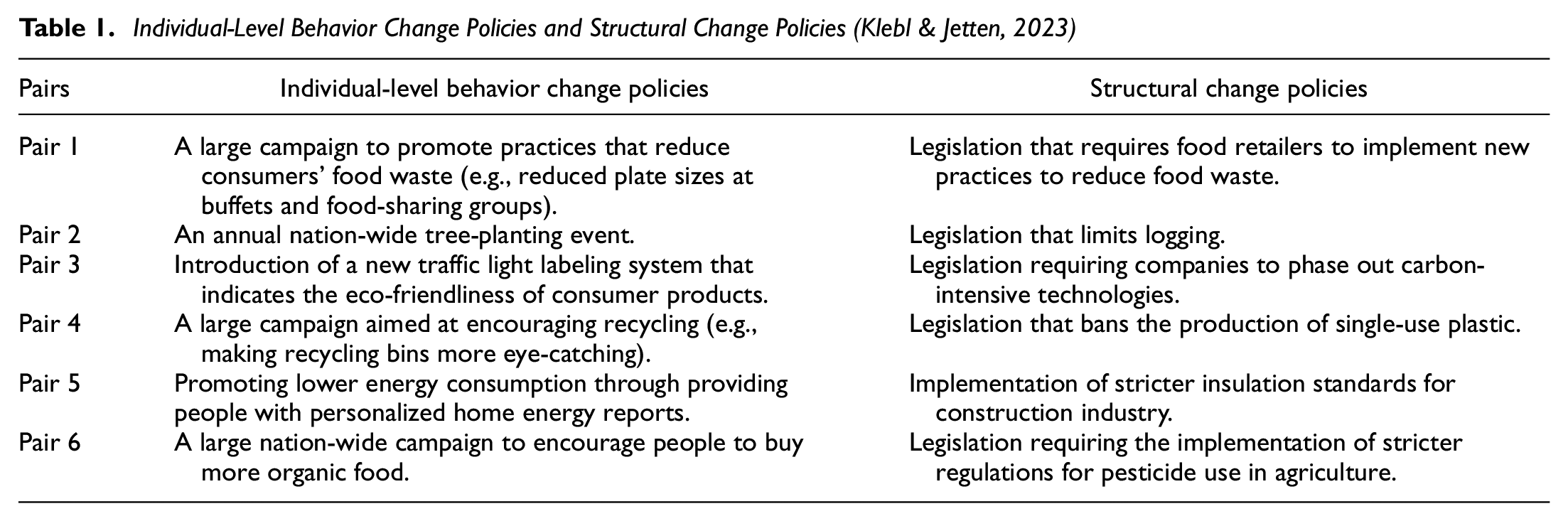
Participants first read a paragraph describing environmental problems Australia is facing (e.g., increased risk of bushfires). We then presented participants with six pairs of climate policies adapted from Klebl and Jetten (2023) that seek to address various environmental problems linked to climate change (e.g., energy consumption or deforestation; see Table 1). Within each pair, one climate policy was aimed at structural change, and one was aimed at individual-level behavior change. In a validation study (N = 37), participants judged the structural (vs. individual-level behavior) change policies to be more strongly aimed at structural change (p < .001, d = 1.01), less strongly aimed at individual-level behavior change (p < .001, d = 1.38), more effective at reducing emissions (p < .001, d = .69), more strongly affecting society as a whole (p < .001, d = .56), and less feasible to be implemented more quickly (p < .001, d = .62; see Supplemental Material). The validated policies were randomly presented as either Proposal A or Proposal B in Study 1. Participants were asked to indicate on a slider ranging from −5 (strongly prefer Proposal A) and 0 (equal preference) to 5 (strongly prefer Proposal B) which of the two policies they would want the Australian government to implement.
Individual-Level Behavior Change Policies and Structural Change Policies (Klebl & Jetten, 2023)
After this, we measured perceived inequality by asking participants to report on a scale from 0 (very small) to 6 (very large) how large the wealth gap in Australia is (“Overall, how large is the wealth gap between the poorest and the wealthiest people in Australia?”). We included additional inequality measures (fairness and justifiability of inequality, change of inequality in the past decades, and a subjective GINI measure; see Supplemental Material). Furthermore, we assessed generalized trust with a three-item measure (e.g., “Would you say that most of the time people try to be helpful or that they are mostly looking out for themselves?”; α = .82) on a scale from −3 (e.g., people mostly look out for themselves) to 3 (e.g., people mostly try to be helpful). Political orientation on economic issues (“Please indicate your political beliefs on issues of the economy, e.g., social welfare, government spending, tax cuts”) and social issues (“Please indicate your political beliefs on social issues, e.g., immigration, same-sex marriage, abortion”) was assessed on a Likert-type scale from 1 (left) to 7 (right). Finally, two simple attention checks were used. 2
Results
Ten participants were excluded from the analyses because they failed the attention check, and six participants were excluded because they did not consent to their data being used. Linear mixed-effects models with policy pairs and participants as random intercepts were conducted (R package lme4; Bates et al., 2015). The policy items were re-coded so that positive values indicated a greater preference for structural policies and negative values indicated a greater preference for individual-level behavior change policies.
The inequality measure exhibited negative skewness (−1.25). We attempted a log transformation and square root transformation of the inequality variable to reduce the skewness, but this was not effective. Therefore, we performed a Box-Cox transformation and found that a lambda value of 2 provided the best transformation for our data. The results obtained using the nontransformed variable are reported in the Supplemental Material.
Perceived inequality (M = 5.33, SD = .89) positively predicted people’s support for structural (vs. individual-level behavior) change policies (M = 1.99, SD = 1.89, b = .05, SE = .008, t(466) = 6.02, p < .001, 95% confidence interval [CI] [.03, .06], R2 = .07). This effect remained significant when controlling for social (M = 2.73, SD = 1.60) and economic (M = 3.03, SD = 1.97) political orientations (b = .03, SE = .008, t(464) = 3.65, p < .001, 95% CI [.01, .04]). The same patterns of results were found for perceiving inequality as unfair, unjustifiable, and as having increased in the past decades (all p’s < .001) and were marginally significant when using the subjective GINI coefficient (p = .53; see Supplemental Material). Generalized trust (M = −1.00, SD = 1.01) was not associated with policy support (b = .10, SE = .09, t(466) = 1.20, p = .231, 95% CI [−.07, .27]).
Discussion
Study 1 found that perceived inequality is positively associated with support for structural (vs. individual-level behavior) change policies, and this effect remained significant when controlling for political orientation. Moreover, there was no effect of generalized trust on policy support. These findings do not support the possibility that perceived inequality undermines policy support through reducing generalized trust. Instead, they provide support for the possibility that perceived inequality increases support for structural (vs. individual-level behavior) change policies—presumably because perceived inequality evokes a greater desire for drastic changes.
Study 2
In Study 2, we preregistered the hypothesis that perceived inequality is positively associated with support for structural (vs. individual-level behavior) change policies. Moreover, we hypothesized that the effect of perceived inequality on policy support is mediated by a desire for drastic changes.
Method
Participants
We determined that a sample size of N = 352 is required to detect a small effect size (r = .20; two-tailed) using a mediation model with one mediator, setting the power at .80 and α = .05 (Schoemann et al., 2017). A larger sample of 500 participants was recruited via Prolific, and 480 participants (277 women, 199 men, 3 nonbinary individuals, 1 other gender; Mage = 42.6 years, SD = 12.6 years; range = 18–65 years) living in the United Kingdom completed the survey. They were compensated with £1.35.
Procedure and Materials
The same policy support measure as in Study 1 was used. However, in the previous study, structural climate policies may have been viewed as more expensive to implement than individual-level behavior change policies. Therefore, we held policy costs constant by asking participants to imagine that they are a recently elected member of parliament who will vote on a £10-billion budget for policies addressing environmental problems. As in Study 1, they were then asked to indicate on a slider ranging from −5 (strongly prefer Proposal A) to 5 (strongly prefer Proposal B) the degree to which they support one of the policies.
Participants were subsequently asked to report whether they agree that the United Kingdom’s wealth gap is very large (“To what extent do you agree that the wealth gap between the poorest and wealthiest in the UK is very large?”). 3 Participants’ desire for drastic changes was assessed using a four-item measure (α = .80) asking about how the UK should deal with current national and global problems: “Drastic changes are needed”; “Quick fixes are possible and sufficient” (reverse scored); “Don’t patch it up—shake it up”; “We cannot go on like this and therefore have to change the system.” For all items, a scale from 0 (not at all) to 6 (very much so) was used. As a part of an unrelated study, we also measured perceived national and personal wealth and the United Kingdom’s moral obligation to solve global issues (see Klebl & Jetten, 2023).
Results
We excluded 14 participants from the analyses for failing the attention check and three for not providing consent for their data being used. Linear mixed-effects models with policy pairs and participants as random intercepts were conducted.
Main Analyses
As the inequality measure was skewed (skewness = −1.61), we Box-Cox-transformed the variable (lambda = 2). A linear mixed-effects model revealed that perceived inequality (M = 5.15, SD = 1.10) positively predicted people’s support for structural (vs. individual behavior) change policies (M = 1.75, SD = 1.67, b = .04, SE = .006, t(461) = 5.92, p < .001, R2 = .07). The effect remained significant when controlling for social (M = 3.08, SD = 1.58) and economic (M = 3.25, SD = 1.38) political orientations (b = .02, SE = .006, t(459) = 2.81, p = .005).
Mediation Analyses
A mediation analysis with inequality as the independent variable, preference for structural (vs. individual-level behavior) change policies as the dependent variable, and desire for drastic changes as the mediator was conducted using the PROCESS macro for SPSS (Hayes, 2017; see Figure 1 and Table 2). The perceived inequality positively predicted participants’ desire for drastic changes (M = 4.54, SD = 1.06), and desire for drastic changes was positively associated with support for structural (vs. individual behavior) change policies. As predicted, there was an indirect effect of perceived inequality on policy support via a desire for drastic changes. The mediation was partial, that is, there was a significant direct effect. The indirect effect remained significant when controlling for social and economic political orientations, and there was no direct effect of perceived inequality on policy support. Thus, the desire for drastic changes fully mediated the effect.
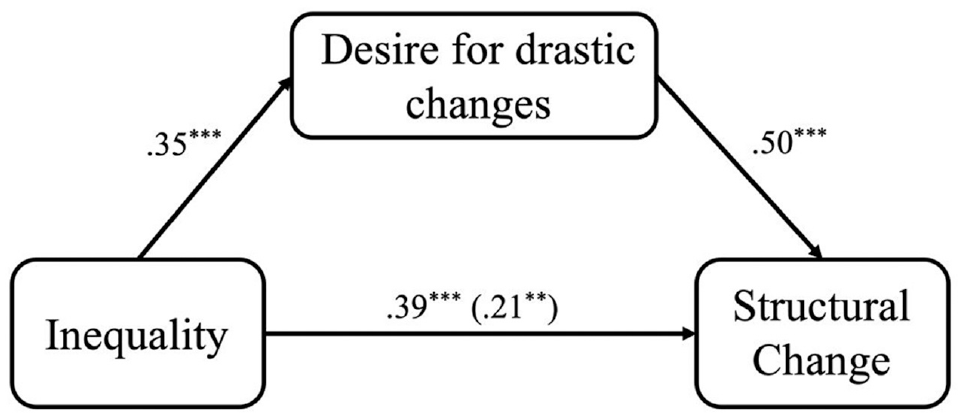
Mediation Analysis for Study 2
Mediation Analyses With Perceived Inequality as the Independent Variable, Desire for Drastic Changes as the Mediator, and Support for Structural (vs. Individual Behavior) Change Policies as the Dependent Variable
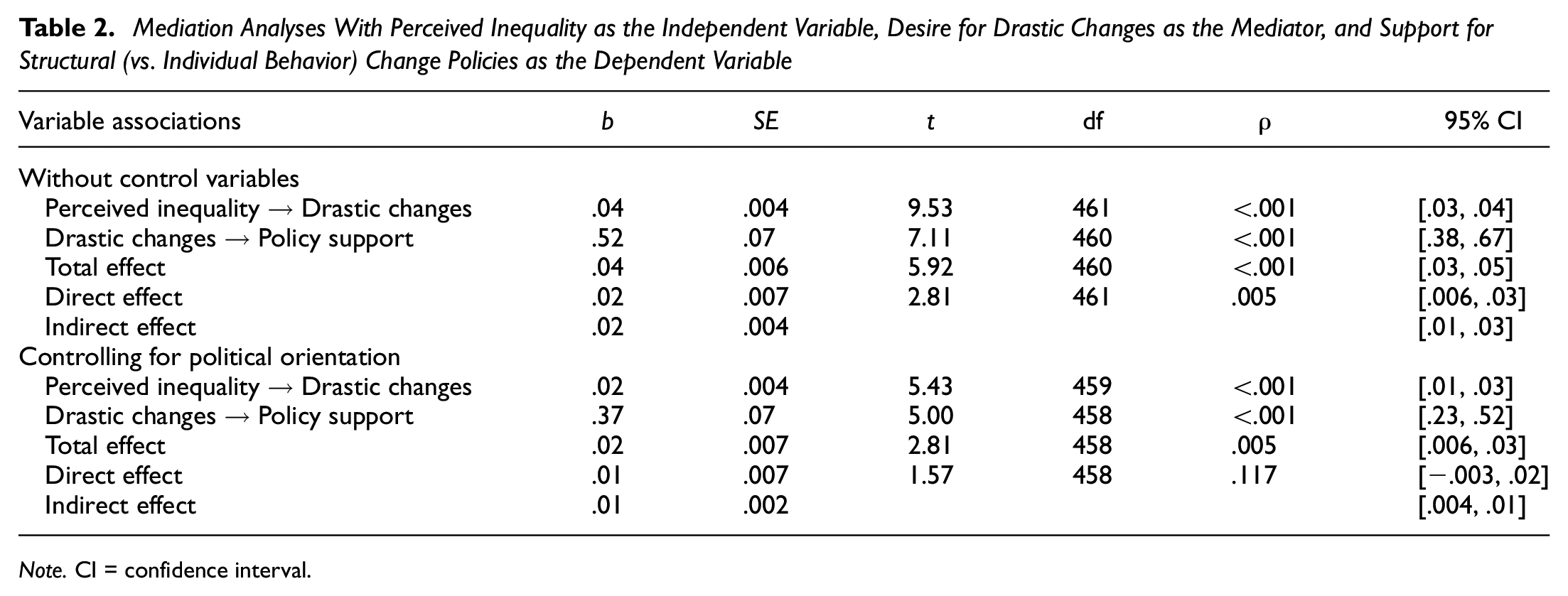
Note. CI = confidence interval.
Discussion
The findings supported our hypothesis that perceived inequality is associated with a greater support for structural (vs. individual-level behavior) change policies through a greater desire for drastic changes. The effect remained significant when controlling for political orientation.
Study 3
As Studies 1 and 2 were correlated, we used an experimental design in Study 3. Economic inequality was manipulated by assigning participants to a fictional country with either high or low inequality. We preregistered the hypothesis that people who imagine living in a highly unequal country more strongly want their country to adopt structural (vs. individual-level behavior) change policies than people who imagine living in a comparatively equal country and that this relationship is mediated by a greater desire for drastic changes.
Method
Participants
As in Study 2, we recruited 500 participants living in the United Kingdom from Prolific and 492 participants (314 women, 177 men, 1 nonbinary person; Mage = 41.4 years, SD = 12.3 years; range = 19–81 years) completed the survey. Participants were compensated with £1.10.
Procedure and Materials
Participants were introduced to a fictional world with six countries that differed in the degree to which they are economically unequal (adapted from Tanjitpiyanond et al., 2022). They were presented with a bar plot that ranks the countries in terms of their GINI coefficients and were presented with bar plots showing the wealth distributions of the most and least unequal country. For example, in the most unequal country, the bottom 20% owned 0.3% of the total wealth, and the top 20% owned 85% of the total wealth (i.e., similar to the wealth distribution of South Africa), whereas in the least unequal country, the bottom 20% owned 17%, and the top 20% owned 23% of the total wealth. Participants were then assigned to either the most or least unequal country. In both conditions, they first were told that the average wealth of a citizen is 200,000 dollars (in their country’s currency), presented with the wealth distribution of their country again, and presented with an image showing the wealth difference between the top 5% and bottom 5%.
As manipulation checks, we asked participants to indicate on a scale from 0 (not at all wealthy/poor/unequal) to 6 (extremely wealthy/poor/unequal) the extent to which the wealthiest group is wealthy and the poorest group is poor (e.g., “Consider the poorest group in Nam Dinh, how poor is this group?”), as well as the extent to which their country is unequal (“To what extent is Nam Dinh unequal?”). Participants then reported their desire for drastic changes in their fictional country (α = .81), the degree to which they would want their country to implement structural or individual-level behavior-change policies (see Supplemental Table S1), and their political orientation. As in Study 2, policy costs were held constant.
Results and Discussion
Ten participants were excluded from the analyses because they failed the attention check. In total, 244 participants were in the low-inequality condition, and 238 participants were in the high-inequality condition.
Manipulation Checks
Linear regression analyses were conducted to test whether the conditions differed in their perceived inequality. Participants judged the fictional country as more unequal in the high-inequality condition (M = 5.78, SD = .76) than in the low-inequality condition (M = 1.05, SD = .87, b = 4.73, SE = .07, t(480) = 63.22, p < .001, 95% CI [4.59, 4.88]). They judged the wealthiest group as wealthier in the high-inequality condition (M = 5.77, SD = .59) than in the low-inequality condition (M = 3.96, SD = 1.12, b = 1.81, SE = .08, t(480) = 22.11, p < .001, 95% CI [1.65, 1.98]). Finally, participants judged the poorest group as poorer in the high-inequality condition (M = 5.16, SD = 1.67) than in the low-inequality condition (M = 2.26, SD = 1.17, b = 2.90, SE = .13, t(480) = 22.08, p < .001, 95% CI [2.64, 3.16]).
Main Analysis
A linear mixed-effects model with policy pairs and participants as random effects was conducted. As predicted, people assigned to the highly unequal country (M = 2.16, SD = 1.83) more strongly wanted their country to implement structural (vs. individual-level behavior) change policies than people assigned to the country with low levels of inequality (M = 1.24, SD = 1.70, b = .92, SE = .16, t(480) = 5.70, p < .001, 95% CI [.60, 1.24], R2 = .06) (see Figure 2).
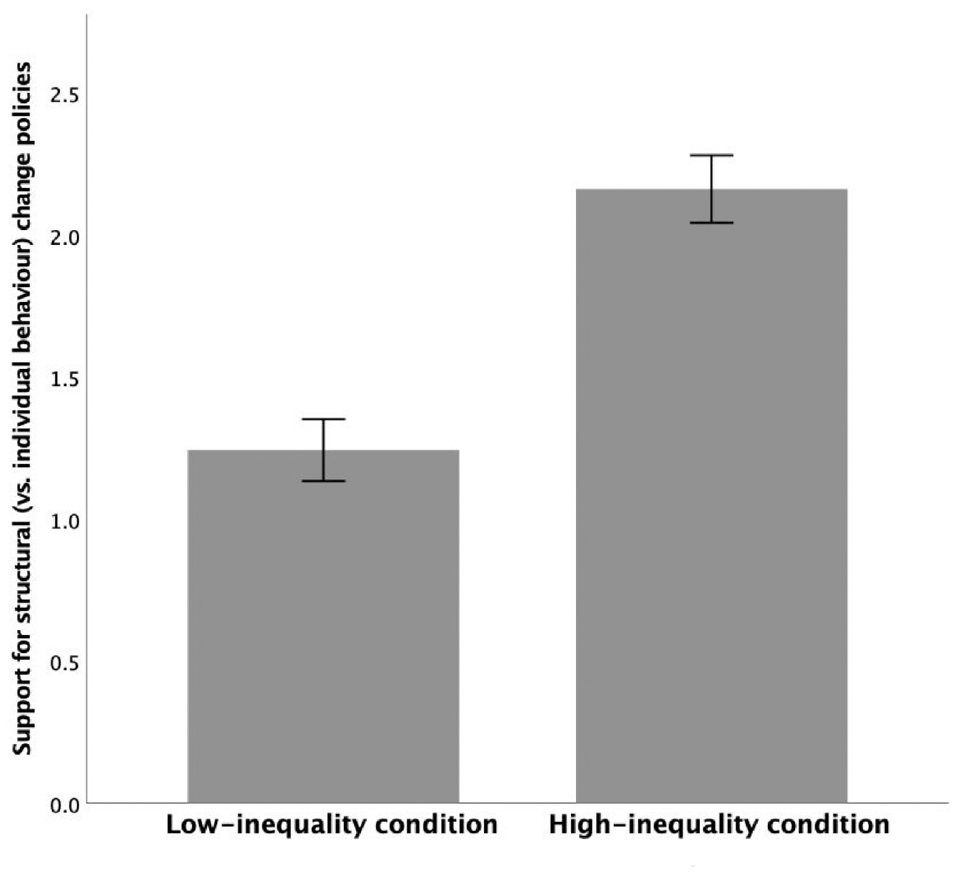
Support for Structural (vs. Individual-Level Behavior) Change Policies in the High-Inequality Condition and the Low-Inequality Condition (Study 3)
Mediation Analyses
A mediation analysis with condition (low inequality vs. high inequality) as the independent variable, support for structural (vs. individual-level behavior) change policies as the dependent variable, and desire for drastic changes as the mediator was conducted (see Table 3). Participants reported a greater desire for drastic changes in the high-inequality condition (M = 4.85, SD = .94) than in the low-inequality condition (M = 1.81, SD = 1.18). Desire for drastic changes positively predicted support for structural (vs. individual behavior) change policies. As predicted, the indirect effect of condition on policy support via the desire for drastic changes was significant. There was a nonsignificant direct effect. Thus, the desire for drastic changes fully mediated the effect.
Mediation Analyses With Condition (Low Inequality vs. High Inequality) as the Independent Variable, Desire for Drastic Changes as the Mediator, and Support for Support for Structural (vs. Individual Behavior) Change Policies as the Dependent Variable
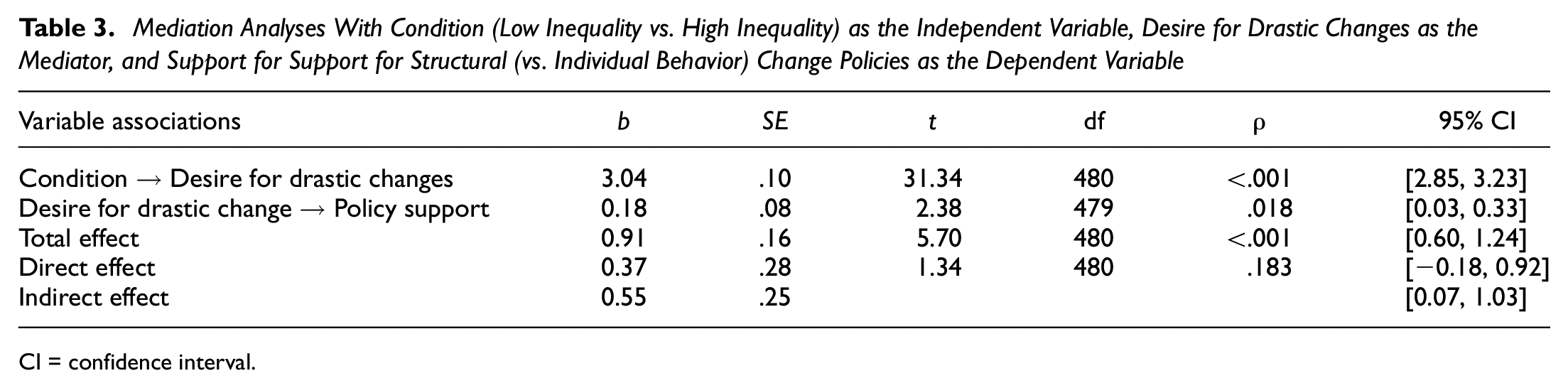
CI = confidence interval.
Discussion
Study 3 provided experimental evidence for the effect of perceived inequality on policy support. People who imagined living in a highly unequal country more strongly wanted their country to implement structural (vs. individual-level behavior) change policies than people who imagined living in a comparatively equal country, and this effect was mediated by a greater desire for drastic changes.
General Discussion
In three studies, we examined whether perceived economic inequality increases or reduces people’s support for climate change policies aimed at structural change over policies aimed at individual-level behavior change. Initially, we speculated that there may be two ways through which perceived inequality may influence support for structural climate policies. Perceived inequality may undermine people’s support for structural (vs. individual-level behavior) change policies through reducing generalized trust or, alternatively, increase policy support through evoking a greater desire for drastic changes. The present findings provided evidence for the second pathway. Perceived inequality predicted policy support for structural solutions in both an Australian sample (Study 1) and a UK sample (Study 2), and this could not be explained by political orientation. In addition, we found experimental support for this effect. People who imagined living in a fictional country with high economic inequality more strongly preferred their country to adopt structural (vs. individual-level behavior) change policies than people who imagined living in a country with relatively low inequality. Moreover, a greater desire for drastic changes was found to mediate the effect of perceived inequality on policy support (Studies 2 and 3).
Our findings provide the first empirical evidence that perceived inequality can have arguably positive social consequences by motivating people to endorse structural change. Although prior research has consistently shown the negative effects of both objective and perceived inequality on both individuals and society as a whole (e.g., Buttrick & Oishi, 2017; Jay et al., 2019; Jetten et al., 2021; Rothstein & Uslaner, 2005), our findings suggest that while people’s response to perceiving their country as unequal may prompt individuals to view society’s current state unfavorably, it may motivate them to support measures aimed at improving it. Future research is needed to investigate whether perceived inequality not only increases people’s desire for structural solutions to climate change but also affects people’s desire for structural change more broadly. For example, people who perceive their country as highly unequal may be more likely to favor structural solutions to a wide range of social issues such as poverty, homelessness, gender discrimination, or racial discrimination.
One limitation of our studies is that they do not provide insight into the specific characteristics underlying structural climate policies that drive support among individuals who perceive high levels of inequality. For instance, structural climate policies are perceived as both more effective and as having a greater impact on society as a whole. In addition, while desire for drastic changes was a consistent mediator, there may be other psychological mechanisms through which perceived inequality influences policy support. For example, structural policies may be seen as targeted toward the wealthy and may be viewed as requiring those with more resources to bear a greater responsibility for reducing emissions. Furthermore, when inequality is higher, less-effective policies may be viewed as an inefficient use of public resources. Another limitation of our research is that it was conducted only in Western countries with moderate levels of objective inequality. Future research should investigate whether the findings are generalizable to societies with very low or very high levels of inequality.
The present findings also extend previous work that explored factors influencing the degree to which people care about climate change by investigating a factor that leads people to endorse one type of climate policies over another. To meet the goal of keeping the global temperature rise well below 2°C as set by the Paris Agreement, it is not sufficient to focus on individual-level behavior change alone, and structural change is necessary (IPCC, 2022). It is, therefore, important to identify the factors that shift people’s support from individual-level behavior-change policies to structural solutions to climate change. The present research showed that perceived inequality increases support for structural climate policies, with small to medium effect sizes highlighting its practical importance in understanding people’s policy support. However, perceived inequality is just one of several factors increasing people’s support for structural climate policies. For example, left-leaning individuals are more likely to support structural climate policies than right-leaning individuals (see Supplemental Material). Furthermore, support for democracy, vulnerability to climate change, or perceived threat to people’s social identities may influence the degree to which people support climate change policies aimed at structural change. Further research is also needed to better understand the conditions under which public support for structural climate policies leads to policy change; for example, when policy support leads to collective action and the barriers for collective action to result in policy outcomes such as obstructions by fossil fuel corporations (cf. Louis, 2009).
Finally, the present findings have implications for environmental activists, environmental organizations, and policymakers. They suggest that one avenue through which to gain people’s support for structural change is to remind them of the unequal wealth and income distribution in their country. Future research is needed to identify the conditions under which evoking perceptions of inequality motivates people to support structural solutions to climate change and engage in collective action to promote structural change, without simultaneously giving rise to a fractured society or violent extremism (Jetten et al., 2021).
Conclusion
Economic inequality has wide-ranging adverse individual and social consequences (Jetten et al., 2021; Wilkinson & Pickett, 2009). Despite this, perceiving one’s country as unequal can lead to a greater support for structural change. The present studies explored this in the context of climate change where structural change is urgently needed to prevent catastrophic consequences such as food insecurity, displacements, and a mass extinction of species (IPCC, 2021, 2022). We found that perceived inequality increases people’s support for structural change policies over those aimed at individual-level behavior change through a greater desire for drastic changes. This suggests that people’s dissatisfaction with their country’s unequal wealth distribution can be harnessed to promote structural climate polices and gain support for the structural transformation urgently needed to limit climate change.
Supplemental Material
sj-docx-1-spp-10.1177_19485506231169328 – Supplemental material for Perceived Inequality Increases Support for Structural Solutions to Climate Change
Supplemental material, sj-docx-1-spp-10.1177_19485506231169328 for Perceived Inequality Increases Support for Structural Solutions to Climate Change by Christoph Klebl and Jolanda Jetten in Social Psychological and Personality Science
Footnotes
Handling Editor: Danny Osborne
Declaration of Conflicting Interests
The author(s) declared no potential conflicts of interest with respect to the research, authorship, and/or publication of this article.
Funding
The author(s) disclosed receipt of the following financial support for the research, authorship, and/or publication of this article: This work was supported by an Australian Research Council Laureate Fellowship (FL180100094) awarded to Jolanda Jetten.
Ethics Statement
This research has been approved by the Human Ethics Research Committee (2022/HE001111) at the University of Queensland.
Disclosure of Data Collection and Analysis

Supplemental Material
Supplemental material for this article is available online.
Notes
Author Biographies
References
Supplementary Material
Please find the following supplemental material available below.
For Open Access articles published under a Creative Commons License, all supplemental material carries the same license as the article it is associated with.
For non-Open Access articles published, all supplemental material carries a non-exclusive license, and permission requests for re-use of supplemental material or any part of supplemental material shall be sent directly to the copyright owner as specified in the copyright notice associated with the article.
