



Abstract
Bushfires are anticipated to become more severe in Australia due to climate change. However, Australians have a long history with bushfires, making them part of the Australian identity. We theorise that Australian identity would therefore lead people to be less likely to subjectively attribute bushfires to climate change and, in turn, be less supportive of climate policy. This pre-registered, cross-sectional study examined these relationships using a representative Australian sample (N = 5,038). In support of our hypotheses, subjective attribution partly explained the relationship between Australian identity and climate policy support. Specifically, those higher in Australian identity were less likely to attribute bushfires to climate change, which reduced their climate policy support. These findings expand our understanding of how differences in the content of a country’s national identity can impact climate outcomes and suggest that public campaigns should consider how appeals to national identity may influence climate policy support.
Introduction
Australia has a long history of bushfires 1 (Head et al., 2014; Logan, 2015; Rickards et al., 2017). However, the severity and frequency of Australian bushfires are increasing due to climate change (Di Virgilio et al., 2019; IPCC, 2023; Seneviratne et al., 2021; van Oldenborgh et al., 2021). The 2019/2020 “Black Summer” bushfires, for example, were unprecedented in scale. Not only did they burn over 24 million hectares of land and claim approximately 33 human lives (and many more due to complications associated with smoke inhalation), but they also contributed to the death or displacement of up to 3 billion animals (Abram et al., 2021; Commonwealth of Australia, 2020). A common assumption in prior literature (and popular media) is that the experience of extreme weather events, such as bushfires, will promote belief in and action on climate change, however the research evidence for this is mixed (Ai et al., 2024; Bergquist et al., 2019; Boon, 2016; Bradley et al., 2020; Ettinger et al., 2024; Howe, 2021; Howe et al., 2018; Hughes et al., 2020; Rowan, 2023). Emerging research suggests that this may be because not everyone attributes the cause of such events to climate change (Ai et al., 2024; Ogunbode, Demski, et al., 2019; Wong-Parodi & Berlin Rubin, 2022). Therefore, the experience of extreme weather events may be more likely to promote belief in, and action on, climate change when a person attributes the cause of the event itself to climate change (Ogunbode, Demski, et al., 2019; Wong-Parodi & Berlin Rubin, 2022).
Given the unique, long history of bushfires within Australia, bushfires have been ingrained into the Australian way of life and therefore the Australian national identity (Logan, 2015; Rickards et al., 2017). As the experience of bushfires has become normalised in Australia, this may mean that those who identify more strongly as Australian are less likely to attribute the cause of bushfires to climate change. We propose that this lack of subjective attribution to climate change is likely to affect the extent to which Australians support climate policy. Given these considerations, the present research seeks to investigate the associations between Australian identity, subjective attributions of climate change, and support for climate policy. Specifically, it aims to investigate whether the subjective attribution of the 2019/2020 bushfires to climate change mediates the relationship between Australian identity and climate policy support. However, we do acknowledge that it is also possible that this proposed mediating effect may differ depending on the type of climate policy being considered. Given this, we will also investigate whether subjective attribution affects different types of climate policy in the same manner.
Australian Identity in the Context of Extreme Weather
Using the Social Identity Framework (Tajfel, 1979; Turner et al., 1987), Australian identity can be defined as the level of identification one has with the beliefs, values, and norms of the Australian social category or group (Abrams & Hogg, 1990; Fielding & Hornsey, 2016; Klas et al., 2022). Australian identity is often characterised by a high level of national pride (patriotism), resilience, adaptability and a strong connection to the natural environment (Austin & Fozdar, 2018; Bromfield et al., 2021; Caldwell & Henry, 2020; McAllister, 2018; Rickards et al., 2017). The Social Identity Framework stipulates that social identities become relevant and can contribute to one’s beliefs and actions when the norms of a social category with which one strongly identifies are made salient within a context or situation (Abrams & Hogg, 1990; Fielding et al., 2020; Fielding & Hornsey, 2016). Therefore, if Australian national identity is salient in the context of the natural environment, we would assume that people who more strongly identify with the nation would be more likely to have climate attitudes and take climate-related action to preserve the environment (Fritsche et al., 2018; Sapiains et al., 2016). Yet, despite the strong personal connection many Australians have with the natural environment (Caldwell & Henry, 2020; Curll et al., 2022; Purdie & Wilss, 2007; van der Nagel et al., 2023), Australian identity has shown inconsistent associations with climate actions and policy support (e.g., pro-environmental behaviour; Aydin et al., 2022; Duong & Pensini, 2023; Klas et al., 2022; Nguyen & Platow, 2021; Sapiains et al., 2016). For example, some studies have found negative associations between national identity and climate action (Aydin et al., 2022; Duong & Pensini, 2023; Nguyen & Platow, 2021), as well as negative associations with climate attitudes like support for climate mitigation policy (Klas et al., 2022). Other studies have found positive associations between national identity and climate actions (Sapiains et al., 2016) and climate attitudes, including climate adaptation policy support (Klas et al., 2022). We suggest that these inconsistent associations between national identity and climate policies targeting mitigation versus adaptation may be because extreme weather events, namely bushfires, are often viewed as part of the typical experience of being Australian (Austin et al., 2020; Barnett et al., 2021; Boon, 2016; Bromfield et al., 2021; Phillips & Smith, 2000; Reser et al., 2012), rather than solely a direct consequence of climate change.
Australians have a long history of dealing with, and surviving, bushfires and the conditions that precipitate them (e.g., prolonged drought; Head et al., 2014; Logan, 2015; Rickards et al., 2017). Bushfire experience, therefore, forms a unique aspect of Australians’ national identity (Logan, 2015; Phillips & Smith, 2000; Rickards et al., 2017; Williamson et al., 2022). Bushfires have often been portrayed in Australian media and history books as national character-building events (Banwell et al., 2015; Bromfield et al., 2021; Bromhead, 2023; van der Nagel et al., 2023) and those who volunteer their time to fight bushfires are often described as the quintessential national hero (Bromfield et al., 2021). Thus, those who identify strongly as Australian may be less likely to subjectively attribute the cause of extreme weather events like bushfires to climate change (Ai et al., 2024; Buys et al., 2012; Millar et al., 2015), because these events have become normalised, and therefore viewed as a perennial Australian experience (Austin et al., 2020; Bromfield et al., 2021). Recent qualitative research focused on flooding (another common extreme-weather event in Australia) points to a similar phenomenon (Barnett et al., 2021). Specifically, Australians living in a flood-prone area, with stronger identification with the area, were more likely to view their flooding experience as a normal part of life, to downplay their experience as being a consequence of climate change, and to view climate policy as a potential threat to their identity (Barnett et al., 2021).
Subjective Attributions to Climate Change
Prior literature (and popular media) often proposes that experiencing extreme weather events will increase climate action and policy support (Bergquist et al, 2019; Demski et al., 2017; Hazlett & Mildenberger, 2020; Hornsey et al., 2016; Mann, 2020; Ray et al., 2017; Reser & Bradley, 2020; Sambrook et al., 2021). By this logic, Australians’ extensive experience with extreme weather should be associated with heightened climate action and policy support. However, prior research within and outside the Australian context has found a small to negligible associations between the experience of extreme weather events and climate actions, such as adaptation behaviour and policy support (Ai et al., 2024; Boon, 2016; Bradley et al., 2020; Cologna et al., 2025; Howe et al., 2018; Ray et al., 2017; Rowan, 2023; Xia et al., 2022), especially when compared to the effects of psychological variables such as identity (Hornsey et al., 2016; van Valkengoed & Steg, 2019) and subjective appraisals of extreme weather (Bergquist et al., 2025; Del Ponte et al., 2025; Reser et al., 2012; Zanocco et al., 2019). For example, perceived personal harm or damage severity was found to be more influential for climate policy support than extreme weather experience alone (Del Ponte et al., 2025; Zanocco et al., 2019). In the Australian bushfire context specifically, while bushfire experience is common, even among those in suburban and urban areas (Reser et al., 2012, p. 133), prior experience with bushfires often does not influence climate action, even when the level of experience is extensive (Boon, 2016; Reser et al., 2012) and can sometimes even reduce climate action among those already engaged (Ettinger et al., 2024). However, when bushfire experience is perceived as an impact of climate change, the association with climate action is often stronger (Ettinger et al., 2024; Reser et al., 2012). These findings suggest that experiencing extreme weather may not be an essential motivating factor for climate policy support; instead, people need to subjectively attribute that experience to climate change to increase the likelihood of positive climate outcomes. That is, the subjective attributions people make about their experience of extreme weather – specifically, whether they attribute these events to climate change – may be a more important mechanism for driving climate action than the experience of extreme weather itself. Therefore, in the current context, we propose that Australians with a stronger level of national (Australian) identity should be more likely to see their direct experience of bushfire events as normal events that are part of the Australian experience, instead of subjectively attributing their cause solely to climate change.
Emerging research shows that subjective attribution of extreme weather events to climate change is associated with several climate actions as well as climate policy support (Blennow et al., 2012; McClure et al., 2022; Ogunbode, Böhm, et al., 2019; Ogunbode, Demski, et al., 2019; Reser et al., 2012; Wong-Parodi & Berlin Rubin, 2022). For instance, in the UK, flood experience predicted greater support for climate mitigation policy only among residents who subjectively attributed their experience to climate change (Ogunbode, Demski, et al., 2019). Likewise, in the US, the likelihood of supporting a carbon tax was higher among US residents who subjectively attributed their wildfire experience to climate change (Wong-Parodi & Berlin Rubin, 2022). Despite these findings, we still don’t know the potential effects that subjective attributions of bushfires have on climate policy support in the Australian context. There is some cross-national research showing positive associations between subjective attribution and policy support in Australia (Bergquist et al., 2025; Cologna et al., 2025). Additionally, there is preliminary research which suggests that feeling vulnerable to climate change post-bushfire experience (a proxy of subjective attribution) can further increase engagement in related climate action (e.g., climate activism) among Australians already engaging in this behaviour (Ettinger et al., 2024); yet the effects of subjective attribution of bushfires specifically on climate policy support in the broader Australian population are still largely unknown. Beyond this, it would be helpful to explore the relationship between subjective attributions and climate policy support to give us a broader understanding of how this relationship might look in other countries where some kind of extreme weather event is being worsened by climate change, but is already normalised within that country. For instance, it is possible that in countries like Australia, where bushfires are normalised, national identification may act as a barrier to climate policy support by reducing subjective attribution of these events to climate change.
Support for Climate Mitigation and Adaptation Policy
While our central argument is that subjective attribution plays an important role in the relationship between Australian identity and support for climate policy, it is possible that this relationship may differ depending on the nature of the policy being considered. Specifically, the relationship may differ depending upon whether the policies in question are targeting climate mitigation or adaptation. This is because climate mitigation policy aims to reduce the carbon emissions caused by human engagement in unsustainable behaviour, whereas climate adaptation policy targets the risks and/or costs associated with preparing for or managing the consequences of increased carbon emissions (Bateman & O’Connor, 2016). If bushfire experience and recovery are aspects of Australian identity, then attributing bushfires to climate change might not be necessary for Australians to support climate adaptation policy. Given this, strongly identified Australians may be supportive of policies that help Australians to adapt to and manage the risks and/or costs associated with bushfires (Austin et al., 2020; Howe et al., 2018; Klas et al., 2022; Leviston et al., 2015; Ray et al., 2017; Stanley et al., 2021). Support for climate mitigation policy, however, requires Australians to believe that bushfires are no longer “normal,” but are becoming worse due to climate change and will continue to do so, without large-scale efforts to reduce carbon emissions. Given this, highly identified Australians may only be supportive of climate mitigation policy if they perceive that bushfires are becoming more severe because of climate change (i.e., they attribute the event partially to climate change). Indeed, research shows that Australians are often more likely to support climate adaptation policy than they are climate mitigation policy (Austin et al., 2020; Forino et al., 2018; Klas et al., 2022; Pearce et al., 2018).
The Present Research
Extreme weather, such as bushfires, is a typical part of life in Australia, such that it appears to form a unique component of Australian identity (Barnett et al., 2021; Boon, 2016; Bromfield et al., 2021; Logan, 2015; Phillips & Smith, 2000; Reser et al., 2012; Rickards et al., 2017). Thus, so intertwined is the experience of bushfires with Australian identity that highly identified Australians may not subjectively attribute worsening bushfires to climate change (Ai et al., 2024; Buys et al., 2012) and consequently may not respond to bushfire experience by supporting climate change mitigation policy (but they may still support adaptation policy regardless of this subjective attribution). Given this, the present research aimed to investigate the associations between Australian identity, subjective attributions of climate change, and support for climate policy. Specifically, our aim was to investigate whether the subjective attribution of the 2019/2020 bushfires to climate change mediates the relationship between Australian identity and climate policy support. However, given the possibility that this proposed mediating effect may differ depending on the type of climate policy being considered, we also aimed to investigate whether subjective attribution affects different types of climate policy in the same manner.
Using a pre-existing dataset with Australian participants, we tested several pre-registered hypotheses to investigate these potential relationships (the pre-registration can be found at: https://osf.io/gy4dv/?view_only=b1948b989a644ae0ba22ffe1fb47d1b9). Following the literature reviewed above, we first hypothesised that Australian identity would be associated with lower support for climate mitigation policy (H1[i]) and higher support for adaptation policy (H1[ii]). Second, we hypothesised that subjective attribution of the 2019/2020 bushfires will explain (mediate) the association between Australian national identity and climate mitigation policy support (H2). Specifically, people with a stronger Australian identity would be less likely to attribute the 2019/2020 bushfires to climate change, and this will in turn be associated with a lower likelihood to endorse climate mitigation policy. We did not hypothesise that a mediation effect would occur for climate adaptation policy support, as we assumed that those with higher national identity could still be supportive of policies that help Australians to adapt to and manage the risks and/or costs associated with bushfires, regardless of whether they attribute the bushfires to climate change.
Additionally, as outlined in our pre-registration, we also conducted some exploratory analyses. Primarily, to test the above hypotheses while controlling for political orientation as a covariate. This is because climate change has been a consistently politically polarising issue in Australia, with left-wing (or liberal) individuals more inclined to support climate policy than their right-wing (or conservative) counterparts (Fielding & Hornsey, 2016; Tranter, 2021; Zheng & Bhatt, 2022). Consequently, we ran adjusted analyses to test whether the above relationships would persist when controlling for the effects of political orientation. Additionally, given the cross-sectional nature of the dataset, we also tested for reverse mediation (where the independent variable and mediator in the above hypotheses are switched). 2
Materials and Methods
Participants and Procedure
We accessed a pre-existing dataset (N = 5,110 adults over the age of 18) from a national survey about climate attitudes in Australia conducted in Australia between August and September 2020, shortly after the 2019/2020 “Black Summer” bushfires had ended. Ethics was granted for the original study by the Australian National University Human Research Ethics Committee (ID: 2020/429) committee. Informed consent was obtained from all participants, and those who completed the study were individually incentivised for participation in the study.
Participants were excluded from our analyses if they failed to provide a response when asked, “Do you think any of the following factors were associated with the intensity of bushfires this fire season?” (our categorical measure of subjective attribution; n = 4). This is because we were primarily interested in the mediation effect of this variable. Given the large sample size, participants with more than 20% missing data across the remaining variables used in the study (i.e., Australian identity, climate policy support) were also excluded from the analysis (n = 5; Schlomer et al., 2010). Participants with less than 20% missing data were dealt with using multiple imputation, a reliable and valid statistical strategy to ensure observations are retained in the dataset (Schlomer et al., 2010; Sinharay et al., 2001). Fifty-one univariate outliers were identified using z-scores and 12 multivariate outliers using Mahalanobis Distance. These participants (n = 63) were removed prior to running the main analyses.
The final sample contained 5,038 participants, who were on average 47 years old (M = 47.15; SD = 17.69). The sample also contained a relatively even gender distribution (2,575 [51%] females, 2,446 [49%] males, 7 [<1%] other, 9 [<1%] prefer not to say). A sensitivity power analysis using Monte Carlo simulation (Schoemann et al., 2017) was conducted in R (Lavaan package) to estimate power for detecting the indirect effect in our proposed mediation models. A total of 1,000 datasets were simulated with N = 3,058. Population path coefficients were based on prior research and descriptive estimates from the current sample (path a = 0.15, path b = 0.57, path c’ = 0.14; Klas et al., 2022; Wong-Parodi & Berlin Rubin, 2022). The indirect effect was defined as ab. Across simulations, the proportion of datasets in which the indirect effect was statistically significant at α = .05 was 100%, indicating a very high probability of detecting the indirect effect with the available sample of N = 5,038.
Measures
Australian identity was measured on a four-item 7-point Likert scale (1 = strongly disagree, 7 = strongly agree). Examples include: “I often think of myself as Australian” and “I consider myself a typical Australian” (α = .85, ω = .88). Higher scores indicated stronger levels of Australian identification.
Climate policy support was measured using a 7-point Likert scale (1 = strongly disagree, 7 = strongly agree). Higher scores indicated stronger levels of climate policy support. Two single-item measures of climate policy support (one for mitigation and one for adaptation) were selected from the original survey to be used in the current study. Participants were asked, “To what extent would you support the following policy initiatives?” For mitigation, the policy item was “taxing industries that emit high levels of greenhouse gases.” For adaptation, the item was “rebates to assist homeowners to prepare their houses for potential extreme events.” 3 These policy items were selected from the original list of eight items for two reasons. First, these two single items were selected due to their conceptual alignment with the definitions of mitigation and adaptation provided by Bateman and O’Connor (2016). Second, for their applicability within the Australian context of the study (e.g., high bushfire proneness and current Australian attitudes towards these policies; Climate Council, 2019; Morison et al., 2024). For example, a recent Australian report shows that 70% of Australians support a “polluters-pay” tax and 50% believe the government should be doing more to adapt to the impacts of climate change (Morison et al., 2024).
Subjective attribution (of the 2019/2020 Australian Black Summer bushfires to climate change) was measured using a categorical item that asked participants, “Do you think any of the following factors were associated with the intensity of bushfires this fire season?” A list of seven reasons was then presented (including drought, land management, climate change, extreme heat, strong wind, housing, or buffer zones and none of these), with participants able to select more than one reason. The current study was only focused on identifying whether the bushfires were attributed to climate change or not. Therefore, this item was recoded into a binary variable for the analyses. Participants who selected climate change as an option were coded as a “1” (1 = climate change), even if they selected multiple options. Anyone who did not select climate change as one of their options was coded as a “0” (0 = not climate change), regardless of their other selected answers for this item.
Political orientation was measured using a 101-point slider scale from 0 (left-wing) to 100 (right-wing). Participants were told to “Move the cursor below to the place on the slide which best represents your political views.” Higher scores indicated one was more politically right-leaning.
Results
Descriptive Statistics
Table 1 presents the means, standard deviations and correlations of the major variables of the study. On average, our sample identified strongly as Australian and demonstrated higher levels of support for adaptation than mitigation policy. Associations between Australian identity and climate policy support were negative and weak for mitigation (i.e., taxing industries that emit high levels of greenhouse gases) but non-significant for adaptation policy support (i.e., rebates to assist homeowners to prepare their houses for potential extreme events). Conversely, the associations between subjective attribution and policy support were positive and weak for adaptation policy support and positive but moderate for mitigation policy support. There was also a weak, positive correlation between Australian identity and right-wing political orientation and a negative relationship between right-wing political orientation and climate policy support (moderate for mitigation, but weak for adaptation). Additionally, while there was a positive relationship between subjective attribution and support for all climate policy types, nearly half of our sample (n = 2,348, 47%) did not attribute the 2019/2020 “Black Summer” bushfires to climate change.
Means, Standard Deviations and Bivariate Correlations of Major Variables.
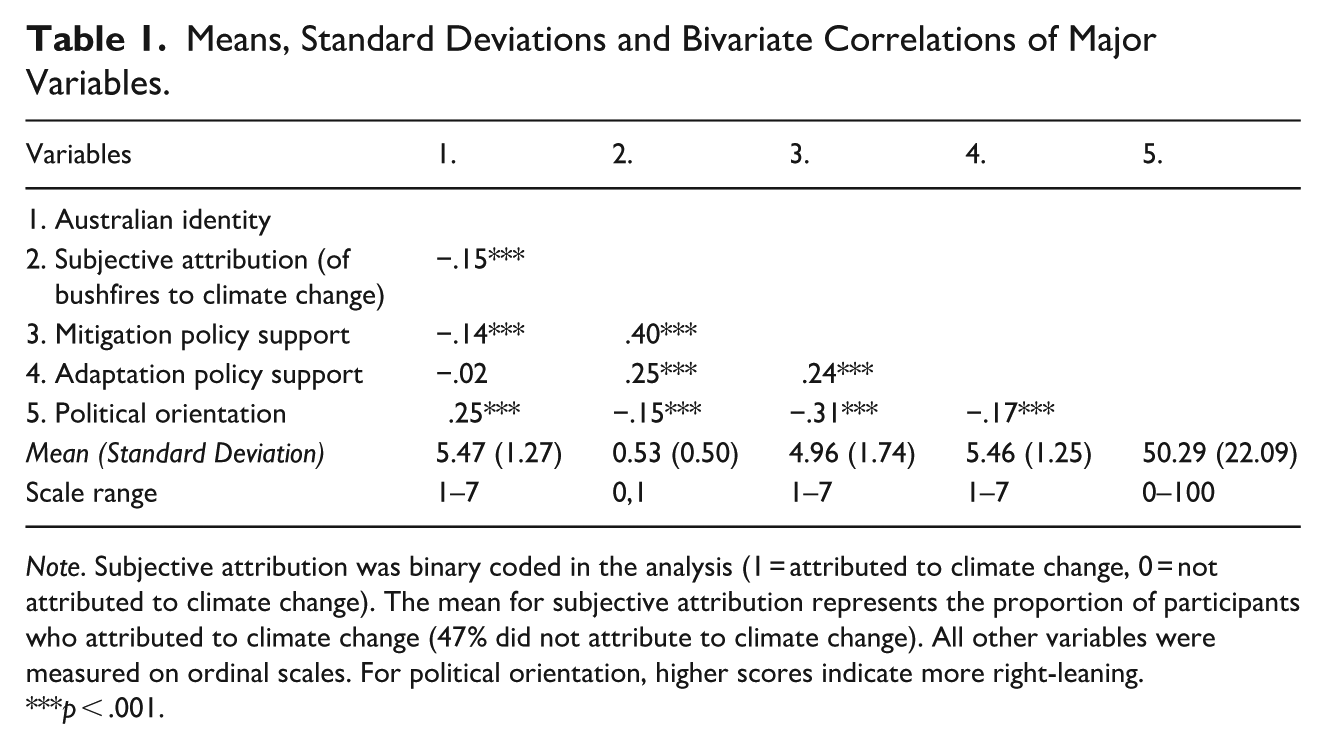
Note. Subjective attribution was binary coded in the analysis (1 = attributed to climate change, 0 = not attributed to climate change). The mean for subjective attribution represents the proportion of participants who attributed to climate change (47% did not attribute to climate change). All other variables were measured on ordinal scales. For political orientation, higher scores indicate more right-leaning.
***p < .001.
Mediation Analyses
We ran two separate path models using the Lavaan package in R to test for the proposed differential direct effects (H1) across our outcome variables (mitigation policy support [model 1] and adaptation policy support [model 2]). To test for our hypothesised mediation effect (H2; i.e., whether the relationship between Australian identity and climate mitigation policy support was explained by subjective attribution of bushfires to climate change [model 1]), bootstrapping with 5,000 samples was used, with the confidence level set at 95%. This method is considered best practice for testing indirect effects (Schoemann et al., 2017). The two path models were also conducted, adjusted to control for political orientation as a potential confounding variable (see Figure 1; results are reported in brackets across the respective mediation models). Given that the mediator was a binary variable, the “ordered” argument within the Lavaan package, which uses the diagonally weighted least squares (DWLS) estimator, was used to conduct our path analyses (see Figure 1 for the respective mediation models). 4
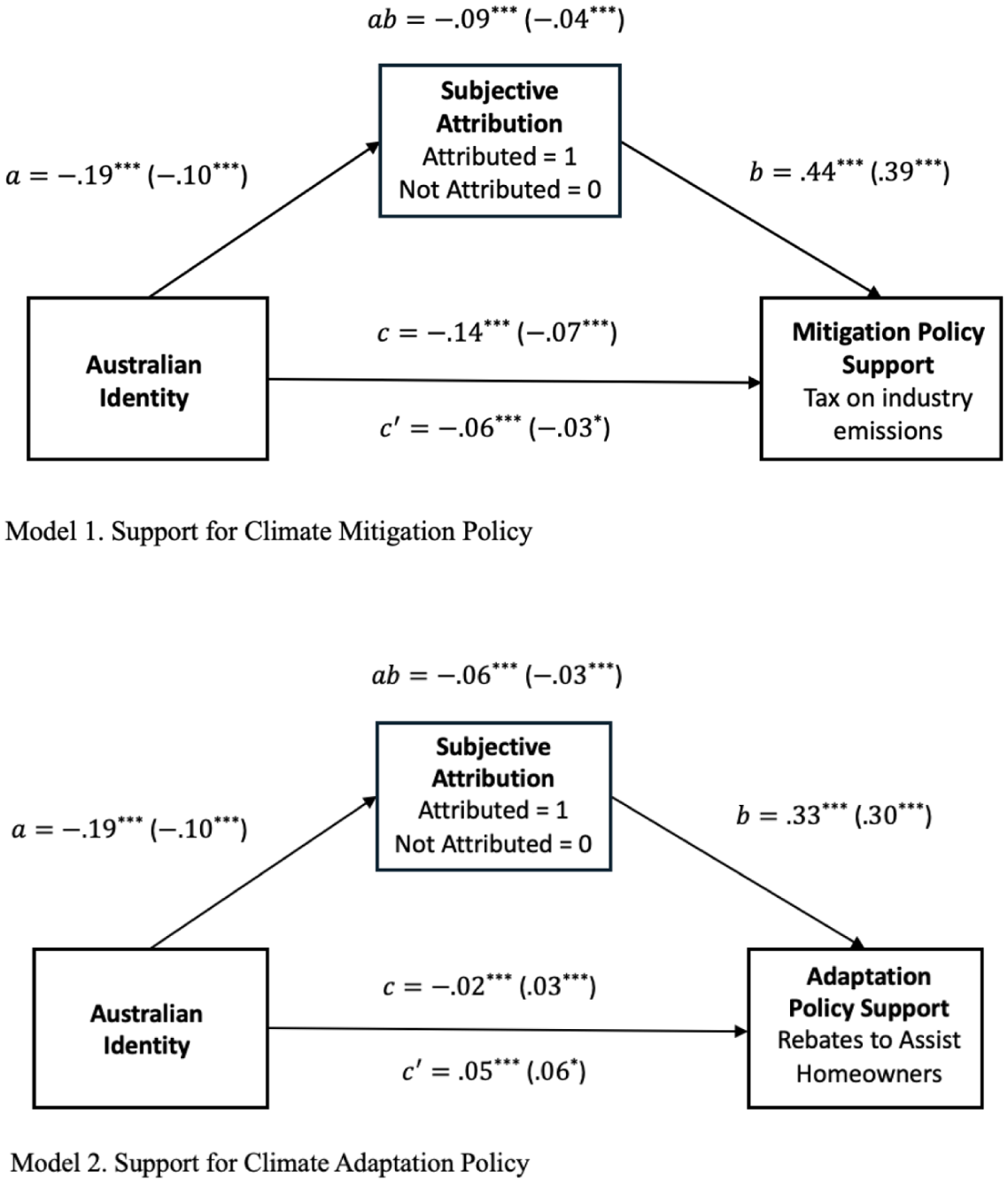
Standardised path coefficients for mediation models 1 and 2.
Mediation Model 1: Mitigation Policy Support as the Outcome Variable
Our first path analysis returned a significant but small direct negative effect of Australian identity on climate mitigation policy support (i.e., taxing industries that emit high levels of greenhouse gases), indicating that higher Australian identity was weakly associated with lower willingness to support climate mitigation (see Figure 1, Model 1). The indirect effect of Australian identity on climate mitigation policy support via subjective attribution was also small but significant and negative (see Figure 1, Model 1), demonstrating that subjective attribution partly explained the relationship between Australian identity and support for climate mitigation policy, as was hypothesised in our pre-registration. This indicates that people who identified more strongly as Australian were less likely to attribute the 2029/2020 bushfires to climate change, which in turn was associated with lower support for climate mitigation policy. The overall model explained 23% of the variance in climate mitigation policy support (R2 = .23), indicating that the model accounted for a moderate to large proportion of the variability in support for taxing industries that emit high levels of greenhouse gases.
Mediation Model 2: Adaptation Policy Support as the Outcome Variable
In model 2 we found a small but significant, positive direct effect of Australian identity on support for adaptation policy (i.e., rebates to assist homeowners to prepare their houses for potential extreme weather events), indicating that when subjective attribution was being controlled for, higher Australian identity was associated with higher willingness to support this specific adaptation policy (see Figure 1, model 2). In contrast, although not hypothesised, when subjective attribution was included as a mediator in the model, we found a small but significant negative indirect effect of Australian identity on climate adaptation policy support via subjective attribution (see Figure 1, Model 2). Specifically, stronger Australian identification was associated with a lower likelihood of attributing the 2019/2020 bushfires to climate change, and this lower attribution was, in turn, associated with lower support for climate adaptation policy. This indicates that subjective attribution explains part of the association between Australian identity and climate adaptation policy support, but in the reverse direction of the positive direct effect. As a result, the negative indirect effect of subjective attribution suppresses the direct effect, weakening the positive association between Australian identity and adaptation policy support. Model 2 explained 10% of the overall variance in climate adaptation policy (R2 = .10), indicating that the model accounts for a moderate proportion of the variance in support for rebates to assist homeowners in preparing their houses for potential extreme weather events.
Exploratory Analyses
Mediation Models Adjusted for Political Orientation
Additionally, as outlined in our pre-registration, we also conducted exploratory analyses to test our hypotheses with political orientation as a covariate. When controlling for political orientation in both mediation models, the effects remained significant and in the same direction but were reduced, except for the direct effect in Model 2 (adaptation policy support), where the effect increased compared to the unadjusted model. This direct effect for Model 2 is consistent with a suppression effect, whereby political orientation masks part of the positive association between Australian identity and adaptation policy support (see Figure 1, results for path c’ are reported in brackets for both models), indicating that when political orientation is controlled for, those with stronger Australian identity show slightly higher adaptation policy support. Overall, these findings indicate that while political orientation partially explains the relationship between our main variables, subjective attribution still remains a significant and independent explanatory factor in the relationship between Australian identity and climate policy support.
Discussion
Bushfire experience is normalised in Australia to the extent that it appears to be an important component of Australian identity (Logan, 2015; Phillips & Smith, 2000; Rickards et al., 2017). The Social Identity Framework suggests that when people strongly identify with a social group, they are more likely to adopt that social group’s beliefs and norms and to behave in ways that align with those norms when these are made salient in a particular context (Abrams & Hogg, 1990; Fielding et al., 2020; Fielding & Hornsey, 2016). Given the normalisation of bushfires in Australia, we proposed that high Australian identifiers may therefore not attribute the cause of bushfires to climate change, which may, in turn, act as a barrier to support for climate policy. Due to this, we explored the relationships between Australian identity, subjective attributions, and support for climate policy (mitigation and adaptation). Specifically, we investigated whether subjective attribution of the 2019/2020 bushfires to climate change mediated the relationship between Australian identity and climate mitigation policy support (but not adaptation policy support).
In line with our argument, we found that there was a weak, but significant and negative indirect effect of Australian identity on climate policy support via subjective attribution. While this effect was only hypothesised to be significant for climate mitigation policy support in our pre-registration, we also conducted the same analysis for adaptation policy support and observed the same pattern of results for climate adaptation policy. Although this was somewhat unexpected, this demonstrates that subjective attribution can play a key explanatory role in the relationship between Australian identity and climate policy, regardless of whether that policy is targeting adaptation or mitigation. A more detailed discussion of the results of the present study now follows.
Climate Mitigation Policy Support
With regards to climate mitigation policy support, we found that there was a negative indirect effect of subjective attribution on the relationship between Australian identity and support for mitigation policy, which supports hypothesis two (H2). As expected, those with higher Australian identity were less likely to attribute the 2019/2020 bushfires to climate change, and this lack of attribution was in turn associated with reduced support for taxing industries that emit high levels of greenhouse gases. The finding that support for climate mitigative policies is more likely among those who subjectively attribute the bushfires to climate change may help to explain why extreme weather experience often does not predict climate outcomes in the Australian context (Boon, 2016; Bradley et al., 2020). This finding provides further credence to past literature that suggests subjective attribution is a key predictor of climate policy support and supports our theory that Australian identity may act as a barrier to this key predictor of climate policy support. Lastly, we found that Australian identity was also directly associated with lower support for mitigation policies, which supports hypothesis one (H1i; that there would be a negative direct effect of Australian identity on climate mitigation policy support). This is unsurprising given that past research shows that Australian identity is often negatively associated with climate action and mitigation policy support (Aydin et al., 2022; Duong & Pensini, 2023; Klas et al., 2022; Nguyen & Platow, 2021).
Climate Adaptation Policy Support
Focusing on adaptation policy support, we found that Australians with higher identification were less likely to attribute the 2019/2020 bushfires to climate change, which was, in turn, weakly associated with reduced support for rebates to assist homeowners to prepare their houses for potential extreme events. In other words, people with stronger Australian identity were also less supportive of climate adaptation policy, and this was because they were less likely to subjectively attribute the bushfires to climate change. This finding appears to diverge from past research indicating high support for adaptation policies in Australia, particularly among individuals with higher levels of Australian identity (Klas et al., 2022; Leviston et al., 2015; Stanley et al., 2021). One possible explanation for this discrepancy is that national identity norms such as bushfire preparedness and self-reliance to manage bushfires may impact perceptions of climate risk (Head et al, 2014; Howe et al., 2018), such that highly identified Australians who do not think the 2019/2020 bushfires were caused climate change, also do not perceive bushfires as worsening because of climate change (that is, their climate risk is low). Instead, highly identified Australians may view bushfires (even those in 2019/2020) as consistent and manageable threats, and as such, do not see the need for extra government resources to manage bushfire risks and costs. High Australian identifiers may also perceive that these policies could reduce their self-efficacy to manage their own bushfire risk, which is a key predictor of adaptation actions (van Valkengoed & Steg, 2019). This phenomenon has been found in qualitative research investigating support for adaptation policy in areas of Australia prone to flooding, where higher Australian identifiers denied that flooding was a worsening problem requiring climate adaptation intervention (Barnett et al., 2021).
Conversely, the overall pattern may also reflect the behaviour of those who did attribute the 2019/2020 bushfires to climate change and are more likely to support climate policy regardless of whether that policy is for adapting to, or mitigating climate change. In other words, when participants are given the option to support both adaptation and mitigation policies (as in our study), those who do attribute bushfires to climate change (and who likely view climate change as a threat; Ogunbode, Demski, et al., 2019) may also score higher on support for both types of policies. In contrast, those who do not attribute bushfires to climate change score lower on support for both policy types. Therefore, the negative indirect effect is amplified because those who do not attribute are comparatively less supportive of both mitigation and adaptation policies than those who do attribute. In practice, however, adaptation and mitigation may be viewed as competing priorities for limited resources (Howarth & Robinson, 2024; Ray Biswas & Rahman, 2023). In such circumstances (when asked to choose between adaptation and mitigation), we may expect to observe the anticipated null effect of subjective attribution on climate adaptation policy. Future research should investigate this further by asking participants to choose which they would prefer to support between climate mitigation and adaptation policies.
In terms of the direct effect, we found that Australian identity was positively associated with higher support for adaptation policy, specifically rebates to assist homeowners to prepare their houses for potential extreme events, which partially supports hypothesis one (H1ii; that Australian identity would be positively associated with support for climate adaptation policy). In other words, when we controlled for whether participants attributed the 2019/2020 bushfires to climate change, we saw a flip in the direction of our effect, such that stronger Australian identity was associated with higher support for adaptation policy. These findings therefore lend some support to previous research, which shows that strongly identified Australians are often supportive of climate adaptation policy (Klas et al., 2022; Leviston et al., 2015; Stanley et al., 2021). However, because we also found a negative indirect effect of Australian identity on support for climate adaptation via subjective attribution, this positive direct effect is offset to some extent by the negative indirect effect. This suggests that, while Australian identity may independently increase support for extreme weather preparedness, Australian identity also affects Australians’ interpretations of bushfire events, and these interpretations, in turn, reduce adaptation policy support. Another explanation for this contrasting direct effect may be that some highly identified Australians support climate adaptation policies for reasons unrelated to climate change (e.g., out of a nationalistic sense of duty to keep Australians safe or to protect one’s home). Indeed, prior research has shown that support for policies that help to protect the safety of fellow Australians is higher among strongly identified Australians (van Bavel et al., 2022).
The Role of Political Orientation
Past research has shown that political orientation is associated with national identity, subjective attributions and climate policy support (Drews & van den Bergh, 2016; Klas et al., 2022; Ogunbode et al., 2020; Unsworth & Fielding, 2014). Specifically, research shows that Australian identity is often associated with right-wing party voting (McAllister, 2018). Given this, we assumed that political orientation would be correlated with all our main variables in the current study and, therefore, might also help to explain climate policy support. However, political orientation did not eliminate the indirect effect of Australian identity on policy support, via subjective attribution across both models. This suggests that while climate change is a politically polarising issue in Australia (Zheng & Bhatt, 2022), identity-based perceptions may also account for some of the variance in climate policy support in Australia, alongside the well-established role of political orientation (Leviston et al., 2024). Specifically, these findings highlight that while the indirect effect was weak, the effects of Australian identity on climate policy support via subjective attribution are not just explained by their common relationship with political orientation. Instead, Australian identity and subjective attributions exert unique effects on climate policy support, which highlights the independent role of Australian identity in shaping beliefs about climate change consequences and attitudes towards climate policies.
Theoretical and Practical Implications
Overall, these findings support prior literature, which shows that social identity (specifically national identity) and the attributions people make about the cause of extreme weather events, such as bushfires, are important for understanding what motivates climate policy support (Fielding & Hornsey, 2016; Ogunbode, Demski, et al., 2019; Wong-Parodi & Berlin Rubin, 2022). Extending on this literature, the findings from the current study demonstrate that Australian identity is negatively associated with the attributions Australians make about extreme weather, and that these attributions even matter for their willingness to support policies that align with Australian identity norms, such as rebates to increase bushfire resilience. These findings, therefore, have theoretical implications for our understanding of what national identity means in the context of climate change. Although we did not examine the content of Australian identity directly, it is possible that national identity norms surrounding bushfires may help to explain the relationships we observed. Specifically, these findings suggest that the degree to which extreme weather experience is normalised within a country and how integral such experiences are to a nationalistic sense of identity could impact causal perceptions about extreme weather. This social phenomenon may therefore give rise to a somewhat ironic situation where countries that are most susceptible to extreme weather driven by climate change may also be those least likely to support climate policy aimed at reducing the severity of extreme weather in their nation. Our findings therefore highlight the value in considering the relationship between national identity, weather extremes and subjective attributions more closely, as the extent to which one’s national identity impacts attributions of extreme weather (and in turn their support for climate policy) may depend on contextual factors (Ogunbode, Demski, et al., 2019), including the unique identity norms of a country (Milfont et al., 2020; Nguyen & Platow, 2021). Research conducted elsewhere has shown how national identity norms can play a role in support for climate policy. For instance, in New Zealand, national identity was found to be positively associated with support for climate policy, because of their unique national identity norm around the importance of maintaining a “clean and green” national image. Future research could therefore investigate which Australian identity norms are most likely to act as inhibitors or motivators of climate policy support.
Our results may therefore also have implications for understanding climate policy support in other countries where experience with similar extreme weather is also common and may also be a normalised aspect of the national identity (e.g., certain parts of the US and wildfires; Wong-Parodi & Berlin Rubin, 2022). However, there may also be countries where specific extreme weather events are not considered “normal,” and as such, there may be no connection between extreme weather and national identity. In these countries, we would expect a different pattern of relationships between national identity and climate action to emerge. Understanding the history and experiences of people from different countries is therefore crucial for understanding what national identification means in the context of climate change. Examining this further, by testing the relationships between national identity and subjective attributions about climate consequences (like extreme weather) in other countries, would enhance the generalisability of our findings that national identity specificity can play a meaningful role in climate outcomes.
These findings also have important practical implications for how we communicate to Australian audiences about the need for stronger climate policy. First, these findings show that emphasising national identity in climate action appeals in Australia may inadvertently reinforce beliefs and attitudes that diminish support for climate policy, such as the belief that bushfires are not worsening due to climate change. Given that subjective attribution was positively associated with both adaptation and mitigation climate policy, public campaigns may benefit from informing Australians about the link between unprecedented extreme weather events and climate change (Bergquist et al., 2022). However, because attribution science is probabilistic (Lane et al., 2023), purely informational interventions may lack credibility among certain audiences. For example, those who are sceptics of climate science or politically right-leaning may be motivated by their political identity or pre-existing beliefs about climate change to reject causal attribution (Cruz & Carpenter, 2024; Tranter, 2023.
Given that strongly identified Australians are also less likely to attribute bushfires to climate change, it may be more effective to focus on “who” communicates the message, rather than focusing solely on “what” is communicated. That is, could information about the effects of climate change on extreme weather be delivered in a way that is congruent with the existing identity, or by agents who are representative of that identity? For example, Colvin et al. (2025) argue that role-based unconventional advocates (e.g., advocates identified with a social group not typically connected with environmentalism) may be more effective at motivating typically resistant populations to support climate policy. Similarly, climate messages delivered to traditionally climate-opposed social groups (i.e., conservatives) by in-group members, in ways that align with conservative values, are more effective at motivating climate action within that social group (Goldberg et al., 2021; Wolsko et al., 2016). In the Australian context, volunteer firefighters are often viewed as prototypical of Australian identity. Therefore, one group that may represent a promising unconventional advocate for communicating about the need for stronger climate policy may be the Australian Firefighters Climate Alliance (Bromfield et al., 2021; Gulliver et al., 2025).
Limitations and Directions for Future Research
One limitation of the current study is that it is cross-sectional in nature and therefore, we can only speak to the relationships between our variables at one time point. Another limitation is that the data were collected directly after the 2019/2020 bushfires, which meant that the bushfires were highly salient at the time, and therefore, it is possible that temporal proximity to the 2019/2020 bushfires could have intensified the effects (Demski et al., 2017). Future research should consider investigating these associations longitudinally to see if the mediating effect of subjective attribution on the relationship between Australian identity and climate policy support remains over time.
Moreover, given the highly conceptual nature of the current study, future research should consider directly examining the specific content of Australian identity in relation to subjective attribution and climate policy support, which would give us a greater understanding of how Australians view climate change, and this may act as a barrier or motivator for climate policy support. In addition to possible qualitative research, experimental research could further strengthen our understanding of the relationship between Australian identity and climate policy support by manipulating salient aspects of Australian identity to determine if a causal link exists between the variables.
Beyond this, although the current study used a large, national dataset, as this was pre-existing data, we were constrained regarding the measures we could use to test our hypotheses. For instance, we used a categorical measure that was not designed to assess subjective attribution of the 2019/2020 bushfires to climate change specifically. Rather, this measure allowed participants to select more than one option from a range of factors, in which climate change was just one option among several others, including land management, drought, etc. This makes it difficult to determine with precision how strongly the participants believed that these bushfires were attributable to climate change. Future research should consider using a more nuanced measure of subjective attribution of extreme weather, like the measure used by Ogunbode, Demski, et al. (2019), which directly asked participants how strongly they believed that an extreme flooding event was attributable to climate change (e.g., “the floods were caused in part by climate change”). We were also limited by our policy item measures. For example, while our mitigation policy item (taxing industries that emit high levels of greenhouse gases) is a core strategy for mitigating climate change, our measure of climate adaptation (rebates to assist homeowners to prepare their houses for potential extreme events) lacks the “climate” keyword, which can be an important signaller for support. This might also explain why we found an opposite direct effect of Australian identity on adaptation policy support to the indirect effect via subjective attribution. As mentioned above, it is possible that highly identified Australians might support these rebates for reasons other than climate adaptation.
Additionally, while we were able to control for one covariate that had the potential to explain our results (e.g., political orientation), we were constrained by the pre-existing dataset with regard to other potential covariates that might have explained or modified these results. However, as argued above, given the frequency of bushfire experience in Australia, it’s possible that this identity norm may mean that highly identified Australians are somewhat desensitised to their experience of extreme weather and therefore experience lower levels of climate change risk perception. Indeed, some research shows that issue fatigue (i.e., weariness or mental exhaustion associated with repeated exposure to an event or social issue) is high among Australians and is associated with reduced willingness to engage in climate action (Morrison et al., 2018). Therefore, future research should consider including additional factors, such as climate risk perception, as a potential alternative explanatory factor in the relationship between Australian identity and climate policy support.
Another potential explanatory factor could be how direct the participants’ 2019/2020 bushfire experience was. It is possible that more direct experience – in terms of severity of impact or damage – could account for subjective attribution to climate change in our study. While such variations in the directness of one’s experience are unlikely to account for the identity effects we found in our study, future research is needed to clarify how direct or severe one’s experience needs to be for experience to act as a motivator for climate policy support.
Conclusions
Australia’s long history with bushfire events has led to the normalisation of bushfire experience and its integration into the Australian identity (Logan, 2015; Rickards et al., 2017). Using bushfire normalisation in Australia as a context for our research, we found that a stronger Australian identity can affect how Australians attribute the causes of extreme weather events like the “Black Summer” bushfires. This, in turn, can influence their responses to these events, such as supporting climate policy. Importantly, contrary to our theorising about adaptation policy support in Australia, we found that subjectively attributing bushfires to climate change did matter for public support of mitigation and adaptation climate policies (e.g., “taxing industries that emit high levels of greenhouse gases” and “rebates to assist homeowners to prepare their houses for potential extreme events,” respectively). This research, therefore, contributes to our understanding of national identity within the context of climate change, specifically for our understanding of how variations in the content of a country’s national identity may impact how people respond to the consequences of climate change. Practically, this research also has implications for how we communicate to Australian audiences about the need for stronger climate policy to deal with these climate consequences, as appealing to Australian identity can potentially increase the saliency of Australian identity norms (e.g., the normalisation of extreme weather experience, particularly of bushfire and self-reliance to manage risks) that may diminish the urgency of climate action.
Supplemental Material
sj-docx-1-eab-10.1177_00139165261429470 – Supplemental material for The Role of Subjective Attributions in the Association Between Australian Identity and Climate Policy Support Following the 2019/2020 “Black Summer” Bushfires
Supplemental material, sj-docx-1-eab-10.1177_00139165261429470 for The Role of Subjective Attributions in the Association Between Australian Identity and Climate Policy Support Following the 2019/2020 “Black Summer” Bushfires by Emma-Jean Schneps, Anna Klas, Julian W. Fernando, Emma M. Marshall and Samantha K. Stanley in Environment and Behavior
Footnotes
Acknowledgements
We would like to extend our thanks to everyone who participated in this research.

Funding
The authors disclosed receipt of the following financial support for the research, authorship and/or publication of this article: Emma-Jean Schneps receives scholarship funding from the Australian Government Research Training Program (RTP) Scholarship, and this research contributes to her PhD.
Declaration of Conflicting Interests
The authors declared no potential conflicts of interest with respect to the research, authorship, and/or publication of this article.
Supplemental Material
Supplemental material for this article is available online.